Archive for the ‘nature’ Category

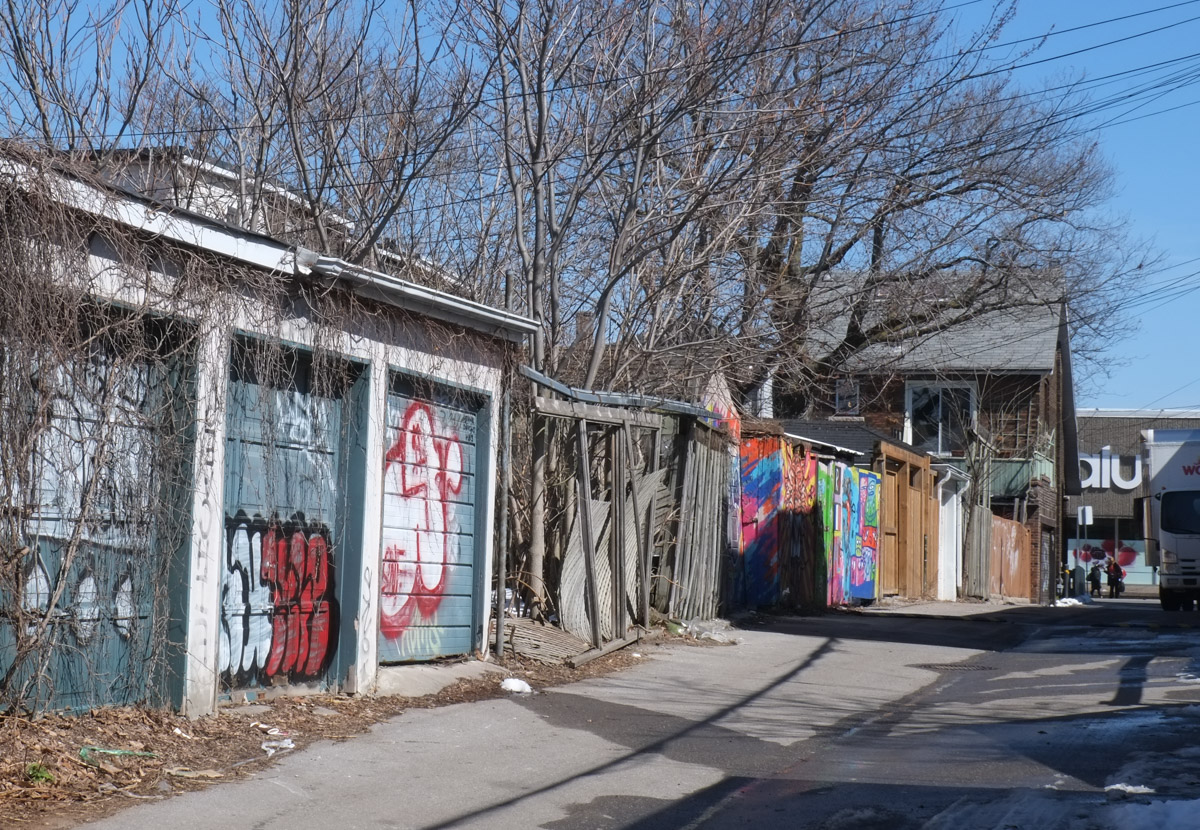
small part of a mural on a garage door in an alley, a blue coffee mug with I 'heart' T.O. on it

This is another “walk with friends” post; three of us out enjoying a May morning looking for signs of spring (and summer!), bits of art, and other eccentric little details.  Like all good walks, this one started with a coffee and a bite to eat.  In this case, at Rustle and Still on Bloor West, a Vietnamese coffee shop

painting on the wall, interior of coffee shop, Rustle and Still, man witting on a stool drinking coffee

where I tried their purple sweet potato croissant.  Highly recommended!

vietnamese iced coffee in a glass mug beside a plate with a purple sweet potato croissant on it, on a wood table in a coffee shop

We walked more or less south and west from Bloor and Palmerston to Queen and Dunn.   This is some of what we saw. … Starting with the colours of spring with lots of greens

below: Flowers such as these big purple balls of allium

front yard, by sidewalk, with yellow fire hydrant, also lots of spring greenery including purple allium puff balls

below: More purple – Bergenia Crassifolia flowers seem to want to jump out of the garden.

little purple flowers in a garden, bergenia crassiflora

below: Grape vines coming back to life.

a vine on a fence, with little pink buds,

below: Crabapple tree blossoms in abundance

white crab apple tree blossoms on a tree, with some old dried dark red crab apples too

below: … and flowers of a different kind. Purple orchids on a garage door painted by Trexlorian.

mural of three purple orchids on a garage door in an alley

below: Spring colours here too…  Fabulous bright orange toes!

a woman in blue and white plaid pants sits on a white plastic chair outside a restaurant. she is wearing sandals and has orange toe nail polish

And other colours too….

A red shed (or gate?).  Also, the metal gate and fence with the circles is unique!

bright red shed at the back of a yard, alley view, also a cut metal fence and gate with circles

A bright pink house (with red trim! … and a green front door)

a brick house painted bright pink with red trim and a green front door

below: The ivy has gone crazy here but the cheerful blue trim hasn’t been hidden… yet!

house with white and blue trim, lots of windows in front, ivy growing on roof above windows

And while we’re looking at houses, one little house stand alone dwarfed by the large brick house on one side.  Even the other houses on the left are larger.

houses on a street, on the right the houses are large, and on the left the houses are small, dwarfed by their larger neighbours

below: Another tiny house stuck in the middle!

small house between larger ones,

below: This is actually a row of three little homes where the outer two have a peaked roof.

a row of small workers cottages, or similar architectural style, bungalows,

There seem to be a lot of houses that have expanded upwards with third storey additions, or new rooftop balconies.

a large japanese maple tree in front of a row of houses

below: An alley view –  What caught my eye here was the fact that all six houses have an upper level (rooftop?) balcony with a wood railing.

dump truck in a lane, Alex Borovoy Lane, back of houses, all two storeys with upper level balconies and wood railings. No dumping sign, one house has no garage

below:  And then there are the houses that look like they have never changed.  This one still has the old asphalt shingle siding in fake brick colour.

laneway view of the back of houses, small 2 storey houses

We came across this Joe Road front yard where someone must be a Toronto Maple Leafs fan.

small sign that says Joe Rd, blue, with a Toronto Maple Leafs symbol on it as well, mounted on a piece of wood in a frontyard

below: This is the view of Joe Road from across the street, the neighbour’s view

a house with a small frontyard with a short black fence around it. the yard is full of stuff, decorations

below: The yard is full of stuff, knickknacks of all sorts.  The interior is dark and some of it is difficult to see without trespassing.  Some of it is held together with spray foam insulation.

mix of stones, a small toy skull, a plastic face, birch bark, all held together with spray insulation

below: A fish on a plaque, a black and white cow, and that red and white thing – is that a painted rock?  What kind of symbol is that (if anything)?

stuff in a front yard, fish plaque, black and white toy cow, red ball, stones,

below: Superman, a chicken, a cow, a man’s head carved out of stone, a large blue Disney something or other, and various other toys and trinkets piled high.

decorations and knick knacks on display in a front yard, a black chicken, superman, a stone man's head, other toys and trinkets

below: Darth Vader (but with a bit of extra white?) and an owl guard the upper level.

a large darth vader and a white owl stand over a front yard.

below: Another yard, another set of animals.  This time it’s a pelican, an orange butterfly, and a sheep in a little garden that looks like so neat and tidy.  Someone has put a lot of work into this space.  Two yellow tulips are in bloom – they are real but I’m not sure that the orange lily is.

small circular garden at the base of a tree with a fake pelican and sheep. two yellow tulips

below: Creativity on a slightly grander scale (complete with “Beware of the dog” sign).

front of a house with steps leading to porch with white statues, curved arches, white railing,

below: Hiding his face.  The enemy remains unseen.

small stone statue of a samauri warrior between two sets of stairs, with a hosta plant behind it that hides the head of the statue

One sign that you are in Little Italy or Little Portugal is the requisite religious icon by the front door

religious plaque, Christ, on blue house beside front door

Little Italy and Little Portugal both claim portions of College Street

below: The mural on the side of a building at College and Crawford celebrates Branca Gomes who was the first Portuguese teacher in Toronto.  She started teaching in 1964 at the First Portuguese School on Augusta.  She also taught at Alexander Muir Elementary from 1969 to 1974.  The small green space in front of the mural is the Portuguese Pioneers Parkette.

mural, Portuguese teacher in a classroom

below: Across the street from Branca Gomes is this  mural.  in 1937 Sam Sniderman, along with his brother Sidney, opened Sniderman’s Music Hall record department in the family store at 714 College Street.  They later moved the store to Yonge Street where it became ‘Sam the Record Man’ (or colloquially, Sam’s).  In their heyday, the early 1980s, there were 140 Sam the Record Man stores across Canada.  The mural was painted by sumartist (aka Paul Glyn-Williams).

L'Italia mural with orange stripe on top, man sitting reading newspaper about Sam the Record Man, another person standing beside, also a black cat

Toronto street signs, Little Italy, College Street and Grace Street

below: Neither Italian nor Portuguese but Slovenian in a mosaic above the door to a church.  Marija Pomagaj, Mary of Perpetual Help, or more loosely, Mary, Help of Christians.

mosaic image of Mary and baby Jesus, both wearing crowwns, mary in a blue dress with a red robe, words say Marija Pomagaj

below:  Greens, yellows, and purples in the vertical panes of glass.  What this photo fails to show is that the green and purple form two large cross shapes on the front of this church, the Toronto Spiritualist Temple on College Street.  There is a third cross, in blue, to the left of the purple.

coloured glass windows in vertical stripes, in shades of green and yellow, can see interior staircase through the colours

below:  This billboard above the Ladybug Tavern on College is actually part of the CONTACT Photography Festival.  Two figures draped in yellow stand under a palm tree, one of whom is wearing a bird-like mask.   It is part of “Window into Bassam” by Nuits Balnéaires, an artist from the Ivory Coast (where Grand-Bassam is a city).

billboard above shops on college street, is a part of contact photography festival,

half of a semi divided house remains after the other half has been demolished

old brick buildings on College Street, now store fronts, three storeys tall,

below: At College and Ossington, a mural by Alice Pasquini (in  partnership between the Istituto Italiano di Cultura Toronto, the College Promenade BIA and the City of Toronto).

mural on building at College and Ossington, bus stop in front of it, with people waiting for the bus.

We explored a few alleys …  where we encountered a few faces and strange creatures

on a brick garage in an alley, painted white but paint fading, a red face of two eyes and big lips

blue blob guy graffiti, no arms and legs, two eyes overlapping, one big tooth

No faces in this lane but the barbecue looks shiny and new… and ready to use.

brown wood fence in an alley, with small opening so the barbecue in the backyard is visible

below: How many raccoons live here?!

in an alley, a broken wood garage door with some graffiti on it

below: Infill housing? – with an air conditioner and a satellite dish.

old square brick structure with garage door on lower level, balcony on roof

a jumble of houses and back yards, from a laneway

below: Black Lives Matter 24/7 in both directions

black lives matter sign turned into a street sign and posted on a pole beside a no parking sign, on a toronto street corner

Graffiti that we saw:

below: The man behind the mask, by Bruho

sticker on a metal pole by bruho, man in blue mask, topless, white pants, stands beside a woman reclining on a couch, text says man behind the mask

below: A stencil of a penguin and its little one

black and white stencil of a penguin parent and little one, one cement block wall of garage in alley

below: Paper paste-up of a lions head with its eyes blacked out.

paper paste up gaffiti of a black and white realistic drawing of lion's head with black bar through its eyes

black and white graffiti sticker of a woman crying, with white flowers, on a pole by chainlink fence


With thanks to Merle and Nancy who went wandering with me that morning.

two women alking on a street with two large houses and white car parked

Back in 2017 I visited this lane for the first time and I added some photos from that visit on this blog (see Paul Estrela Lane.).   Most of the street art that I saw then is still there.  Some of it has been overgrown like the mural below.  In a month or two some of these waves will be hidden behind greenery.

below: Mural by Caitlin Taguibao, Pre-pupa moment painted in 2018.

mural by caitlin ta in an alley, a woman is sitting, blue leaves on plants around her

central female figure in caaitlin mural, green and black striped collar, or pillow, around her neck, black sky, yellow sleeves on clothing,

garages on Paul Estrela Lane, some with street art or graffiti on them

below: Another older mural that natures seems to want to cover up.  This one is the work of Kim Therese Dolan.

mural of a woman's face, eyes closed

below: Winter vines on painted particle board.

below: Icey icicles on a March morning

graffiti on wall, white on black, text that says icey, above it are 3 icicles

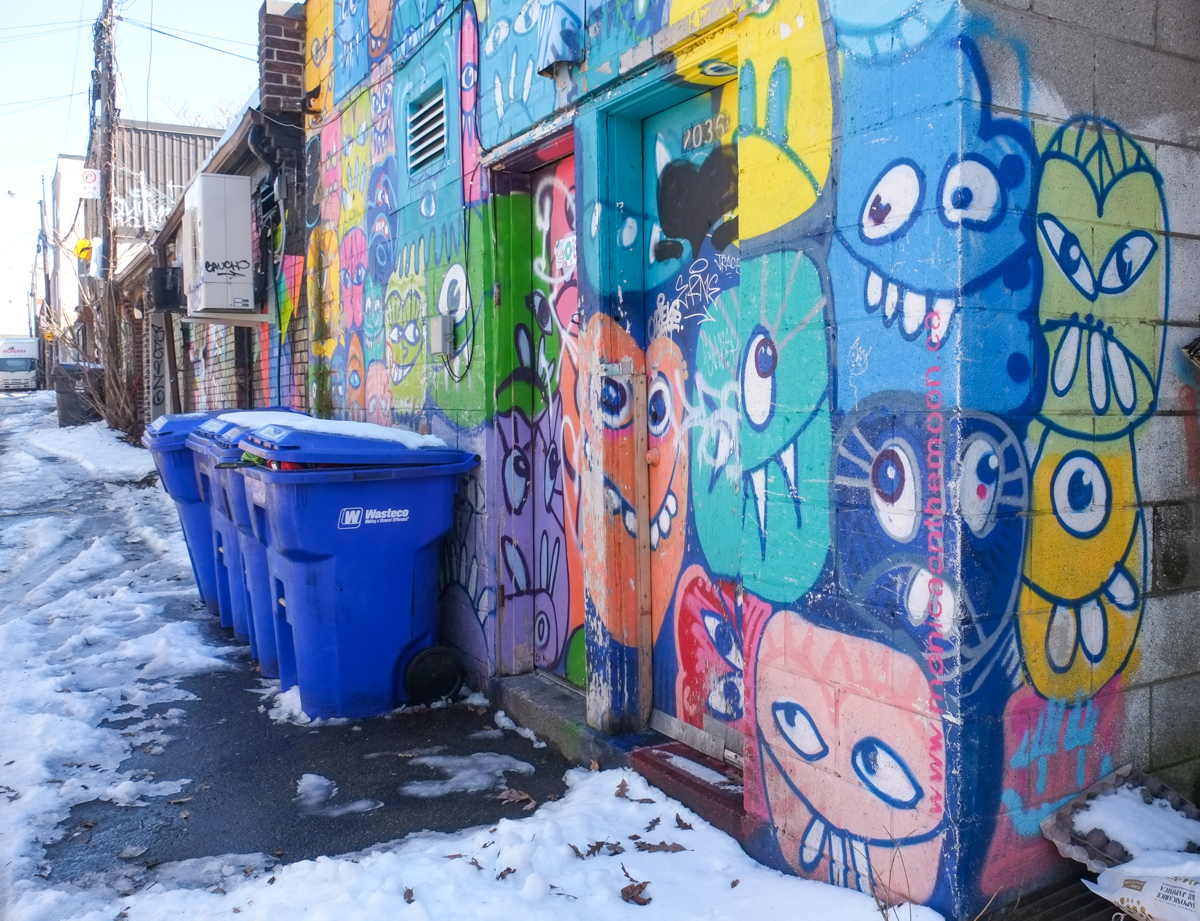
below: Many coloured goofy faces with impressive teeth and googly eyes.  A whimsical work by Monica on the Moon (aka Monica Wickeler).

monica on the moon mural of faces, with blue garbage bins in front, in an alley

blobby goofy faces in blue, green, and pink, part of a mural

below: Kanos, a French artist, from Paris.  More of his work can be seen under ikanografik on instagram.

black and white on red mural by kanos

below: More red, this time from Mediah

mural by mediah, geometric shapes, sharp angles, straight lines, on red background

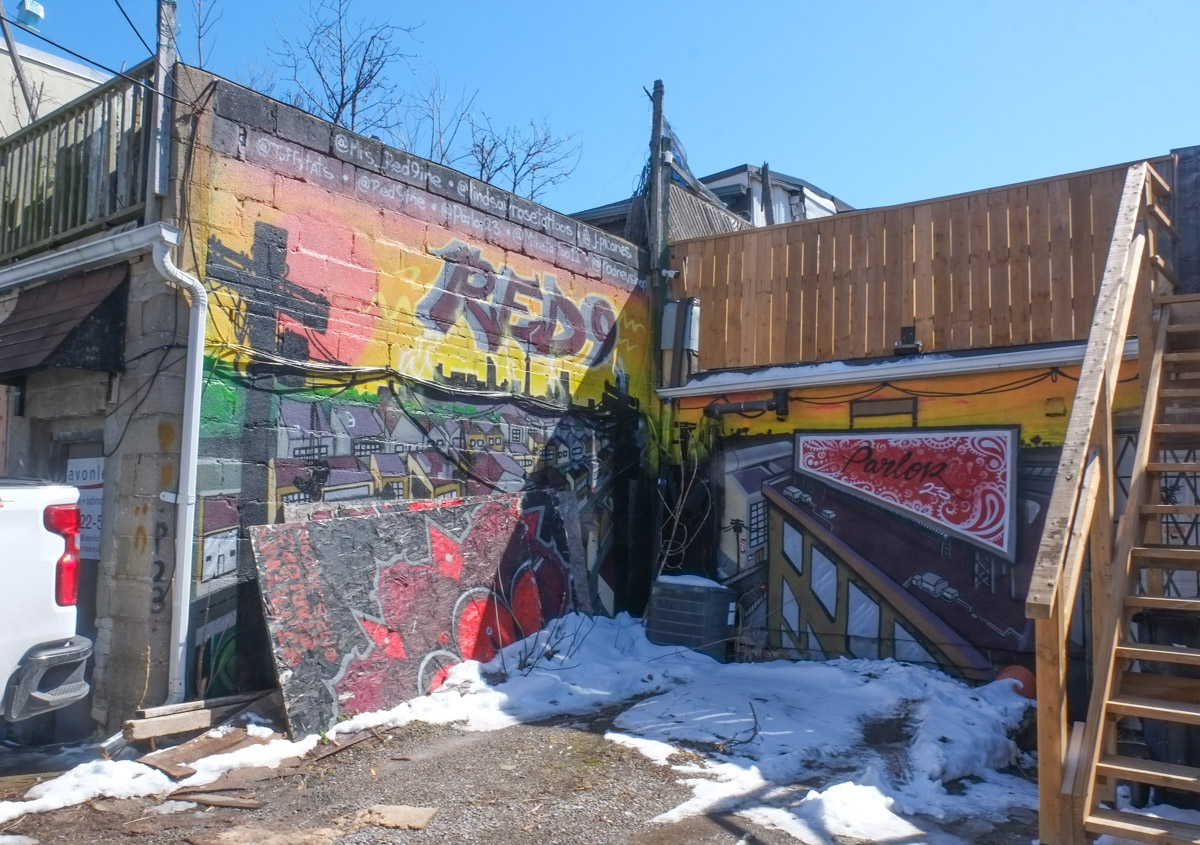
below: Red 9 and Parlor 23 in the shadows.

below: Peeling teal paint on weathered wood.

part of a fence that was painted teal colour but paint is now peeling, picket tops of the wood forms triangles

paul estrela lane

below: Heidi Berton,

small street art in paul estrela lane painted by Heidi Berton

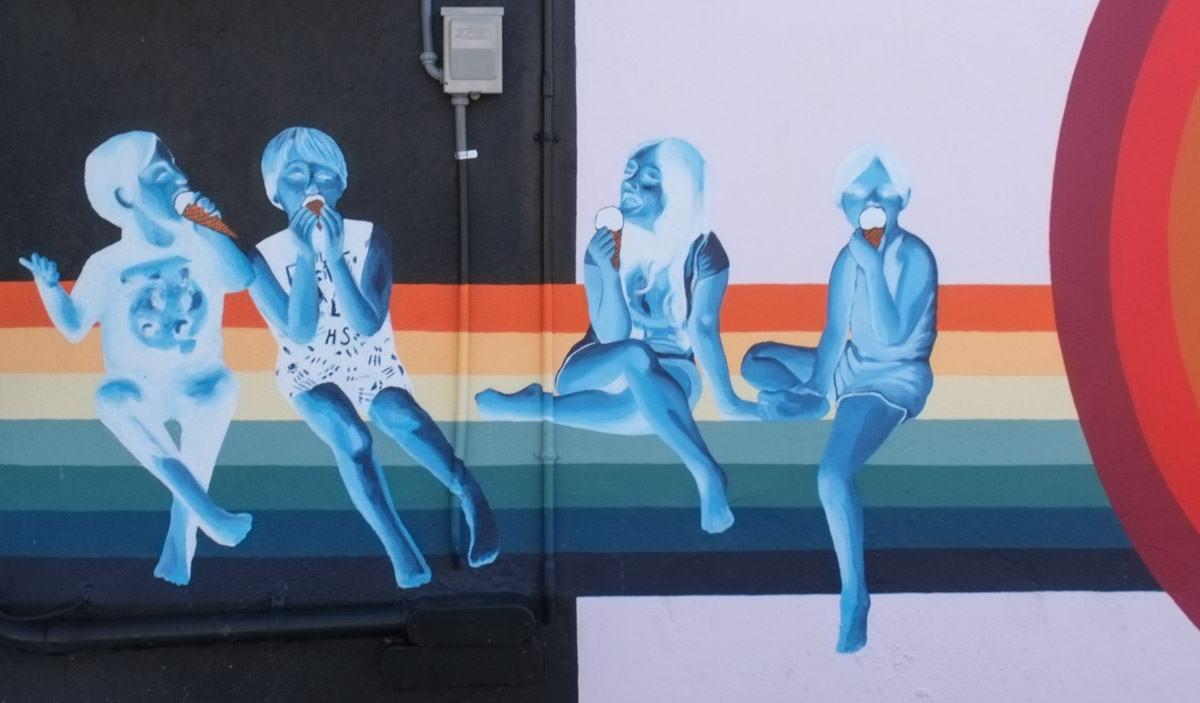
below: Children eating ice cream beside a hot summer sun.

part of mural, for carters ice cream store around the corner, a line of children eating ice cream cones

below: A blue man and his cat by a mystery man, Victorful.

two murals in paul estrela lane, first is a man in blue with a tiger, and the other is a line of children eating ice cream while sitting beside a sun made of concentric circles, with yellow in the center and red on the outside ring

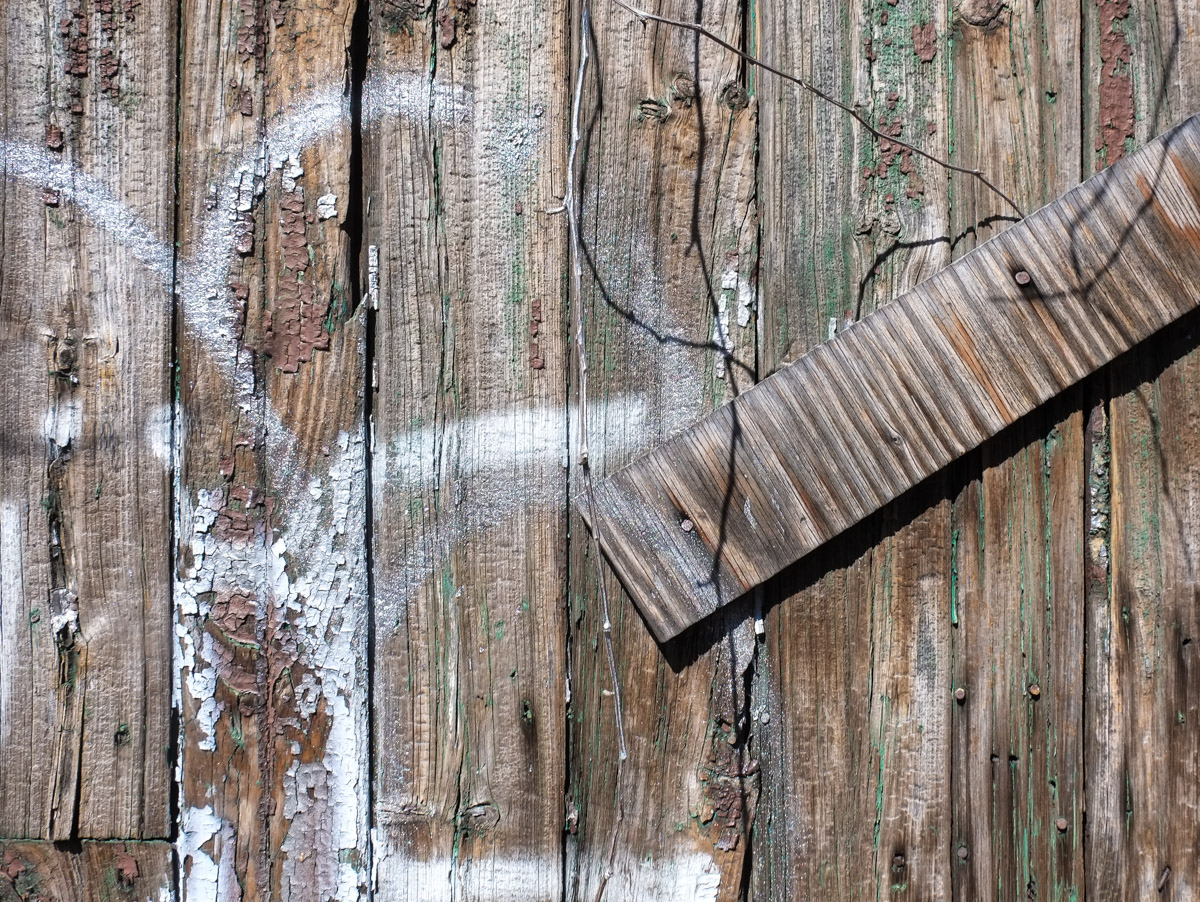
below: More wood textures.

old wood fence, close up showing the texture of the wood grain

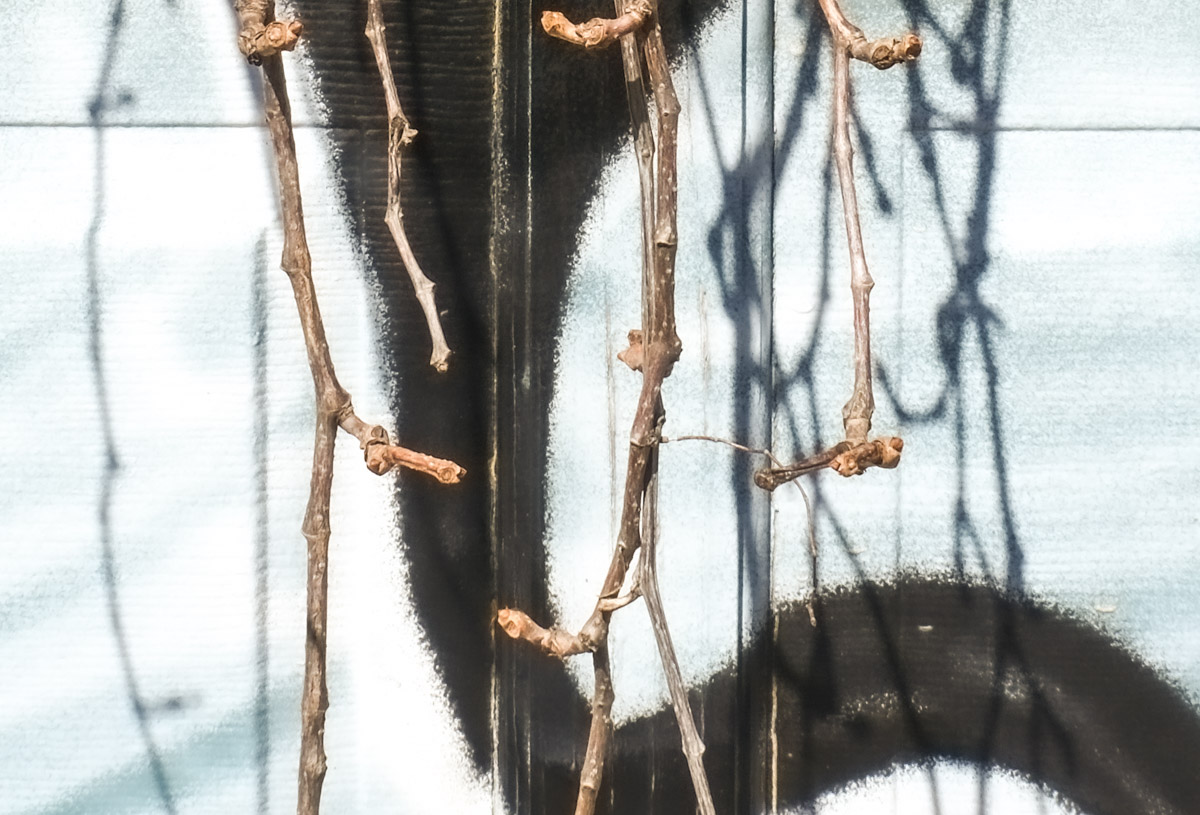
… as well as vines and shadows….

vines on a white garage door with black graffiti on it as well

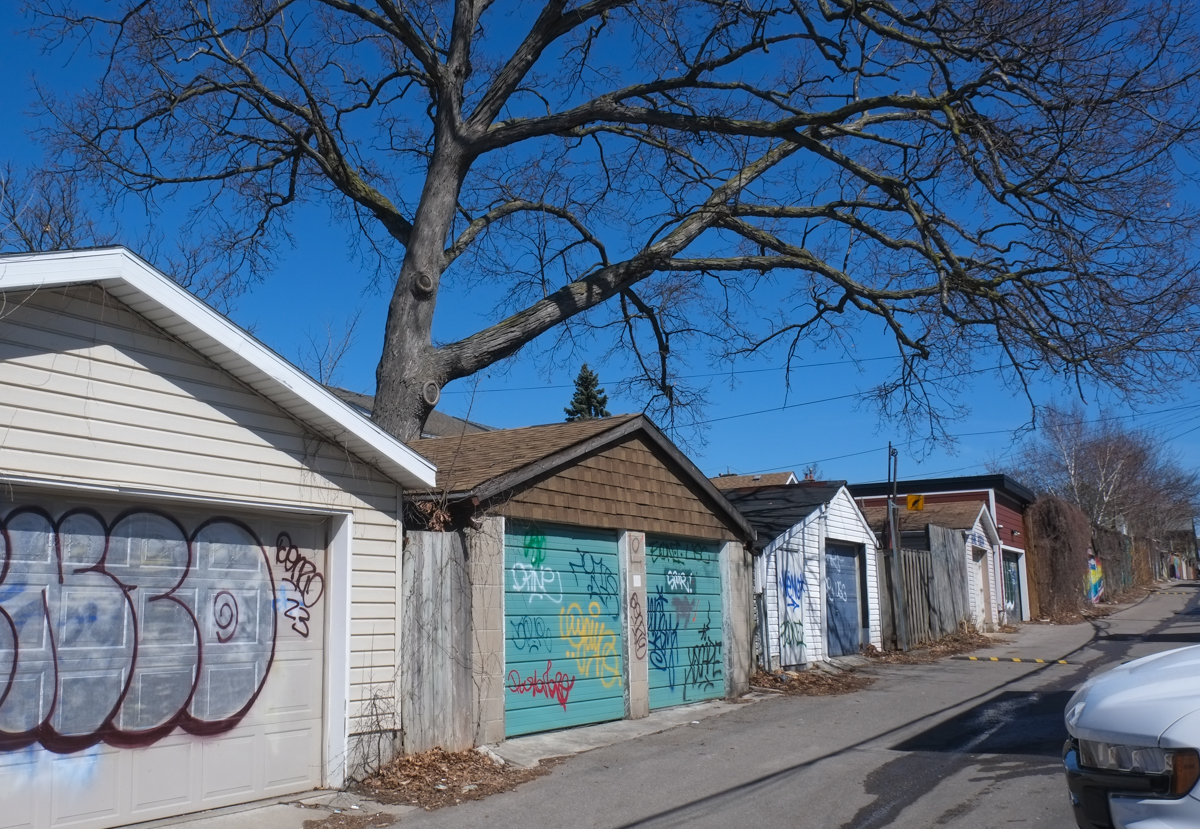
…. and one last view of the alley

garages along the north side of paul estrela lane, large tree, no leaves, winter time, but no snow, some graffiti on the garage doors

A bench at Edwards Gardens… late February.  It’s been a warmer than usual winter without much snow.  February ended on a warm streak that has continued into March.  These photos were taken at Edwards Gardens before I realized just how early spring might be this year.

a couple, man and woman, site on a bench beside the path at Edwards Gardens, with trees in the background, winter but no snow, no leave on the trees

The giant willow tree has hardly begun to turn yellow like it does every spring.
large willow tree in Edwards Gardens in February winter but no snow, no leaves on tree, person walking on the path towards the willow tree

two people on the path beside the Wilket Creek, some small tree between them and the camera

A little bit of snow and ice linger in the shadier parts along the path.

rocks along the shore of Wilket Creek at Edwards Gardens, grass, and then red stems of dogwood shrubs before a path and then the forest beyond, some snow under the trees

two Canada geese in the shallow waters of Wilket Creek by one of the bridges at Edwards Gardens, sand on the shore of the river, winter, no snow,

a tree branch overhanging the Wilket Creek, people walking on the path in the background

brown dead maple leaves slightly curled at the edges, lying on the dirt on the ground, some small twigs too

a path through the woods at Edwards Gardens, dead leaves cover the ground, no leaves on the trees, winter, but no snow

ivy growing up the trunk of a larger tree with rough bark

dead hydrangea blossoms on branch with spruce tree in the background along with dead leaves on the ground

red window box on a white building, winter greenery in the box, cedar, pine,

old house building and newer greenhouse at Edwards Gardens, crab apple tree in the foreground with lots of small crab apples on it, no leaves, February, winter but no snow

A monkey – a light-hearted touch in the greenhouse where it’s warm all year round.

a stuffed toy monkey on a small palm tree in a green house

Almost 200 hundred years ago plans were made for a new park in a very new city.

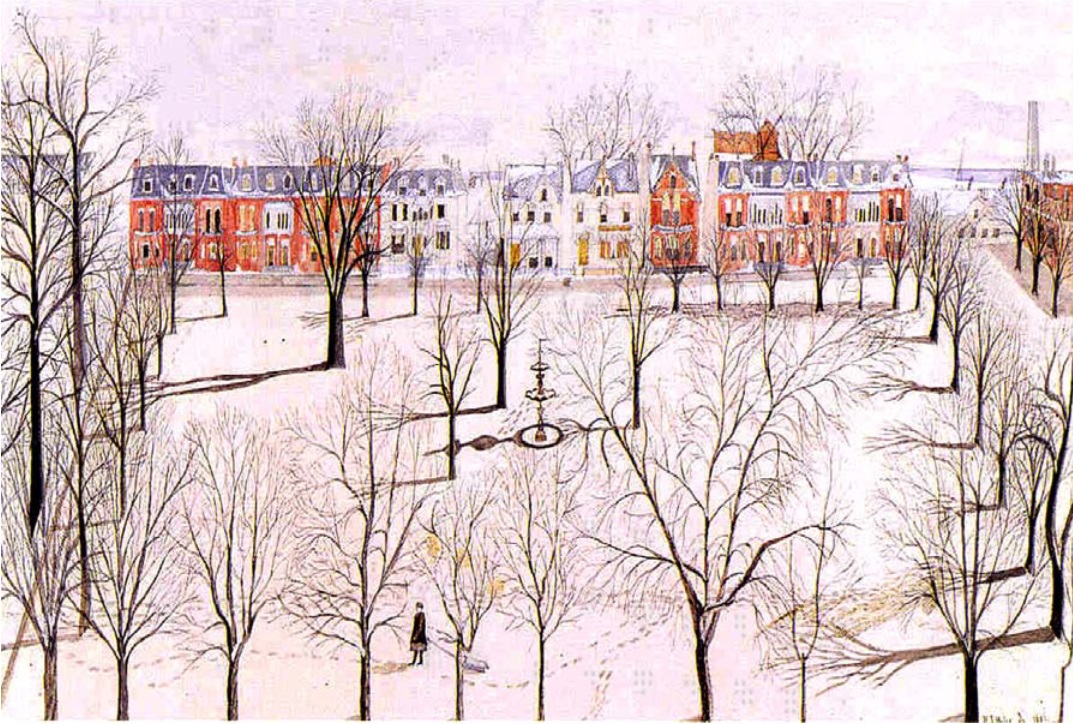
old painting of Clarence Park in Toronto in winter, trees around a small fountain, a line of houses at the top of the picture

Colorized print, Clarence Park with houses on north side and a fountain in the middle.  Image found on a Heritage Assessment document for the park, no credit given there.

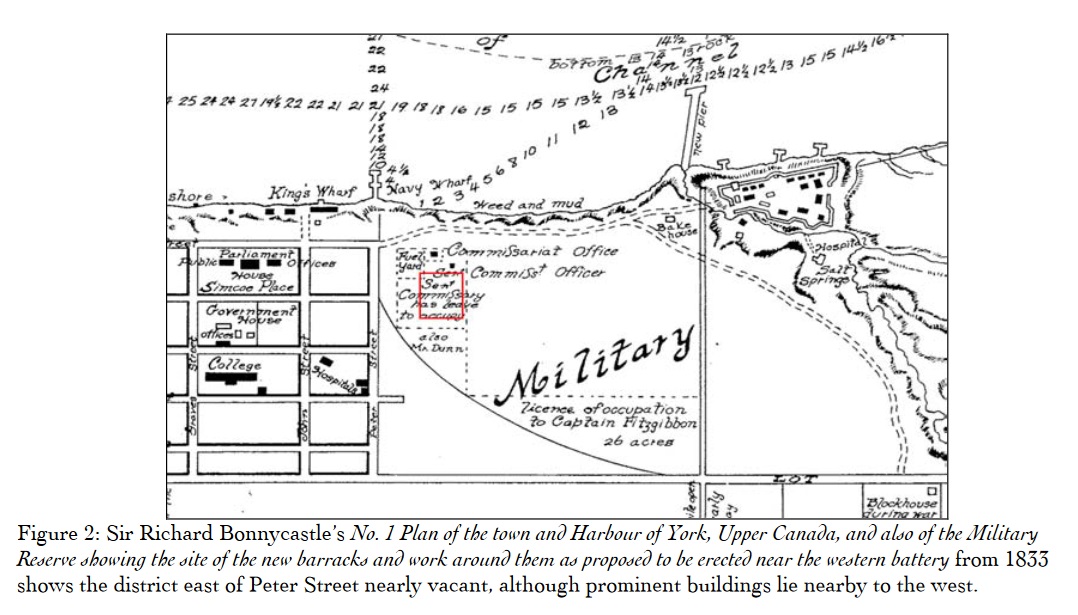
The park, named Clarence Park for the Duke of Clarence, was part of a planned community conceived of in the 1830s that included a church, a market, and building lots for houses.  The land that it was on was part of a military reserve (i.e. it belonged to the British).   In 1860 ownership of the land, already developed as a park, was transferred to the city by means of a  Crown grant containing a restrictive covenant to maintain it as a public square.

below: A map of the area circa 1833.  Lake Ontario to the south is at the top of the map.  Fort York, on the right was actually on the waterfront at the time.  On the left are some of the original streets – Peter St. and John St. being two of them that are still with us today.  The red square on the map is the location of the present day Clarence Park.

1833 map of Fort York and some streets in Toronto at the Lake Ontario waterfront

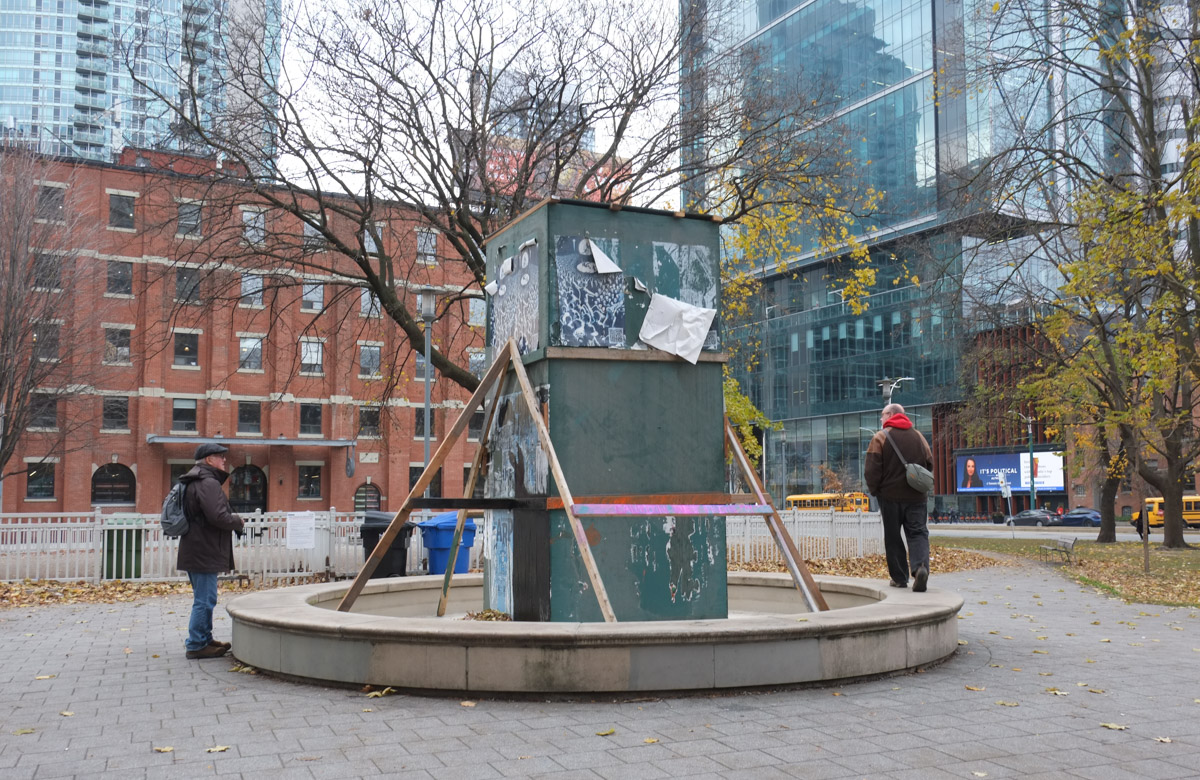
below: Clarence Park fountain these days.  I have mentioned before that I think that Toronto does a horrible job with fountains but this one probably wins an award for worst maintenance job ever.  And you say it’s been this way for at least four years?  Is the original fountain (see the painting at top) hiding under here?

boxed sculpture in dry fountain in clarence park

below: So nice of the city to provide more canvas space for graffiti.  Public art at its finest!

paper paste ups on plywood on boxed sculpture in clarence park

close up of paper paste ups on plywood covering sculpture in the middle of a dry fountain in clarence park

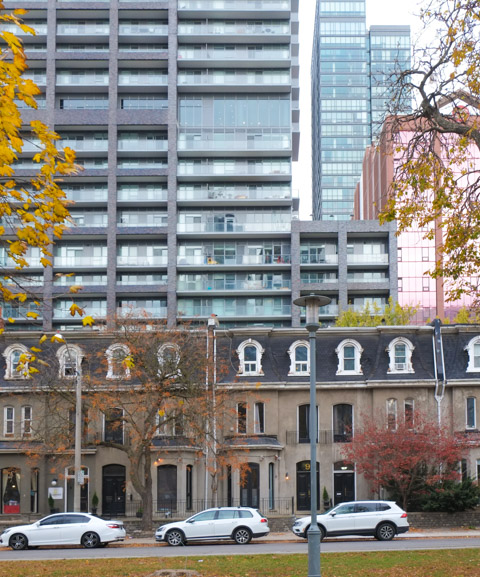
below: Not that long ago, this type of picture was not that common in the city. Now, this layered look is everywhere. The houses of Clarence Square, north side, built 1879 – 1885.

row houses on clarence square with glass condos behind

below: Part of the homeless encampment of Clarence Square.  Since this picture was taken (mid-November) some of the other encampments in the city have been cleared, specifically Kensington and St. Stephens church on College Street.  Yes, we have a housing problem.  No, we haven’t got any solutions, or at least none that we can agree on or are prepared to pay for.  Are tents in parks a good idea?  Probably not.  But they are there because it’s an “easy” solution that costs the city nothing.
homeless encampment in clarence park

below: Does anyone recognize this view?  There are a view clues that suggest this is just another view of Clarence Park. But when did those towers appear?  Turn around and someone alters the landscape while you’re not looking, playing tricks with your memory.

cluster of tall condo towers behind a park

below: Now turn 180 degrees, and the view changes…. sort of.  The new LCBO on Spadina that replaces the one at King & Spadina (that building is still standing and still vacant by the way).  Also, across the street is The Well that I blogged about previously.

LCBO store in brick building on corner, on Spadina, across street from new steel and glass development, the well, and other condos in the distance

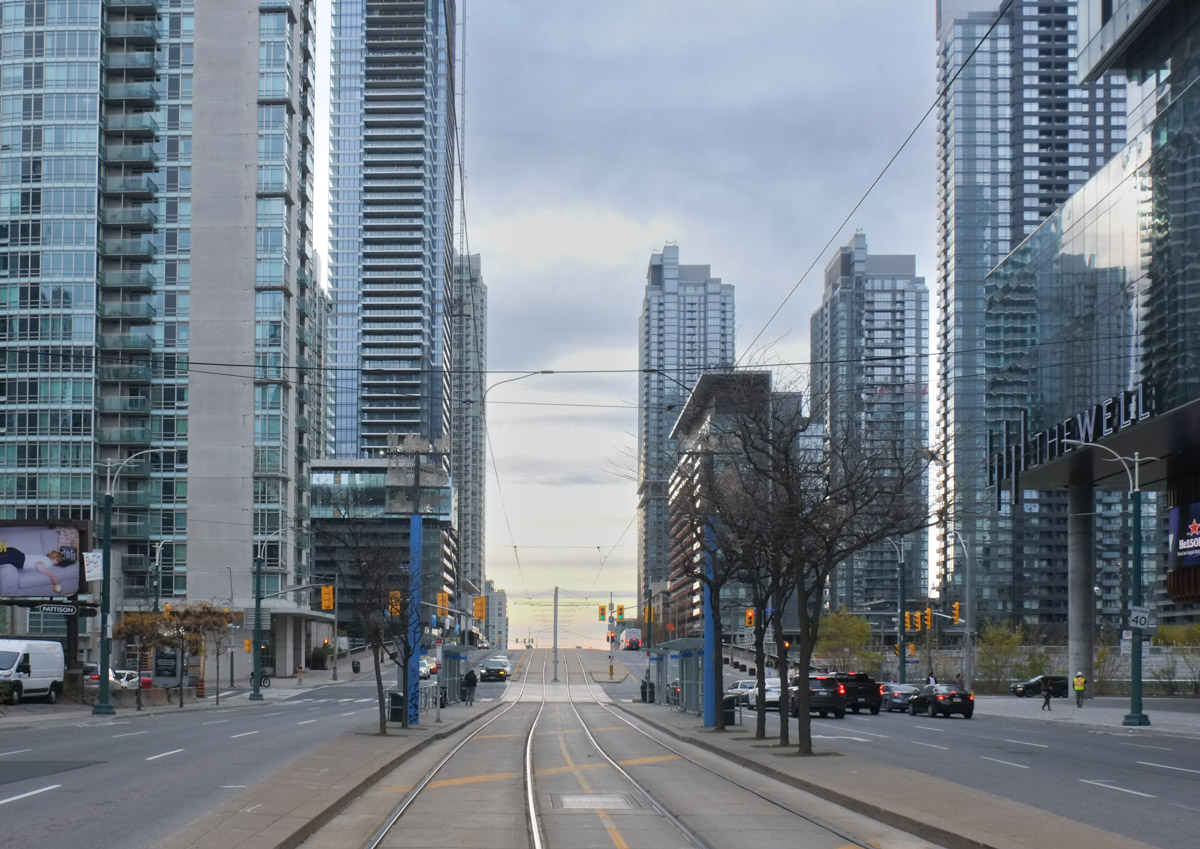
below: Looking south on Spadina at Front Street – I love the way that Spadina seems to disappear into the distance.  Into the great beyond.

standing on streetcar tracks TTC and looking south on Spadina, at Front street, with glass tower condos on both sides

people waiting at streetcar stop at spadina and front in toronto,

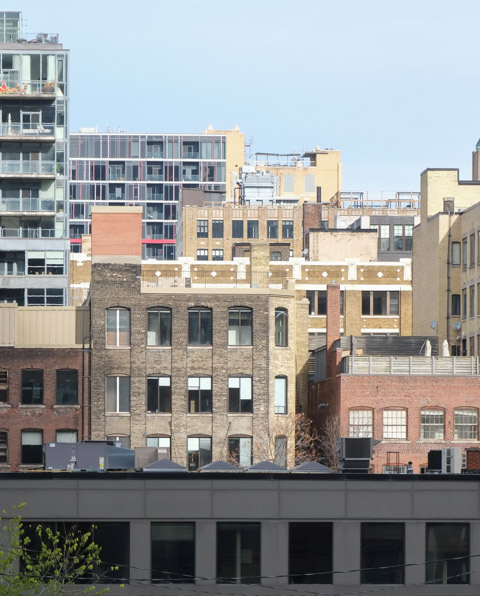
below: If you walk through The Well, at one point this is the view to the north with an interesting jumble of roof lines, window styles, and brick patterns.

layers of midrise buildings, mostly brick, some with balconies, downtown toronto, north of wellington, west of spadina

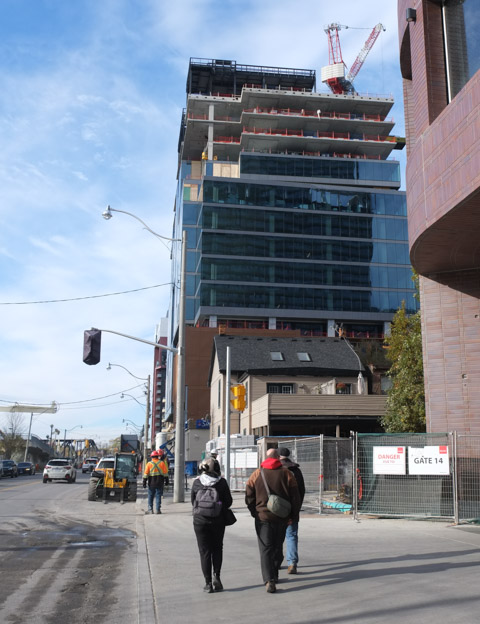
below: Front St., putting the finishing touches on the sidewalk outside The Well development.

workmen in hi viz jackets laying concrete blocks to make sidewalk along Front Street in downtown Toronto, CN Tower in the background

below: Front Street, walking west towards Bathurst.

three people walking along sidewalk on front street towards portland street and bathurst street in toronto

below: “Dance all night till you can’t feel your legs”

back corner of white car, red light, stickers, rooster, mask, dakkar, and words that say dance all night until you can't feel your legs

below: So many possible captions!  Tossing happiness aside … Empty promises of happiness…

a pile of empty pizza boxes on the sidewalk beside some city of toronto rubbish bins and recycling bins

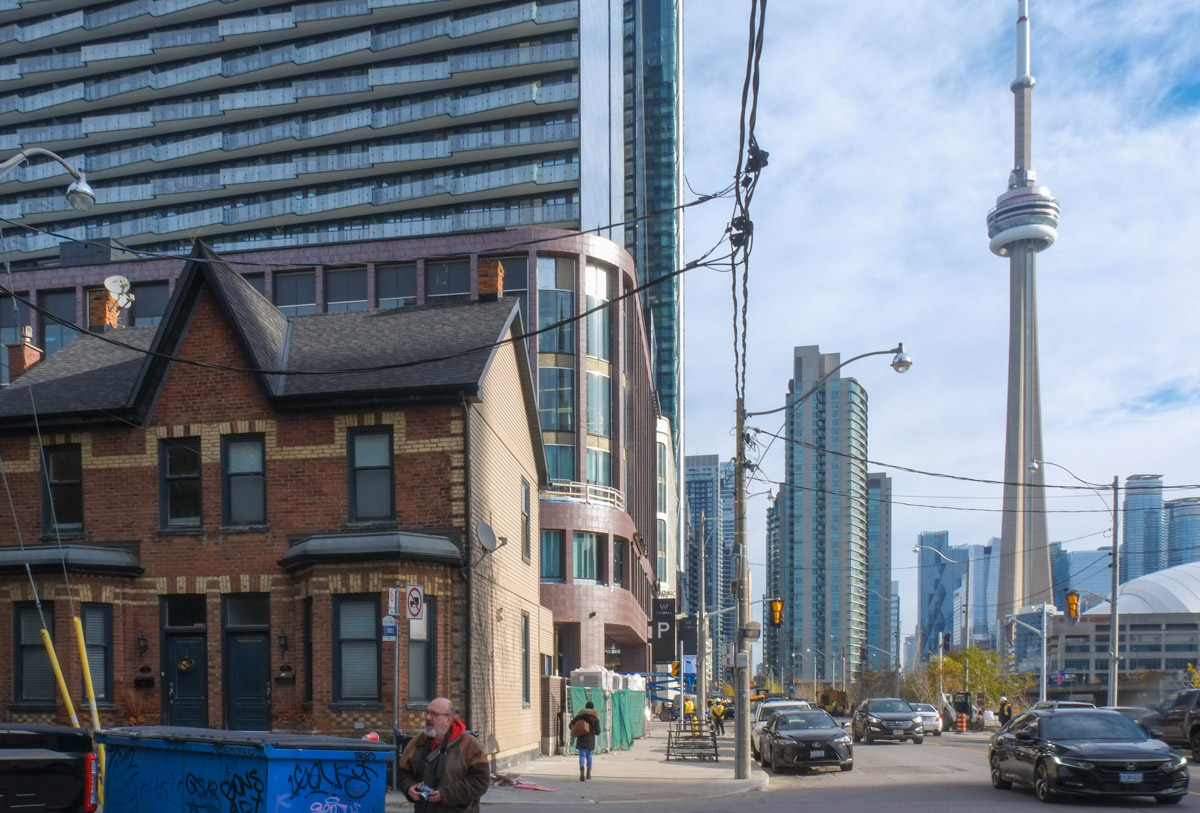
below: In the midst of all the new development along Front Street and the railway corridor, Draper Street remains.  It is one block of old houses, many of them heritage row houses.

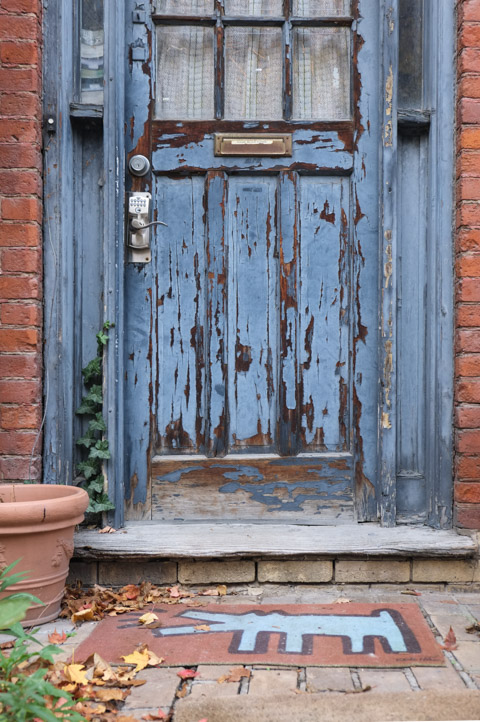
old blue wood door on brick house, stone step, welcome mat with keith herrig image on it

below: Draper Street houses – a smaller version of the houses seen on Clarence Street (see above).  They are of a similar vintage with almost identical rooflines and window shapes.  The Empire Style.

empire style row houses from the 1880s, black mansour roof, with new condos behind

City of Toronto historic plaque for Draper Street

“DRAPER STREET – Draper Street’s Empire-style cottages were built in 1881 and 1882,  while its larger homes were constructed between 1886 and 1889.  The street – a Designated Heritage Conservation District – is unusual because its residential character survived the overall industrialization of the King-Spadina neighbourhood in the twentieth century.  Draper Street has been a haven for people of many backgrounds, such as Lincoln Alexander, who was born here in 1922 to West Indian parents, and who served as Lieutenant-Governor of Ontario from 1985-1991.  The name of the street honours William Henry Draper (1801-1877), a pre-Confederation lawyer and Conservative politician, who was the virtual “Prime Minister” of the United Province of Canada from 1844 to 1847.  He subsequently became a judge, eventually being appointed Chief Justice of post-Confederation Ontario in 1869. “


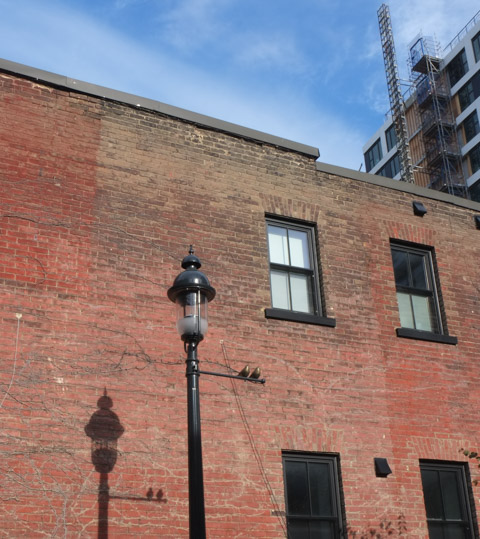
shadow of old light pole on brick wall of house, new condo being built behind, draper street

The new condos at The Well loom over a new park (2021), Draper Park.  It’s small, the equivalent of two housing lots; numbers 19 and 21 once stood here.  The original owner of 19 Draper Street (1881) was George Hickey, a railway manager.  It was demolished in 1942 and was replaced by a small factory owned by Farrell Plastics.  At that time, a factory would not be out of place as the area was more industrialized.  The building was destroyed by fire in 1969.

below: Draper and Front, looking east

intersection of draper and front streets, looking eastward

Since I mentioned the fact that this land was once owned by the British military, and the fact that Fort York was once “in the middle of nowhere”, I’d like to add a couple more photos that show much development has occurred in the area.

below: New development along Front Street.  The bridge is at Bathurst.  Draper Street is just outside the photo on the righthand side.  All the railway corridor and the lands to the south were not there in 1833 when Sir. Richard Bonnycastle drew his map – but that’s a whole other story for another day!

looking northeast across the railway corridor to Front Street and the new development along it at Bathurst St., Bathurst bridge over the tracks, and new condos in the distance

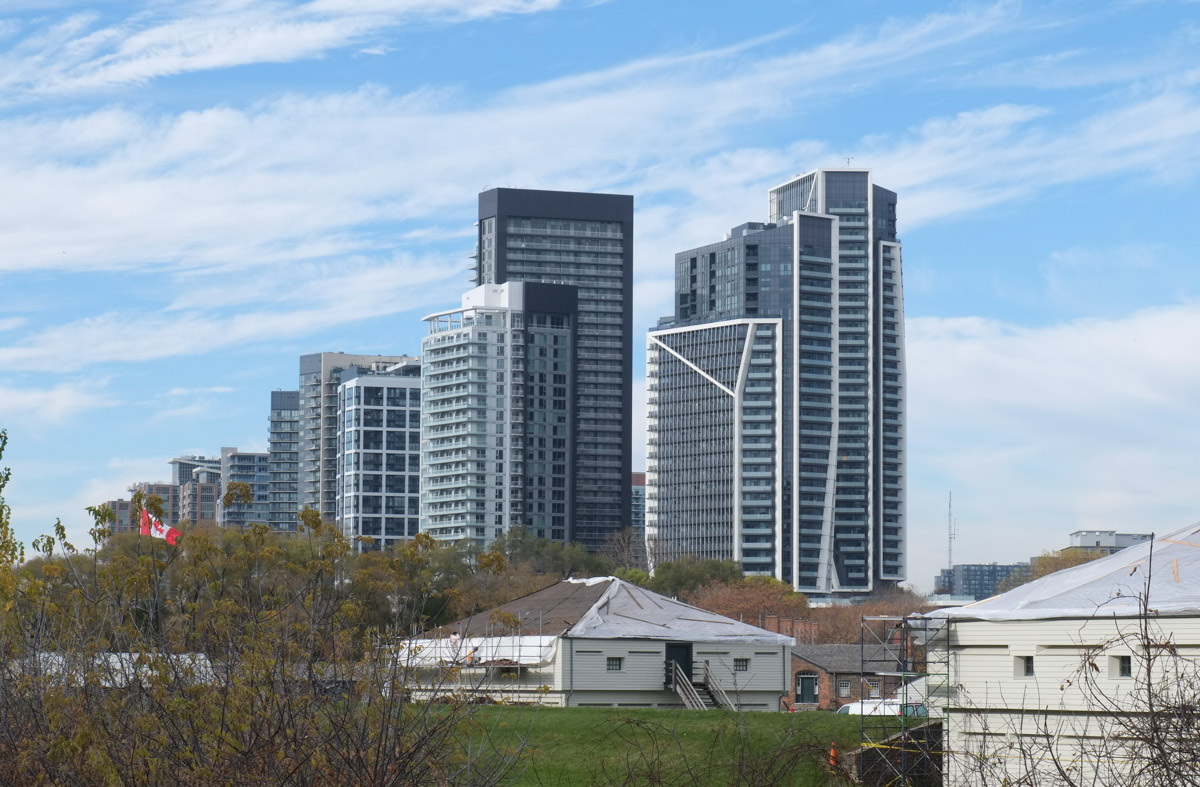
below: View from Bathurst – the white buildings here are part of Fort York while the new condos are just beyond, closer to Strachan Ave.

buildings at fort york in the foreground, new condo high rise buildings in the background, looking northwest from Bathurst and Front

buildings at fort york in the foreground, new condo high rise buildings in the background, looking northwest from Bathurst and Front


The north end of Senlac Road is at Finch Avenue. It runs south through the middle of York Cemetery and the Lansing neighbourhood towards Sheppard Ave.   .

an old wood bench on a patch of grass in front of shrubs and trees

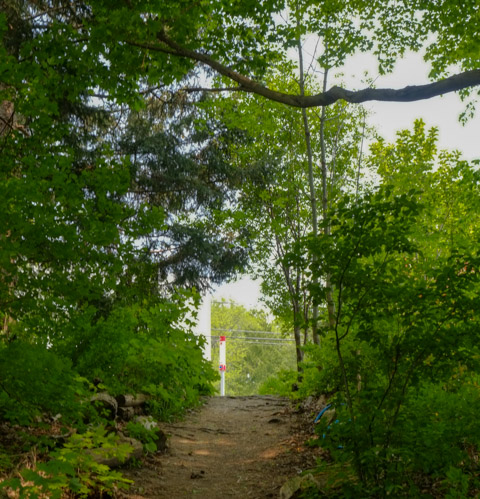
below:  Addington Greenspace (or Addington Greenbelt) is a small park on the west side of Senlac, or rather it is an access point to the city’s ravine system.  In this photo, the trail back up the hill to the street ends by a bus stop.

looking uphill along a path through the woods and ravine, Addington, to a TTC bus stop pole at the top of the trail

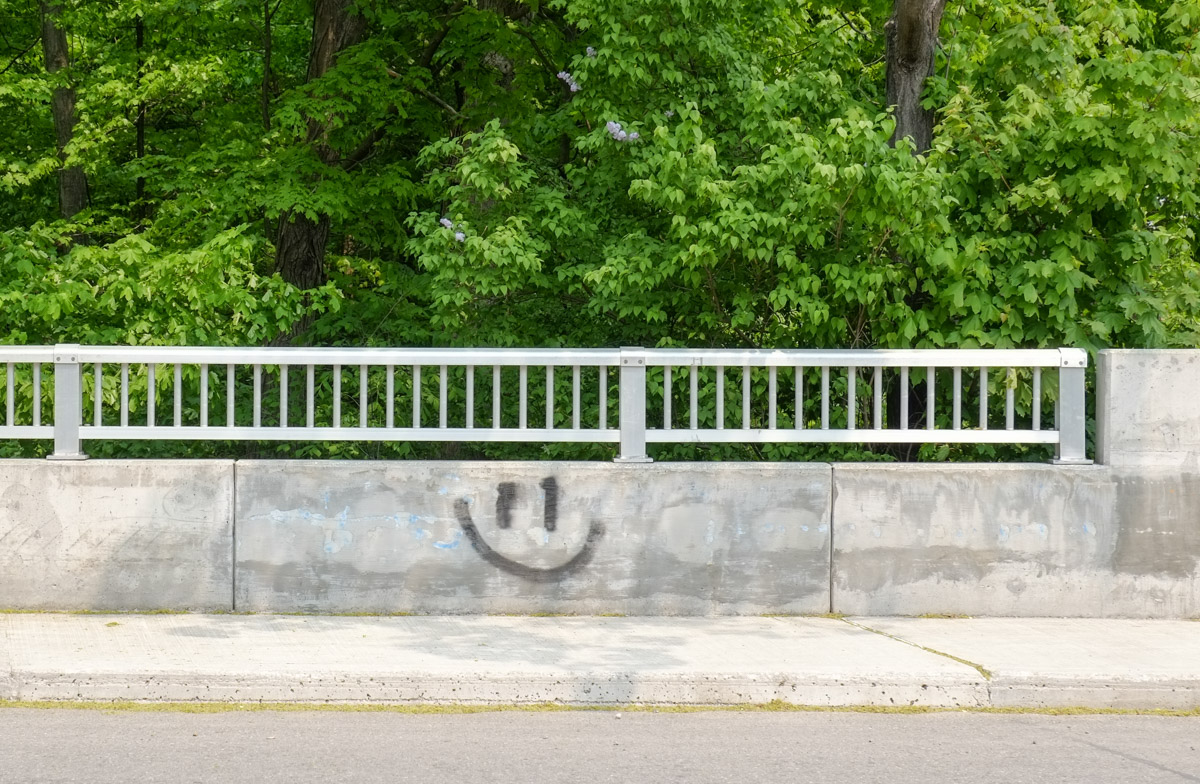
below: The greenspace follows a creek and passes under Addington Street before it meanders southwestward towards the Don River close  to Sheppard and Bathurst.

concrete wall on bridge, has a black happy face spray painted on it

below: Protest signs on lawns.  Back in May City Council tried passing a new bylaw that would limit what signs you put on your lawn and how many.  There were more than 30 amendments to the Toronto Municipal Code Chapter 693 (Signs).  Most of them were adopted on the 14th of June except (if I am reading it correctly) for all amendments concerning “advocacy signs”.   The council agenda item history is online.  If you check it out and find that I am wrong, please let me know!

sign beside sidewalk that says stop privitization of public hospitals

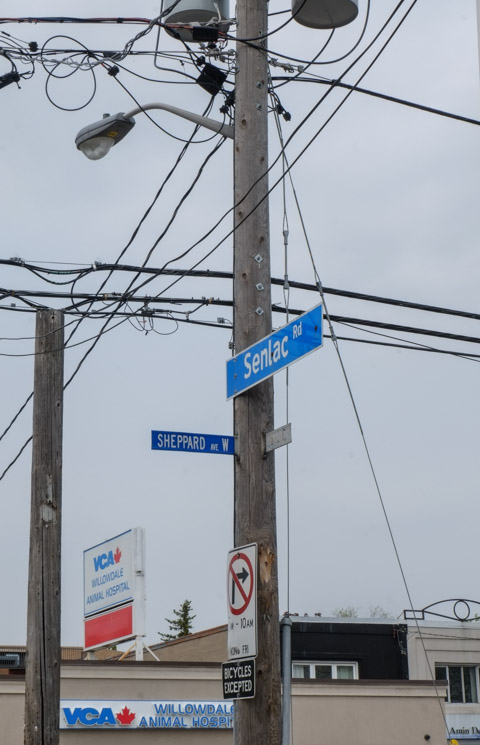
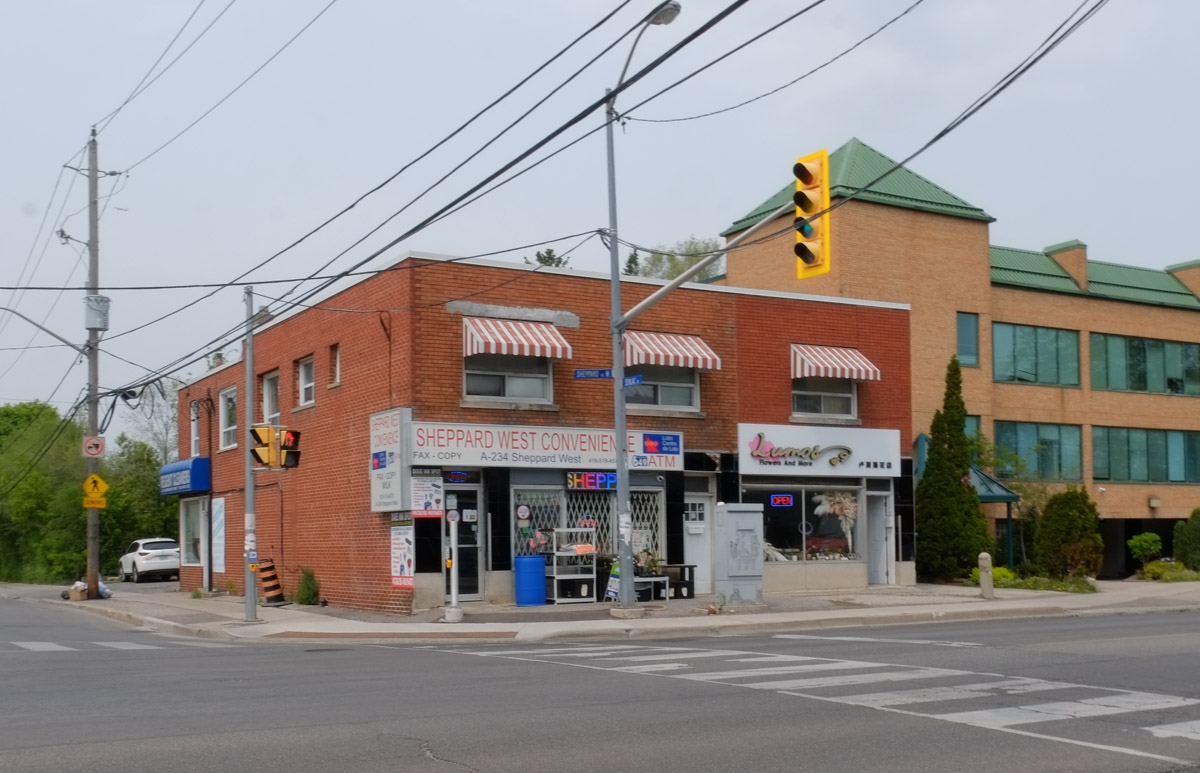
below: Although the main part of Senlac ends at Sheppard, there is a small two block section south of Sheppard slightly to the west.

utility poles and hydro wires, street signs for senlac and sheppard avenue

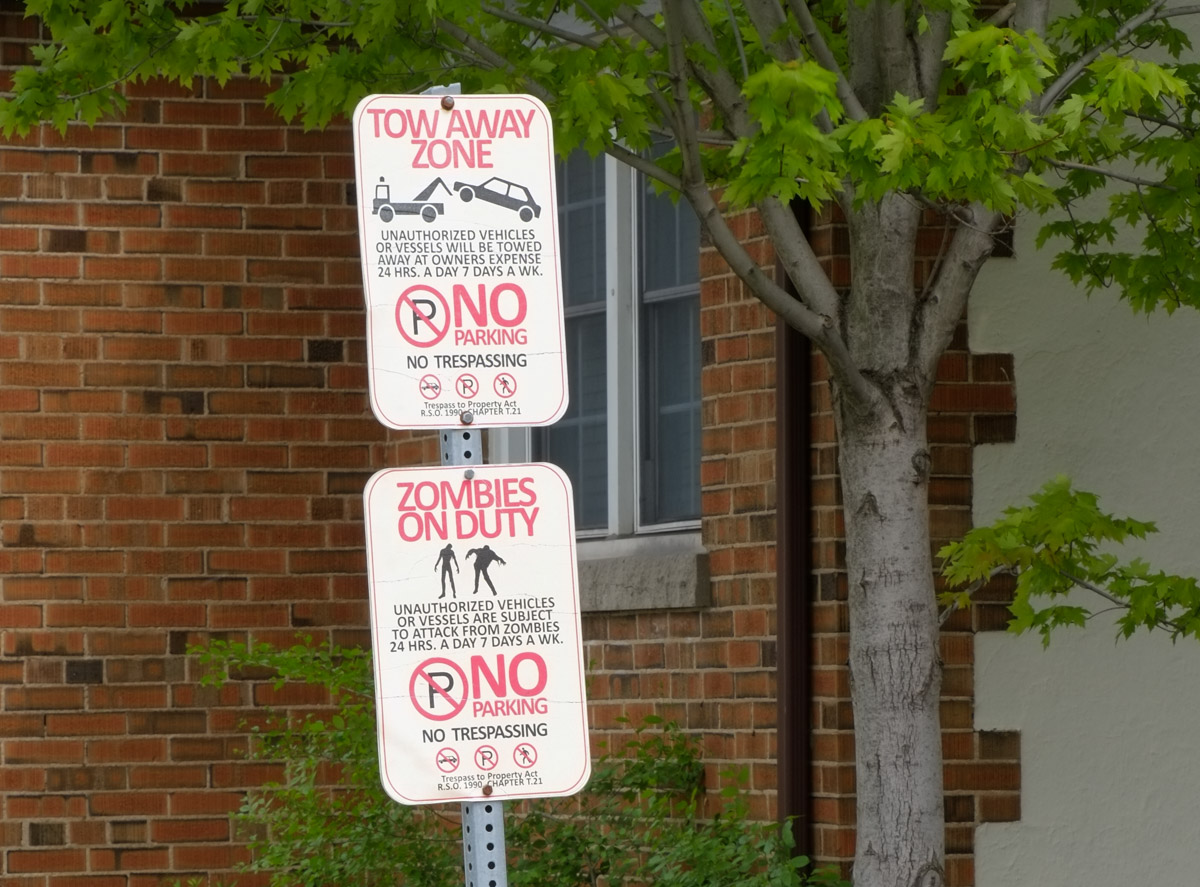
below: Beware of the zombies!!

no parking signs, one says zombies on duty


low rise brick building

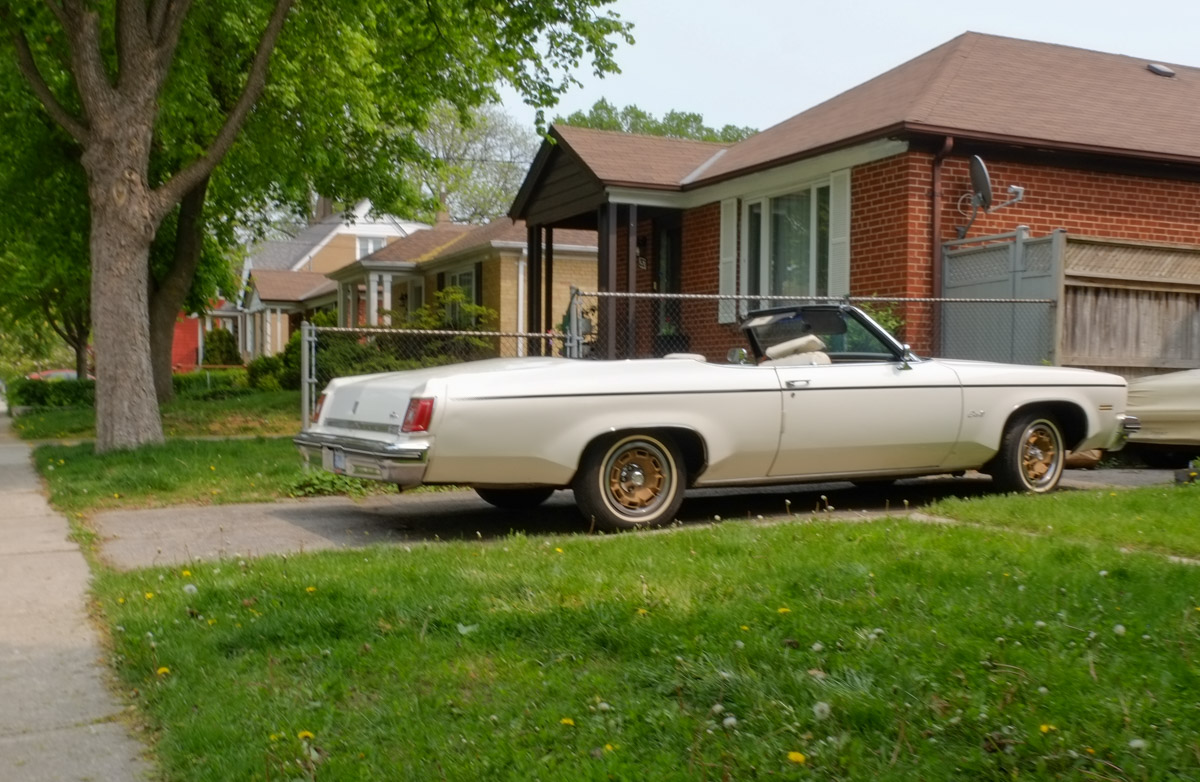
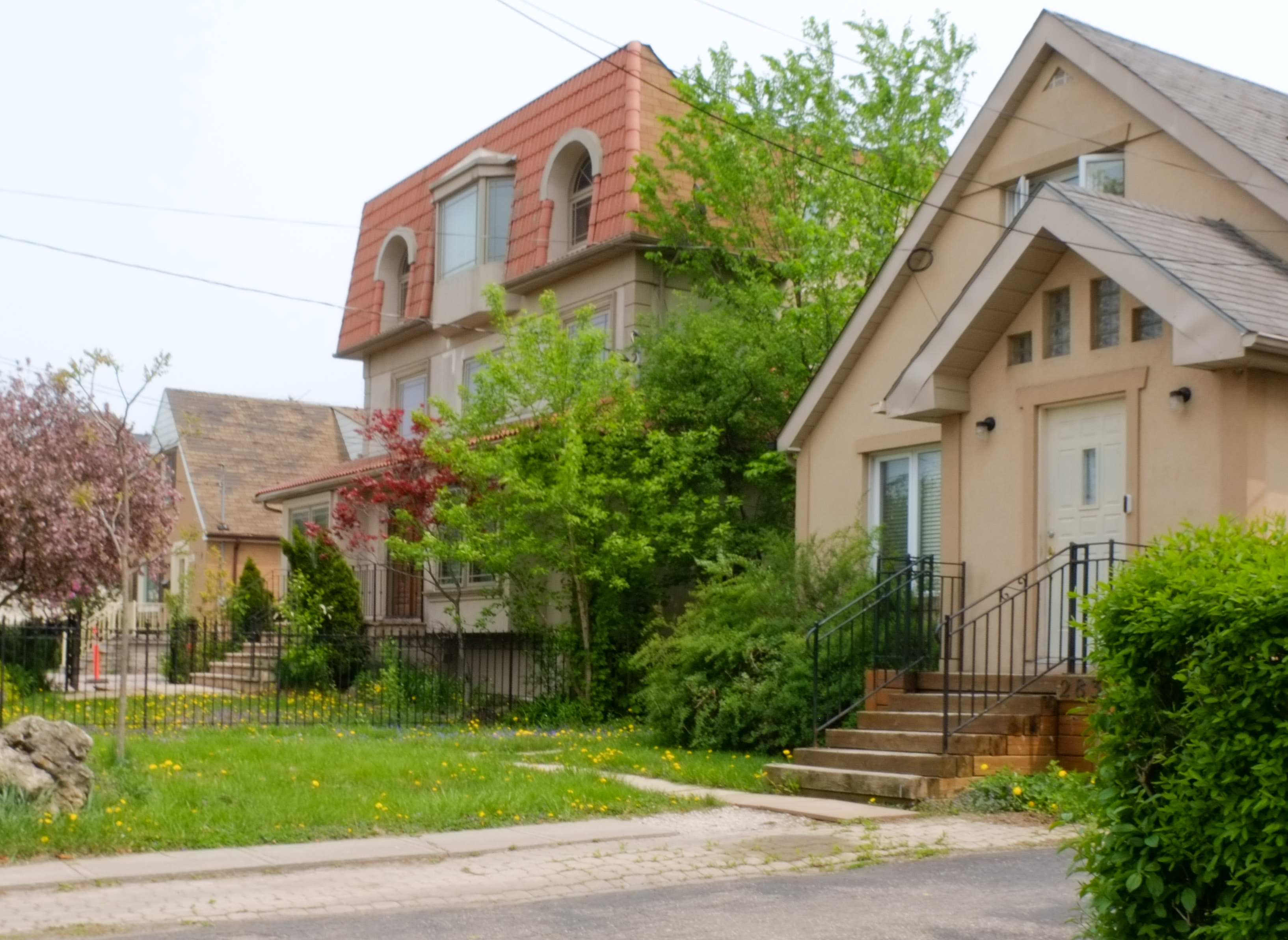
below: Most of the area is residential – 1950s and 60s suburbia.

old white convertible with top down parked in driveway in front of a house

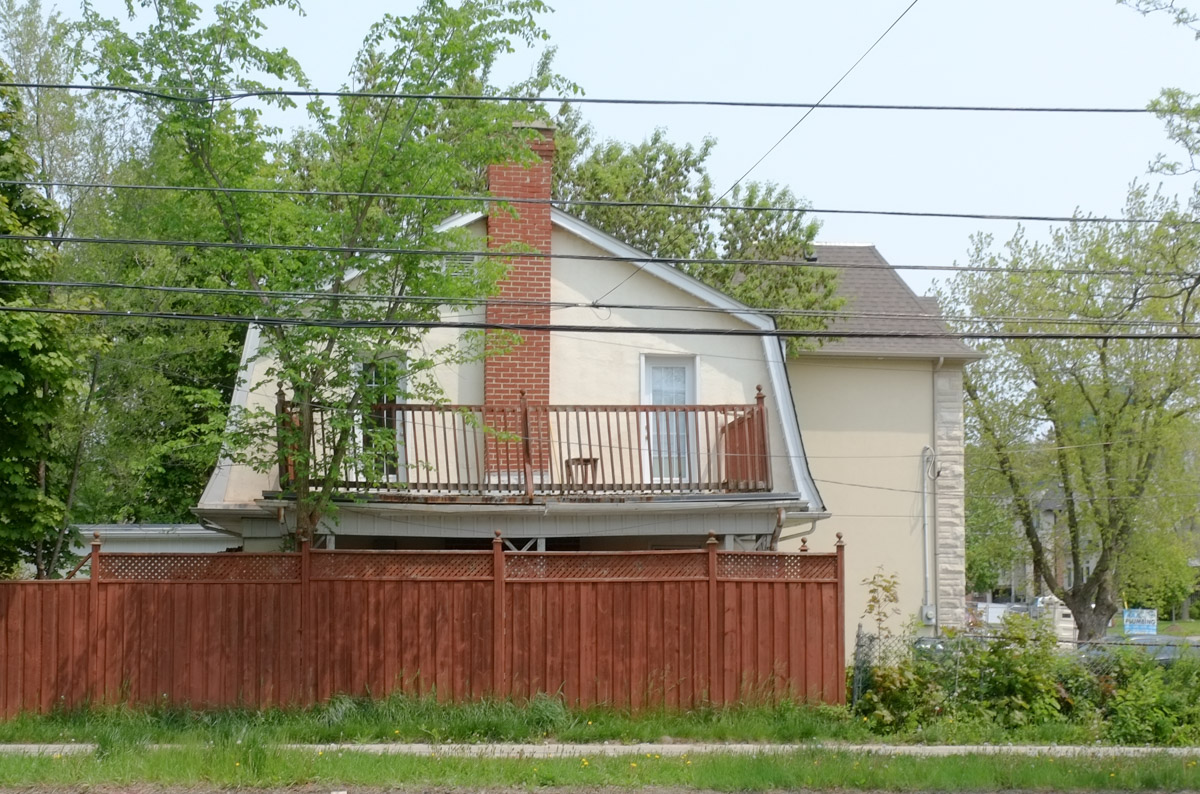
side view of a house, wood fence in front of it, roofline is barn shaped

lots of plants growing in blue and grey pots in front of the porch and beside stairs of a house

pink lilac bush in full bloom, by a wood fence

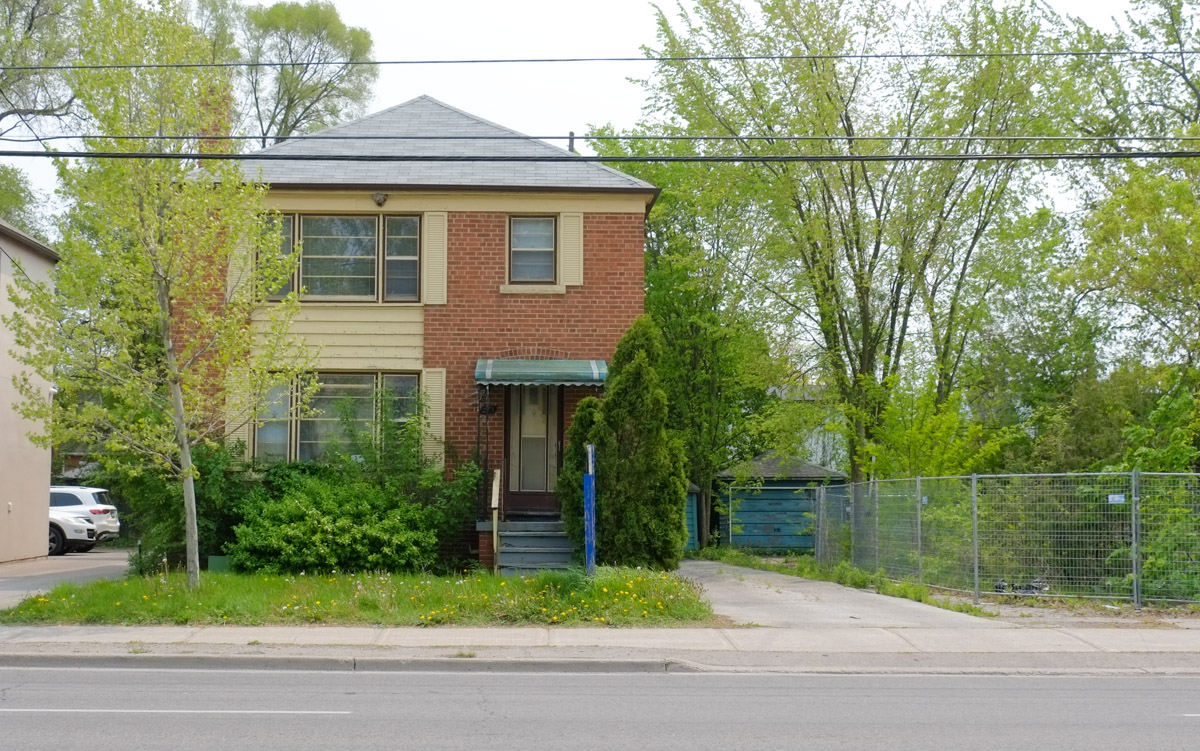
2 storey brick house on sheppard aveune, beside a vacant lot

old red car in driveway of a house

below: Like all older neighbourhoods in Toronto, many smaller houses are being upsized.

renovation and enlargement of a house, smaller older house beside

2 houses on a residential street

…. or torn down and redeveloped totally.

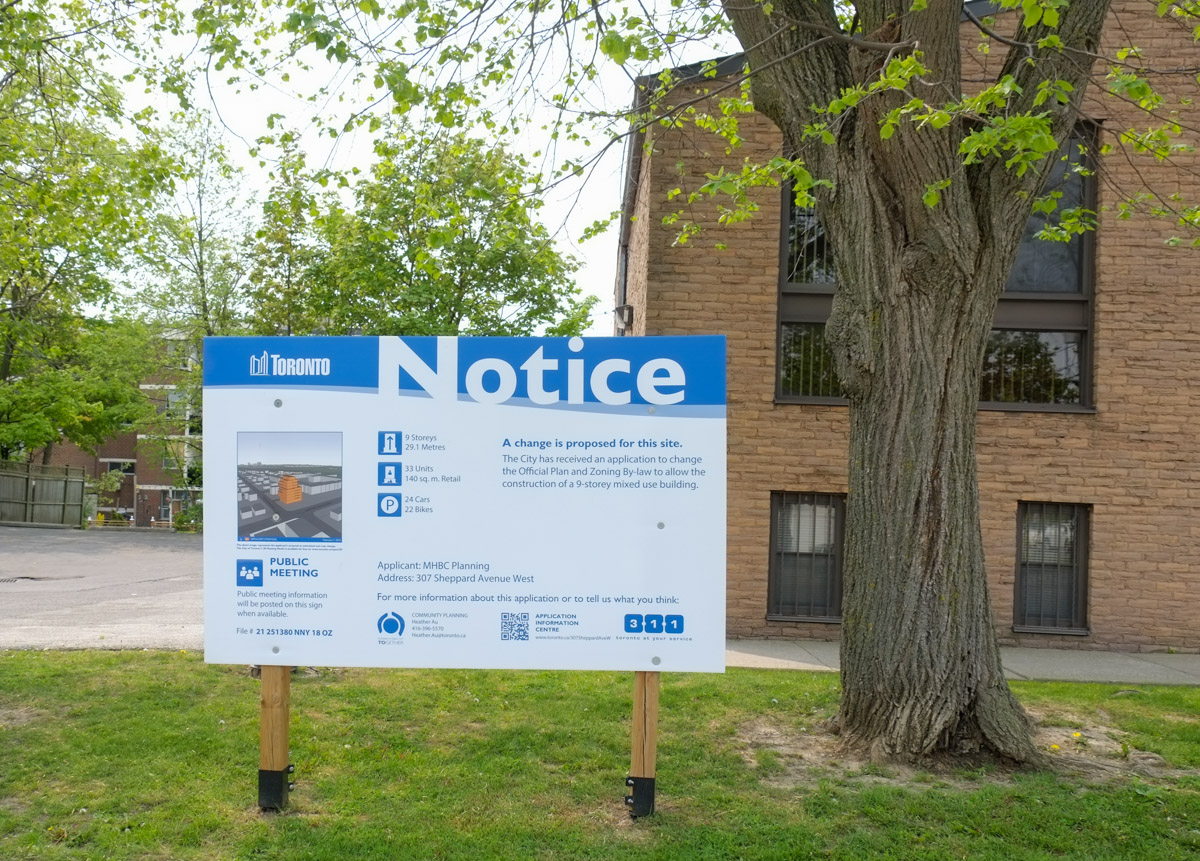
blue and white city of toronto development notice

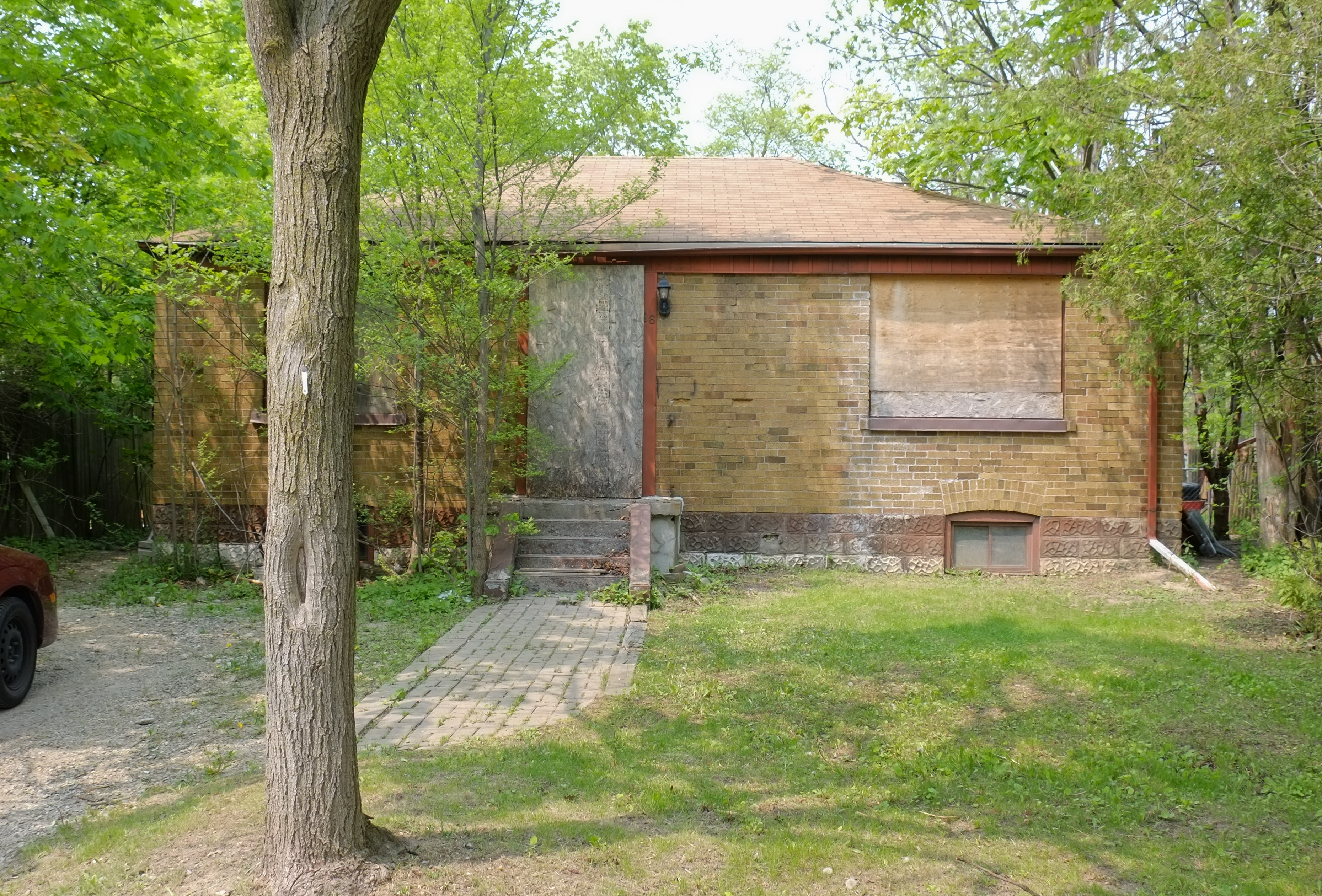
below: An empty house.  As I was taking these pictures, a woman passing by remarked that they had been empty for seven years.  I hadn’t meant for this walk to turn into yet another redevelopment story but even here there are blue white signs along with boarded up buildings.

front porch and front door of old brick house now empty

below: This development dates from 2016.  It proposes townhouses along Sheppard but 5 multistorey (11-25 storeys) buildings behind.  Part of the reason for the delay is that the project also involves tearing down existing rental accommodation.  In June 2022 the City Planning Division recommended that City Council approve the Rental Housing Demolition application that accompanies this development.  It is 14 pages long but if you are interested in what happens when developers want to tear down rental units, click on this City of Toronto link

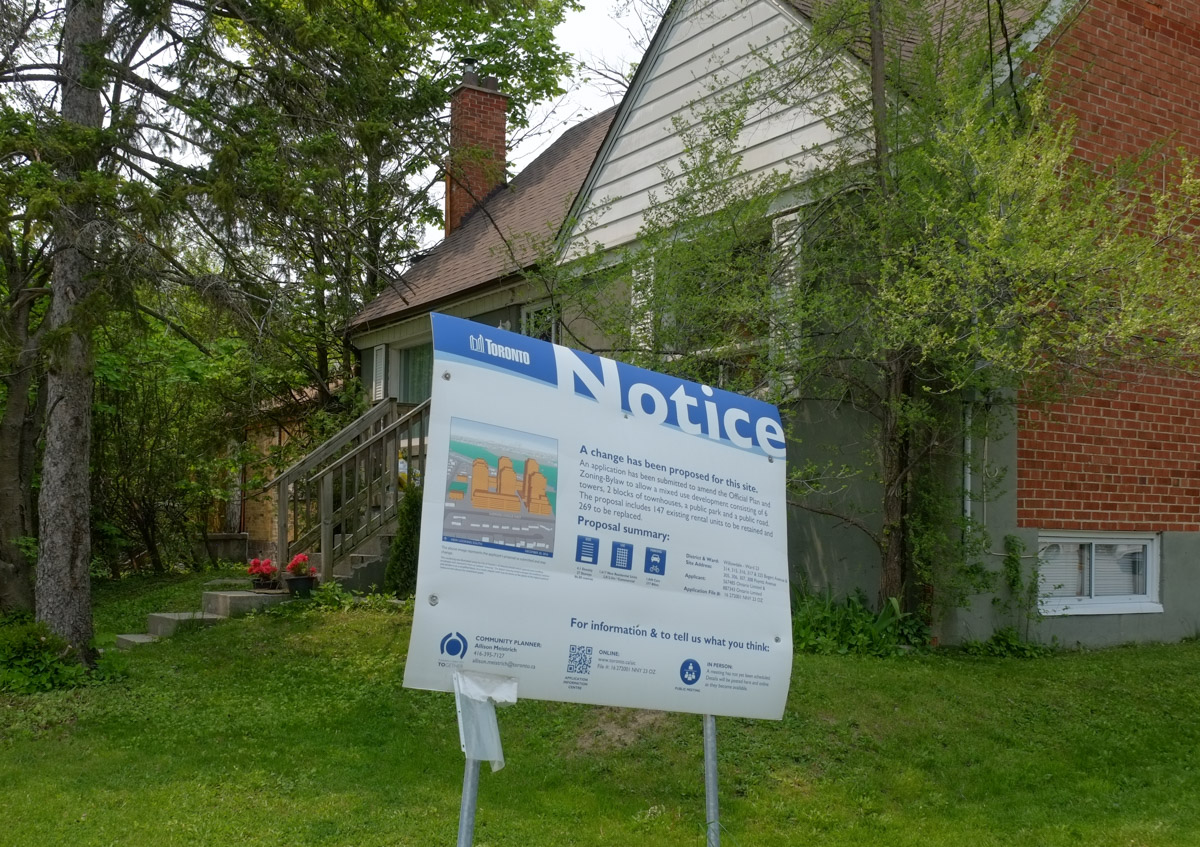
blue and white development notice in front yard of a house

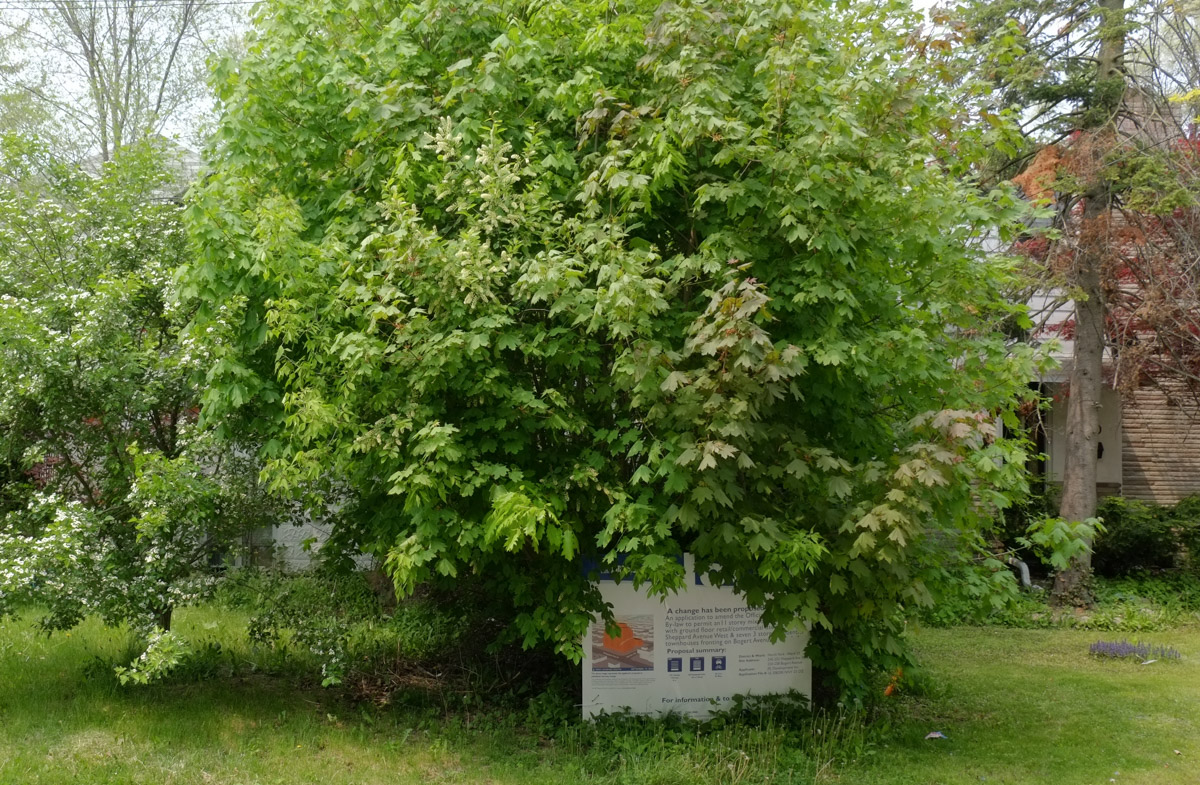
below: Hiding behind a massive shrub, both a house and a development notice

a large green shrub obscures a house that is awaiting demolition

boarded up doors and window of an empty brick house, wood porch has rotted away

old brick bungalow with boarded up windows and door

small brick house with boarded up windows

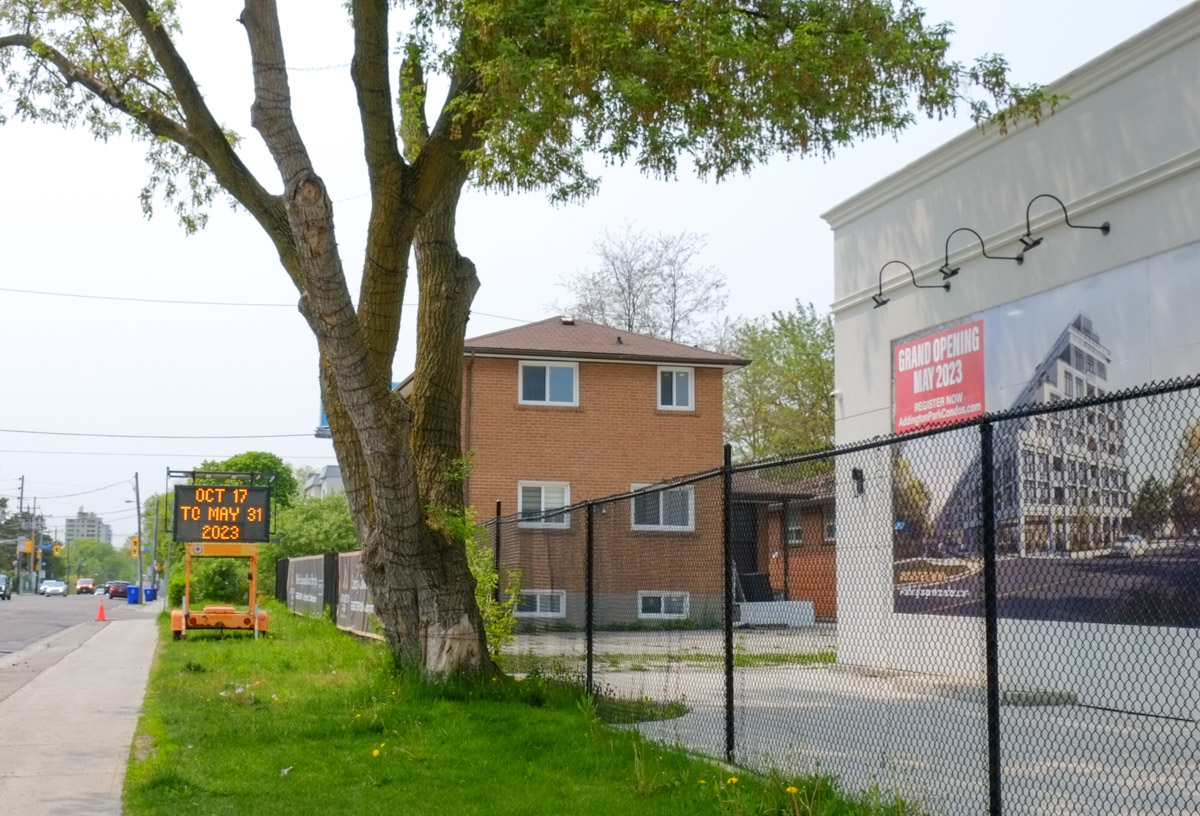
below: This bungalow is actually on Sheppard West.  The proposal here is not for a condo, but for a 38 room hotel (in 6 storeys).

small brick bungalow with development notice in the front yard

below: Also Sheppard West.

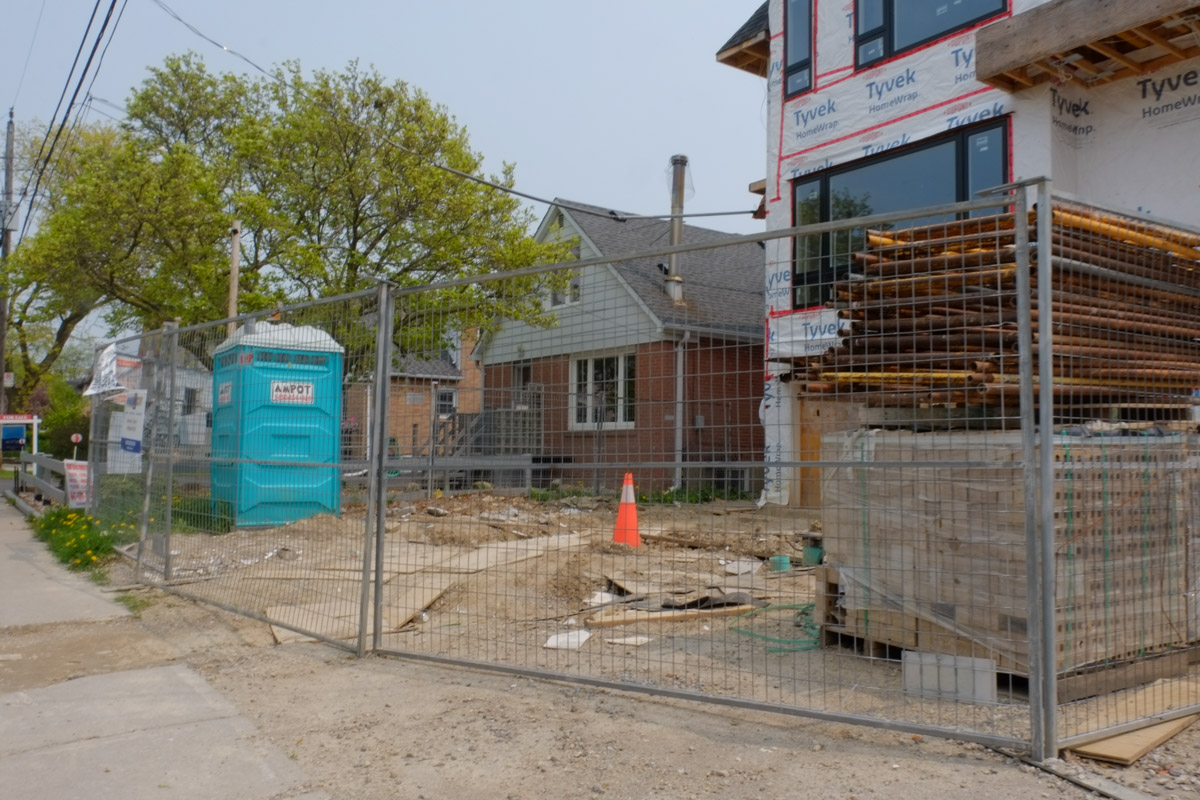
black metal construction fence around a building site

mm

… with touches of pinks and other colours.  Spring time!

Here are a few photos of spring in the city that I collected as I walked in the past few weeks.

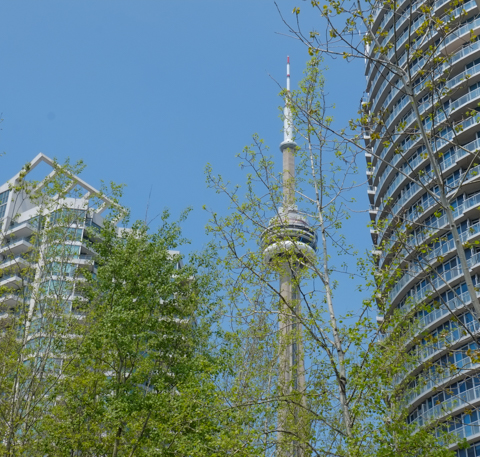
CN tower behind spring buds and new growth on trees

below: Spring time … when all the bugs and insects come out!

a large stuffed caterpillar on a deck of a house

below: As do the trees….  including this massive pink magnolia in full bloom.

a large pink magnolia tree in a front yard

a house with a large white blossom tree in the front yard

below: Flowers on a grave

York cemetery, tombstones in foreground, tall buildings of North York in the background

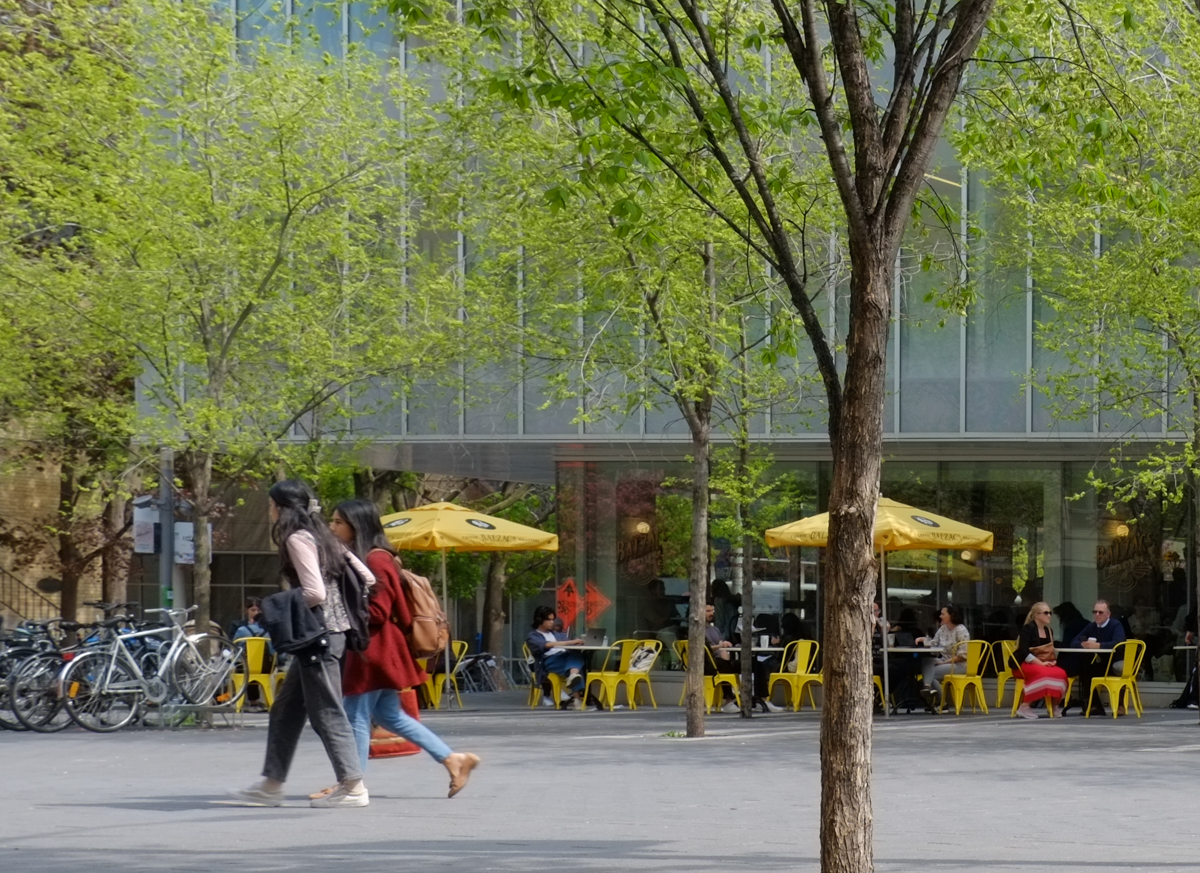
Ryerson university, Balzacs coffee, yellow umbrellas outside on spring day, people sitting outside, some people walking past

a man sits on a red bench on Pape Ave., East York

Pinehills cemetery, stones in the oreground, blossom trees in spring in the middle, and apartment building with blue features in the background

two houses on a street, with condo in background, spring, double car garages, white brick, black roofs, large tree in front

front yard, black metal trellis, blossom trees, one yellow tulip, fake stone front of house, stone walkway, brown wood fence, single white door for front door

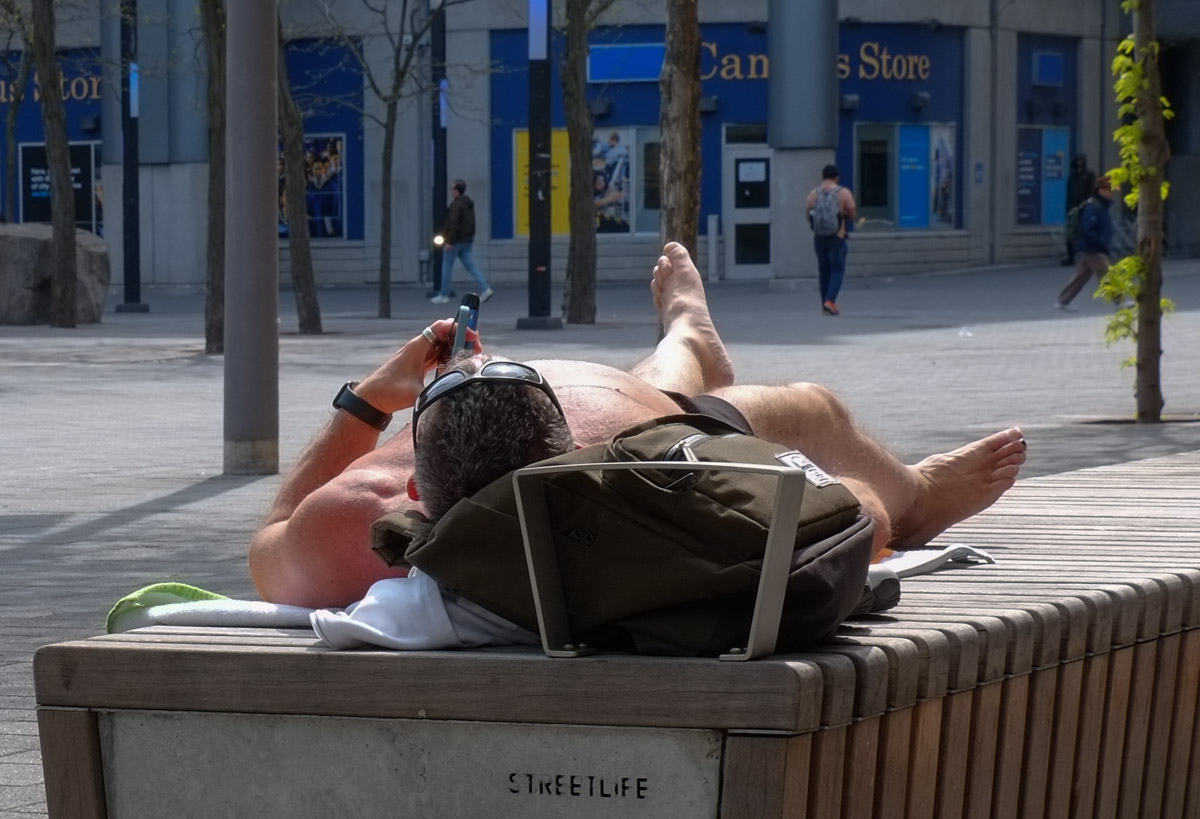
a man wearing only shorts lies on a bench

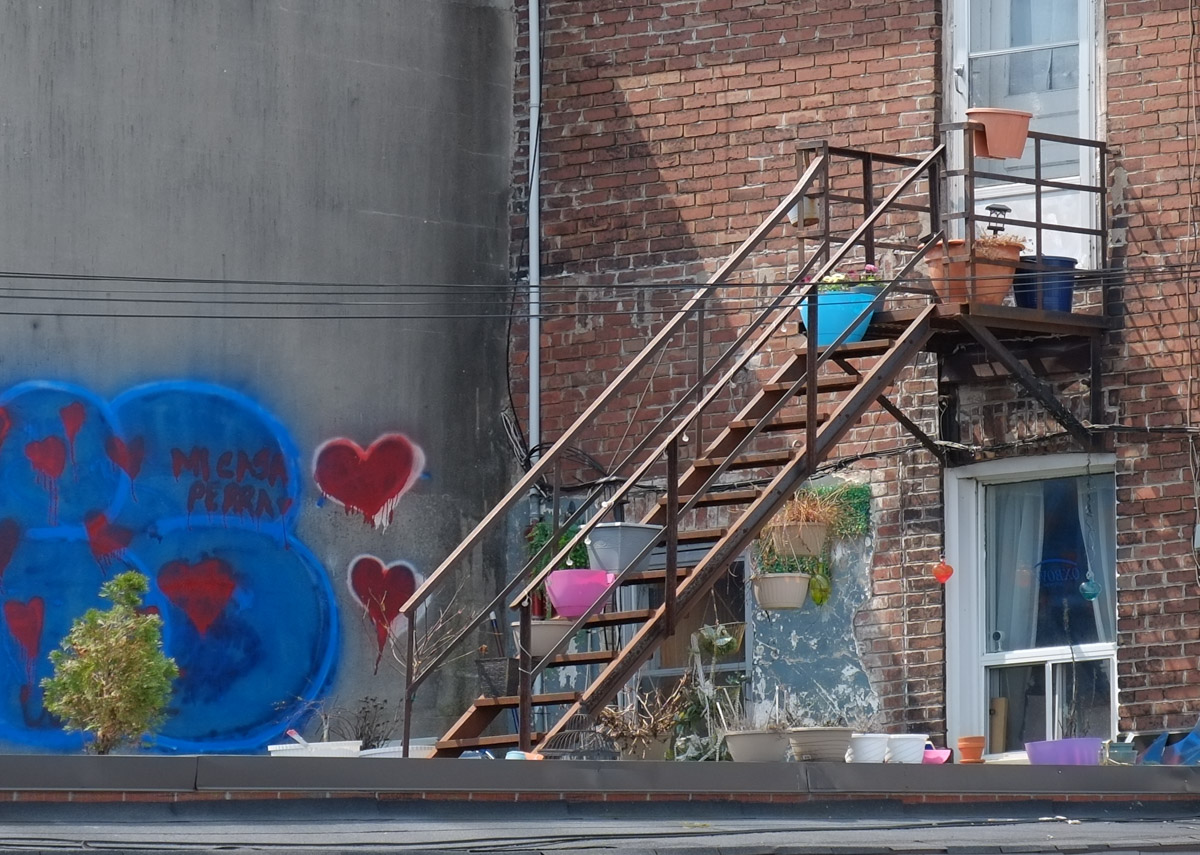
back staircase of a brick building, upper apartment, with blue and pink planters on the stairs

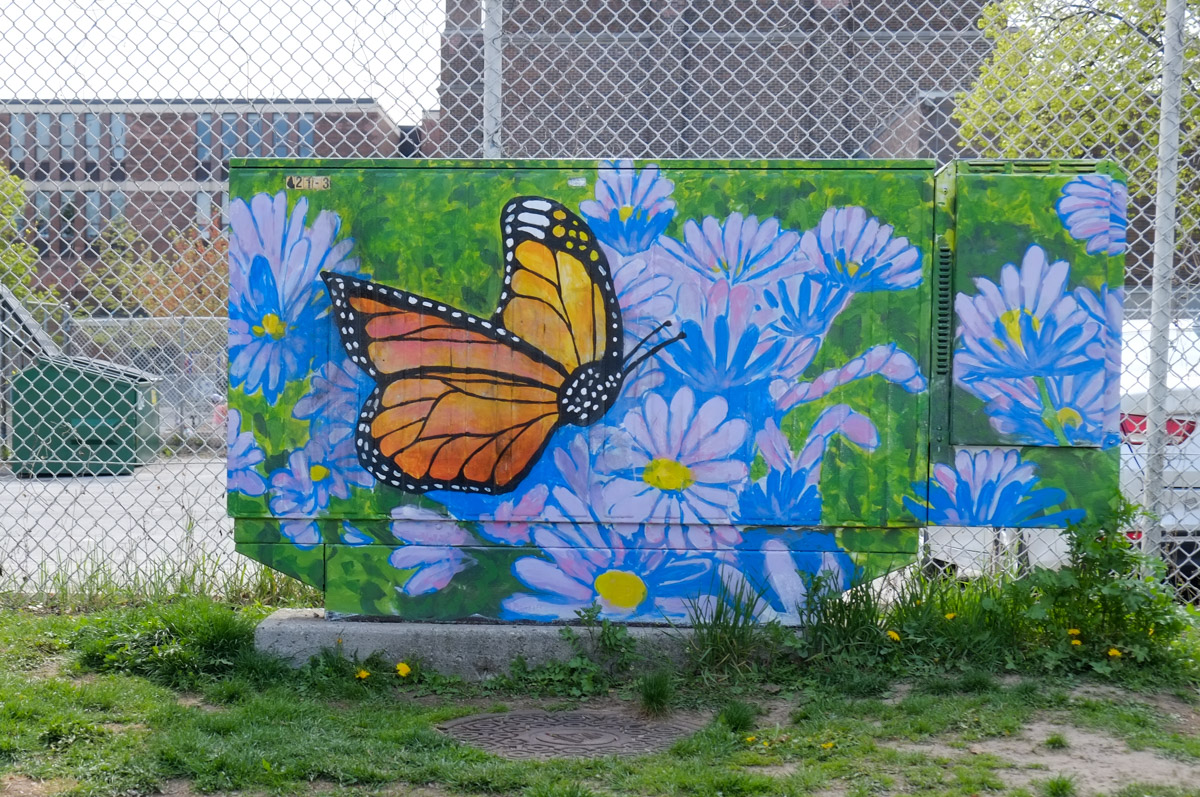
metal box on sidewalk, bell box, painted with a monarch butterfly in a field of pale purple daisies

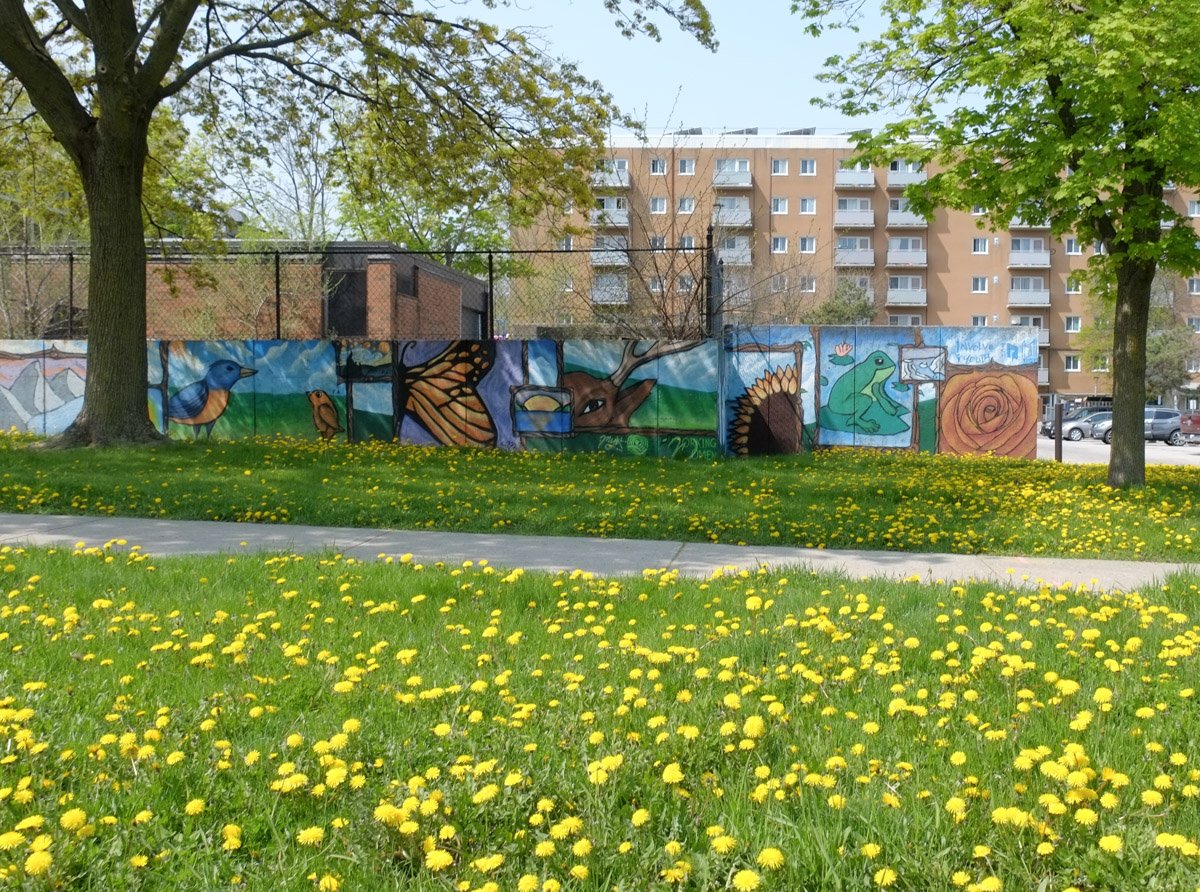
lots of dandelions in the grass by a sidewalk in front of a wall with street art on it, apartment building behind.

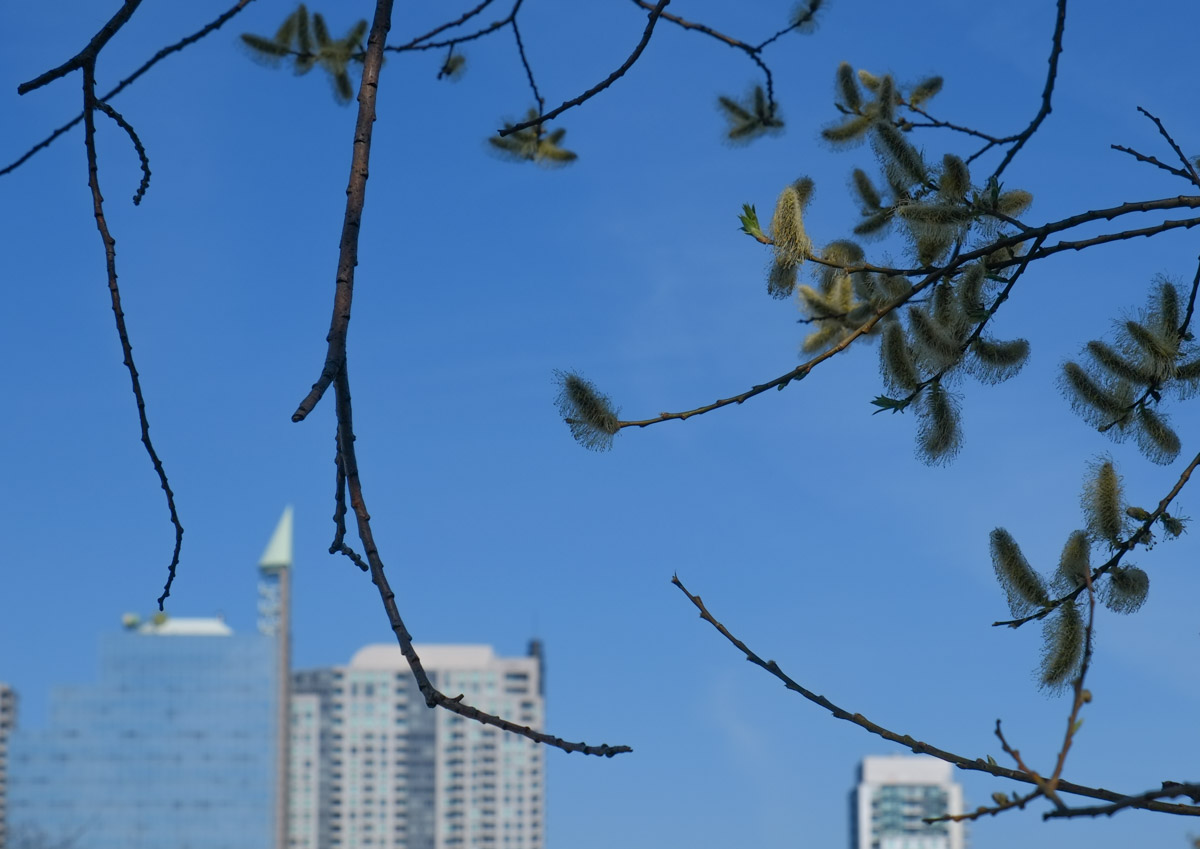
pussy willow in the foreground, tall buildings in the background

big old willow tree in spring in front of two houses

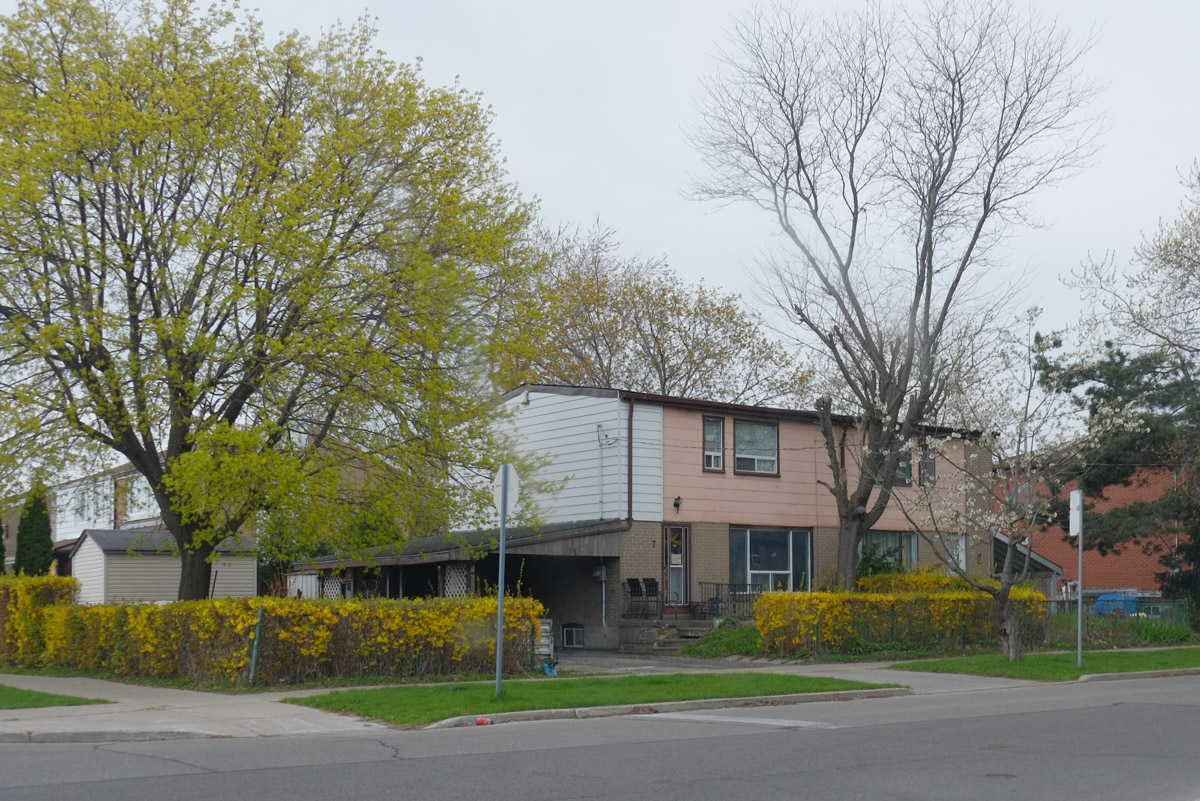
house with pale pink siding on upper floor, spring

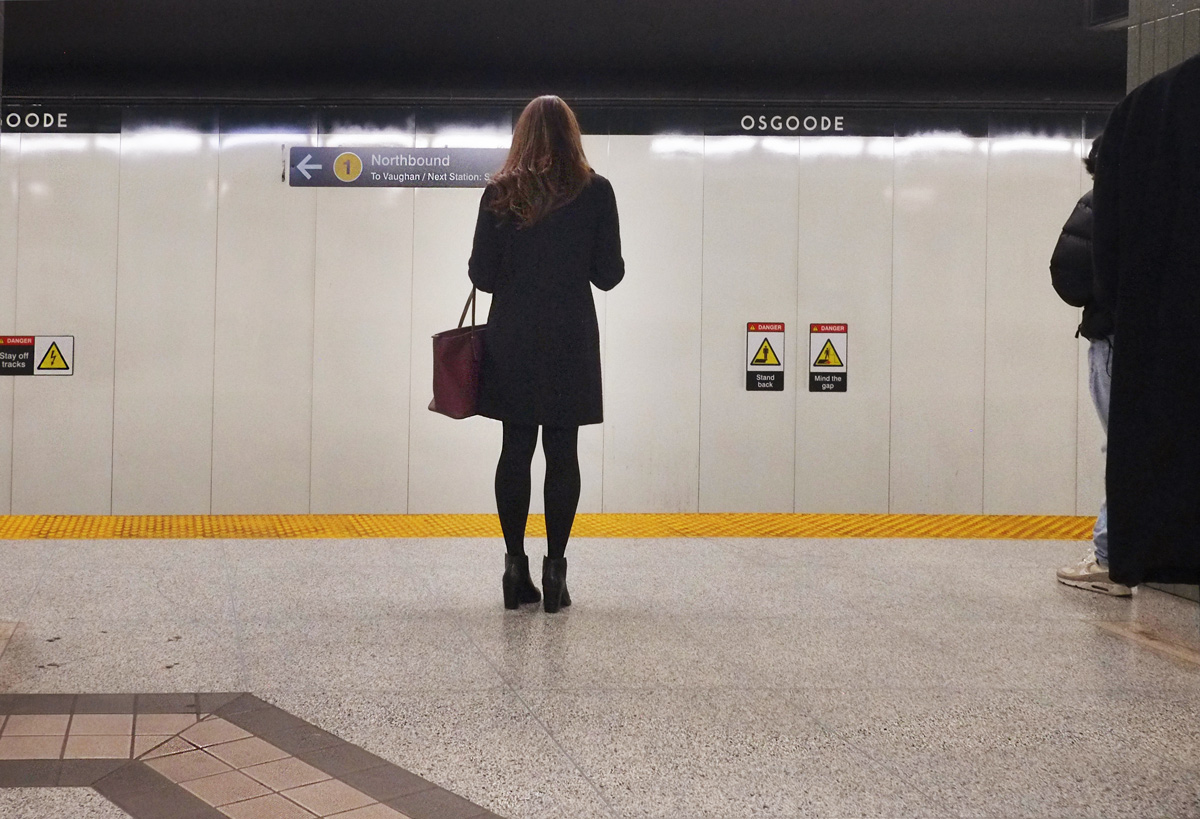
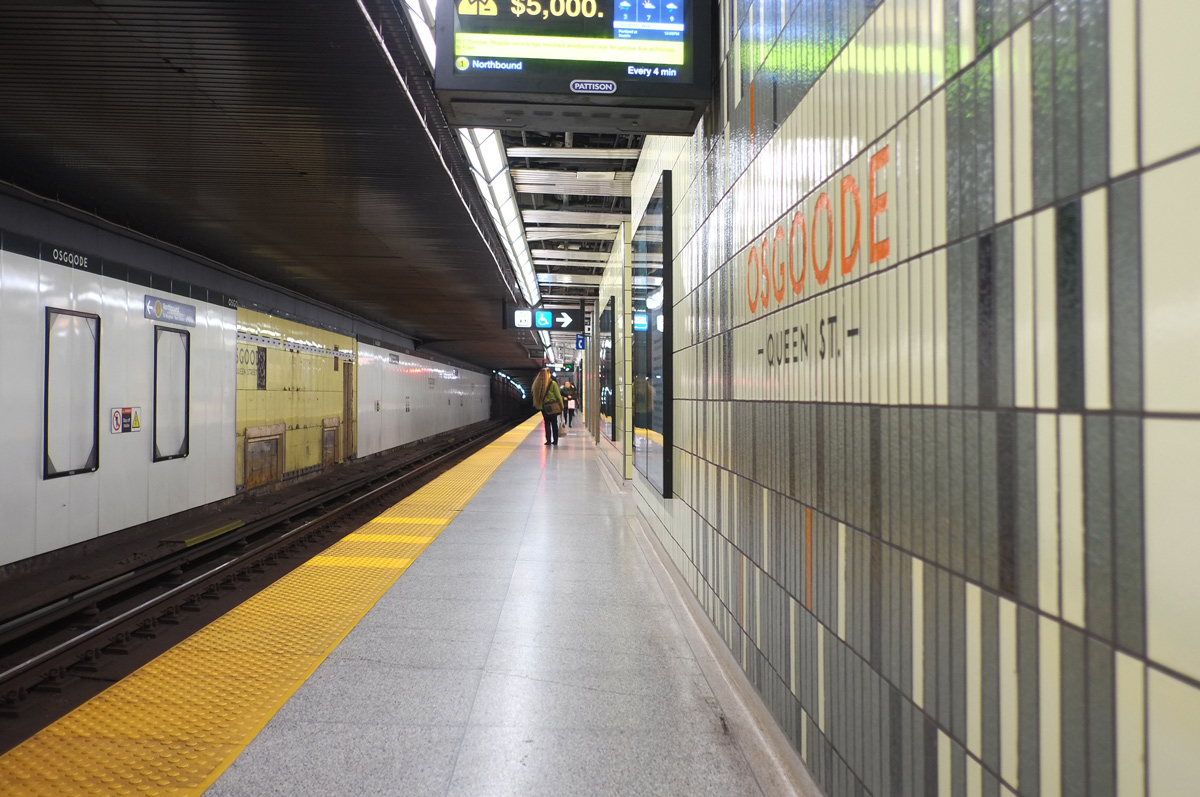
Welcome to Osgoode subway station.

young woman in short coat, boots, and a reddish handbag stands on the osgoode subway station platform

It’s not the busiest station on the University Line but changes are in the works.  It is going to become one of the transfer stations with the new Ontario Line.  This line will cross downtown underground with stations at: Corktown, Moss Park, Queen, Osgoode, Queen/Spadina, and King/Bathurst.

Osgoode subway platform

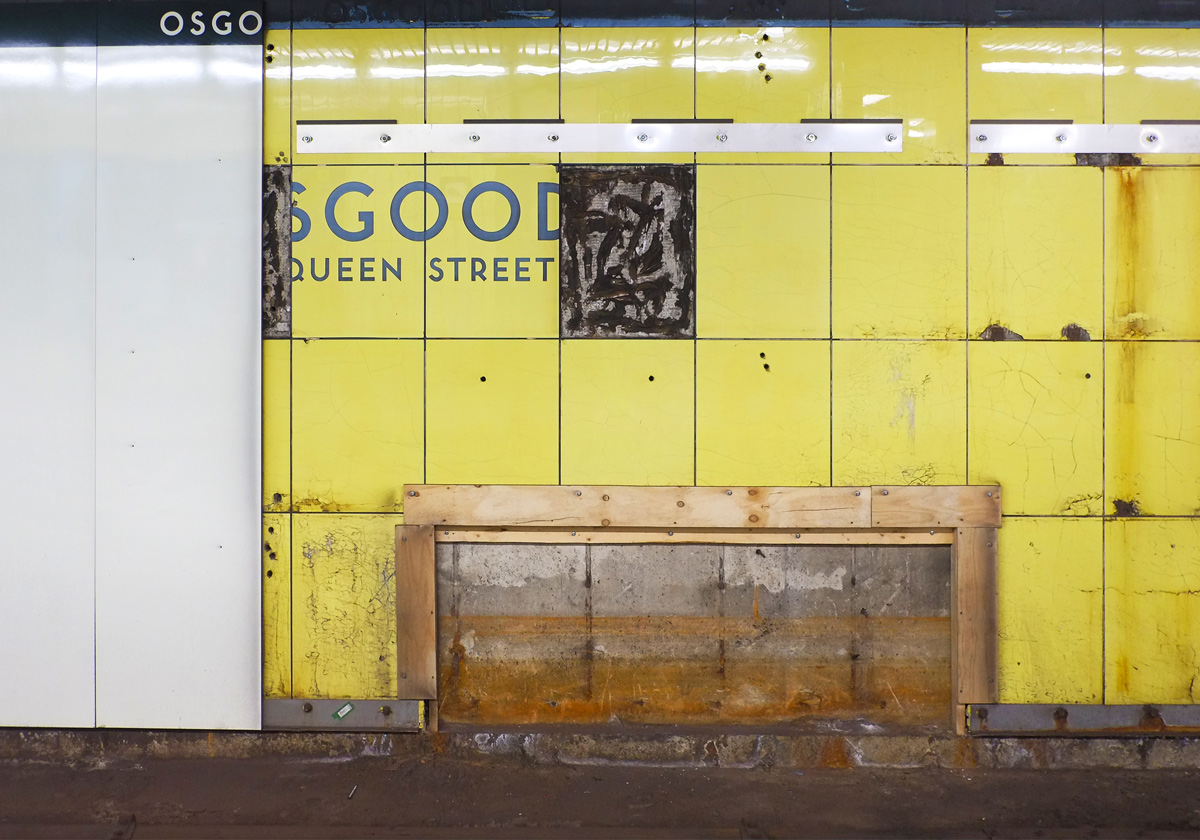
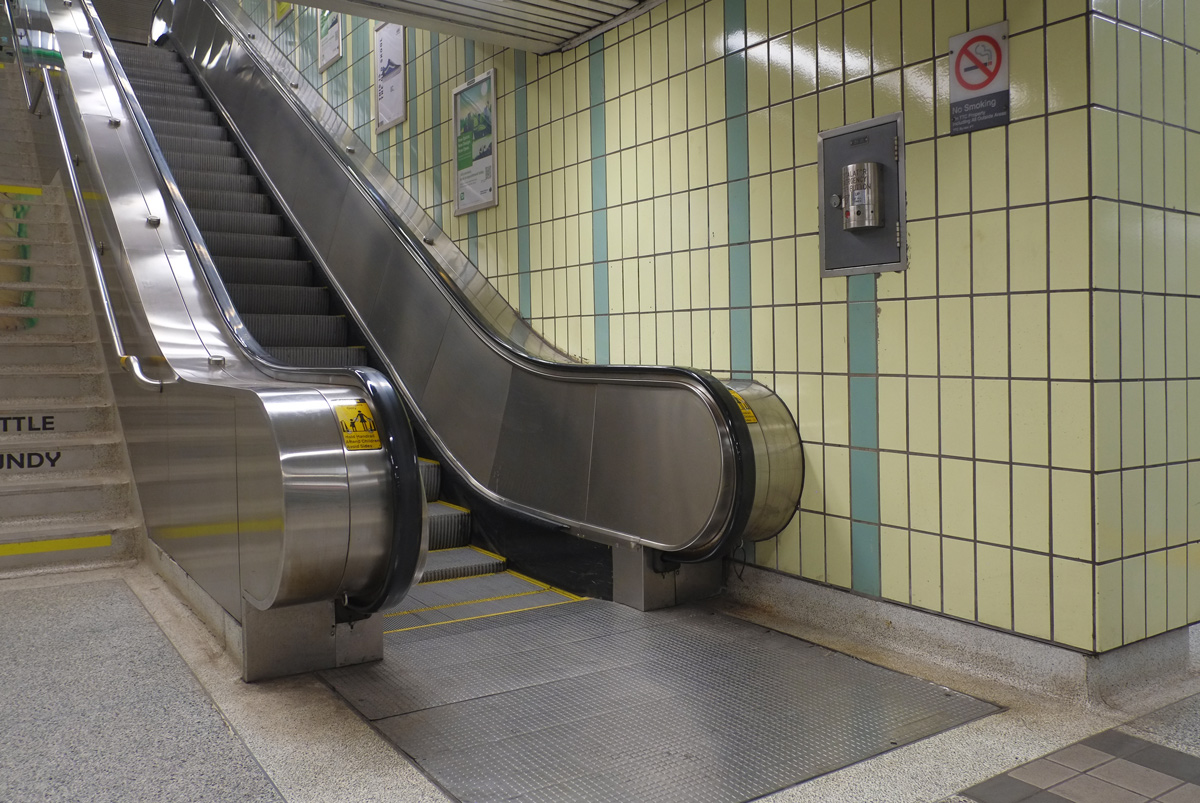
When the University Line was built in 1966, Osgoode station was yellow with greenish accents.

section of wall at osgoode subway station, original yellow tiles have been revealed when part of new white cladding was removed

Like other University Line station, it is nondescript and built with the minimum of fuss.

escalator from platform level at osgoode ttc subway station, yellow and green tiles on the walls

One could say the bare minimum

tunnel to an exit at Osgoode station, green tiles on walls, grey institutional flooring, overhead lights, exit sign at the end of the tunnel

One of the only extras that have been added to the station recently is direct access to the  Four Seasons Centre on the southeast corner.

stairs connecting osgoode subway station with Four Seasons centre

The other three corners of the University and Queen West intersection have stairwells on the sidewalks that connect to Osgoode station.   But…. I didn’t really mean to dwell on the station itself….

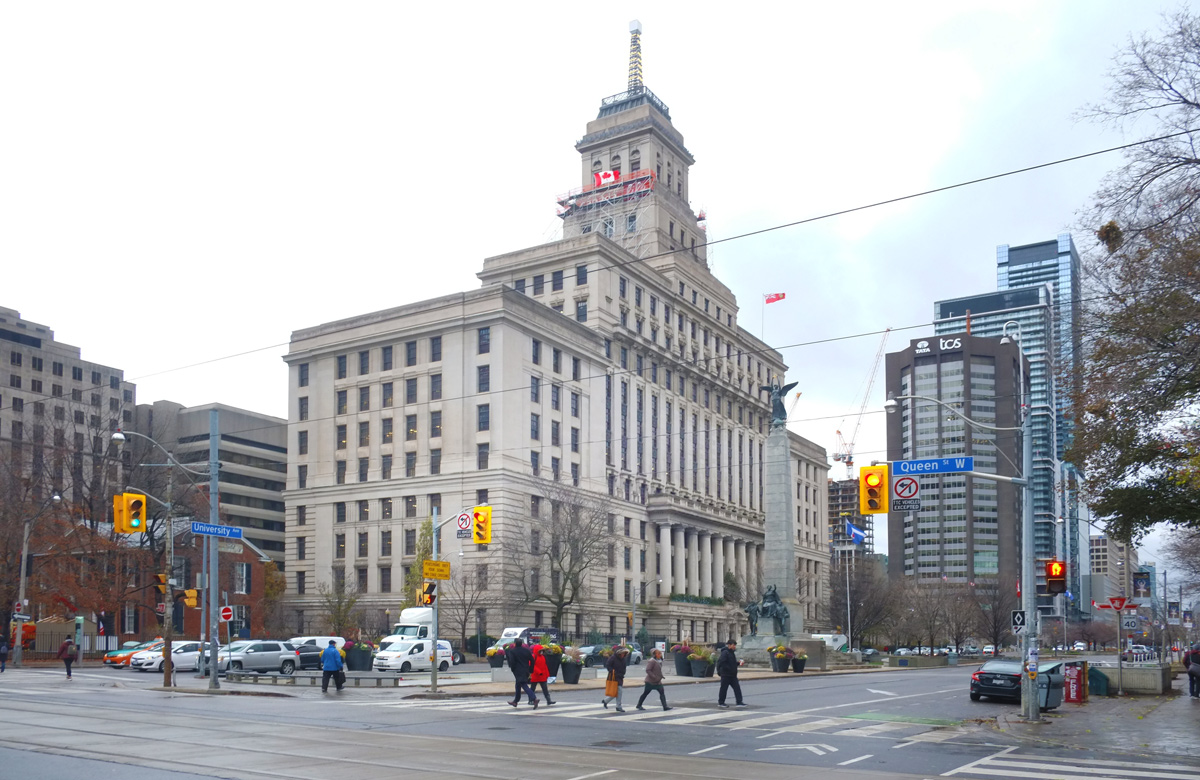
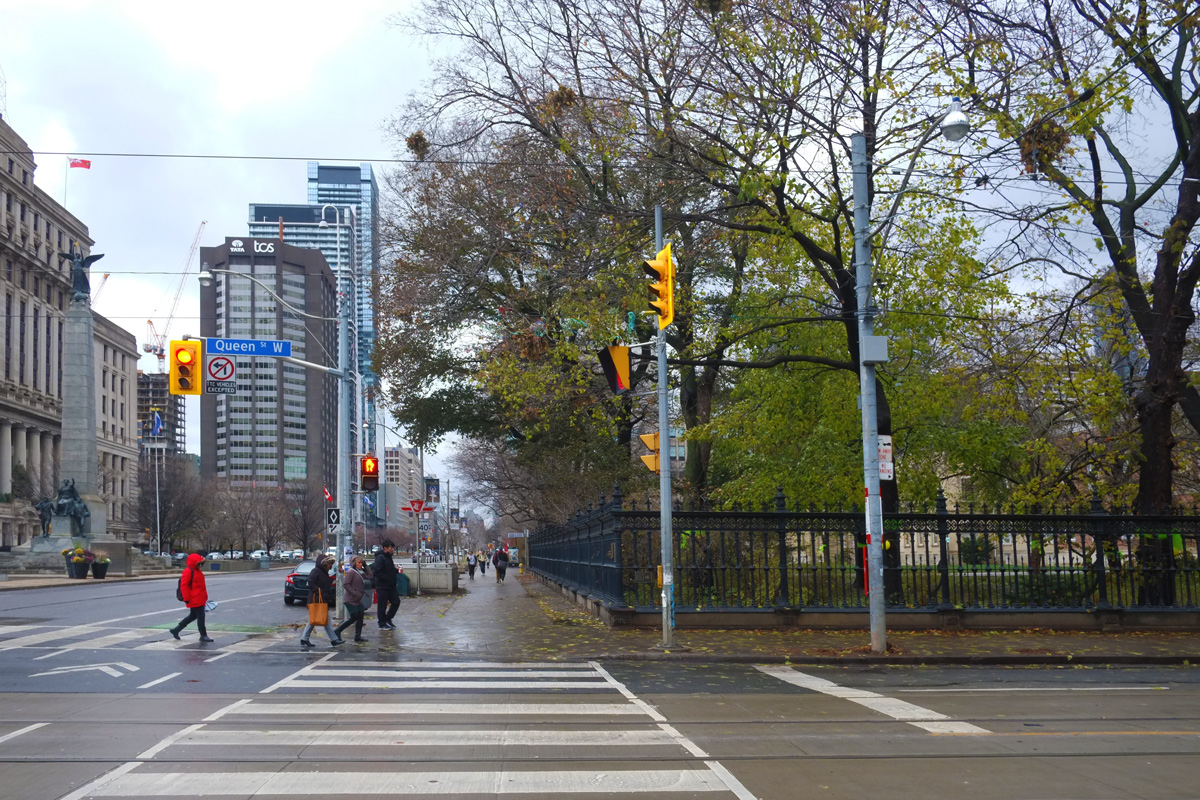
below: Canada Trust building on University Avenue
Canada Trust building on the west side of University Ave., just north of Queen, people crossing University Ave at the intersection, rainy day

I came here to document the intersection as it is now, pre-Ontario Line construction (and years of disruption!)

below: Looking north up University Avenue from Queen, east side of University (including the present subway entrance on the sidewalk – close to where the pedestrians are in the photo).

looking north up University Avenue, east side, from Queen, Osgoode law school with green grass and trees in front, surrounded by black wrought iron fence

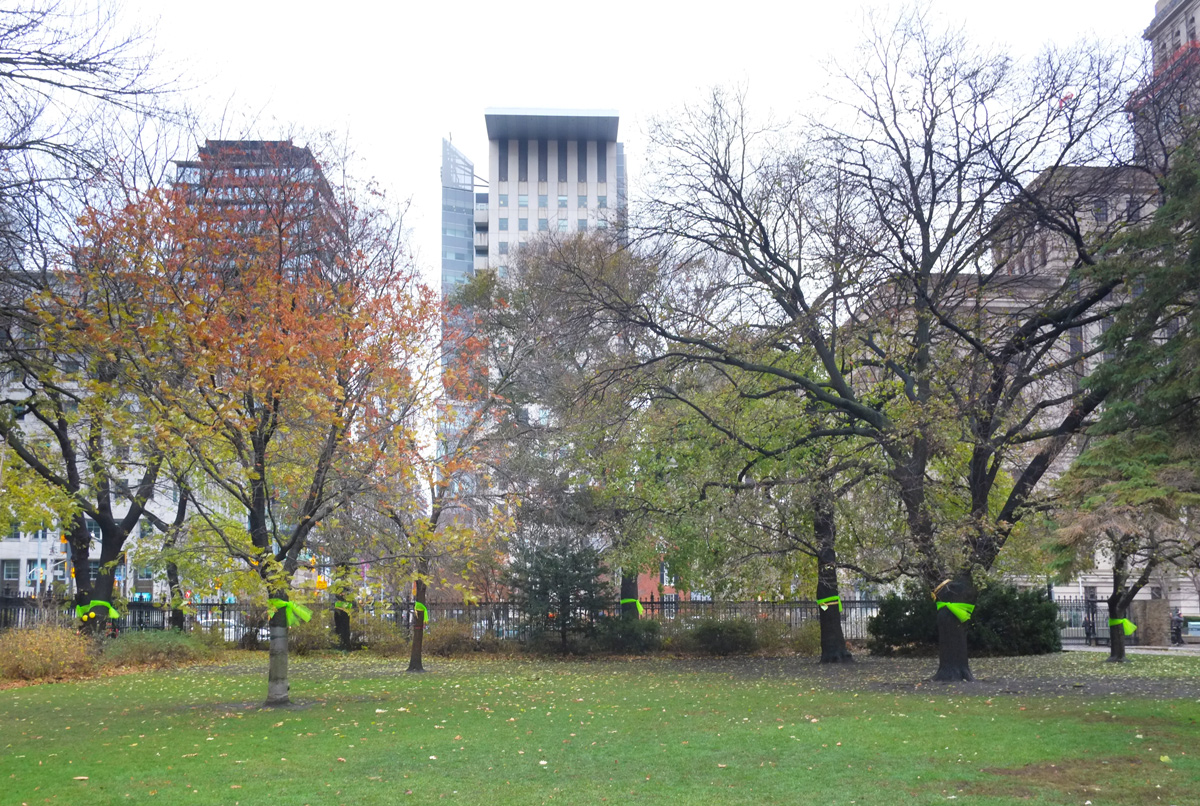
Behind the black wrought iron fence is the former Osgoode Law School (for which the subway is named).  There is public access to the grounds and it is an oasis of green and shade in the summer time.  Green ribbons have been tied around the large trees.

trees in a park, late autumn, early winter, green ribbons are tied around the large trees

… and at least one tree has been tagged as an historic tree.

a large tree trunk with a gold ribbon and green tag on it. Tag says historic tree

Metrolinx wants to build another subway entrance here.  Apparently a third-party independent review of alternative station designs is in the process but hasn’t been completed yet.  Metrolinx decided that in the meantime they’d cut down the trees on the 5th of December (this coming week) anyhow.    If you want to see one of the ideas for the plan, there are artist’s renderings on their website:   The Ontario Line – Neighbourhood Updates – Downtown – Osgoode Station.  As usual, what is pictured now is never guaranteed to be the end product!

The Law Society of Ontario is the custodian of this greenspace and they have formally objected to Metrolinx trying to short-circuit the process.

green space in front of Osgoode Hall, trees, grass, tall buildings in the background (looking south)

Yet another location to keep an eye on!


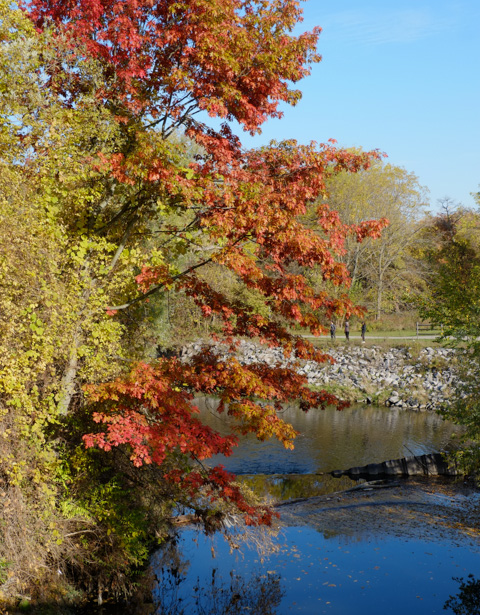
october scene, leaves on trees in different shadesof greens, yellows, and oranges, with blue water of highland creek, as well as reflections of leaves in the water

Colonel Danforth Park is located where Kingston Road and Old Kingston Road pass over the Highland Creek in Scarborough.

people walking by highland creek in october with lots of red leaves on the trees

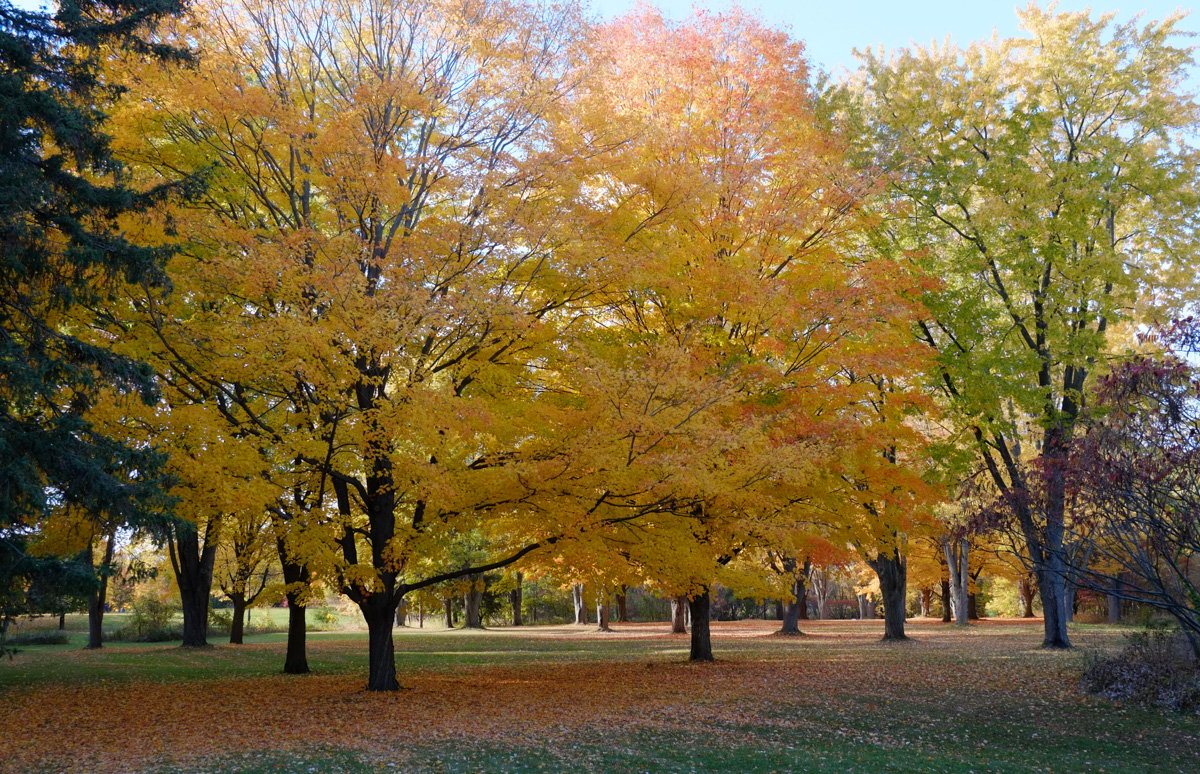
This past weekend we had some amazing warm and sunny days – great days to spend some time meandering through a park, especially this year when the autumn colours seem so much brighter and plentiful than in past years.  Is it just my imagination or have the colours have also lingered longer?

large deciduous trees with lots of orange and red leaves, october

The north part of the park merges with the grounds of U of T Scarborough campus.

bright orange and red leaves on mid si

people at univerity of toronto scarborough campus tennis courts on lower playing fields, october, trees in bright autumn colours

large group of autumn trees, with lots of leaves on the ground

birch trees in autumn, lots of blue sky too

late afternoon sun low in sky, long shadows, light through tree trunks, with lots of october leaves on the ground

october afternoon in the woods, large mature trees with lots of colourful leaves

afternoon sunlight shining through forest

three tall straight pine trees beside a path

a path through the woods in October, different coloured leaves on the trees, leaves fallen on the path

trees in the woods at Colonel Danforth park, one is dead, the others have colourful leaves, october scene

below:  Seed pods of ‘dog-strangling vine’ (or swallowwort) starting to burst.  This plant is an invasive species.  It is quite pretty at this time of year as the seeds are released and the leaves of the plant turn a silvery colour.  Unfortunately, it is a fast growing vine that quickly climbs other plants such as this young sumac tree.  It will kill that plant.

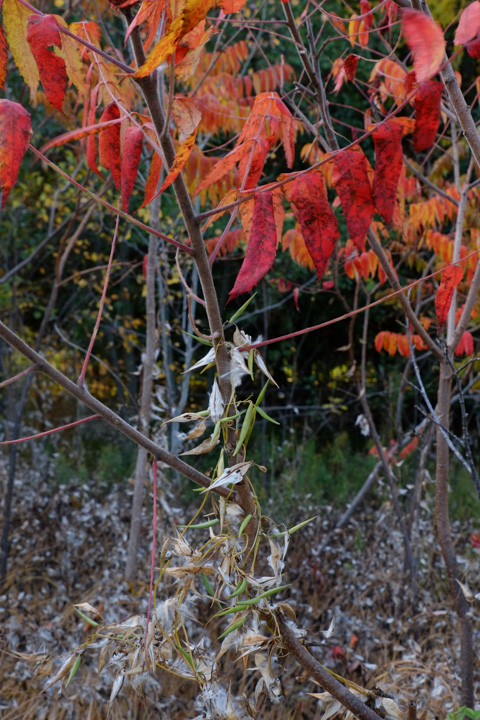
dog strangling vine growing on young sumac or sumach with red leaves

the remains of a very old tree, a broken stump, very large, beside another tree

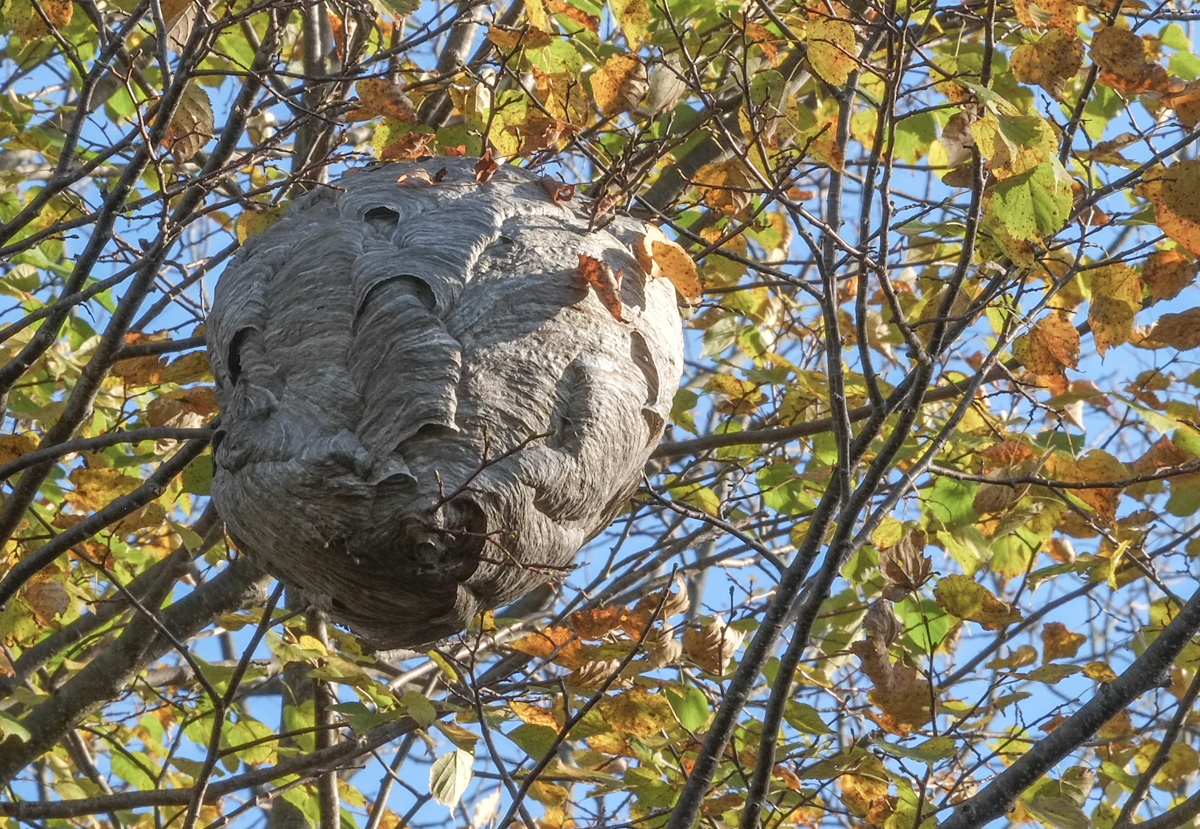
below: A wasp nest high up in a tree

large globe shaped wasp nest up in a tree

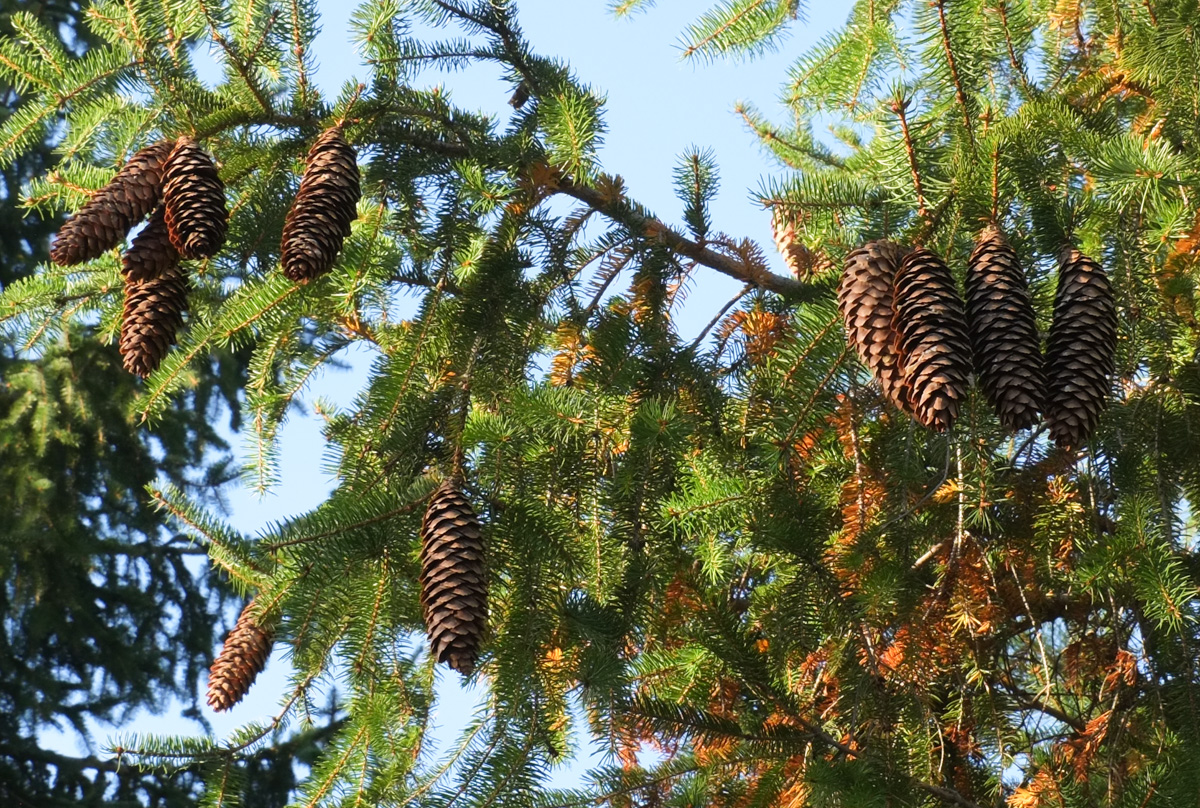
big fat pine cones growing on a pine tree

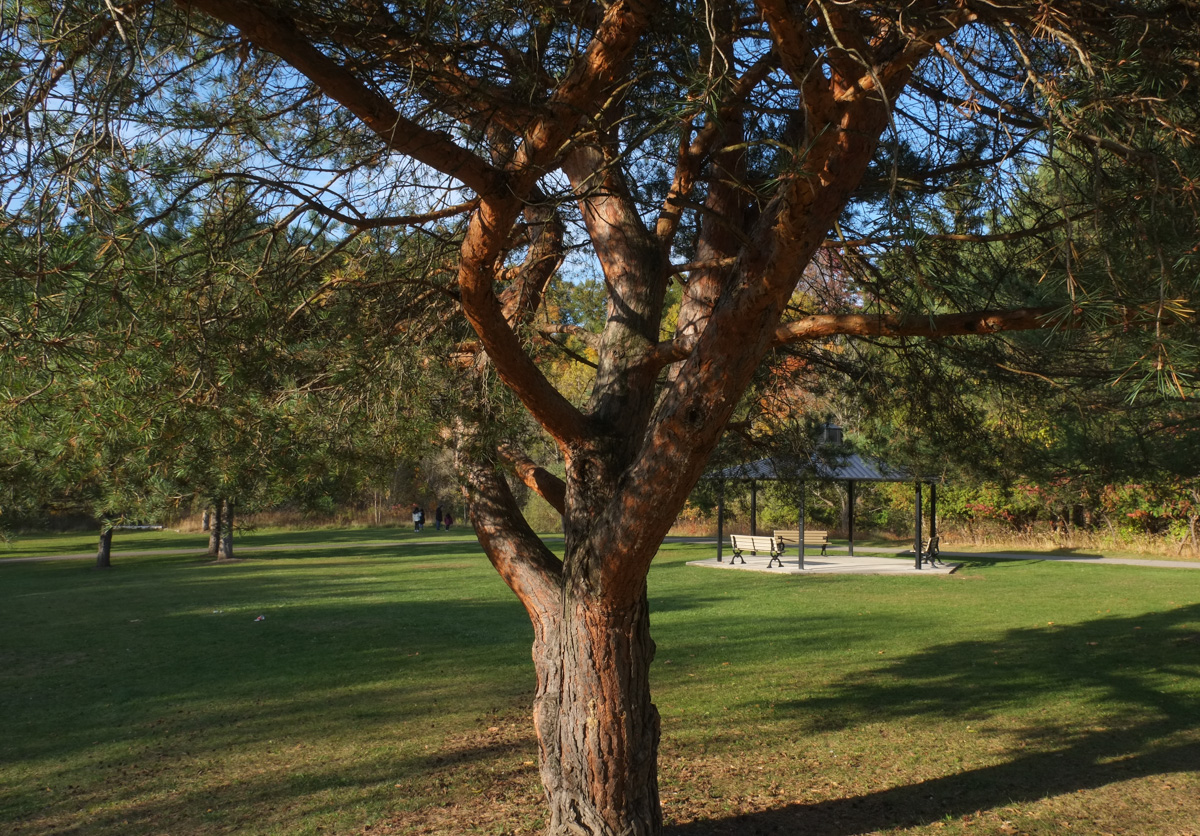
large reddish hued pine tree with gnarled trunk in the foreground, benches in the park in the background

below:  Ooops!  “Off roading” taken a bit too far.

a small plastic toy ride on truck stuck on the rocks in a creek

below: Under Kingston Road

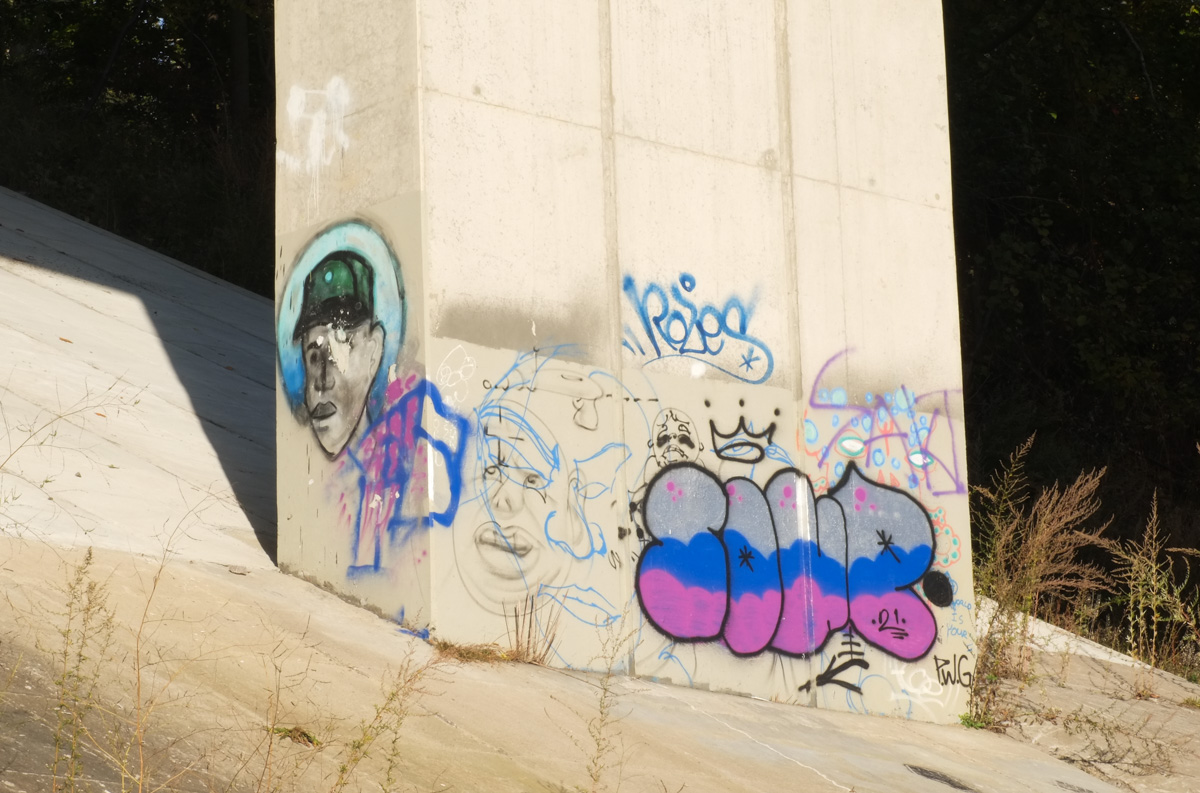
three faces, graffiti on concrete supports for a bridge. each face has black hair, one has glasses and their skin is various shades of brown

 graffiti on bridge concrete support

tall concrete supports holding up bridge, Kingston Road, over Highland creek and Colonel Danforth park

***

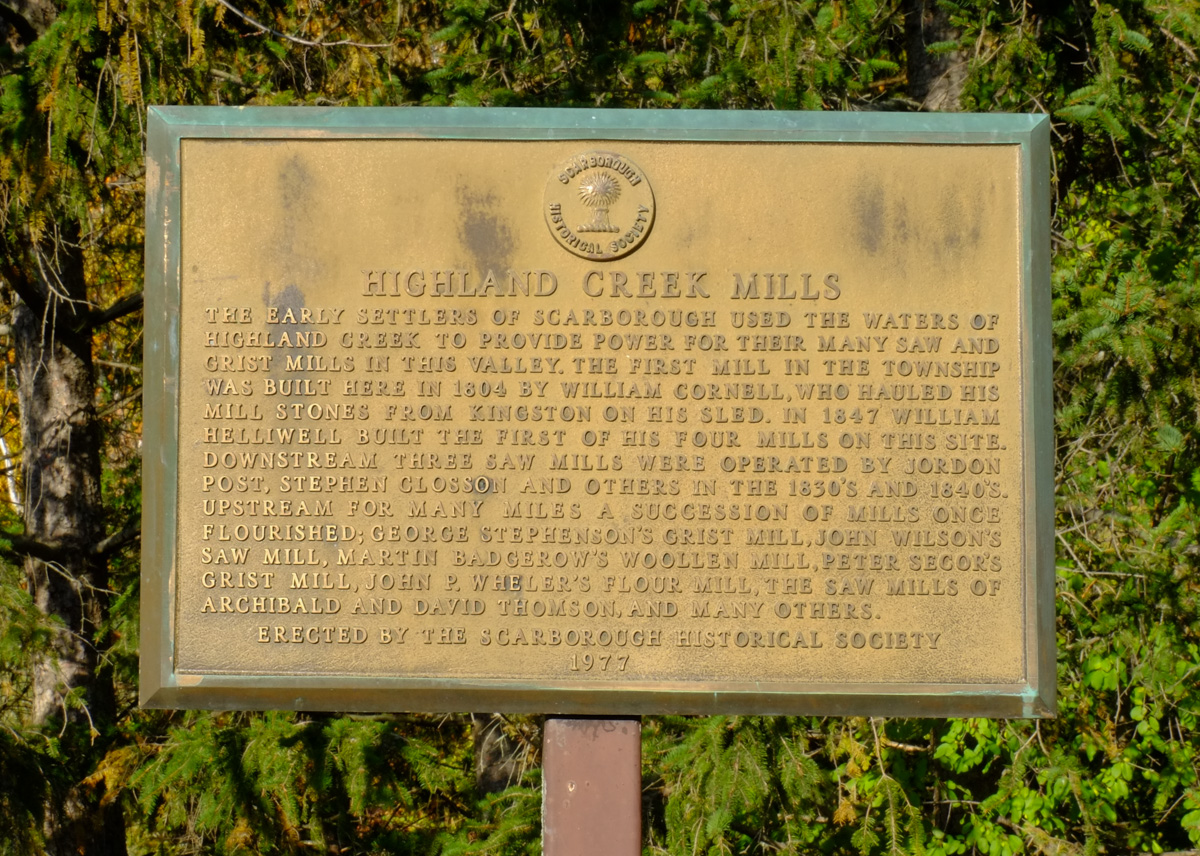
historical society plaque for Highland Creek Mills

“Highland Creek Mills
The early settlers of Scarborough used the waters of Highland Creek to provide power for their many saw and grist mills in this valley. The first mill in the township was built here in 1804 by William Cornell who hauled his mill stone from Kingston on his sled. In 1847 William Hellewell built the first of his four mills on this site. Downstream there were saw mills operated by Jordan Post, Stephen Closson, and others. …”


There have been discussions recently about the lack of washroom facilities in Toronto parks especially once the city deems summer to be over. There were no facilities that I saw on my walk but I was thankful for the porta-potty that was provided. Not the best but I have seen worse!

…at the Forks of the Don

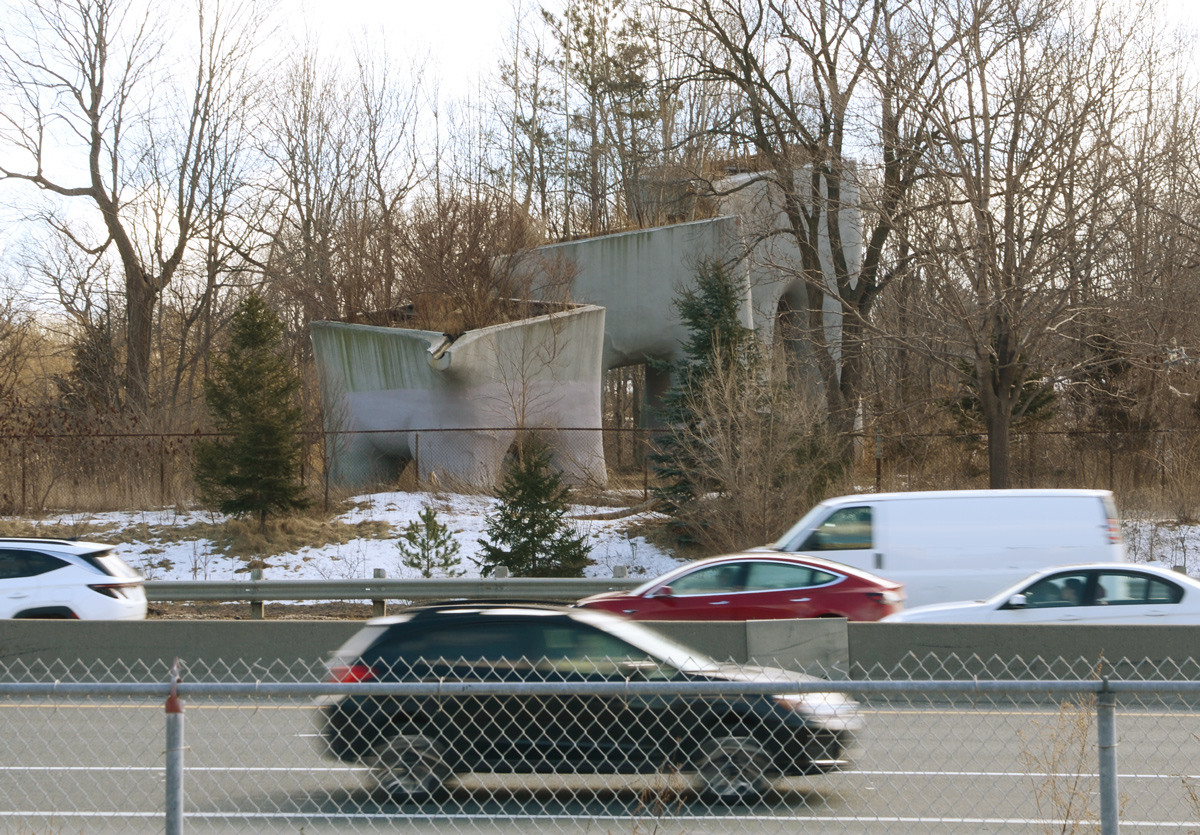
If you’ve driven on the Don Valley Parkway you’ve probably seen them, the big grey structures that look like teeth.  They are just south of Don Mills Road, on both sides of the DVP.  Over the years, the trees and shrubs have been growing around them so they don’t stand out as much as they did when they were first installed in 1998.

below: On the west side of the Parkway

an old and rusted city street sign, maximum 30 km/h begins, with elevated wetlands sculptures behind

The structures were designed by Noel Harding (1945-2016) and are constructed out of recycled polystyrene and acrylic. Financing was provided by a group from the Canadian Plastics Industry Association.

large concrete containers, planters, on a small hill with small trees, winter,

Their purpose is to help purify polluted water from the Don River watershed.

below: On the west side, the third planter stands alone, looking a bit like the back end of an elephant.

large grey planter for wetlands water purification, looks like the back end of an elephant, with four stumpy legs

large container on right with spout to concrete planter on the left, in the background, seen between the two concrete planters, an old cement bridge and a highrise apartment in the distance

below: The three concrete structures form a line on the east side of the DVP.

looking across traffic on the Don Valley Parkway to the other set of elevated wetlands sculptures

They can be accessed by following the trail that goes under the highway and follows Taylor Massey Creek.  If you follow this route, you end up walking generally east and you can walk for miles through the ravine system that runs under O’Connor Drive, through Taylor Creek Park and on to Warden Woods Park.

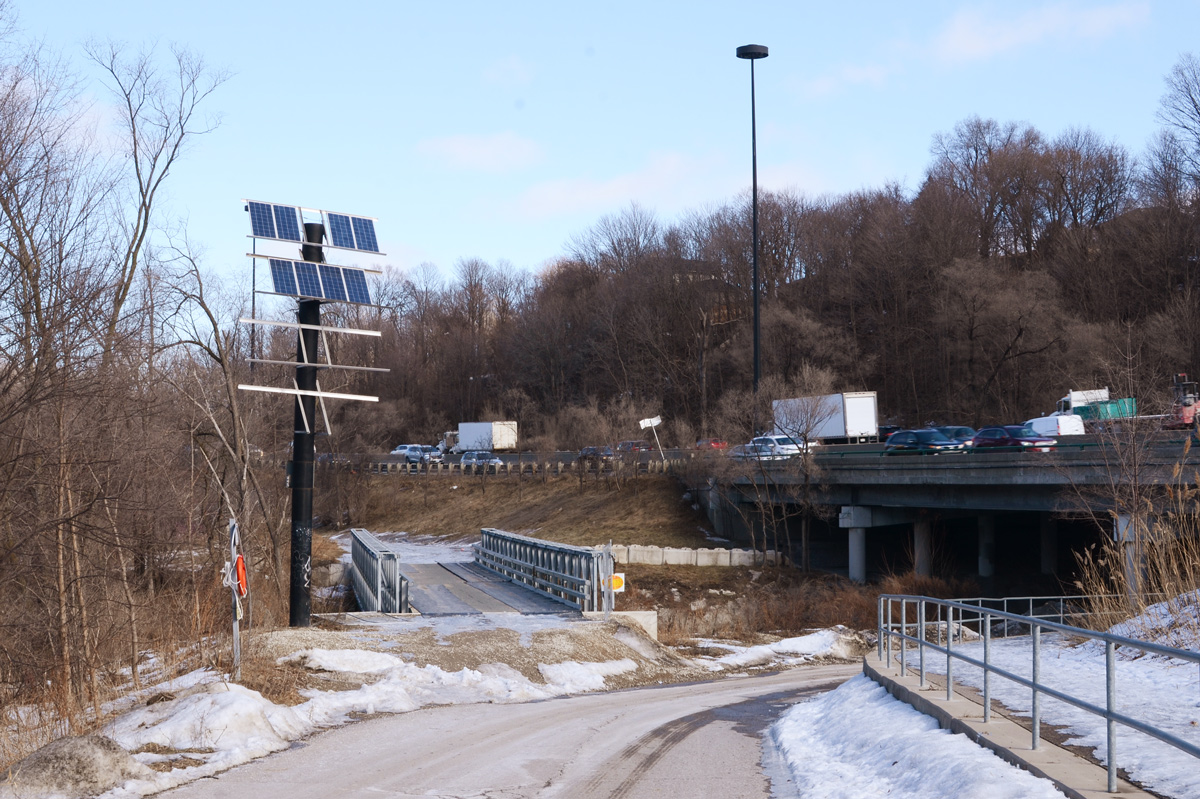
roadway curves to the right and passes under the Don Valley Parkway, traffic crossing over the bridge, winter time, snow on the ground, Forks of the Don where Taylor Massey Creek joins the Don River

Forks of the Don – where rivers come together, trails go in all directions, and even the railway passes through.

below: Stairs up to Don Mills Road and Gateway Blvd,

stairs leading up, to an apartment building, trees, winter

below: Or take the ramp that passes under Don Mills Road beside the tracks.

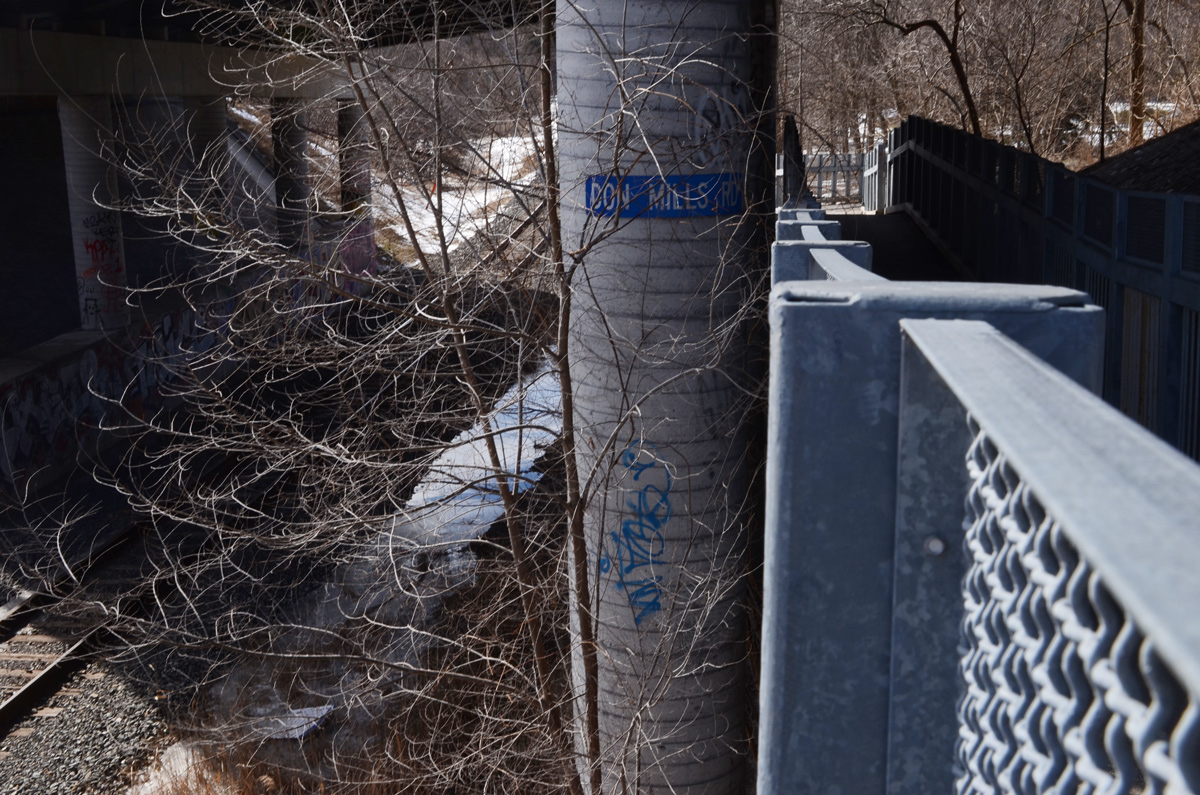
blue sign on a concrete pillar that says Don Mills Road, beside a metal ramp walkway under a bridge, Lower Don Trail

below: Looking southbound towards Union Station.

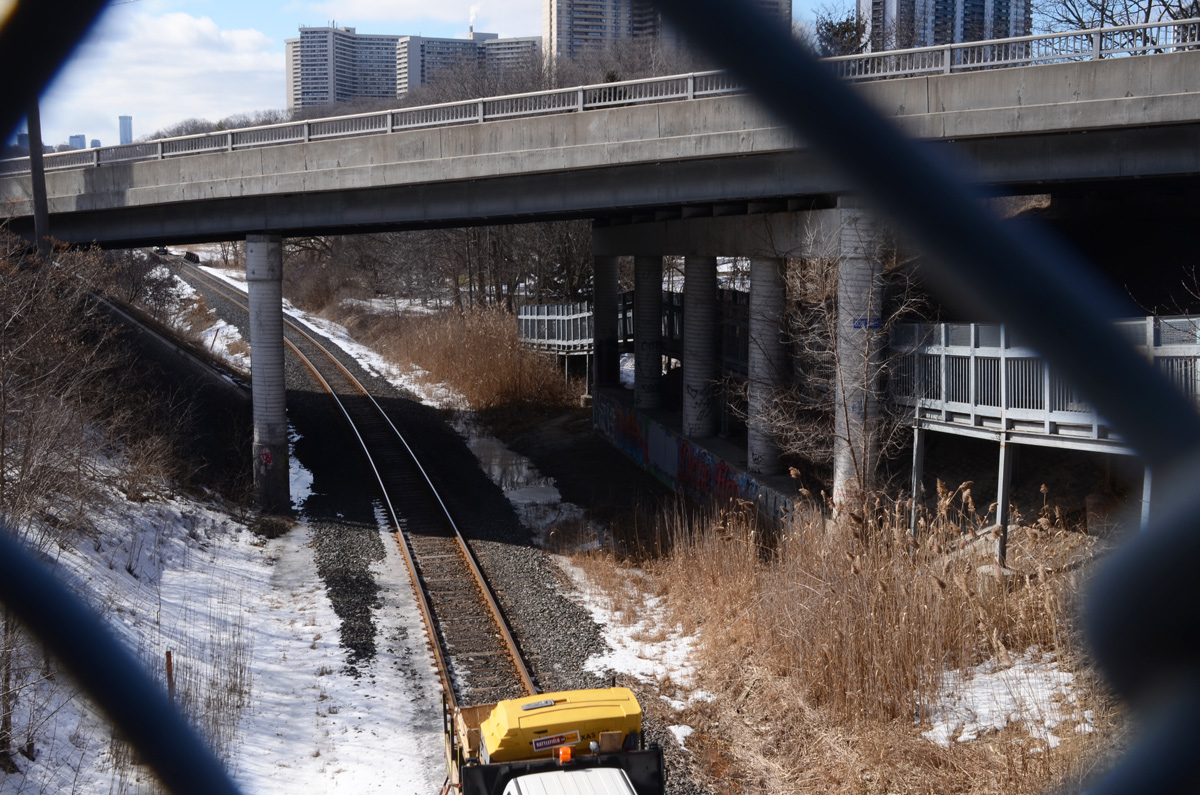
vehicle on train tracks approaching an underpass, where Don Mills Road crosses the tracks

below: From here the tracks follow the Don Valley east and then north.  They pass under Don Mills Road once more, just south of York Mills Road, before heading to Oriole GO station.

looking through gaps in a chainlink fence, a railway vehicle on the tracks below, looking eastward from Don Mills Road, apartment buildings in the background

below: This part of the Lower Don Trail really is a nexus, or hub, in the ravine path system.  Trails also lead northwest to the Science Center and Wilket Creek Park.

three people walking across a snow covered park towards highrise buildings

below: Choose kindness

colorful sticker on metal railing, lots of one eyed faces with big teeth on the back of a van with words choose kindness

heart painted on metal rail, graffiti, left side is red and right side is blue

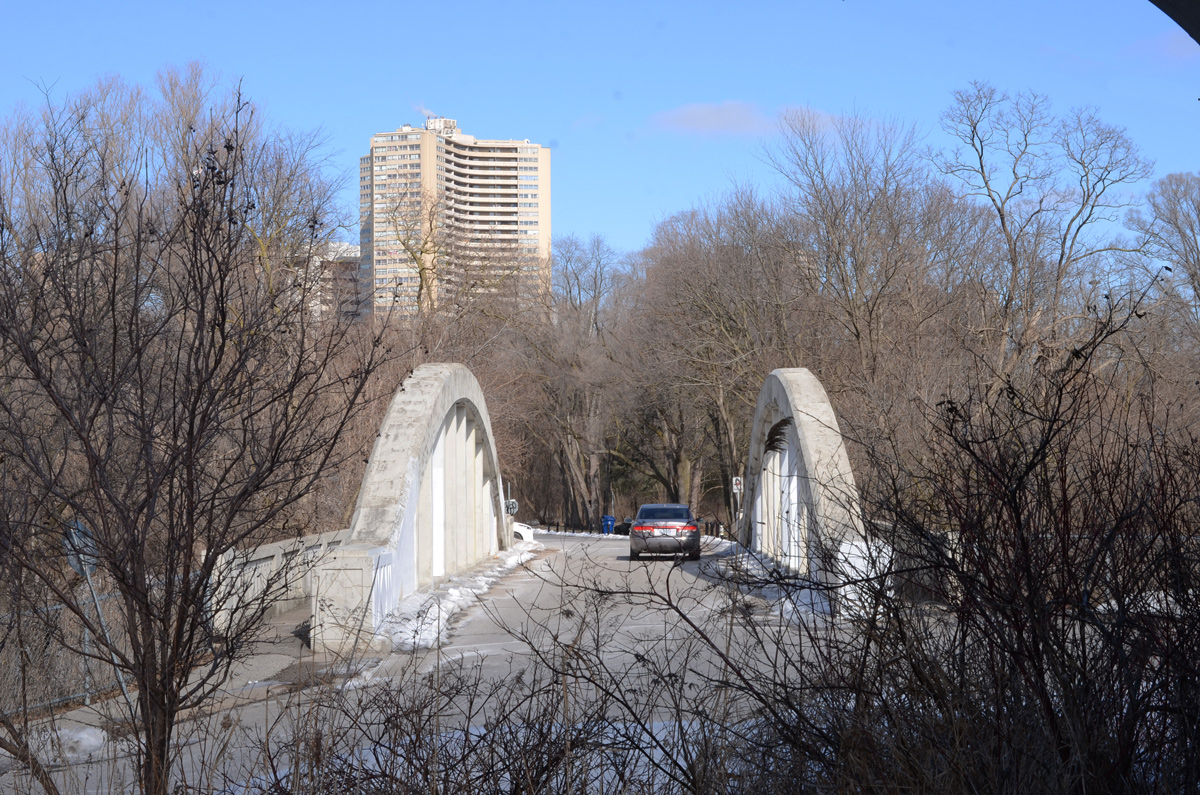
a car drives over an old semi circular concrete bridge over the Don River, Gateway Blvd apartment building in the background

road bridge, concrete, above a river with a parth beside the river. Rusted metal railings on both sides of the path, green metal beams under the bridge, winter, sone snow, no leaves on the trees, Lower Don Trail, under Don Mills Road

below: “Passage”, an art installation by Labspace Studio under the Don Mills Bridge – part of the PanAm Path project.

public art under a bridge, halves of red canoes appear to come out of the wall, 8 of them in a line

below: Southward on the Lower Don Trail where you can walk all the way to Lake Ontario.

lower don trail, looking south, with DVP on one side and trees on the other, apartment building in the background.

below: If you are interested, this is a map of the PanAm Path, one of the projects from when the PanAm games were hosted here in Toronto in 2015.  The Forks of the Don is in the center by the pink X.  Something to consider exploring in the spring!?

city of Toronto map of the PanAm Path that crosses the city.

*****
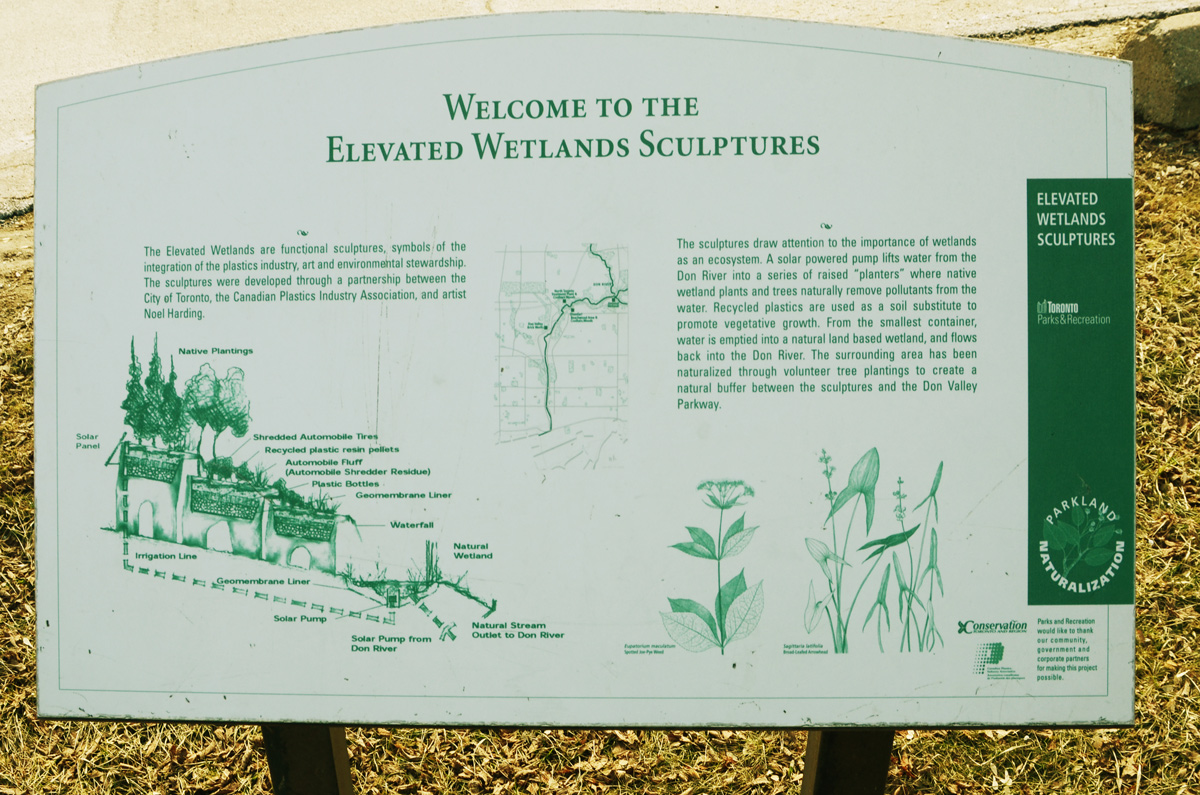
plaque describing the elevated wetlands sculptures

“The elevated wetlands are functional sculptures, symbols of the integration of the plastics industry, art and environmental stewardship. The sculptures were developed through a partnership between the City of Toronto, the Canadian Plastics Industry Association, and artist Noel Harding.”

“The sculptures draw attention to the importance of wetlands as an ecosystem. A solar powered pump lifts water from the Don River into a series of raised “planters” where native wetland plants and trees naturally remove pollutants from the water. Recycled plastics are used as soil substitute to promote vegetative growth. From the smallest container, water is emptied into a natural land based wetland, and flows back in to the Don River. The surrounding area has been naturalized through volunteer tree plantings to create a natural buffer between the sculptures and the Don Valley Parkway. “


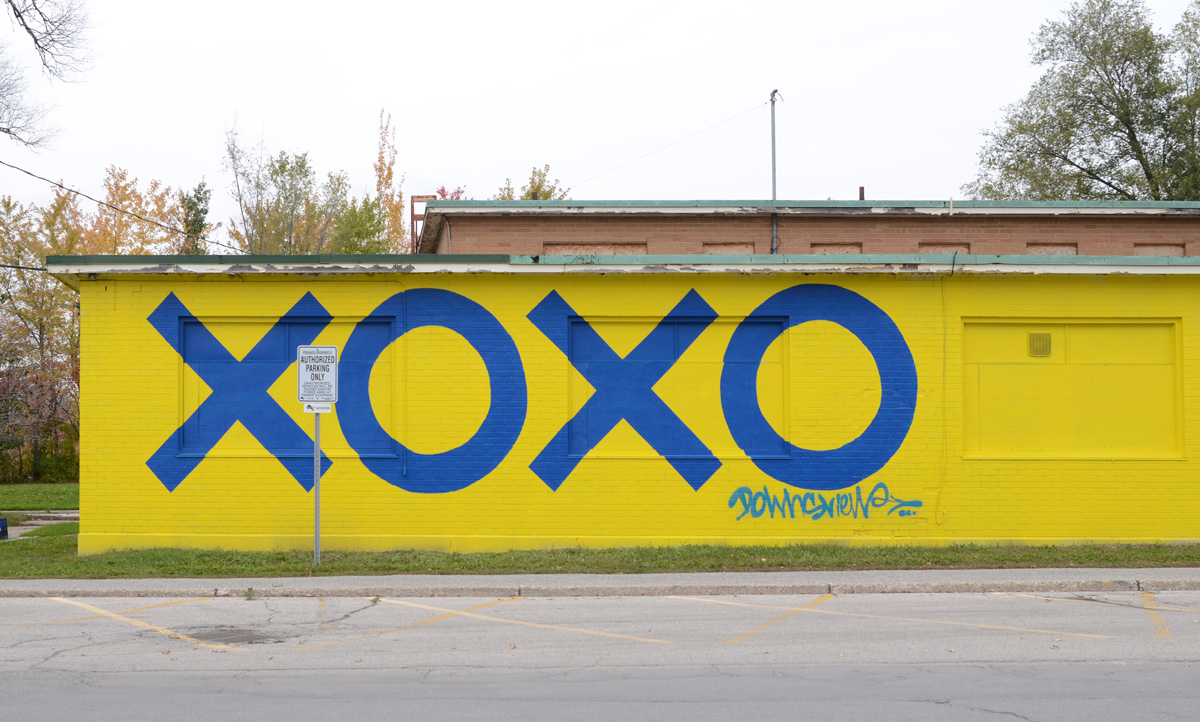
mural, blue letters on yellow, XOXO Downsview

below: Ulysses Curtis mural by Danilo Deluxo McCallum.  Curtis (1926-2013) played for the Toronto Argonauts football team in the 1950s.  He was considered to be the first black player on the team.

mural, black man with helmet and shoulder harness straps

The Downsview area and airplanes have been linked since the late 1920s when land here was being used for airfields—Barker Field, the Canadian Express Airport and the Toronto Flying Club.  In 1929 de Havilland Aircraft of Canada purchased 70 acres of farmland along Sheppard Avenue West.  In the mid-1950s de Havilland moved its operations to newly constructed modern facilities to the southeast.  De Havilland Canada was sold to Boeing in 1988 and then to Bombardier in 1992.

below: Bombardier facility and GO tracks on the east side of the park.   Downsview Park station at the north end of the park connects the GO system with the TTC’s Line 1.

Bombardier facility beside GO tracks in Downsview

In 2017, the Sesquicentennial Trail was developed on part of the site.  Sesquicentennial means 150 years, as in Canada was 150 years old in 2017.

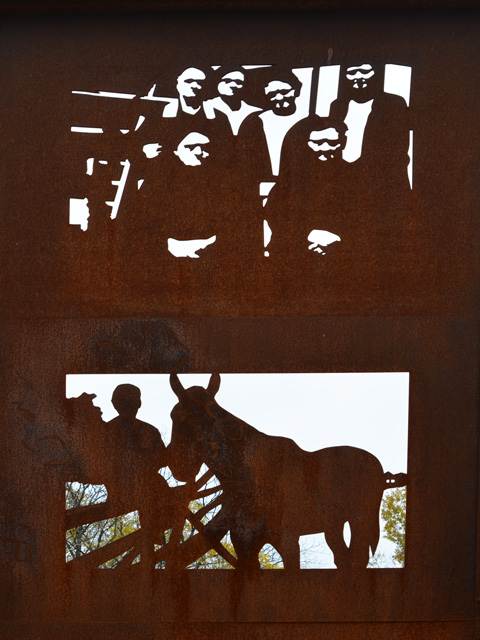
below: The North Plaza of the trail features a semi-circular wall of rusted steel with cutout silhouettes of real historical photographs showing various people, buildings, and airplanes that was designed by John Dickson.

rusted metal art installation with sections of wall with cutout pictures, airplane windsock in front

part of an art installation, rusted metal with cut out pictures, cut out words that say danger low flying aircraft stop until clear

two pictures cutout of rusted metal

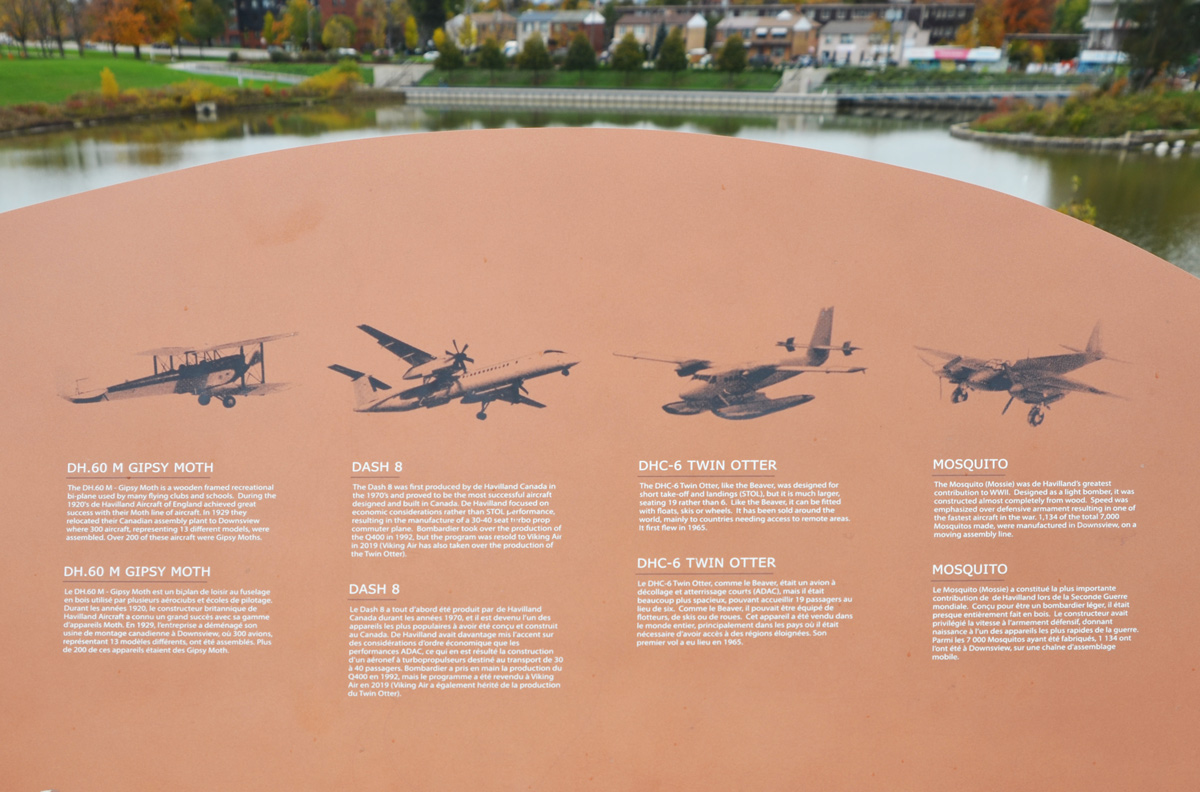
Small models of four of the aircraft built by DeHaviland ‘fly’ over the trail – the DH.60 Gipsy Moth, the Dash 8, the DHC-6 Twin Otter, and the Mosquito.   They cover years of both DeHaviland and aircraft history from the bi-winged Moth in the mid-1920’s to the turboprop Dash8. The later was developed in the early 1980s and is still in production today.

plaque describing 4 of the types of aircraft once produced in Downsview, DH.60 Gipsy Moth, the Dash 8, the DHC-6 Twin Otter, and the Mosquito

two model airplanes on pillars, look like they are flying above a pond, park, and new apartments under construction

below: High overhead, a DHC-Beaver, a bush plane developed in 1947 here at Downsview.

large metal flat silhouette of beaver airplane on tall metal poles as public art in a park

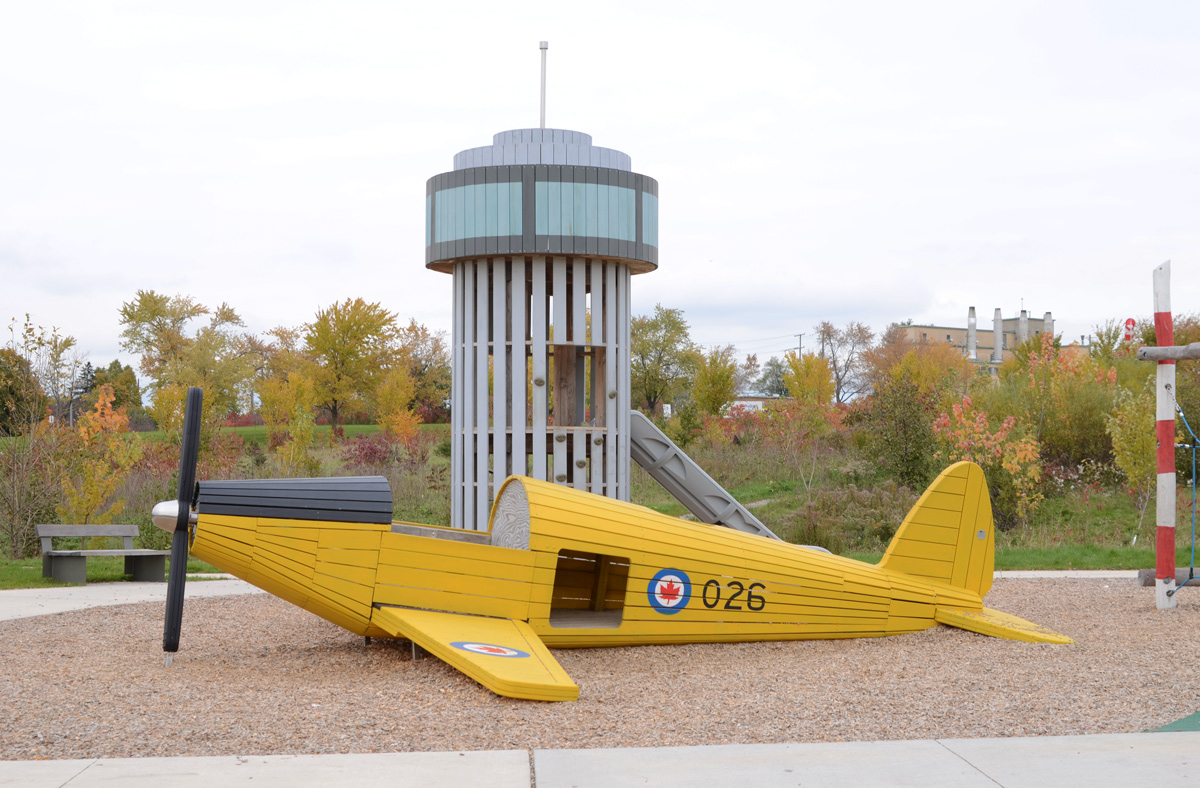
Grounded! But still great for child’s play.

playground at Downsview Park, yellow wood airplane on ground with pretend control tower

Hundreds, and probably thousands, of trees have been planted on the site.

two red muskoka chairs near the top of a hill, overlooking the trees in the valley below

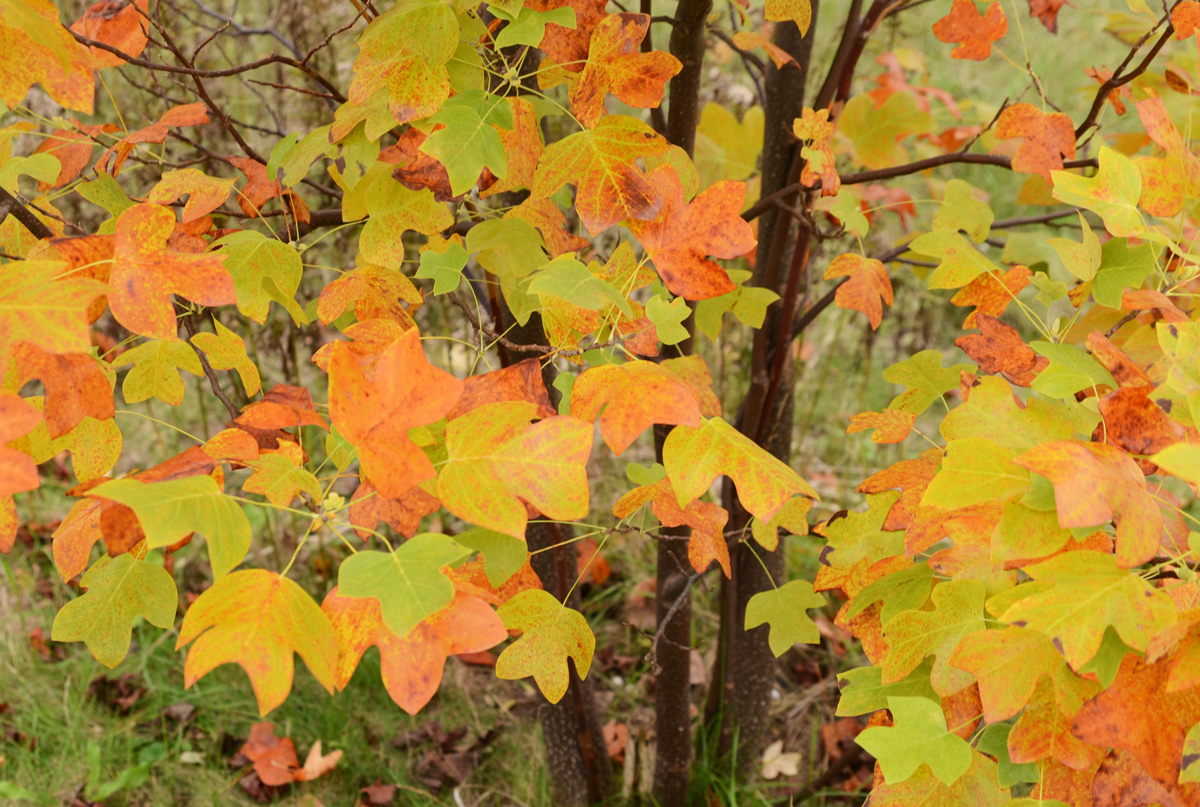
below: Tulip tree

autumn colours on a tulip tree

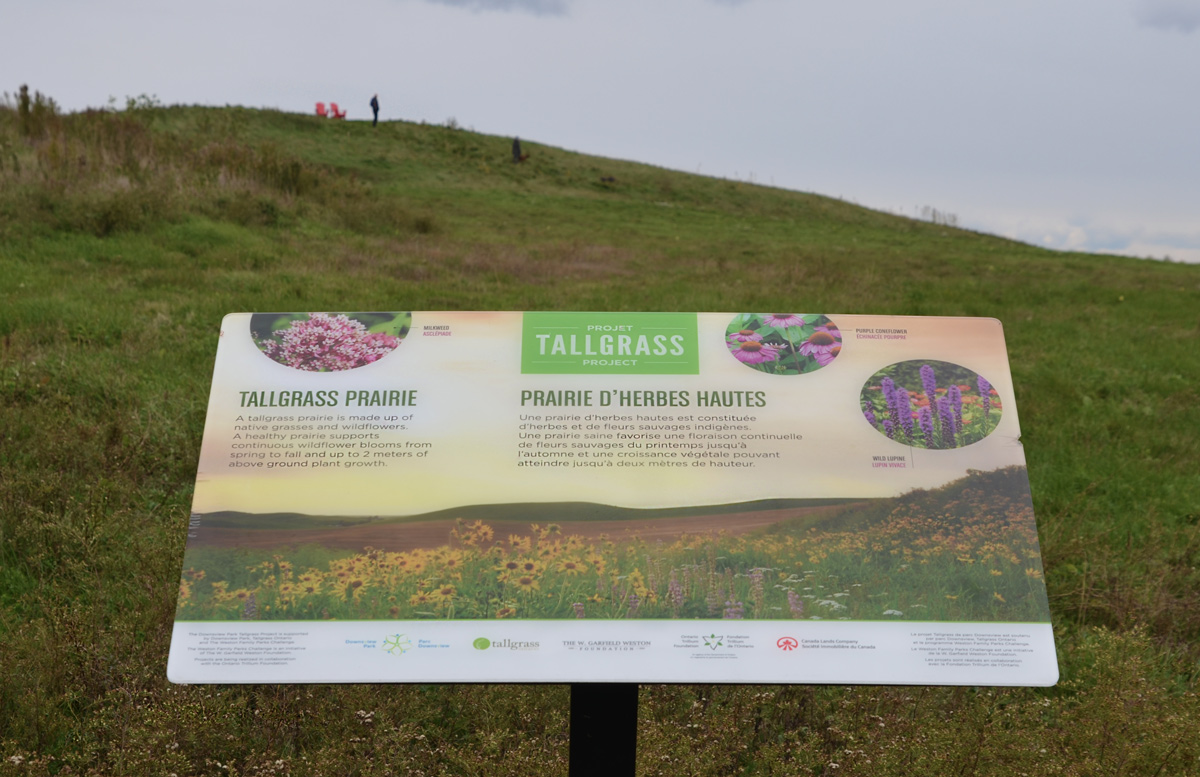
below: Other areas have been set aside for native grasses and wildflowers such as milkweed, purple coneflower, and wild lupine.

plaque at donswview park describing tallgrass prairie and three of the plants that grow there

below: There is a large hill in the park and this is the view to the southwest from there.

Downsview view from hill in the park, looking southwest over a path, some apartment buildings, and rest of Toronto skyline

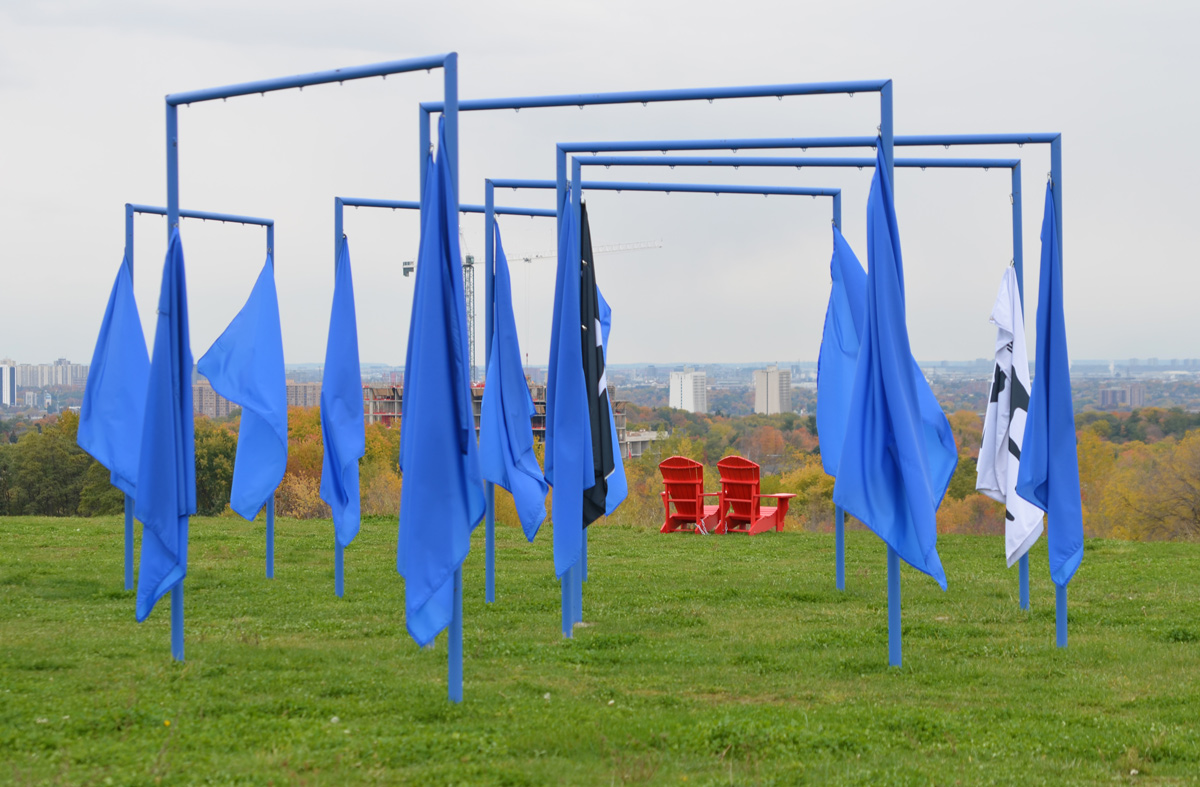
below: At the top of the hill stands an installation of blue flags along with two of the many red muskoka chairs scattered around the park.   This is “Wind Rose” by Future Simple Studio. This picture doesn’t show it very well but at the northwest corner, two of the flags are not blue – one is black and the other white (black for west and white for north).  These two flags, “The Turtle and the Traveller,” were designed by Mi’kmaq artists Chris and Greg Mitchell.   They are best seen when the wind is blowing!

blue flags hanging from poles, art installation at Downsview Park

maple leaves in autumn

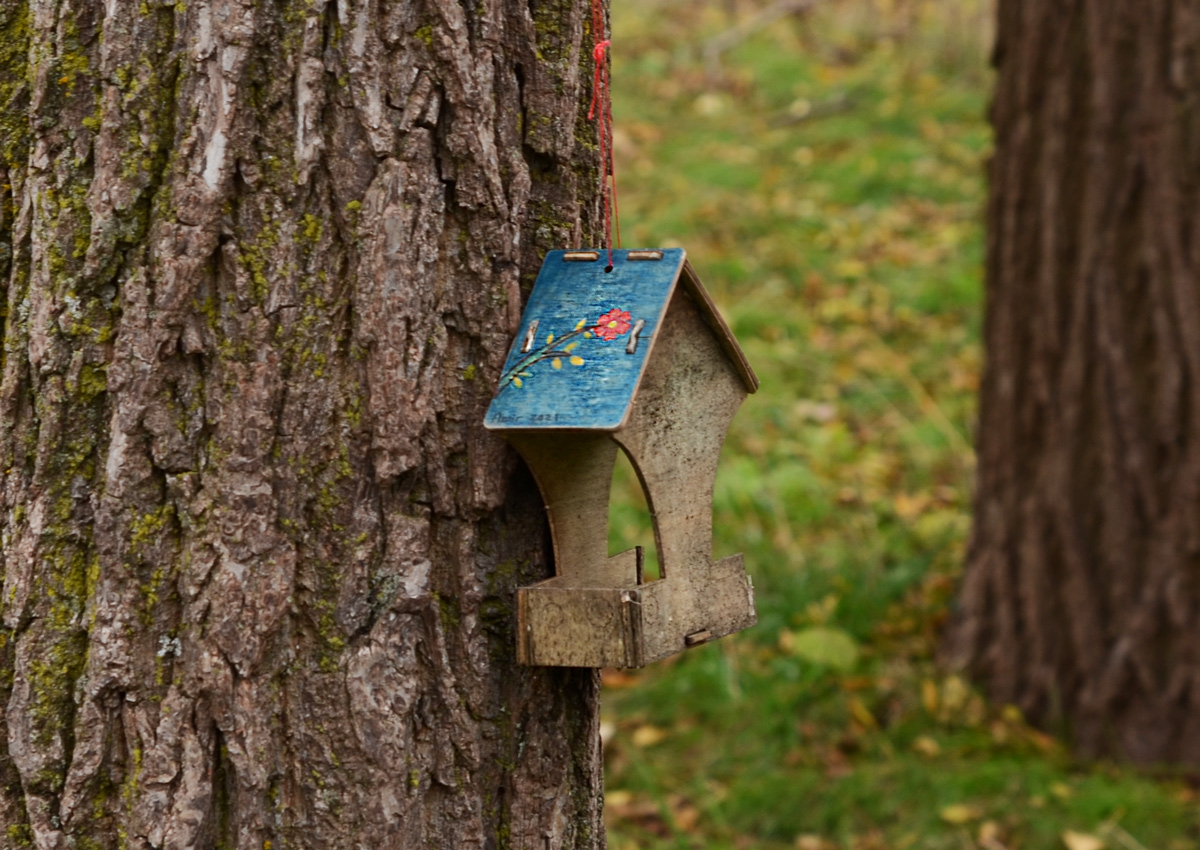
small bird feeder on a tree, with a blue roof with red flower painted on the roof

Downsview has also been associated with the military.  In 1937, the Royal Canadian Air Forces expropriated portions of the site to establish the RCAF Station Downsview.  The site once had two residential areas with barracks – one for the enlisted soldiers and their families and another for the commissioned officers and their families.  Over the years the base expanded to include the original de Havilland lands.  In the 1960s, the military expropriated the lands adjacent to the Downsview Airport and closed 2.5 miles of Sheppard Avenue between Dufferin and Keele Streets.  That is why Sheppard Avenue swings north around what is now Downsview Park.

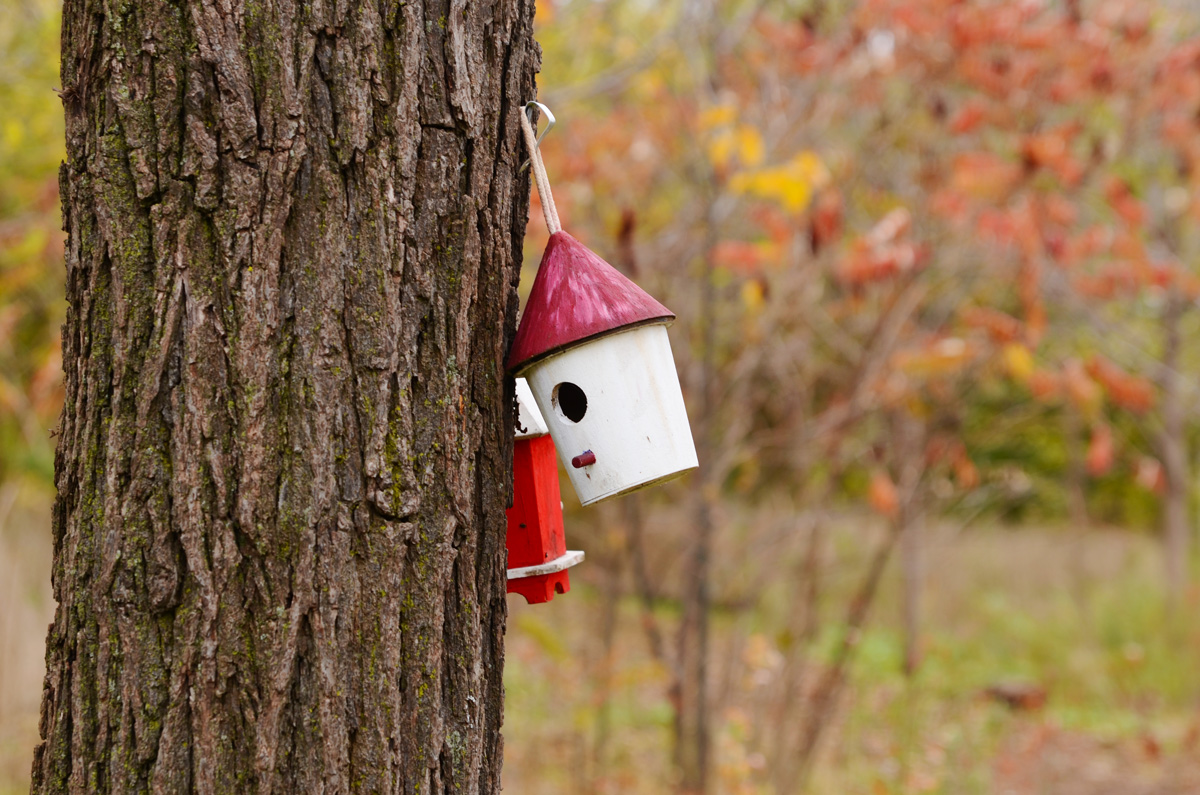
two small bird houses hanging against a tree, white round one with red conical shaped roof

In 1996 CFB Toronto officially closed.  Parc Downsview Park Inc. was established in 1999 to build and operate Downsview Park but administrative control over the land wasn’t transferred to the Park until 2006.

very red crimson maple leaves in fall

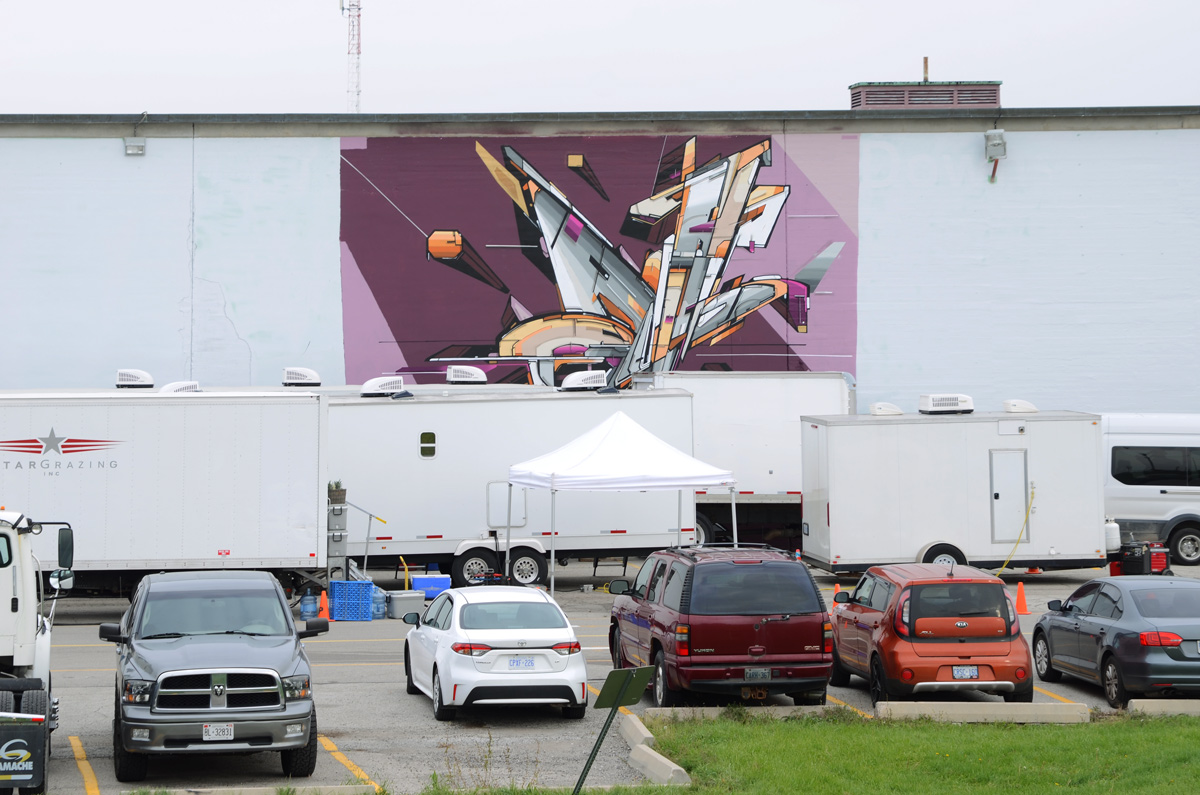
below: ArtworxTO Hub North with a mural by Mediah.  At the time, the site was being used by a film crew.

mediah mural at arthub at Downsview park

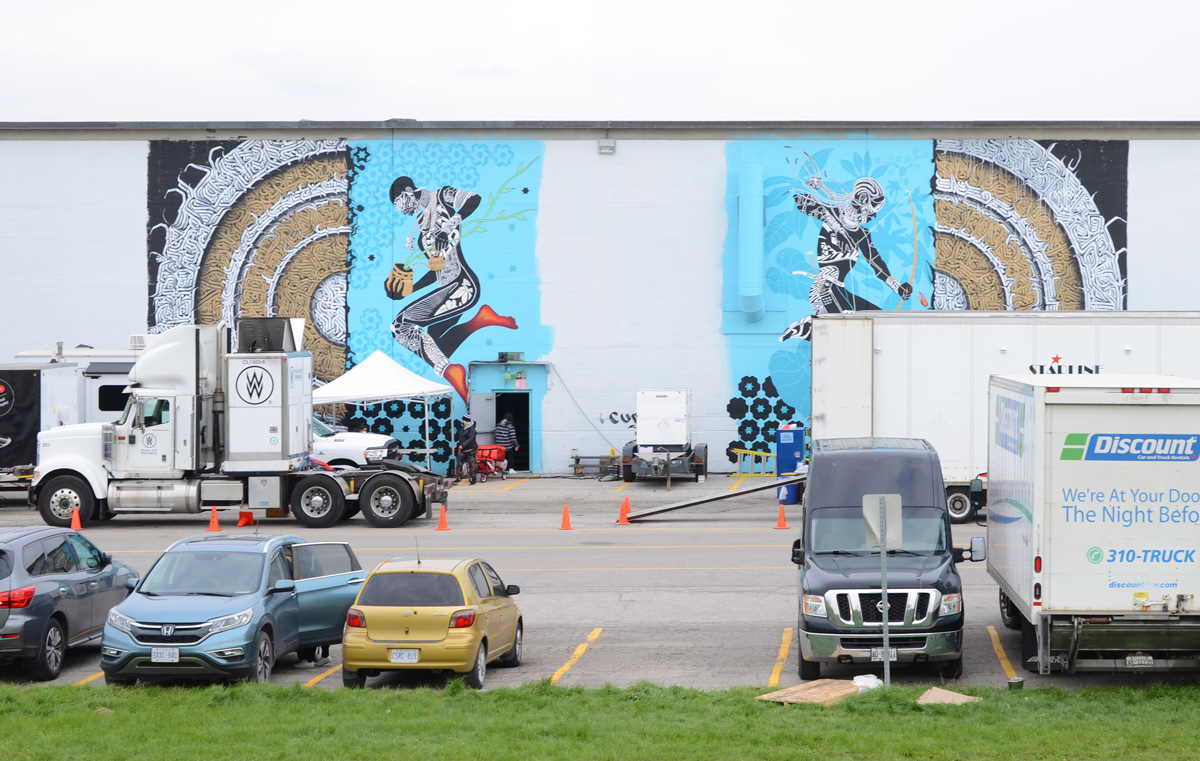
below: Another mural on the exterior of the ArtworxTO Hub building.  This one was painted by Kreecha.
mural at arthub at Downsview park

stickers on the back of a dark coloured car, robots shooting at stick figures, The Empire Doesn't Care about your stick figure family