Archive for the ‘history’ Category

Last Folio, A Living Monument to the Holocaust
An exhibit of photographs by Yuri Dojc,

at the Art Gallery of Ontario

Yuri Dojc was born in Slovakia but is now based in Toronto.
Starting in the 1990’s he has returned to Slovakia a number of times in search of traces of Jewish life from prior to WW2.

a close up of a photograph of an old book, open, with the pages on one side all curled up.   The photo is taken from the top of the book.

Details of one of the photographs in the exhibit.

There are only eight photographs in this exhibit but each one tells a story.   Narratives of loss and of life interrupted.
But also stories of memory and remembrance.

 More information about the Last Folio project.


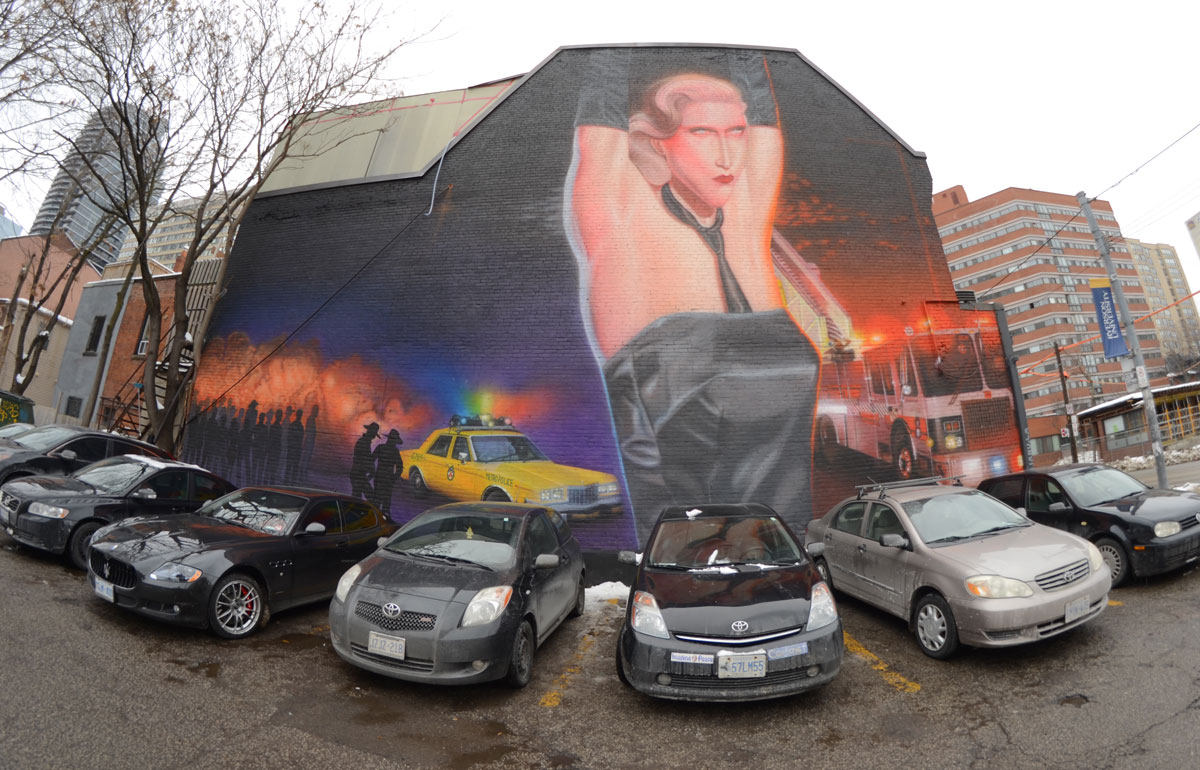
The Bathhouse Raids by Christiano De Araujo is a mural on Church Street just south of Carlton.
Completed in the fall of 2013, it was the largest of the Church St. Mural Project pieces commissioned for WorldPride 2014.

The following photos were taken with a very wide angle lens
because of the size of the mural and because there are always cars parked in front of it.

large mural on the side of a building.  A number of cars are parked in front of it.  The mural depicts the bathhouse raids, an event in Toronto's history where police raided gay bath house and arrested those they found inside.  A yellow Toronto police car, a fire truck with its lights on are both in the picture.  An oversized person is in the center, hands held over her/his head.

On the 5th of February, 1981, Toronto police raided four bathhouses in what was known as ‘Operation Soap’.
Around 300 men were arrested.  Most charges connected to the incident were eventually dropped or discharged, although some bathhouse owners were fined.

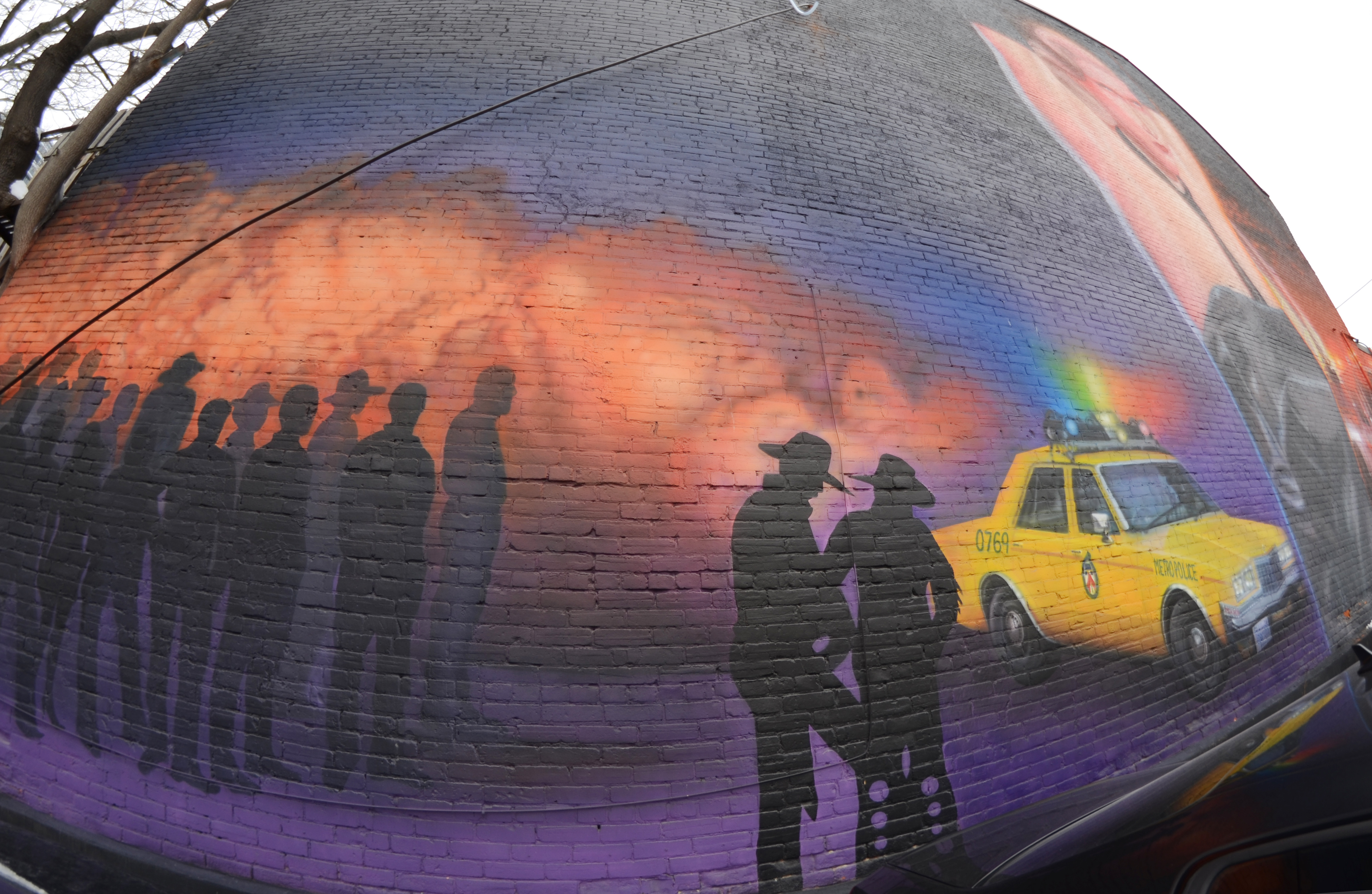
part of a large mural showing a yellow Toronto police car from the 1980's, a couple of policemen and a crowd of men standing just back of the police car

part of a large mural showing a yellow Toronto police car from the 1980's, a couple of policemen and a crowd of men standing just back of the police car

The event marked a major turning point in the history of the LGBT community in Canada.
The raids led to protests – the night after the raids, 3,000 people marched on 52 Division police headquarters and on Queen’s Park, smashing car windows and setting fires.  That spring the city held its first Pride Parade.

right hand side of the bathhouse raid mural on Church St. showing a firetruck with its red flashing lights on

Along Dundas St. West between Islington and Kipling there are a series of more than twenty murals that depict scenes from the history of the area. 

In 1793, Simcoe’s Queen’s Rangers cut a route through the forest for Dundas Street.  It was meant to serve both as a military route in case of war with the U.S. and as a route to increase settlement in the area.   Settlement of what became the village of Islington began a few years later with the arrival of the Johnston family in 1808.

The first mural was a picture of the Methodist church painted on plywood.  It no longer exists.

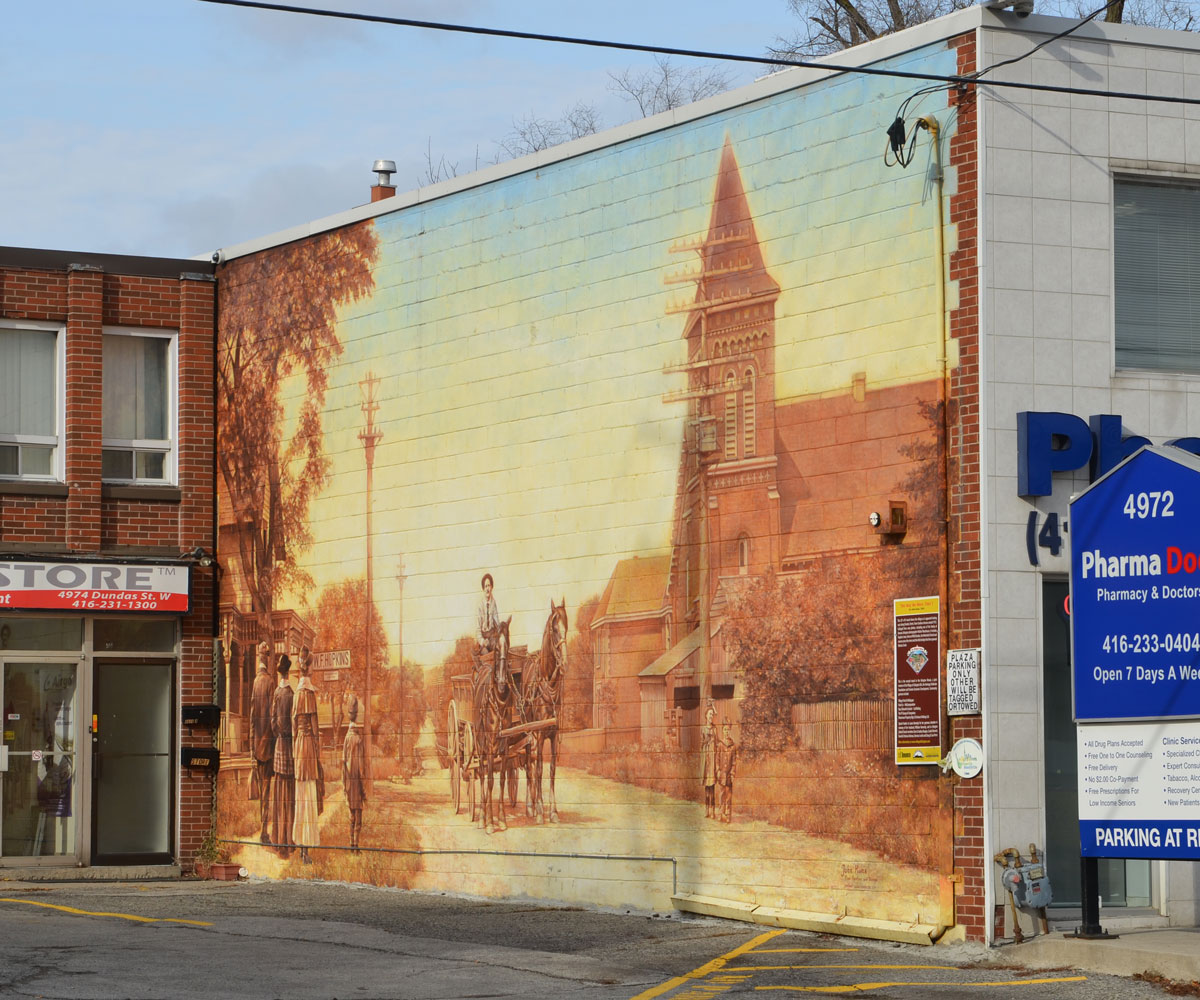
mural 2 – The Way We Were, part 1 by John Kuna, 2005.
Looking east along Dundas St. towards Cordova Ave in 1912.  It includes Hopkins store and the Methodist church.
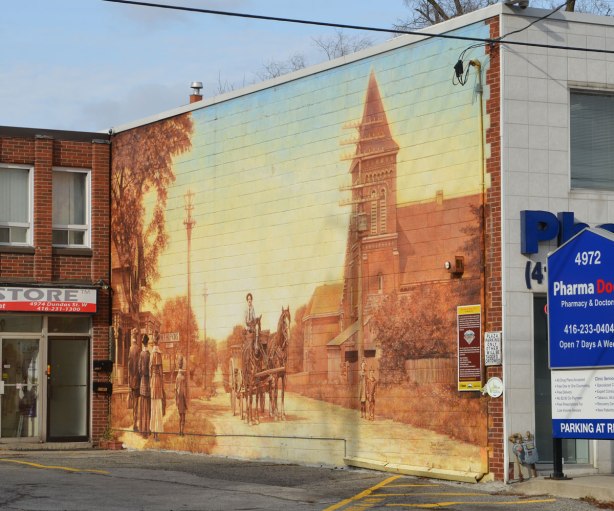
large mural on the side of a building that shows people in old fashioned clothes walking down a street.  A man in a horse drawn wagon is coming down the street.

part of a large mural on the side of a building that shows people in old fashioned clothes walking down a street.  A man in a horse drawn wagon is coming down the street.

mural 3 – They Way We Were part 2, 1912, by John Kuna, 2006.
Because of the car that was parked next to it, I don’t have a good photo of the whole mural.
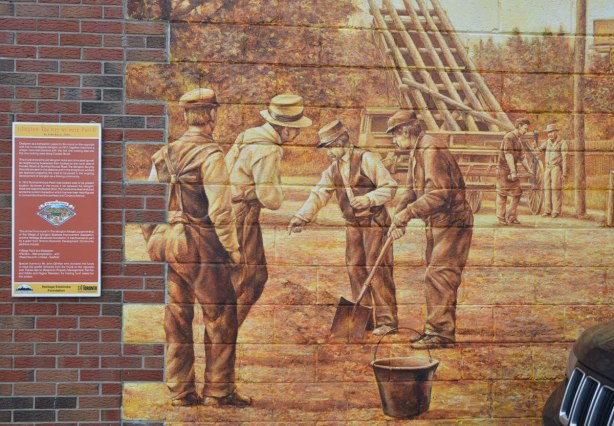
a mural showing a group of men in clothing from the 1930s shoveling in the dirt.

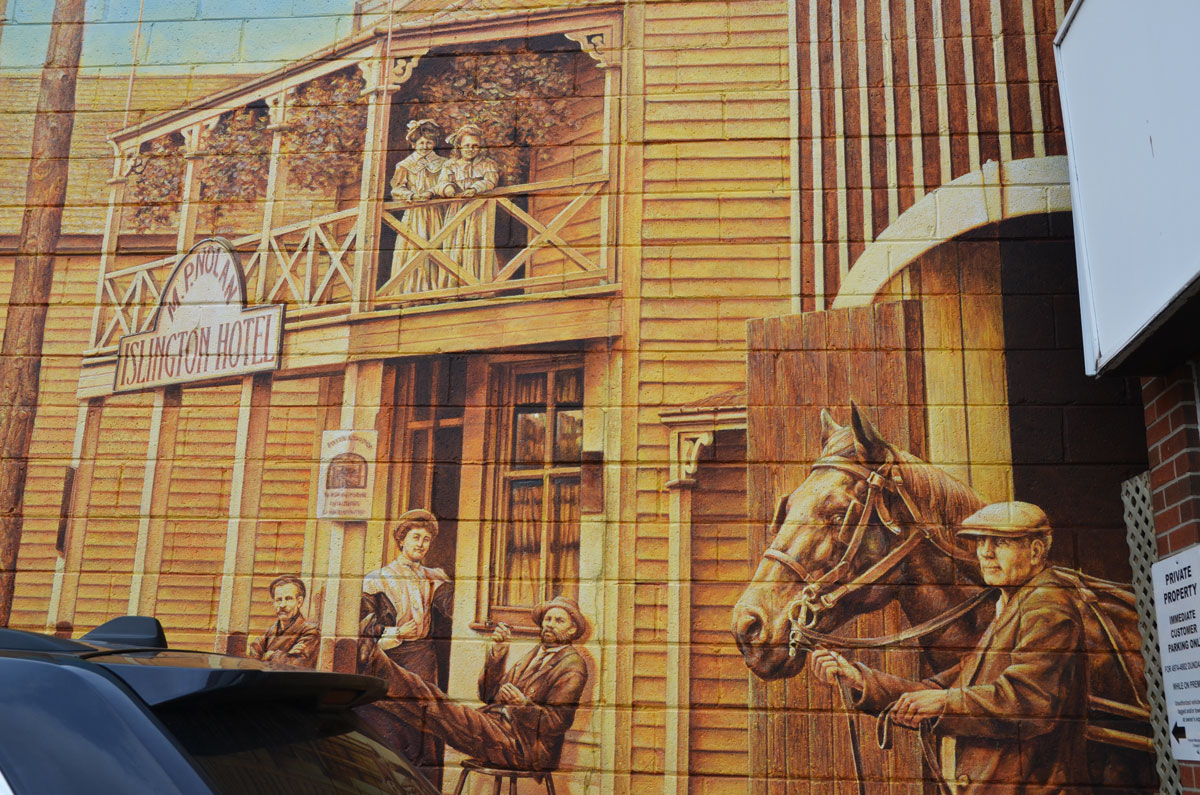
part of a mural, a man leading a horse out of the stables, the Islington Hotel behind.  Two ladies are standing on the balcony of the second floor of the hotel.  A man is reclining on a chair on the front porch of the hotel.

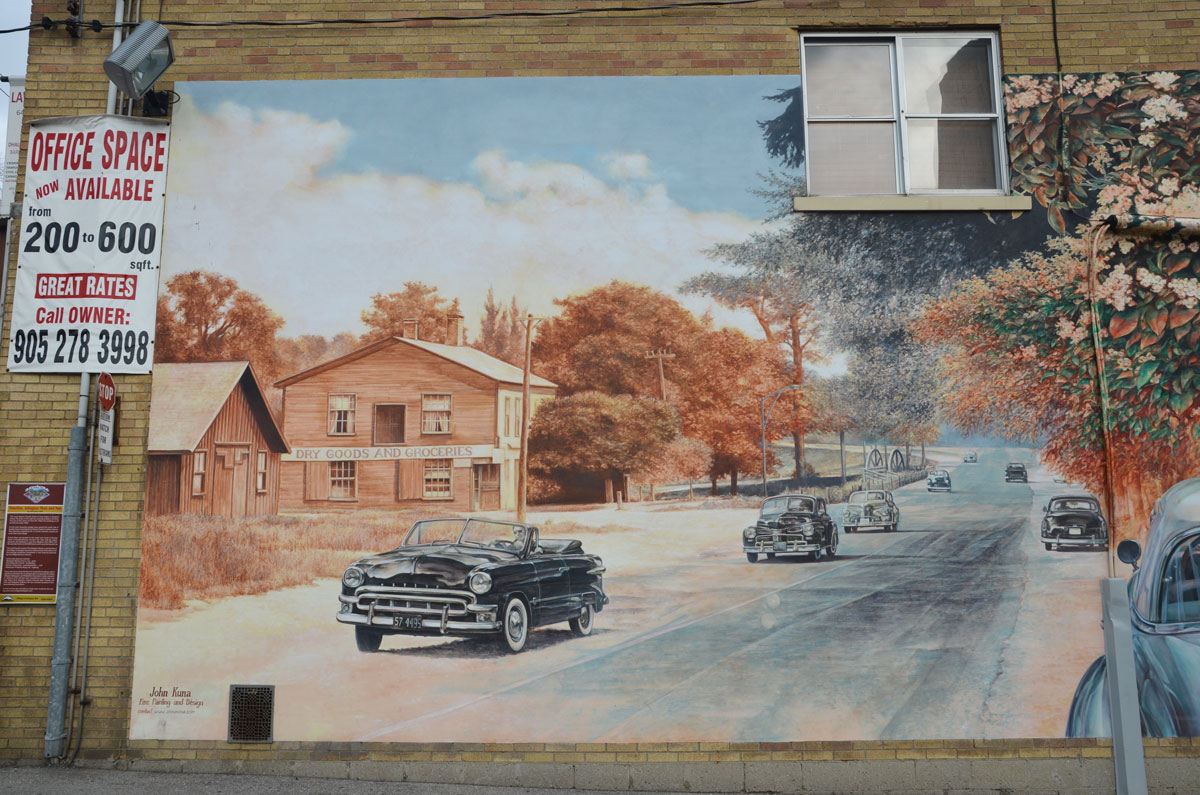
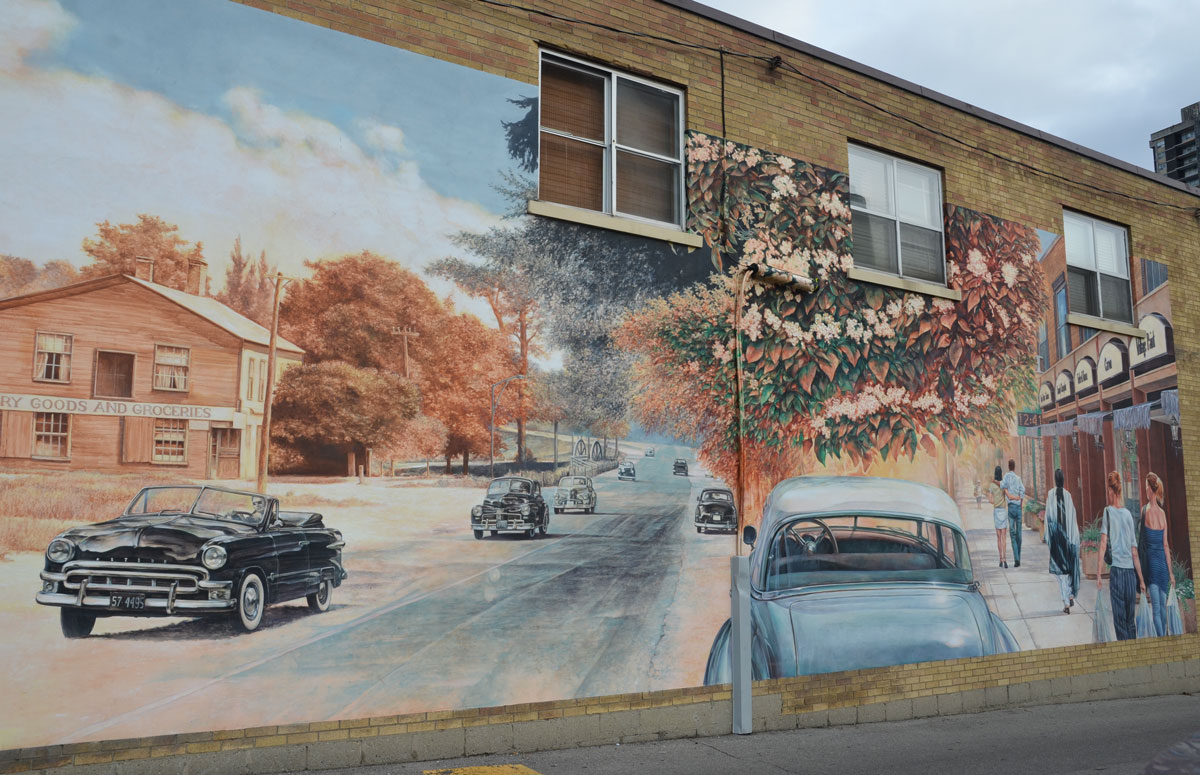
mural 4 – Timeline: Islington Then and Now, by John Kuna, 2006.
Showing Dunn’s store (NE corner of Dundas & Burnhamthorpe Cres) as well as the flowering catalpa trees that used to line the street (on the right in the picture)

part of a mural depicting the main street of town as it was in the 40s and as it was in 2006.  cars, street, people shopping,

blog_islington_here_right

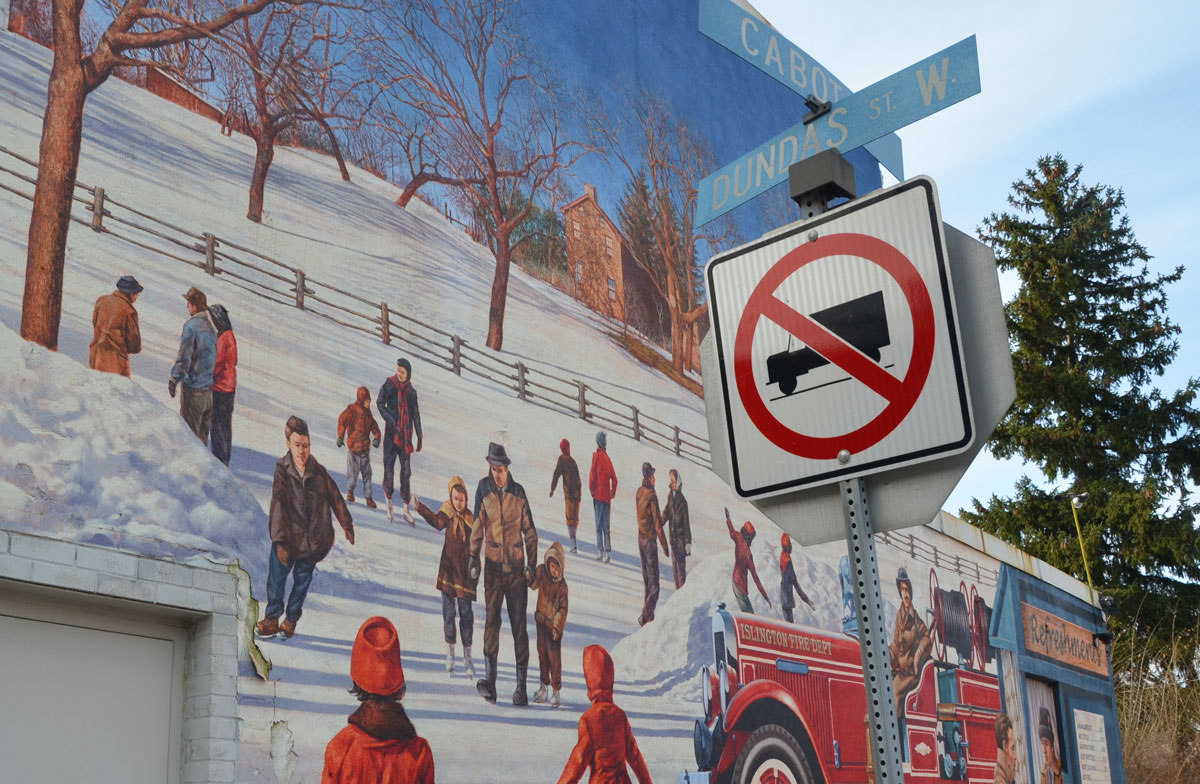
mural 5 — Honouring Islington’s Volunteer Fire Brigade, by John Kuna, 2007. 
Islington had its first motorized fire truck in 1931.  In the 1940s and 1950s the volunteer firefighters would use water from the Mimico creek to flood part of Central Park, on the west side of the creek, to create a skating rink.
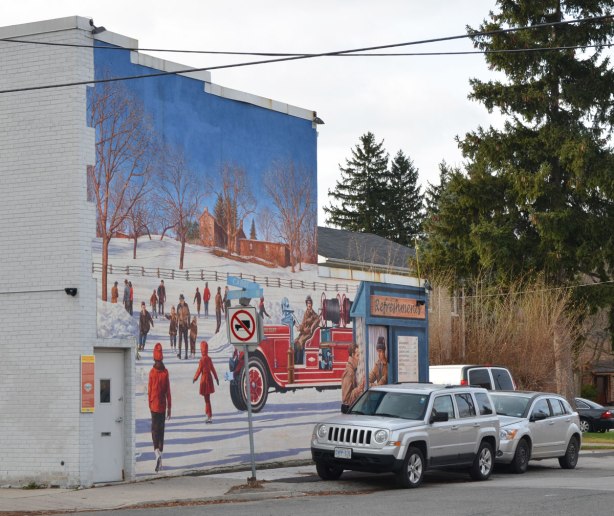
looking across the street at a mural on the side of white brick building, a winter scene, some people are skating, lots of bright red jackets, there is also an old fashioned fire engine with firefighters sitting in it.  At the right edge of the picture is a small wood hut with a sign that says Refreshments on it.

close up of a mural showing people skating on a frozen pond in the winter.  In the foreground is a traffic sign that says no trucks, also blue street signs for Cabot St. and Dundas Street West

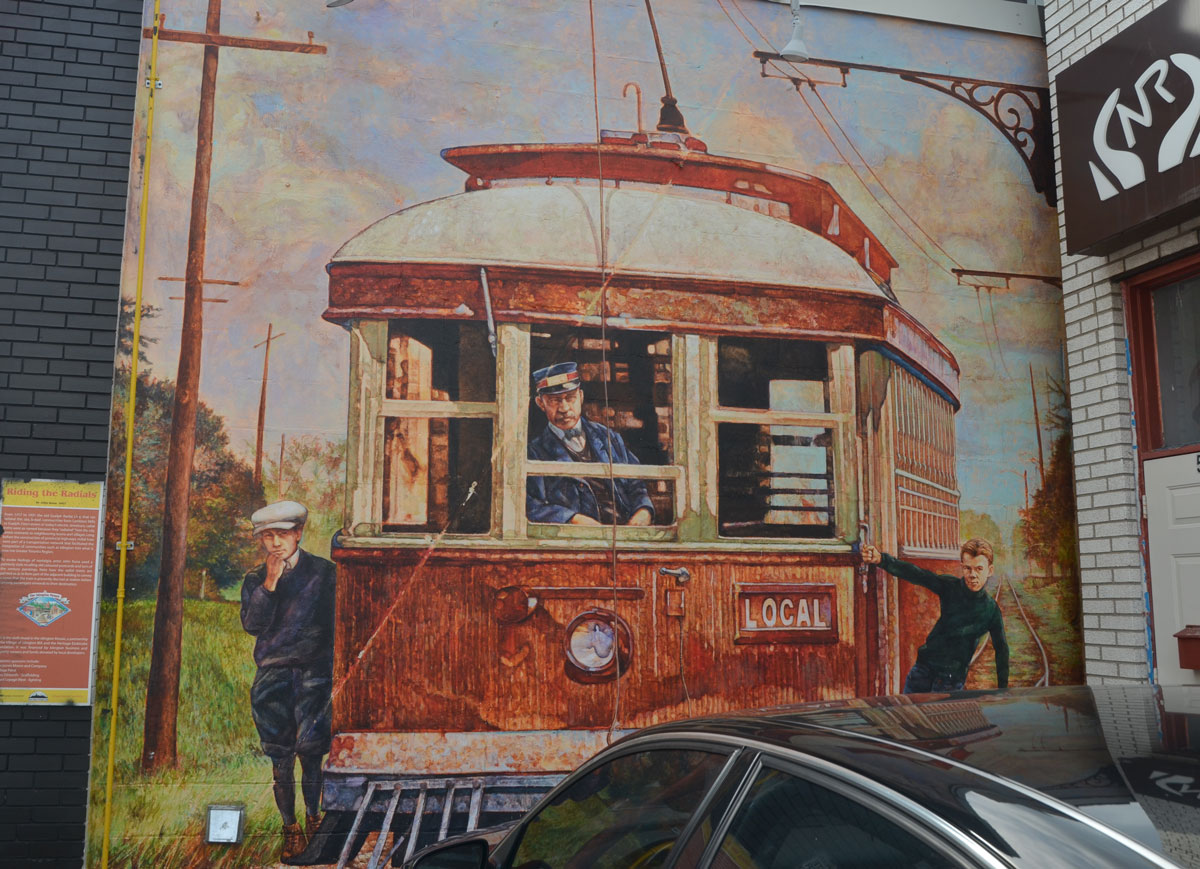
mural 6 – Riding the Radials, by John Kuna, 2007.
From 1917 to 1931 the old Guelph Radial Line (or Toronto Suburban Railway) ran close by this site.  It was an electric rail line between Toronto and Guelph.

A mural showing the front of an old electric train car with the conductor sitting in front.  Two boys are hanging out the doors, one on each side of the train car.

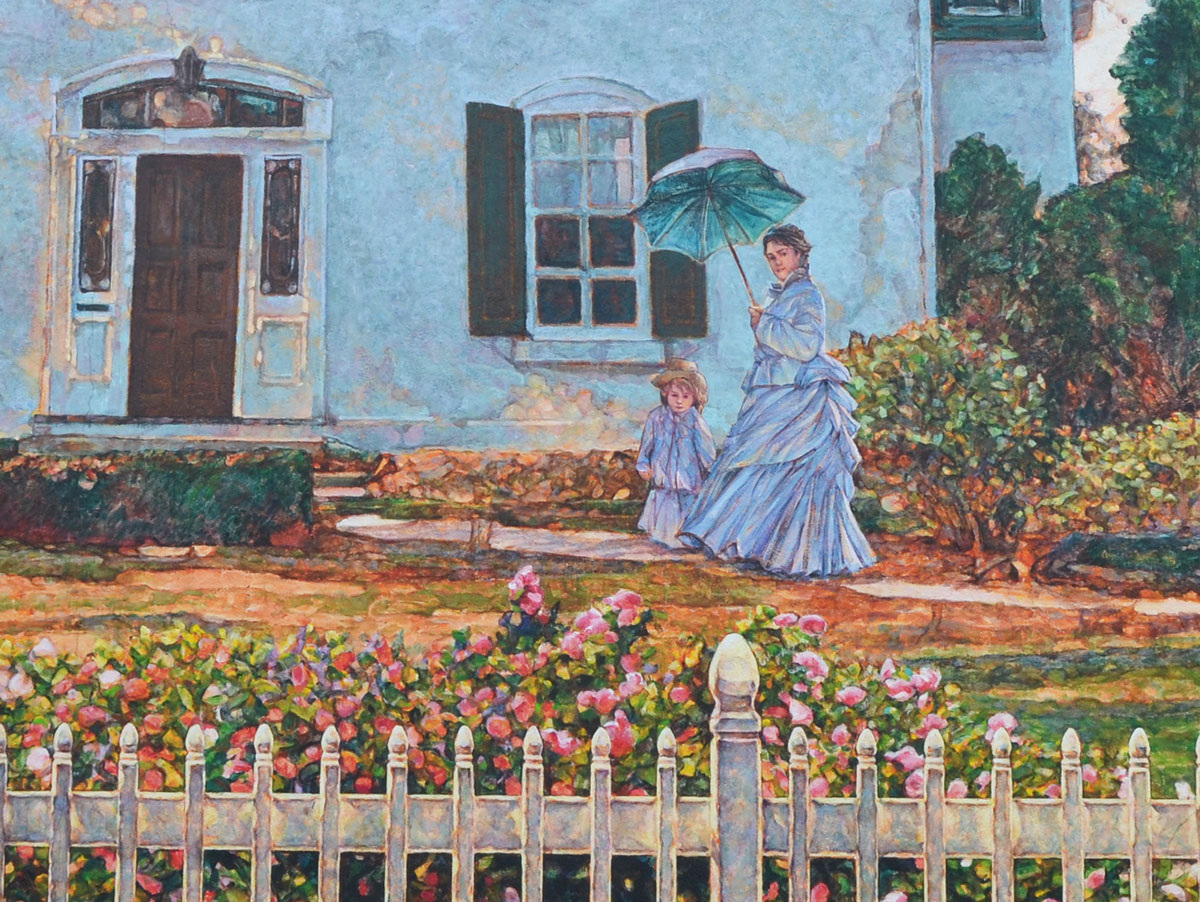
mural 7 – Briarly, Gone but not Forgotten, by John Kune, 2007.
Briarly, also known as Gunn House was built in 1840s. From 1870 to 1985 it was owned by the Montgomery family and their descendents.
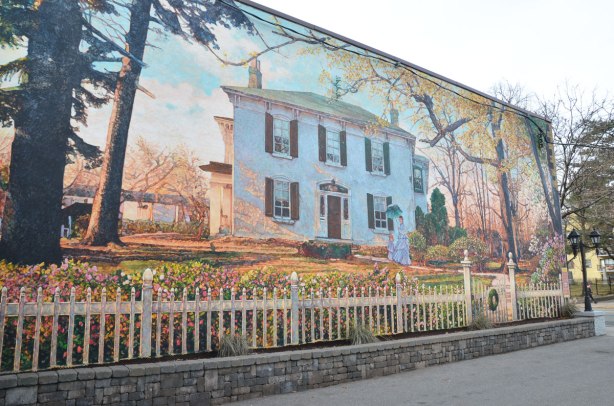
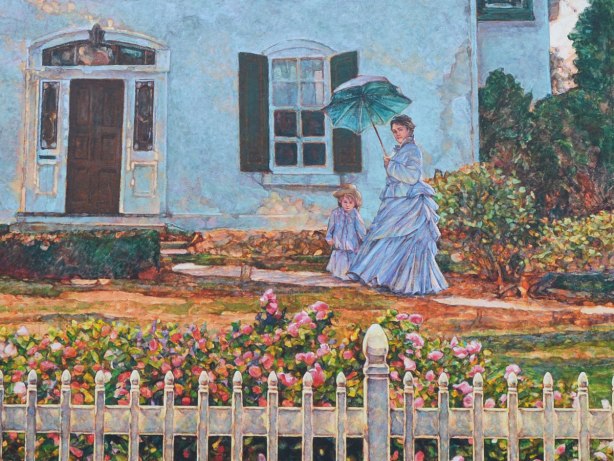
mural 7 - Briarly, Gone but not Forgotten, by John Kune, 2007.  Briarly, also known as Gunn House was built in 1840s.  From 1870 to 1985 it was owned by the Montgomery family and their descendents.

A woman and a girl in long light blue dresses are walking in front of a house.  The woman is carrying a blue parasol.  There is a white picket fence and flowering shrubs in the foreground of the picture.

mural 9 – Harold G. Shipp’s Firt High Flier, by John Kuna, 2008.
The story behind this mural: “In 1944 Harold Shipp convinced a Lancaster bomber pilot who ferried supplies from Toronto to England during the war, to fly over the school’s football field and drop hundreds of leaflets, a few of which could be traded for tickets to the school dance. Unfortunately, a rogue wind scattered the leaflets across the Chinese market gardens near Montgomery’s Inn. In the ensuing mayhem, excited football fans frantic to secure a winning ticket, stormed the field and trampled the carefully tended cabbages”

mural showing men playing football in the 1920s, with a low flying airplane overhead.

mural showing men playing football in the 1920s, with a low flying airplane overhead, as seen from an angle - form this perspective you can see that the mural is actually two pictures.

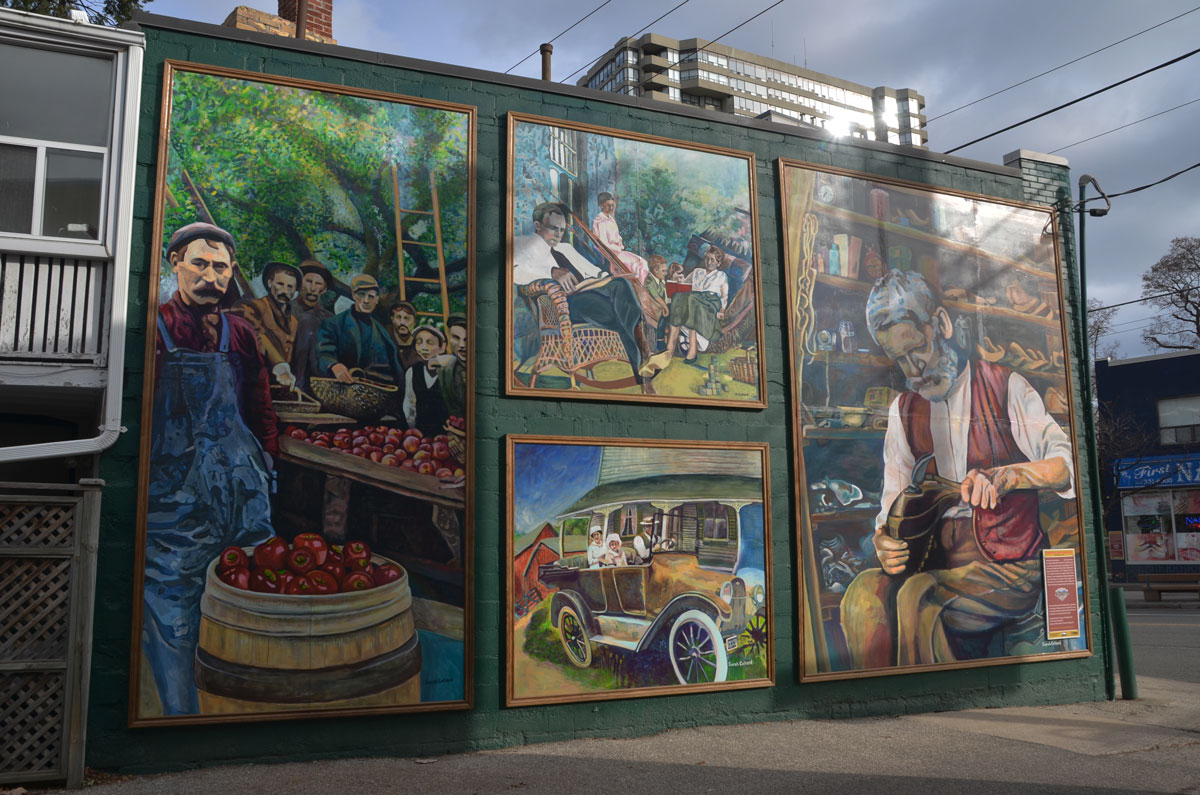
mural 10 – Portraits from our Past by Sarah Collard, 2008.
Inspired by pictures taken in the early 1900’s. “These include: Apple Packers at Bigham family orchards, Rathburn and Martingrove ~1917; Sunday Afternoon, a scene showing the family of famous Islington photographer Walter Moorhouse on their veranda at 34 MacPherson Ave. (now Aberfoyle); Islington’s First Car, a 1917 Chevrolet owned by the Appleby family; and the Village Shoemaker, Mr. Nelson in the 20th century.”
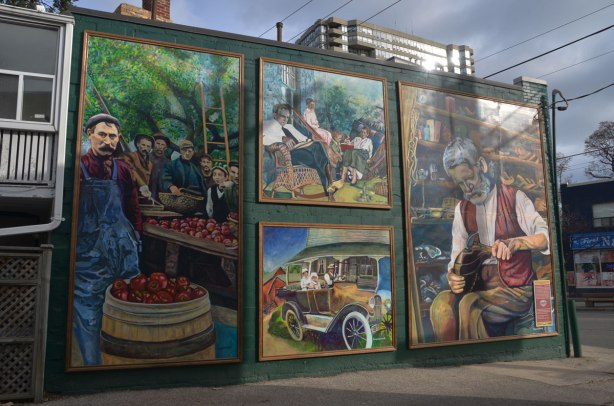
mural in 4 parts, 1 on the left, 1 on the right and 2 in the center.  The left depicts a man selling apples, the right depicts a cobbler fixing shoes.  In the center: bottom, a family in old fashioned car.  Center top - a family sitting in a livingroom including a man in a rocking chair

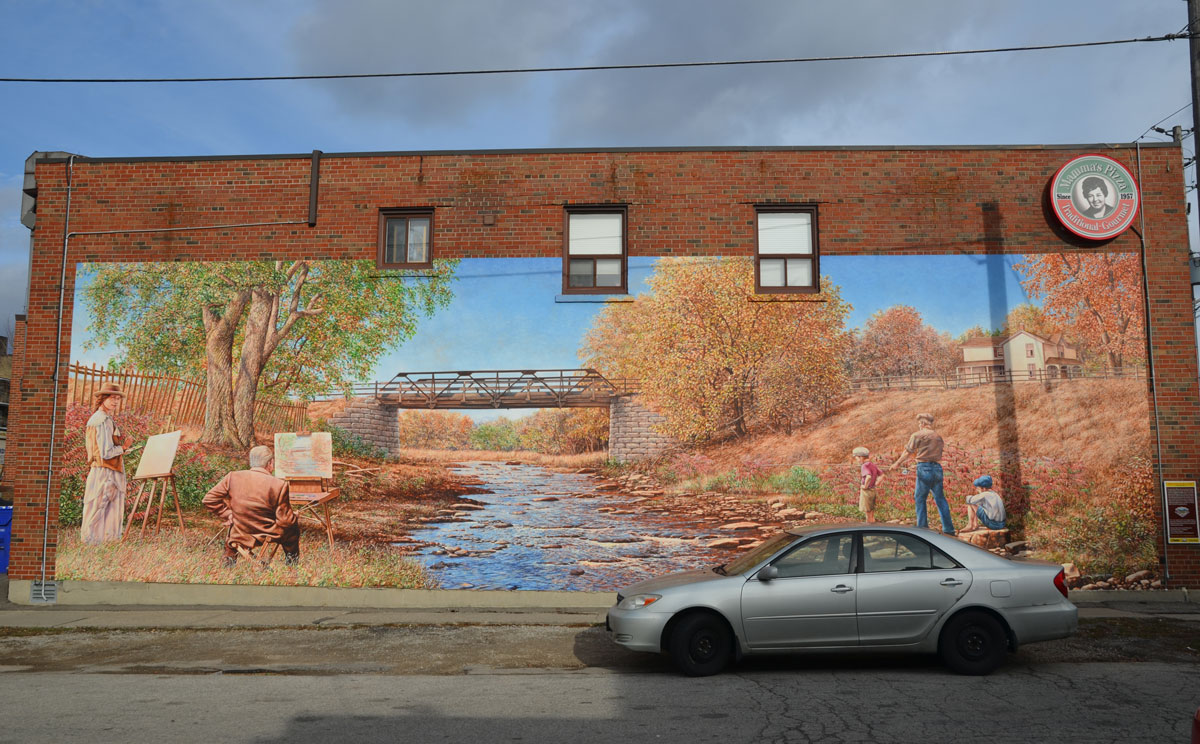
mural 11 – Mimico Creek in Fall, ca 1920, by John Kuna, 2008.
Looking north towards the Dundas Street bridge.
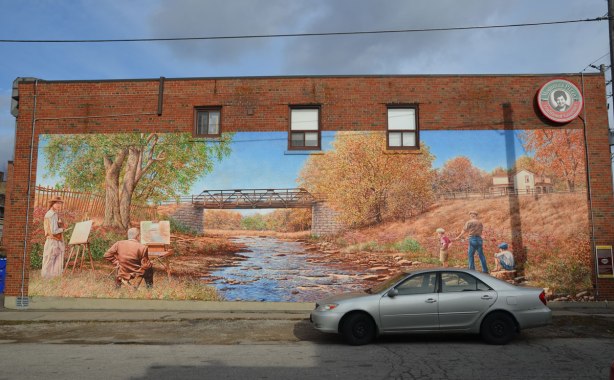
A large mural of a creek.  On the left back are two painters with their easels set up beside the river.  On the right bank are two boys and a man

Gordon’s Dairy, by John Kuna, 2008.

A mural on the front of the Islington Senior's Centre showing dairy carts.

mural 13 – The Old Swimming Hole by June Kuna, 2009.
Swimmers at the mill pond.

large mural of people swimming in a creek in bathing costumes from the 1920s

closer view of part of the mural of people swimming in a creek.  In this part of the picture, kids are climbing on a water wheel.  The mural is reflected in the window of the store next to it.

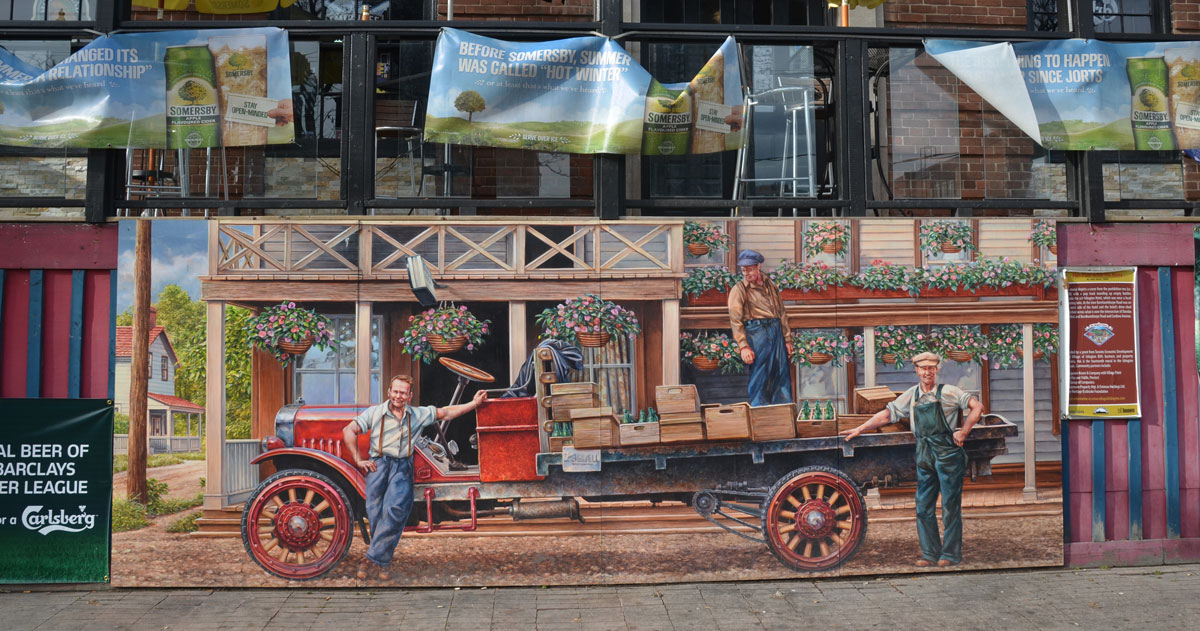
mural 14 – The Pub with no Beer, by June Kuna, 2009. 
A scene from the Prohibition Era in the late 1920’s.   Men collecting empty pop bottles from outside the Islington Hotel.
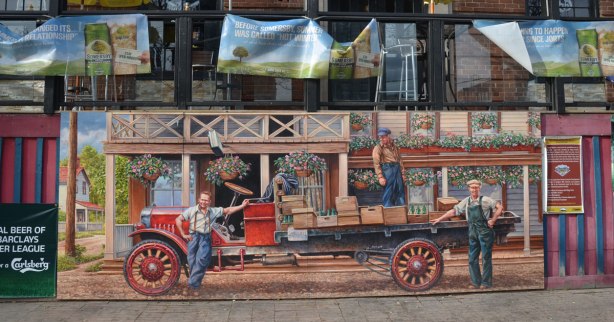
mural showing men loading an old flat bed truck with crates of empty pop bottles, 1920s

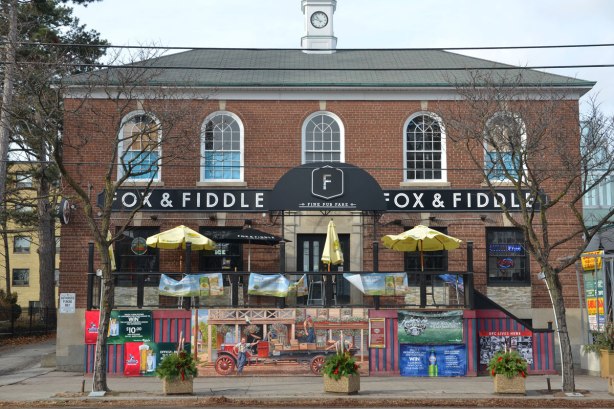
Fox and Fiddle bar, a two storey brick building,

mural 15, Faith of Our Fathers, part 2, by John Kuna

mural showing the building of a chirch

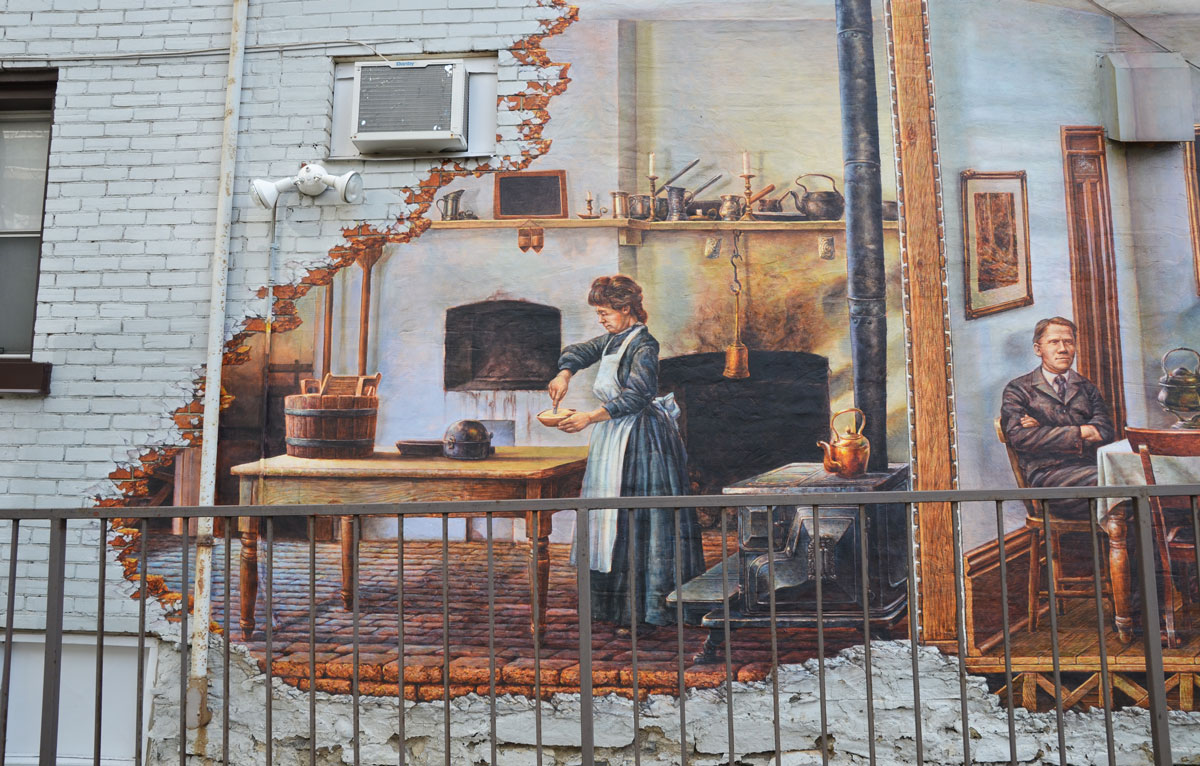
mural 16 – The Manse Committee by John Kuna 2010
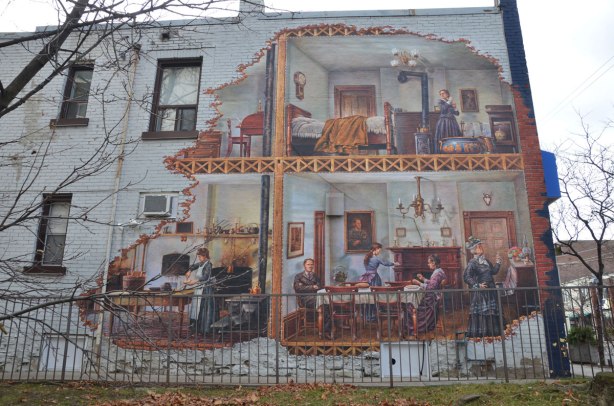
mural on the side of a two storey white brick building.  The picture looks like the outer wall has been removed to reveal a family house from the early 1900s.  A cook is working in the kitchen,

blog_islington_16kitchen

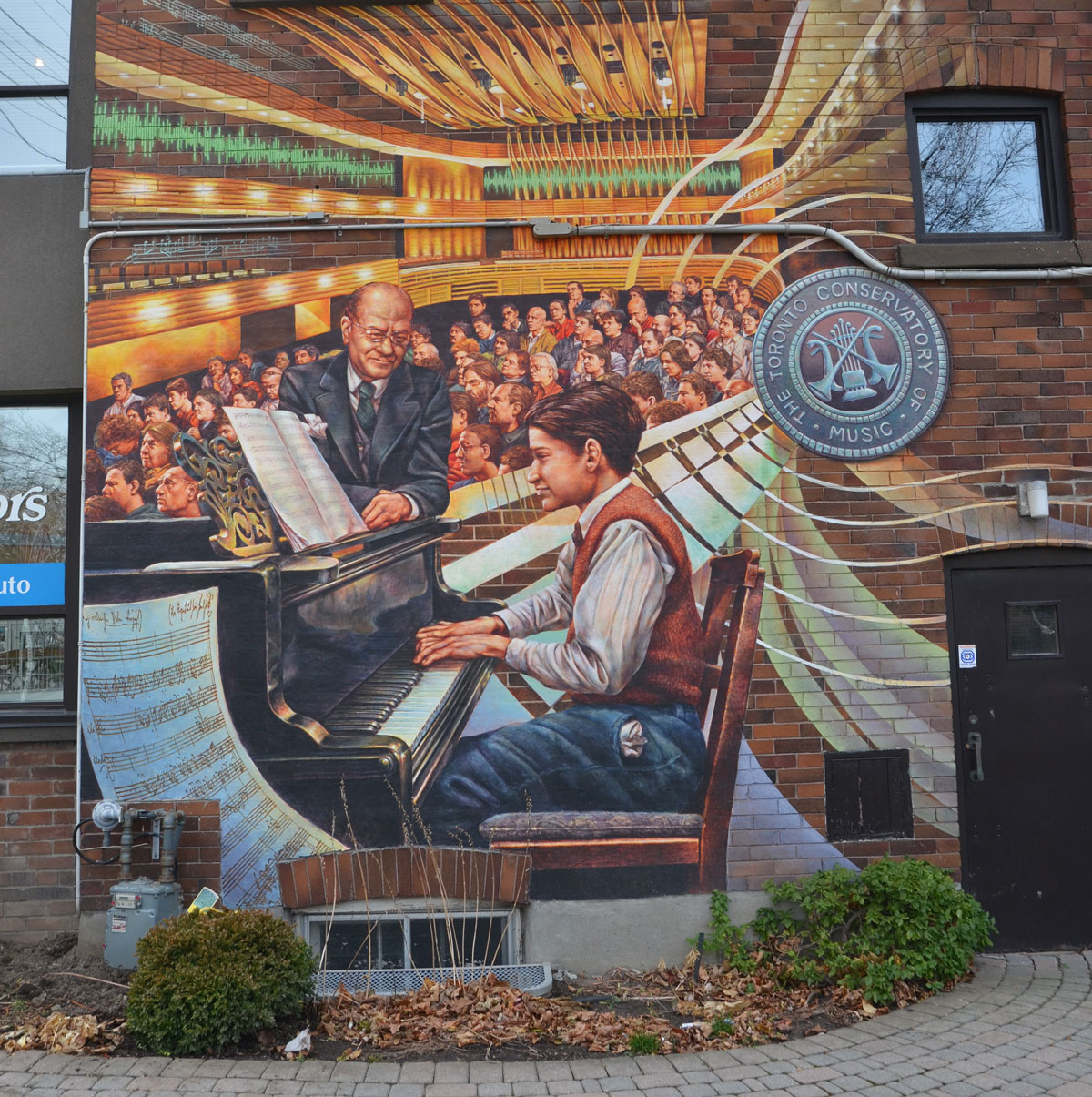
The Prodigy, by John Kuna, 2011
A satellite branch of the Royal Conservatory of Music was located in this building from the 1950s through the 1980s.
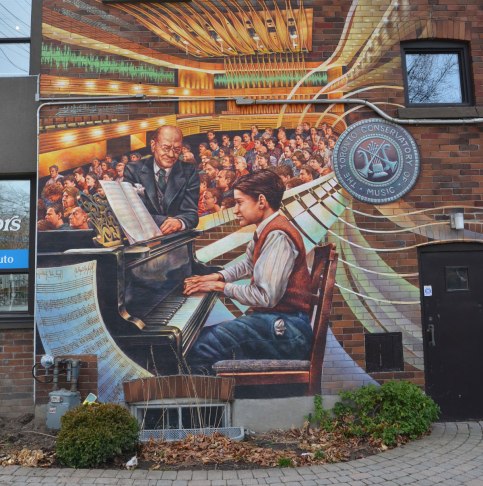
mural depicting a boy playing a piano in front of an audience.  A man is helping to turn the pages of the music.

mural 19 –  Aftermath by John Kuna, 2011.
After Hurricane Hazel on 15 Oct 1854, most of Islington Golf Course and the low lying areas around Mimico Creek were flooded.
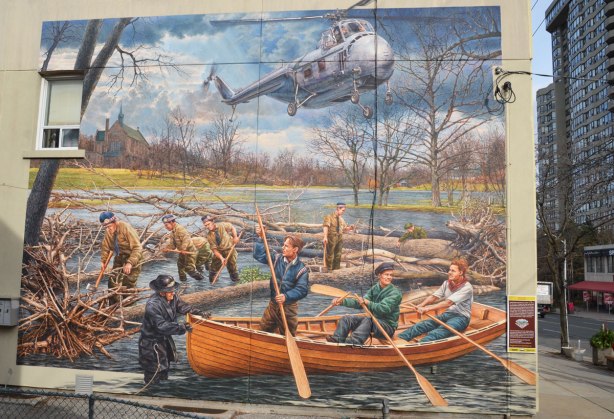
large painting of men in boats, helicopter overhead

mural 20 – Ontario Gothic, by John Kuna, 2011
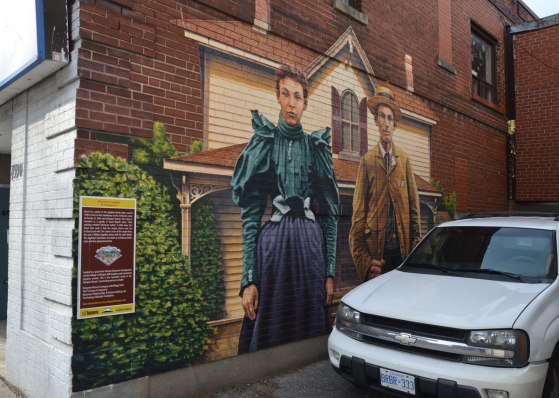
A mural of a man and a woman standing outside a two stroey farm house.  A white car is parked in front of the mural and it blocks the bottom right of the picture.

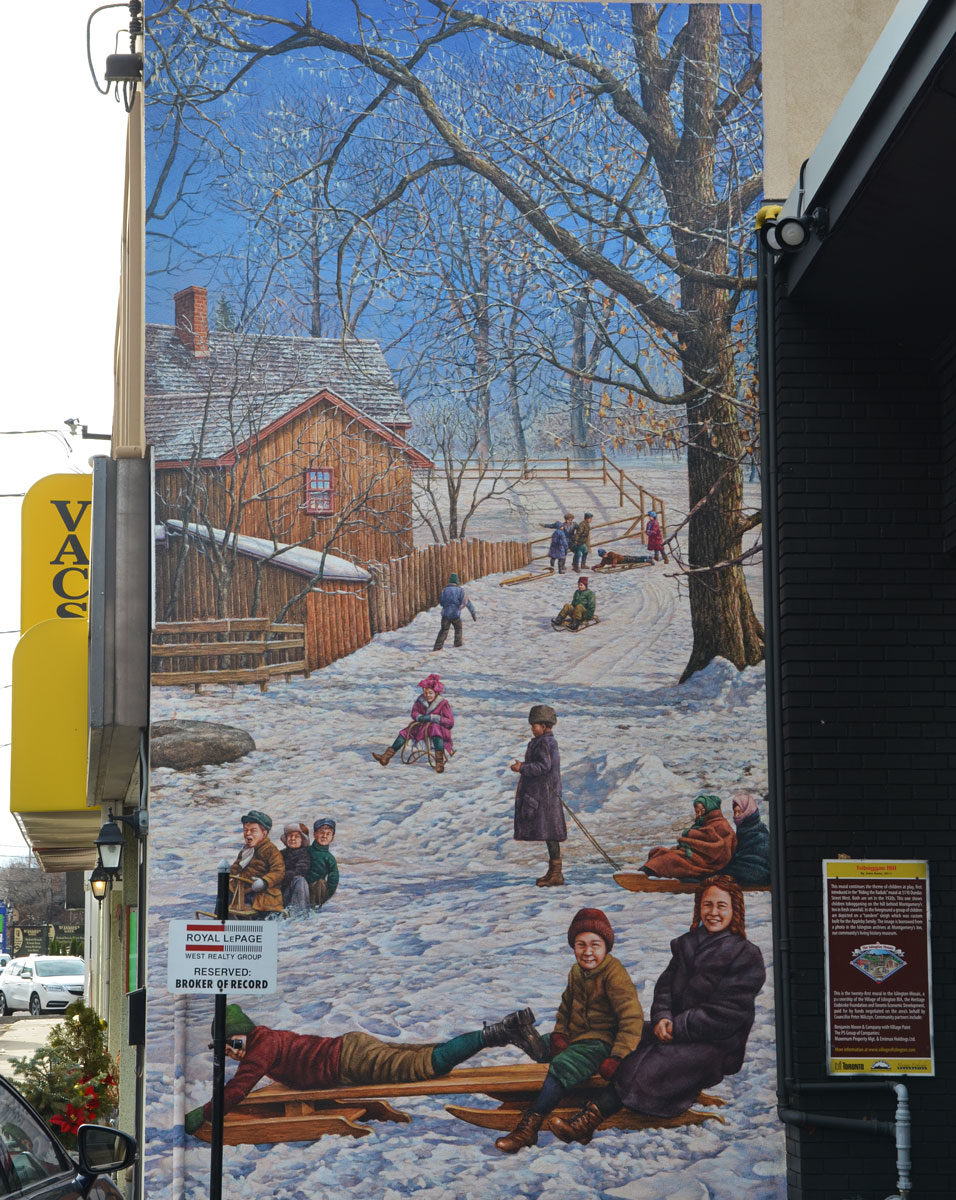
mural 21 – Toboggan Hill, by John Kuna, 2011
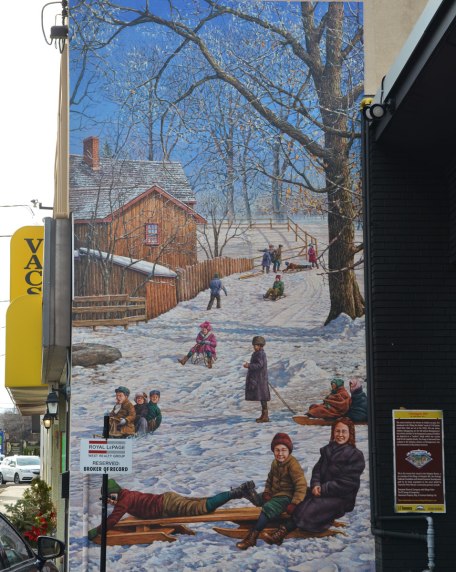
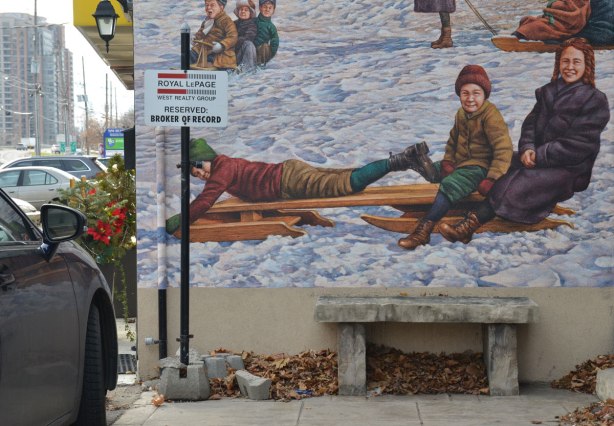
large vertical mural depicting a hill in winter.   Bare trees, kids on tobaggons.

Close up of the bottom part of a mural whowing kids on old fashioned wooden sleds, or toboggans.

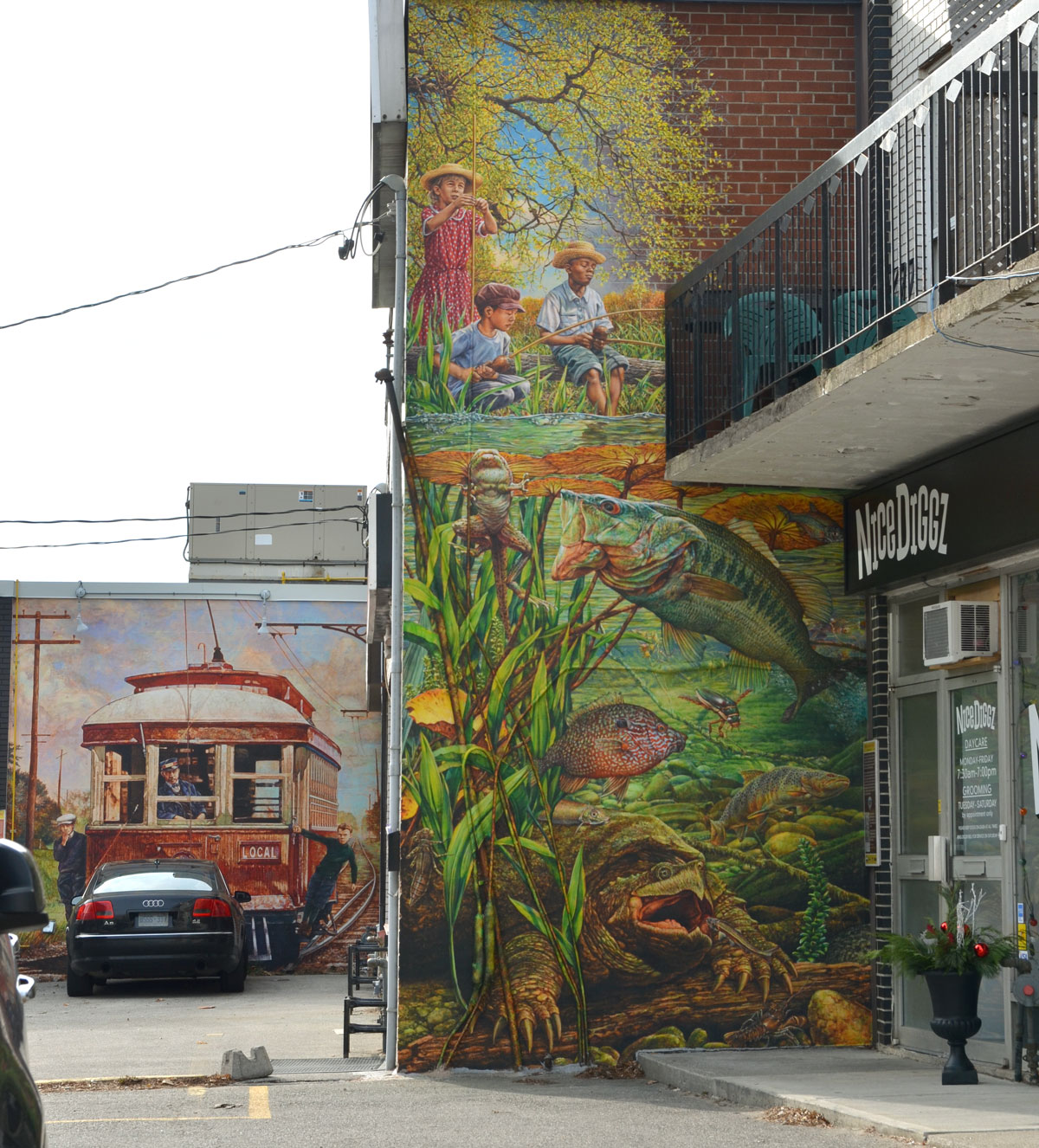
Fishing in Mimico Creek, by John Kuna, 2012,
with Riding the Radials seen in the background.

 includes largemouth bass, rainbow trout, pumpkinseed sunfish

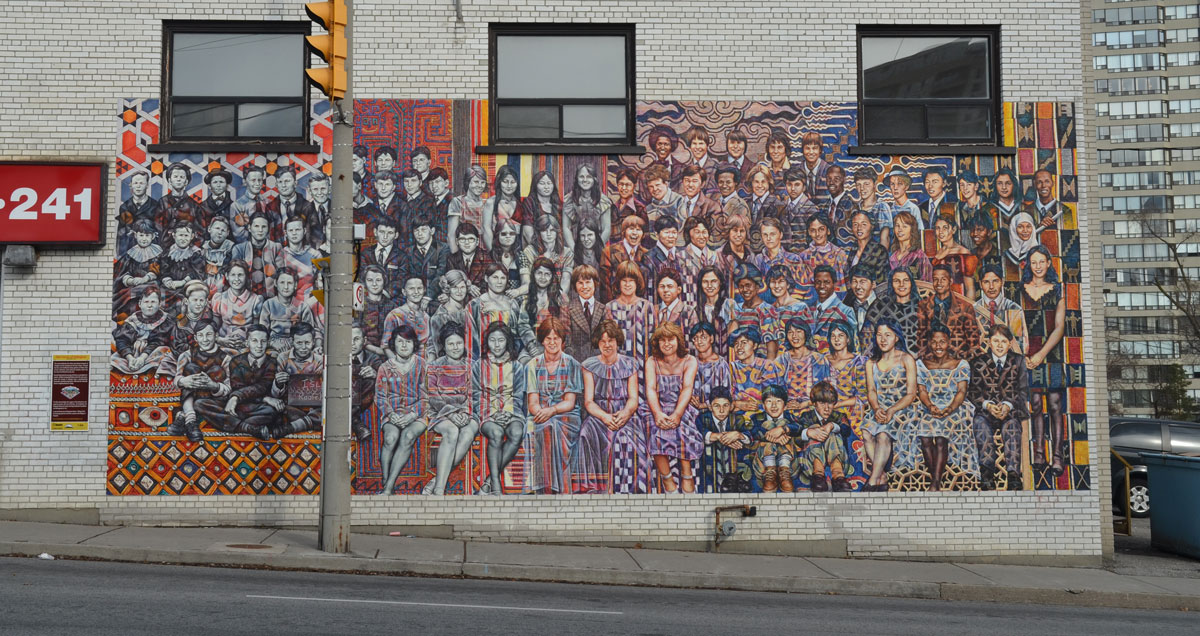
The Faces of Islington, by John Kuna, 2013
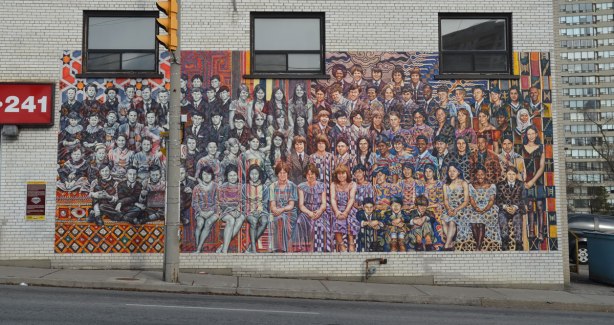
The Faces of Islington, by John Kuna, 2013
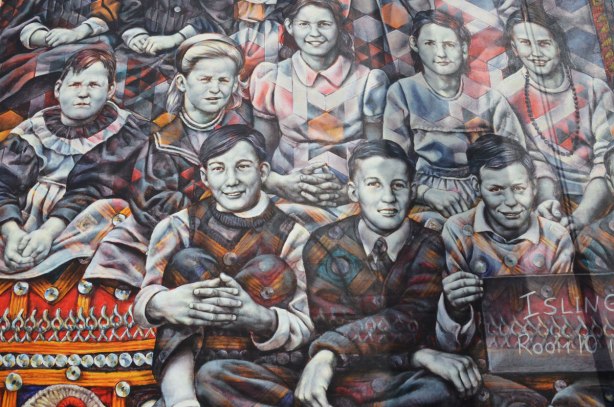
blog_islington_21part

the mural with no sign

mural of a group golfing in clothes typical of the 1940s

 more information – village of Islington murals website

Another new pair of murals painted under a bridge.
This time, they’re close to Warden subway station.

Beside a four lane road, a sign pointing to Warden station passenger drop off.  In the background is a bridge over the road.

Warden subway station is on the southeast corner of Warden and St. Clair. Just east of that intersection the subway passes over St. Clair.


The north side of the underpass

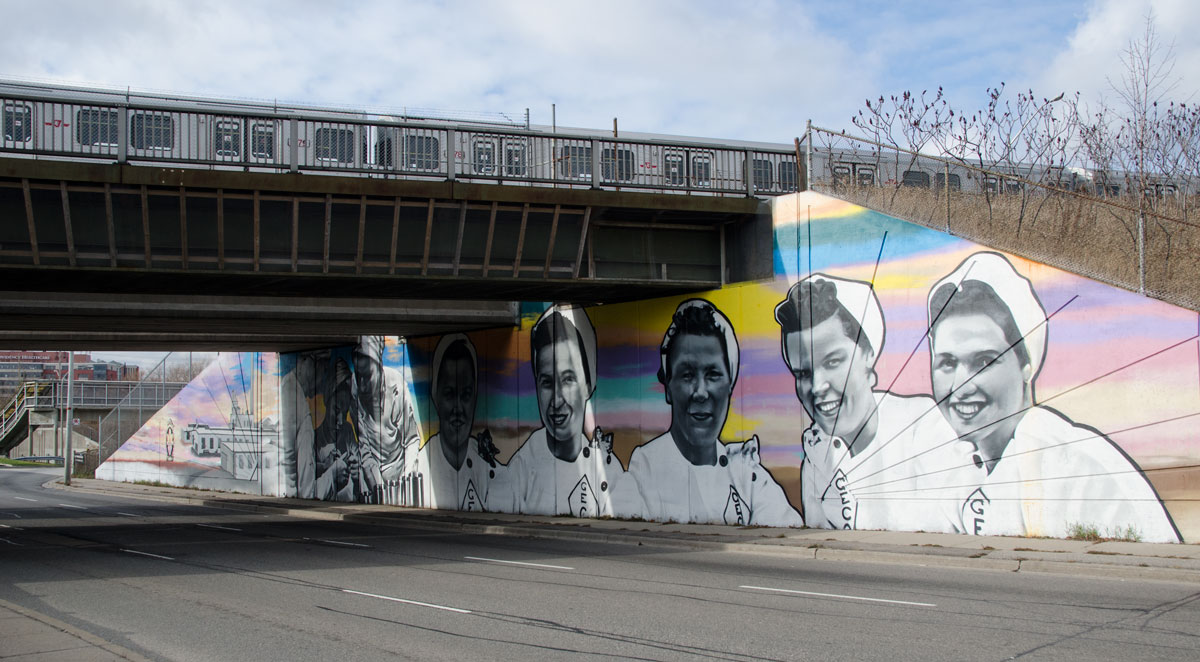
The north side of the underpass is dedicated to the woman who worked filling fuses for the General Engineering Company (Canada) Ltd., a  WW2 munitions plant that was located nearby.   More about the history of GECO.

full length of a mural on the side of an underpass.  Historical picture of women who worked in a munitions factory during the second world war.  From the shoulders up.  They are in white clothing and their heads are covered in white hats.

mural under subway bridge, showing woman munitions workers from the era of world war 2.  They are wearing white tops and white hair coverings.

The south side of the underpass

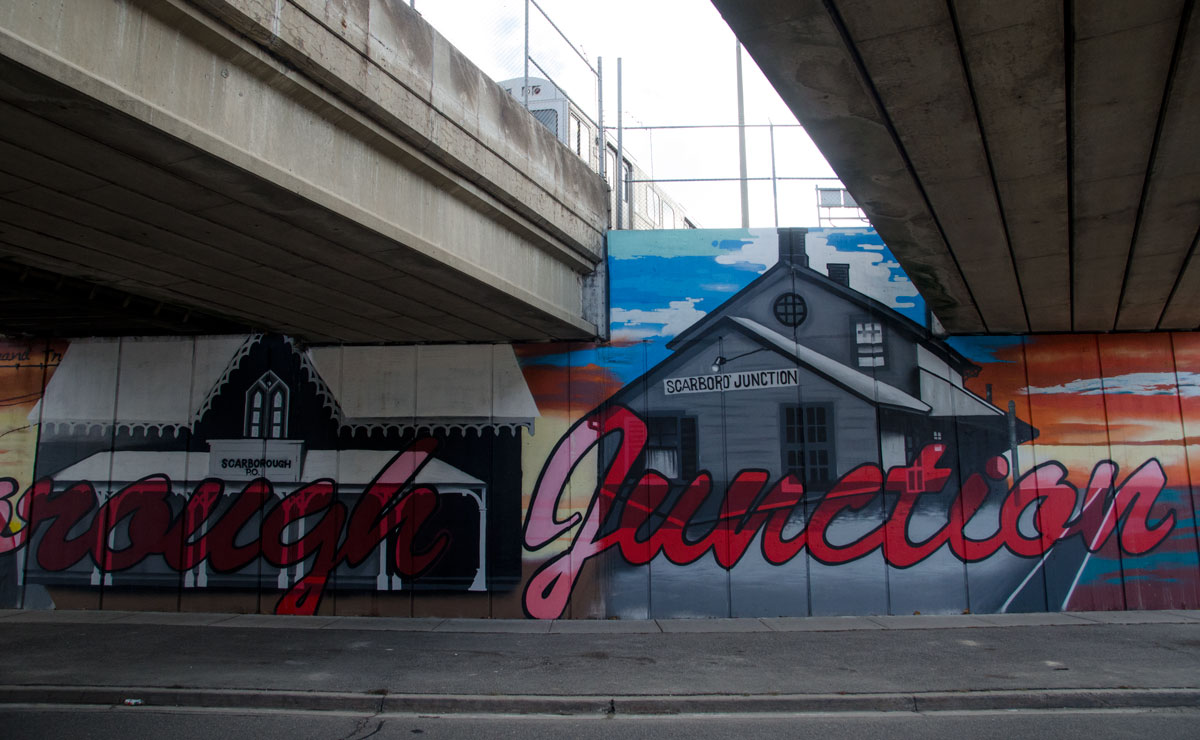
The south side portrays the establishment of Scarborough Junction in 1873.  This was when a second rail line and commercial hub was built in the area.

street art mural showing two large heads, a man and a woman, in black and white.  Very realistic looking.

part of mural under subway bridge, large red cursive letters that say Scarborough Junction.  A picture of an old Scarborough post office as well as a wood building that was a general store.

Scarborough post office and Everest & Sons’ General store. The latter was built in 1873 in Scarborough Junction.

a woman is walking past part of mural under subway bridge, large red cursive letters that say Scarborough Junction.  A picture of an old Scarborough post office and two very much larger than life people (man and woman) looking east.

blog_warden_end

The murals were painted by Montreal-based street artist Omen.    They are also the result of a collaboration between the city-led art program StreetARToronto, not-for-profit arts organization Mural Routes,  local historians and city councillor Michelle Berardinetti.

The Heritage Trail murals are a series of murals depicting the history of Scarborough.  The project began in 1990 and consists of 12 murals at different locations along Kingston Road (old hwy 2).

Just west of Midland Ave are two of the murals.

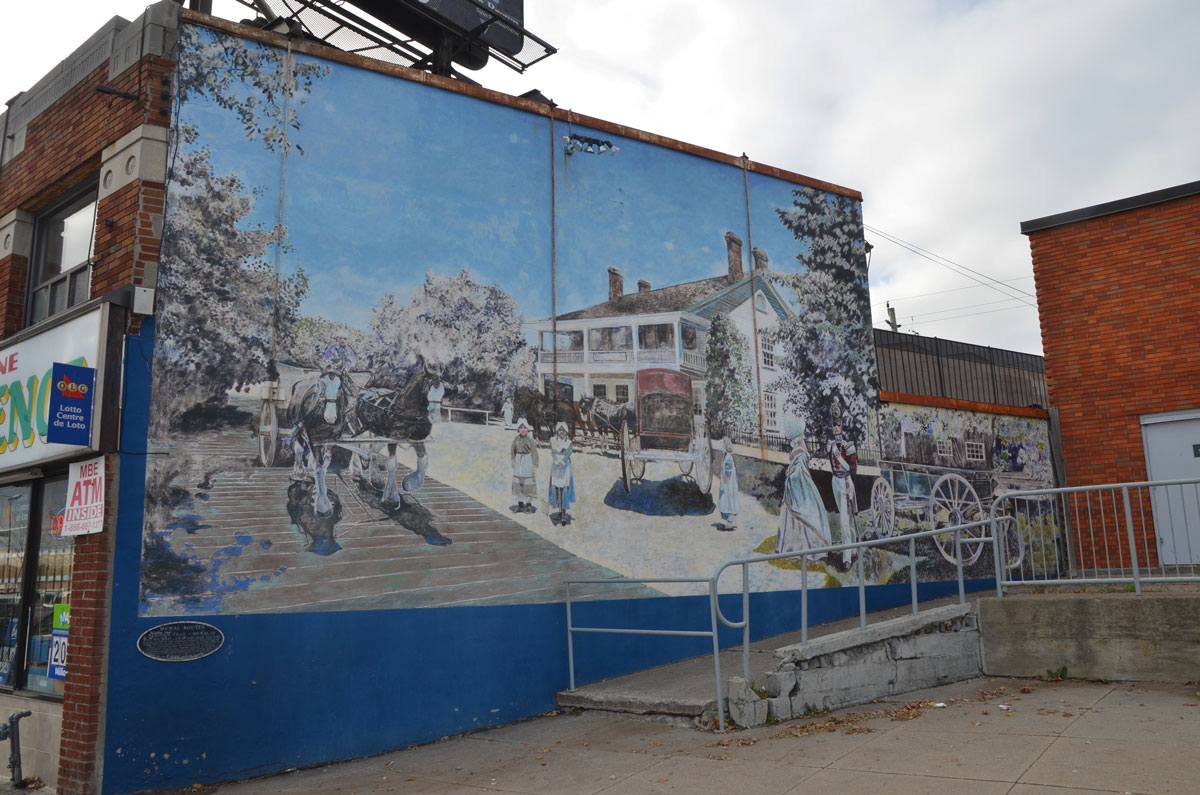
Half Way House painted in 1990 by John Hood at 2052 Kingston Road, the NW corner of Midland & Kingston Rd.  It is a picture of the Half Way House inn (and stage coach stop) that stood at this corner.   It’s name comes from the fact that it was halfway between the village of Dunbarton (now a part of Pickering) and the St. Lawrence Market in Toronto.   In 1965 the building was moved to Black Creek Pioneer village.

A mural that takes up the side of a building.  It is a picture of an old two storey inn.  It is a street scene as well, with people wearing clothes from the late 1800s.

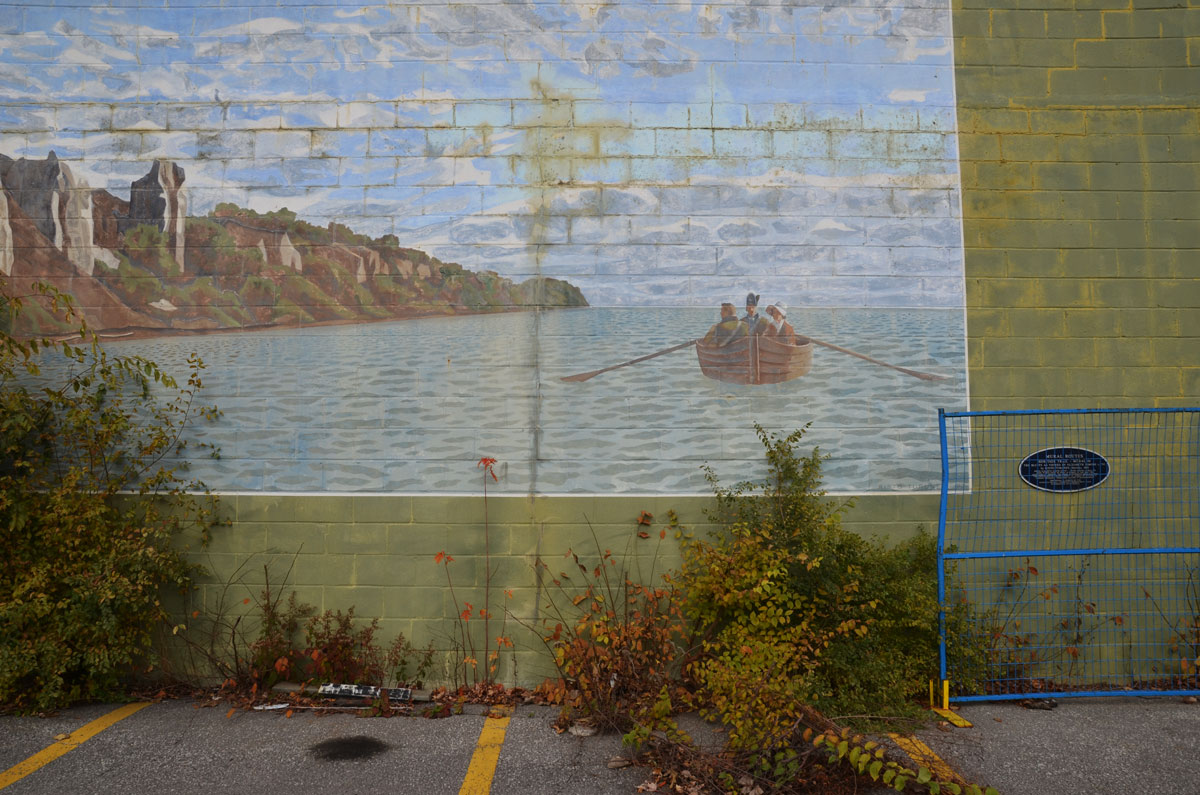
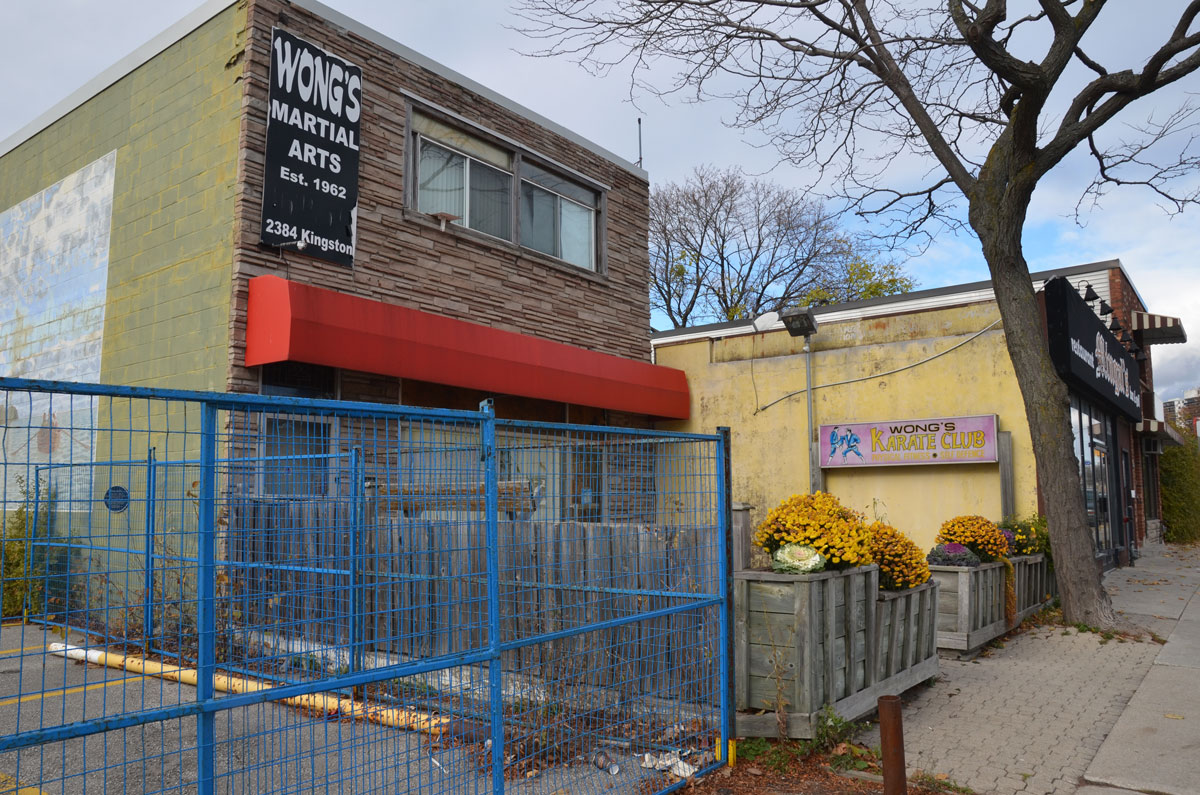
Just farther to the west is another mural.  ‘The Bluffs as Viewed by Elizabeth Simcoe c. 1793’ was painted by Risto Turunen in 1992.  It is on the side of the building located at 2384 Kingston Rd, now Wong’s Martial Arts.  Elizabeth Simcoe was the wife of wife of Lieutenant-Governor John Graves Simcoe, the first Lieutenant Governor of Upper Canada.
mural on the side of building depicting an early scene from Canadian history - a small rowboat with a couple of people in it is passing by the cliffs that are now known as the Scarborough bluffs.

The property beside this mural is now vacant and is enclosed by the type of blue temporary fencing that you see around many construction sites all around Toronto.  If there was a building there, it has been demolished, otherwise there is no work being done there at the moment.

mural on the side of building depicting an early scene from Canadian history - a small rowboat with a couple of people in it is passing by the cliffs that are now known as the Scarborough bluffs.

Wongs Martial Arts building, a nondescript two storey brick building.

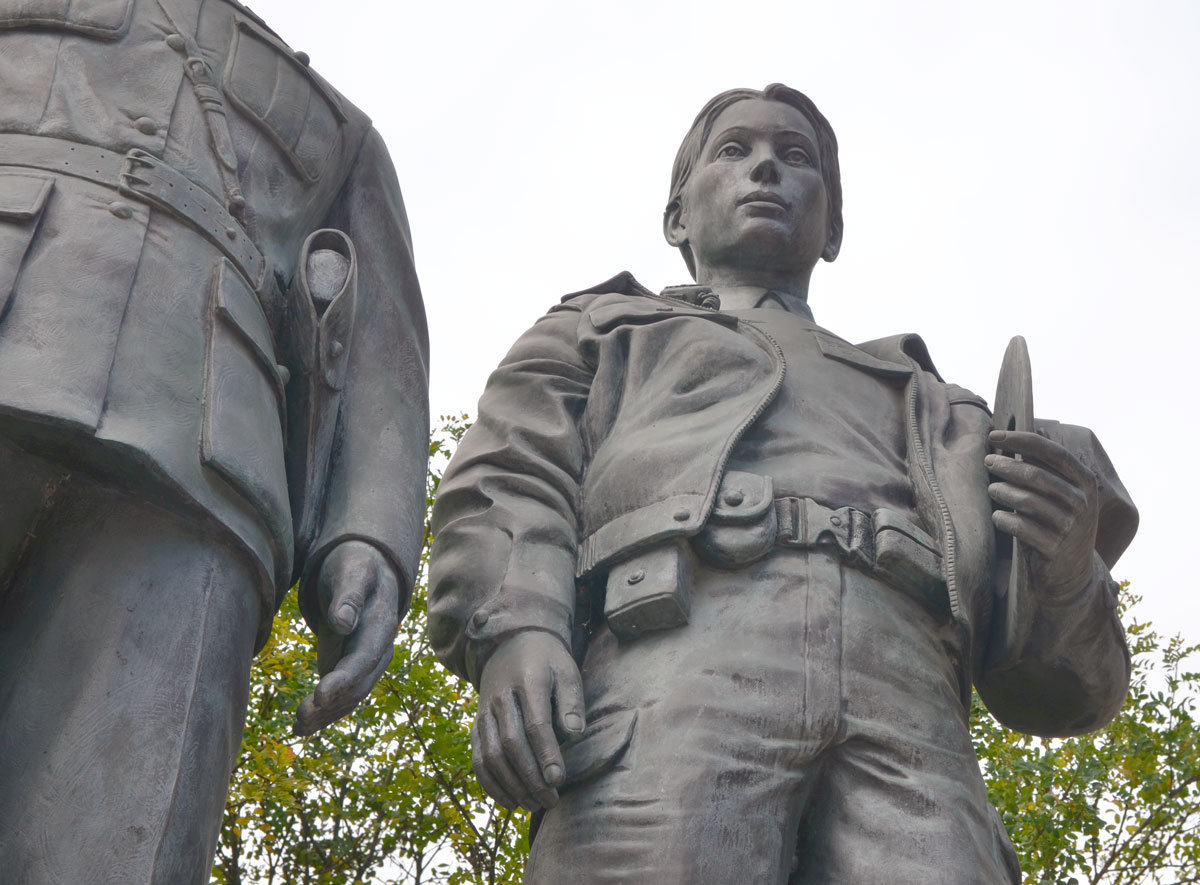
Near the corner of Queens Park Crescent and Grosvenor Street is the Ontario Police Memorial.
It was dedicated in May of 2000.

Light grey stone horizontal with 5 panels.  The outer two panels on each side contain the names of the policemen who have died while on duty in Ontatio.  The center section of the stone is the base for two statues - an older and a younger policeman.

The names of fallen Ontario police are carved in the stone at the base of the memorial.

.
The two statues on the police memorial as seen from the side.
.
close up of young police officer (upper body) at the Ontario Police Memorial
.

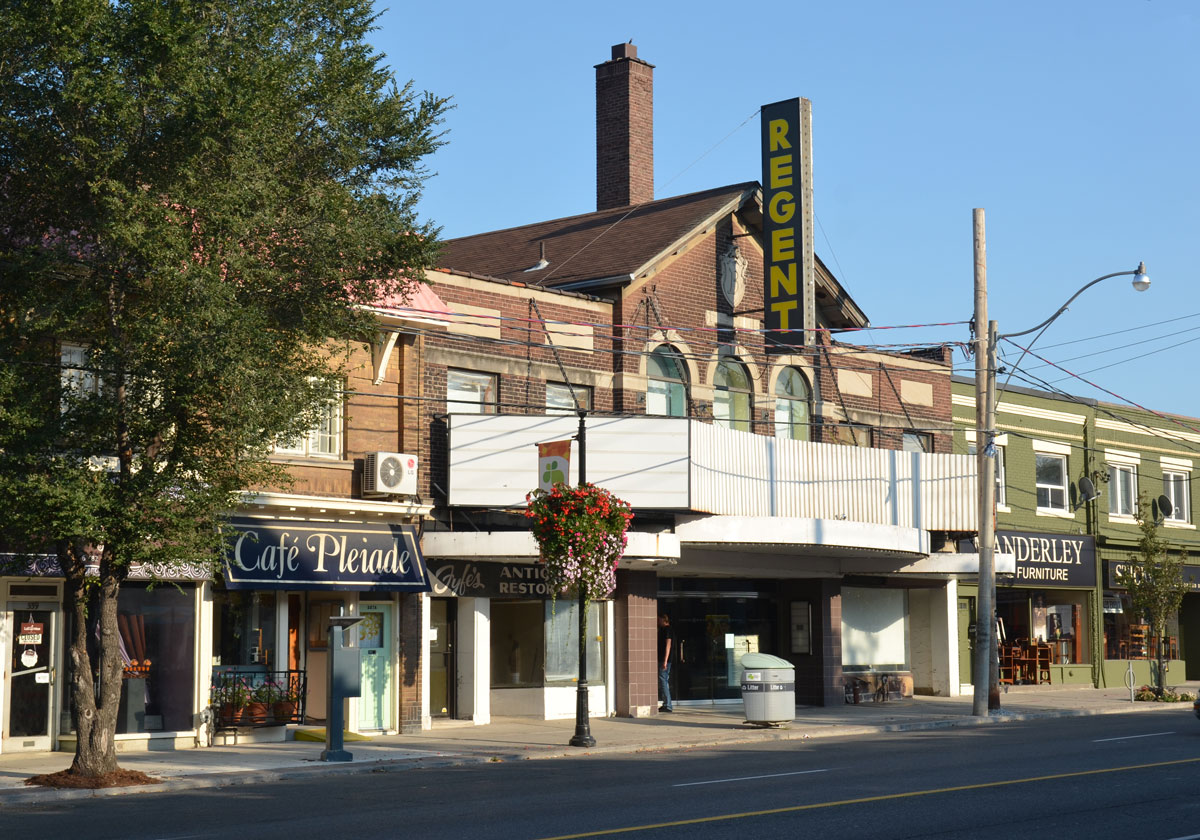
On Mt Pleasant Road, just north of Davisville Ave. is the Regent Theatre.  It is a rather nondescript brick building with an ugly white piece of something across the front.  Sometimes the names of the movies that are showing appear on the south side of that white thing (on the side you can’t see in the photo!).

The front of the Regent theatre, a two storey red brick building with a large ugly blank white sign across the bottom of the upper storey.

The Regent theatre today.

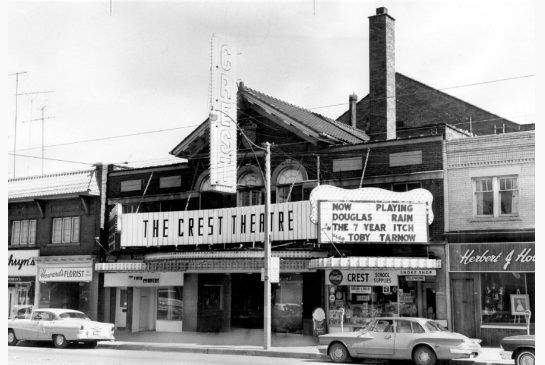
It was built in 1920 as the Belsize Theatre.  As you can see, the front of the building hasn’t changed much after almost 90 years.

old black and white photo of a stretch of Mt. Pleasant showing some stores and the Belsize Theatre.

Even back then the hydro poles and wires were an eyesore!

A mid life name change and it became the Crest Theatre.

old photo of the Crest Theatre from the late 60's or early 70's.

Crest Theatre – The movie ‘The 7 Year Itch’ came out in 1955.  I have been corrected (see comments below).  Between 1954 and 1966 the Crest Theatre was not a movie house, but was devoted almost exclusively to live theatre.  The “now playing” refers to the theatre production of ‘The 7 Year Itch’ which pre-dated the movie.  The original stage play was by George Axelrod (1962) and was presented live at the Crest in December of 1963.  Their production starred Toby Tarnow and Douglas Rain.  (with thanks to David Rain for the correction and added information).

.

By the time of Confederation in 1867, one quarter of the population of Canada were of Irish ancestry.  Although the Irish had been immigrating to what is now Canada for a long time, the Irish famine years of 1845 to 1849 saw an increase in the number of immigrants.  Immigration peaked in the summer of 1847;  boatloads of Irish settlers arrived.  Most were very poor and sick.  They landed in a number of places along the St. Lawrence River and Lake Ontario, including Toronto.   Thousands of those Irish immigrants died in Ontario that summer, mostly from typhus (or typhoid fever).

Ireland Park is home to a memorial in honour of those immigrants. It is on the waterfront between Lake Ontario and the old Canada Malting Co. silos.

view of Ireland Park from the waterfront, and looking slightly north east.  A large shape made of limestone is on the left of the photo and a green space is beside it.  The silos of the Canada Malting Company are visible as is part of the Toronto skyline in the distance.

Sections of limestone fit together in a shape that resembles a boat.

Names are engraved on the sides of the limestone sections.  They are placed such that they are in the gaps between the sections.  At first they are not visible.  It is only when you are close to the stone that you can see the names.

Names in black lettering carved into the side of limestone.

675 names are carved in the stone. These are the known names of the 1000 to 1100 people who died shortly after they arrived in Toronto in the summer of 1847.


The park also has seven sculptures by Rowan Gillespie of Dublin Ireland.
The installation is called ‘Arrival’. 

Sculpture of a man with his arms upraised.  He is looking over part of the harbour towards downtown Toronto.

‘The Jubliant Man’ from behind.

close up of one of the sculptures in Ireland Park.  It is a man with his hands clenched in front of him and a worried look on his face.

‘The Apprehensive Man’

 for more information: the Ireland Park Foundation website
Corktown Common

One of Toronto’s newest parks

In one corner of the park there is a plaque that commemorates the William Davies Company, once the owners of the land and buildings in this part of the city.

blog_plaque

“From 1874 to 1927, this site was home to the William Davies Company, reputed to be the largest pork packing plant in the British Empire. Established in 1857 by William Davies (1831-1921), the company made its fortune preparing and exporting cured sides of pork to England. Later, its products were sold through William Davies Company shops, one of Canada’s first store chains. In its buildings here, the innovative company controlled the entire process from slaughter to shipment. Processing nearly 500,000 hogs annually by 1900, the company contributed to the city’s nickname “Hogtown”.
In 1892, Joseph Flavelle (1858-1939) became a partner and managing director of the company. Under Flavelle, the business flourished until the 1920’s when it was hurt by falling markets. The William Davies Company merged with three other packing firms to create Canada Packers, which continued to operate from this site until 1932. The last of the company’s buildings here were demolished in the 1990’s.”
.

An old coloured map of the area now called the West Don Lands.   This illustration also appeared in a blogTO post about the William Davies Company. http://www.blogto.com/city/2013/10/how_toronto_got_the_nickname_hogtown/

An old illustrated map of the area now called the West Don Lands. The red letters are as follows:
A – Gooderham & Worts, now the Distillery District
B – William Davies Company, now Corktown Common
C – CNR tracks
D – the Don River
A version of this illustration also appeared in a blogTO post about the William Davies Company.

.

The last remains of the pork processing business disappeared long ago. After remaining vacant for a number of years, the site was developed into a park as part of the West Don Lands rebuilding.
 

small trees and other greenery , with a path and bench in the middle, in the foreground and the Toronto skyline is in the background.

The park is starting to look a lot greener as the plants and trees grow. This photo was taken from on top of one of the man made hills in the park. August 2014

.

A black, grey, white and orange butterfly on a pink flower

There are now lots of butterflies….

.

A bee and a butterfly on a tall upright light purple flower.

… and bees

.

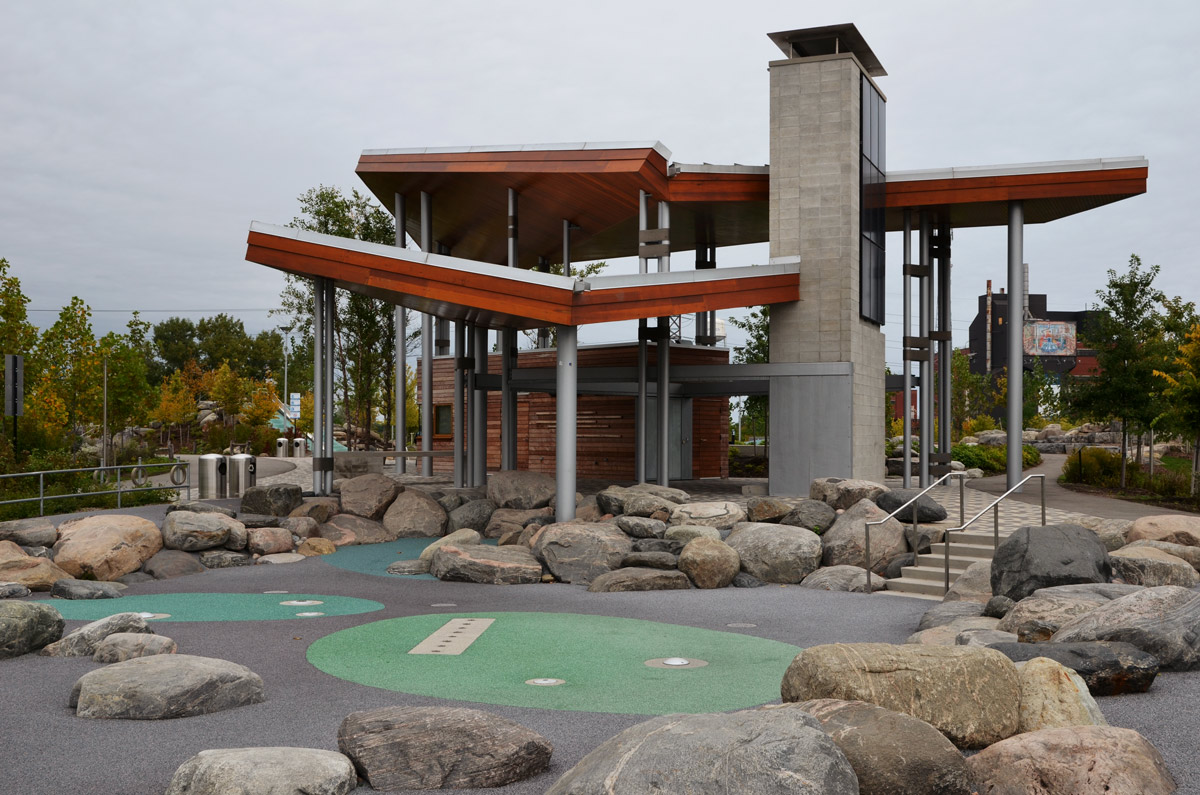
a metal and wood structure

A pavilion made of steel and wood sits atop a small hill in the middle of the play area. The pavilion was designed by by Maryann Thompson Architects of Boston The blue and green ovals are where there are fountains for warm weather water play.

.

a woman is sitting on a bench, looking at her phone.  Behind her there are a number of buildings under construction

Looking west, and slightly north, from the pavilion towards the downtown area.  West Don Lands redevelopment in the immediate background.  Autumn 2013 (the building under construction is now almost complete – see above)

.

Part of a large red metal sculpture is in the foreground, looking past it you can see the pavillaion on top of a small hill that is part of Corktown Common park

Looking northeast through the wood and red metal sculpture,  ‘No Shoes’, by Mark di Suvero.  May 2014

.

Newly planted trees surroounded by grass.

The trees are starting to grow. They don’t look like much at the moment but give them time!

.

raspberries, not quite ripe, on a raspberry canes

There is even a large raspberry bush but by the looks of it, only the birds and insects have found it!

.

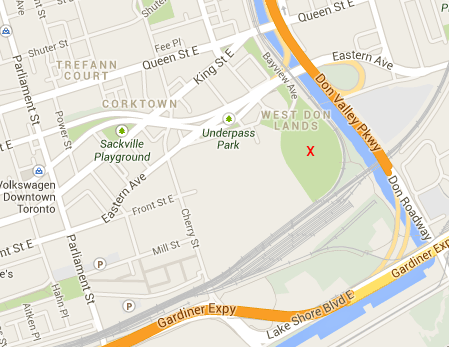
A map, screenshot from google maps, of West Don Lands and vicinity.

A map of the area today. The red X marks the spot of the new park.

When the park opened in 2013, urbantoronto.ca had an article about it.  You can read  about it  here

Some wonderful aerial views of the area can be seen in another wordpress blog

******

Jennifer Kateryna Kobal’s’kyj

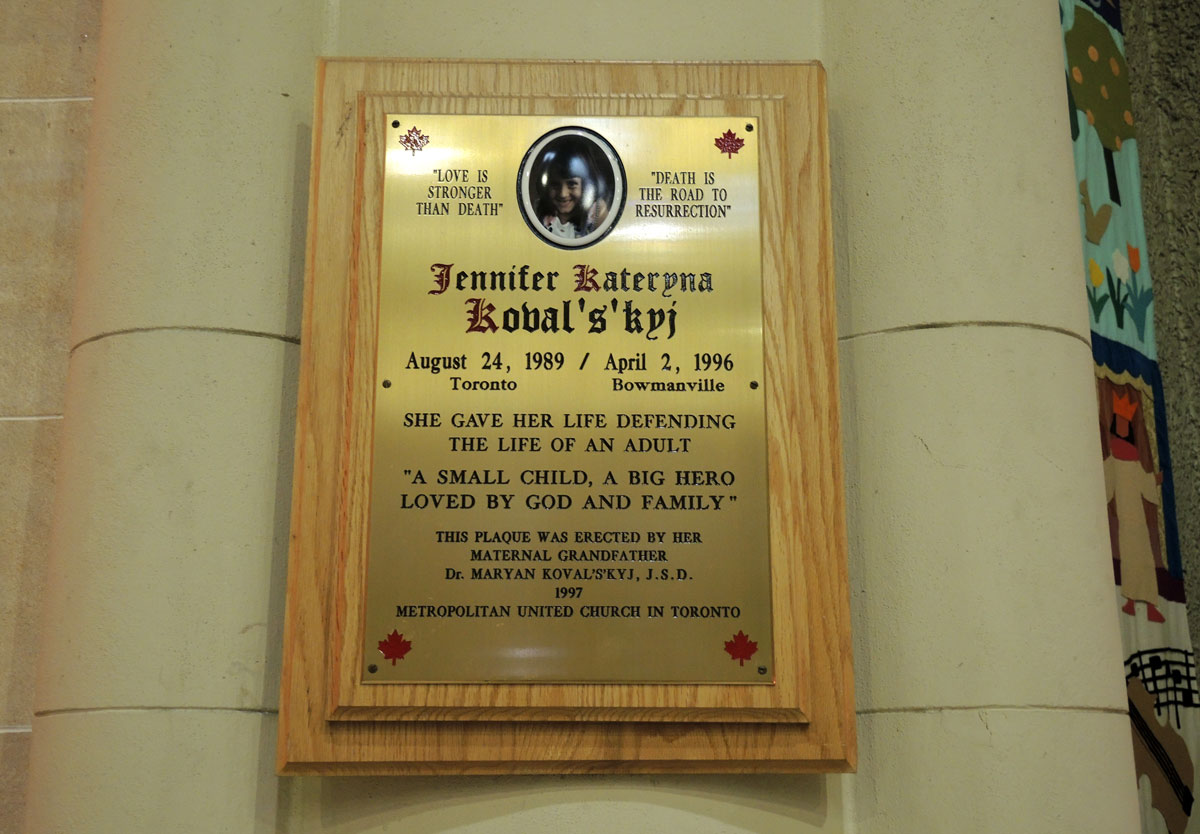
I became curious about this story when I encountered two different memorial plaques for this girl in two different churches on the same day.   Jennifer Kateryna, 24 Aug 1989 to 2 April 1996.  She would have been just a couple of months older than my daughter.

memorial plaque on a wall

In 1997 her maternal grandfather erected a plaque in her memory in Metropolitan United church.

.

memorial plaque on a wall

There is another plaque, this one at St. James Cathedral, erected by her mother, maternal grandfather and aunt in 1998.

The death of a child is never a happy event, but Jennifer’s story is one of the sadder ones as she was murdered by her father as she tried to protect her grandmother from him. Sadder still is the fact that she had been living with her grandmother as part of the settlement in a custody dispute.

Polson Street Park, where the Don River meets Lake Ontario, was officially changed to Jennifer Kateryna Kobal’s’kyj Park in 1998. This park is at the end of Polson Pier, overlooking Toronto Harbour.

——————