Archive for the ‘galleries’ Category

Marys in Toronto 
It has become one of the things I do – I look for ‘Marys’ when I travel.  For one reason or another, I started seeing Marys in Toronto too.  Perhaps it was because I spent more time in galleries and museums on those really cold days that we had last winter.    There aren’t nearly as many Marys here as there are in Lima Peru or in Malta.  Hence, finding them was a bit more difficult but that just made the hunt more interesting.

below: In the window of Sonic Boom on Spadina

A picture of Mary and Jesus in a store window. Jesus is depicted as a middle age man.

below:  a sculpture of Mary and Jesus,  from the Gardiner Museum

ceramic (or glazed terracotta?) sculpture of mother and child, Mary and Jesus.

below: ‘The Dormition of the Virgin’ by Esteban Marquez De Velasco (c.1655 – 1720, Spain).
This painting is in the Art Gallery of Ontario.  It depicts the moment before Mary falls asleep and her soul leaves her body to join Him in heaven.  The apostles surround Mary and kneel in prayer.

A close up of a painting. A young woman, the virgin Mary, is sitting up in bed, her right hand over her heart and her eyes raised to heaven. A man is standing to the right, his eyes also looking up to heaven. Men reading books are to her left.

below: ‘Madonna and Child’ by Andrea Della Robbia (1435-1525, Florence Italy).
Glazed terracotta. On loan to the AGO from the family of Murray Frum.

A white porcelain relief sculpture on a reddish wall. Mother and child, Mary and Jesus.

below:  In front of St. Clare Roman Catholic church on St. Clair Ave. West

White statue of Mary and Jesus outside a church, a vase of red and white flowers is beside her feet. The words Sancta Maria Mater Dei are on a bronze plaque under the statue.

below: In the window of Crows Nest barber shop, Kensington Market

 A figurine of the Virgin Mary with her light blue shawl stands piously in the window of a barber shop. The building is painted a light blue colour.

below: Figurines for sale at Honest Ed’s

seven figurines of Mary painted with long white, light blue and gold robes. They are about 20 cm high, all with downcast eyes except the one on the left looks like she's looking at the camera.

below: Holographic cards with images of Mary Jesus in a red plastic tub.
You can buy a card at Honest Ed’s for 69 cents.

postcards with holographic images of Mary and Jesus.

below: Sagrada Familia, by the front door of a house in Little Portugal

A ceramic plaque of Mary, Joseph and Jesus on the exterior wall of a house beside the front door and above the mailbox

below:  Hiding amongst the drapery sits Mary and her child.

from the outside, the lower part of a window with white shutters and a stone window sill. Lace curtains are in the window and a statue of Mary and Jesus is inside.

below: Another from the AGO,  Virgin and Child from circa 1750, once in a chapel of a Montreal church.
Wood with traces of pigment.

 In the Art Gallery of Ontario, a wooden statue of Mary holding baby Jesus. Behind the statue is a large painting of the fire in Quebec City in the 1700's.

Wooden statue of Mary standing while holding a baby Jesus.

below: Mount Pleasant cemetery

close up of part of a tombstone in a cemetery showing a small relief sculpture of Mary, Joseph and Jesus

below:  On an ofrenda at a Dia de Muertos celebration

a statue of mary with pink candles on either side of her. A yellow day of the dead paper cut out is behind her. Strings of yellow, orange and pink flowers are also on either side of her.

below: Radio Maria, una voce cristiana nella tua casa, part of the Holy Mother World Networks.

entrace to a small red brick building with a two signs, one over the door and one beside the door, for Radio Maria.

below: With other members of the Nativity scene, for sale in a vintage store on Queen West.
I think that $20 buys you the contents of the box.

ceramic figures of the Nativity scene, Mary, Joseph, baby Jesus, etc. They are lying in a box that is for sale in a store.

below: In a front yard in the Junction
I’ve put her at the end because I am not 100% sure that she is a Mary. The Virgin Mary is usually depicted with a light blue shawl draped over her shoulder or else holding a baby Jesus.

A small white statue of Mary on a makeshift pedestal in a front yard. Early spring, bare rose bush branches, a couple of small white planters with flowers in them. A white metal railing on the front porch.

And here ends that game.  This post represents almost a year’s worth of looking and while the hunt was interesting in the beginning it’s charm is starting to wear thin.   I could probably find more Marys in churches and cemeteries but I think I will listen to words of wisdom and let it be.
 Food is an important part of our lives and there is a lot that we take for granted about the food we eat. Food, and all that accompanies it, is the theme of a collection of art exhibits at Harbourfront’s Artport.   On display is work by a number of artists who have been examining different food related issues.   How we see food, it’s role in our lives, how healthy is it,  it’s production, and how we obtain it, are just a few of the questions that are explored.   We eat food but what about the parts we usually waste?

Below is a sample of what is on offer.

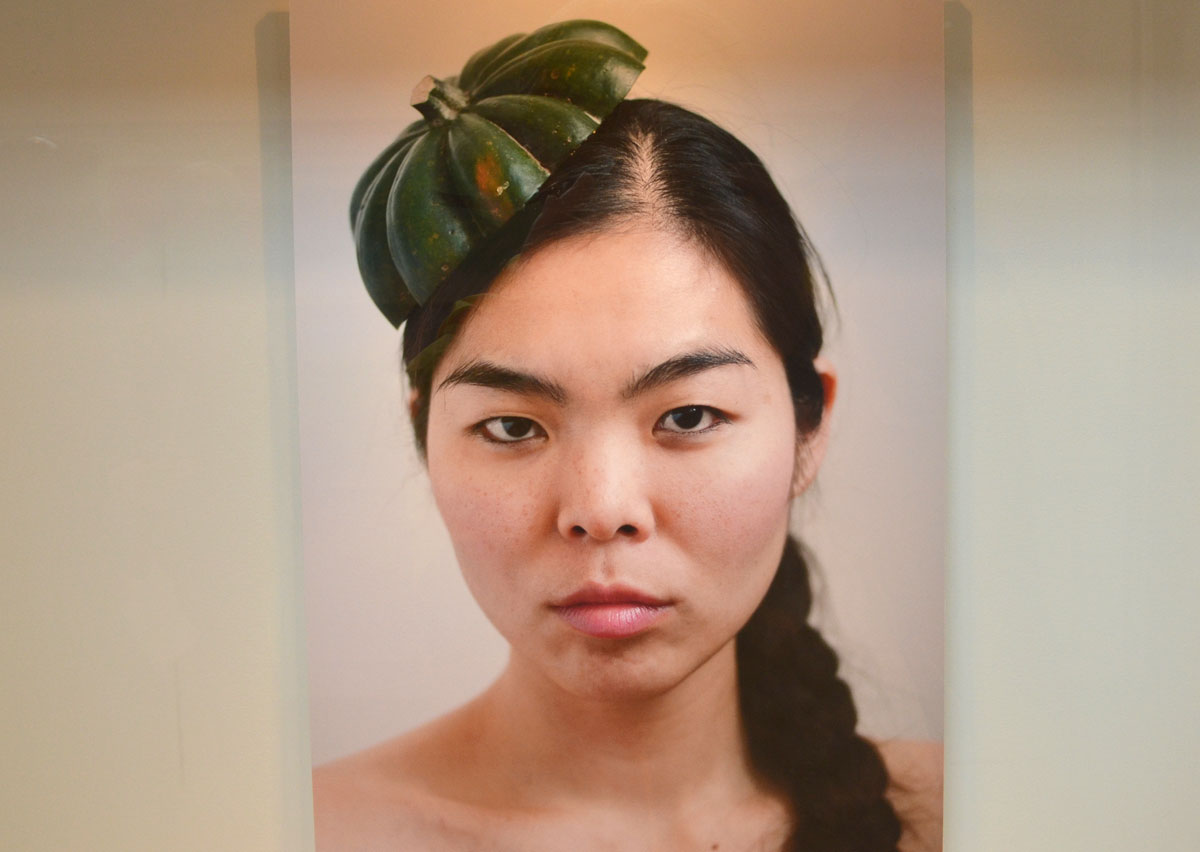
below: ‘Wearable Food – Hat’, 2014, by Sooyeong Lee, part of a series of photographs that displays food in atypical and unexpected ways.   An acorn squash fascinator is precariously perched on her head.

A picture of a photo of an Asian woman with her hair in a braid, a stern expression on her face, and the top of an acorn squash on her head in place of a hat

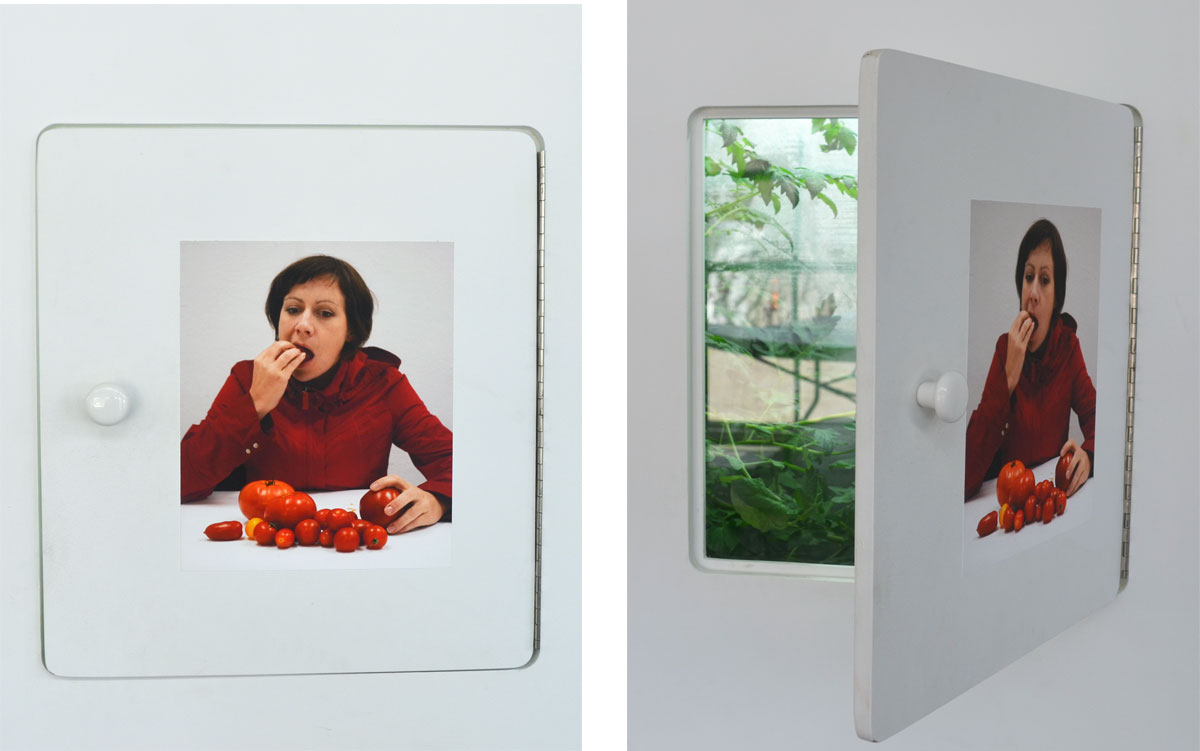
below: ‘Frugivore Project’, 2011-ongoing, by Amanda White, an attempt to communicate biologically with tomato plants.  White bought tomatoes from the grocery store and ate them.   She harvested the seeds after they had passed through her digestive system and then planted them.  After the plants bear fruit, it is eaten and the cycle continues.

Two pictures of one art installation. On a small door is a picture of a woman eating a tomato and with a pile of tomatos in front of her. Open the door and it reveals a small space with a tomato plant growing there.
 

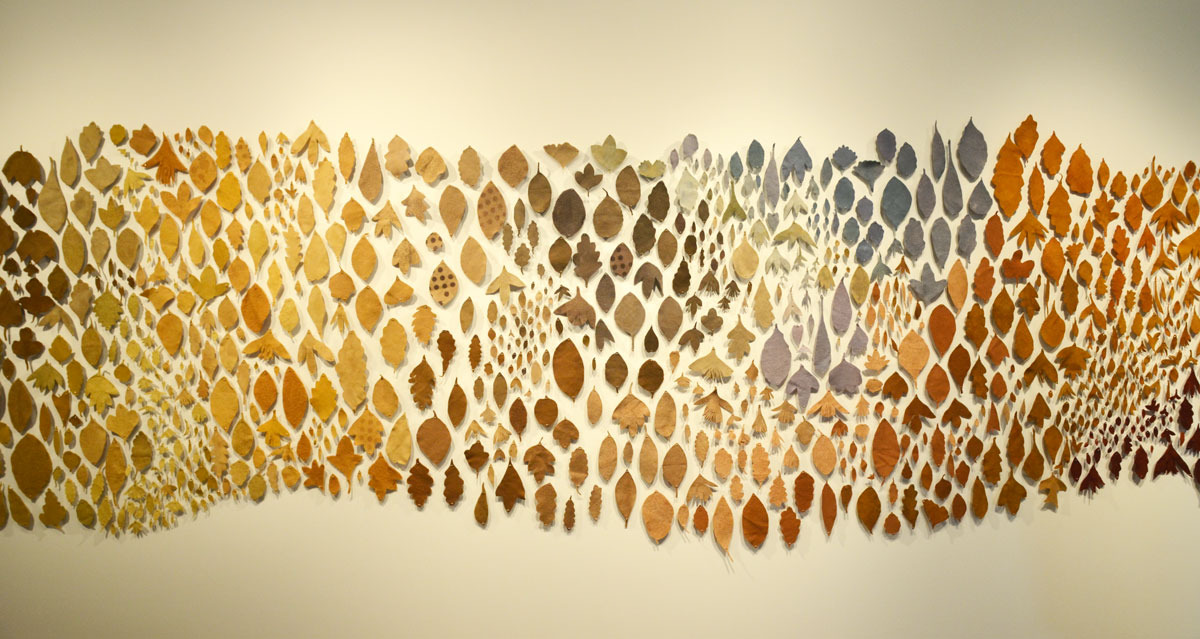
below: ‘Foraged Palette’, 2015, Thea Haines, made with wool, silk, linen, hemp and cotton with natural dyes.   The dyes are made from food waste such as carrot peels, onion skins, pomegranate skins and avocado pits.

A pattern of hand dyed, hand cut leaves in varying shades of yellows oranges and browns is displayed on a wall

close up of A pattern of hand dyed, hand cut leaves in varying shades of yellows oranges and browns is displayed on a wall

below:‘Strain to Absorb, 2015, by Lisa Myers, three digital files running simultaneously. Blueberries contain the pigment anthocyanin which the artist produces from strained fruit.

Three video screens displayed horizontally on a wall.

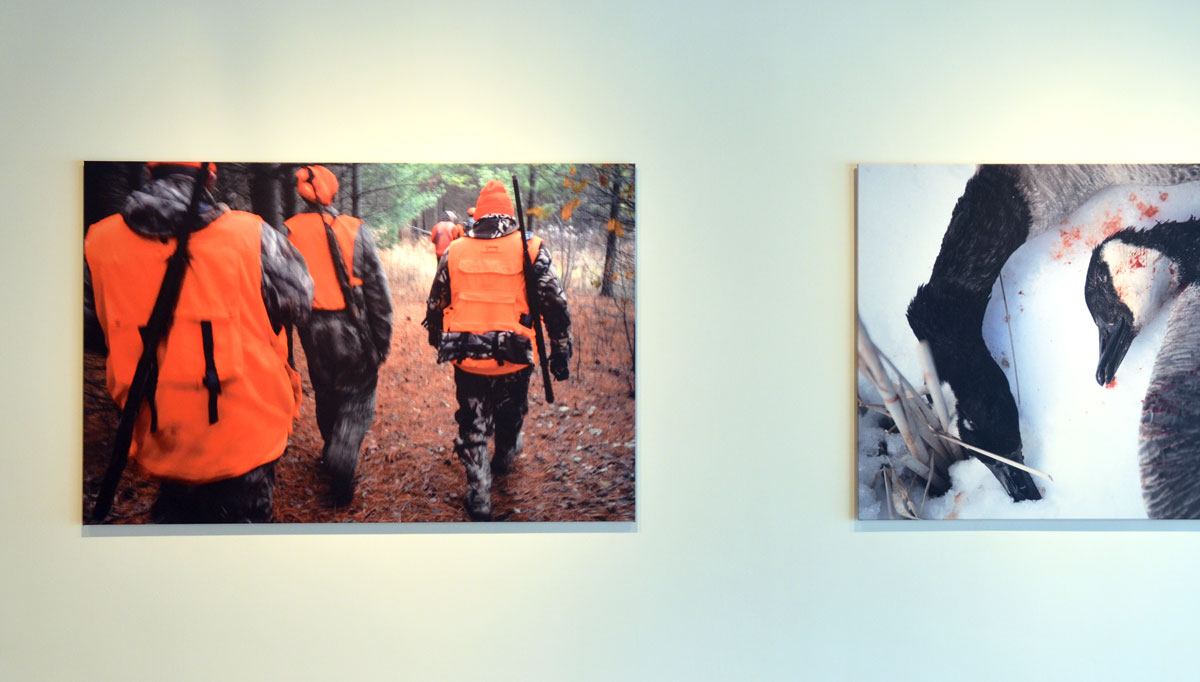
below:‘Accidental Hunter’, 2014, by Erin Riley, hunting with a rifle received as a gift from her father and taking pictures of the event.

A picture of a large photograph of people in orange vests and hats as they set out with their rifles on a hunting trip. To the right is part of a picture of dead geese but only part of it is visible

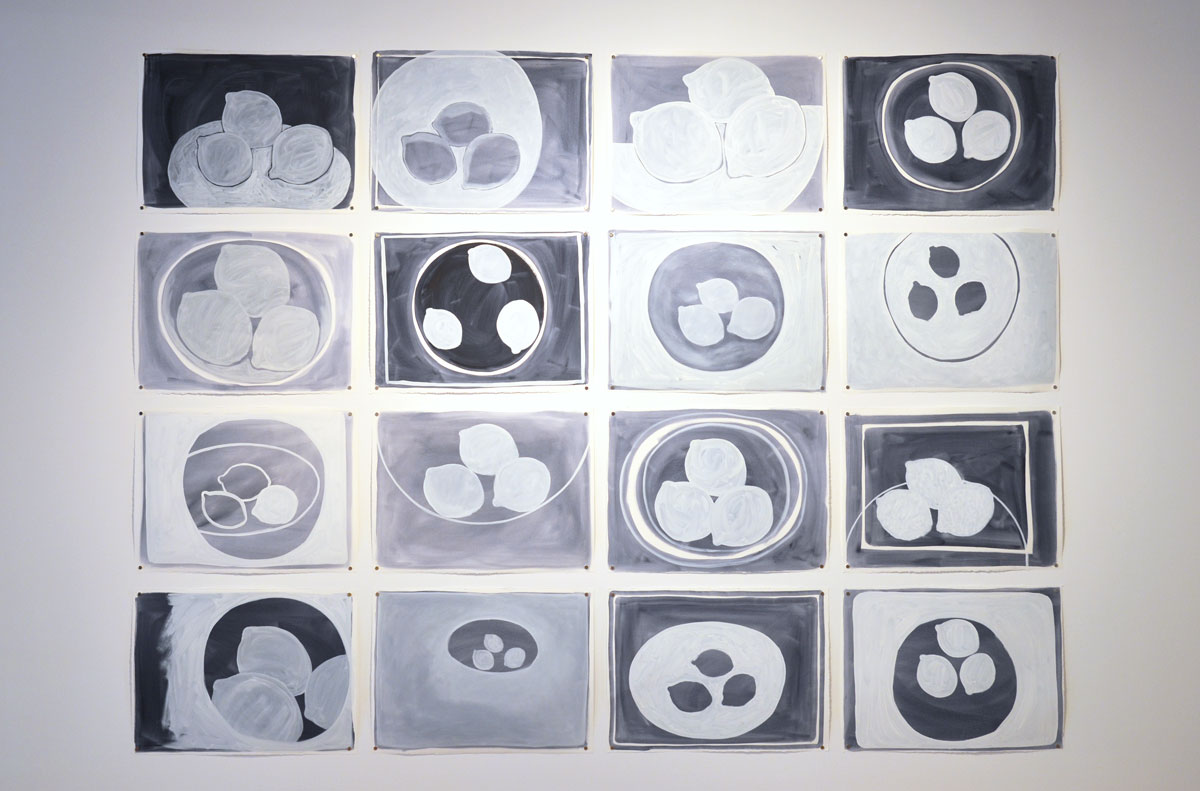
below: ‘Delicate merchandise!”, 2014, by Lynn Price, oil on paper.  The title comes from a poem called ‘Ode to a Lemon’ by Pablo Neruda (see bottom of post)

A grid of 16 black and white paintings of three lemons in a bowl , on an art gallery wall

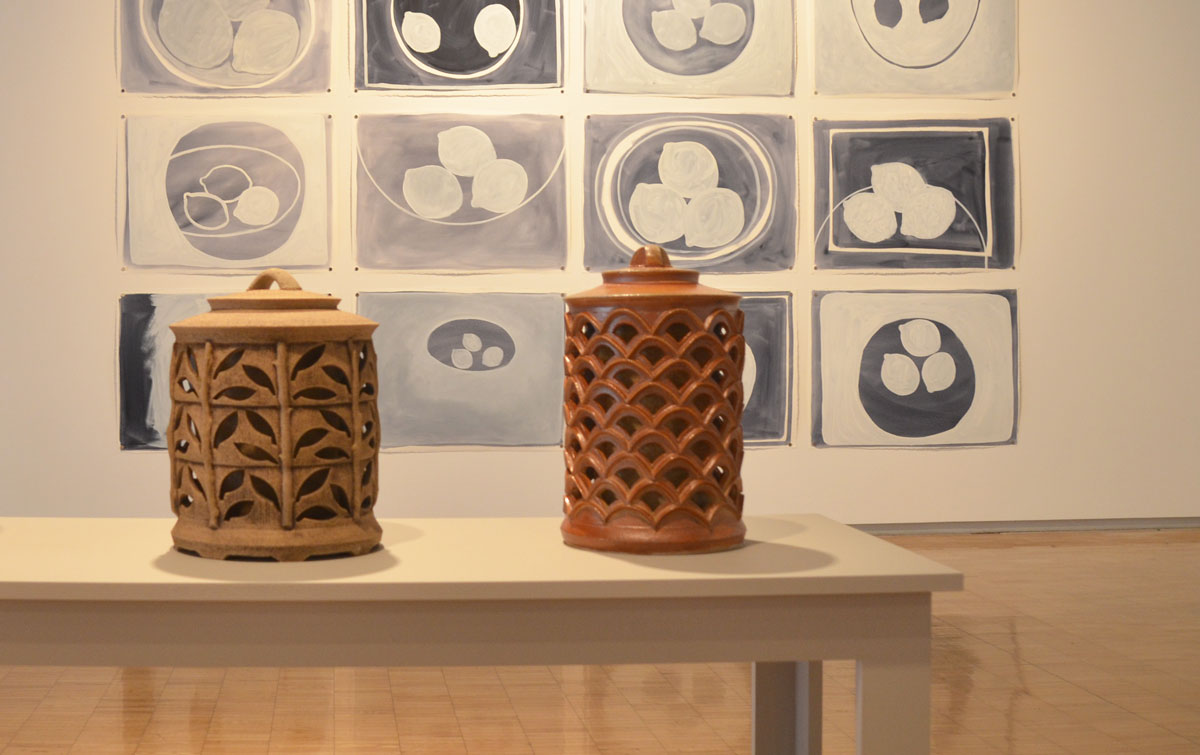
below:Functional Ceramic Tableware, 2005-2015, by Bruce Cochrane

Two intricately designed ceramic containers on a table in front of a series of pictures of lemons in a bowl

Two artistic ceramic pieces by Bruce Cochrane on a small shalef

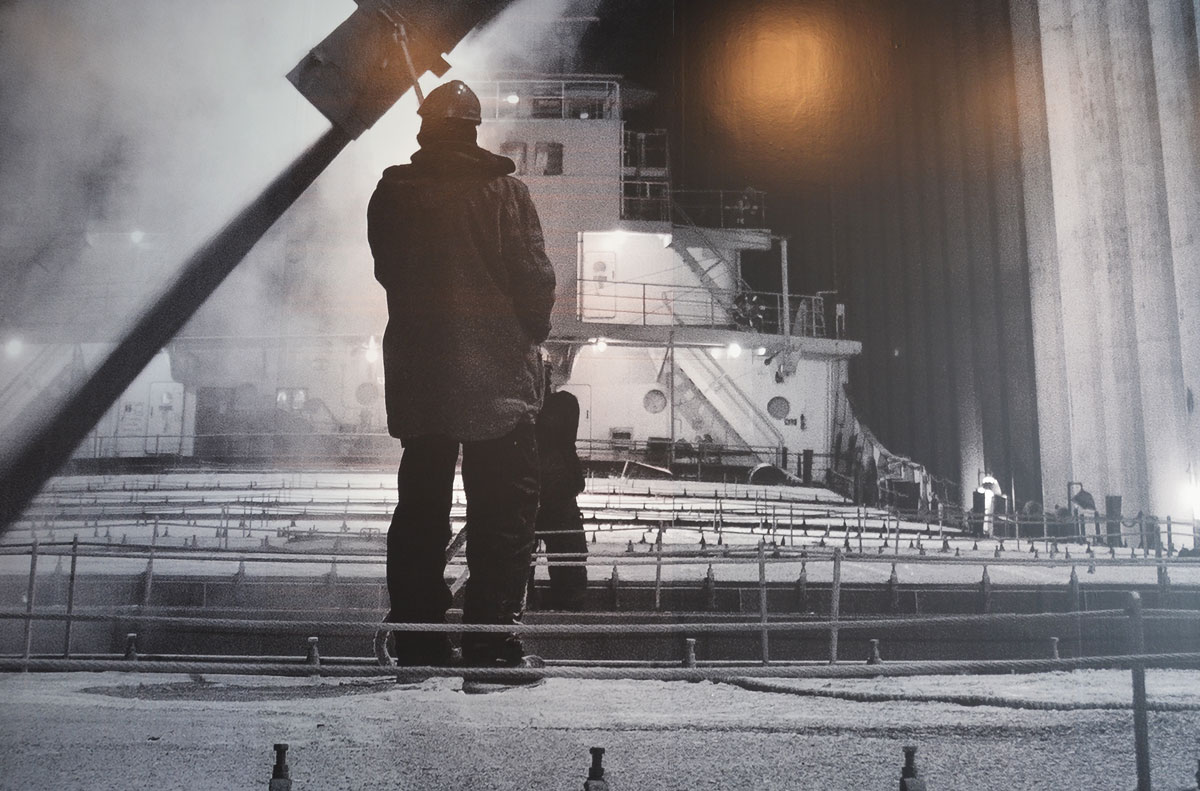
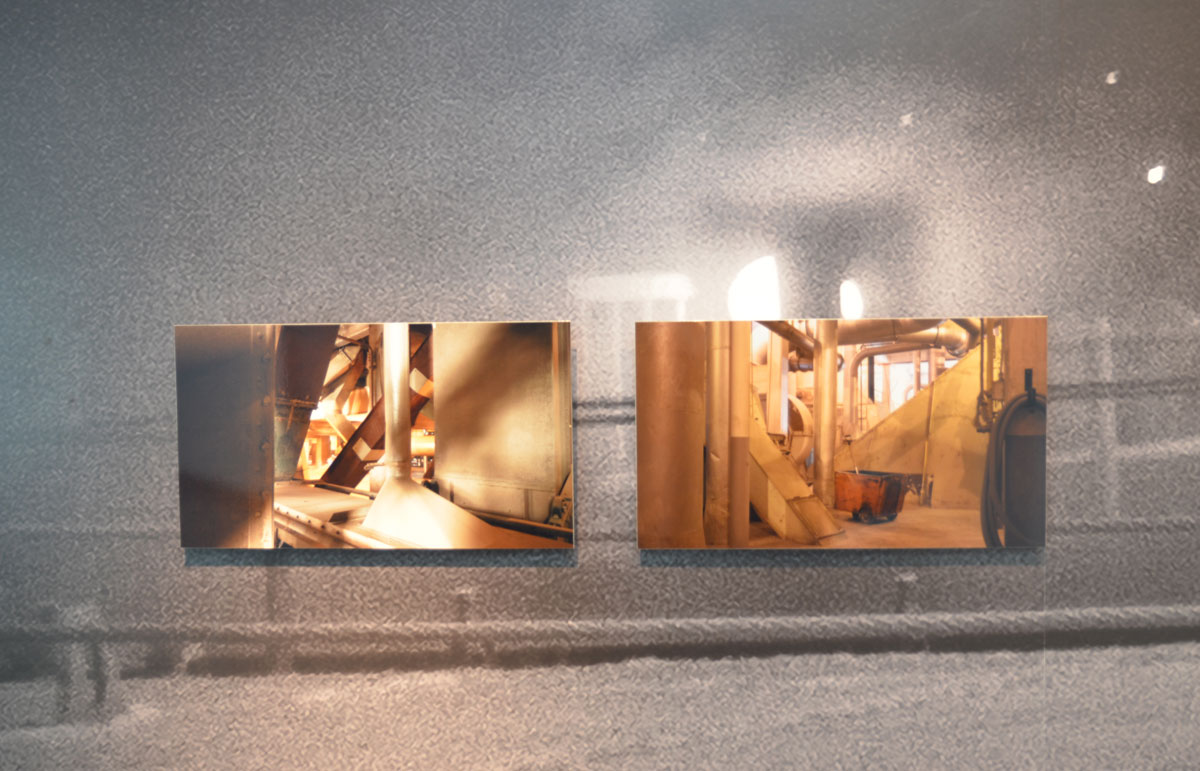
below: Trading Places, Victoria Piersig.  A series of photographs from a journey spent onboard a ship transporting wheat from Thunder Bay to Montreal.

close up of part of a very large black and white photograph of a man standing on the deck of a lake freighter at night in the winter

Two photographs of parts of a ship mounted on a wall that is covered with a large black and white photo

below: cookie cutter rings and brooches, by Andree Wejsmann

six little rings and broaches made to look like cookie cutters, a shovel, a squirrel, a rabbit, a heart, a duck and a snail.

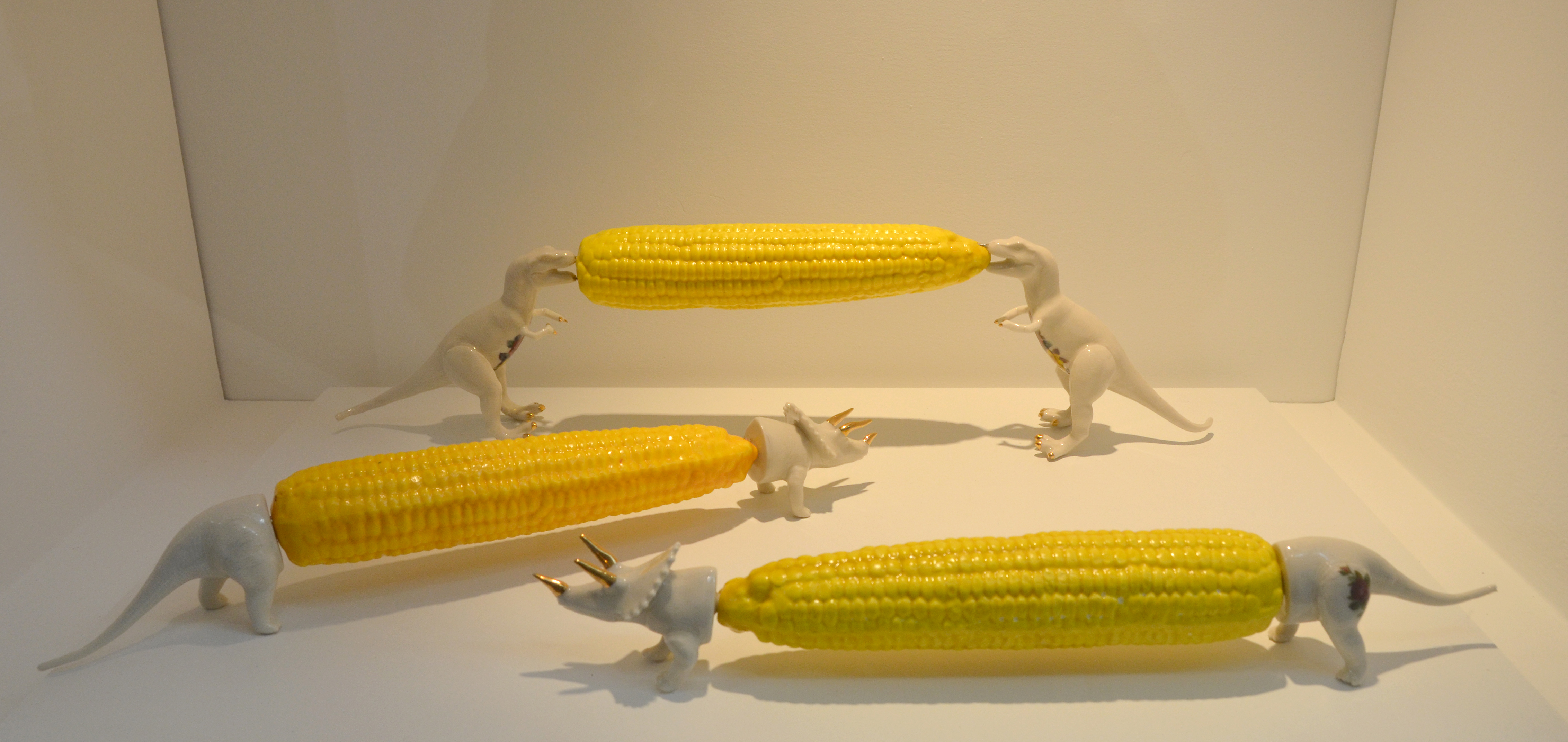
below: Teerex and Triceratops Corn Cob holders, 2012, by Lana Filippone

sculptures of cobs of corn, three, each with dinosaur corn cob holders.

***

‘Ode to a Lemon’ by Pablo Neruda

Out of lemon flowers
loosed
on the moonlight, love’s
lashed and insatiable
essences,
sodden with fragrance,
the lemon tree’s yellow
emerges,
the lemons
move down
from the tree’s planetarium
Delicate merchandise!
The harbors are big with it –
bazaars
for the light and the
barbarous gold.

Invention, an installation at The Power Plant gallery, by Mark Lewis.

The main part of the exhibit consists of 3 short films shot in Toronto.
When I first saw it, I thought that the films were older, perhaps from the 60s or 70s.

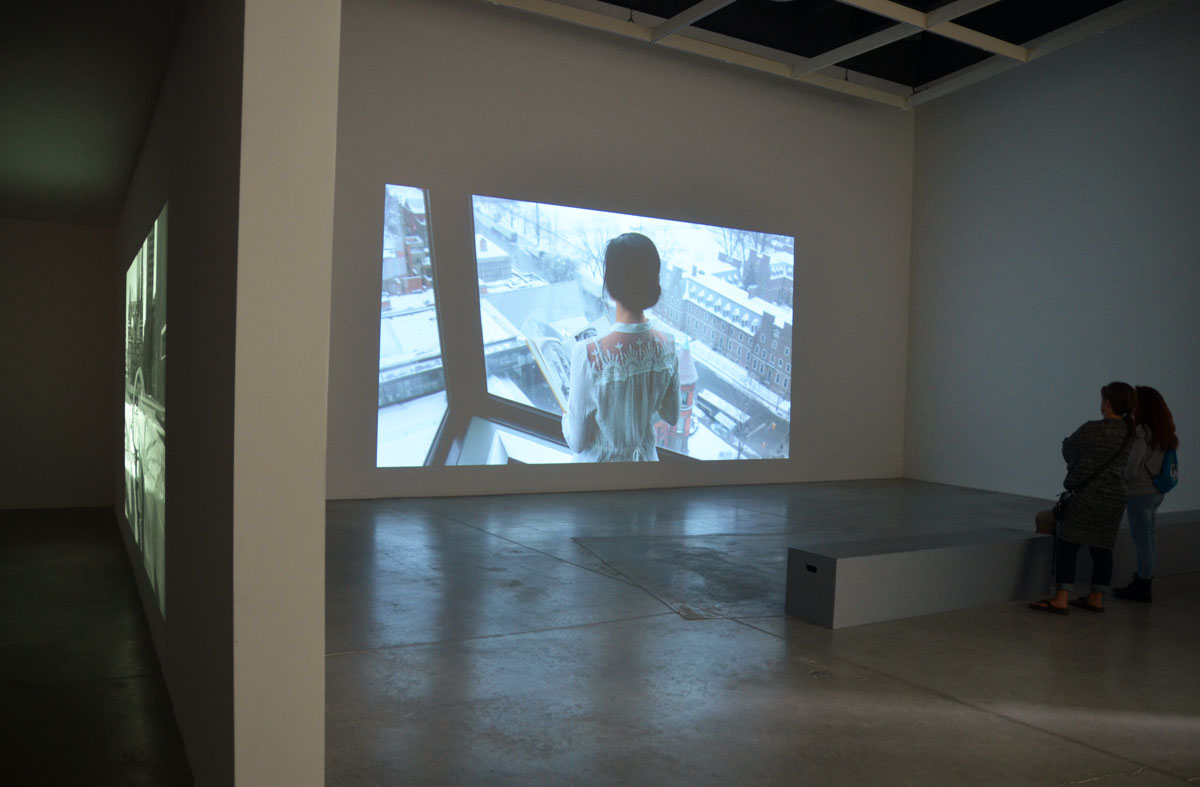
below:  A short film begins with a pan over part of downtown Toronto.  It circles back to the Robarts Library and focuses on a woman standing in the window of one of the upper floors.  After zooming in on the woman, the film “enters” the room she’s in and turns back to focus on what her view out the window looks like.

Two women are standing in the semi darkness in a room in an art gallery, watching a black and white film that is showing on a large screen in front of them. The image on the screen is the back of the upper part of a woman as she stands in front of a window in the Robarts Library in Toronto. The scene outside the window is clearly visible, winter time, University of Torotno campus. She is holding a book in her hands.

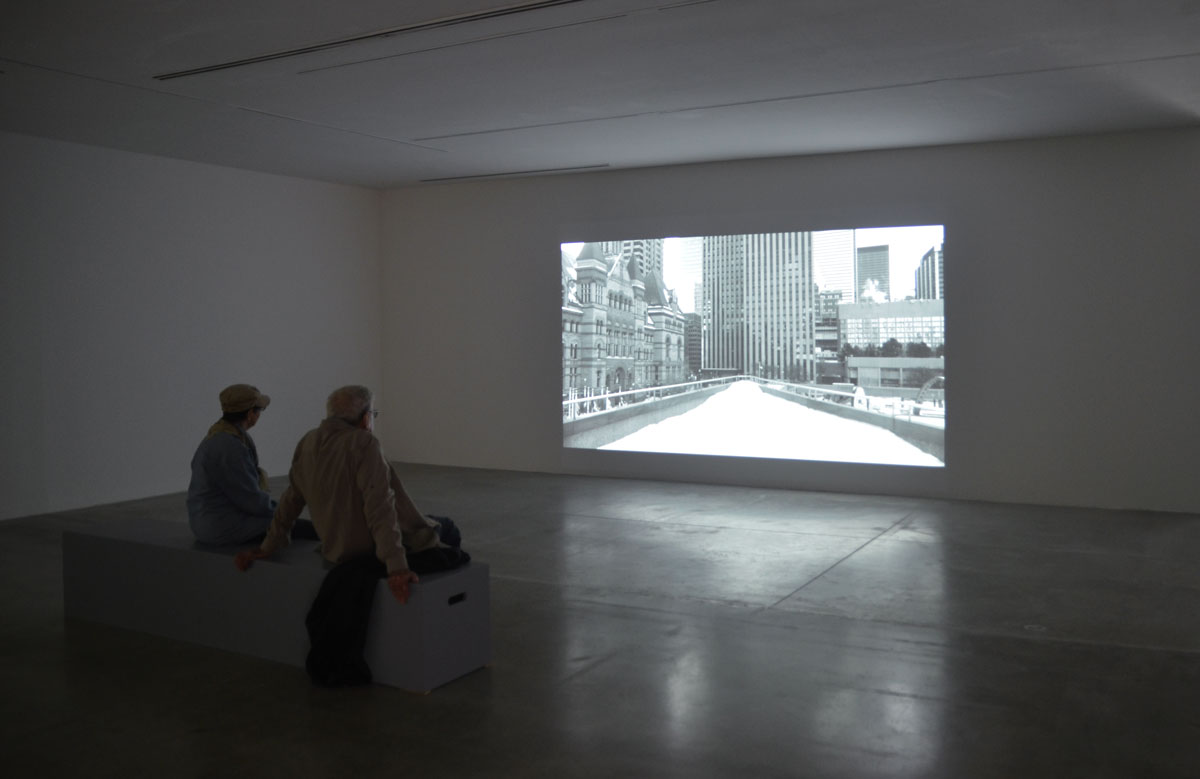
below:  Another exhibit is a film comprised of segments filmed at a number of locations around City Hall this past winter.   The image below is shot from the upper ramp at Nathan Phillips Square, looking south.   Old City hall is on the left.   There are no people in the picture.  There are also no commercial images such as billboards or signs on the buildings.  Slow moving, quiet.

An older couple are sitting on a bench at an art gallery. They are watching a black and white film that is showing on a large screen in front of them. The image on the screen is a shot of the upper ramp at Nathan Phillips Square, looking south, in the winter with snow on the ground. There are no people in the picture on the screen.

It wasn’t until I looked more closely at the images that I realized that the films had to have been made recently… for example, the recently built stage area in Nathan Phillips Square.  So I watched the films again looking for details.

One of the images shown in an art installation on a large wall screen, a black and white picture overlooking Nathan Phillips Square in the winter.

A little perplexed, I tried to find out why Lewis made these films, and why they were considered to be “art”. It wasn’t easy; it was probably made more difficult by my love/hate relationship with contemporary art.  The title of this post comes from a paragraph I found on The Power Plant website description of this installation: “Together, the elements that make up Mark Lewis’ films culminate in a body of work that is as astute as it is elegiac in its contemplation of the quotidian, offering an experience of the flux of time that is as elating in its duration as it is haunting for its sense of passing.”  Well, um, okay.

It also wasn’t easy because of the scope of the questions that Lewis seems to be tackling.  One of his interest lies in discovering what it might have felt like when film revolutionized they way we looked at ourselves and at the world around us.   That’s a tough one.  We are a society that is immersed in moving images of all kinds. Movies and TV have been part of our lives for many generations.  Can anyone truly imagine what it might have been like to see a film for the first time?

As we all know, digital technology has put video production into the hands of anyone with a cellphone.   Even my three year old granddaughter asks me to make videos of her and I’m sure it won’t be long before she’s producing them.  And that leads to another question that Lewis is interested in examining – what are the implications of these technological changes?  Not only can see video, we can be in control of making our own whenever we want.

But that’s not all.  Lewis is also interested in architectural surfaces so walls, windows, pavements and reflective glass amongst others play a role in his films.   Urban architecture; urban landscapes.  Cinema made of the ordinary everyday life of living in the city and everyday life in the city is cinema.  24/7 movie making.  You are part of the cast; you are the camera.

What I have presented here are just three pictures and I’m not sure the pictures do the films justice.   If you want to see these films, they are at The Power Plant gallery until 3 Jan 2016.

#PPInvention

I happened to walk into the Queen Mother Cafe (on Queen West) this afternoon.  They often have original artwork displayed on their walls and today was no exception.  I found some intriguing and very creative masks.

A mask in beige, black and white mounted on the wall. The nose is a wrench. The white part looks like a mask across the eyes of the mask

They are the creation of Jeff Mann, a Kingston based artist.

four metal masks mounted like on a wall. One looks a reddish dog and one looks like a skull. They are made of car parts.

According to his website, Mann makes the masks mostly from car parts and shovels.  The ones here are only a sample of the collection I saw at the Queen Mother cafe.   In addition, there are pictures of more masks on Mann’s website.

close up of a mask hanging on a wall. It's made of rusty metal car parts welded together

A mask that looks like a cow. Large black and white face, a pinkish red body and four skinny spindly legs. Curly cue tail too.

‘Space’ is a series of commissioned works for Mercer Union Centre for Contemporary Art.  These works appear in the billboard space on the side of their building on St. Clarens Ave (at the corner of Bloor Street West).   At the moment, the 4th in the series, ‘Many Maids Make Much Noise’ by Olivia Plender is on display.

words in dark blue written on a white board that is fastened to a brick wall, behind a rust coloured metal fence

Transcription (wordpress has trouble with the formatting I’m afraid):

“1) Imagine you are chewing a piece of very tough meat. Begin
to chew grossly and use the full movements as if trying to break down a gristly lump.

2) Maintain the chewing action whilst repeating the following sentences:
Mutton makes a meaty meal
Militant miners means more money
Many maids make much noise

3) Now try it in a group and repeat several times a day.
Many maids make much noise
Many maids make much
Many maids make
Many maids
Many

[repeat]”

The words are the instructions for making sounds, especially the sound of the letter m. This seemingly mundane exercise is given political overtones by the choice of the sentences chosen to practice on.

This billboard is scheduled to remain until January 2016

Mercer Union website

The title of the exhibit is ‘Surrender’ and the words on the wall say this:

“Liz Magor’s art invites us to reconsider our relationships with the things we encounter every day.  Through subtle shifts in materiality and context, her works reveal the important role that objects play in our lives: they can allow us to conceal ourselves or to express our identities.  In her sculptures and photographs, Magor explores how we depend on domestic materials to develop a sense of self.”

Nothing is mentioned about surrendering, or why the exhibit has the title that it does.

In the first room there are boxes on the wall.  Each box looks like a carefully wrapped sweater or jacket that has just been purchased.  I can envision a middle aged saleslady taking her time to package your purchase, like in an Eatons store thirty or forty years ago.

art installation at the Art Gallery of Ontario by Liz Magor - two walls with many open boxes on them. The boxes are made to look like they've just been opened to reveal a sweater or top folded neatly inside, including the tissue paper that often accompanies a new purchase. The clothes have all been decorated with different objects.

On closer look, most boxes also have a hand print, or shape of a hand with index finger pointing at something and little details are amiss…  a ketchup package for example.

blog_liz_magor_cornhuskers

The second room has a number of smaller installations.

A garment bag left over a chair.
Neatly folded blankets hanging on a wall.
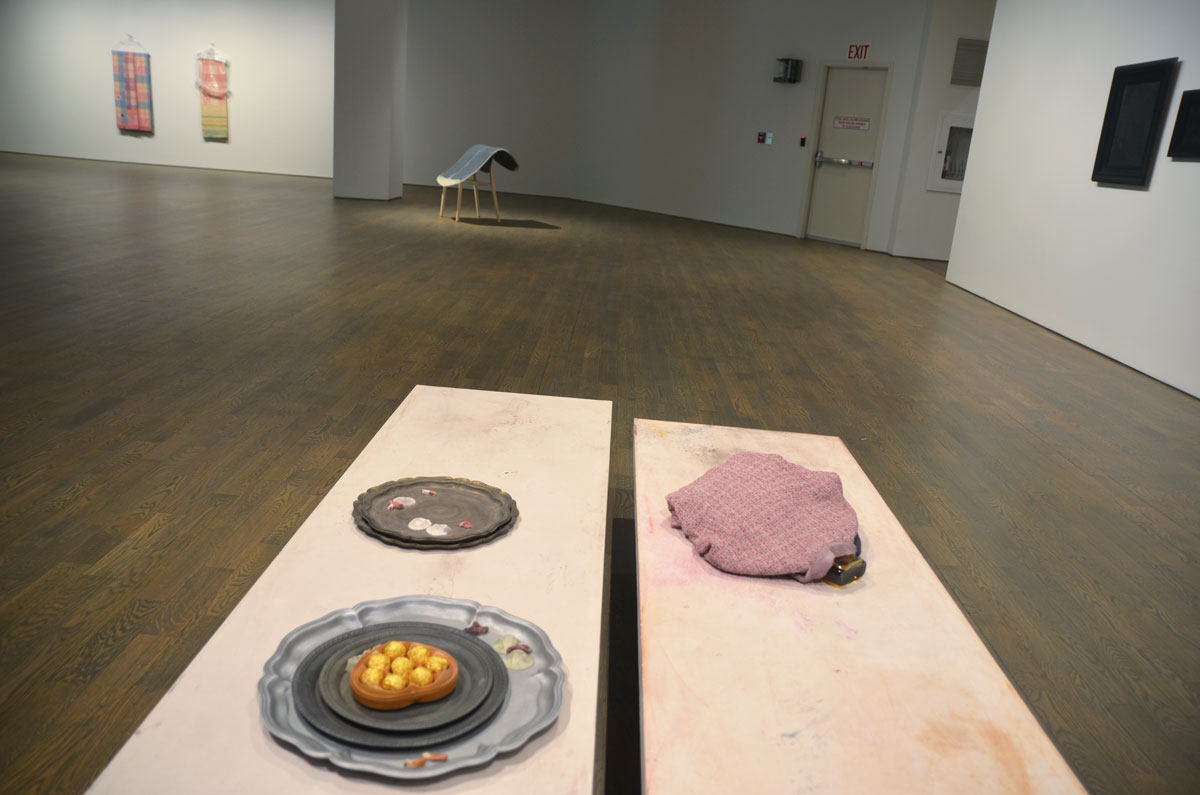
A platter of chocolates and left overs.
A tweed jacket on top of a liquor bottle.

art installation at the Art Gallery of Ontario by Liz Magor - in the foreground are two long narrow tables. On one of them is a platter with chocolates and a platter with the remains of cheese and crackers.

A husky under a blanket (of snow?  on a bed?)
A coat and purse hanging on a hook.
The contents of a room boxed and ready to move.

art installation at the Art Gallery of Ontario by Liz Magor - 3 pieces. First, a pile of moving boxes and other items that look like they are in the midst of getting ready for the movers. Second, a large white blanket bed sized that has a hole in the middle of where the pillows should be but instead there is a wolf curled up inside the whole. Third, what looks like a jacket hanging from a hook on the wall

art installation at the Art Gallery of Ontario by Liz Magor - two hangers with plaid blankets folded over them hanging from hooks on a wall. One of the blankets has a clear plastic Creeds bag over the top part of it

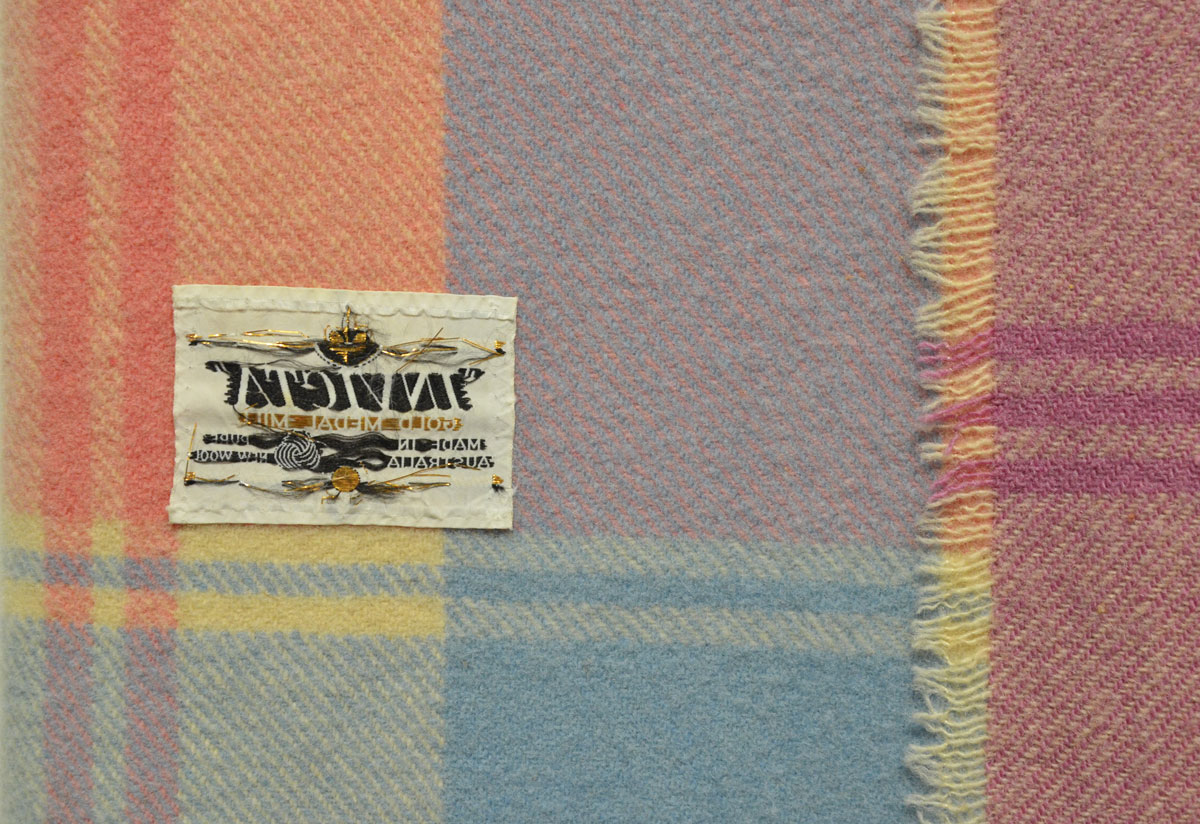
On closer look, some of the details on the blankets are wrong
including the labels that are sewn on back to front.

The label on a plaid blanket is sewn on backwards so that the writing on the label faces the blanket.

I was interested in what people’s reactions were to this exhibit so I had a chat with a couple of the employees about it.  According to them,  there was no reaction.  Most people showed interest in the boxes but when they walked into the second room they rarely stopped to take a closer look.

blog_liz_magor_rose

As for surrender, I did find reference to it in the description of the exhibit on the AGO website, ” In this exhibition, everyday objects and forms, as well as the natural world, function allegorically by evoking the human need to surrender to desires, compulsions, fantasies.”  Once again, I will leave it to you to decide if this description fits.

Exhibit continues until 29th November.

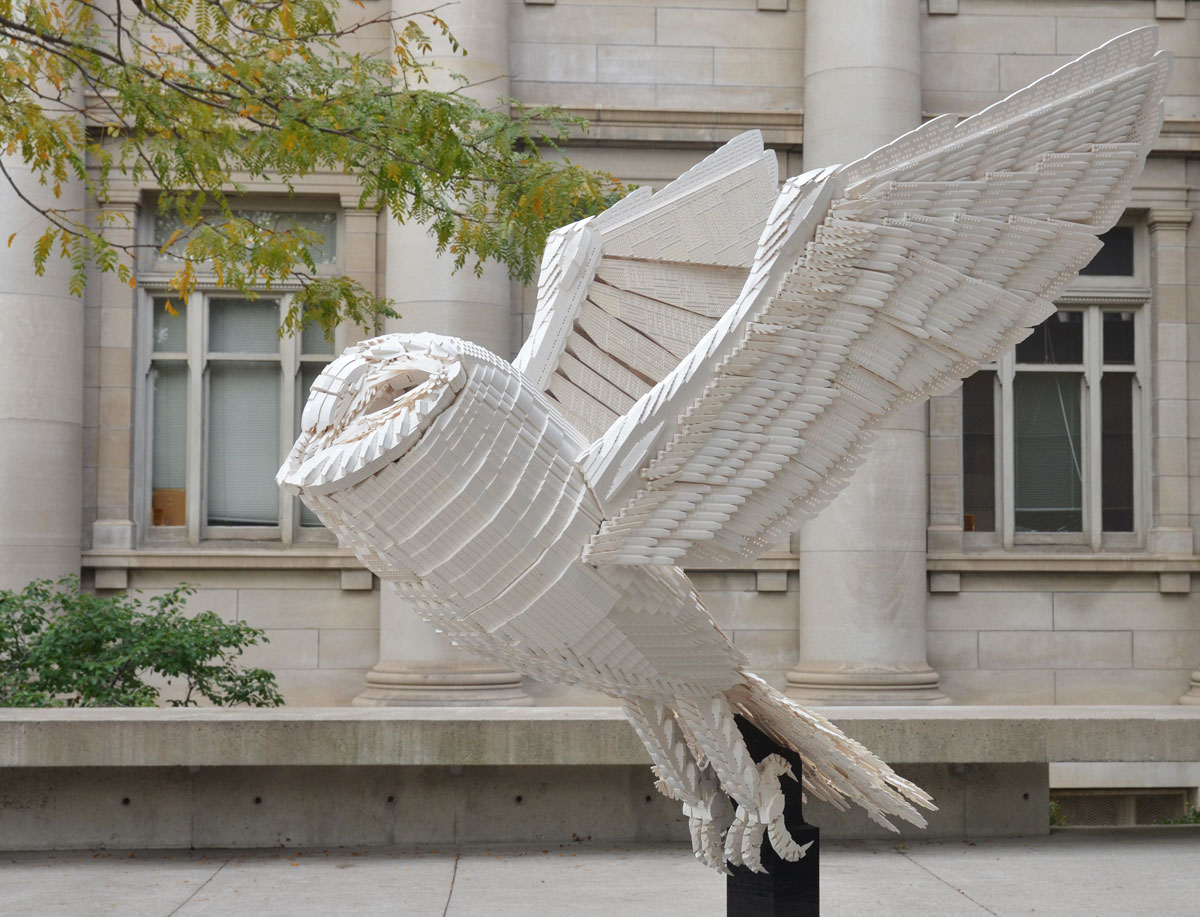
Silent Knight by Ekow Nimako,
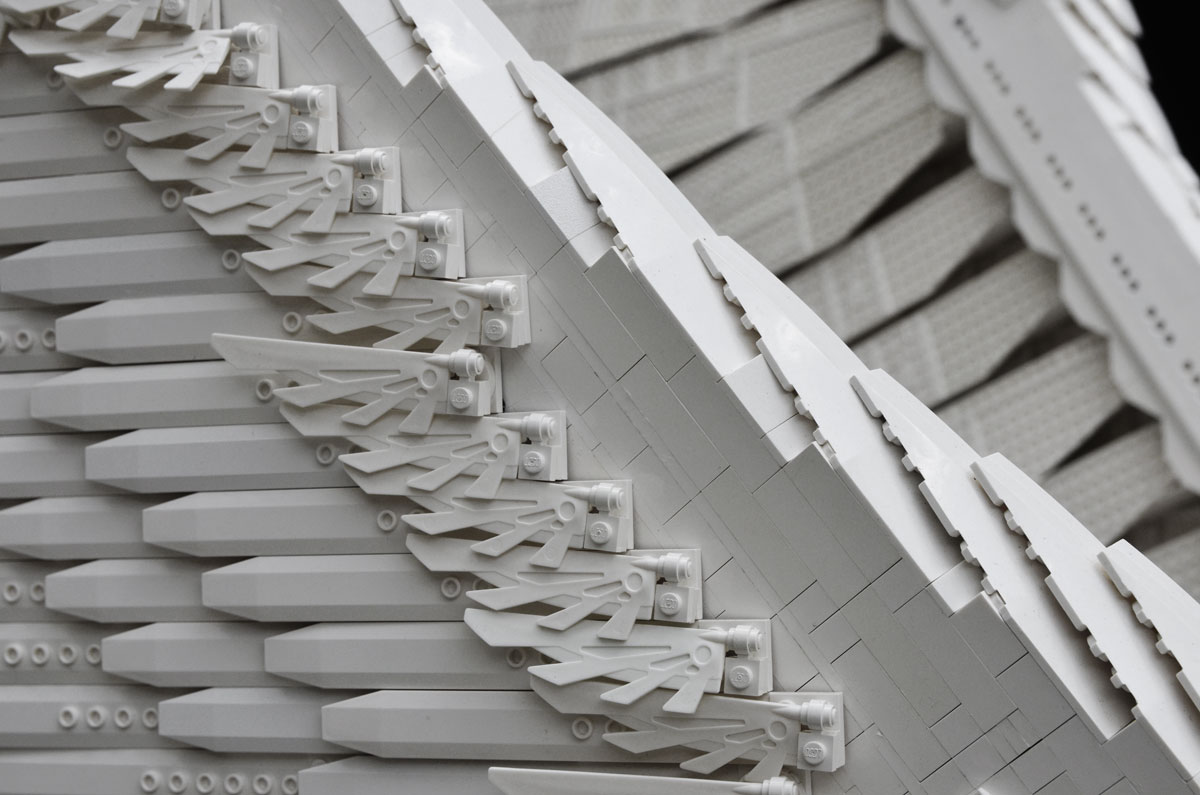
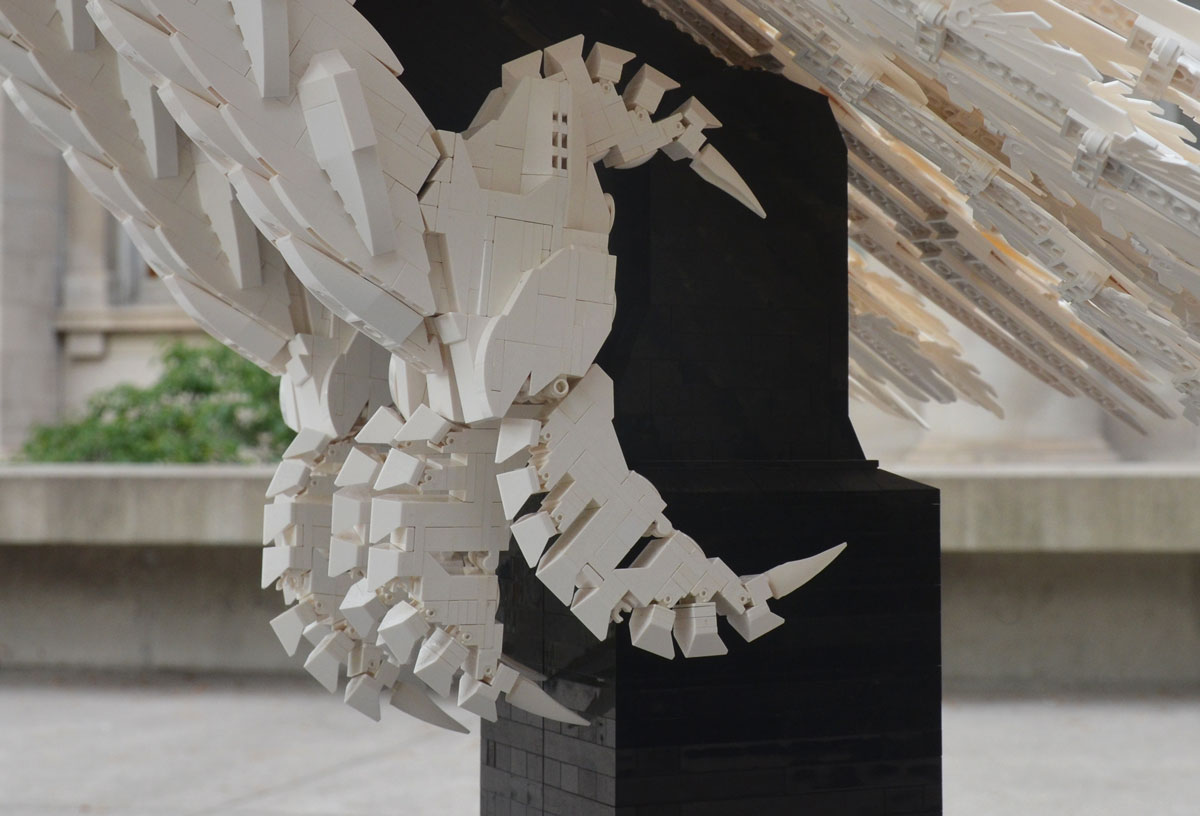
a sculpture of a barn owl using more than 50,000 pieces of LEGO,
on display in front of the Gardiner Museum as an extended Nuit Blanche exhibit

sculpture of a barn owl taking flight made of white lego, on a black pedestal (also made of lego) in front of the gardiner museum

close up of the wings and the lego blocks used to make the sculpture of a barn owl

close up of a foot and talons of the barn owl sculpture that is made of lego

#snbTO

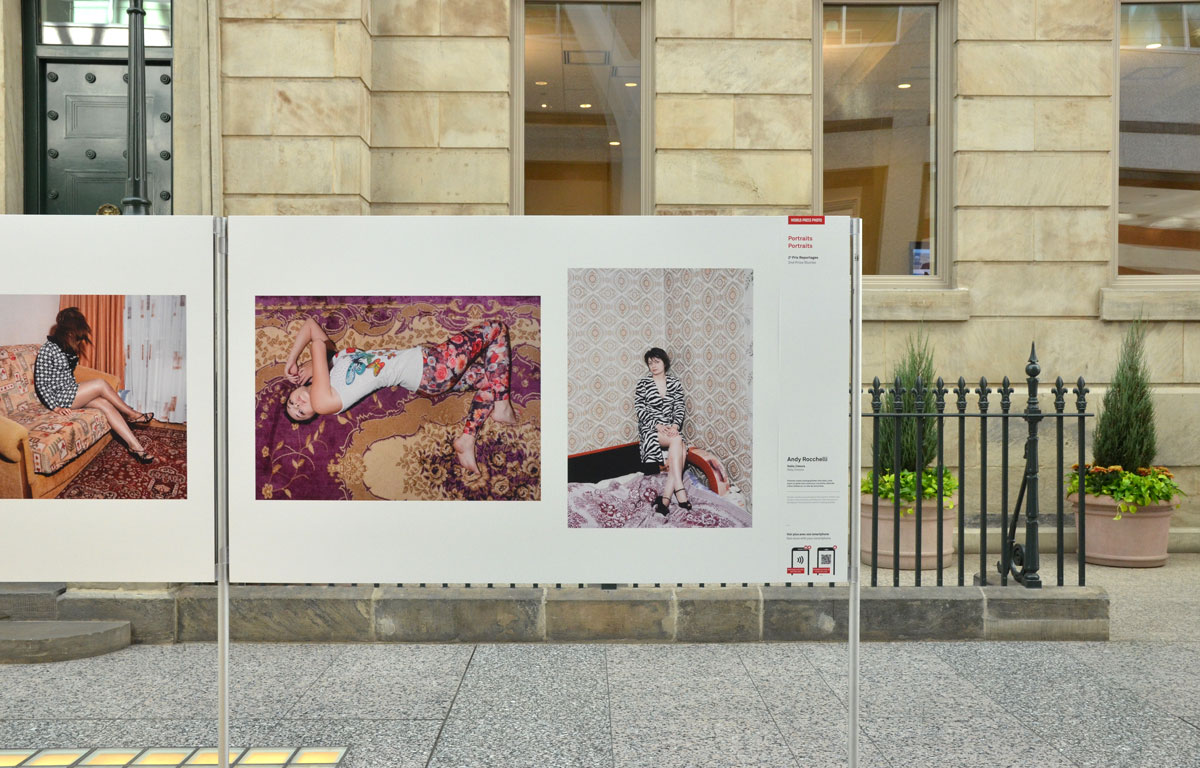
At Allan Lambert Gallery, Brookfield Place,
winning photos from the 58th World Press Photo Contest

Winning images chosen from 97,912 photographs taken by 5,692 photographers from 131 countries.

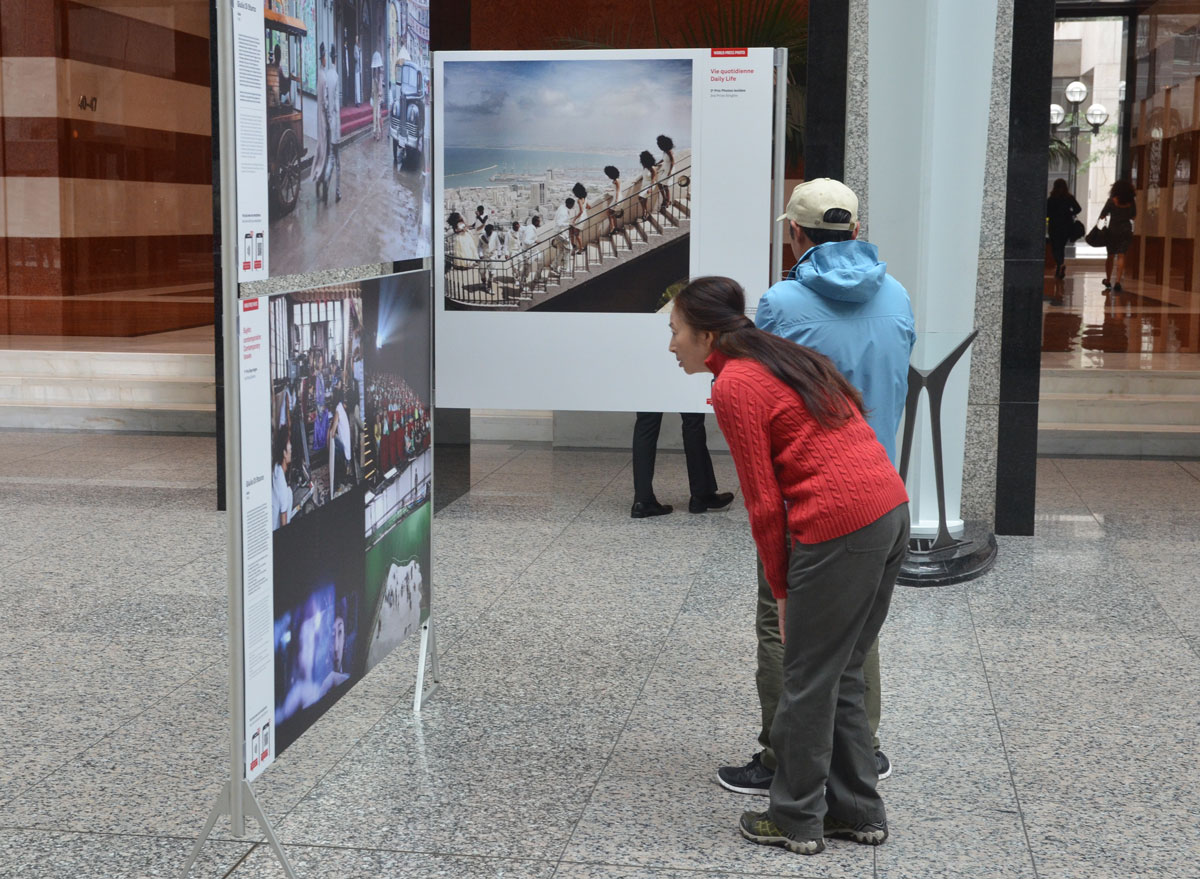
Three people are looking at a series of photographs on display. One of the photos is a boat carrying refugees, taken from above, the boat is packed full

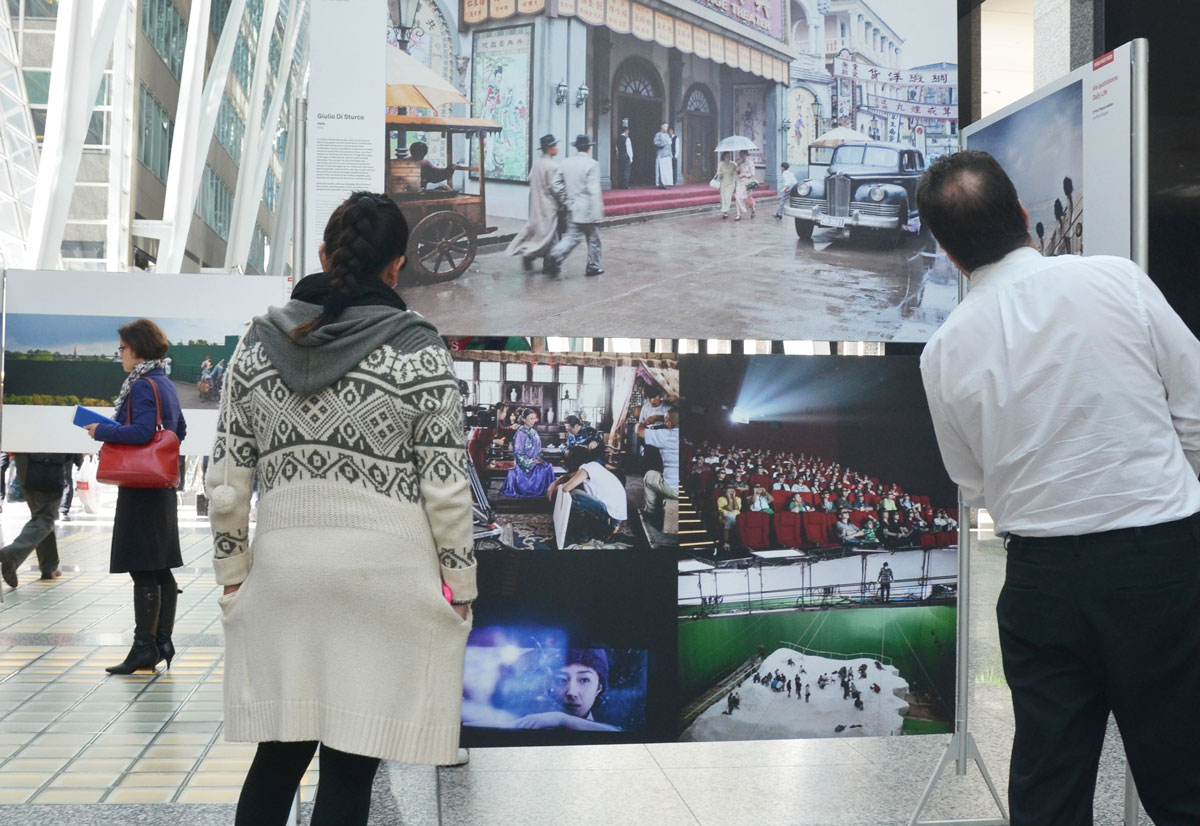
below:  Taken by Andy Rocchelli of Italy, part of his series of ‘Russian Interiors’ portraits. There were 10 photographs in the series, three of which are shown here (well, two and a half).  All were of women.

Three pictures on white board on display in the Allan Lambert gallery in Brookfield Place. Behind the board is the stone facade of the old bank building.

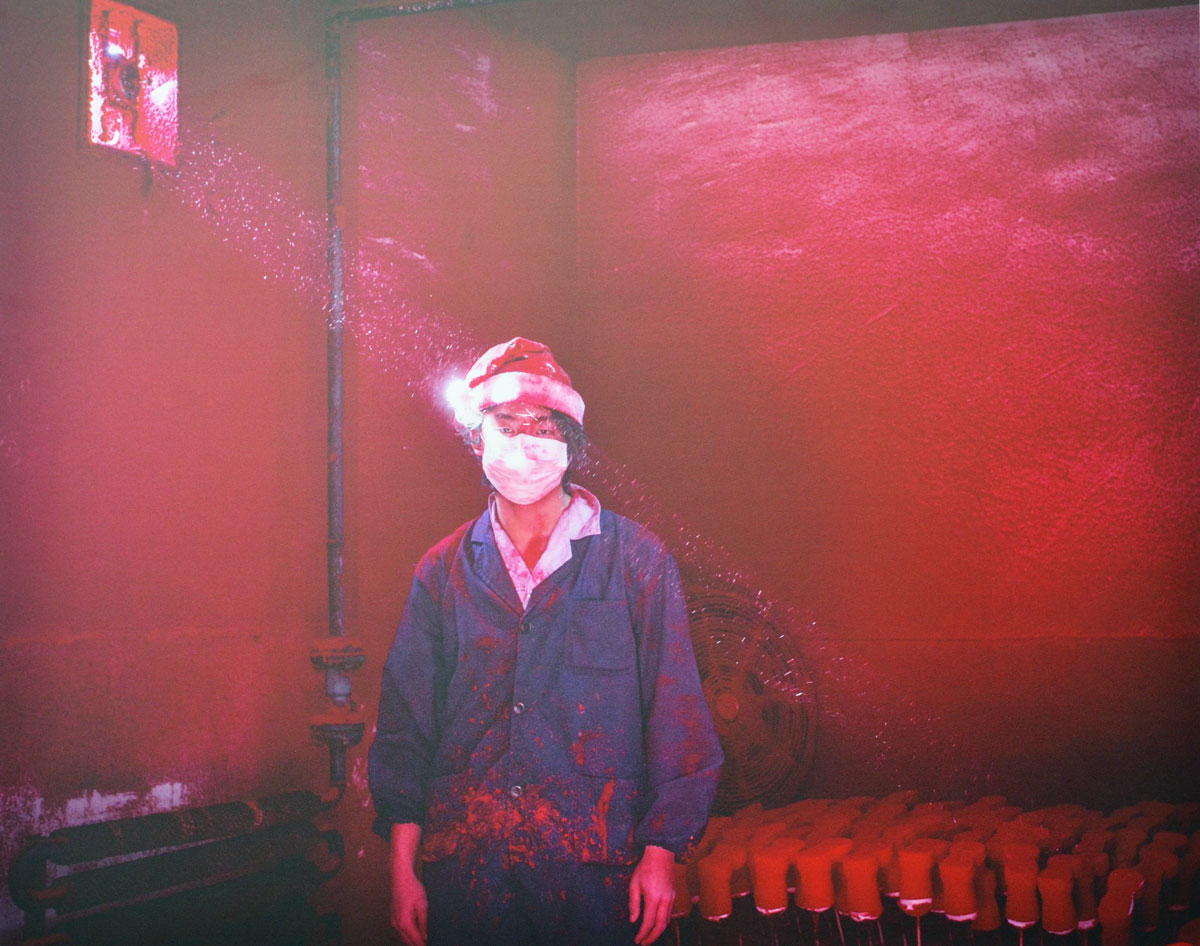
below:  One of the multitude of Chinese migrant laborers, a factory worker in in Yiwu China. His job is to coat polystyrene snowflakes with red powder.  There are 600 factories in Yiwu and they produce 60% of the world’s Christmas decorations.  Photo by Ronghui Chen, second prize winner in the Contemporary Issues category.

A picture of a photograph taken in a red room of a young man wearing a Santa Claus hat and a blue jacket.


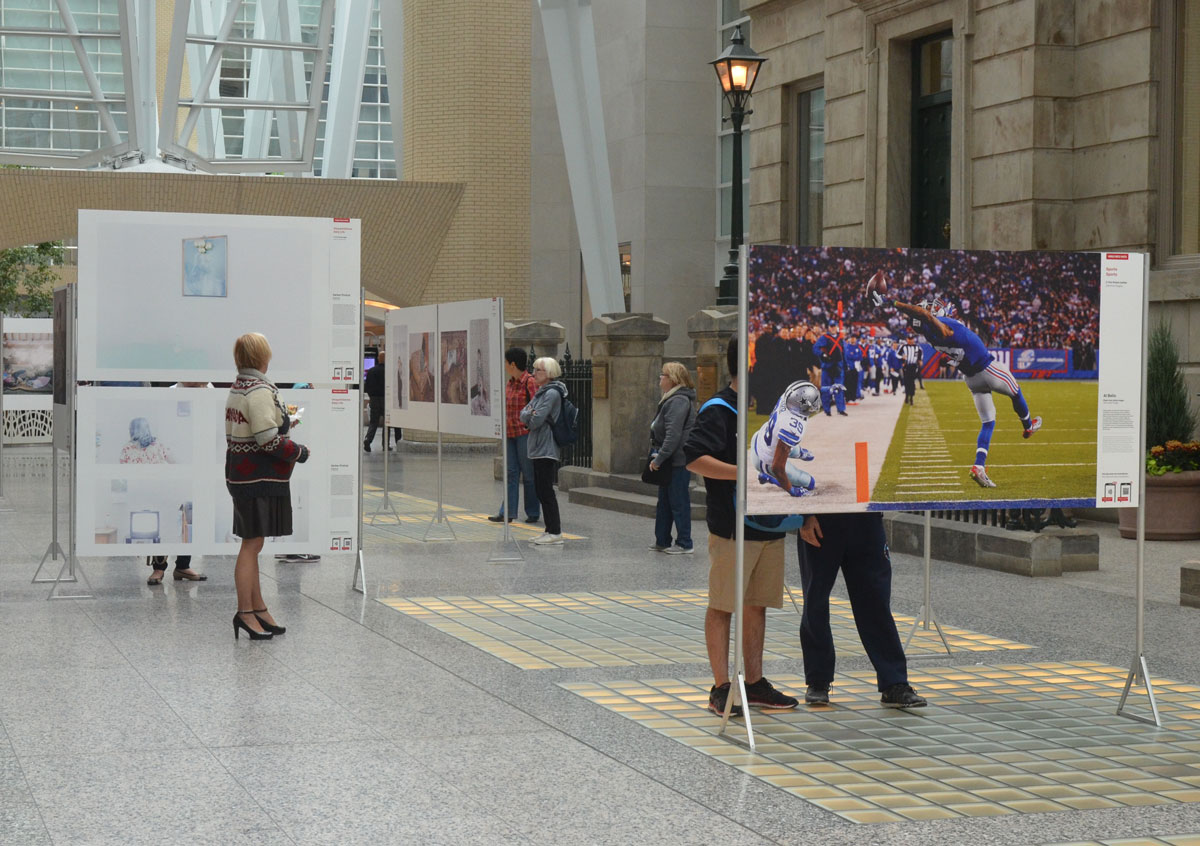
below: The three winning photographs from the Sports (Singles) category.  The predominant photo is the second prize photo; it is a photo of Odell Beckham of the New York Giants making a one handed touchdown catch, taken by Al Bello.  The winning sports photo is the one on the far left.  It is a photo of Argentine football player Lionel Messi receiving the Golden Ball trophy at the World Cup in Brazil, taken by Bao Tailiang.   In the middle is a picture of Philip Hughes, a cricket batsman who was hit on the head by a ball during a game, taken by Mark Metcalfe.

Picture taken at night. The light source is from lights in the floor. Three photographs are on display, part of a larger exhibit of winning photography from around the world. The three shown here are sports photos. The main one being a football player catching a pass.

people looking at photographs, the winning pictures from the World Press Photo contest, on display at Brookfield Place

people looking at photographs, the winning pictures from the World Press Photo contest, on display at Brookfield Place

people looking at photographs, the winning pictures from the World Press Photo contest, on display at Brookfield Place

World Press Photo contest winners, sign cautioning people that the section they are about to enter has some disturbing images in it.

people looking at photographs, the winning pictures from the World Press Photo contest, on display at Brookfield Place

below: The winning photo, by Danish photographer, Mads Nissen of Jon and Alex, a gay couple, sharing an intimate moment at Alex’s home, a small apartment in St Petersburg, Russia. (It looks better in real life!)

A photo by Mads Nissen, the winning photograph of the 58th World Press Photography Contest, Jon and Alex , two men, one lyng on his back and the other sitting beside him. The greenish curtains in the background dominate the picture.

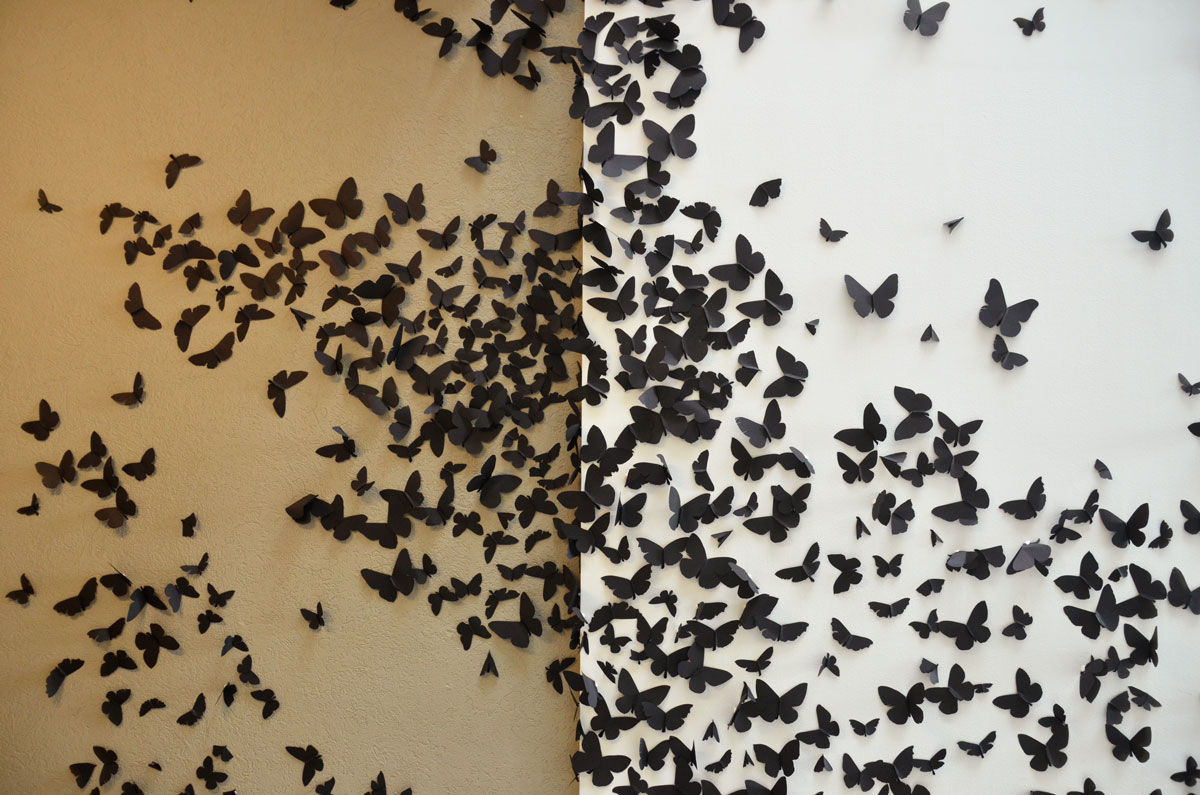
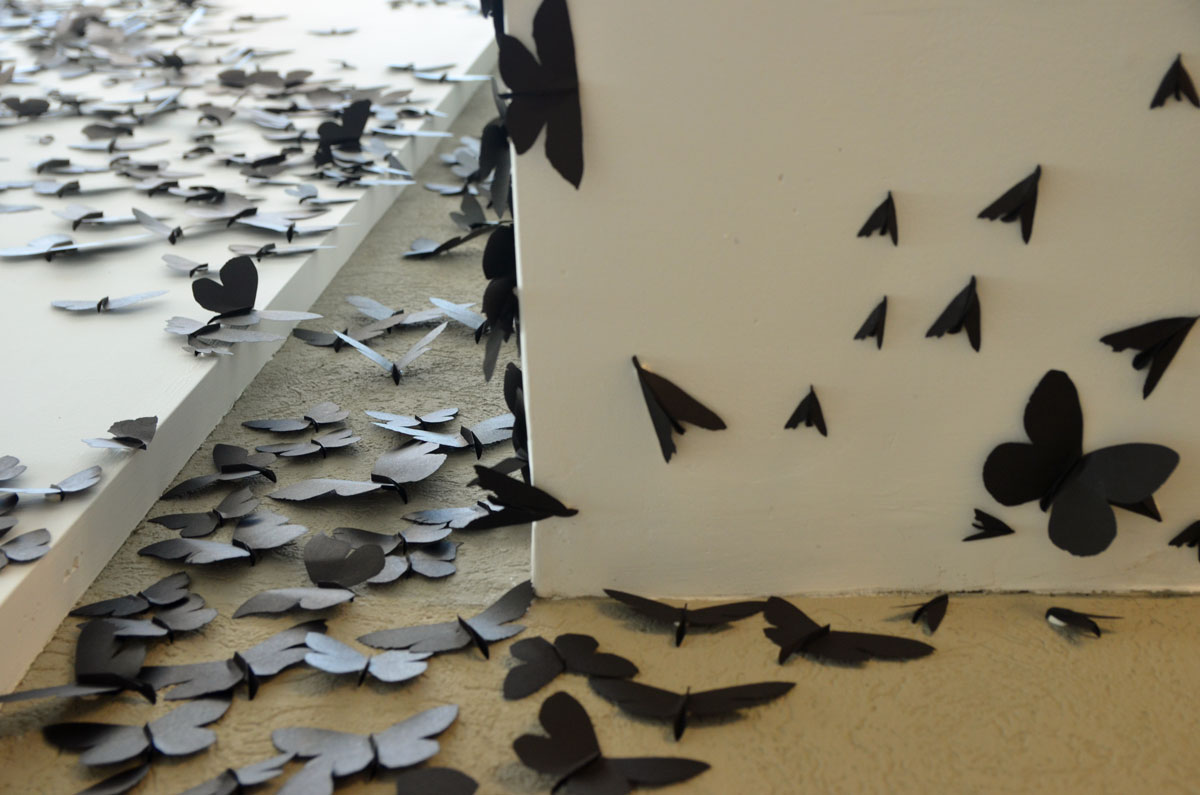
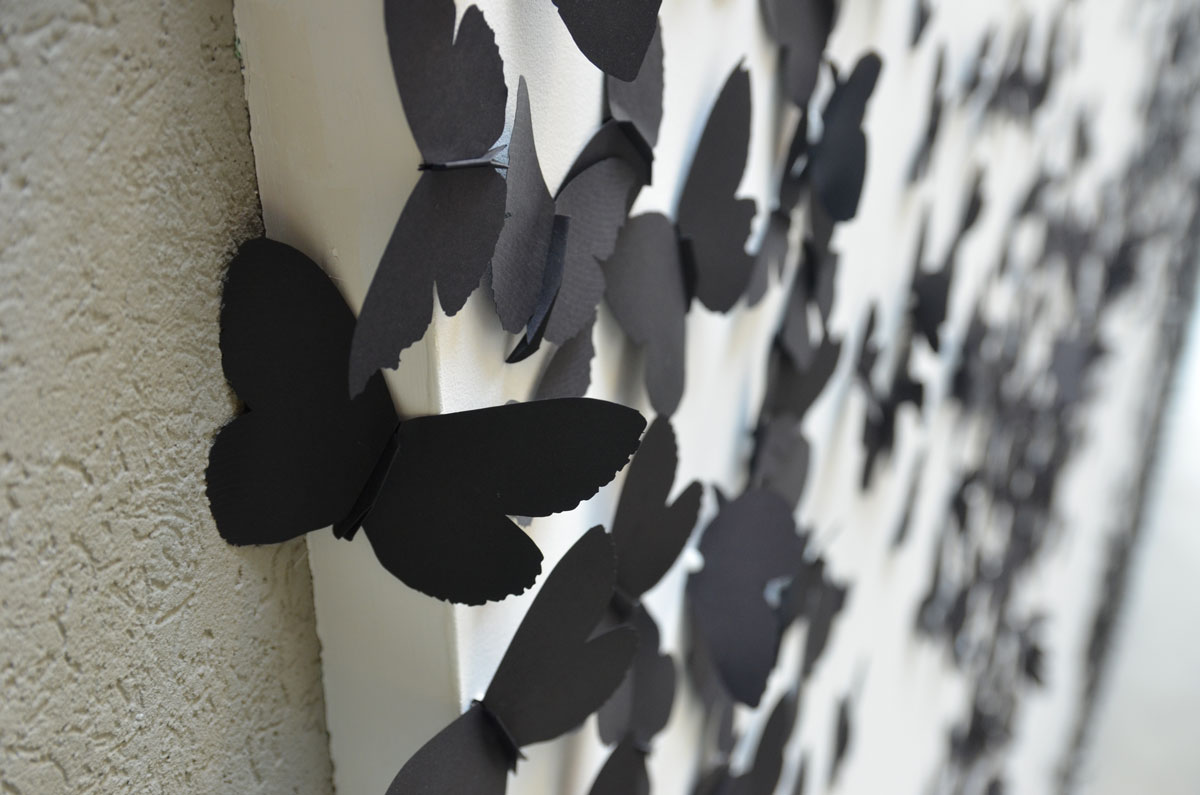
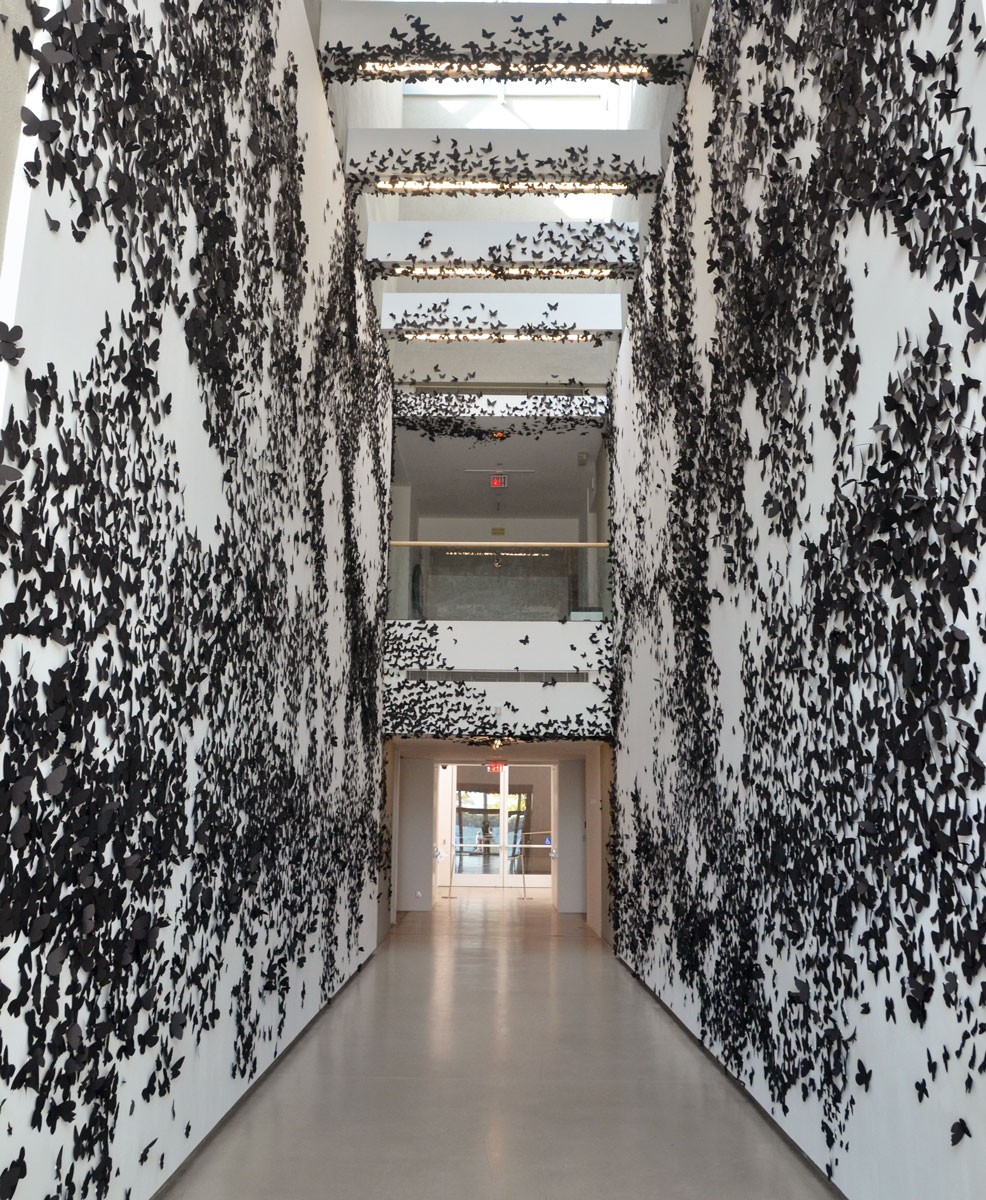
The exhibit is called ‘Black Cloud’ and it consists of thirty thousand black moths, each one individually attached to the walls and ceiling of the clerestory of the The Power Plant Gallery.   Artist Carlos Amorales has reproduced the shapes and sizes of thirty six different species of moth with black paper.  They swarm towards the lights and they congregate in the corners.  It’s a fascinating display both in the overall composition and in the attention to small details.   This installation first appeared at an art gallery in Paris in 2007.

A wall covered with black paper moths, part of an art installation called Black Cloud by Carlos Amorales

A wall covered with black paper moths, part of an art installation called Black Cloud by Carlos Amorales where 30,000 black paper moths are stuck to the walls and ceilings of a hallway - looking up at all the moths on the ceiling

A wall covered with black paper moths, part of an art installation called Black Cloud by Carlos Amorales where 30,000 black paper moths are stuck to the walls and ceilings of a hallway - looking at the corner of the hall, where the wall meets the ceiling

A wall covered with black paper moths, part of an art installation called Black Cloud by Carlos Amorales where 30,000 black paper moths are stuck to the walls and ceilings of a hallway - this picture is a close up of some of the moths

As much as I liked the display, I was glad they weren’t real moths!

A hallway covered with black paper moths, part of an art installation called Black Cloud by Carlos Amorales where 30,000 black paper moths are stuck to the walls and ceilings of a hallway

#PPBlackCloud

Camera Atomica
a photography exhibit at the Art Gallery of Ontario

below: The first photograph of the bones of the hand, by Wilhelm Rontgen in 1895.    Rontgen was a German physicist who discovered x-rays (or Rontgen rays) in 1895 and he produced this image of his wife’s hand shortly after.  The green in the picture below is a reflection of the chandelier that the AGO has hanging in the room where this exhibit is being shown.

An xray picture of a hand.

The exhibit consists of more than 200 works that all fall under the category of nuclear – topics such as atomic weapons, Cold War politics, nuclear energy, and the mining of uranium.  The photographs cover the history of these topics from 1945 to the present, from the development of the atomic bomb to the meltdown at Fukushima Daiichi in Japan in 2011.

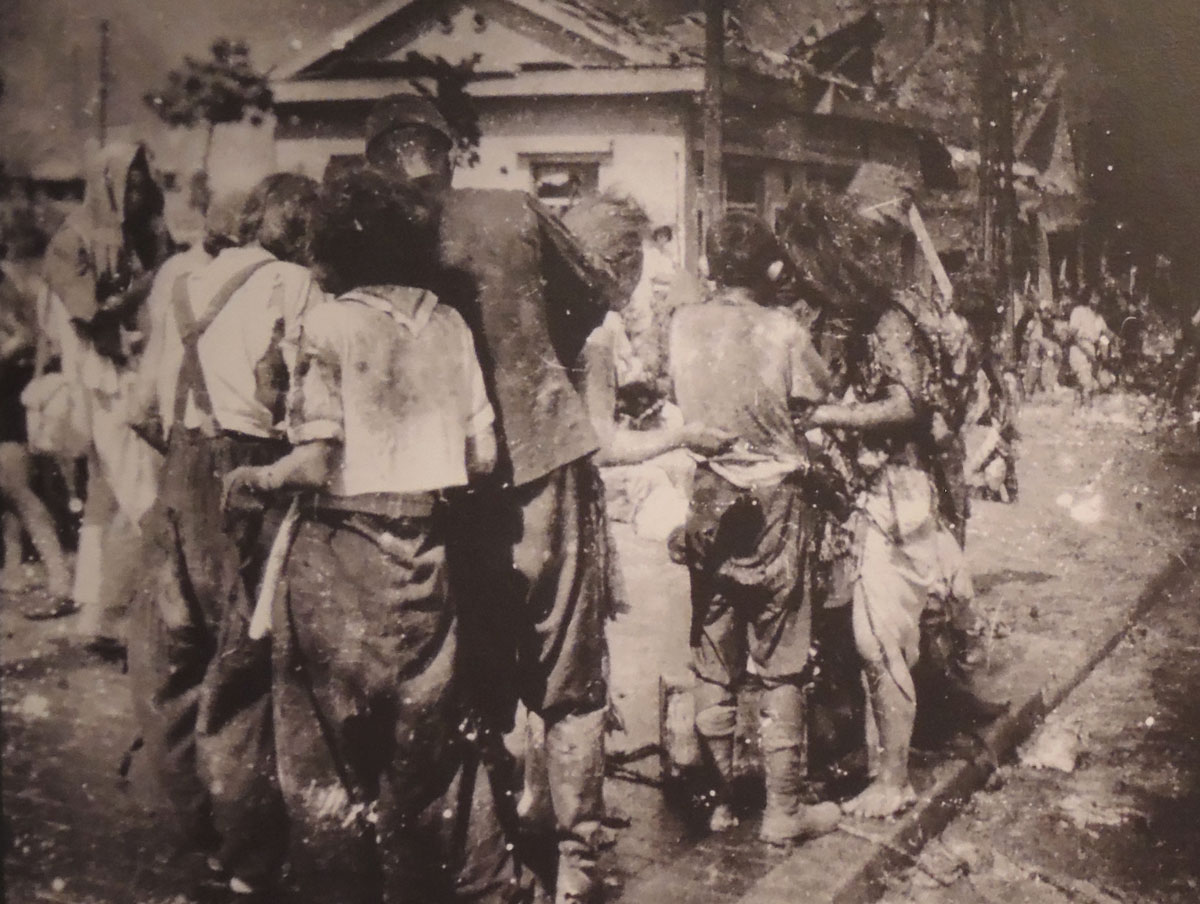
below: Hiroshima Japan, photo by Yoshito Matsushige, taken 6 August 1945.
The first atomic bomb was detonated at the Trinity test site in New Mexico USA on 14 July 1945.  Shortly after, American bombers dropped two atomic bombs on Japan.  The first bomb was dropped 6th August 1945 on the city of  Hiroshima and second one three days later on Nagasaki.

An old black and white photo taken in Hiroshima after the dropping of the atomic bomb during WW2

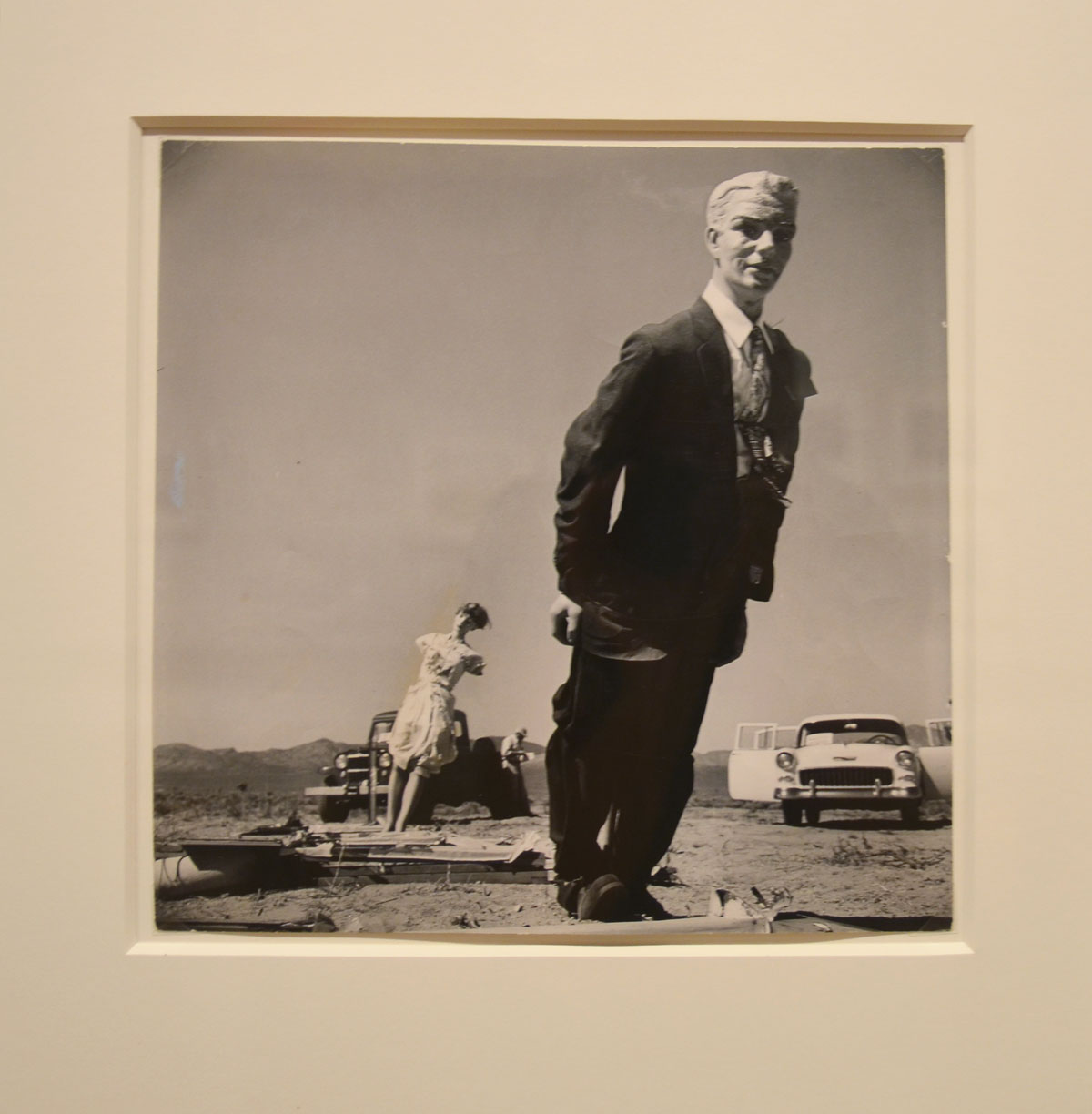
below: Photo by Dean Loomis, 7 May 1955 of scorched male mannequin standing in the desert 7,000 feet from the 44th nuclear test explosion at Yucca Flat Nevada.  Photo taken the day after the blast.  Apparently mannequins were used to test the effects of the nuclear blasts on people and this photo shows that people at 7000 feet from a blast could be burnt but alive.

Picture of a black and white silver gelatin print from 1955 by Dean Loomis showing a male mannequin in a black suit who has been partially knocked over by a nuclear test blast in the Nevada desert.

below: Mushroom clouds on a wall

A collage of photos of nuclear blast mushroom clouds. There are about 25 colour and black and white photos hanging on a wall of the Art Gallery of Ontario

below:  Part of  ‘Uranium Tailings #2, Elliot Lake Ontario’ a photograph by Edward Burtynsky.

Eliot Lake was established in 1955 as a mining town after uranium was discovered in the area.  In the early 1990’s the mines closed because of depleted reserves and low prices for uranium.

Tailings are the materials left over after the valuable part of an ore has been removed.  The uranium ore found at Eliot Lake had very little uranium in it, only about 0.1% of the ore was uranium.

Close up of part of a photograph by Edward Burtynsky titled Uranium Tailings #2, Elliot Lake Ontario. It is a picture of a desolate swampy looking terrain where all the vegetation is dead. The trees have been reduced to dead poles.

below:  Inkjet prints by David McMillan, part of four on display from his series of photographs of places abandoned because of the Chernobyl disaster in 1986.   The photograph on the right is of the nursery at Pripyat Hospital taken in 1997.   Beside it is a picture of a classroom in a Pripyat nursery school.

Pripyat is an abandoned city in northern Ukraine.  It was built in 1970 to service the Chernobyl Nuclear power plant.  Following the explosion and fire at Chernobyl on 26 April 1986, the city’s 49,000 people were evacuated

Two photographs on a wall. The one in the foreground shows an abandoned hospital nursery in Pripyat Ukraine, abandoned after the Chernobyl nuclear disaster.

A young man is half squatting as he leans back to get a better look at the words on the wall of an art gallery that accompany three black and white photographs.

The exhibit continues until 15th November.

#atomicAGO