Posts Tagged ‘exhibit’

‘Making Peace’ is a traveling exhibit that is being shown in Toronto at the moment.  It was produced by the International Peace Bureau (IPB) and was first shown in in 2010 as a celebration of the 100th anniversary of the 1910 Nobel Peace Prize that was awarded to IPB.  It’s purpose is to promote peace as well as educate and inform.

It can be seen until the end of June on Front Street East in the Canary District (by Corktown Commons, east of the Distillery District).    In Toronto, the exhibit involves short four-sided pillars that line the sidewalk and each side of every pillar has a photo with a description or a quote from a famous person.  There is also a temporary gallery in an indoor space ‘loaned’ to the exhibit by one of the developers in the Canary District.

below: A painting in progress by Ford Medina showing Nelson Mandela in five colours.  These colours carry over into the outdoor exhibit and each colour represents the five main elements that IPB considers necessary for peace:
1. disarmament and nonviolence (purple)
2. conflict prevention and resolution (red)
3. economic and social justice (orange)
4. human rights, law and democracy (blue)
5. environment and sustainable development (green)
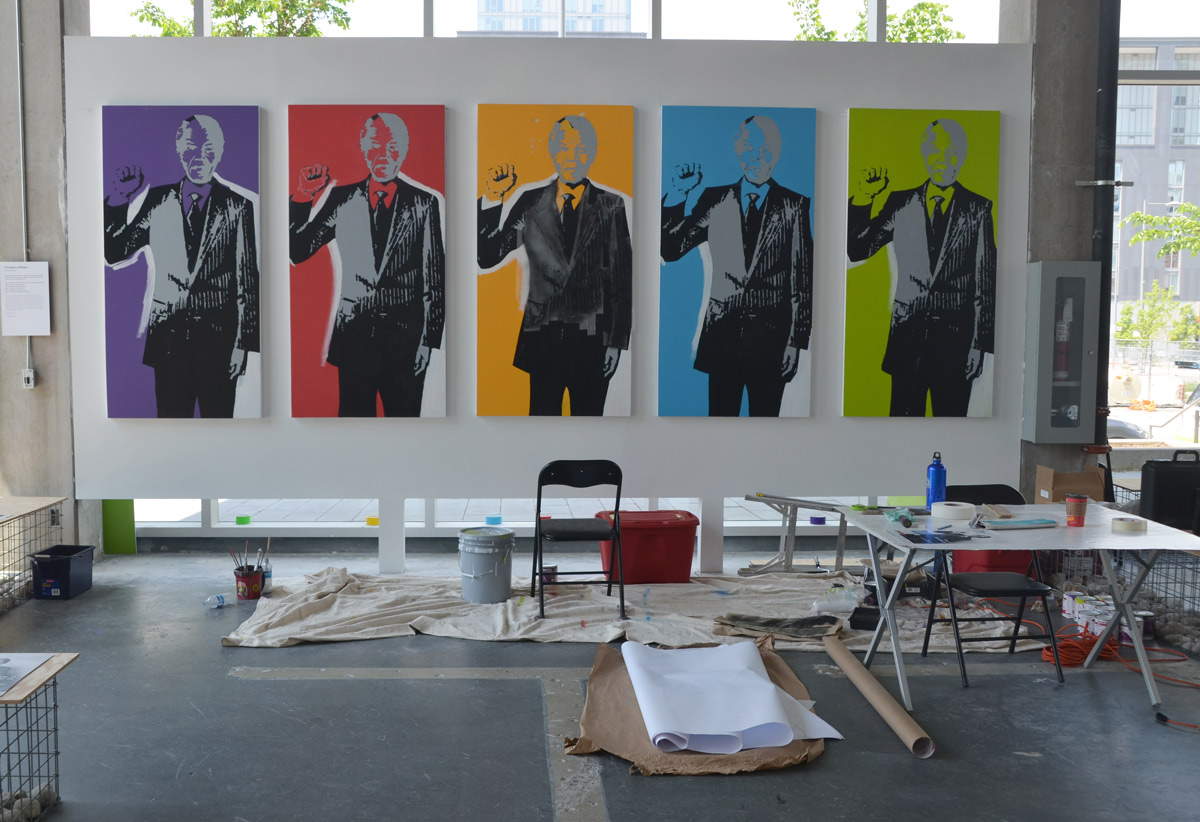
indoor temporary gallery for the Making Peace exhibit, a painter is in the midst of creating a large painting of five copies of a picture of Nelson Mandela, each copy is in a different colour, purple, red, orange, blue and green,

below: The display extends into Corktown Commons.  Here the pillars are green as this is the section for the fifth element named above, the environment.

outdoor exhibit, Corktown Commons, short pillars with 4 sides, each side has a picture and a description, the background colour is green which represents the environment and sustainability.

below:  Photo by Ribeiro Antonio.  The words that accompany this photo are: ” On 25 September 2015, the 193 countries of the UN agreed to an historic plan of action, entitled ‘Transforming our world: the 2030 Agenda for Sustainable Development’.  This plan contains 17 goals with 169 targets covering a broad range of sustainable development issues.  These include ending poverty and hunger, improving health education, making cities more sustainable, combating climate change, and protecting oceans and forests.”  If you are interested in this, there is more information on the UN website.
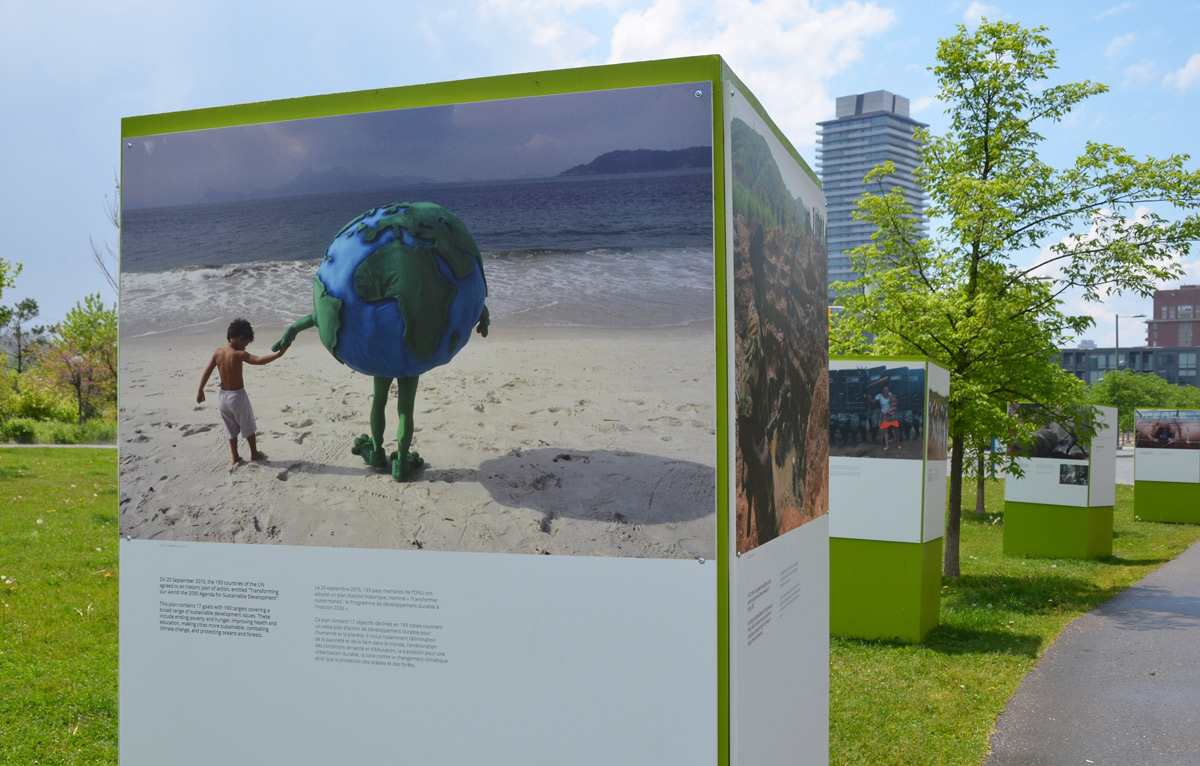
a photo of a person dressed in a large blue and green Planet Earth costume, holding the hand of a young boy as the walk on a beach towards the water

below: Blue is for human rights, law, and democracy and here you have an old black and white photograph of Sylvia Pankhurst (1882-1960), a British campaigner, apparently taken when she was in Australia speaking out on behalf of woman’s rights as part of the Suffragette movement.  The Suffragettes (or Women’s Social and Political Union or WSPU) was founded by a small group of women in 1903, including Sylvia, but during WW1 Sylvia was expelled from the WSPU because of her pacifist views and anti-war actions.  Her sister Adela shared similar views – she immigrated to Australia where campaigned against the First World War.

a vintage black and white photo that is part of an exhibit, outdoors, called Making Peace

below: Two photos.  The one on the right, of the woman holding the flower in front of the armed soldiers, was taken at a Peace March against the Vietnam War in Washington DC in 1967.  The photo on the left was taken in 2001 and is the back of a Kamajor fighter in Sierra Leone.  They played a role in the civil war that occurred in that country between 1991 and 2002.

2 sides, taken from the corner, of a box like structure, with black and white photographs on the two sides, one of the back of a man with a rifle across his shoulders and a backpack that says Lets go to school. The other photo is a woman standing up to a line of soldiers with bayonets.

below: A couple of the red pillars on Front Street with the blue sculpture, “The Water Guardians ” behind them.   The images on the closest pillar are of inside the Holocaust Memorial in Jerusalem as well as UN peacekeepers in Bosnia.
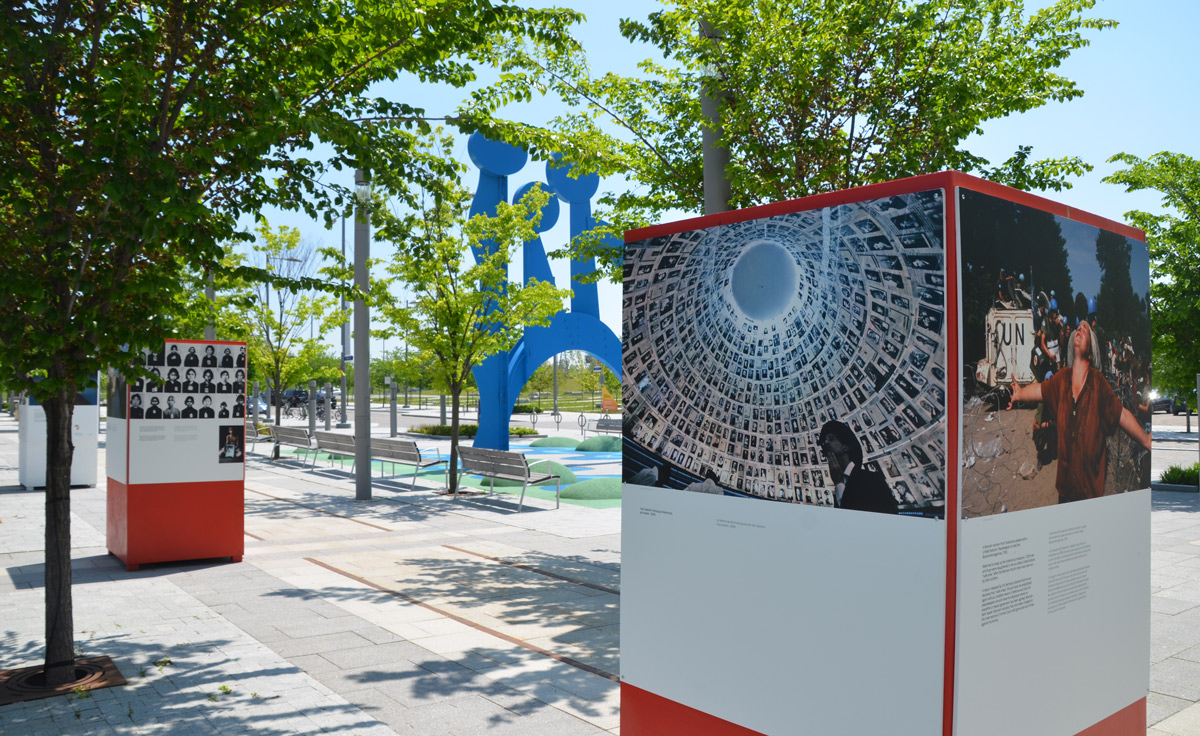
an outdoor art exhibit on peace, two of the structures used for mounting pictures on, with the blue sculpture on Front Street, Canaray District, in between the two boxes.

below: Closer to home, this pillar celebrates the work of the Toronto Parks and Trees Foundation.   Working with the city as well as with community groups, businesses, and individuals, they help to increase  Toronto’s tree cover.
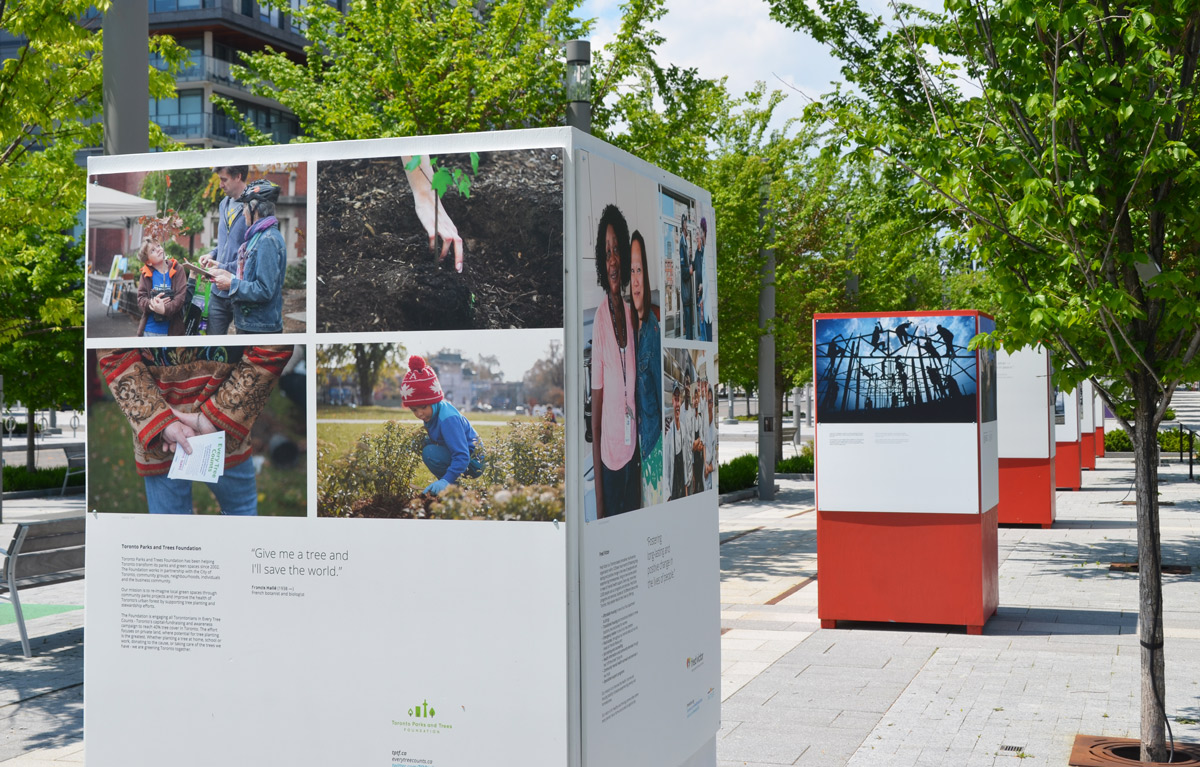
a set of four photos about planting trees on the side of a square pillar, one of many pillars that are arranged in a line on the sidewalk.

“Earth provides enough to satisfy every man’s need, but not every man’s greed.”  Gandhi

below: Homeless migrant worker, China

picture of a woman sleeping underneath a picture of a woman lying on a bed, shown outdoors so there are some tree leaves in the picture

The exhibit continues until mid-September.

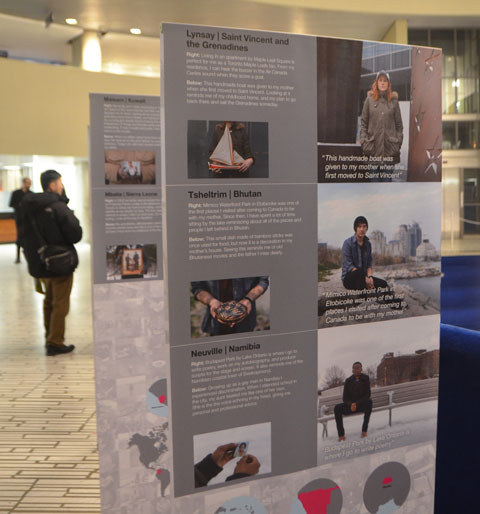
Myseum of Toronto is a fairly new addition to the cultural fabric of the city.  It is a museum without walls.  It is an organization that helps deliver programming to different locations in the GTA.  Last night, March 6, at City Hall, Myseum of Toronto launched its second annual festival of events and exhibitions.  This festival, Myseum Intersections,  consists of 36 different events and exhibits spread around the city throughout the month of March.   “One Toronto.  Infinite Perspectives” is the motto of this year’s festival.

In keeping with that motto is an exhibit called ‘Cosmopolis Toronto: The World in One City’.   It was showcased at the Myseum Intersections launch party.   A few months ago it was on display at 18 libraries around the city but it has been brought together in one exhibit for the festival.   At the moment it can be seen on the ground floor of City Hall but it will also spend some time at Metro Hall and then end the month at the North York Civic Center.   (schedule at the bottom of the post).
people looking at an exhibit of photos and stories that are printed on upright posters standing on the floor.
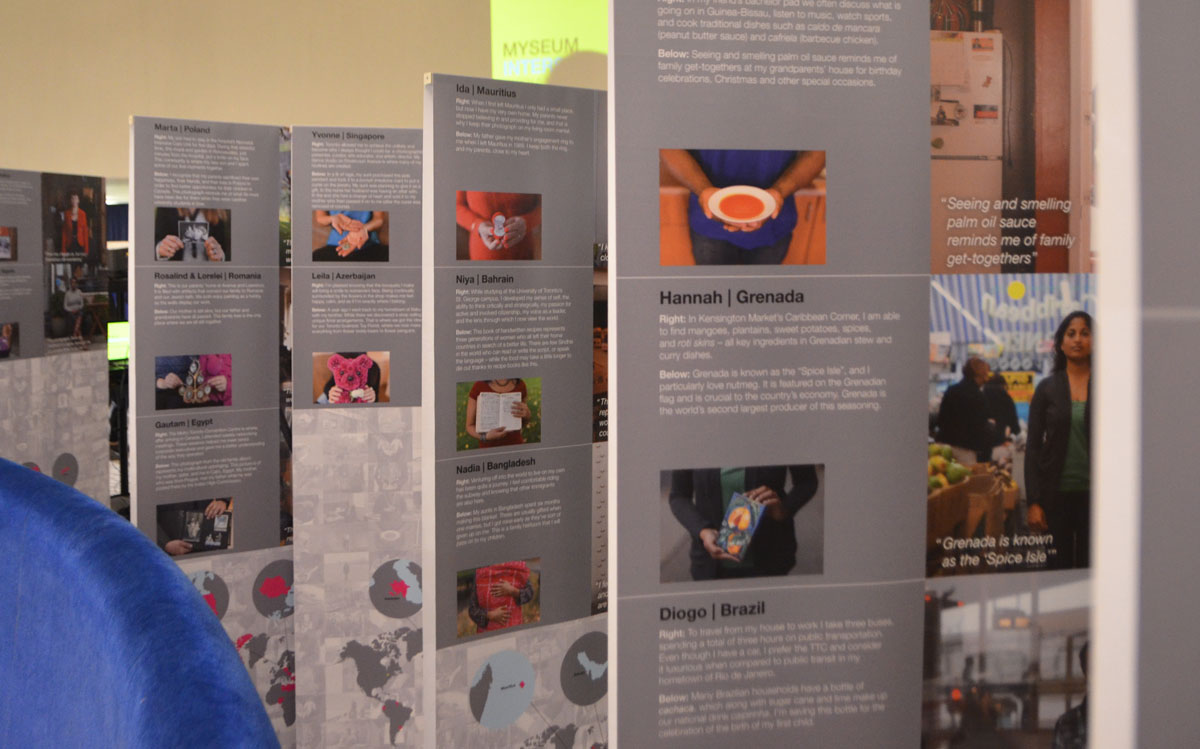
“Cosmopolis” consists of a series of portraits and interviews by Colin Boyd Shafer.   The goal was to find a person from every country in the world who now calls Toronto home, hence its tagline “Photographing the world, one Torontonian at a time”.   I am not sure if that goal was attained, but the series is a fascinating look at a very diverse group of people.

Cosmopolis posters on display at City Hall as part of Myseum Intersections festival

Cosmopolis posters of Andrea from the Congo and Nevena from Serbia

Two photos were taken of each person.     The first was a portrait taken in a Toronto location where they felt “at home”.  The second was of an object that they felt connected them to their country of birth.

cosmopolis posters of immigrants to Toronto from different countries

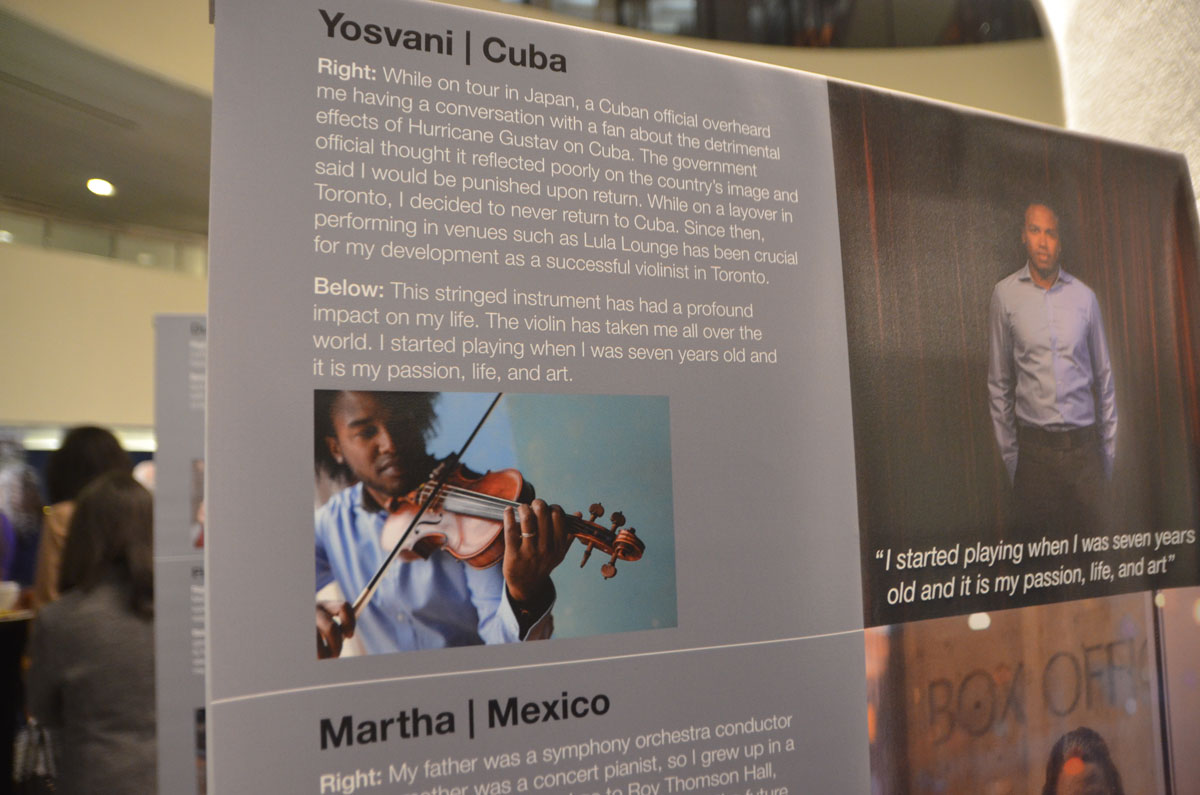
The Cosmopolis website has more information as well as the portraits and stories of many more new Torontonians.

portrait and story about Yosvani from Cuba, a violin player

cosmopolis posters of immigrants to Toronto from different countries

***

EXHIBITION DATES & TIMES:
MARCH 5 – 8 & 13 – 19
MONDAY – FRIDAY, 8:30AM – 4:30PM
City Hall
100 Queen St W, Toronto

MARCH 9 – 12
MONDAY – FRIDAY, 7:30 AM – 9:30 PM
SATURDAY & SUNDAY, 8AM – 6PM
Metro Hall
55 John St, Toronto

MARCH 20 – APRIL 2
MONDAY – FRIDAY, 7:30AM – 9:30PM
SATURDAY & SUNDAY, 8AM – 6PM
North York Civic Centre
5100 Yonge St, Toronto

#myseumTO | #myseumX


You’ve probably never heard the word asafo before.  You probably have no idea what it means.

Until last week I didn’t know the word existed either.

I went to the Royal Ontario Museum to see the Wildlife Photographer of the Year exhibit.  There were 100 excellent pictures of insects, animals, marine life, the sort of thing you’d expect.  There was no photography allowed in that exhibit so I have no photos of the images on display.  You’ll have to take my word for it that I was there.

I can appreciate the skill and patience that it takes to capture rabbits in the snow or a school of fish in a certain light underwater but those kind of pictures don’t excite me.   That’s not to diminish the work of the photographers, it was all very high caliber both technically and visually.    What I think I’m trying to say is that I left the exhibit wanting more, something more from my visit to the ROM.

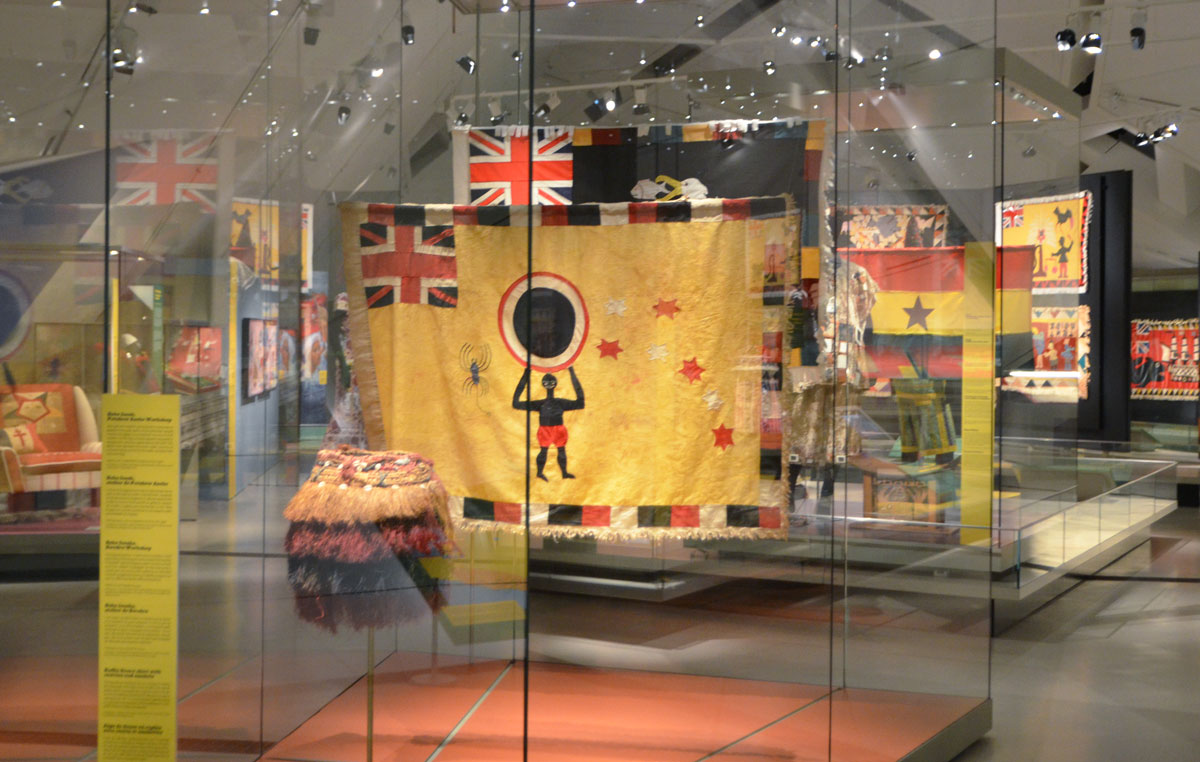
Luckily I didn’t have to look far.  In the next room was Art, Honour, and Ridicule: Asafo Flags from Southern Ghana.

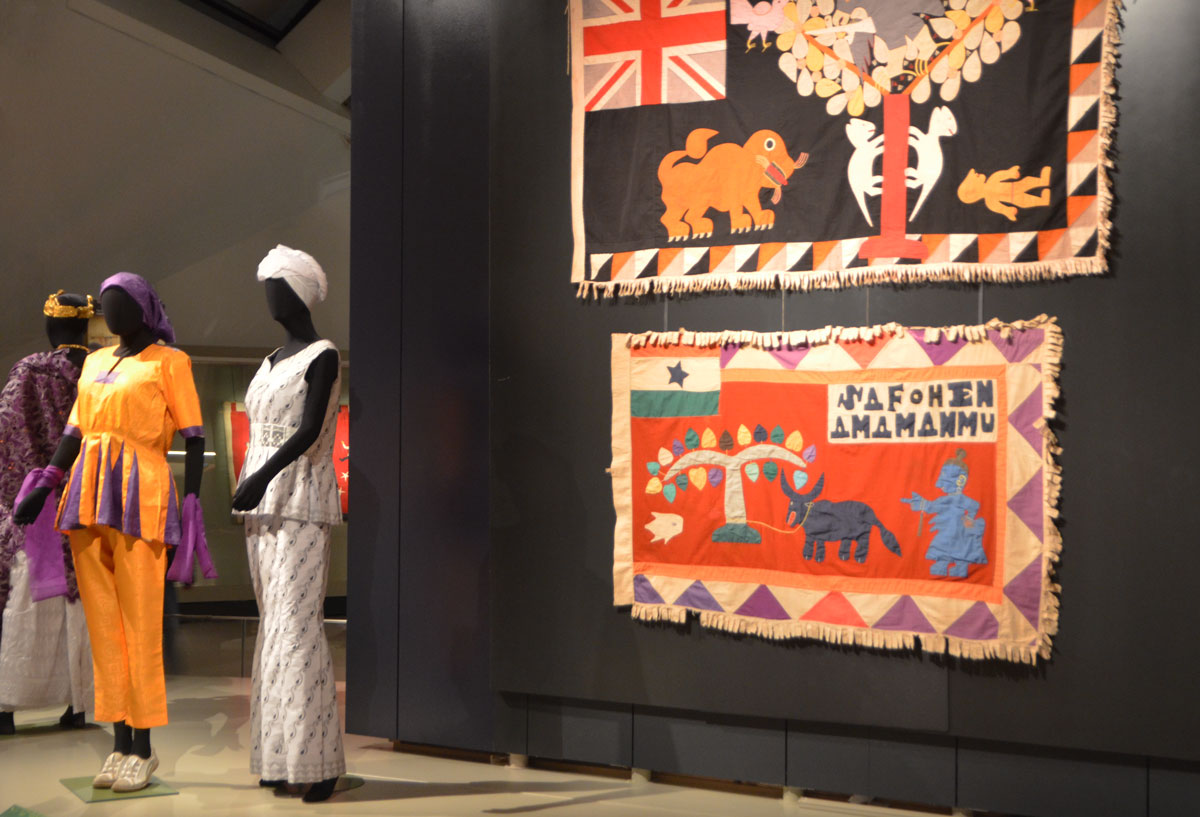
museum exhibit of asafo flags from Ghana, colourful flags of militia groups in yellows, reds and black. Many are hanging in display cases.

Colour, lots of colour.  And a subject that I knew nothing about, asafo flags.  I wasn’t even sure what part of Africa Ghana is in (It’s on the south coast of Western Africa between Togo and the Ivory Coast as it turns out.).

The flags are hand made with an assortment of different motifs.  The British Jack in the upper left corner is a very common feature.  That’s a clue.  Yes, Ghana was a British colony.   Reading the history of Ghana is like reading the colonial history of large parts of Africa.  The Portuguese built a fortress at Elmina in 1482.    Interest in the region was piqued by the presence of gold, hence the name Gold Coast.   By the early 17th century the first African state,  Akwamu, controlled an extensive part of the coast.  They were displaced by the Ashanti who were very involved in the slave trade, especially in trading slaves for weapons.   When European countries outlawed trading in slaves in the early 1800’s,  Ashanti power suffers.   Some tussles ensue, a few battles, some back and forth, and by 1902 what was Ashanti becomes is a British colony.    It remained a colony until 1957.

close up of a flag, hand made, British Jack in the top left corner, a man walks in front of a church in the center, a black bear in the top right.

I’m not going to pretend to know or understand African history.  I’m only trying to give some context to the flags.    First, jump back to my mention of Elmina and the Portuguese. When the Portuguese arrived in this area in the 15th century, it was the Fante (or Fanti) people that they encountered.  Both the Fante and the Ashanti belong to the Akan people.  The Fante prevented them from venturing inland and leased properties for Portuguese trading missions. But when the Portuguese objected to Fante rules and regulations the Fante expelled them.  Soon after, the Dutch arrived.  The Fante served as middlemen in the commerce between the interior and Dutch traders on the coast.

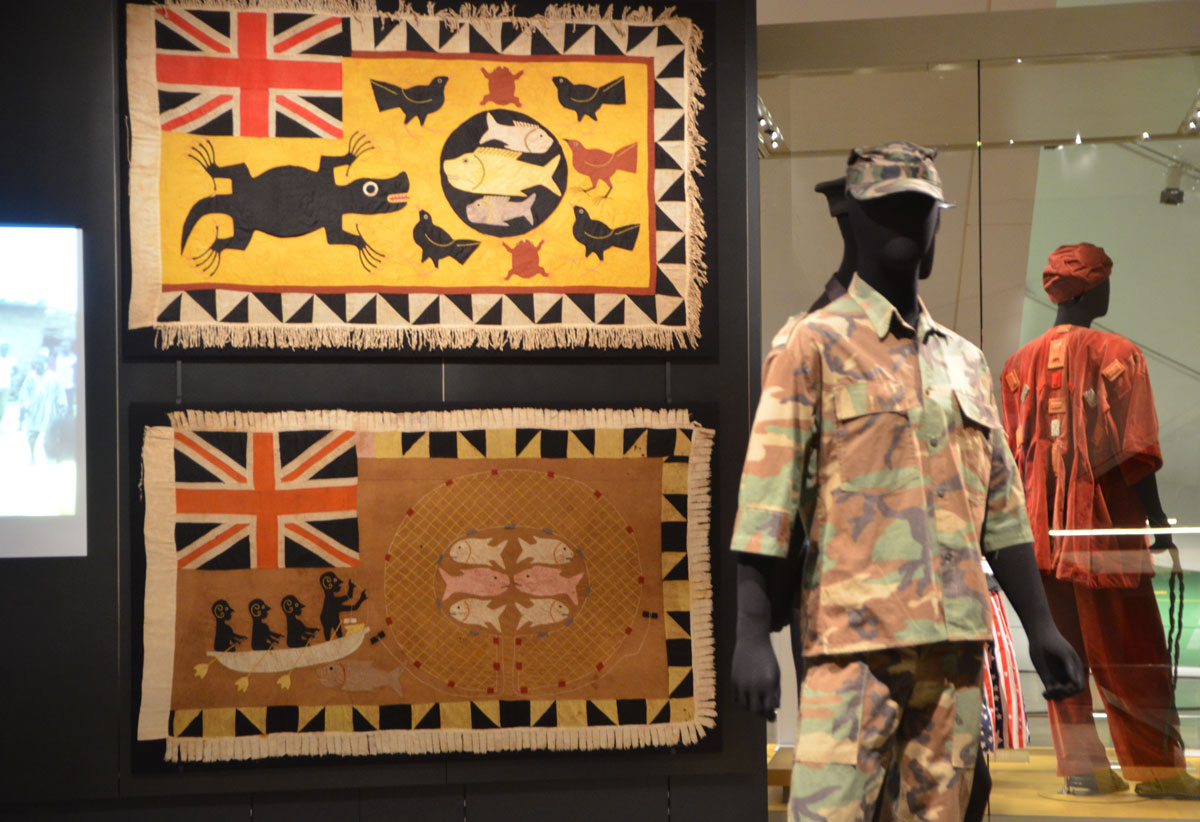
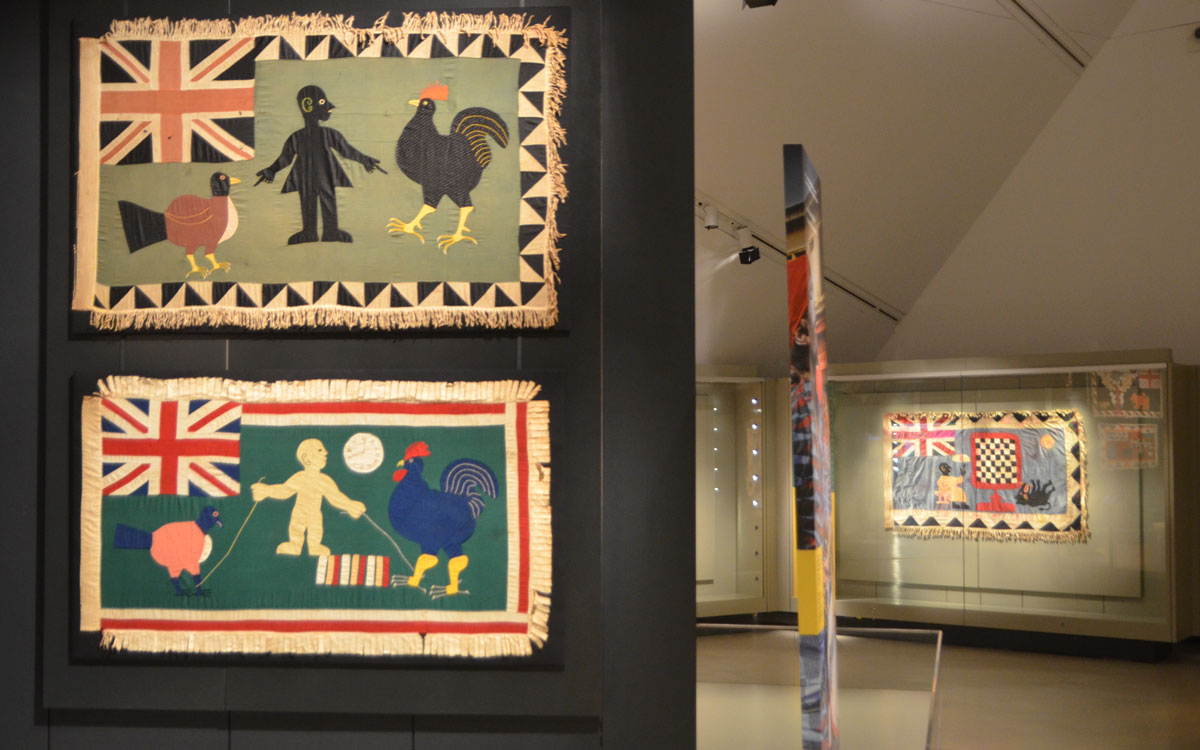
Around 1724 the Dutch either established or made important a number of militia groups of local Fante.  These are the Asafo companies.  Historically, Asafo companies were in charge of the safety and protection of the local community.   At the height of the slave trade they protected individuals and communities.   They exerted power, exercise political influence and maintain codes of conduct within Fante communities. Each company has a flag and that flag has many roles.   They represent proverbs and depict narratives of pride and wisdom.  They accompany oral history and provide a means to preserve customs and traditions.

below:

  1. top flag, by Kweku Kakanu, Saltpond Workshop. “Only a brave man goes under a large tree” because only large animals go under large trees. Made sometime between 1950 and 1957.
  2. bottom flag, artist unknown, Kromantse Workshop. “Only tie a bull to a large tree”. Both the animal and the tree are acknowledged to be strong and mighty.  Made around 1980.  It has a Ghanese flag in the top left corner.


two flags displayed on a black background, with three femail mannequins dressed in traditional Ghanese costume.

below:

  1. top flag, by Kweku Kakanu, Saltpond Workshop. A crocodile dominates and controls a pond of fish. Made around 1940.  The prey can not escape.
  2. bottom flag, by Kwesi Budu, Saltpond Workshop. The fish cann’t escape the net of the fishermen just like enemies will not be able to escape when confronted by the company.  Made around 1950.

two flags displayed on a black background, with two male mannequins dressed in military Ghanese costume.

Fante asafo flags from Ghana, two on display in a museum, chickens and roosters,

Fante asafo flags from Ghana, two on display in a museum, griffons

two mannequins in military uniforms as part of a museum exhibit at ROM


Patricia Harris Gallery of Textiles and Costumes,
ROM, 4th floor,
until March 2017.


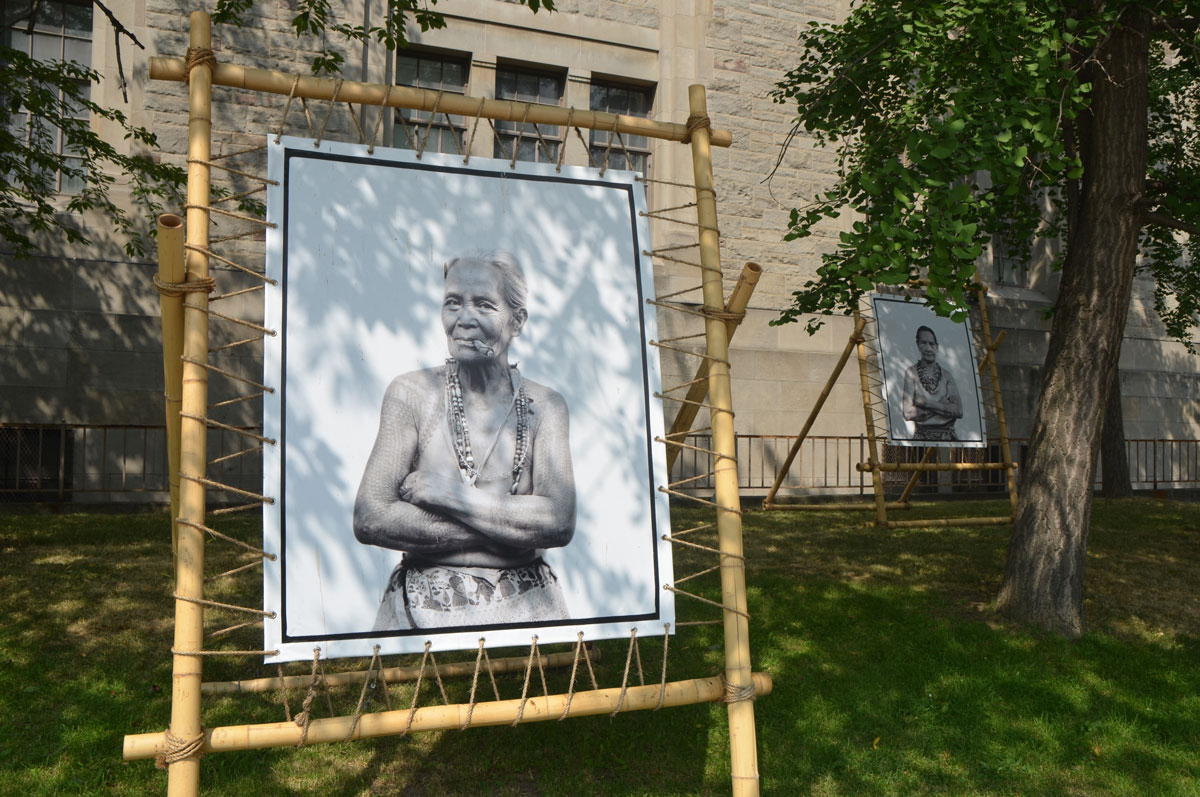
There are seven or eight large photographs, portraits of older women, on University Avenue.   They were actually part of the CONTACT Photography Festival and they have been on display outside the Royal Ontario Museum since early May.  The photos are the ‘The Last Tattooed Women of Kalinga”, portraits by Jake Verzosa.

large black and white photo of an older woman with many tattoos, black and white, displayed outside, another portrait in the background

In the villages of the Cordillera mountains of northern Philippines the women have been tattooed with lace-like patterns for centuries.  The tattoos are symbols of stature, beauty, wealth and fortitude and are traditionally applied during rituals.  The tradition is dying out as standards of beauty change and as the old ways are replaced with more modern methods.

Each village once had their own tattooist, or mambabatok, but today only one remains.  Born in 1918, Whang-od (or Fhang-od), is the last person to practice the centuries old technique called batok.  The ink is made of charcoal and water and it is applied by tapping the skin with a thorn.

two older women with their shoulders tattooed, wearing necklaces and a patterned skirt, seated. Black and white

Once the men were also tattooed.  The Kalinga tattoo has evolved from their ancient tradition as warriors and headhunters.  Heads were taken from fights and battles as a trophy; each time a man brought home a head he would receive another tattoo as a reward.  Tattoos were a mark of social status.

Indigenous groups throughout the Philippines practiced tattooing for centuries.   When the Spanish arrived in the 1500’s they called the people ‘pintados’ or ‘painted people’ as it was not uncommon for people to have tattoos covering their whole body.  While some tribes used tattoos to mark status, other tribes believed that tattoos possessed special spiritual or magical powers which gave the individuals strength and protection.  The use of tattoos as protective symbols is an idea that occurs in many cultures.

large black and white photo of an older woman with many tattoos, black and white, displayed outside, another portrait in the background

In conjunction with the Kalinga portraits, the ROM is featuring an exhibit that examines the beliefs surrounding tattoos, and the role that they and other forms of body art play in different cultures over the years.  “Tattoos: Ritual, Identity, Obsession, Art” is on view until September 5th.  It is a global tour of tattoos past and present.

One of the cultures that is featured is the Chinese.  For centuries, tattoos were forbidden, or at least taboo, in China.  To be tattooed was to be discriminated against as they were associated with prisoners or vagrants.  Recently that has begun to change.

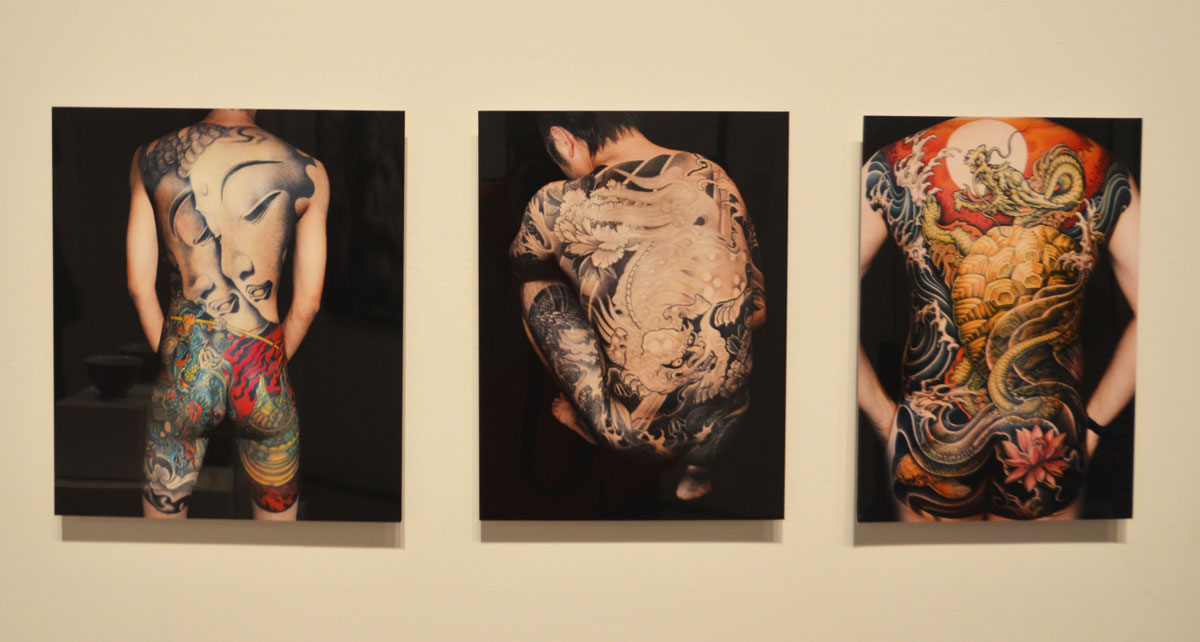
below: Three large modern picture tattoos by Taiwanese tattoo artist Gao Bin featuring traditional Chinese images, Buddha, lion and dragon.  Tattoos as a cultural expression.  In some countries such as Sri Lanka and Thailand images of Buddha are considered sacred objects of worship.  While it’s not illegal to have such a tattoo, wearing one could get you into trouble.

Three pictures of the backsides of men, each with a large picture tattoo from neck to thigh. Chinese art pictures as tattoos

below:  Here is another example of why people get the tattoos that they do.  This is a picture of one photograph in a series by Isabel Munoz.  Munoz spent three weeks inside several prisons in El Salvador and photographed mara gangs.  Gang members wear offensive tattoos to assert their antisocial behaviour and express their loyalty to the gangs.  Tattoos as statement; tattoos as a mark of membership and belonging.  Tribal.

photo of a picture in a museum of a man's face that has been tattooed with gang symbols and words,

below: A silicone arm with a tattoo by Montreal artist Yann Black on display.  This is one of 13 commissioned tattoos on silicone body parts – arms, legs and torsos both male and female that are part of the exhibit.   Tattoos as artwork.  Individuality.

a silicone arm has been tattooed with a design that looks something like a cross between Frank Lloyd Wright and Mondrian. It is in a glass showcase in a museum.

The oldest known tattoos were found on Otzi the Iceman, a natural mummy who was found in the Otzal alps near the Austria – Italy border in 1991.  His tattoos were 61 lines ranging in length between 7 and 40 mm.  The lines were arranged in groups.  Most of his tattoos were on his legs where there were 12 groups of lines.  Otzi is estimated to have died between 3239 BC and 3105 BC.

Tattooed mummies have also been found in other places – Greenland, Alaska, Siberia, Mongolia, western China, Egypt, Sudan, the Philippines, and the Andes in South America.  We will probably never know what significance the tattoos had.  Theories abound of course and they often involve reasons like protection, spiritual, status, tribal, or just for decoration.  Reasons that probably ring true today too.  The methods have changed and some of the images have changed, but human nature remains just that, human nature.


Spread around Kensington and Chinatown are 20 large black and white photos taken by a number of freelance photojournalists who are part of a group called #Dysturb.   One of their goals is to present photojournalism in new ways, including as street art, with the aim of engaging people and encouraging discussion of global issues.   The images are part of an exhibit for the Scotiabank CONTACT Photography Festival.

Kensington has had a problem with taggers for a while.  Often street art gets vandalized in that area.   The #Dysturb photo that was at 56 Kensington (under Mona Lisa) has already been torn down and a couple of others have been ripped.

Pictures of some of the images that are part of the exhibit are shown below.  I have included a partial transcription of the words that accompany each picture.


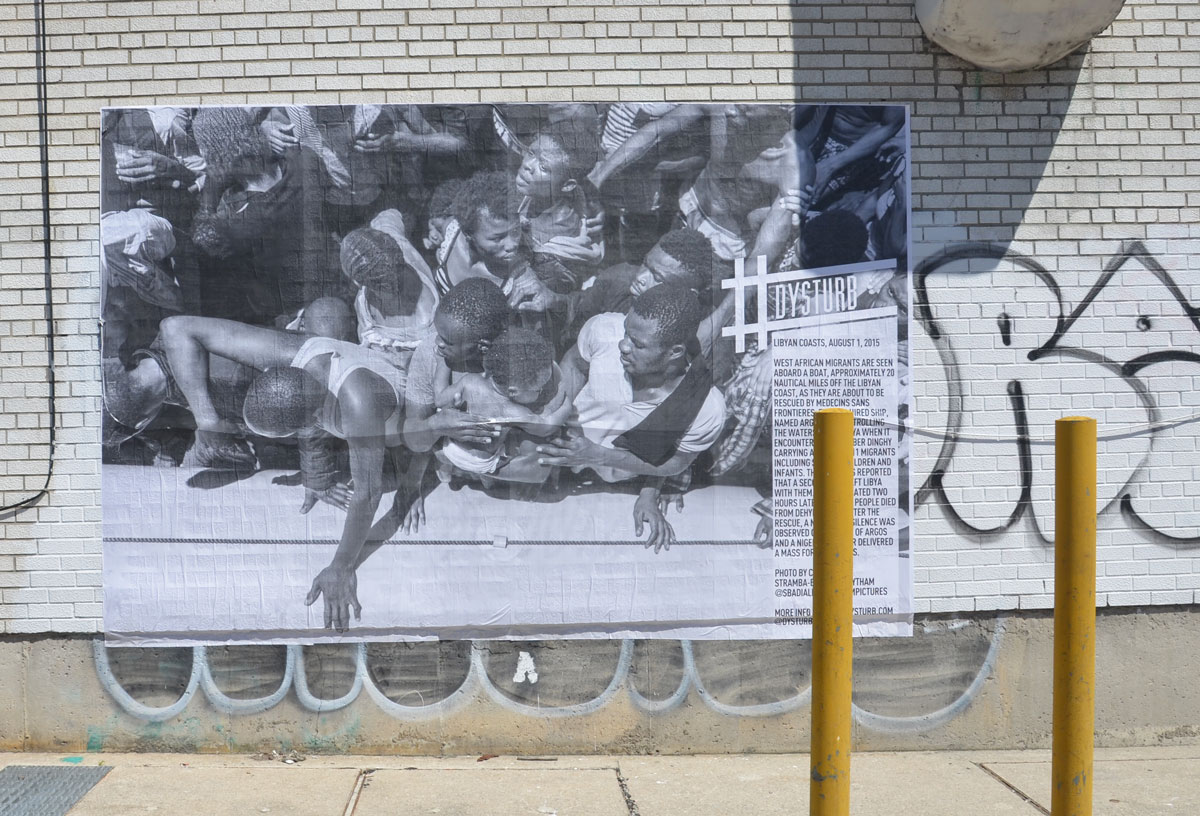
Libyan Coasts, August 1, 2015
Photo by Christophe Stramba-Badiali/Haytham

a large black and white photojournalist picture, part of CONTACT photography festival, pasted on a wall - a boat load of Libyan migrants is being rescued from their rubber dinghy.

West African migrants are seen aboard a boat, approximately 20 nautical miles off the Libyan coast, as they are about to be rescued by Medecins Sans Frontieres. The MSF-hired ship, named Argos, was patrolling the waters off Libya when it encountered one rubber dinghy carrying a total of 111 migrants including several children and infants. “


Barpak, Ghorka District, Nepal, May 9, 2015 ”
Photo by Renaud Philippe/Hans Lucas

a large black and white photojournalist picture, part of CONTACT photography festival, pasted on a wall - children playing in the wind created by a helicopter, Nepal, on a wall in an entraceway.  A man is busking in front, and there are people walking past on the sidewalk

Children play in a cloud of dust and gravel thrown by an Indian army helicopter landing in Barpak Nepal.  The community is at the epicenter of the devastating earthquake that struck April 25, 2015, taking over 8000 lives.  Of Barpak’s 1400 houses, only 20 remain standing.   The rest of the town is a pile of rubble that blends into the rocky landscape.  An archway that somehow survived the quake greets visitors with a rueful ‘Welcome to Barpak’.”


Shaanxi Province, Henan, China, February 27, 2014
Photo by Sim Chi Yin/Vii

a large black and white photojournalist picture, part of CONTACT photography festival, pasted on a wall - an ill Chinese man is being comforted by his wife.  The picture is on a graffiti covered wall and a black car is parked close to it.

Gold miner, He Quangui, battling silicosis, struggles to breathe while cradled in the hands of his wife Mi Shixiu.  After many attempts to stabilize his breathing, in the early hours of the next morning her tried to kill himself to end the suffering.  He contracted the irreversible disease working in illegal gold mines in China’s Henan province.   He is among some six million workers in China who have pneumoconiosis – the country’s most prevalent occupational disease.”


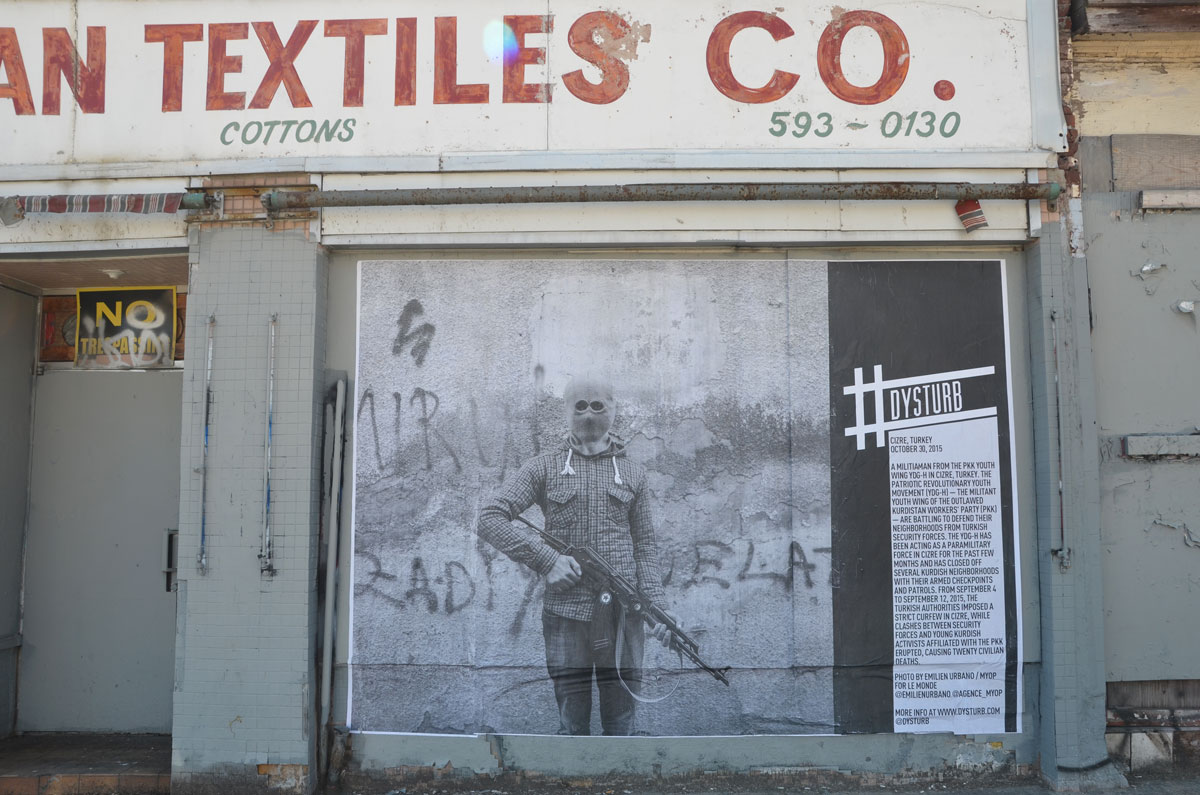
Cizre Turkey, October 30, 2015.
Photo by Emilien Urbano/Myop for Le Monde
NOTE: I took this picture on Friday. Today (Monday) it was gone.

large black and white photo pasted onto a boarded up storefront of European Textiles on Spadina Rd. The photo is part of #Dysturb exhibit at Contact Photography Festival. It shows a hooded man holding an automatic rifle

A militiaman from the PKK Youth wing YDG-H in Cizre Turkey.  The Patriotic Revolutionary Youth Movement (YDG-H) – the militant youth wing of the outlawed Kurdistan Workers’ Party (PKK) – are battling to defend their neighbourhoods from Turkish security forces.  The YDG-H has been acting as a paramilitary force in Cizre for the past few months and has closed off several Kurdish neighbourhoods with their armed checkpoints and patrols.


Fort McKay, Alberta, Canada, August 12, 2015
Photo by Ian Willms/Boreal Collective

a large black and white photojournalist picture, part of CONTACT photography festival, pasted on a wall - a sick boy is lying on a bed, on a wall in the entranceway to a store, sidewalk and street scene in the background

Dez, 7, plays in his bed.  Dez was born with an underdeveloped heart and has received multiple open heart surgeries.  His family and healthcare professionals in Fort McKay believe that his condition was caused by environmental pollution.   Fort McKay is an indigenous community that is surrounded by oil  sands developments.”


Kunduz City, Afghanistan, November 18, 2015.
Photo by Andrew Quilty/Oculi

a large black and white photojournalist picture, part of CONTACT photography festival, pasted on a wall - a mother (covered in a black burka) and her daughter in grief, at a gravesite.  Pasted on an orange wall with an old brown leather sofa in front of it.

Najibah tries to comfort her daughter Zahara, 8, as they weep over the grave of their husband and father, Baynazar.   Baynazar, 43, was wounded by gunfire on his way home fromwork during the Taliban takeover of Kunduz in late 2015.  He was taken to the nearby Doctors Without Borders (MSF) trauma centre.  In the early hours of October 3, during his second operation, a US AC-130 aircraft attacked the hospital for more than half an hour, killing 43 MSF staff, patients and nurses.  Dozens more were wounded.

About #Dysturb

#CONTACT16

FORTY ONE the Esplanadian Connection,
an exhibit inspired by the book ‘FORTY ONE Neighbours’

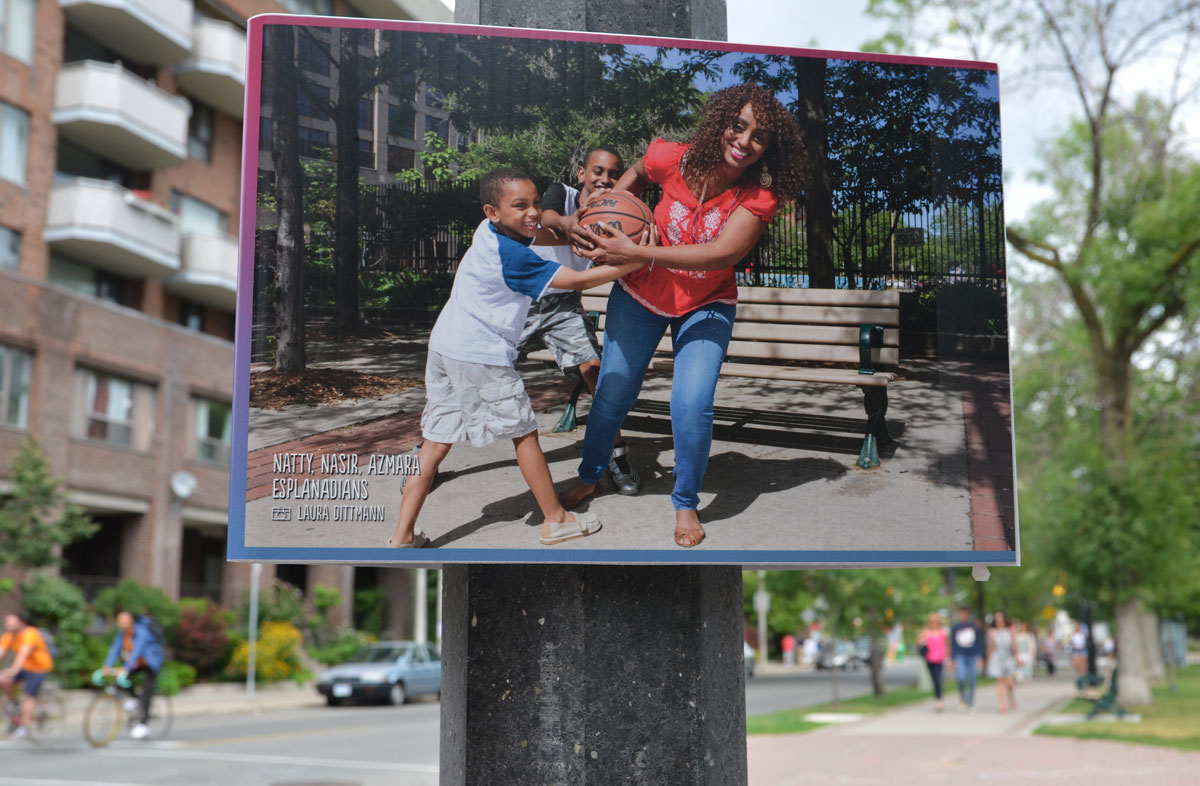
The book was published earlier this year and there was a book launch at St. Lawrence Hall back in April.  The book is a collection of 41 portraits, one person from each country participating in the Pan Am and Parapan Games.  Each portrait is also of a person with a connection to the Esplanade community. Fifty three students/authors from The Esplanade neighbourhood wrote the stories.

A poster on a lamp pole, a picture of a woman and two boys playing with a ball (pretending to fight over it)

For the exhibit, the portraits were re-enacted by local residents.

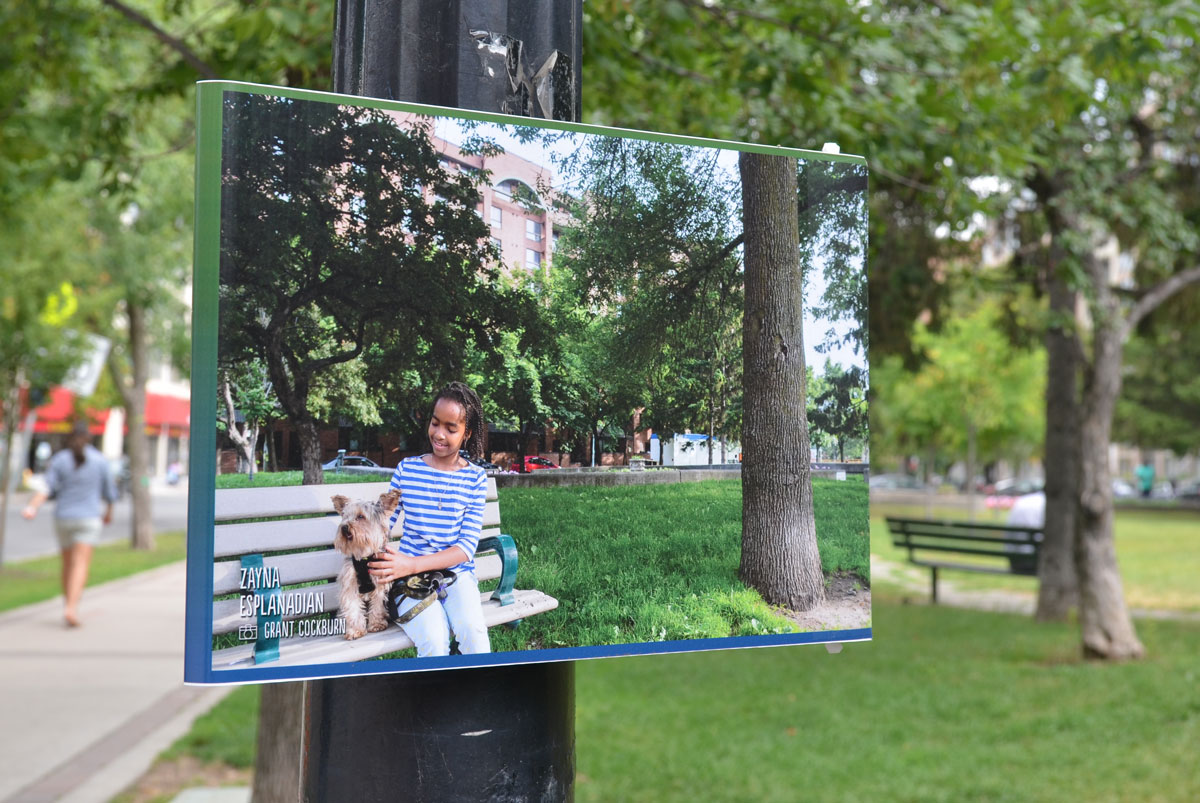
A picture of a girl with a dog on a bench is posted on a lamp post as part of an exhibit for the Pan Am games, a bench in the park is in the background

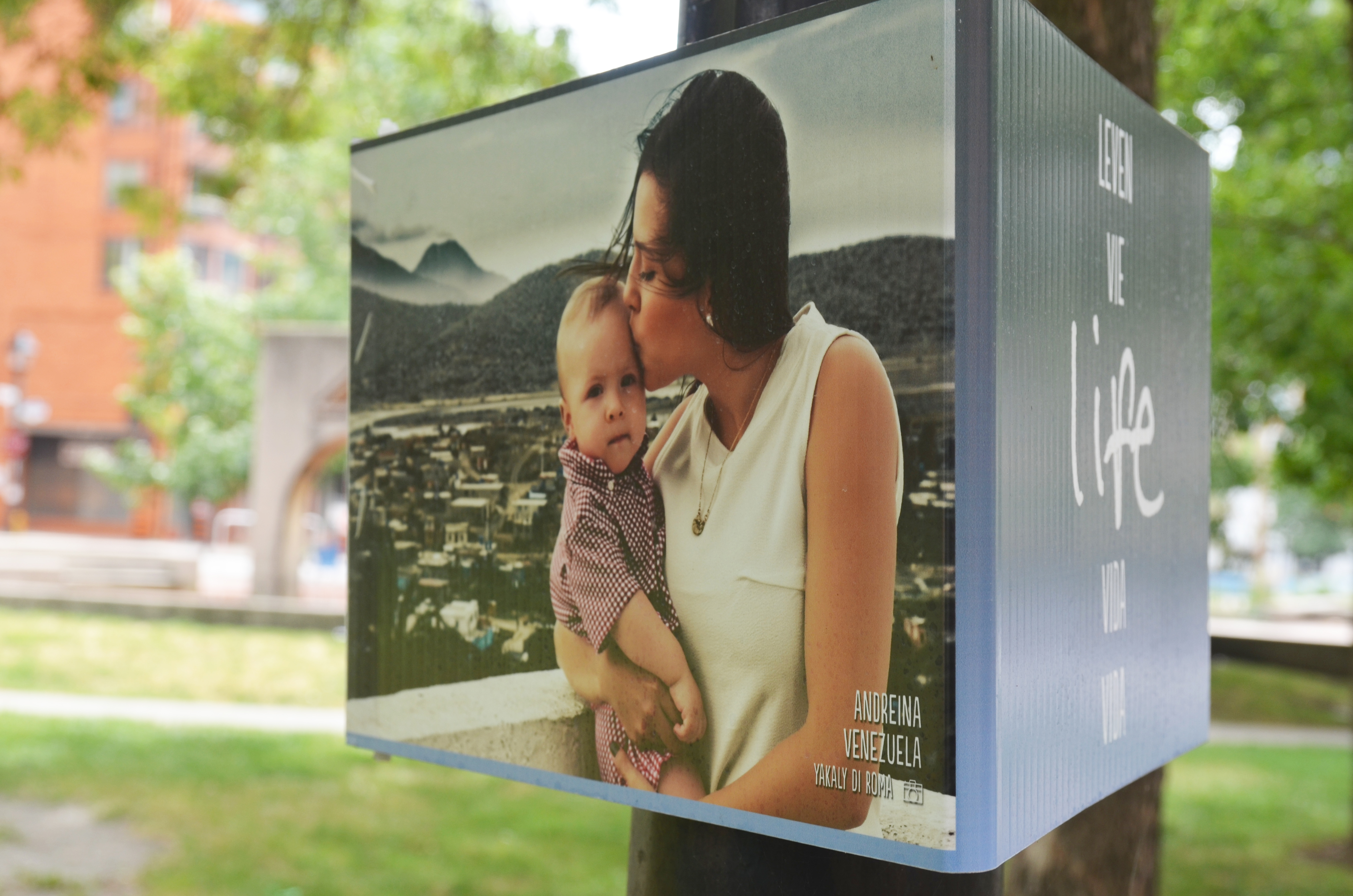
Each portrait consists of three sides.  Two sides have photographs on them – one side with a Esplanadian person or family and the other side with a PanAmerican resident.

An exhibit on a street in Toronto that consists of a three sided sign wrapped around a streetlight pole. Two sides can be seen in this photo. One side is a picture of a woman sitting in an otherwise empty auditorium with red seats. the other side has the word calmness in English and then the translation of that in 4 other languages, French, SPanish, Dutch and Portugese
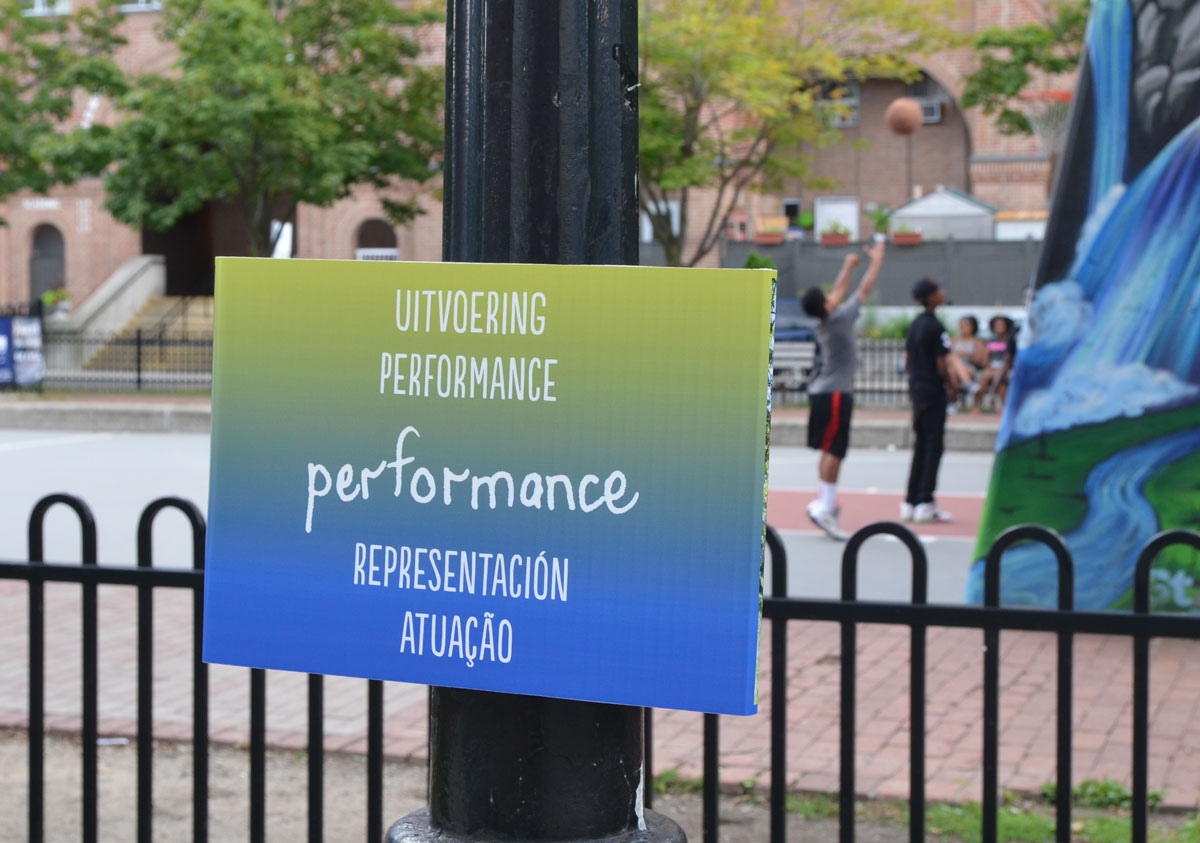
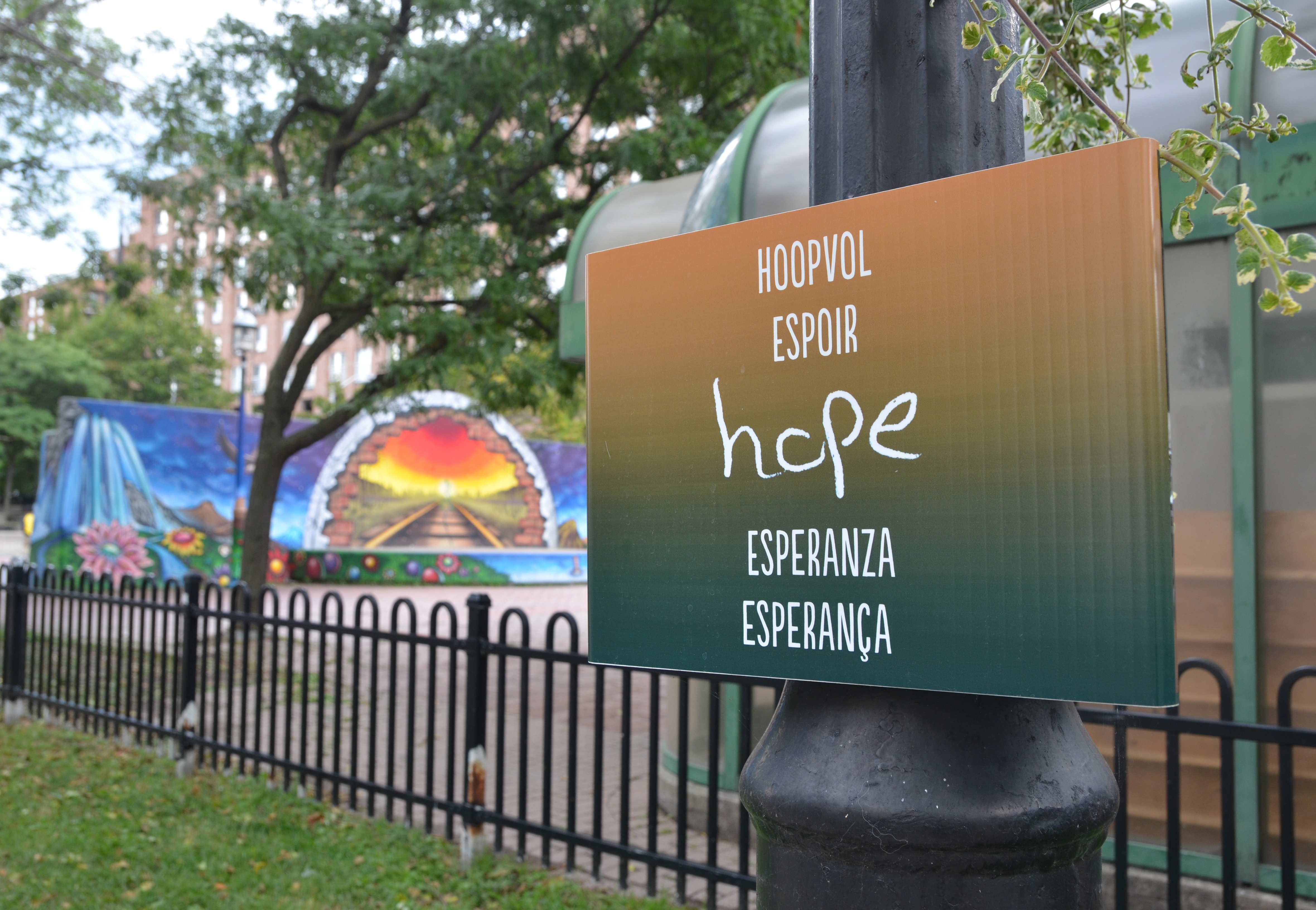
The third side has one word written in five languages.
From top to bottom – Dutch, French, English, Spanish and Portuguese.

The word performance on a green and blue sign. It is also written in 4 other languages, Dutch, Spanish, French and Portugese

The words were chosen from the stories in the book, one symbolic word from each portrait.

sign on a lamp post that says hope in 5 languages with a basketball court and murals in the background. On the Esplanade in Toronto

The signs are mounted on lamp posts along the Esplanade.

poster on a lamp post with the picture of a mother and her son. Park is in the background. Part of an exhibit in association with the Pan Am Games.

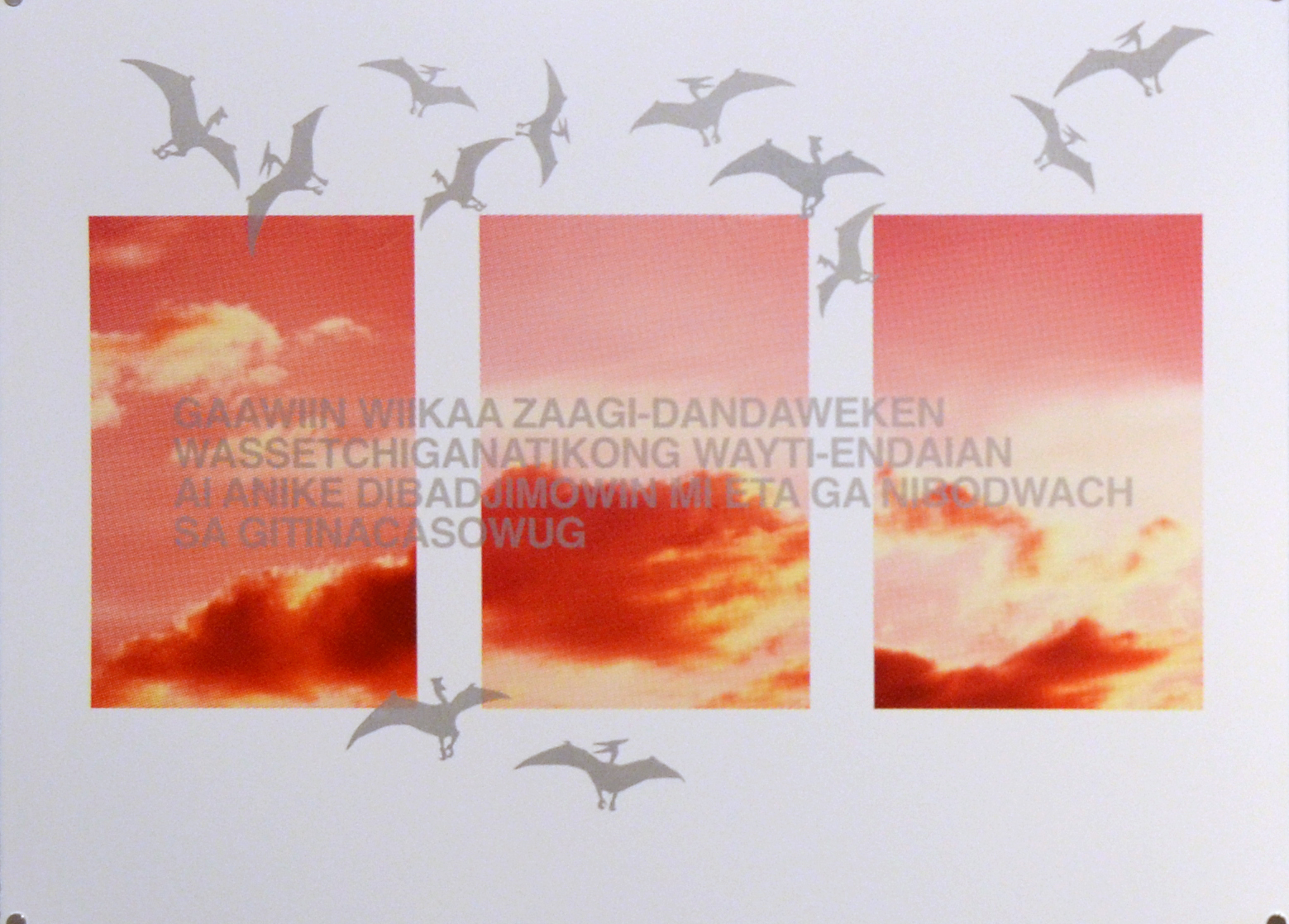
 Planet IndigenUS is a ten day festival co-produced by the Harbourfront Centre in Toronto and the Woodland Cultural Centre in Brantford. It features 300 artists with dance and music performances as well as visual art exhibits at a number of venues.  One of the venues is the gallery at Harbourfront Centre where a number of artists of Anishnabe heritage are showing their work.  Two of the artists are Christian Chapman and Scott Benesiinaabandan, and a sample of their work is presented here.


 Screenprints by Christian Chapman

print of an evergreen forest, a text in Ashishnabe language on top of the trees, hanging on a gallery wall gaawiin wiikaa ji gwerina-ka-nawich
miskwadessi opixwanak misa oi kitimagia
miskwadessi wag dash awessiwag
ji manaadji-a-ka-ni-watch

 never turn a turtle on its back so that it is helpless
turtles and all other animals are to be accorded respect


print of asky with clouds in red and orange tones, a text in Ashishnabe language on top of the trees, hanging on a gallery wall gaawiin wiikaa zaagi-dandaweken
wassetchiganatikong wayti-endaian
ai anike dibadjimowin eta ga nibodwach
sa gitinacasowug

never climb out a window in your house,
traditionally, only dead people are brought out like that

***

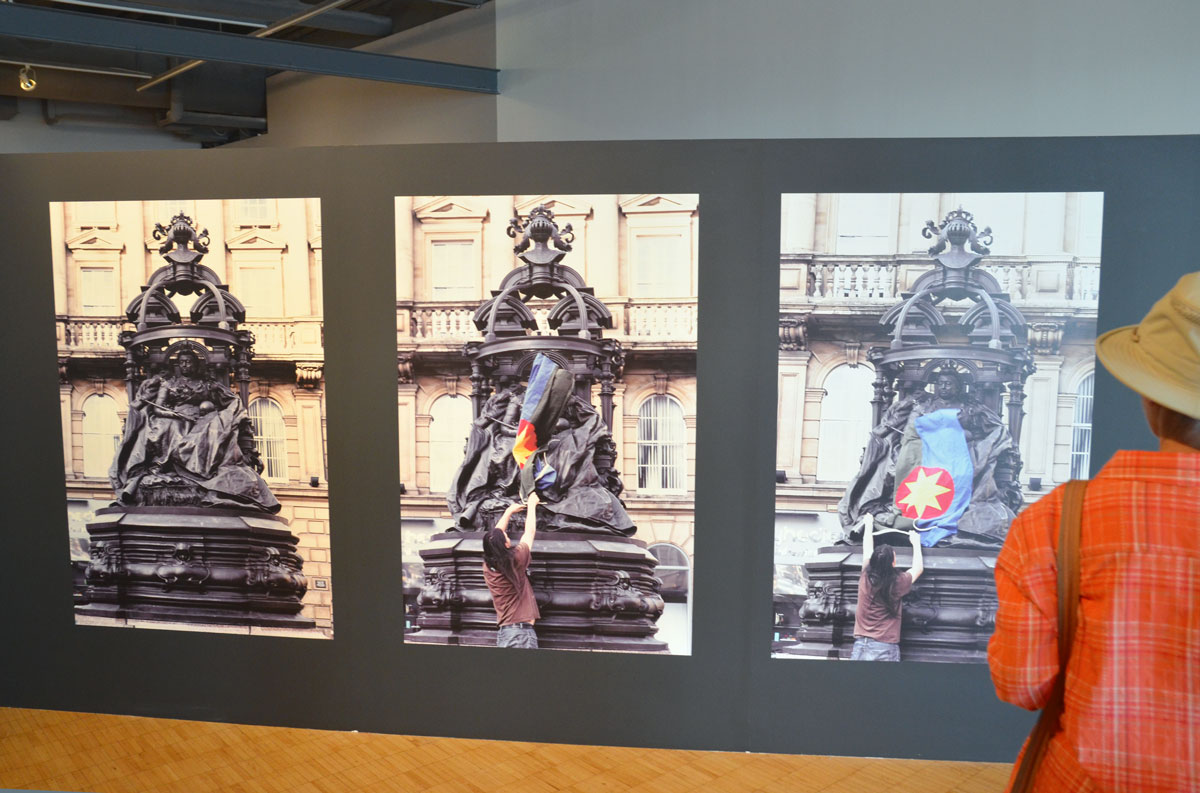
below: ‘God Save the Queen’ by Scott Benesiinaabandan
a series of photos in which the queen is partially covered by the artist’s Solidarity Flag

In an art gallery, a series of three large photographs of a statue of Queen Victoria.  THe first picture is just the statue, the middle picture is a man starting to put a  flag over the bottom part of the statue and the third picture is the flag on the statue.  Flag is solidarity flag created by Scott Benesiinaabandan, black and blue background, red circle in the middle, yellow sun in the red circle


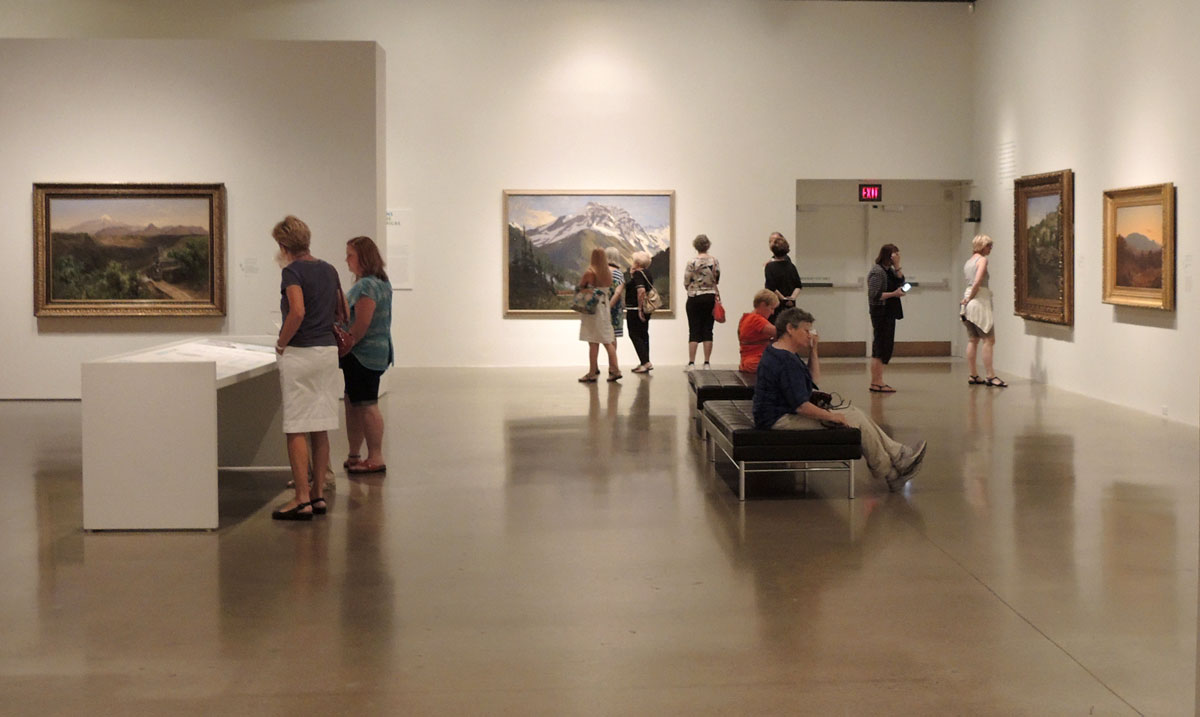
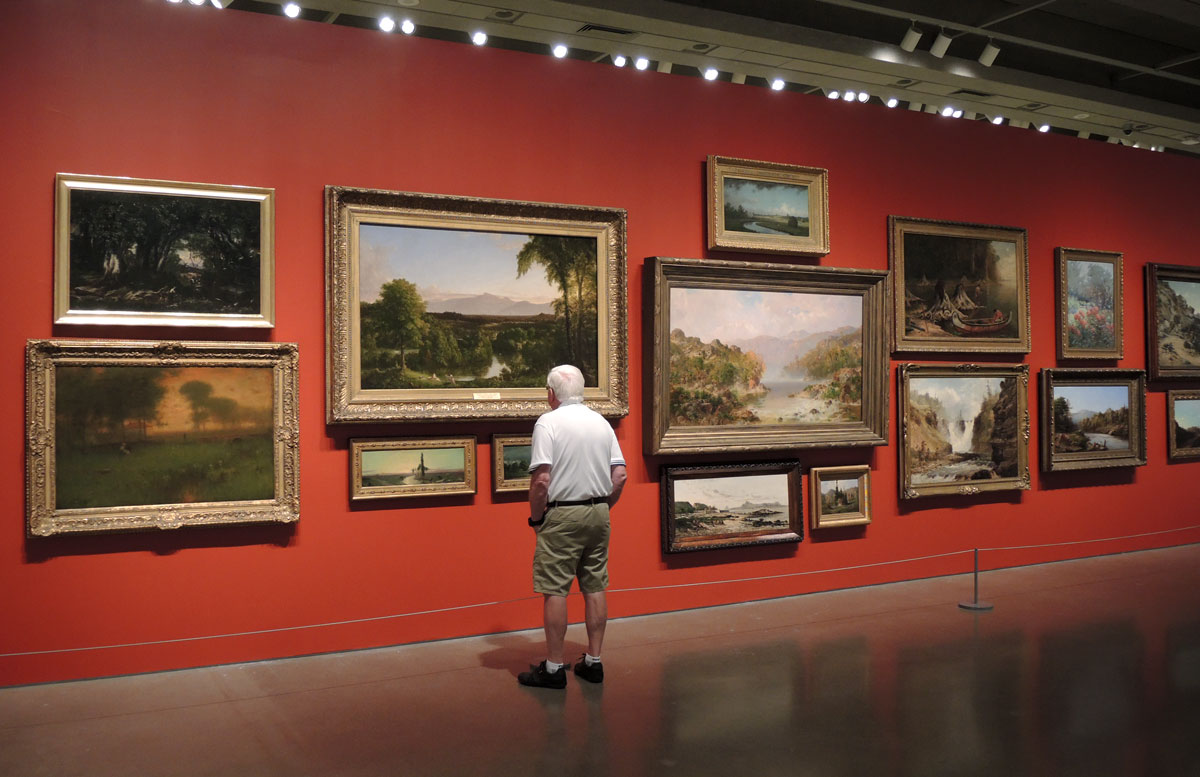
Landscape paintings depicting scenes from the top of North America to the tip of South America
are on display at the Art Gallery of Ontario until Sept 2015.   The collection centers on just over 100 works that were painted between the early 1800s and the eary 1900s.

7 or 8 people in an art gallery looking at paintings that are hanging on the walls

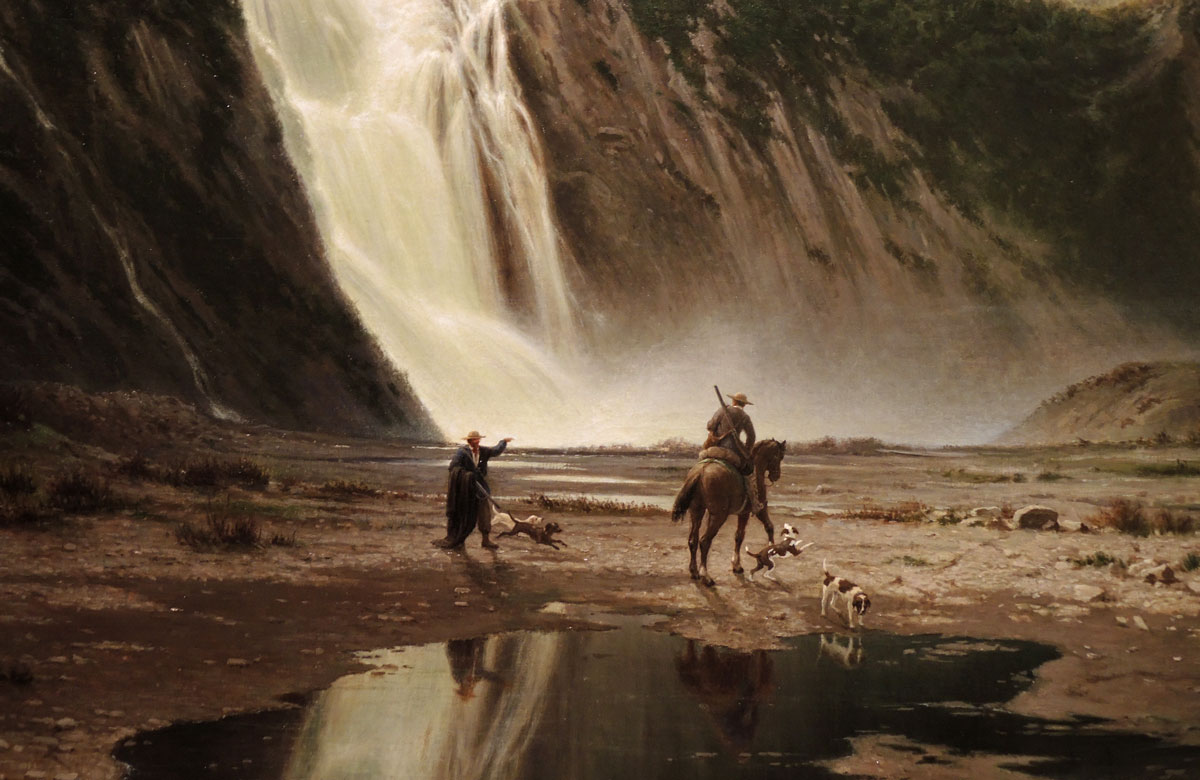
below:  part of a painting, ‘Montmorency Falls’ by Guido Carmignani (Parma Italy 1838-1909)
oil on canvas,  1869

close up of part of a painting - Montmorency Falls by Guido Carmignani 1869, Italian hunters at the base of the falls (even though they are in Quebec) in summer time.

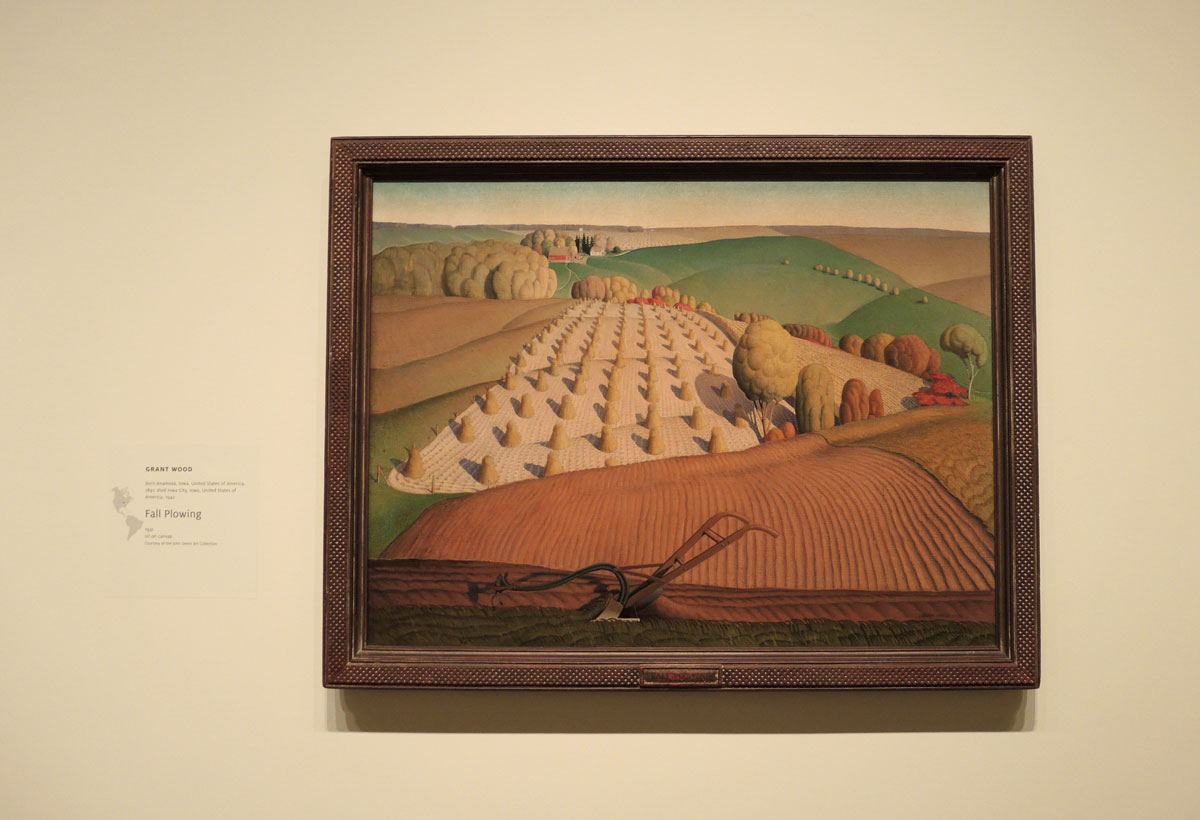
below: Fall Plowing, by Grant Wood (b. and d. Iowa USA),  1931, oil on canvas

painting on a wall in an art gallery of fields being harvested by Grant Wood


A man is looking at a wall of paintings. The wall is painted red. It is in an art gallery

close up of part of a painting including part of the intricately carved frame.  THree men getting into a boat at the edge of a river

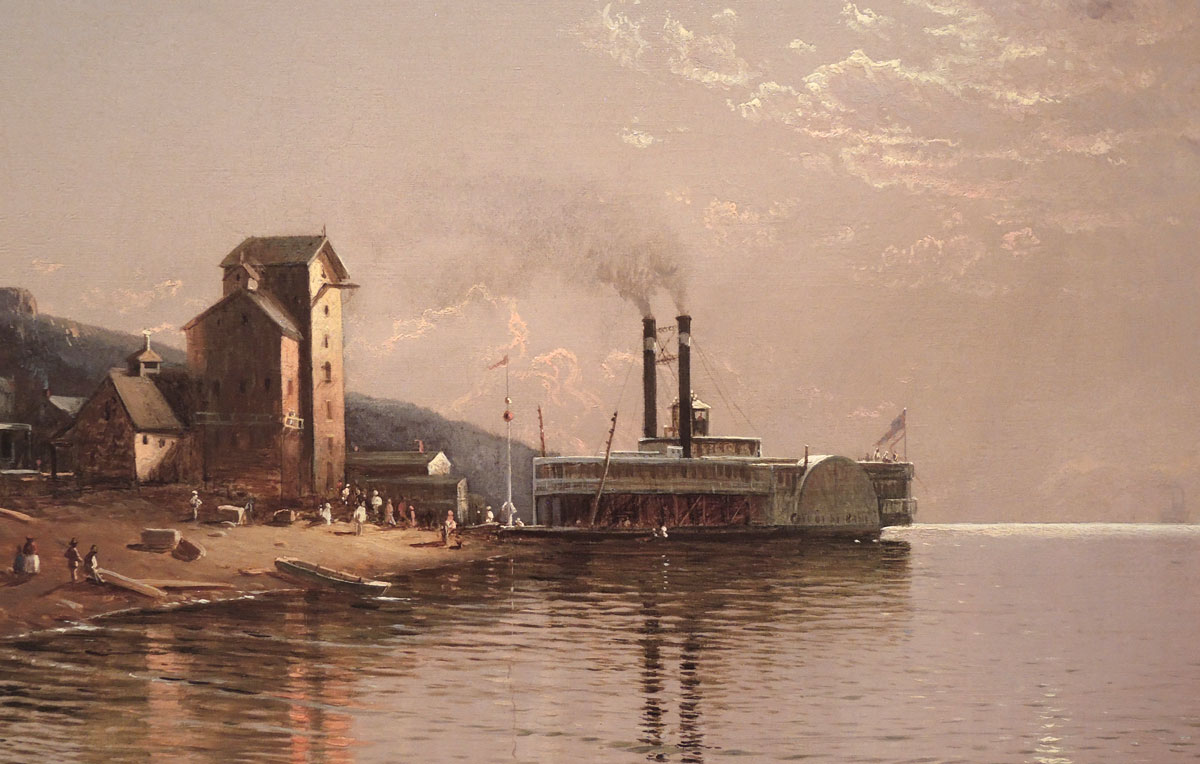
 below: part of “The Sidewheeler, the ‘City of St. Paul’ on the Mississippi River, Dubuque Iowa”
by Alfred Thompson Bricher (American), oil on canvas,  1872

close up of part of an oil painting showing an old paddle wheel steam boat on a river

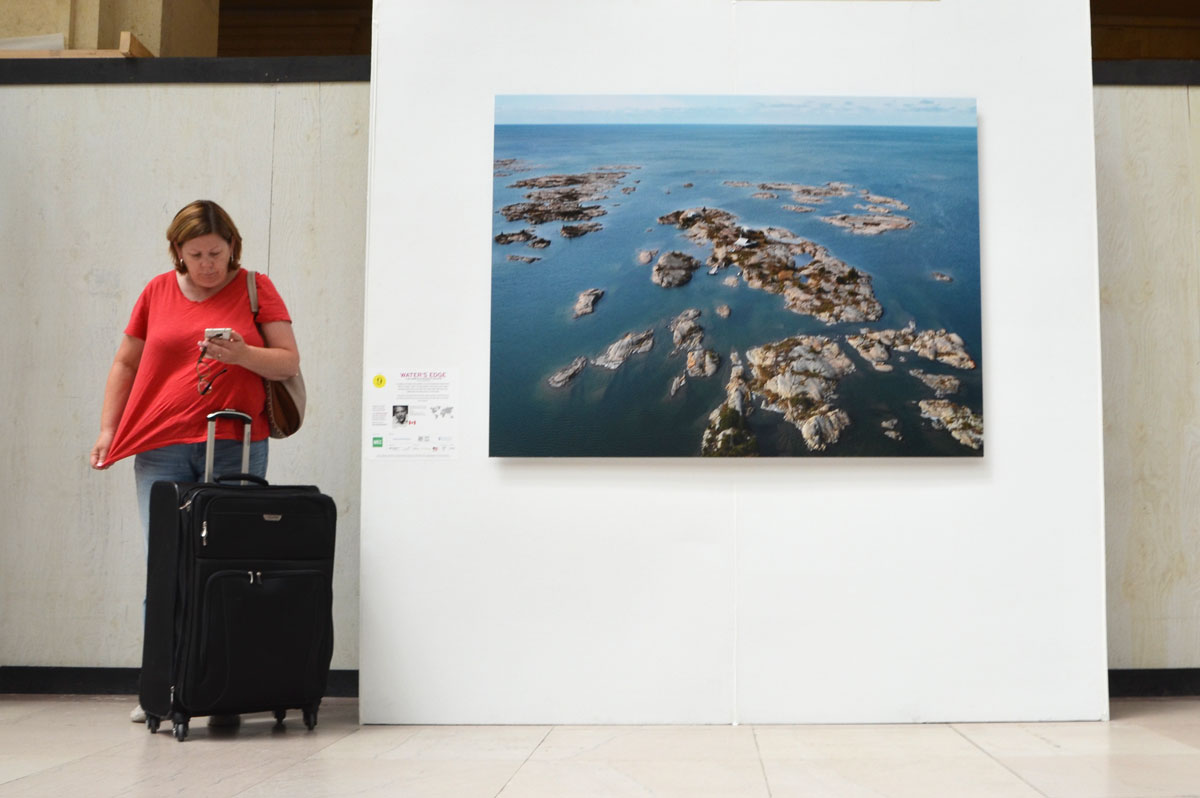
Water’s Edge
A Pan-American photography exhibit

produced by No.9: Contemporary Art & the Environment.

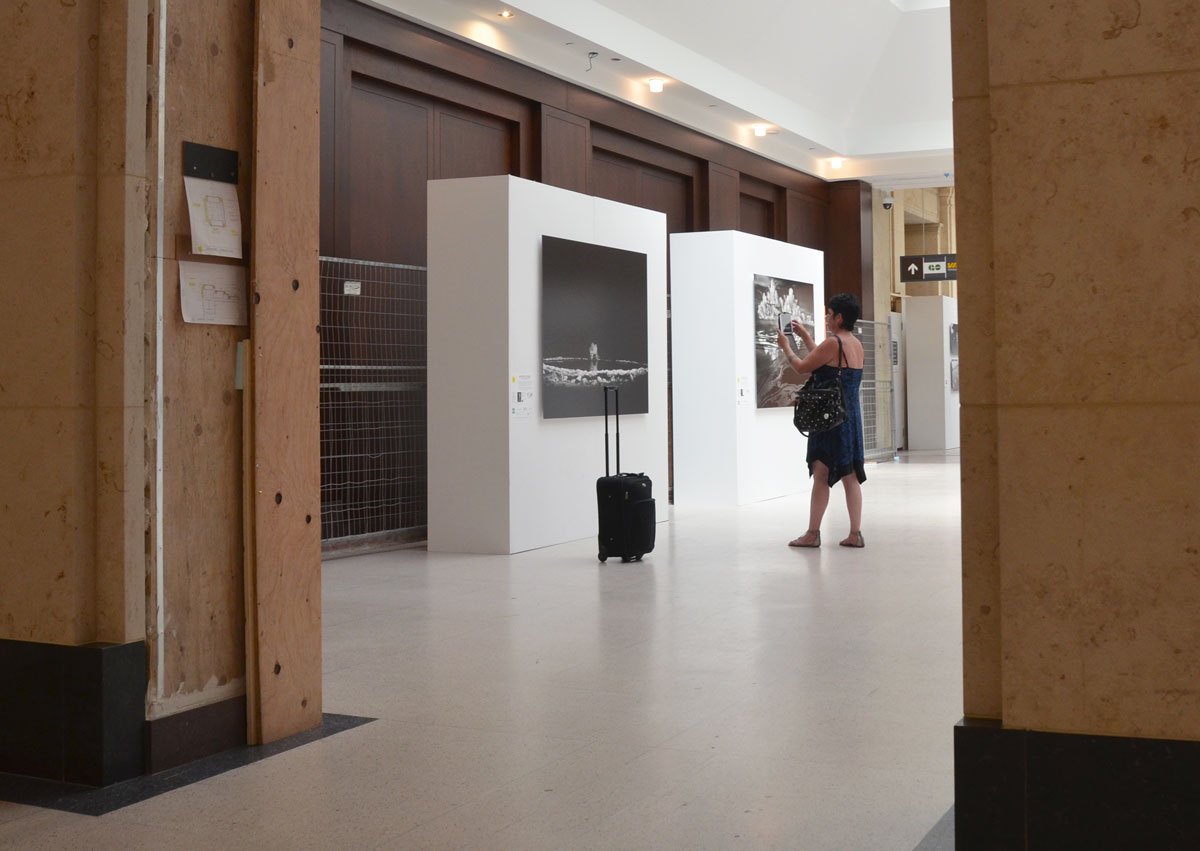
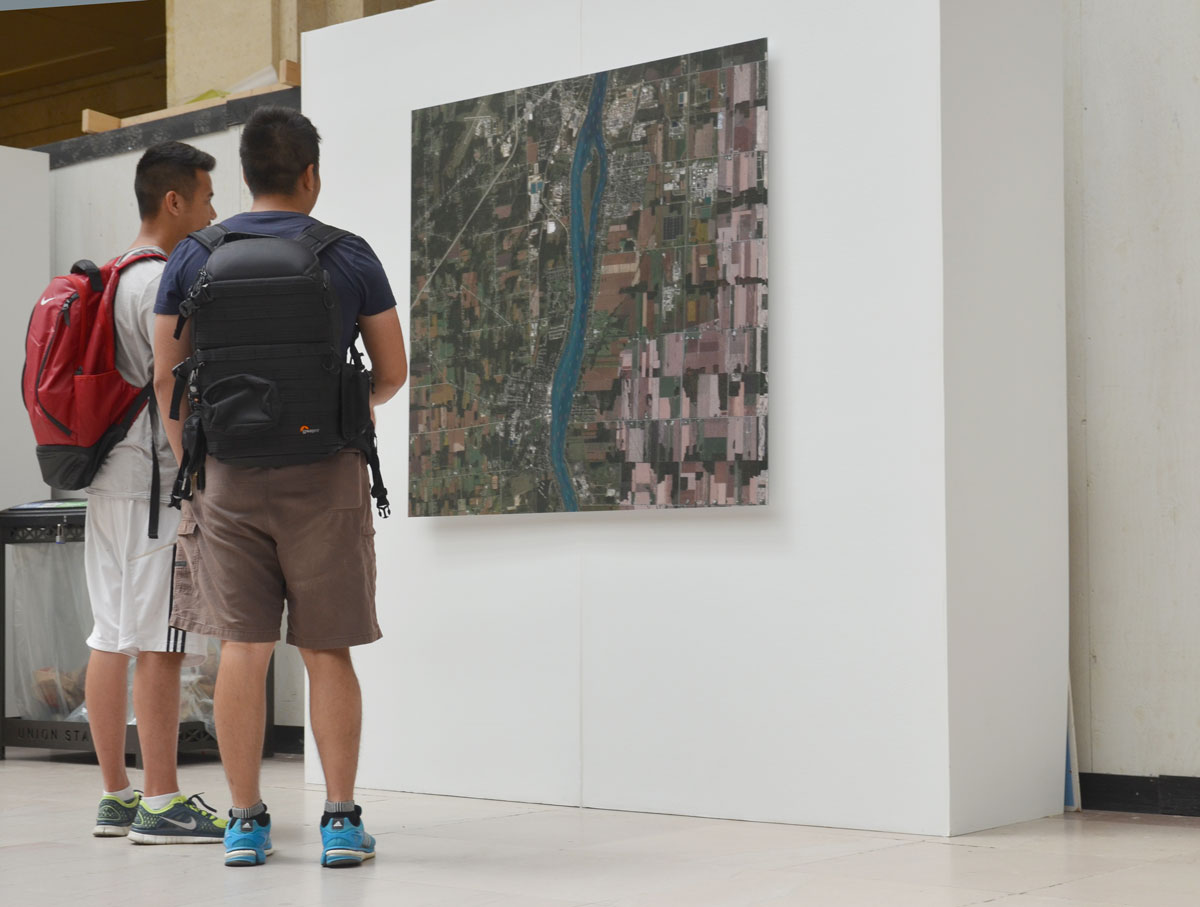
Two venues are involved, Union Station and Pearson Airport.  The photos below represent a sample of the photos on show at Union Station.


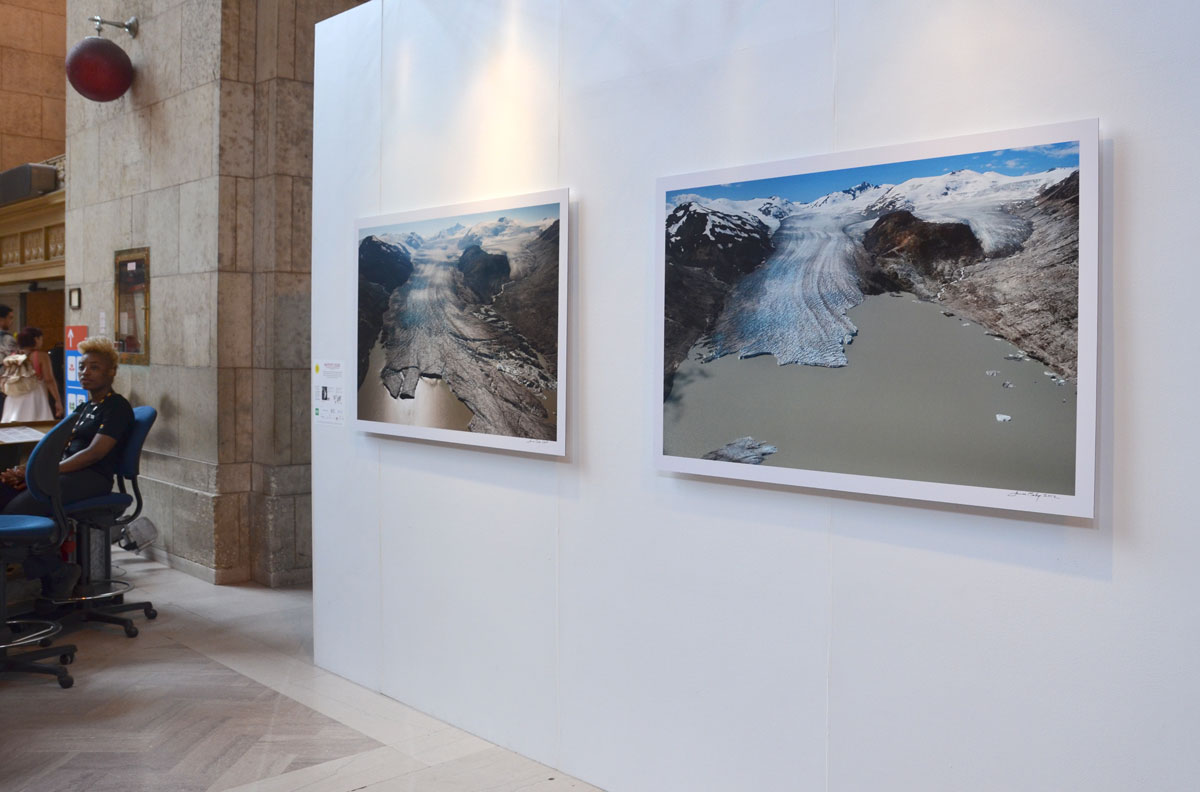
below: Bridge Glacier, British Columbia 2012, by James Balog, part of his study of vanishing glaciers.

large photographs, part of an exhibit at Union Station in Toronto -

below: Two black and white photographs by Sebastiao Salgado,
part of a photographic project titled ‘Genesis’.
One aim of ‘Genesis’ was to examine “the fragile beauty and grandeur of nature”.

large photographs, part of an exhibit at Union Station in Toronto -

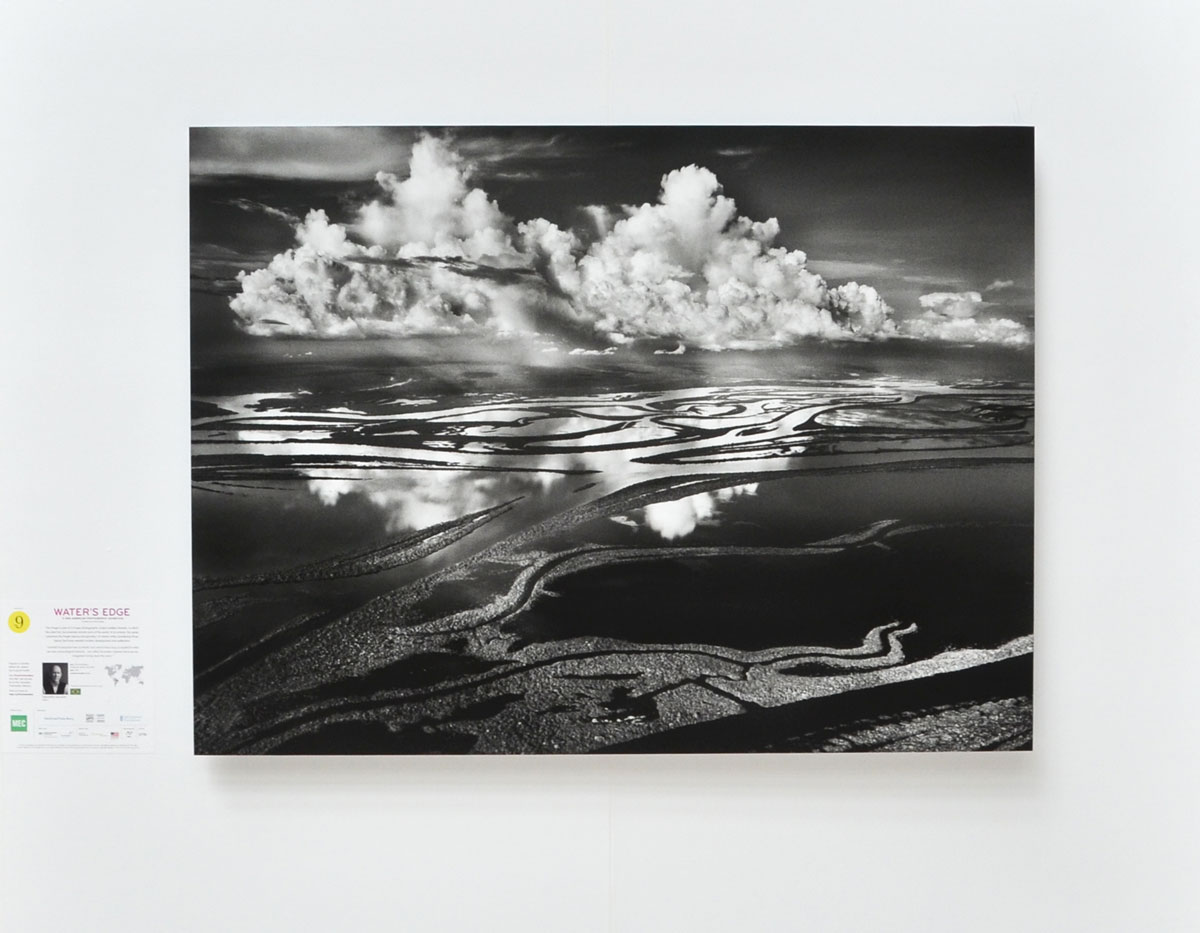
below:  ‘The Anavilhanas’ taken in Amazonas Brazil, 2009 by Sebastiao Salgado.
Located on the Rio Negro, the Anivilhanas Archipelago is the world’s largest fresh water archipelago.  It is an unique ecosystem with over 400 river islands spread over 90 km.  The Rio Negro is 27 km at its widest point. During the rainy season (November to April) many of these islands are underwater.

large black and white photograph, part of an exhibit at Union Station in Toronto -

below: ‘Sarnia’ by Gustavo Jononovich, taken in Sarnia, from his “Free Shipping” series.

large photographs, part of an exhibit at Union Station in Toronto -

below: ‘Georgian Bay #1, Four Winds’, Point-au-Baril, Ontario  2009, by Edward Burtynsky.
This picture is part of his Water Series, a series that looks at changing water systems around the world as well as the relationship that we have with these water systems.

large photographs, part of an exhibit at Union Station in Toronto -

The exhibit ends on the 15th of August.

#myhomewaters

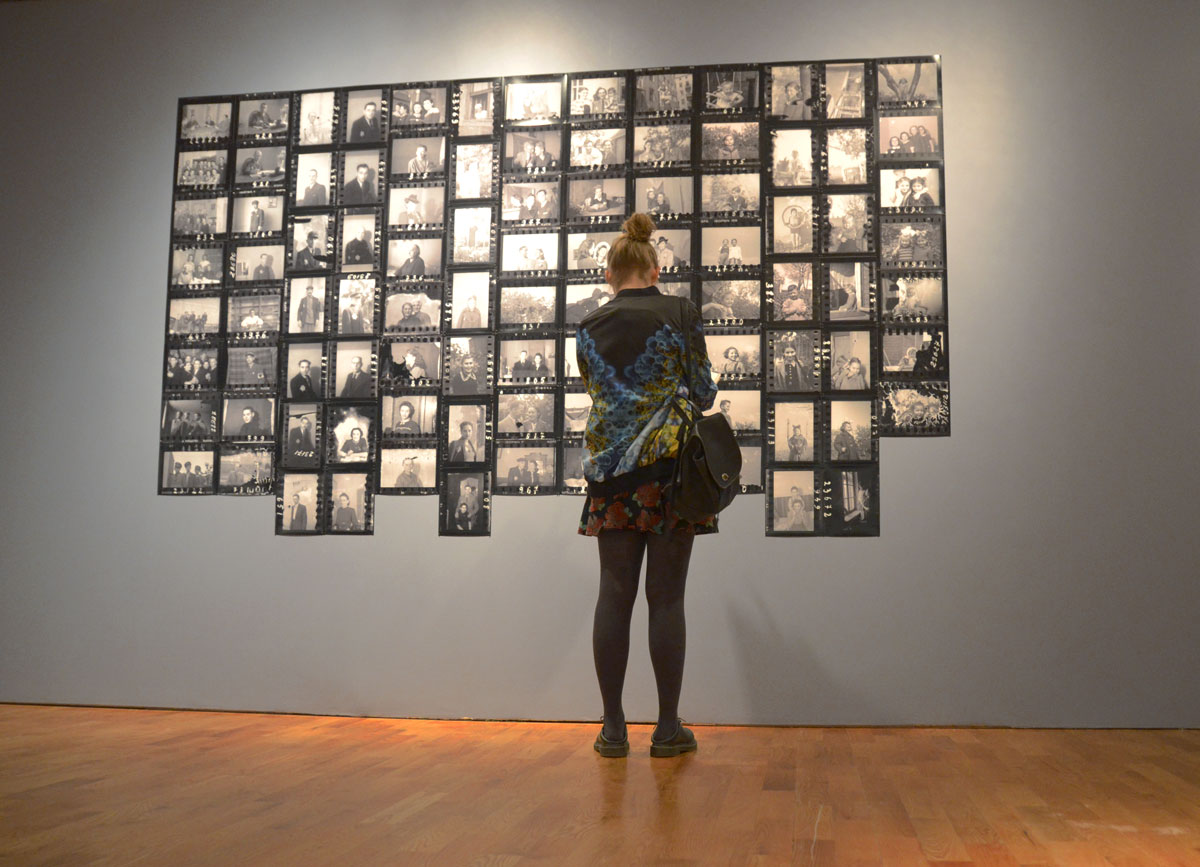
Photographs of the Lodz Ghetto (Poland 1940-1945)
by Henryk Ross,
at the Art Gallery of Ontario until 14 June 2015

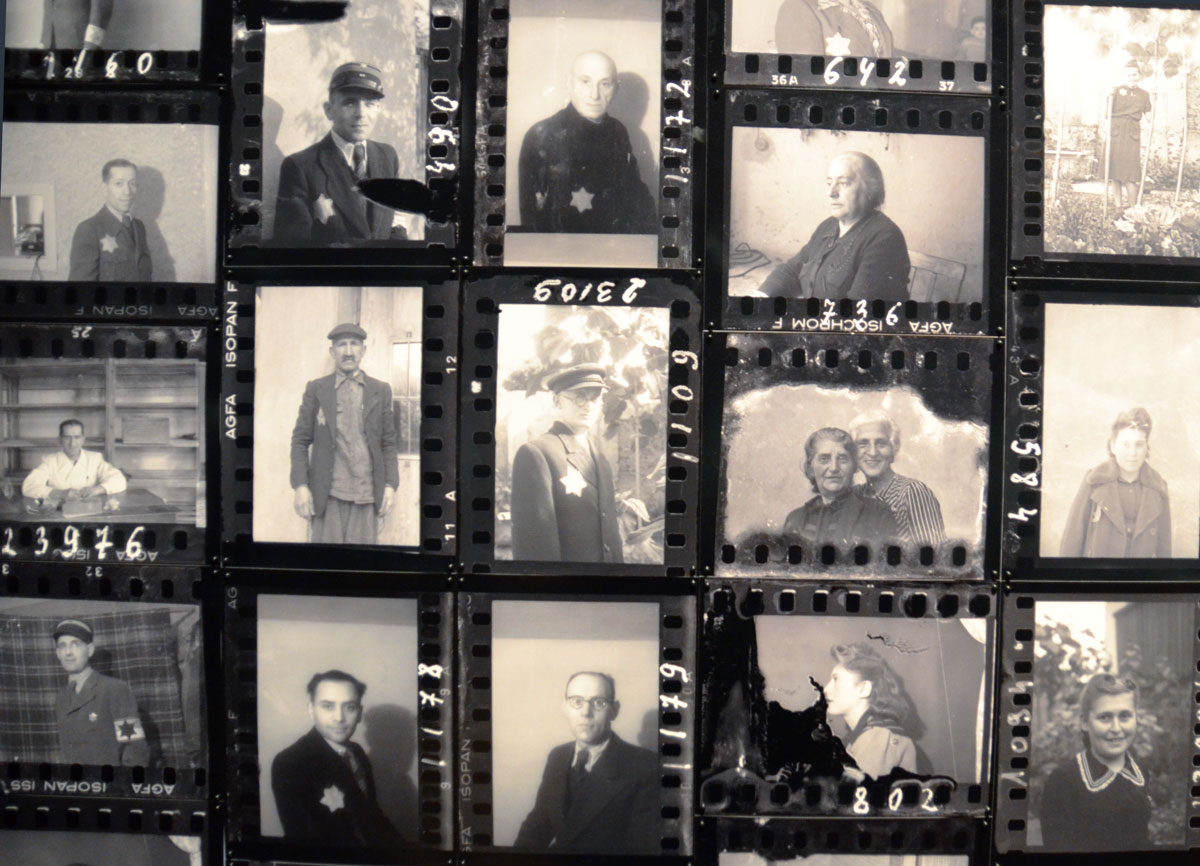
Ross was a Polish Jewish photographer and one of the official Lodz ghetto photographers under the Nazi regime.

A girl is standing in front a photography exhibit where many black and white photos are grouped together to form one big picture.

In the autumn of 1944 as the Lodz ghetto was being shut down, Ross buried his 6000 negatives in jars.  The Red Army liberated Lodz in January of 1945 after which Ross unearthed his negatives.  Water damaged about half of them.  Of the surviving 3000 negatives, about 200 form the ‘Memory Unearthed’ exhibit.

Close up of photo display showing black and white photos of people in portrait like photos.

Some of the photos are ordinary pictures – portraits of people, children playing.  Other photos look ordinary until you learn the context, what is really happening in the picture.  Many photos document suffering and despair.  They elicit a lot of uncomfortable emotions but as an historical record the collection is excellent as well as much needed.