There is no theme to this blog post.  I never really had a purpose in mind as I walked yesterday.  I walked to enjoy the spring day.  I walked wherever my feet took me…  and they took me on a route that wove between Bay Street and University Avenue and from Grenville south to Dundas.

two women dressed up and walking down the street. One is in a puffy black dress, black tights and black shoes. The other woman has long red hair and a polka dot sweater on.

below: “Jimmy Mount Rushmore” mural on the side of Jimmy’s Coffee featuring four famous musical Jimmys: Jimi Hendrix, Jimmy Page, Jimmy Buffet and Jim Morrison.
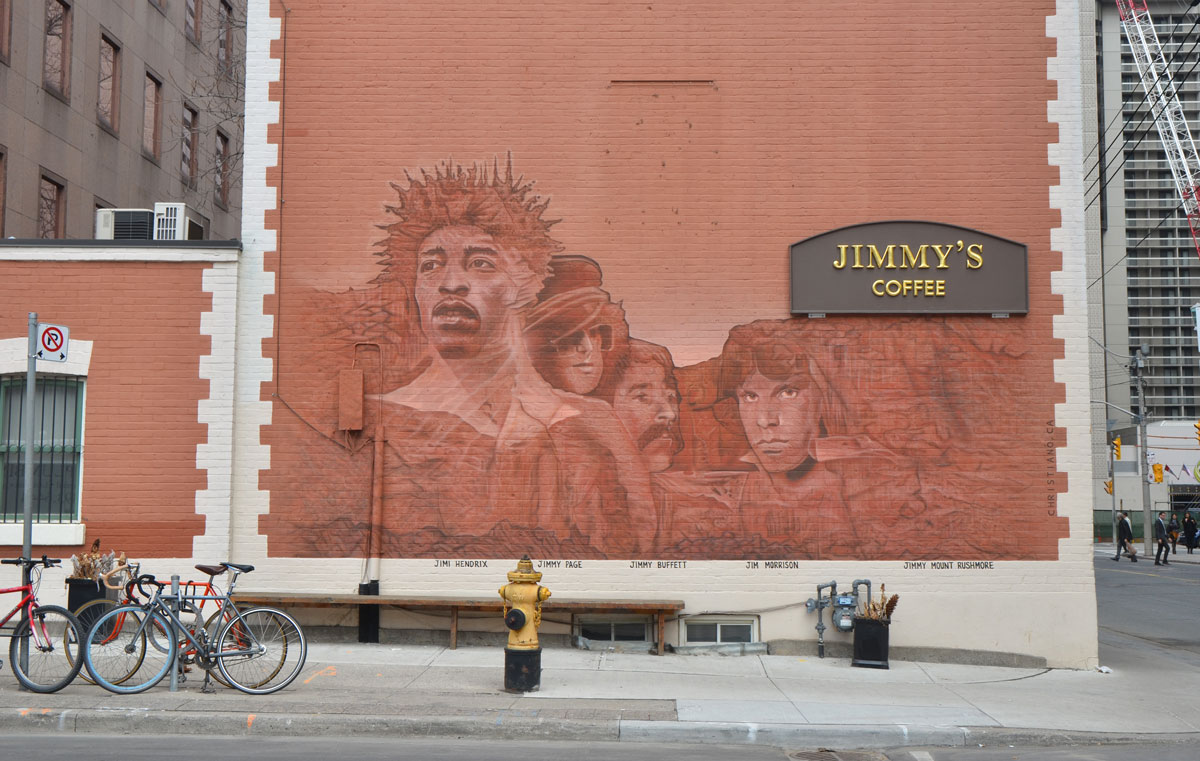
mural on the side of Jimmys coffee, monochromatic in rust, pictures of what Mount Jimmy Rushmore would like, four famous Jimmys, Jimi Hendrix, Jimmy Page, Jimmy Buffett and Jim Morrison

below: ‘Inner City Gate’ by Kosso Eloul.  1978.  A balancing act of stainless steel boxes on the lawn of the R. Fraser Elliott building (part of the old Toronto General Hospital), Elizabeth Street.
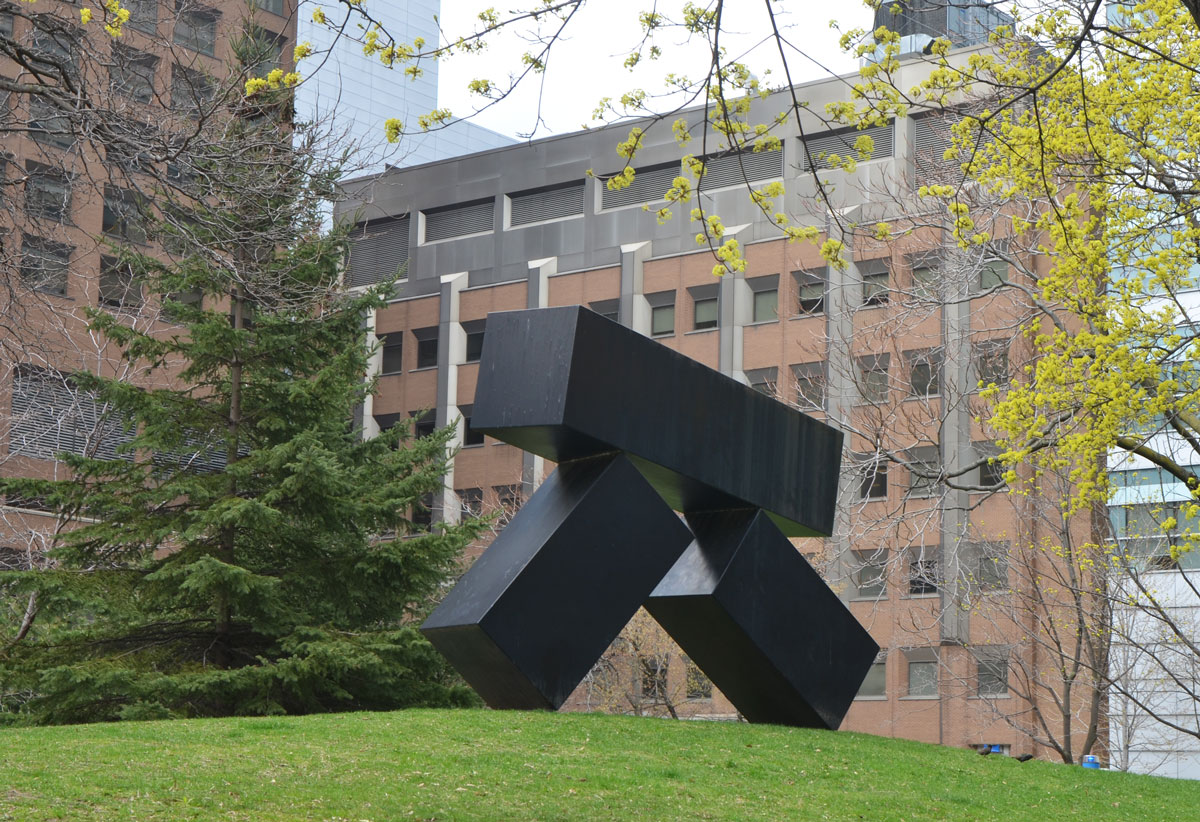
black metal sculpture of three boxes precariously balanced, the upper box is almost horizontal and it is being supported by the other two who are falling down but still balancing

below:  A blight on the sidewalk, so-called information pillars that are really just a sell-out to Astral Media.  They needlessly obstruct the sidewalk and obstruct the view of  cyclists and motorists.  Unfortunately they are part of a 20 year contract that the city has with Astral Media which doesn’t expire until 2027.
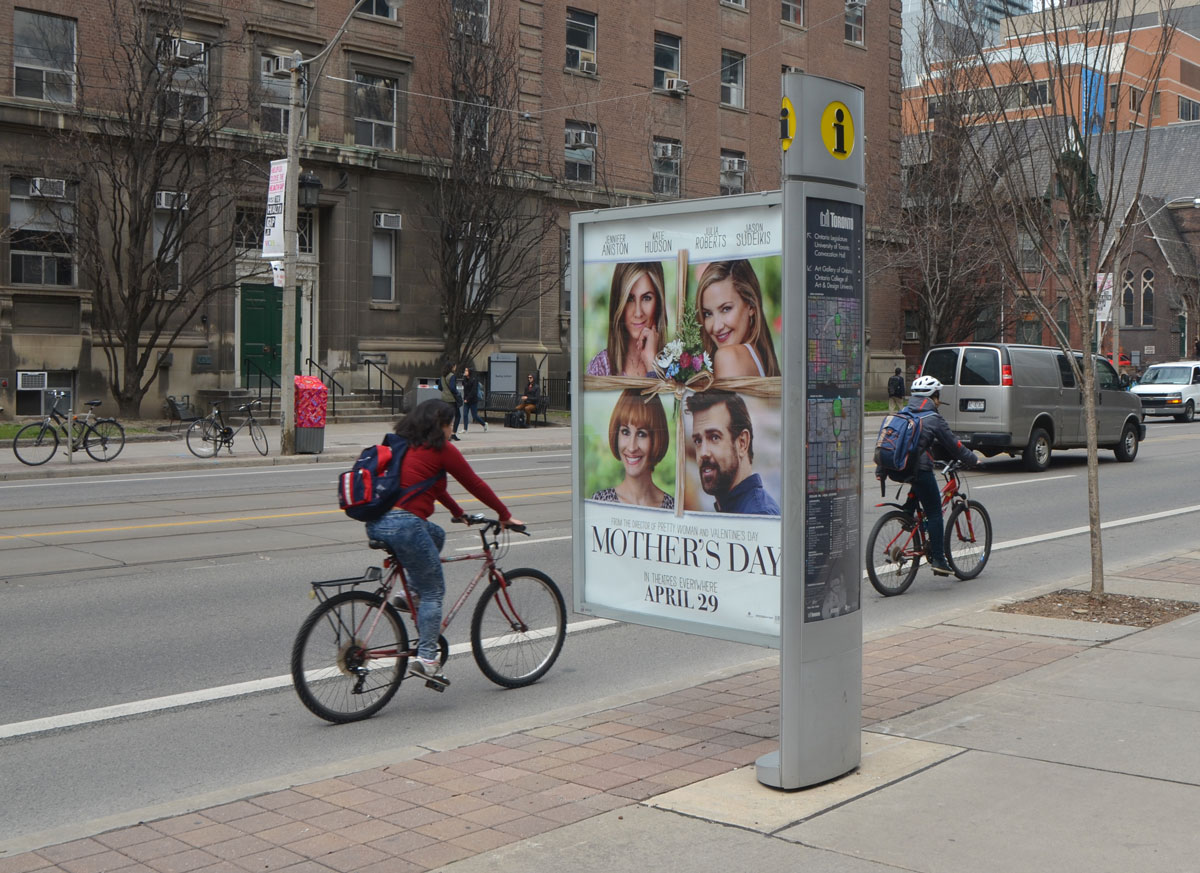
cyclists ride by an information pillar that has a large ad jutting out towards the street.

below: Incised into limestone blocks on the Edward Street side of McClelland House (originally the McLean Hunter building) is half of an artwork by Elizabeth Wynn Wood (1903 – 1966) called “Communication”.  The woman is sending a message to a man who is apparently shown on the other side of the building.  Sadly, I missed the man so there is no photograph of him here.  When the work was completed in 1958, the incised lines were inlayed with gold colour.

outline drawing of a woman floating in the sky, incised into limestone facade of a building. She is releasing a bird.

below: Across the street from the ‘floating woman’, 480 University Avenue is getting a facelift.
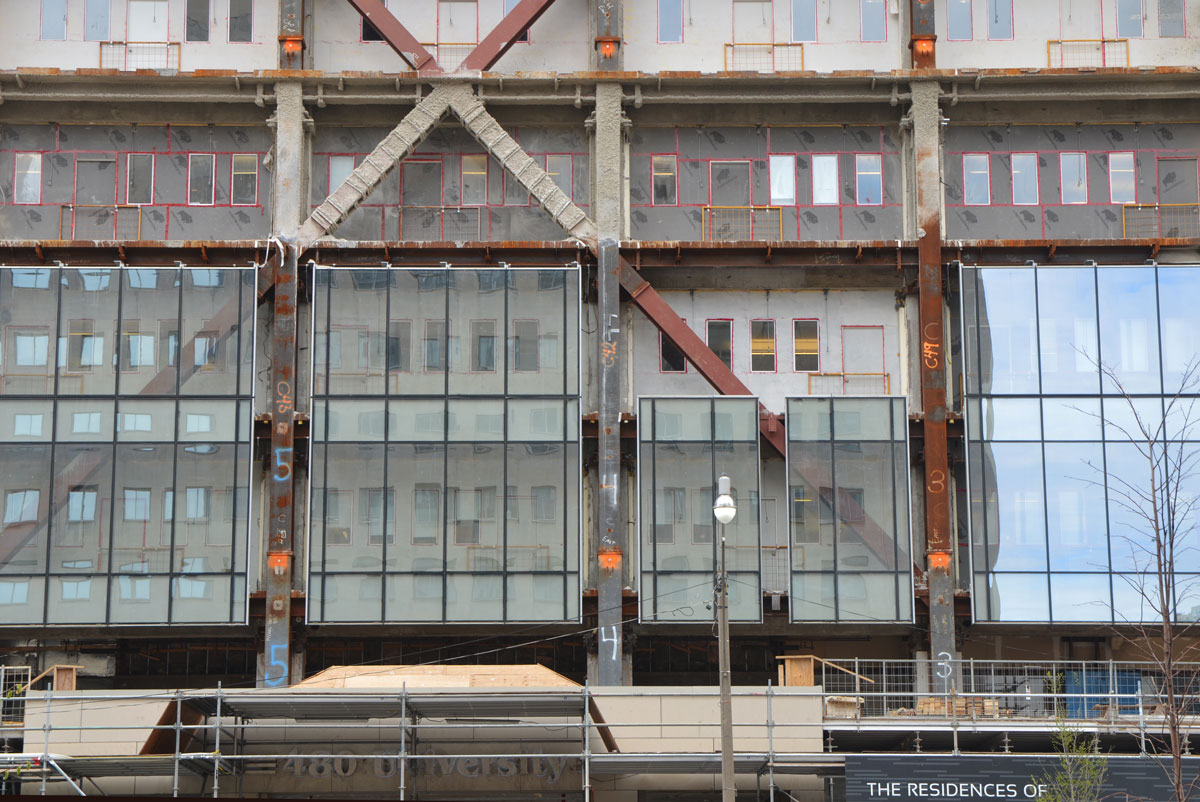
lower part of building have its facade upgraded to glass panels
below:  This picture shows most of the front of 480 University and you can see the different stages of the recladding process.  At the top of the building, the precast concrete grille that was part of the original 1968 Global House office tower is still in place while new glass panels have already been installed on the lower floors.   It is interesting to watch the metamorphosis of an 18 storey office building into a 55 storey condo tower.   Four levels of underground parking have also been added to the site and a new indoor entrance to St. Patrick subway station is in the works.
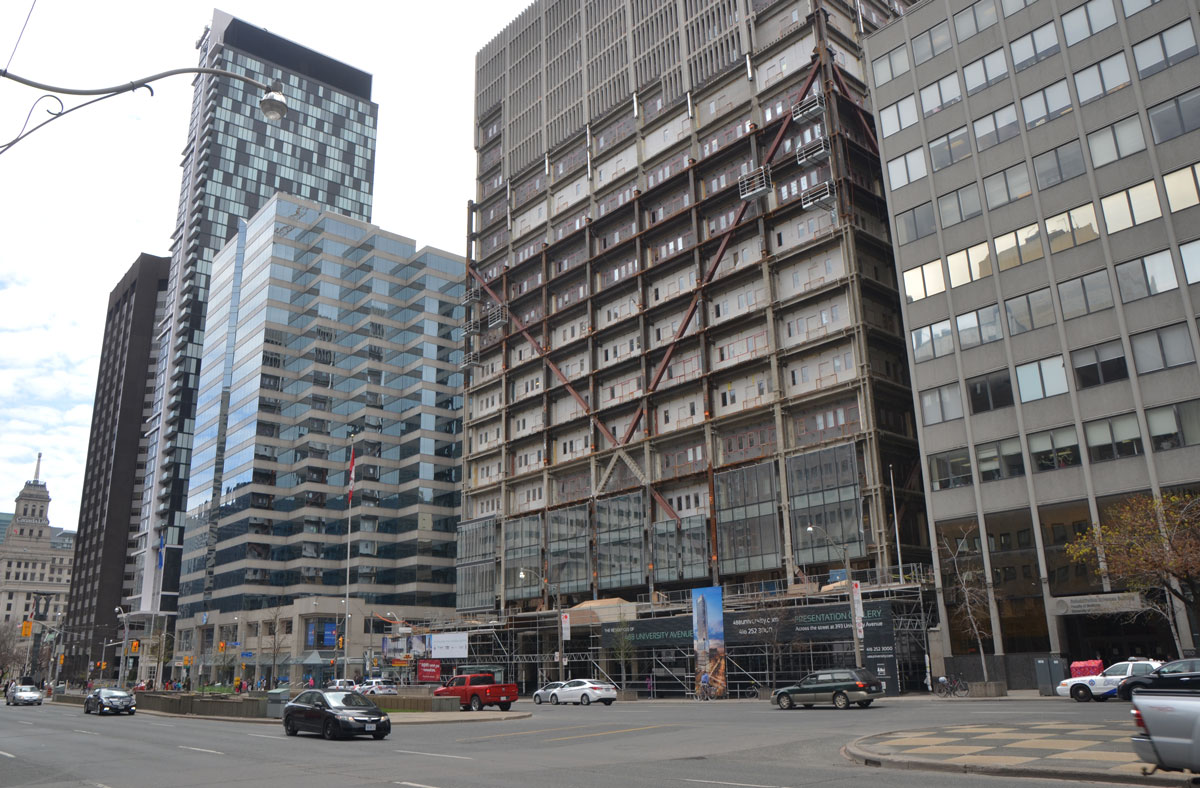
Tall office building is having its concrete facade replaced with glass. The upper floors are still concrete, the middle floors are bare and the lower floors have new glass

below: Abstract in blues and greys

very close detail shot of glass and reflections that make diamond shaped abstract in blue and grey

There is a lot of building and redevelopment in the area where I walked.

below: Womens College Hospital is totally new.
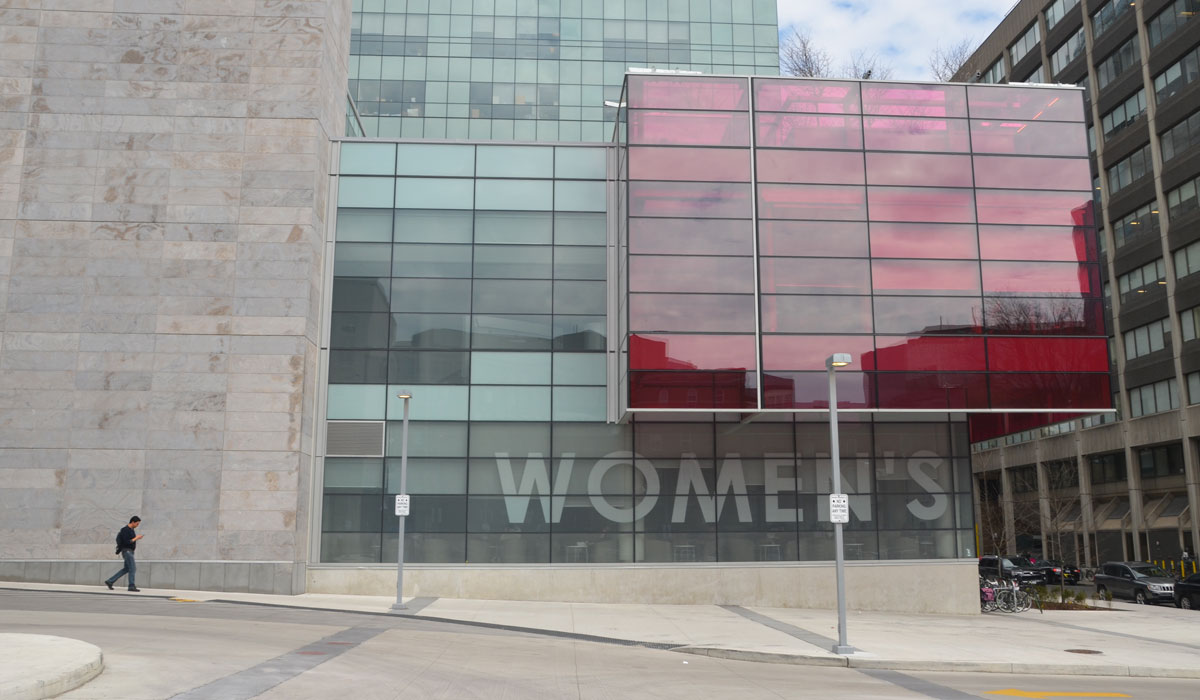
a lone man walks by the new Womens College Hospital building with its light grey stone facade, large glass section, and large pink glass section.

below: The corner of College and Bay, looking southeast, is now a wall of glass.

cyclist rides through the intersection of College and Bay streets. A wall of glass condos in the background.

below: The new wing of Sick Kids Hospital dwarfs the older buildings on Elm Street.
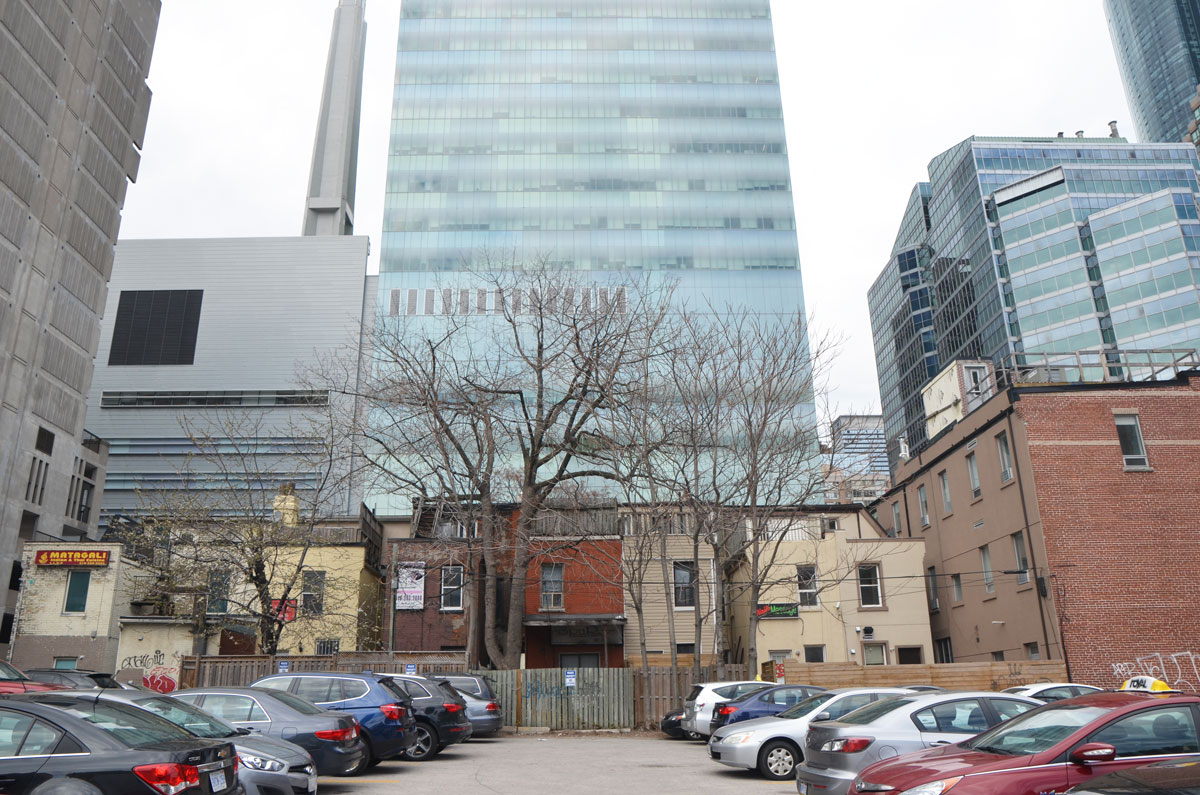
view from a parking lot, a row of the back of older two storey brick buildings with some mature trees, then taller modern glass buildings.

below:  The old and the new integrated into one building, Princess Margaret Hospital.
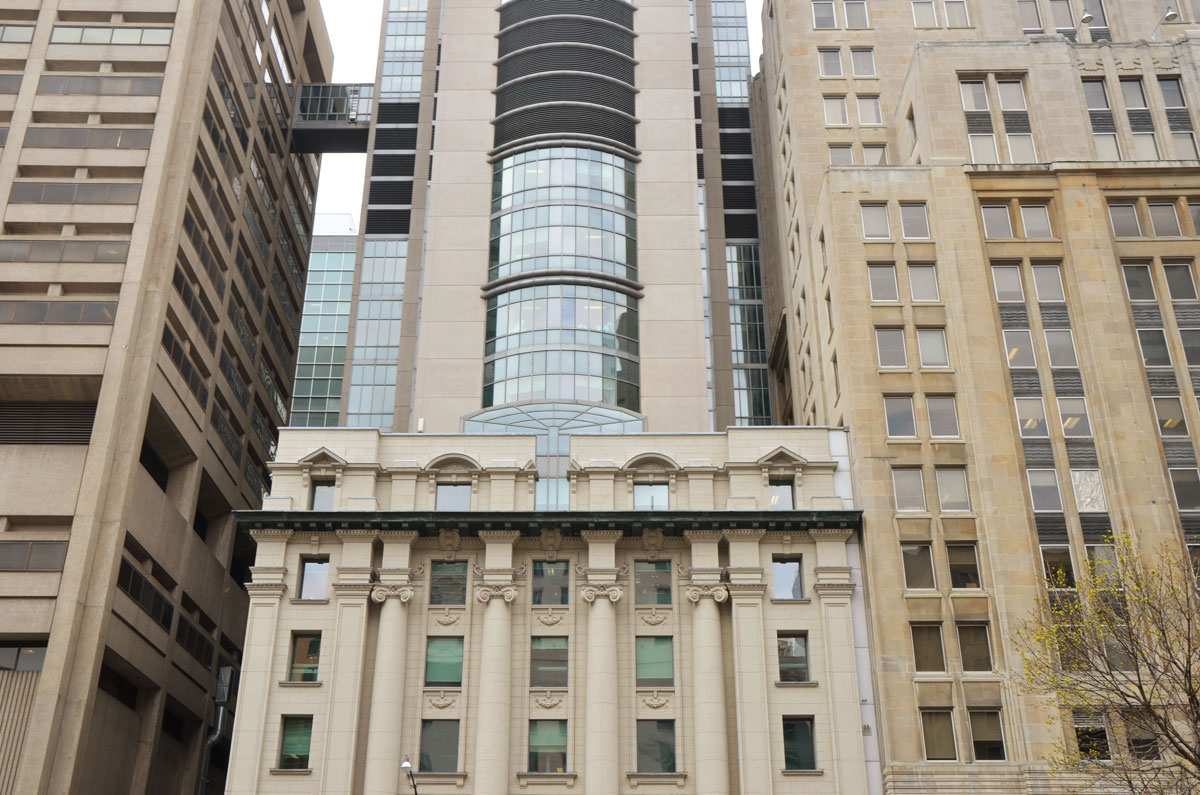
Princess Margaret Hospital, with the older stone building at the bottom, and the new modern addition above and beside it.

below: Even the street is being redone.  The center of Bay Street from Dundas to Elm is torn up because of  TTC streetcar track replacement.

A digger and other equipment working on a torn up section of Bay street.

below: Little quirky details:  First, the cross shapes made of contrasting brick on the back of the Red Cross building.  Second, the workings (or barrier?) of the compressed gas tanks that have been made to look like ice.
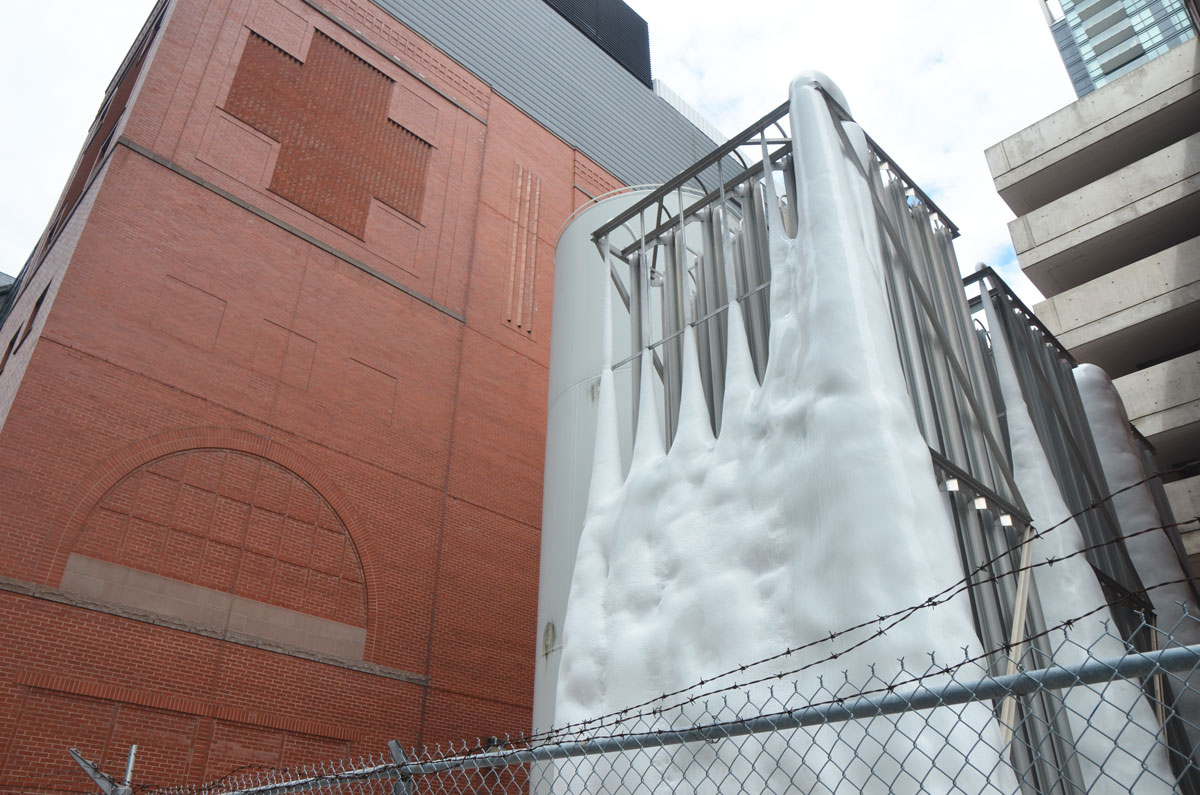
part of the addition that was added to the Red Cross building, two cross shaped features in contrasting brick on the upper levels. In front of that building are large compressed gas tanks.

below:  Another piece of public art, ‘Liquid Echo’ by Catherine Widgery, 1999, is in front of 750 Bay Street.  They look like stiff and lifeless frozen metallic fountains… or maybe just 12 pencils 🙂 .   Circular vent shafts for the underground parking have been incorporated into the artwork.

public art installation outside 750 Bay street

below: A  lovebot watches over the people passing through the bus station, unaware that he is there.
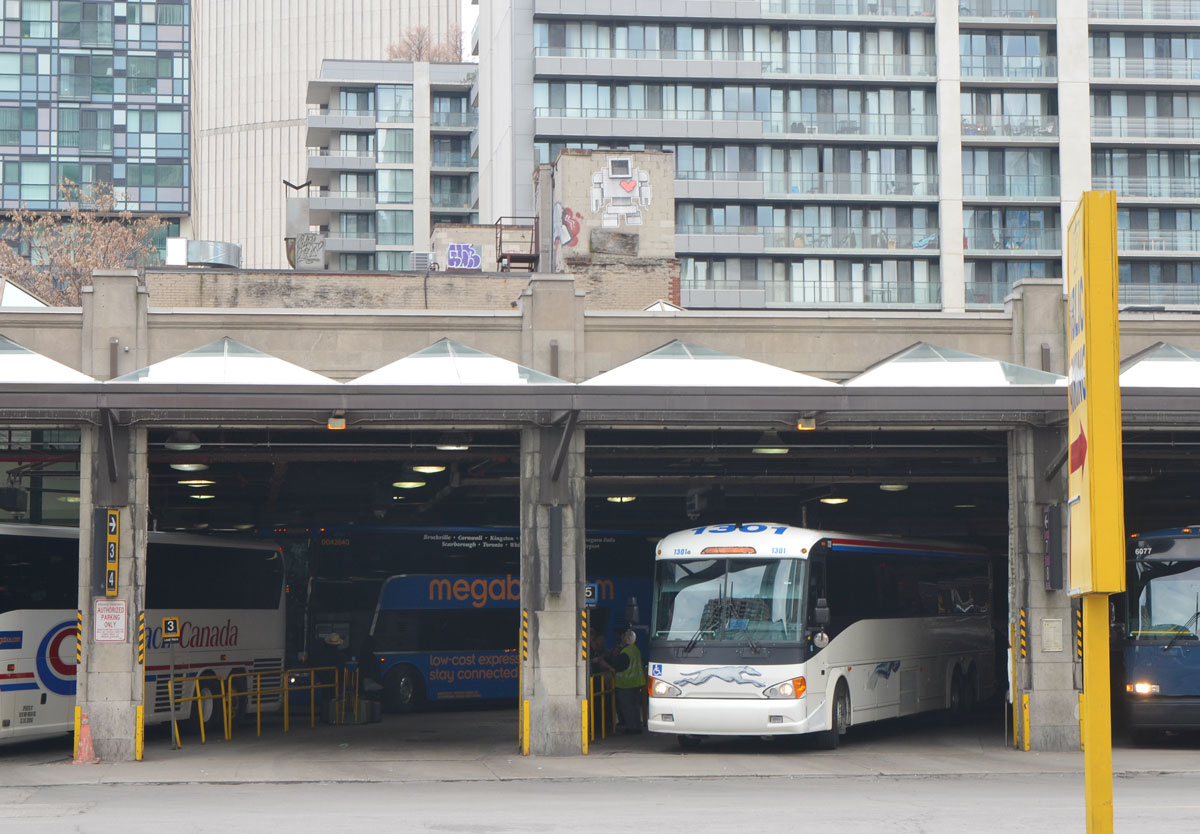
large lovebot wheatepaste paste up above the downtown Toronto bus terminal. A white bus is parked in one of the bus bays. Condos in the background.

below: And last, a colourful collection of squares and rectangles. Blue and green.  Red and white.

green and blue glass of a building's facade, with a storefront below. The windows of the store are filled with red and white pillows arranged in a grid.

The dapper, larger than life Alexander Wood has stood on his corner at Church and Alexander streets for 11years now.  The bronze statue by Del Newbigging was unveiled in May 2005.

Wood came to Upper Canada from Scotland and settled in Toronto (known as York at the time) in 1797.  He was a successful merchant, magistrate, and lieutenant in the York militia.  The plaque on the granite pedestal tells his story.


statue of Alexander Wood, a young man with long coat, and a hat in his hand. The statue is on a large square pedestal so his feet are close to eye level.  Below the statue is a plaque detailing his life as early settler of York, of being a gay, and of being involved in a scandal in 1810.

“Militia Officer, Businessman, Public Servant, Justice of the Peace, Gay Pioneer

Alexander Wood came to Canada in 1793, settled in York in 1797 and started a mercantile business, one of only three stores in York at that time. Within a year he was a lieutenant in the York Militia; he was appointed magistrate in 1800 and by 1805 was a Commissioner for the Court of Requests (a senior planning officer). He was involved in a homophobic scandal in 1810 and fled to Scotland, but in two years he was back in Canada and resumed his duties. In spite of ridicule and discrimination he had a successful career in public service: he was on the executive of nearly every society in York, often as treasurer; he was manager of several businesses and acted for clients in land transactions. Wood died in 1844 at the age of seventy-two while in Scotland. The British Colonist paper called him one of Toronto’s ‘most respected inhabitants’.”

***

There is another bronze plaque on the back of the pedestal, complete with shiny bits.  This plaque adds more details to the story of the 1810 scandal that Wood got himself into.

plaques on a statue. The top is of a man with his pants lowered, the bottom is the story of the scandal that led to Alexander Wood having to leave Canada.  The bare bum on the plaque is shiny from repeated rubbing by passers by.

“1810 The Scandal
In 1810 a woman reporting a rape to Magistrate Wood said she had scratched her rapist. Wood inspected several suspects privately, requiring them to undress. To avoid the scandal caused by his unconventional behaviour, Wood fled to Scotland. After two years he returned to Canada but suffered ridicule and discrimination for the rest of his life.

Alexander Wood 1772-1844
Militia Officer, Businessman, Public Servant, Justice of the Peace, Gay Pioneer”

***

In 1810, word had spread quickly around the town (of 700) and Wood had become known as the “Inspector General of Private Accounts”.    The worst of the scandal blew over while Wood was in Scotland; he was back in York in 1812 and resumed all his previous occupations, including magistrate. At that time, “molly’ was a derogatory word for a gay man and he was nicknamed Molly Wood.

In 1826 he purchased 50 acres of land east of Yonge St. and north of Carlton St. in the neighbourhood where his statue now stands.  It is also the “Village”.  In Wood’s time it was referred to as ‘Molly Wood’s Bush’.  Wood remained in Toronto until 1842 at which time he returned again to Scotland where he died two years later.

‘Current Studies’ and ‘Paper Planes’
Two different series of photographs by Sjoerd Knibbeler
Allan Lambert Galleria, Brookfield Place

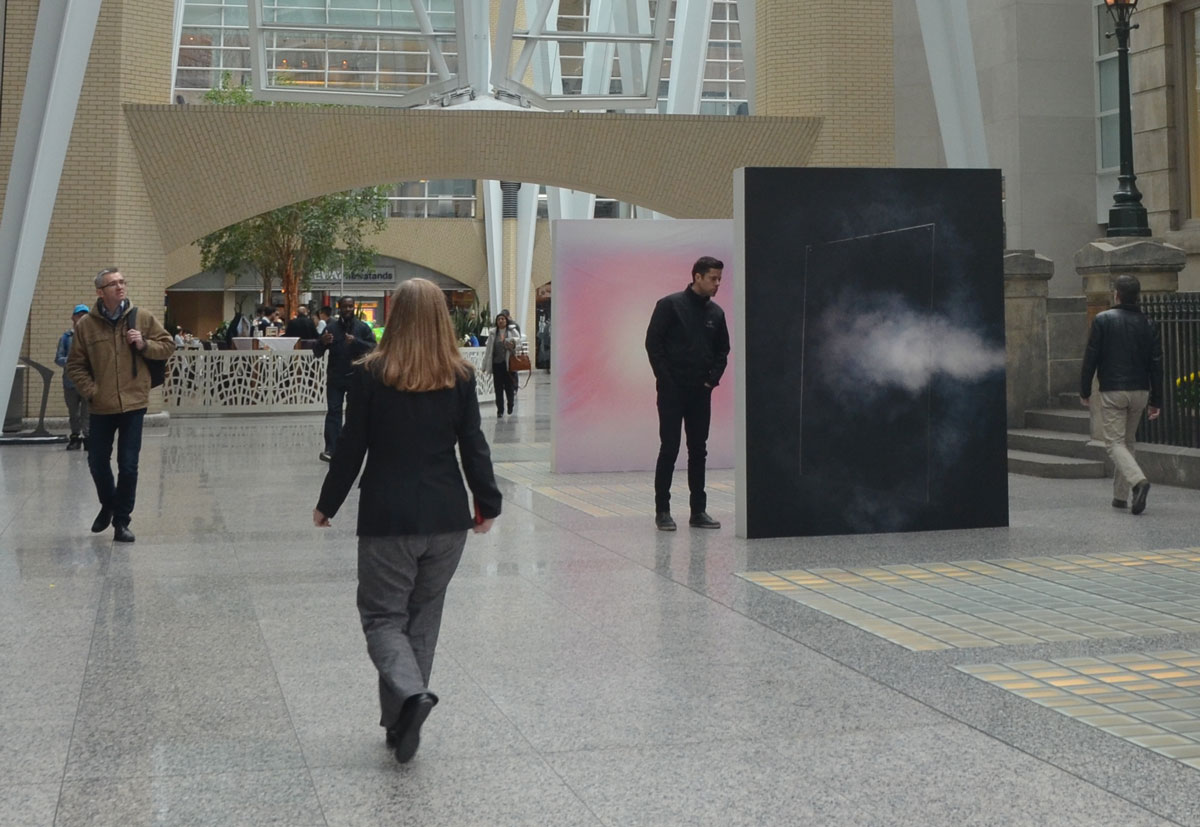
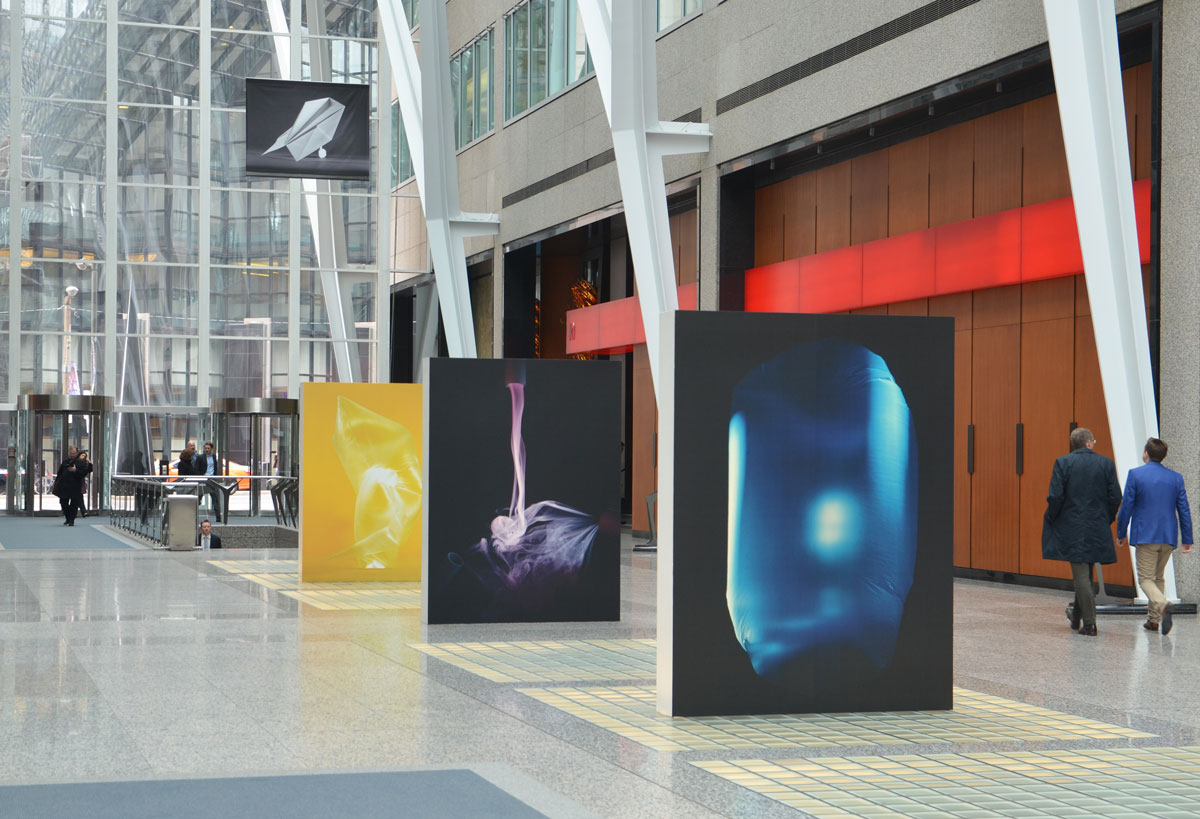
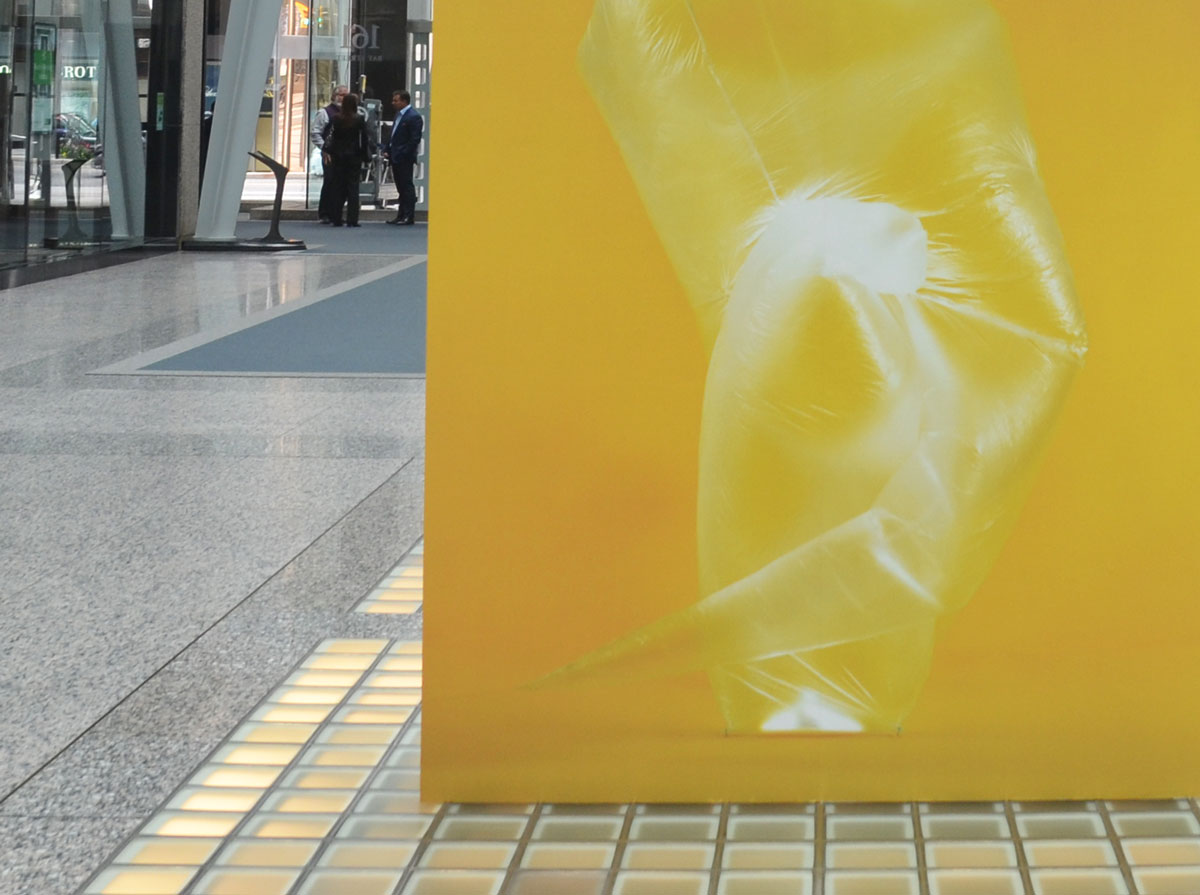
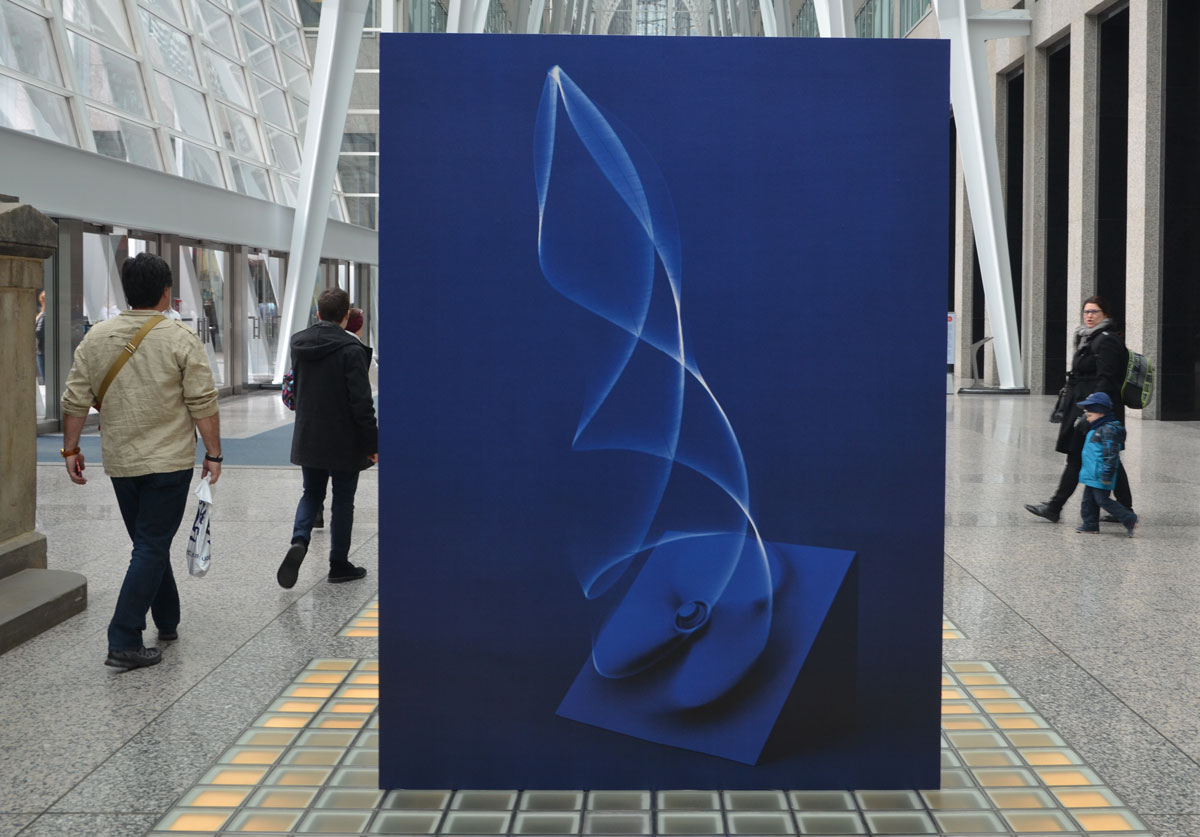
At ground level there are six large freestanding ‘walls” arranged in line, three at each end of the atrium.    Each ‘wall’ is covered by two images, one on either side.  They are photographs that are the result of Knibbeler’s experiments to “ shape, encompass, and capture air currents.”  This is the ‘Current Studies’ part of the installation.
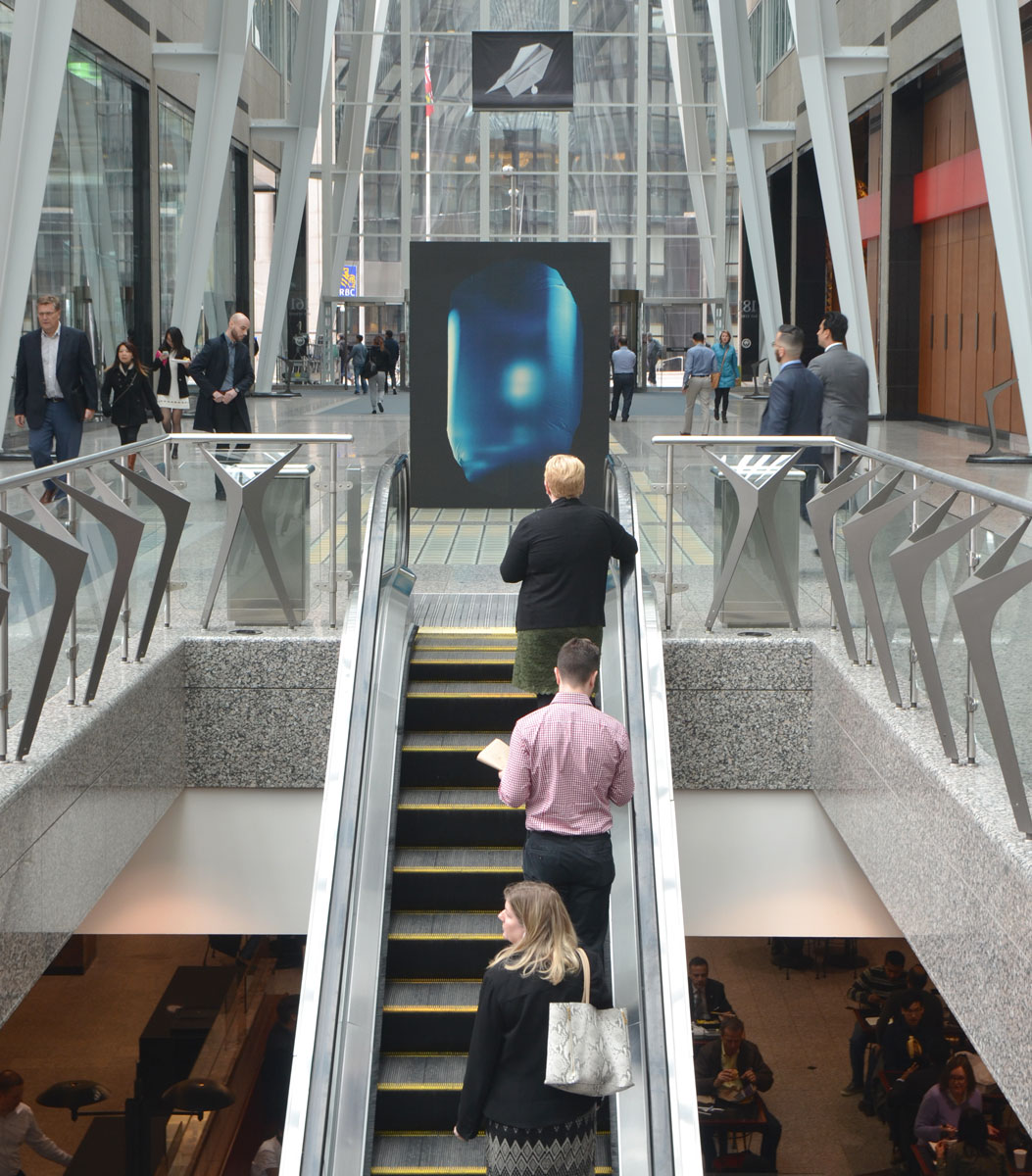
A picture taken inside the Allan Lambert Gallery at Brookfield Place, photos by Sjoerd Knibbeler, a series called Current Study large pictures standing in the middle of the gallery, as well as series called "Paper Planes" which are hung from the ceiling

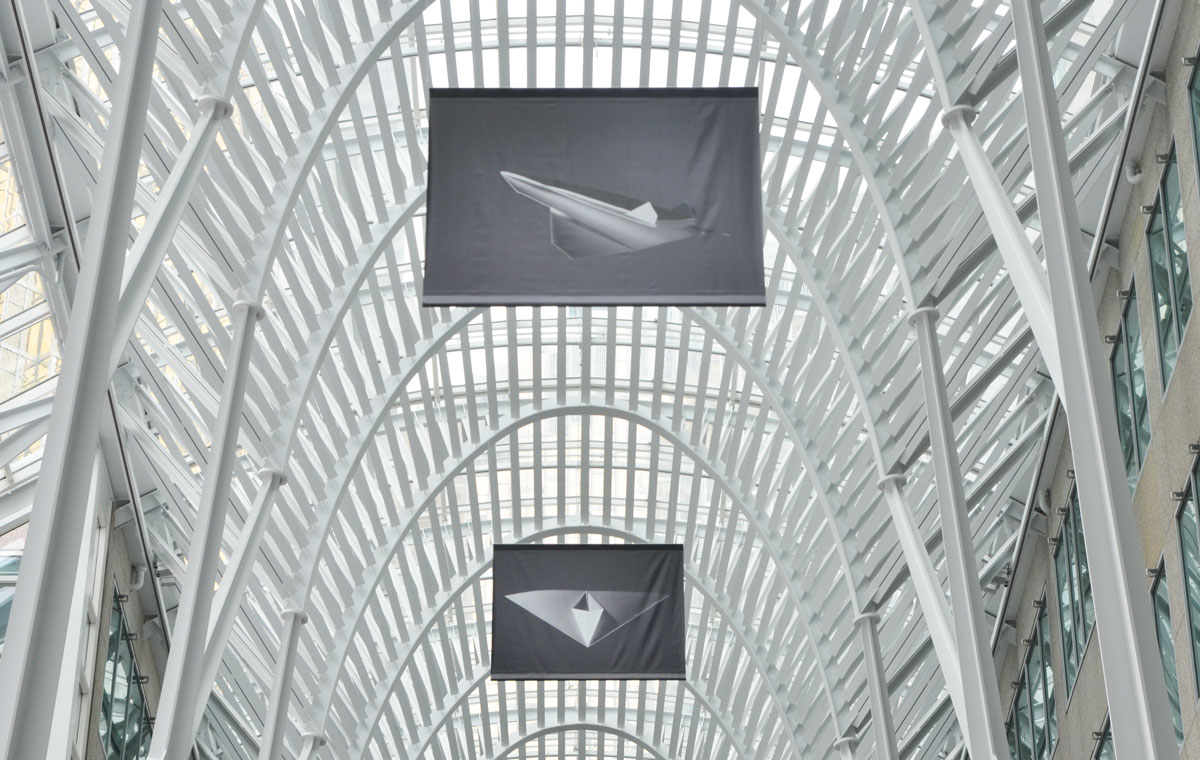
Suspended from the ceiling are a set of photographs of paper airplanes, the ‘Paper Planes’ part of the installation.    Knibbeler photographed paper airplanes that he made using information that he found online.  He chose military planes that were never produced.

A picture taken inside the Allan Lambert Gallery at Brookfield Place, photos by Sjoerd Knibbeler, a series called Current Study large pictures standing in the middle of the gallery, as well as series called "Paper Planes" which are hung from the ceiling

A picture taken inside the Allan Lambert Gallery at Brookfield Place, photos by Sjoerd Knibbeler, a series called Current Study large pictures standing in the middle of the gallery, as well as series called "Paper Planes" which are hung from the ceiling

A picture taken inside the Allan Lambert Gallery at Brookfield Place, photos by Sjoerd Knibbeler, a series called Current Study large pictures standing in the middle of the gallery, as well as series called "Paper Planes" which are hung from the ceiling

A picture taken inside the Allan Lambert Gallery at Brookfield Place, photos by Sjoerd Knibbeler, a series called Current Study large pictures standing in the middle of the gallery, as well as series called "Paper Planes" which are hung from the ceiling

A picture taken inside the Allan Lambert Gallery at Brookfield Place, photos by Sjoerd Knibbeler, a series called Current Study large pictures standing in the middle of the gallery, as well as series called "Paper Planes" which are hung from the ceiling

A picture taken inside the Allan Lambert Gallery at Brookfield Place, photos by Sjoerd Knibbeler, a series called Current Study large pictures standing in the middle of the gallery, as well as series called "Paper Planes" which are hung from the ceiling

A picture taken inside the Allan Lambert Gallery at Brookfield Place, photos by Sjoerd Knibbeler, a series called Current Study large pictures standing in the middle of the gallery, as well as series called "Paper Planes" which are hung from the ceiling

A picture taken inside the Allan Lambert Gallery at Brookfield Place, photos by Sjoerd Knibbeler, a series called Current Study large pictures standing in the middle of the gallery, as well as series called "Paper Planes" which are hung from the ceiling

#CONTACT16

May 1, May Day, International Workers Day
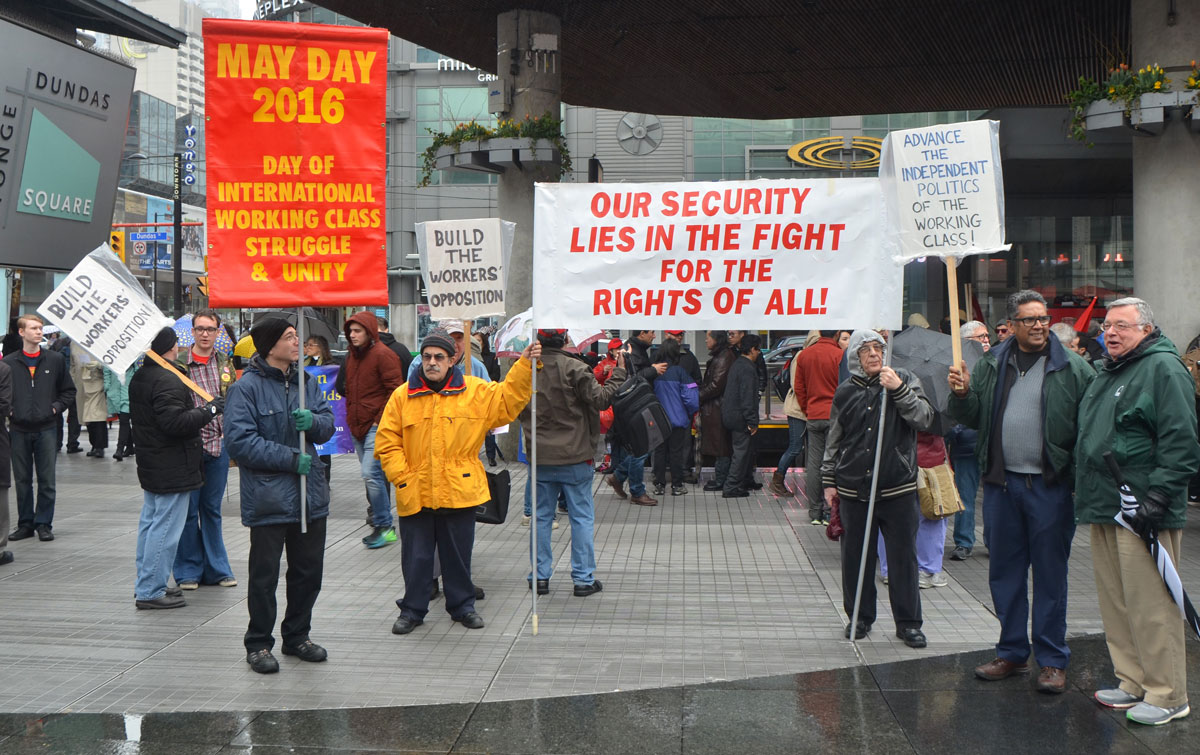
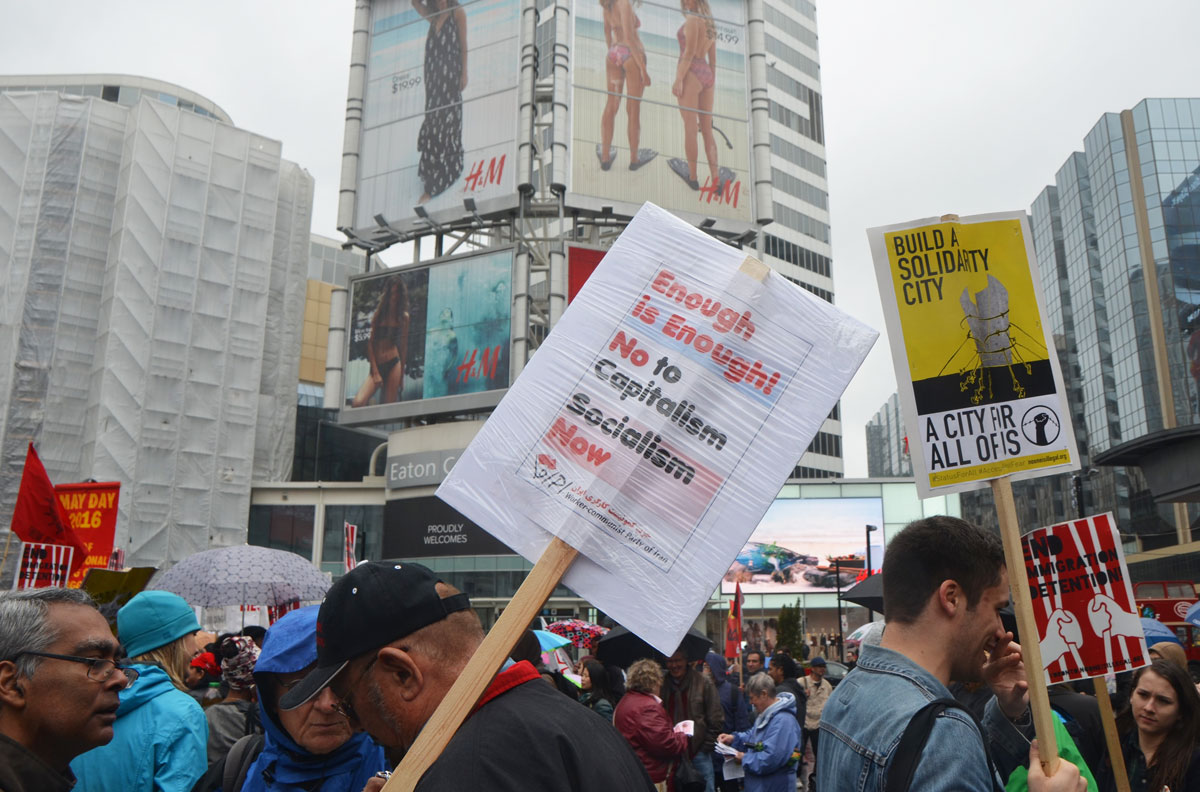
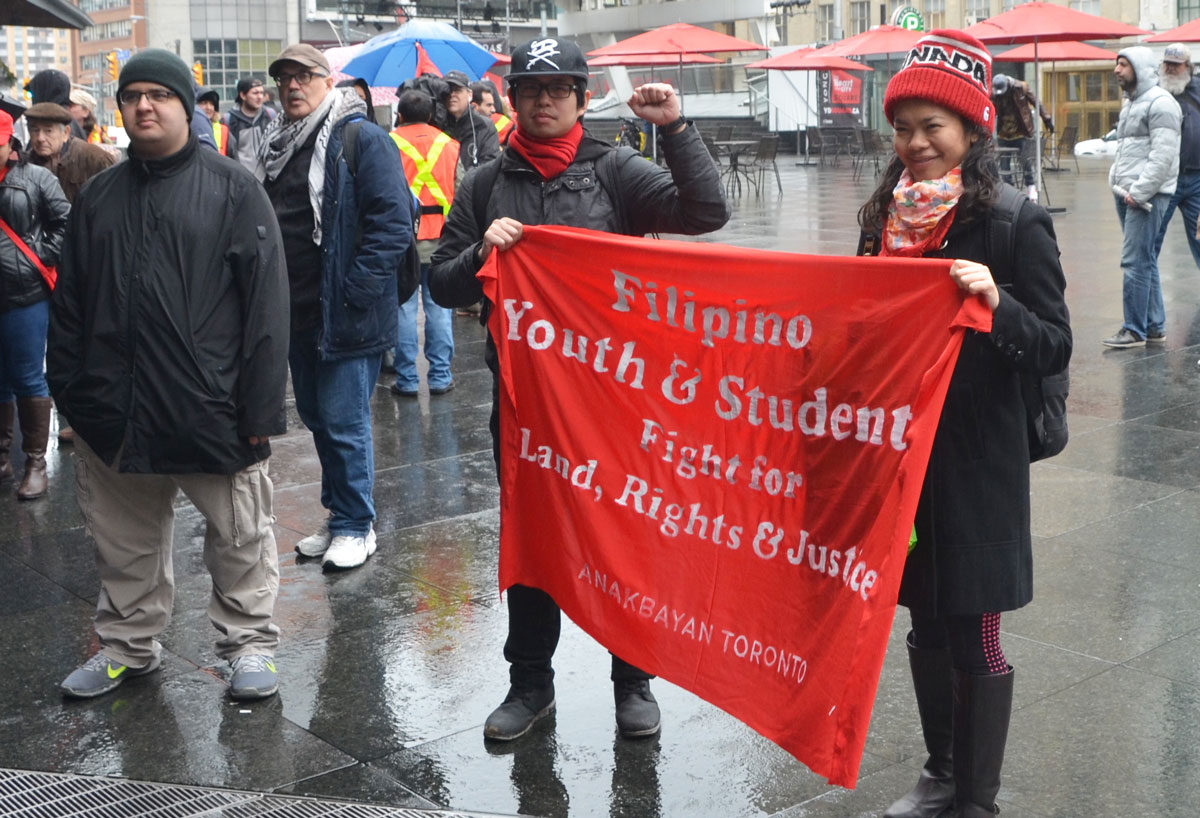
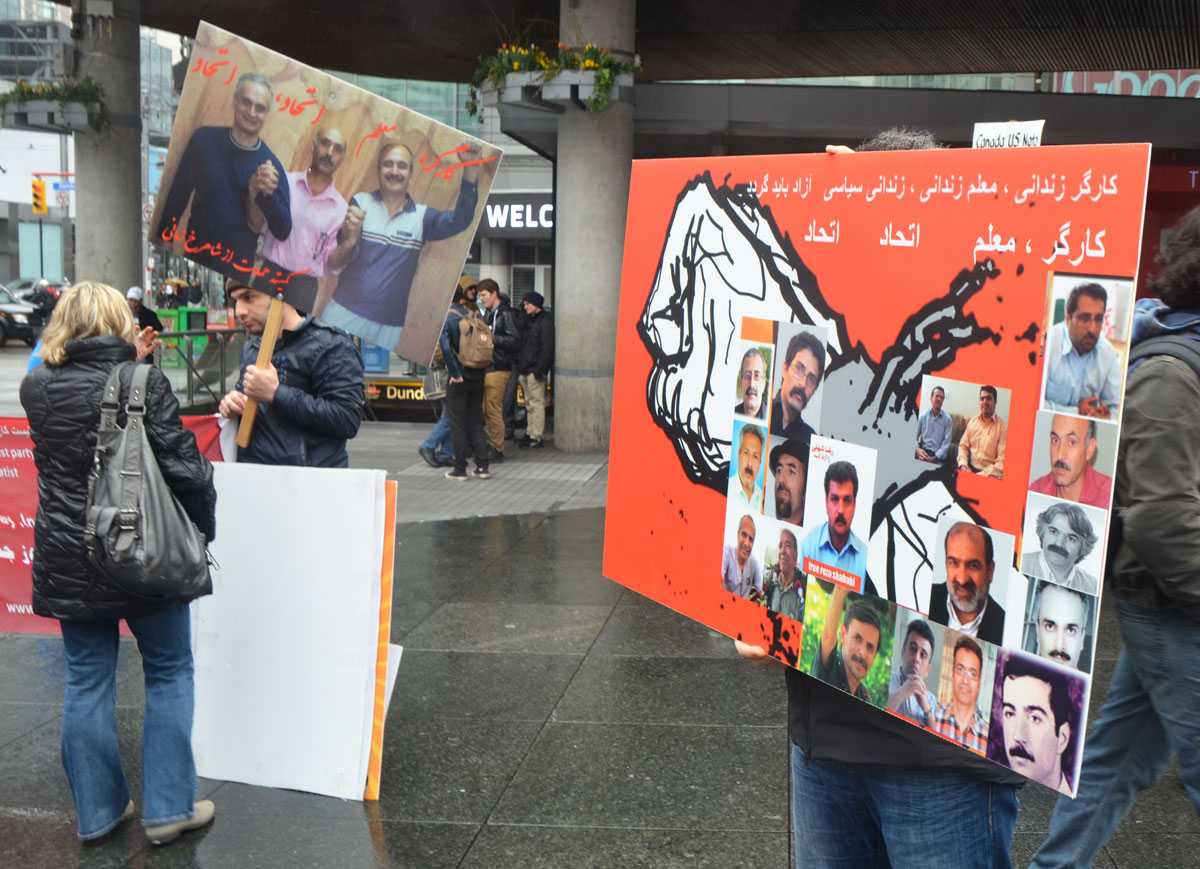
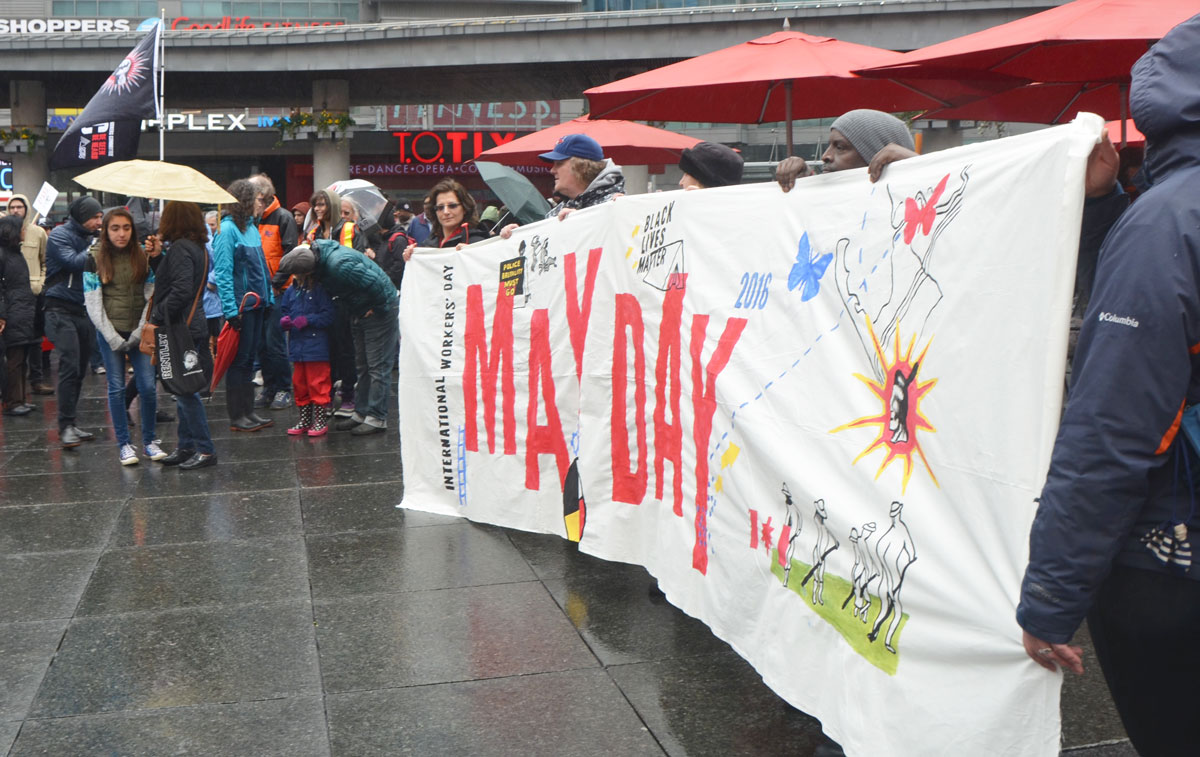
To mark the day, there was a rally at Yonge Dundas Square.
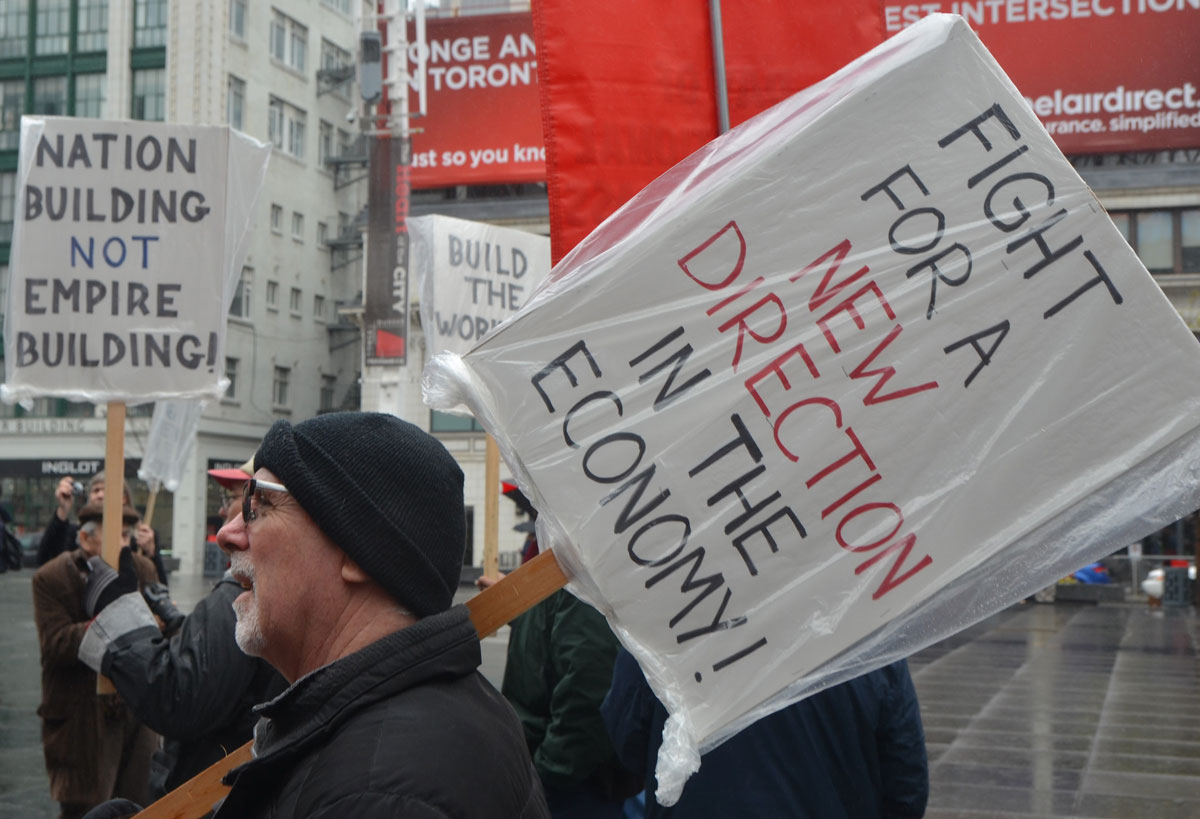
The wet afternoon didn’t dampen the spirits of those who were there with their placards and banners.

May day, International Workers Day rally at Dundas Square on a rainy day -

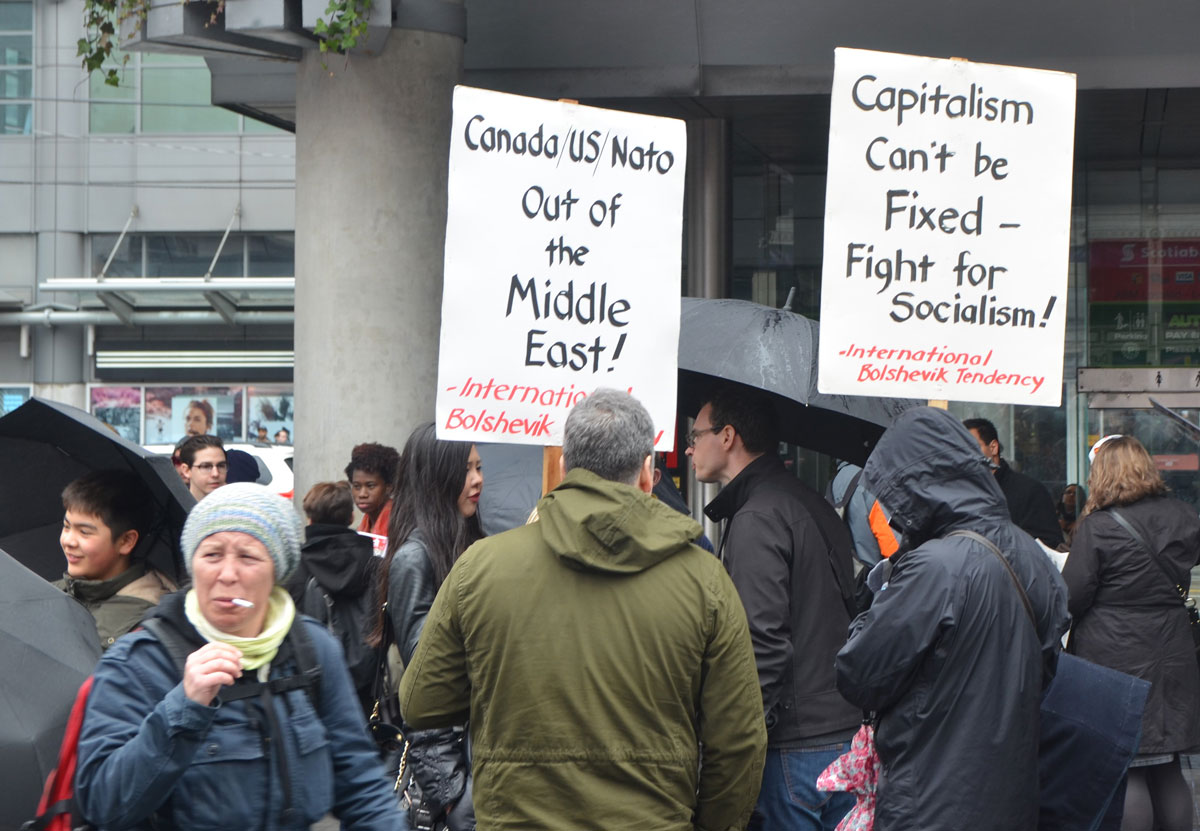
Two men holding placards at a rally. One says "Canada US NATO out of the Middle East" and the other says "Capitalism Can't be fixed - Fight for Socialism" , both are from the International Bolshevik Tendency - May day, International Workers Day rally at Dundas Square on a rainy day -

A man holds a placard that says "Enough is enough, No to Capitalism, Socialism now"May day, International Workers Day rally at Dundas Square on a rainy day -

A group of people holding a large rad and white banner with most of the words written in Arabic and English. The English part says "Long Live May Day. Workers of all countries unite"

An older man holds one end of a red banner for the Communist Party of Canada while a young man holds the other end - May day, International Workers Day rally at Dundas Square on a rainy day -

Two students hold a red banner for the Filipino Youth and Students fight for land, rights and justice - May day, International Workers Day rally at Dundas Square on a rainy day -

May day, International Workers Day rally at Dundas Square on a rainy day -

A man holds up a sign written in Arabic about men missing I think. It is red with a picture of a fist on it. On the fist are glued pictures of 16 men . Also in the picture, a man holding a placard with a photo of three men on it, talks to a woman whose back is to the camera.

from under the photographer's umbrella, a scene of people with protest signs - May day, International Workers Day rally at Dundas Square on a rainy day -

A young man is giving out placards at a rally - May day, International Workers Day rally at Dundas Square on a rainy day -

A group of women standing behind and holding up a large white banner for May Day - May day, International Workers Day rally at Dundas Square on a rainy day -

A man holds a sign that says "Time for a new direction in the economy" - May day, International Workers Day rally at Dundas Square on a rainy day -

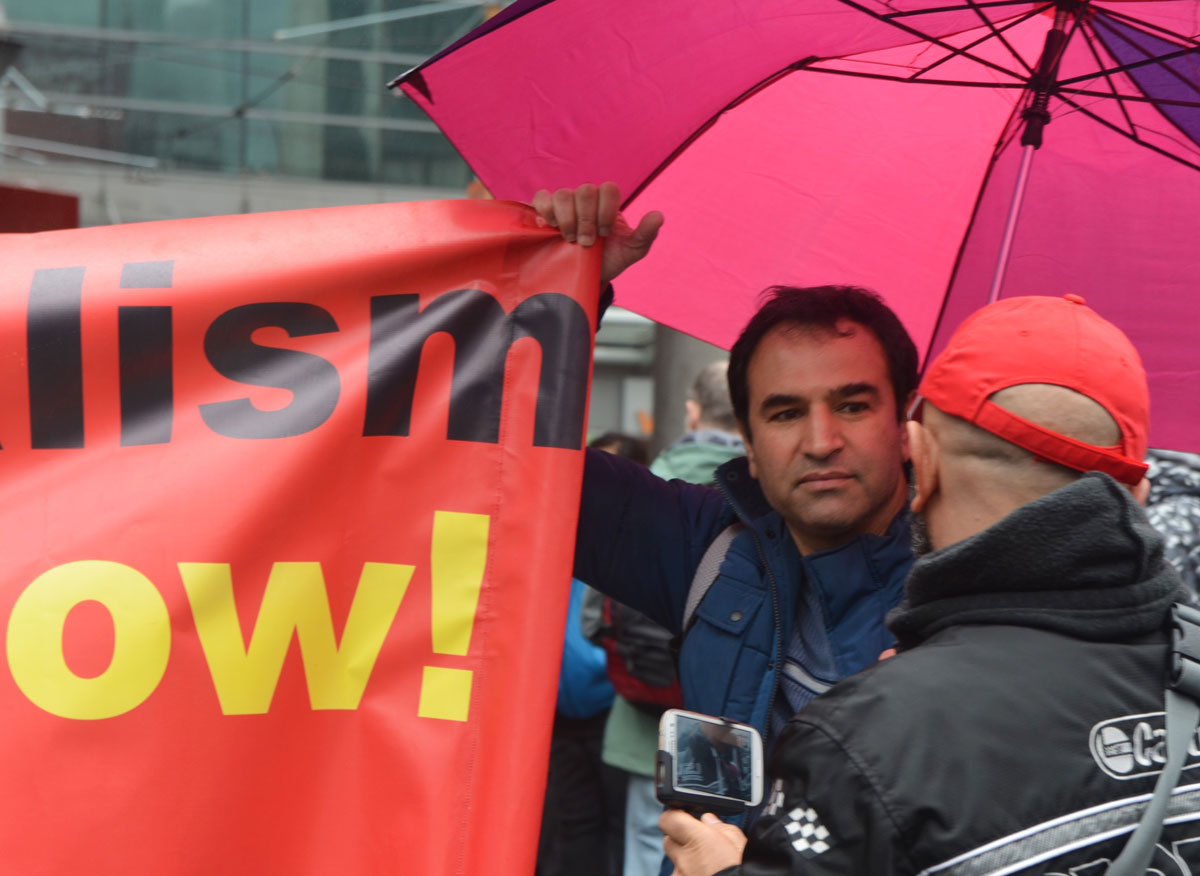
A man under a pink umbrella talks to a man whose back is to the camera - May day, International Workers Day rally at Dundas Square on a rainy day -

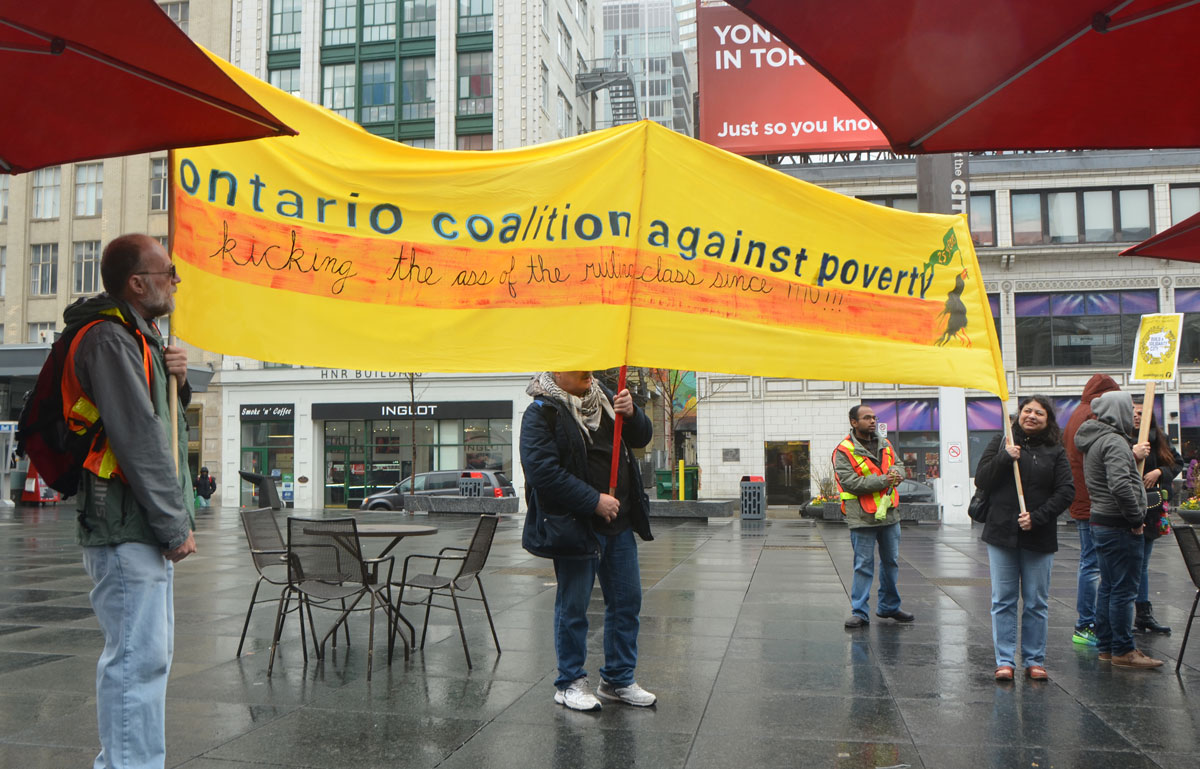
Three people hold a large yellow banner for the Ontario Coalition Against Poverty - May day, International Workers Day rally at Dundas Square on a rainy day -

a bundle of small OCAP placard signs sit on a chair - May day, International Workers Day rally at Dundas Square on a rainy day -

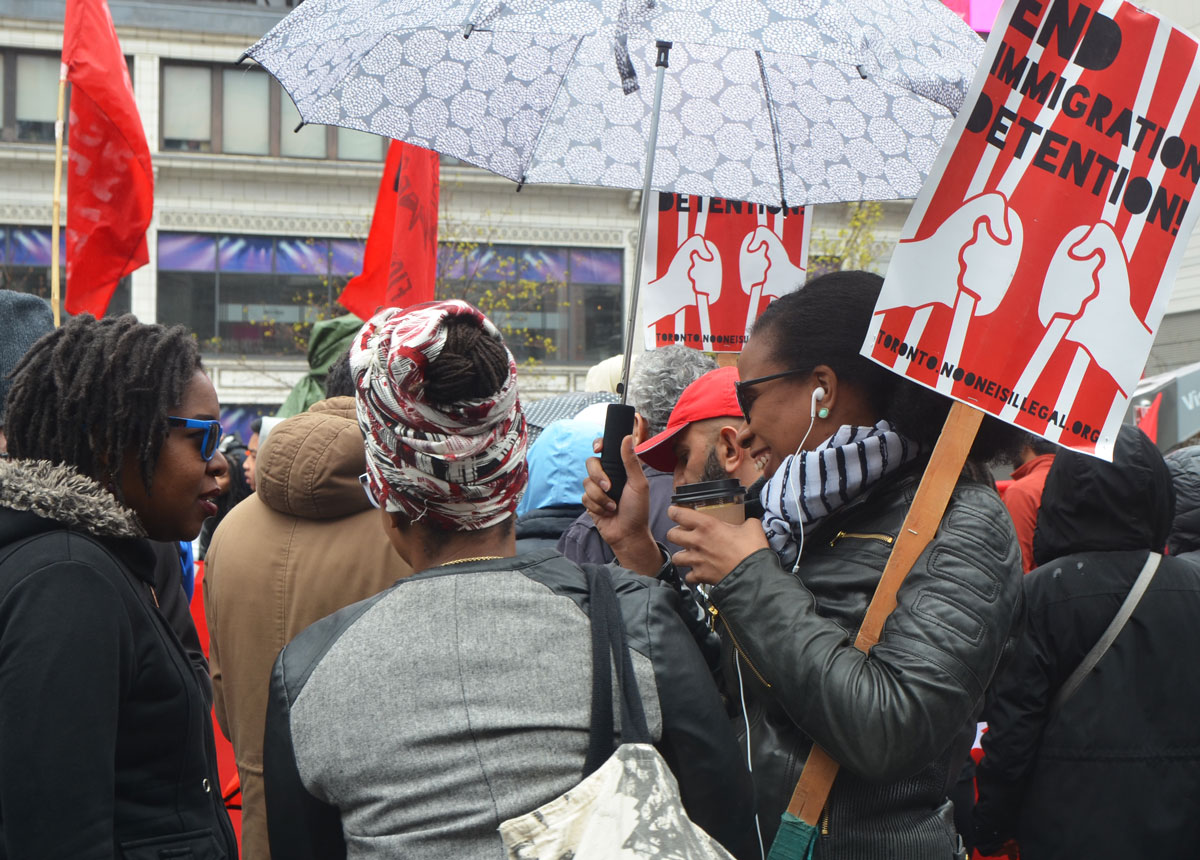
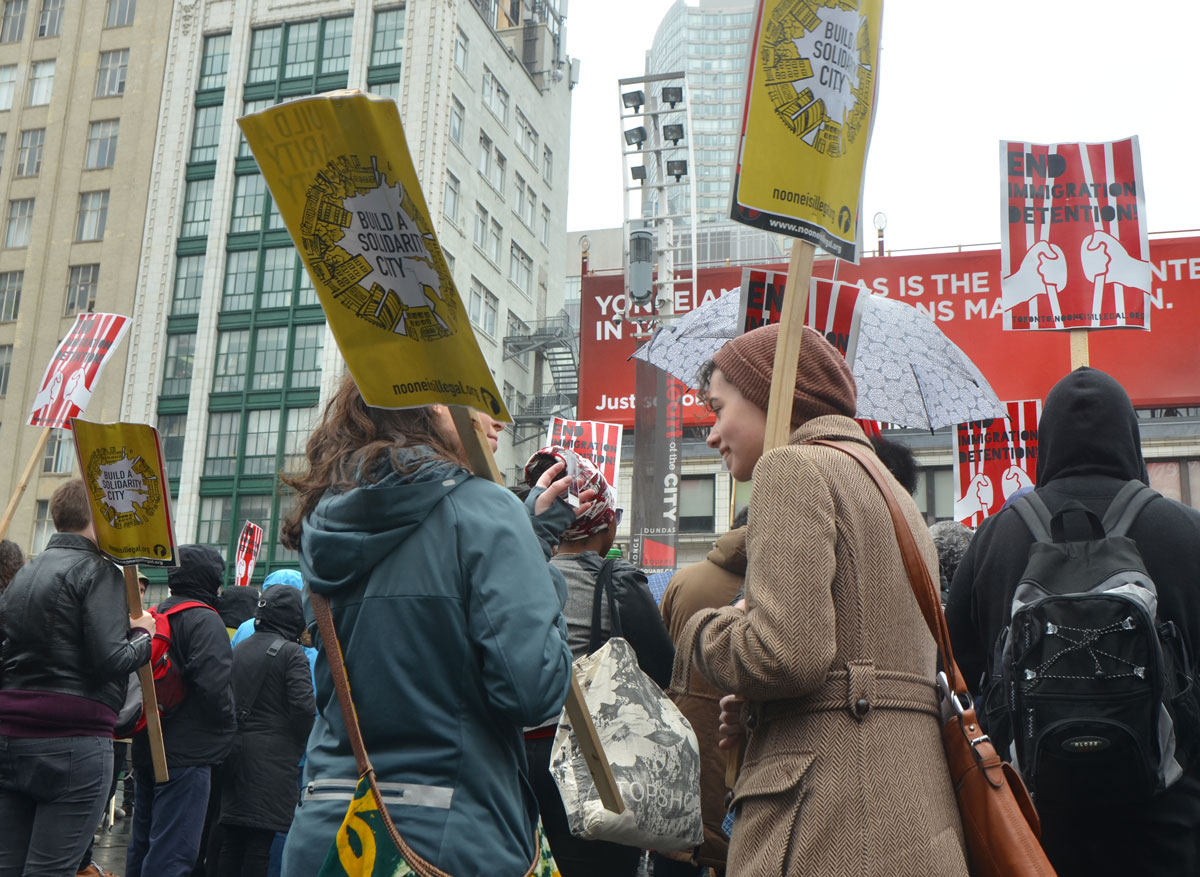
women talking and laughing together at a rally, holding placards that say "End Immigration Detention " and also holding umbrellas

women talking and laughing together at a rally, holding placards that say "Build a Solidarity City"

May day, International Workers Day rally at Dundas Square on a rainy day - a man holds his fist in the air as he stands beside a banner

As I was walking across Queen Street West a couple of days ago, I saw a pink sparkly tribute to the musician Prince who died recently.   In 1993 while having contract problems with Warner Brothers, Prince changed his stage name to this symbol.  It became known as the Love Symbol although he was more regularly referred to as ‘The Artist Formerly Known as Prince’ for the next seven years.

A large pink painting on a sidewalk, a symbol used by the singer Prince. The painting is a memorial to him. His dates are given 1958 to 2016.

A few feet away, at the corner of Queen and Spadina I found the artist busy on another painting.  Victor, as in #whatsvictorupto, was in the middle of painting a blue and purple unicorn with pink glitter too.  I asked him if there was any significance to the unicorn.  He said that this was going to be his ‘Year of the Unicorn’.  He also mentioned that he already painted a few unicorns….

A man is painting a glittery pink and purple unicorn picture on the sidewalk as people pass by on Queen Street in Toronto

below: The finished painting

A blue and purple painting of a unicorn with pink glitter added to it too. Painted by Victor and signed as #whatsvictorupto

below: So far I have found two other unicorns.  First, this slightly faded unicorn on a four leaf clover is painted outside the Black Irish pub on Queen Street East at Sherbourne.

A unicorn in green, blue and black painted on a green four leaf clover by #whatsvictorupto The word Kelsey is also beside the painting

below:   Second, a unicorn on the sidewalk in front of Sick Kids Hospital

A blue and gold unicorn head painted in a red heart on a sidewalk, by Victor of What's victor up to.

below: A little bit of fun – it seems that a lot of people have uploaded their pictures of the  Prince painting to instagram in the past day or two!

a screenshot of a cellphone, pictures of the pink Prince symbol that different people have added to instagram

If I see any more unicorns I’ll let you know!

May is photography month in Toronto.  It is the month when there are numerous exhibits in public spaces and in galleries, all part of the CONTACT Photography Festival.   Over the next few weeks I hope to visit many of the exhibits and blog about some of them.   From past experience I have discovered that a lot of the public installations appear before May 1st so I went exploring yesterday.

below: Looking south from Spadina and Adelaide….  Partially obscured by a building, on the right in this photo, is the first large black and white photo that I saw.

view from the NE corner of Spadina and Richmond streets. a small parking lot is directly across the street, two large billboards loom over the lot. Once is for Lorne's coats showing two people wearing coats. The other is for Maple flavoured iced capp at Tim Hortons.

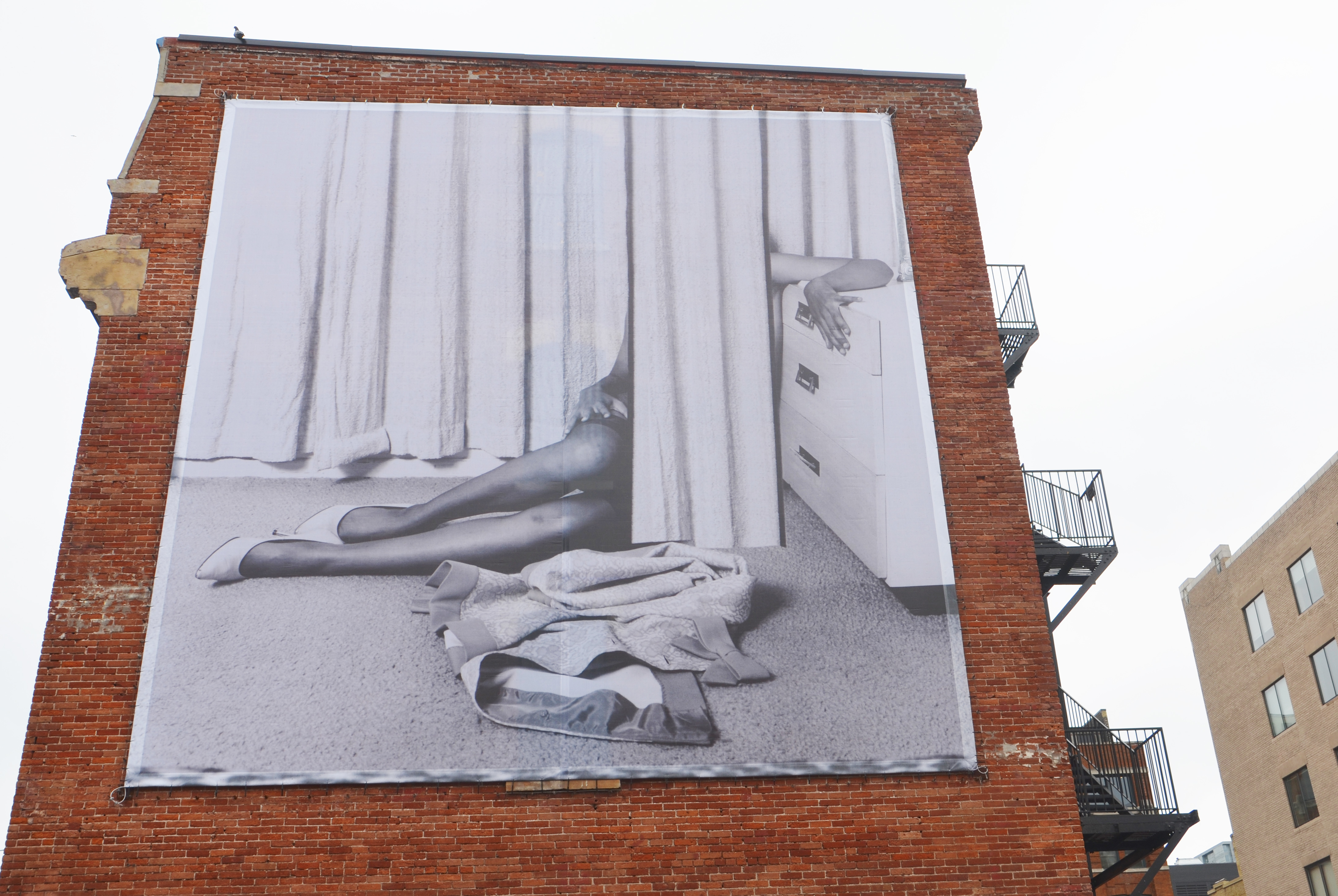
below: Up close,  ‘Drape’ by Eva Stenram.  Stenram has taken a 1960’s pin-up photograph of a woman and manipulated it.  She has brought the background, the drapery, forward and has covered up the original subject in the picture.

large black and white photo by Eva Strenram called 'Drape'. It is mounted on the upper level of a three storey red brick building. It shows a woman sitting on the floor partially obscured by drapery. Her upper body and head can not be seen.

below: Looking west on Wellington from Spadina.  The light grey building is the Old Press Hall (Globe and Mail) which will be demolished in the near future.

looking down the street past parked cars. A large black and white photo is on the side of the building.

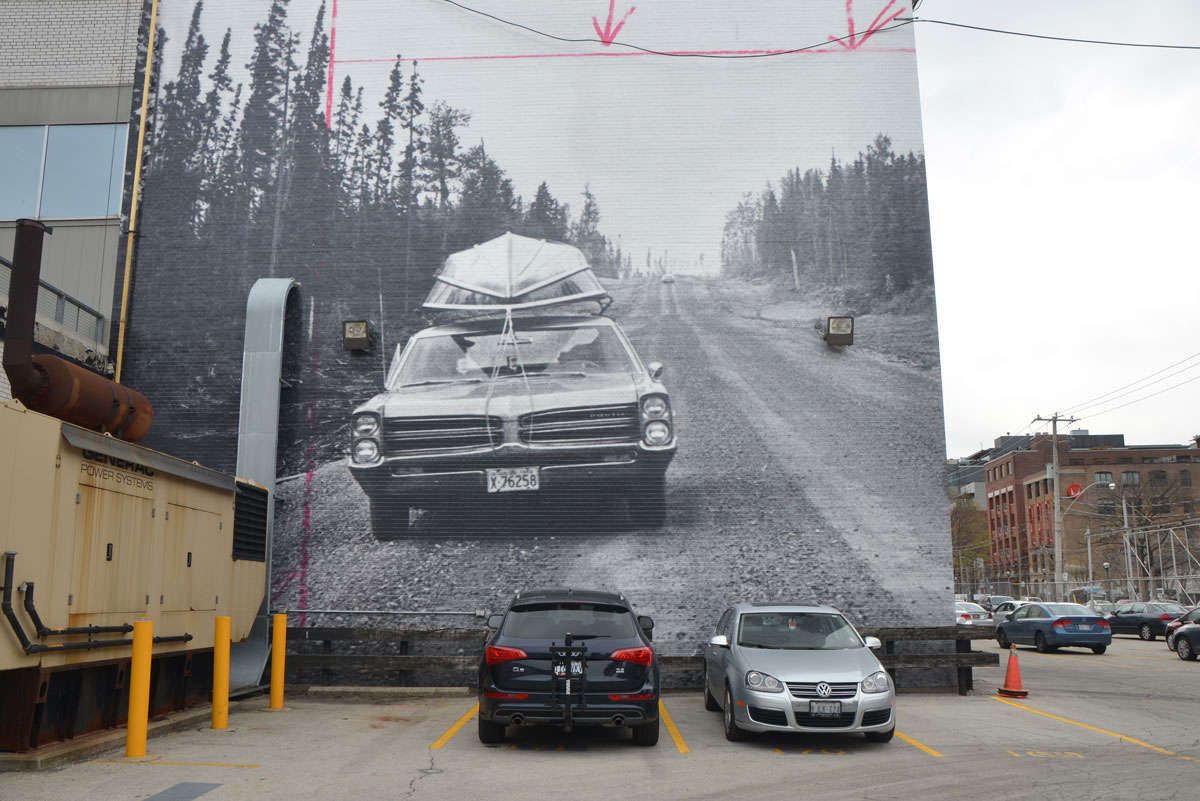
below: Up close, ‘Stopping Point’ by an unknown photographer.  The original title and description was: ‘Along the new Highway, which runs from Smooth Rock Falls to Fraserdale, Ontario, there’s no sign of human habitation apart from one empty lumber camp, c.1966. 

A very large black and white photograph from the 1960's of a car on a two lane road with pine trees on either side. There is a boat tied to the roof of the car. The photo is on the side of the Globe and Mail building with cars parked around it.

The above photograph is one of 750,000 photos in the Globe and Mail’s picture library.   100,000 of their old photos are being digitized to create a new historical archive.  From these, a collection of 20,000 prints will be donated to the newly formed Canadian Photography Institute at the National Gallery of Canada.

More of the photos from the Globe and Mail’s collection are on view inside the Old Press Hall.

I usually take a dim view of conceptual art largely because the importance given to the “words on the wall” has eclipsed the consideration given to the artwork itself.   Mediocrity in technique or creativity hides behind big jargon words and convoluted language in the artist statement.  Often the concept that the artist claims to be exploring is at odds with the end product.

When the art doesn’t live up to words that sound learned and meaningful then it degrades the work and makes the artist, and those curating the exhibit, seem pompous and out of touch.

For example, if you read that certain videos by an artist “cast a hitherto unexampled light on the conventional North American city”,  what would you expect to see?  Would you expect to see a video shot from a helicopter as it circled a city at night?  A video that looks familiar to anyone who has flown over a city after dark.   That’s what you get with Aude Moreau’s ‘The End in the Background of Hollywood 2015’ now showing at The Power Plant gallery.   I don’t have a photo of it but I do have a picture of three of her other photographs also on display.

below: From left to right (discounting the small picture farthest from the camera): 1. ‘Untitled (Hollywood Sign)’ 2015, 2. ‘LAPD (Los Angeles Police Department)’ 2015.  It’s a picture of a tiny helicopter in a large grey sky.  and 3. ‘Waiting for Landing’, airplanes lined up as they approach LAX airport.   Unfortunately, the words on the wall then go on to say, about these three images, “These demonstrate visual strategies that act upon the symbolic representation of the city and the spectacular dimension of the film industry.”  Oh my.

4 pictures hanging in a contemporary art gallery. One is a picture of the Hollywood sign taken just after dark, the next is a grey sky with a tiny dot of a helicopter in the middle, the third is too far away to discern, and the last is a picture of Los Angeles at night taken from a helicopter

And with that I left The Power Plant gallery.  Growling silently to myself and shaking my head with a mix of disdain and and frustration.   Imagine my surprise when once outside I encountered another of Moreau’s photographs.  A very lovely one.

below:  A picture of the Toronto skyline by Aude Moreau mounted on an exterior wall at The Power Plant Contemporary Art Gallery.  A picture with visual impact.

A photograph by Aude Moreau of the Toronto skyline as the sun starts to set, sunlight reflected off the buildings, darkening blue sky. The picture is mounted on an exterior wall and there is a tree in front of it as well as a couple of picnic tables

below:   You can play “spot the building” and test your knowledge of Toronto geography.   You can line up the DBRS building, the Hilton Hotel and the Canada Life building on University Avenue along with the Sheraton Hotel on Queen street.   The blue addition on the AGO is farther north on Dundas.  Can you think of where the photo was taken?  Apparently, it was taken from Toronto Fire Station 315 at College Street and Bellevue Avenue.  It was taken just after sunset but when there was still enough light in the sky to reflect off the taller buildings.   Moreau makes the city sparkle.

A photograph by Aude Moreau of the Toronto skyline as the sun starts to set, sunlight reflected off the buildings, darkening blue sky. The picture is mounted on an exterior wall and there is a tree in front of it

I must have seen this picture very shortly after it was installed.  It is part of the CONTACT photography festival that starts this weekend but there was no accompanying sign, no words that attempted to a explain the image.  Perhaps that was for the best.  In fact, I now have the CONTACT catalogue with their description of the artwork but I think I won’t read them.  I’d rather enjoy the picture just the way it is.

Have you ever noticed how many trees there are in this city?
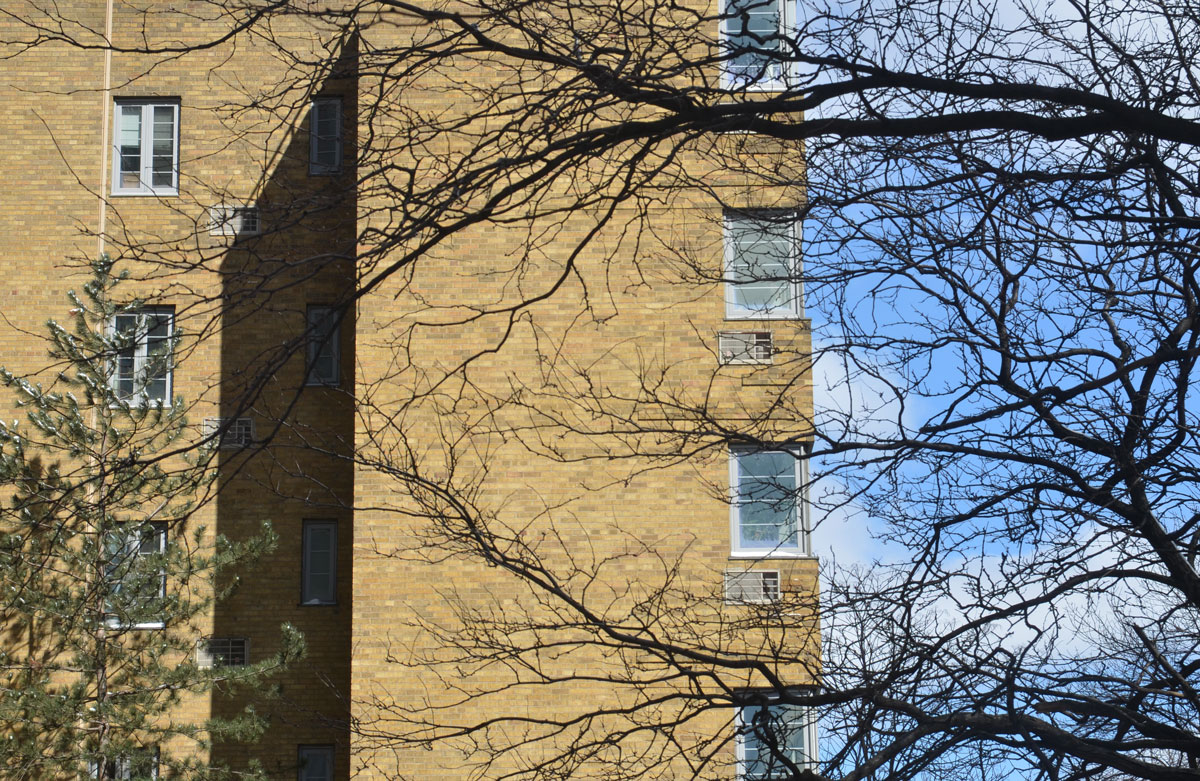
Have you ever stopped to examine the visual relationship between trees and architecture, the patterns of leafless branches superimposed on straight man-made lines?

Horizontal branches of a tree growing in front of a low rise yellowish brown brick apartment building. Balconies, jutting out with the bright blue sky behind.

For the past couple of weeks I have been keeping an eye open for such relationships while I walk.   As it turns out, there are lots to be found…. and some are even interesting  🙂

Part of a mature tree, looking upwards, the greenish steeple of St. Basils church can be seen through the branches. No leaves on the tree. A very tall condo building under construction is also in the picture.

Just for fun I googled “How many trees are there in Toronto?”.  I got answers!  One link was particularly useful:  available in pdf from the City of Toronto’s website is a report titled, “Every Tree Counts: A Portrait of Toronto’s Urban Forest” (updated in 2013).   It is estimated that Toronto has about 10.2 million trees and they provides a tree canopy over between 26% and 28% of the city.

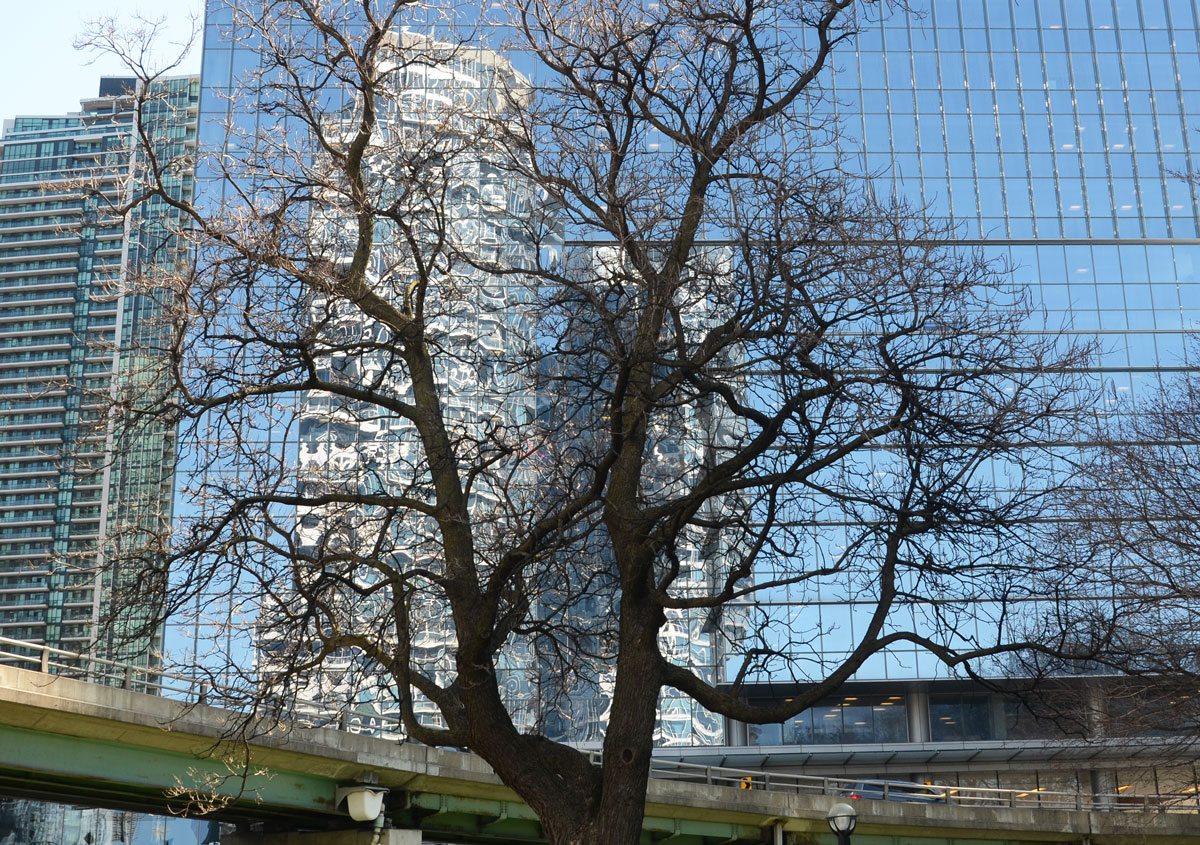
A large mature tree with no leaves, early spring, grows in front of a large glass building that has a reflection of another large building its windows.

There are at least 116 different tree species in the city.  The 10 most common species account for close to 58% of the total.   We have a lot of maple trees – Norway Maple, Sugar Maple, and Manitoba Maple were the top 3 species.  Next in the list were Green Ash, White Spruce, Silver Maple, American Elm, Eastern White Cedar, Austrian Pine, and White Ash.

When Dutch elm disease devastated the city’s elm trees in the 1960s and 1970s many were replaced by Norway maples.  These proved to be hardy but they were also very invasive and damaging to ravines and other natural spaces.  As a result they are rarely planted on city property anymore.  Still, they represent 15% of Toronto’s tree coverage.

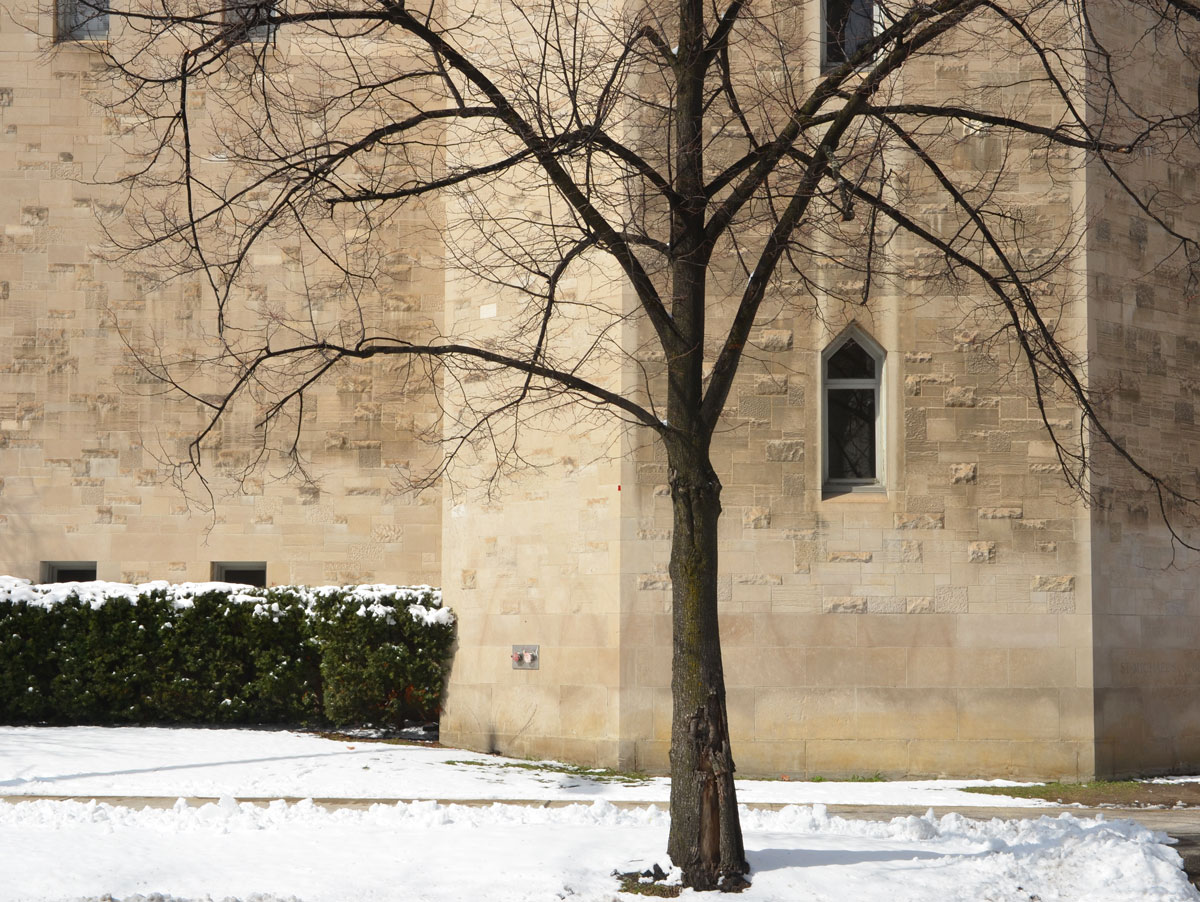
A lone smallish sized tree in winter is growing in front of a stone building on the University of Toronto campus, snow on the ground.

Of the total tree population, 6.1 million (60%) trees are on private property, 3.5 million (34%) trees are in parks and ravines, and 0.6 million (6%) trees are on city streets.

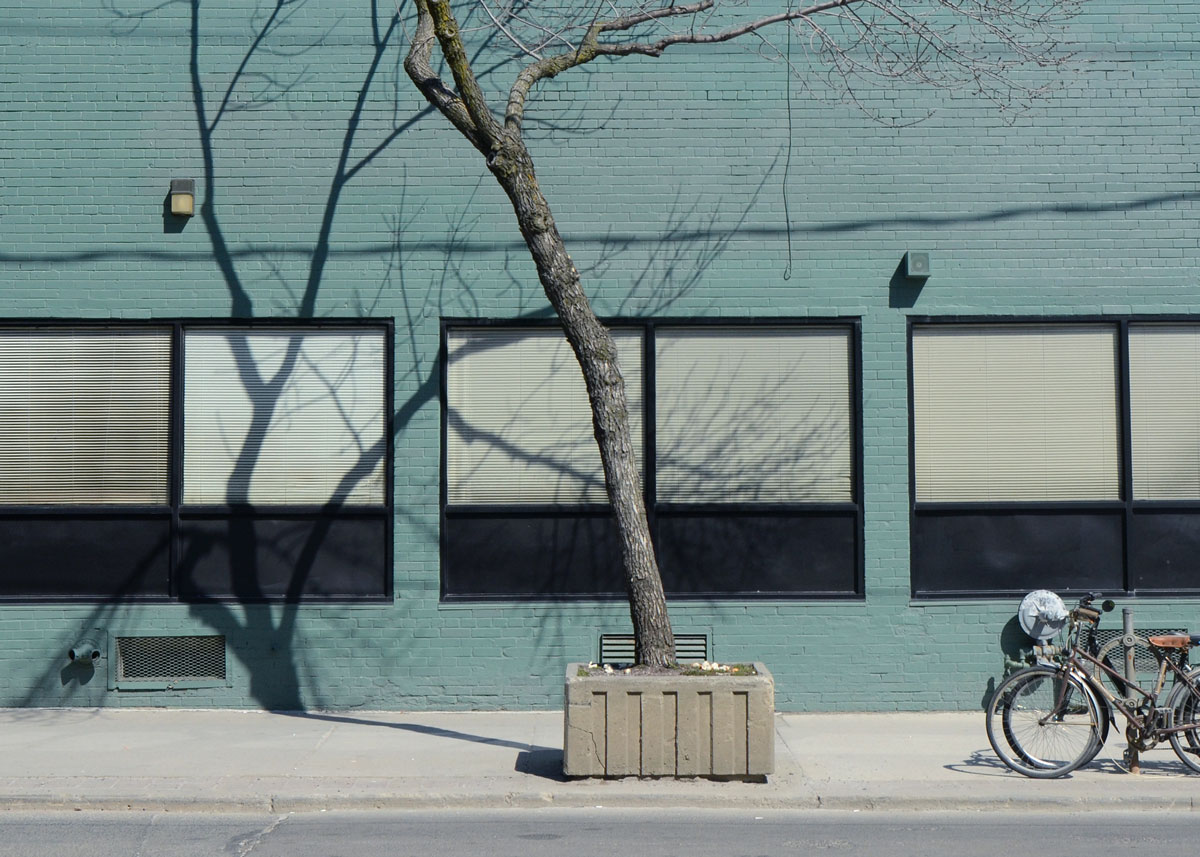
A tree in a concrete planter in front of a tral coloured building. It's a sunny day so there is a shadow of the tree on the building.

Trees make a significant contribution to our life.  Not only do they look nice, but they also provide benefits.  They provide shade in the summer and they help improve the air quality.  They help prevent erosion in our ravines and they provide habitat for insects, birds and animals.  Our parks would be poorer places without trees.

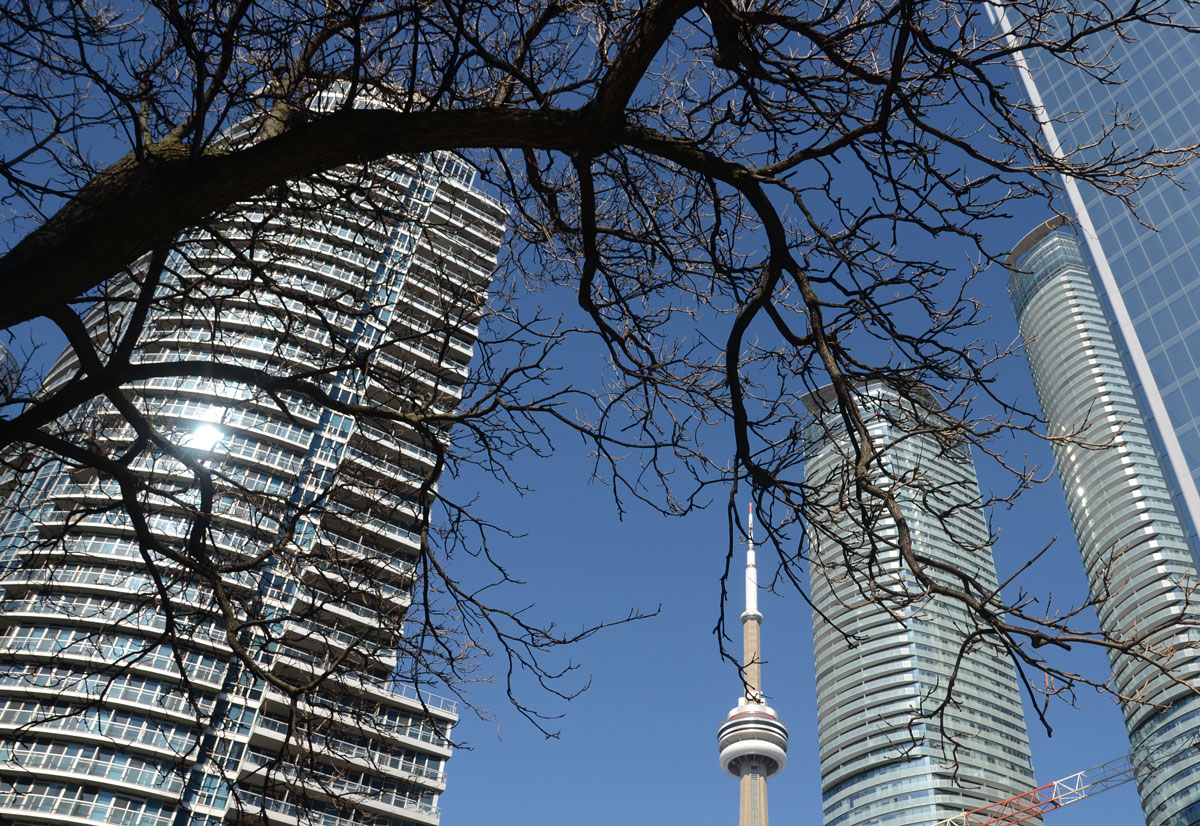
A large branch of a tree in the foreground, condos and the CN tower in the background. The curve of the tree branch looks like its wrapping itself around one of the tall condos.

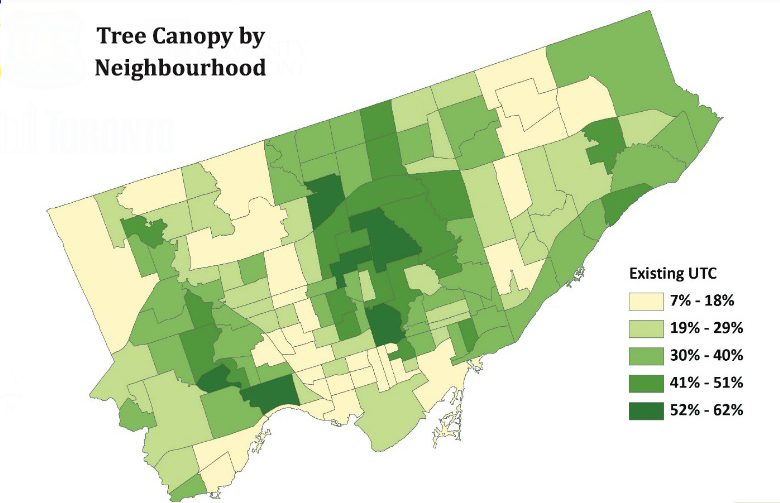
One goal that the city has is to increase the canopy cover over Toronto to 30%.  To this end, between 2004 and 2012 the city and its partners planted almost 100,000 trees per year.   That’s almost 900,000 trees.   Not all survive but progress is being made.  Tree cover increased slightly (1.3%) between 1999 and 2009.

below: A map of Toronto showing the tree canopy in each neighbourhood

A map of Toronto showing the percentage of each neighbourhood covered by tree canopy from almost white (very few trees) to dark green (a lot of trees)

in winter, some snow, part of a large leafless tree in front of an office building with a sloght curve in it.

Take a moment to look at the trees you pass, yes, look up!  Especially in the next week while the branches are still bare.  Better still, look up often and watch the changes unfold as the trees bud and bloom.  At this time of year the trees change quickly and before you know it the city will be transformed.

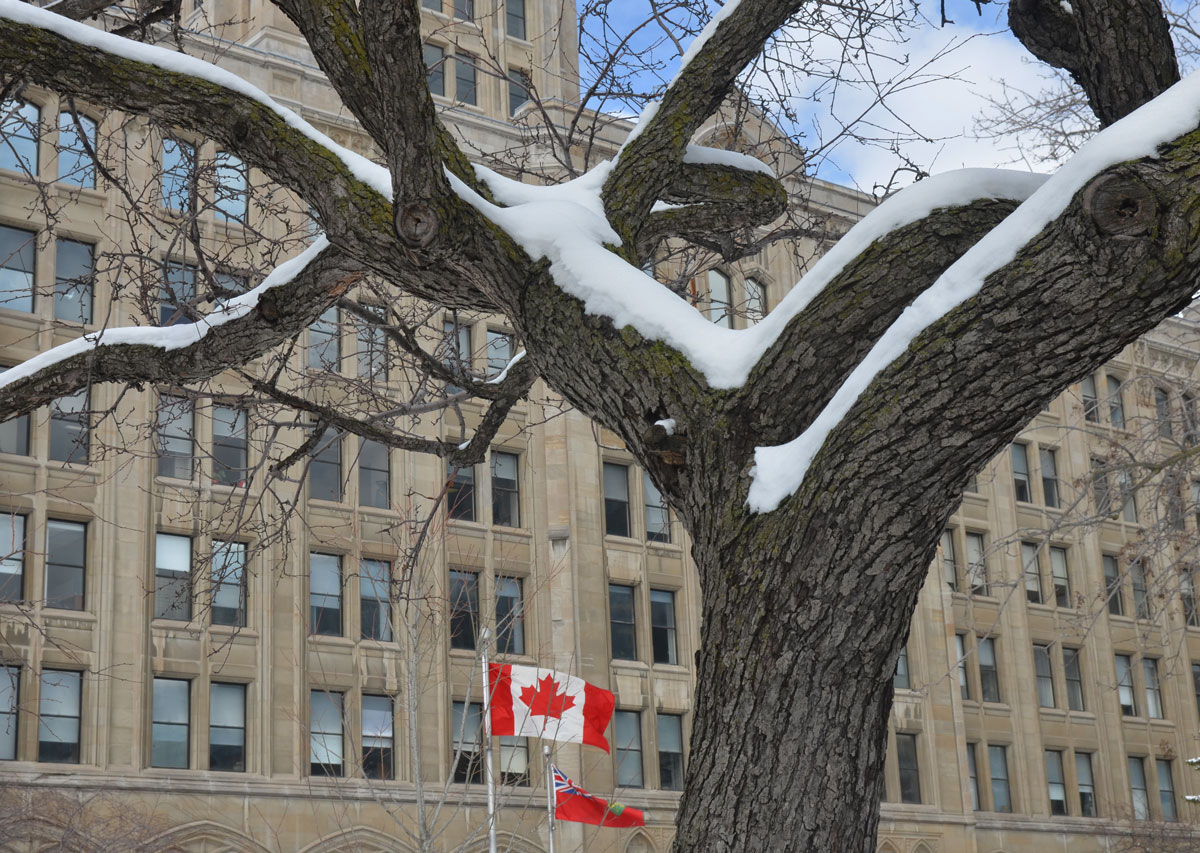
winter tree in front of a stone government building on Queens Park Circle, A Canadian flag and an Ontario flag are flying in front of the building.

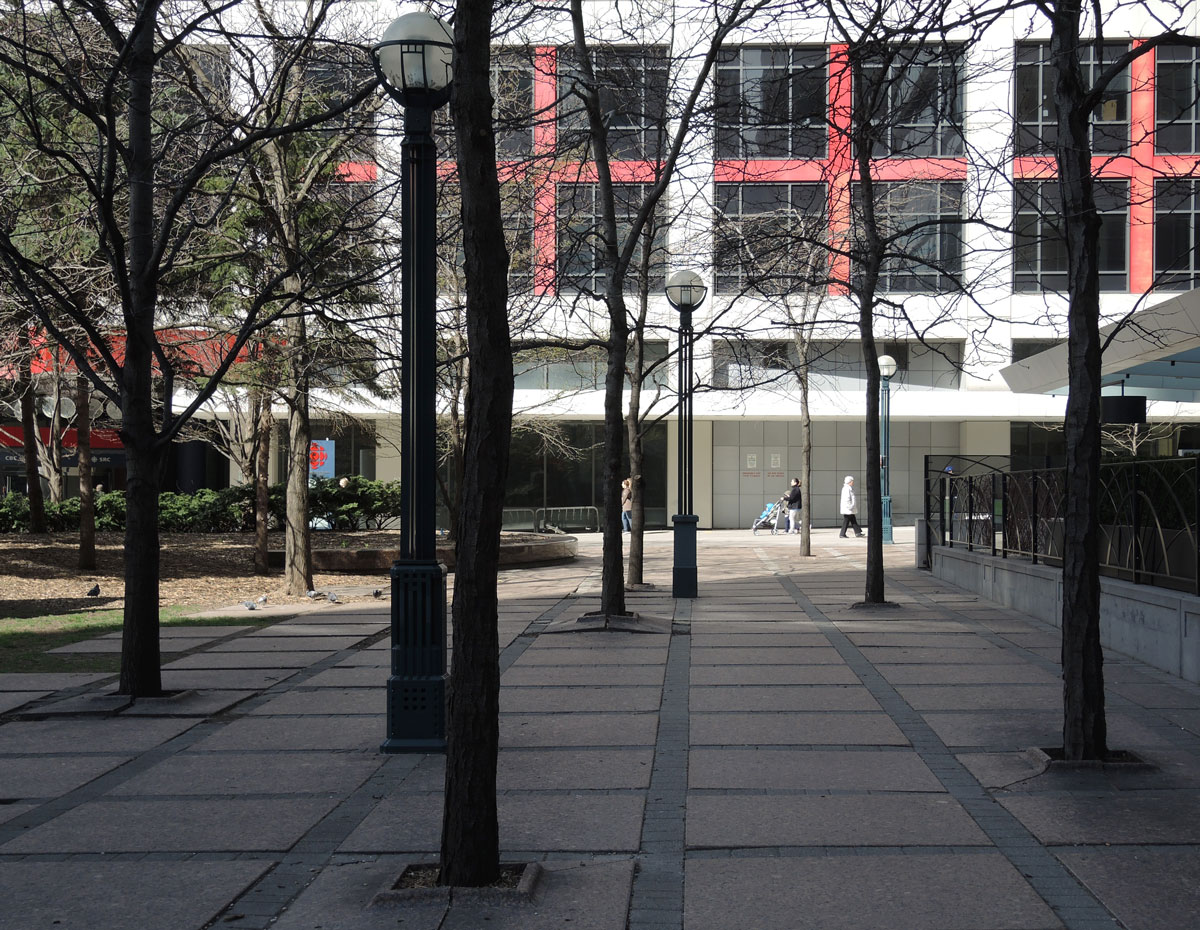
A number of leafless trees and three lamp posts in Simcoe Place, downtown Toronto, with the CBC building in the background

A man's legs as he walks across the pond on Ryerson campus. Very little water is therem lots of reflections of the trees and buildings around. He is wearing jeans and bright orange running shoes.

leafless tree branches above an older red brick house with a mansard black slate roof and a feww yellow brick details

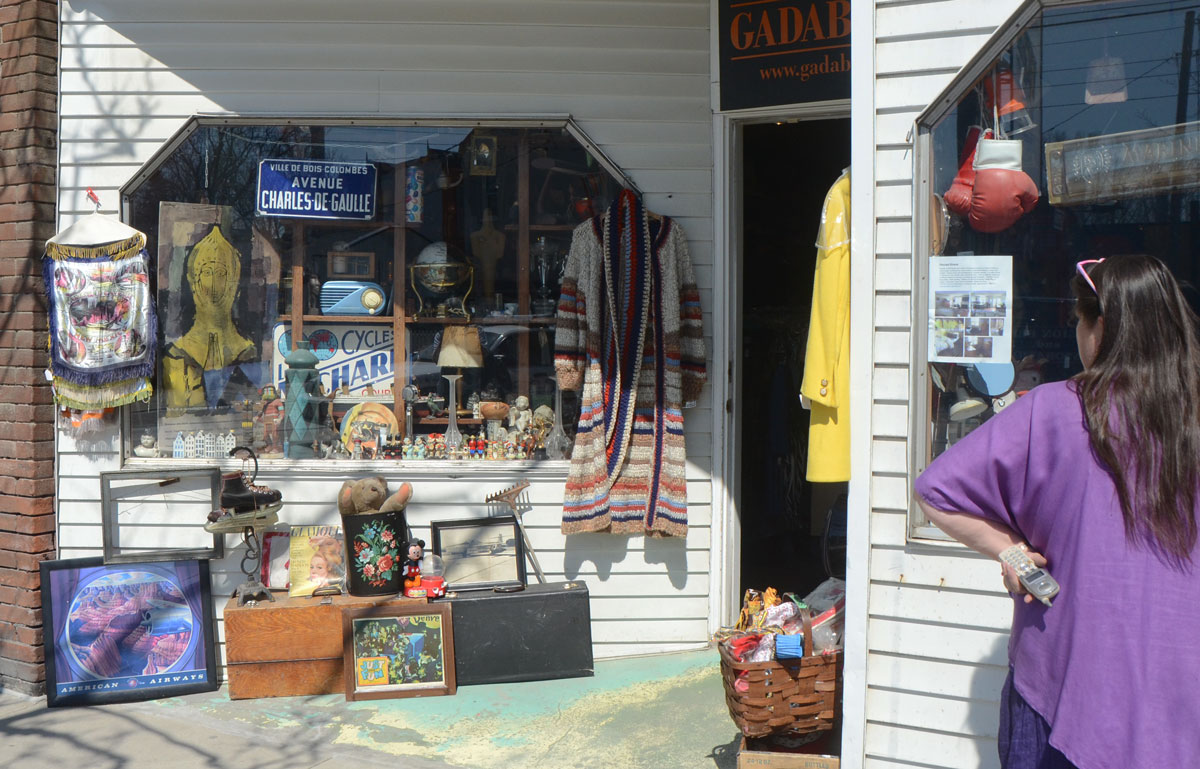
First, a big thank you for being welcomed into Gadabout to explore and take pictures.  Gadabout is a store on Queen St East and it is home to “vintage clothing, nostalgia, ephemera, textiles and curios.”  It is packed full of old things.  Interesting things.

Exterior of the Gadabout store on Queen St East showing the window display and entrance. The window is full of things for sale and there are also a few things sitting outside the store that are also for sale - old glamour magazine, old men's skates, a teddy bear, a crocheted coat,

below: And when I say packed, I mean it!  Floor to ceiling.

Against a wall in Gadabout store, shelves with small cubbyholes all filled with small items, curios, b=vintage, treasures, such as old producs, toys, figurines, household items,

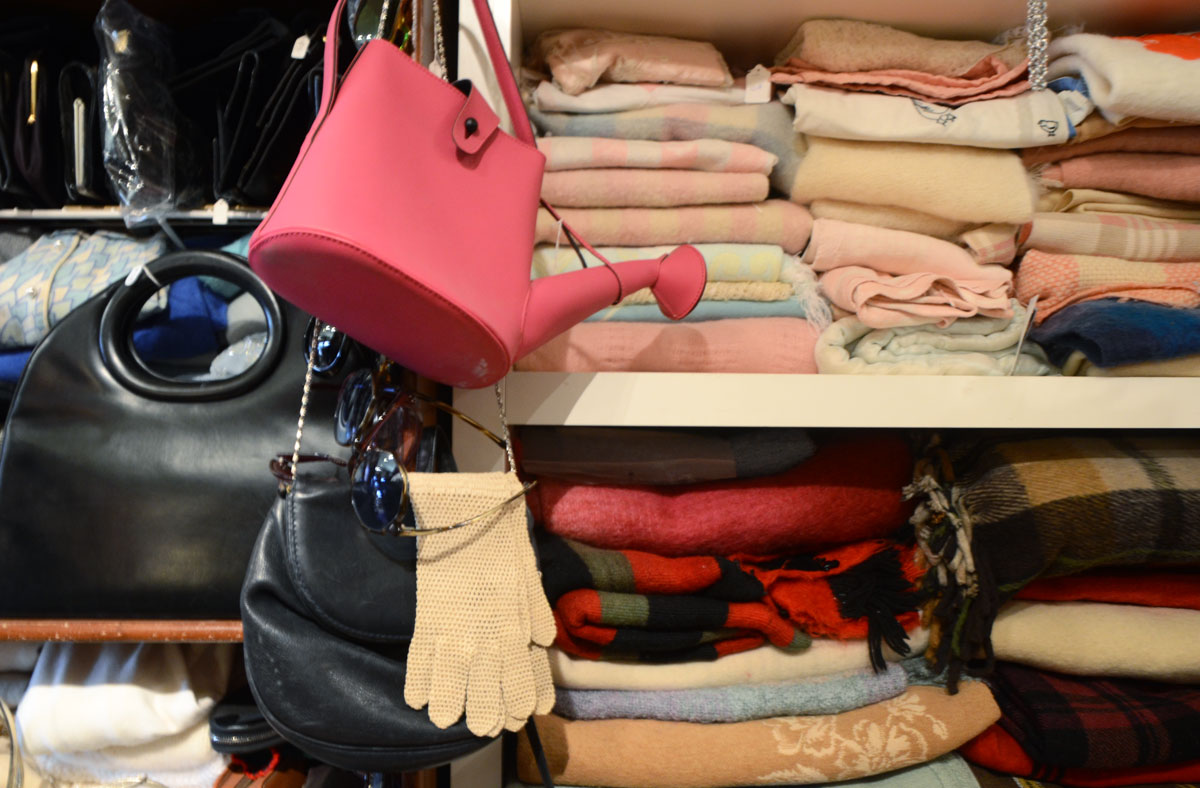
below: Who could resist a watering can purse?  In pink even.

a pink purse in the shape of a watering can hangs from a hook on a wall. A pair of beige gloves hangs below it. Folded fabric items are on the shelves beside the bag and gloves. Blankets or sweaters.

A small doll with a very lifelike face is looking towards a shelf filled with small ceramic and porcelain items such as vases and figurines

below: Containers and packaging for Mennen baby powder, 40 cents for J.R. for Athlete’s Foot, Silvo silver polish, a tire repair kit, 6-12 insect repellent, and wintergreen oil.  The latter is used topically to relieve muscle aches and pains.  It’s labelled as a poison as it is easy to overdose on it if ingested.

A small section of shelf in a store selling vintage items, on this shelf are old drug store and household products such as wintergreen oil, silvo silver polish, baby powder, athletes foot treatment,

below: Knights Templar black bicorne hat with feather along with matching cuff.

An old black military hat with a white feather in it sits on a head mannequin. Beside it is another mannequin wearing a tartan kilt and a white shirt. The shirt has a brownish leather cuff with a red cross on it.

below: All those drawers are filled with old photographs.

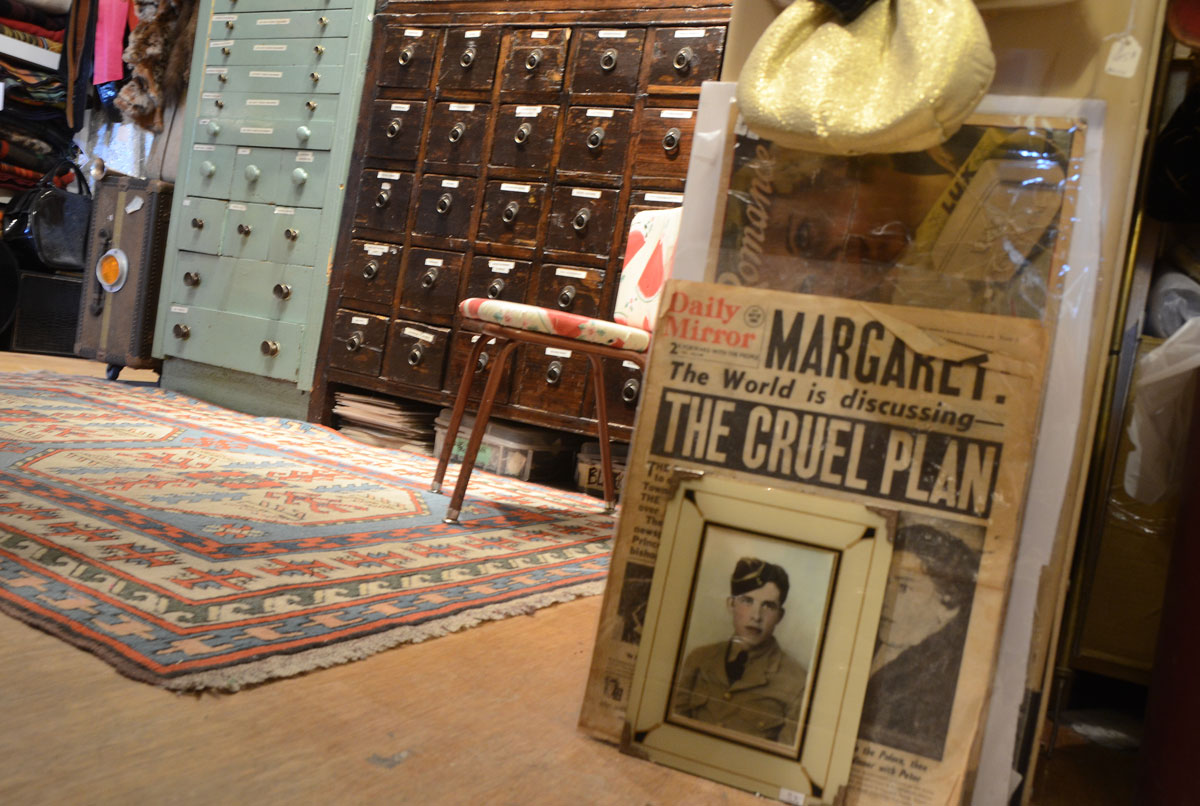
old wooden drawers filled with old photographs, a mirror, and an old chair with a vinyl watermelon print fabric on it.

old photograph of a man in uniform, a front page of the Daily Mirror newspaper, more drawers, all in a store filled with vintage items.

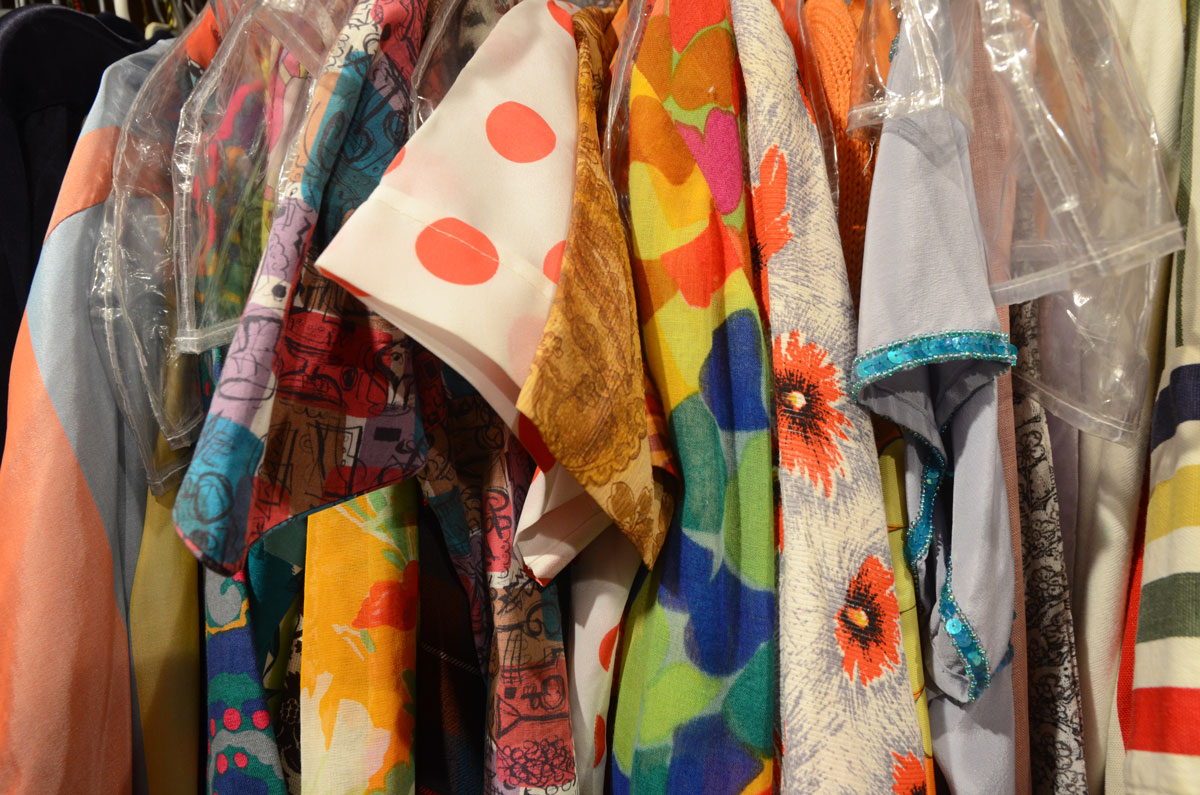
below: Vintage clothing

sleeves of colourful shirts and blouses hanging on a rack. Orange polka dots, red poppies, wild prints, all vintage clothing

a teddybear sites in a can with a painting of flowers on it. An old Glamour magazine with a yellow cover
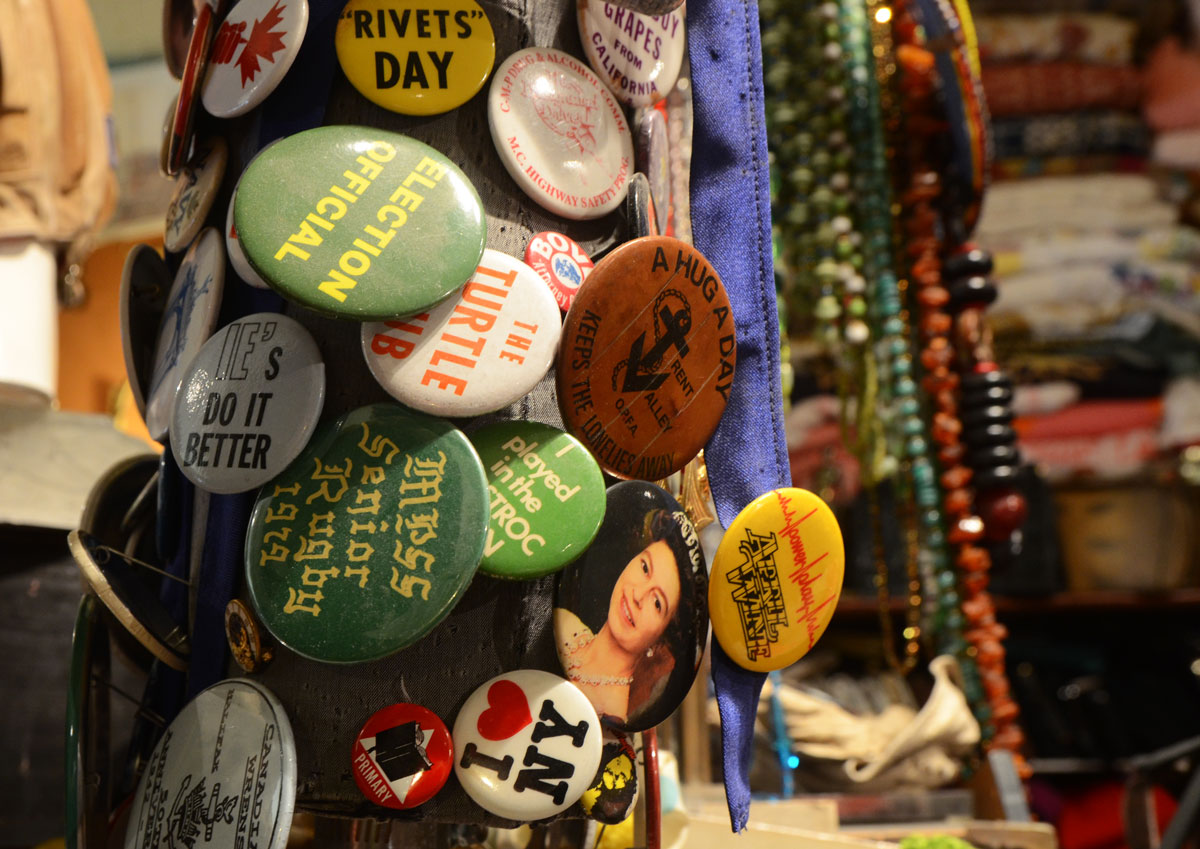
Old pins (buttons) in the foreground with beaded necklaces in the background.

below:  Fancy handbags and shoes.

items in a vintage store on Queen St East in Toronto, on the wall there are some small handbags, as well as some high heeled shoes. Some of the bags are beaded and one is a shiny gold colour.

Gadabout website

An art installation ‘Nest Egg’ by Brendan McNaughton
at the Corkin Gallery, Distillery District

The title of this blog post is taken from a description of McNaughton’s work on the Corkin gallery website, “The relationship between plutocrats and proletariats is central to his art practice.”  A plutocrat is a person who is powerful because they are wealthy.  Money equals power.  Proletariat on the other hand is a class of people, the working class, a class without money and without power.

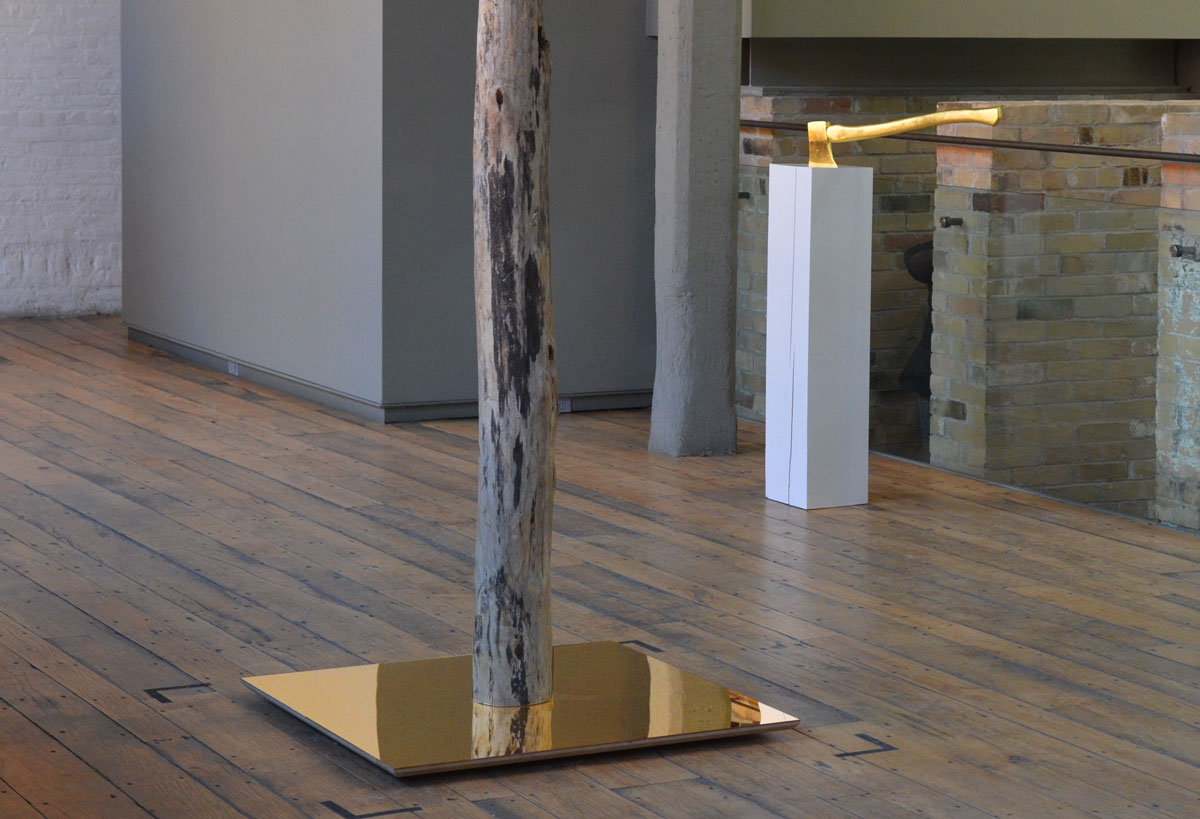
below: A gold axe.  With its blade in a column, on a pedestal?  That’s not a passive positioning of the axe, i.e. it’s not just lying around.  Someone has swung it.
Axe as a symbol of the working class?  Juxtapositioned with gold, a symbol of money?

picture taken inside an art gallery - a tree trunk stands in the middle of a gold toned mirror, in the background, a gold plated (or gold colured) axe with its blade in the top of a white rectanguar column

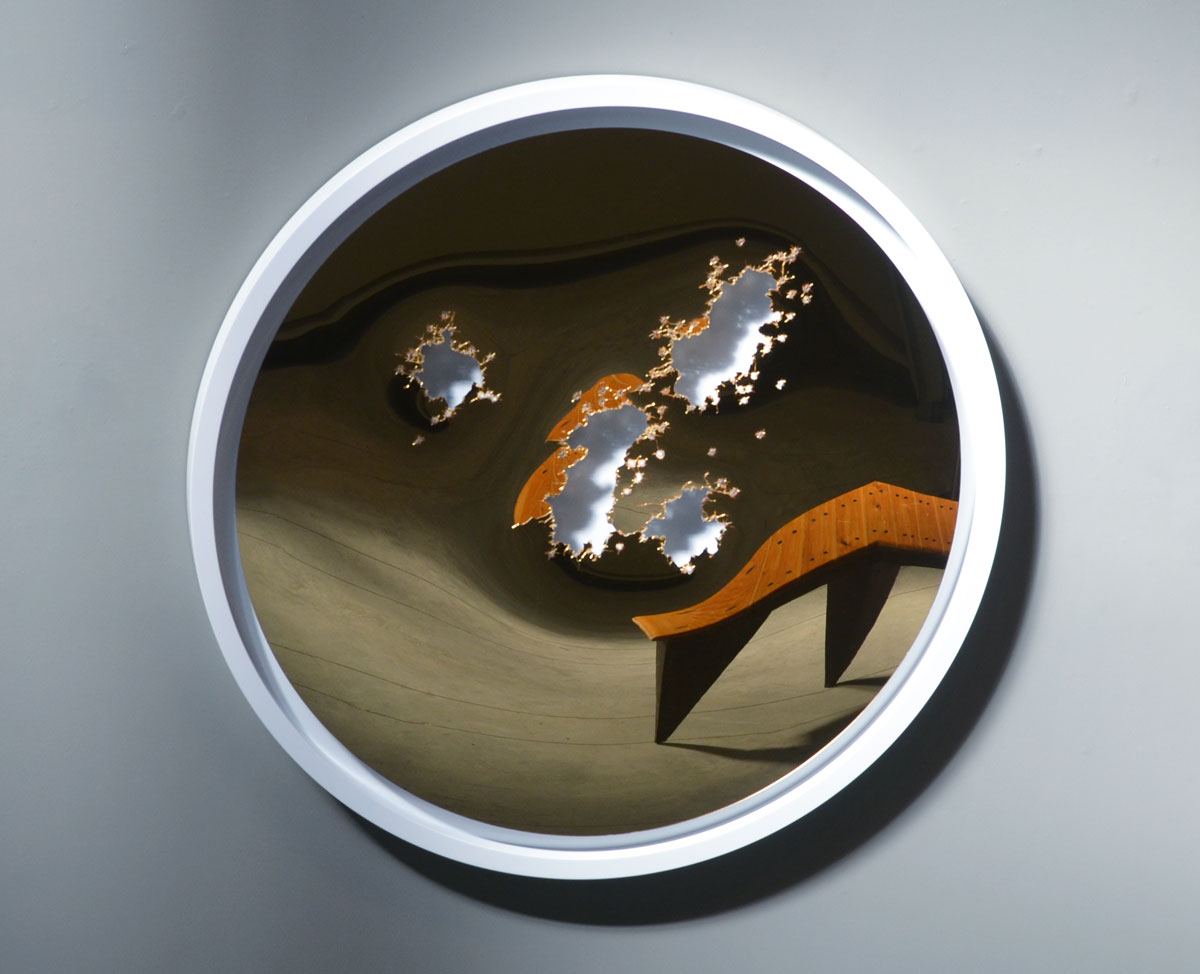
below: A couple of the pieces were mirrors. But they were mirrors with a difference – slightly concave in shape, with a hint of gold, and marred by ragged shaped holes.  The resulting reflections are distorted and flawed.

an artwork by Brendan McNaughton of a slightly concave mirror but with a few torn holes in it. A bench is reflected in the mirror but because the mirror isnt't flat, the bench is distorted.

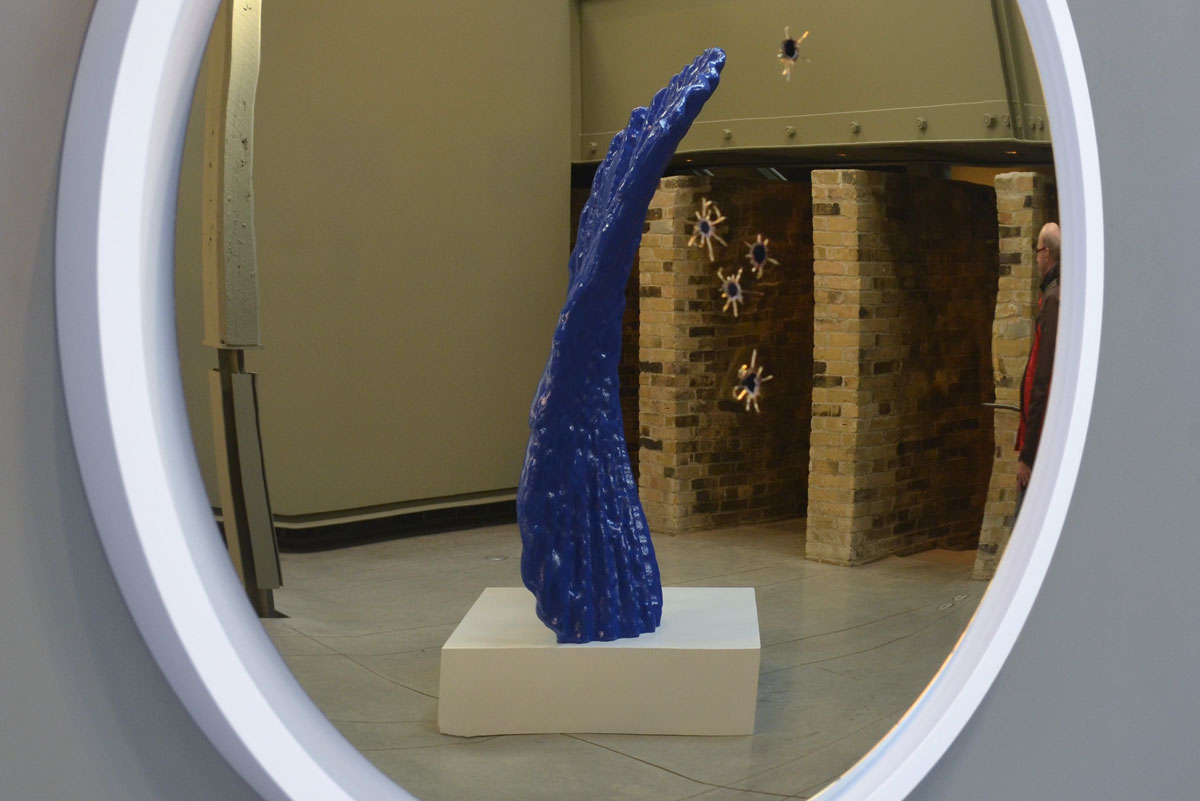
below: ‘Blue Chip’ a sculpture by Brendan McNaughton as viewed through one of his mirrors.  The expression ‘blue chip’ has become synonymous with high quality stocks, usually ones from the New York Stock Exchange.   Originally the expression meant stocks with higher prices because, if the story is correct, blue chips in poker are traditionally associated with the highest value.

Blue Chip, a sculpture by Brendan McNaughton, as viewed through an oval shaped mirror which is actually another art piece by the same artist.

below: The colour gold is very prevalent in this installation as are reflective surfaces.

picture taken inside an art gallery - a tree trunk stands in the middle of a gold toned mirror, also a mirror is on the top of each trunk, in the background are four panels of wrinkled gold

below: Parts of three wrinkly gold panels. There are actually four of these reflective square panels.  They are all the same size and colour but the surface patterns are slightly different.  Once again, the reflections are distorted.  Wealth distorts your view?

three square panels of reflective gold, wrinkled, material with reflections of people in them.

below: There was a group of what appeared to be photography students visiting the gallery at the same time that I was there. As I was standing beside this piece, looking for different and/or interesting angles and reflections, one of the students remarked on how he liked it when ordinary items were used in out of the ordinary ways. He then said that he wondered if it was …. and then he paused. I finished his sentence with the word ‘art’. He laughed and said yes, but that he was always afraid to say such things out loud. I gave him permission to ask “is it art?” as loud and as often as he wanted.

picture taken inside an art gallery - a tree trunk stands in the middle of a gold toned mirror,

picture taken inside an art gallery - a tree trunk stands in the middle of a gold toned mirror,

Installation ends May 1st