Archive for the ‘galleries’ Category

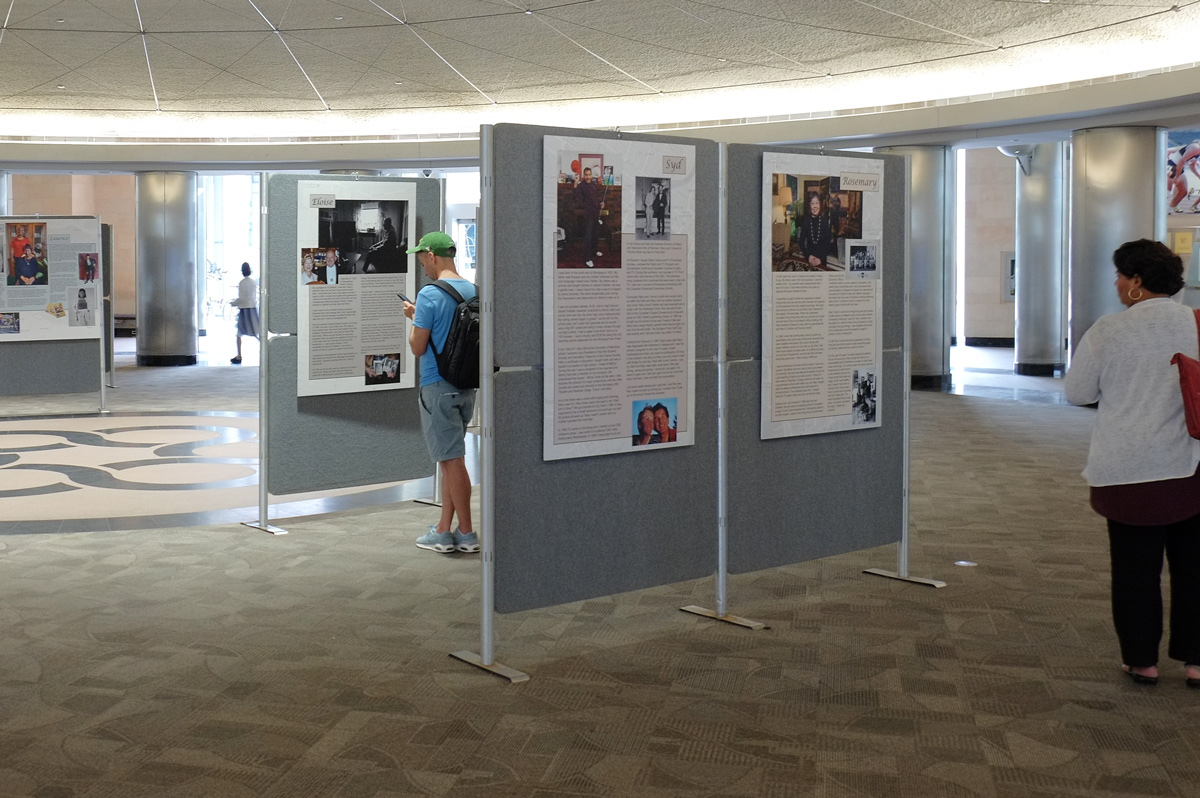
Now on in the Rotunda at Metro Hall, the second showing of ‘Focus on Our Elders’, a photo documentary project by The 6ix Clicks.

panels on exhibit at the rotunda at Toronto Metro Hall, Focus on Our Elders exhibit by the 6ix clicks photography group. Portraits and interviews of seniors in Toronto.

Portraits of, and interviews with, 24 Toronto seniors from diverse backgrounds.

panels on exhibit at the rotunda at Toronto Metro Hall, Focus on Our Elders exhibit by the 6ix clicks photography group. Portraits and interviews of seniors in Toronto.

The exhibit is only on this week, 13 to 17 August, inclusive.  The Rotunda is on the ground floor of Metro Hall and the building is open from 7:30 to 9 p.m.

For more information about these interviews: 6ix Clicks website

What are words?   How do we use them?

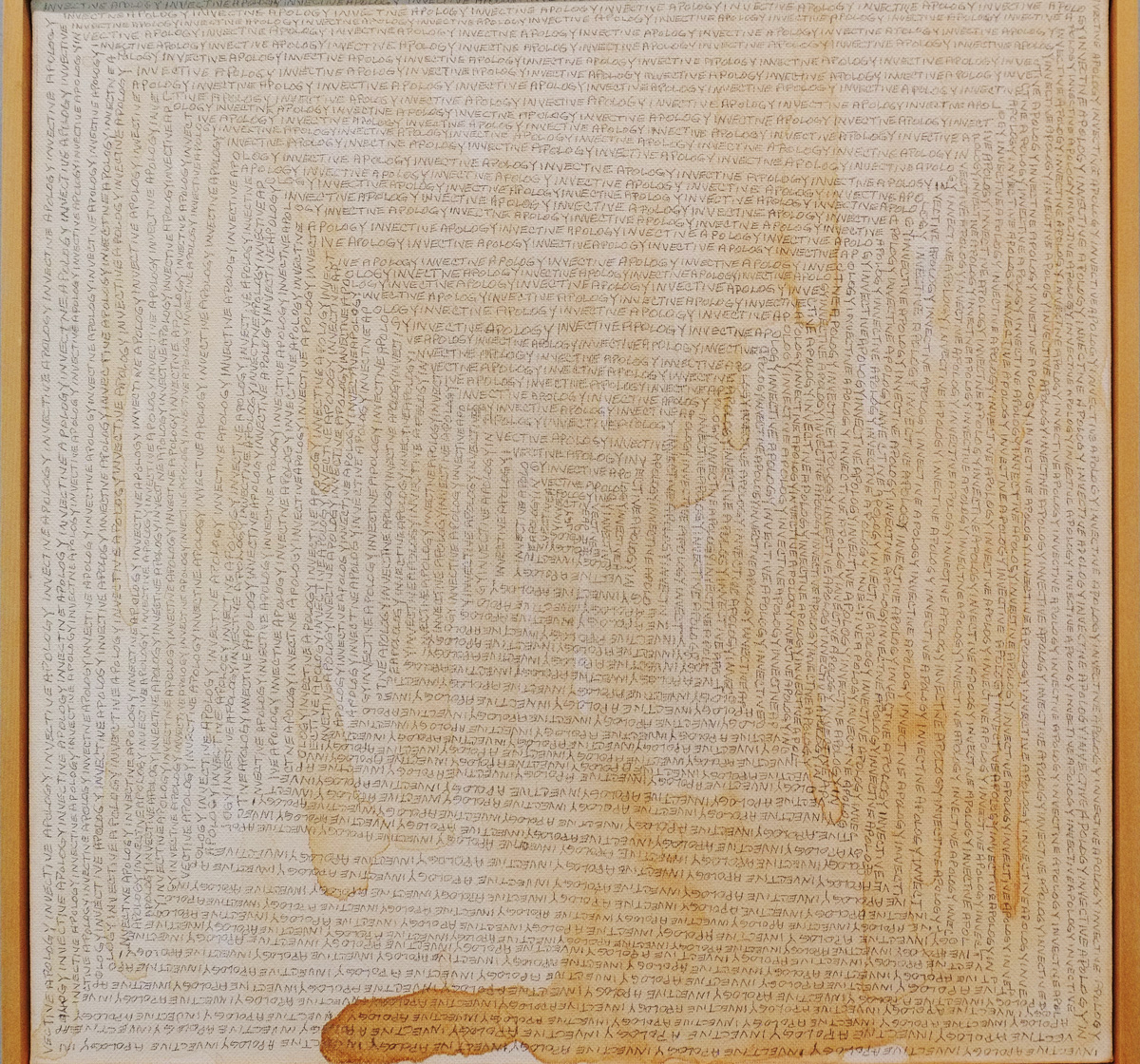
below: “Excuses injurieuses” 2007, by June Clark.  One of her “Wine and Tea” pieces.  It consists of the words Invective and Apology written over and over again starting from the top left corner and moving inwards toward the center.  Instead of a spiral it is a pyramid shape.  Perhaps it rises upwards, or perhaps it sinks down.  It’s only 40cm x 40 cm so the words are tiny.  I’d love to know how many words there are but I think that I’d be screaming profanities before I finished counting.  What I can tell you is that the pair of words ‘invective apology’ is written 32 times on the outer square.  If  invective is a noun that means, expletive, or abusive language, what does ‘invective apology’ mean and is that the same as the french title, ‘Excuses injurieuses’?

close up artwork of words written over and over again, invective apology, in smaller and smaller circles.

June Clark was born in Harlem NY but moved to Toronto in 1968.   At the moment, the AGO is featuring some of her work.  For whatever reason, I was more attracted to the pieces with words.

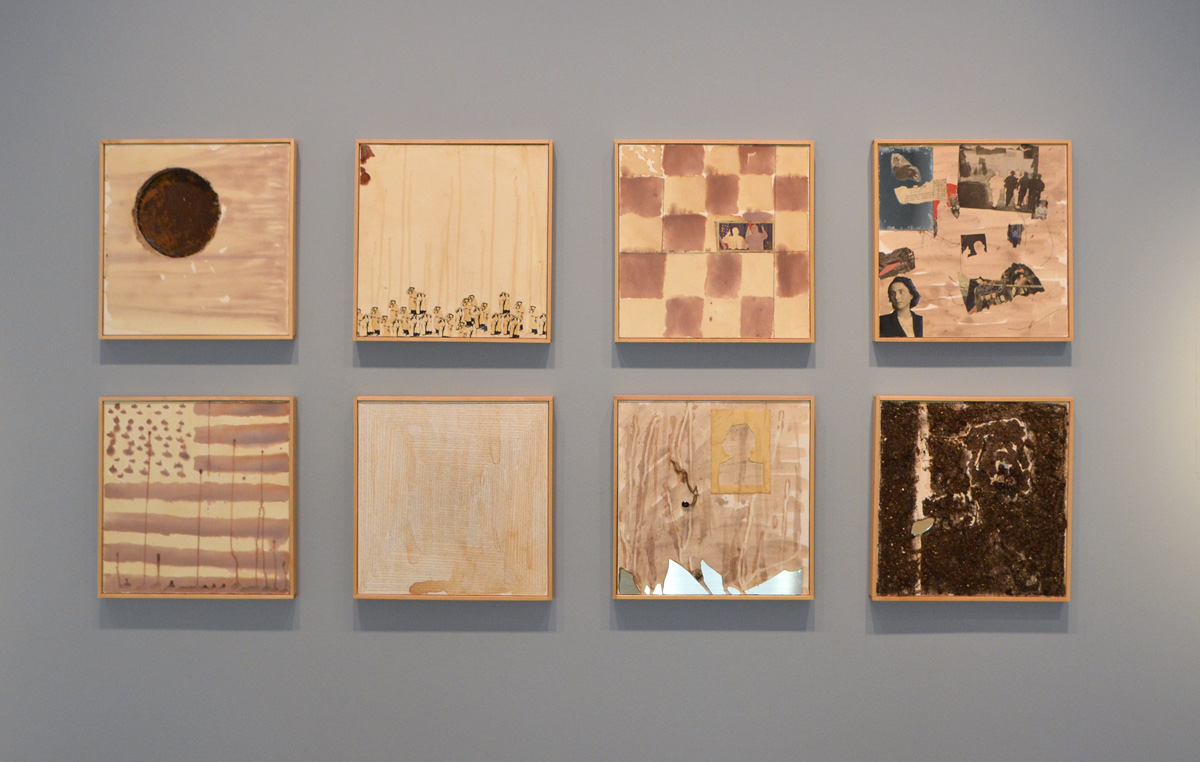
below: More of Clark’s “Wine and Tea” series, 2007.  Each one is a 40cm x 40 cm square and they are made with wine, tea and paper except for the one on the top left.  It is “Poubelle Lune” and the circle is a rusted lid that fits in a circle that has been cut out of the canvas.

a grid of 8 square artworks by June Clark on a gallery wall

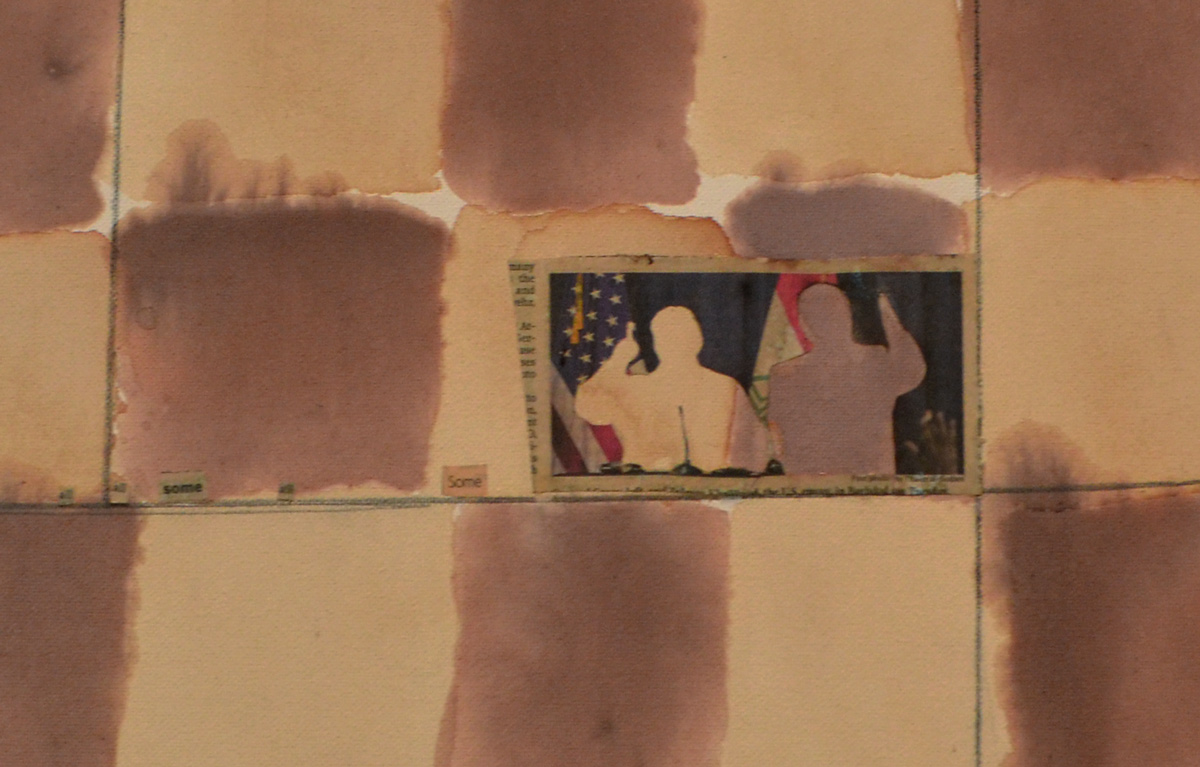
below: Close up of another of the eight squares, a collage of sorts, the silhouettes of two people (men?) in front of flags, one American and one ? Titled: “All Some Many”.  If you look closely, you can see small words cut out of newspapers or magazines, some, all.

close up of an artwork, ink and collage. Brown squares in checkerboard shapes, with one shape being a photo, 4 small words from a newspaper, all (twice) and some (twice).

below: The next two photos are panels from “Formative Triptych” 1989/1990.  The first one says “I always imagine that I never received anything as a child, but I do remember being disappointed that the chocolate Easter Bunny was hollow and then of course there was the red broom and dustpan set.”

old black and white photo of a black girl, smiling, in dress, with words beside that say "

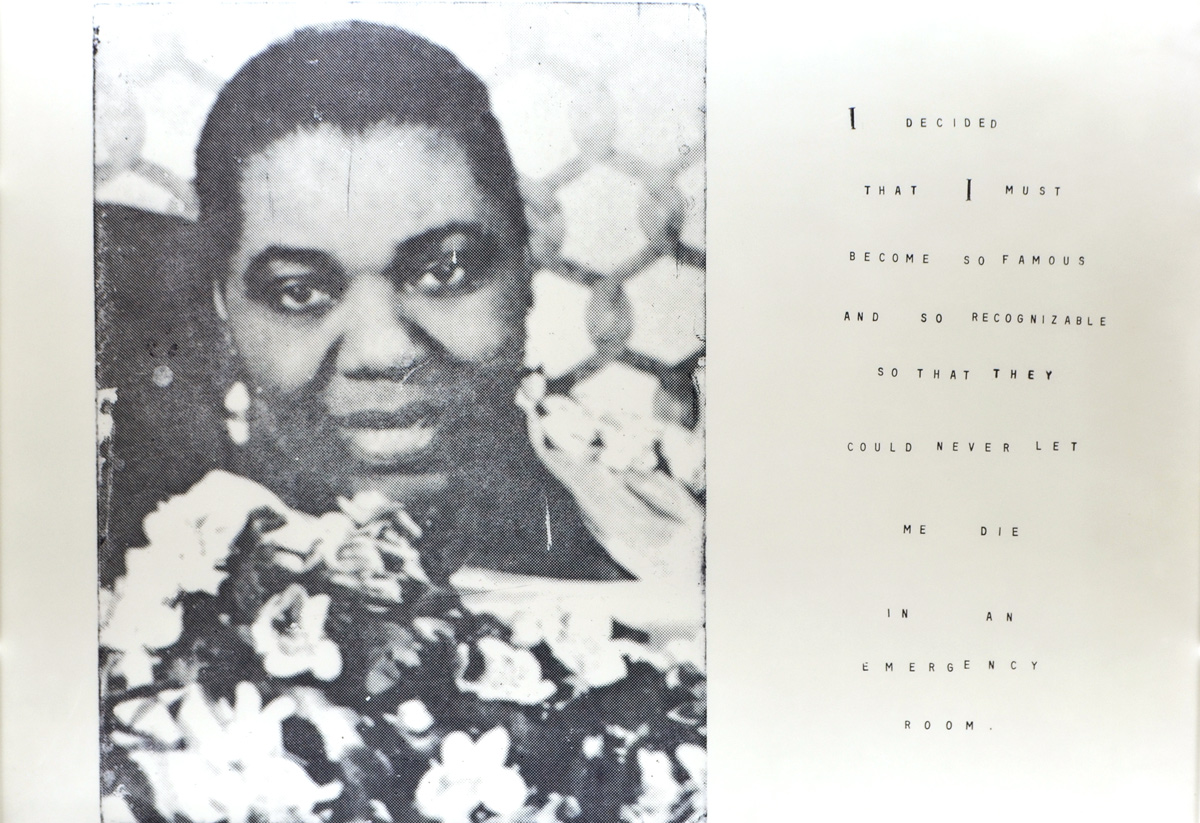
below: The words say “I decided that I must become so famous and so recognizable so the they could never let me die in an emergency room.”

picture of the head and shoulders of a middle aged black woman, old black and white photo, with words beside that say "

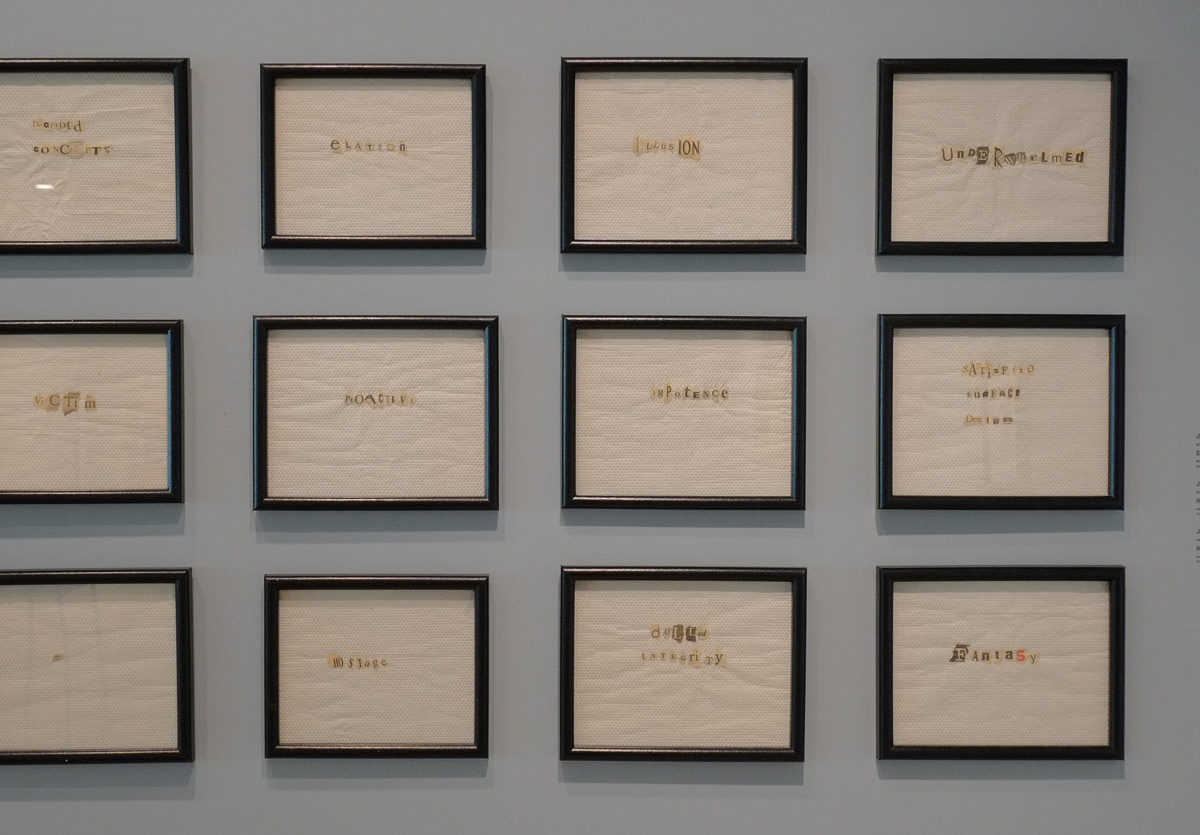
below: More collage and more words, this time it’s “Homecominghome”, words on paper towel.   Words like proactive, dulled integrity, impotent, hostage, elation, victim, underwhelmed, illusion, and satisfied surface desires.   These are only some, there were many more, each in their own little black frame.  Paper towel, that stuff we use once and then throw away.  Can we throw away the words?  Or what is behind the words?  Do we want to?

Actually there was a story about why paper towels were used – “…was made during a residency in New York City.  I had been cleaning the space so it was empty aside from paper towels.  It was a way of dealing with my emotions around how I felt living back in Harlem.  Cutting out the words, I felt like I was captive but free – a sort of ransom situation, of calls for help and demands for responsibility. ”  Quote taken from the words on the wall at the exhibit.

a grid of 8 square artworks by June Clark on a gallery wall - black frames around pieces of paper towel with words on them formed from cut outs from newspapers,

Words are fascinating.

June Clark’s work is on exhibit at the Art Gallery of Ontario until December 2018.


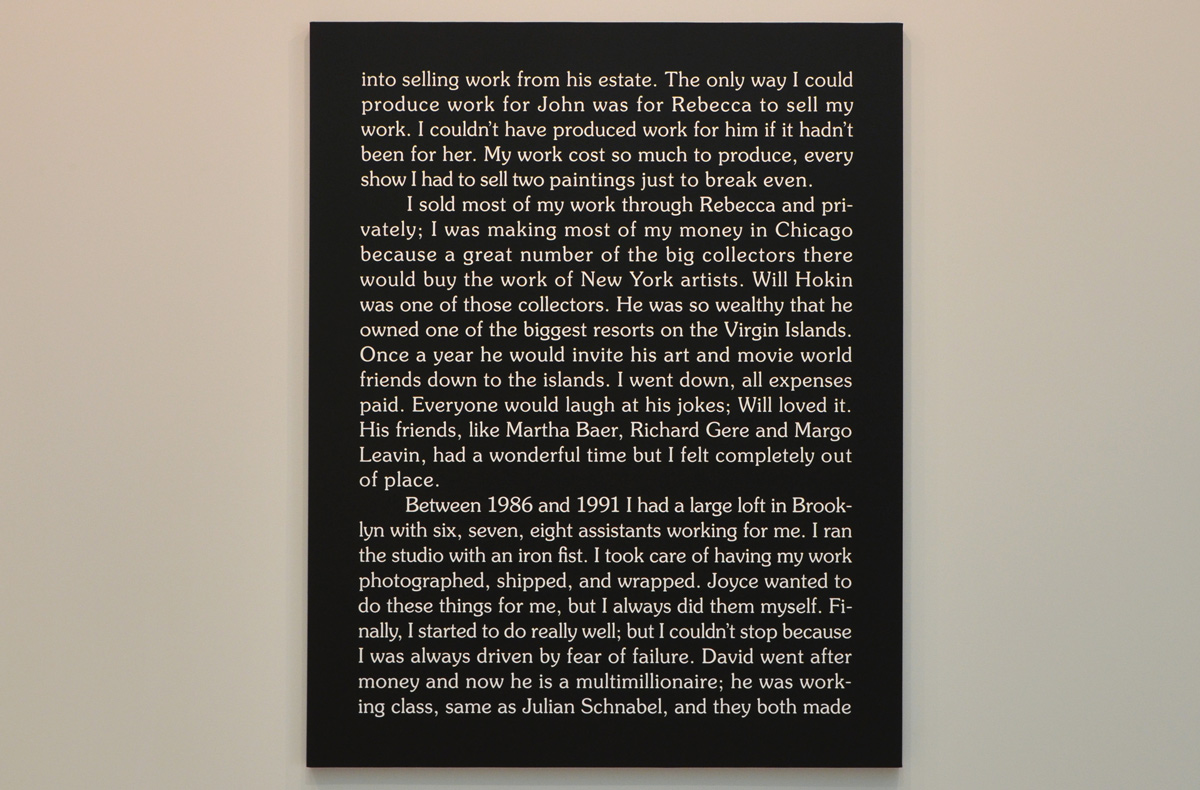
And while we’re on the subject of words and the AGO, there is a whole room of panels like the one below.  This is “Jack and the Jack Paintings: Jack Goldstein and Ron Terada”

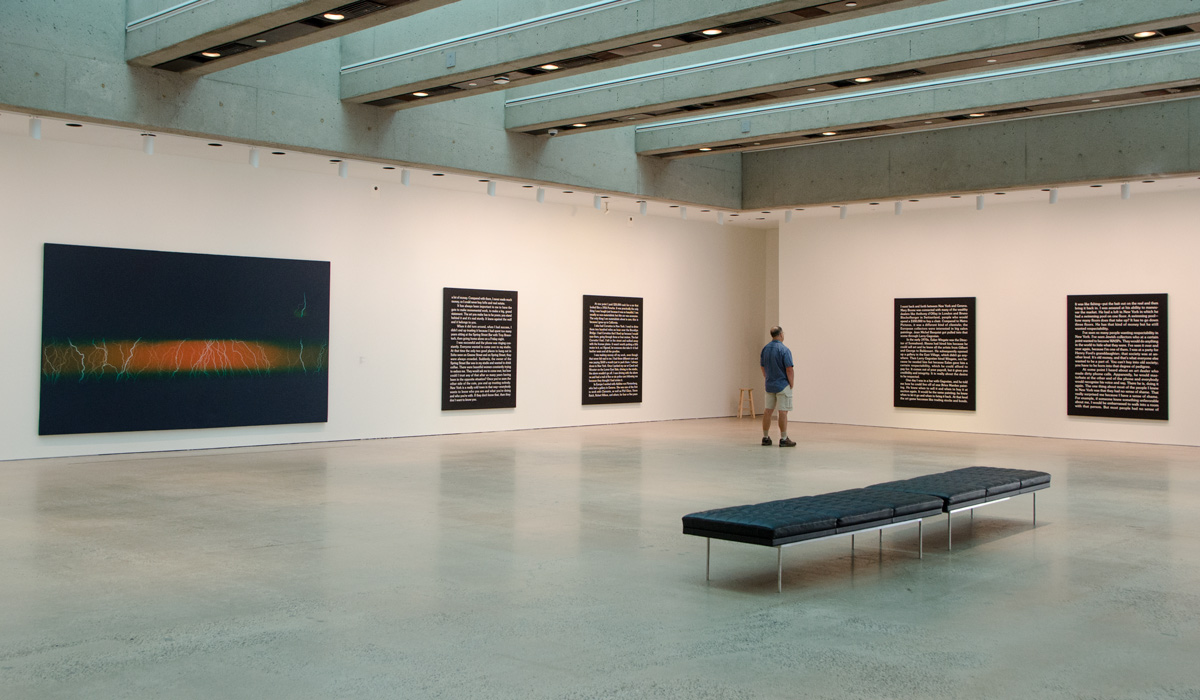
Goldstein was an artist who published his memoirs in 2003, just before he committed suicide.  Terada has taken words from the book and made them into 14 panels, sorry, I mean test-based paintings.  They are Goldstein’s words? Or are they now Terada’s words?  Whose story are they telling?

below: A large painting by Jack Goldstein (lightning) and four of the panels by Ron Terada.

The Jack exhibit continues until 16 September.

‘Trans Am Apocalypse No. 3’ by John Scott

a 1980 Pontiac firebird trans am, painted in black house paint and then words scratched into it, the words from Revelations in the New Testament of the bible, every part of the black surface is covered with words, in an art gallery

This is a 1980 Pontiac Firebird Trans Am painted with black house paint.   The words from the book of Revelation from the New Testament of the bible scratched into it, covering the whole surface of the car.

below: “Faithful until death” stands out on the door handle.  From Revelation 2:10 “Do not fear what you are about to suffer. Behold, the devil is about to throw some of you into prison, that you may be tested, and for ten days you will have tribulation. Be faithful unto death, and I will give you the crown of life.

words from Revelations in the New Testament of the bible scratched into paint covering the whole surface of a trans am car, close up of door handle with the words faithful until death on it,

This is actually the third car that Scott produced. The first, finished in 1988 ended up being crushed into a cube of metal. The second, finished in 1993, is now in the National Gallery in Ottawa.  This one was finished in 2000 but it was homeless for a while.   In 2007 it was donated to the AGO (at that time it was housed in a barn). It was first displayed in 2016.

below: All 22 chapters of the Revelation to John fits on the car, including the part seen here: “He who overcomes, I will make him a pillar in the temple of My God, and he will not go out from it anymore; and I will write on him the name of My God, and the name of the city of My God, the new Jerusalem, which comes down out of heaven from My God, and My new name.”   This is Revelations 3:12.

words from Revelations in the New Testament of the bible scratched into paint covering the whole surface of a trans am car, close up of the side of the car by the front passenger door, and front tire

The book of Revelation is written in a very symbolic language and there are different interpretations of its meaning.  One interpretation is that it was written to give ancient Christians hope for dealing with their own problems –  to stand firm in their faith despite the threat of death from the Roman government.

Another interpretation is that our world is doomed, that Revelation is a description of the “end of days” sometime in the future. This is the futurist interpretation of Revelation with its premise  that the prophecies in Revelation still await a future, literal fulfillment.  In this interpretation, the four horsemen described in the sixth chapter symbolize the evils to come at the end of the world.   This seems to be the interpretation that gets a lot of attention. 

I have no intention of writing an essay on this but I wanted to mention the horsemen because some of the words used by the AGO to describe John Scott’s car are “A symbol of American consumerism and machismo, the vehicle has been modified to produce a contemporary mode of transport fit for the Four Horsemen of the Apocalypse”.   The Trans Am, a doomsday vehicle on the highway to hell.


words from Revelations in the New Testament of the bible scratched into paint covering the whole surface of a trans am car, close up of the front corner of the car, headlights and part of hood

What drives a person to scratch out these biblical words, not once, but three times?  What goes through a person’s head while they’re working on it?

And I have one more question – wouldn’t a Mustang be a more appropriate vehicle for the four horsemen?

‘This Mountain Loves You’

is a mountain of positive messages stitched into a quilt-like artwork at the AGO.  Fabric squares were decorated with pictures and messages and then hand stitched together.  It is the creation of the AGO Youth Council, overseen by artist Ani Castillo.

 AGO, Art Gallery of Ontario, This Mountain Loves You, by AGO youth council, view from second level of the gallery

black and white art by Ani Castillo of 'Toronto in the Summer', many whimsical scenes of the city in the summer, birds, trees, kids on scooters, lots, of legs, all kinds of flowers, picnics, the island, sun, the ex,

An example of her work, black and white drawings with a little bit of whimsy and a lot of heart…. ‘Toronto in the Summer’ by Ani Castillo. Found online at Bored Panda.


AGO, Art Gallery of Ontario, This Mountain Loves You, by AGO youth council, close up of some of the squares of fabric

“I love my black hair and my black loves me”.
“It’s me and it’s you and we’re the universe too”.

Castillo worked with a group of young people (ages 14 to 24) over seven weeks and this was one of the results.   I’m not sure how high it was, 4 or 5 metres perhaps?

AGO, Art Gallery of Ontario, This Mountain Loves You, by AGO youth council, close up of some of the squares of fabric

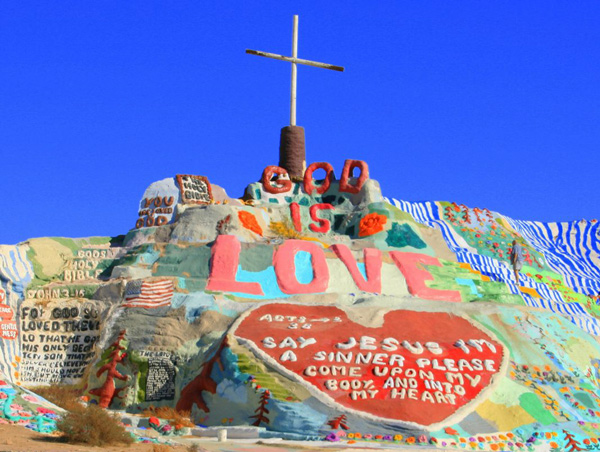
Part of the AGO description of ‘This Mountain Loves You’ mentions that it is a tribute to, and a recreation of, Salvation Mountain in southern California.

Photo credit: by Kevin Key, found online at Los Angeles Magazine in an interesting article about the site and its creator, Larry Knight who worked on it for 30 years before his death in 2014.

As you can see in the above photo, Salvation Mountain is predominantly about God and Jesus whereas the fabric mountain proclaims a message of secular love, hope, and acceptance.  Messages such as “trust in your abilities”, “love ahead!”, and “keep families together”.

AGO, Art Gallery of Ontario, This Mountain Loves You, by AGO youth council,

Today was the last day that this ‘mountain’ was on display.

Toronto Outdoor Art Fair 2018,
Nathan Phillips Square

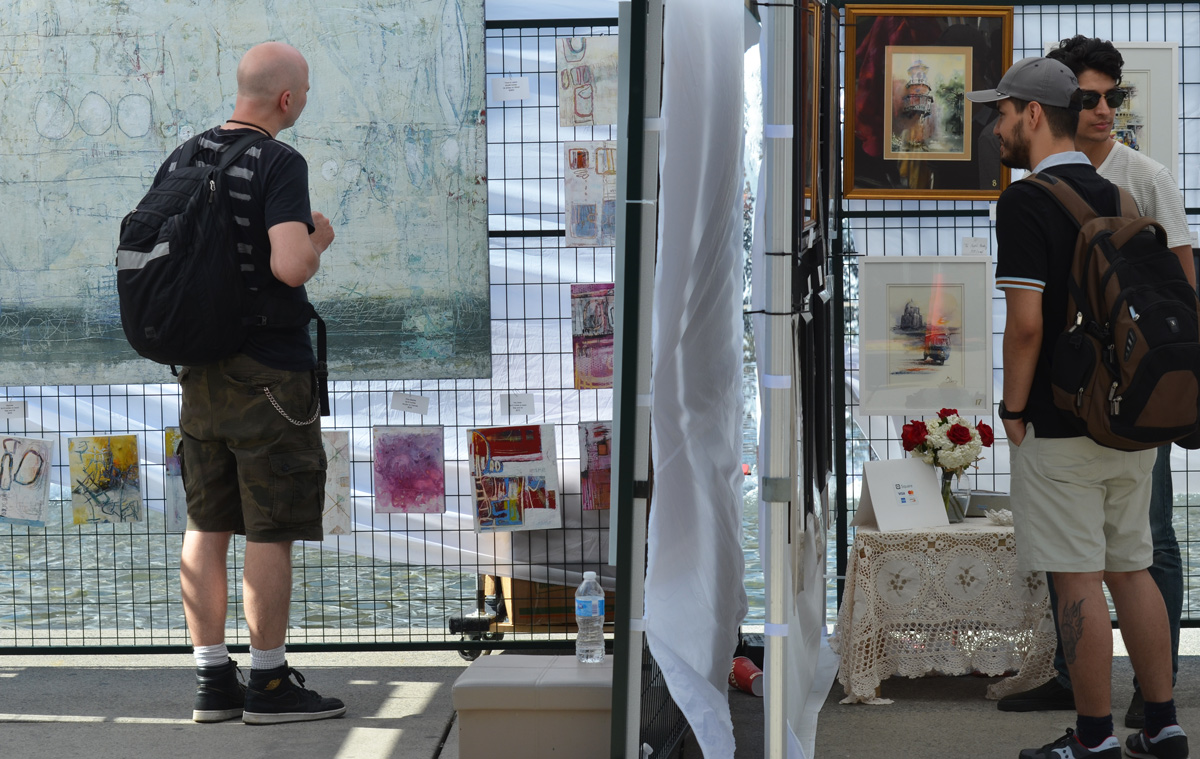
three men, in two different booths, side by side, looking at paintings, Nathan Phillips Square, outdoor art fair

three men looking at paintings, Nathan Phillips Square, outdoor art fair

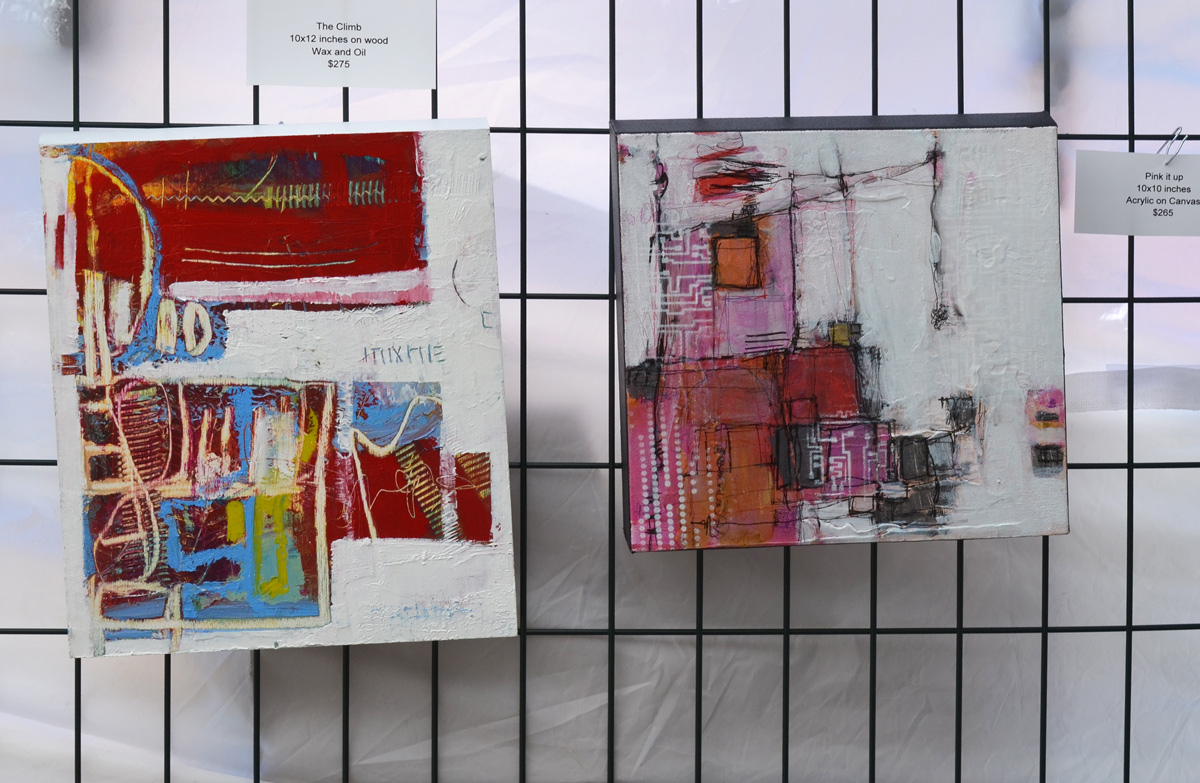
two small paintings on wood, hanging on a metal grid

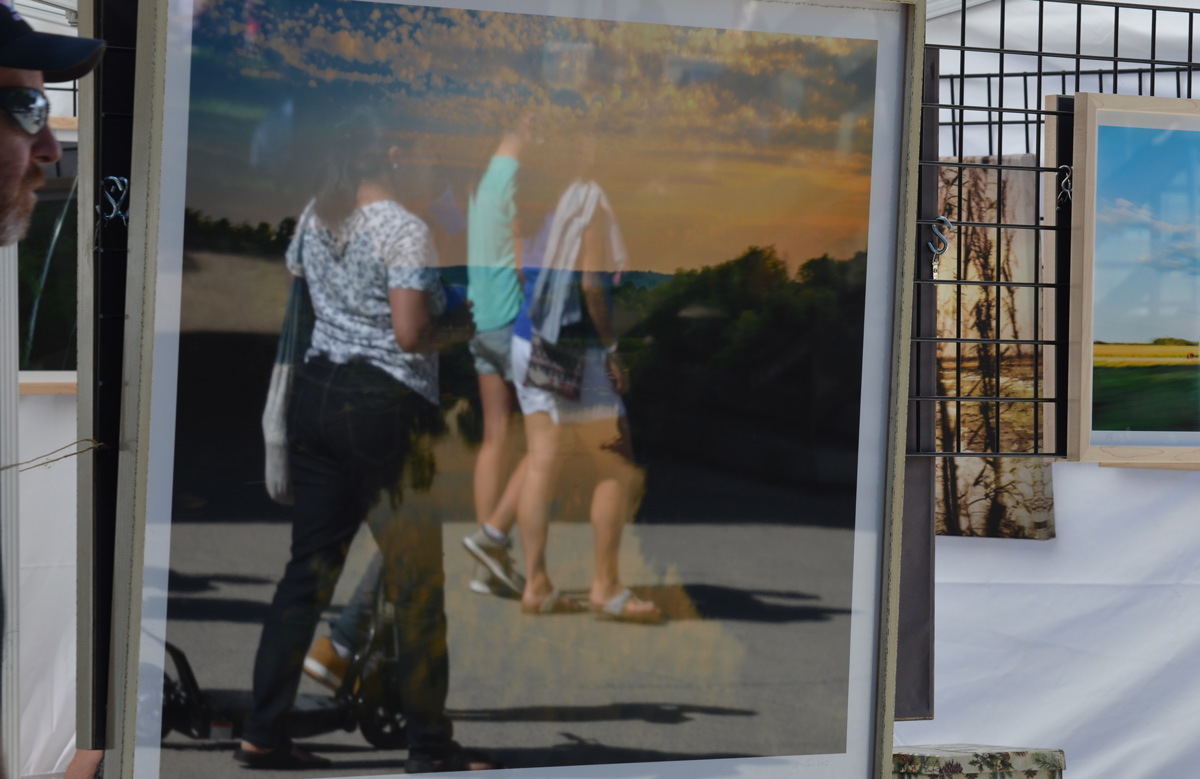
reflections in a framed artwork, people passing by, outdoor art fair

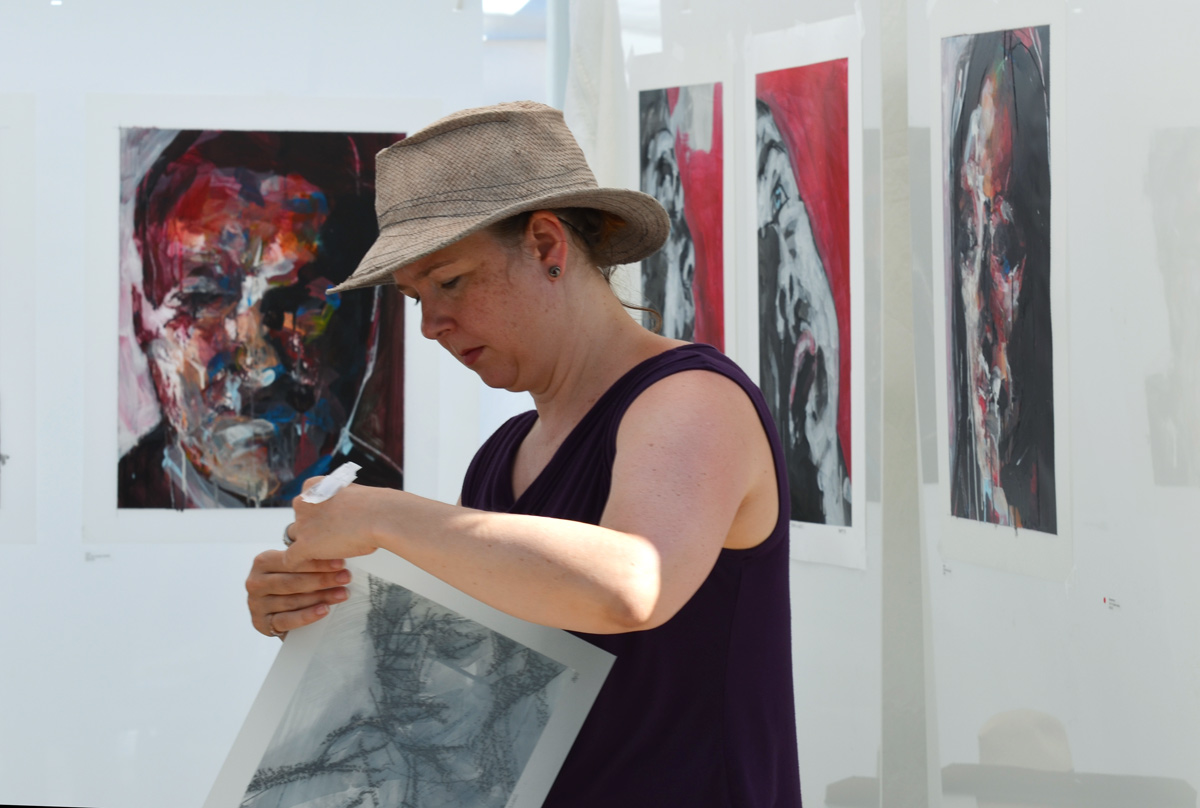
woman in a brown hat starts to pack up her paintings of people's faces at the end of an outdoor art fair in Toronto

two paintings in a booth at an outdoor art fair, one is yellow, there is a table in front of it, with a flower and and a hat on it, a man walks past

three little glass sculptures of little robot like creatures with rectangular heads and one large antenna

a woman walks past a painting of a cat head in blues and greys,

old rusty hand saws with wood handles, blades have been cut in intricate designs, one in maple leaves and the other with oak leaves

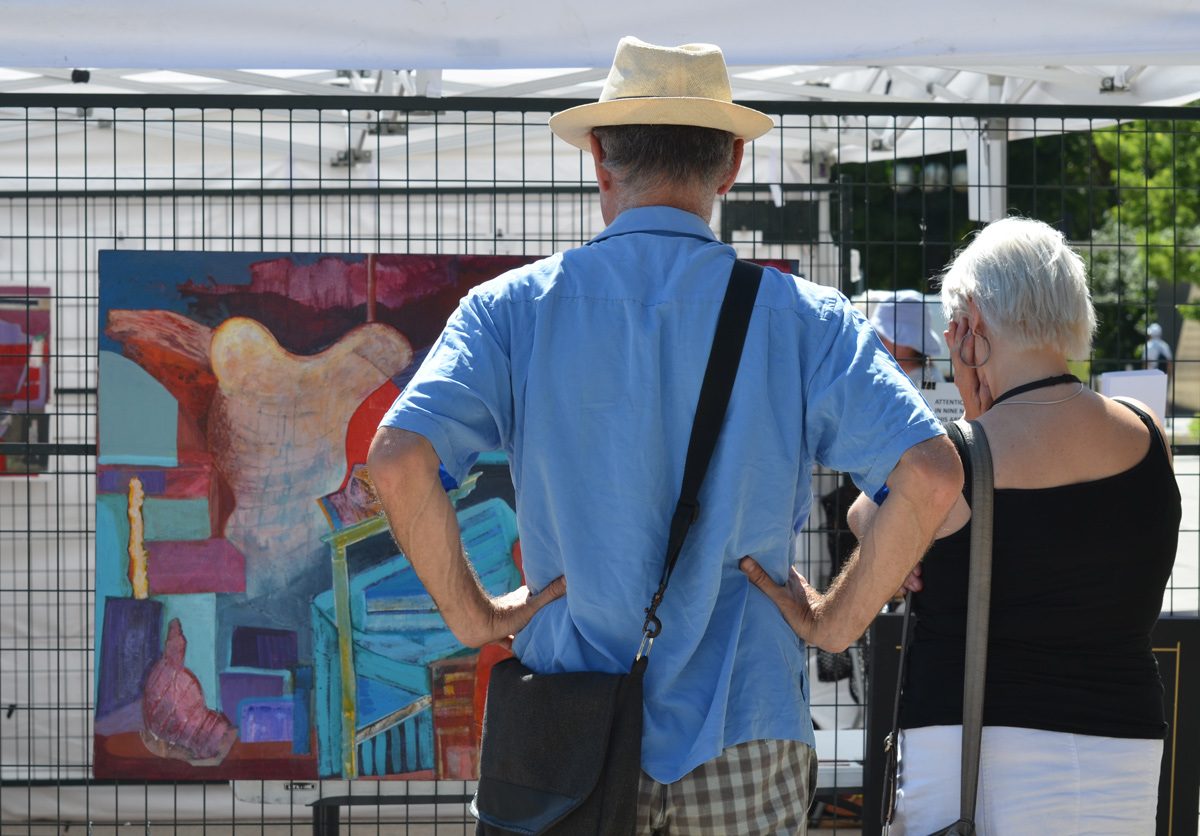
a couple looks at a painting at an outdoor art fair

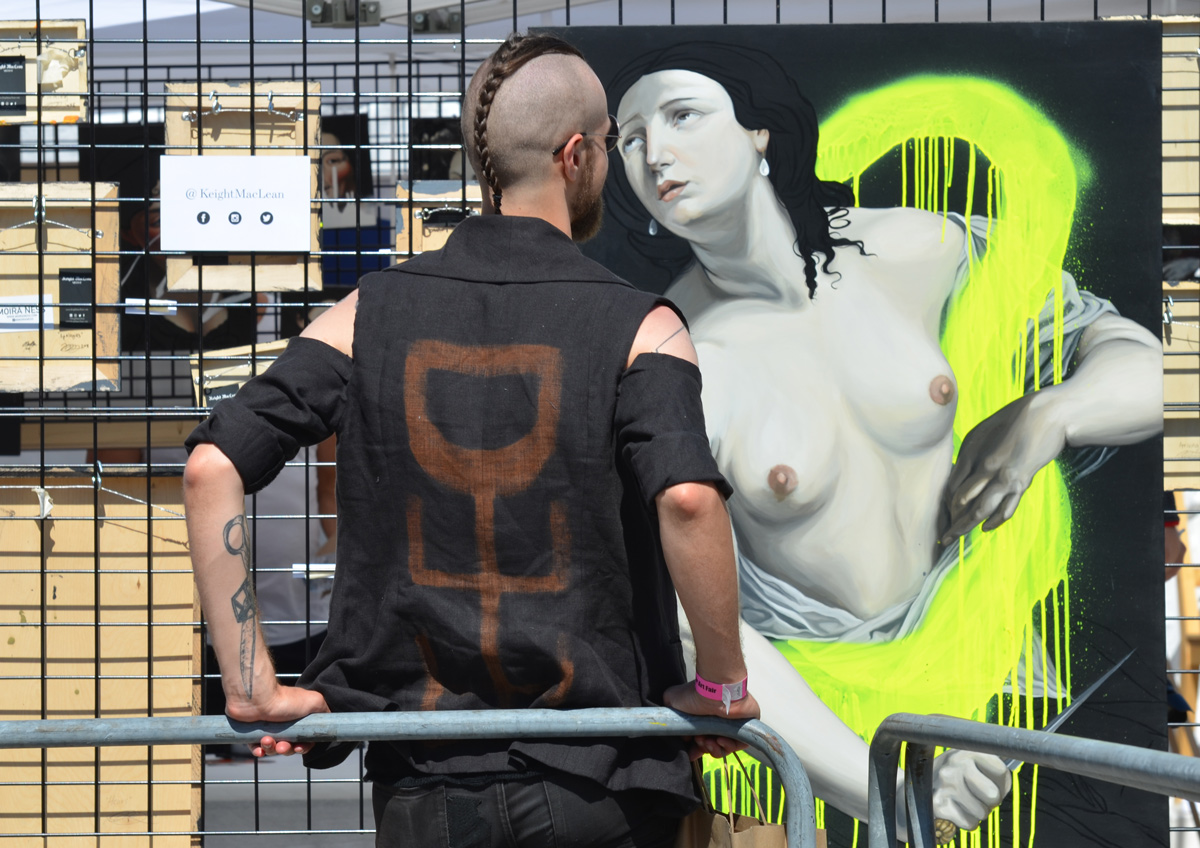
a man, with back to the camera, stands beside a painting of a topless woman, their faces are close together

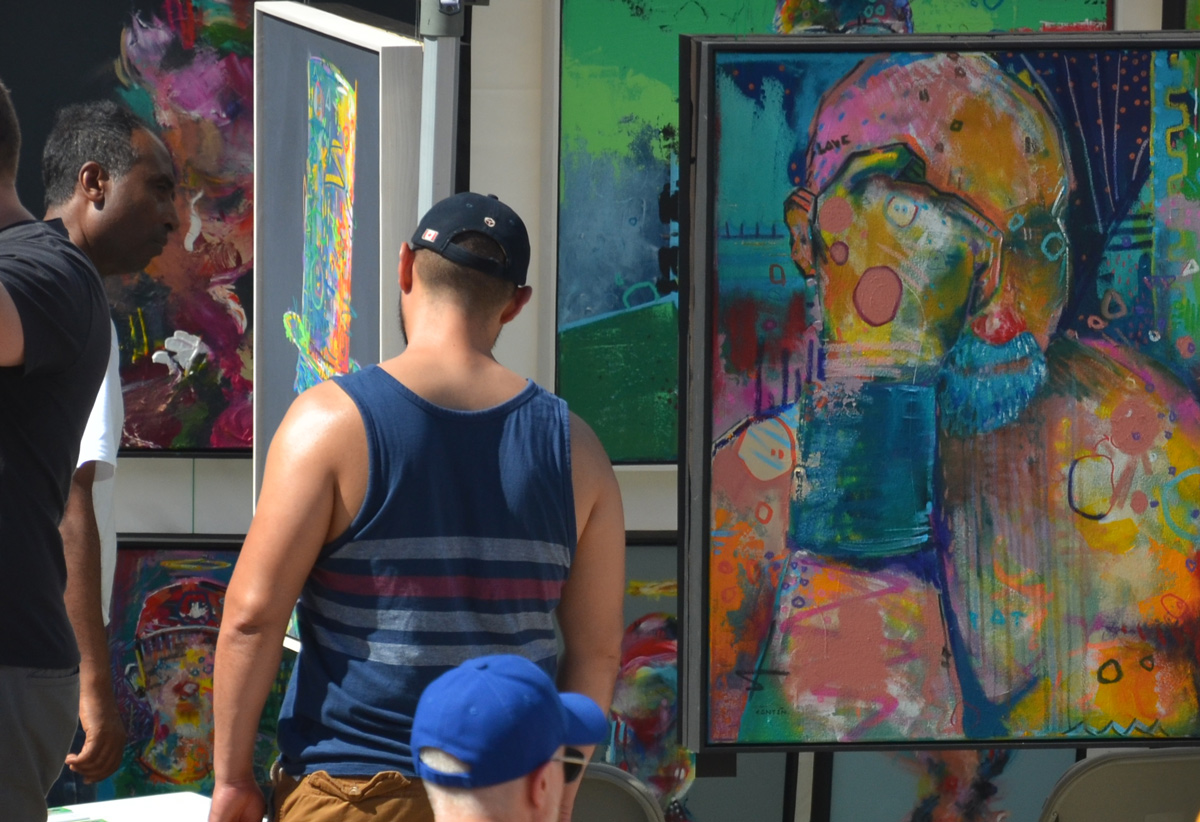
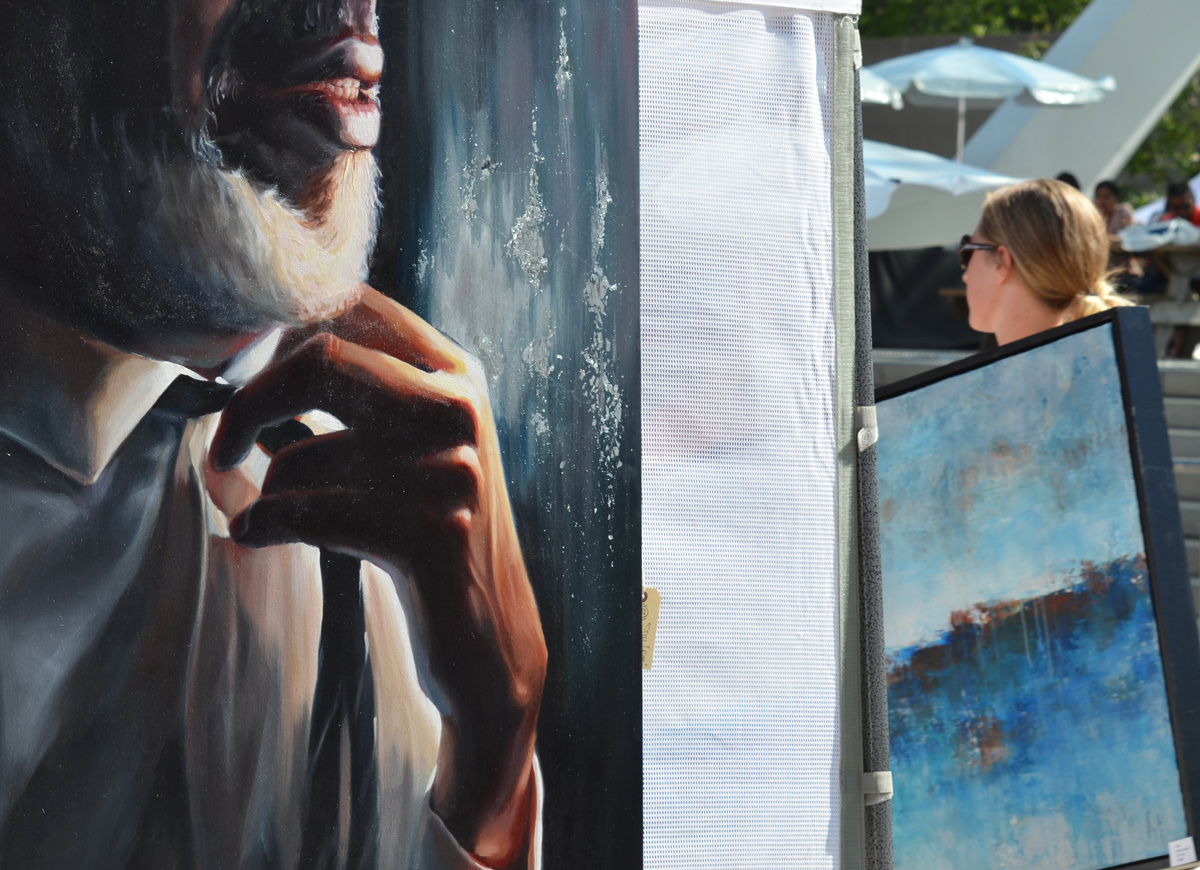
a woman carries a large painting, passes by another large painting of a black man with a white beard

a woman in a large brimmed pink hat is talking to another woman in front of some paintings at an outdoor art fair

five black and white photos are attached to a string with wooden clothes pegs

square artworks arranged in a grid on a metal mesh wall, hanging at an outdoor art fair.

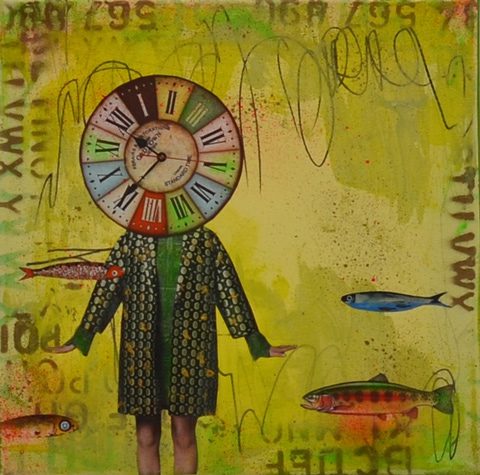
sqaure artwork, mainly yellow, person body with large clock head , fish swimming around, letters and numbers on the edges

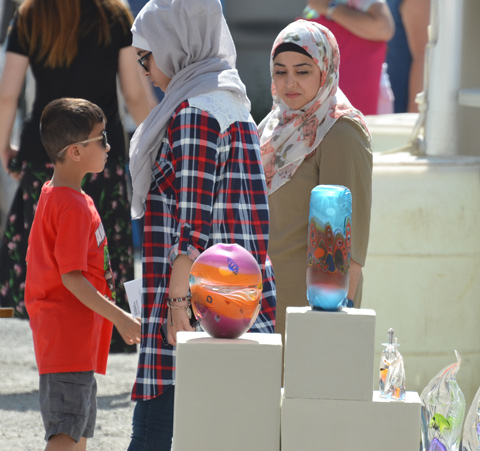
two muslim women in head scarves walk past some glass sculptures at an outdoor art fair

Tinirrusiangit is an Inuktitut word that means “their gifts” or “what they gave”.   It is the name of the latest exhibit at the Art Gallery of Ontario features the work of two Inuit artists, Kenojuak Ashevak (1927-2013) and her nephew Tim Pitsiulak (1967-2016).   Ashevak (1927-2013) was born in southern Baffin Island although she grew up on the land in the traditional, semi-nomadic hunting lifestyle, living in igloos and skin tents.

In the 1950’s she developed TB and ended up, against her will, in a hospital in Quebec City  This was not a happy time in her life.  She had just given birth when she was forcibly transferred; the baby was adopted by a neighbouring family. Several of Kenojuak’s children died while she was in the hospital.   One of the ways of passing time at the hospital was making arts and crafts such as beading and doll making.

When she returned to Kinngait Nunavut (previously Cape Dorset), she learned printmaking.  She was also one of the early members of the West Baffin Eskimo Collective which became Kinngait Studios.

Ashevak was the first internationally known Inuit artist.  Her most famous piece, ‘The Enchanted Owl’ 1960, was used on a Canadian postage stamp in 1970 in honour of the Northwest Territories centennial.   Owls were one of her favorite subjects.


below: Ravens and Owl, 1979, stonecut and stencil on paper, by Kenojuak Ashevak

a picture of an Inuit artwork, Ravens and Owl, stonecut and stencil on paper, 1979, by Kenojuak Ashevak

below: Happy Little Owl, 1969, stonecut on paper, by Kenojuak Ashevak

a picture of an Inuit artwork, Happy Little Owl, stonecut on paper, 1969, by Kenojuak Ashevak

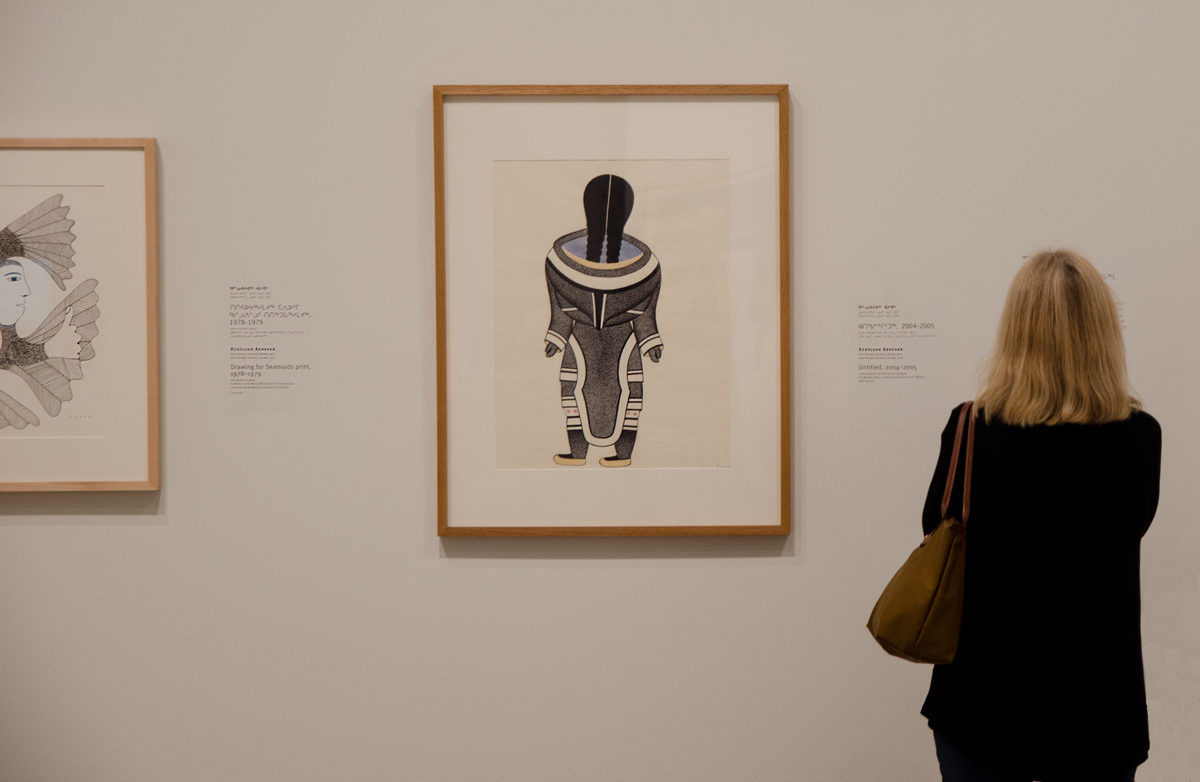
below: Untitled, 2004-5, pencil and felt tip marker on paper, by Kenojuak Ashevak

woman in an art gallery looking at two pictures on the wall, both by Kenojuak Ashevak

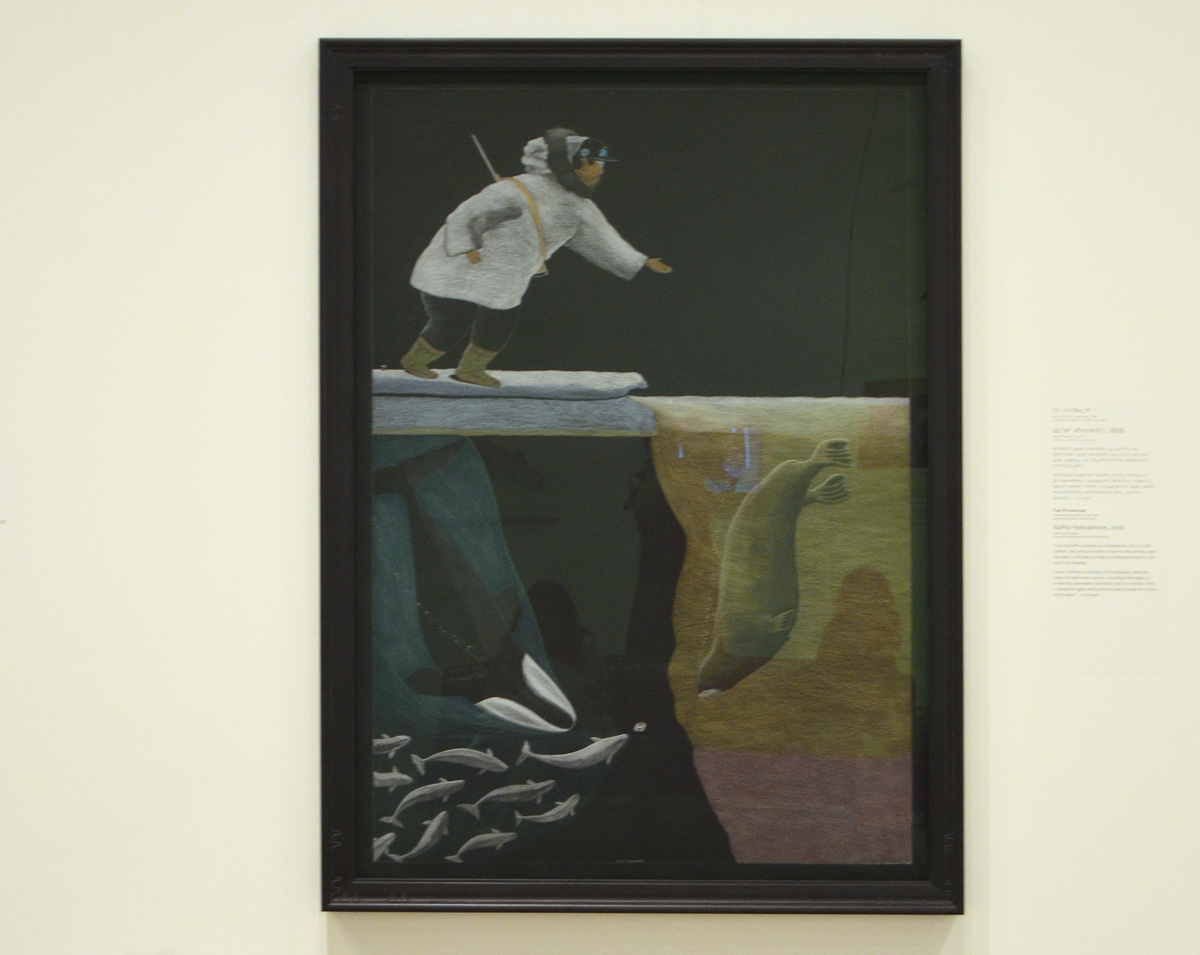
Tim Pitsiulak, born in Kimmirut Nunavut,  was a hunter and a painter.  He started drawing as a young boy and although he tried carving and jewelry making, most of his artwork centers around depicting everyday life in drawings and paintings.

below: GoPro Hydrophone, 2016, pastel on black paper, by Tim Pitsiulak.  Here, the artist (the hunter) throws a GoPro camera into the water to record the sounds and images of the animals in the water.

gopro hydrophone, a painting by Tim Pitsiulak at the art gallery of Ontario

“What more could I ask for, than for people to notice what we have up here? This is the best thing about being and artist and a hunter.” Tim Pitsiulak quote on the wall at the AGO.

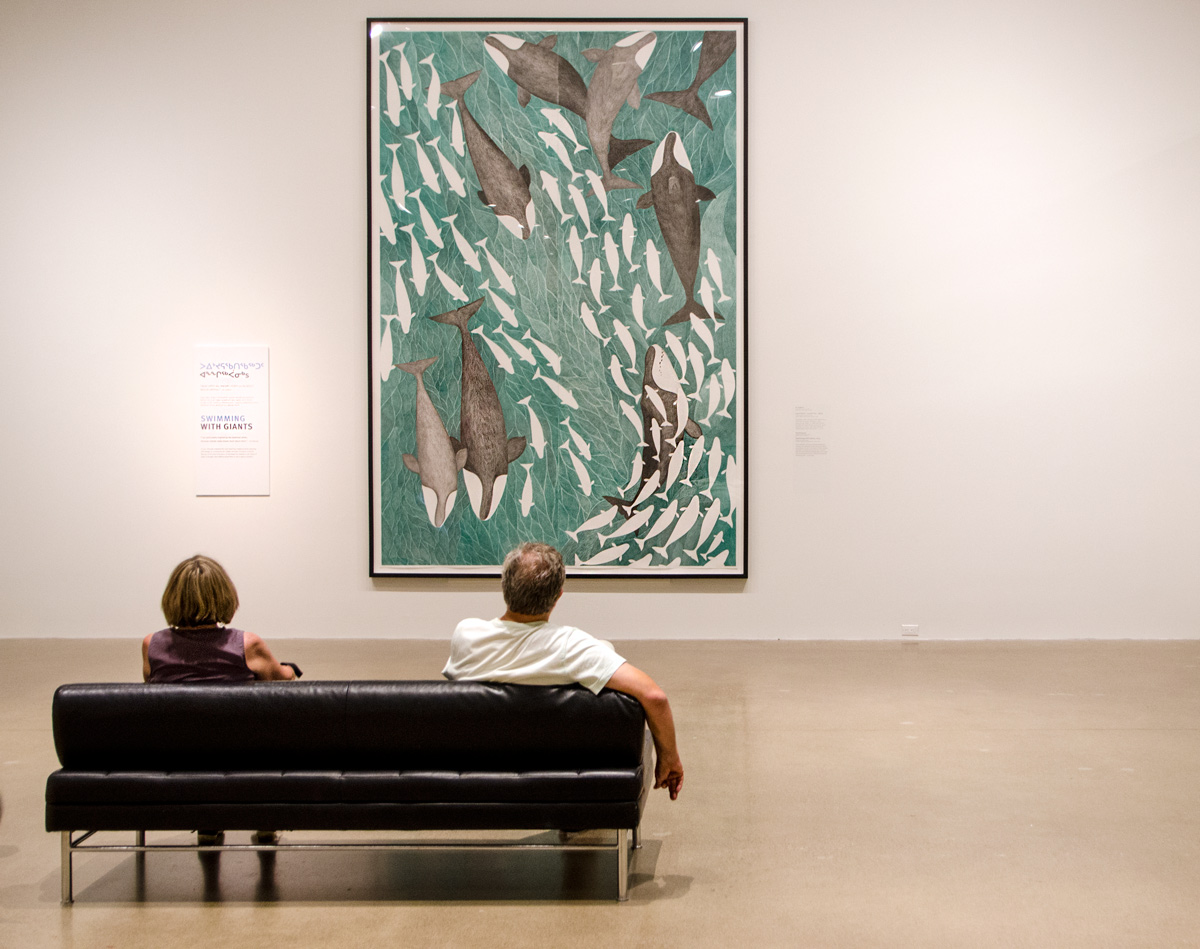
below: Swimming with Giants, 2015, by Tim Pitsiulak.  Beluga whales swimming with a bowhead whale.

two people sitting on a black sofa, looking at a large painting by Tim Pitsiulak called Swimming with Giants, lots of fish and whales swimming in the water


The exhibit continues until 12 August 2018

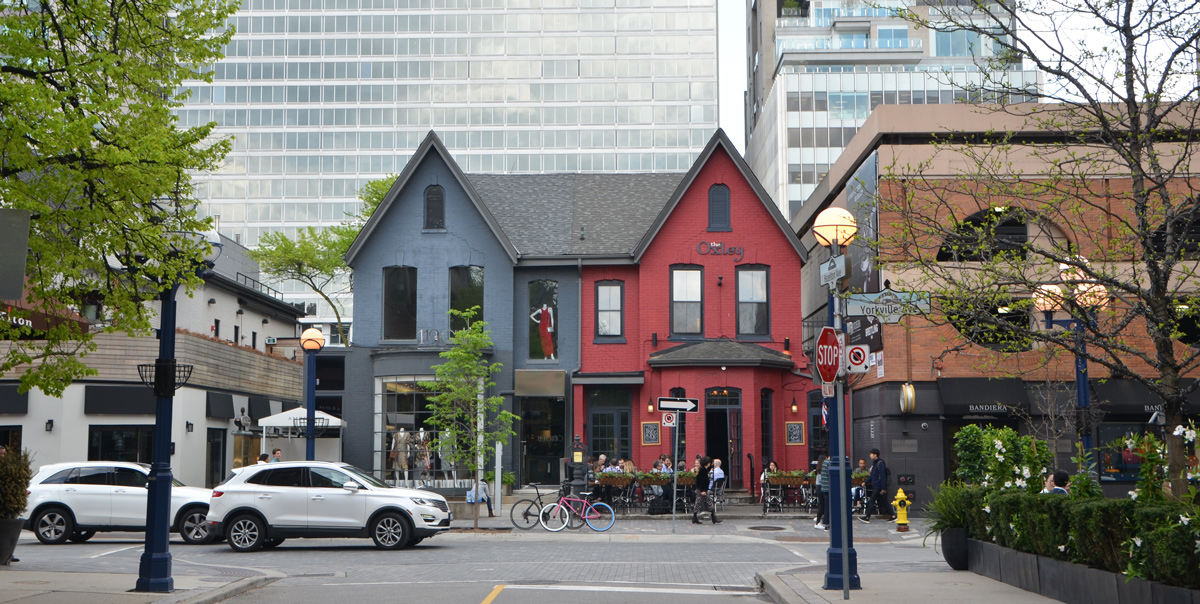
looking down Hazelton Ave towards Yorkville Ave., two older houses, now used as commercial businesses, one half painted blue and the other half is red.

It’s still May and the CONTACT Photography Festival is still on so I am still trying to see as much as possible.   Yesterday afternoon I went wandering in Yorkville where there is lots to see and do besides a couple of CONTACT exhibits.

below: Captain Canuck.  I started with the TD Gallery at the Toronto Reference Library.  It wasn’t that long ago that I was there (April I think) but the exhibit has changed.   It is now ‘Alter Ego: Comics and Canadian Identity’.  Isn’t Captain Canuck the most famous Canadian superhero?  He first appeared in 1975.

painting of Captain Canuck, from the chest up, one arm raised to shoulder height

below: Not so well known – The cover of the book ‘Nelvana of the Northern Lights’ by Adrian Dingle (1911-1974).   Nelvana was Canada’s first female superhero; she first appeared in 1941, a few months before (American) Wonder Woman.  Nelvana’s superpowers included turning invisible and traveling at the speed of light along a ray of the Northern Lights.  According to Wikipedia, she “visited lost kingdoms under the ice, journeyed to other dimensions, and fought against the Axis Powers during World War II, eventually taking on the secret identity of secret agent Alana North.   Her last adventure was published in 1947.

book cover, book called Nelvana of the Northern Lights, a comic book by Adrian Dingle, 15 cents, 68 pages, hard cover

below: This structure was built in 1876 as a Carpenter Gothic Revival Style church – the Olivet Congregational Church.  It has been the home of the Heliconian Club since 1923.  This women only club was formed in 1909 and is still active today supporting women in the arts.  There is a photo exhibit on there at the moment but viewing is by appointment only (it is a club not a gallery after all).

pale blue wood building, originally a church, now the home of the Heliconian Club on Hazelton ave. Bright blue doors, two, rose window,

below: For CONTACT, the Lomas Gallery on Yorkville Ave is featuring a few large photos of cityscapes that are full of tall buildings.  The one behind the red couch is ‘NoMad New York’ by Christopher Woodcock.

Lomas Gallery in Yorkville, bright red oval shaped couch in front of a wall with a large photo of a city scene, lots of skyscrapers with lots of windows, by Christopher Woodcock, plus words on the wall that say Contact Festival, City Obscure, Windows on either side of the wall with people passing by

below: On the wall beside is ‘[a]DCLXI’ by Amyn Nasser.

on a gallery wall, Lomas Gallery, a large photo, [a]DCLXI by Amyn Nasser of a wall of glass skyscrapers with lots of windows, on the wall beside is another photo in which Nasser's photo is reflected.

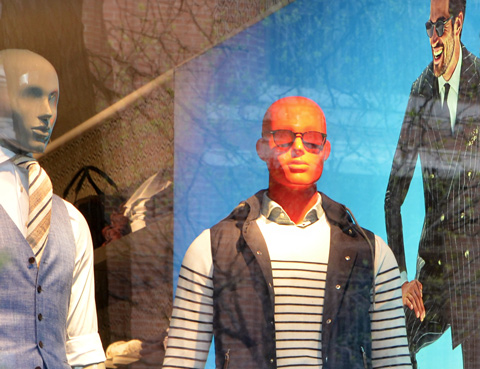
below: It’s not a sculpture or a statue, but this red faced mannequin caught my eye. Maybe next time he’ll remember his sunscreen.

two male mannequins in a mens wear store window, one has a very red face, also a picture of a man in a black suit with a bright blue background is in the window

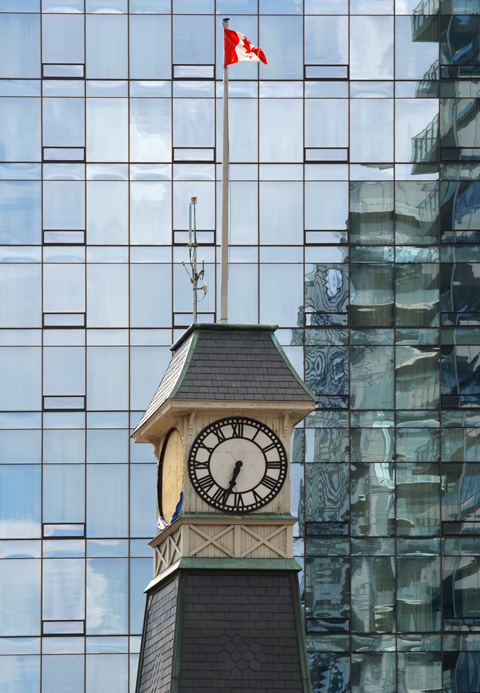
below: The clock tower of the Yorkville firehall. One side seems to missing its clock face.

the clock tower of Yorkville fire station with a reflective glass building behind it. A Canadian flag is flying on top of the firehall clock tower.

below: Brendan Meadows’ black and white portraits hang on the walls of the Liss Gallery in an exhibit titled ‘Ipseity’.  These were printed as silver gelatin selenium-toned lith prints by Bob Carnie from negatives made from digital images.  The images were also  manipulated with the Sabatier effect (solarization); this results in an image that is wholly or partially reversed in tone. Dark areas appear light or light areas appear dark.

interior shot, Liss Gallery, frames black and white portraits on the walls

below: Posters on hoardings add a little life at street level to the construction sites in the area.  This set features businesses and sites in the area including the ROM.

posters on hoardings in front of a construction site - picture of the ROM at night, picture of the interior of a menswear store, man trying on a suit

below: Some colourful art deco style posters.

art deco posters on hoardings in front of a construction site

art deco posters on hoardings in front of a construction site inclujding a Vogue picture

below: Prepared for anything!  With a yellow duckie, handcuffs and binoculars, Batman and his Robin hand puppet prepare to take on the forces of evil!  These are sculptures by Patrick Amiot.

a metal junk sculpture by Patrick Amiot, outside, by the front door of an art gallery, batman, with a very small robin in one of his hands.

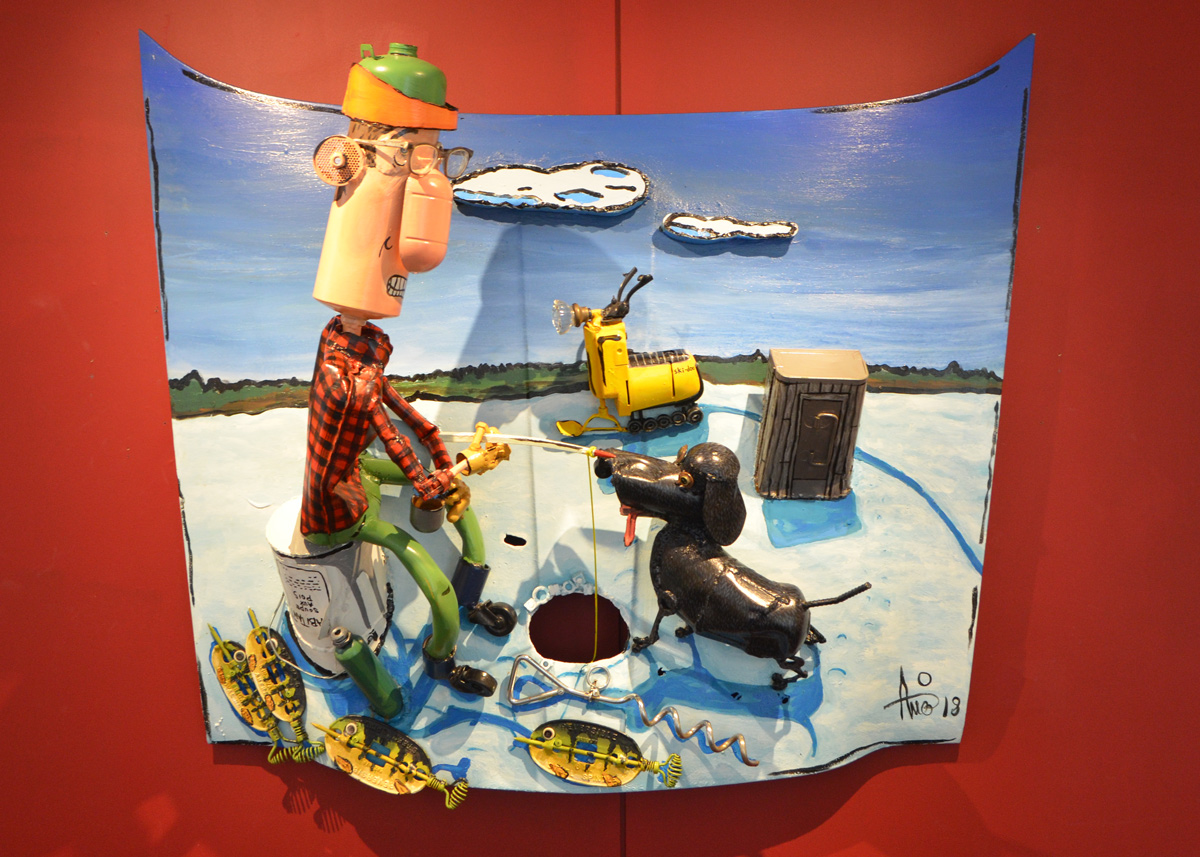
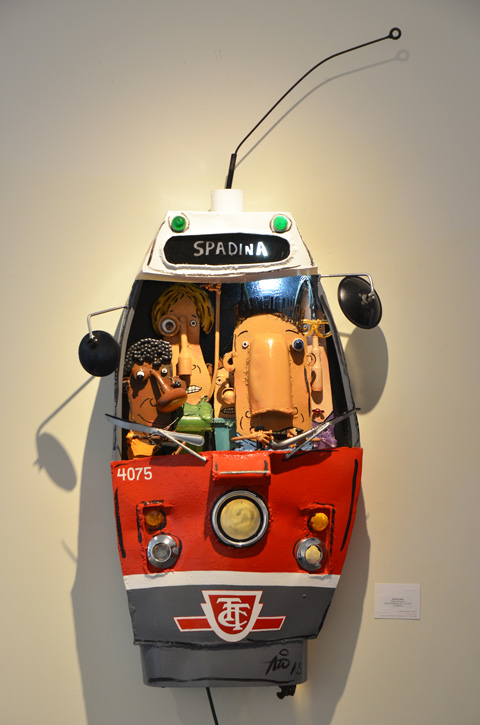
below: Part of the Miraim Schiell gallery is devoted to Amiot’s work.

a wall mounted artwork by Patrick Amiot of a man ice fishing with his dog, created from junk

an artwork on a gallery wall, by Patrick Amiot, of the front of a Spadina TTC streetcar, crowded with driver, man, and dog,

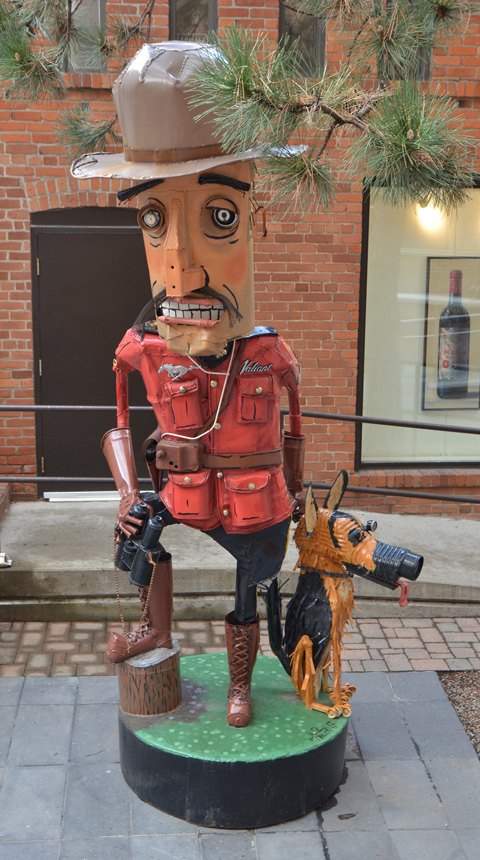
below: This large RCMP mountie and his dog stand behind the gallery.

metal junk sculpture by Patrick Amiot of a mountie and his dog, outside, behind a gallery in Yorkville

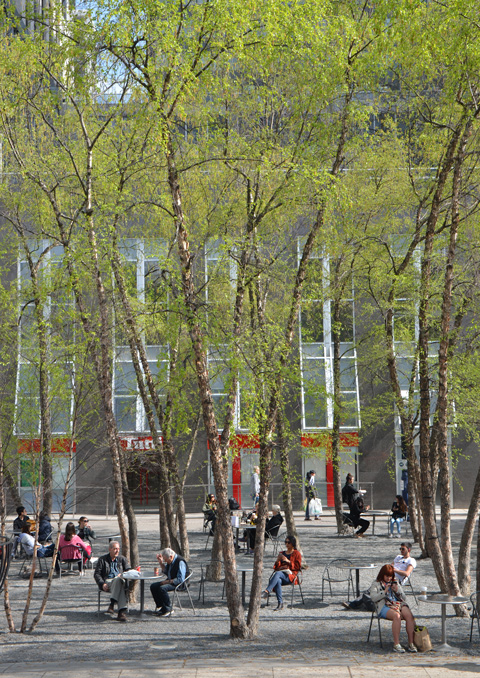
below: Enjoying the wonderful spring afternoon on Cumberland.

outside, park in Yorkville, tall trees with leaves just coming out, spring, people sitting on chairs under the trees, talking, reading, phones, drinking,

statue of a bear outside, life size, a painting in a glass enclosed box is behind him

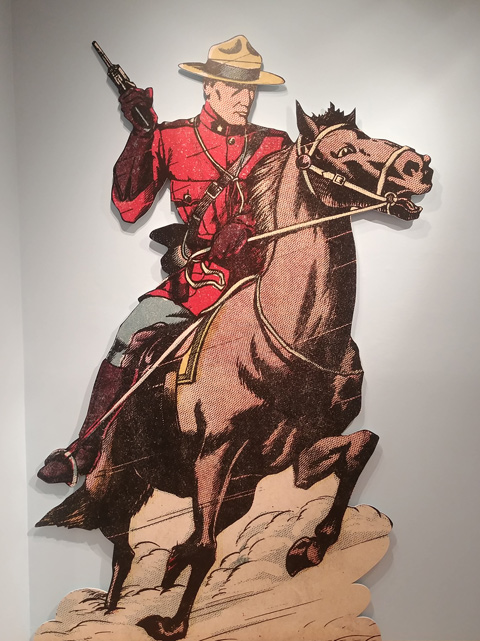
below: Oh.. that second mountie that I alluded to in the title of this post – he was on the wall at the Alter Ego exhibit.  This one.   Just don’t call him Dudley Do-Right.

large picture of a mounti on a horse with a gun in his hand, on a wall in a gallery

below:  This is either ironic or sad.  The first few lines of text say “In the the 1960s and 1970s, Yorkville village was the heart of Canada’s bohemian, counterculture community”.  As I took this picture a new Bentley with dealer plates drove past.  I looked around and the ‘counterculture’ of 40 to 50 years ago has been replaced by designer boutiques, high end stores, fine art galleries, and restaurants with linen napkins.  Not a lot of music happening here.  Full transcription is below.

plaque to Yorkvilles music scene, Heritage Toronto black and white plaque, from 2016

“In the the 1960s and 1970s, Yorkville village was the heart of Canada’s bohemian, counterculture community. More than 40 clubs and coffee houses nightly featured folksingers-songwriters, including Ian & Sylvia, Gordon Lightfoot, Joni Mitchell, and Neil Young, who performed some of their first compositions in these smoky venues.
Yorkville’s first coffee house, Club 71, was opened by Werner Graeber in 1959. By 1964, Yorkville had become a nurturing environment not only for folk music, but also for pop, blues, and later, psychedelic rock. Hippies and teenagers flocked to these unlicensed venues, which offered an alternative to Yonge Street bars.
Yorkville was also home to three sound-recording studios, taping major acts such as The Guess Who, Lighthouse, and Ann Murray. With its vital role in fostering a wealth of talent, the Yorkville scene inspired a generation of songwriters and led to the rise of a new Canadian sound.”

outside pizza pizza, man inside eating, another man outside looking at mural on the wall

… and vicinity

The Bentway is a new park being built under the Gardiner Expressway between Bathurst and Strachan.  I walked it almost two years ago when the park was only in the planning stages.   I thought that I’d take a look at it again the other day.  Originally, it was supposed to be ready last summer so it’s a bit behind schedule.  Surprised?

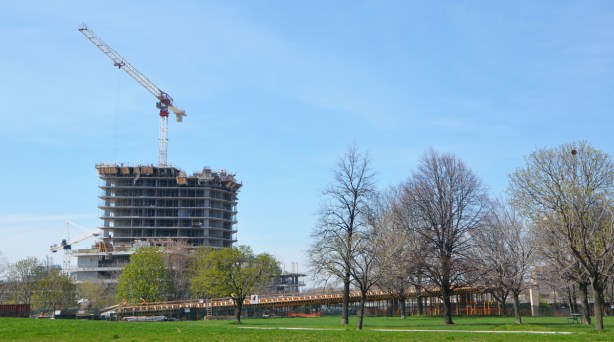
Walking south on Strachan from King, and whoa, there are changes happening here too.  Cranes everywhere.  Holes in the ground.   How many people are employed in the construction industry in Toronto?  in the GTA?

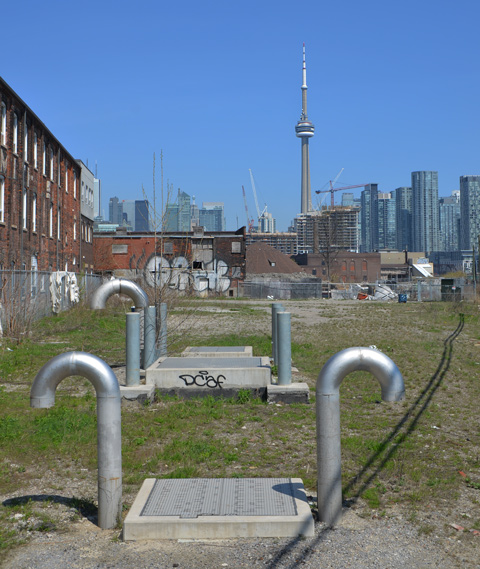
below: Looking eastward from Strachan Avenue, immediately south of King Street.

looking east from Strachan, immediately south of King, past older brick buildings to the CN Tower and city skyline

below: The view from a few metres farther south on Strachan.  The metal grid covers the railway tracks and supports the retaining walls on either side.  It also makes an interesting pattern.  These tracks turn northward – they are used by the UP Express to the airport and GO trains to places like Georgetown and Barrie.   There’s the CN Tower again – just in case you’re a CN Tower junkie like me.  I can’t resist taking pictures of it, especially when I find new angles, new foregrounds.
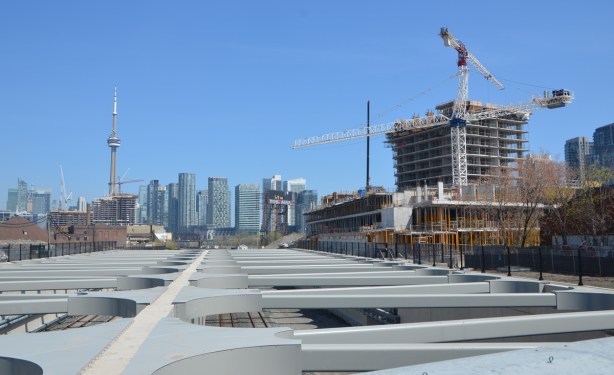
looing over the railway tracks to city skyline and CN Tower, construction of new building on the right

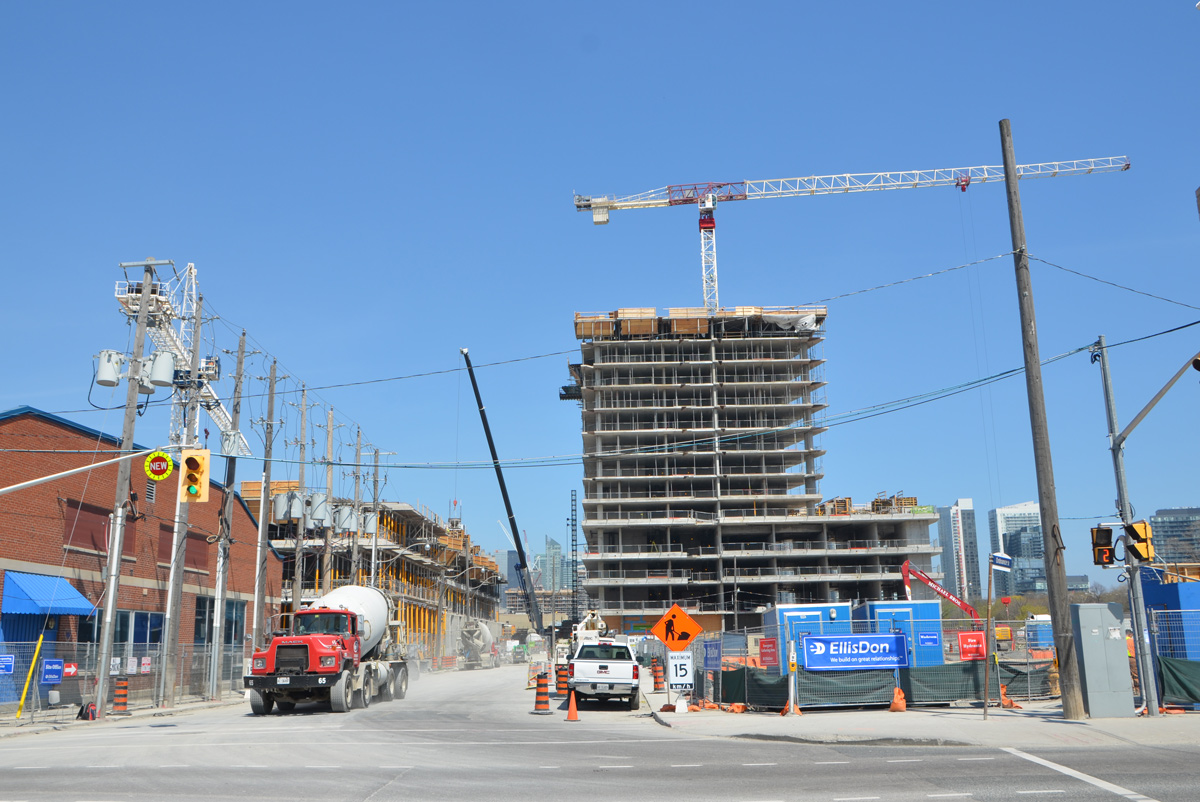
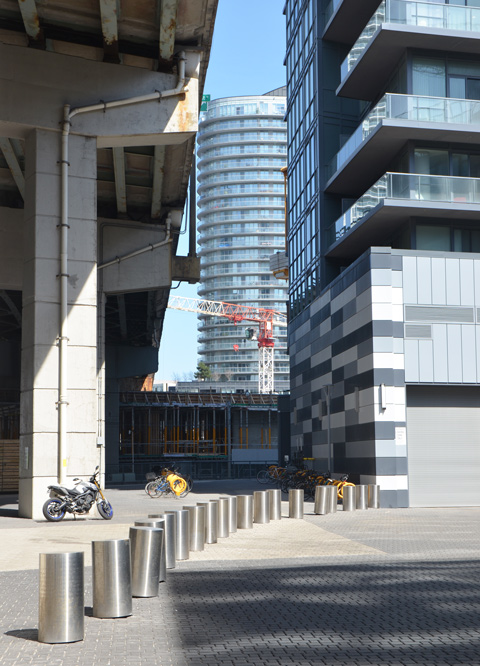
below: Immediately south of the train tracks is Ordnance Street.  Until recently it was a sleepy little dead end street of light industrials.
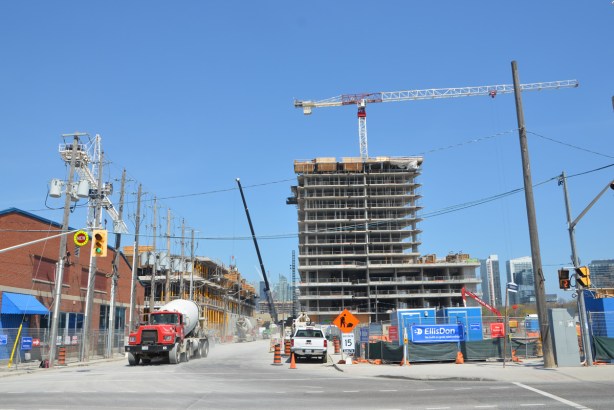
cement truck on street in front of construction site, cranes, fences, building about 20 storeys high

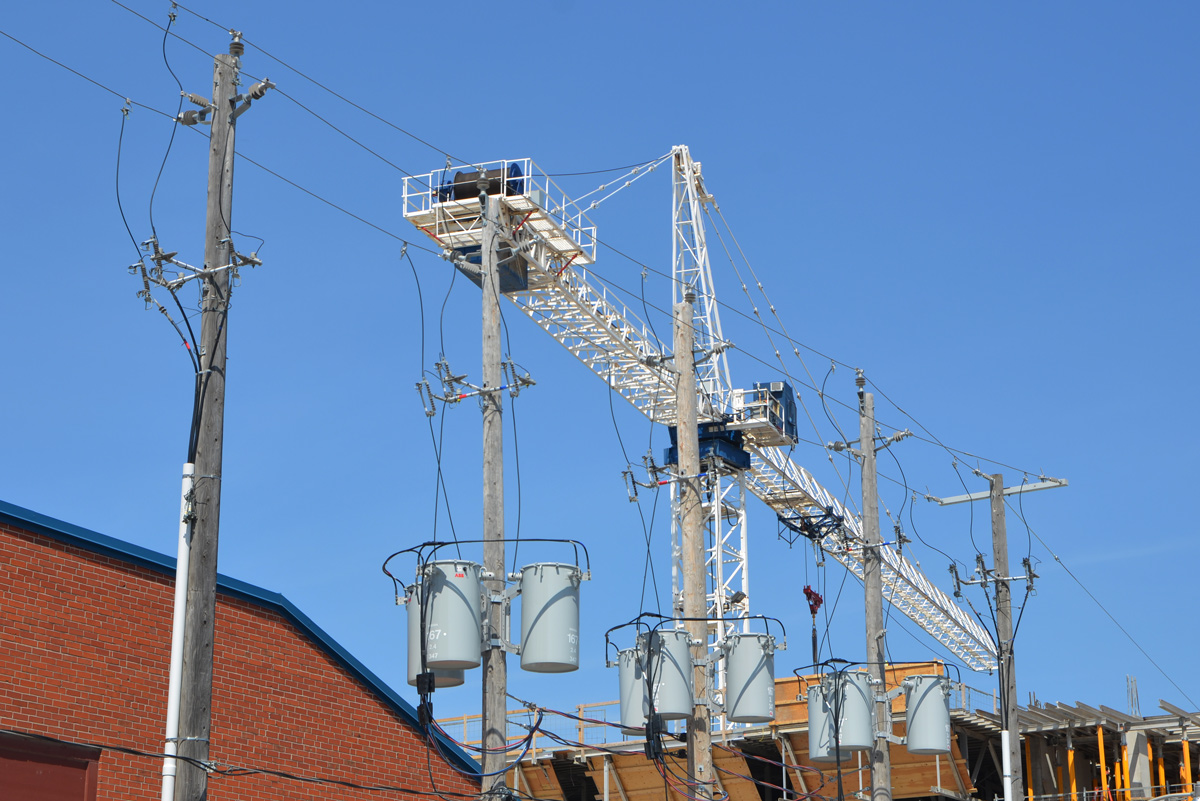
below: Ouch! Look at all those transformers on the poles.


white crane in the background, many hydro utility poles, with large grey cylindrical transformers on each of them

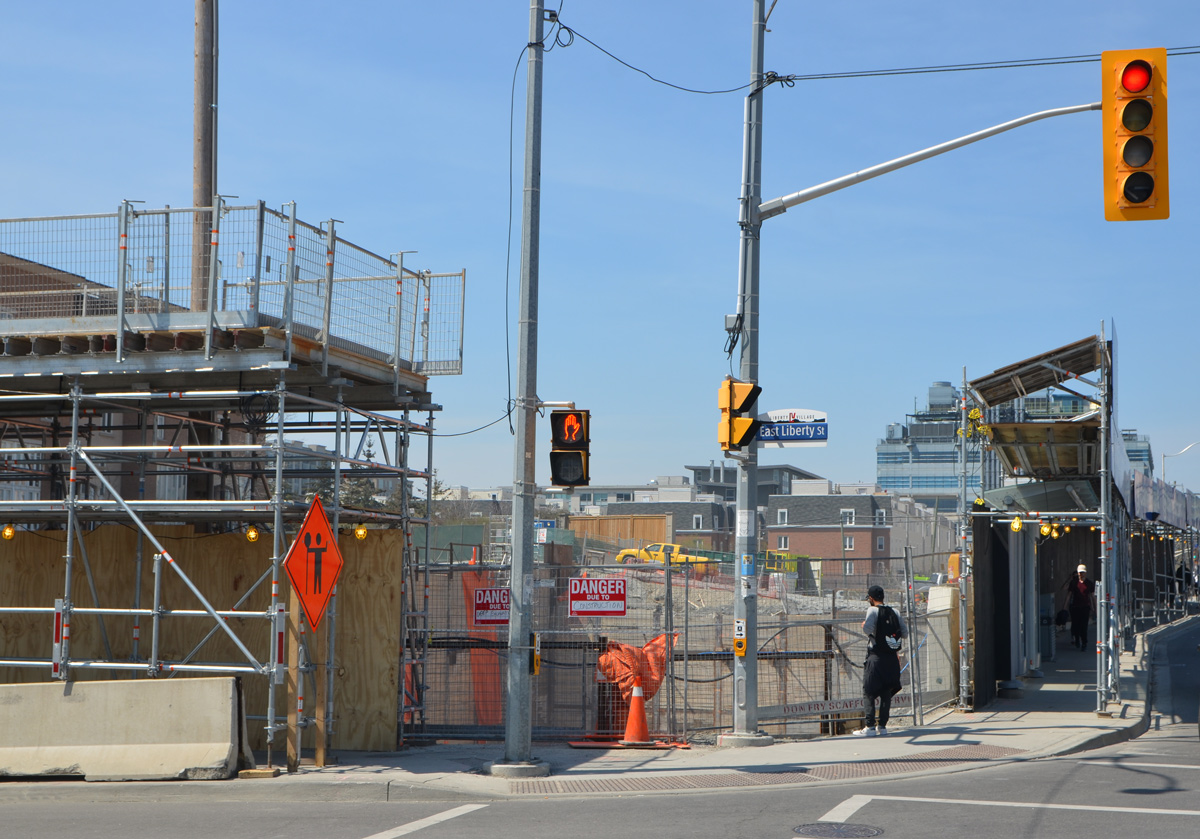
below: The east end of Ordnance Street is at Strachan.   It doesn’t actually end there, but continues on the west side as East Liberty Street.  This is the eastern edge of Liberty Village.
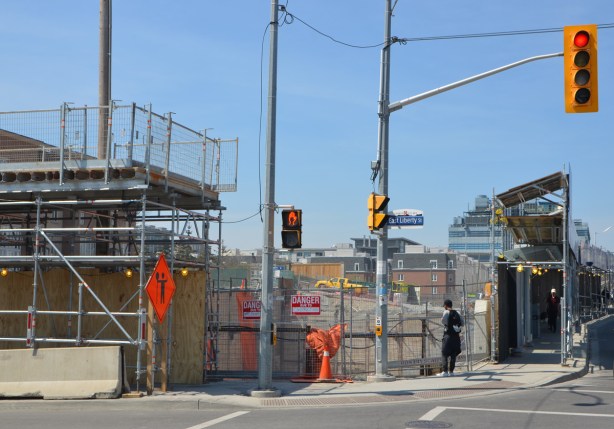
the NW corner of Strachan Ave and East Liberty Street, construction site with fence and hoardings.

Sorry, we haven’t got to the Bentway yet.  If you are a Torontonian you should now have your bearings and know at least approximately where you are.  Not far to go now.  It’s a beautiful day and we’re walking slow!

The Ordnance Street development is on a triangle of land with one side as Strachan Avenue and the other two sides as railway lines.

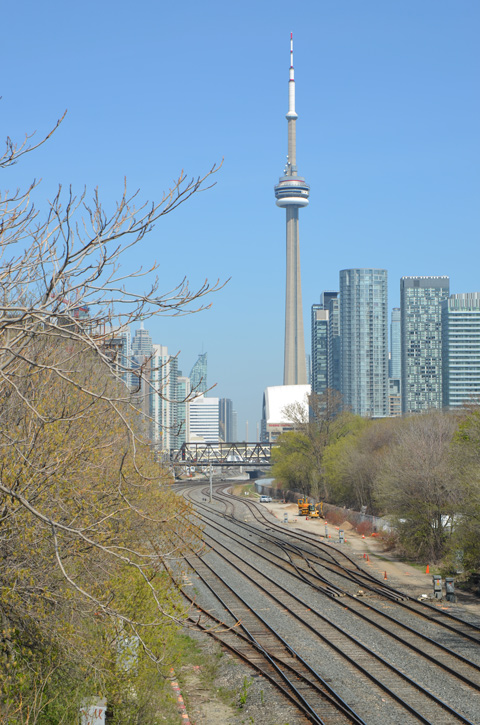
below: You’ll have to take my word for it that the construction on Ordnance Street is just behind the bushes on the left.   These are the tracks that run to the west and the bridge over the tracks is at Bathurst Street.  By this time, the two sets of tracks have come together as they approach Union Station.

railway tracks and CN Tower

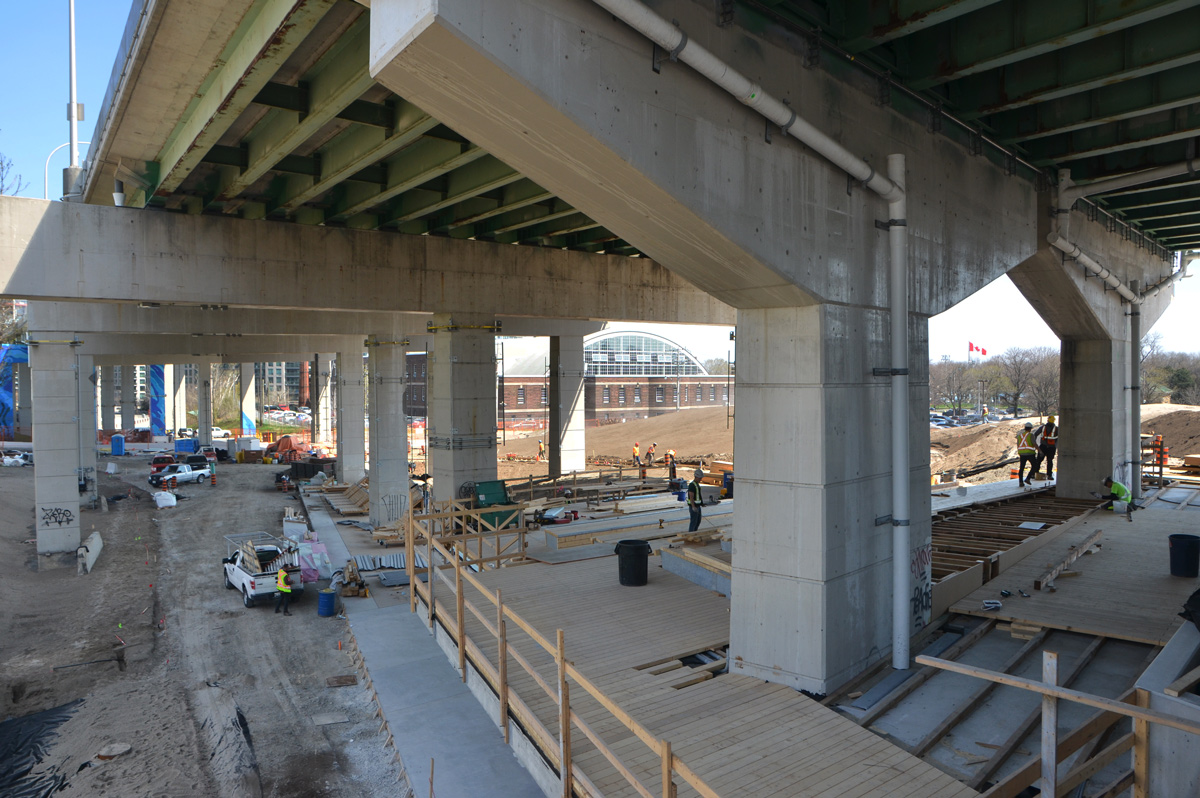
below: One of the first views of the Bentway.  More construction.  I was standing on Strachan when I took this picture.  This is the beginnings of a new entrance to the Bentway – a large staircase down the hill from the street.  The steps are wide to allow for multiple uses – a place to gather, a place for entertainment.

construction under the elevated Gardiner Expressway, making a large set of stairs down from Strachan Ave to Grenadier Common near Fort York

below: This end of the Bentway parallels Garrison Common.  The Ordnance Street development can still be seen but there is also another structure being built on Garrison Common side of the railway tracks.
construction of an elevated ramp beside a park from a distance, with condo building going on behind it

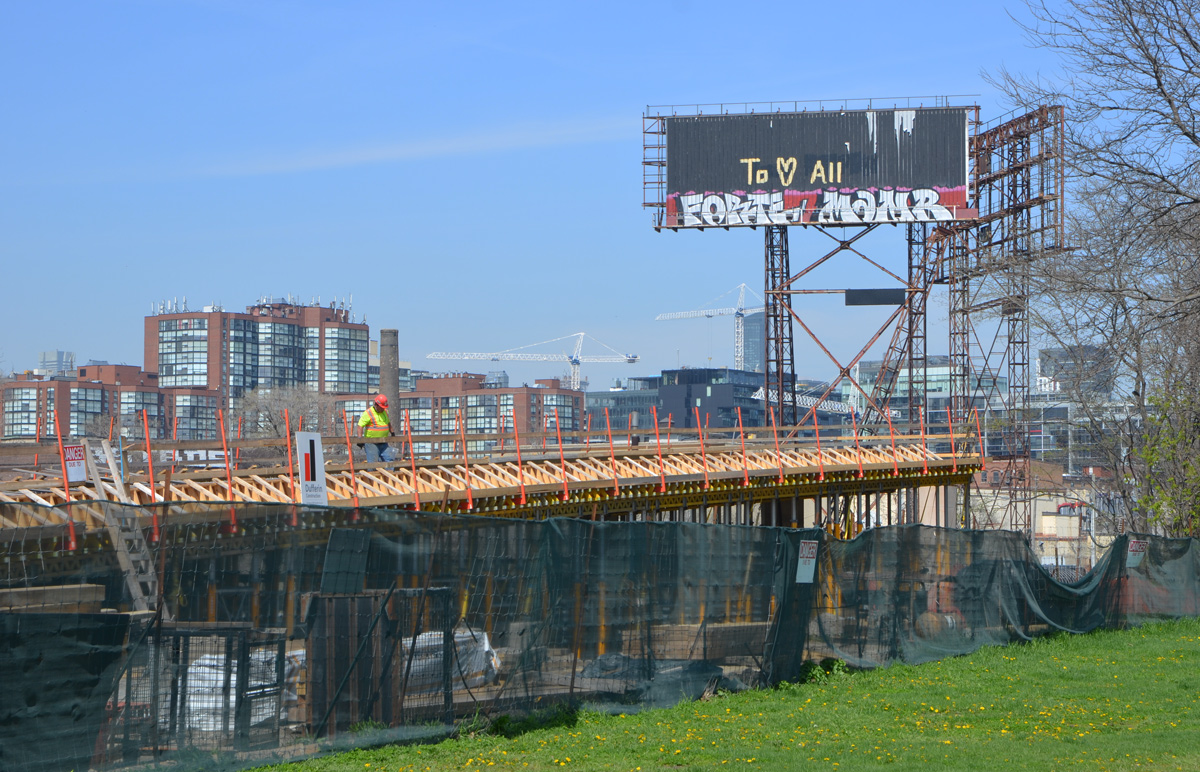
below: A closer look.  It appears to be a ramp to a pedestrian/cycle bridge that will cross the tracks and join Ordnance Street to the Bentway, Fort York, and the streets/paths to the south.  I also really like the billboards – one with graffiti and the other is empty.

billboard beside construction of an elevated ramp beside a park

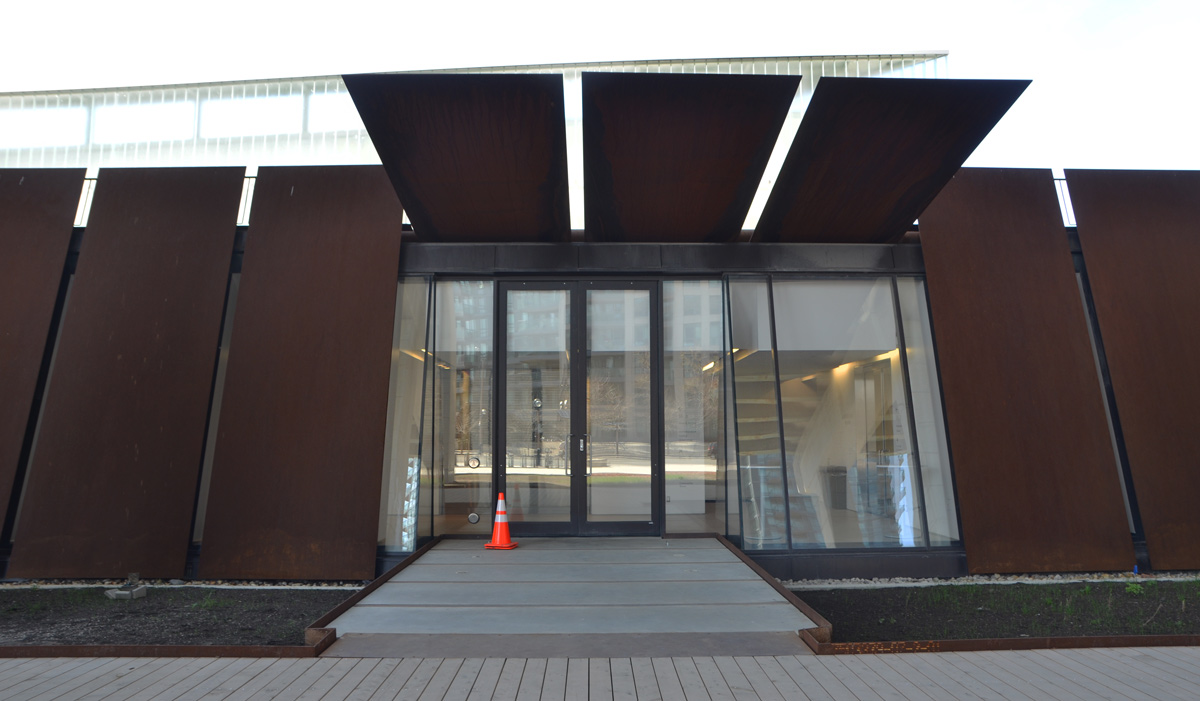
below: The new rusty entrance to the Fort York Visitors Centerentrance to Fort York visitors centre, rusted metal panels on exterior walls and as covering over doorway


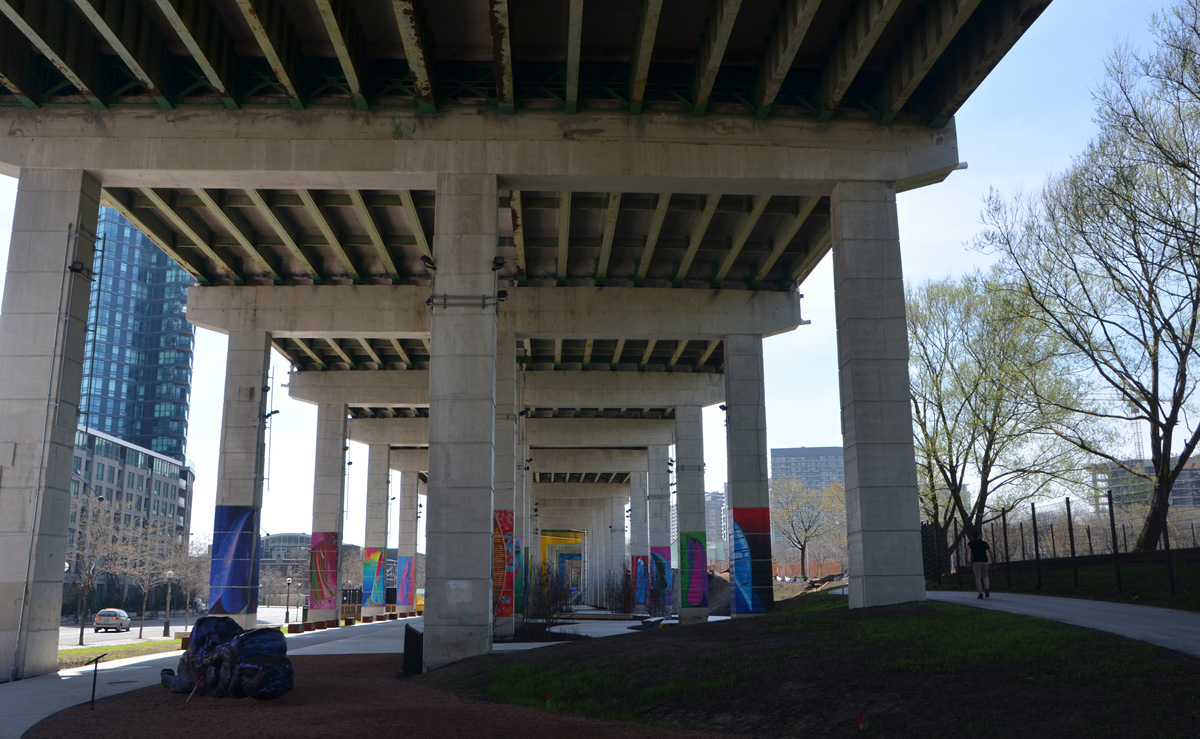
below: Just beyond the visitor’s center, the Bentway is closer to completion. There was a skating rink here this past winter.

concrete path winds under the bents and pillars of the Gardiner Expressway

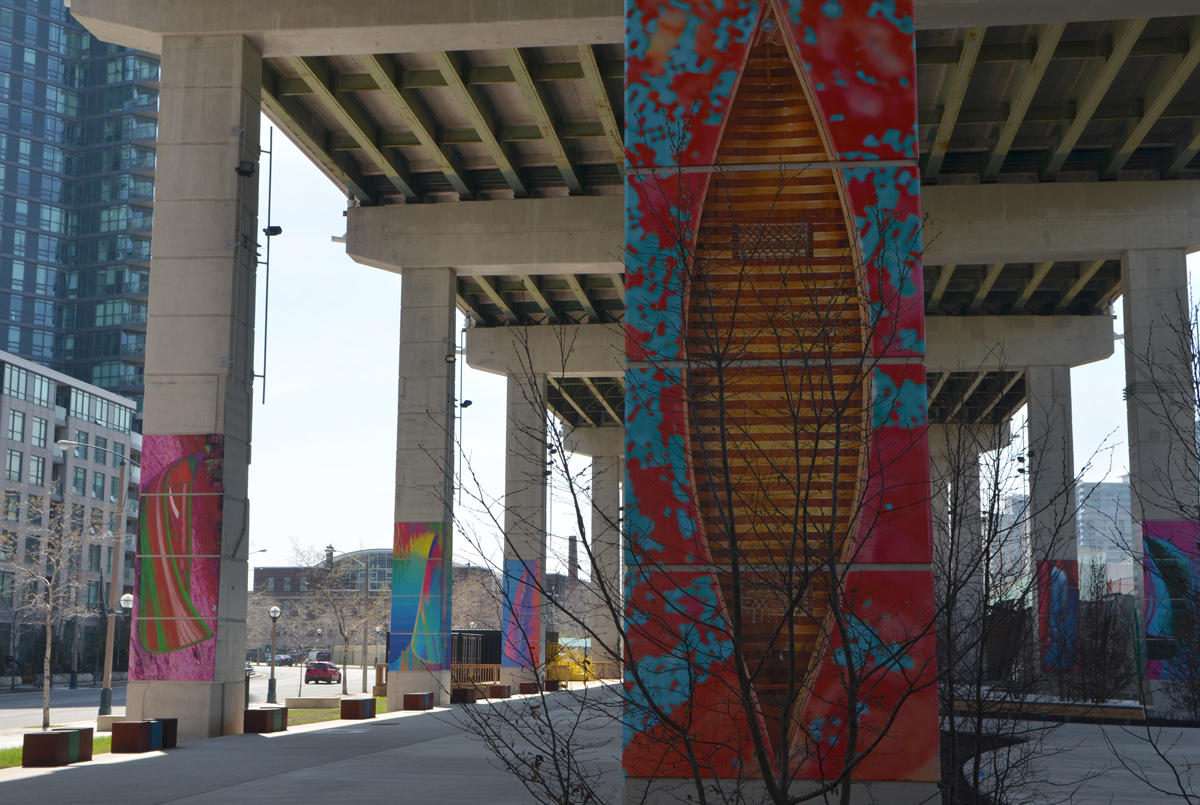
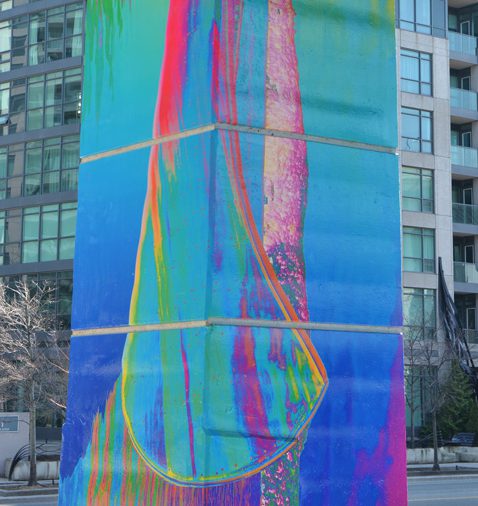
below: Also here is an installation by Dana Claxton called ‘Forest of Canoes’.  Colourful images of canoes on the concrete pillars.  Light-wise, they are probably best seen in the morning but that’s not when I was there.
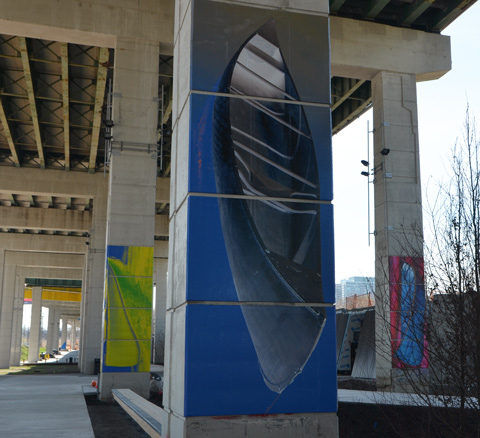
at the Bentway, Dana Claxton's 'Forest of Canoes' art installation of pictures of canoes on the concrete supports of the Gardiner Expressway - grey canoe on black background

The Bentway follows the shoreline of Lake Ontario that existed before landfill was used to create a space for the railway lines.  Canoes were once an essential means of transport.  Now their images sit on concrete pillars that hold up the Gardiner Expressway where thousands of cars pass by every day.

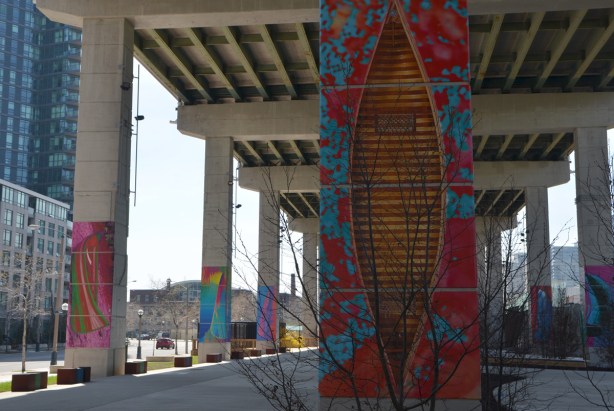
at the Bentway, Dana Claxton's 'Forest of Canoes' art installation of pictures of canoes on the concrete supports of the Gardiner Expressway - blue canoe

at the Bentway, Dana Claxton's 'Forest of Canoes' art installation of pictures of canoes on the concrete supports of the Gardiner Expressway - cedar strip canoe

below: In the bottom left corner of this picture is what looks like a bluish blob.  My apologies to the artist for calling it a blob but I’ll blame it on the lack of light and therefore, the lack of detail, in the photo.  This is another art piece.  It is ‘Future Snowmachine in Kinngait (Colossus)’ by Janice Qimirpik, Moe Kelly, Embassy of Imagination, and PA System.  Embassy of Imagination is a collaboration between PA System (Patrick Thompson and Alexa Hatanaka) and youth in the Cape Dorset community of Kinngait.  This sculpture started with small playdough models of snowmobiles made by Qimirpik and Kelly.  They were then scaled into a larger than life sculpture.
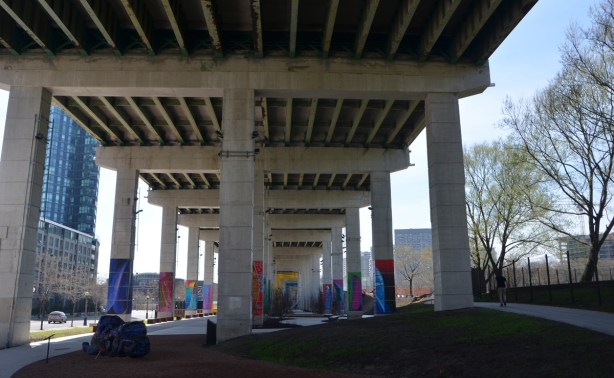
at the Bentway, Dana Claxton's 'Forest of Canoes' art installation of pictures of canoes on the concrete supports of the Gardiner Expressway

The next part of the Bentway is under construction and there is still no pedestrian crossing across Fort York Blvd and is passes diagonally under the Gardiner.   There is (was?) one in the plan.

below: This sculpture is on the corner of Fort York Blvd and Grand Magazine Street.  It is ‘Fountaingrove’ by Carlo Cesta and Nestor Kruger, 2014.  It sits above the Garrison Creek Culvert that carries the now buried creek to the lake.  Like the name states, it represents water in fountains.   Of course there is a white crane hiding behind it.

part of a metal twisty sculpture, condos behind, blue sky, sun spot

below: Just west of Bathurst Street

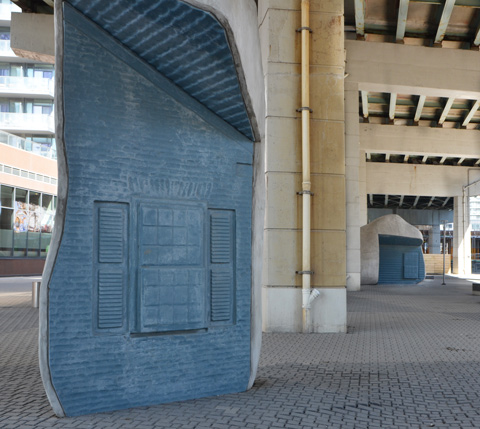
blue surface, window relief sculpture in it, other side is artifical rock, under the Gardiner Expressway, lock stone ground,

below: Getting cosy.  Condos rise up right beside the Gardiner Expressway.  If you’ve driven across the Gardiner, you’ll know just how close some of the buildings are to the traffic.   How useful is a balcony if it’s metres away from a highway and from all those cars and trucks?  They keep being built and people keep buying them.

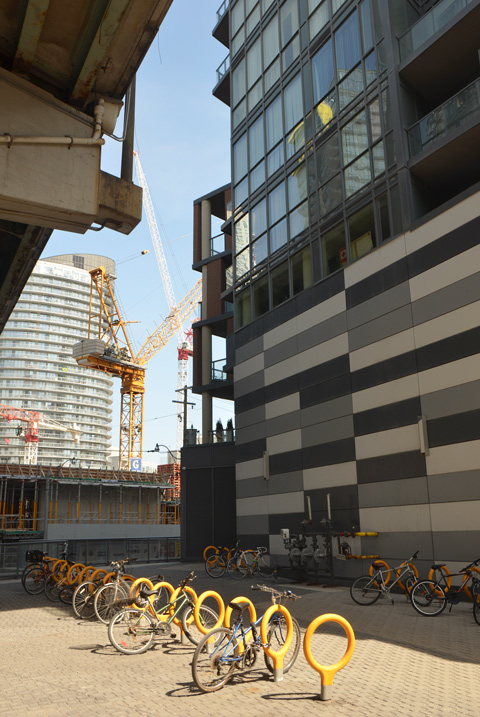
below: I couldn’t resist all the yellow and orange bits and pieces!

yellow circular bike rack, bikes, condos,

below: On the east side of Bathurst is the construction of a new Loblaws.  It never ends does it?
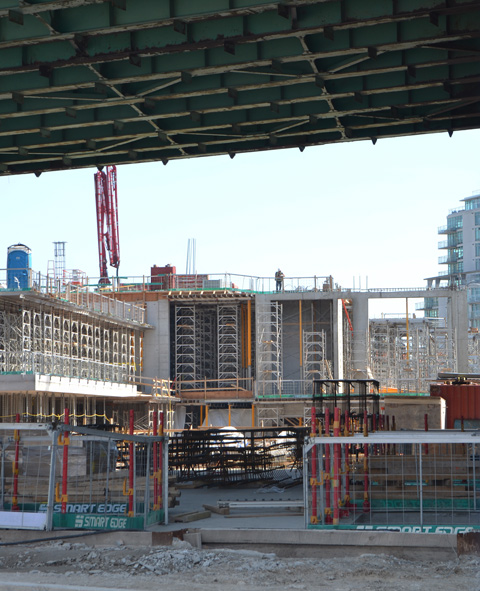
construction site that is partially covered by the Gardiner Expressway

This blog may have been a bit heavier on construction photos than you were expecting, especially since the title was about canoes. There was just so much work going on in that area that it was hard to avoid.  The next time that I walk this area it will probably be totally different… unfortunately new buildings are a lot duller to look at than construction sites so there may not be many photos!

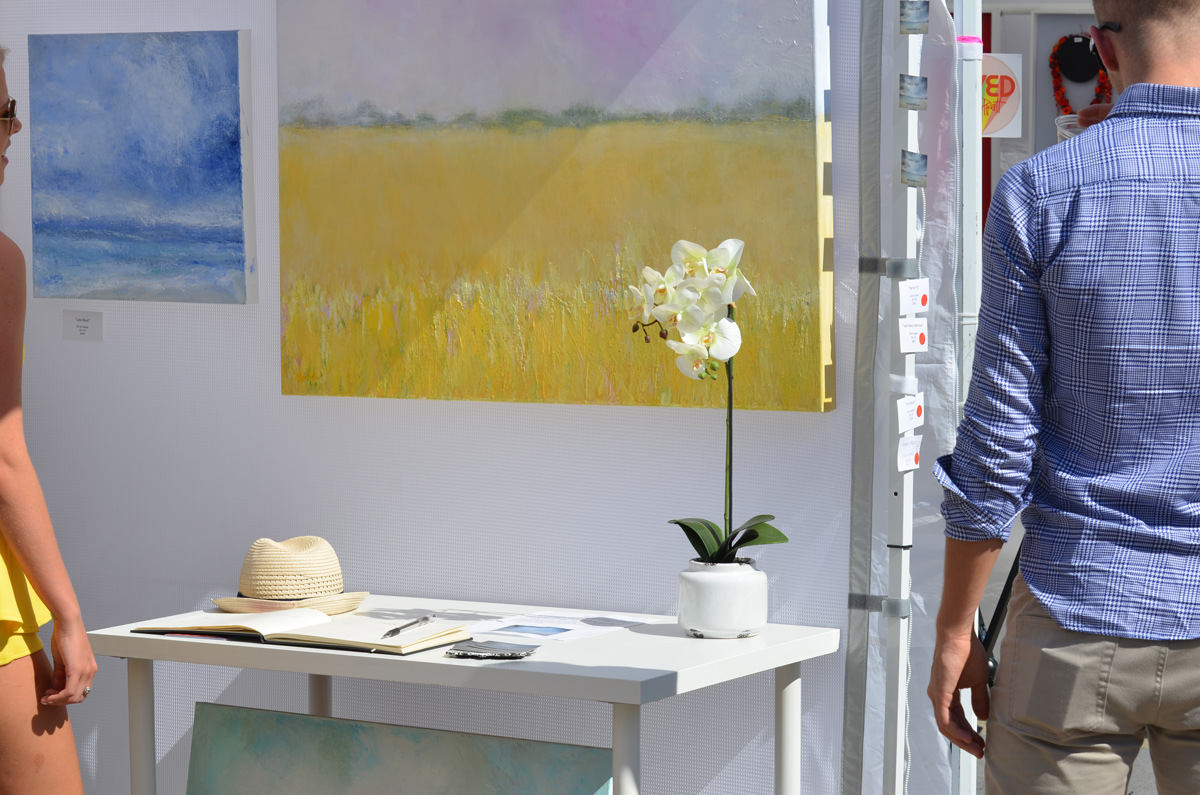
on grey construction hoardings, a sign tat says post no bills. Someone has added 4 stencils of different Bills, Bill Murray, Bill Clinton.

Dana Claxton canoe image at Bentway, Forest of Canoes, multicoloured, bright colours,

Tucked away in part of the old Lever Brothers (then Unilever) soap factory there is a small exhibit now showing.

below: Follow the yellow caution tape to find the installation…..

yellow caution tape marks a path through an old industrial space, sign on a post that says Danger no pedestrian traffic.

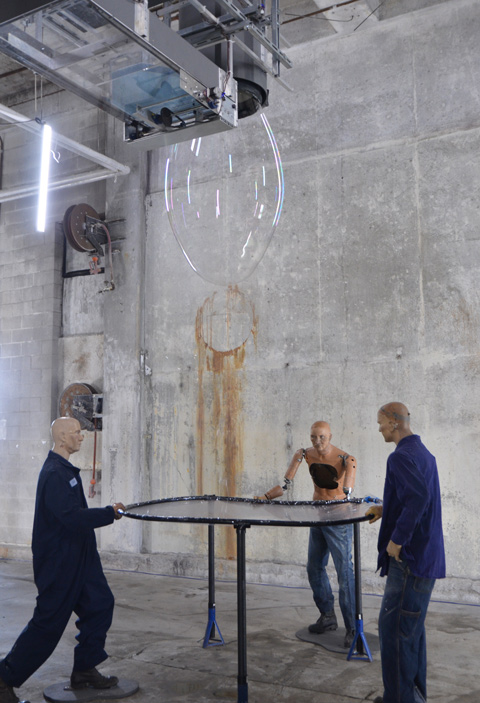
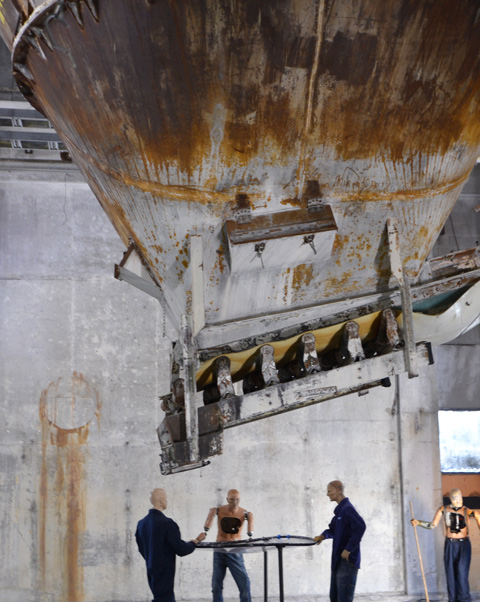
below: This is the sight that greets you when you first walk into the room…..   A large industrial sized funnel left behind when the factory was decommissioned dominates the room.  A few figures stand on the other side of it.

mannequin automatons as part of an art installation in the old Unilever soap factory, concrete floor and walls - three of them stand around a net on a circular frame, a large industrial funnel above them.

below: Moving closer.  Above the figures is a bubble making machine – how appropriate for a soap factory!
mannequin automatons as part of an art installation in the old Unilever soap factory, concrete floor and walls

As it turns out, these figures – mannequins or automatons – were originally made back in the 1980’s as props for the Wilderness Adventure Ride at Ontario Place.  When Ontario Place closed, these guys were abandoned.

below: He looks very intent on something. .. like destroying my camera if he could.

mannequin automatons as part of an art installation in the old Unilever soap factory, concrete floor and walls - solitary man with half an arm missing, staring straight ahead, beside a net to catch soap, a large soap bubble dropping from above him

Toronto artist Max Dean rescued their remains, cleaned them up and brought them back to life.

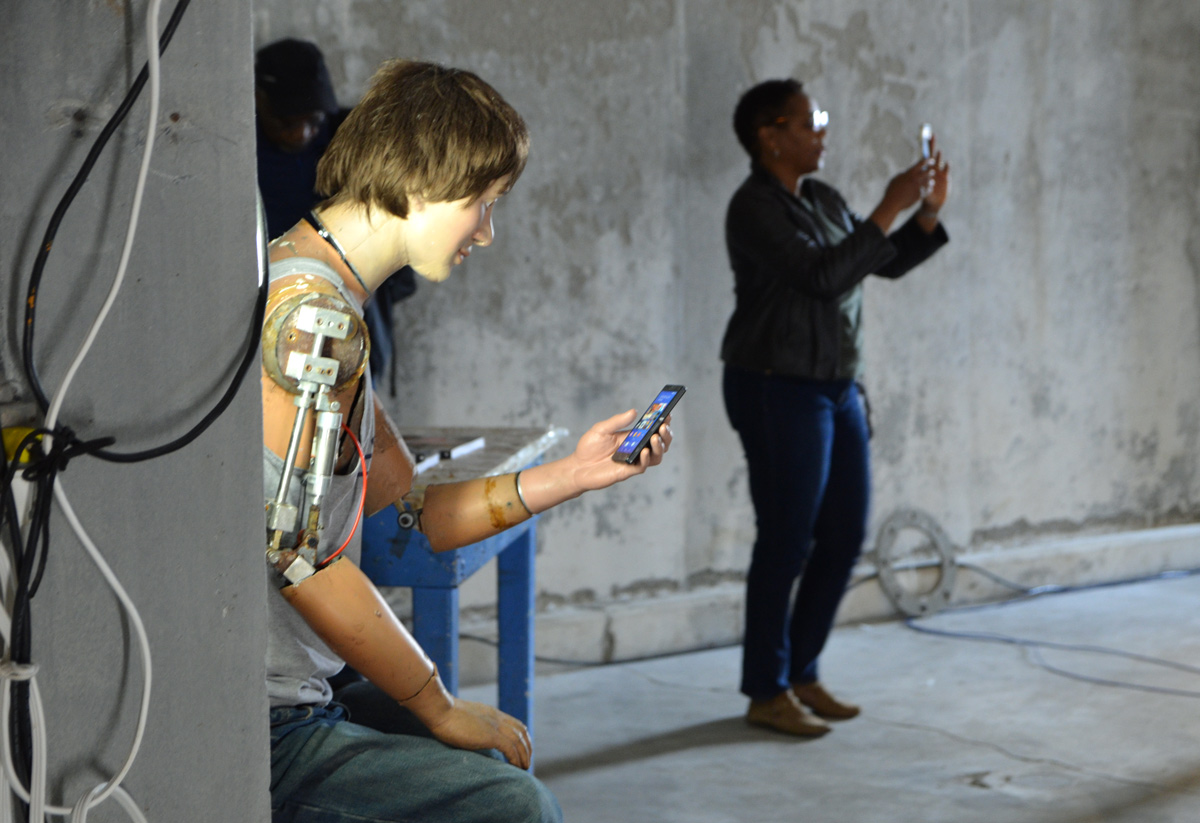
below: … and into the 21st century.  Playing Candy Crush to pass the time? Or checking his Tinder messages?

mannequin automatons as part of an art installation in the old Unilever soap factory, concrete floor and walls - sitting on a stool with a phone in one hand, a real woman behind him with a phone in her hand taking a picture

mannequin automatons as part of an art installation in the old Unilever soap factory, concrete floor and walls - an older man standing on the stairs and looking down

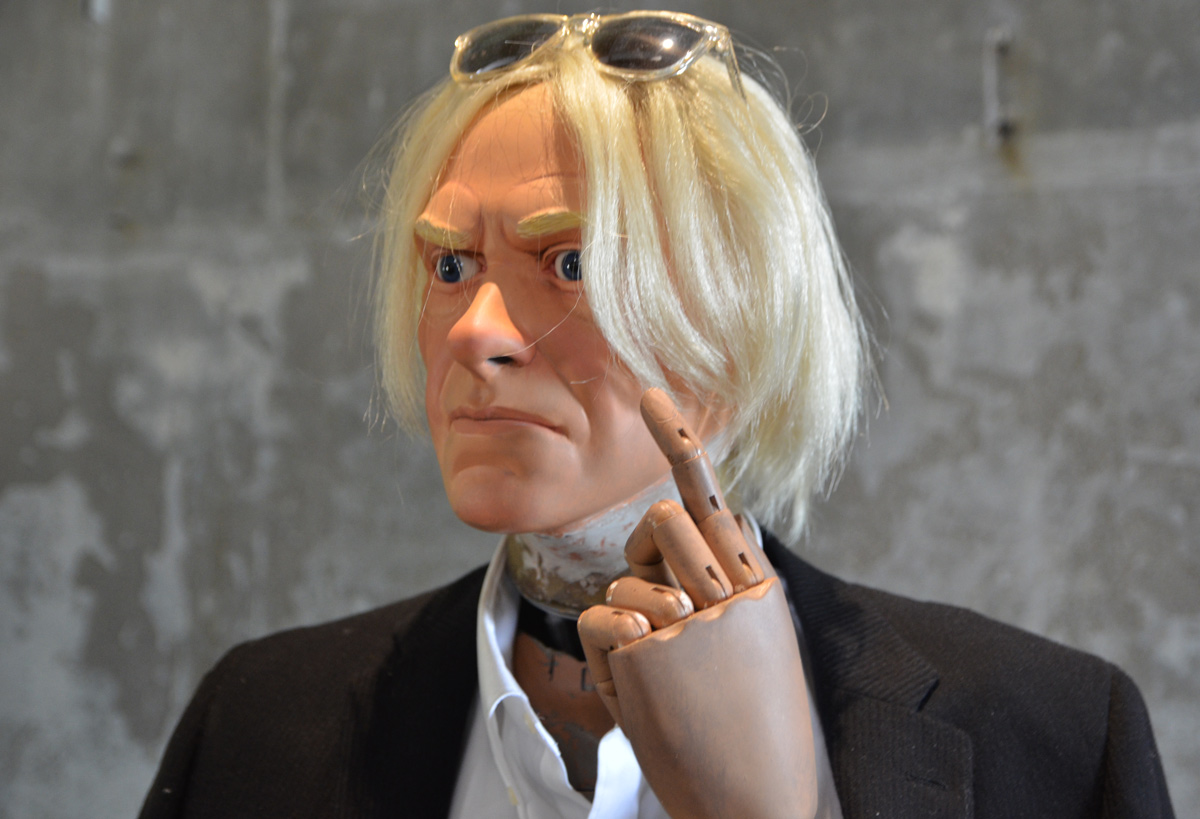
mannequin automatons as part of an art installation in the old Unilever soap factory, concrete floor and walls - the likeness of Andy Warhol, white hair, glasses on head, hand up, finger pointing

The Unilever factory site is now owned by First Gulf (a development company). Access is at 21 Don Roadway which also the DVP ramp from the Lakeshore. There is parking. Getting there by public transit is not easy as there is no access directly from the north (the railway tracks & DVP are in the way).


“Still Moving” continues until the 3rd of June.

This little walk starts with the artwork of Marleen Sleeuwits and her ‘Not the Actual Site’ exhibit at Brookfield Place (Allan Lambert Galleria).

A short walk from Brookfield Place westward along King street towards Metro Hall….

where pictures from John Edmonds ‘Hoods’ series are on display (as are the people who walk past!).

Across the street from ‘Hoods’ is Caroline Monnet’s, ‘History shall speak for itself’.  These photos are the south and west wall of TIFF.

caroline Monnet's large mural on the side of TIFF building, King street, people walking past, bikes parked in front of the art.

Just a bit farther west (at Spadina) you can find a large purple hued image by Felicity Hammond on the north wall of 460 King St. West.
A few more smaller works by Felicity Hammond are in the Contact Gallery at 80 Spadina – the building immediately north of the parking lot where you can find the image above.    The gallery glowed in pink and purple light.

below: Object shapes are cut outs from a thin sheet of acrylic on which photos were printed.  These shapes are held up by clay blobs.

And that’s our tour for today!