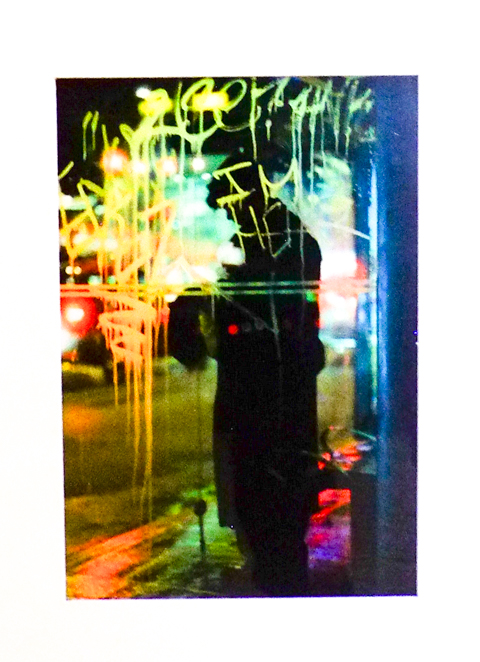
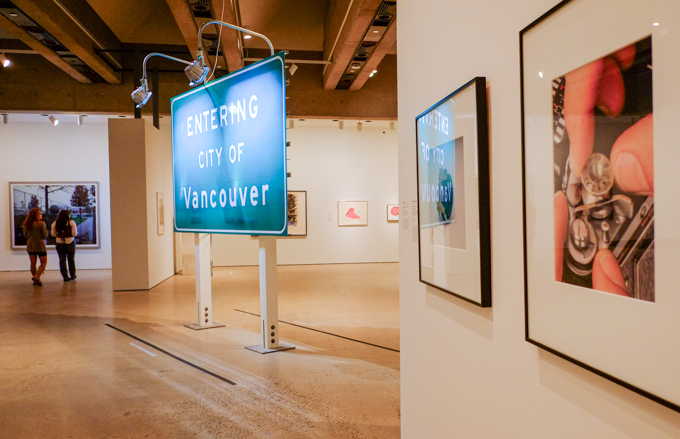
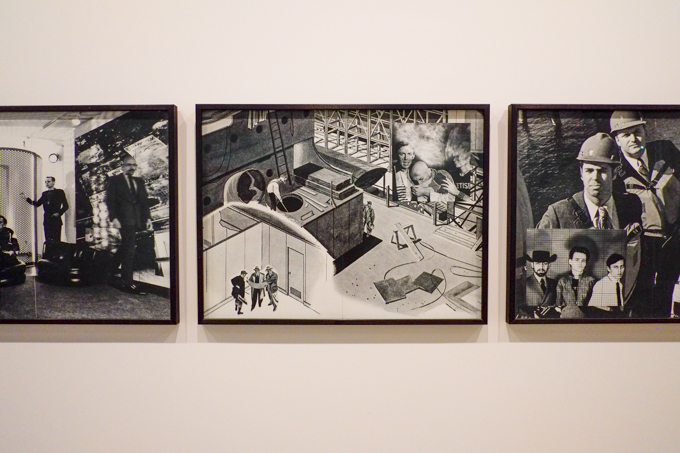
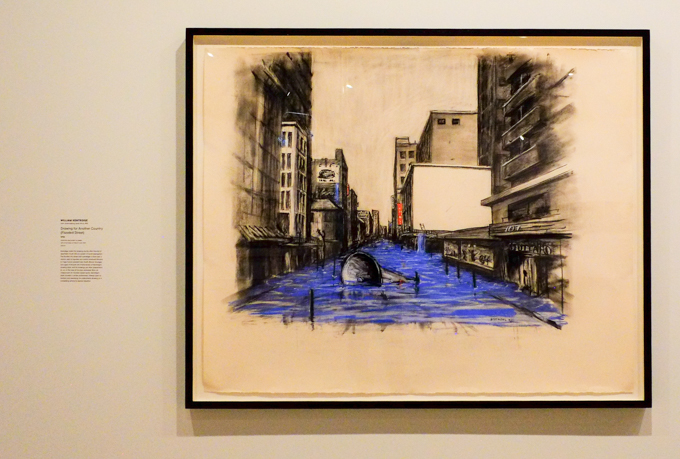
Archive for the ‘galleries’ Category

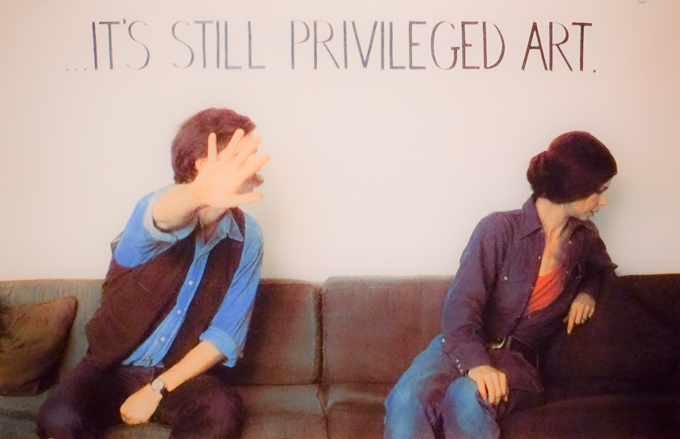
a photograph from 1975, colour, couple sitting on old couch, words on white wall behind them that say it's still privileged art, woman is leaning away from man, head turned away too, man has his hand up toward camera

Photo taken of a picture on an art gallery wall. The original was taken by Carole Conde and Karl Beveridge in 1975 as part of a series titled “It’s Still Privileged Art”. Now it is part of a retrospective exhibit of the artists’ work at A Space Gallery at 401 Richmond West.

Is art privileged? What does that mean? I hadn’t meant to get philosophical when I planned a “Downtown Art Hunt” walk.  Put the question aside for a bit and let the ideas simmer in the back of your head.  Instead we’ll wander around downtown Toronto and see what we can find.

below: I wasn’t looking for Taylor Swift but she’s difficult to avoid these days.

sign on wall of Union station, TTC subway station, at platform level, says to Taylor Swift, with an arrow pointing left

below: It’s hardly art but it’s probably better than grey concrete.  Better still would be to get rid of these Jersey barriers that line Front Street in front of Union Station.  They are a temporary solution that is fast becoming a permanent installation.   “aaniin boozhoo” is Anishinaabemowin (also known as Ojibwe) and is a greeting.  (UPDATE – 25 Nov:  I just read that these barriers are being removed this week!!  Maybe complaints do get action!!).

concrete barriers outside union station that have been painted in bright colours with words,

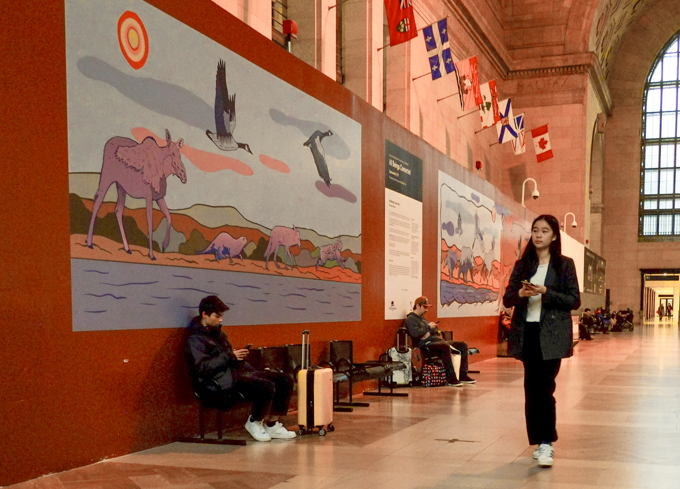
below: “All Beings Connected” by August Swinson in the Main Hall of Union Station.
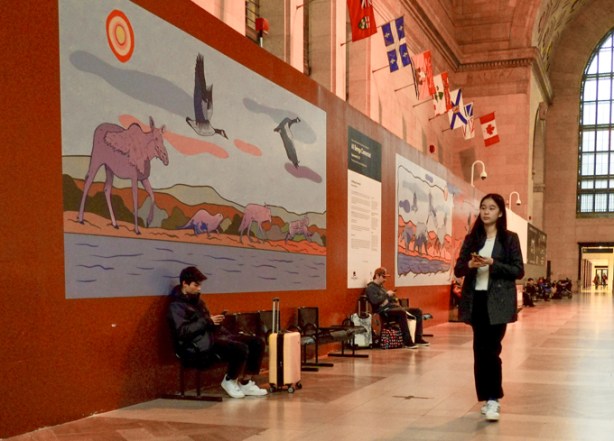
a young woman walks past large artworks on the walls of the main hall in union station, title of art is All beings connected and the artist is August Swinson

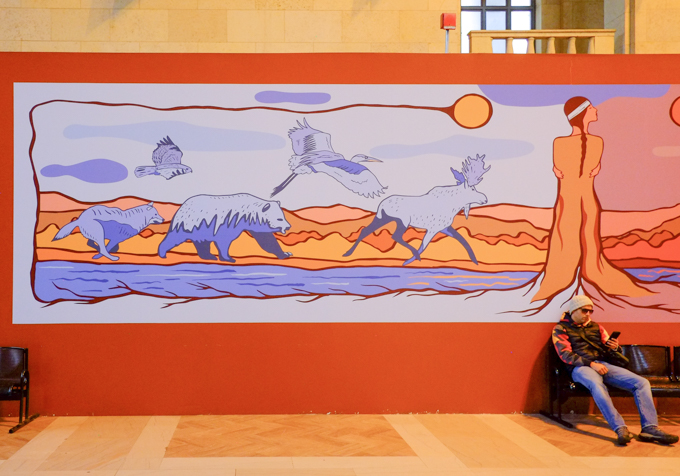
below: The figure in the image is rooted to the ground, drawing their strength from the earth beneath, connected to the life around.

a young man sits in front of a large artwork on the walls of the main hall in union station, title of art is All beings connected and the artist is August Swinson

The West Wing of Union Station connects the main building to the walkway to the UP Express or to the Skywalk that leads to the CN Tower and vicinity.  A lot of people pass by here.  At the moment there are two art exhibits, both of which are part of “Precarious Joys”.  This is the name given to a collection of art exhibits around the city,  the Toronto Biennial 2024 (which ends December 1st).

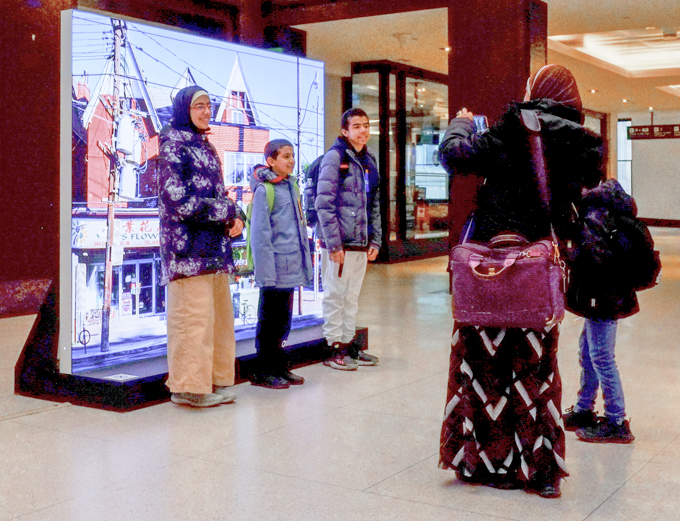
below: Using art as a backdrop to a family photo.  the Tong Yan Gaai (Chinatown) series by Morris Lum
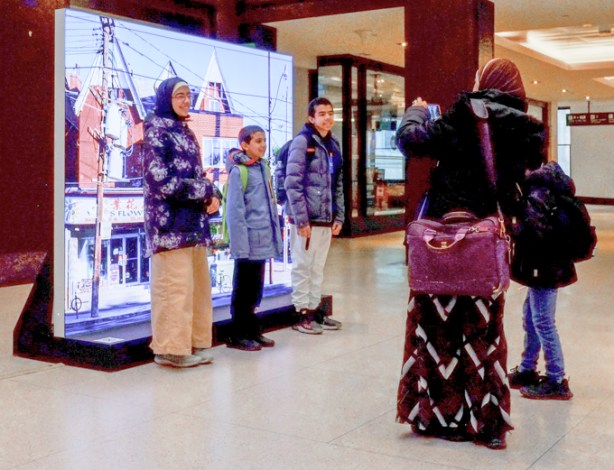
a family stops in front of an art piece at union station, mother is taking a picture of three kids standing in front of it

2 people in winter clothing looking at large illuminated images of interiors of buildings in chinatown, by morris lum, at union station,

below: Nicholas Galanin, part of “Threat Return” 2023

artwork on display at west wing of union station, with people and suitcases walking past. Nicholas Galanin sculptures

below:  “Mycelium” is the name of this network of lights designed by artist Nicholas Baier.  In biology, mycelium refers to a root-like structure of a fungus that consists of a network of thin fungal strands called hyphae.  In Toronto, it is found on the Bay Street bridge that connects Scotiabank Arena with CIBC Square and the GO Bus Station.
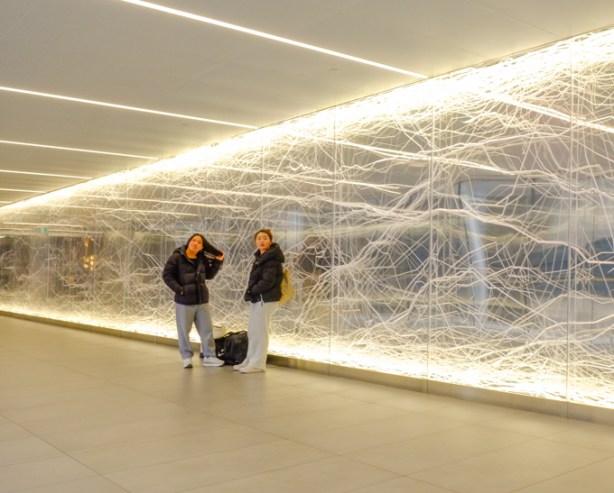
two young women stand beside an illuminated artwork, mycelium, by Nicholas Baier, in pedestrian bridge over Bay street

below: Because the walls of the Bay Street bridge are glass, “Mycelium” is also visible from the outside.

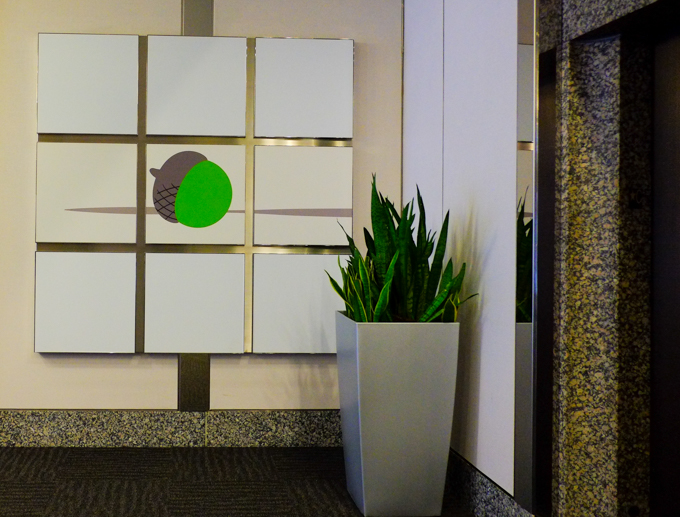
below: A green acorn.  From little acorns…..  There was a picture and a planter beside the elevator in this lobby.  Nothing more. A small austere space but someone cared enough to hanging a painting of an acorn.

below: Tucked away in a corner where it’s often overlooked is “Pi” by Evan Penny (1996).  A man’s head has been cut into four pieces, disconnected, and left sitting on the ground. I have walked past here many times and not noticed it.
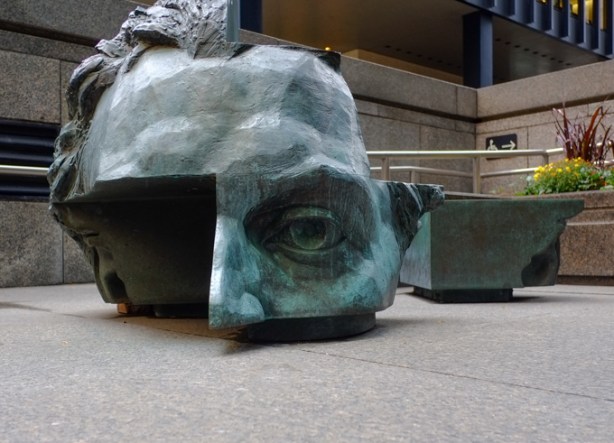
weathered bronze sculpture of upper part of man's face

below: It’s art, but it’s also a place to sit.

weathered bronze sculpture of lower part of man's face

below: Another painting on a wall in a quiet lobby.  No signs.  Abstract, but it reminds me of two faces smushed together.  One of the faces has a mouth and chin made of crushed shredded wheat. He, or she, is wearing a black mask.  What else does it look like to you?
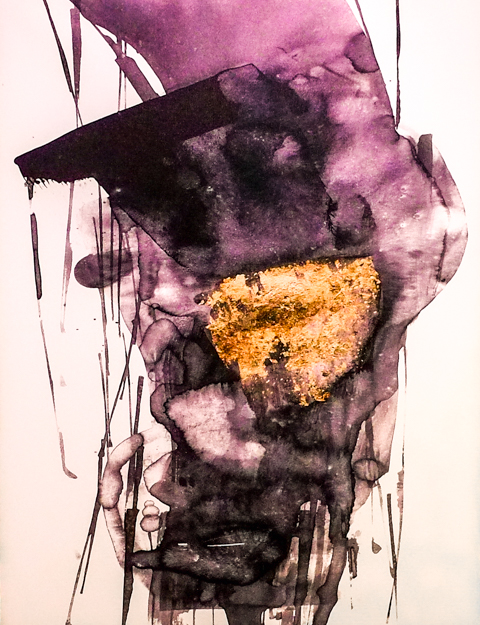
abstract painting in mostly purple and black on white

below: More lobby displays.  One of a group of paintings by John Eric Laford (1954-2021), an Ojibway artist from Manitoulin Island.

inuit style painting by john laford, gallery

below:  Mama elephant is still leading her two little ones behind Commerce Court.

elephant sculpture behind Commerce Court

below: If the elephant could see, this would be her view.  I am not sure it’s art, but the white light trees that come out around Commerce Court at Christmas time are now up.
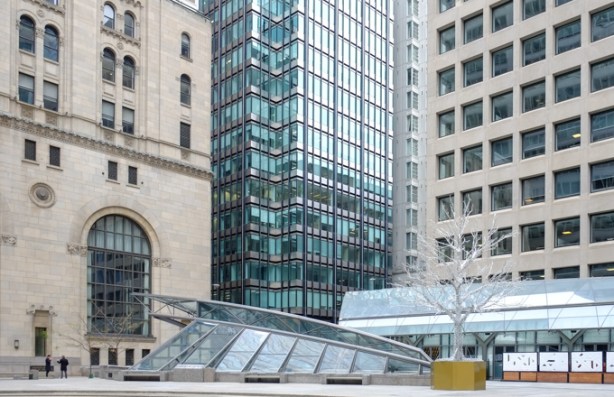
open area behind commerce court west, old Commerce Court building, newer skyscrapers, a tree made of lights, white lights, as Christmas decoration in in the space

In same square (does it have a name?  Or is it just Commerce Court?), is an art gallery, Collision Gallery.  They are one of the locations featuring art from the Toronto Biennial.

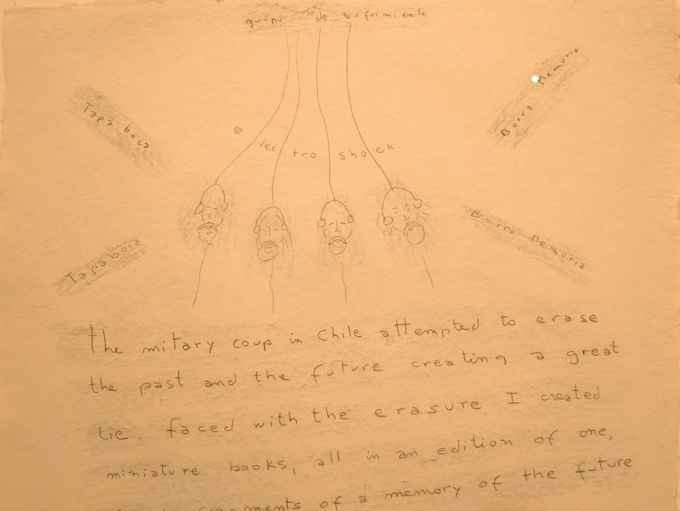
below: Cecilia Vicuna helped co-found of Artists for Democracy in 1974 after she left her home country Chile.  A military coup upended that country in the early 1970s.  Here at the Collision Gallery she has an installation, “Futur.O [Futur.E]” that pays homage to Gail Kastner.

people looking at exhibits at an art gallery

below: Words written on strips of paper. From the left, the first four are:   “I had a very [illegible] feeling in my head.  I had a blob not a head”, “The whole purpose was not to research brain washing but to design a system for extracting information from resistant [forces?]”, “These little books are her memory”, and “To defend herself and preserve her mind from erasure she created little books packed with extremely dense miniature handwriting”  When you read the story of Gail Kastner and her treatment at a Montreal psychiatric institute in 1953, these writings will make more sense.

detail of artwork on display at Collision Gallery, words written on strips of paper

below: Vicuna connects the electroshock experiments of the 1950s to the use of such techniques in interrogation and torture.  In this drawing she writes about electroshock treatment being used in Chile to “erase the past and the future, creating a great lie”.    Almost as an aside,  I’m not sure that creating lies requires such drastic measures; it seems these days that all you have to do it shout it loud enough and often enough and you can create whatever reality you want.  How do we retain our memories under such circumstances?  Memories help keep us connected to our past and to our present.  Who are we without our memories?

pencil drawing of heads being electroshock. with words telling a story about chile and the coup

below: Dreamlike mythical figures dancing together in “Joyous Procession/The Infinite Serpent” by Rajni Perera.
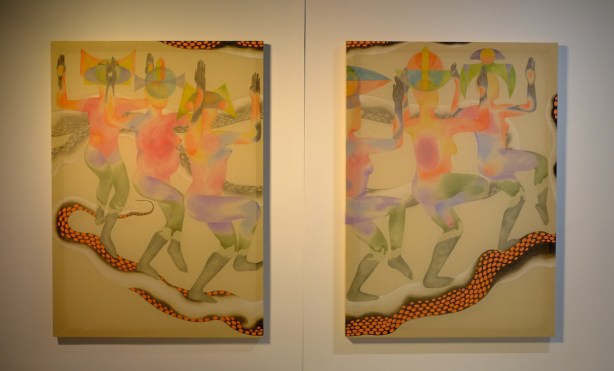
a pair of paintings, Collision Gallery, by R Perera, serpents and people with green legs and feet dancing on them

below:  Details of a couple of the banners that hang from above to form a circle around an LED light fixture that suggests fire.  Artist: Citra Sasmita

parts of two banners that are in turn part of an installation in an art gallery

artwork by citra sasmita at collision gallery

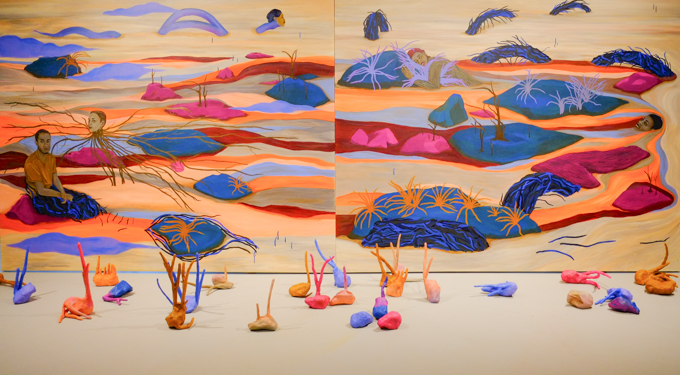
below: “All Islands Touch” by Tessa Mars, another installation at Collision Gallery.  I am not fond of things lying around on the ground counting as art and I don’t think that they add much to the piece. You might disagree and that’s okay.
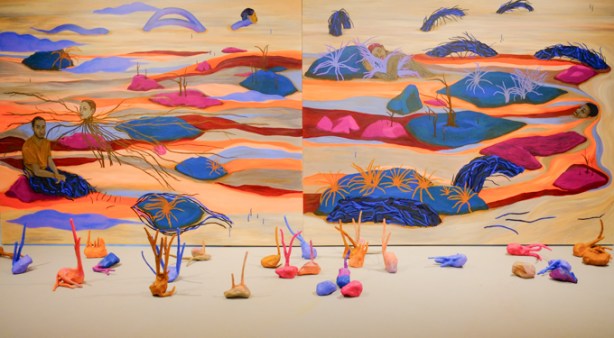
All Islands Touch, a large art installation by Tessa Mars at Collision Gallery, painting of islands with people's heads, small sculptures on the ground in front, look like fingers growing out of coloured rocks

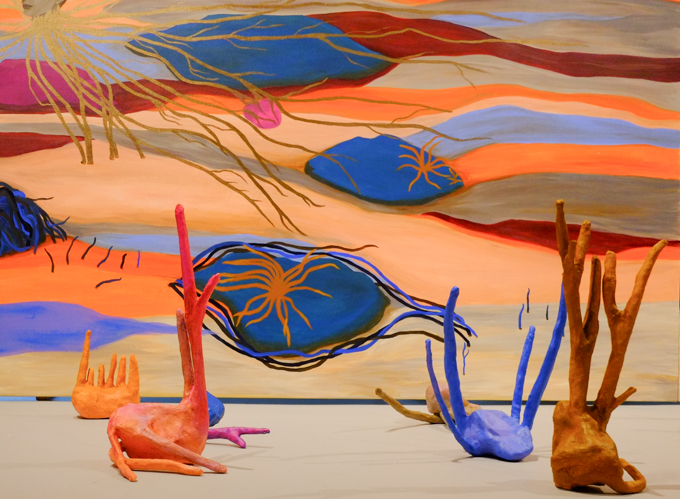
below: Fingers growing out of rocks?  Plant life at the bottom of the sea reaching skyward toward the light?

Part of All Islands Together by Tess Mars, small sculptures on the ground in front of painting

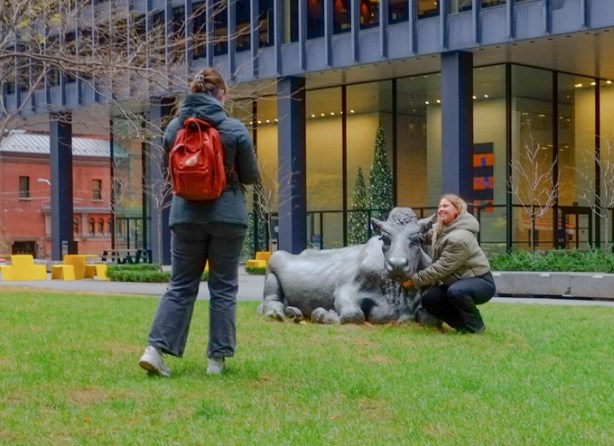
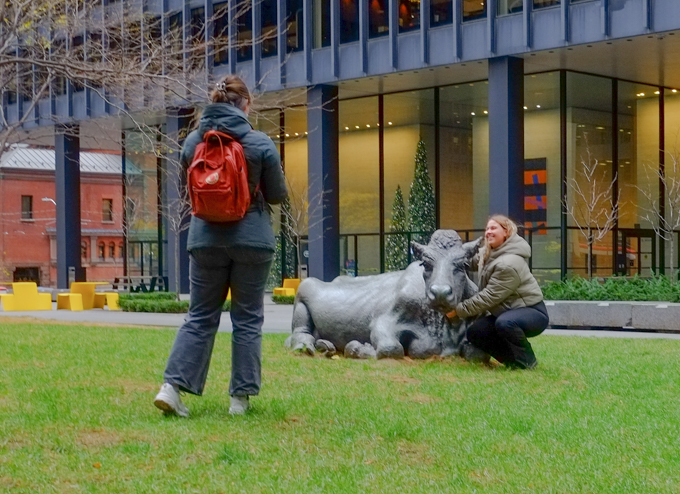
below: Playing with the cows

two women taking pictures of themselves with the bronze cow sculptures, n green grass, downtown Toronto

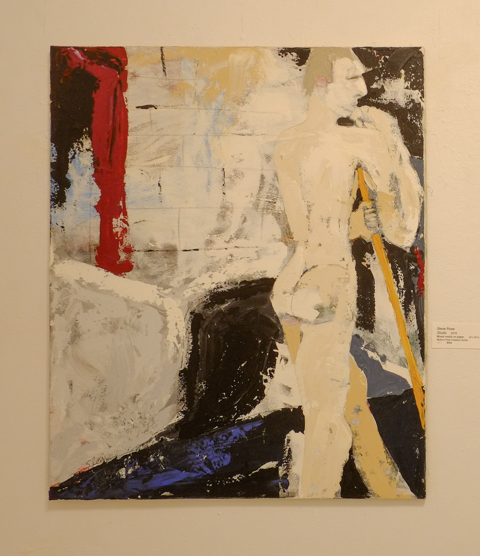
below: Denyse Thomasos (1964-2012) Trinidadian-Canadian, is the artist who painted this picture that hangs inside in the lobby of  the TD Centre-Mies van der Rohe building.  An abstract, but very much an urban scene with its vibrant chaos.
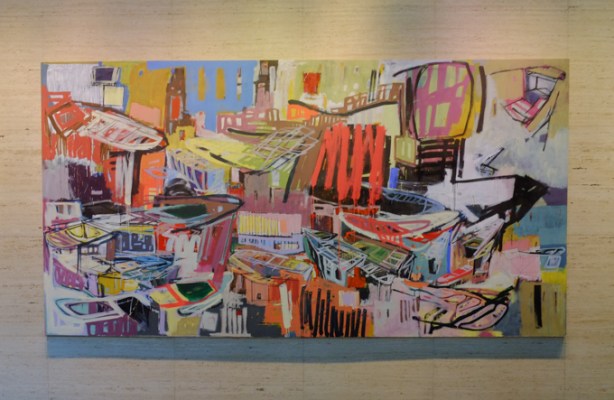
abstract painting, large, by Denyse Thomasos, hanging in lobby of a downtown bank office tower

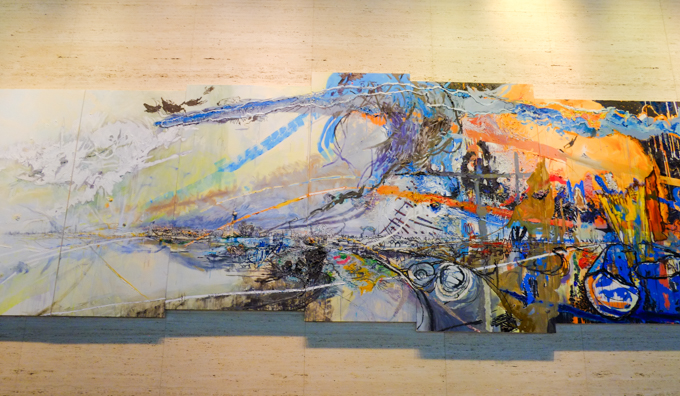
below: In the same lobby as the image above, this abstract by Susanna Heller  (1956-2021) tells a different story.  There is also chaos but it seems more “natural”, more like nature instead of man-made.  It is titled: ‘Restless Prowling from Night to Day Break’  and is 30 foot long.
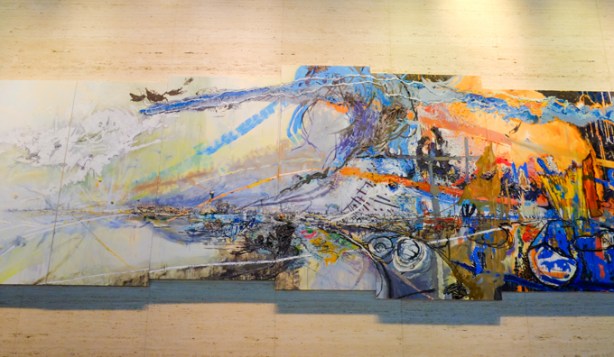
abstract painting by susanna heller

below: Jose Bautista flips his bat after hitting a home run ….and his fans cheer.

large street art mural of blue jays baseball player, Batista, with crowds behind him, as he comes up to bat at home plate

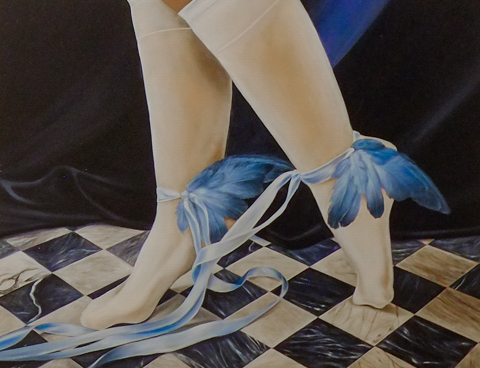
below: Emily Pope and her series of (mostly) blue, black, and white.  “Antidotes for Yearning” or the examining of “the instinctual urge to ward off the inevitable despite our guaranteed decay. Through symbolic imagery…”   Abbozzo Gallery

painting by Emily Pope, blue curtains open to reveal a hand drooping, partially covered with lacy glove with many little blue bows

Emily Pope painting of two feet in white sheer stockings, with blue feathers tied around the ankles, on a black and white checkered floor

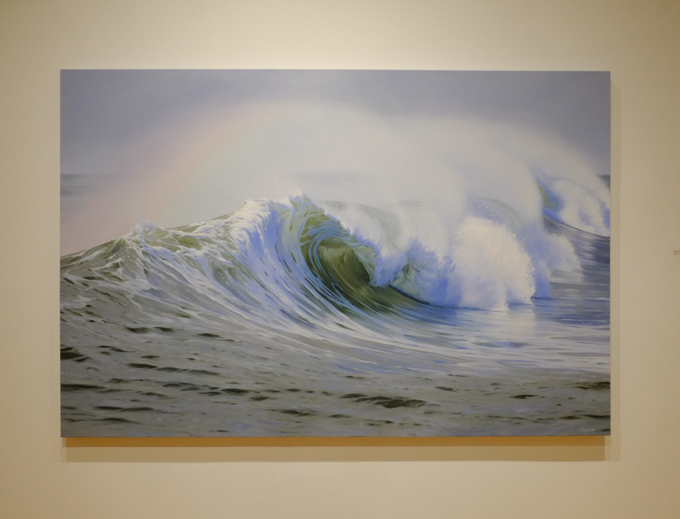
below: Also at the Abbozzo Gallery are a series of very realistic looking paintings of waves by Katharine Burns.  (It looks better in real life!)
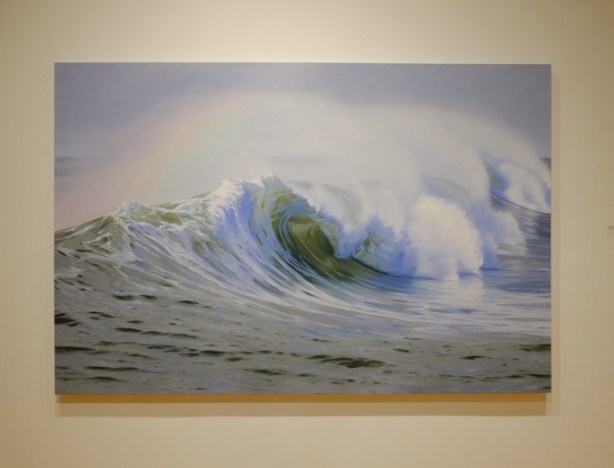
in abbozzo art gallery, on wall, a painting by Katharine Burns of a cresting wave and a small rainbow that is caused by sunlight passing through the spraying water

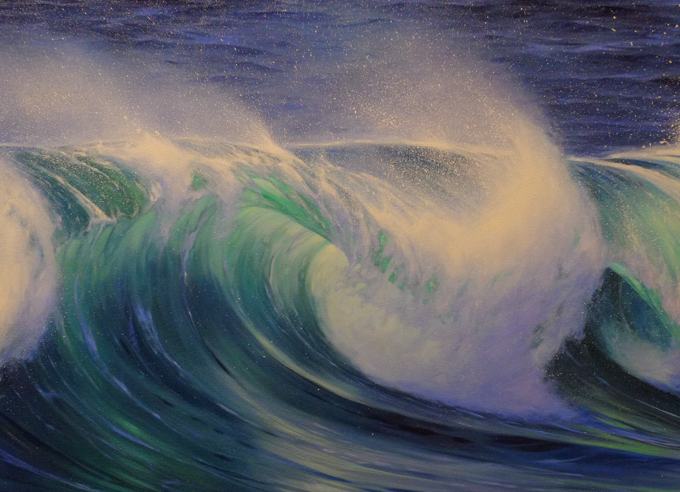
below: One of the wave pictures, zoomed in a bit.  Translucence, light, spray, motion, and so much more.

close up of a painting of waves by Katharine Burns in an art gallery

below: At the BAND (Black Artist Network in Dialogue) Gallery is a small showing of artworks owned by the founders of the gallery.   The BAND Gallery has temporary space at 401 Richmond West while its usual space at 19 Brock is being renovated.

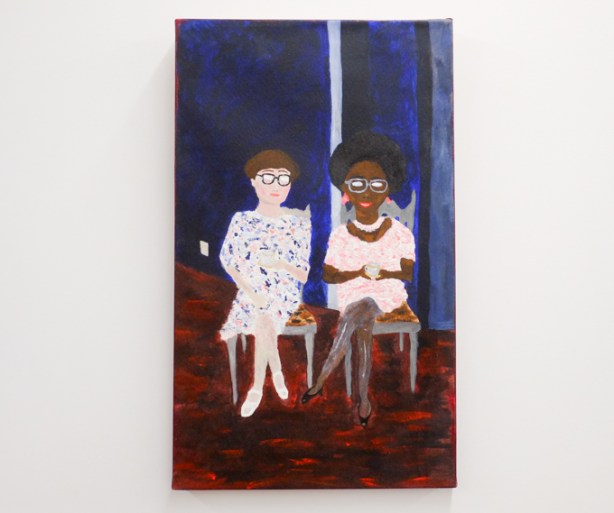
picture on wall of BAND gallery, a woman in orange hat and orange bag, and a cane in the other hand, walking away from the viewer

painting in an art gallery, pair of women, sitting on chairs, one white woman and one black woman, both in dresses, blue curtain behind them

below:  Two large paintings by Janet Cardiff, large figures, connected.  Dancing, Intertwined.  Are they happy?
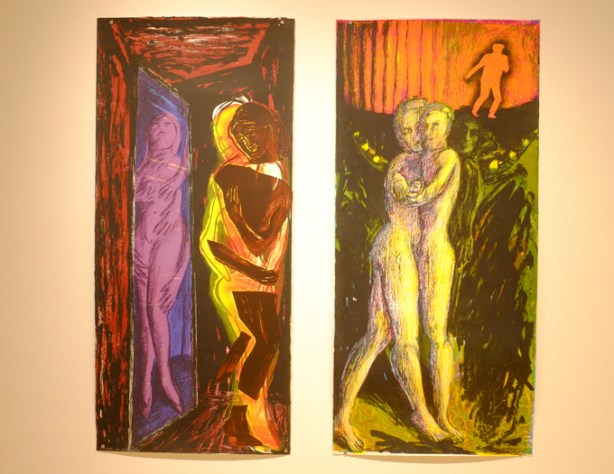
two large paintings by Janet Cardiff

close up of figures together, painted by janet cardiff

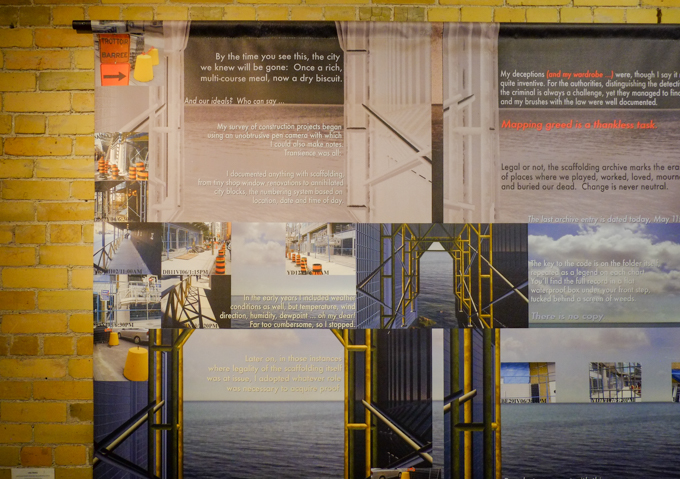
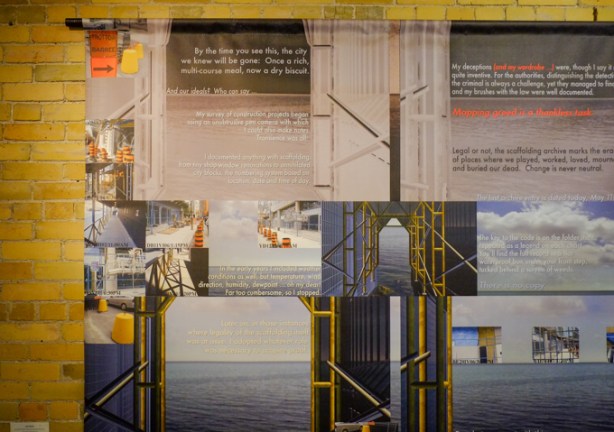
below:  In one of the halls of 401 Richmond West is a large poster.  It is a collage of photos taken by Vera Frenkel with some of her words added to them.  Title: “Once Near Water: Notes From the Scaffolding Archives” 2008.  She took pictures of any scaffolding that she saw while walking around Toronto.   At the top left she opens with these words: “By the time you see this, the city we know will be gone.  Once a rich multi-course meal, now a dry biscuit.”   Do you think that we are turning into (or have become?) a “dry biscuit”?  We’re definitely changing and I’d like to think that some of the changes are for the better (and it would help if Doug Ford would keep his hands out of the cookie jar).
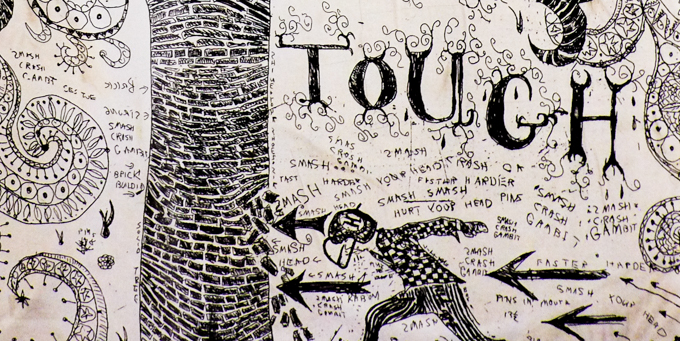
below: On another hallway wall (in the basement) of 401 Richmond is this piece….Do you think that you are tough? A tree made of bricks.

 a hand drawn black and white tree with curly branches and words that say do you think that you are tough

below: He’s got a long way to go.  Smashing the tree, brick by brick, smash, smash, hurt your head, crash, faster harder, smash, smash

lower part of a hand drawn black and white tree with curly branches and words that say do you think that you are tough under the word tough a small black figure is trying to bash the tree trunk with its head

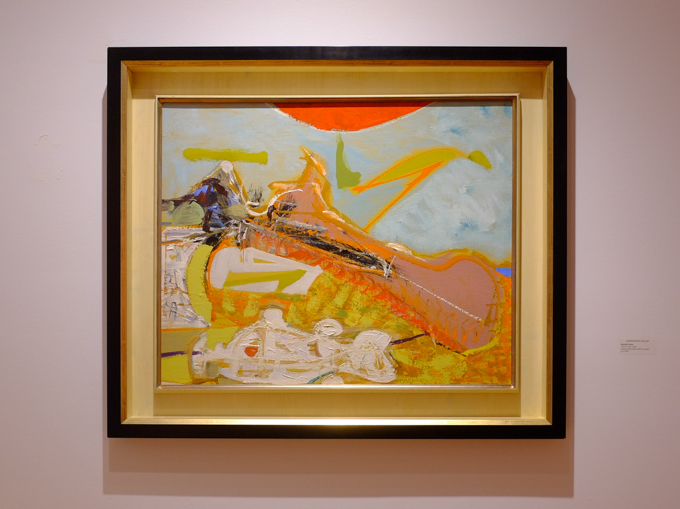
below:  An oldie but goodie; a painting by Harold Town (1924-1990).  It’s on display at the Simon Bentley Fine Art Gallery along with a number of other paintings and artworks.
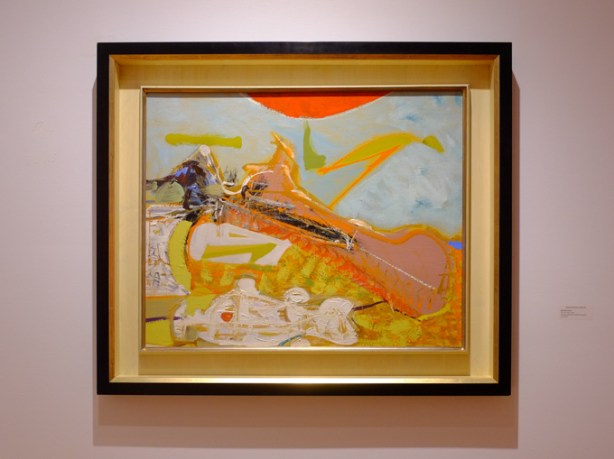
painting by Canadian artist Harold Town, abstract, on the wall of an art gallery

paintings on a gallery wall, one is a large orange square mounted on point, Simon Bentley gallery

If you can remember waaaaay back to the beginning of this post, you will recall that I started with an image by Carole Conde and Karl Beveridge.  I am going to end the post with a couple more of their photos.   They obviously care very much about social issues.

below: A marvelous collage, “A Work in Progress”.  The original dates from 1979.  In 2006 it was updated by adding four in the series so that now 12 decades of women’s work/life is now covered. This is the picture that encapsulates the 1950s.  The wartime image out the window is actually the Hungarian uprising.  Elements include a calendar on the wall showing a woman working in a factory, a coffee percolator on the table, a Beatrix Potter children’s bowl on the table, a crucifix on the wall, a red squeezie ketchup bottle, the syrup container with the pull back tab opening, baby bottle, star weekly magazine, the old radio….
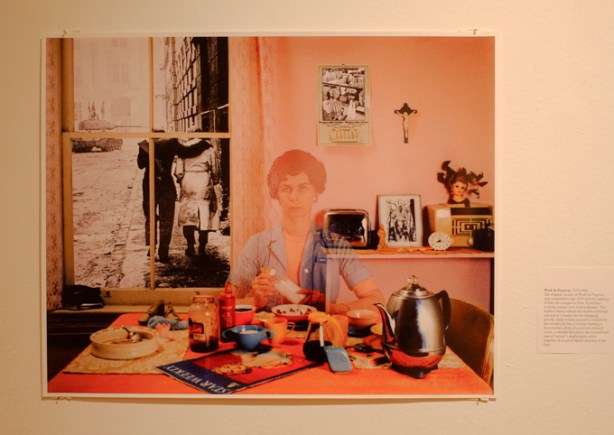
a work in progress, a collage by carole conde and karl beveridge about changes in womens work over the past 12 decades

below: Not a Care, A Short History of Health Care.  This is actually a series of 12 images, each one representing a time and place in history from neolithic times to the present (made in 1999).  I discovered that the whole series is online and if you are interested, you can see them here:  Conde & Beveridge’s website
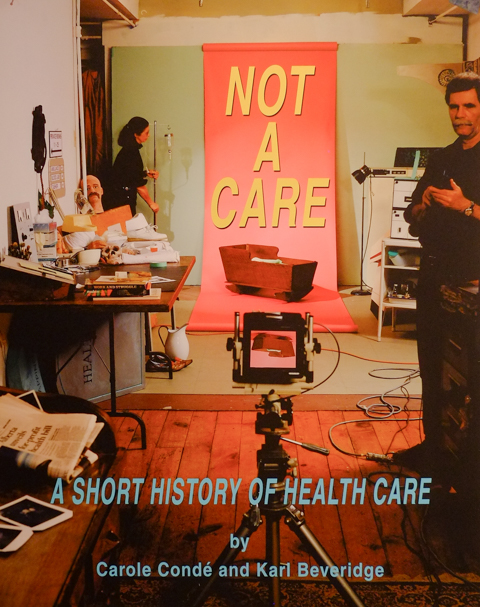
photographic image by conde and beveridge, not a care, short history of health care,

As for that statement about privilege and art…  there is no answer; there are many answers.  Making art is not for the privileged few; most of us have the need to create.  Whether it’s shouted from the rooftops or whispered quietly in a little corner, all art is valid to some degree.

Viewing art is not just for the privileged; there is so much out there… just get out and look.  You will think some of it is stupid, or mediocre but sometimes you’ll find something that makes you stop and think.  Or stop and stare.

 Those sentences barely scratch the surface and may seem quite lame but this is probably not the time nor place for philosophical essays… but feel free to leave your comments/opinions on the subject.

 “Opinions?  I’m supposed to have opinions?”

people sitting on TTC bus

When the fare inspectors get onboard.
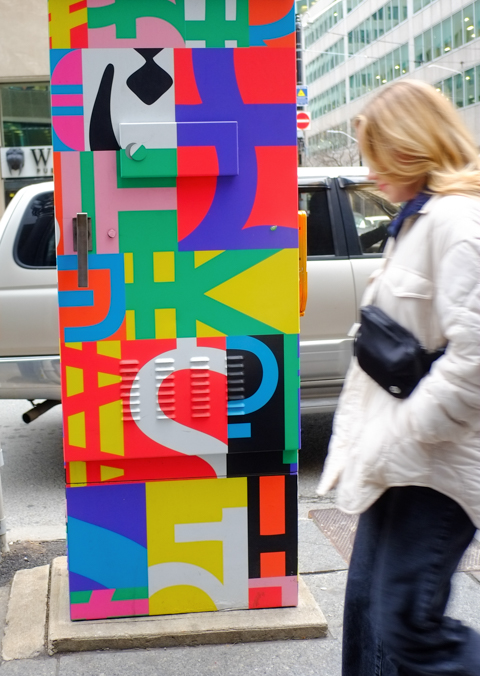
woman walking past pa metal box on sidewalk, traffic signal box, that has been covered with street art painting of abstract letters of the alphabet


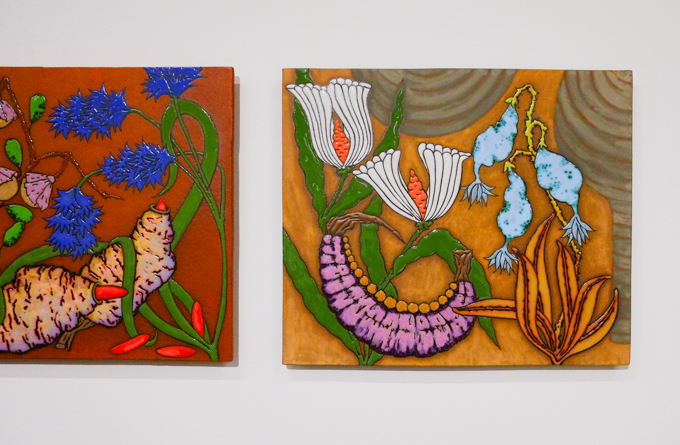
The previous blog post featured a wall that was covered with ceramic tiles that created an image of a Tree of Life –  It is part of “Elaborate”, a group exhibition, at Harbourfront Centre’ s Gallery 235.   This blog post takes a look at some of the other art in that exhibit as well as a few more ceramic art pieces that can be seen in display in cases in the halls of the Harbourfront building.

First, in the hall, Joon Hee Kim’s wonderful busts of fanciful whimsical characters.

ceramic busts by Joon Hee Kim on display on blue and white checked background, three characters, all female, with orange hair,

ceramic busts by Joon Hee Kim on display on blue and white checked background, female, with orange hair, yeloow flowers in hair, and big rimmed glasses that match hair

ceramic busts by Joon Hee Kim on display on blue and white checked background, three characters, all female, with orange hair,

Also in the hallway, round pieces by Jess Riva Cooper where flowers bloom from mouths, noses, and ears of the central subject(s) swirling to form wreaths around them.  The series is titled “Pullulate”

below: “Helleborus viridis” 2024, 45 cm in diameter

round ceramic art, by jess riva cooper, on wall, white plaster face in center, with tulips growing from her face, the flowers make a wreath around her face

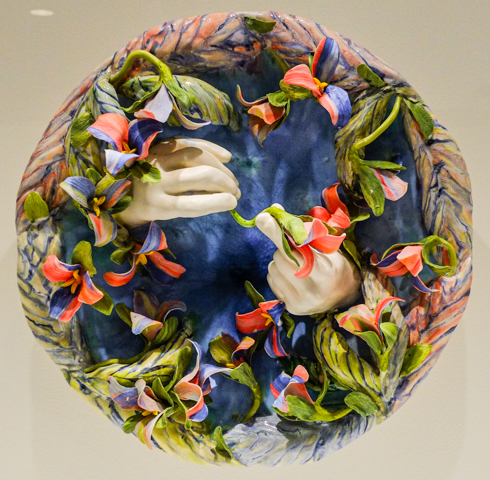
below: Some of pieces have hands in the central position, hands that rip the flowers from the ground and/or tear them apart.

round ceramic art, by jess riva cooper, on wall, white plaster pair of hands on watery blue in center, with with flowers making a wreath around the hands

below: Large droopy flowers in weird colour combinations on a table, sculptures by Julie Moon,

in an art gallery, on a table are some large ceramic droopy looking flowers, in the background is a group of people looking at another table with more ceramics on display

below: On the table in the background in the above photo are little sculptures by Lindsay Montgomery.  This is a close up of one of them.  Maybe someone spilled its cup of tea?

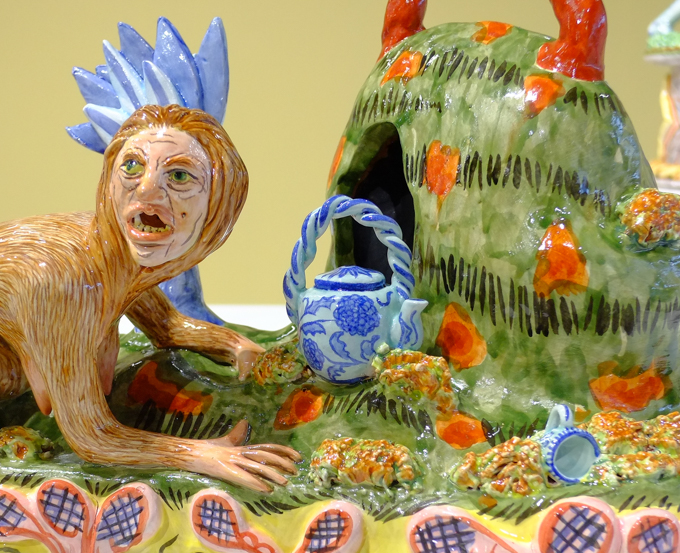
part of a sculpture by Lindsay Montgomery, a male character crawling towards a blue and white teapot sitting on the ground, a matching tea cup is lying on its side

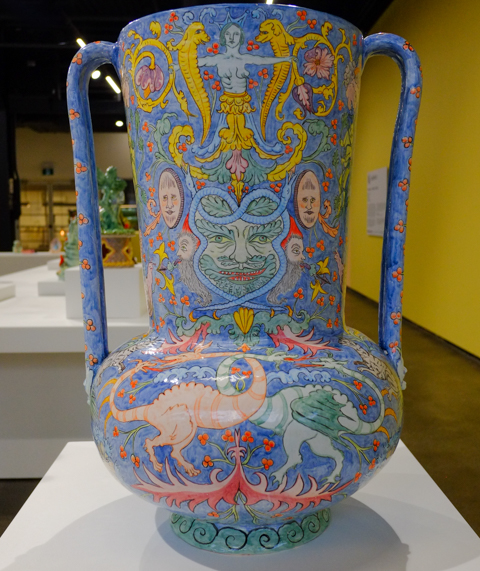
Montgomery’s work is in two sections.  The above figurine is a newer piece from the series “Despairware” “which references books of demonology and iconographies of feral femininity with Staffordshire figurines from the 19th century” (from the words on the wall at the gallery).  She is also showing some of her older work here, a series called “Neo Istoriato” which re-imagines paintings  and pottery from the Renaissance.  Two examples:

double handled vase or urn, pottery, painted with many macabre figures, by Lindsay Montgomery, in an art gallery

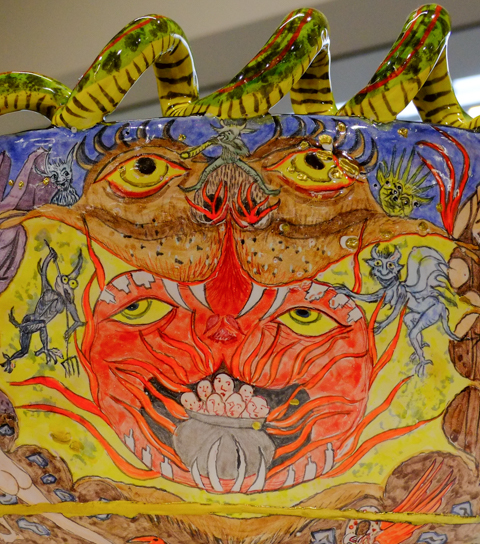
All together in a big pot in the fiery mouth of Hell while the demons dance with glee.

close up of a painting on the side of a pottery vessel, many people inside mouth of a red cat-like creature, with frog head on top, many eyes, little demon figures play beside red head

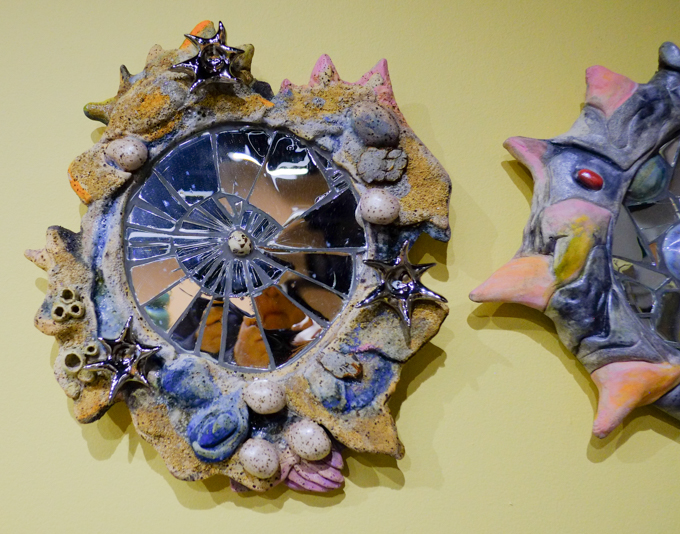
below: Kaley Flowers, cracked and broken glass to mimic water within a frame of ceramic shells, rocks and marine forms.

small ceramic artwork hanging on a wall, center is spiral of broken glass, outer layer is shells and rocks but made of ceramics

below: Marissa Alexander, eight women hanging on the wall.  Hung up, hanging about, hanging out….

small figurine of people in different positions, hanging on a wall

And last, there are a few individual tiles by Marc Egan that are very similar to the flowers and leaves in his Tree of Life.

2 ceramic tiles mounted on a wall, in an art gallery, floral pictures

The Tree of Life is a symbol that originated in antiquity; it appears in most religions and cultures.  Over the centuries it has been depicted in many different ways.  Here, it is shown with colourful and imaginative flowers and leaves in an image that has been constructed using large ceramic tiles by artist, Marc Egan.  The resulting artwork is 9 feet by 12 feet big.

artwork by Marc Egan, a large image of his version of the tree of life made out of ceramic tiles.

It is on display at Gallery 235 in the Harbourfront Centre,  It is part of an exhibit titled “Elaborate” that continues until 29th December 2024.

two flowers, yellow centers, white petals, on larger pale blue petals, skinny green leaves

part of a ceramic art piece by Marc Egan, imaginative flowers and leaves on a tree, black background

yellow and pink flowers, ceramic artwork

puffy foamy blue flowers in yellow green cup like leaves, ceramic artwork, tree of life, in an art gallery, other flowers that look like chocolate chip cookies,

two pink flowers that look like pink feather dusters, with long droopy skinny pink petals,

There is even a creepy crawly red and white bug!

red and white caterpillar on a branch of a tree, ceramic art by Marc Egan, tree of life, black background

bottom part of marc egan ceramic tree of life, the trunk, masses of green leaves


Infinite games, repeating games – both kinds of games can be seen in Yorkville.  For instance, we can start with the infinite…..

below: Sculpture by German artist Willy Verginer, titled “The Infinite Game”.  It’s a boy all in white kneeling on 4 dark grey teddy bears.  Meaning?

in courtyard at 80 cumberland, a statue by Italian artist Willy Verginer, a boy all dressed in white is kneeling on 4 grey teddy bears

below: The words, “Life is a Repeating Game” are a predominant part of this piece by James Verbicky.  The whole artwork is a large circle.  Circles, we go around in circles don’t we?  Plus, circles make cycles which we repeat over and over again.

artwork in a gallery window, horizontal stripes, painted in abstract, with words life is a repeating game

Yes, this post is about art.  More specifically, it is some of the works that caught my eye as I walked around the Cumberland-Yorkville area.  Some are in galleries or in their windows;  some are on the street.

below: “Hercules”, by Joe Fafard (the same artist who is responsible for the piece where Vincent Van Gogh’s head is inside a square, located on Dundas Street directly across from the Art Gallery of Ontario).  No attempts at being profound here but there is nothing wrong with whimsy.

flat metal sculpture, outline with small number of lines outlining details, of a cow, with title hercules, by sculptor joe fafard, located in front of mira goddard gallery in yorkville

below: Francisco Valverde’s riot of colours in vertical stripes in an artform that he calls Histograms.    There is an image in the background that is then covered with resin stripes of different colours.  The title of this piece is “Apricity”.

below: “Cosmic Dust” by Chinese artist Zhuang Hong Yi.  He produced this artwork by using acrylic paint on rice paper which has been mounted on canvas.  The paint is added last. .  The rice paper is folded and added to the canvas before the paint is applied.

artwork called cosmic dust, three dimensional, on wall, folded rice paper that is painted and then stuck on board or canvas

below: Three paintings, oil on board, on a gallery wall – painted by Ron Bolt.  They are images of rock formations that have been shaped by the ocean, and they are titled, Sea Carvings 1, 2 and 3.

paintings, oil on board, by Ron Bolt, on display at Loch Gallery, images of stones by the sea, abstract looking, 3 paintings side by side

below: d|azur A blue and white mural by Toronto-based artist Dahae Song on the corner of the Four Seasons Hotel.  It’s title is “d|azur”.

large artwork

below: This is “Raptor” by Nathan Mabry.  Something like ‘Toronto Raptors meet the Toronto Blue Jays’ vibes going on here.

Large blue bird, metal sculpture, title is raptor, by nathan mabry, in yorkville

below: Large black and white photographs by Deana Nastic in the windows of the Izzy Gallery

black and white photo, large, in window of izzy gallery,

black and white photo, large, in window of izzy gallery,

below: Another gallery window, another female image but that is where the similarities end!  Betty Boop and a collage of pop culture references such as The Beatles, Marilyn Munroe by Andy Warhol, bazooka chewing gum,  Pac-Man, the Starbucks logo, and more.

in a gallery window, collage art, featuring very large image of betty boop

below: Art on the streets, specifically on hoardings to hide a construction site.

artwork on hoardings and under scaffolding, beside sidewalk and around a construction site, multicoloured ovals, oriented vertically, on black background, by Peter triantos

below: Big coloured ovals on a black background, by Peter Triantos.

artwork on hoardings and under scaffolding, beside sidewalk, around construction site, multicoloured ovals, oriented vertically, on black background, by Peter triantos

artwork on hoardings and under scaffolding, beside sidewalk, around construction site, people, with lots of purple and orange tones

below: Slightly different from all the other image here, but still art in my opinion.  This image is from inside the Cumberland Terrace, a shopping center that has always struggled and is now facing demoltion (or total makeover, not sure what the plan is).  The interesting tile design on the wall was defaced by a line of Bell telephone booths. I wonder how long it’s been since someone made a call here?

tile mosaic design, interior wall of cumberland terrace, black and white stripes and a yellow and orange circle in the middle. Four phone booth mounted on wall

below: Gallery clutter.  He’s watching you watching him.  What does he see?

bookcase in a niche in a wall in an art gallery, painting above it, many small images in frames on the shelves, and a portrait of a man in front of it

I am going to end this post with three artists (from different eras and different backgrounds) who have portrayed their Canadian experiences in their paintings.

below: First is the oldest, Dutch born and European taught, Cornelius Kreighoff (1815-1872), whose “A Trip to Town” (1865), is one of his many scenes of life in what is now Quebec.   Kreighoff was a fairly prolific artist during his time in what is now Canada.  He first moved to the Montreal area about 1846.  At one point Ken Thomson (the newspaper/magazine publisher) owned about 200 paintings, many of which are now at the Art Gallery of Ontario.

painting by Cornelius Kreighoff in a fancy gold coloured frame, title is A trip to town

below: Lawren Harris (1885-1970), of the Group of Seven, painted  “House in the Ward, Winter City Painting No. 1” (Toronto) in circa 1924.   A snow covered street scene with not a car in sight! Just lovely old trees and red brick houses.

painting of a city street in winter, snow covered leafless trees, a red brick house, painting by Lawren Harris of the Group of Seven

below: And last, William Kurelek (1927-1977) “The School’s Woodpile” 1972, mixed media on board. Kurelek, son of Ukrainian immigrants, grew up on the Prairies during the Depression.

Previous posts about Yorkville Art:

1. The Yorkville-ification of Street Art.
2. A Yorkville meander with Captain Canuck


One of the pieces on display at TMU’s The Image Centre is this is pen and ink drawing signed by “Fun & Borckmann” from about 1895.  It is part of the exhibit, “Hypervisibility: Early Photography and Privacy in North America, 1839-1900.”  The drawing is on loan from the collection of Stephen Bulgar and Catherine Lash.   As you can see, across the top is the title, “A Common Enemy of Mankind”.  If you start at the first panel on the top left, you might think it is etiquette suggestions for photographers, but on closer inspection, is it?

an ink drawing from the late 1800s as seen in a gallery, framed and behind glass

Let’s take a look!

Panel 1 (below): ” The amateur
Photographer
A cheerful sort of nuisance is.
Does it occur To him – or her –
He shouldn’t take what isn’t his

part of an ink drawing by Fun and Borckman from about 1895 on the etiquette of photography, a common enemy of mankind

Panel 2 (above): A man whose life
Has been one strife
Against appearances of wrong,
Can’t kiss his wife
Lest lenses rife
On negatives his kiss prolong

Panel 3 (below) – along with “The other fellow’s girl!”
“Where’er one goes
To seek repose
Far from the city’s heat and din
Be cannot doze
In wooded close
But that a snap-shot takes him in.”

Can I call him a jaunty looking fellow with his striped blazer and the polka dot band on his hat?

ink drawing from circa 1895, a young man and a woman are sitting together outside, another man with a camera is hiding in the bushes behind them

Panel 4 (below): “Sometime mayhap,
A city chap
May linger in the moonlight fair;
He hears the tap
Of shutter-snap
And knows too well he’s pictured there.”

ink drawing with etiquette rules for photographers, or is it a guide to the follies of mankind? picture of two men about to kiss

Panel 5 (below): “Or in the street,
If he should meet
A former friend of single days,
It’s not meet
His smile so sweet
Be captured in actinic rays.”

bottom panel of drawings, a common enemy of mankind, with bottom title of Snap-Shots at the Amateur Photographer, about 1895 by Fun and Borckmann

Panel 6 (above): “But in default
Of dungeon vault
In which to lock this modern pest,
A plain assault
Might cause a halt –
But then, perhaps, a gun were best.”

Life’s little indiscretions now preserved in little snap-shots!   Please don’t shoot the photographer!

Extra litte note or two: Peter Borckmann was an artist whose pen and ink drawings appeared in the “New York Fun Magazine”. In the 1880s and 1890s, this art form became very popular as demand for humorous illustrations grew along with the increasing popularity of magazines and journals at that time. The “Fun Magazine” was published in the 1880s and early 1890s.

Oh, in case you were wondering about that word ‘actinic’.  I looked it up….According to Merriam Webster:  “of, relating to, resulting from, or exhibiting chemical changes produced by radiant energy especially in the visible and ultraviolet parts of the spectrum.”   Sounds a lot like old-fashioned, pre-digital, light hitting chemically treated film, photography to me!


For the last 12 days of June, Gallery 1313 had an exhibit of artworks that featured Toronto.  As someone who walks around this city with a camera, I was interested to find out how others “see” the city.

signs on a gate outside Gallery 1313 with the three posters about the shows there at that time

below: “Cranes on the Rooftop” (collage) and a photo of the old Humber Cinema on Bloor West.   Both are the creation of Jesse Miletin.

artwork on the wall of Gallery 1313, two colour photos

below: Two paintings by Kathleen McGuire (“Shwarma King” and “Abell Street Stop”), and a photograph by Courtney Fairweather of the Gooderham Building.  The distinctive yellow building on the northeast corner of Church and Queen was a Shwarma King restaurant in the last years of its life.  It is now being demolished.
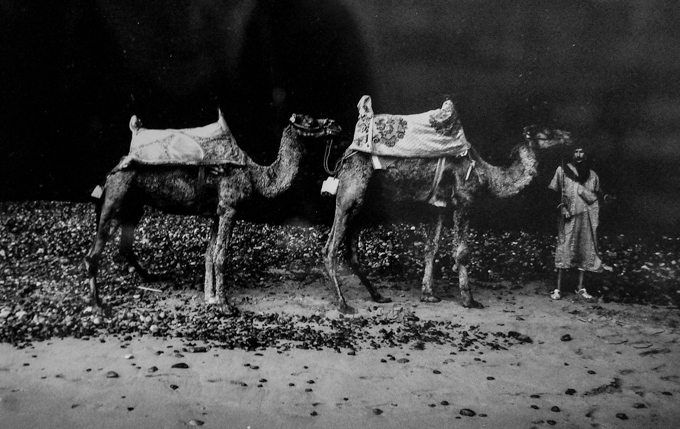
artwork on the wall of Gallery 1313, 2 paintings and a photograph

below: Drawing of a raccoon (actually a digital print on canvas), “Toronto, Mood the Raccoon” by Edgar Baculi.

artwork on the wall of Gallery 1313, black line drawing of a raccoon

below: Two Toronto images – on the left the CBC building with shadows of people dancing or cheering by Phil Taylor.   And on the right a mix of Yonge subway station and the interior of a subway car by Tim Gorewich. Or at least that’s what the labels on the wall claim.  As it turns out, both pieces are Tim & Phil collaborations.  The two men have been friends and collaborators for more than 30 years.

artwork on the wall of Gallery 1313, 2 photos

below: Collage with a TTC theme, by Emily Pike, “Takeover”.

artwork on the wall of Gallery 1313, collage with ttc theme

below: “Why Wellesley” by Anshul Sharma.

artwork on the wall of Gallery 1313, platform at wellesley subway station

below: “Fresh Peaches” by Steve Schnier

artwork on the wall of Gallery 1313, painting in mostly blues and golds, of a woman looking a baskets of peaches for sale at a fruit and vegetable market, sidewalk, by Steve Schnier

below: On the left (and yes, it’s difficult to see), a pencil drawing by Michele Cross, “The Railway Bridge at King”.   In the middle is “Bus Stop No. 1” by Elnaz Hessami Pilehrood.  TTC bus route 39 is Finch East.
3 artworks on gallery wall, two paintings and a black and white drawing

below: A section of the “The Toronto Show” exhibit.

photographs on display in a gallery, on a wall with a white radiator

below: Two black and white photographs by Monique Campbell – “Timeless”, taken in a barber shop and “Union Station” showcasing the ornate decorative elements in the arched doorway.

two black and white photos on the wall of gallery 1313, above a radiator

below: Just looking

woman in a brown and white striped shirt looking at artwork on the wall of Gallery 1313

“The Toronto Show” was in the larger room at Gallery 1313.  Off to the side are two smaller rooms and each featured a different show.  One of these was “Artist Pets”.

below: “Whiskered Foster” by Mariel Pagliai

artwork on the wall of Gallery 1313, title whiskered foster, very orange, with black drawings of rabbit and cat, also in blue, a nest of eggs

below: Photo of a dog on an old wicker chair by Karen Perlmutter, “Gracie in the Woods”.  Gracie has had her photo taken MANY times!!  A star model.

artwork on the wall of Gallery 1313, sepia toned photo of a dog sitting on an old wicker chair

below: And last, a painting by Roy Wong of a barn in winter, seen somewhere in Caledon.  “Impressions of Beauty” was the title of the small exhibit of Wong’s still life paintings and landscapes.

artwork on the wall of Gallery 1313, barn on a lane in caledon, painted in winter

gallery wall, exposed metal vents or beams in the ceiling, image on the wall

“True Colours” was a brief exhibit at the Dignam Gallery.  The gallery is run by the Women’s Art Association of Canada and is located in their building on Prince Arthur Street.  This was their 3rd Annual Uptown Pride Exhibition.  Saturday, 29th June is the last day of the show.

One of the nice things about this gallery space is the decor.

in an art gallery, a chaisse lounge against a wall with two paintings by karen taylor on it.  another painting in the background

below: “Express Yourself” and “It’s bad bitch o’clock” by Karen Taylor

two paintings on a gallery wall, both by karen taylor.  one is a long vertical and the other is square.  both are words, express yourself on the left in orange, green, and purple.  On the right is it's bad bitch o'clock in shades of pink and red

below:   Hung over this old fireplace is a painting by Stacy Athena May.  It is titled, “Hymn to Hera (Sisters Dance)”.

old fireplace painted white, painting above the mantel, art gallery space, painting by Stacy Athena May, two figures dancing, male and female body parts,

below:  Another Stacy Athena May painting, “Dismal Entity” hangs over a matching old white fireplace.  On the left is a painting by Shawn Skeir.

inside an art gallery with an old white fire place on an interior wall, paintings hung around the room

below: “Spirit Doll”, mixed media, sculpture by Steve Rose

small ssculpture, spirit doll, by steve rose, covered in fabric with lots of loose fibers, reds and oranges,

below: On the right is “Pride on the Subway”” (2019) by Lin Duperron.  The other 2 are by Steve Rose.

a green cloth covered wood chair, against a wall in dignam gallery, womens art association of canada, with three artworks on the wall behind the chair, 2 paintings and a photograph

below: What’s so crazy about peace, love, and understanding…. over and over again.  A twist on “What’s so funny about peace, love, and understanding” from the song written by Nick Lowe but made famous by Elvis Costello.

close up of artwork, with words what's so crazy about peace love and understanding, written many many times on white and yellow background, word love written loosely, and large, over the hand written text

At the Women’s Art Association, there are two galleries – the Ruth Upjohn Gallery has its own small room.   At the moment there are some marvelous photos by Ulla Djelweh, “Through the Garden Gate”, of flowers from a garden.  These orchids are hers.

lens based artwork by ulla djelweh, orchidsi n a garden, growing in small blue baskets

sewing mannequin form stands in front of an open door, photo on door, framed paintings on wall in hall, bottom of staircase can be seen

Also could be called, “Of bricks and stones and a lot of glass.”

I was recently telling a relative that one of the best ways to explore Toronto, especially downtown,  is just to get off at a subway station or streetcar stop and start walking.  There is always something to see.   This walk is the result of taking my own advice and just getting off at Queen station and seeing where my feet took me.   First stop was the Eaton Centre where Michael Snow’s birds still fly.  “Flightstop”.

interior of eaton centre shopping mall, south end by queen street exit, escalators and stairs, glass ceiling

below: Interior, Eaton Centre where all the benches have been removed.  Sadistic?  Gone are the days when you could take pictures of the men sitting outside Victorias Secret.

inter eaton centre shopping mall, people walking, others on walkway above,

interior of eaton centre shopping mall, large dream catcher shaped decoration hanging from the ceiling, with gold, silver, and white, ribbons, people on stairs beside it

below: As I walk around the city, I see more and more of this – the glass wall.   This view is south on James Street as I walk between the Eaton Centre and Old City Hall.

looking south on James street with old city hall on the right and eaton centre on the left, looking towards queen street with lots of glass towers in the background

below: Approaching City Hall and Nathan Phillips Square from the east you now encounter a conundrum.  Did people hit their heads on the low ramps?  Or were people camping out here?  A poor, and I hope temporary, solution.

barricades under a ramp with two signs saying this way, with red arrows, pointing opposite directions from each other

below:  A few images from “The Red Chair Sessions”, photography by Nadya Kwandibens  A series of 9 large photos is on display in the ground floor windows of City Hall (viewed from outside).  On the right, Sage Paul, designer and artist, originally from English River; on the left, Mushkegowuk Iskwew from Peetabeck (Fort Albany Ontario).

red chair photography at toronto city hall

below: Portrait of Ogimaa Kwe Bnes (aka Chief Lady Bird, her Spirit name) from Mnjikaning and Aura from Onyota’a:ka, posing under a mural that the two of them painted at Underpass Park.

red chair photography at toronto city hall

below: The backside of Sir Winston Churchill as he walks away from City Hall – something to think about?  The new court house is in the background.

man standing beside backside of statue of winston churchill

below: New court house from the corner of Chestnut and Armoury.

new court house, tall glass and steel building

below: Reflections in the glass of the new court house

very blue sky with white puffy clouds, reflected in windows of new court house on armoury

below:  Across Chestnut from the court house is an old hotel that is now part of U of T.  Its older brick and concrete facade contrasts with the glass and steel of the newer building.

grey brick and concrete wall

below: More concrete, the back of City Hall (completed 1965).  This is not a view that is typically shown but I find it fascinating that there are no windows at all on the outer sides.  As it turns out the back walls are made from 18 inches of reinforced concrete that allow for cantilevered floors which in turn make it possible to have an inner structure with few structural elements.

back side of toronto city hall, curved buildings, concrete

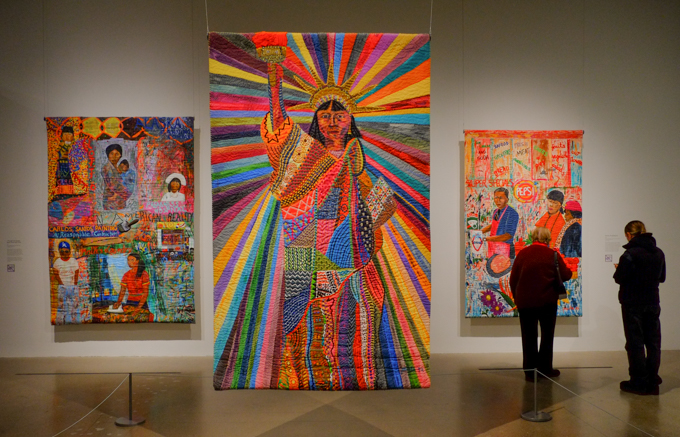
below: Also on Centre Ave is the Textile Museum. At the moment one of their exhibits is about quilts, “The Secret Codes: African Nova Scotian Quilts.  Some of the quilts are older ones like this pair by Susan Lawrence (1931-2008) which is a variation of “square in square” pattern.

two quilts by Nova Scotia resident Susan Lawrence, hanging in the textile museum

below: Other quilts are more contemporary such as these three by Myla Borden from New Glasgow NS

three quilts by Myla Borden on exhibit at textile museum, black line applique of daily scenes

quilt by Myla Borden on exhibit at textile museum, black line applique of daily scenes

I first read about these quilts on a blog, junkboattravels.blogspot.com  She has a more thorough description of the exhibit along with some pictures. I will add a few more of my photos at the bottom of this post, but if you are interested in seeing others, I recommend checking out the link above (and then scroll down a bit).

below: Looking north on Centre Ave to Dundas and beyond.  The facade of the old brick building on the northwest corner is being saved. It was built in 1928 as an extension to McLean Hunter which was on University Ave. This Beaux-Arts style building has five storeys of offices and four storeys for a printing plant.

looking north on centre avenue towards dundas

below: A closer look at the facade.

dundas and centre, northwest corner, facade of old brick building is being saved during redevelopment

below: Also Centre and Dundas, but the eastside of Centre, a colourful spot… and a trendy way to liven the street appeal of a parking garage.

east side of Centre and Dundas inersection with colourful abstract geometric mural on the corner of a parking garage, and turquoise upper level of Hong Shing restaurant

below: “The world is a little bitter. I want to give you a little sweet.” written on the inside.  Tiles in a marvelous tessellation by the front door.

looking in the window of a restaurant or coffee shop, with tiles in grey black and white pattern by the front door

below: Reflections in the glass at the northwest corner of University and Dundas.

glass building with lots of reflections, northwest corner of dundas and university

below: Crossing University Ave. while looking west on Dundas.  There’s a curvy new building underway.

looking west along dundas from university

below: The old court house, or Toronto Courthouse, which was built in 1966 is on University Ave just north of Osgoode Hall.  It is a 20th Century Modern building clad in Queenston limestone, a stone that you can also see on many other Toronto civic buildings such as the ROM and the .  It is quarried in Queenston, near Niagara Falls, and at one point was the largest quarry operation in Ontario.  You’d easily mistake it for concrete.

old court house building, or Toronto Courthouse, 361 University Ave., 8 storeys, clad with Queenston limestone, Canadian flag flying beside.

below: Cannons and yellow umbrellas

two cannons behind a black wrought iron fence by a patio with yellow umbrellas

below: Behind the yellow umbrellas

below: A narrow passageway between buildings.

two people at the end of a narrow lane that has a tall black wall on the left. 4 lamp posts along the wall

below: Old City Hall clock tower

a woman on her phone walks north on university ave past the canada life building where a man is sitting on the steps

below: The CN Tower sneaks into the photo.  At Osgoode, Metrolinx has taken over part of University Avenue for construction of the Ontario Line across Queen Street.

a man walks south on university, past the entrance to osgoode subway station on the northwest corner of university and queen west

below: Even Campbell House is behind scaffolding.

below: Just another Toronto street corner.

workmen in orange safety clothing standing around and talking or watching others work, construction site at Queen and Simcoe

below: Another facade saved. This one is at Queen and Simcoe where a bank once stood.

construction on Queen West and Simcoe

below: The wide open mouth of the green monster reaches upward as it tries to grasp the red balcony between its jaws.

below: This is the bank in question, The Canadian Bank of Commerce, built in 1930 just after the beginning of the Depression.  The photo was taken in 1931.  Take a close look at the other buildings in the picture, the stores to the right.   The structure with the Coleman Oil Burners billboard is gone but take a  look at the next couple photos which are of this stretch of Queen West today.

old black and white photo of bank of commerce on southwest corner of queen and simcoe, black and white, taken 1931

Queen street west, new condo with red glass on balconies, older stores like Adrenaline Tattoo, a Barbershop, Hollywood Hi, south side of the street

below: Queen West struggles to maintain its character.  The store in the middle is definitely in sad shape.  It looks like it would collapse if the others weren’t there to support it.

three stores on Queen West

two stores on Queen West

three stores on Queen West

below: There’s a little white “ceremonial” street sign, just below the blue and white Queen St. West sign, that let’s you know that this stretch of road was also named Moses Znaimer Way.  Znaimer had a long career in the entertainment industry in Toronto including co-founding CITY-TV, MuchMusic, and more.  In Toronto, a ceremonial street name is secondary to the legal name.  I am not sure how many there are in the city and I haven’t gone down that rabbit hole to find out.  Interesting idea though.

two people crossing the street by Queen West, with stores in the background, Civello, Stag Shop and another

below: Queen and McCaul, looking west

below: Gelber Brothers ghost sign on Richmond Street.

below: The CN Tower… again!  and Hooters (do they still exist?)

below: Murals in a parking lot.  Both were painted by Alex Bacon.

below:  Blue marine life, sharks circling.  An ominous hook.  This one of many Pangea Seed Foundation sponsored murals in the city.  Some of the others appear in a much earlier blog post, “love letters in paint” (2016).  Pangea Seed’s original mission was to use science, art and creativity to “inspire positive change around pressing ocean environmental issues”. This campaign has now branched out to increase awareness of the issues involving out fresh water lakes and rivers as well.

mural, blues, aquatic, marine animals, sharks swimming in the water

below: Restaurants on John Street.

restaurants in old brick houses on John street, with tall glass and steel condos rising above them

below: A vacant building longing to be another restaurant. In the meantime it’s been painted black… and as I type those words I am reminded of the Rolling Stones song, “Paint it Black”.  The song is a bit depressing and negative but then again, so is a blackened building.

older three storey building with mansour roof and upper gable windows, painted black, vacant, ad posters on it

The last stanza is “I wanna see it painted Painted black
Black as night
Black as coal
I wanna see the sun Blotted out from the sky
I wanna see it painted, painted,
painted Painted black, yeah

below: “We See You” shout out to the doctors, nurses, and other healthcare professionals that worked throughout Covid.  “Thank you”.  Painted by Elicser Elliott.

mural by elicser elliott on the side of a Tim Hortons, small lane, with text that says we see you. it's a thank you mural to the healthcare professionals that worked throughout covid

below: Variety on Adelaide.  Bricks and stone and a lot of glass.

older brick building, with sign Variety on Adelaide, in front of newer glass and steel condos

below: Looking east along Adelaide (a one way street with bike lanes and newly rebuilt streetcar tracks).

looking east along adelaide from john

below: Looking down the middle of the glass and metal sculpture in Grasett Park.  If you were to step back a bit, the sculpture takes on the shape of sails of a ship.

glass and metal sculpture in a park that looks like sails on a ship

below: Looking through the netting/glass, same sculpture as above.  The park is named after Dr. George Robert Grasett, a medical doctor (1814-1847).  The park stands on the site of the Emigrant Hospital built in 1847 to treat “ship fever” (typhoid) and other sicknesses in the Irish immigrants who started arriving in greater numbers that year.  Many died on the journey and many more were sick when they arrived.  Dr. Grasett was appointed as Medical Superintendent of the hospital but he died of typhoid fever about a month afterwards.   His name, as well as the names of the other doctors, nurses, and orderlies, (and one priest) are engraved on the benches in the park.

looking through etched glass on a sculpture to street scene on other side of adelaide street

below: Designs in the pavement – etched into the granite is an 1842 map of Toronto.

pavement designs in a small park, grasett park, dedicated to robert grasett and irish immigrants of the 1840s

below: Widmer Street, where a row of old houses has been preserved, but are dwarfed by the developments around them.

below: King Street, looking east from John Street.

barriers on King Street that were initially part of King street pilot for streetcars but infrastructure never made permanent, King street looking east from JOhn

below: It’s always there!  The CN Tower again.

below: Southeast corner of King and John.  Another glass wall.

below: Another row of preserved brick facades.  This time on King West.

preserved row of brick buildings on king street, with glass and steel condo rising above and behind

below: Rising above the Royal Alex Theatre

top part of Royal Alexandra Theatre building on King Street, with new glass condo towering above it

a couple standing on sidewalk and talking, a red and white crane in a construction site rises behind them, condo building in the background

below: This is “The Poet, The Fever Hospital” (1992) by Bernie Miller in David Pecaut Square

Bernie Miller sculpture in David Pecaut Square, title of The Poet, The Fever Hospital

below: Nearby is a new sculpture by Gillie and Marc and it has a very long title: “He was on a Wild Ride to a Safer Place with Rabbitwoman and a Dogman” (not the Dogman from the childrens books!). There is an empty seat at the back of the bike and it’s waiting for you to join them on their wild ride!

sculpture in david pecaut square, a four seater bicycle with a large rhino in the front seat, then a dog and then a rabbit. the back seat is empty for photo ops, this is by Gillie and Mac and is called He was on a wild ride to a safer place
Rabbitwoman and Dogman from a Gillie and Mac sculpture

black door at number 122, with white words painted on door that say who taught you to love

black and white slap graffiti on a metal box on sidewalk

This post has grown. It’s longer than I had envisioned it when I started putting ideas together a few days ago. I am not sure whether to thank you or to congratulate you for getting this far! Maybe both. Anyhow, I hope that you’ve seen a few new things, or interesting bits, as you’ve scrolled through this post.  Perhaps the pictures have brought back some memories?  In the meantime…..


As promised earlier, more quilts to end the post.

quilt in a museum


quilt in textile museum, the cotton pickers

quilt in a museum with a poem on it as well as black and white photos

“Sing poets of this beauty
Sing choirs of this inviolate pride
Make these moments precious to history
Let these scenes live in every eye”

Back down to the waterfront, Ontario Square and Harbourfront to be more precise.

Canada Square, near waterfront, tall condos overlooking small concrete structure with a large photograph, art piece, displayed on the side of it, Liquid Gold by Alex McLeod

below: Three large pieces by Alex McLeod, “Liquid, Gold” are on display on the walls of the underground parking entrance structure in the middle of Ontario Square.

Liquid Gold, images by Alex McLeod, large, two, on a concrete structure outdoors

From the words on the wall:  “Liquid, Gold” envisions oases where fragments of coral, flora, gems, and precious metal formations emerge. Delicate structures are weaving a narrative of resilience and adaptation. The crystal-clear waters, reflecting the azure skies above, beckon viewers to immerse themselves in the tranquil embrace of nature’s bounty.  Each ripple in the water is a testament to the fluidity of existence, whispering tales of renewal and transformation.”

Liquid Gold, images by Alex McLeod, large, outdoors

below: There are more large images from this series on the walls in the hallway of Harbourfront Centre.   McLeods artwork is on display through to December.

Liquid Gold, images by Alex McLeod, large, gallery

Liquid Gold, images by Alex McLeod, large, gallery, close up view

below:  Another exhibition now on at Harbourfront Centre is “Future Matters”.   Matters is a play on words here as it means both ‘materials’ and ‘is important’.  One matter, or material, is stone. It is represented here in this large collage of photos of quarry walls by Nada Al-Obaidi.

collage of images of stone structures made to look like a large stone wall

below:  Another material, and one that most of you wouldn’t think of, is dried salmon skins.  Here, Morgan Possberg Denne has used 74 skins to fashion two lampshades.

hanging lamps with shades made from dried salmon skins, art, in a gallery

There are other exhibits that don’t photograph all that well (or that I curated out) such as crumpled bits of paper on tables, fabric made of milkweed, and paints sourced from a vacant lot – using crushed snail shells, and sumac flowers for example.

exhibits in a gallery at harbourfront centre, wood structure, picture on wall, image of stones,


Also at Ontario Square is the Power Plant Contemporary Art Gallery.  There are two exhibitions on there at the moment.  First, a retrospective of the work of June Clark and second, a look at the research by Terence Gowan on architecture in some of the embassies around the world.

below:  Gowan has extensively studied the architecture of American embassies in Baghdad, Havana,  Ho Chi Minh City, and Ottawa (the last one is unbuilt), including how different materials are used.  Over time, the materials and methods have become more sophisticated and complex as governments demand more safety and more secrecy from their embassies.   From a sociological perspective, or as a look at the history of international relations, it is a fascinating exhibit.

room in art gallery, Power Plant Contemporary Gallery, with exhibit based on research by Terence Gowan into architecture of embassies around the world

But does this work translate well to an art gallery setting?

room in art gallery, Power Plant Contemporary Gallery, with exhibit based on research by Terence Gowan into architecture of embassies around the world, looking through grid of ceramic tile to far wall where a woman is looking at a display

below: The most eye-catching of the June Clark art installations is “Harlem Quilt” (1997).

a wall of little lights in an art gallery, each light is by a photo of a person printed on fabric. Witness, by June Clark at Power Plant contemporary art gallery

Each light is mounted with a piece of fabric on which a photo of a person has been printed. In many cases the light obscures the face of that person. I am not sure if this was intentional or not.

part of witness, an art installation by june clark featuring a string of lights and each light is mounted on top of a piece of fabric and each fabric has a photo of a person printed on it.

part of witness, an art installation by june clark featuring a string of lights and each light is mounted on top of a piece of fabric and each fabric has a photo of a person printed on it.

below: The installation has a room of its own and the effect that it produces is quite ethereal.

three walls of little lights of a room full of them, in an art gallery, each light is by a photo of a person printed on fabric. by June Clark at Power Plant contemporary art gallery

below: Another exhibit that is part of Clark’s “Witness” is a circle of chairs made of washboards titled “Keepers”. Like most of her other work here, it features people in her life. Each chair is decorated with items that evoke the memory of a person that mattered in her life.

close up of the back on one of the chairs made out of whitewashed washboards, in a circle, art project by June Clark, chair in foreground has photo of a boy, plus watch and chain hanging over the top corner,

below: One of 10 pieces from “Homage”.  Again, a tribute to other people in Clark’s life.

little sculpture of a board painted white, a metal key, some frayed rope and a miniature washboard

below: And last, the one part of Clark’s work that is about her is “44 Thursdays in New York” where each piece has a photo of herself plus a copy of her journal from that day, for 44 consecutive Thursdays in 2004 when she was living in New York City.   I’d love to be able to read the words as well!

3 framed images on a gallery wall, each has  portrait photo in the center as well as pages from a journal, ink on lined paper, June Clark, 44 Thursdays in New York.


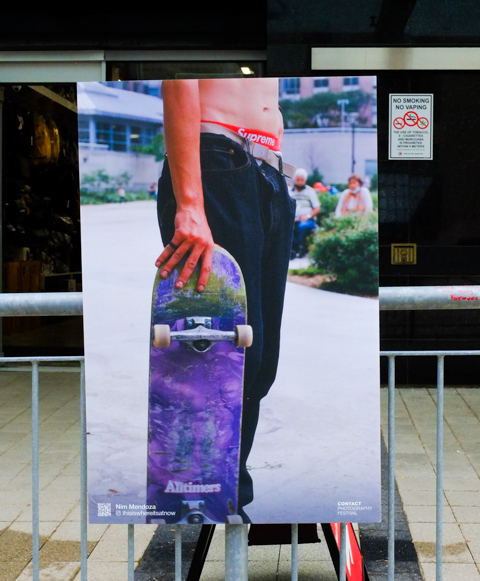
… a CONTACT Photography post.

Gallery 1313 and Elaine Fleck Gallery are within a block of each other out in Parkdale and both were participating in this year’s festival.

The Elaine Fleck Gallery were featuring the work of one artist, Bill Hornbostel, in a retrospective show titled ‘Luminous Realism’.   At Gallery 1313 I saw ‘Offshoot’, a collection of images from nine photographers.   Unfortunately the latter was only on display until May 19th.

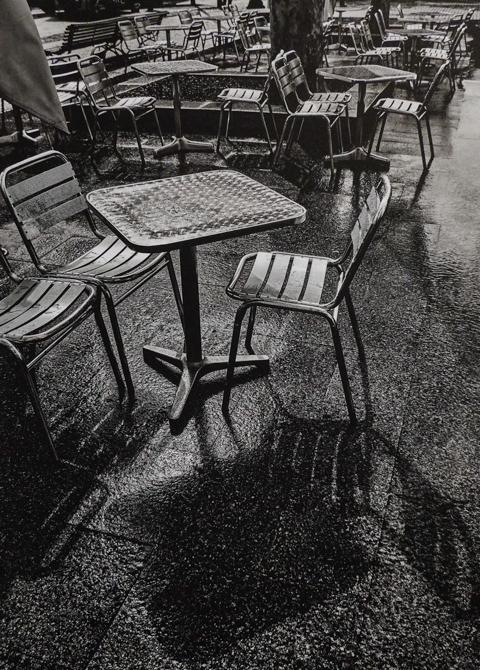
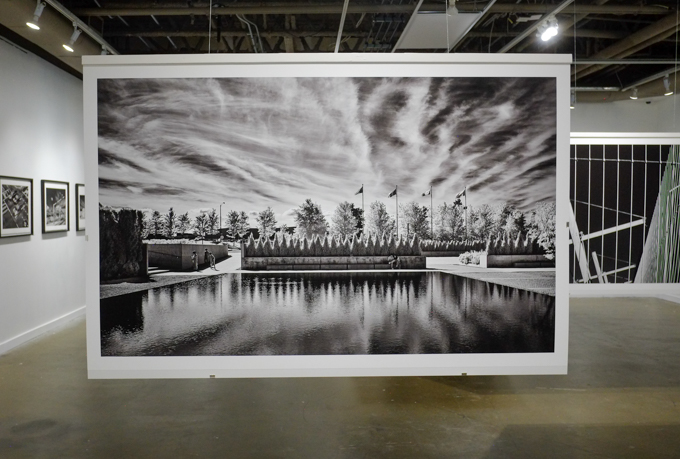
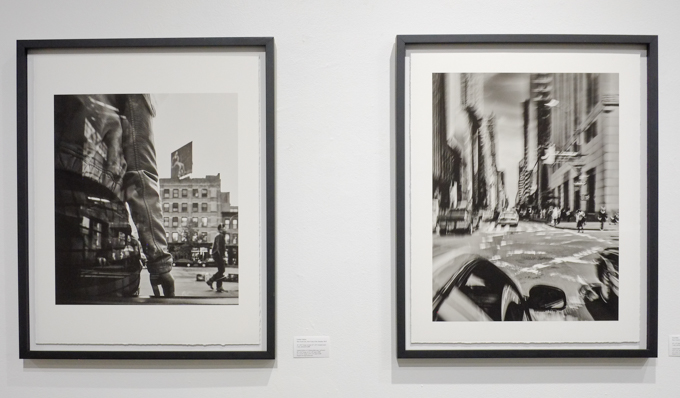
below: Hornbostel’s images are large, and shot at slightly longer exposures.   Some of the photos, like this one of traffic on Bay Street south of Old city Hall, were taken in Toronto

a large photograph of Bay Street in Toronto, looking toward old city hall, hanging on a wall in Elaine Fleck Gallery, photo by Bill Hornbostel

below: ‘Offshoot’ at Gallery 1313

two women in an art gallery looking at photographs that are mounted on the wall

below: Margaret Kittel Canale, two building exteriors, orange and blue.

two photographs on a gallery wall, both building exteriors, the upper photo is an orange building, the lower one is grey stone with a blue arched door

below: Jude Marion (two photos), industrial areas in Hamilton.

photograph by Jude Marion of an industrial part of hamilton ontario at night

four photos of hamilton industrial areas on a gallery wall, work of jude marion

below: Lilianne Schneider with “Displaced” that looks at the abandonment and relocation of two heritage structures.

photographs of rural abandoned buildings by Lilianne Schneider, on a gallery wall

below: One of the photos by Courtney Fairweather who chose to highlight cell phone usage in today’s society.

man in orange robes, seated, looking at his cell phone, a photograph in a gallery by courtney fairweather

below: Some interesting photographs by Ted Scott

4 photos on a gallery wall by ted scott

below:  When I first posted this, I thought these images were part of ‘Offshoot’ but I was mistaken.   They are in fact part of a solo exhibit of digital photocollages by Janne Reuss (in a separate little room) titled ‘Thread(t)s and Narratives’ .

artwork on a gallery wall

artwork on a gallery wall

With apologies to the photographers whose work I haven’t shown (not missed on purpose): Joachim Oepkes, Ulla Djelweh, James Sutherland, and Eric Garsonnin.

The Bill Hornbostel show continues until the end of May

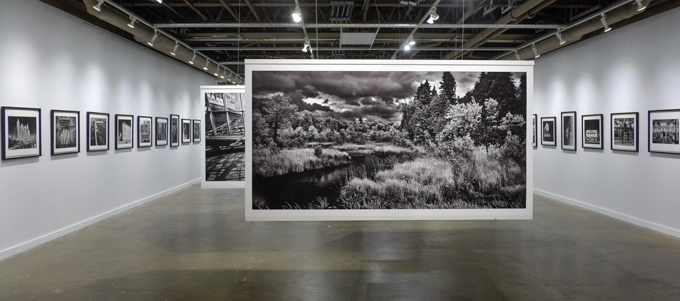
a large framed photograph on a gallery wall with lots of reflections of the people in the gallery, and of the view from the front window of the gallery