Archive for the ‘galleries’ Category

Yesterday afternoon I wandered into The Power Plant Art Gallery.  It was late enough in the day that the sun was already low in the sky.  It shone through the large windows in the main gallery and cast a warm glow on the current exhibit, works by Yto Barrada titled ‘Faux Guide’ .

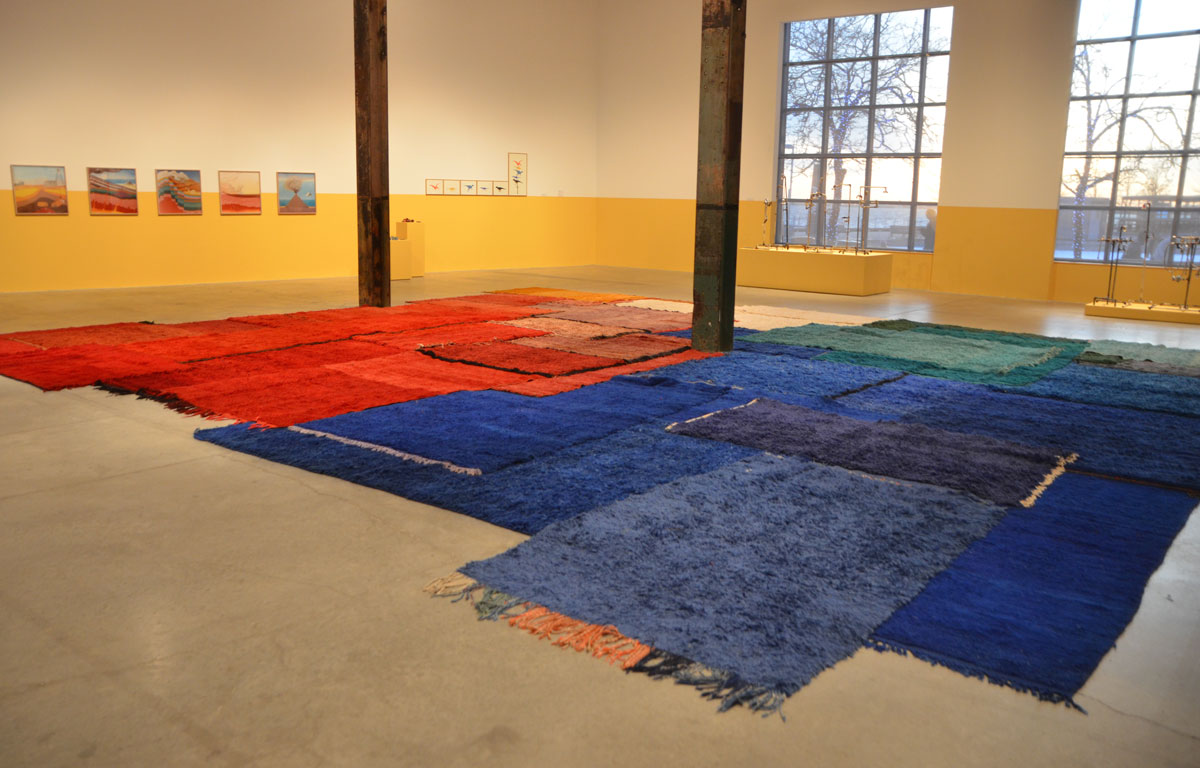
The first thing you see when you enter the rooms is a collection of carpets.  This is ‘Geological Time Scale’ and it consists of bright and bold red, blue, and green carpets – Beni Mguild, Marmoucha and Ait Sgougou pile rugs from Western Central, Middle Atlas, Morocco.   It’s definitely eye catching and it definitely draws the viewer into the exhibit.

main exhibit room of The Power Plant Contemporary Art Gallery, large room with two large windows in which the low afternoon sun is shining. Exhibit by Yto Barrada consisting of red, green and blue carpets on the floor. some framed pictures on the far wall, walls have been painted yellow up to about 4 feet from the floor.

A series of  small exhibits are arranged around the room and most of them are the result of the artist’s research on Moroccan dinosaurs, fossils, and the industry that has built up around them including the trade in fake fossils sold to tourists and museums.   I have not shown most of these exhibits – I will leave it up to you to discover them.

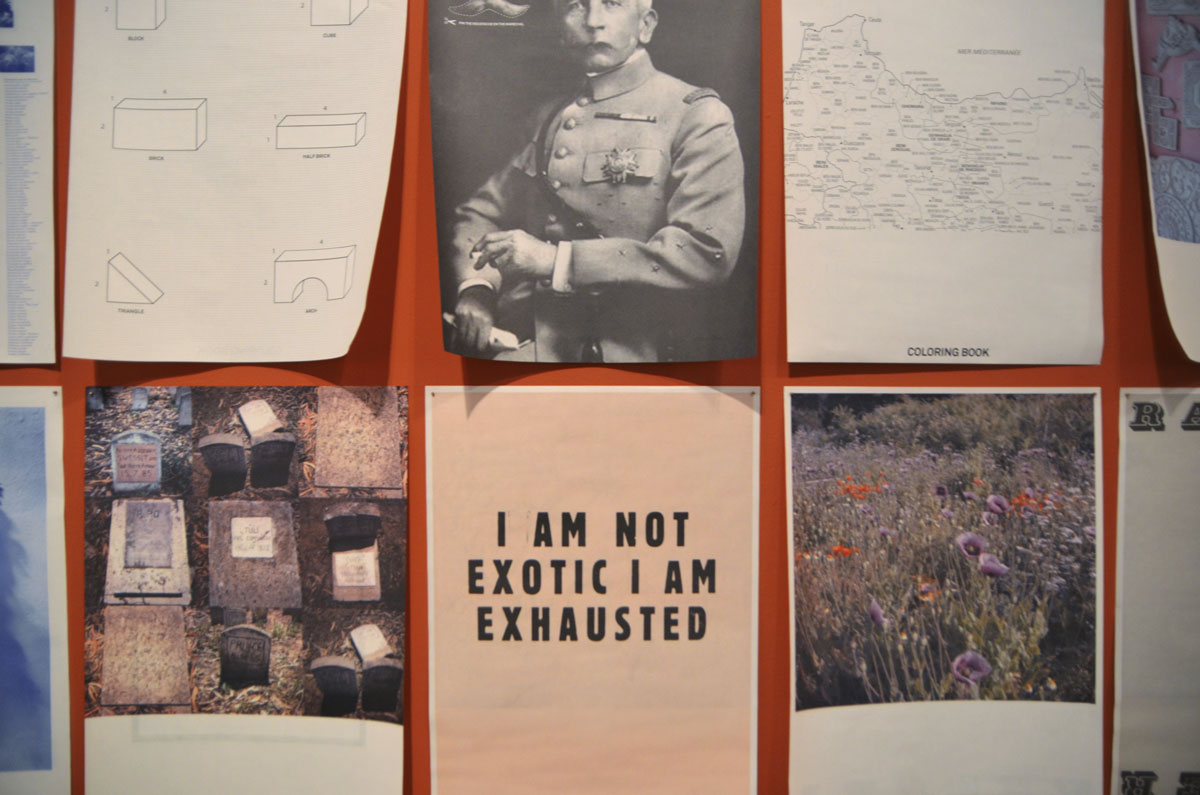
below: “I am not exotic I am exhausted”.  I suspect that this comes as Barrada’s response to living in a place (Tangiers Morroco) where tourists come to see “exotic things”.  But it is also the lament of anyone trying to live and work in a place that is also a “tourist attraction”.

Part of an exhibit by Yto Barrada of a series of posters printed on paper and loosely tacked to the wall, of images and words. 6 shown in this photo. Including one that only has a few word on it, I am not exotic I am exhausted.

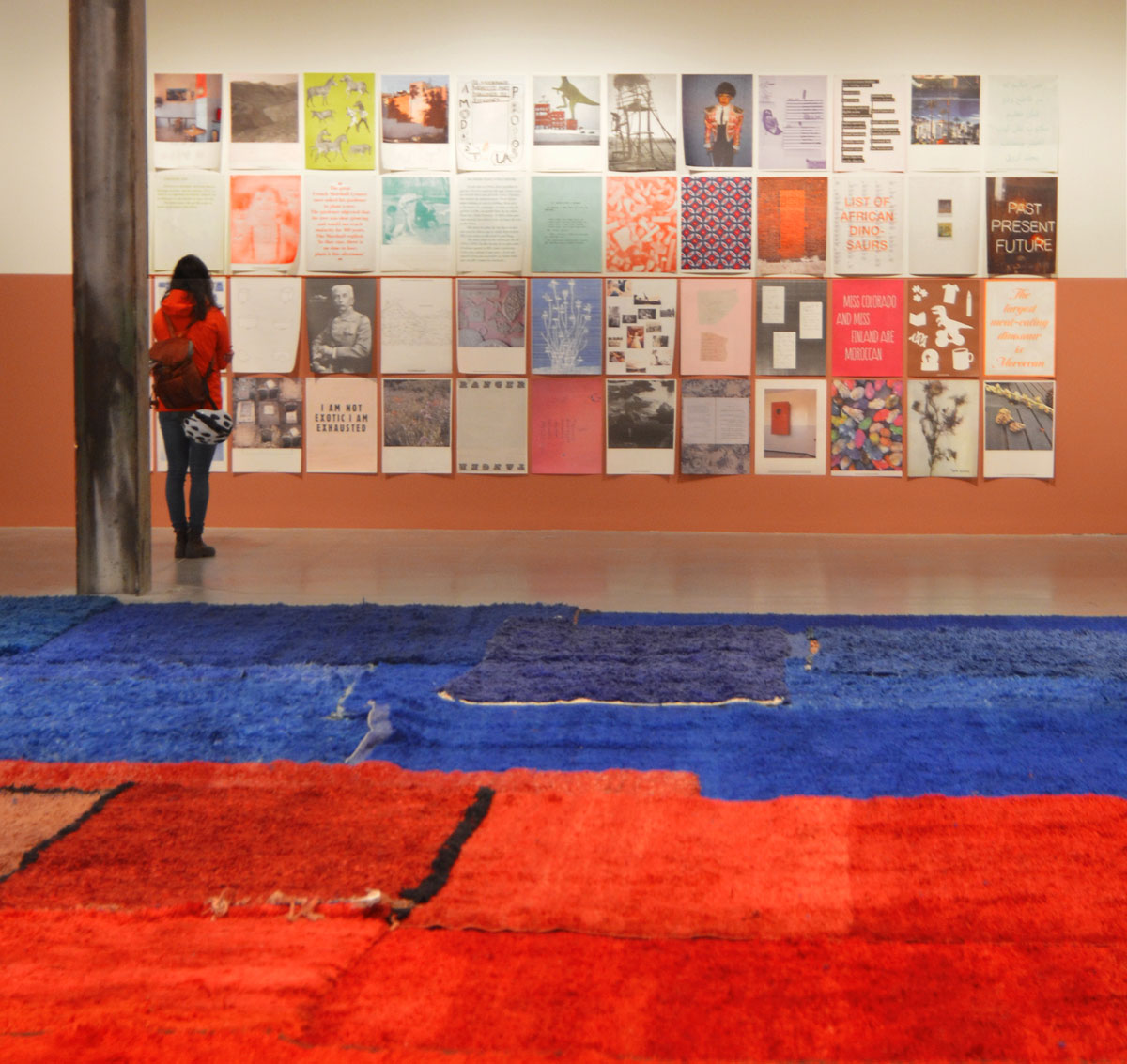
below: The whole of ‘A Modest Proposal’ and ‘Faux Guide’, 2015.  A set of 48 posters loosely tacked to the wall.  A mix of humorous and poignant.  One is an alphabetical listing of all the types of dinosaurs found in Morocco.  One says “Miss Colorado and Miss Finland are Moroccan” – which did happen in 2012.

Part of an exhibit by Yto Barrada of a series of posters printed on paper and loosely tacked to the wall, of images and words. They are arranged in a grid of 12 x 8 pictures. A woman is standing in front of them, reading the words on one. Blue and red carpets are on the floor in the foreground.

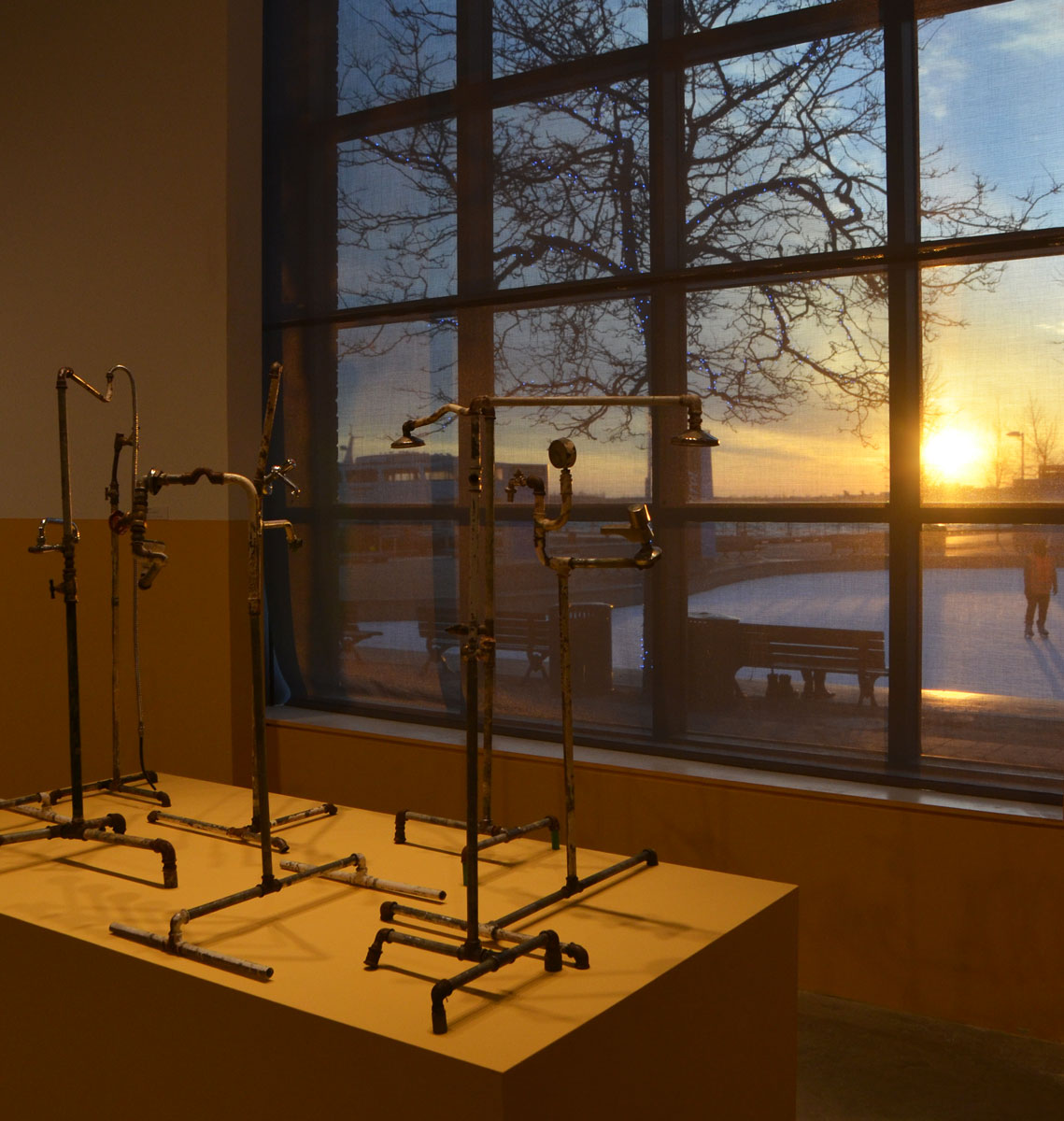
below: ‘Plumber Assemblage’ by the window, with skaters outside in the fading light.

plumber assemblage, an artwork by Yto Barrada consisting of a few sculpture like pieces made from pipes, faucets, taps, shower heads and other plumbing things.

There are many, many things that you can take from this exhibit.  Many things to think about.

An article in the  Toronto Star claims that Barrada  “explores the cultural heritage of her homeland through a colonial lens” and how that heritage has been used to make money from tourists.   But….   Is this the making of money by exploiting one’s culture and history?  Or the exploiting of Moroccan culture and history by the tourists?

Tourists go searching for the foreign and the exotic.  Many of them are souvenir hunters – Sometimes it’s a selfie in front of every “famous” place (or interesting building or whatever) and sometimes it’s a “find”.  But we live in a world that is full of  ‘made in China’ souvenirs and we are a people that don’t care to distinguish between the real and the fake.  We just want a story to tell the folks back home.

There were once dinosaurs living in a tropical land in what is now Morocco….  how the world has changed, and is changing.   Insert your opinions on climate change here.

Because it is a collection of exhibits under one umbrella, it has been compared to a museum.  Very trendy.   One description of the exhibit claims that it is “Meant to make us question the ways in which museums confer value on things”.  Can I take that one step further by asking, how do art galleries confer status on art and artists?  Museums make curatorial choices and so do art galleries.  Barrada too has surely made choices as have I.

You are probably wondering what carpets on the floor have to do with all those words that I just wrote.  Good question.  I think that Yto Barrada is on to something – an exhibit that has visual appeal, offends no one, and is flexible in its interpretation (i.e. it says something different to everyone and fits nicely into most people’s narratives).   You can agree with me, or disagree.  Best to go and see it for yourself and form your own opinions…. mine just might be fake.

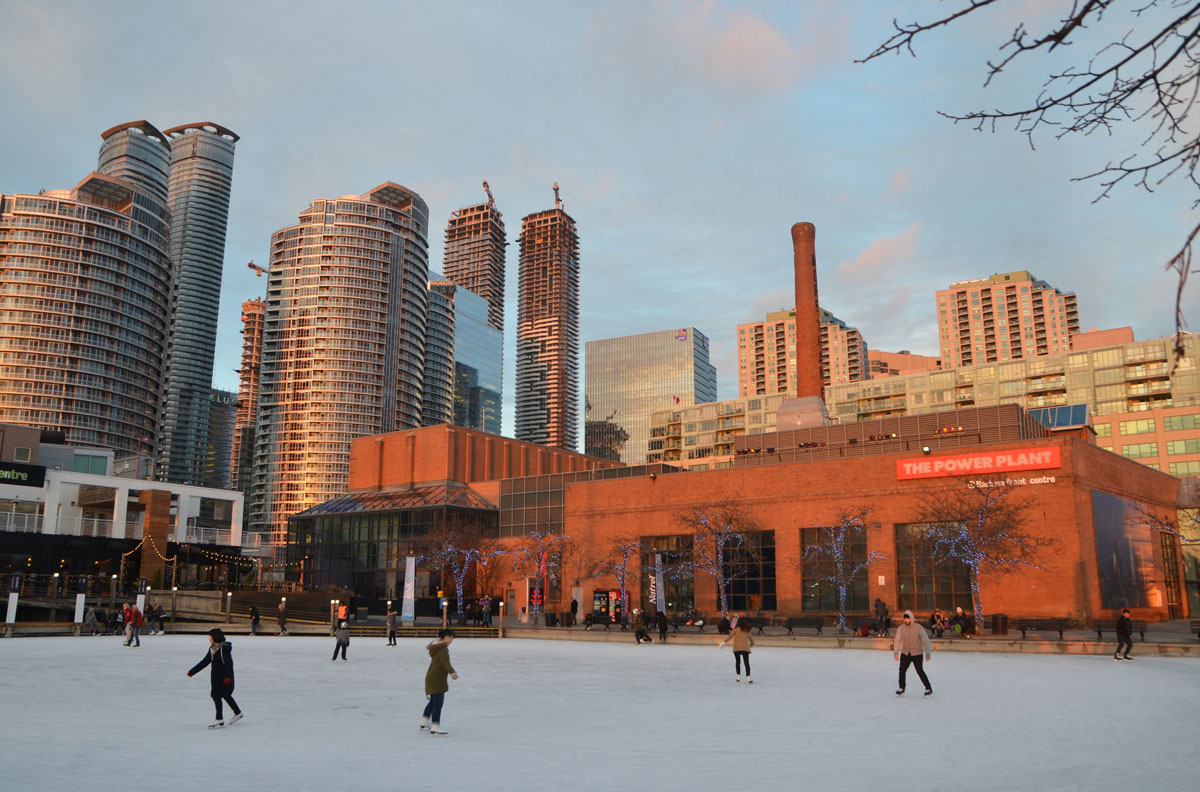
below: People skating on the frozen Natrel Pond beside The Power Plant.

late afternoon with the sun low in the sky casting yellowish glow on the world, Toronto skyline in the background with its condos and construction cranes, also The Power Plant Center and art gallery. In the foreground is the frozen Natrel Pond of Harbourfront and on it people are skating.

Yto Barrada’s exhibit will be on at The Power Plant until the 2nd of January.

The word Chihuly in the title refers to Dale Chihuly, an American artist who has been working in glass since the mid 1960’s.   At the moment there is a special exhibit at the Royal Ontario Museum (ROM) of some of the sculptural work produced by him and his team.

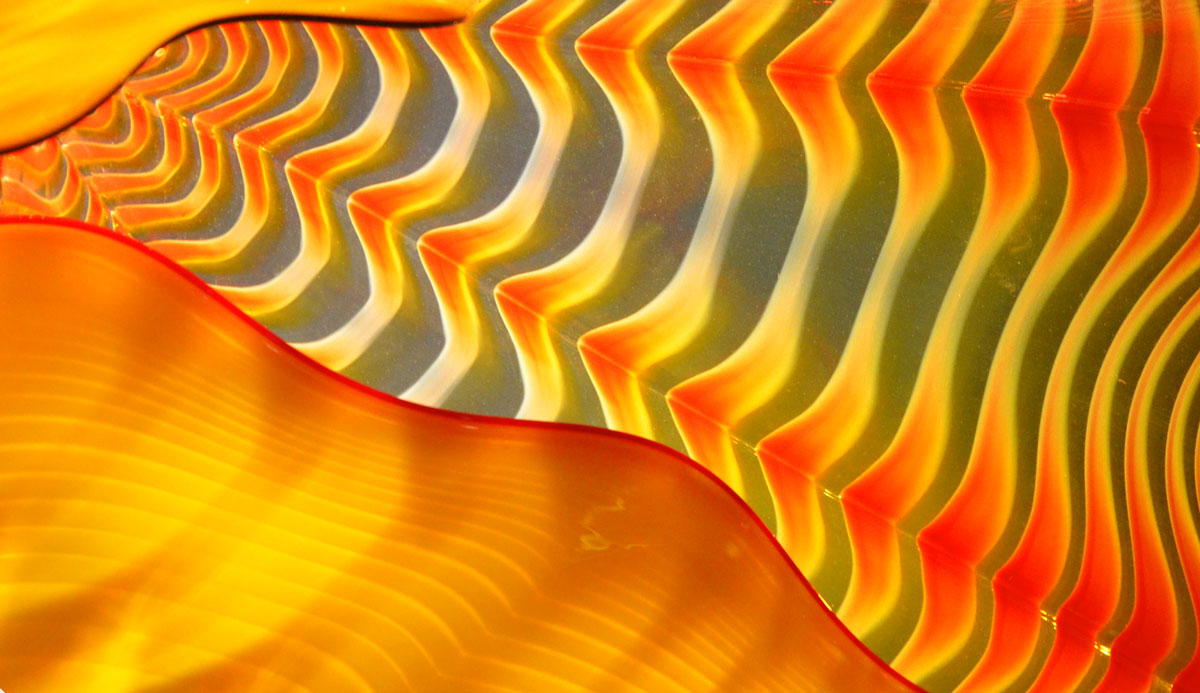
detail of a glass sculpture showing ripples and waves of colour, ornages, greys and yellows

I’ve now wandered through this exhibit three times.   The first time, I found it a bit overwhelming and I wasn’t sure how to photograph it.  The second time I went I just looked.  Yesterday I went back with my camera and tried again.  I’m reasonably happy with the photos but I know that I have only captured a small part of the art.  Perhaps it is enough to enable you to imagine more of it, or to refresh your memory if you have already seen the exhibit.

below:   Admirers looking at “Persian Ceiling”, 2012 .  Large cushions were provided for those who wanted to lie down to get a view of the ceiling in its entirety.  Of course, looking at the sections up close was also fascinating.  All the different shapes and colours overlap and produce new colours and textures.

people lying on the floor looking a ceiling that is made of different coloured glass pieces, back lit, also some people standing and pointing at different pieces

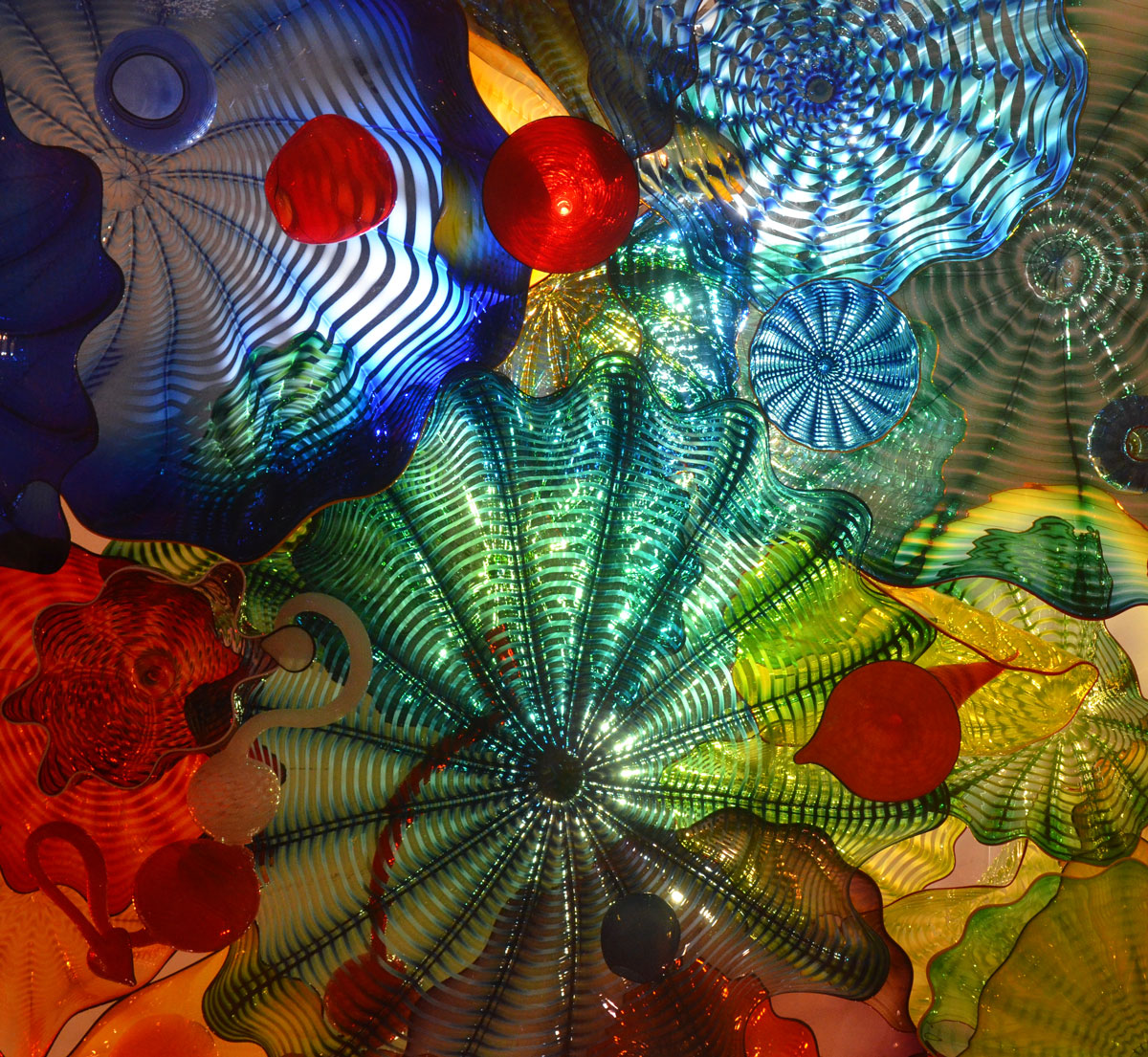
below:  Section of the “Persian Ceiling” installation.

bits of coloured glass, circular shapes, ridges, back lit,

The round slight scalloped glass shapes that look a bit like flowers are called Persians.  At least that’s the name that Chihuly has given them as described in this quote that appears on the wall just outside the room.    “I just liked the name Persians.  It conjured up sort of Near-Eastern, Byzantine, Far East, Venice, all the trades, smells, sense… I don’t know, it was an exotic name to me, so I just called them Persians.”

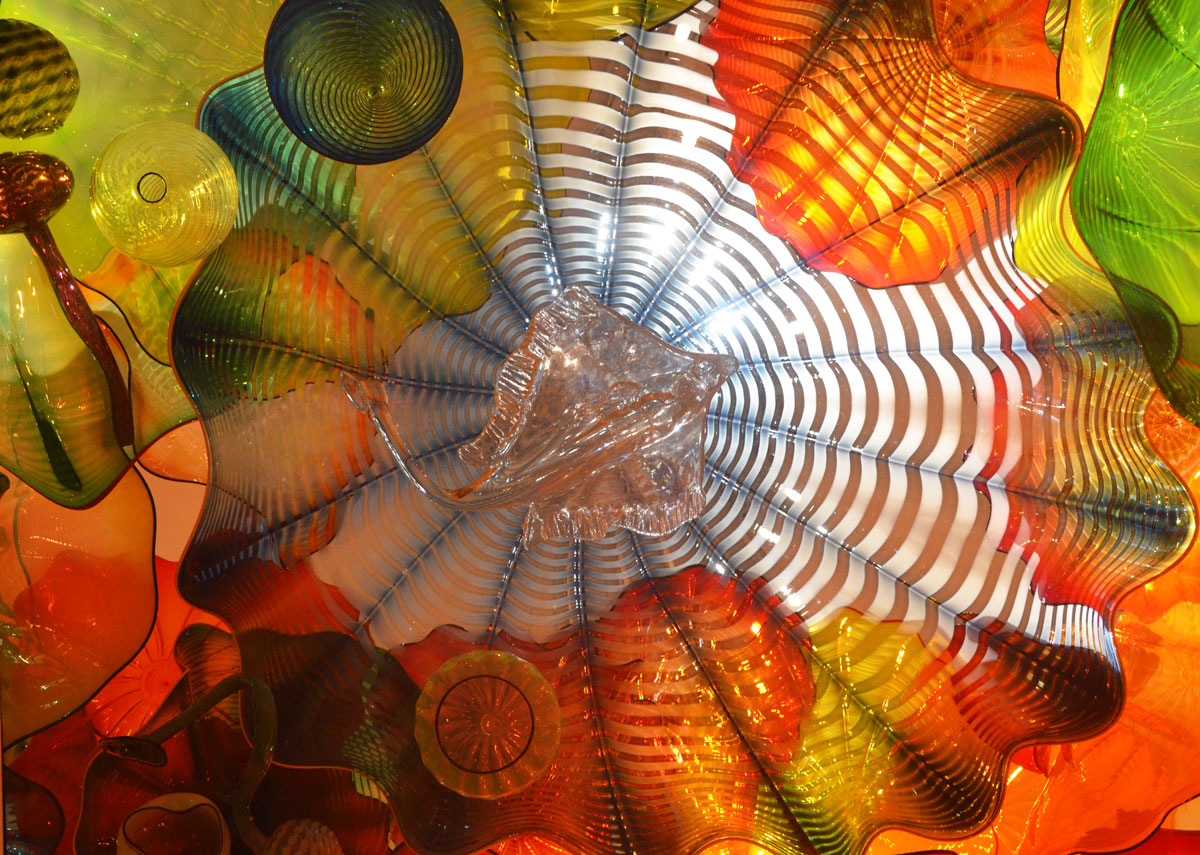
below: A ray swims amongst the waves of colour.

bits of coloured glass, circular shapes, ridges, back lit,

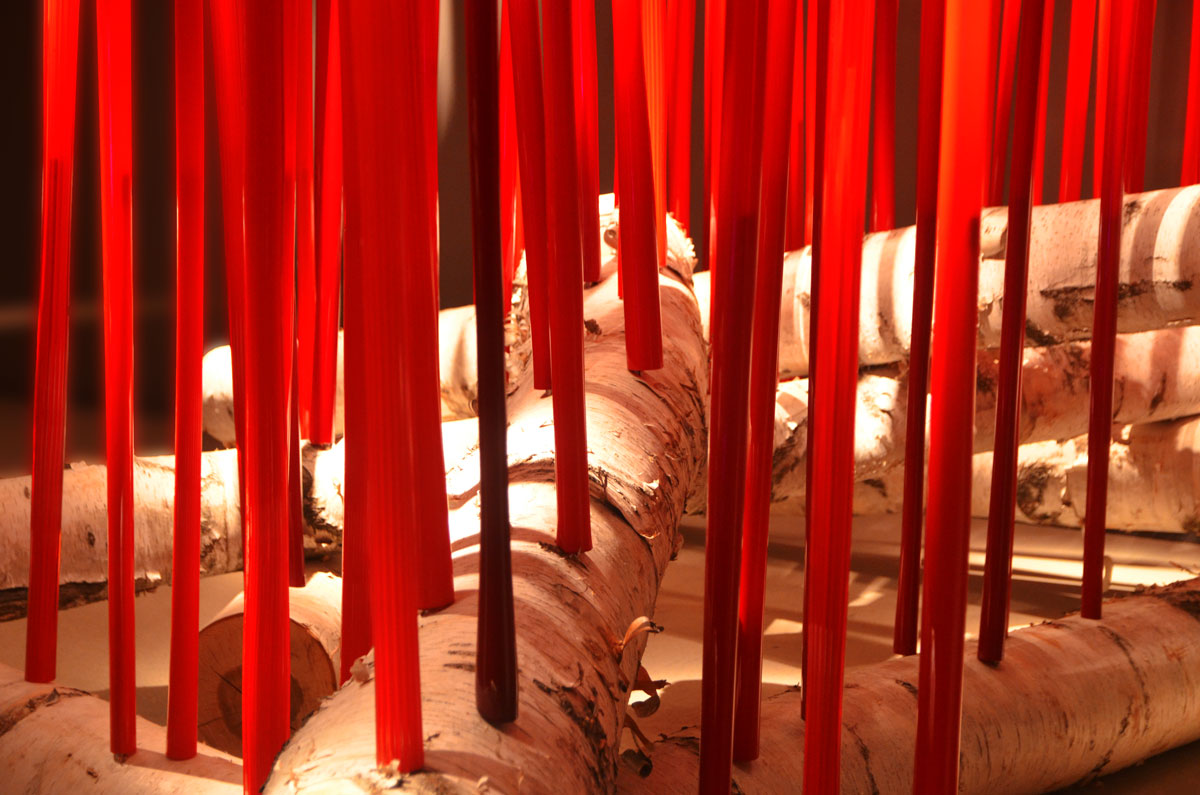
below: “Red Reeds”.  I thought of candles when I first saw this piece, red candles in a birch bark candle holder.  Then the  young girl standing beside me announced that it was a campfire and I changed my mind.  I think she’s right.  Marshmallows anyone?

The red tubes are hollow glass.  Metal rods have been inserted into the birch logs and the glass tubes sit over these rods.  You can see the darker sections at the bottom of the tubes where the metal rods are.

red glass tubes inserted into large birch logs, looks like a campfire with tall flames

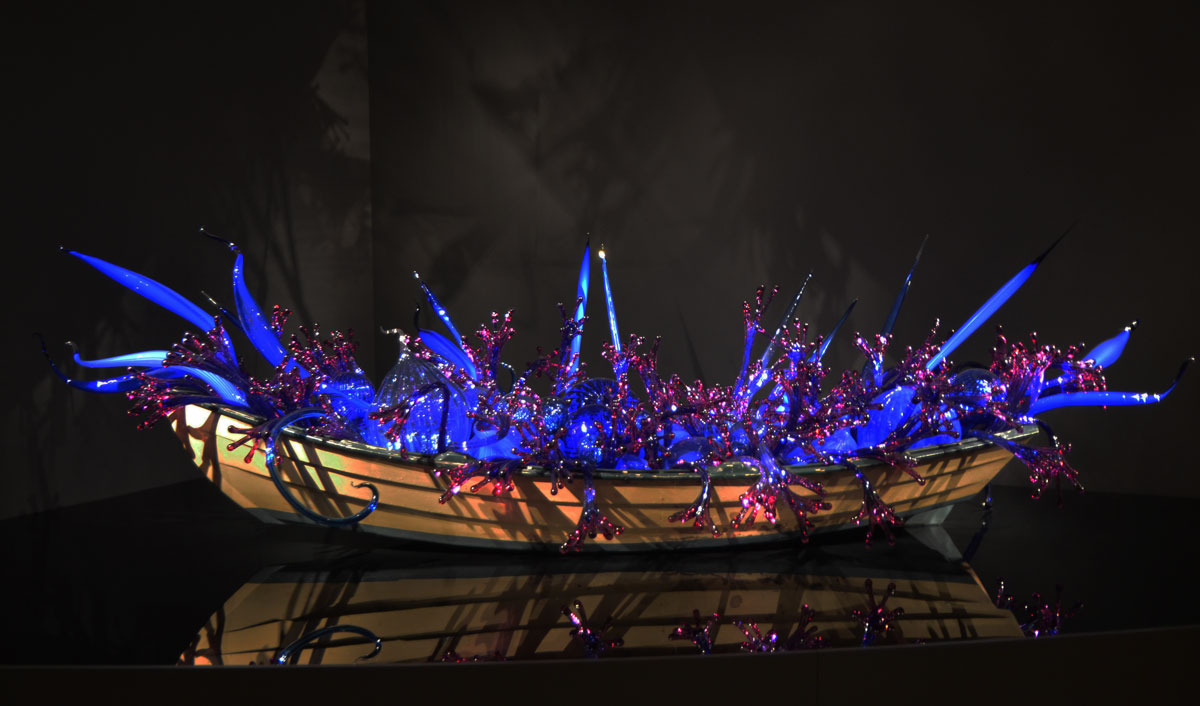
below: “Blue and Purple Boat, 2006”.  Back in 1995 Chihuly floated some glass pieces on a river in Finland.   Local teenagers collected the pieces in their wooden boats and this provided the inspiration for a number of installations featuring glass in boats.  This is one of two on display at the ROM.  It is on a reflective surface, like a calm river.

a wooden boat on a black reflective surface. The boat is filled with blue and magenta pieces of sculpted glass

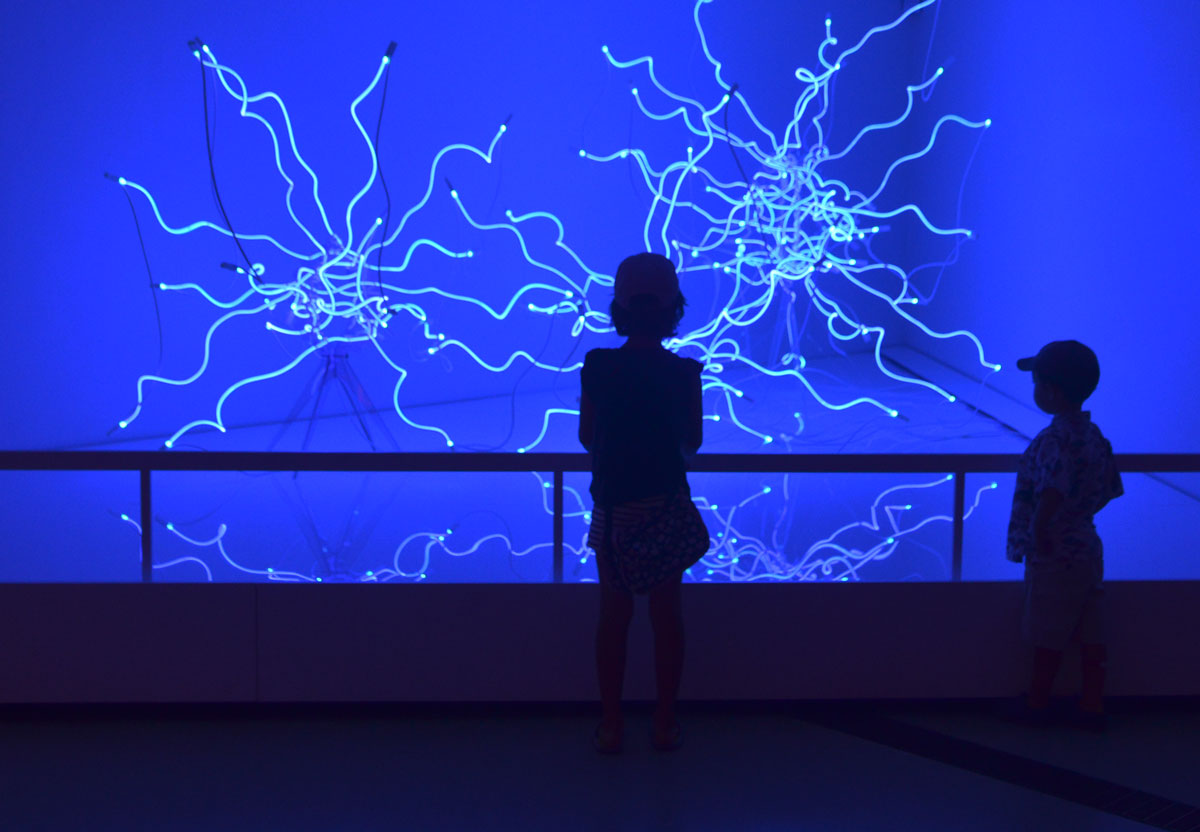
below: “Sapphire Neon Tumbleweeds” constructed from factory made neon tubes that have been heated and bent into organic shapes.  The lighting is magenta in real life but blue in my photos.

two kids standing in front of an exhibit with blue neon lights twisted into tumbleweed shapes, backs to the camera

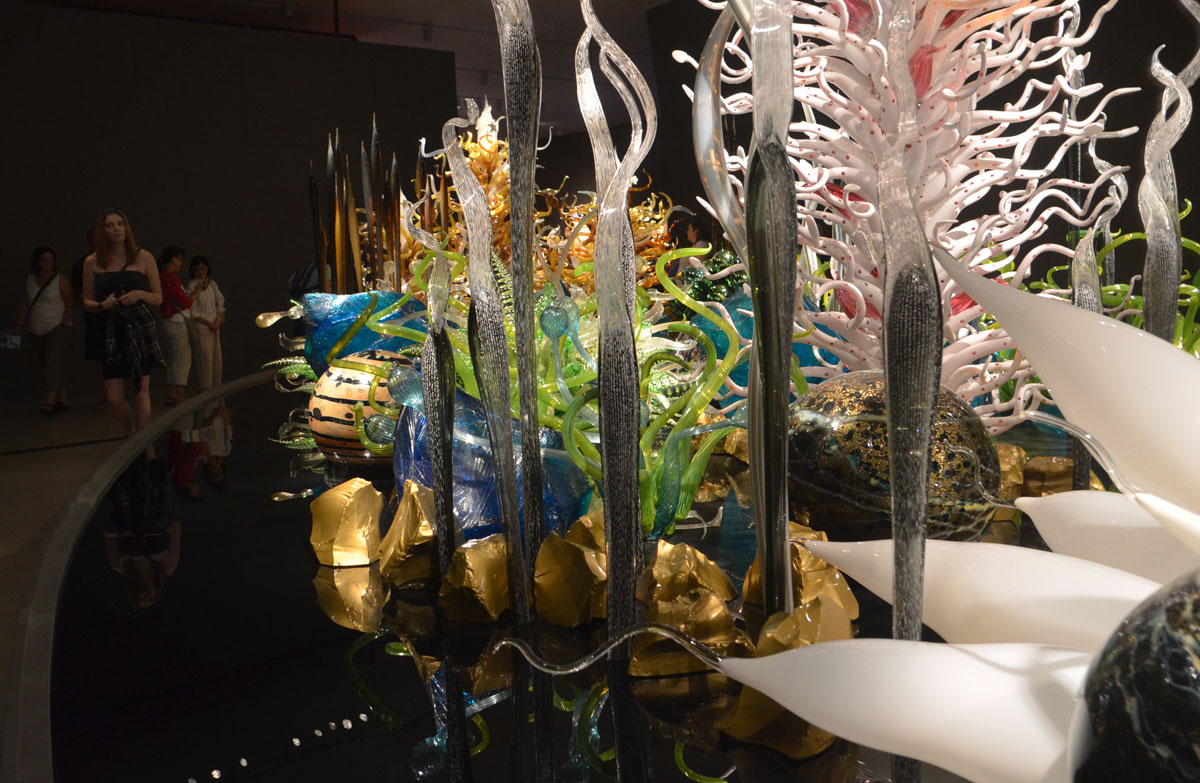
below: The next few photos are of a large and elaborate installation called “Laguna Torcello”,  named after a lagoon island in Venice.  It is a garden of fantasy in glass.  Parts seem to be aquatic, growing under water.

aquarium like structures, water plants, and large shells, made of glass, on a black glass reflective surface

As an aside, I suspect that the logistics and cost of transporting and installing these pieces is not minor.  Like the red tubes above, this garden is made of hollow glass pieces that are arranged on, and supported by, rods.  The whole thing sits on a flat, dark, and reflective surface which adds another dimension to the artwork.

green glass and silver metallic horn shaped pieces on a black reflective surface, part of a large glass art installation by Chihuly at the ROM

different shaped glass sculptures that look like stylized underqater scene, aquatic plants

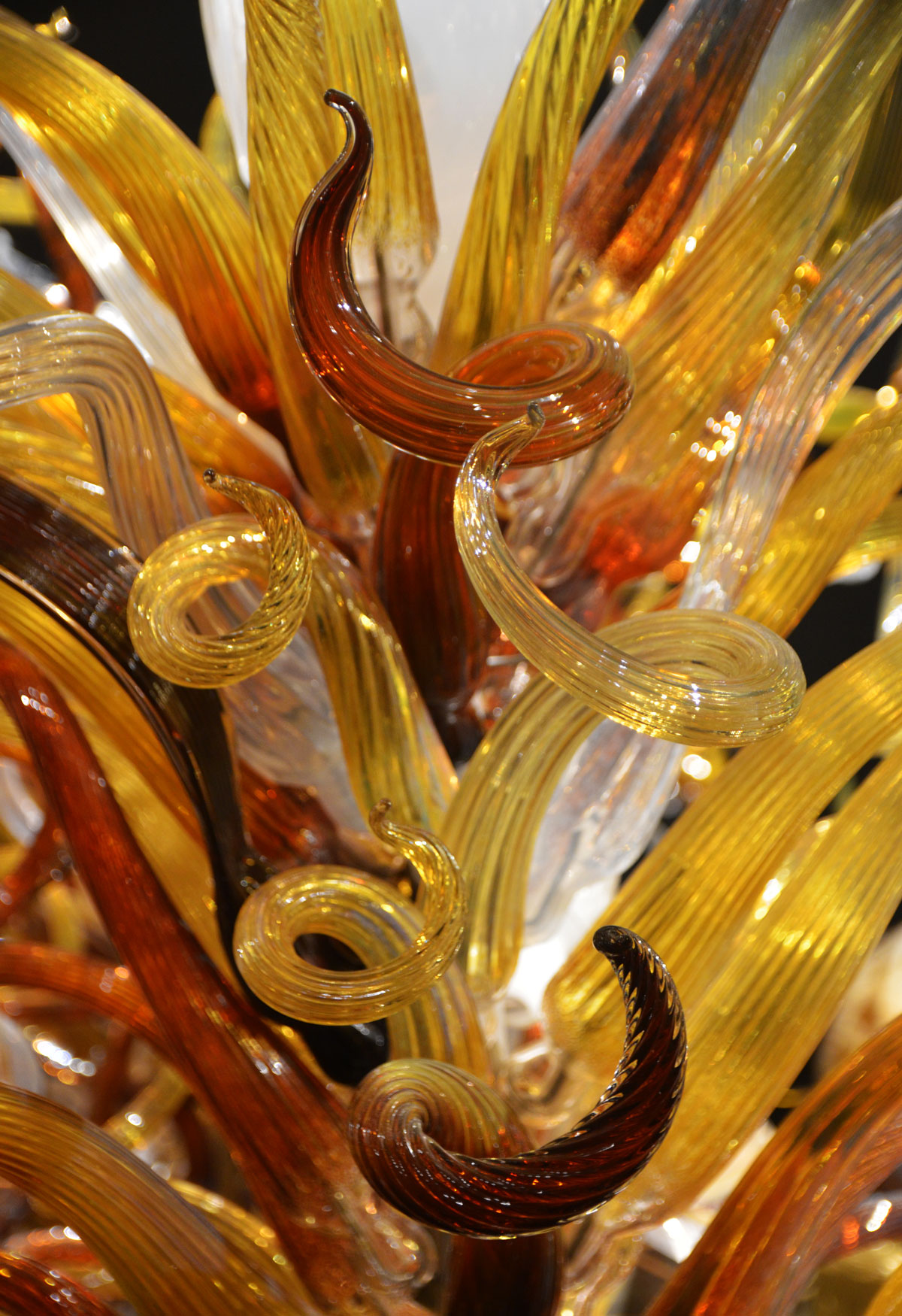
curly pieces of glass in different shade of amber, look a bit like curly seaweed growing under water

The exhibit continues until the end of 2016.

Dale Chihuly website

This post is subtitled ‘Staying Cool on a Hot Hot Day’.  When the temperatures are into the 90’s (old style) and the humidity makes the air thick, walking streets and alleys is not very comfortable.  Instead I took refuge in air conditioned arty places.  With the help of the (mostly) air conditioned TTC I only needed to take a few steps outside.

below: At one point I walked through an air conditioned building rather than going outside.  This is what I found there. ‘August 6, 1945’ by Matthew Day Jackson.  Moments after I pulled my camera out of my backpack, a security guard appeared.  I was sure that once again I was going to get the “this is private property” talk but instead we ended up discussing the work and how it is displayed.

It is constructed of four panels and it’s very heavy.  The base is made of lead; you can see the lead where Lake Ontario is.  It is attached to the wall with 18 very long bolts and each bolt is wired to an alarm.

map of toronto made of charred wood and lead, meant to resemble the city after an atomic bomb, large, made by Matthew Day Jackson, hanging on a wall behind a metal railing.

below:  Looking a bit more closely at it you can see that it is a map of Toronto.  As you might have surmised,  the title is a reference to the dropping of the atomic bomb on Hiroshima by the USA during WW2.    This isn’t just any map of Toronto, it’s an aerial view of a burnt out city after a nuclear explosion.  It is one in a series of cities given similar treatment, all with the same title.

detail of the islands and downtown area of map of toronto made of charred wood and lead, meant to resemble the city after an atomic bomb, large, made by Matthew Day Jackson

From the effects of man made death to the life enhancing effects of nature….

below: A few steps outside took me past the Gardiner Museum where I noticed that the front garden was redone about a year ago.  ‘Vertical Crevice Garden’ was designed and donated by landscape artist Neil Turnbull.  From the Gardiner museum website, a quote by the artist: “When the massive forces of continental drift push against layers of sedimentary rock, they cause it to crack, break, and rise. Over centuries, through exposure to wind, sun, and the freeze-thaw cycle, the layers split open. These fissures and crevices collect rain, dust, and an array of windblown bits like seeds and spores; plants take root, and life takes hold.”

limestone rocks arranged on a slant in a garden, stripes of red rock and grey rock, all just a few inches off the ground

below: When walking past the Gardiner Museum, one can’t help but notice the striped head.  It’s actually called ‘Untitled’ (why do artists do that?) and it’s by Jun Kaneko, 2002.  It’s made of glazed ceramic and galvanized steel.   Before heading underground at Museum subway station I took a few minutes to try to take a ‘pretty’ picture of the head.  The plants in the garden next door haven’t quite grown up enough to hide that ghastly table that the head sits on.  I have always wondered why the museum chose such a mundane bland platform for the sculpture but now that I look at it again I wonder if it’s possible that the table is actually part of the artwork.  Could it be?

large striped head sculpture on a table, outside, by Jun Kaneko, old building behind it, lavender and other plants growing in front of it.

below:  A photograph in the doorway of a gallery caught my eye.  The picture below is not the one in the doorway, but one that was hanging on a wall inside that I liked even more.  ‘Paris Rooftops 4’ by Michael Wolf.  It is 48″ x 68″ and is a chromogenic print (full-colour silver-based photograph), edition of 9.   To buy it will set you back $22,000 but looking is free – check out more of Michael Wolf’s work on the Bau-Xi gallery website.

picture of a photograph by Michael Wolf of Paris rooftops. Concrete grey with lots of lines of little terra cotta chimneys

below: A man with a camera stares at a painting on a gallery wall.  ‘Watching’ 2010, (26 inches high) by Tom Campbell on the left and ‘Brown Trail #7’ 2016 by Shi Le, a Toronto based landscape artist.  These are at the other Bau-Xi gallery (the non-photography one)

a small sculpture of a man holding a camera is placed in an art gallery such that he seems to be looking at a painting on the wall.

below: Three paintings by NUBARR Gallery, a collection of the works of Armenian-Canadian painter Noubar Sabag (Noubar Sabbaghian) 1920-2006.   These, and others by the same artist, are on show at the Art Square Cafe & Gallery but unfortunately I just learned that today is the last day.
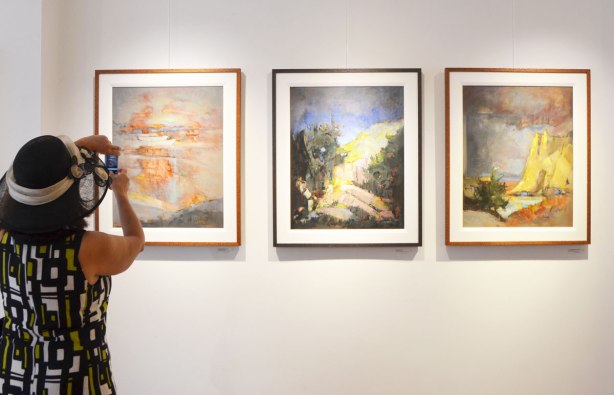
a woman in a floppy black hat is taking pictures of three paintings hanging on a gallery wall.

below:  How many people try to paint pictures like this?  How many people sell such paintings, not to mention have them hang in the Art Galley of Ontario?  But they aren’t Robert Motherwell.      So I ponder on the age old question of what makes a piece of art valuable or collectable?  Is the AGO (and other galleries) collecting paintings or names?  Motherwell painted this in numerous variations – a few changes in colour, a slight change in the lines.  Cheating?  Or brilliant marketing?  One for every gallery of note? This is Motherwell’s ‘Untitled (In Orange with Charcoal Lines)’ c1970.  There’s that “untitled” again, the most popular name for an artwork.

all orange with 3 black lines that form three sides of a square, top line of the square is missing. It's a picture of a painting by Robert Motherwell in an art gallery

My last stop of the afternoon was at the photography exhibit by Thomas Ruff at the AGO.  Part of the exhibit was a few large photographs of stars,  ‘Sterne’.  Large pictures of stars in the night sky were made from negatives that Ruff bought from the European Southern Observatory in Chile in 1989.

below:  They are difficult to look at, or rather it is difficult to what is the picture because the blackness of the photograph creates a mirror when placed behind glass.   This is me taking a picture of the picture – me plus the picture on the opposite wall plus the lights and light fixtures in the ceiling plus a table plus another person in the room plus a few white spots that are stars.

large photograph of the night sky, lots of stars and blackness. The black acts like a mirror and parts of the gallery are reflected in the picture.

below: ‘Walking Away, Walking Through the Universe’ a manipulation of a manipulation.

a reflection of two people walking hand in hand as seen reflected in a photograph of stars in the black night sky

below:  One last photo.  Let’s end this on a positive note and give Thomas Ruff credit for some interesting work.   These two pictures are part of his press++ series where he has taken old photos used in print medium and merged the front (picture) and back (words and markings) of the print into one.

a woman is standing in an art gallery and she is looking at two large pictures on the wall.

Thomas Ruff, Object Relations, at the AGO until 1 August 2016

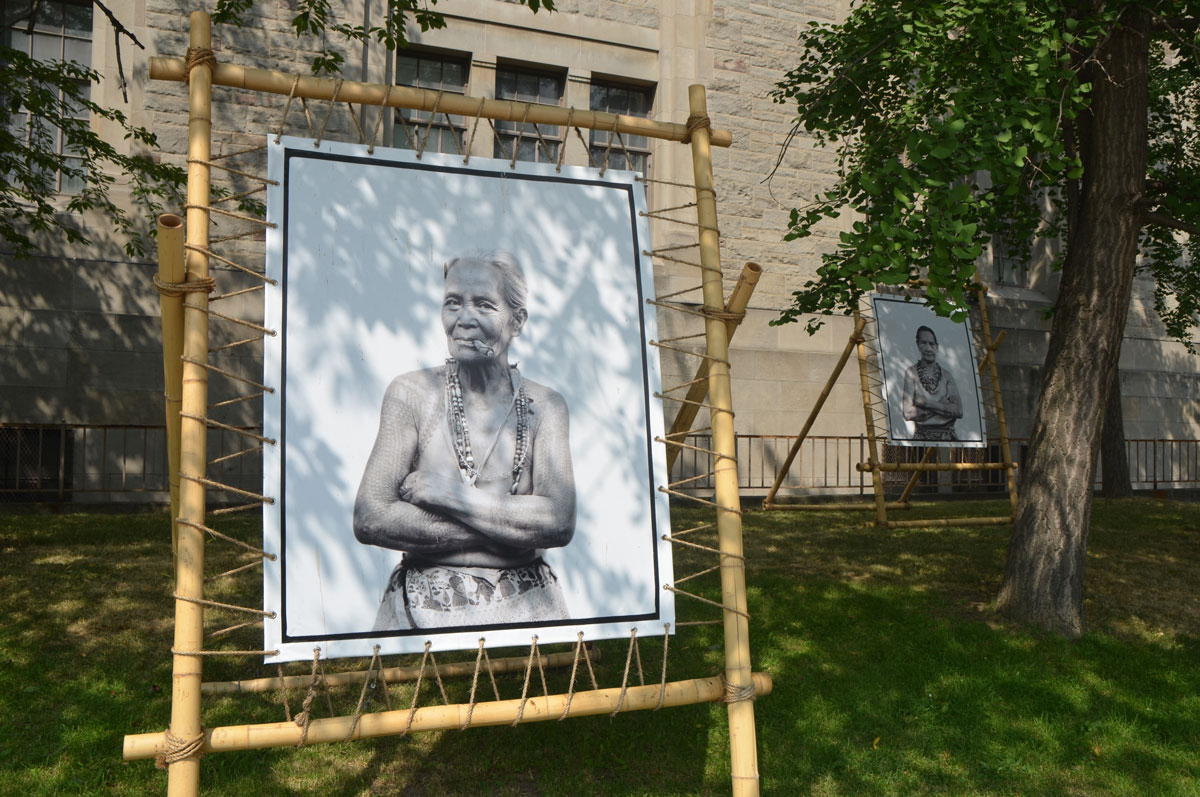
There are seven or eight large photographs, portraits of older women, on University Avenue.   They were actually part of the CONTACT Photography Festival and they have been on display outside the Royal Ontario Museum since early May.  The photos are the ‘The Last Tattooed Women of Kalinga”, portraits by Jake Verzosa.

large black and white photo of an older woman with many tattoos, black and white, displayed outside, another portrait in the background

In the villages of the Cordillera mountains of northern Philippines the women have been tattooed with lace-like patterns for centuries.  The tattoos are symbols of stature, beauty, wealth and fortitude and are traditionally applied during rituals.  The tradition is dying out as standards of beauty change and as the old ways are replaced with more modern methods.

Each village once had their own tattooist, or mambabatok, but today only one remains.  Born in 1918, Whang-od (or Fhang-od), is the last person to practice the centuries old technique called batok.  The ink is made of charcoal and water and it is applied by tapping the skin with a thorn.

two older women with their shoulders tattooed, wearing necklaces and a patterned skirt, seated. Black and white

Once the men were also tattooed.  The Kalinga tattoo has evolved from their ancient tradition as warriors and headhunters.  Heads were taken from fights and battles as a trophy; each time a man brought home a head he would receive another tattoo as a reward.  Tattoos were a mark of social status.

Indigenous groups throughout the Philippines practiced tattooing for centuries.   When the Spanish arrived in the 1500’s they called the people ‘pintados’ or ‘painted people’ as it was not uncommon for people to have tattoos covering their whole body.  While some tribes used tattoos to mark status, other tribes believed that tattoos possessed special spiritual or magical powers which gave the individuals strength and protection.  The use of tattoos as protective symbols is an idea that occurs in many cultures.

large black and white photo of an older woman with many tattoos, black and white, displayed outside, another portrait in the background

In conjunction with the Kalinga portraits, the ROM is featuring an exhibit that examines the beliefs surrounding tattoos, and the role that they and other forms of body art play in different cultures over the years.  “Tattoos: Ritual, Identity, Obsession, Art” is on view until September 5th.  It is a global tour of tattoos past and present.

One of the cultures that is featured is the Chinese.  For centuries, tattoos were forbidden, or at least taboo, in China.  To be tattooed was to be discriminated against as they were associated with prisoners or vagrants.  Recently that has begun to change.

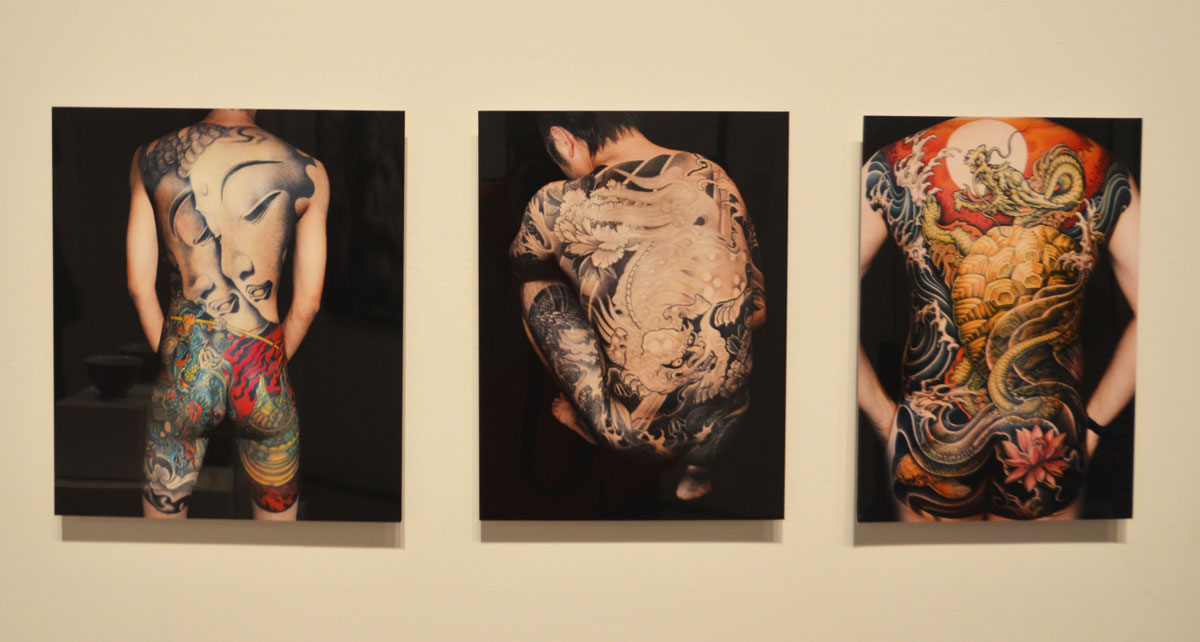
below: Three large modern picture tattoos by Taiwanese tattoo artist Gao Bin featuring traditional Chinese images, Buddha, lion and dragon.  Tattoos as a cultural expression.  In some countries such as Sri Lanka and Thailand images of Buddha are considered sacred objects of worship.  While it’s not illegal to have such a tattoo, wearing one could get you into trouble.

Three pictures of the backsides of men, each with a large picture tattoo from neck to thigh. Chinese art pictures as tattoos

below:  Here is another example of why people get the tattoos that they do.  This is a picture of one photograph in a series by Isabel Munoz.  Munoz spent three weeks inside several prisons in El Salvador and photographed mara gangs.  Gang members wear offensive tattoos to assert their antisocial behaviour and express their loyalty to the gangs.  Tattoos as statement; tattoos as a mark of membership and belonging.  Tribal.

photo of a picture in a museum of a man's face that has been tattooed with gang symbols and words,

below: A silicone arm with a tattoo by Montreal artist Yann Black on display.  This is one of 13 commissioned tattoos on silicone body parts – arms, legs and torsos both male and female that are part of the exhibit.   Tattoos as artwork.  Individuality.

a silicone arm has been tattooed with a design that looks something like a cross between Frank Lloyd Wright and Mondrian. It is in a glass showcase in a museum.

The oldest known tattoos were found on Otzi the Iceman, a natural mummy who was found in the Otzal alps near the Austria – Italy border in 1991.  His tattoos were 61 lines ranging in length between 7 and 40 mm.  The lines were arranged in groups.  Most of his tattoos were on his legs where there were 12 groups of lines.  Otzi is estimated to have died between 3239 BC and 3105 BC.

Tattooed mummies have also been found in other places – Greenland, Alaska, Siberia, Mongolia, western China, Egypt, Sudan, the Philippines, and the Andes in South America.  We will probably never know what significance the tattoos had.  Theories abound of course and they often involve reasons like protection, spiritual, status, tribal, or just for decoration.  Reasons that probably ring true today too.  The methods have changed and some of the images have changed, but human nature remains just that, human nature.


A comparison of sorts.  Two painters from two different time periods.  One looked north and the other looks south.  The north with its barren cold and blue in comparison to the south and its lush greenness.  A famous anglo Canadian painter who went searching for simplicity and a relatively new British painter with Jamaican roots who explores complexities.

Lawren Harris and Hurvin Anderson.  You should know which is which!

I didn’t purposely set out to compare them.  I saw the ‘The Idea of North’ exhibit that features the Steve Martin paintings of Lawren Harris first.  As much as I like the Group of Seven, Harris’s minimalist snow and ice paintings have never been my favorite.  Still, it was an interesting collection to see.  After I finished there, I headed up to the contemporary art floors.  The fifth floor is still closed (new installation opening later this week) but I discovered that the fourth floor is devoted to the works of Hurvin Anderson.  As I walked around the Anderson installation I kept thinking of similarities and differences between him and Lawren Harris.

many people in a room in an art gallery, standing around and looking at paintings.

below: Mountains in Snow: Rocky Mountain Paintings VII, 1929.  One of the many famous Lawren Harris snow and ice paintings.  Light, reflected light, shadows, and contrasts.  The elements reduced to their simplest form.   The landscape itself is almost secondary.  Or the landscape is the medium, not the message.

a Lawren Harris painting of a snow covered mountain, blue sky in the background.

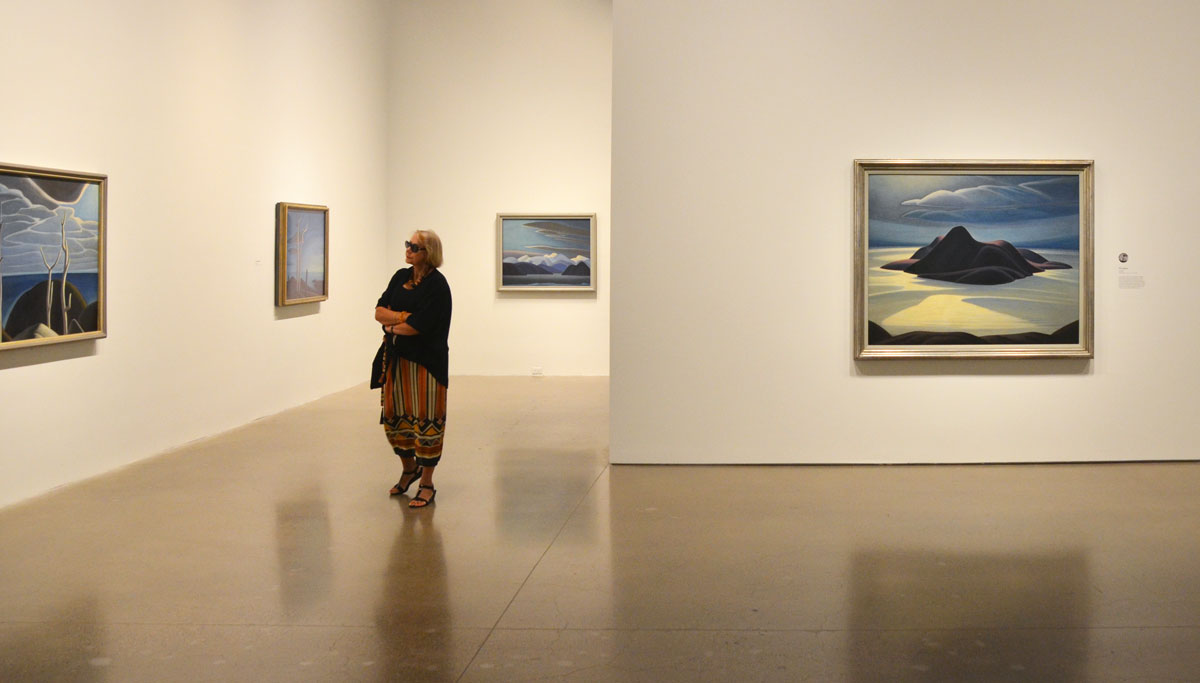
below: The large painting on the right is ‘Pic Island’ painted about 1924.  Pic Island is an unpopulated island along the north shore of Lake Superior.  Today the island is part of Neys Provincial Park.

a woman walks through a gallery with paintings on the wall. She stops to look at one of them.

below: Two of Hurvin Anderson’s paintings from his Caribbean landscape collection.  On the left is ‘Beaded Curtain – Red Apples’, 2010.

three young women sitting on a couch with their backs to the camera, they are looking at two large paintings on a wall, by Hurvin Anderson.

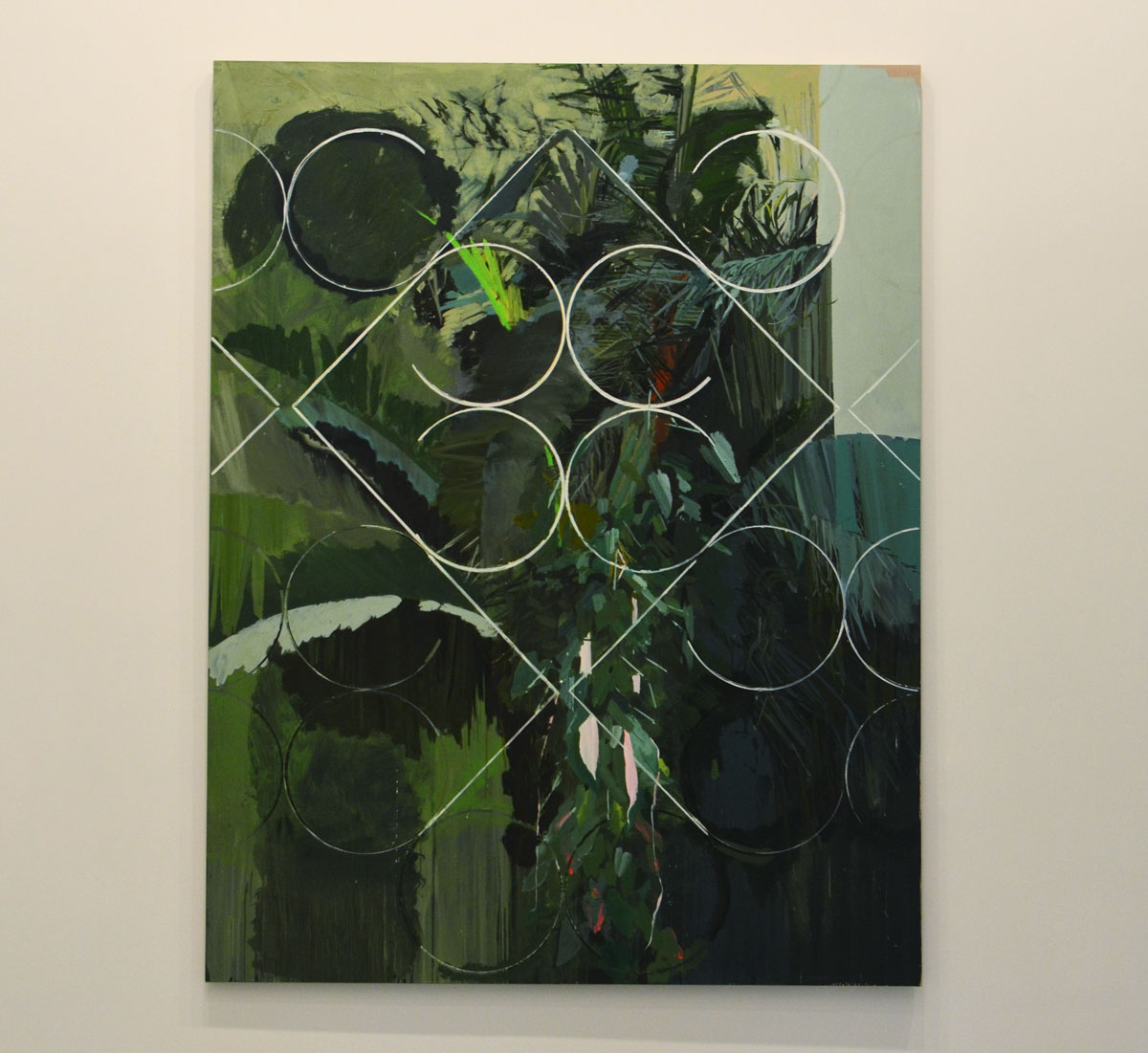
below:  ‘Constructed View’, 2010.  Anderson’s Caribbean paintings have grilles incorporated into them.  These are the security features prevalent on houses and businesses in the Caribbean (and elsewhere in the world), metal fixtures over windows and doors to keep out the unwanted.  They contain what’s inside.  They are a barrier.  They intrude on the landscape and cut it up.  Again, the landscape is almost secondary.  The message, or emotion, is more important.  [aside – There is a grille in the painting above (right) but it’s more subtle.]

a landscape painting in shades of green with fragments of white grille overlayed, repeating pattern of 4 circles with a square

Lawren Harris painted his famous mountain pictures in the late 1920’s.  In 1930 he visited Baffin Island and a few paintings resulted from that trip.  I learned that although I associate Harris with icebergs and arctic scenery, most of his snow and ice paintings were from the north shore of Lake Superior or from the mountains around Banff Alberta.

The repetoire of both painters is not limited to landscapes.  Harris painted many houses and street scenes from downtown Toronto including houses and streets that were demolished years ago.  The examples of Anderson’s non-landscape work were interiors.  Both men used bold colours but Anderson tends to show more detail in his paintings.

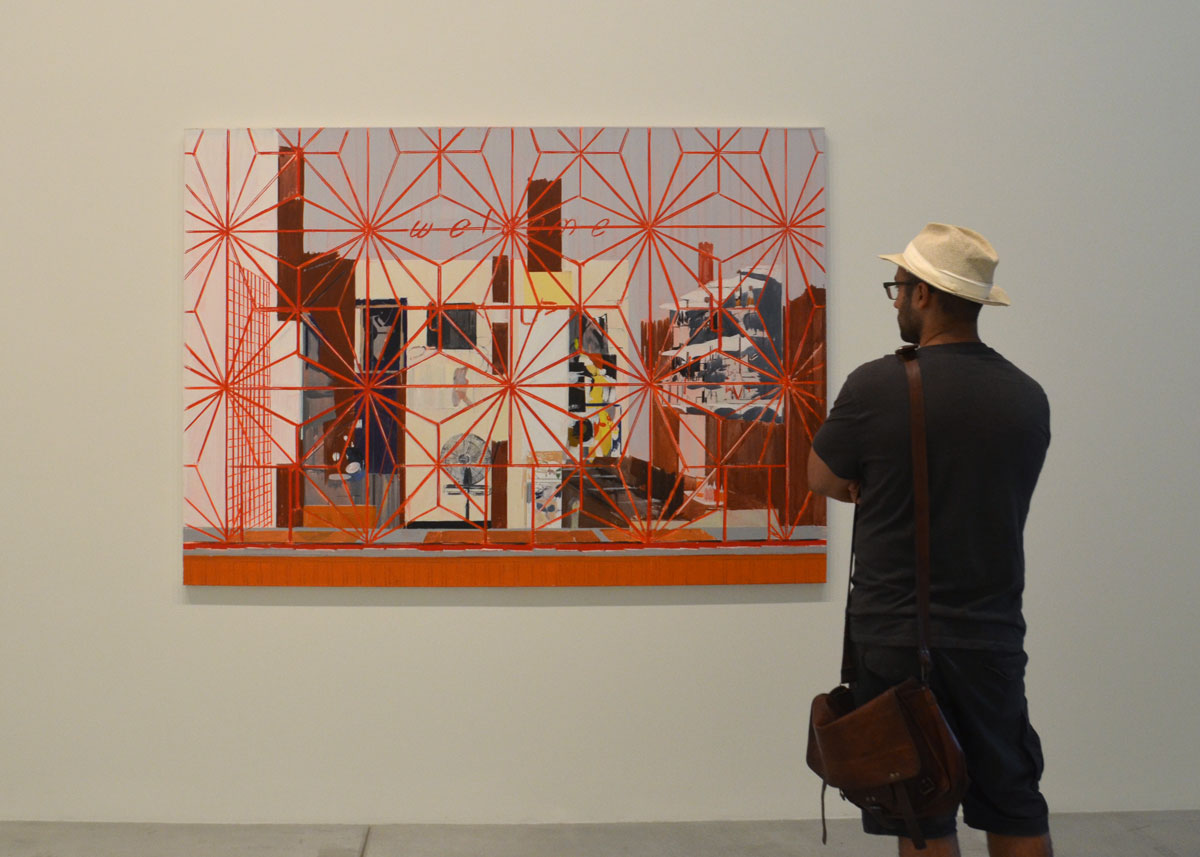
below: ‘Welcome: Carib’  The Welcome sign of the bar in  juxtaposition with the red metal work covering the window.  The picture beckons to us but keeps us out.

a man in a straw fedora stands in front of a painting called Welcome: Carib by Hurvin anderson, it features a red star patterned grille over the painting, over the window that is in front of the interior scene.

below: One of the paintings from Anderson’s Barbershop collection, ‘Flat Top’ 2008.

two young women walk away from a large painting hanging on an art gallerywall.  two barber chairs in a barber shop, empty.  Bright pink wall with squares of colour.

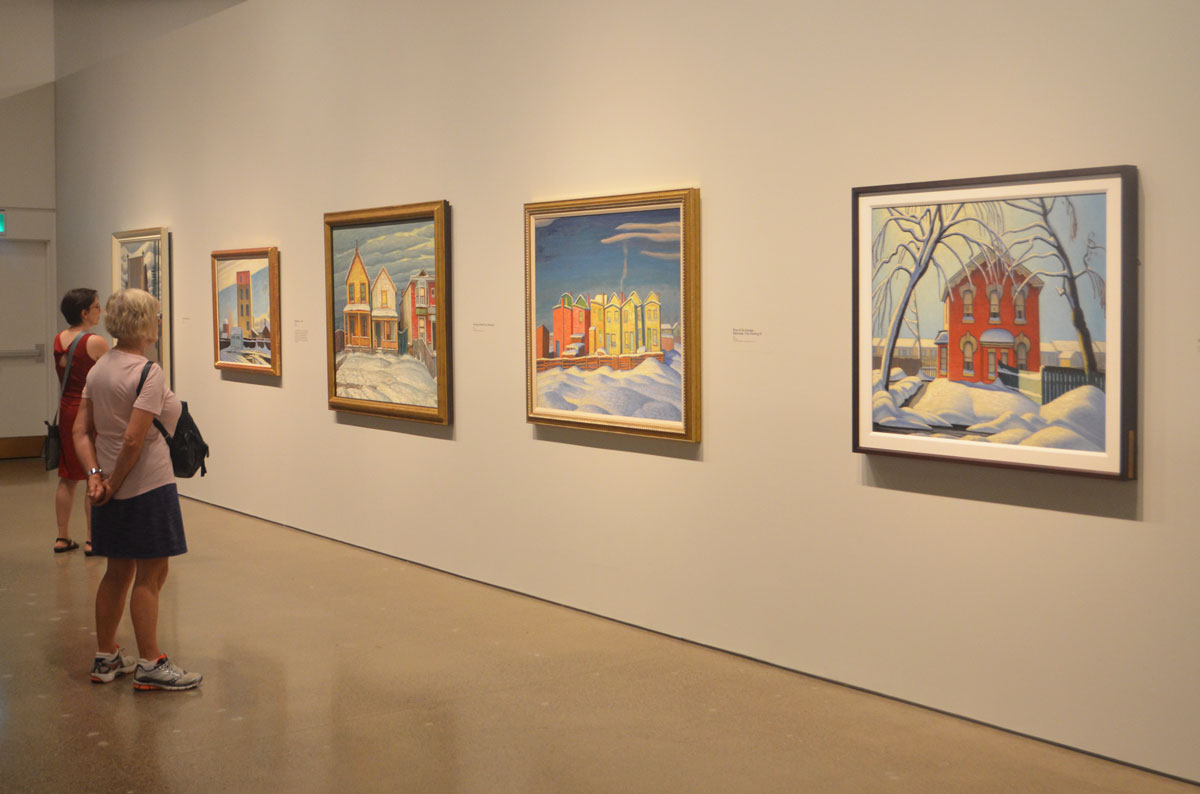
below: A selection of colourful Toronto houses in winter painted by Harris in the 1920s.

two women look at a line Lawren Harris paintings of brightly coloured houses in winter on a wall in an art gallery

In the 1930’s Lawren Harris’s personal life went awry.  The words on the wall at the AGO says that he divorced, remarried and moved to the states.  That’s a bit of spin.  He didn’t divorce his wife because that would be messy, apparently.  Instead in 1934 he just married the wife of an old friend.   And of course that turned messy and the new couple left for the USA for a few years before eventually settling in Vancouver BC.   Harris’s post-1934 work is very abstract and was never as successful as his earlier paintings.

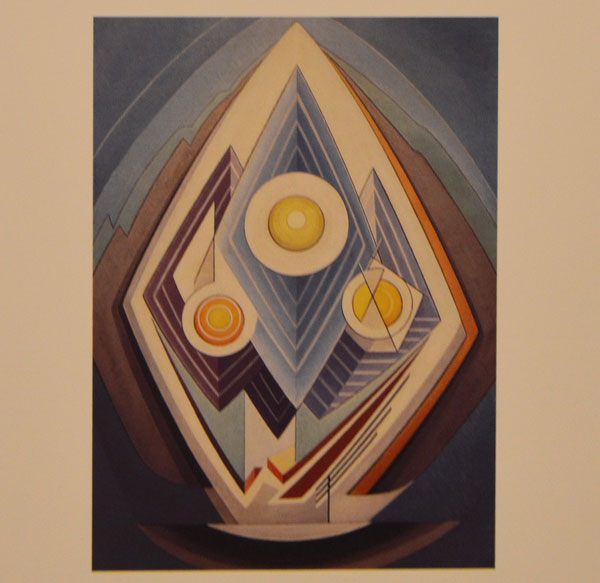
below:  You can see the influence of the mountain paintings in this,  ‘Painting No. 4’, about 1939, painted when he was a member of the Transcendental Painting Group.  This was a collective of artists in New Mexico that Harris help to found.

an abstract painting by Lawren Harris, circles and diamonds in an egg shape

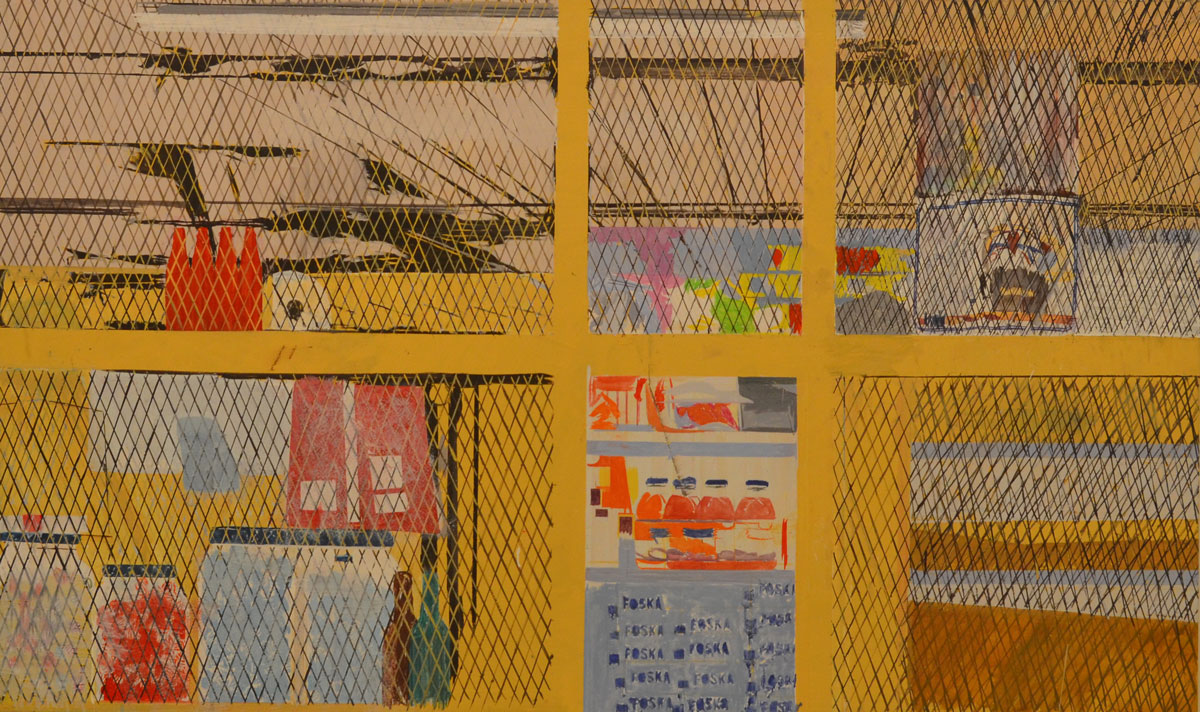
below: Since I have no idea where the art of Hurvin Anderson is headed, I will leave you with one more of his present paintings (I’m not sure those two ideas actually go together!).  ‘Foska Foska’, the interior of a shop behind yellow bars and black mesh.

a painting by Hurvin Anderson called Foska Foska, shows the interior of a store with a yellow metal gate in front.  and a wire structure covering the ceiling too


The Idea of North – until 18 September

Hurvin Anderson – until 21 August

#HarrisAGO | #HurvinAndersonAGO

‘Cutlines’, an exhibit of old photographs from the Globe & Mail,
part of the CONTACT Photography Festival

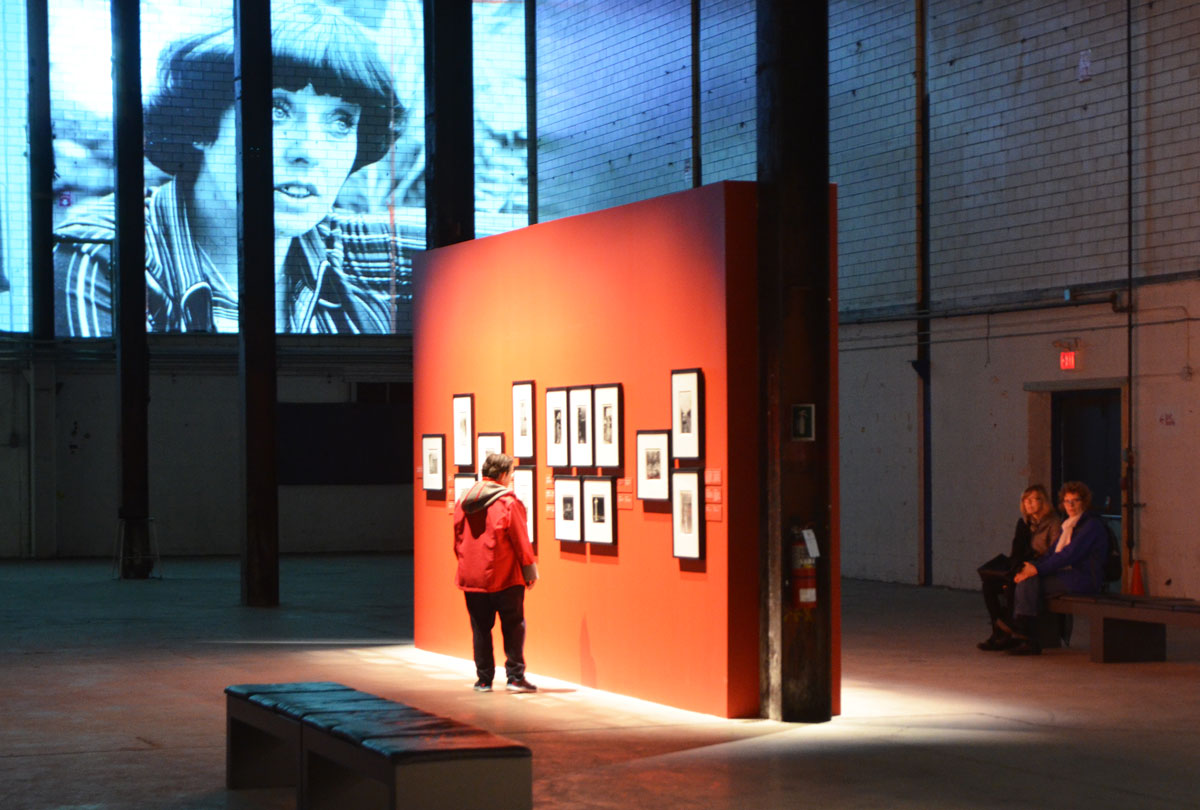
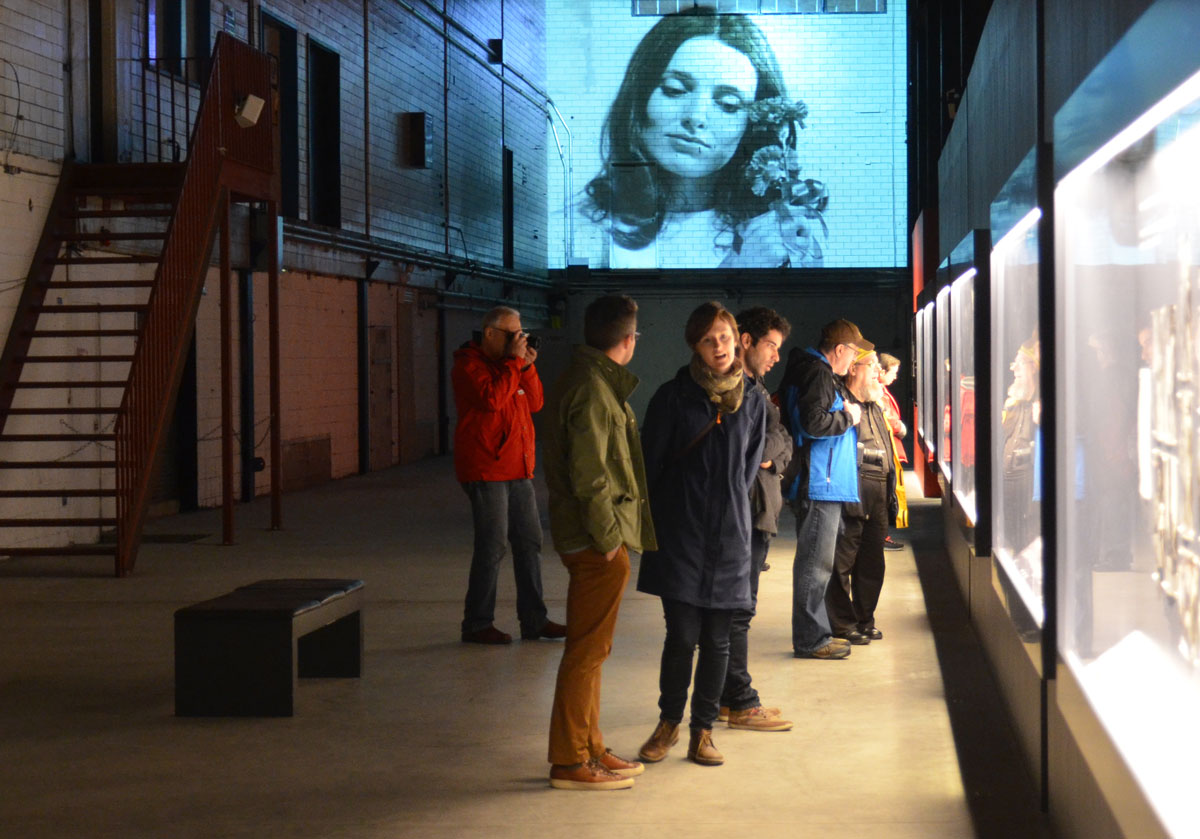
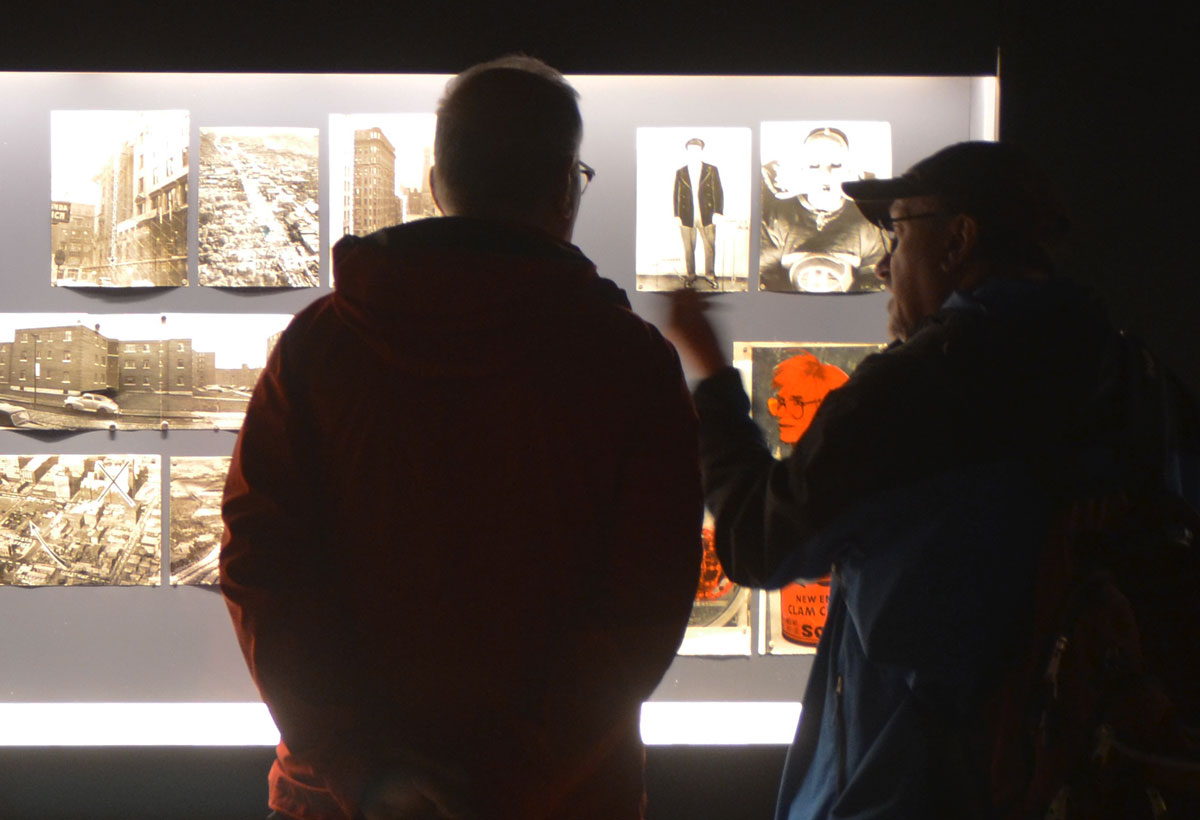
people standing in a large room, the old Press Hall at the Globe and Mail newspaper, looking at an exhibit of old photos. Some photos are being projected onto a wall

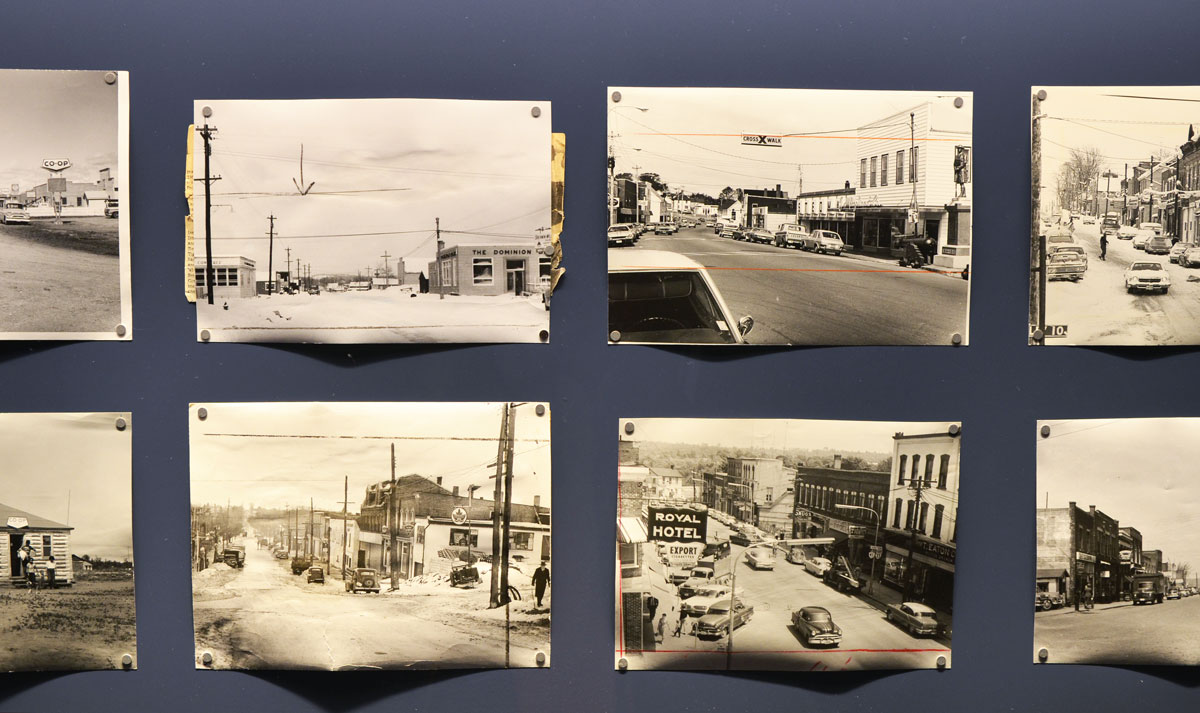
below: A small sample of the 175 vintage black and white photos from the vast collection held by the Globe and Mail newspaper on display.

old photographs, black and white, of small towns, in a display case, as part of an exhibit called Cutlines, old photos from the Globe and Mail collection

below:  The exhibit is being held at the Press Hall on Wellington Street (near Spadina).  This old building is slated for demolition in the near future as the Globe and Mail is in the midst of moving to a new home.  Prints were in cabinets in the center of the room while other images were projected high on the walls.

people standing in a large room, the old Press Hall at the Globe and Mail newspaper, looking at an exhibit of old photos. Some photos are being projected onto a wall

The Globe & Mail has amassed a collection of about 750,000 photographs.  As they transition from print to digital images, they are ‘cleaning house’ with respect to their photo archives.  About 100,000 of the prints are going to be digitized and a portion of those donated to the new Canadian Photography Institute at the National Gallery of Canada in Ottawa.

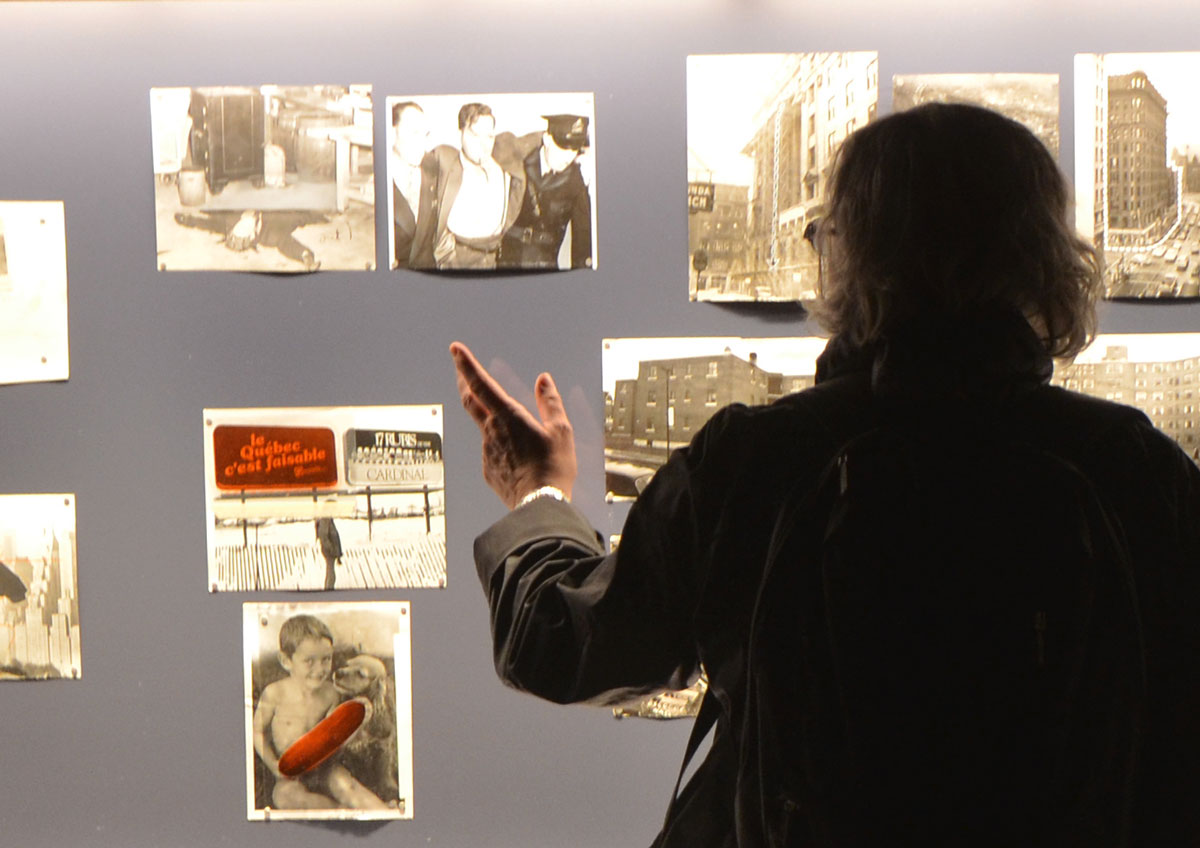
below: Some of the pictures were covered with red, with what is known as a rubylith mask.  When the images were printed, the portions covered in red remained as they were while the rest of the picture could be changed to suit the needs of the story of the day.

silhouette of a woman standing in front of a lit display case of old photographs

people standing in a large room, the old Press Hall at the Globe and Mail newspaper, looking at an exhibit of old photos. Some photos are being projected onto a wall

people standing in a large room, the old Press Hall at the Globe and Mail newspaper, looking at an exhibit of old photos. Some photos are being projected onto a wall

people standing in a large room, the old Press Hall at the Globe and Mail newspaper, looking at an exhibit of old photos. Some photos are being projected onto a wall

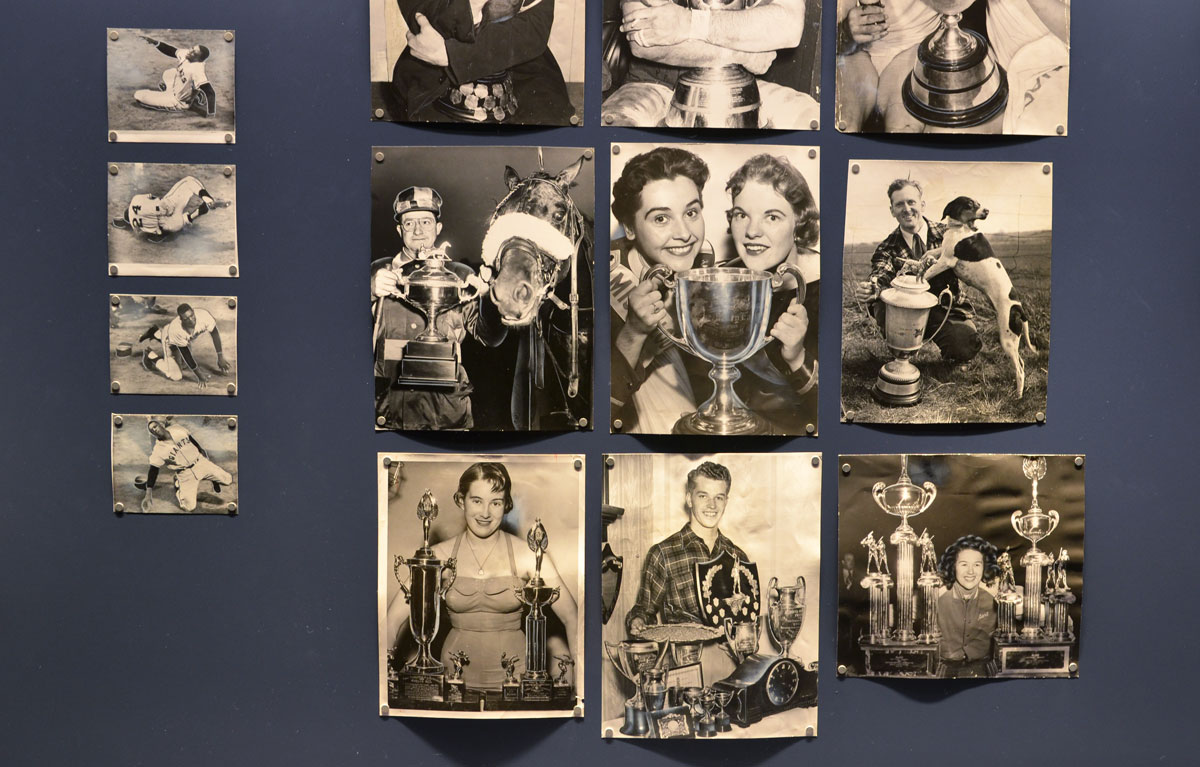
below: The woman with the two trophies, bottom left, is Marilyn Bell who swam across Lake Ontario.  I know that the man beside her is from a story about a cowboy championship of some sort in Calgary and my apologies for not remembering more of the details.

old photographs, black and white, of people with trophies, in a display case, as part of an exhibit called Cutlines, old photos from the Globe and Mail collection

silhouette of two men standing in front of a lit display case of old photographs

On view at 425 Wellington St. West until 26 June 2016

#CONTACT16
‘Current Studies’ and ‘Paper Planes’
Two different series of photographs by Sjoerd Knibbeler
Allan Lambert Galleria, Brookfield Place

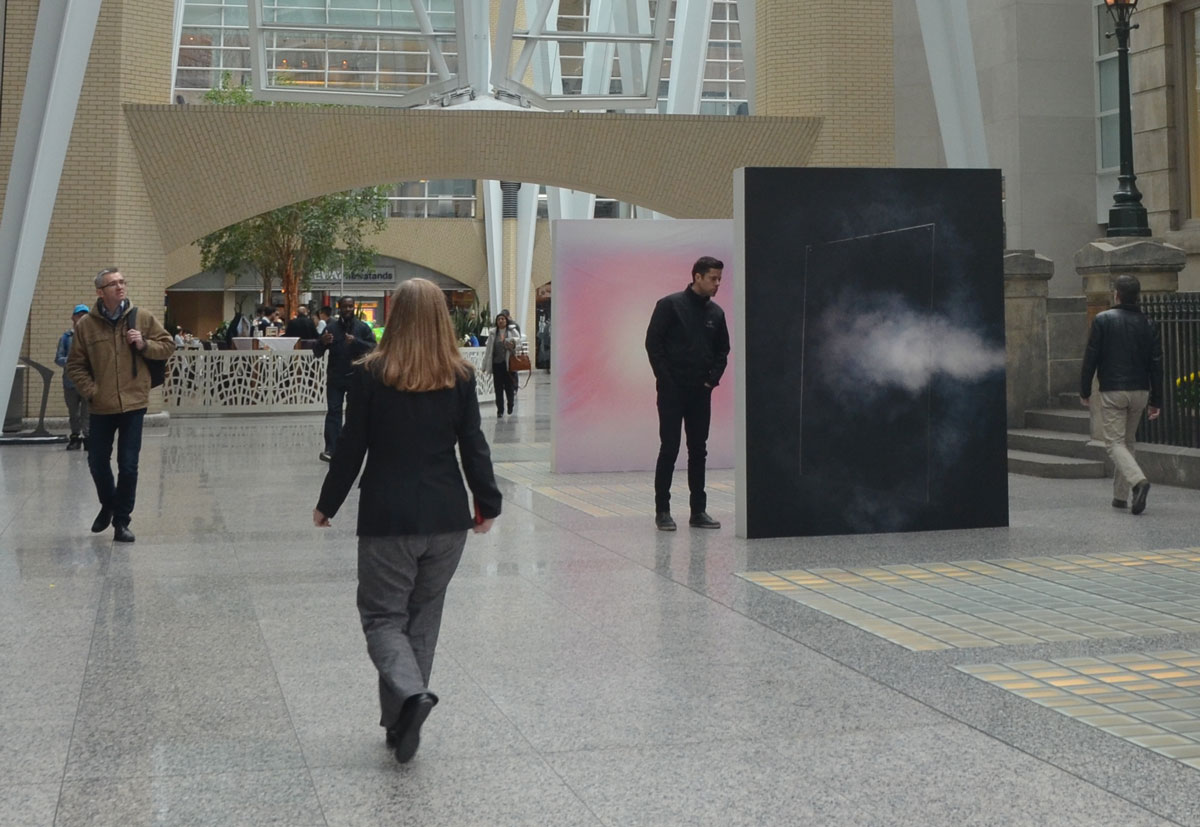
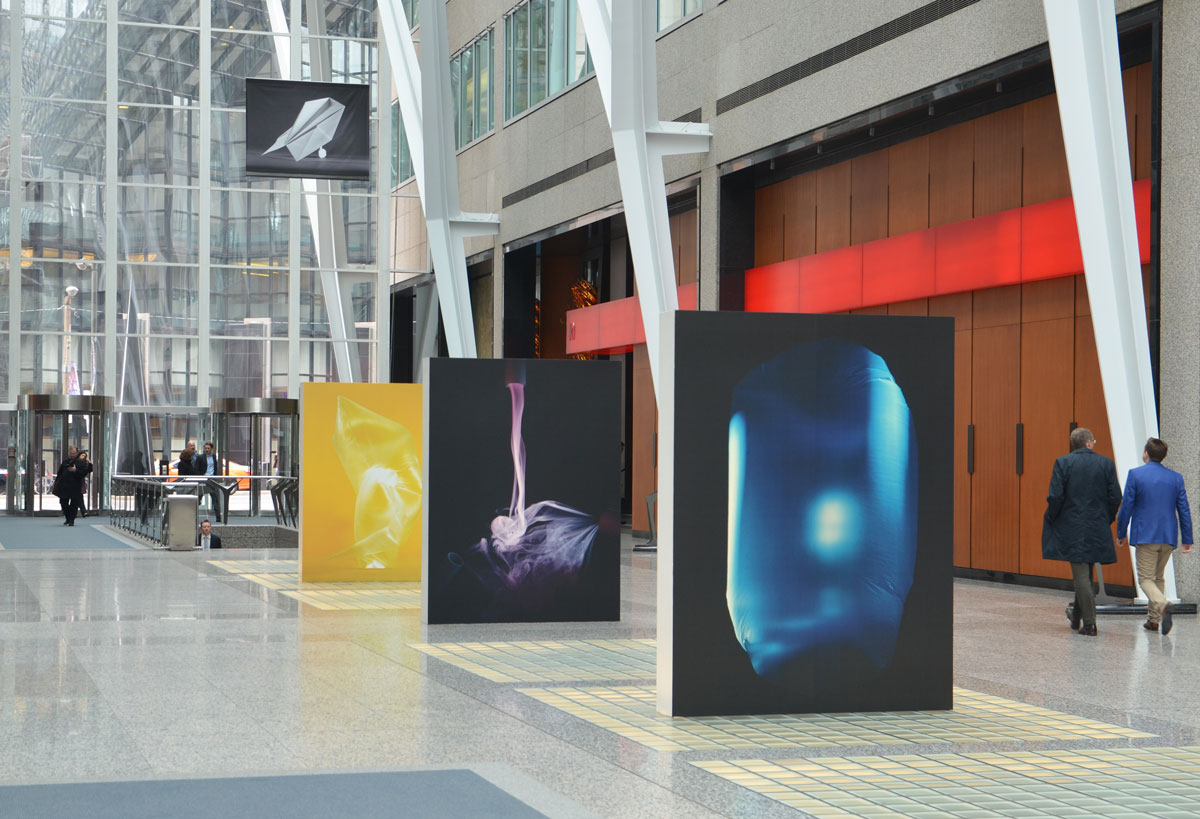
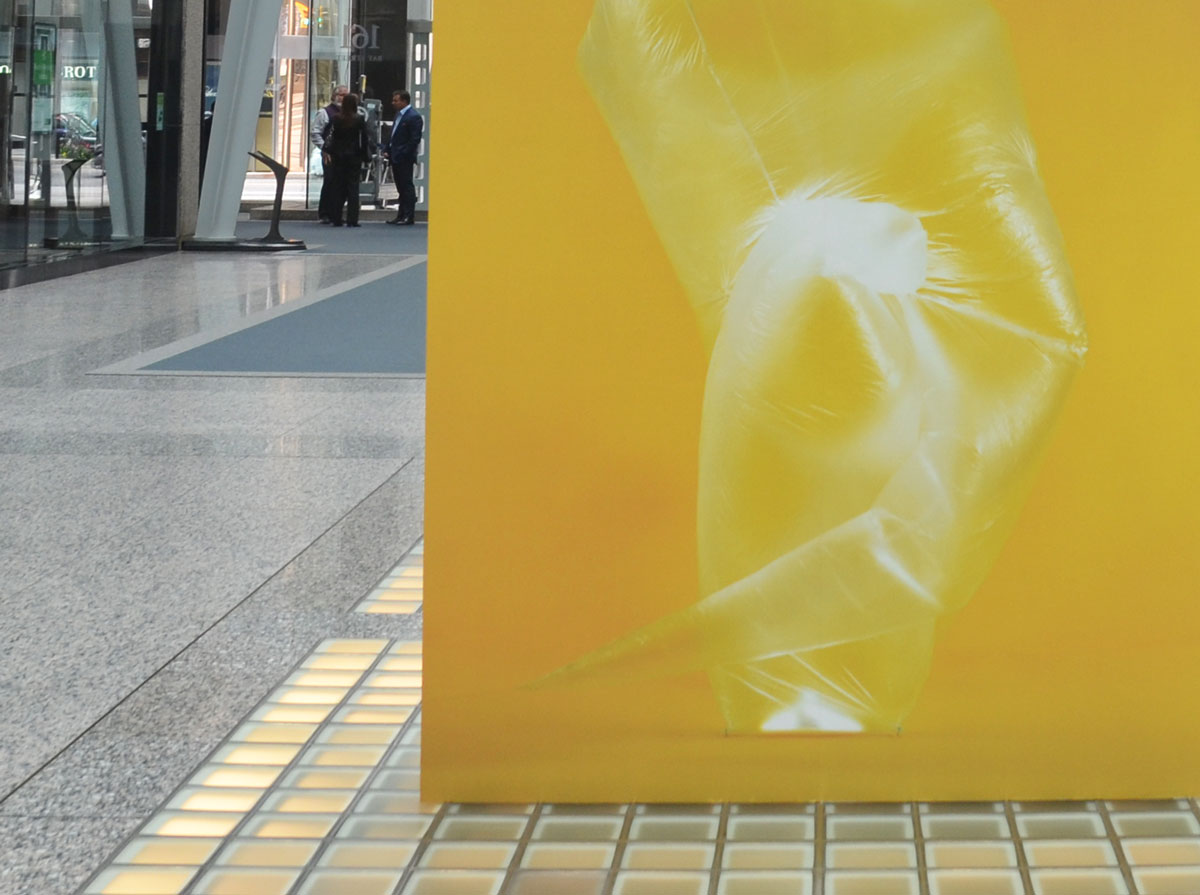
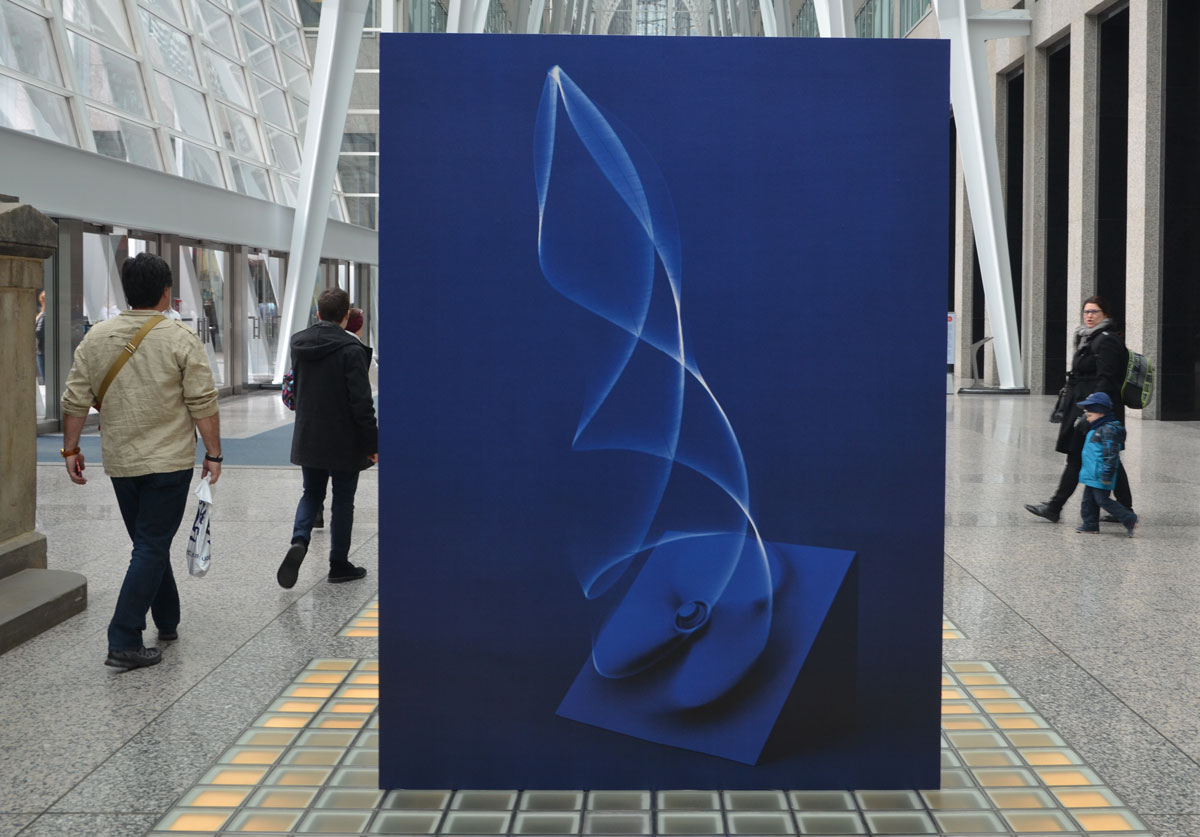
At ground level there are six large freestanding ‘walls” arranged in line, three at each end of the atrium.    Each ‘wall’ is covered by two images, one on either side.  They are photographs that are the result of Knibbeler’s experiments to “ shape, encompass, and capture air currents.”  This is the ‘Current Studies’ part of the installation.

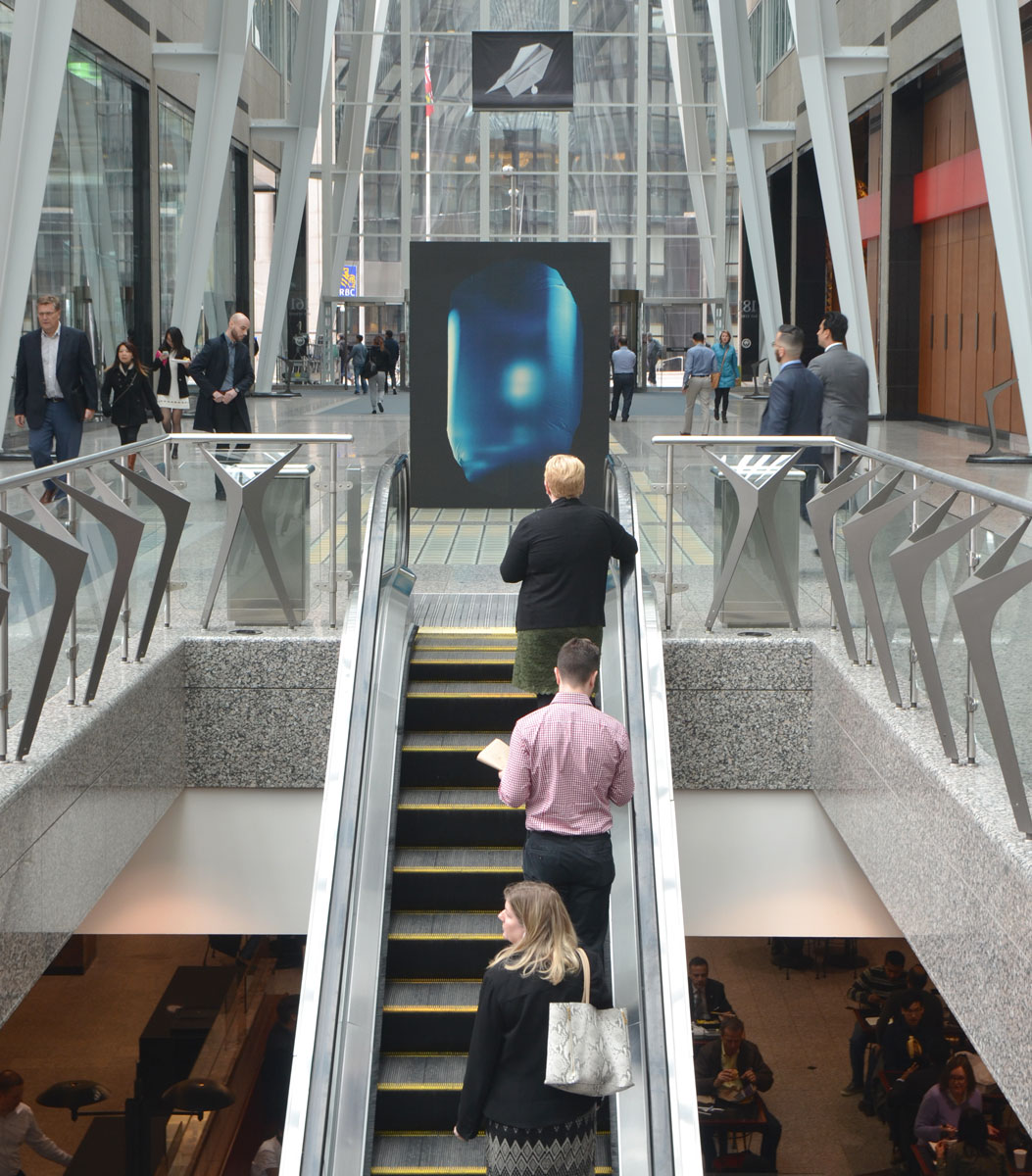
A picture taken inside the Allan Lambert Gallery at Brookfield Place, photos by Sjoerd Knibbeler, a series called Current Study large pictures standing in the middle of the gallery, as well as series called "Paper Planes" which are hung from the ceiling

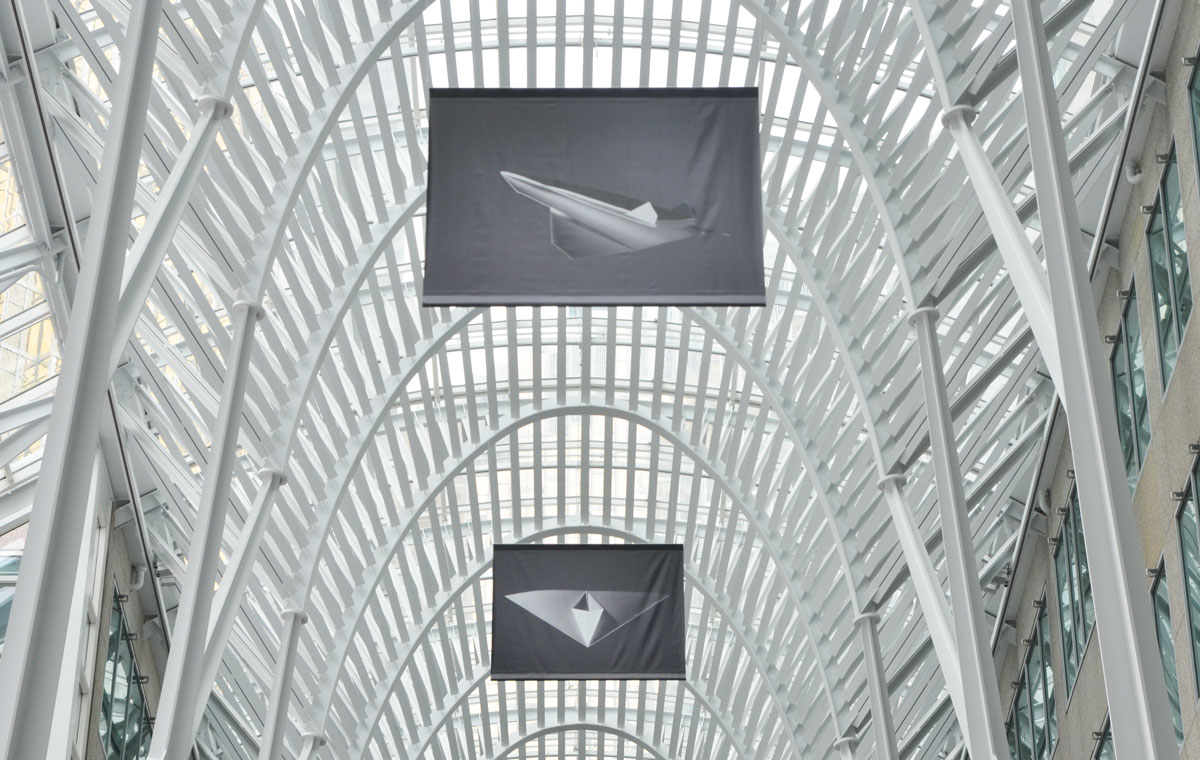
Suspended from the ceiling are a set of photographs of paper airplanes, the ‘Paper Planes’ part of the installation.    Knibbeler photographed paper airplanes that he made using information that he found online.  He chose military planes that were never produced.

A picture taken inside the Allan Lambert Gallery at Brookfield Place, photos by Sjoerd Knibbeler, a series called Current Study large pictures standing in the middle of the gallery, as well as series called "Paper Planes" which are hung from the ceiling

A picture taken inside the Allan Lambert Gallery at Brookfield Place, photos by Sjoerd Knibbeler, a series called Current Study large pictures standing in the middle of the gallery, as well as series called "Paper Planes" which are hung from the ceiling

A picture taken inside the Allan Lambert Gallery at Brookfield Place, photos by Sjoerd Knibbeler, a series called Current Study large pictures standing in the middle of the gallery, as well as series called "Paper Planes" which are hung from the ceiling

A picture taken inside the Allan Lambert Gallery at Brookfield Place, photos by Sjoerd Knibbeler, a series called Current Study large pictures standing in the middle of the gallery, as well as series called "Paper Planes" which are hung from the ceiling

A picture taken inside the Allan Lambert Gallery at Brookfield Place, photos by Sjoerd Knibbeler, a series called Current Study large pictures standing in the middle of the gallery, as well as series called "Paper Planes" which are hung from the ceiling

A picture taken inside the Allan Lambert Gallery at Brookfield Place, photos by Sjoerd Knibbeler, a series called Current Study large pictures standing in the middle of the gallery, as well as series called "Paper Planes" which are hung from the ceiling

A picture taken inside the Allan Lambert Gallery at Brookfield Place, photos by Sjoerd Knibbeler, a series called Current Study large pictures standing in the middle of the gallery, as well as series called "Paper Planes" which are hung from the ceiling

A picture taken inside the Allan Lambert Gallery at Brookfield Place, photos by Sjoerd Knibbeler, a series called Current Study large pictures standing in the middle of the gallery, as well as series called "Paper Planes" which are hung from the ceiling

#CONTACT16
I usually take a dim view of conceptual art largely because the importance given to the “words on the wall” has eclipsed the consideration given to the artwork itself.   Mediocrity in technique or creativity hides behind big jargon words and convoluted language in the artist statement.  Often the concept that the artist claims to be exploring is at odds with the end product.

When the art doesn’t live up to words that sound learned and meaningful then it degrades the work and makes the artist, and those curating the exhibit, seem pompous and out of touch.

For example, if you read that certain videos by an artist “cast a hitherto unexampled light on the conventional North American city”,  what would you expect to see?  Would you expect to see a video shot from a helicopter as it circled a city at night?  A video that looks familiar to anyone who has flown over a city after dark.   That’s what you get with Aude Moreau’s ‘The End in the Background of Hollywood 2015’ now showing at The Power Plant gallery.   I don’t have a photo of it but I do have a picture of three of her other photographs also on display.

below: From left to right (discounting the small picture farthest from the camera): 1. ‘Untitled (Hollywood Sign)’ 2015, 2. ‘LAPD (Los Angeles Police Department)’ 2015.  It’s a picture of a tiny helicopter in a large grey sky.  and 3. ‘Waiting for Landing’, airplanes lined up as they approach LAX airport.   Unfortunately, the words on the wall then go on to say, about these three images, “These demonstrate visual strategies that act upon the symbolic representation of the city and the spectacular dimension of the film industry.”  Oh my.

4 pictures hanging in a contemporary art gallery. One is a picture of the Hollywood sign taken just after dark, the next is a grey sky with a tiny dot of a helicopter in the middle, the third is too far away to discern, and the last is a picture of Los Angeles at night taken from a helicopter

And with that I left The Power Plant gallery.  Growling silently to myself and shaking my head with a mix of disdain and and frustration.   Imagine my surprise when once outside I encountered another of Moreau’s photographs.  A very lovely one.

below:  A picture of the Toronto skyline by Aude Moreau mounted on an exterior wall at The Power Plant Contemporary Art Gallery.  A picture with visual impact.

A photograph by Aude Moreau of the Toronto skyline as the sun starts to set, sunlight reflected off the buildings, darkening blue sky. The picture is mounted on an exterior wall and there is a tree in front of it as well as a couple of picnic tables

below:   You can play “spot the building” and test your knowledge of Toronto geography.   You can line up the DBRS building, the Hilton Hotel and the Canada Life building on University Avenue along with the Sheraton Hotel on Queen street.   The blue addition on the AGO is farther north on Dundas.  Can you think of where the photo was taken?  Apparently, it was taken from Toronto Fire Station 315 at College Street and Bellevue Avenue.  It was taken just after sunset but when there was still enough light in the sky to reflect off the taller buildings.   Moreau makes the city sparkle.

A photograph by Aude Moreau of the Toronto skyline as the sun starts to set, sunlight reflected off the buildings, darkening blue sky. The picture is mounted on an exterior wall and there is a tree in front of it

I must have seen this picture very shortly after it was installed.  It is part of the CONTACT photography festival that starts this weekend but there was no accompanying sign, no words that attempted to a explain the image.  Perhaps that was for the best.  In fact, I now have the CONTACT catalogue with their description of the artwork but I think I won’t read them.  I’d rather enjoy the picture just the way it is.

An art installation ‘Nest Egg’ by Brendan McNaughton
at the Corkin Gallery, Distillery District

The title of this blog post is taken from a description of McNaughton’s work on the Corkin gallery website, “The relationship between plutocrats and proletariats is central to his art practice.”  A plutocrat is a person who is powerful because they are wealthy.  Money equals power.  Proletariat on the other hand is a class of people, the working class, a class without money and without power.

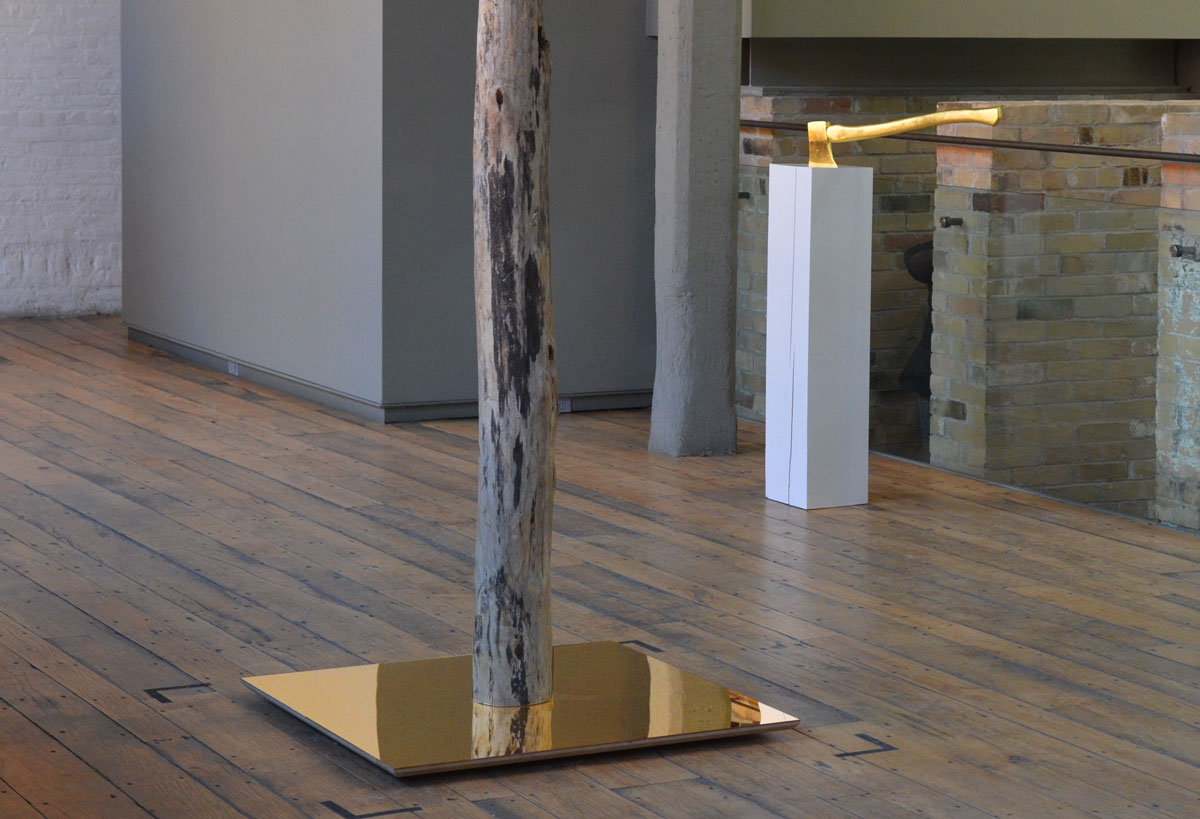
below: A gold axe.  With its blade in a column, on a pedestal?  That’s not a passive positioning of the axe, i.e. it’s not just lying around.  Someone has swung it.
Axe as a symbol of the working class?  Juxtapositioned with gold, a symbol of money?

picture taken inside an art gallery - a tree trunk stands in the middle of a gold toned mirror, in the background, a gold plated (or gold colured) axe with its blade in the top of a white rectanguar column

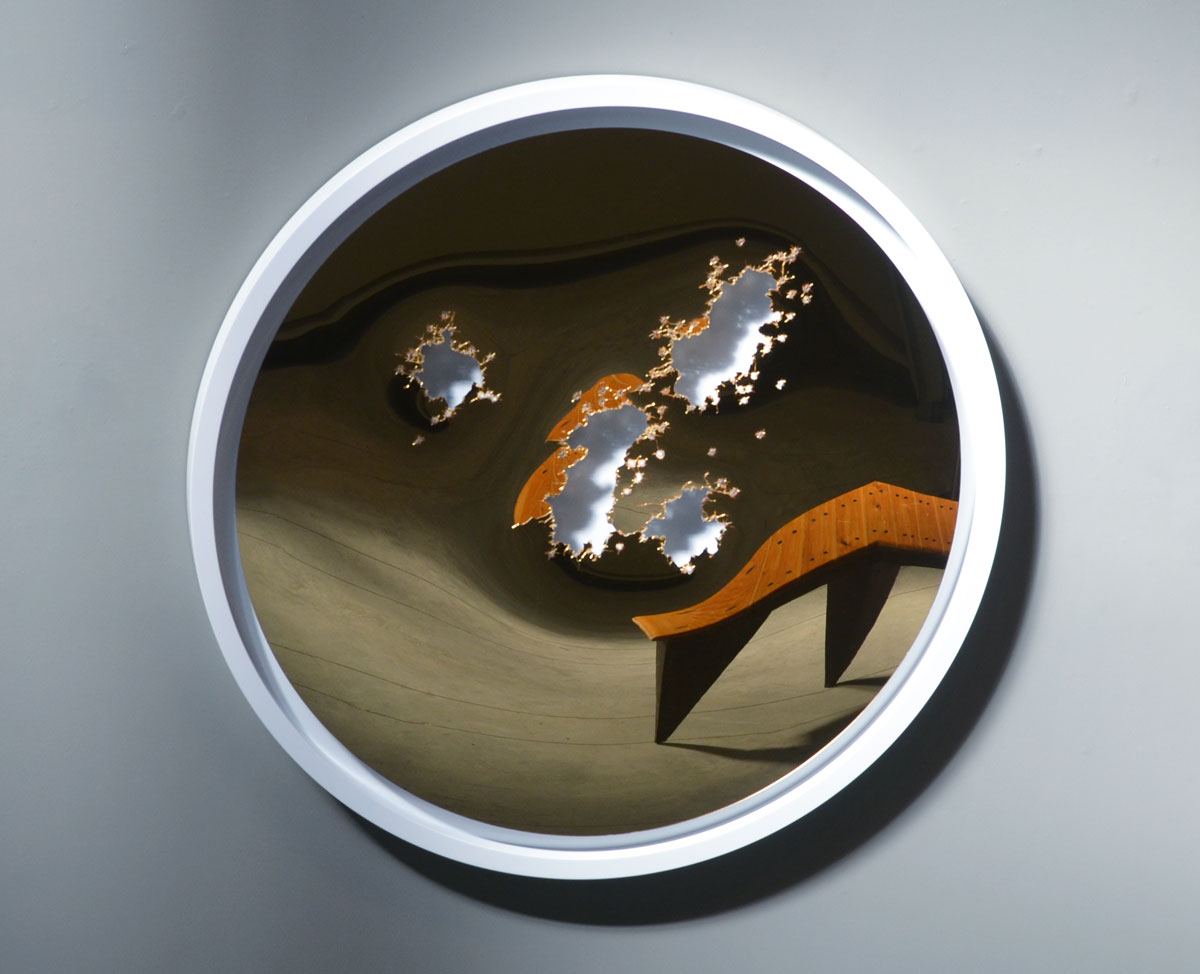
below: A couple of the pieces were mirrors. But they were mirrors with a difference – slightly concave in shape, with a hint of gold, and marred by ragged shaped holes.  The resulting reflections are distorted and flawed.

an artwork by Brendan McNaughton of a slightly concave mirror but with a few torn holes in it. A bench is reflected in the mirror but because the mirror isnt't flat, the bench is distorted.

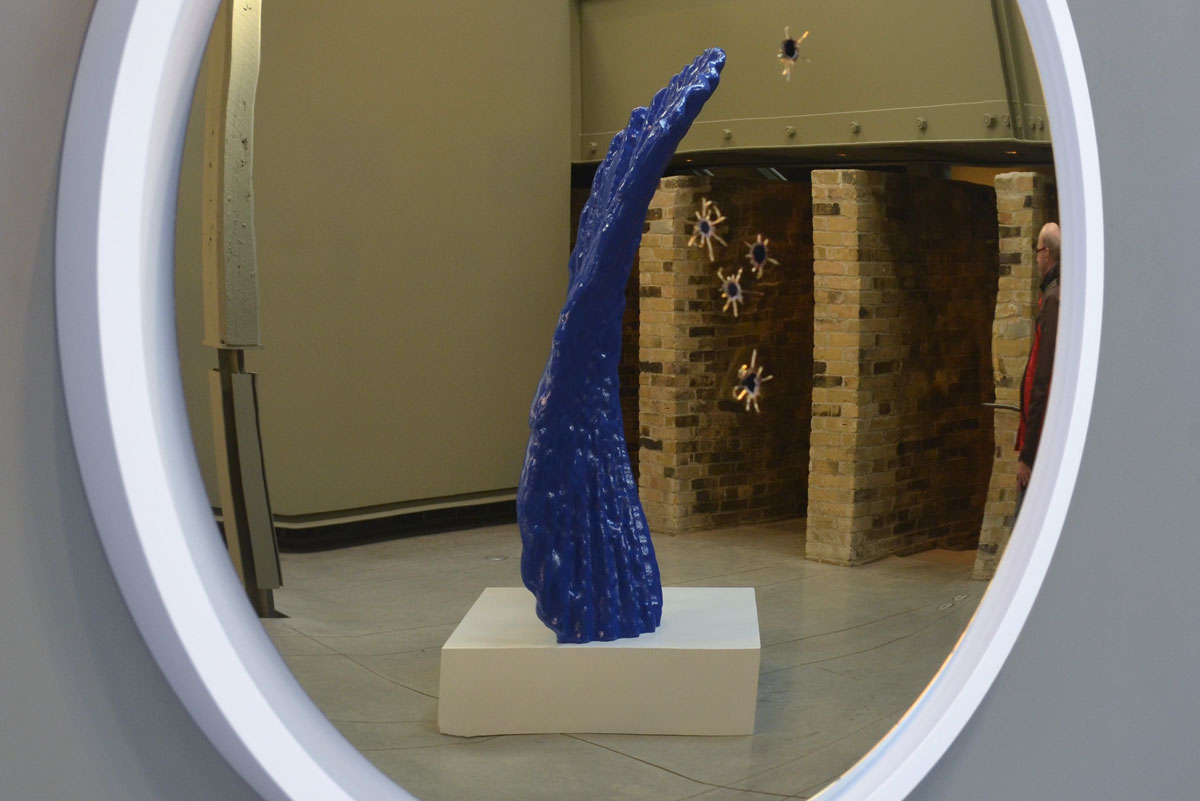
below: ‘Blue Chip’ a sculpture by Brendan McNaughton as viewed through one of his mirrors.  The expression ‘blue chip’ has become synonymous with high quality stocks, usually ones from the New York Stock Exchange.   Originally the expression meant stocks with higher prices because, if the story is correct, blue chips in poker are traditionally associated with the highest value.

Blue Chip, a sculpture by Brendan McNaughton, as viewed through an oval shaped mirror which is actually another art piece by the same artist.

below: The colour gold is very prevalent in this installation as are reflective surfaces.

picture taken inside an art gallery - a tree trunk stands in the middle of a gold toned mirror, also a mirror is on the top of each trunk, in the background are four panels of wrinkled gold

below: Parts of three wrinkly gold panels. There are actually four of these reflective square panels.  They are all the same size and colour but the surface patterns are slightly different.  Once again, the reflections are distorted.  Wealth distorts your view?

three square panels of reflective gold, wrinkled, material with reflections of people in them.

below: There was a group of what appeared to be photography students visiting the gallery at the same time that I was there. As I was standing beside this piece, looking for different and/or interesting angles and reflections, one of the students remarked on how he liked it when ordinary items were used in out of the ordinary ways. He then said that he wondered if it was …. and then he paused. I finished his sentence with the word ‘art’. He laughed and said yes, but that he was always afraid to say such things out loud. I gave him permission to ask “is it art?” as loud and as often as he wanted.

picture taken inside an art gallery - a tree trunk stands in the middle of a gold toned mirror,

picture taken inside an art gallery - a tree trunk stands in the middle of a gold toned mirror,

Installation ends May 1st

Wisdom of the Poor: Communal Courtyard,
an art installation by Chinese artist Song Dong,
Art Gallery of Ontario

This installation is made from parts of 100 old wardrobes collected from traditional Beijing neighbourhoods, or hutongs, like the one in which Song Dong grew up in.  These neighbourhoods, and their communal way of life, are disappearing.


part of an art installation by Chinese artist Song Dong using vintage wooden wardrobe doors with mirrors and curtains, reflections
The pieces of the wardrobes are arranged with the backside towards the viewer.  The arrangement is such that you can not see the front side of most of the wardrobes.

part of an art installation by Chinese artist Song Dong using vintage wooden wardrobe doors with mirrors and curtains, reflections
There are two circles of wardrobes that you can enter – where you can now stand in the courtyard so to speak.   The wardrobes become stand-ins for the fronts of houses that once faced onto courtyards in the old hutongs of Beijing.

part of an art installation by Chinese artist Song Dong using vintage wooden wardrobe doors with mirrors and curtains, reflections of a foot in one of the mirrors
A wardrobe was one of the items that the Chinese government provide to all families.  They are all similar yet different.  All have mirrors.  Most are made of the same colour wood and most have green curtains.  They all have little legs and they are all about the same height.
part of an art installation by Chinese artist Song Dong using vintage wooden wardrobe doors with mirrors and curtains, reflections
Wardrobes are personal articles and former owners have left their marks on many of them…. a different fabric in the window or a picture glued onto the wood.
part of an art installation by Chinese artist Song Dong using vintage wooden wardrobe doors with mirrors and curtains, reflections, door handles, key holes and a curtain that is a blue and white plaid and has musical notes on it.

part of an art installation by Chinese artist Song Dong using vintage wooden wardrobe doors with mirrors and curtains, reflections, wardrobes arranged in a curved shape
part of an art installation by Chinese artist Song Dong using vintage wooden wardrobe doors with mirrors and curtains, reflections

This installation also appeared in the Venice biennale in 2011 although the wardrobes were arranged differently.  For the exhibit at the AGO, there are a number of items that appear within the ‘courtyards’ created by the wardrobes.  For the viewer, these items can only be viewed through the windows of the wardrobes.  One of the items, below, is a series of three paintings of the Canadian ballerina Karen Kain.

part of an art installation by Chinese artist Song Dong using vintage wooden wardrobe doors with mirrors and curtains, reflections. through one of the windows there is a painting of Karen Kain on the wall

In another, bikes

part of an art installation by Chinese artist Song Dong using vintage wooden wardrobe doors with mirrors and curtains, reflections, through two of the windows there is a bike

part of an art installation by Chinese artist Song Dong using vintage wooden wardrobe doors with mirrors and curtains, reflections, door knobs and frosted glass and a white curtain

This installation remains at the AGO until 17 July 2016