Posts Tagged ‘sculpture’

The word Chihuly in the title refers to Dale Chihuly, an American artist who has been working in glass since the mid 1960’s.   At the moment there is a special exhibit at the Royal Ontario Museum (ROM) of some of the sculptural work produced by him and his team.
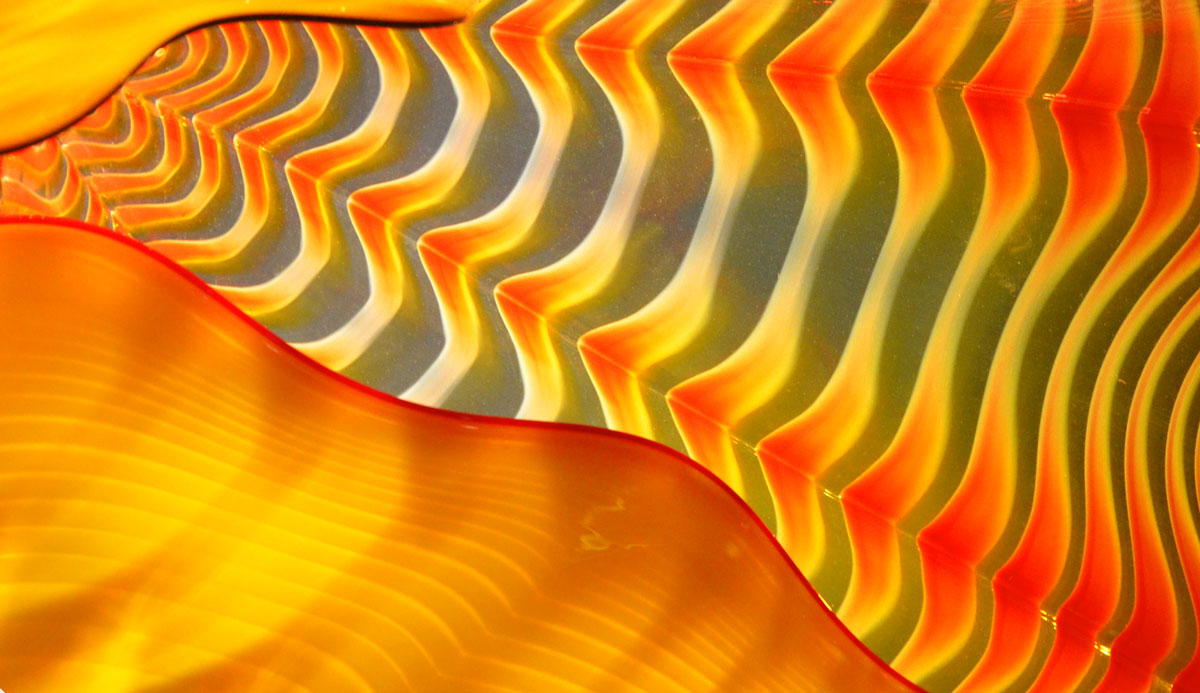
detail of a glass sculpture showing ripples and waves of colour, ornages, greys and yellows

I’ve now wandered through this exhibit three times.   The first time, I found it a bit overwhelming and I wasn’t sure how to photograph it.  The second time I went I just looked.  Yesterday I went back with my camera and tried again.  I’m reasonably happy with the photos but I know that I have only captured a small part of the art.  Perhaps it is enough to enable you to imagine more of it, or to refresh your memory if you have already seen the exhibit.

below:   Admirers looking at “Persian Ceiling”, 2012 .  Large cushions were provided for those who wanted to lie down to get a view of the ceiling in its entirety.  Of course, looking at the sections up close was also fascinating.  All the different shapes and colours overlap and produce new colours and textures.

people lying on the floor looking a ceiling that is made of different coloured glass pieces, back lit, also some people standing and pointing at different pieces

below:  Section of the “Persian Ceiling” installation.
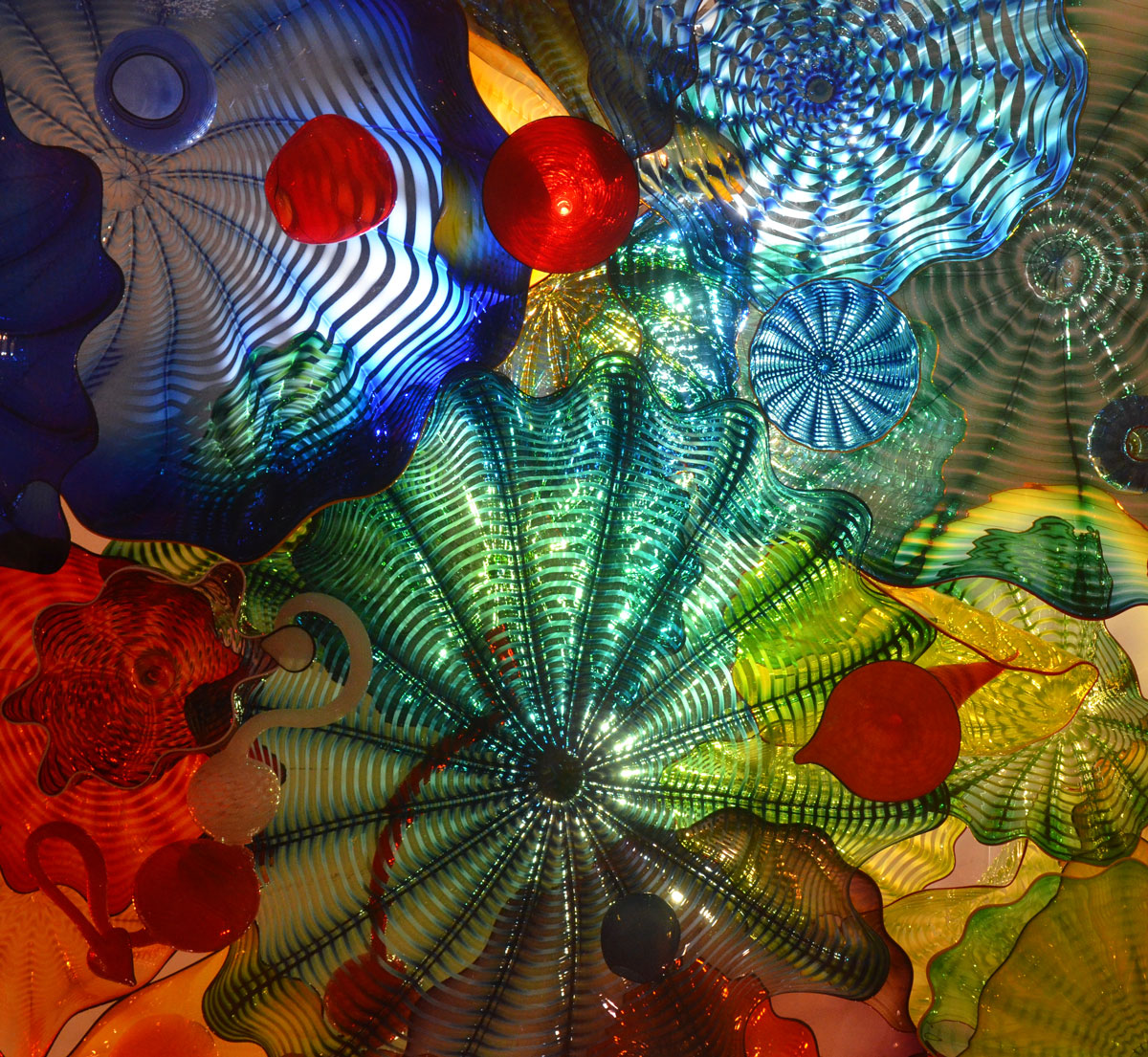
bits of coloured glass, circular shapes, ridges, back lit,

The round slight scalloped glass shapes that look a bit like flowers are called Persians.  At least that’s the name that Chihuly has given them as described in this quote that appears on the wall just outside the room.    “I just liked the name Persians.  It conjured up sort of Near-Eastern, Byzantine, Far East, Venice, all the trades, smells, sense… I don’t know, it was an exotic name to me, so I just called them Persians.”

below: A ray swims amongst the waves of colour.
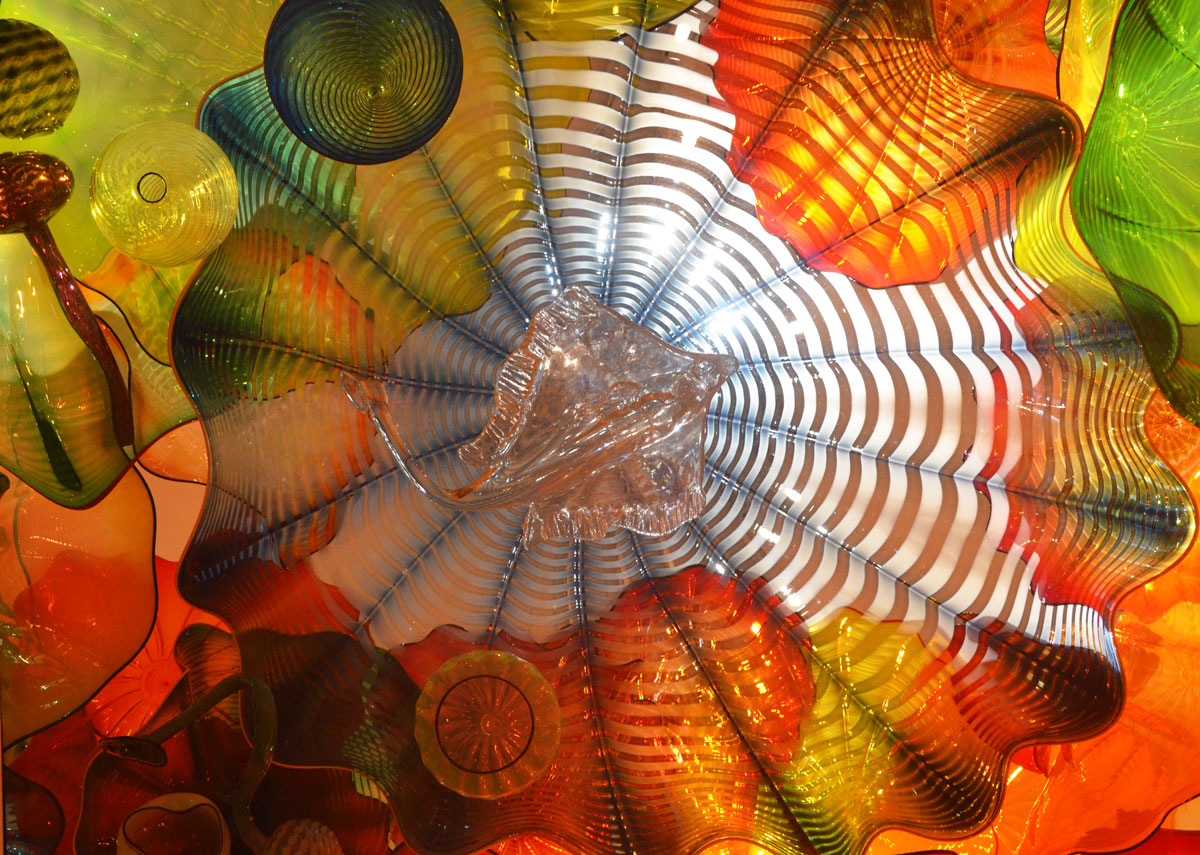
bits of coloured glass, circular shapes, ridges, back lit,

below: “Red Reeds”.  I thought of candles when I first saw this piece, red candles in a birch bark candle holder.  Then the  young girl standing beside me announced that it was a campfire and I changed my mind.  I think she’s right.  Marshmallows anyone?

The red tubes are hollow glass.  Metal rods have been inserted into the birch logs and the glass tubes sit over these rods.  You can see the darker sections at the bottom of the tubes where the metal rods are.
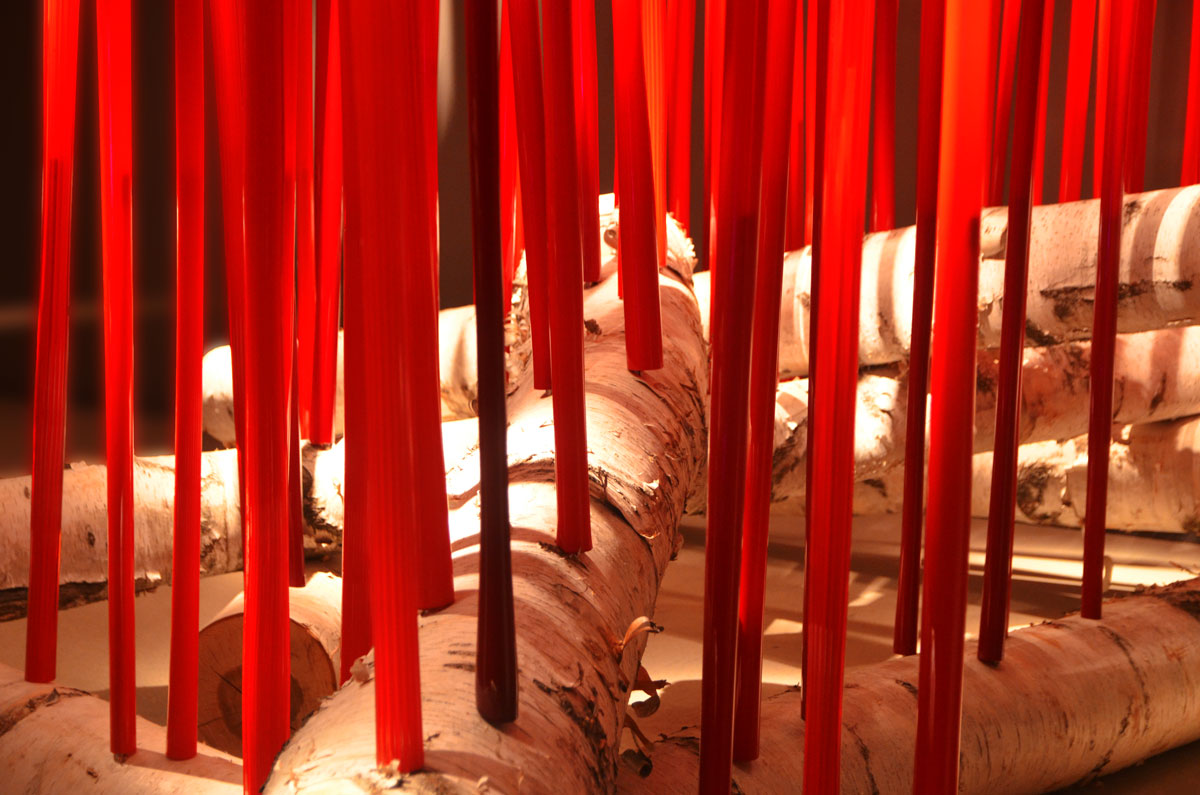
red glass tubes inserted into large birch logs, looks like a campfire with tall flames

below: “Blue and Purple Boat, 2006”.  Back in 1995 Chihuly floated some glass pieces on a river in Finland.   Local teenagers collected the pieces in their wooden boats and this provided the inspiration for a number of installations featuring glass in boats.  This is one of two on display at the ROM.  It is on a reflective surface, like a calm river.
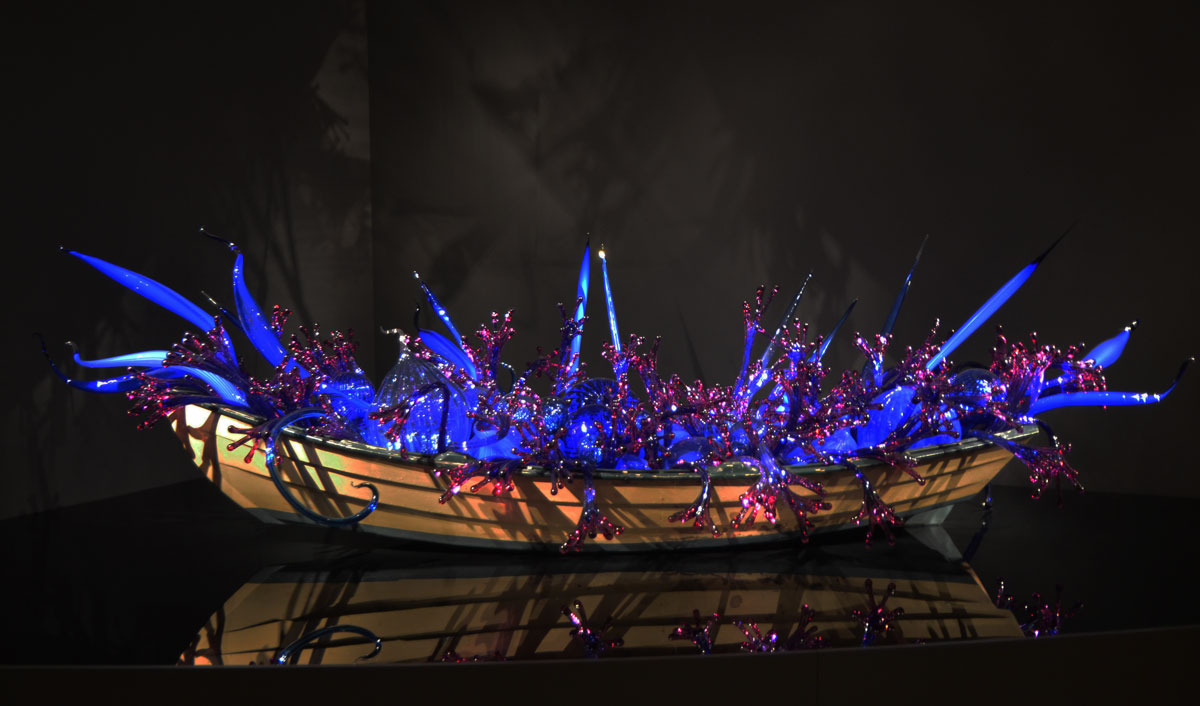
a wooden boat on a black reflective surface. The boat is filled with blue and magenta pieces of sculpted glass

below: “Sapphire Neon Tumbleweeds” constructed from factory made neon tubes that have been heated and bent into organic shapes.  The lighting is magenta in real life but blue in my photos.
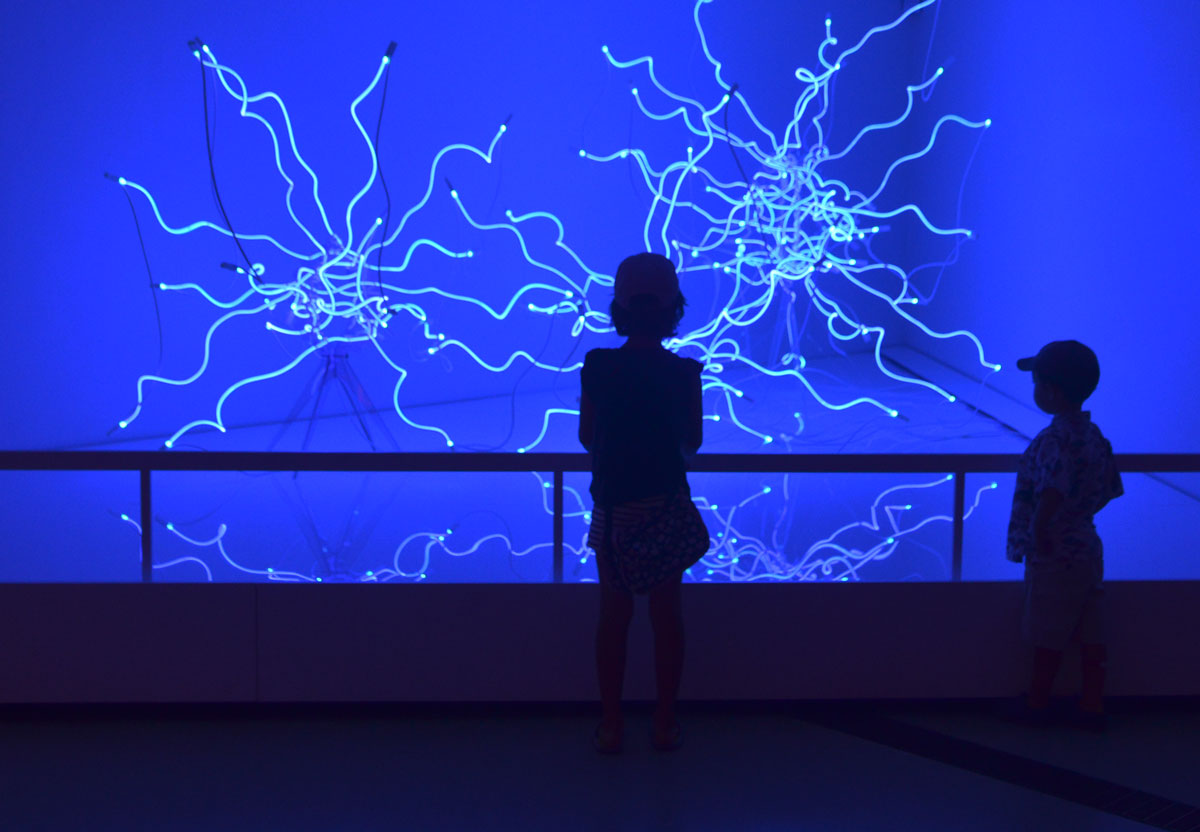
two kids standing in front of an exhibit with blue neon lights twisted into tumbleweed shapes, backs to the camera

below: The next few photos are of a large and elaborate installation called “Laguna Torcello”,  named after a lagoon island in Venice.  It is a garden of fantasy in glass.  Parts seem to be aquatic, growing under water.
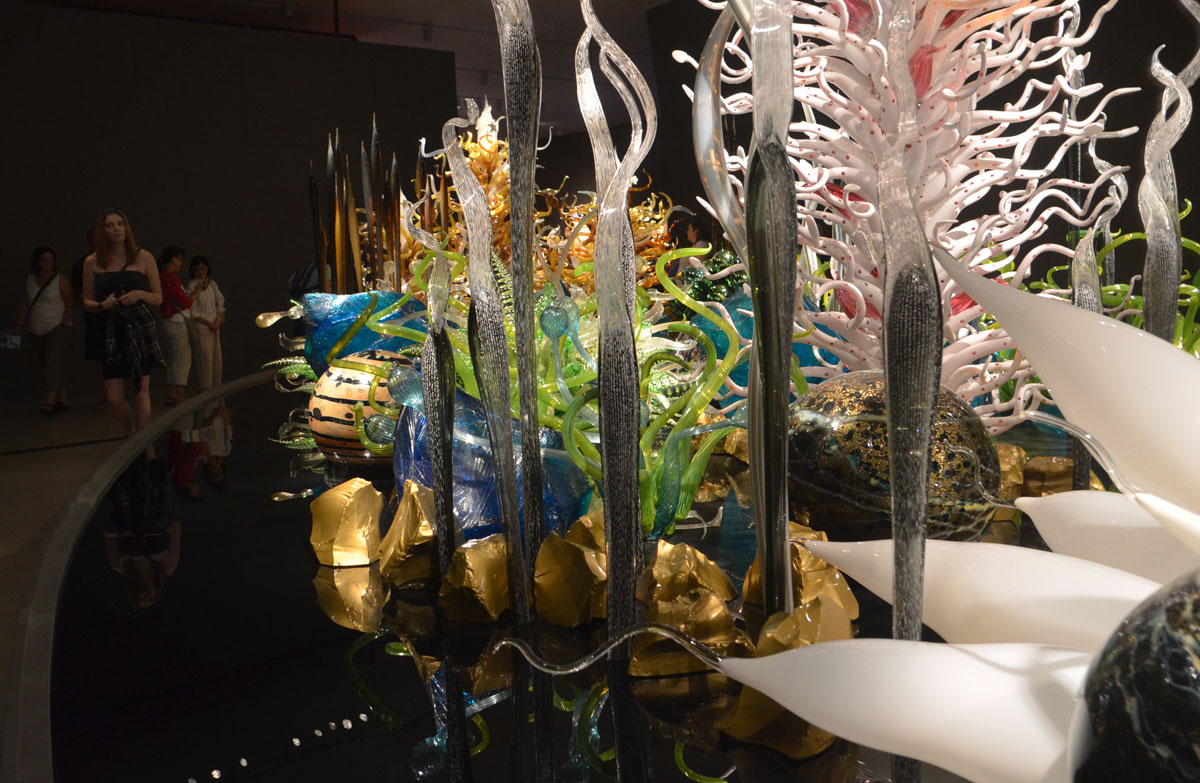
aquarium like structures, water plants, and large shells, made of glass, on a black glass reflective surface

As an aside, I suspect that the logistics and cost of transporting and installing these pieces is not minor.  Like the red tubes above, this garden is made of hollow glass pieces that are arranged on, and supported by, rods.  The whole thing sits on a flat, dark, and reflective surface which adds another dimension to the artwork.

green glass and silver metallic horn shaped pieces on a black reflective surface, part of a large glass art installation by Chihuly at the ROM

different shaped glass sculptures that look like stylized underqater scene, aquatic plants

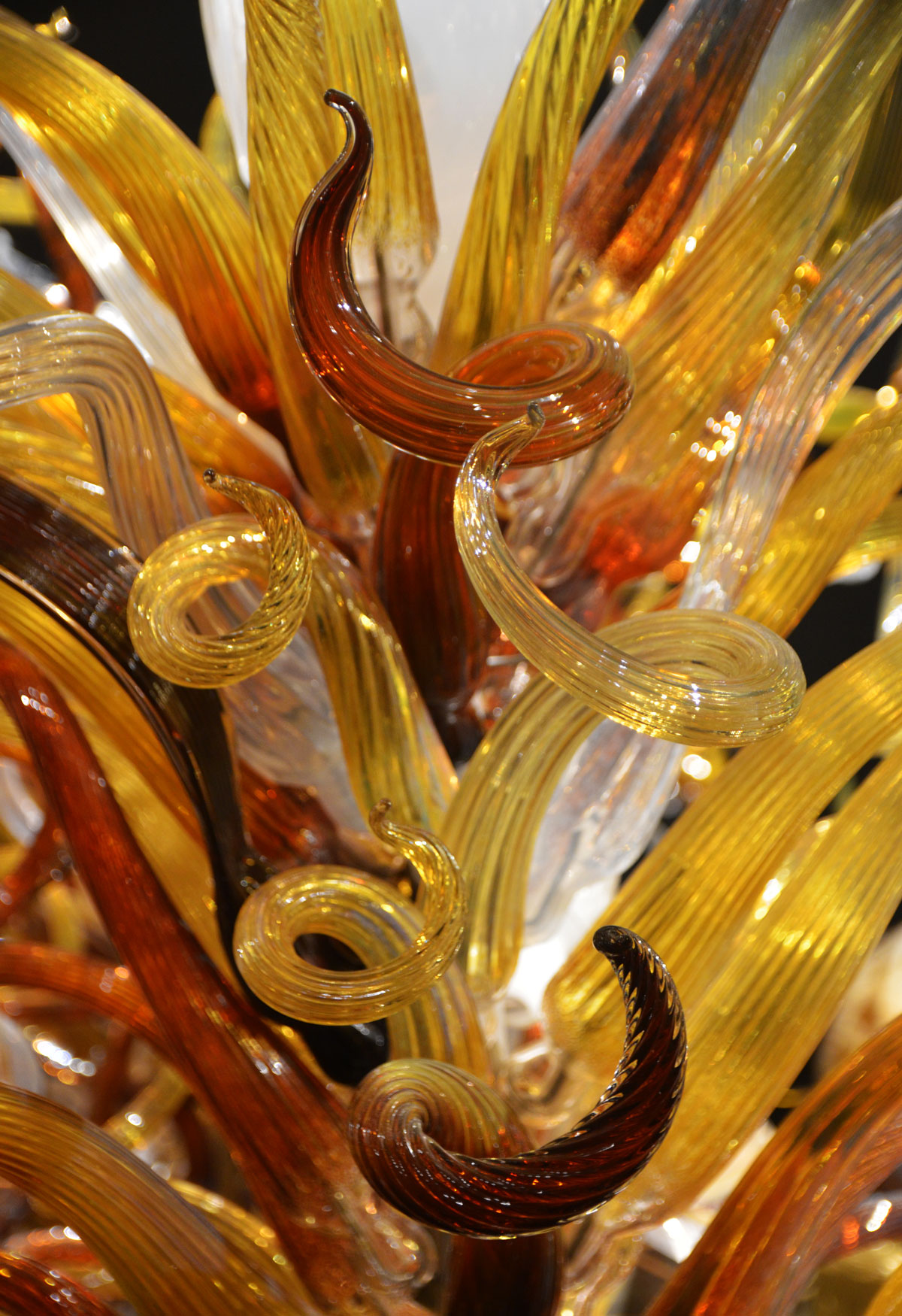
curly pieces of glass in different shade of amber, look a bit like curly seaweed growing under water

The exhibit continues until the end of 2016.
Dale Chihuly website

The first time I saw the latest art installation in the Canary District I was in a car and only got a quick look at it.  I couldn’t figure out what the mess was all about.  It wasn’t until I went back on foot to take a closer look that I could appreciate what the artists were trying to do.

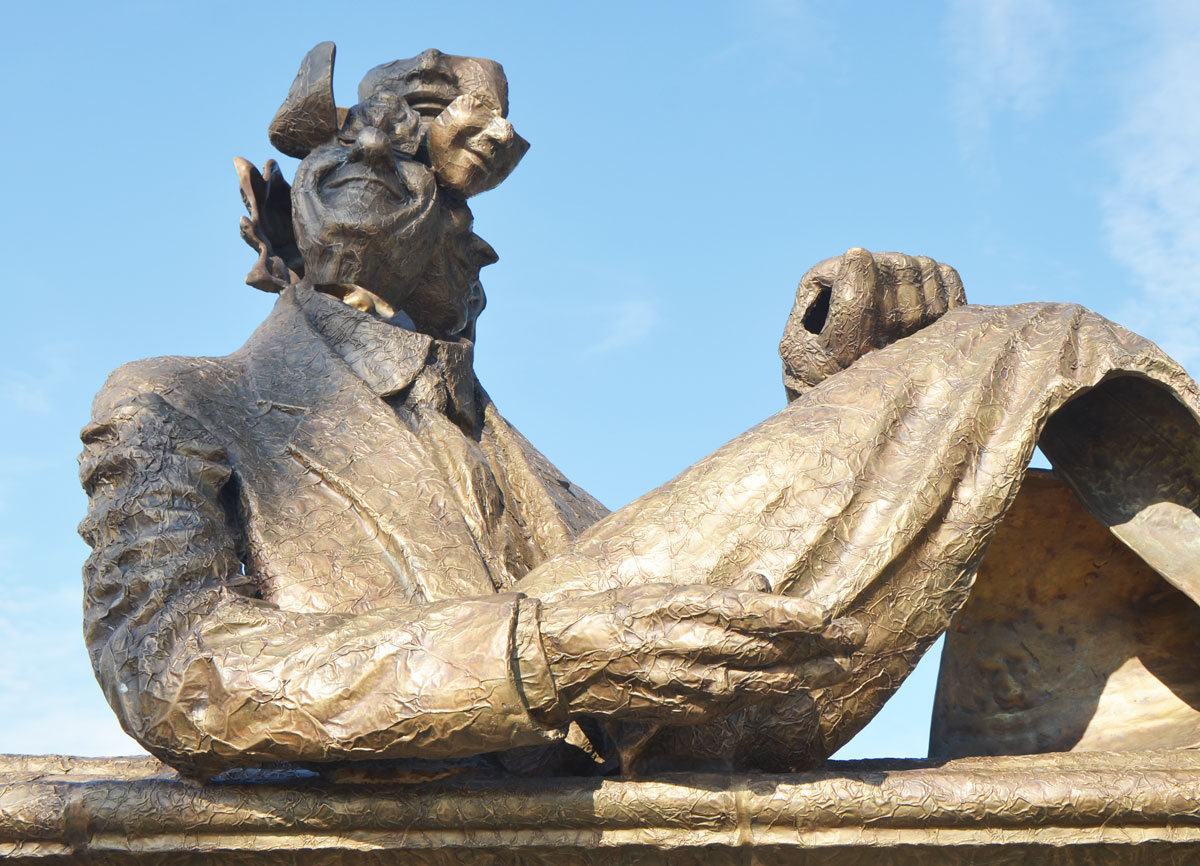
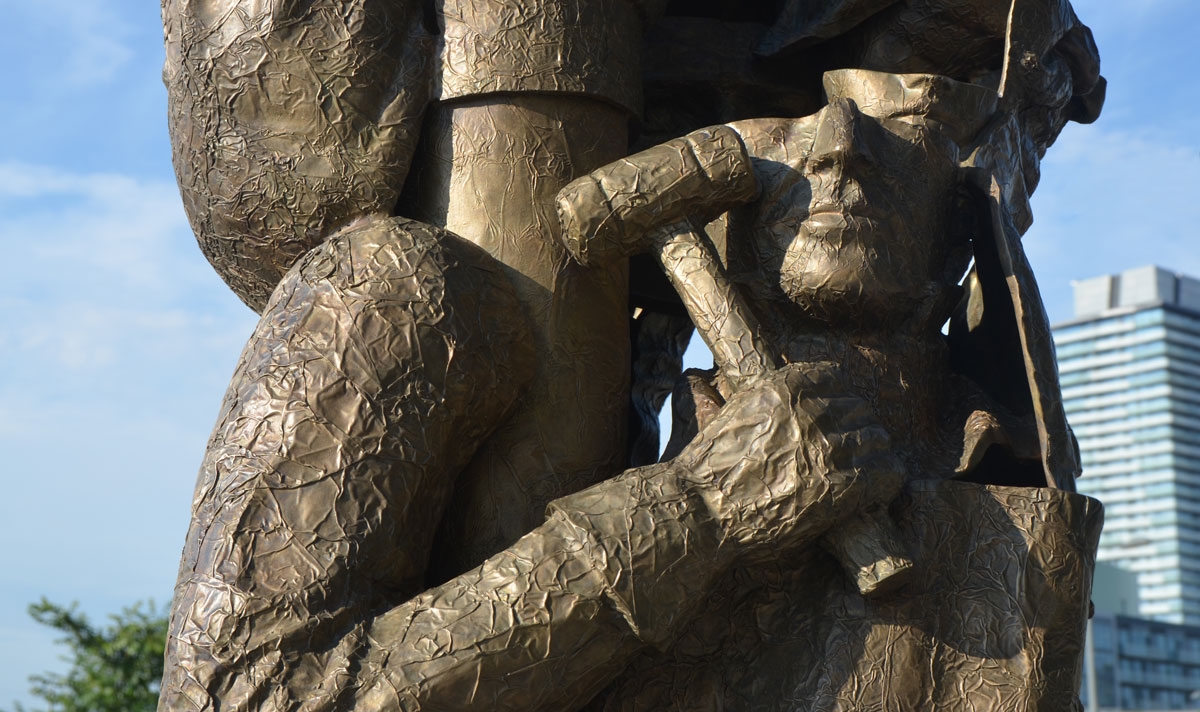
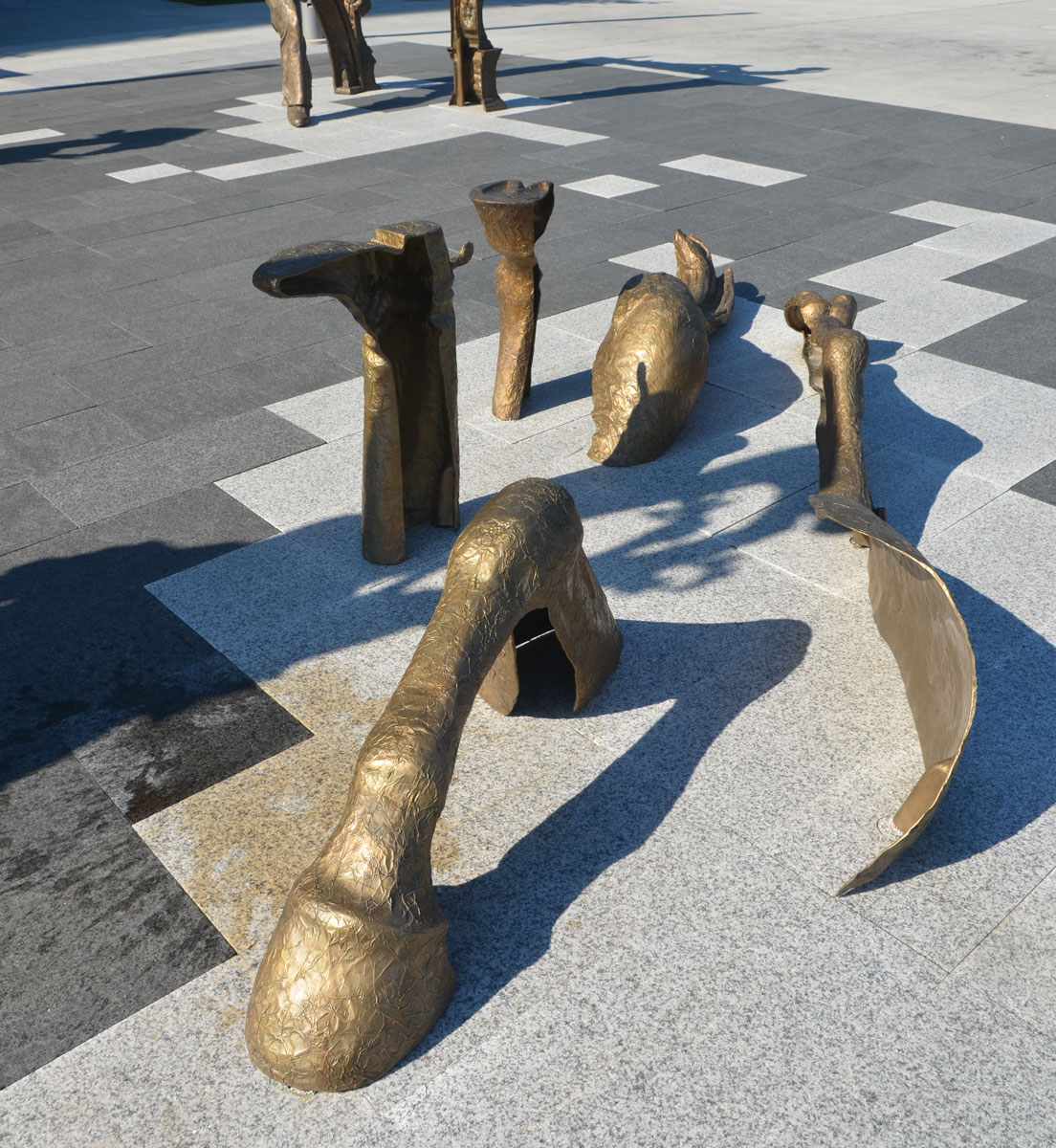
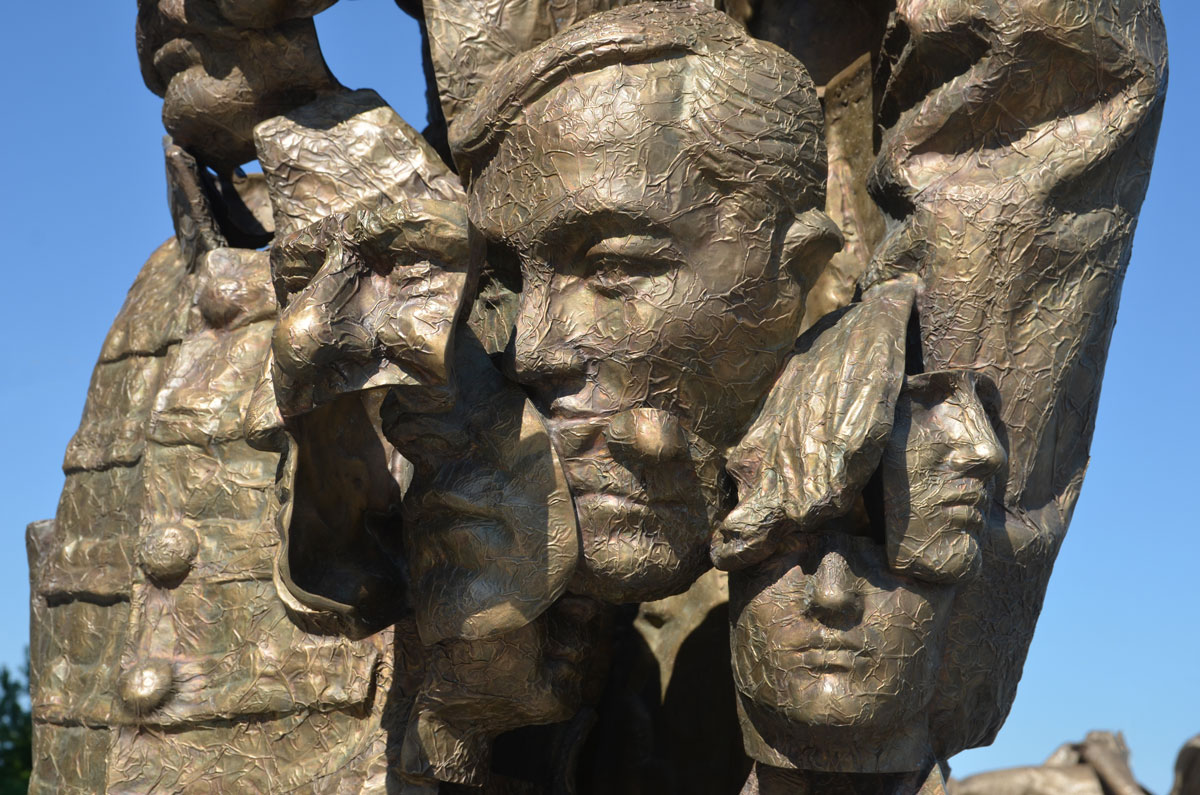
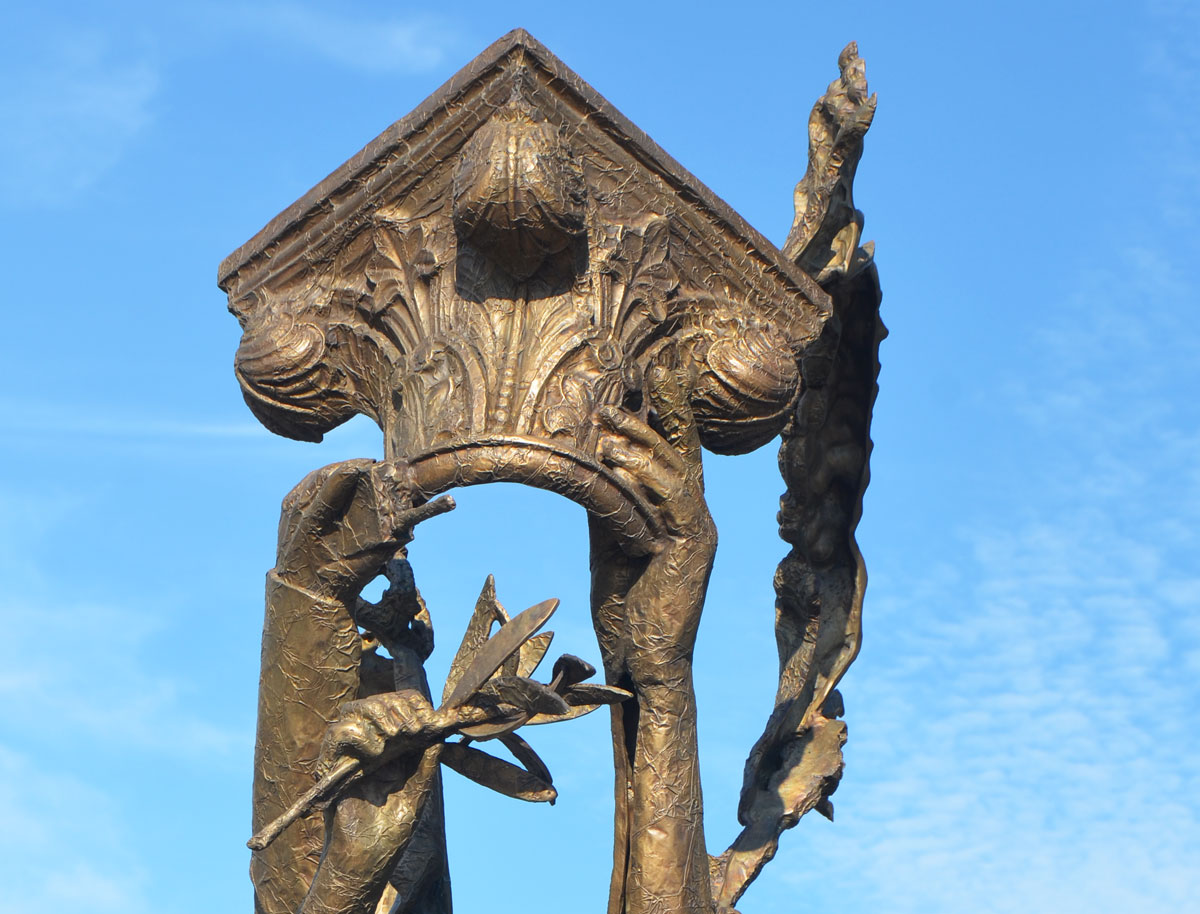
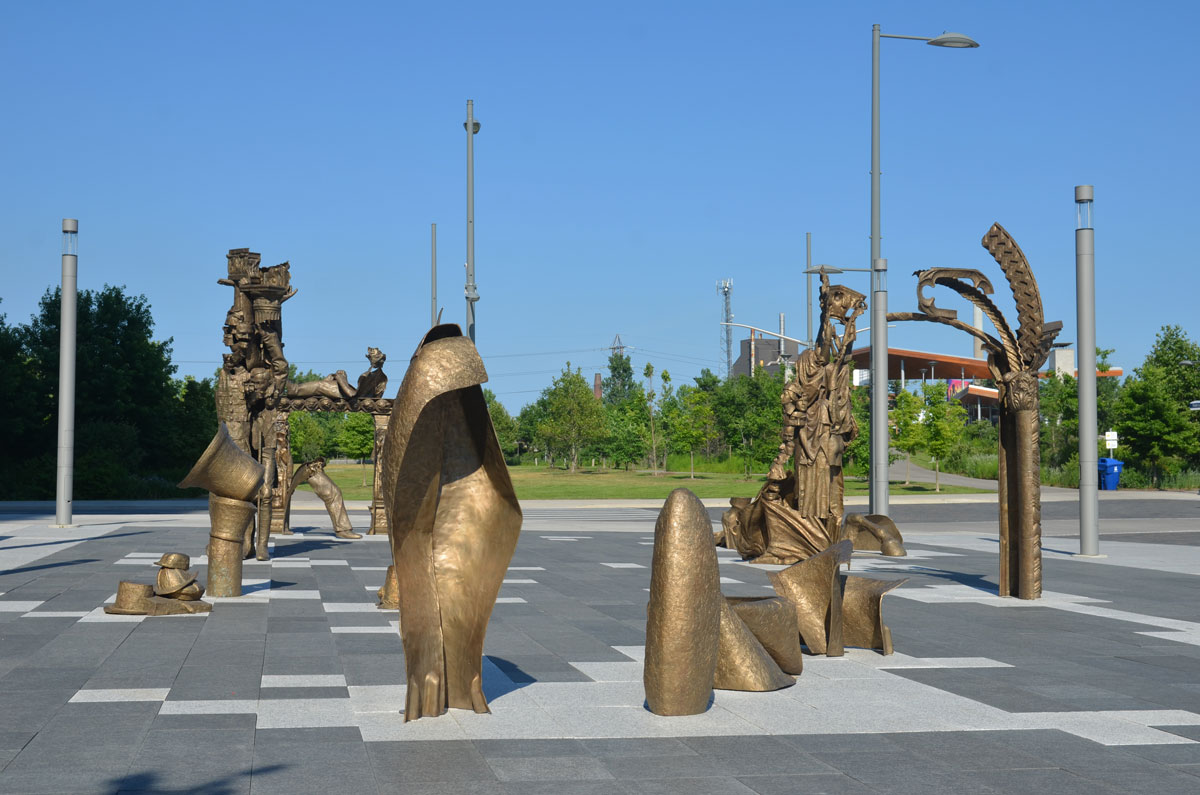
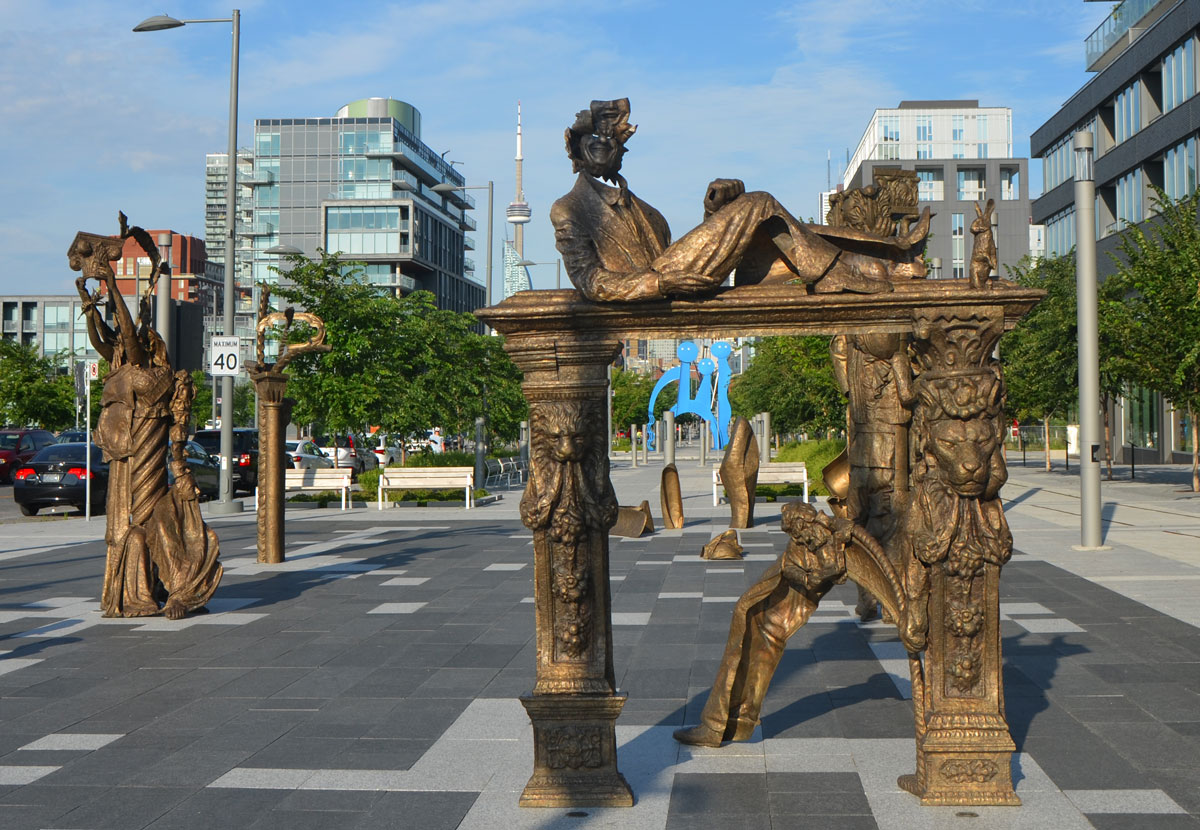
Located at Front and Bayview is the ‘Garden of Future Follies’ by Hadley Howes and Maxwell Stephens (Hadley & Maxwell and the Studio of Received Ideas).  It is a sculpture garden and there are 7 sculptures in this garden.  Each sculpture is a mashup of pieces from different sculptures around Toronto.  Aluminum foil ‘molds’ were used to replicate portions of over 80  different monuments and architectural features.  These portions were then put together in a whole new way.

public art installation on Front St East, various pieces of sculptures put together wrong, people with more than one face, legs in pieces, bronze pieces in 5 groupings on the sidewalk

From an interview with the artists:

“Sir John A. Macdonald’s nose is assembled along with the eyes of artists Frances Loring and Florence Wyle, the chin of Dr. Sun Yat-Sen, and Northrop Frye’s hair; Jack Layton’s smile is one of seven that grace a figure lounging atop a reconstituted mantel from the library at Osgoode Hall; a bell from St. James Cathedral’s famous collection is perched on a cannon from Fort York; while nearby a suitcase from the Memorial to Italian Immigrants acts as a plinth for a collection of hats from various bronze heads.”

Now you can play spot the pieces!  But you won’t find any hockey sticks.

blog_man_three_heads_statue

So far I haven’t seen anyone taking selfies here but I think it would be a great spot for them!

part of a public art installation outdoors created by piecing together fragments of other statues cast in bronze , man and hammer

fragments of horse and feet statues embedded in the sidewalk

part of a public art installation outdoors created by piecing together fragments of other statues cast in bronze

part of a public art installation outdoors created by piecing together fragments of other statues cast in bronze, hands, top of a column and a laurel leaf

part of a bronze sculptture, a naked bum with a hand beside it.

part of a public art installation outdoors created by piecing together fragments of other statues cast in bronze

below: No one will ever call it beautiful, playful yes, but not pretty.

arrangement of statue pieces to form a sculpture garden, Garden of Future Follies by Hadley and Maxwell.

a face is upside down on a statue made from bits and pieces of other statues


This post is subtitled ‘Staying Cool on a Hot Hot Day’.  When the temperatures are into the 90’s (old style) and the humidity makes the air thick, walking streets and alleys is not very comfortable.  Instead I took refuge in air conditioned arty places.  With the help of the (mostly) air conditioned TTC I only needed to take a few steps outside.

below: At one point I walked through an air conditioned building rather than going outside.  This is what I found there. ‘August 6, 1945’ by Matthew Day Jackson.  Moments after I pulled my camera out of my backpack, a security guard appeared.  I was sure that once again I was going to get the “this is private property” talk but instead we ended up discussing the work and how it is displayed.

It is constructed of four panels and it’s very heavy.  The base is made of lead; you can see the lead where Lake Ontario is.  It is attached to the wall with 18 very long bolts and each bolt is wired to an alarm.

map of toronto made of charred wood and lead, meant to resemble the city after an atomic bomb, large, made by Matthew Day Jackson, hanging on a wall behind a metal railing.

below:  Looking a bit more closely at it you can see that it is a map of Toronto.  As you might have surmised,  the title is a reference to the dropping of the atomic bomb on Hiroshima by the USA during WW2.    This isn’t just any map of Toronto, it’s an aerial view of a burnt out city after a nuclear explosion.  It is one in a series of cities given similar treatment, all with the same title.

detail of the islands and downtown area of map of toronto made of charred wood and lead, meant to resemble the city after an atomic bomb, large, made by Matthew Day Jackson

From the effects of man made death to the life enhancing effects of nature….

below: A few steps outside took me past the Gardiner Museum where I noticed that the front garden was redone about a year ago.  ‘Vertical Crevice Garden’ was designed and donated by landscape artist Neil Turnbull.  From the Gardiner museum website, a quote by the artist: “When the massive forces of continental drift push against layers of sedimentary rock, they cause it to crack, break, and rise. Over centuries, through exposure to wind, sun, and the freeze-thaw cycle, the layers split open. These fissures and crevices collect rain, dust, and an array of windblown bits like seeds and spores; plants take root, and life takes hold.”

limestone rocks arranged on a slant in a garden, stripes of red rock and grey rock, all just a few inches off the ground

below: When walking past the Gardiner Museum, one can’t help but notice the striped head.  It’s actually called ‘Untitled’ (why do artists do that?) and it’s by Jun Kaneko, 2002.  It’s made of glazed ceramic and galvanized steel.   Before heading underground at Museum subway station I took a few minutes to try to take a ‘pretty’ picture of the head.  The plants in the garden next door haven’t quite grown up enough to hide that ghastly table that the head sits on.  I have always wondered why the museum chose such a mundane bland platform for the sculpture but now that I look at it again I wonder if it’s possible that the table is actually part of the artwork.  Could it be?

large striped head sculpture on a table, outside, by Jun Kaneko, old building behind it, lavender and other plants growing in front of it.

below:  A photograph in the doorway of a gallery caught my eye.  The picture below is not the one in the doorway, but one that was hanging on a wall inside that I liked even more.  ‘Paris Rooftops 4’ by Michael Wolf.  It is 48″ x 68″ and is a chromogenic print (full-colour silver-based photograph), edition of 9.   To buy it will set you back $22,000 but looking is free – check out more of Michael Wolf’s work on the Bau-Xi gallery website.

picture of a photograph by Michael Wolf of Paris rooftops. Concrete grey with lots of lines of little terra cotta chimneys

below: A man with a camera stares at a painting on a gallery wall.  ‘Watching’ 2010, (26 inches high) by Tom Campbell on the left and ‘Brown Trail #7’ 2016 by Shi Le, a Toronto based landscape artist.  These are at the other Bau-Xi gallery (the non-photography one)

a small sculpture of a man holding a camera is placed in an art gallery such that he seems to be looking at a painting on the wall.

below: Three paintings by NUBARR Gallery, a collection of the works of Armenian-Canadian painter Noubar Sabag (Noubar Sabbaghian) 1920-2006.   These, and others by the same artist, are on show at the Art Square Cafe & Gallery but unfortunately I just learned that today is the last day.
a woman in a floppy black hat is taking pictures of three paintings hanging on a gallery wall.

below:  How many people try to paint pictures like this?  How many people sell such paintings, not to mention have them hang in the Art Galley of Ontario?  But they aren’t Robert Motherwell.      So I ponder on the age old question of what makes a piece of art valuable or collectable?  Is the AGO (and other galleries) collecting paintings or names?  Motherwell painted this in numerous variations – a few changes in colour, a slight change in the lines.  Cheating?  Or brilliant marketing?  One for every gallery of note? This is Motherwell’s ‘Untitled (In Orange with Charcoal Lines)’ c1970.  There’s that “untitled” again, the most popular name for an artwork.

all orange with 3 black lines that form three sides of a square, top line of the square is missing. It's a picture of a painting by Robert Motherwell in an art gallery

My last stop of the afternoon was at the photography exhibit by Thomas Ruff at the AGO.  Part of the exhibit was a few large photographs of stars,  ‘Sterne’.  Large pictures of stars in the night sky were made from negatives that Ruff bought from the European Southern Observatory in Chile in 1989.

below:  They are difficult to look at, or rather it is difficult to what is the picture because the blackness of the photograph creates a mirror when placed behind glass.   This is me taking a picture of the picture – me plus the picture on the opposite wall plus the lights and light fixtures in the ceiling plus a table plus another person in the room plus a few white spots that are stars.

large photograph of the night sky, lots of stars and blackness. The black acts like a mirror and parts of the gallery are reflected in the picture.

below: ‘Walking Away, Walking Through the Universe’ a manipulation of a manipulation.

a reflection of two people walking hand in hand as seen reflected in a photograph of stars in the black night sky

below:  One last photo.  Let’s end this on a positive note and give Thomas Ruff credit for some interesting work.   These two pictures are part of his press++ series where he has taken old photos used in print medium and merged the front (picture) and back (words and markings) of the print into one.

a woman is standing in an art gallery and she is looking at two large pictures on the wall.

Thomas Ruff, Object Relations, at the AGO until 1 August 2016

Happy Mothers Day!

I didn’t write this blog post specifically for Mothers Day even though it’s about four women, Mary Pickford, Edith Cavell, Florence Wyle, and Frances Loring.  Just because they are women doesn’t mean that they are mothers, in fact only one is.  Mary Pickford adopted two children.  I also didn’t intend to write a blog post on the merits of motherhood vs childlessness so I am going to say nothing further on the subject!

The first woman can be found at the corner of University and Elm.  Here, there is a a bronze portrait bust of Mary Pickford that was sculpted by Eino Gira in 1983.

bust of Mary Pickford with her hand on her cheek, in front of Sick Kids Hospital in Toronto, red brick hospital behind her in the photo

The plaque beside her says:

Born in 1893 in a house which stood near this site, Gladys Marie Smith appeared on stage in Toronto at the age of five.   Her theatrical career took her to Broadway in 1907 where she adopted the name Mary Pickford.  The actress’s earliest film “Her First Biscuits”, was released by the Biograph Company in 1909 and she soon established herself as the international cinema’s first great star.   Her golden curls and children’s roles endeared her to millions as “America’s Sweatheart”.  She was instrumental in founding and directing a major film production company and starred in over fifty feature-length films including “Hearts Adrift”, “Pollyanna” and “Coquette”.  For the last named film she received the 1929 Academy Award as the year’s best actress.

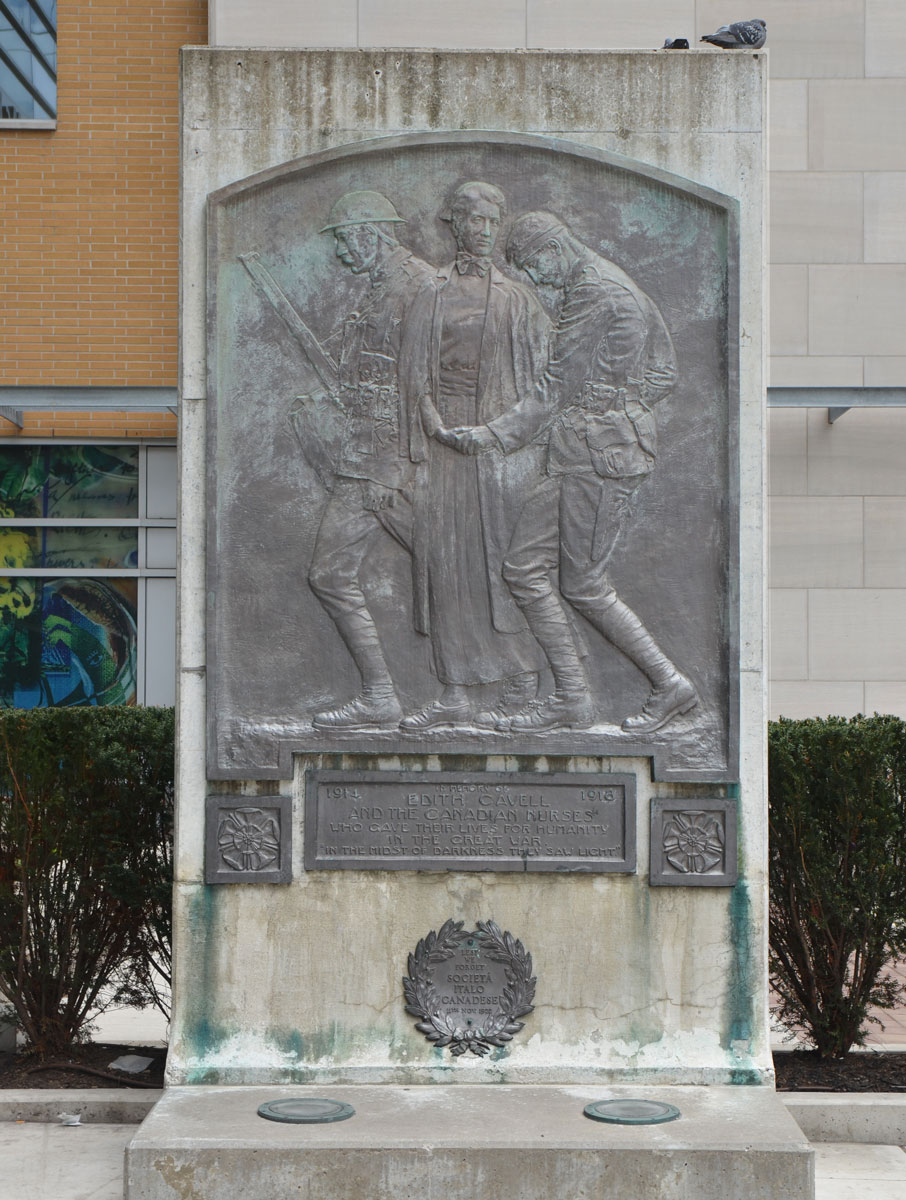
below: Just up the street, next to one of the entrances of Toronto General Hospital, is a memorial to British nurse Edith Cavell (1865-1915) and to all the Canadian women who served as nurses in WW1.  The memorial  was installed at University Ave and College St. in 1921 but later moved to its present location.

A memorial to British nurse Edith Clavell and the Canadian nurses of WW1, a bronze plaque mounted on a stone tablet. Picture of Clavell between two upright but wounded soldiers.

In memory of Edith Cavell and the Canadian nurses who gave their lives for humanity in the Great War.  “In the midst of darkness they saw light”

Cavell had been working in Brussels when WW1 broke out.  After the Germans invaded Belgium, Cavell helped wounded Allied soldiers escape to the Netherlands.  She was caught by the Germans, charged with treason, and executed on 12 October 1915.  She became the most well known woman casualty of WW1.

The above memorial was designed by Florence Wyle.  There is a memorial to Wyle and her partner, Frances Loring (also a sculptor), in a small park at the corner of Mt Pleasant and St. Clair.

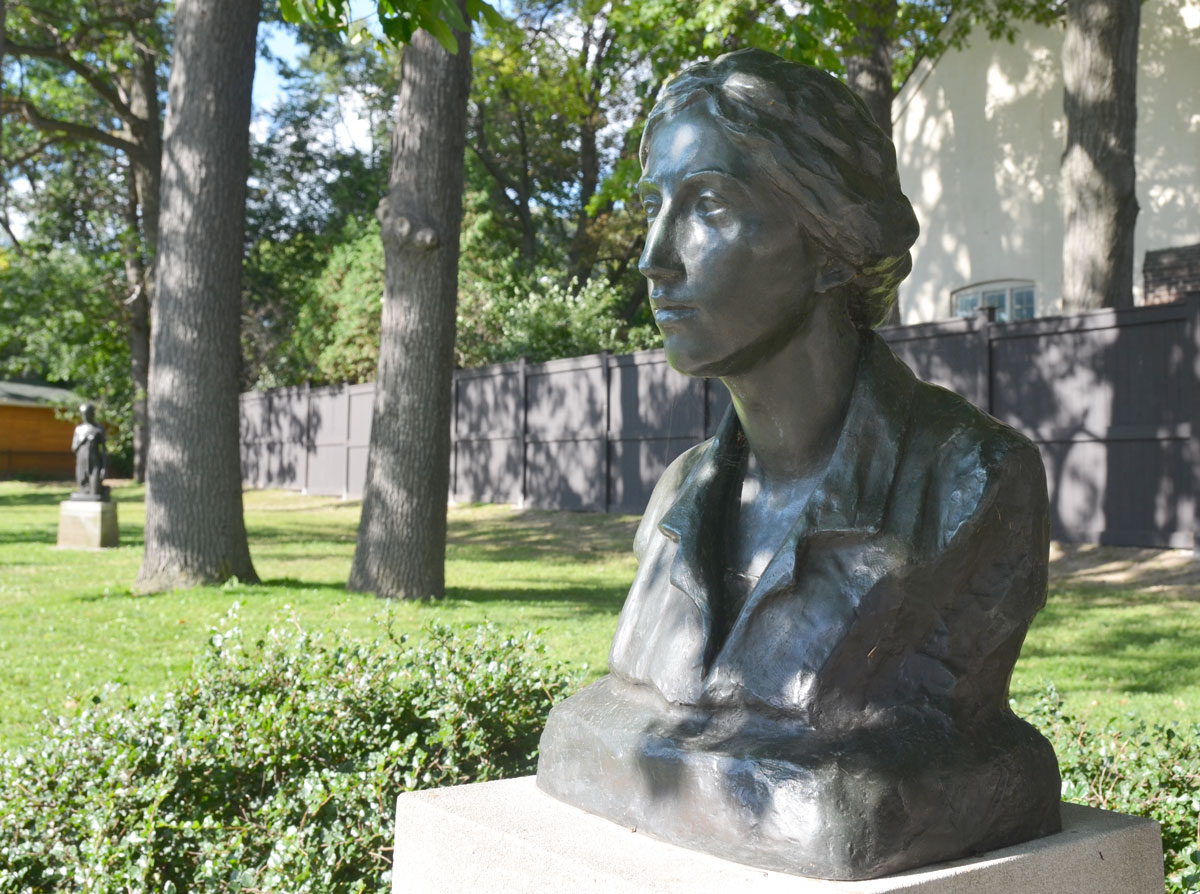
below: bronze bust of Florence Wyle, by Frances Loring

bust of Florence Wyle, a Canadian sculptor, in a park

below: bronze bust of Frances Loring, by Florence Wyle

bust of Frances Loring, a Canadian sculptor, in a park, in the shade of a large tree

below: There are a couple of small statues by Wyle in the same park, including this one.
“Young Girl”, about 1938.

bronze statue titled "Young girl", showing a girl from the thighs up, holding up a cloth that is wrapped around her body but her breasts are bare

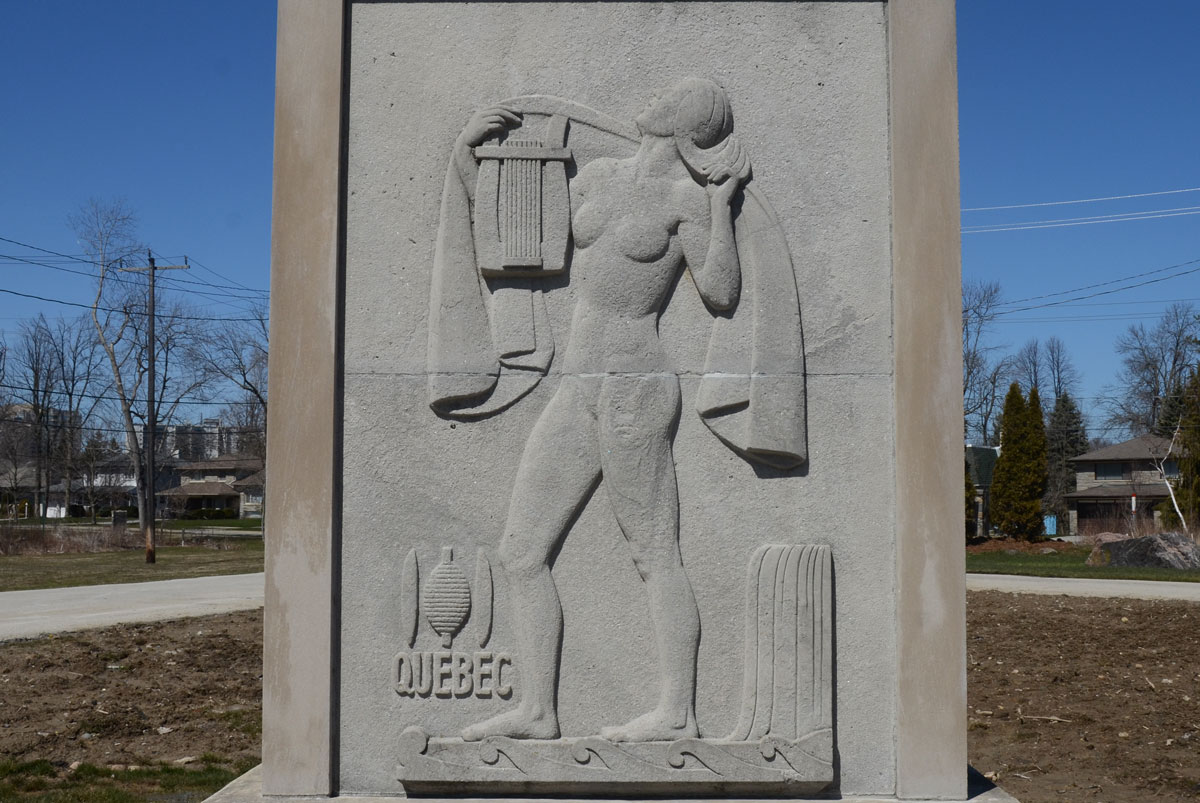
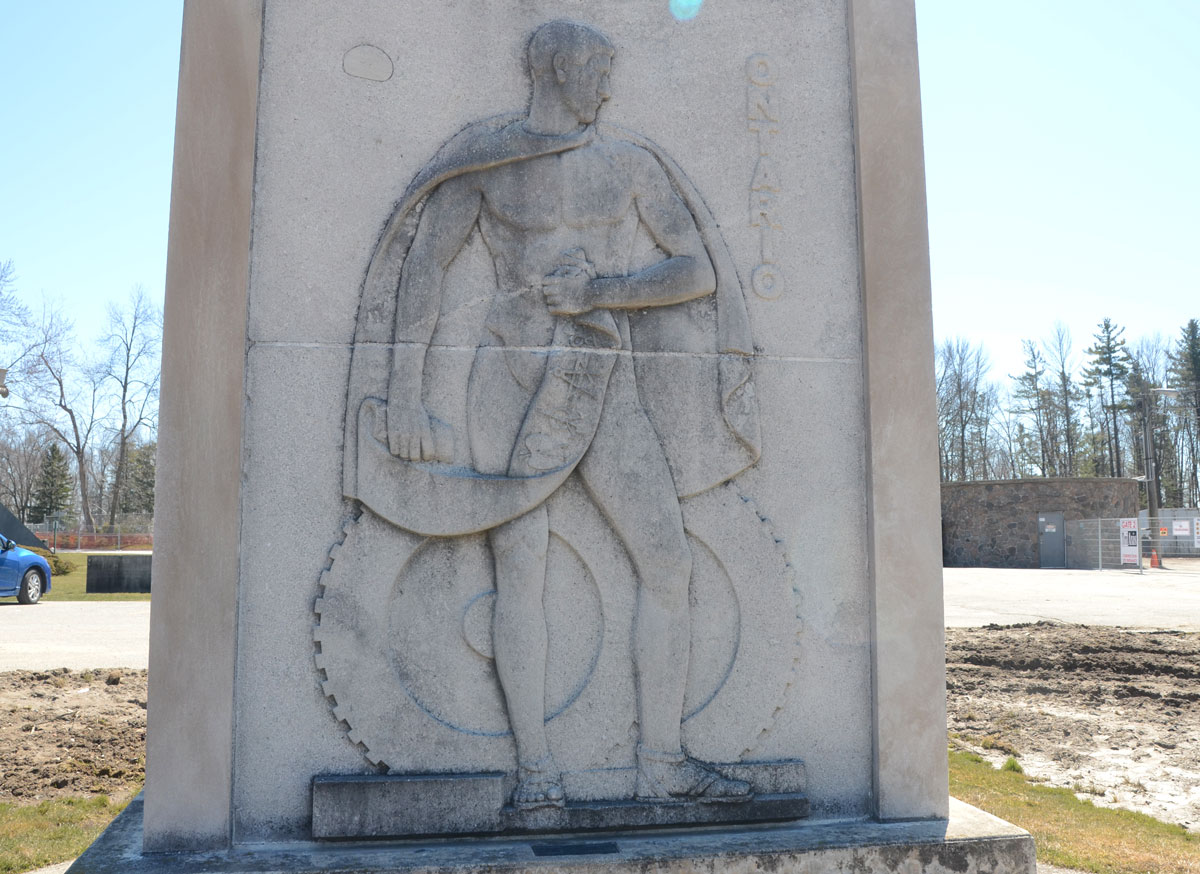
Loring and Wyle are responsible for a number of sculptures around the city.  Two of these used to be on the Bank of Montreal building at the northwest corner of King and Bay. It was built in 1887 by architects Marani and Morris and demolished in 1968.  The building featured a series of sculptures representing the Canadian provinces that were done by a number of artists.  Frances Loring sculpted the panels for Ontario and Quebec.  When the Bank of Montreal building was demolished, all of the panels were moved to the grounds of the Guild Inn in Scarborough where they remain today.

Quebec sculpture - A stone relief sculpture from a series on provinces of Canada, originally on a Bank of Montreal building in Toronto. They were rescued when the bank was demolished and moved to the grounds of the Guild Inn in Scarborough. By Canadian artist Frances Loring. A naked woman upright, with a cloth over her shoulders and looking upwards

A stone relief sculpture from a series on provinces of Canada, originally on a Bank of Montreal building in Toronto. They were rescued when the bank was demolished and moved to the grounds of the Guild Inn in Scarborough. By Canadian artist Frances Loring. Ontario is in the picture, as a man surrounded by symbols of industry such as large gears and architectural plans

There is no theme to this blog post.  I never really had a purpose in mind as I walked yesterday.  I walked to enjoy the spring day.  I walked wherever my feet took me…  and they took me on a route that wove between Bay Street and University Avenue and from Grenville south to Dundas.

two women dressed up and walking down the street. One is in a puffy black dress, black tights and black shoes. The other woman has long red hair and a polka dot sweater on.

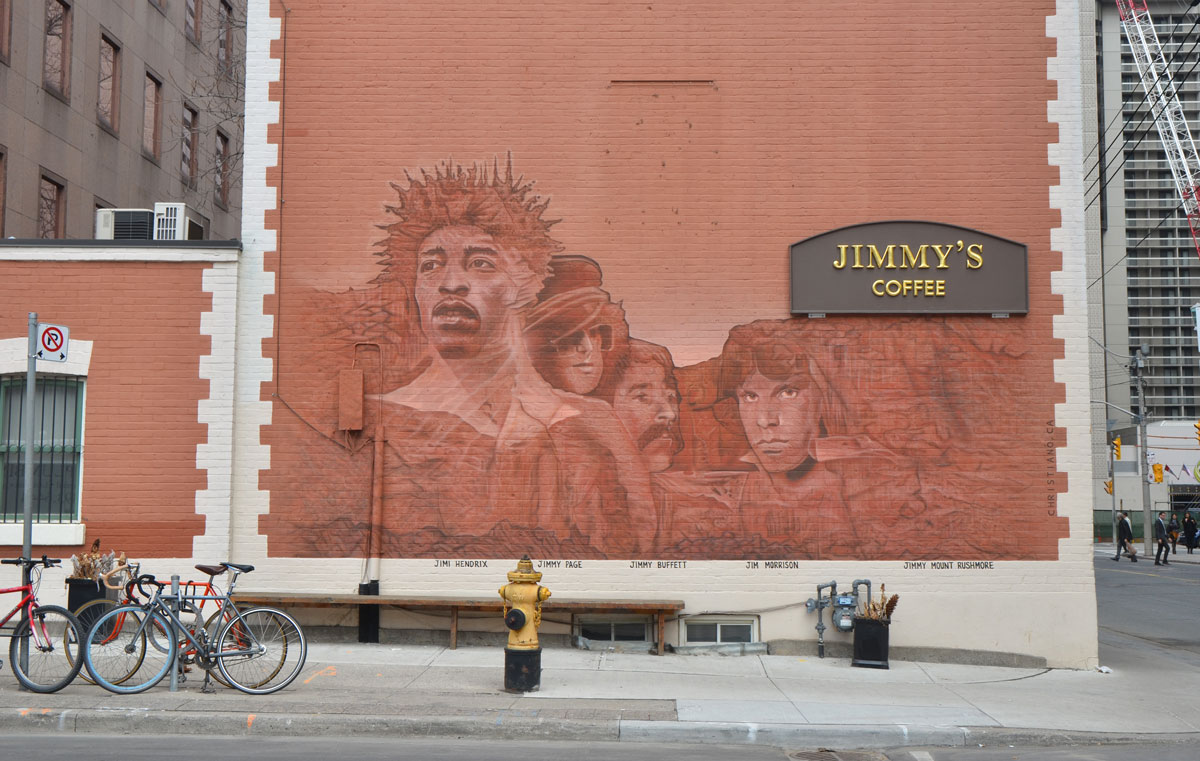
below: “Jimmy Mount Rushmore” mural on the side of Jimmy’s Coffee featuring four famous musical Jimmys: Jimi Hendrix, Jimmy Page, Jimmy Buffet and Jim Morrison.

mural on the side of Jimmys coffee, monochromatic in rust, pictures of what Mount Jimmy Rushmore would like, four famous Jimmys, Jimi Hendrix, Jimmy Page, Jimmy Buffett and Jim Morrison

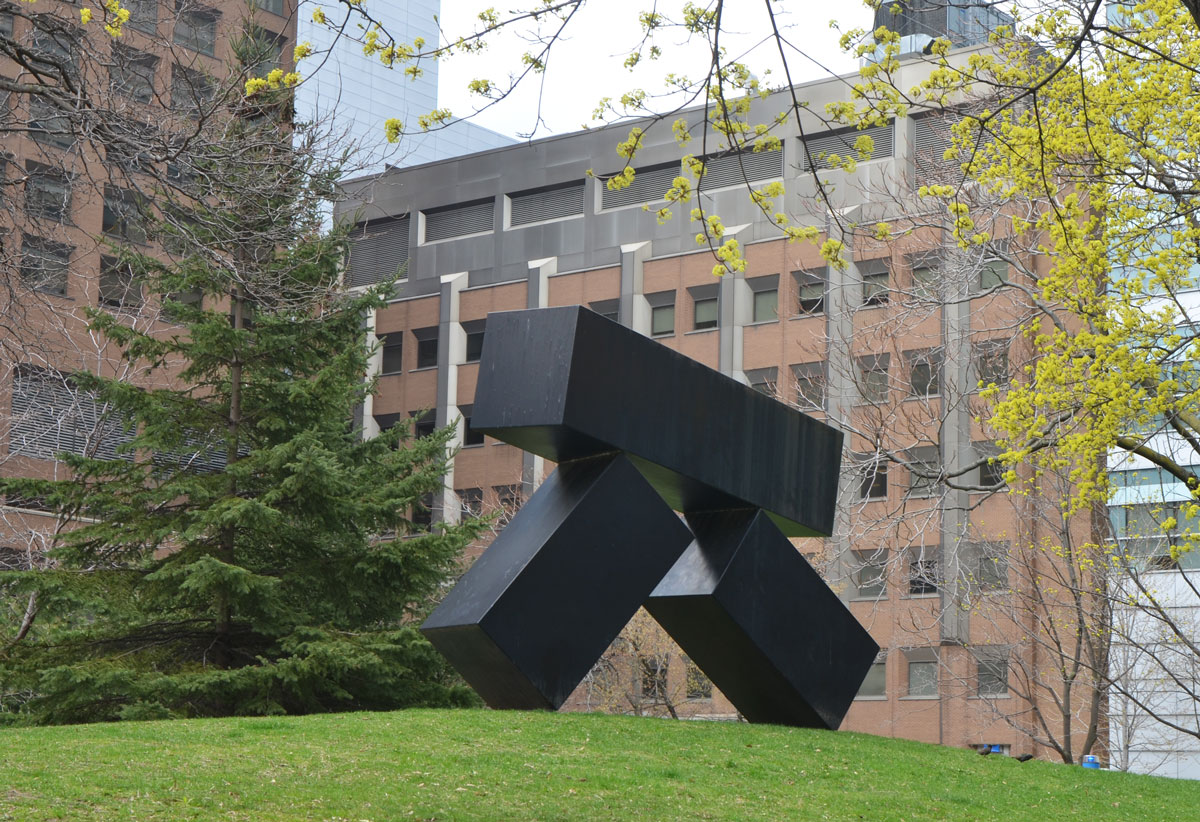
below: ‘Inner City Gate’ by Kosso Eloul.  1978.  A balancing act of stainless steel boxes on the lawn of the R. Fraser Elliott building (part of the old Toronto General Hospital), Elizabeth Street.

black metal sculpture of three boxes precariously balanced, the upper box is almost horizontal and it is being supported by the other two who are falling down but still balancing

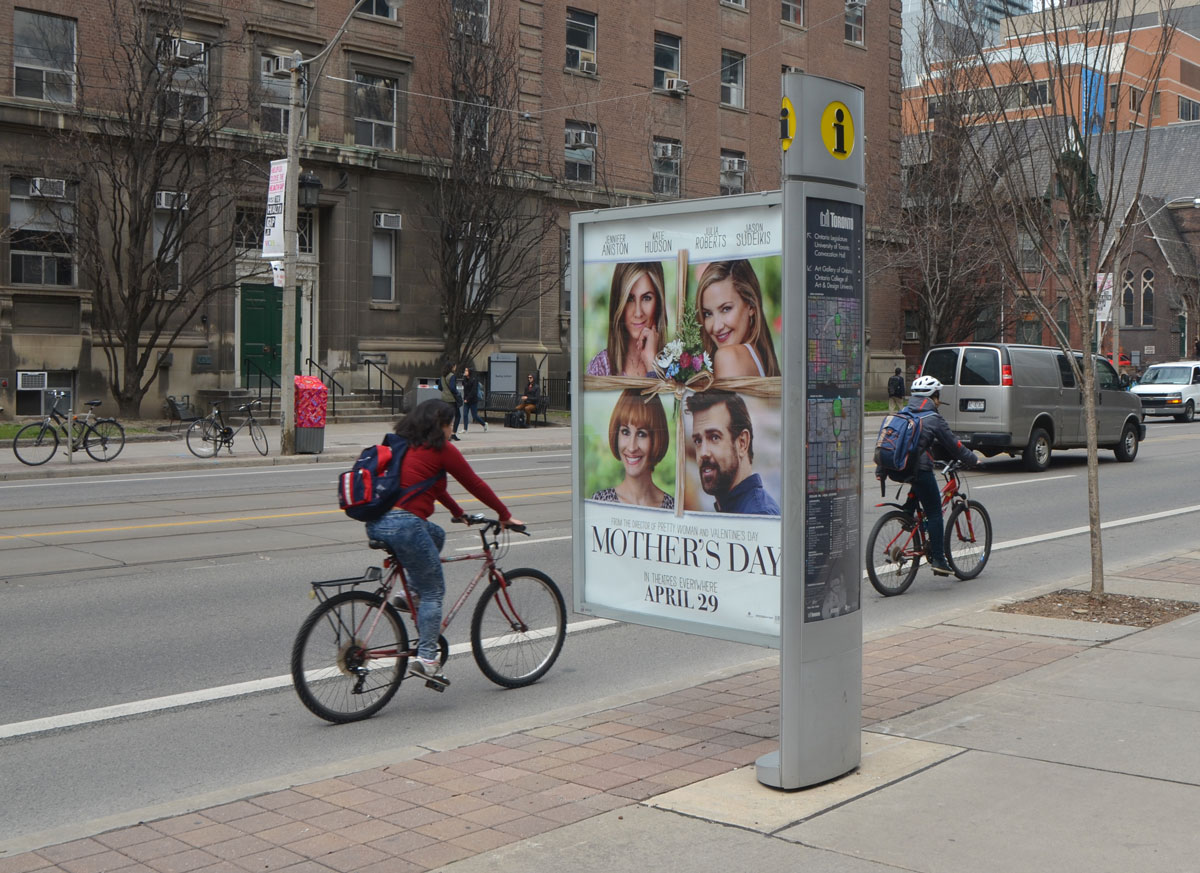
below:  A blight on the sidewalk, so-called information pillars that are really just a sell-out to Astral Media.  They needlessly obstruct the sidewalk and obstruct the view of  cyclists and motorists.  Unfortunately they are part of a 20 year contract that the city has with Astral Media which doesn’t expire until 2027.

cyclists ride by an information pillar that has a large ad jutting out towards the street.

below: Incised into limestone blocks on the Edward Street side of McClelland House (originally the McLean Hunter building) is half of an artwork by Elizabeth Wynn Wood (1903 – 1966) called “Communication”.  The woman is sending a message to a man who is apparently shown on the other side of the building.  Sadly, I missed the man so there is no photograph of him here.  When the work was completed in 1958, the incised lines were inlayed with gold colour.

outline drawing of a woman floating in the sky, incised into limestone facade of a building. She is releasing a bird.

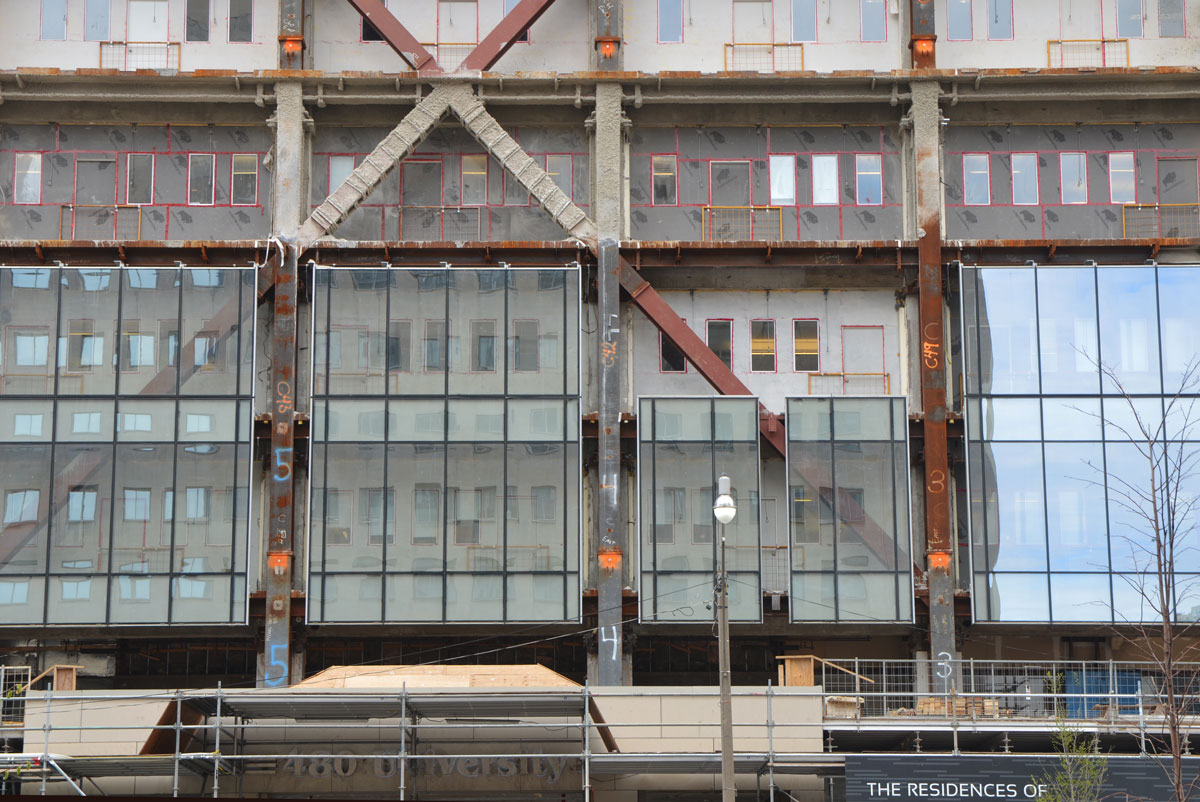
below: Across the street from the ‘floating woman’, 480 University Avenue is getting a facelift.

lower part of building have its facade upgraded to glass panels
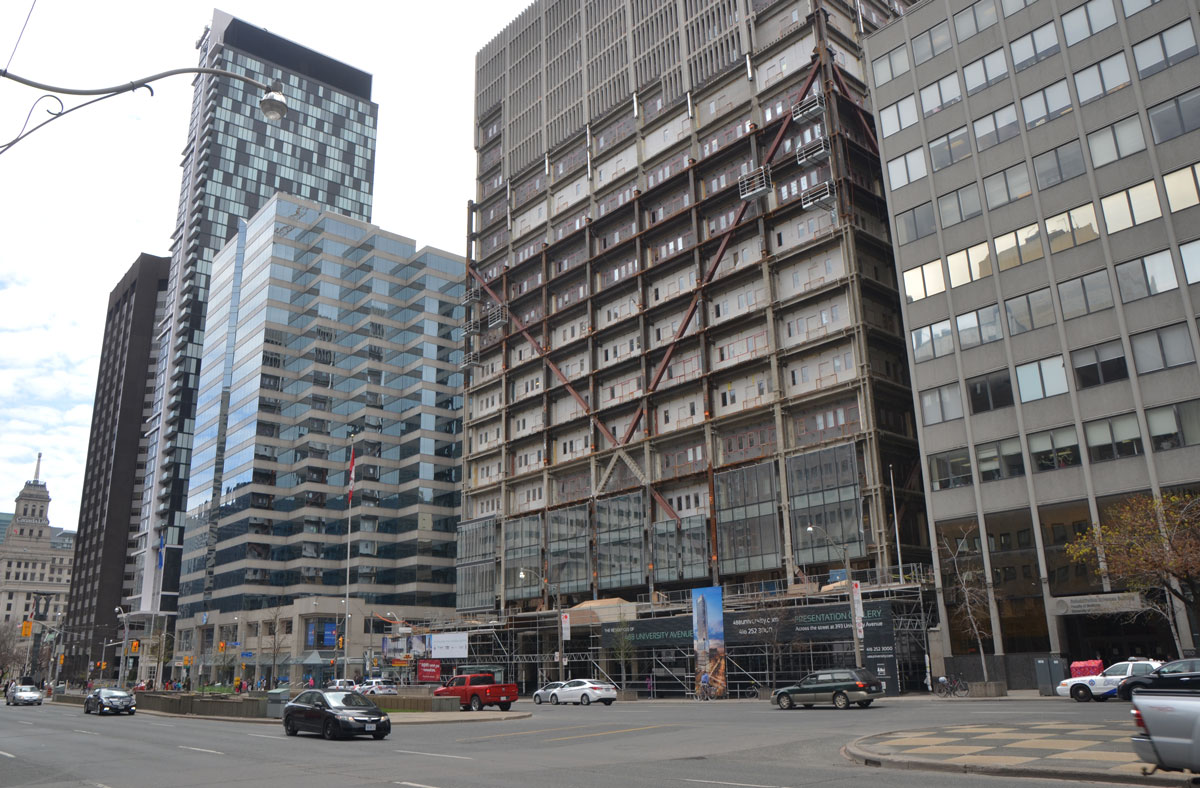
below:  This picture shows most of the front of 480 University and you can see the different stages of the recladding process.  At the top of the building, the precast concrete grille that was part of the original 1968 Global House office tower is still in place while new glass panels have already been installed on the lower floors.   It is interesting to watch the metamorphosis of an 18 storey office building into a 55 storey condo tower.   Four levels of underground parking have also been added to the site and a new indoor entrance to St. Patrick subway station is in the works.

Tall office building is having its concrete facade replaced with glass. The upper floors are still concrete, the middle floors are bare and the lower floors have new glass

below: Abstract in blues and greys

very close detail shot of glass and reflections that make diamond shaped abstract in blue and grey

There is a lot of building and redevelopment in the area where I walked.

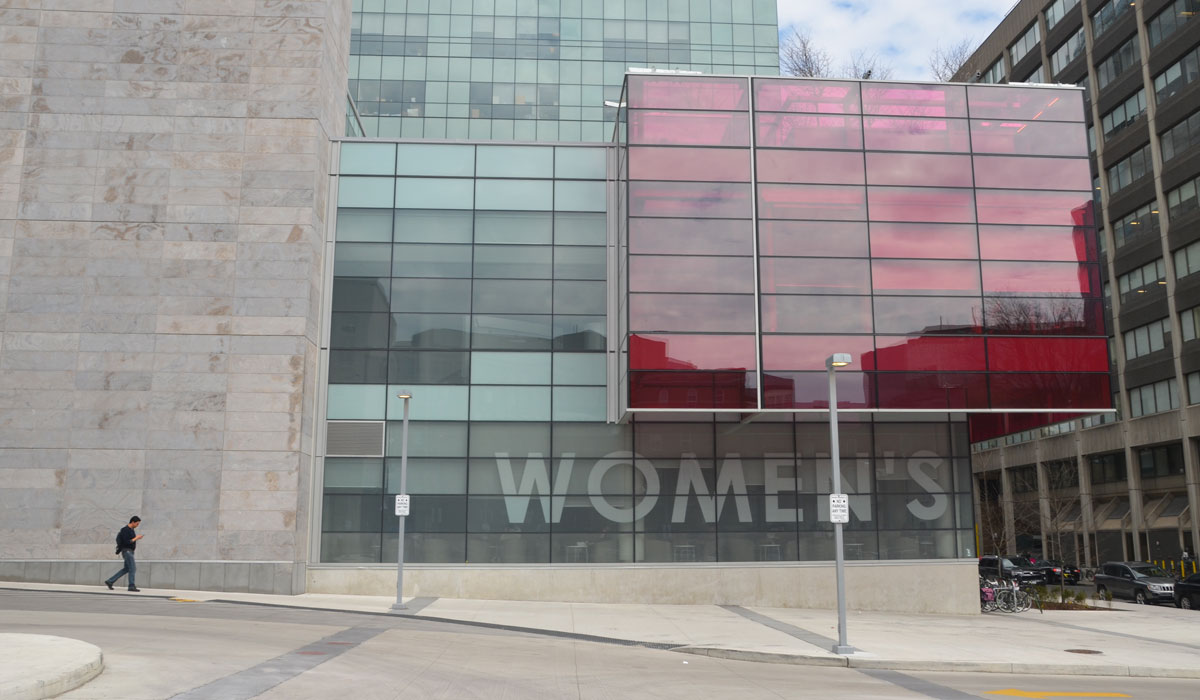
below: Womens College Hospital is totally new.

a lone man walks by the new Womens College Hospital building with its light grey stone facade, large glass section, and large pink glass section.

below: The corner of College and Bay, looking southeast, is now a wall of glass.

cyclist rides through the intersection of College and Bay streets. A wall of glass condos in the background.

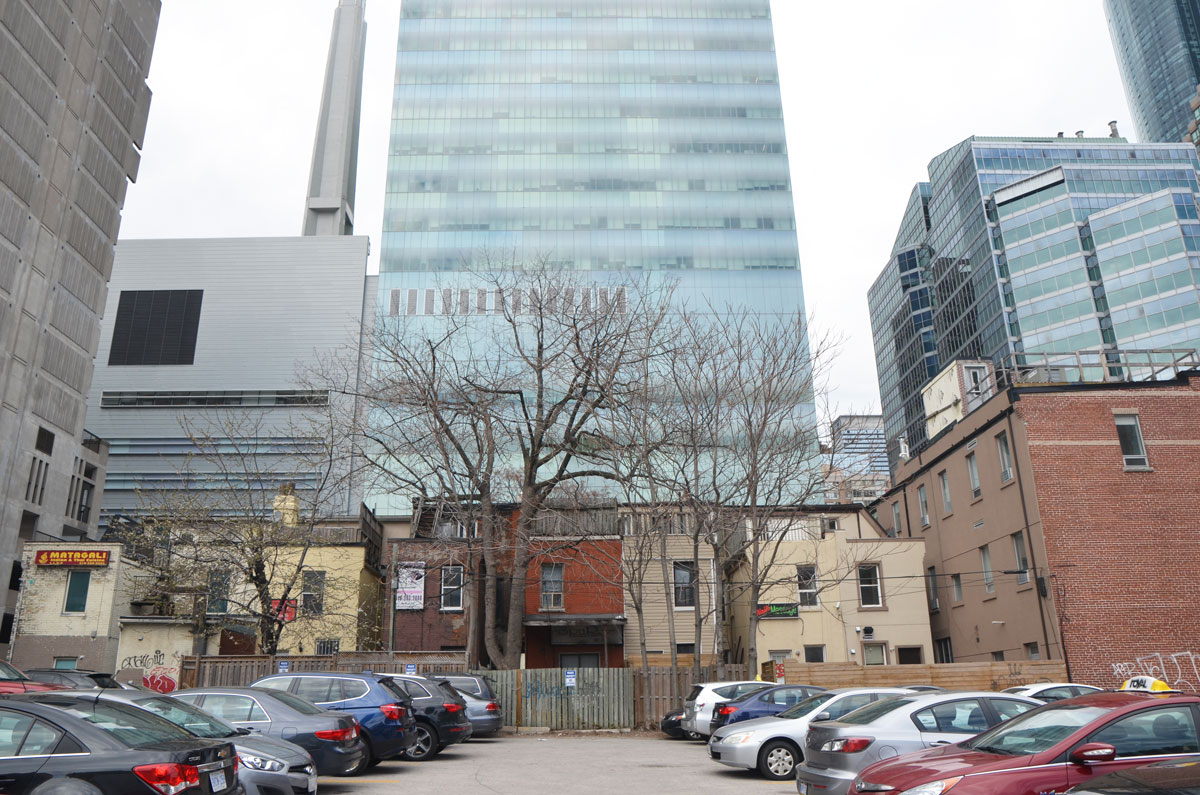
below: The new wing of Sick Kids Hospital dwarfs the older buildings on Elm Street.

view from a parking lot, a row of the back of older two storey brick buildings with some mature trees, then taller modern glass buildings.

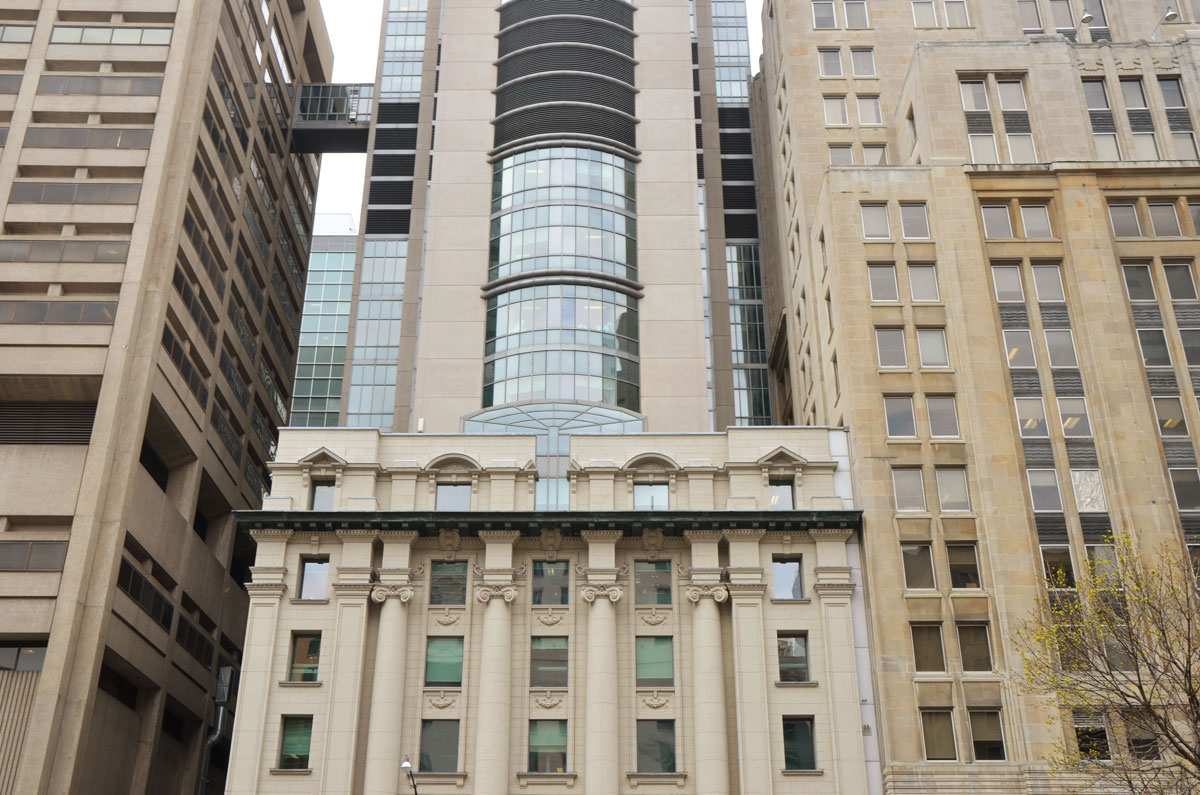
below:  The old and the new integrated into one building, Princess Margaret Hospital.

Princess Margaret Hospital, with the older stone building at the bottom, and the new modern addition above and beside it.

below: Even the street is being redone.  The center of Bay Street from Dundas to Elm is torn up because of  TTC streetcar track replacement.

A digger and other equipment working on a torn up section of Bay street.

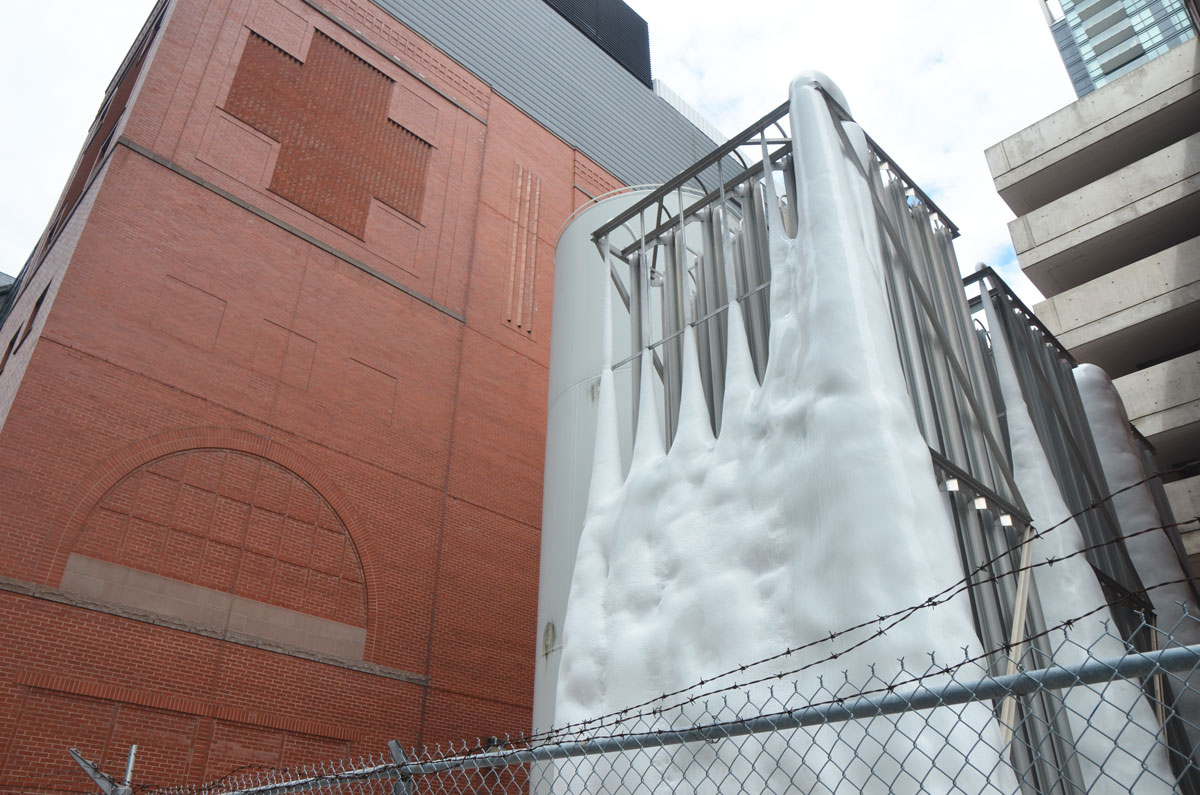
below: Little quirky details:  First, the cross shapes made of contrasting brick on the back of the Red Cross building.  Second, the workings (or barrier?) of the compressed gas tanks that have been made to look like ice.

part of the addition that was added to the Red Cross building, two cross shaped features in contrasting brick on the upper levels. In front of that building are large compressed gas tanks.

below:  Another piece of public art, ‘Liquid Echo’ by Catherine Widgery, 1999, is in front of 750 Bay Street.  They look like stiff and lifeless frozen metallic fountains… or maybe just 12 pencils 🙂 .   Circular vent shafts for the underground parking have been incorporated into the artwork.

public art installation outside 750 Bay street

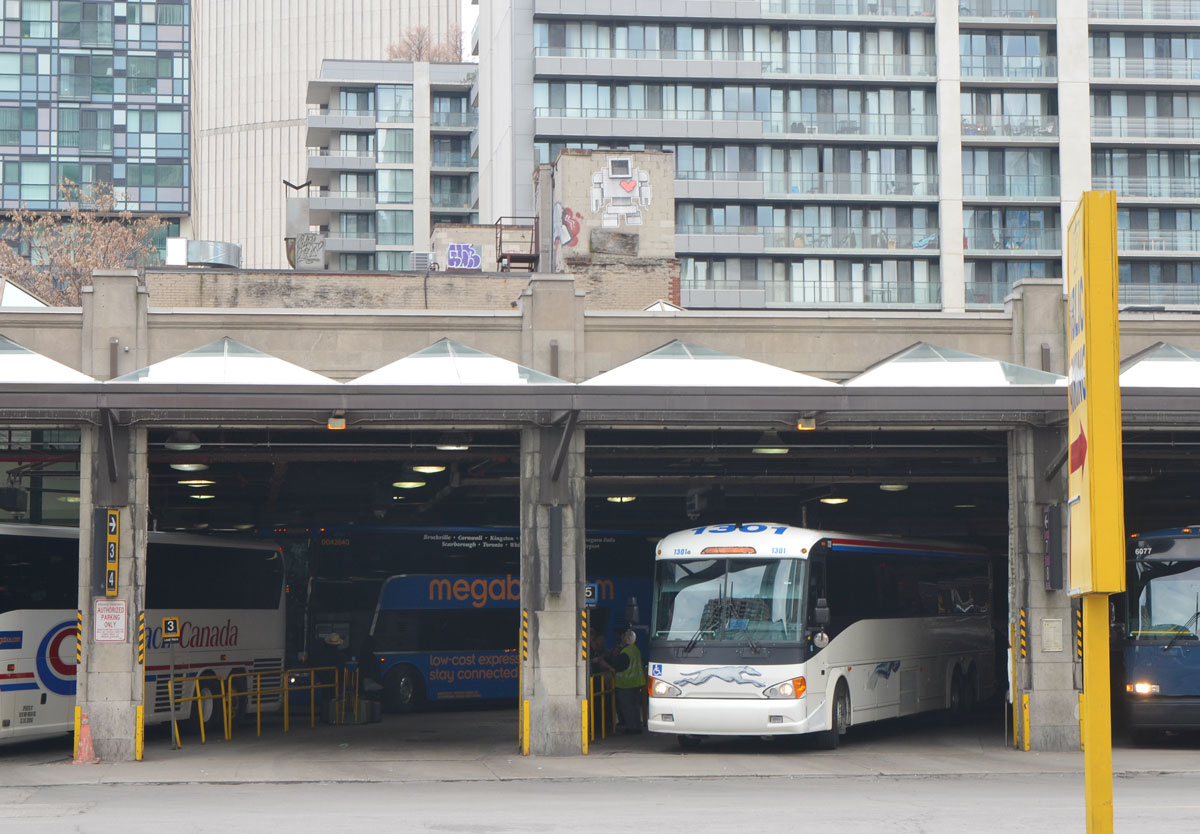
below: A  lovebot watches over the people passing through the bus station, unaware that he is there.

large lovebot wheatepaste paste up above the downtown Toronto bus terminal. A white bus is parked in one of the bus bays. Condos in the background.

below: And last, a colourful collection of squares and rectangles. Blue and green.  Red and white.

green and blue glass of a building's facade, with a storefront below. The windows of the store are filled with red and white pillows arranged in a grid.

An art installation ‘Nest Egg’ by Brendan McNaughton
at the Corkin Gallery, Distillery District

The title of this blog post is taken from a description of McNaughton’s work on the Corkin gallery website, “The relationship between plutocrats and proletariats is central to his art practice.”  A plutocrat is a person who is powerful because they are wealthy.  Money equals power.  Proletariat on the other hand is a class of people, the working class, a class without money and without power.

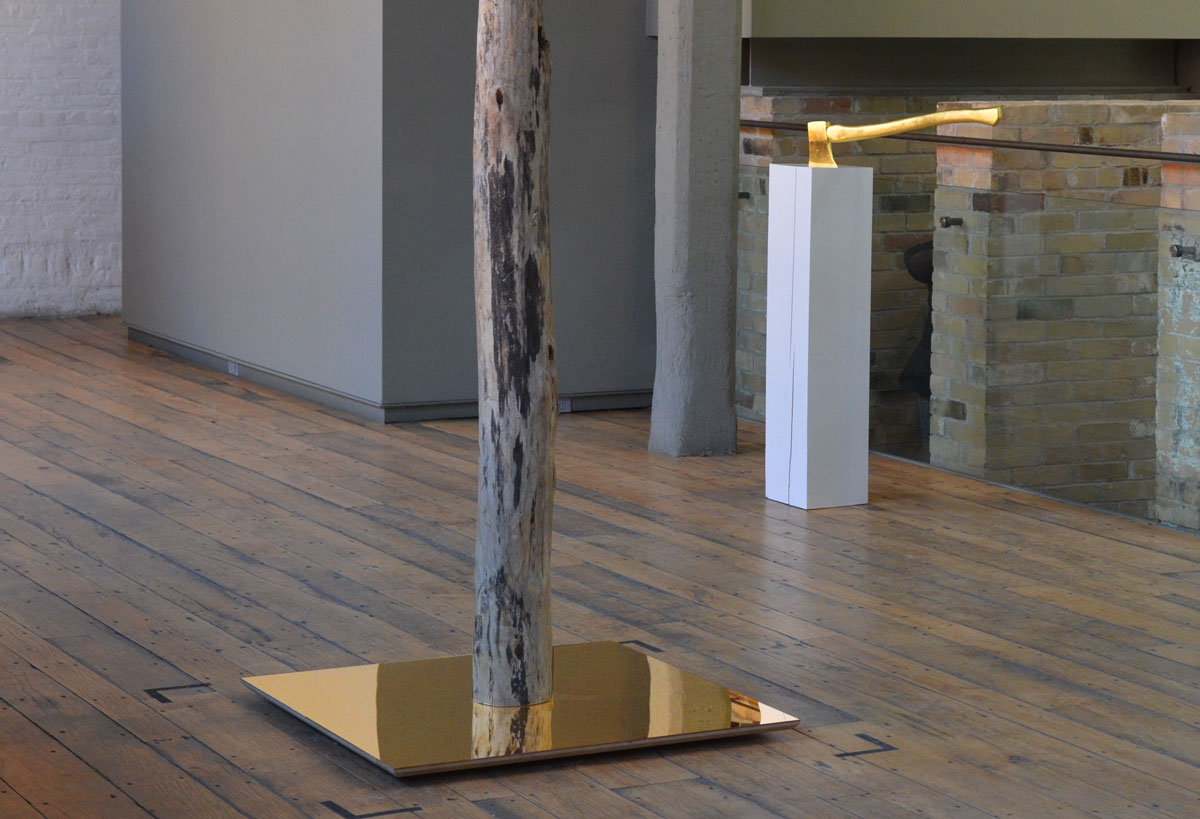
below: A gold axe.  With its blade in a column, on a pedestal?  That’s not a passive positioning of the axe, i.e. it’s not just lying around.  Someone has swung it.
Axe as a symbol of the working class?  Juxtapositioned with gold, a symbol of money?

picture taken inside an art gallery - a tree trunk stands in the middle of a gold toned mirror, in the background, a gold plated (or gold colured) axe with its blade in the top of a white rectanguar column

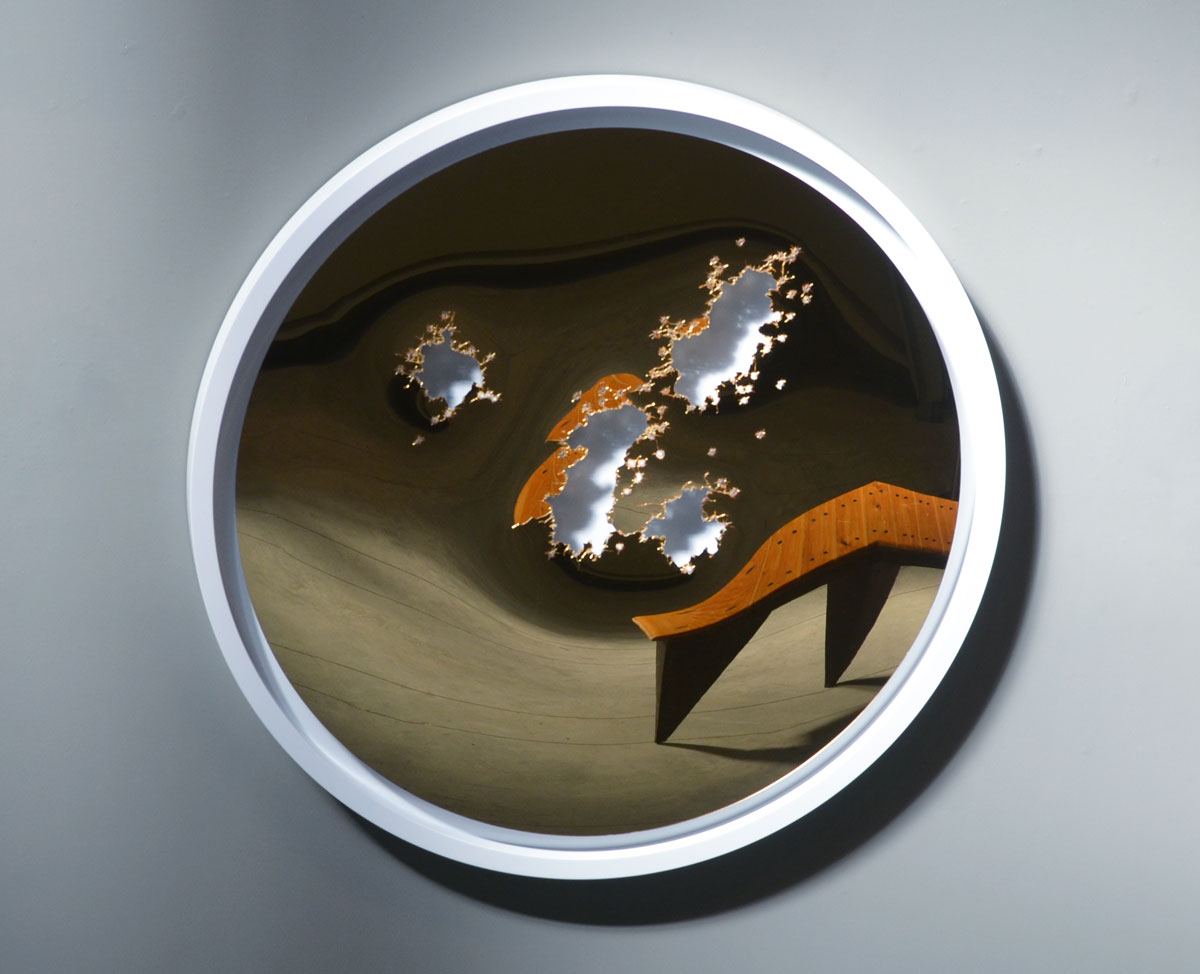
below: A couple of the pieces were mirrors. But they were mirrors with a difference – slightly concave in shape, with a hint of gold, and marred by ragged shaped holes.  The resulting reflections are distorted and flawed.

an artwork by Brendan McNaughton of a slightly concave mirror but with a few torn holes in it. A bench is reflected in the mirror but because the mirror isnt't flat, the bench is distorted.

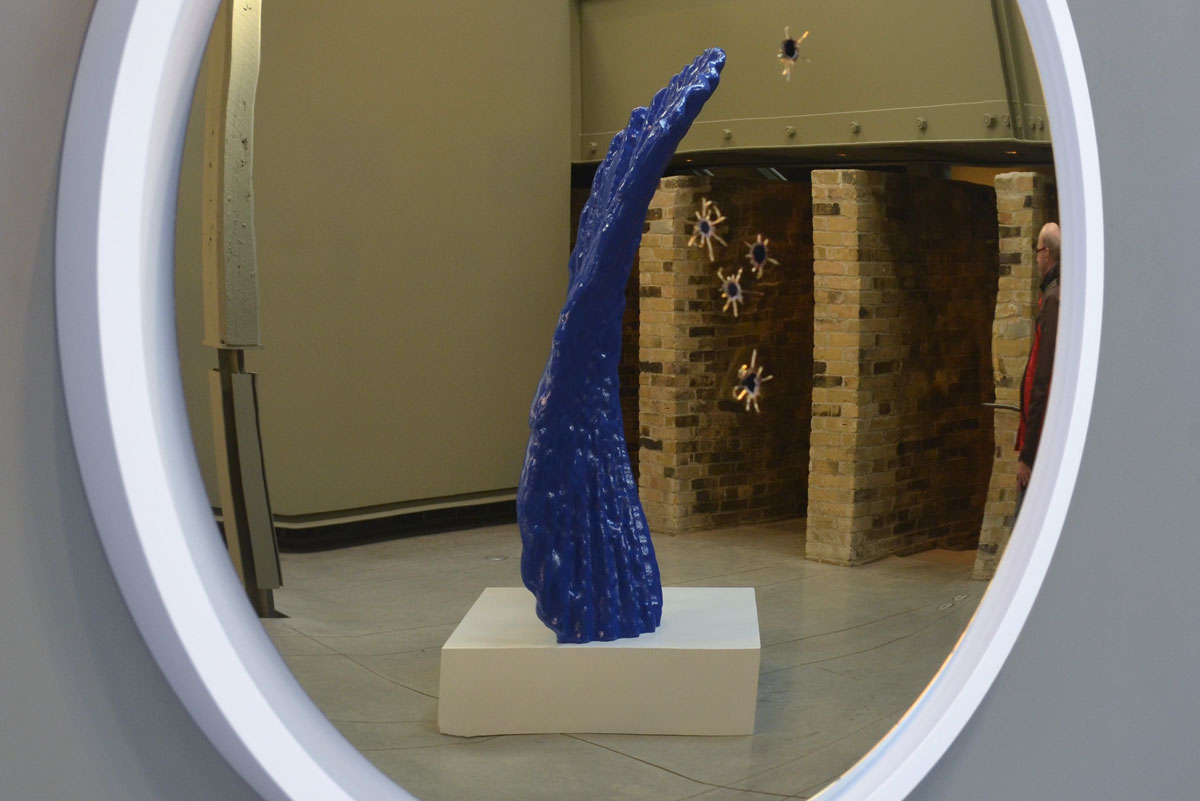
below: ‘Blue Chip’ a sculpture by Brendan McNaughton as viewed through one of his mirrors.  The expression ‘blue chip’ has become synonymous with high quality stocks, usually ones from the New York Stock Exchange.   Originally the expression meant stocks with higher prices because, if the story is correct, blue chips in poker are traditionally associated with the highest value.

Blue Chip, a sculpture by Brendan McNaughton, as viewed through an oval shaped mirror which is actually another art piece by the same artist.

below: The colour gold is very prevalent in this installation as are reflective surfaces.

picture taken inside an art gallery - a tree trunk stands in the middle of a gold toned mirror, also a mirror is on the top of each trunk, in the background are four panels of wrinkled gold

below: Parts of three wrinkly gold panels. There are actually four of these reflective square panels.  They are all the same size and colour but the surface patterns are slightly different.  Once again, the reflections are distorted.  Wealth distorts your view?

three square panels of reflective gold, wrinkled, material with reflections of people in them.

below: There was a group of what appeared to be photography students visiting the gallery at the same time that I was there. As I was standing beside this piece, looking for different and/or interesting angles and reflections, one of the students remarked on how he liked it when ordinary items were used in out of the ordinary ways. He then said that he wondered if it was …. and then he paused. I finished his sentence with the word ‘art’. He laughed and said yes, but that he was always afraid to say such things out loud. I gave him permission to ask “is it art?” as loud and as often as he wanted.

picture taken inside an art gallery - a tree trunk stands in the middle of a gold toned mirror,

picture taken inside an art gallery - a tree trunk stands in the middle of a gold toned mirror,

Installation ends May 1st

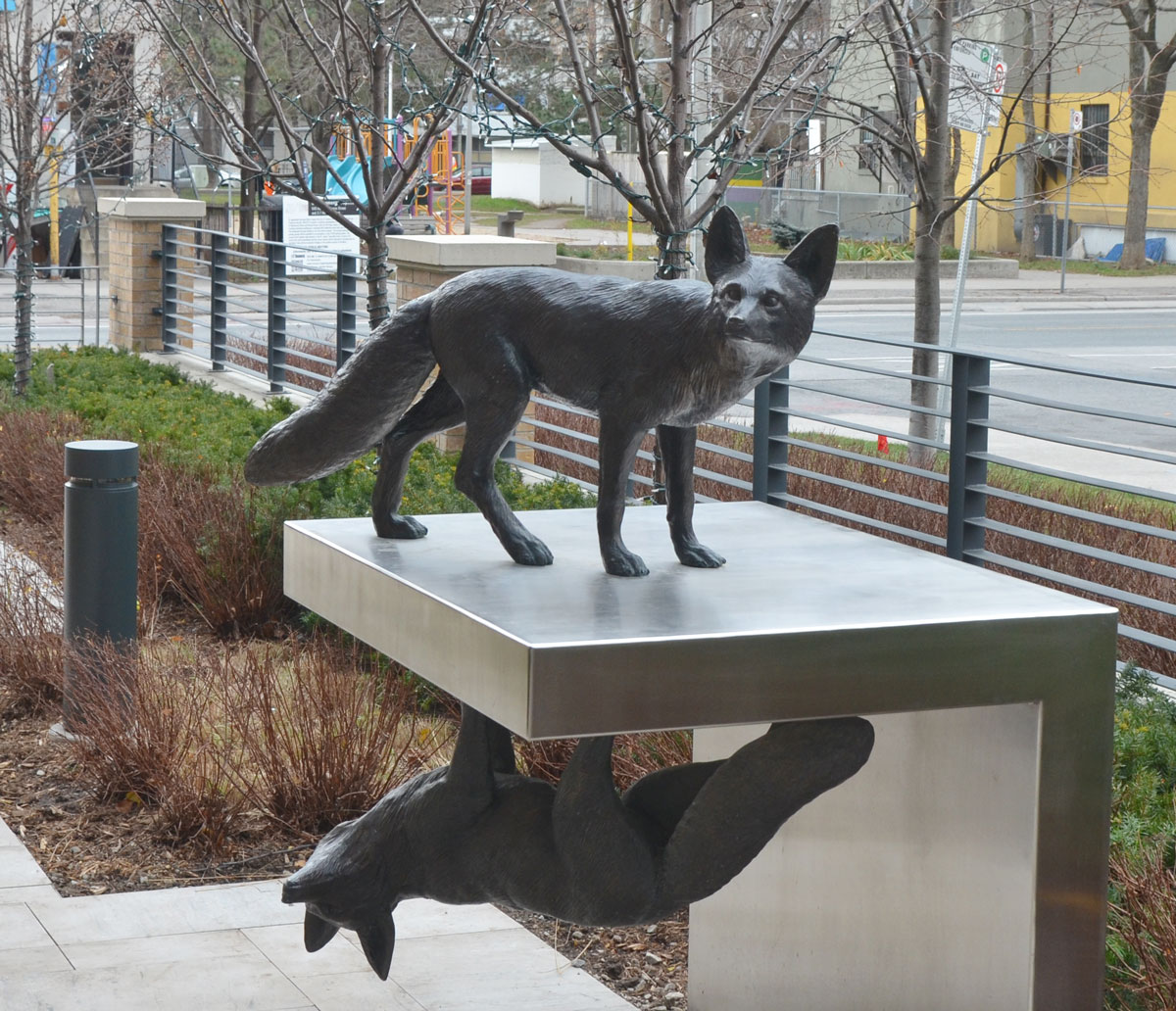
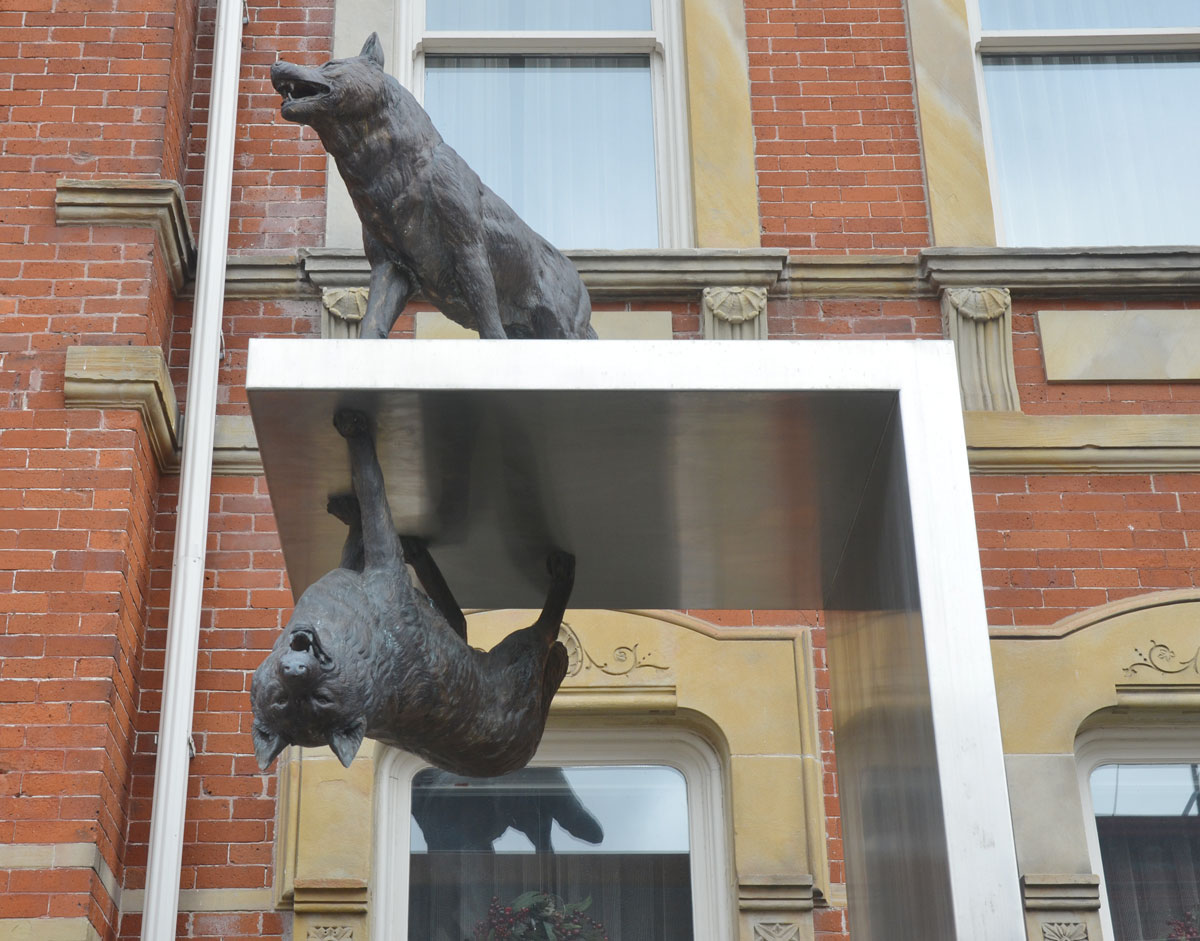
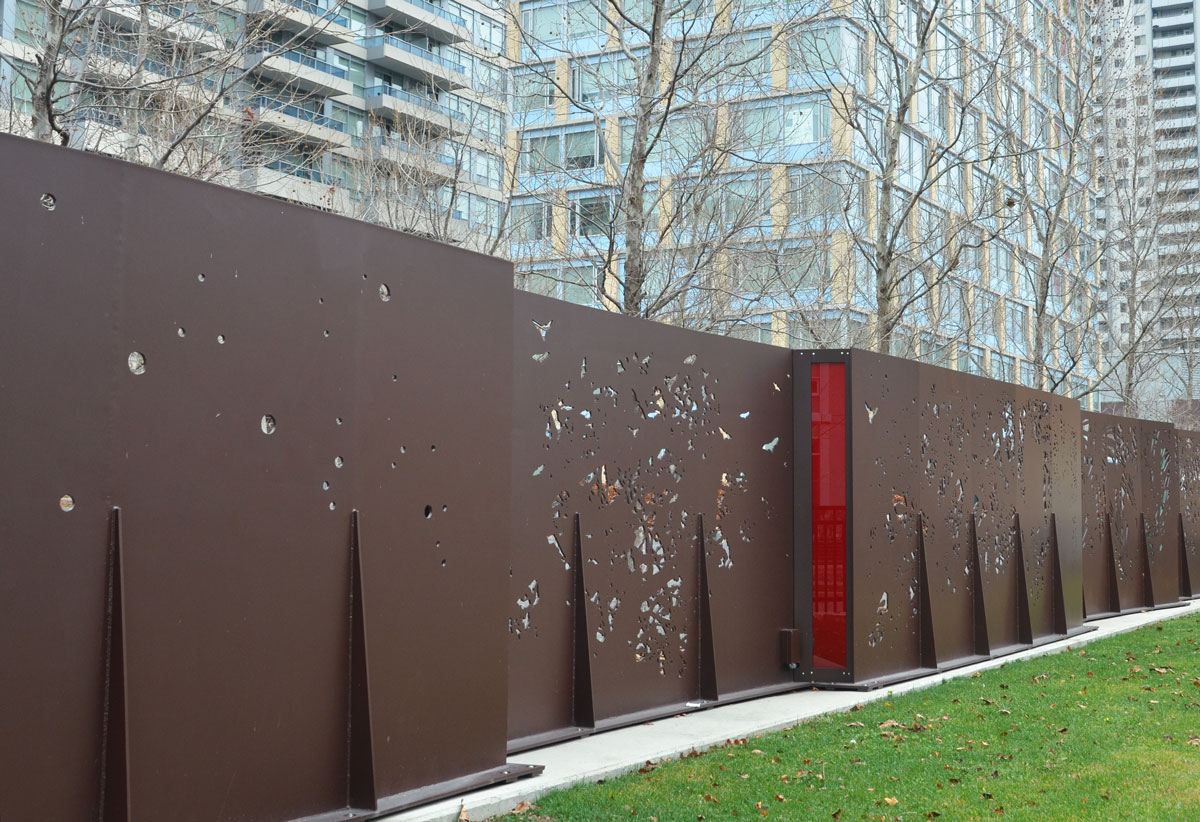
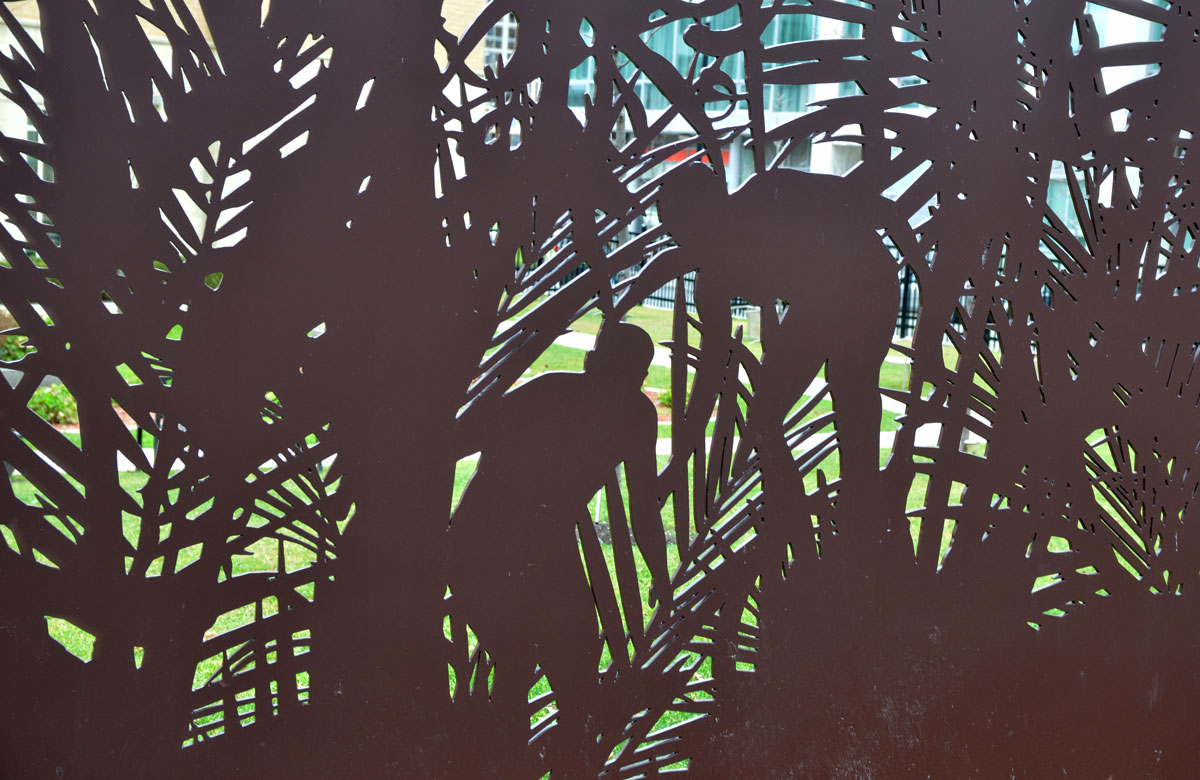
Today’s walk took me past three art installations that were new to me.  All three had nature as the theme; I saw a giant abstract tree,  upside down animals, and a walk in the forest.

The giant tree is ‘Red, Orange and Green’ by Michael Snow.  This 14 metre high, stainless steel sculpture stands in a small park on Huntley Street.  The gate of the park was locked, apparently closed for the season.   I took a few pictures through the metal bars of the fence and made a note to myself to return next season for a closer look.

large stainless steel tree sculpture by Michael Snow, consisting of three planes intersecting. 14 metres high, in a small park

When I first started researching this piece, I read that it’s title was because of the way it reflected street lights.  This didn’t make any sense – it sits in a park.  In the early 1990’s the city of Toronto commissioned Snow to design a sculpture for the corner where Jarvis meets Mt Pleasant at Bloor St. East and this work is the result.    When Rogers subsequently bought the building on that corner, they insisted on moving the sculpture to its present location.  The building in the background of these photos is the Rogers building at Bloor and Jarvis (although that stretch of Jarvis has been renamed Ted Rogers Way).

large stainless steel tree sculpture by Michael Snow, consisting of three planes intersecting. 14 metres high, in a small park

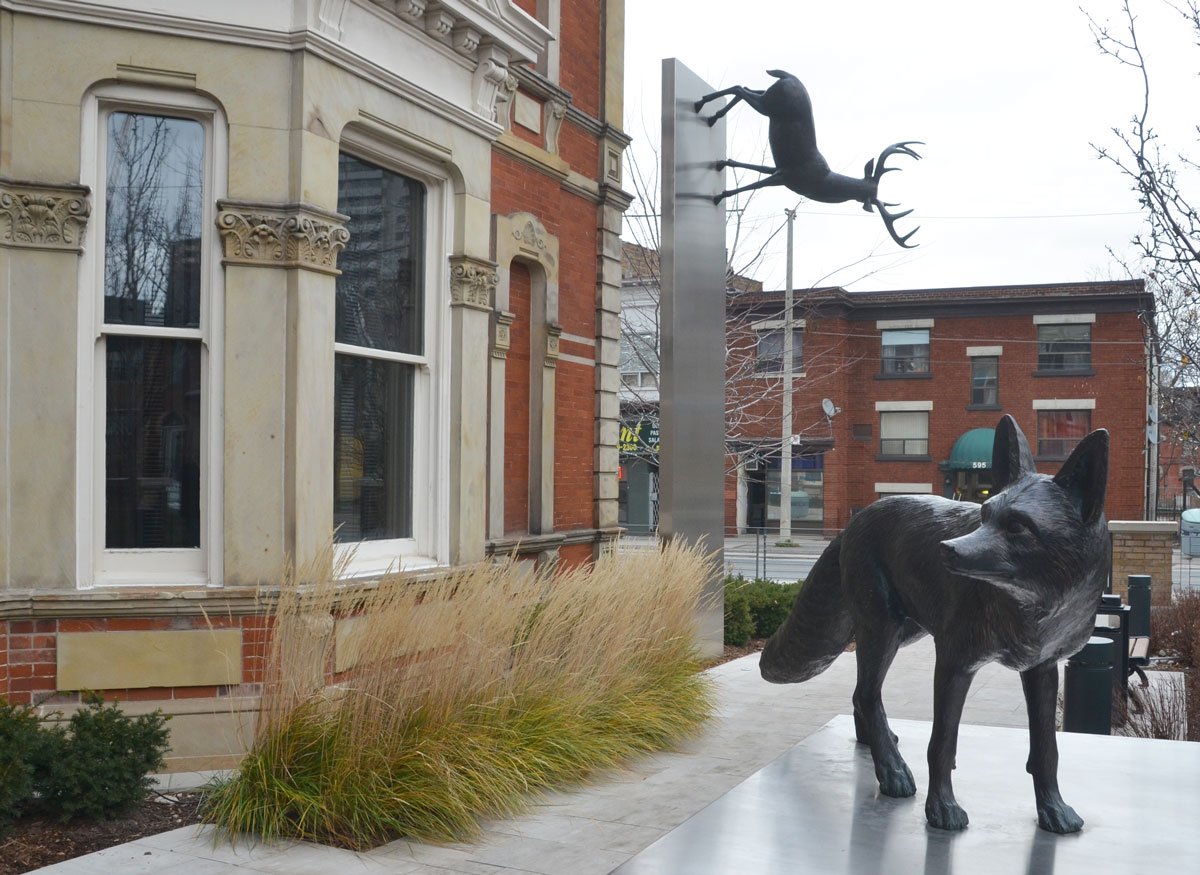
Just around the corner on Sherbourne Street is an art installation by Eldon Garnet.  It sits, or rather stands, on a condo development that incorporated the James Cooper Mansion at Linden and Sherbourne streets.

part of an art installation by Eldon Garnet called inversion -
The house was built for James Cooper in 1881.  He was a partner in Cooper and Smith, a company that imported, made, and sold footwear.   The house had eight bedrooms and was built in the Second Empire style with a mansard roof and dormers.  The house was purchased by the Knights of Columbus in 1910

part of an art installation by Eldon Garnet called inversion - a large moose seems to be standing against the side of an old mansion that has been renovated and incorporated into a new highrise condo development

part of an art installation by Eldon Garnet called inversion - two foxes, one on top of the other on a metal platform. The bottom one is upside down

part of an art installation by Eldon Garnet called inversion - the head of a deer in front of a building

part of an art installation by Eldon Garnet called inversion - A deer in front of a building and a wolf hanging upside down part way up the side of the building

part of an art installation by Eldon Garnet called inversion - a wolf on a metal platform and a second wolf upside down under the same platform

Just a little farther south there is a quiet park just to the west of Sherbourne Street, Wellesley Magill Park. This park was named in honour of Wellesley Central Hospital and Dennis Magill.  Magill was a founder of the Wellesley Institute and the first community Director of the Wellesley Hospital.   The park is situated on the site of the old Wellesley Central Hospital which was demolished in 1998.

Running east-west along the park’s southern perimeter is a public artwork created in 2010 by Ed Pien.  It is called ‘Forest Walk’ and it is 45 meter long wall comprised of eight sheets of painted steel.  Each panel contains cut outs of a forest scene, or a scene of people walking through a forest.

cut outs in a metal wall of people walking through a forest

below: The back of the fence. The park is on the other side of the fence.

a steel wall between a park and a residence

cut outs in a metal wall of people walking through a forest


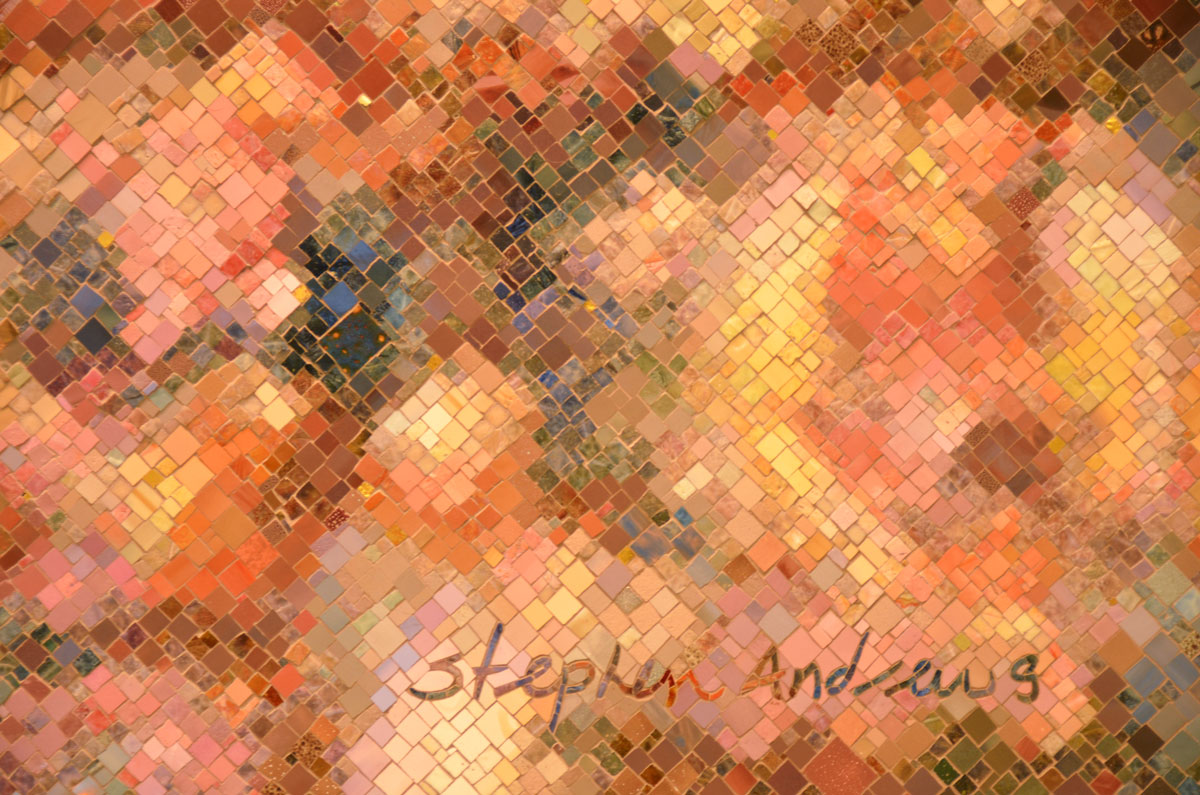
The other day I came across an interesting mosaic of which the picture below is just one part.  There is a plaque beside it which says “Seen at a disance the mosaic reveals a crowd of people sheering and clapping, people of all backgrounds, which is the unique mix of Toronto.  Up close, the images dissolve into abstract patterns of colour and light.”.

close up of a mural made of mosaic pieces, people seated in an arena is the subject of the mural

The mural is called ‘A Small Piece of Something Larger’ and it was designed by Stephen Andrews and fabricated in Montreal by Mosaika Art.  It is made of smalti (hand cut mosaic glass), gold tiles and hand glazed ceramic tiles.

close up of a mosaic by Stephen Andrews with his signature on it.

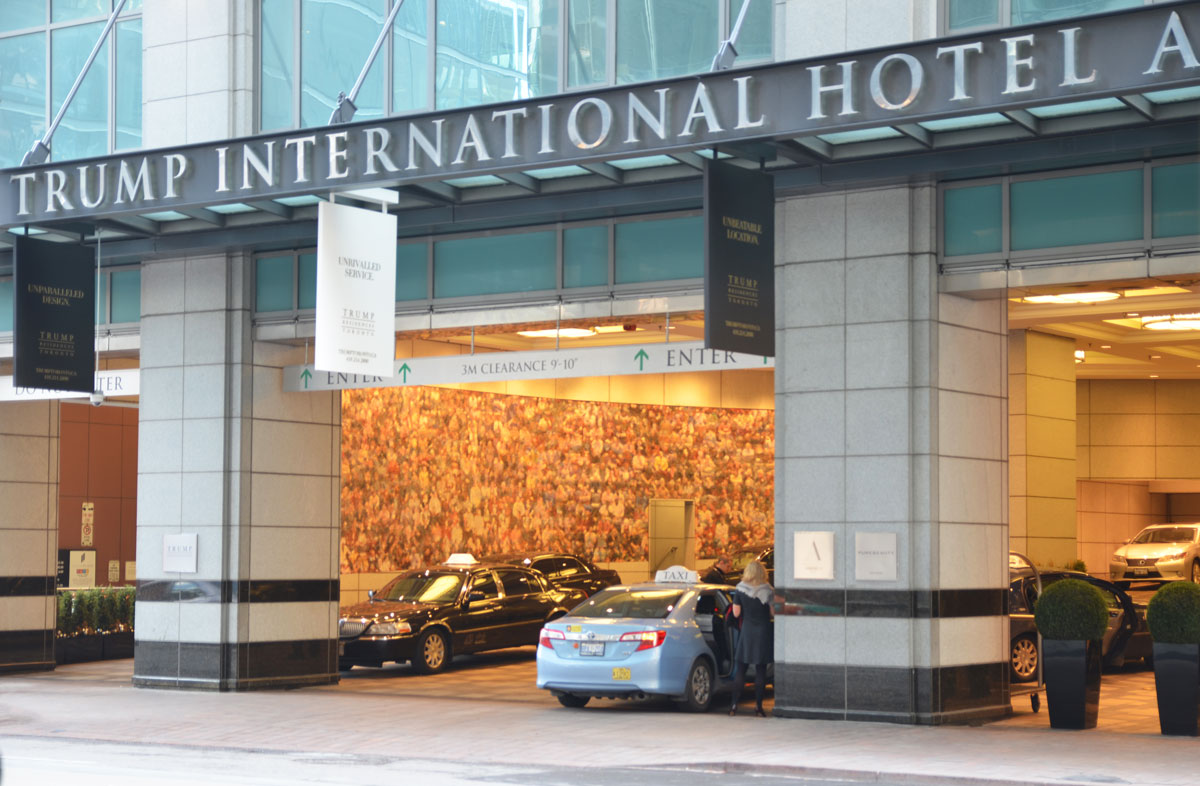
I’d love to show you a picture of the whole thing but I can’t.  The piece is located in the taxi drop off and valet parking area of the Trump International Hotel.   I dodged cars while I took these photos.   The wall that it is on looks cheap, especially with the dreary doorway that cuts into the mosaic.  Another strike against this piece is the very yellow nature of the lighting in this space. I played with the colour balance on the photo below to try to capture the true colour of the artwork.

mosiac art on a wall with a doorway in the middle of it

It really deserves a better location.

parking entrance and valet parking at Trump International Hotel in Toronto. A blue taxi has just pulled in, a yellowish hue in the interior of the space
The above picture was taken from the NE corner of Bay and Adelaide.
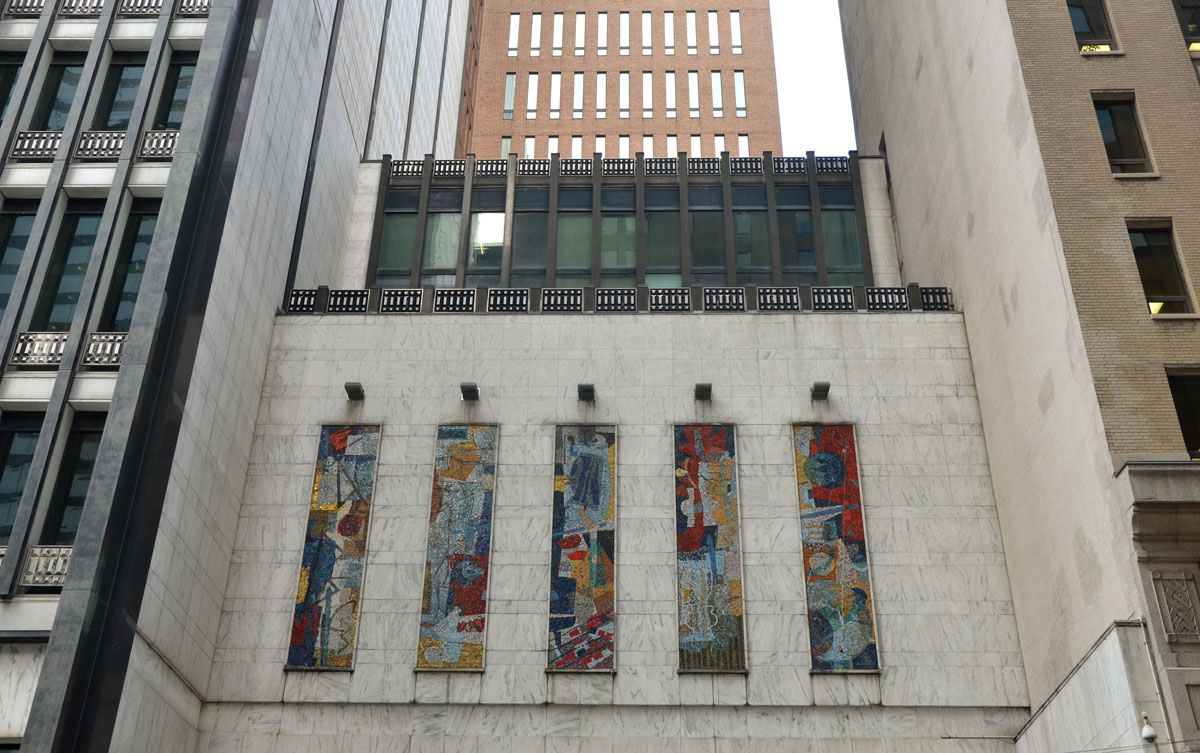
Just a few steps west on Adelaide is this mosiac (look up!):

Five vertical panels of mosaics above the entrance of a downtown building, much taller buildings are on either side of it and behind it. Bell Canada building on Adelaide West, mosaics by York Wilson, communication theme public art

It is above the entrance to the Bell Canada Building at 76 Adelaide West.  Five panels, each twenty feet tall and five feet high, of glass mosaic tile are embedded in the cement of the building.  It was designed by York Wilson and installed in 1965 when the building was constructed.

The theme of the piece is communication and each panel represents a different form of communication.   From left to right: writing, drawing, music, voice, and satellites.

five vertical panels of mosaic in bright colours on an exterior wall

Staying on Adelaide, walk east again but continue to Yonge Street.  Here you can find another hidden, almost secret, mosaic that many people have walked past and never seen.  Find the silly little entrance way to what is called the Dynamic Funds Tower on the SE corner of Yonge and Adelaide.  Stand outside the entrance but don’t go in.  Now look up.

glass mosaic ceiling that is almost circular, octagonal but the sides are not equal width.

Three very different mosaics all within a few steps of each other.

….and there’s one last stop on our mosaic tour.  It’s not a mosaic but looking at Stephen Andrews’ work at the Trump Hotel reminded me of a sculpture.  If you walk down Yonge Street, just south of the railway tracks you’ll find a bronze ‘Immigrant Family’ by Tom Otterness.

Immigrant Family, a sculpture by Tom Otterness, a father mother and baby in arms.
A roly poly mother, father and baby in arms.  A bit cartoonish but vague enough that they represent no one immigrant group.  They could be any piece in the mosaic that is Toronto.

close up of a sculpture by Tom Otterness of a family of three, mother, father and baby in arms. Father is carrying a suitcase. Title of sculpture is Immigrant Family

With a shoutout to Penny at Walking Woman since it was because of her blog post that I learned about the Otterness sculpture.

Other links:


The first three days of November have been wonderful – three beautiful warm sunny days, perfect fall weather.

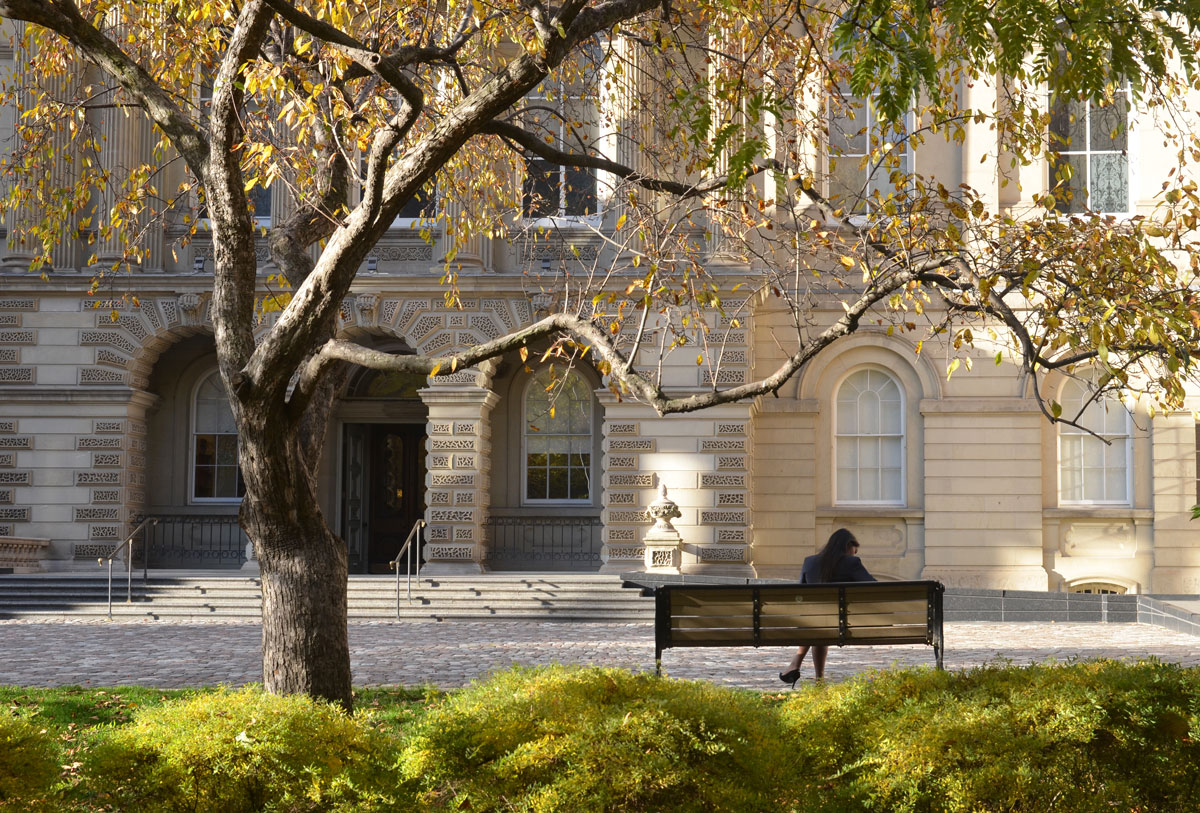
 below: Taking advantage of the warm afternoon in front of Osgoode Hall.

A woman sits on a bench in front of Osgoode Hall, a stone building. Her back is to the camera. A tree with a few yellow leaves frames the picture.

below: On St. George Street in front of Sir Daniel Wilson residence, University College

college on St. George Street, front of the building with black wrought iron fence in front of it along with a few mature trees with some yellow and rust coloured leaves still on them. The clock tower is visible through the tree branches. There are people on the sidewalk in front of the building.

below: Looking across Kings College Circle towards University College

One small tree in the middle of the grass at Kings College circle in front of University College

below: Maple leaves still on the tree.

maple leaves in autumn colours, rust and orange leaves in the foreground, yellow leaves in the background.

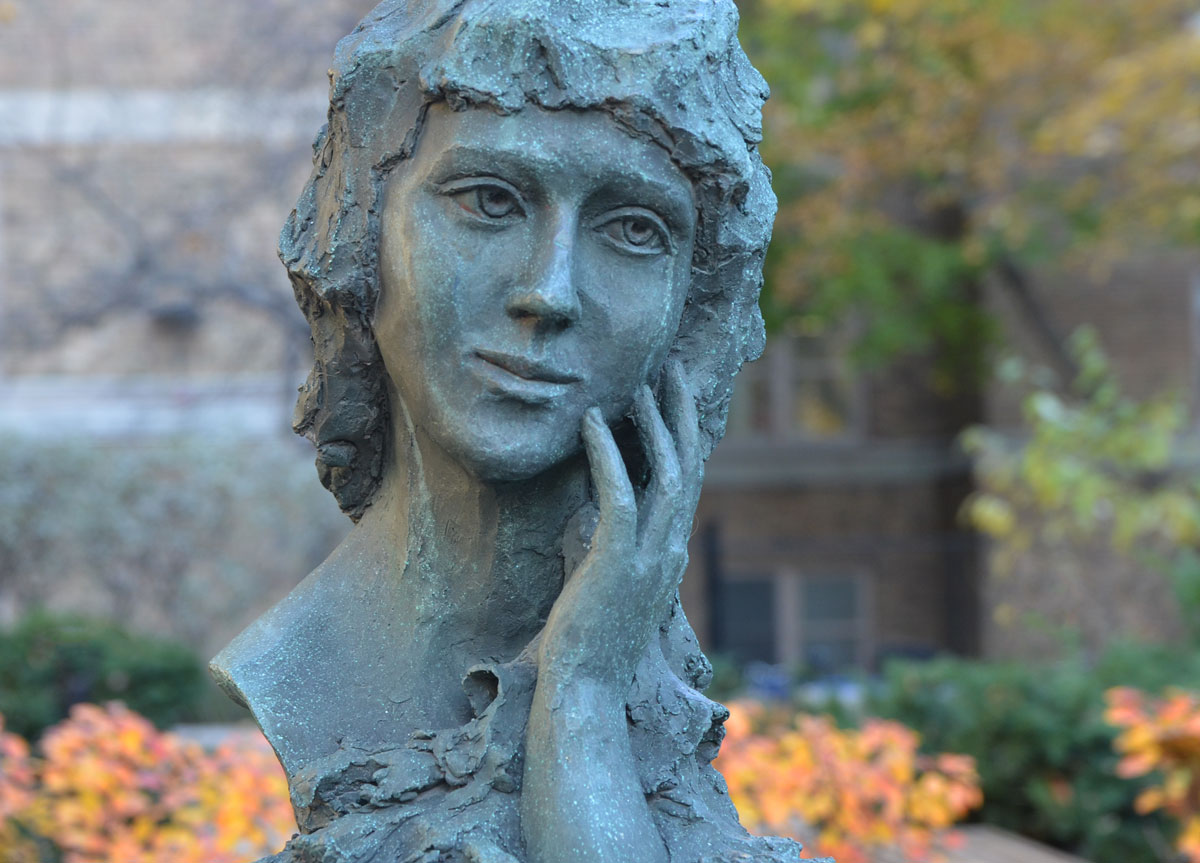
below: Mary Pickford looks over University Avenue.

a bust of Mary Pickford, she is resting her head in one of her hands. In the background is a building along with some bushes and a tree with yellow and orange leaves.

There is an historical plaque beside this statue and it reads: “Born in 1893 in a house which stood near this site, Gladys Marie Smith appeared on stage in Toronto at the age of five. Her theatrical career took her to Broadway in 1907 where she adopted the name Mary Pickford. The actress’s earliest film, “Her First Biscuits”, was released by the Biograph Company in 1909 and she soon established herself as the international cinema’s first great star. Her golden curls and children’s roles endeared her to millions as “America’s Sweetheart”. She was instrumental in founding and directing a major film production company and starred in over fifty feature length films including “Hearts Adrift”, “Pollyanna” and “Coquette”. For the last named film, she received the 1929 Academy Award as the year’s best actress. “

.

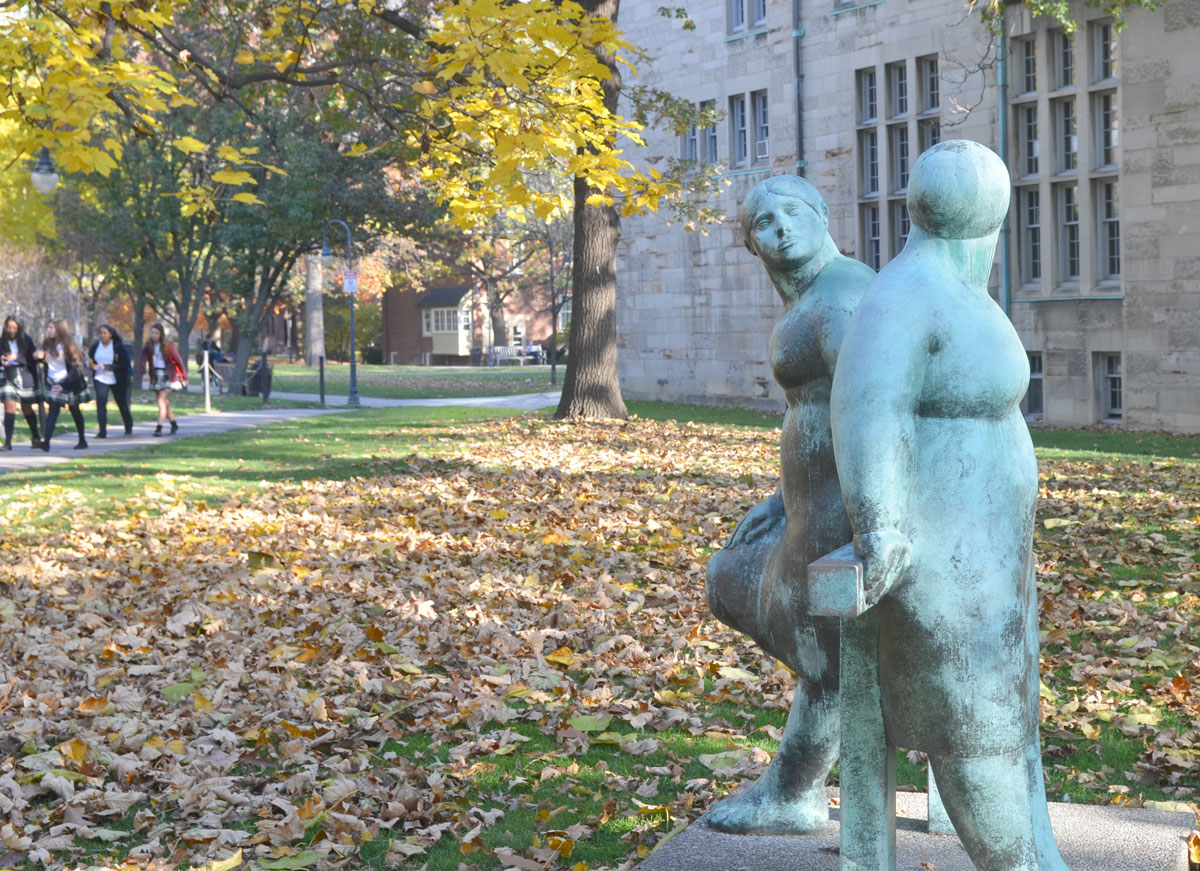
below: Two women outside Emmanuel College, Queens Park Circle

A blueish bronze statue of two overweight women standing facing each other beside a stone building on the University of Toronto campus. It is autumn and there are leaves on the ground. A group of girls is walking in the background.

below: Northrop Frye sits on a bench on the campus of Victoria College (U of T).

A statue of a man, Northrop Frye, sits on a bench with his legs crossed and an open book on his lap. Another book sits beside him on the bench.

This life sized statue was created by Darren Byers and Fred Harrison and was unveiled in October 2012.

.
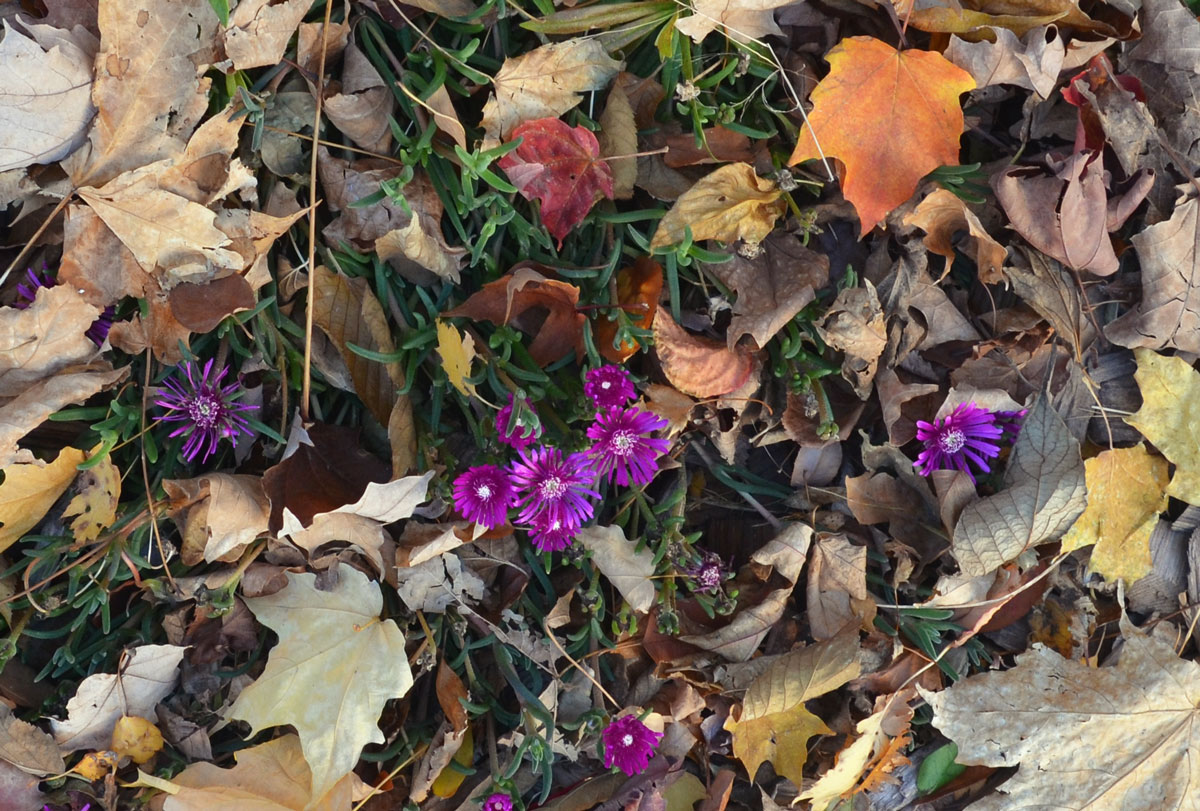
small purple aster flowers in a garden that is close to being covered with autumn leaves that have fallen off the nearby trees

The title of the exhibit is ‘Surrender’ and the words on the wall say this:

“Liz Magor’s art invites us to reconsider our relationships with the things we encounter every day.  Through subtle shifts in materiality and context, her works reveal the important role that objects play in our lives: they can allow us to conceal ourselves or to express our identities.  In her sculptures and photographs, Magor explores how we depend on domestic materials to develop a sense of self.”

Nothing is mentioned about surrendering, or why the exhibit has the title that it does.

In the first room there are boxes on the wall.  Each box looks like a carefully wrapped sweater or jacket that has just been purchased.  I can envision a middle aged saleslady taking her time to package your purchase, like in an Eatons store thirty or forty years ago.

art installation at the Art Gallery of Ontario by Liz Magor - two walls with many open boxes on them. The boxes are made to look like they've just been opened to reveal a sweater or top folded neatly inside, including the tissue paper that often accompanies a new purchase. The clothes have all been decorated with different objects.

On closer look, most boxes also have a hand print, or shape of a hand with index finger pointing at something and little details are amiss…  a ketchup package for example.

blog_liz_magor_cornhuskers

The second room has a number of smaller installations.

A garment bag left over a chair.
Neatly folded blankets hanging on a wall.
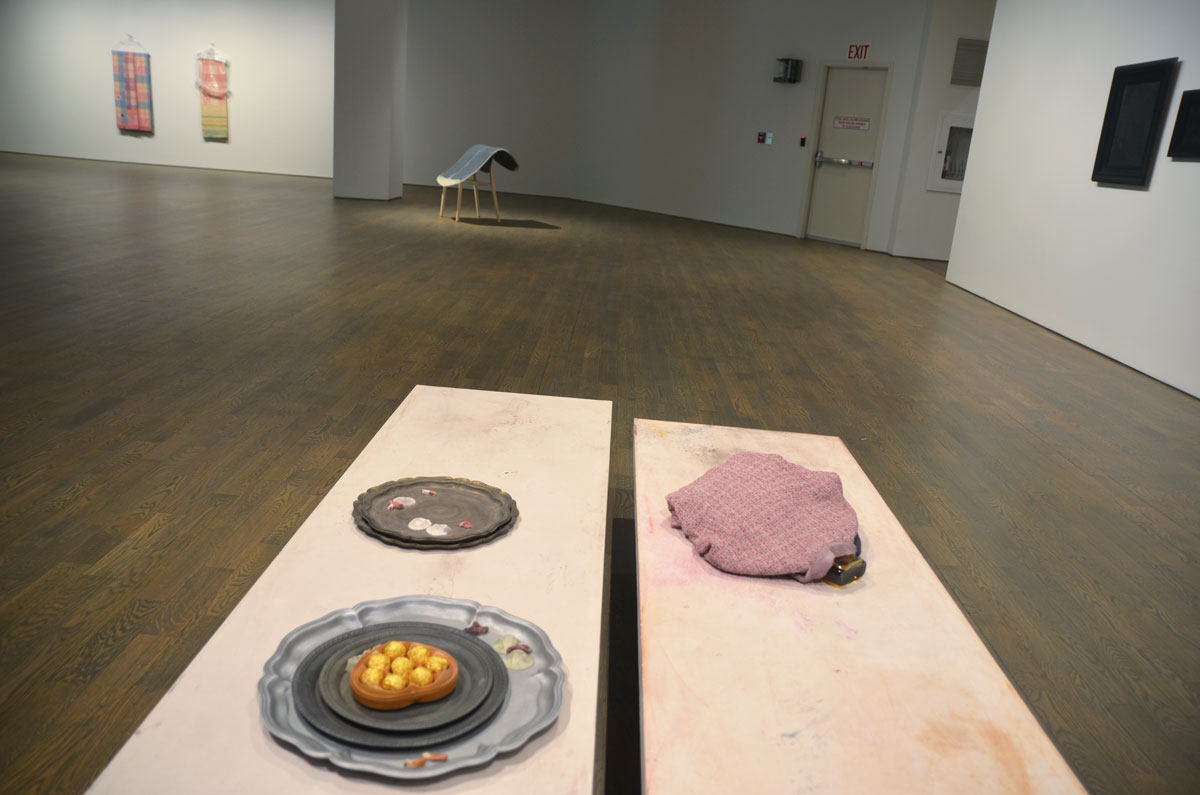
A platter of chocolates and left overs.
A tweed jacket on top of a liquor bottle.

art installation at the Art Gallery of Ontario by Liz Magor - in the foreground are two long narrow tables. On one of them is a platter with chocolates and a platter with the remains of cheese and crackers.

A husky under a blanket (of snow?  on a bed?)
A coat and purse hanging on a hook.
The contents of a room boxed and ready to move.

art installation at the Art Gallery of Ontario by Liz Magor - 3 pieces. First, a pile of moving boxes and other items that look like they are in the midst of getting ready for the movers. Second, a large white blanket bed sized that has a hole in the middle of where the pillows should be but instead there is a wolf curled up inside the whole. Third, what looks like a jacket hanging from a hook on the wall

art installation at the Art Gallery of Ontario by Liz Magor - two hangers with plaid blankets folded over them hanging from hooks on a wall. One of the blankets has a clear plastic Creeds bag over the top part of it

On closer look, some of the details on the blankets are wrong
including the labels that are sewn on back to front.

The label on a plaid blanket is sewn on backwards so that the writing on the label faces the blanket.

I was interested in what people’s reactions were to this exhibit so I had a chat with a couple of the employees about it.  According to them,  there was no reaction.  Most people showed interest in the boxes but when they walked into the second room they rarely stopped to take a closer look.

blog_liz_magor_rose

As for surrender, I did find reference to it in the description of the exhibit on the AGO website, ” In this exhibition, everyday objects and forms, as well as the natural world, function allegorically by evoking the human need to surrender to desires, compulsions, fantasies.”  Once again, I will leave it to you to decide if this description fits.

Exhibit continues until 29th November.