Posts Tagged ‘old’

Flat Death and Contemporary Floral Arrangements,
by Sarah Cwynar,
large photographs on billboards on Lansdowne Avenue,
Part of CONTACT Photography Festival.

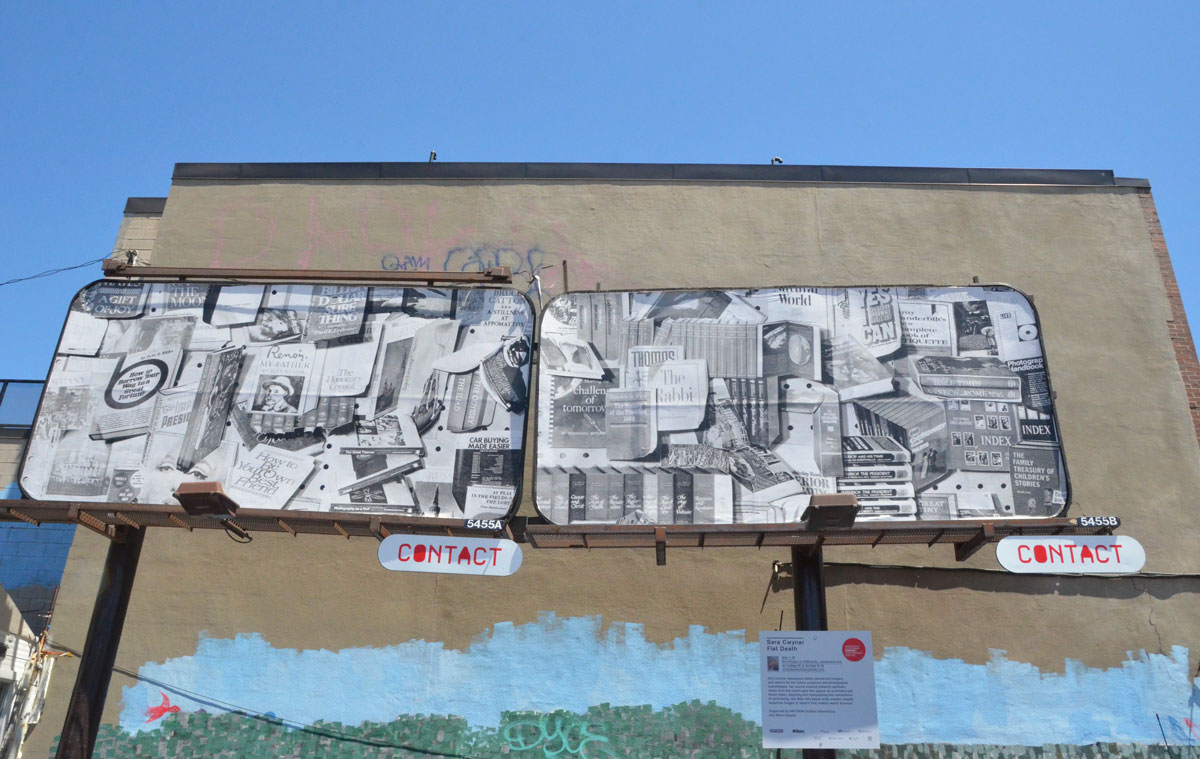
below: ‘Flat Death’ at Lansdowne and Dundas West.
Black and white photos of books on four billboards.

billboards above a used car lot, 3 billboards with large black and white photos of books.

Two billboards side by side each with a large photo of old books in black and white

bikes parked in a bike stand in the foreground, a used car lot in the background.  Above the car lot is a billboard with a black and white photo of old books.  A Lansdowne TTC bus is on the right hand side.

 below:  ‘Contemporary Floral Arrangements’ on the corner of Lansdowne and College

The foundation for ‘Contemporary Floral Arrangements’ are 1960’s photographs of floral arrangements.  Small objects such as key chains, plastic bits, buttons, spools of thread, etc are then placed on the photos, matching colour and tone.

An building with a 'car wash' sign on it but the windows are covered with a sign for "engima' cond development.  On the roof of the building is a billboard with a large photo of a flower arrangement.

The idea that this is an ad made of things that no one wants may be interesting in theory but in practice it’s just a pretty picture.  Because of the location of the billboard, the details of the picture can’t be seen.

At an intersection, An building with a 'car wash' sign on it but the windows are covered with a sign for "engima' cond development.  On the roof of the building is a billboard with a large photo of a flower arrangement.

Honest Ed’s

 In 1948 Edwin Mirvish opened his ‘Honest Ed’s Famous Bargain House’ on the southwest corner of Bloor and Bathurst streets.  Honest Ed’s was not only one of the first department stores in the city but also one of the first to offer discount prices on its merchandise.

below: Honest Ed’s, from across the intersection of Bloor and Bathurst streets.

Looking across an intersection of Bloor and Bathurst streets towards Honest Eds store with its big orange, yellow and black signs on grey cladding.  Running around the store, about the level of the top of the first storey, are signs (red lettering on white background) that read "Only the Floors are crooked" , "There's no place like this place, any place", "Come in and Get Lost" and lastly, "A Bargain Centre like this happens only once in a lifetime"

photo taken 25 March 2015


below: The same intersection in 1948 when Honest Ed’s Famous Bargain House opened.  As you can see, the exterior was covered with signs with humorous sayings from the beginning.

historical black and white photo of Honest Eds store at Bloor and Bathurst.

photo from Honest Eds store via a 2013 article in The Grid TO

Along with the discount merchandise, Ed Mirvish filled his store with pictures and posters, especially movie posters.   The stairwell walls are covered.

movie posters as well as other kinds of posters in a stairwell at Honest Eds, including a large red poster with a picture of 'Honest Ed Mirvish'.
reflections in a round mirror in a staircase at Honest Eds store showing the stairs, railing and various pictures and posters hanging on the walls

A stairwell at Honest Eds store with a large black and red sign that reads "Honest Ed's an Idiot, his prices are cents-less"
You can buy almost anything at Honest Ed’s!  Clothes, shoes, toys, household items, groceries, hardware, prescriptions, souvenirs, … and so on.

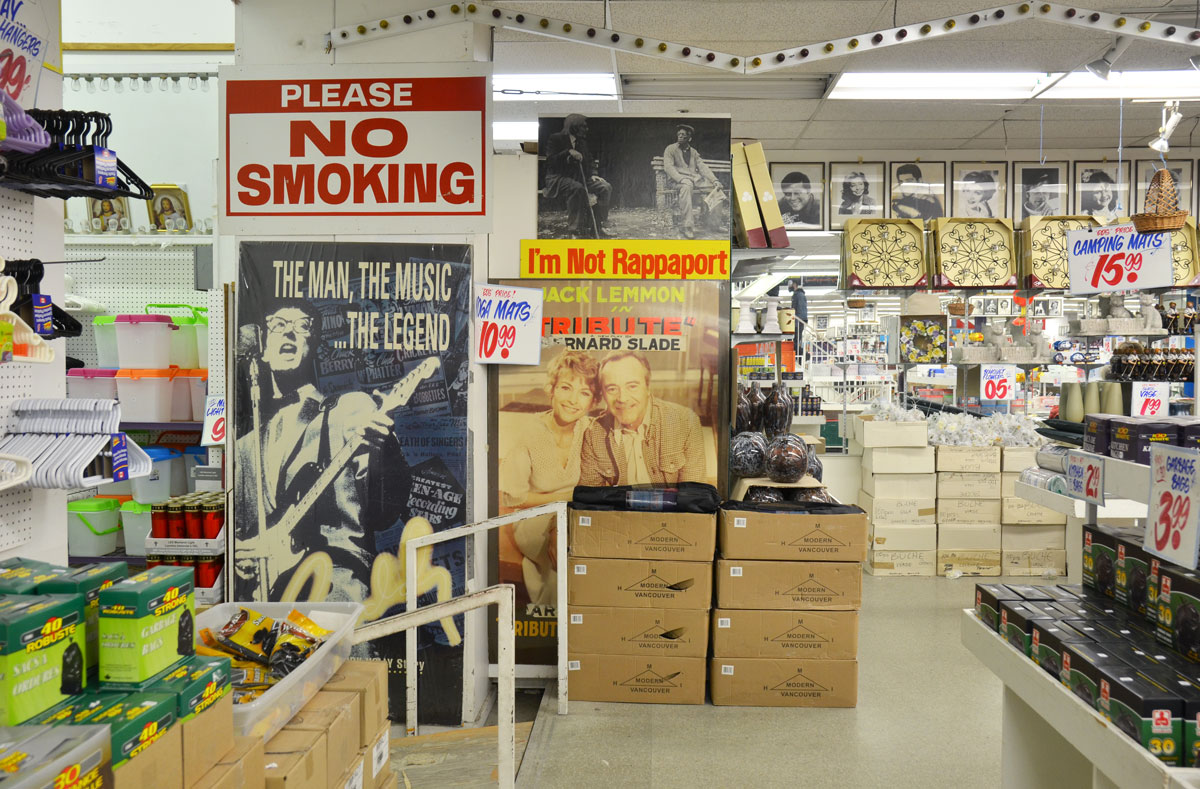
Interior photograph of Honest Eds store with its eclectic mix of merchandise.  Big No Smoking sign on the wall, some old movie posters on the wall too.

aisle in a discount bargain store.  White wooden shelves and bins, lots of red signs, cashier sign as well.  Honest Eds interior, ground floor, kitchen ware,

There are hundreds of pictures of actors and other famous (and no so famous!) people.

kitchen wares for sale laid out on white table like shelves.  Large pillar in the middle of the store with a sign warning you that you are on camera.  Seven pictures of movie stars adorn the pillar.  Lots of merchandise for sale in the background.

Jeans for sale, on tables in Honest Eds store.  Large black and white posters on the wall along with a colour full length portrait of a woman in a long dress.

All of the signs in the store are hand painted.  In March 2014, Honest Ed’s had a sale of all their signs and the profits ($17,000) from this sale were donated to Victim Services Toronto.
Another sign sale is scheduled for 11 April 2015 starting at 8 a.m.  If you want to buy a sign, arrive early and expect to wait as it is a very popular event.

Sandals for sale at Honest Eds, on white shelves.  There is a mirror behind and in the reflection is most of the shoe department of the store.

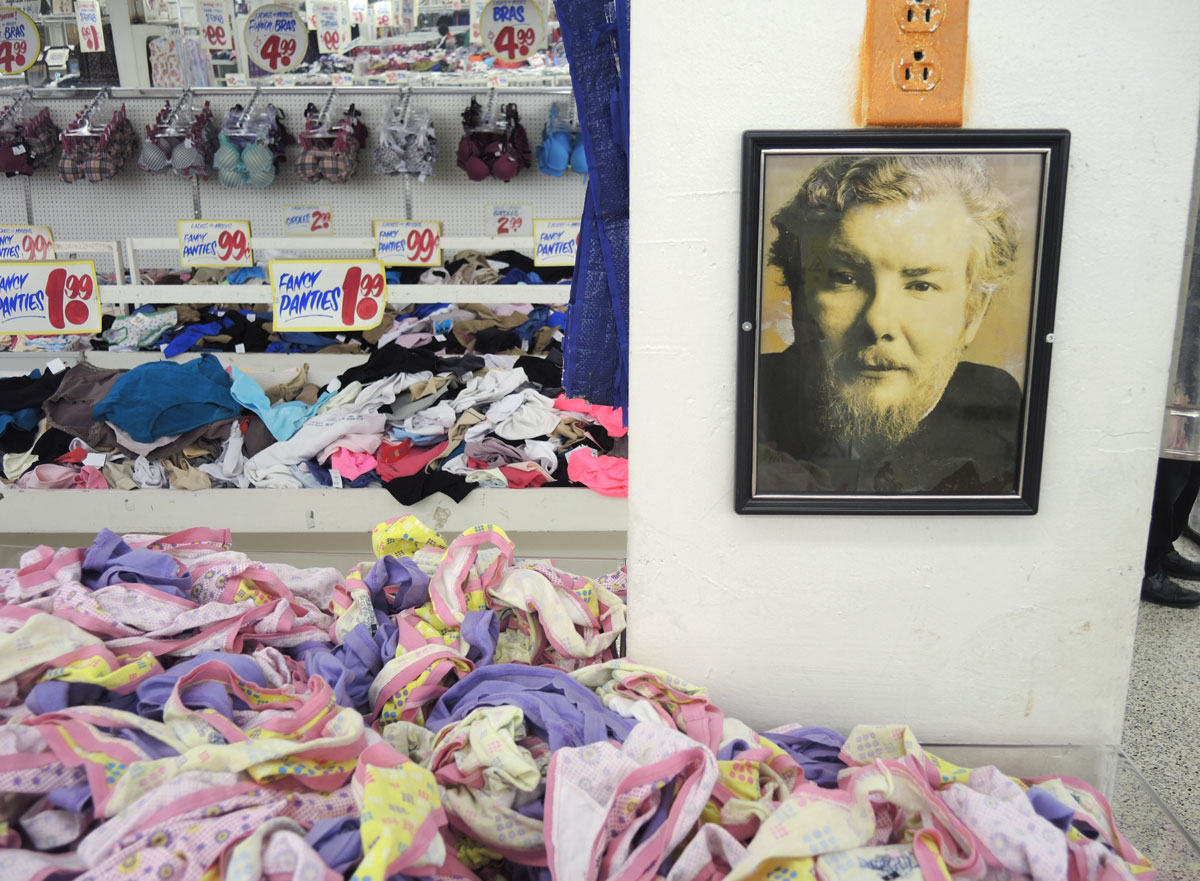
bins of panties for sale, a wall display and long horizontal mirror in the background.  Beside the bin in the foreground is a white pillar on which there is a black and white picture of a man from the shoulders up.

Signs in a store window.  One says "Honet Ed can't cook but his customers never get a raw deal" and the other is a page showing all the special prices available at the store.  It is printed like a newspaper page and there is a lot of information on it.

A bin full of brightly coloured kids running shoes in greens, blues, reds, etc

In October 2013, the property was sold to a developer but as you can see from the sign in the photo below, the store is still open.  It will remain open until the end of 2016.  It’s been open for 67 years and will remain open for another 21 months.
The southeast corner of Markham and Bloor.  The corner of Honest Eds store with its red framed windows and loud garish signs.

Flowers, a sign of spring.  No real flowers outside yet and probably not for quite a while!
Instead we’ll have to settle for European pottery florals from the Gardiner Museum today.

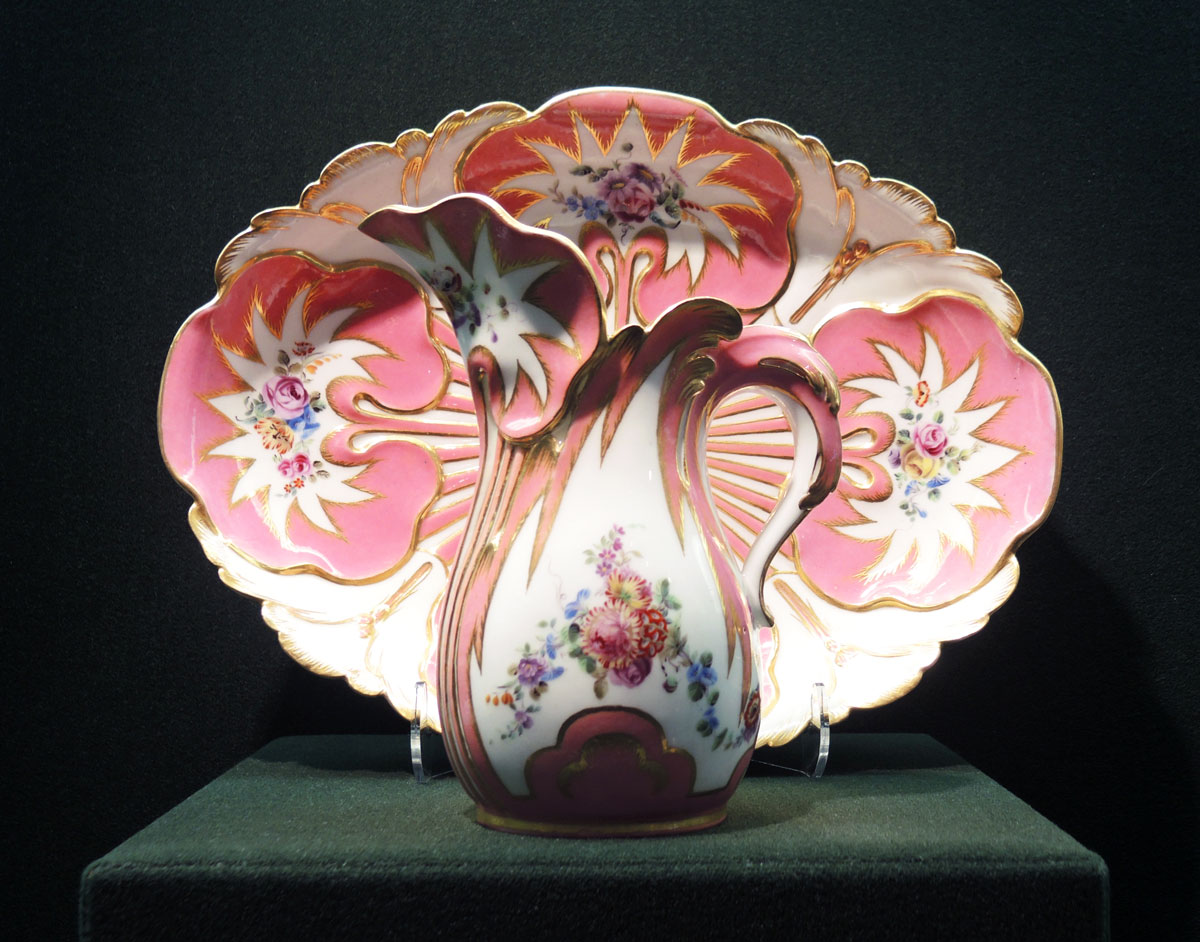
below:  Ewer and basin, Sèvres France, 1757,  porcelain, attributed to Jean-Claude Duplessis.  Pink ground with foilage-like edges.

1757 Sevres ewer (water jug) and basin in pink and white with a tiny bit of blue, floral patterns

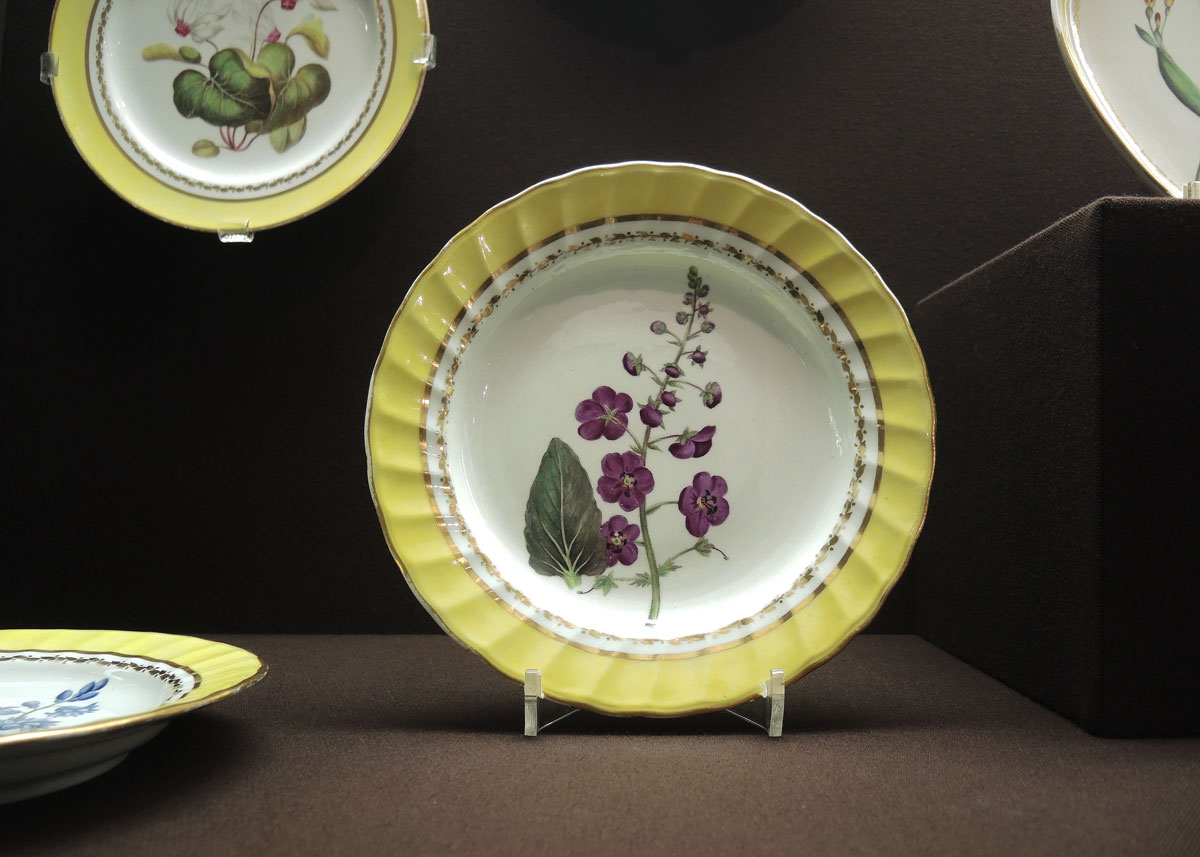
below: Purple flowered mullein plate, from Derby botanicals, pattern 216, England, c1800.

yellow rimmed plates with pictures of flowering plants in the center

Along Dundas St. West between Islington and Kipling there are a series of more than twenty murals that depict scenes from the history of the area. 

In 1793, Simcoe’s Queen’s Rangers cut a route through the forest for Dundas Street.  It was meant to serve both as a military route in case of war with the U.S. and as a route to increase settlement in the area.   Settlement of what became the village of Islington began a few years later with the arrival of the Johnston family in 1808.

The first mural was a picture of the Methodist church painted on plywood.  It no longer exists.

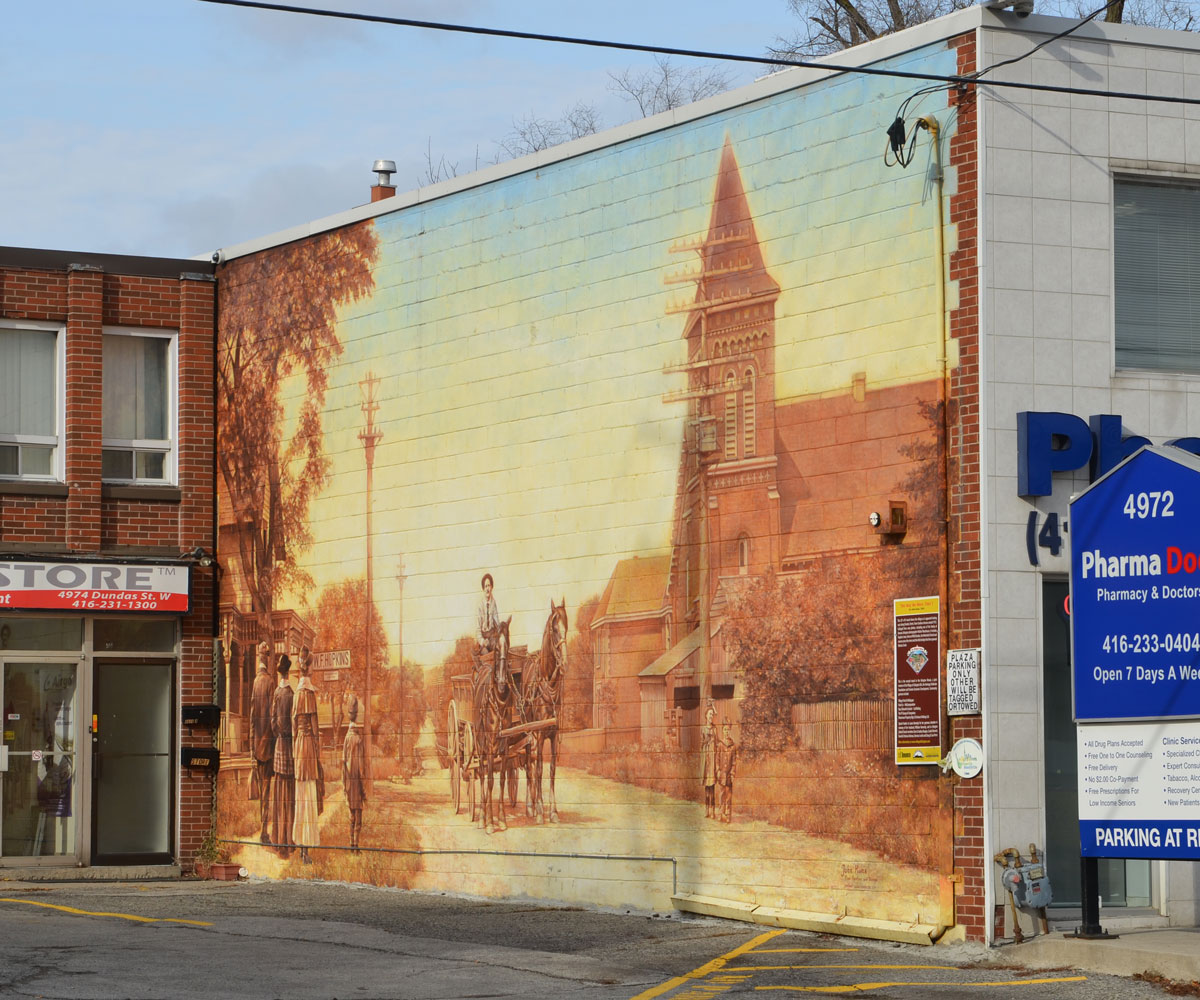
mural 2 – The Way We Were, part 1 by John Kuna, 2005.
Looking east along Dundas St. towards Cordova Ave in 1912.  It includes Hopkins store and the Methodist church.
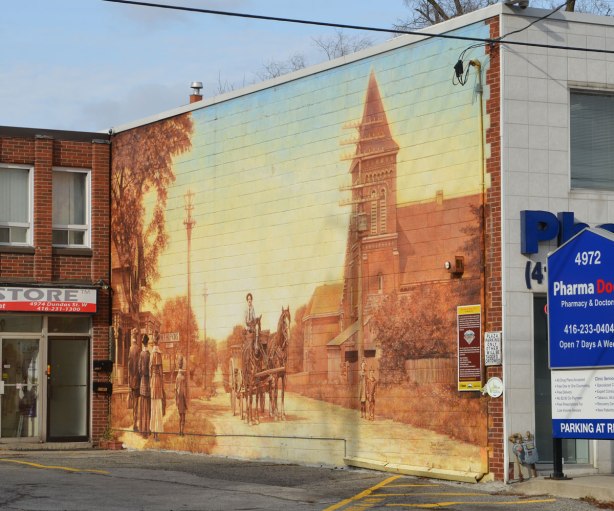
large mural on the side of a building that shows people in old fashioned clothes walking down a street.  A man in a horse drawn wagon is coming down the street.

part of a large mural on the side of a building that shows people in old fashioned clothes walking down a street.  A man in a horse drawn wagon is coming down the street.

mural 3 – They Way We Were part 2, 1912, by John Kuna, 2006.
Because of the car that was parked next to it, I don’t have a good photo of the whole mural.
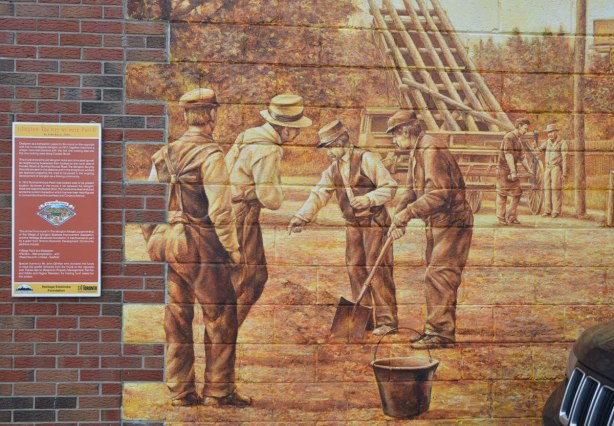
a mural showing a group of men in clothing from the 1930s shoveling in the dirt.

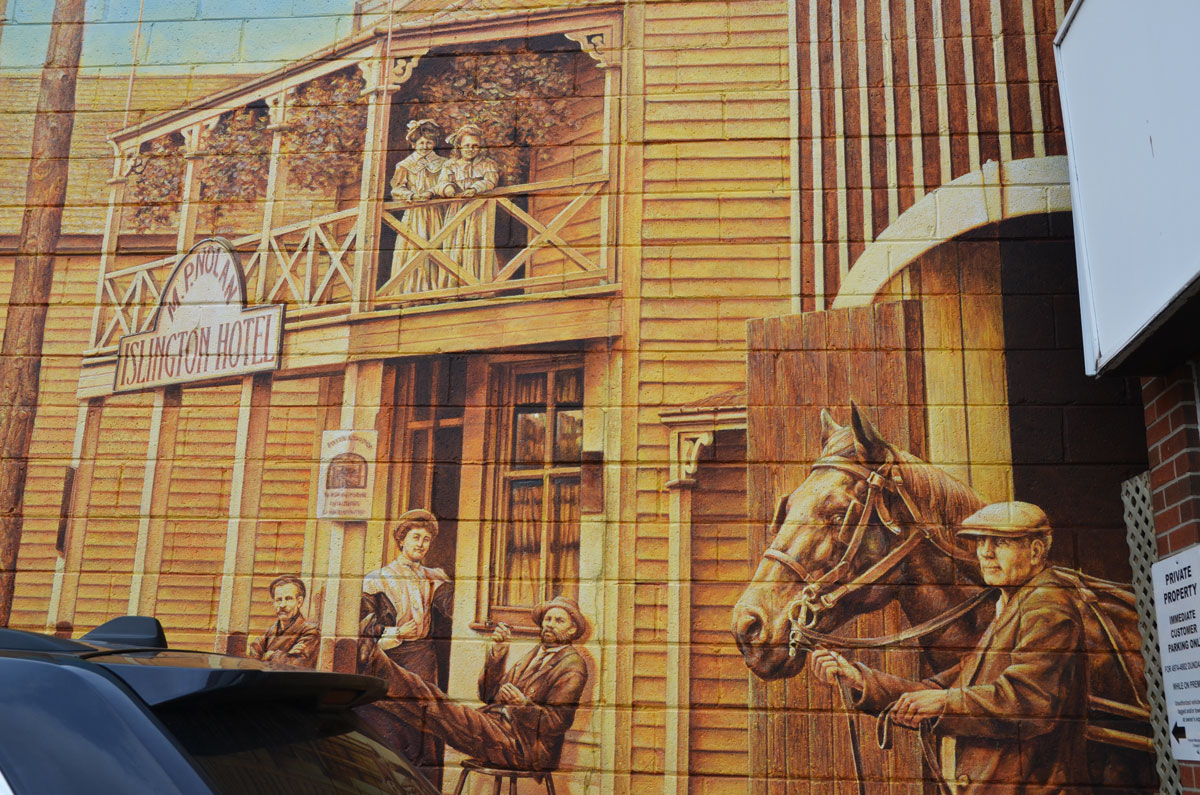
part of a mural, a man leading a horse out of the stables, the Islington Hotel behind.  Two ladies are standing on the balcony of the second floor of the hotel.  A man is reclining on a chair on the front porch of the hotel.

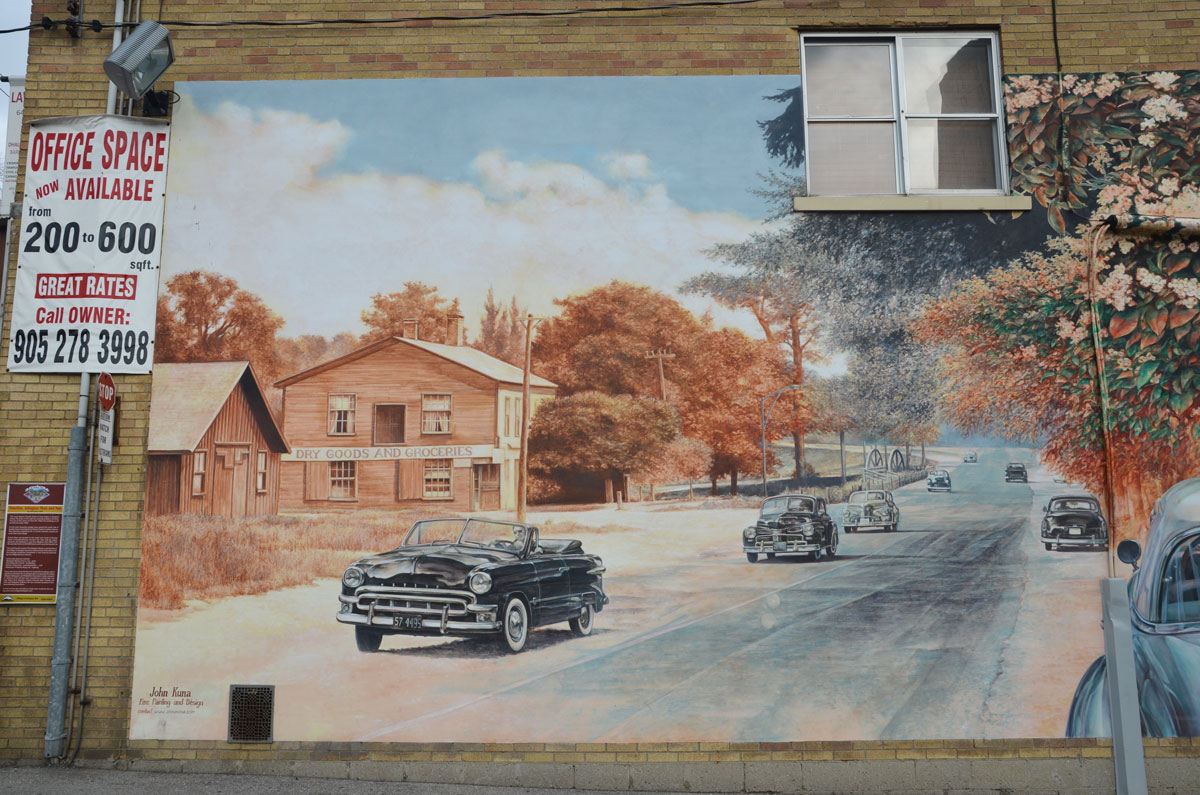
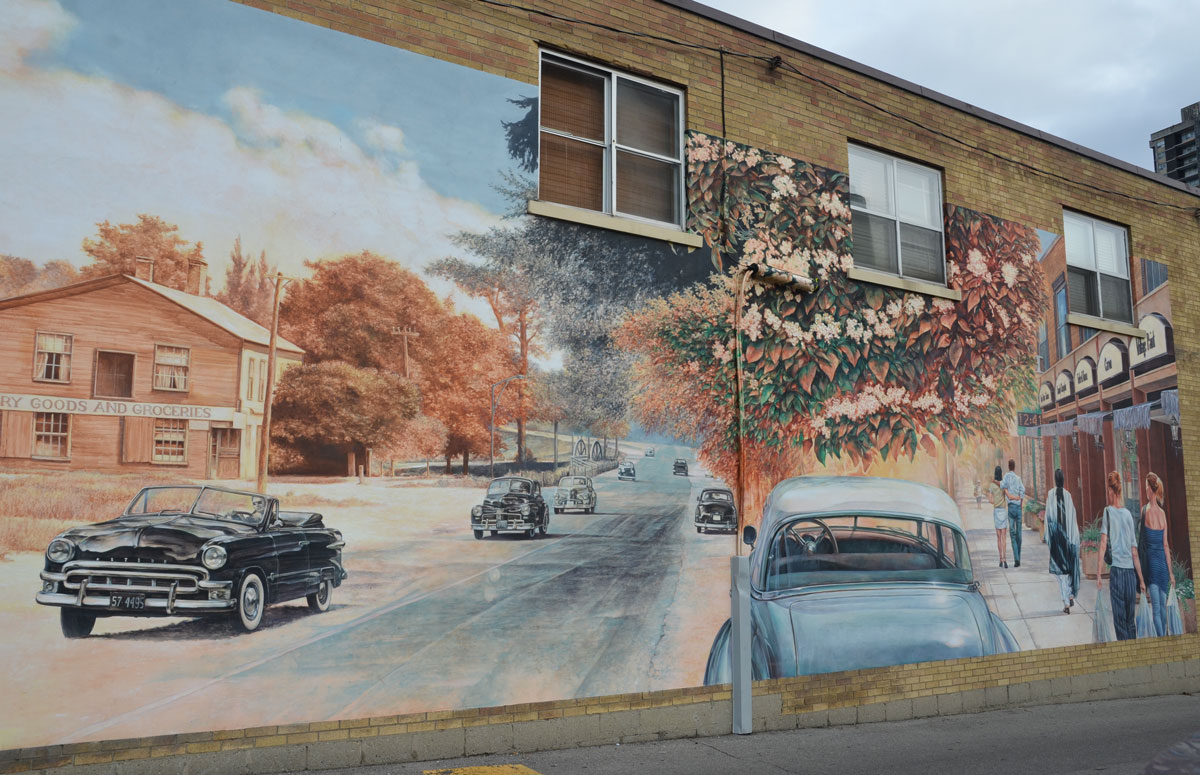
mural 4 – Timeline: Islington Then and Now, by John Kuna, 2006.
Showing Dunn’s store (NE corner of Dundas & Burnhamthorpe Cres) as well as the flowering catalpa trees that used to line the street (on the right in the picture)

part of a mural depicting the main street of town as it was in the 40s and as it was in 2006.  cars, street, people shopping,

blog_islington_here_right

mural 5 — Honouring Islington’s Volunteer Fire Brigade, by John Kuna, 2007. 
Islington had its first motorized fire truck in 1931.  In the 1940s and 1950s the volunteer firefighters would use water from the Mimico creek to flood part of Central Park, on the west side of the creek, to create a skating rink.
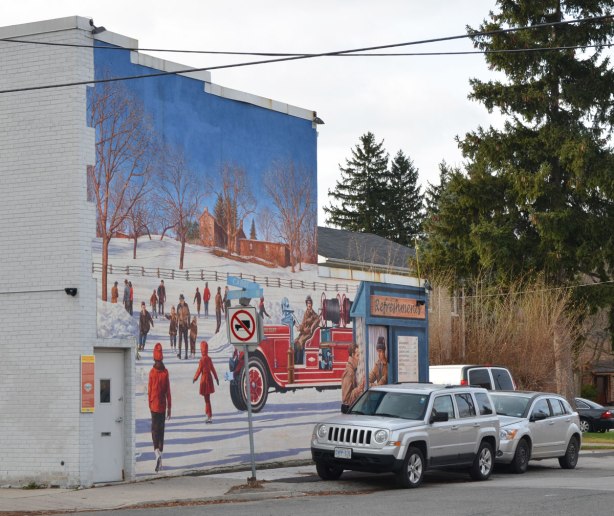
looking across the street at a mural on the side of white brick building, a winter scene, some people are skating, lots of bright red jackets, there is also an old fashioned fire engine with firefighters sitting in it.  At the right edge of the picture is a small wood hut with a sign that says Refreshments on it.

close up of a mural showing people skating on a frozen pond in the winter.  In the foreground is a traffic sign that says no trucks, also blue street signs for Cabot St. and Dundas Street West

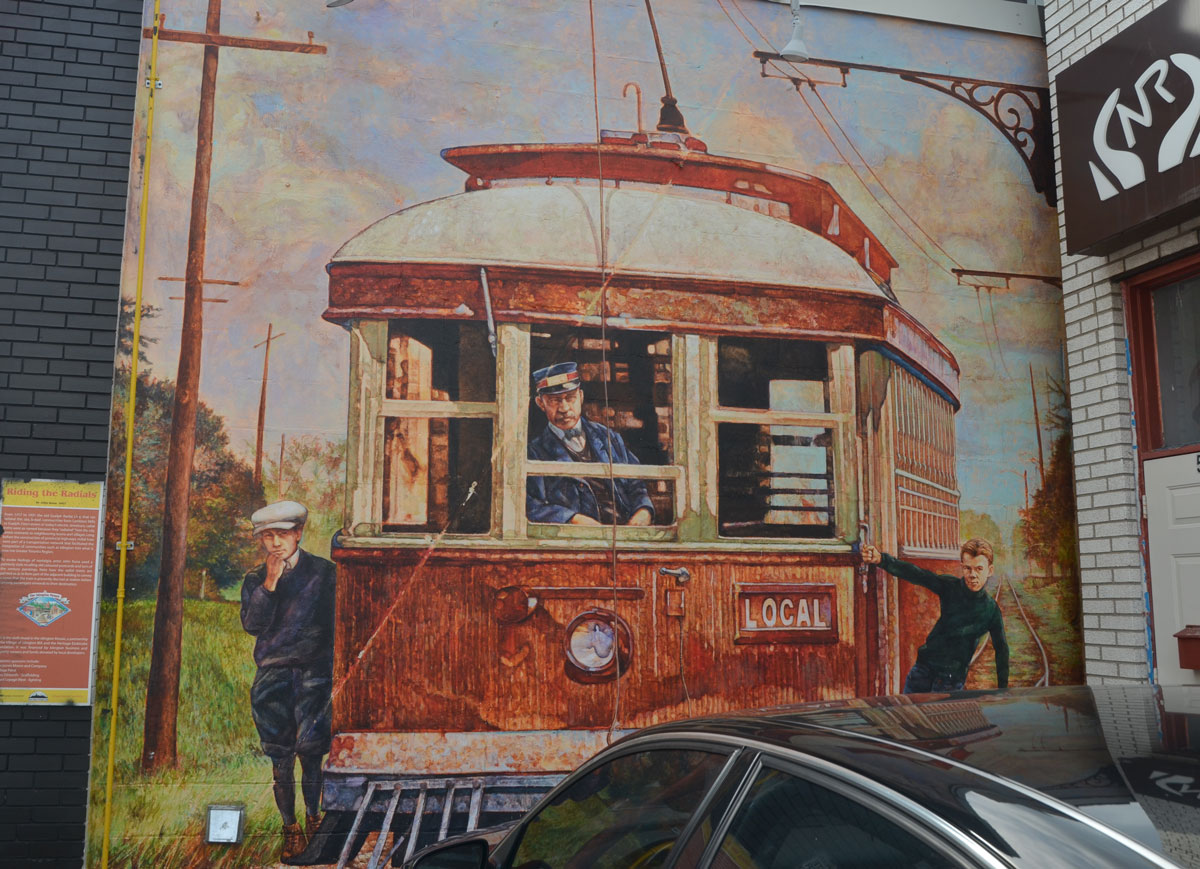
mural 6 – Riding the Radials, by John Kuna, 2007.
From 1917 to 1931 the old Guelph Radial Line (or Toronto Suburban Railway) ran close by this site.  It was an electric rail line between Toronto and Guelph.

A mural showing the front of an old electric train car with the conductor sitting in front.  Two boys are hanging out the doors, one on each side of the train car.

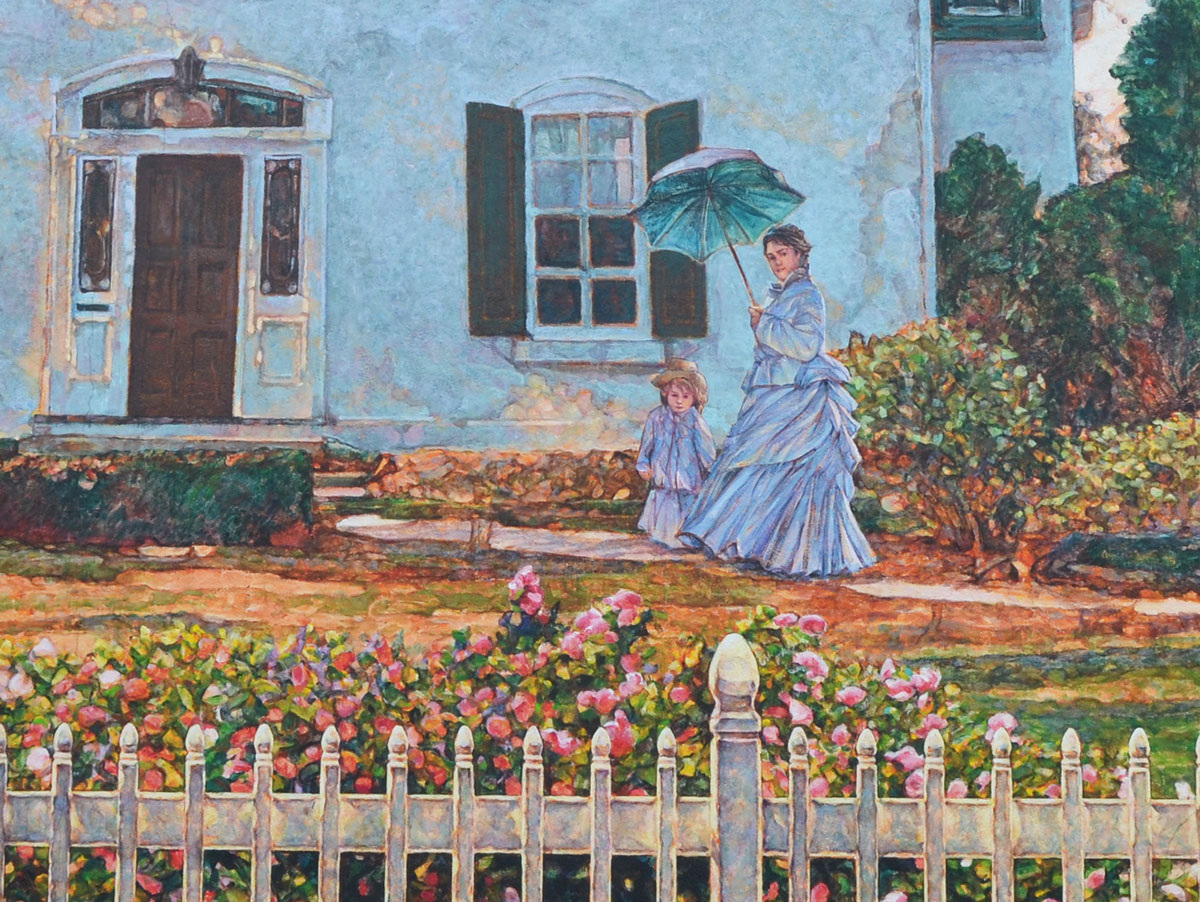
mural 7 – Briarly, Gone but not Forgotten, by John Kune, 2007.
Briarly, also known as Gunn House was built in 1840s. From 1870 to 1985 it was owned by the Montgomery family and their descendents.
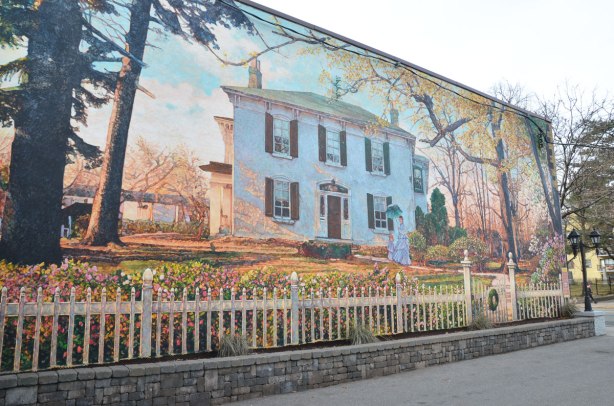
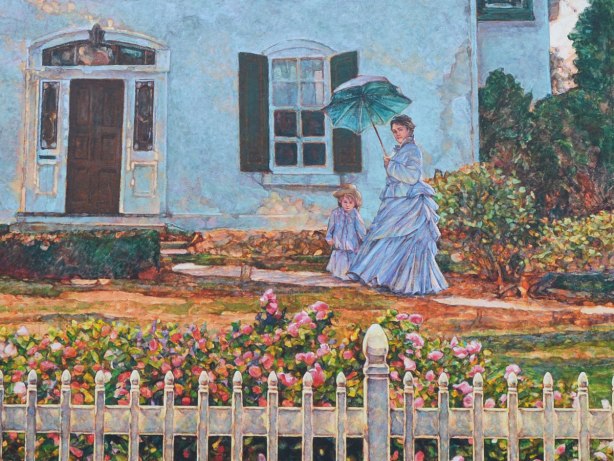
mural 7 - Briarly, Gone but not Forgotten, by John Kune, 2007.  Briarly, also known as Gunn House was built in 1840s.  From 1870 to 1985 it was owned by the Montgomery family and their descendents.

A woman and a girl in long light blue dresses are walking in front of a house.  The woman is carrying a blue parasol.  There is a white picket fence and flowering shrubs in the foreground of the picture.

mural 9 – Harold G. Shipp’s Firt High Flier, by John Kuna, 2008.
The story behind this mural: “In 1944 Harold Shipp convinced a Lancaster bomber pilot who ferried supplies from Toronto to England during the war, to fly over the school’s football field and drop hundreds of leaflets, a few of which could be traded for tickets to the school dance. Unfortunately, a rogue wind scattered the leaflets across the Chinese market gardens near Montgomery’s Inn. In the ensuing mayhem, excited football fans frantic to secure a winning ticket, stormed the field and trampled the carefully tended cabbages”

mural showing men playing football in the 1920s, with a low flying airplane overhead.

mural showing men playing football in the 1920s, with a low flying airplane overhead, as seen from an angle - form this perspective you can see that the mural is actually two pictures.

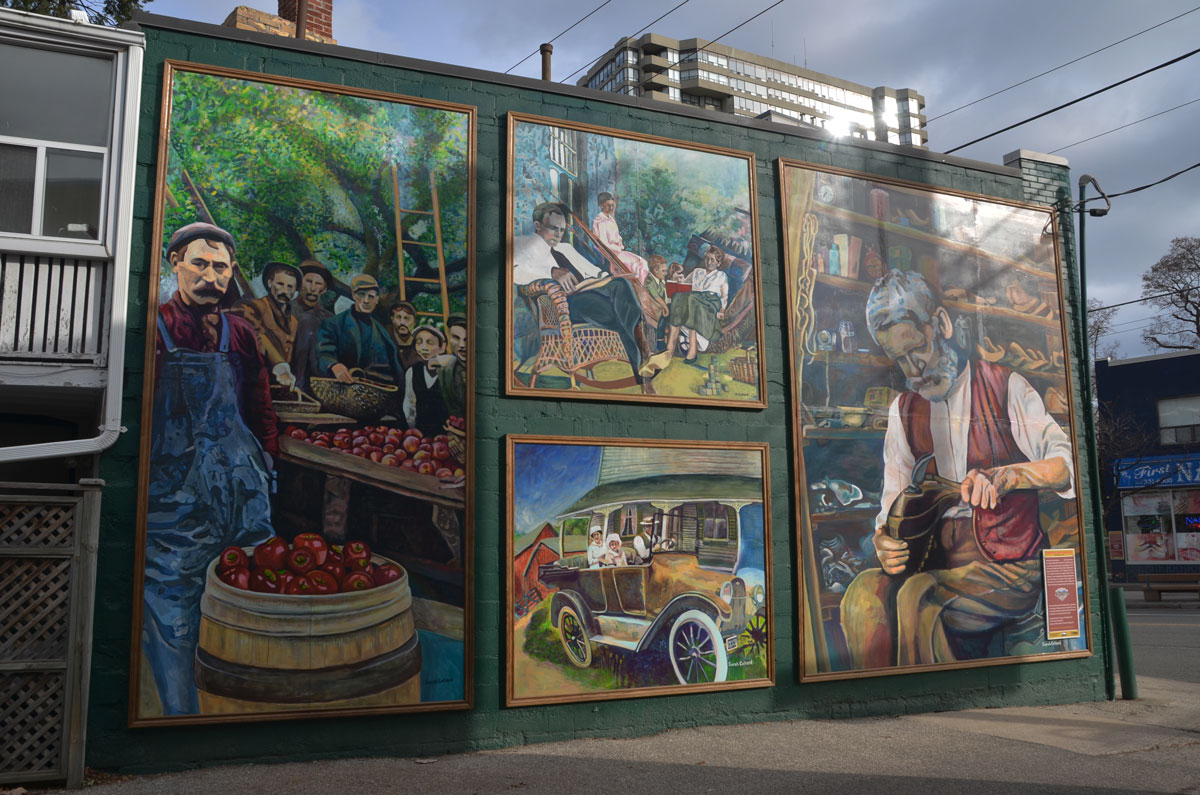
mural 10 – Portraits from our Past by Sarah Collard, 2008.
Inspired by pictures taken in the early 1900’s. “These include: Apple Packers at Bigham family orchards, Rathburn and Martingrove ~1917; Sunday Afternoon, a scene showing the family of famous Islington photographer Walter Moorhouse on their veranda at 34 MacPherson Ave. (now Aberfoyle); Islington’s First Car, a 1917 Chevrolet owned by the Appleby family; and the Village Shoemaker, Mr. Nelson in the 20th century.”
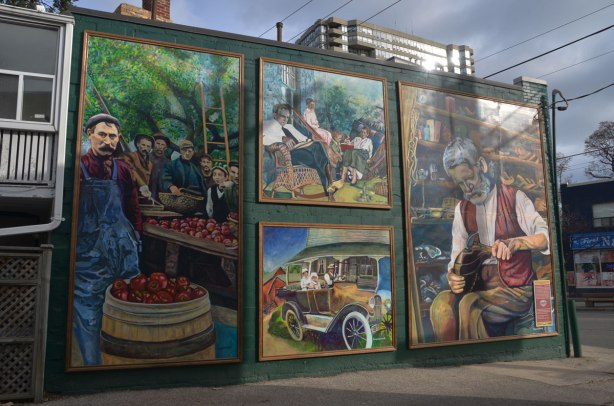
mural in 4 parts, 1 on the left, 1 on the right and 2 in the center.  The left depicts a man selling apples, the right depicts a cobbler fixing shoes.  In the center: bottom, a family in old fashioned car.  Center top - a family sitting in a livingroom including a man in a rocking chair

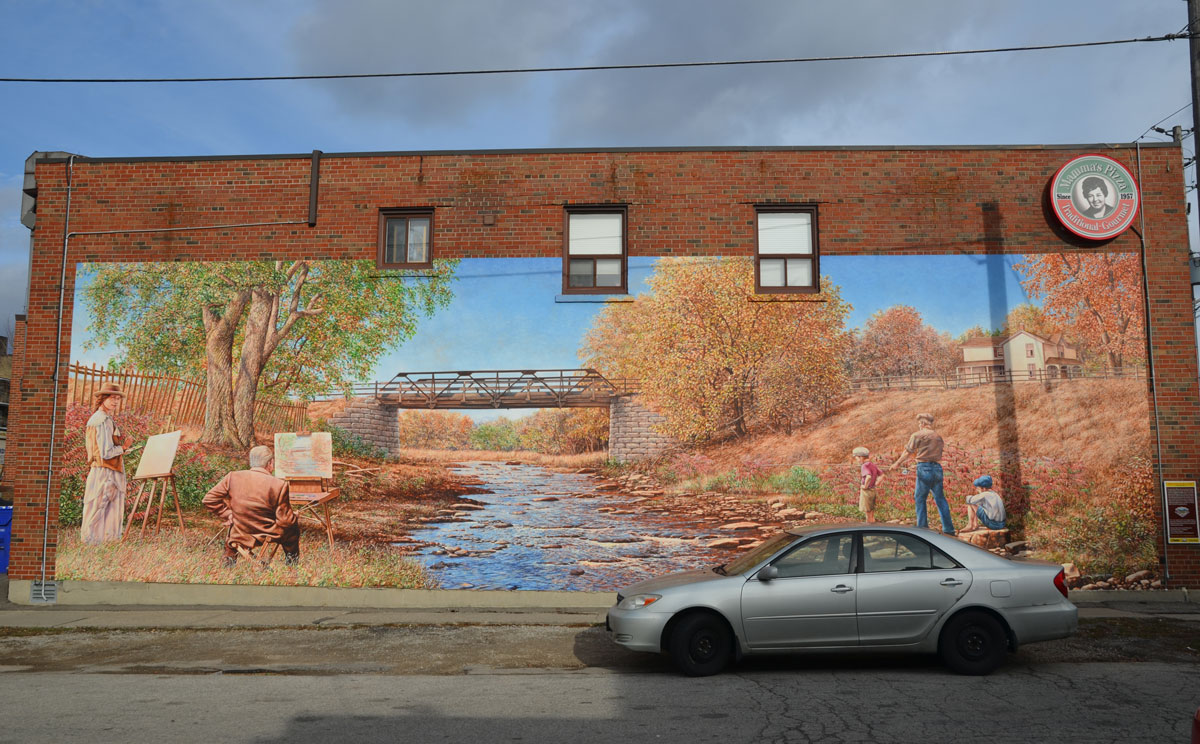
mural 11 – Mimico Creek in Fall, ca 1920, by John Kuna, 2008.
Looking north towards the Dundas Street bridge.
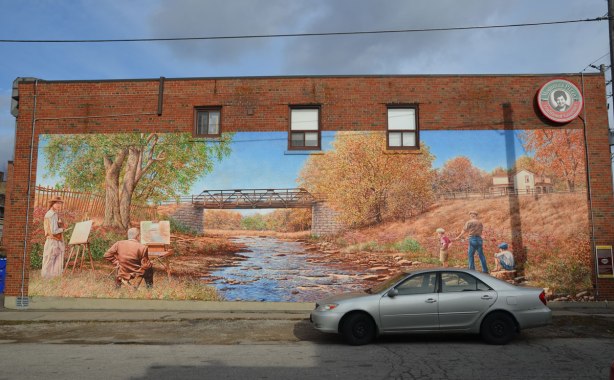
A large mural of a creek.  On the left back are two painters with their easels set up beside the river.  On the right bank are two boys and a man

Gordon’s Dairy, by John Kuna, 2008.

A mural on the front of the Islington Senior's Centre showing dairy carts.

mural 13 – The Old Swimming Hole by June Kuna, 2009.
Swimmers at the mill pond.

large mural of people swimming in a creek in bathing costumes from the 1920s

closer view of part of the mural of people swimming in a creek.  In this part of the picture, kids are climbing on a water wheel.  The mural is reflected in the window of the store next to it.

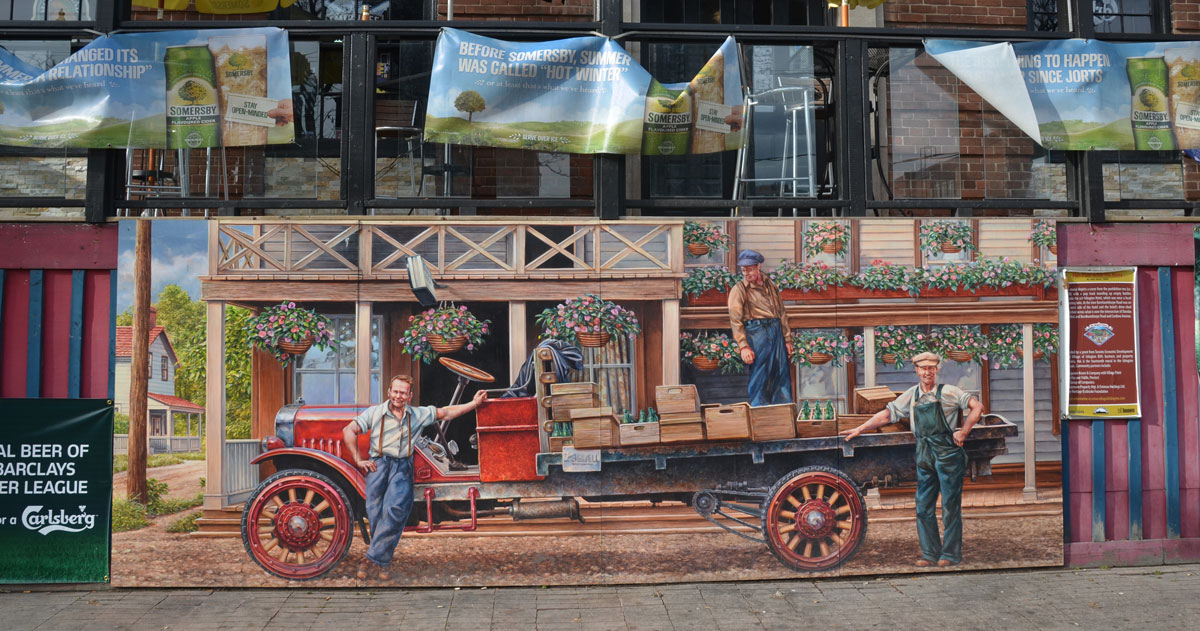
mural 14 – The Pub with no Beer, by June Kuna, 2009. 
A scene from the Prohibition Era in the late 1920’s.   Men collecting empty pop bottles from outside the Islington Hotel.
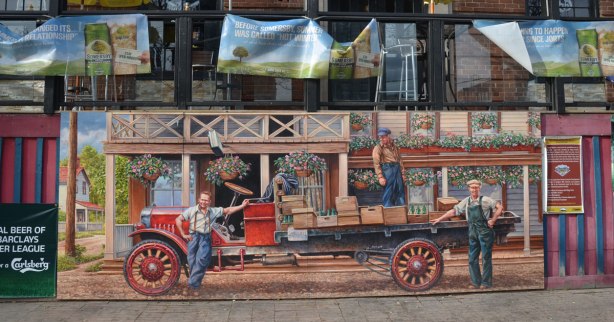
mural showing men loading an old flat bed truck with crates of empty pop bottles, 1920s

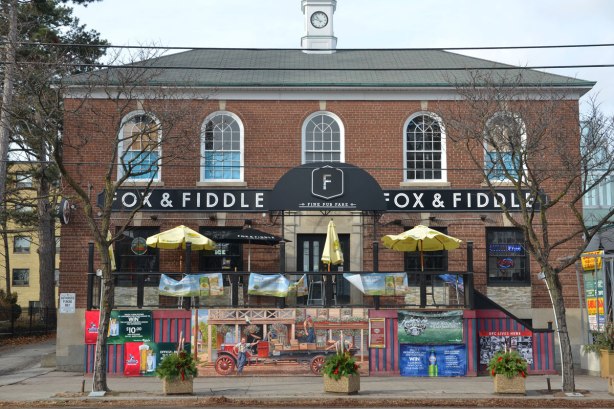
Fox and Fiddle bar, a two storey brick building,

mural 15, Faith of Our Fathers, part 2, by John Kuna

mural showing the building of a chirch

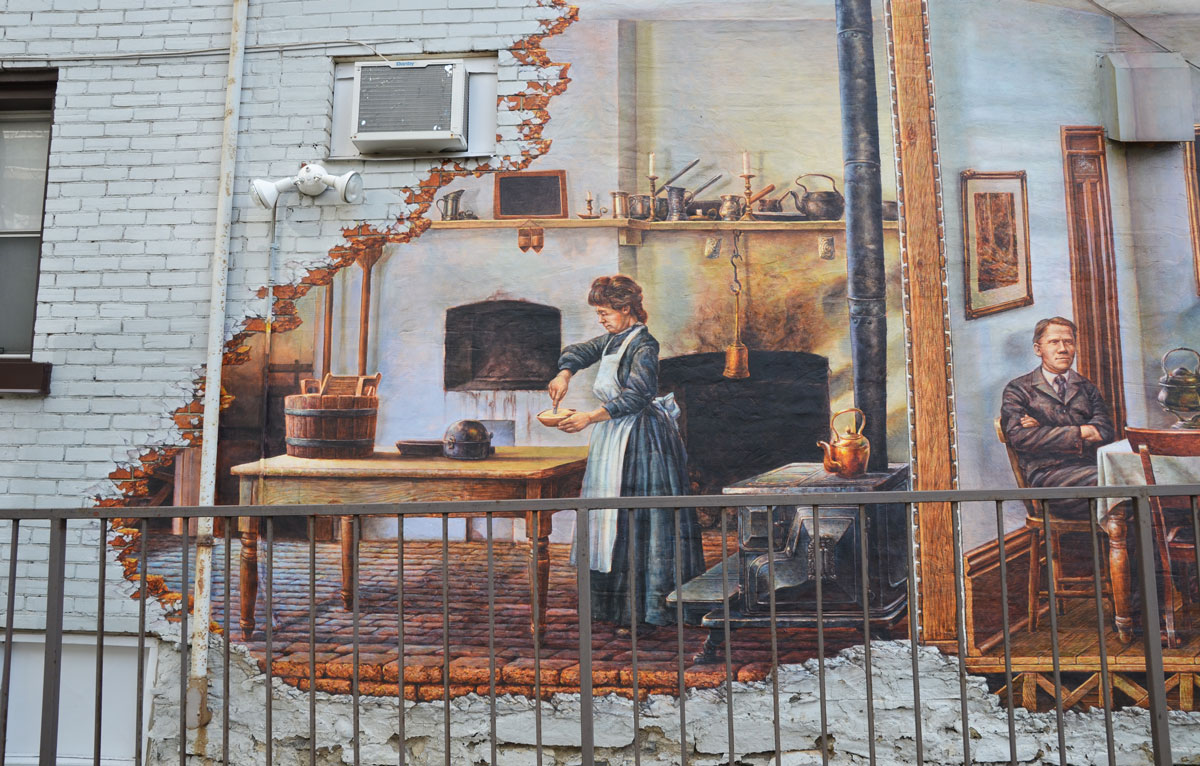
mural 16 – The Manse Committee by John Kuna 2010
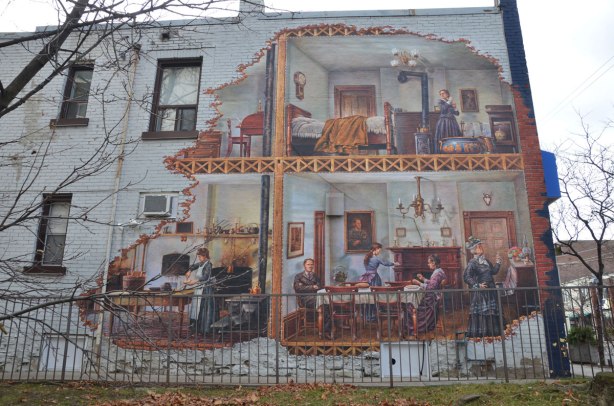
mural on the side of a two storey white brick building.  The picture looks like the outer wall has been removed to reveal a family house from the early 1900s.  A cook is working in the kitchen,

blog_islington_16kitchen

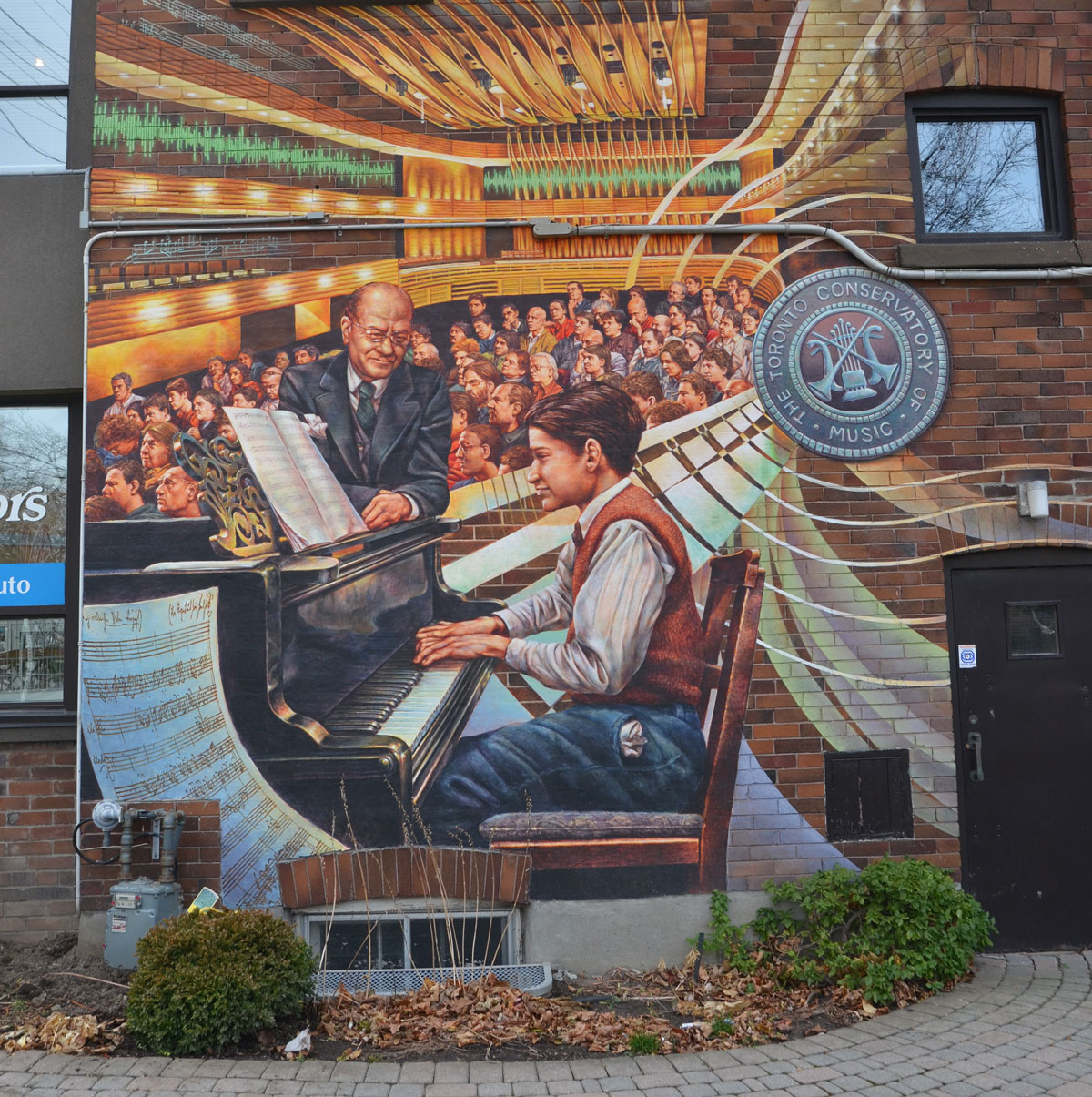
The Prodigy, by John Kuna, 2011
A satellite branch of the Royal Conservatory of Music was located in this building from the 1950s through the 1980s.
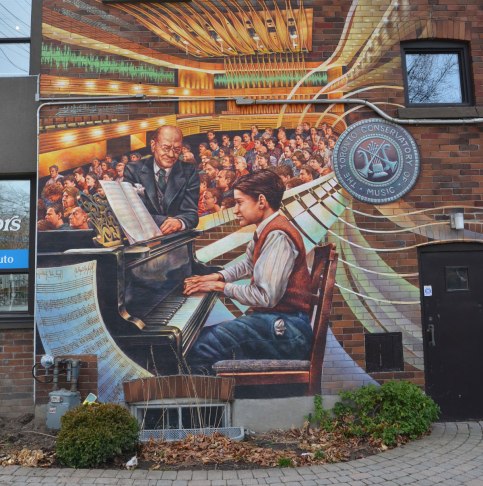
mural depicting a boy playing a piano in front of an audience.  A man is helping to turn the pages of the music.

mural 19 –  Aftermath by John Kuna, 2011.
After Hurricane Hazel on 15 Oct 1854, most of Islington Golf Course and the low lying areas around Mimico Creek were flooded.
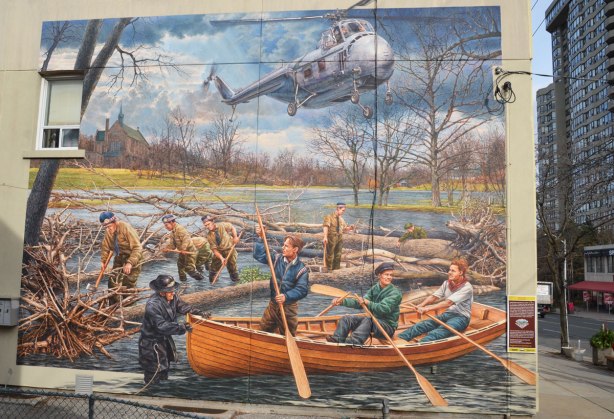
large painting of men in boats, helicopter overhead

mural 20 – Ontario Gothic, by John Kuna, 2011
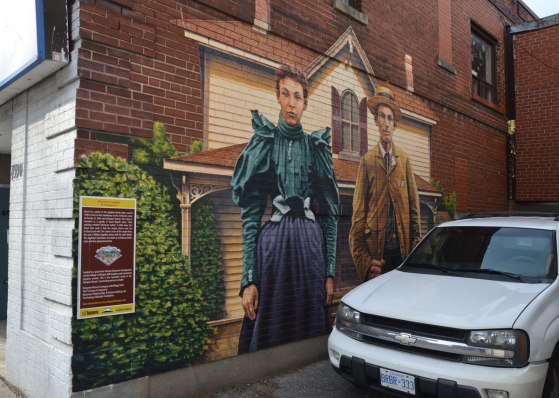
A mural of a man and a woman standing outside a two stroey farm house.  A white car is parked in front of the mural and it blocks the bottom right of the picture.

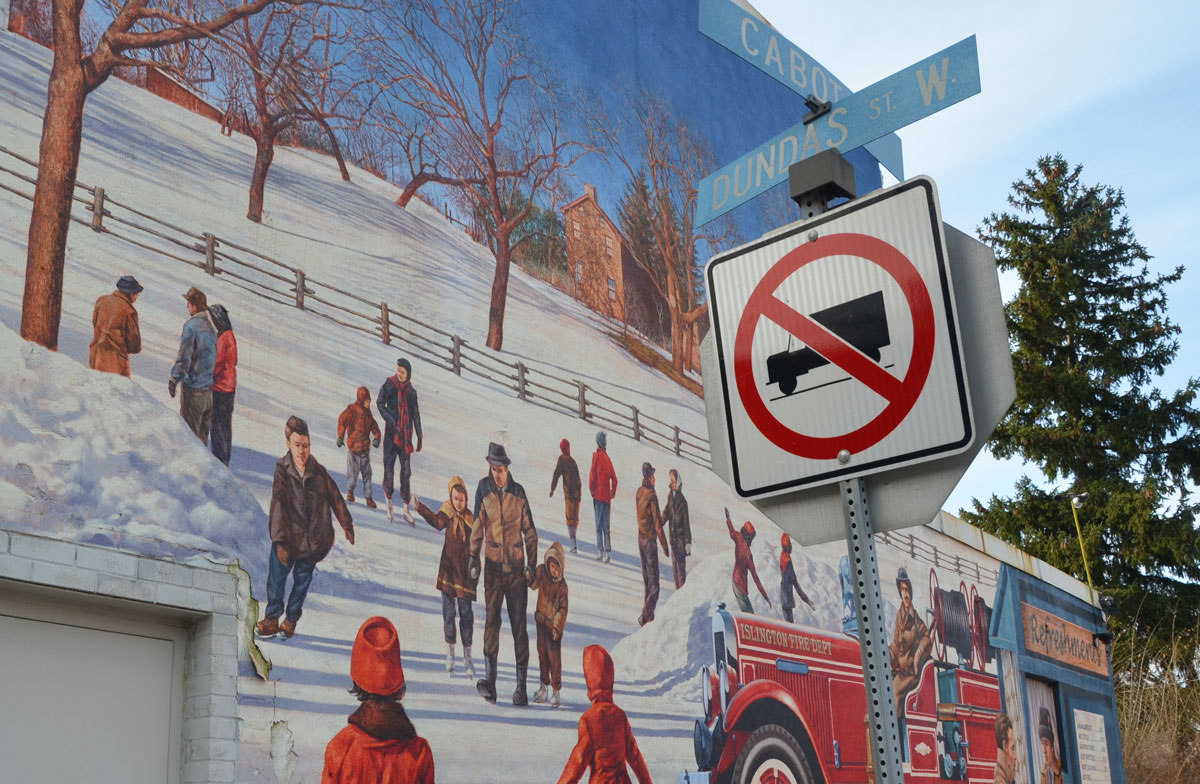
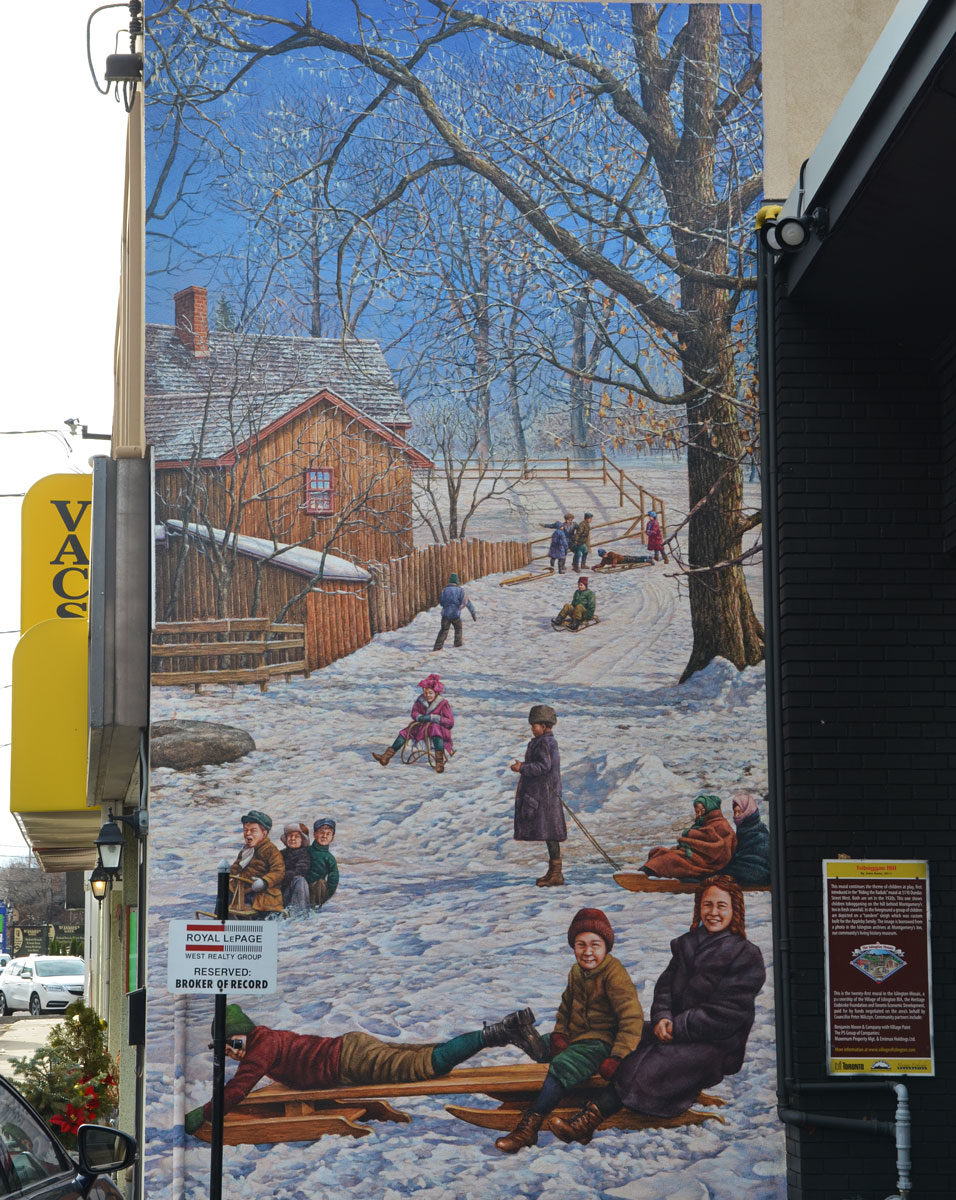
mural 21 – Toboggan Hill, by John Kuna, 2011
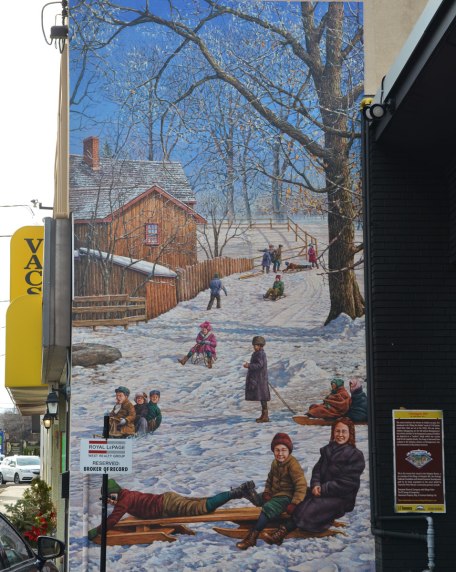
large vertical mural depicting a hill in winter.   Bare trees, kids on tobaggons.

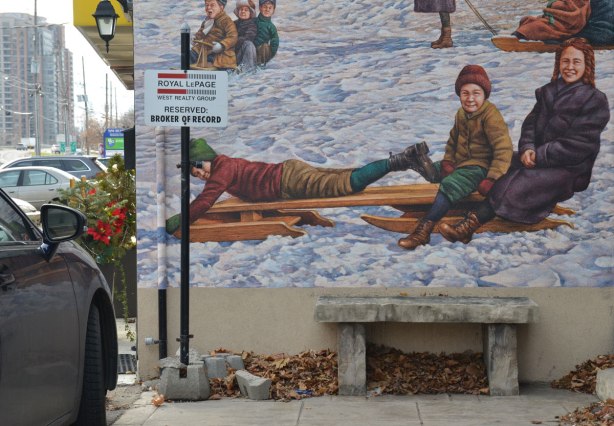
Close up of the bottom part of a mural whowing kids on old fashioned wooden sleds, or toboggans.

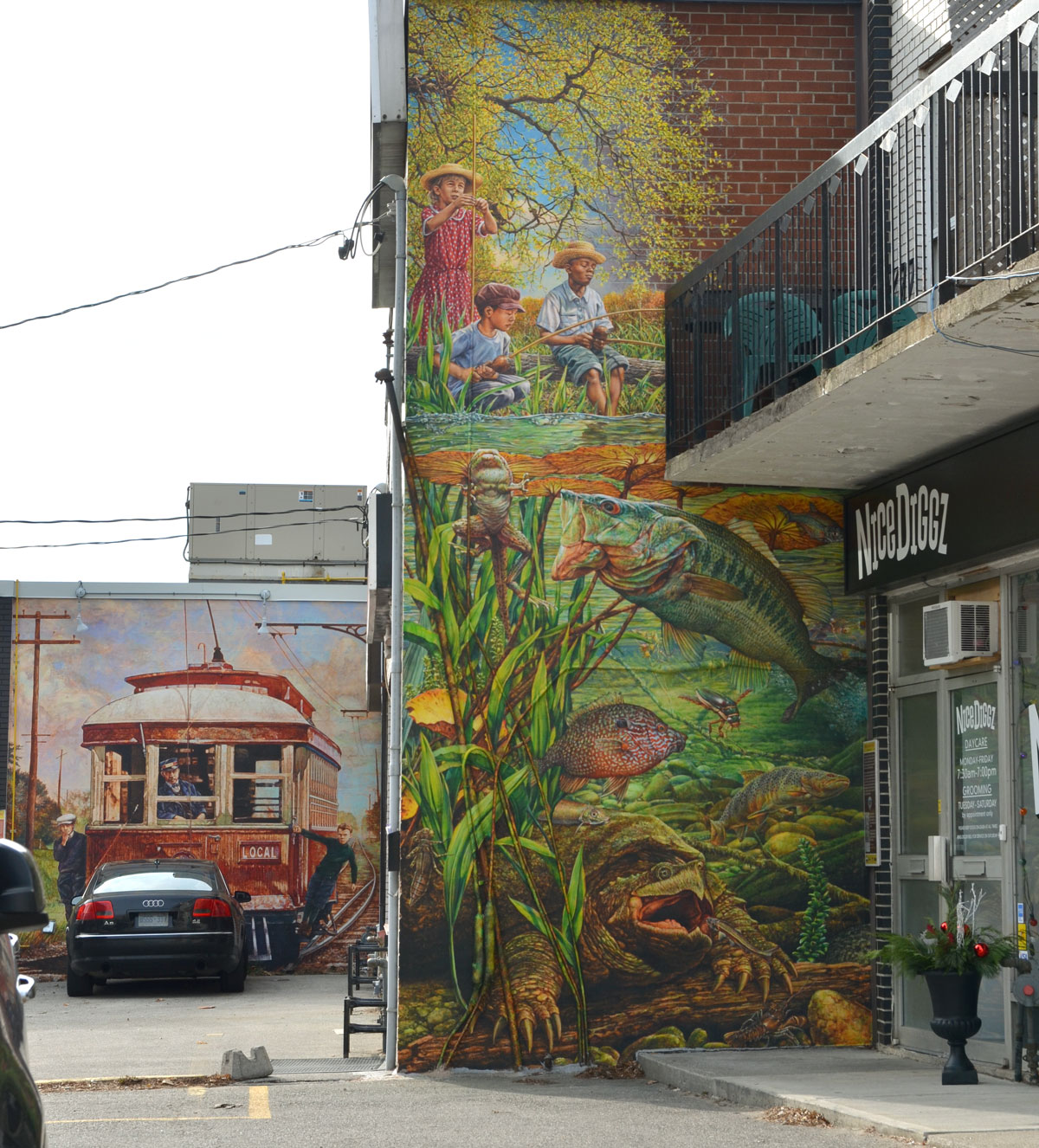
Fishing in Mimico Creek, by John Kuna, 2012,
with Riding the Radials seen in the background.

 includes largemouth bass, rainbow trout, pumpkinseed sunfish

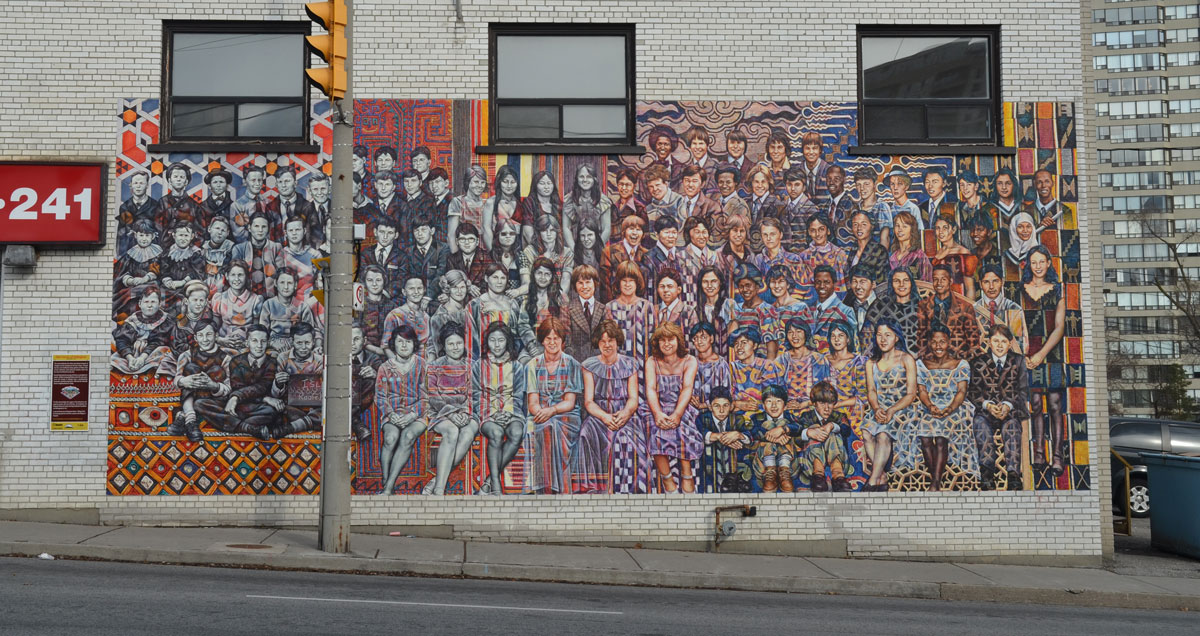
The Faces of Islington, by John Kuna, 2013
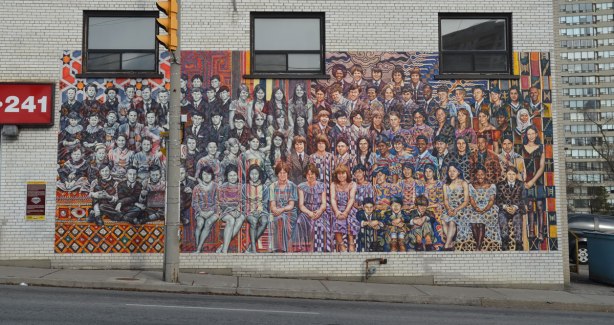
The Faces of Islington, by John Kuna, 2013
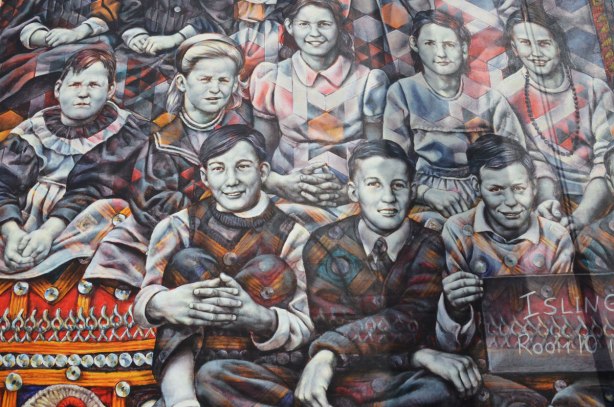
blog_islington_21part

the mural with no sign

mural of a group golfing in clothes typical of the 1940s

 more information – village of Islington murals website

St. Andrews  Bendale, Presbyterian church and cemetery, are located in a quiet corner of Scarborough, east of McCowan Avenue and north of Lawrence Avenue.  The property backs onto Thomson Memorial Park which in turn follows the West Highland Creek.

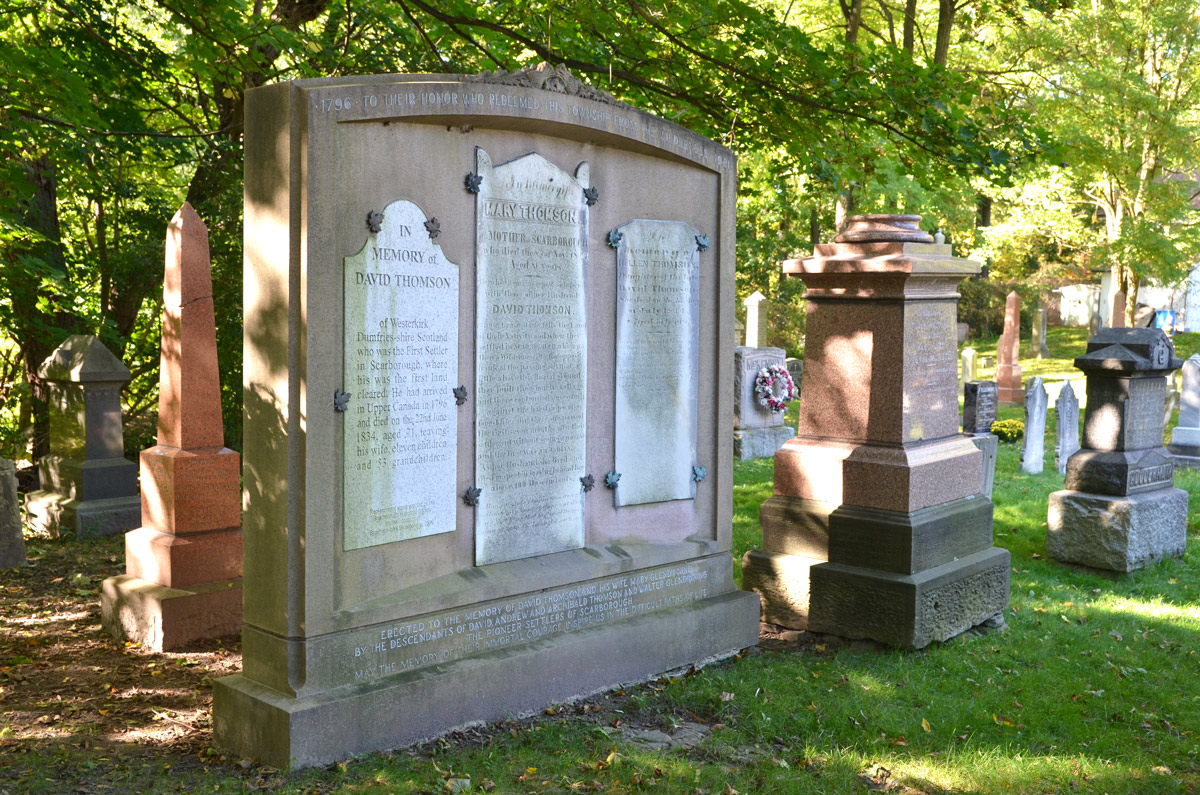
The acre of land for the church was donated by David Thomson and the original wood church was built here in 1818.  It was the first Presbyterian church built in what is now Toronto.   David Thomson had arrived in the area from Scotland in 1796 at which time he was granted 400 acres of land.  David was soon followed by his brothers Andrew Thomson and Archibald Thomson who settled nearby.  The area became known as the Thomson Settlement.

A large memorial in a cemetery.  The memorial consists of three tombstones that have been attached to a large concrete structure that looks like a tombstone

Thomson burial plot.   The inscription across the top reads “1796 – To their honor who redeemed this township from the wilderness – 1921”    
The three plaques (stones) are for David Thomson, Mary Thomson and Hellen Thomson.On the left: “In Memory of David Thomas of Westerkirk Dumfries-shire Scotland who was the First Settler in Scarborough where his was the first land cleared.  He had arrived in Upper Canada in 1796 and died on the 22nd  June 1834, aged ?, leaving his wife, eleven children and 53 grandchildren.”
Center: “In Memory of Mary Thomson, Mother of Scarborough, who died the 8th of Nov 18–? aged 80 years….”
On the right is the stone for Hellen Thomson. It is very worn and is difficult to read.

.

Robert Rae and Agnes Hamilton "natives of Lesmahago Scotland who came to Scarboro in 1832.  Three weeks after their arrival, in his 29th year, he was killed by a falling tree :: his wife survived him 46 years, dying in 1878 - in her (86?)th year."

Robert Rae and his wife Agnes Hamilton
“natives of Lesmahago Scotland who came to Scarboro in 1832. Three weeks after their arrival, in his 29th year, he was killed by a falling tree :: his wife survived him 46 years, dying in 1878 – in her (86?)th year.”To the left of the Rae/Hamilton memorial is a smaller tombstone for Margaret Rae (d. 1860), wife of Amos Thomson.

To the right of the Rae/Hamilton memorial is a tombstone for James McCowan and Margaret Porteous. This couple also came from Lesmahago Lanarkshire Scotland and they too were one of the pioneering families of Scarborough.

There are a large number of other old Scarborough families represented in this cemetery – Gibson, Muir, Young and Stobo to name a few.

A view of St. Andrews Bendale showing a number of tombstones both old and new

four old tombstones in a cemetery

.

__________________________________________________________________________

The face we put out towards the world.  Again, another fascination of mine.

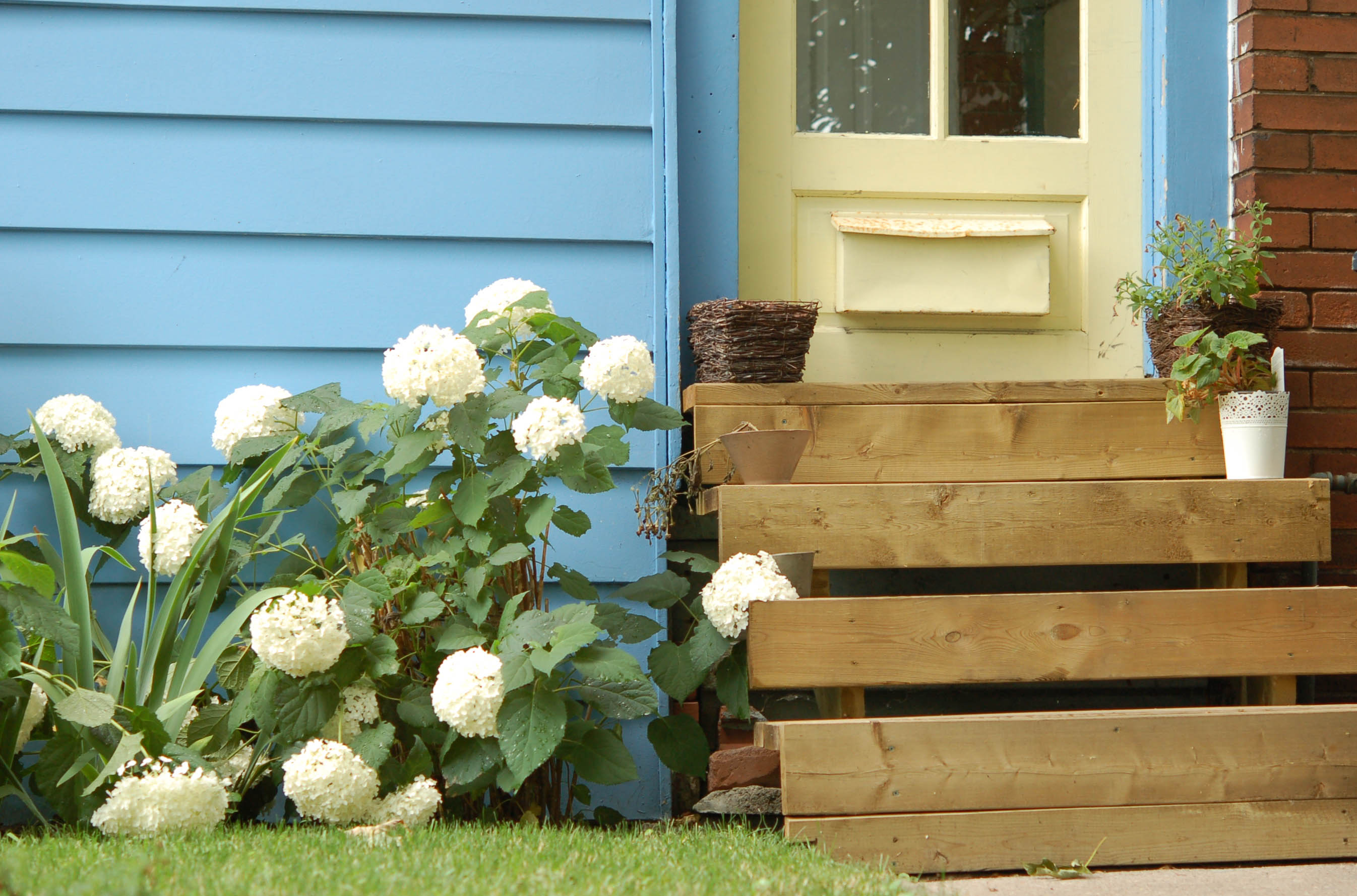
Neat and tidy, welcoming doors….

Blue house, cream door, white flowers

and some not so neat and tidy …..

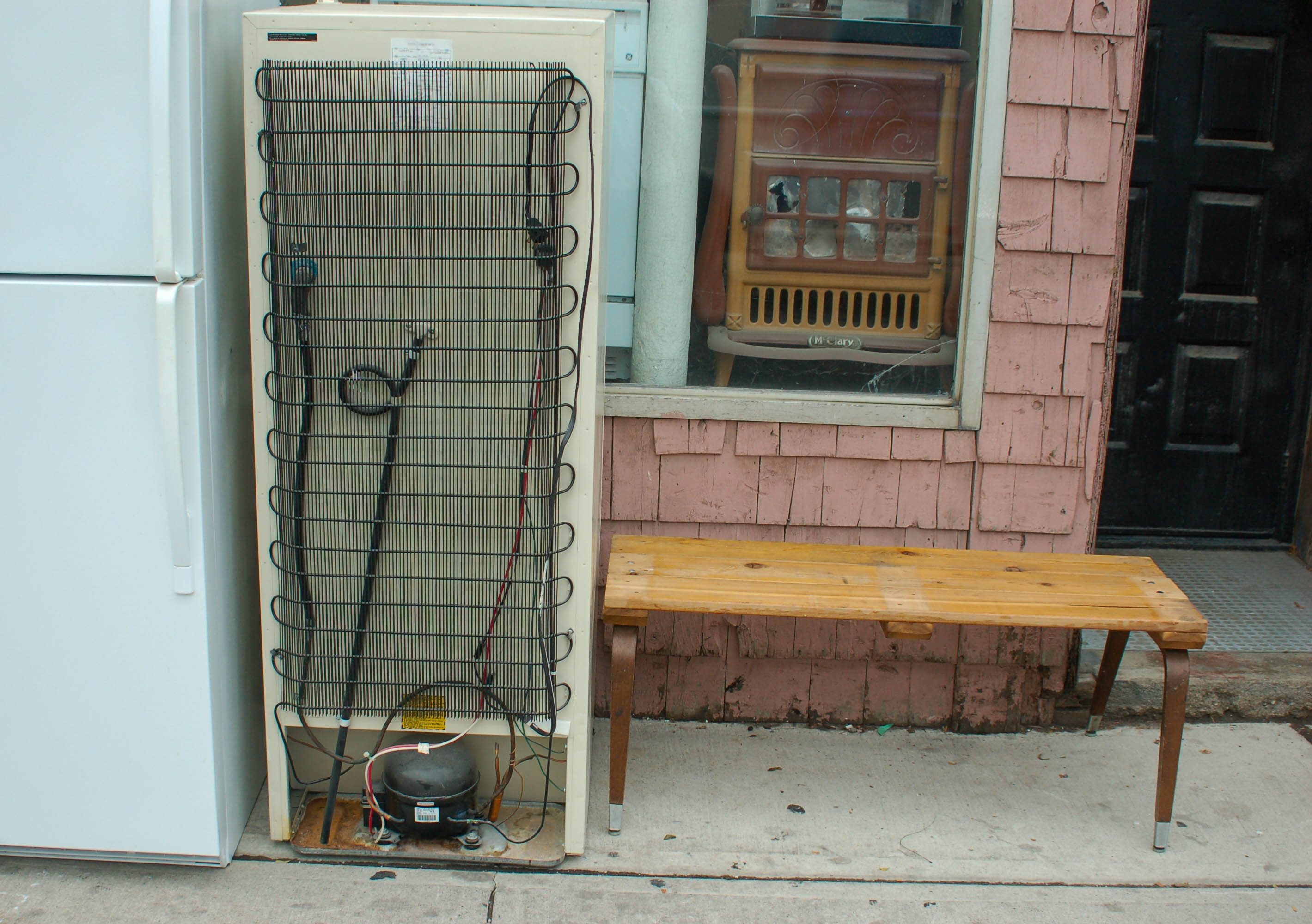
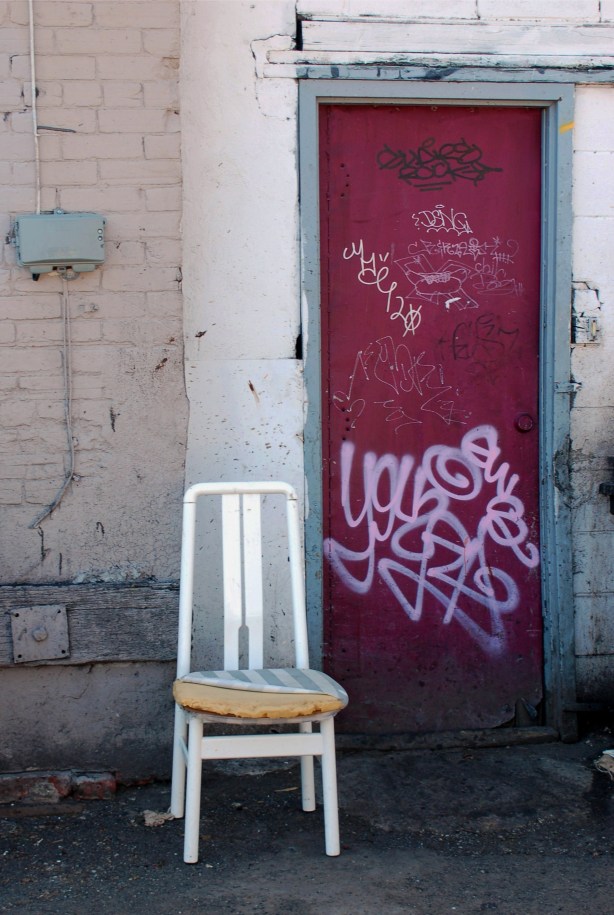
Messier doors that need some TLC

Appliances by the door. This is actually a store on Queen St. West, not someone’s house

..

door

.

Chaotic doorways….

Doorways for numbers 69 and 71

Doorways for numbers 69 and 71

.

Colourful doors are always fun.

Bright orange door on orange walls, on Peter Street

We like to decorate our entranceways too.
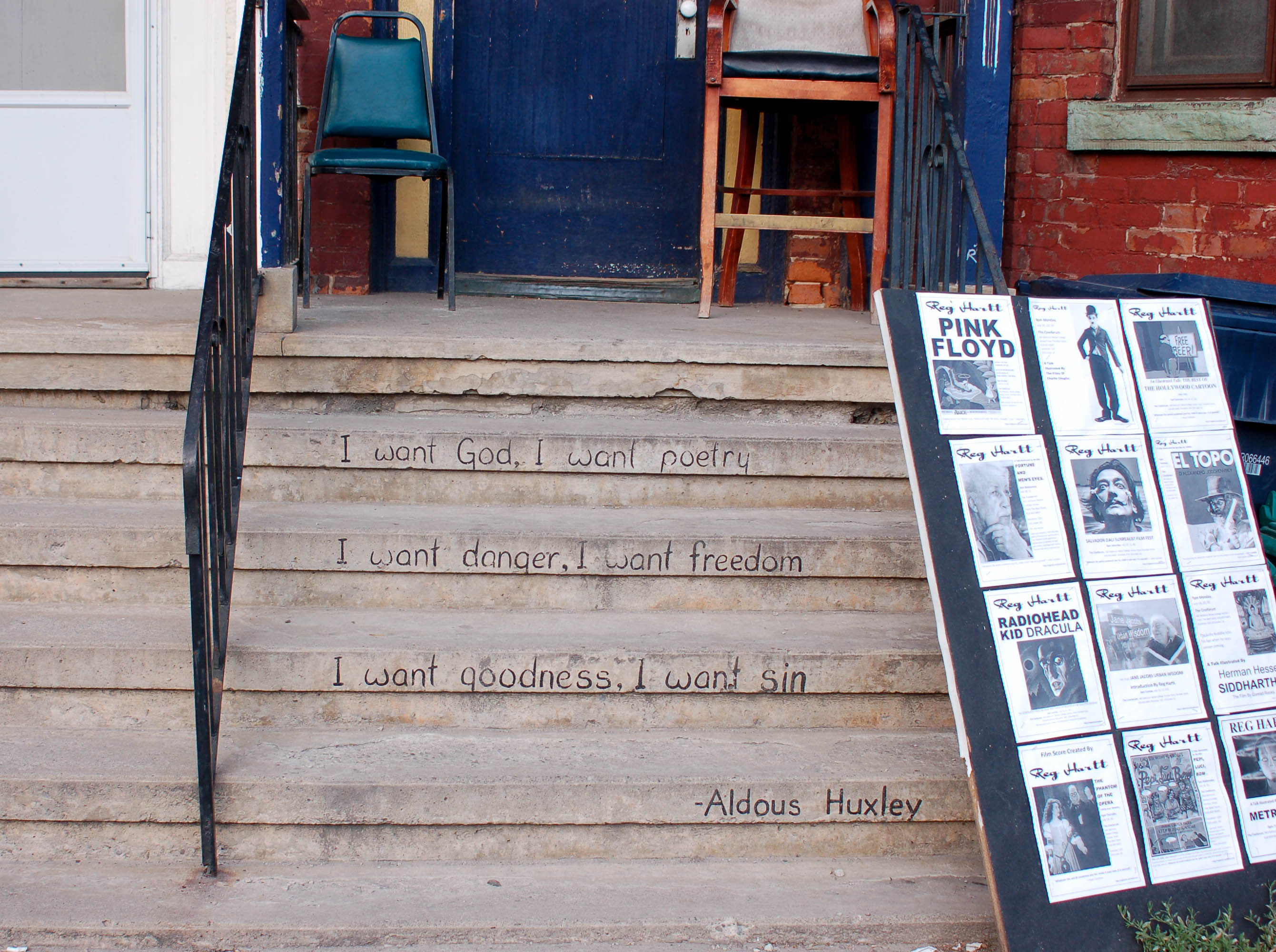
Poetry on the stairs. Bathurst Street
…..

..