Posts Tagged ‘Art Gallery of Ontario’

If you go looking for Henry Moore at the corner of Dundas and McCaul, you will be disappointed.

green construction fence around a small part of the sidewalk at the corner of Dundas and McCaul, equipment inside, one small gingko tree, building says Art Gallery of Ontario

Instead, you have to walk around the corner.

yellow pedestrian crossing sign that has been altered to look like 2 art students, one with a cardboard tube and the other with a portfolio case

After residing at the corner of Dundas and McCaul since 1974,  Henry Moore’s sculpture “Large Two Forms” was moved to the newly renovated Grange Park on the 3rd of June.   Grange Park is behind the Art Gallery of Ontario as well as OCADU (Ontario College of Art and Design University).

 the Henry Moore sculpture, Large Two Forms, in Grange Park behind the Art Gallery of Ontario , a couple on a bench beside it

The new setting suits the sculpture.  There is more room for people to interact with the sculpture and the park makes a more picturesque background for those who like to take photos.

 the Henry Moore sculpture in Grange Park behind the Art Gallery of Ontario - Large Two Forms, with the blue wall of the AGO in the background

a girl in orange shorts and purple shoes stands on top of the Henry Moore sculpture in Grange Park behind the Art Gallery of Ontario

I’d be interested in knowing if the AGO has any plans for the now empty corner at Dundas and McCaul.  Was the construction pictured above just to remove the platform that the sculpture used to be on?  Or is there more to it than that?

Also, I don’t mean to spoil your fun, but how long will it be until a “do not climb” sign appears in Grange Park?   I’m not advocating for one – I just know how the city acts on things like this.   Part of me says, “Quick, get your selfie from on top of the sculpture while you can!”

A little extra that I discovered this morning.   As I wrote this blog post I kept thinking about “Down By the Henry Moore”, a song from my past.   All I could recall was the title.   I found a great version of it on youtube –  the song was written and sung by Murray McLauchlan and was released in 1974.   The Henry Moore referred to in the song is the one in front of City Hall but the video on youtube has some fabulous old picture of Toronto!  Many thanks to john allore who made the video and uploaded it to youtube.  I really enjoyed seeing the old images, down memory lane and all that.   If you are interested, this is the link;  it will open youtube in a new page.  You may have to suffer through a few seconds of ads and you have my apologies for that.

Keeping warm at the Art Gallery of Ontario.

Below are 5 works of art that I saw recently when I decided to spend the afternoon inside instead of walking in the cold.  The AGO is definitely a great way to stay warm!

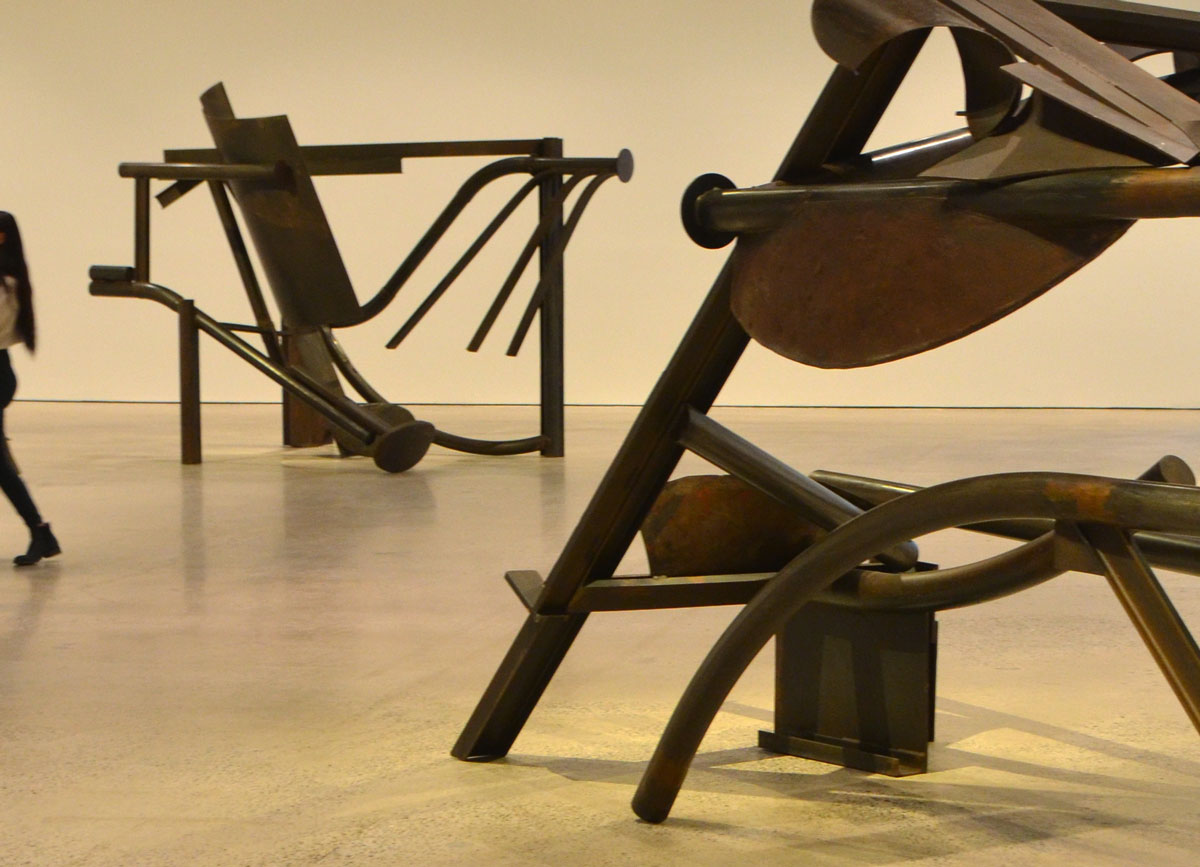
below: There is a room at the Art Gallery of Ontario that is home to four large metal sculptures at the moment.  Large structural pieces. These creations are the work of Sir Anthony Caro (1924-2013).  They are made of discarded metal pieces.  At one point in his career, he made scale models for a giant art project for Park Avenue in New York City.  When the project was cancelled, he took apart the models and used the pieces to make a new series.  Three of those on display here are from that series, ‘Sculpture Laid Bare’.  It would be interesting to see what the Park Avenue sculpture models looked like.

a woman with long hair walks away from a large metal sculpture made of cast off pieces of metal, on display at the Art gallery of Ontario,

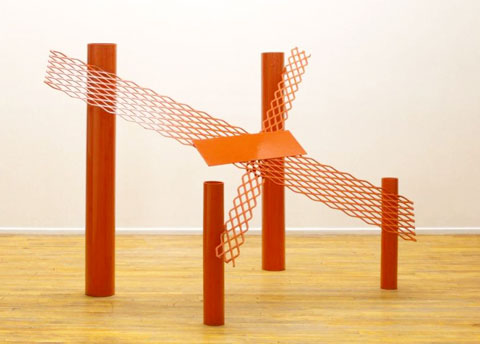
In the early part of his career, Caro made modeled figurative pieces cast in bronze.  In the 1960’s he started to use prefabricated steel and aluminum, sometimes in bright colours such as the example below:

red sculpture by anthony caro, metal, 4 upright cylindrical tubes with metal mesh forming an X on top of them.

Red Splash, by Anthony Caro. Image found online at source.

If they were outside, they would invite interaction.  Touch them.  Climb on them.  In this gallery setting, there is a no touching policy.   The words on the wall says that: “He [Caro] meditates on the passage of time, processes of decay, the painful realities of aging, and the future of modern sculpture.”  Isn’t that why the gallery is doing their best to preserve them just the way they are?


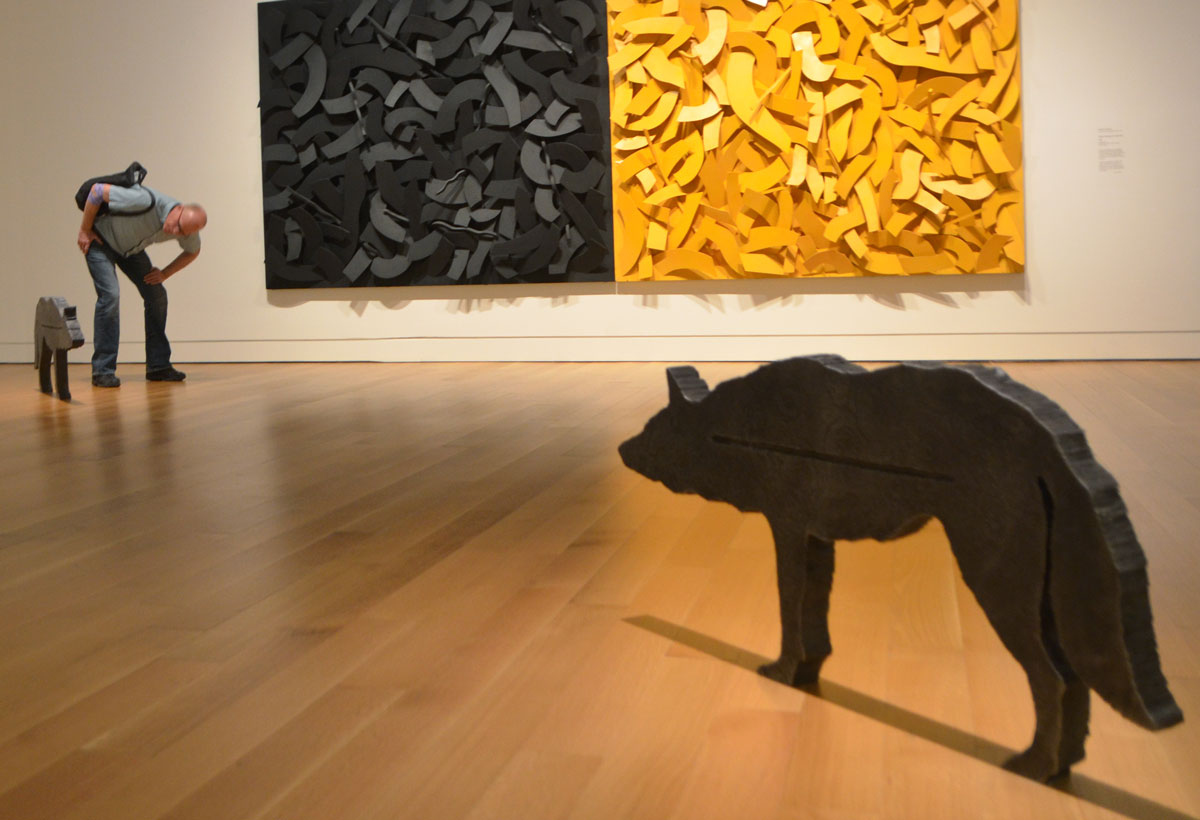
below: ‘The Distinctive Line Between One Subject and Another’ by John McEwen, 1980.  Two steel wolves looking at each other across the room.  On the wall behind the wolves is ‘Folia Series #1 and #2 by Nobuo Kubota, 1976, representations of the wrinkles on the cerebellum in the brain.

two metal sculptures of life sized wolves looking at each other across the room, a large panel art work is on the wall behind them, half black and half yellow.

John McEwen is a Canadian sculptor.  A number of his sculptures can be found around Toronto.  He designed the boat hull like shapes for the Victory Peace memorial on the waterfront that I mentioned in a previous blog post – down to Coronation Park.  The three metal tubes outside the Air Canada Centre – the Searchlight Starlight Spotlight – are also his work.


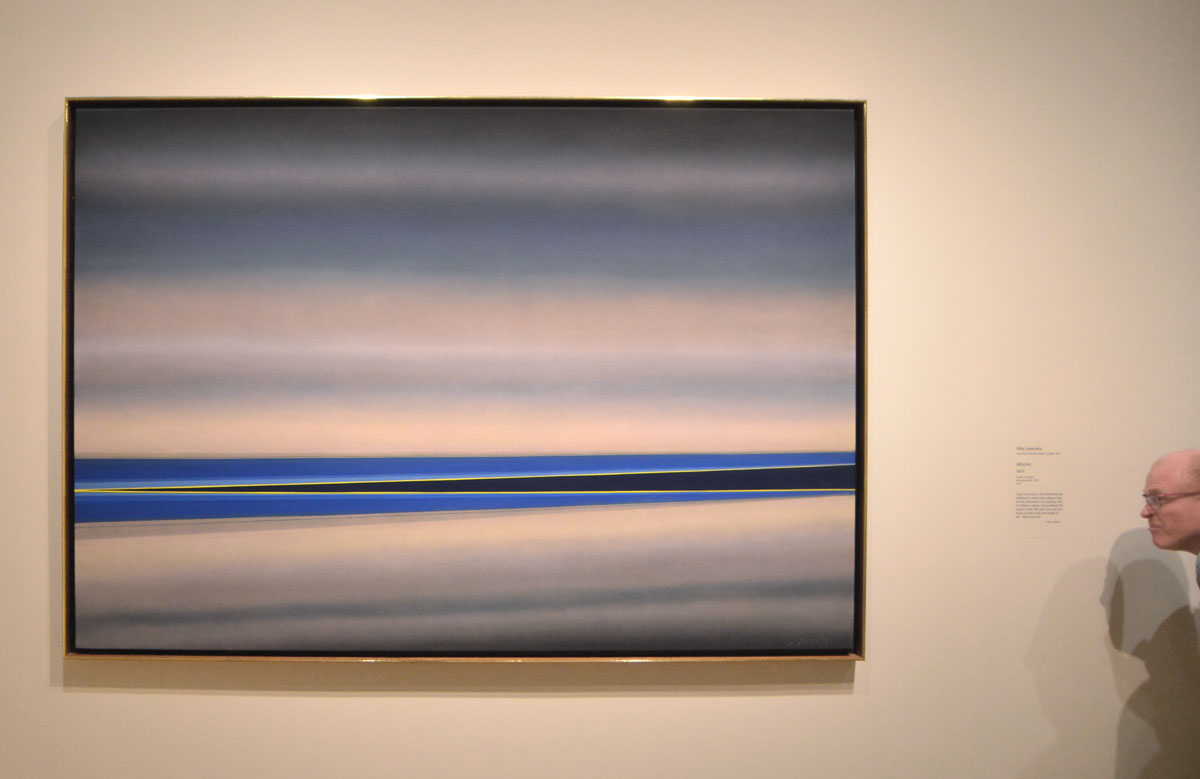
below: More lines, this time its “Aforim” by Rita Letendre, 1975.  Which lines are parallel?  Is there a horizon line?  If so, which one is it?

horizontal lines, some parallel and some at slight angles, in blues and greys, painting on a gallery wall called Aforim by Rita Letendre


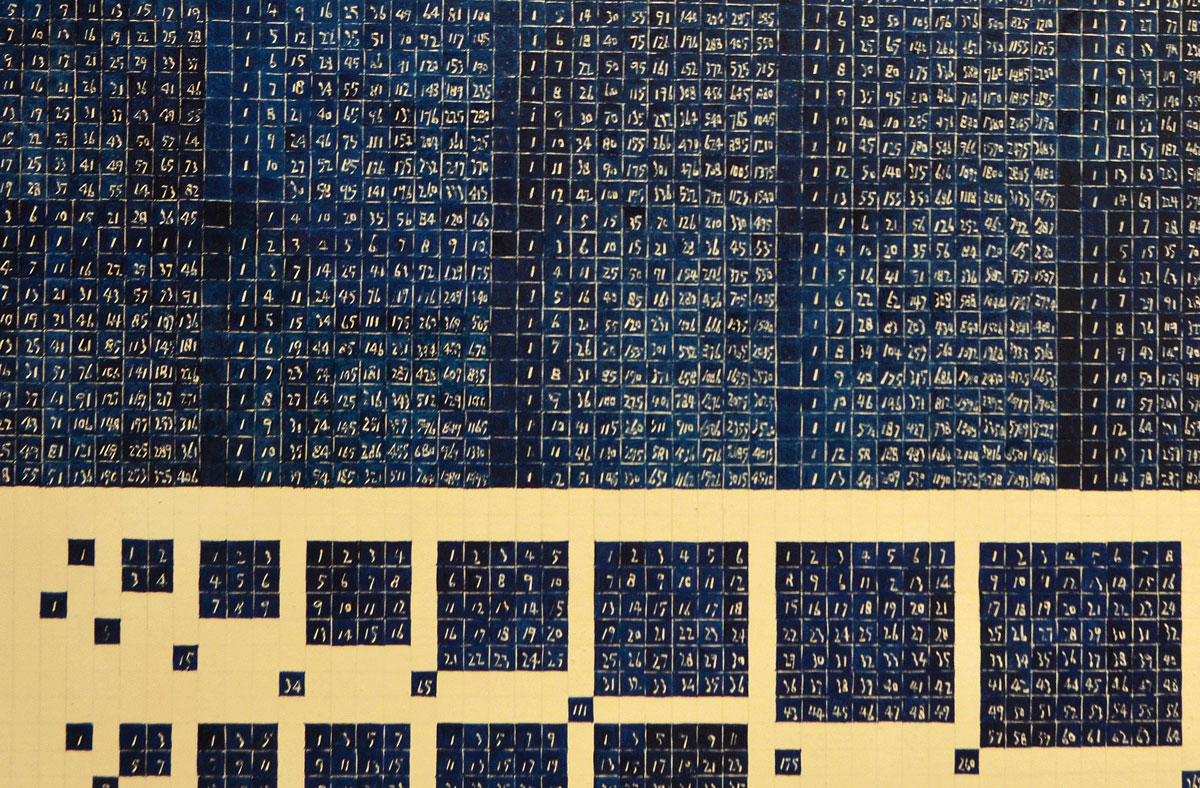
… And lastly, another reference to structure.  But not structure in the 3D, physical form, sense of the word.  Instead, it is a painting called ‘Number Structure II’ by Canadian artist Kazuo Nakamura (1926-2002).  Nakamura graphs out number-structure patterns and calculations and presents them as art.

below: One of the structures that Nakamura used was the Pascal Triangle.  This image shows the first 6 lines of the triangle.  Each number is the sum of the two numbers above it.  Can you figure out what the next line would be?   When expanded, it contains many number sequences and can be used to answer probability questions – as well as other mathematical things that I don’t understand.

the top 6 lines of pascals triangle, a mathematical structure of numbers

below: A small (maybe 1/8th) section of the painting … which unfortunately doesn’t give you much of an idea as to the composition of the artwork.  It does though give you an idea of the detail.  Some of the parts that I have omitted are triangle shapes that conform to Pascals triangle as pictured above.   Is it mathematics?  Is it art?  Where do you draw the line between the two?  Is there a line?

a detail picture of a painting by Kazuo Nakamura called Number Structure 2 which is based on Pascal Triangle. Lots of numbers written in white on blue and black background. the background is made into rectangles, squares and triangles.

It’s the kind of painting that a photograph can never do justice to.  It’s best seen in person.   Oh yes, the answer to the question above:  The next line of the triangle would be: 1, 6, 15, 20, 15, 6, 1.

First I heard a rumour that the Art Gallery of Ontario was going to remove that sculpture from the corner of Dundas & McCaul, you know, the one that everyone climbs on and takes their picture with, the one near the AGO entrance.

Then I read about in a newspaper.

You know, that curvy bulky slippery thing by Henry Moore, the one with a title that’s almost as shapeless as the sculpture, “Large Two Forms” although no one calls it that.   Oh, what do they call it anyhow?

Then I read about it online.

people are walking on the sidewalk, a woman is sitting by a sculpture by Henry Moore, the Art Gallery Of Ontario is beside the sculpture, street and other buildings in the background, street scene,

It’s sat on that corner since 1974.  That’s 42 years.  Longer than the average Torontonian has been alive.
Can you say synonymous? …. as in synonymous with the corner of Dundas and McCaul.

Apparently it’s going to be moved to Grange Park.  That’s the park behind the AGO, the one that is being renovated.

The expression “Rob Peter to Pay Paul” comes to mind.
How about new public art for a renewal of the park?

fence around a construction site, a park that is being renovated

fence around a construction site, a park that is being renovated, the blue wall of the Art Gallery of Ontario is in the background.

But walking the site and looking at the plans made me start to think.  The sculpture is being moved into its own space in the park and as I looked at the drawings and the artist rendition of the future space, it dawned on me that the redesign of Grange Park was possibly (probably?) done specifically to accommodate the sculpture.  The Art Gallery owns Grange Park after all.  Toronto does a lousy job of placement of their public art so maybe I shouldn’t complain about this?

Maybe.

As I tried to take photos of the sculpture where it is, I was reminded of how the streetscape in Toronto gets short shrift.

blog_art_gallery_corner

Henry Moore competes with old poles as well as bus shelters that are designed to maximize Astral Media ads.  At least there isn’t a ghastly trash bin beside the sculpture.  And at least the art is solid enough and strong enough to hold its own.

But this is going to be a problem for any artwork that gets put on that corner.
Oh dear, assuming that something will replace Henry Moore?

Don’t mess it up even more AGO, don’t leave the corner empty.
We have more of a cultural memory than you give us credit for.

A comparison of sorts.  Two painters from two different time periods.  One looked north and the other looks south.  The north with its barren cold and blue in comparison to the south and its lush greenness.  A famous anglo Canadian painter who went searching for simplicity and a relatively new British painter with Jamaican roots who explores complexities.

Lawren Harris and Hurvin Anderson.  You should know which is which!

I didn’t purposely set out to compare them.  I saw the ‘The Idea of North’ exhibit that features the Steve Martin paintings of Lawren Harris first.  As much as I like the Group of Seven, Harris’s minimalist snow and ice paintings have never been my favorite.  Still, it was an interesting collection to see.  After I finished there, I headed up to the contemporary art floors.  The fifth floor is still closed (new installation opening later this week) but I discovered that the fourth floor is devoted to the works of Hurvin Anderson.  As I walked around the Anderson installation I kept thinking of similarities and differences between him and Lawren Harris.

many people in a room in an art gallery, standing around and looking at paintings.

below: Mountains in Snow: Rocky Mountain Paintings VII, 1929.  One of the many famous Lawren Harris snow and ice paintings.  Light, reflected light, shadows, and contrasts.  The elements reduced to their simplest form.   The landscape itself is almost secondary.  Or the landscape is the medium, not the message.
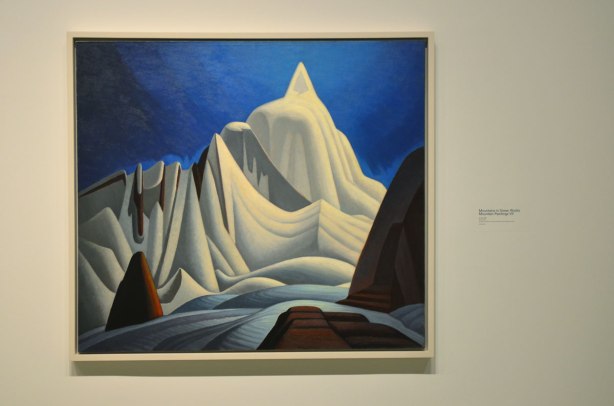
a Lawren Harris painting of a snow covered mountain, blue sky in the background.

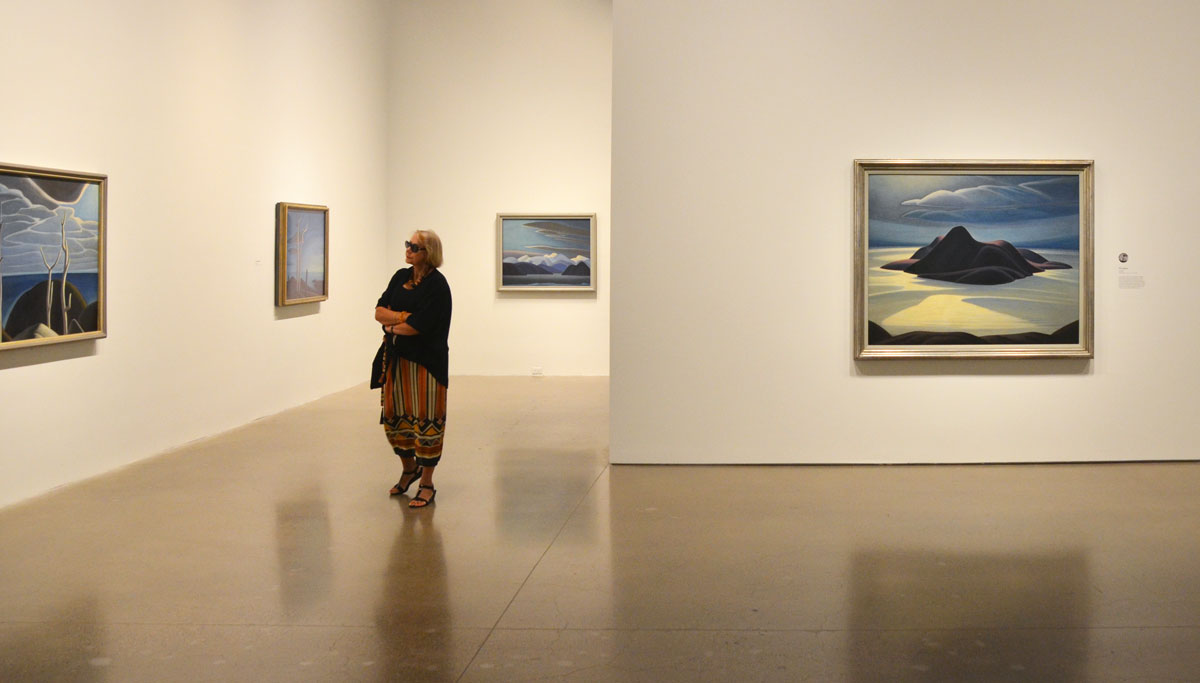
below: The large painting on the right is ‘Pic Island’ painted about 1924.  Pic Island is an unpopulated island along the north shore of Lake Superior.  Today the island is part of Neys Provincial Park.
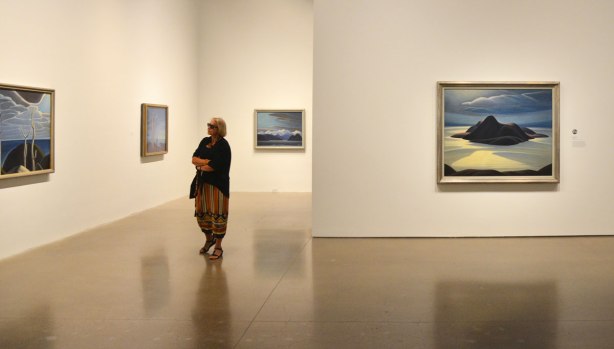
a woman walks through a gallery with paintings on the wall. She stops to look at one of them.

below: Two of Hurvin Anderson’s paintings from his Caribbean landscape collection.  On the left is ‘Beaded Curtain – Red Apples’, 2010.

three young women sitting on a couch with their backs to the camera, they are looking at two large paintings on a wall, by Hurvin Anderson.

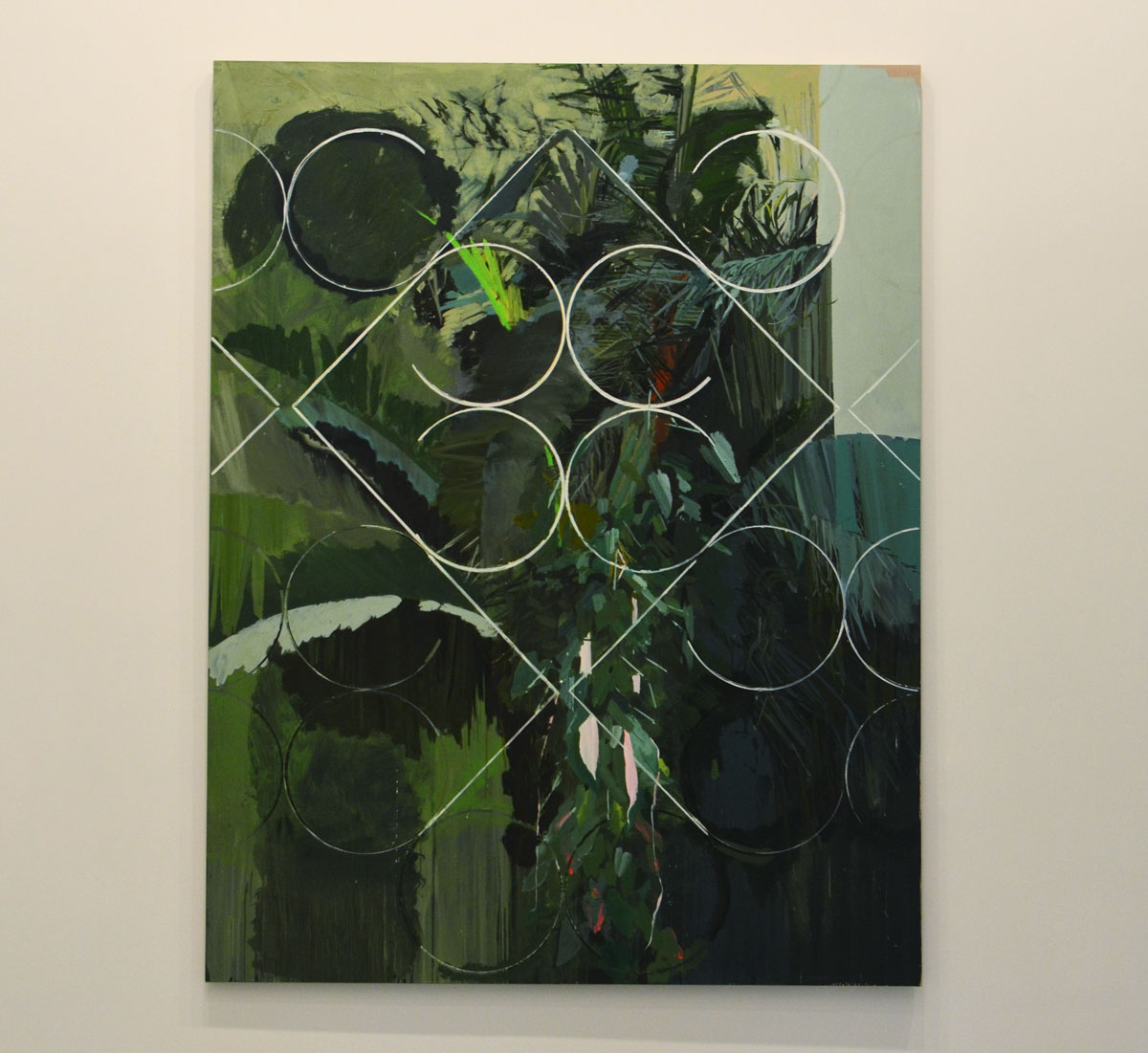
below:  ‘Constructed View’, 2010.  Anderson’s Caribbean paintings have grilles incorporated into them.  These are the security features prevalent on houses and businesses in the Caribbean (and elsewhere in the world), metal fixtures over windows and doors to keep out the unwanted.  They contain what’s inside.  They are a barrier.  They intrude on the landscape and cut it up.  Again, the landscape is almost secondary.  The message, or emotion, is more important.  [aside – There is a grille in the painting above (right) but it’s more subtle.]

a landscape painting in shades of green with fragments of white grille overlayed, repeating pattern of 4 circles with a square

Lawren Harris painted his famous mountain pictures in the late 1920’s.  In 1930 he visited Baffin Island and a few paintings resulted from that trip.  I learned that although I associate Harris with icebergs and arctic scenery, most of his snow and ice paintings were from the north shore of Lake Superior or from the mountains around Banff Alberta.

The repetoire of both painters is not limited to landscapes.  Harris painted many houses and street scenes from downtown Toronto including houses and streets that were demolished years ago.  The examples of Anderson’s non-landscape work were interiors.  Both men used bold colours but Anderson tends to show more detail in his paintings.

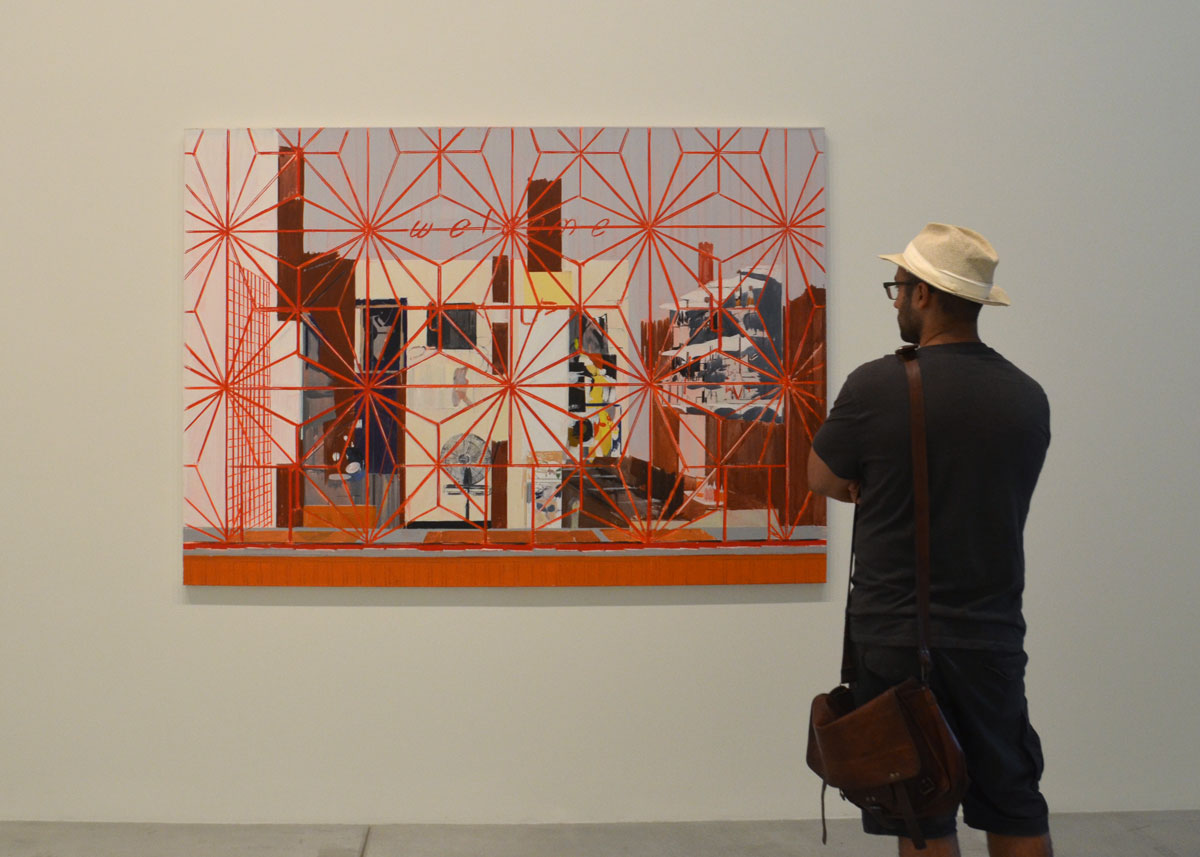
below: ‘Welcome: Carib’  The Welcome sign of the bar in  juxtaposition with the red metal work covering the window.  The picture beckons to us but keeps us out.
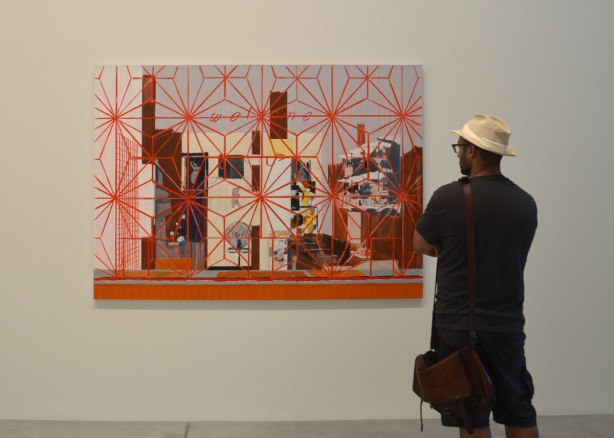
a man in a straw fedora stands in front of a painting called Welcome: Carib by Hurvin anderson, it features a red star patterned grille over the painting, over the window that is in front of the interior scene.

below: One of the paintings from Anderson’s Barbershop collection, ‘Flat Top’ 2008.

two young women walk away from a large painting hanging on an art gallerywall.  two barber chairs in a barber shop, empty.  Bright pink wall with squares of colour.

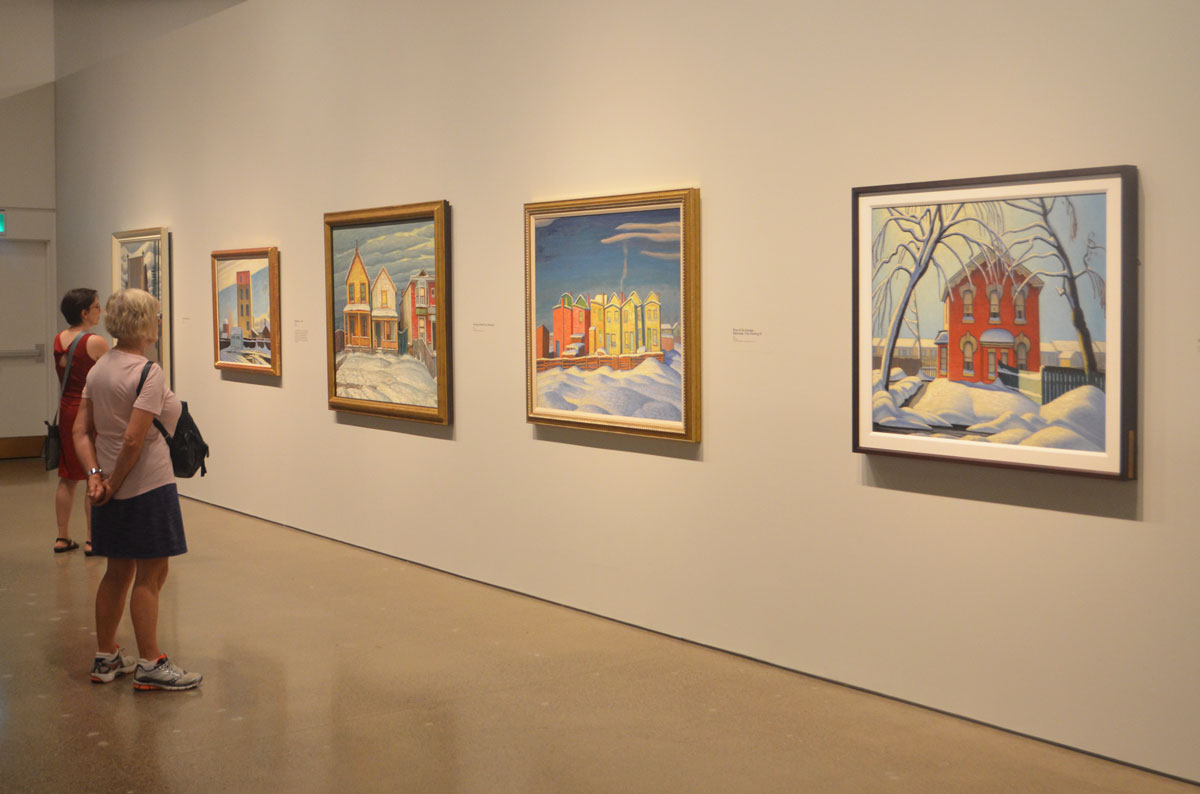
below: A selection of colourful Toronto houses in winter painted by Harris in the 1920s.
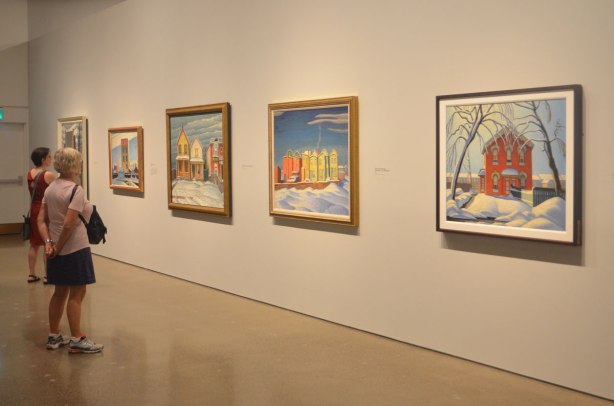
two women look at a line Lawren Harris paintings of brightly coloured houses in winter on a wall in an art gallery

In the 1930’s Lawren Harris’s personal life went awry.  The words on the wall at the AGO says that he divorced, remarried and moved to the states.  That’s a bit of spin.  He didn’t divorce his wife because that would be messy, apparently.  Instead in 1934 he just married the wife of an old friend.   And of course that turned messy and the new couple left for the USA for a few years before eventually settling in Vancouver BC.   Harris’s post-1934 work is very abstract and was never as successful as his earlier paintings.

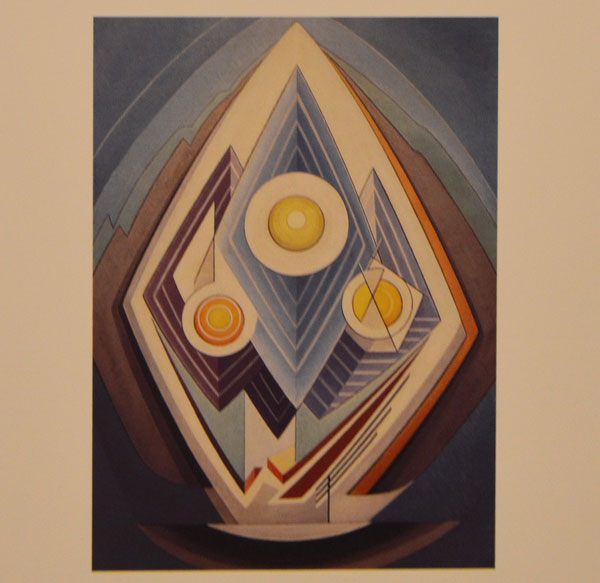
below:  You can see the influence of the mountain paintings in this,  ‘Painting No. 4’, about 1939, painted when he was a member of the Transcendental Painting Group.  This was a collective of artists in New Mexico that Harris help to found.
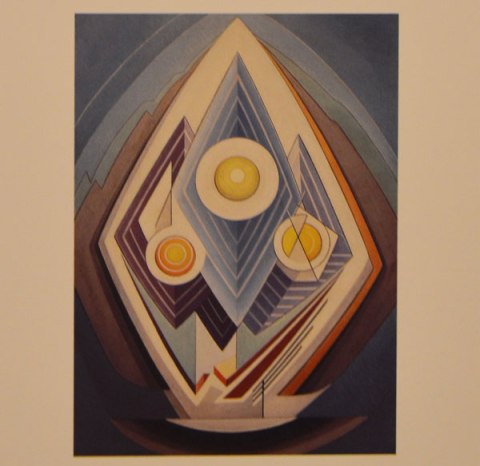
an abstract painting by Lawren Harris, circles and diamonds in an egg shape

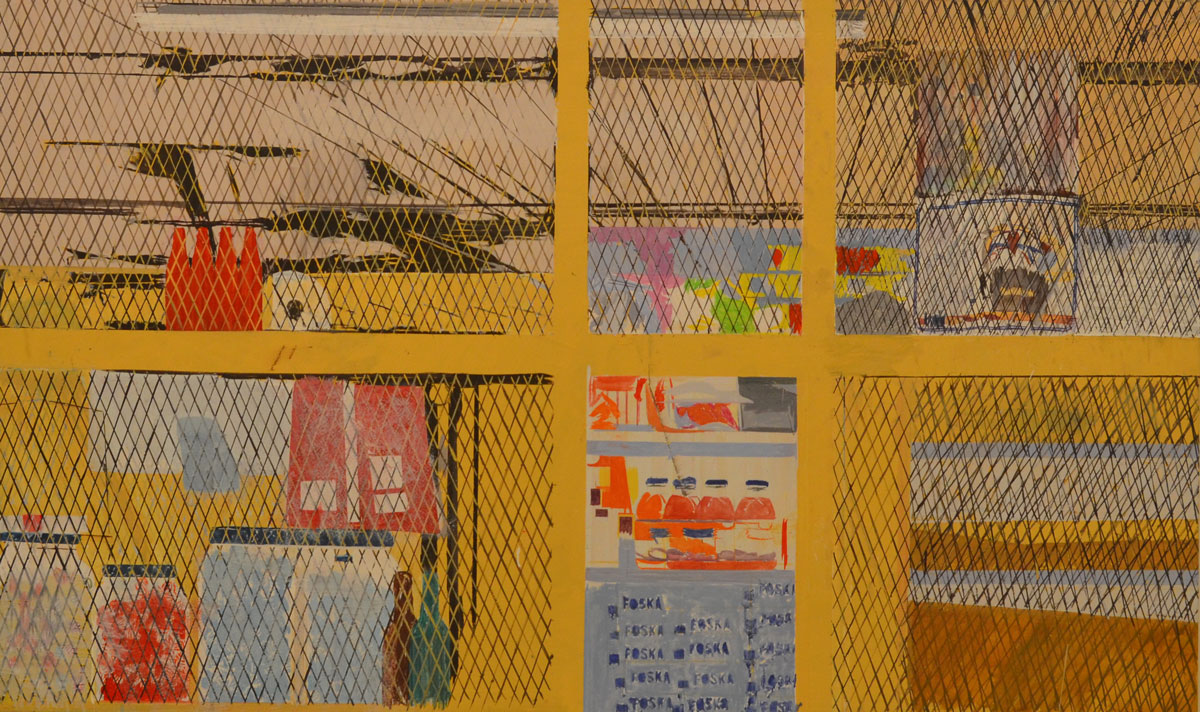
below: Since I have no idea where the art of Hurvin Anderson is headed, I will leave you with one more of his present paintings (I’m not sure those two ideas actually go together!).  ‘Foska Foska’, the interior of a shop behind yellow bars and black mesh.
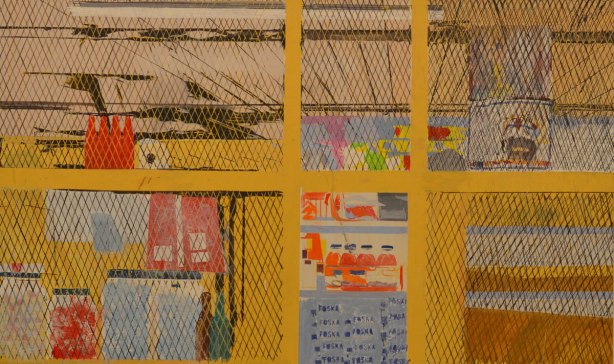
a painting by Hurvin Anderson called Foska Foska, shows the interior of a store with a yellow metal gate in front.  and a wire structure covering the ceiling too


The Idea of North – until 18 September

Hurvin Anderson – until 21 August

#HarrisAGO | #HurvinAndersonAGO

Wisdom of the Poor: Communal Courtyard,
an art installation by Chinese artist Song Dong,
Art Gallery of Ontario

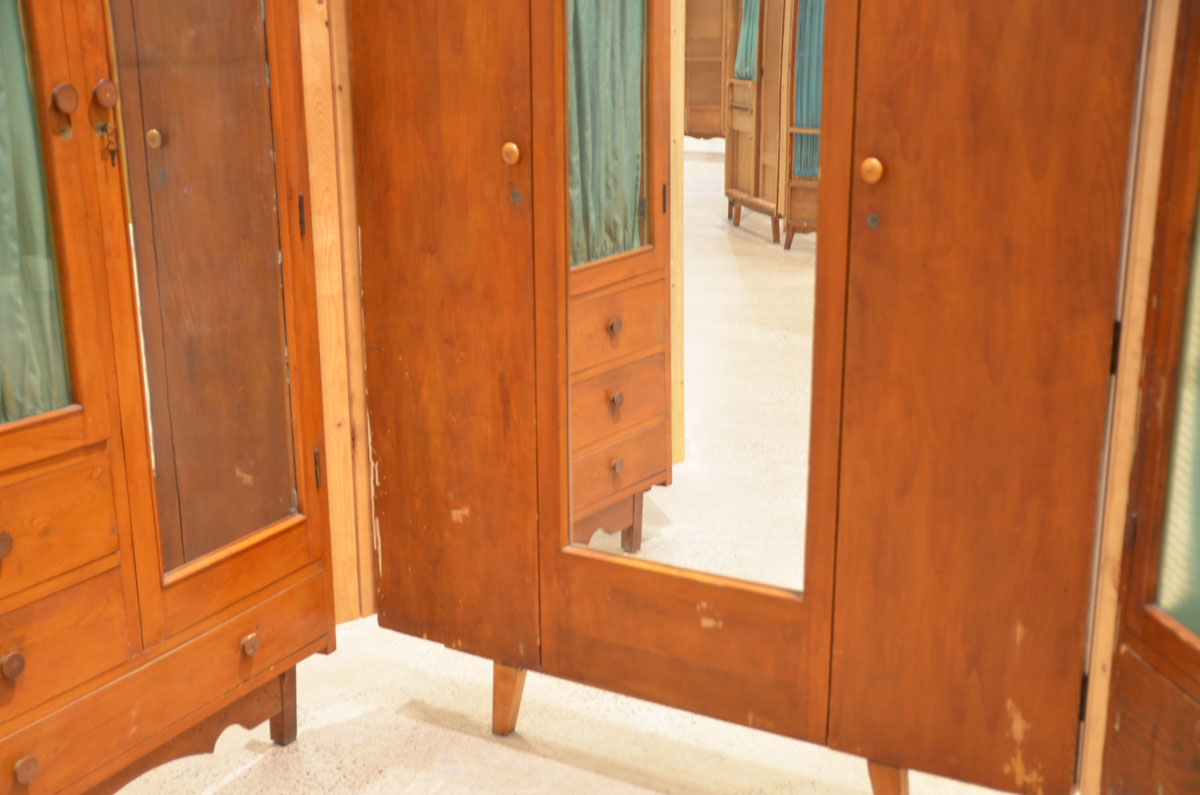
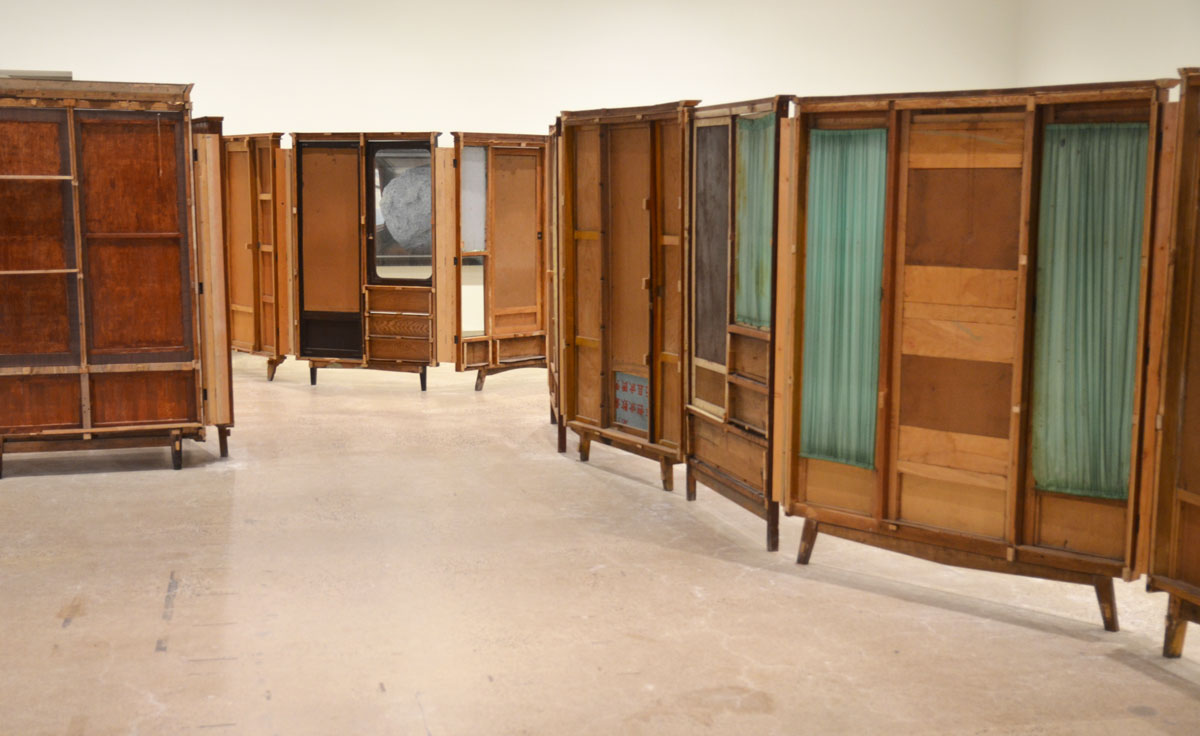
This installation is made from parts of 100 old wardrobes collected from traditional Beijing neighbourhoods, or hutongs, like the one in which Song Dong grew up in.  These neighbourhoods, and their communal way of life, are disappearing.


part of an art installation by Chinese artist Song Dong using vintage wooden wardrobe doors with mirrors and curtains, reflections
The pieces of the wardrobes are arranged with the backside towards the viewer.  The arrangement is such that you can not see the front side of most of the wardrobes.

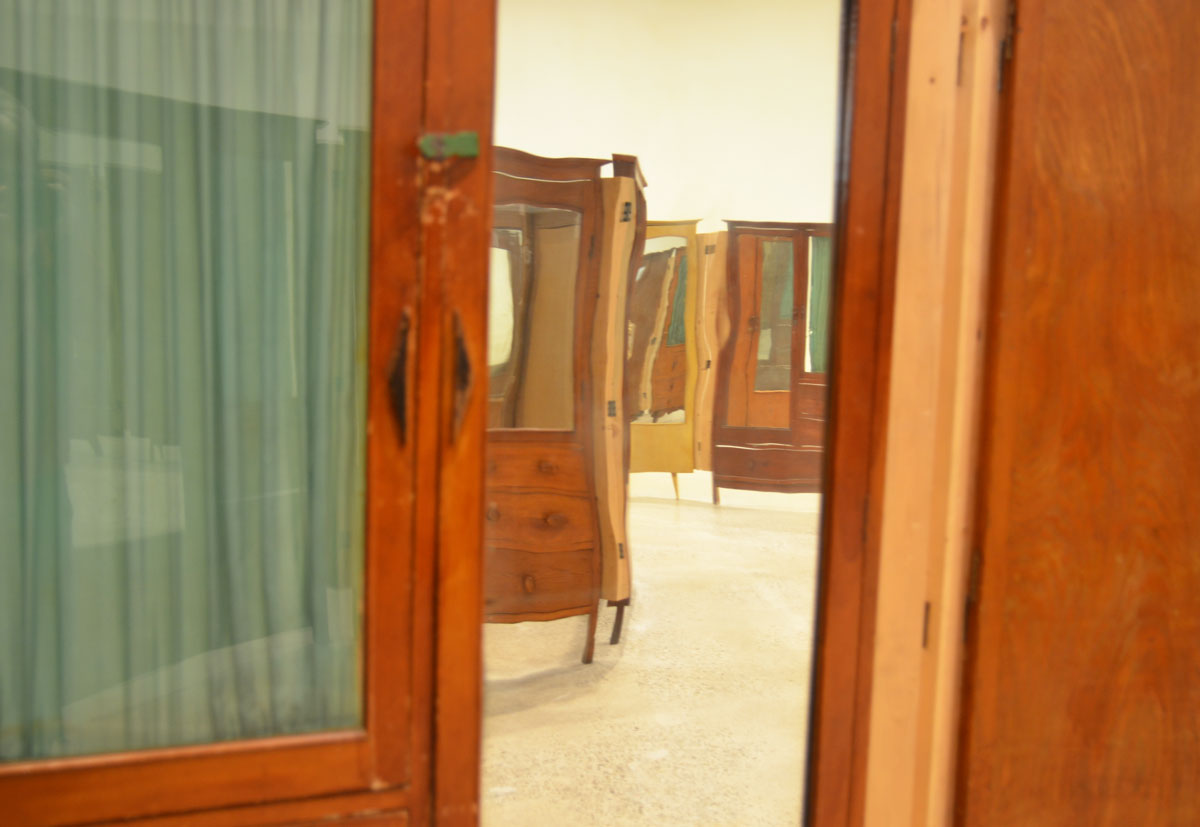
part of an art installation by Chinese artist Song Dong using vintage wooden wardrobe doors with mirrors and curtains, reflections
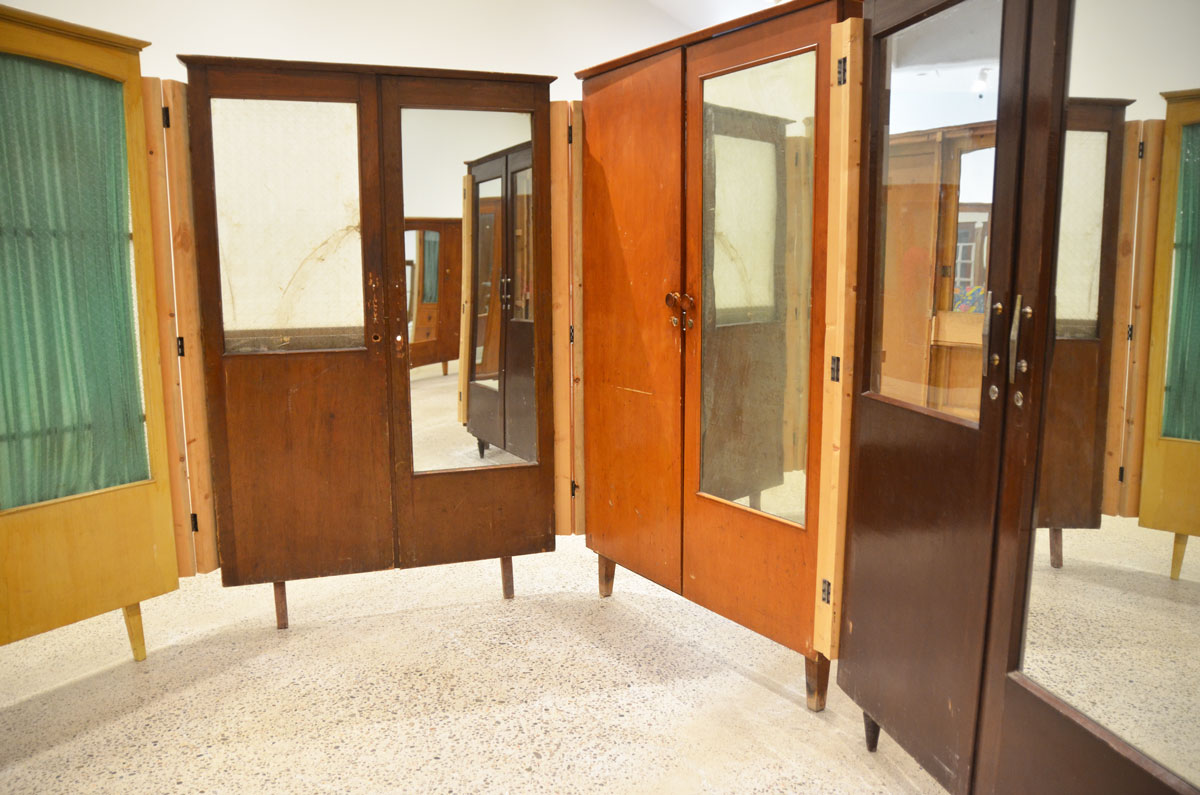
There are two circles of wardrobes that you can enter – where you can now stand in the courtyard so to speak.   The wardrobes become stand-ins for the fronts of houses that once faced onto courtyards in the old hutongs of Beijing.

part of an art installation by Chinese artist Song Dong using vintage wooden wardrobe doors with mirrors and curtains, reflections of a foot in one of the mirrors
A wardrobe was one of the items that the Chinese government provide to all families.  They are all similar yet different.  All have mirrors.  Most are made of the same colour wood and most have green curtains.  They all have little legs and they are all about the same height.
part of an art installation by Chinese artist Song Dong using vintage wooden wardrobe doors with mirrors and curtains, reflections
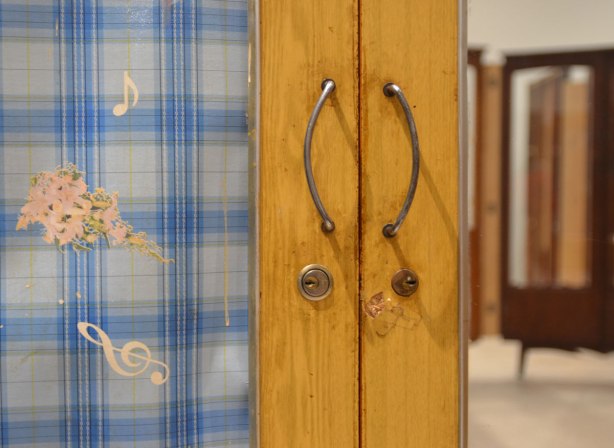
Wardrobes are personal articles and former owners have left their marks on many of them…. a different fabric in the window or a picture glued onto the wood.
part of an art installation by Chinese artist Song Dong using vintage wooden wardrobe doors with mirrors and curtains, reflections, door handles, key holes and a curtain that is a blue and white plaid and has musical notes on it.

part of an art installation by Chinese artist Song Dong using vintage wooden wardrobe doors with mirrors and curtains, reflections, wardrobes arranged in a curved shape
part of an art installation by Chinese artist Song Dong using vintage wooden wardrobe doors with mirrors and curtains, reflections

This installation also appeared in the Venice biennale in 2011 although the wardrobes were arranged differently.  For the exhibit at the AGO, there are a number of items that appear within the ‘courtyards’ created by the wardrobes.  For the viewer, these items can only be viewed through the windows of the wardrobes.  One of the items, below, is a series of three paintings of the Canadian ballerina Karen Kain.

part of an art installation by Chinese artist Song Dong using vintage wooden wardrobe doors with mirrors and curtains, reflections. through one of the windows there is a painting of Karen Kain on the wall

In another, bikes

part of an art installation by Chinese artist Song Dong using vintage wooden wardrobe doors with mirrors and curtains, reflections, through two of the windows there is a bike

part of an art installation by Chinese artist Song Dong using vintage wooden wardrobe doors with mirrors and curtains, reflections, door knobs and frosted glass and a white curtain

This installation remains at the AGO until 17 July 2016

Marys in Toronto 
It has become one of the things I do – I look for ‘Marys’ when I travel.  For one reason or another, I started seeing Marys in Toronto too.  Perhaps it was because I spent more time in galleries and museums on those really cold days that we had last winter.    There aren’t nearly as many Marys here as there are in Lima Peru or in Malta.  Hence, finding them was a bit more difficult but that just made the hunt more interesting.

below: In the window of Sonic Boom on Spadina

A picture of Mary and Jesus in a store window. Jesus is depicted as a middle age man.

below:  a sculpture of Mary and Jesus,  from the Gardiner Museum

ceramic (or glazed terracotta?) sculpture of mother and child, Mary and Jesus.

below: ‘The Dormition of the Virgin’ by Esteban Marquez De Velasco (c.1655 – 1720, Spain).
This painting is in the Art Gallery of Ontario.  It depicts the moment before Mary falls asleep and her soul leaves her body to join Him in heaven.  The apostles surround Mary and kneel in prayer.

A close up of a painting. A young woman, the virgin Mary, is sitting up in bed, her right hand over her heart and her eyes raised to heaven. A man is standing to the right, his eyes also looking up to heaven. Men reading books are to her left.

below: ‘Madonna and Child’ by Andrea Della Robbia (1435-1525, Florence Italy).
Glazed terracotta. On loan to the AGO from the family of Murray Frum.

A white porcelain relief sculpture on a reddish wall. Mother and child, Mary and Jesus.

below:  In front of St. Clare Roman Catholic church on St. Clair Ave. West

White statue of Mary and Jesus outside a church, a vase of red and white flowers is beside her feet. The words Sancta Maria Mater Dei are on a bronze plaque under the statue.

below: In the window of Crows Nest barber shop, Kensington Market

 A figurine of the Virgin Mary with her light blue shawl stands piously in the window of a barber shop. The building is painted a light blue colour.

below: Figurines for sale at Honest Ed’s

seven figurines of Mary painted with long white, light blue and gold robes. They are about 20 cm high, all with downcast eyes except the one on the left looks like she's looking at the camera.

below: Holographic cards with images of Mary Jesus in a red plastic tub.
You can buy a card at Honest Ed’s for 69 cents.

postcards with holographic images of Mary and Jesus.

below: Sagrada Familia, by the front door of a house in Little Portugal

A ceramic plaque of Mary, Joseph and Jesus on the exterior wall of a house beside the front door and above the mailbox

below:  Hiding amongst the drapery sits Mary and her child.

from the outside, the lower part of a window with white shutters and a stone window sill. Lace curtains are in the window and a statue of Mary and Jesus is inside.

below: Another from the AGO,  Virgin and Child from circa 1750, once in a chapel of a Montreal church.
Wood with traces of pigment.

 In the Art Gallery of Ontario, a wooden statue of Mary holding baby Jesus. Behind the statue is a large painting of the fire in Quebec City in the 1700's.

Wooden statue of Mary standing while holding a baby Jesus.

below: Mount Pleasant cemetery

close up of part of a tombstone in a cemetery showing a small relief sculpture of Mary, Joseph and Jesus

below:  On an ofrenda at a Dia de Muertos celebration

a statue of mary with pink candles on either side of her. A yellow day of the dead paper cut out is behind her. Strings of yellow, orange and pink flowers are also on either side of her.

below: Radio Maria, una voce cristiana nella tua casa, part of the Holy Mother World Networks.

entrace to a small red brick building with a two signs, one over the door and one beside the door, for Radio Maria.

below: With other members of the Nativity scene, for sale in a vintage store on Queen West.
I think that $20 buys you the contents of the box.

ceramic figures of the Nativity scene, Mary, Joseph, baby Jesus, etc. They are lying in a box that is for sale in a store.

below: In a front yard in the Junction
I’ve put her at the end because I am not 100% sure that she is a Mary. The Virgin Mary is usually depicted with a light blue shawl draped over her shoulder or else holding a baby Jesus.

A small white statue of Mary on a makeshift pedestal in a front yard. Early spring, bare rose bush branches, a couple of small white planters with flowers in them. A white metal railing on the front porch.

And here ends that game.  This post represents almost a year’s worth of looking and while the hunt was interesting in the beginning it’s charm is starting to wear thin.   I could probably find more Marys in churches and cemeteries but I think I will listen to words of wisdom and let it be.

The title of the exhibit is ‘Surrender’ and the words on the wall say this:

“Liz Magor’s art invites us to reconsider our relationships with the things we encounter every day.  Through subtle shifts in materiality and context, her works reveal the important role that objects play in our lives: they can allow us to conceal ourselves or to express our identities.  In her sculptures and photographs, Magor explores how we depend on domestic materials to develop a sense of self.”

Nothing is mentioned about surrendering, or why the exhibit has the title that it does.

In the first room there are boxes on the wall.  Each box looks like a carefully wrapped sweater or jacket that has just been purchased.  I can envision a middle aged saleslady taking her time to package your purchase, like in an Eatons store thirty or forty years ago.

art installation at the Art Gallery of Ontario by Liz Magor - two walls with many open boxes on them. The boxes are made to look like they've just been opened to reveal a sweater or top folded neatly inside, including the tissue paper that often accompanies a new purchase. The clothes have all been decorated with different objects.

On closer look, most boxes also have a hand print, or shape of a hand with index finger pointing at something and little details are amiss…  a ketchup package for example.

blog_liz_magor_cornhuskers

The second room has a number of smaller installations.

A garment bag left over a chair.
Neatly folded blankets hanging on a wall.
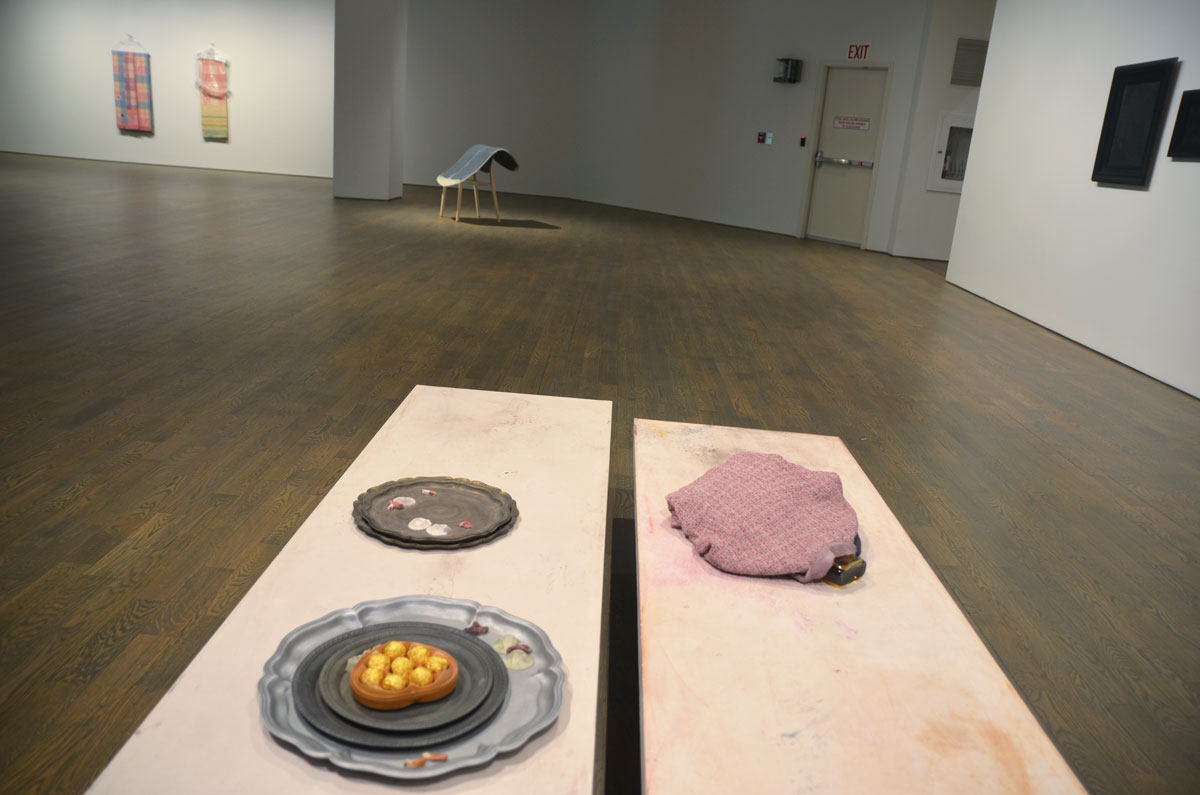
A platter of chocolates and left overs.
A tweed jacket on top of a liquor bottle.

art installation at the Art Gallery of Ontario by Liz Magor - in the foreground are two long narrow tables. On one of them is a platter with chocolates and a platter with the remains of cheese and crackers.

A husky under a blanket (of snow?  on a bed?)
A coat and purse hanging on a hook.
The contents of a room boxed and ready to move.

art installation at the Art Gallery of Ontario by Liz Magor - 3 pieces. First, a pile of moving boxes and other items that look like they are in the midst of getting ready for the movers. Second, a large white blanket bed sized that has a hole in the middle of where the pillows should be but instead there is a wolf curled up inside the whole. Third, what looks like a jacket hanging from a hook on the wall

art installation at the Art Gallery of Ontario by Liz Magor - two hangers with plaid blankets folded over them hanging from hooks on a wall. One of the blankets has a clear plastic Creeds bag over the top part of it

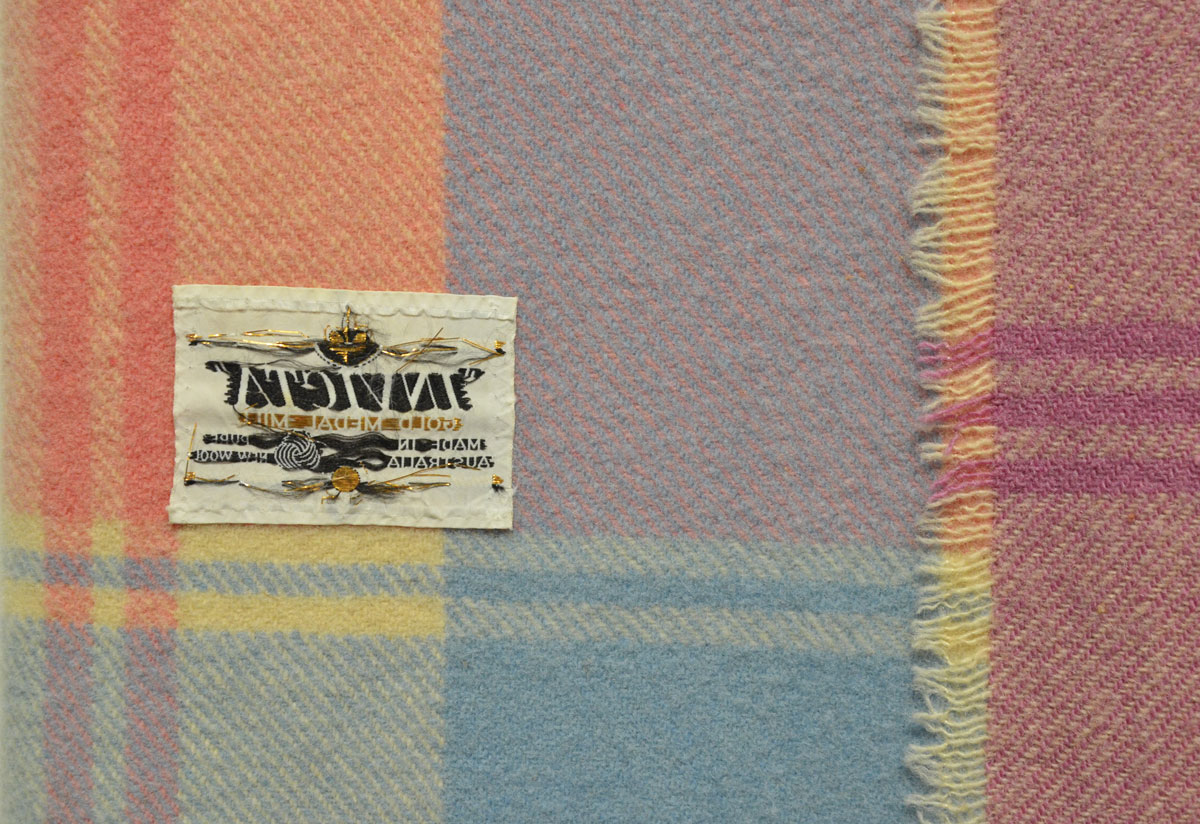
On closer look, some of the details on the blankets are wrong
including the labels that are sewn on back to front.

The label on a plaid blanket is sewn on backwards so that the writing on the label faces the blanket.

I was interested in what people’s reactions were to this exhibit so I had a chat with a couple of the employees about it.  According to them,  there was no reaction.  Most people showed interest in the boxes but when they walked into the second room they rarely stopped to take a closer look.

blog_liz_magor_rose

As for surrender, I did find reference to it in the description of the exhibit on the AGO website, ” In this exhibition, everyday objects and forms, as well as the natural world, function allegorically by evoking the human need to surrender to desires, compulsions, fantasies.”  Once again, I will leave it to you to decide if this description fits.

Exhibit continues until 29th November.

Camera Atomica
a photography exhibit at the Art Gallery of Ontario

below: The first photograph of the bones of the hand, by Wilhelm Rontgen in 1895.    Rontgen was a German physicist who discovered x-rays (or Rontgen rays) in 1895 and he produced this image of his wife’s hand shortly after.  The green in the picture below is a reflection of the chandelier that the AGO has hanging in the room where this exhibit is being shown.

An xray picture of a hand.

The exhibit consists of more than 200 works that all fall under the category of nuclear – topics such as atomic weapons, Cold War politics, nuclear energy, and the mining of uranium.  The photographs cover the history of these topics from 1945 to the present, from the development of the atomic bomb to the meltdown at Fukushima Daiichi in Japan in 2011.

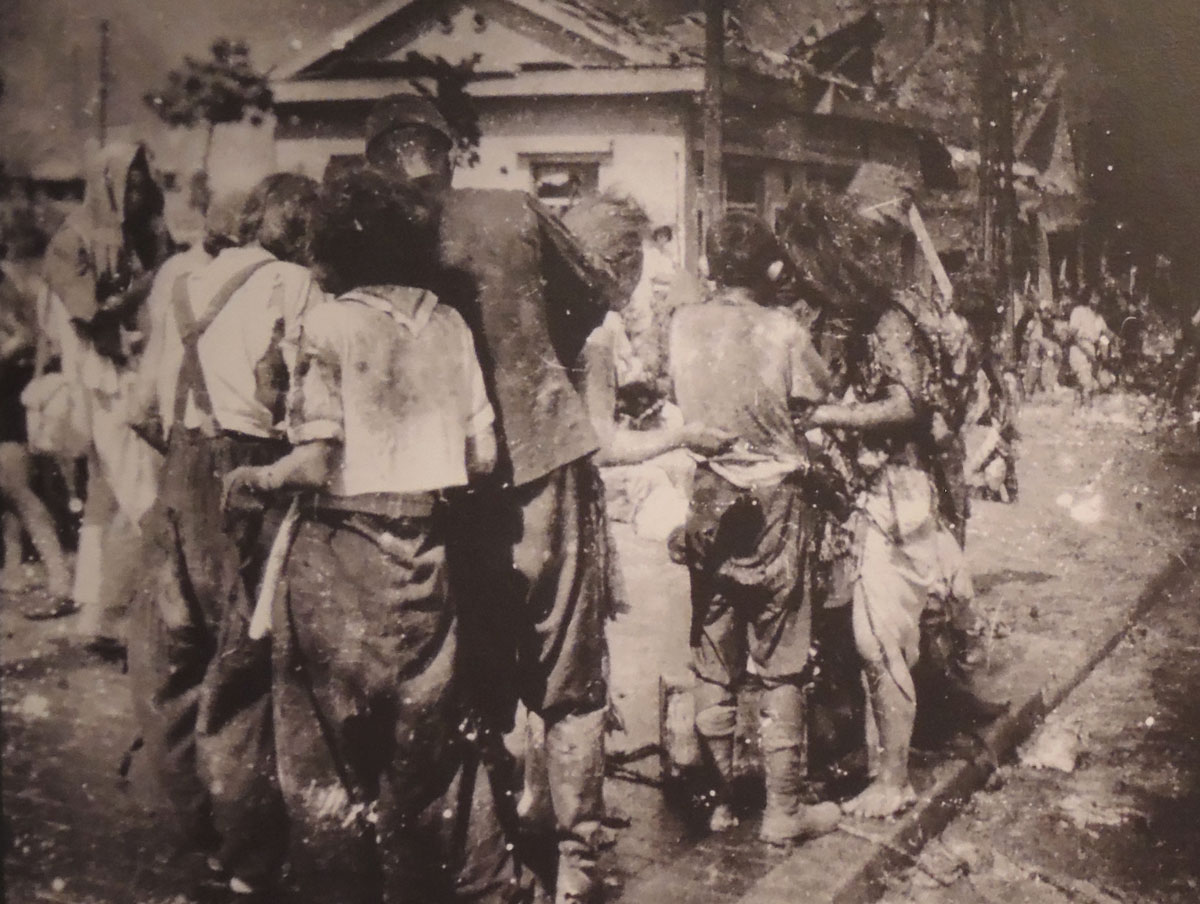
below: Hiroshima Japan, photo by Yoshito Matsushige, taken 6 August 1945.
The first atomic bomb was detonated at the Trinity test site in New Mexico USA on 14 July 1945.  Shortly after, American bombers dropped two atomic bombs on Japan.  The first bomb was dropped 6th August 1945 on the city of  Hiroshima and second one three days later on Nagasaki.

An old black and white photo taken in Hiroshima after the dropping of the atomic bomb during WW2

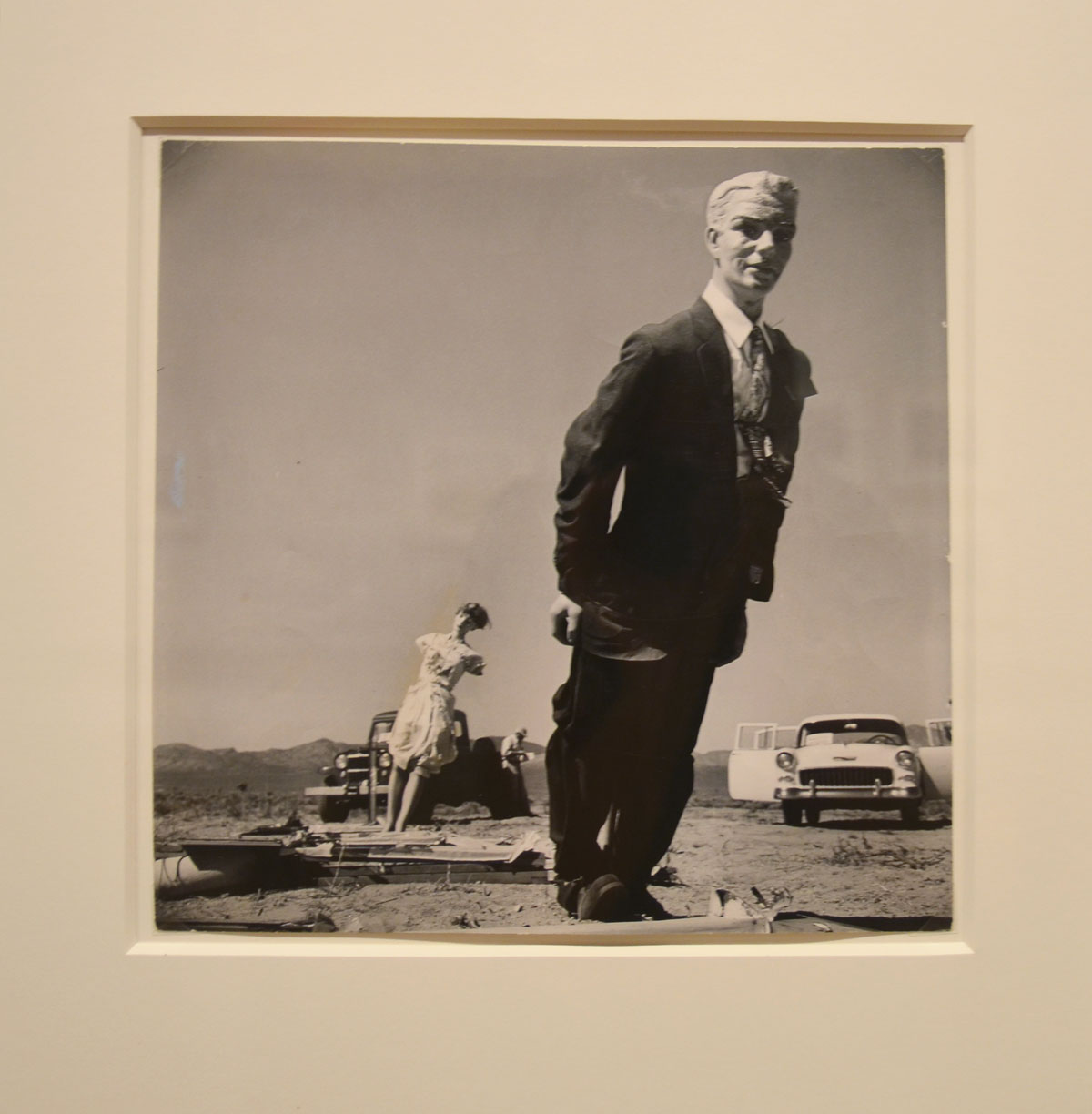
below: Photo by Dean Loomis, 7 May 1955 of scorched male mannequin standing in the desert 7,000 feet from the 44th nuclear test explosion at Yucca Flat Nevada.  Photo taken the day after the blast.  Apparently mannequins were used to test the effects of the nuclear blasts on people and this photo shows that people at 7000 feet from a blast could be burnt but alive.

Picture of a black and white silver gelatin print from 1955 by Dean Loomis showing a male mannequin in a black suit who has been partially knocked over by a nuclear test blast in the Nevada desert.

below: Mushroom clouds on a wall

A collage of photos of nuclear blast mushroom clouds. There are about 25 colour and black and white photos hanging on a wall of the Art Gallery of Ontario

below:  Part of  ‘Uranium Tailings #2, Elliot Lake Ontario’ a photograph by Edward Burtynsky.

Eliot Lake was established in 1955 as a mining town after uranium was discovered in the area.  In the early 1990’s the mines closed because of depleted reserves and low prices for uranium.

Tailings are the materials left over after the valuable part of an ore has been removed.  The uranium ore found at Eliot Lake had very little uranium in it, only about 0.1% of the ore was uranium.

Close up of part of a photograph by Edward Burtynsky titled Uranium Tailings #2, Elliot Lake Ontario. It is a picture of a desolate swampy looking terrain where all the vegetation is dead. The trees have been reduced to dead poles.

below:  Inkjet prints by David McMillan, part of four on display from his series of photographs of places abandoned because of the Chernobyl disaster in 1986.   The photograph on the right is of the nursery at Pripyat Hospital taken in 1997.   Beside it is a picture of a classroom in a Pripyat nursery school.

Pripyat is an abandoned city in northern Ukraine.  It was built in 1970 to service the Chernobyl Nuclear power plant.  Following the explosion and fire at Chernobyl on 26 April 1986, the city’s 49,000 people were evacuated

Two photographs on a wall. The one in the foreground shows an abandoned hospital nursery in Pripyat Ukraine, abandoned after the Chernobyl nuclear disaster.

A young man is half squatting as he leans back to get a better look at the words on the wall of an art gallery that accompany three black and white photographs.

The exhibit continues until 15th November.

#atomicAGO

The fifth floor of the Art Gallery of Ontario is devoted to contemporary art.

Three of the present exhibits are best described as conceptual art.  Conceptual art is art where the idea is more important that the look.  The story behind the work trumps aesthetics.

This blog post has taken me many days to write as I struggle with the love hate relationship that I have with conceptual art.   My biggest complaint about conceptual art is that skill too often gets thrown out the window;  God forbid that something like artistic merit should impede the artist.  I can empathize with causes and I can support ideas without liking the end product.  In other words, just because I don’t the ‘art’ doesn’t mean I don’t “get it”.

Anyhow, on to the exhibits.

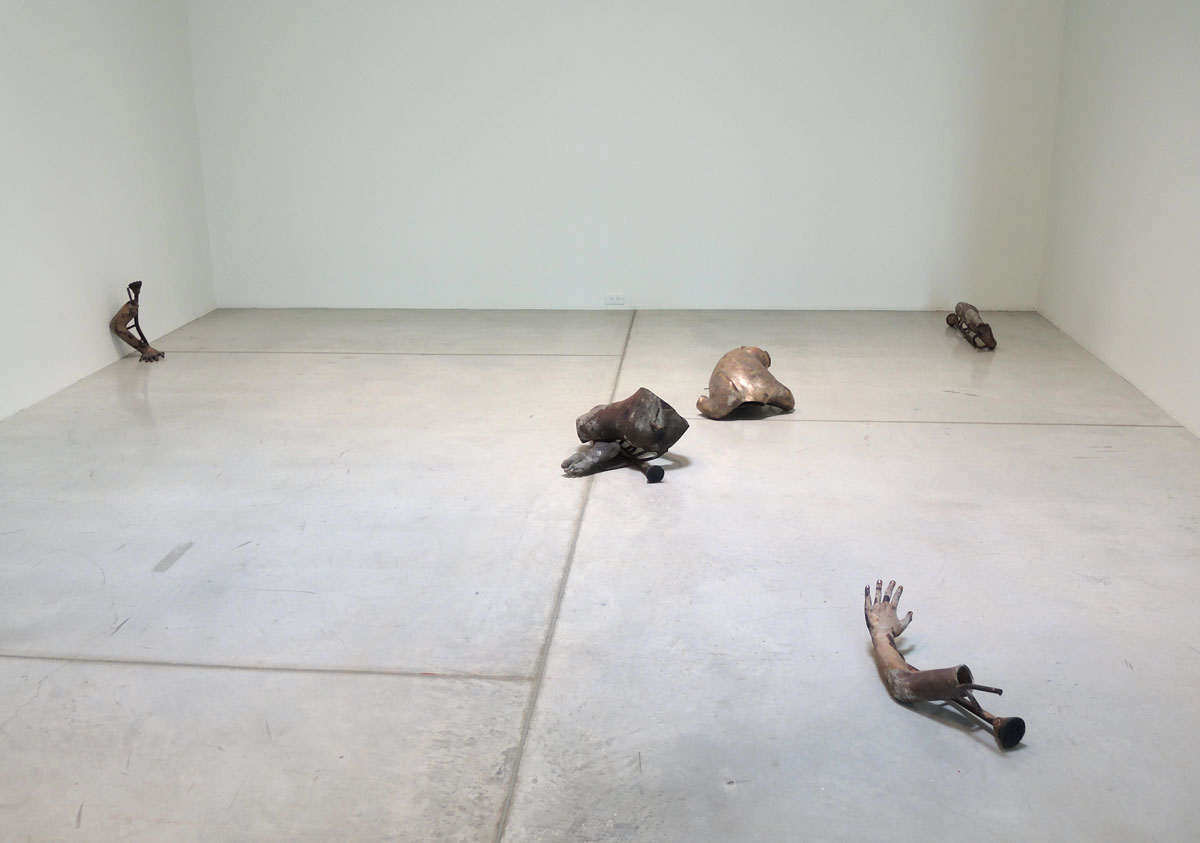
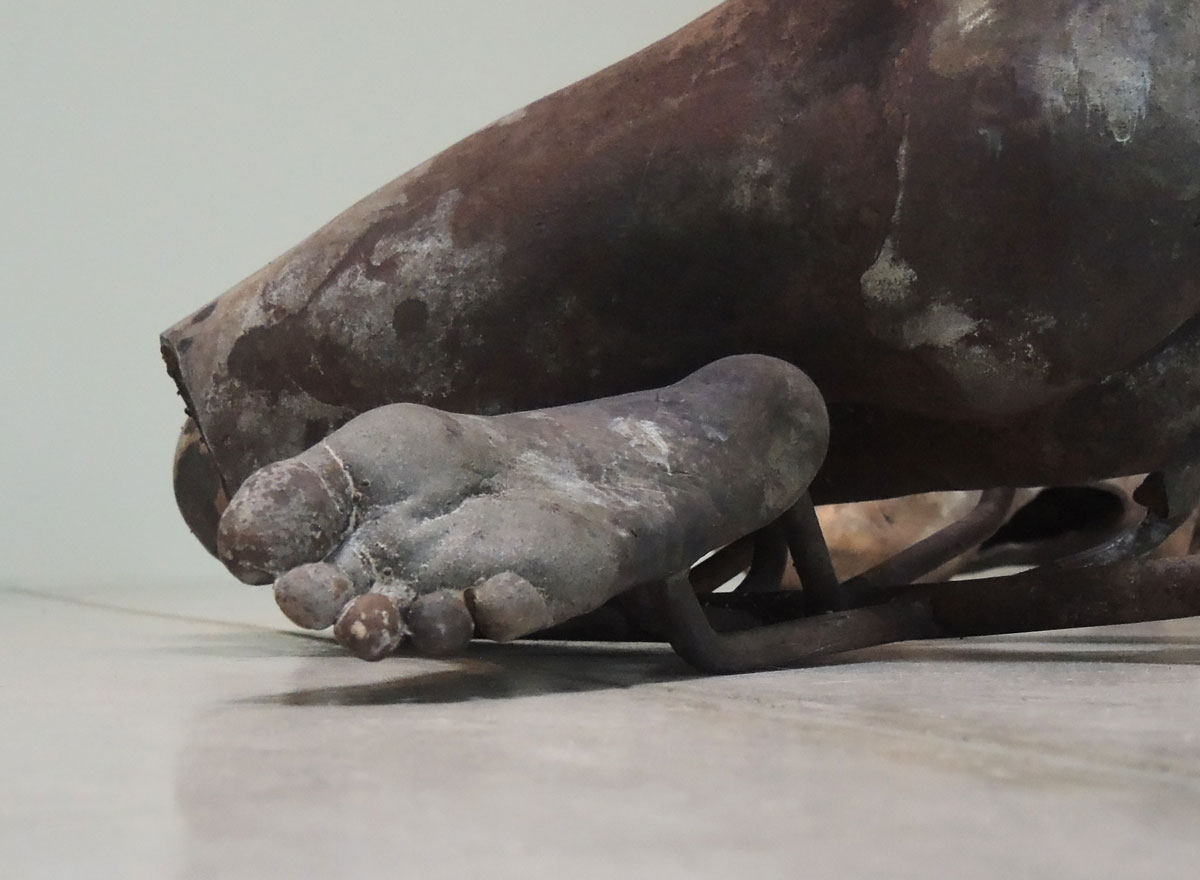
First, ‘Gustav’s Wing’ is an exhibit by Danh Vo, a man born in Vietnam but raised in Denmark.  Using his nephew as a model, Vo had a bronze of cast of the boy’s body made in six pieces.  The pieces are then arranged within a room.  “The resulting installation gives a fragmented and evocative portrait of a boy whose Danish and Vietnamese heritage echoes that of the artist, but who represents the next stage in the family’s story – that of the first-generation Danish citizen”, according to the description of the exhibit.

Looking into a white room, photo taken from the doorway, pieces of metal cast from a boy's body lie on the floor, scattered, part of an art installation at the Art Gallery of Ontario

Close up of a metal cast of a boy's foot. Part of an art installation by Danh Vo at the Art Gallery of Ontario

Three of the metal pieces from Gustave's WIng, an art installation by Danh Vo, pieces of body cast in metal

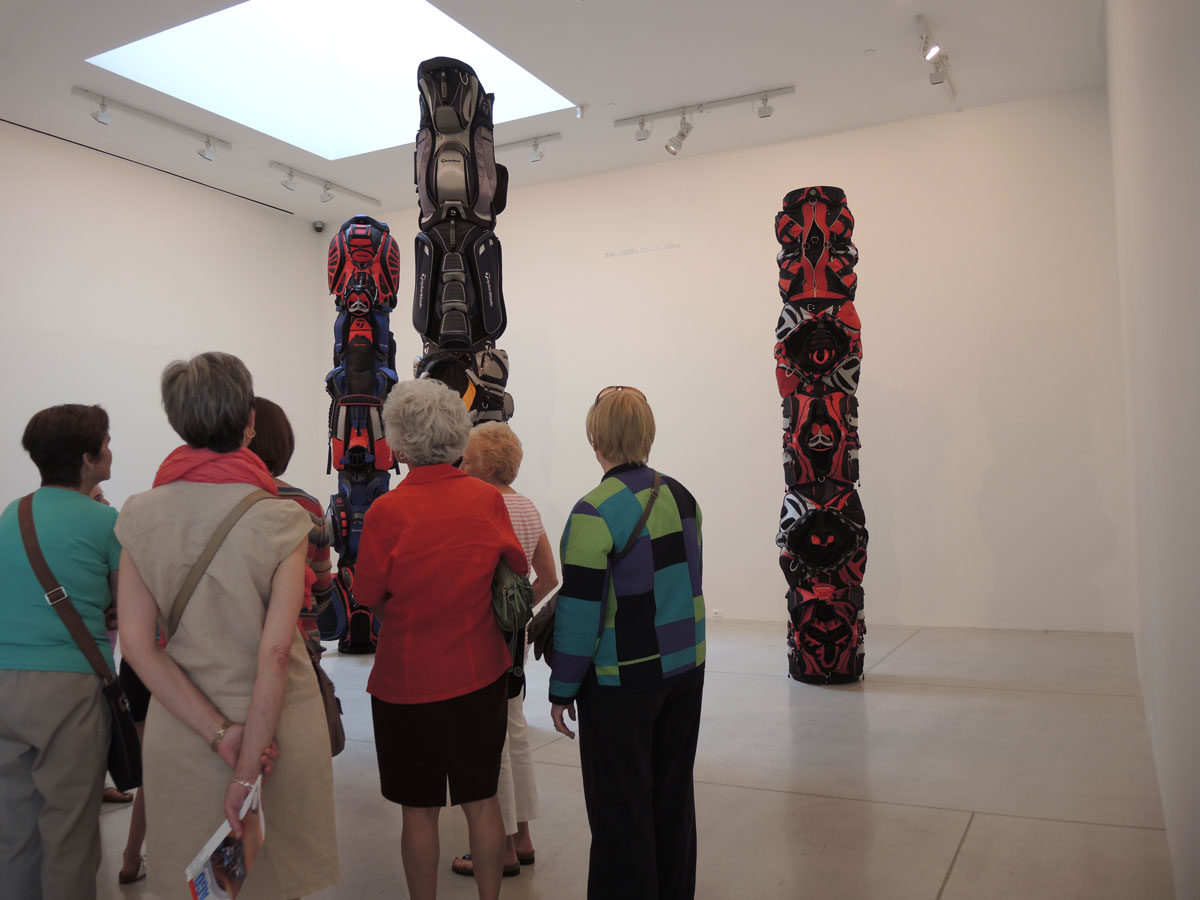
Second, there are three totem poles by Brian Jungen entitled ‘1960’, ‘1970’, and ‘1980’.  All three were made in 2007.  The words in the artist’s statement about this piece say “The towering works recall the complex social and political tensions that can result from First Nations land claims.”  Part of the artist’s reasoning is that golf courses are manicured and their use is quite different from the way land is used by First Nations.


A group of women looks at an art installation of three large totem poles made of golf bags on display in an art gallery (Art Gallery of Ontario)

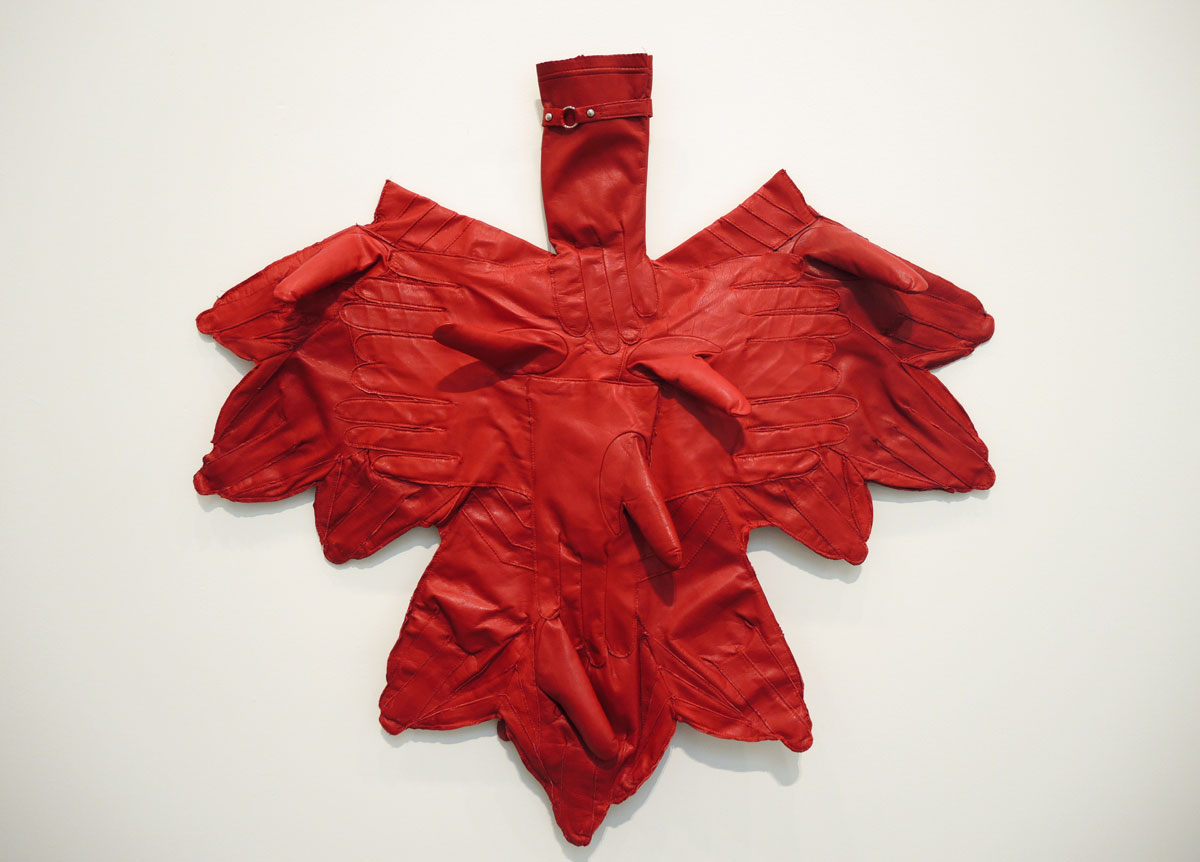
below: Anther piece by Brian Jungen, this one is called ‘Wieland’ and it is made of red women’s leather gloves.  It is supposed to be an upside down maple leaf, i.e. a Canadian symbol turned on its head.  When I first saw it, I saw an eagle with its wings spread but maybe that’s just me.

The words on the wall for this piece: “Its title celebrates Canadian artist Joyce Wieland (1931-1998) whose work in the 1960s and 1970s proposed a gendered patriotism in which indigenous art and culture were given only tokenistic inclusion. With Wieland, Jungen positions himself as part of and against an established narrative of Canadian art history.”

In Wieland’s opinion Canada was female I guess that that is what “gendered patriotism” means.  Otherwise, you will have to figure this one out for yourself.

Upside down rd maple leaf made of women's gloves. It also looks a bit like a large bird with outstretched wings. Part of an art installation at the art gallery of Ontario

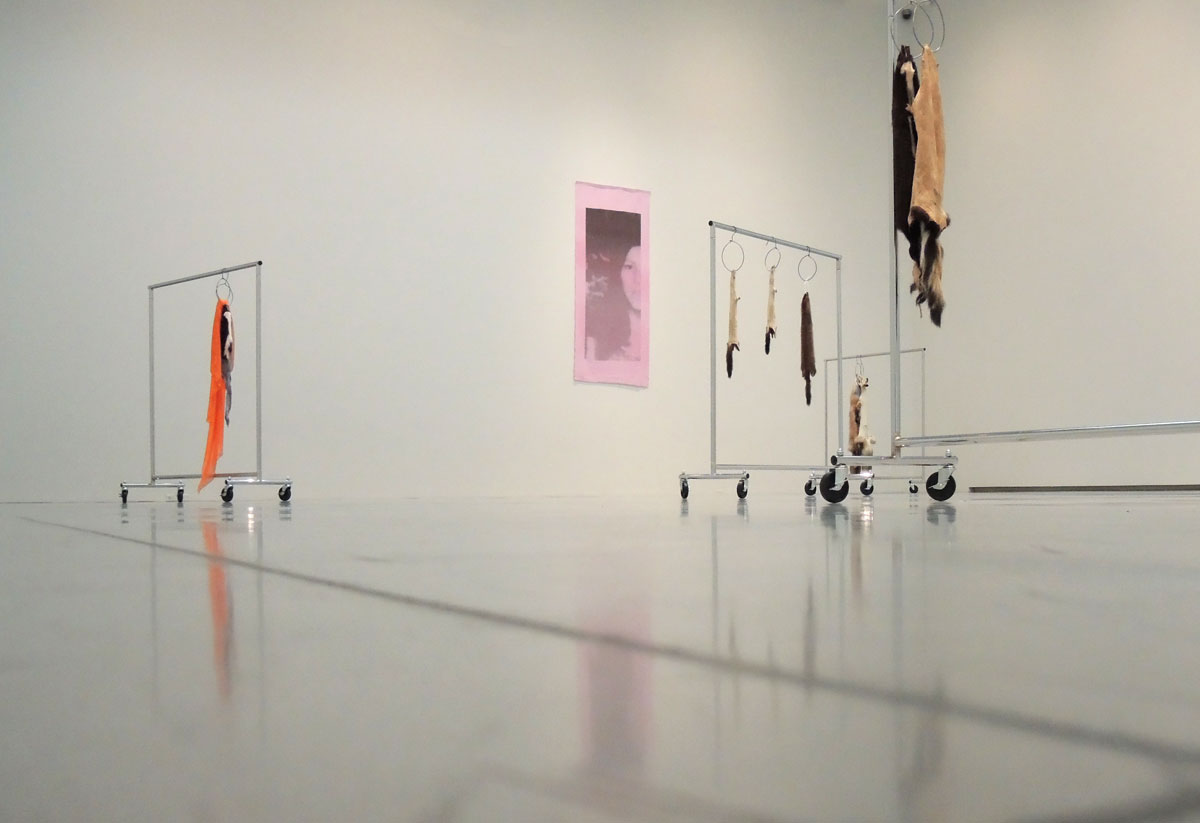
Lastly, there is an installation by Duane Linklater.  Each garment rack is piece and they have names like “My brother-in-law, my sister” and  “The marks left behind”.  Furs of different animals such as fox and skunk hang from the garment racks.  One has an old T-shirt and one has a piece of orange fabric.   “The evocative titles of the pieces speak to family ties, articulating a sense of personal loss” according to the description of the work found on the gallery wall.


A woman is in a large room at the Art Gallery of Ontario, she is looking at an art installation that involves skins of dead animals hanging from garment racks. A pink picture of a woman hangs on the wall.

in an art gallery, an art installation that involves skins of dead animals hanging from garment racks. A pink picture of a woman hangs on the wall.

The two pink pictures on the wall are each a half of a portrait of a woman called Anna Mae Aquash who died in 1976. Together they form ‘Family Photograph’.  Aquash was a Miqmaq woman who was involved as a “radical activist” in the American Indian Movement of the early 1970s.  She was murdered.    If you read the description of the work on the gallery wall, you will read these words: “By including her image, Linklater expresses a sense of familial connection with Aquash and establishes a symbolic relationship with the previous generation while asserting himself in the present. ”   Pardon?

The words on the wall don’t tell you that she was murdered by her own people because they thought she was an FBI informant.  So what relationship is the artist trying to establish?  How does this even remotely lead to “asserting himself in the present”?  Sorry, but empty jargonish words leave me cold. This isn’t art.  Linklater may have a valid idea but that doesn’t make it art.

A group of people in an art gallery, they are looking at an art installation that involves skins of dead animals hanging from garment racks. Two pink picture of women hangs on the wall.


Stephen Andrews POV
an exhibit at the Art Gallery of Ontario

Stephen Andrews is a Toronto artist whose career began in photography and the exhibit now on at the AGO does include a few excellent 8×10 photographs.  The main part of the exhibit though are approximately 20 (mostly large) paintings of his.

A room in an art gallery with white walls and three large paintings on it. A woman is taking a picture of one of them with a camera. The paintings consist of large rectangles
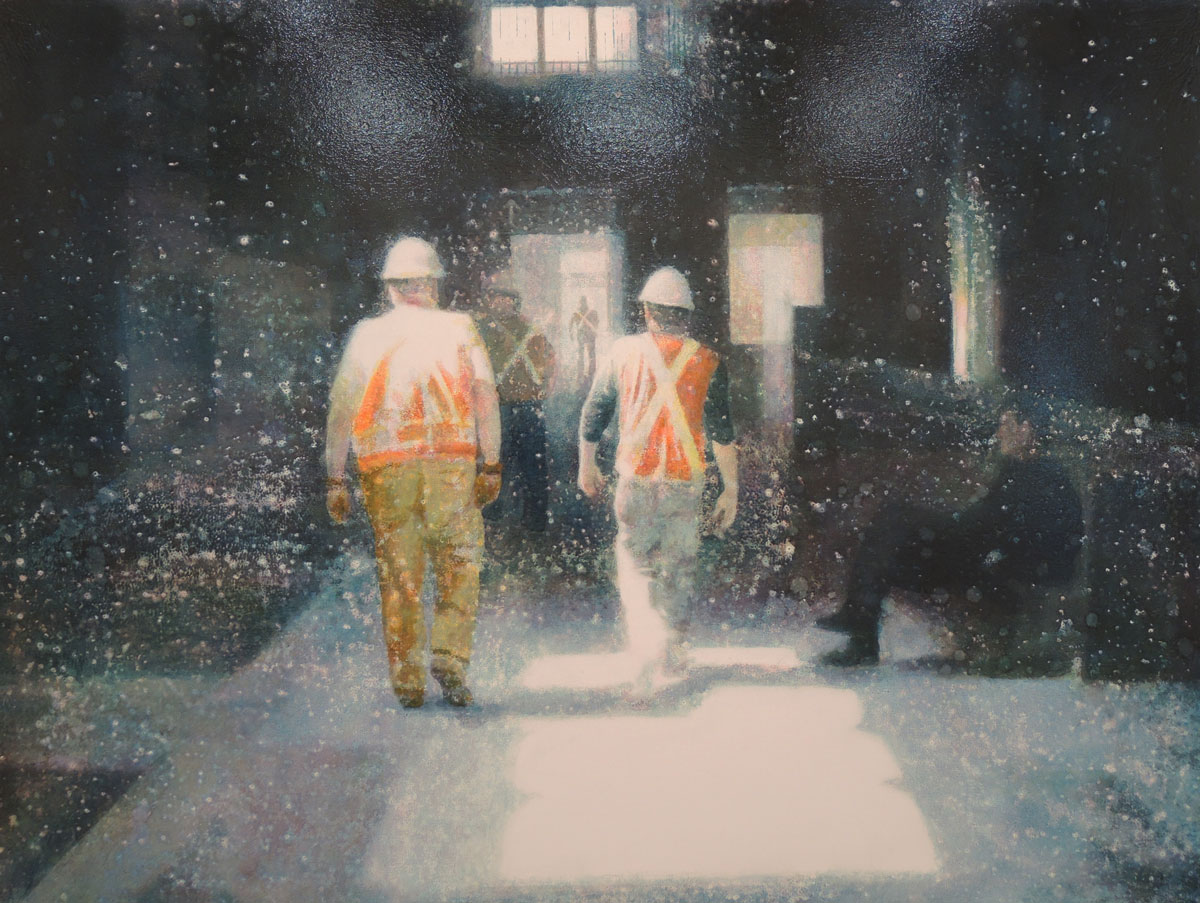
  below: ‘X-men at Union’, 2013, oil on canvas
Construction workers at Union Station, Toronto

rtwork picture of two construction workers wearing orange and yellow safety vests as they walk into a building that is being renovated

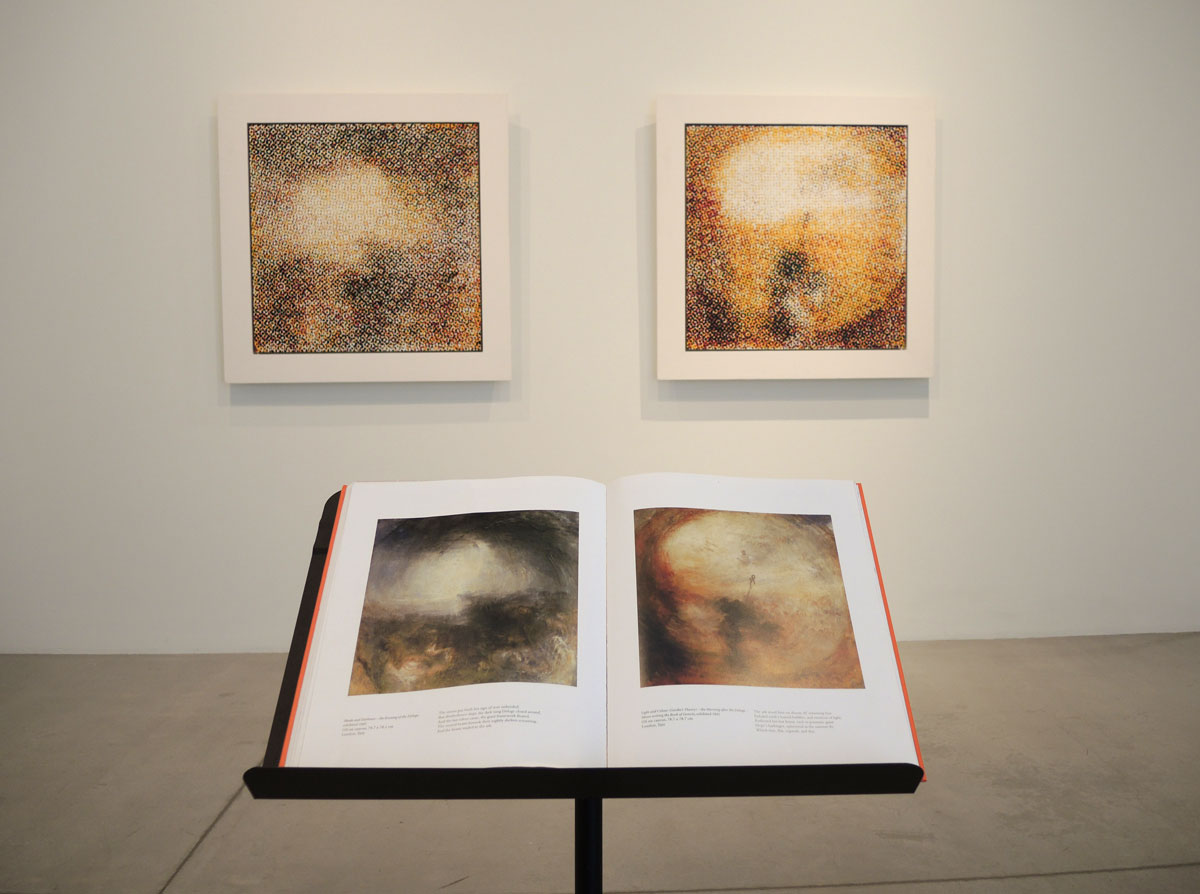
below: ‘After Before/After After’ oil on wood panels
The two paintings on the wall were based on landscapes by J.M.W. Turner that depicted scenes before and after the flood described in the bible (or before and after chaos).  Andrews has painted his with dots in only four colours, yellow, magenta, cyan and black

An open book on a pedestal, a large picture of a painting on each page. Two paintings on a wall directly behind the book. The paintings on the wall are replicas of the ones in the book .

below: detail from ‘Crossing’, 2011, oil on canvas

close up of a painting of a large number of railway crossing signs.

below: close up of part of ‘Entrance/Exit’, 2014, oil on canvas

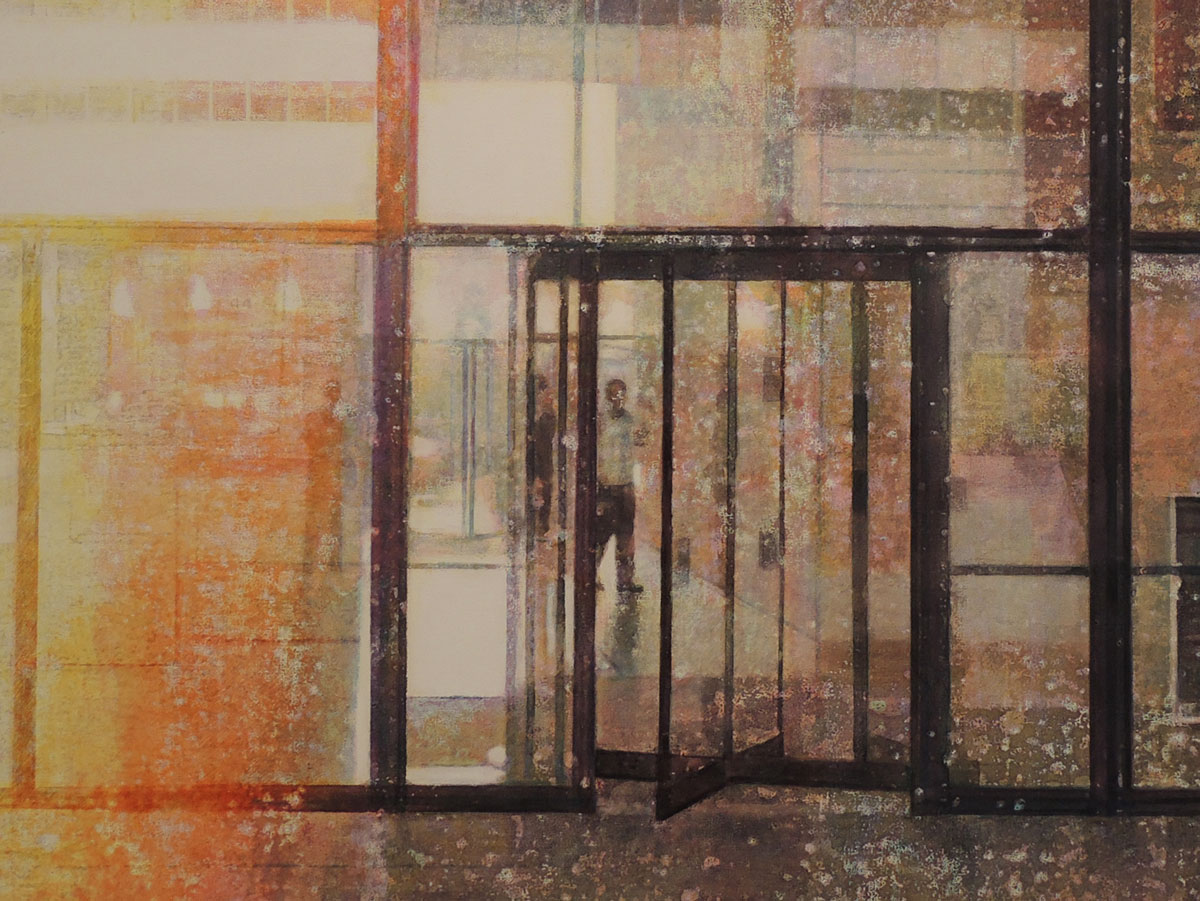
close up of a slightly abstract painting of a person about to go through a revolving door in a glass wall