Archive for the ‘galleries’ Category

Flowers, a sign of spring.  No real flowers outside yet and probably not for quite a while!
Instead we’ll have to settle for European pottery florals from the Gardiner Museum today.

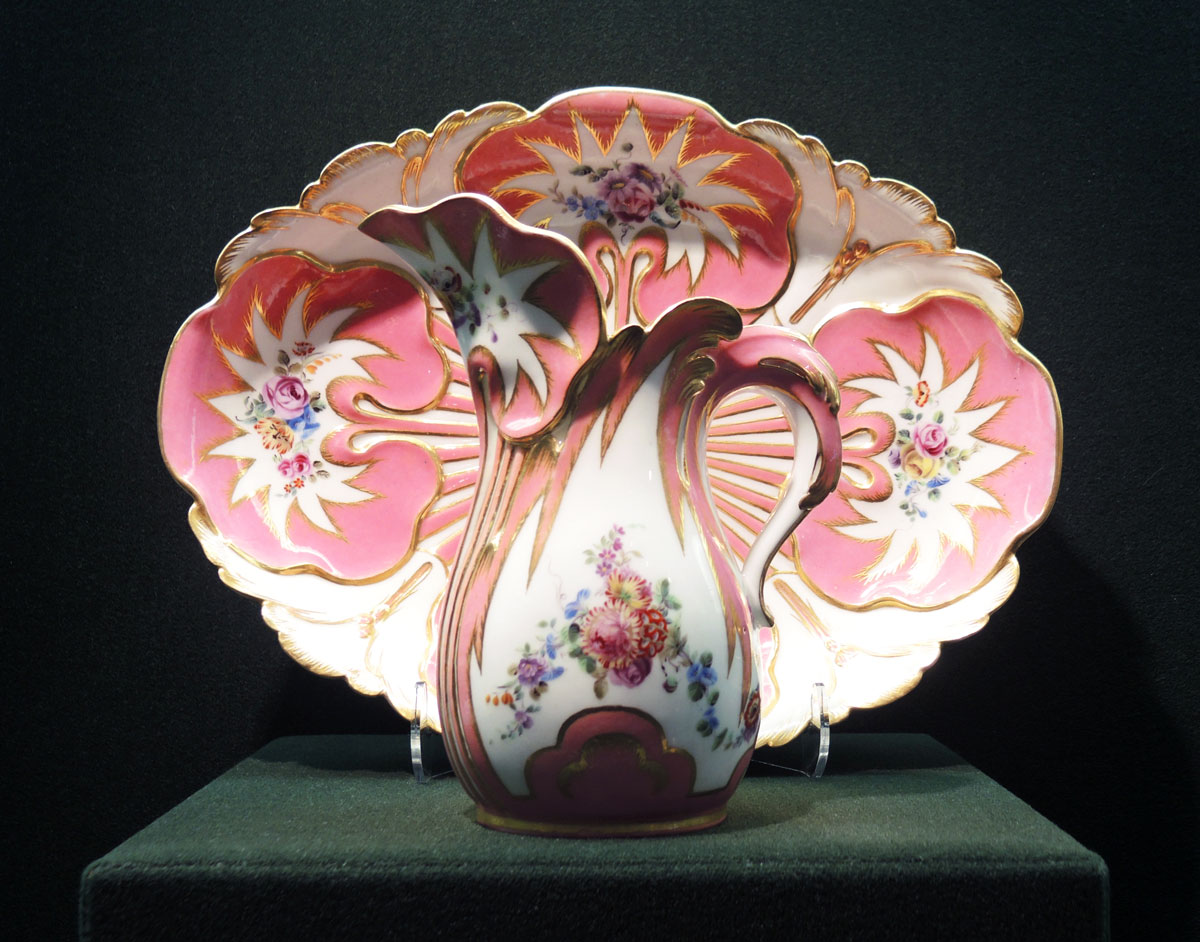
below:  Ewer and basin, Sèvres France, 1757,  porcelain, attributed to Jean-Claude Duplessis.  Pink ground with foilage-like edges.

1757 Sevres ewer (water jug) and basin in pink and white with a tiny bit of blue, floral patterns

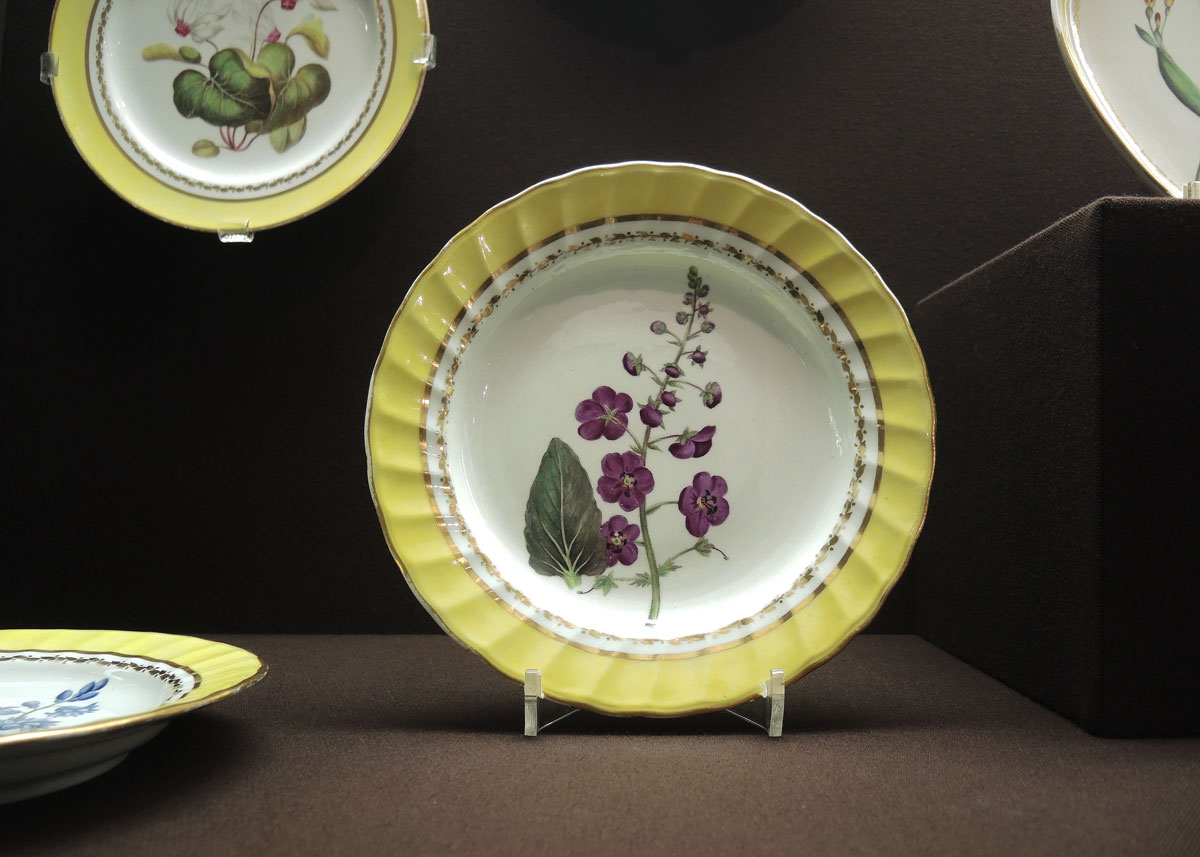
below: Purple flowered mullein plate, from Derby botanicals, pattern 216, England, c1800.

yellow rimmed plates with pictures of flowering plants in the center

Photographs of the Lodz Ghetto (Poland 1940-1945)
by Henryk Ross,
at the Art Gallery of Ontario until 14 June 2015

Ross was a Polish Jewish photographer and one of the official Lodz ghetto photographers under the Nazi regime.

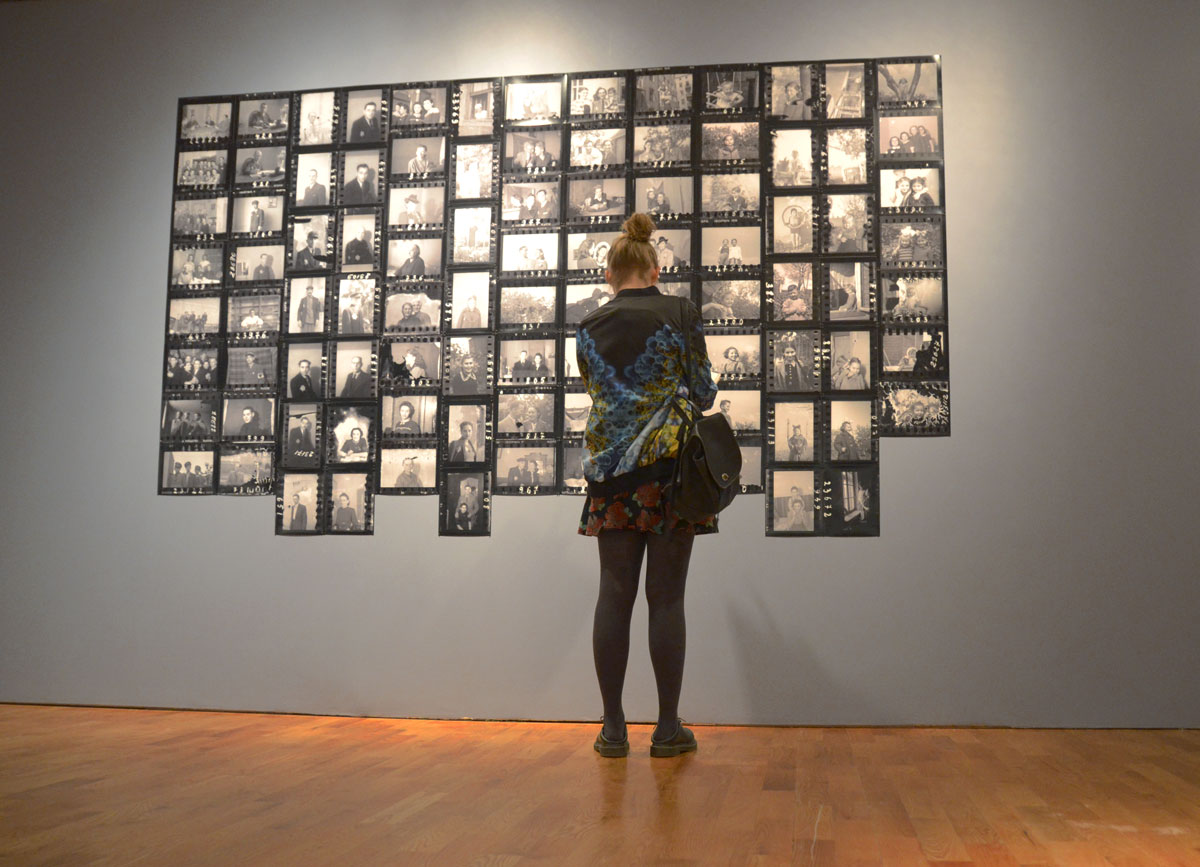
A girl is standing in front a photography exhibit where many black and white photos are grouped together to form one big picture.

In the autumn of 1944 as the Lodz ghetto was being shut down, Ross buried his 6000 negatives in jars.  The Red Army liberated Lodz in January of 1945 after which Ross unearthed his negatives.  Water damaged about half of them.  Of the surviving 3000 negatives, about 200 form the ‘Memory Unearthed’ exhibit.

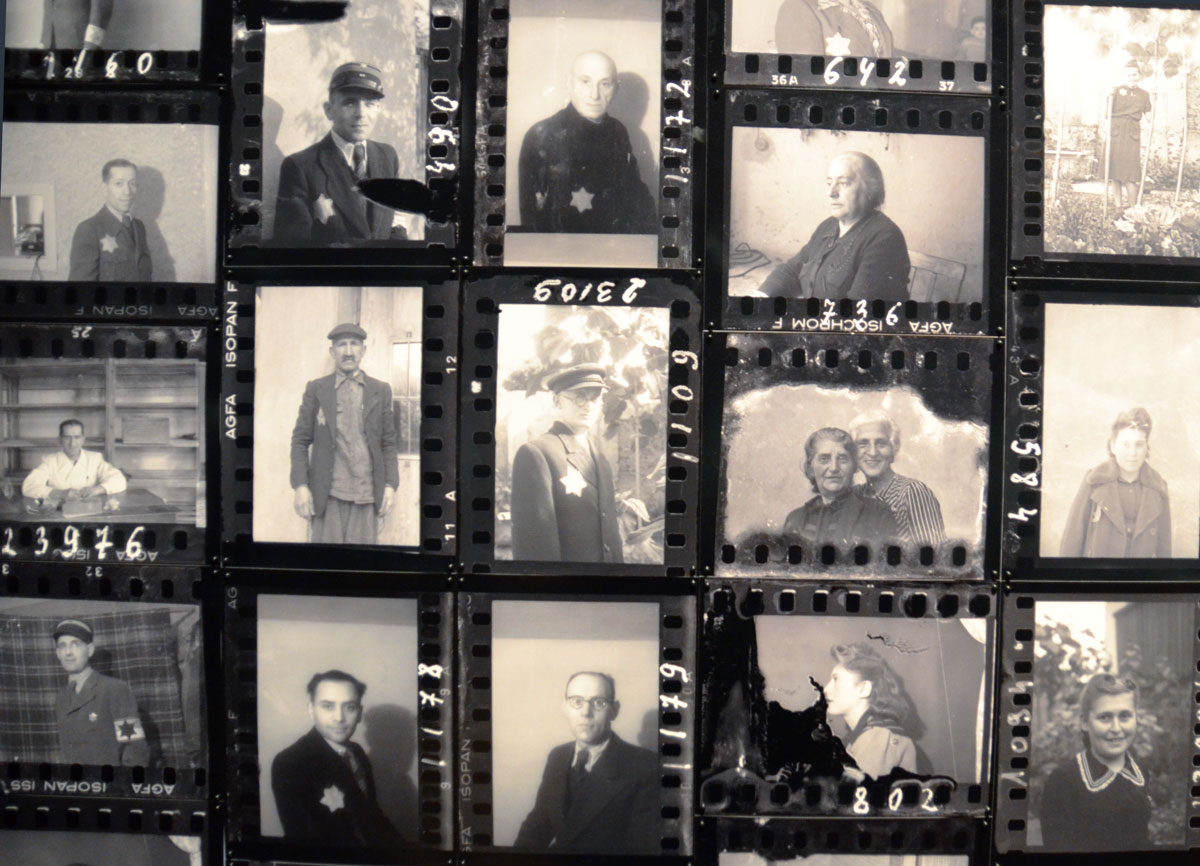
Close up of photo display showing black and white photos of people in portrait like photos.

Some of the photos are ordinary pictures – portraits of people, children playing.  Other photos look ordinary until you learn the context, what is really happening in the picture.  Many photos document suffering and despair.  They elicit a lot of uncomfortable emotions but as an historical record the collection is excellent as well as much needed.

Last Folio, A Living Monument to the Holocaust
An exhibit of photographs by Yuri Dojc,

at the Art Gallery of Ontario

Yuri Dojc was born in Slovakia but is now based in Toronto.
Starting in the 1990’s he has returned to Slovakia a number of times in search of traces of Jewish life from prior to WW2.

a close up of a photograph of an old book, open, with the pages on one side all curled up.   The photo is taken from the top of the book.

Details of one of the photographs in the exhibit.

There are only eight photographs in this exhibit but each one tells a story.   Narratives of loss and of life interrupted.
But also stories of memory and remembrance.

 More information about the Last Folio project.


Seen in the ‘Genizot: Repositories of Memory’ exhibit

 by Bonnie Eisenstein,

at the Royal Ontario Museum until 8 February 2015

blog_the_walk

“Concentrate all your strength, and compel yourself to do the loftiest deed, to endure the most difficult trial, and to survive the most arduous struggle.”

from The Walk by Robert Walser, translated from the German, Der Spaziergang written in 1917.

Douglas Coupland: everywhere is anywhere is anything is everything

Royal Ontario Museum
until April 26, 2015

entrance to an exhibit at the Royal Ontario Museum featuring a large yellow wall with the name Douglas Coupland in large black letters.  In the distance are two women standing in front of a painting that is hung on point.

In the background is a large painting of geometric abstract shapes in yellows, reds and greys.  In the foreground is a close up of two stacks of blocks.  The blocks are old children's wooden building blocks but they are alll different.  Three have letters of the alphabet on them, one has a picture of a birds nest.

The 21st Century Condition
“I want to explore how it feels to be inside the 21st century brain as opposed to the 20th century brain”

Six paintings arranged three across by two down, on a wall.  One in grays, one in pink, one in purple, one in ornage and one in pale pink.

a large wall is covered with coloured rectangles and in each rectangle is an expression that has become common.  For example, get a life, oh my god, delete entire history?, etc.  A woman is standing to the left of the wall, taking a picture of it with her cellphone.

view of an art exhibit, some people are walking through it and a couple of people are looking at the art on the walls

blog_coupland_rom_colour

Painted with dots.  When they are hanging on the wall, they look abstract.
When they are shrunk down and viewed on a smartphone, the picture comes into focus.

three paintings hanging on a wall in an art exhibit.  One is of Osama bin Laden and the other two are 9/11 related, New York .

update:  Here is an interesting article that appeared in the Torontoist on 24th Feb about this exhibit.

Douglas Coupland’s
everywhere is anywhere is anything is everything
at the Museum of Contemporary Canadian Art, Queen St. West
until 19 April 2015

Secret Handshake
What makes Canadians Canadian?
What do we identify with that others don’t recognize?

close up of part of a quilt.  One of the squares is made from fabric with a Toronto Maple Leafs hockey player on it.  Old chrome hubcaps have been added to the quilt.

A quilt made of plain beige fabric into which dreamcatchers of various sizes have been incorporated.
A low hutch with three drawers.  The handle of each drawer is on old pepsi advertisement on an old bar from a door - the kind of bar that you would push on to open the door.

 One of the rooms of the exhibit features Coupland’s re-imagining of famous Canadian paintings,  paintings by Tom Thomson and Lawren Harris of the Group of Seven to name a couple.
In the center of the room is a black metal structure that is supposed to represent a damaged hydro transmission tower reminiscent of the ones damaged by the eastern Canada ice storm of 1998.

A large metal structure that is supposed to represent  a damaged hydro (electricity) transmission tower is in the center of a room.  There are paintings on the walls.

A large metal structure that is supposed to represent  a damaged hydro (electricity) transmission tower is in the center of a room.  There are paintings on the walls.

***

Growing up Utopian

A portion of three Douglas Coupland creations are visible.  In the foreground are numerous lego houses complete with yards and garages all laid out in a grid.  In the background are wood shelves with household articles from the past.  In the middle are lego towers in bright stripes and interesting shapes.
below: Towers, 2014
An urban jungle of imaginative lego towers created from selected parts of towers that were “crowd-sourced” at building events at the Vancouver Art Gallery.

Close up of some of the brightly coloured lego towers in the art exhibit

below: 345 Modern House, 2014
One hundred identical houses built from a kit that was first issued in 1969.

A grid of white lego bungalows with black roofs with detached garages, green lego lawns and red fences.


.

An art exhibit in the Great Hall at Union Station, January 16 to January 23

I’m going to out on a limb a bit here and say like most contemporary or modern art, this exhibit was combination of  some shoddily thrown together nonsense and some well executed and interesting pieces.
One of the things that caught my attention was how people reacted and/or interacted with the different parts of the exhibit.  Union Station is not an art destination.  It’s a space that people walk through on their way to somewhere else.

A view of the Great Hall of Union Station with the provincial flags along one wall, the archway over the window at the end of the room, and an art exhibit in the main part of the hall.  Two woman are looking at sculptures on one side.  A video screen is showing a video about the exhibit - a man sitting in a chair is what is seen in this picture.

In the above photo, the women are using a computer monitor to learn about The Legacy of Joseph Wagenbach, an installation by Iris Haussler.  In 2006 she turned a house on Robinson St. in Toronto into a ‘discovered’ home of a reclusive older man who had filled his house with over 100 sculptures that he had made.  At that time there was some controversy when people learned that there was no real Joseph Wagenbach, that his story was fiction.   There is a  Joseph Wagenbach Foundation with its own website.

A colletion of small sculptures of life like figures in grey and black.

Some of the Joseph Wagenbach sculptures.

A relief sculpture of a woman's head, on the ground.  In the background are people and some of the booths of Union Station.

 ***

A corner of a dimly lit white walled room. In the

‘Marbled Meanings’ by Navid Nuur. 
top right: ‘Broken Diamond’  made of neon, broken glass, argon neon blue light. 
center: ‘Threshold’ made of green florist foam blocks

With the above collection, I found that the light and shadows were more interesting than the green column.  I don’t know whether or not this was an intentional part of the exhibit.

Neon art piece on a wall.  It is shaped like a V, it's turquoise blue in colour and it is a bit bigger than the size of a hand.  It is mounted on a wall with the electrical wires visible.  It is shadow.

close up of ‘Broken Diamond’

 ***

part of a piece of art that is a pillar like structure cover with bits of colourful paper.  There is also a child's drawing in pencil on an 8 by 11 piece of paper.  Also a sign in blue letters that says .  In the background there are a couple of people walking past.

“I’m going to use the two hundred dollar artist fee from this project to pay my phone bill and with the money left over I’ll probably buy a pack of smokes and maybe order some Chinese food.” 
Is this a statement about the value of art?  Is this a f*ck you statement – if you, or society, don’t value art why should I (as the artist) care about my work?


A large translucent rectangular piece of fabric hangs from the ceiling.  It sort of has a face on it, yellow eyes and a small slit mouth.

Floating overhead and watching us with yellow eyes.


This photo was taken looking into a mirror.  A man in a long black winter coat and red scarf is taking a photo of some art on a wall.

reflections


Four people, two are standing together while one texts, and two others are walking past.  Four large square paintings (or photos?) are behind them on a white wall.

I know that art is subjective but I fail to see the appeal in large monochromatic pictures in an ugly shade of green.  They aren’t profound; they’re not making a statement; they elicit no emotion.


The projector is playing a loop of blank screen to a garbled soundtrack.

The projector is playing a loop of blank screen to a garbled soundtrack.


An art piece, a shiny silver coloured porta potty stands in the middle of the floor.  A trash container (real) is behind it.

I couldn’t help but chuckle at the juxtaposition of the arty porta-potty and the real trash container behind it.  Someone tried to open the door of the potty but it was either locked or not real.  Note to artist: Why?

video art installations at an art exhibit.  The large clock and departures board of the train station are seen over the top of the temporary walls of the exhibit.

Preparing for the Toronto Photowalks Exhibit

20 October – 2 November

Art Square Cafe & Gallery, 334 Dundas St. West (across from the AGO)


blog_show_arms
.

blog_show_jenn.

blog_show_dom
.
blog_show_lights
.
blog_show_sally
.
blog_show_sasha
.
blog_show_genie
.
blog_show_j_g
.
blog_show_ladder
.
blog_show_mark
.
blog_show_david_walksin

Toronto Photowalks Group Exhibition

Art Square Cafe & Gallery

Bau Xi Gallery on Dundas West, across the street from the AGO, is one of my favorite galleries.  The artwork that they exhibit is always eclectic and usually interesting.

Two that caught my eye today were by Bratsa Bonifacho.

a very colourful painting that looks like a mosaic of diffferent coloured letters on different coloured squares and rectangles.

painting entitled “The Green Zone”

.

Painting of letters upside down and rightside up in greys and blues.

close up of part of “Ad Rerendum”. The painting is about the size as the one above

.

gallery website:  www.bau-xi.com

Fourth Annual Art Spin Exhibition,
Tower Automotive Building, 158 Sterling Rd.,
Aug 29 – Sept 1, 2013

18 artists, one old vacant heritage industrial building.

Interesting lighting.  Interesting use of the space.  Interesting relationships between the installations and their surroundings.

I have not included photos of all the art in the exhibit.  My apologies to the artists whose work I haven’t shown.

looking at 'Sound the Alarm' by Caroline Larsen' with the video installation 'I,I,I,I' in the foreground

looking at ‘Sound the Alarm’ by Caroline Larsen’ with the video installation ‘I,I,I,I’ in the foreground

space2

'We Are Happy' by Michael Toke.  Like a visit to the dentist's office.

‘We Are Happy’ by Michael Toke. Like a visit to the dentist’s office.

a group of people looking at a piece of art.  They are in a large open space that once was a factory.  Concrete and brick walls.

The painting on the wall to the left is ‘Exit Enter’ by Celia Neubauer.

'Sterling Caer Observer' by Noel Middleton

‘Sterling Caer Observer’ by Noel Middleton

A sculpture that is composed of three tall vertical pieces of shiny metal.  A yellowish brick wall is in the background.

‘Untitled’ by Jinny Yu. Three shaped pieces of metal by brick wall.


artist:  Mary Grisey

art installation in front of an old green door.  There is a lot of frayed rope.

Art installation with a lot of rope, especially frayed rope.

‘Floating in the Eye of the Storm’ by Lois Schklar.

  wire sculpture

Wire sculpture in the foreground with an oil painting in the background

part of a wire sculpture including a star

part of a wire sculpture showing a little gold trinket in the shape of a hand

‘Stillnessence Vivarium’ by John Oswald. 

This installation lent itself to a many interpretations.

projection of life sized picture of a group of people

people2

life sized projection of a group of people, male and female, young and old,

more information about Art Spin  http://www.artspin.ca

a wall, part concrete and part tile.

The video installation ‘Melting Bricks’ was in small room where it was shown fairly high up on the wall. It was the only source of light in the room. I focused on the relationship between the room and the light when I was taking pictures of it. (my apologies to the artist as I seem to have forgotten his/her name).


blocks1

________________________