Posts Tagged ‘statue’

Updated 2 September

The latest StreetARToronto (StART) summer project has just wrapped up.  Seven new murals around Broadview and Gerrard East, each one depicting a famous landmark, make up this project which is now called ‘Around the World in East Chinatown’.  Although it was largely funded and organized by StART, other partners include the Toronto Parking Authority, 55 Division police, and the Chinese Chamber of Commerce (East Toronto).

A crew of more than 20 artists headed by Mike Kennedy worked for about 2 weeks to complete the murals.  Each mural includes the ‘signature’ of the artists.  I am not very good are deciphering (or remembering) the graffiti writing but I’ve had some help identifying the artists.

below: Christ the Redeemer now watches over Gerrard East.  Painted by bacon.  This is the statue built high on a hill overlooking Rio de Janeiro.  If you watched any coverage of this summer’s Olympics you probably saw this statue from every possible angle.   The statue was designed by a Frenchman, Paul Landowski and built by a  Brazilian engineer, Heitor da Silva Costa, between 1922 and 1931.   Made of soapstone and reinforced concrete the statue stands 30m tall and has an arm span of 28m.  He stands on an 8m high pedestal.

a mural of the famous Rio de Janeiro statue, Christ the Redeemer, high on a brick wall, with background in sky blue and yellow

below: Putting the finishing touches on The Great Wall of China, a collaborative effort by Nick Sweetman, Wuns, Rons, Tens, Braes and Wales.   The actual wall was built in sections over many centuries and includes walls, trenches and natural elements such as hills and rivers.  Parts of the wall are in better repair than others – around Beijing where more tourists visit, the wall has been fixed up and is well maintained.  Measurement of the wall varies but if all the branches of the wall are taken into consideration, the total length is about 21,000 km.
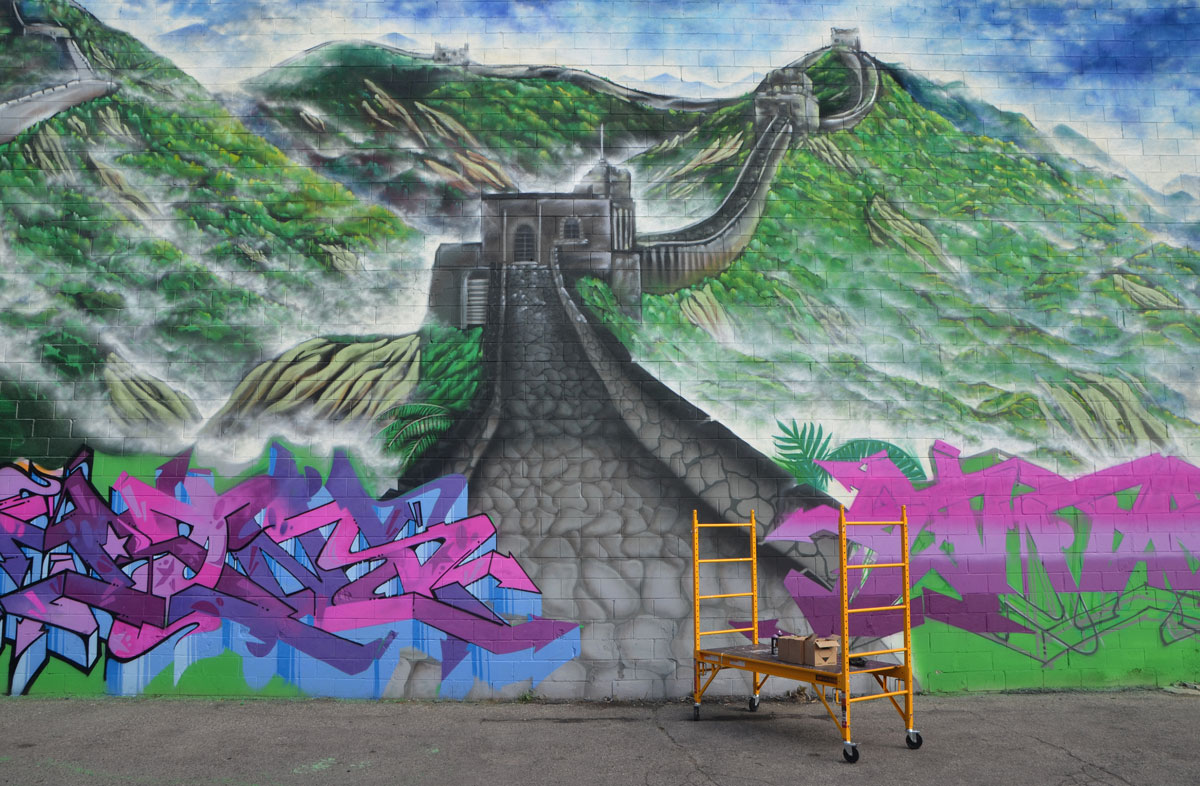
a yellow cart with cans of spray paint on it sits in front of a mural of the great wall of China

below: A hummingbird flies over Machu Picchu in the next mural.   Machu Picchu was built by the Incas in the 15th century in what is now Peru.  It is on a mountain ridge, 2430m above sea level.

full mural of Machu Picchu along he wall of a building at the edge of a parking lot, scene of Machu Picchu with a humming bird in the foreground.

below: Machu Picchu.  Painted by Bacon, Kwest, Kane and Rath.
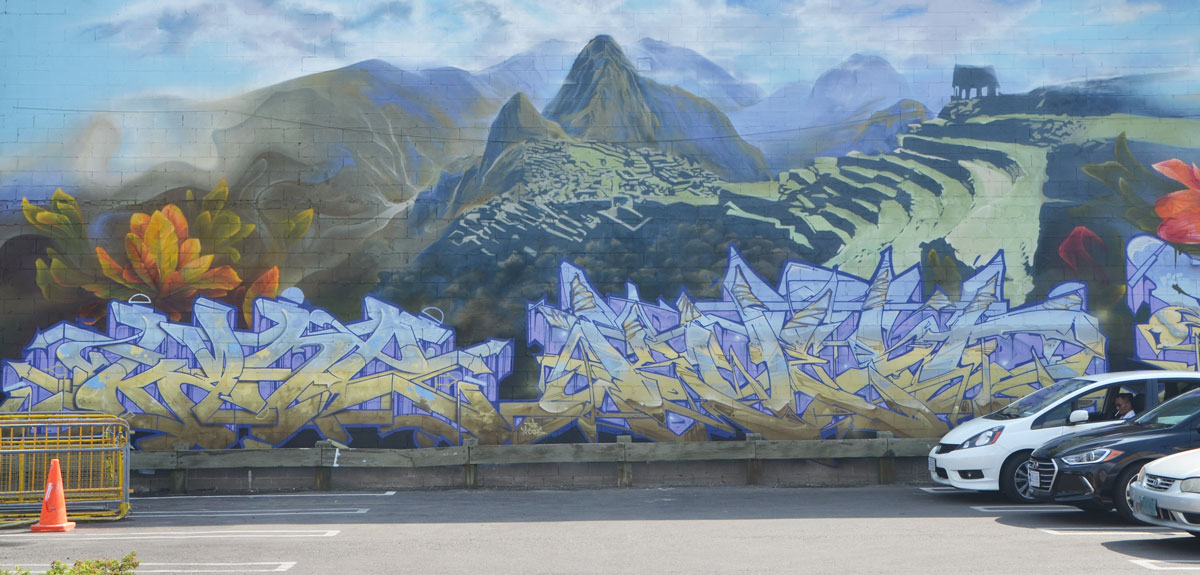
a mural with a panoramic scene of Machu Picchu, with graffiti writing signatues below.

below: In the same parking lot as Machu Picchu but on the other side, is a very large mural centered around an image of the Taj Mahal.  Painted by Sight, Hone, Water, Equal and Tenser.
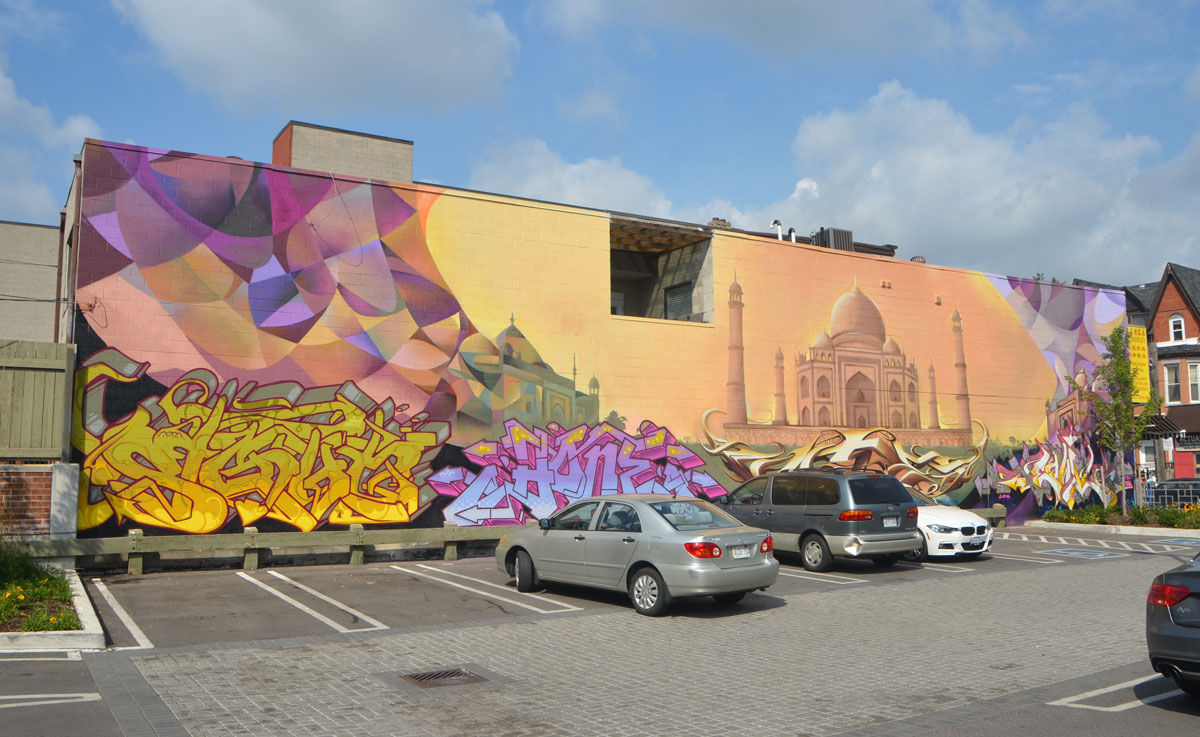
a laong horizontal mural featuring an image of the Taj Mahal.

below: Commissioned in 1632 by the Mogul Emperor, Shah Jahan, the Taj Mahal was built as a mausoleum for his favorite wife Mumtaz Mahal.  She was born Arjumand Banu Begum, a daughter of Persian nobility in Agra India.  In 1613, when she was 19, she married Prince Khurram (later he became Shah Jahan) as his 3rd or 4th wife.    She died in June of 1631 while giving birth to their 14th child.   If my math is correct, that’s 14 children in 18 years.   After the Shah died in 1666, he was buried here too.  Anyhow, many centuries later, the Taj Mahal is still standing in Agra India and it is visited by millions every year.

An image of the Taj Mahal in a mural in warm muted orange and brown tones, with a graffiti writing signature underneath it. On a wall in a parking lot.

below: Teeny tiny people dwarfed by the doors of Petra, Jordan.  Petra is an ancient city with immense buildings cut out of the sandstone cliffs and hills.  It was once a thriving trading center and the capital of the Nabataean empire between 400 B.C. and A.D. 106 when it was called Raqmu.  The Nabateans were a nomadic Arab tribe.  Their empire came to an end when they were conquered by the Romans and their land annexed into the Roman Empire.

mural showing entrance in the stone cliffs to Petra in Jordan, camel head in the bottom left corner, mural on the side of a store, brick wall,

below: The whole Petra mural on the walls of an alley tucked in between the Ka Ka Lucky Seafood BBQ Restaurant and Paradise Spa on Broadview Avenue.  This mural was painted by Hemps.

Chinese restaurant, Ka Ka Lucky Barbeue Restaurant, with an alley on one side. On the wall in the alley there is a mural showing the stone town of Petra Jordan.

below: The Roman Coliseum (Rome) is now on the corner of Broadview and Gerrard.  This is half of the mural and when the photo was taken it was incomplete.  It is now finished – a second visit for a photo is in my future!  The Coliseum (or Colosseum) is in Rome and it was built by 80 A.D, just before the Roman Empire swallowed up the Nabateans.   It was built as an amphitheatre and could hold at least 50,000 spectators – people who came to watch gladiator fights, enactments of classical dramas, or other forms of entertainment.

A mural showing the Coliseum in Rome painted on the side of Chino Locos Mexican restautant.

below: The right hand side of the mural with the graffiti writing signature of the artist. If I could only easily photoshop out that garbage bin.  Mural painted by Sewp, Poser and Frens.
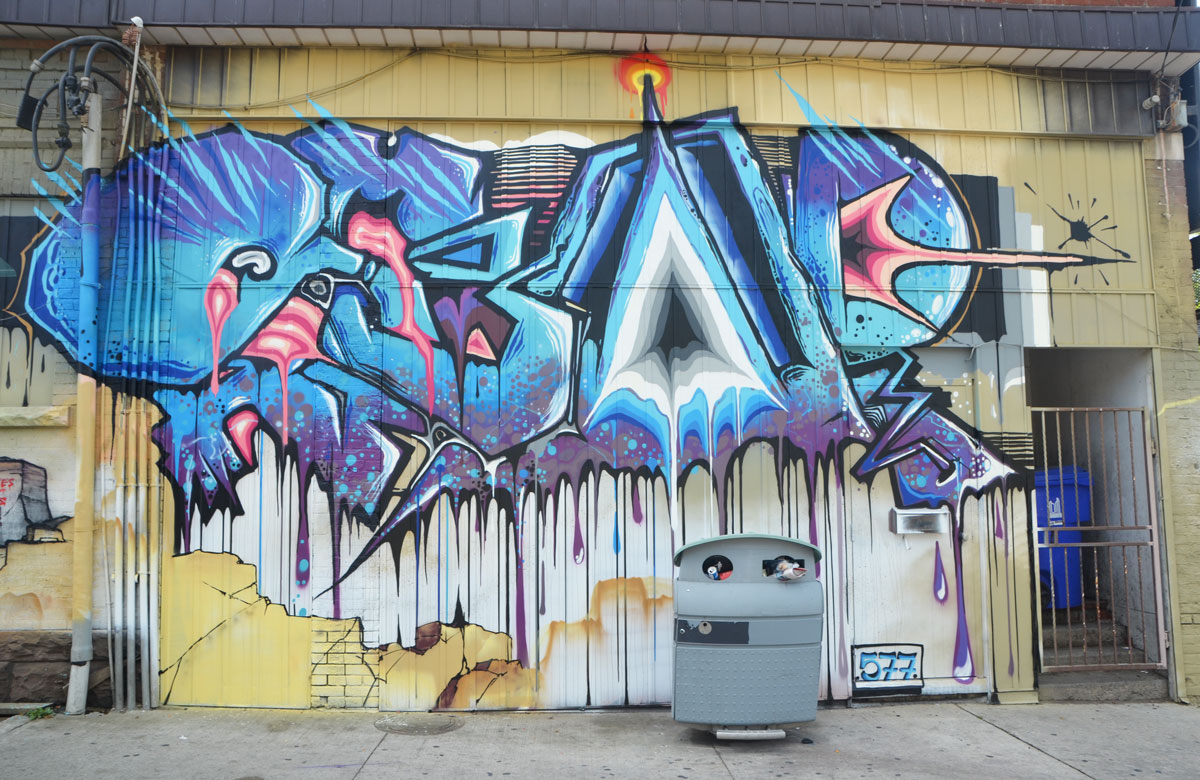
graffiti writing signature on a wall, dripping blue paint, and a garbage bin in front of it.

below: Chichen Itza ruins in Yucatan Mexico and a jaguar on the side of the Sunshine Hair Studio, partially obscured by greenery.  Painted by Cruz, Rons, Sadar and  Rcade.  Chichen Itza was the largest Mayan city covering about 5 square km.  It flourished between 900 and 1050.   The mural depicts El Castillo, or the Temple of Kukulcan, the building at the center of Chichen Itza that dominates the site.
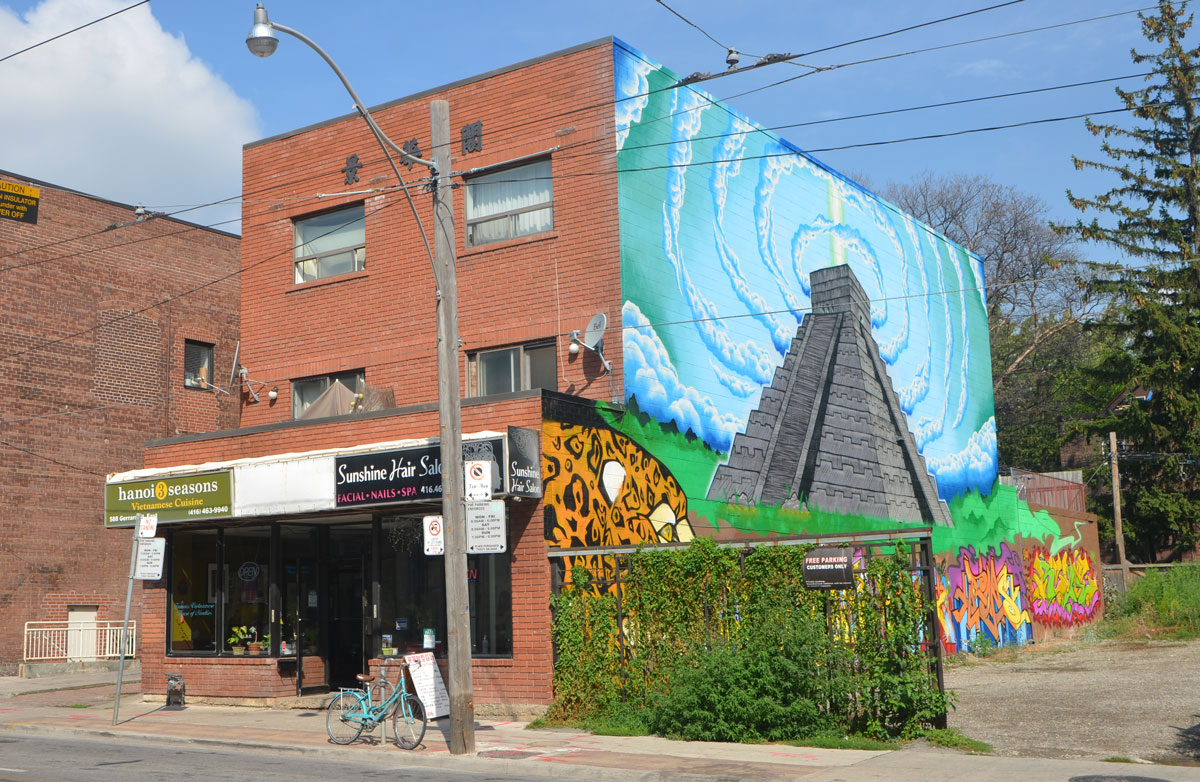
mural on the side of building on Gerrard East, a picture of an ancient stone temple, Chichen Itza in Yucatan Mexico.

And that concludes the seven new murals – Christ the Redeemer statue, The Great Wall of China, Machu Picchu, Taj Mahal, Petra, the Roman Coliseum, and Chichen Itza.

This mural project follows the success of last year’s Project Picasso in the same area.   Graffiti from some of the lanes was cleaned up and a Chinese themed mural was painted on the brick wall at the back of the parking lot on Gerrard Street East, just west of Broadview Avenue.  Riverdale Collegiate students helped with the graffiti clean up and contributed ideas for the mural.

below: Chinatown East mural by ACK crew, bacon, wunder, tensoe 2, and cruz1

large mural across the side of a building at the back of a parking lot, Chinese characters and icons, panda bear, tiger, bamboo forest, lucky cat, chinese lantern, dragon

below: Chinese icons painted in the mural – a resting tiger, cherry blossoms,  red Chinese lanterns floating by, a lucky cat with its paws up,  and a panda munching on a piece of bamboo.


part of a mural in Chinatown East, pink cherry blossoms, red chinese lantern, panda chewing on bamboo, tiger, lucky cat

below: A red dragon beside some Chinese characters.  Does anyone know what it says?
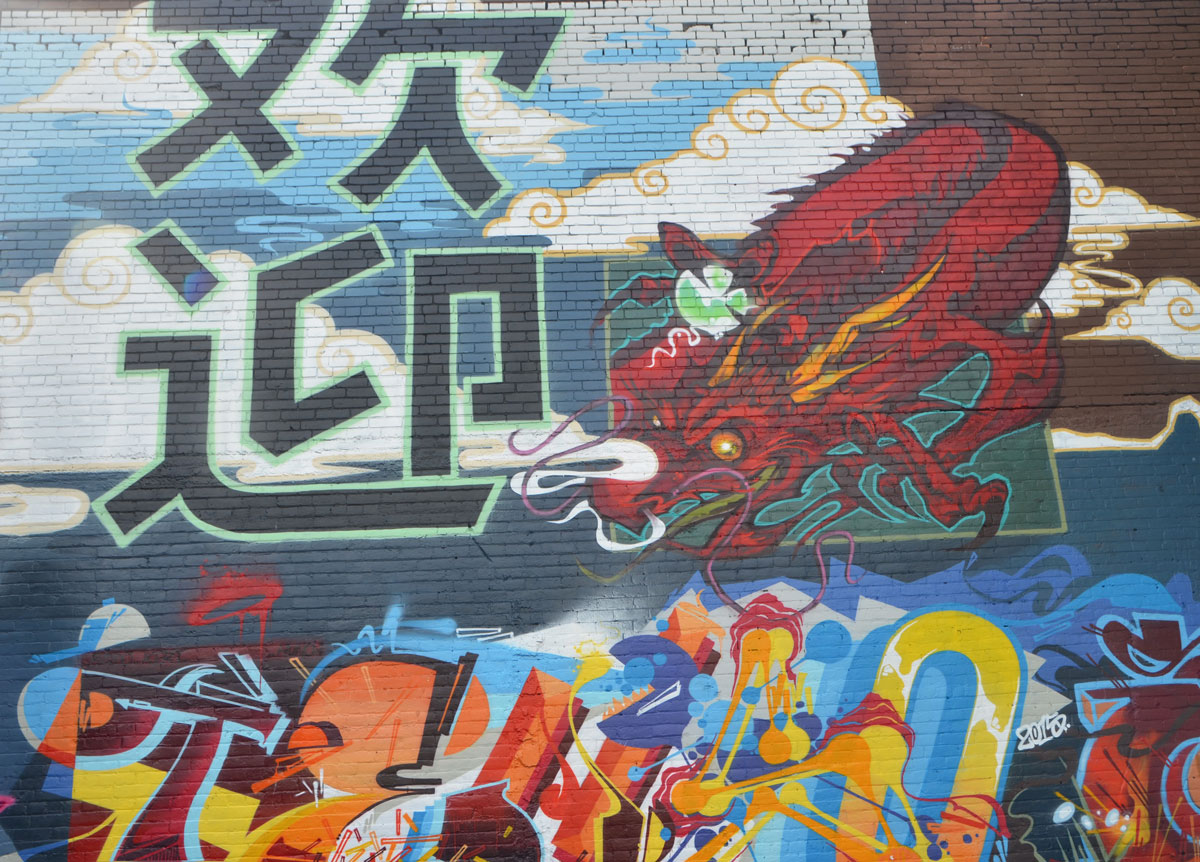
part of a mural in Chinatown East, chinese characters and a red dragon


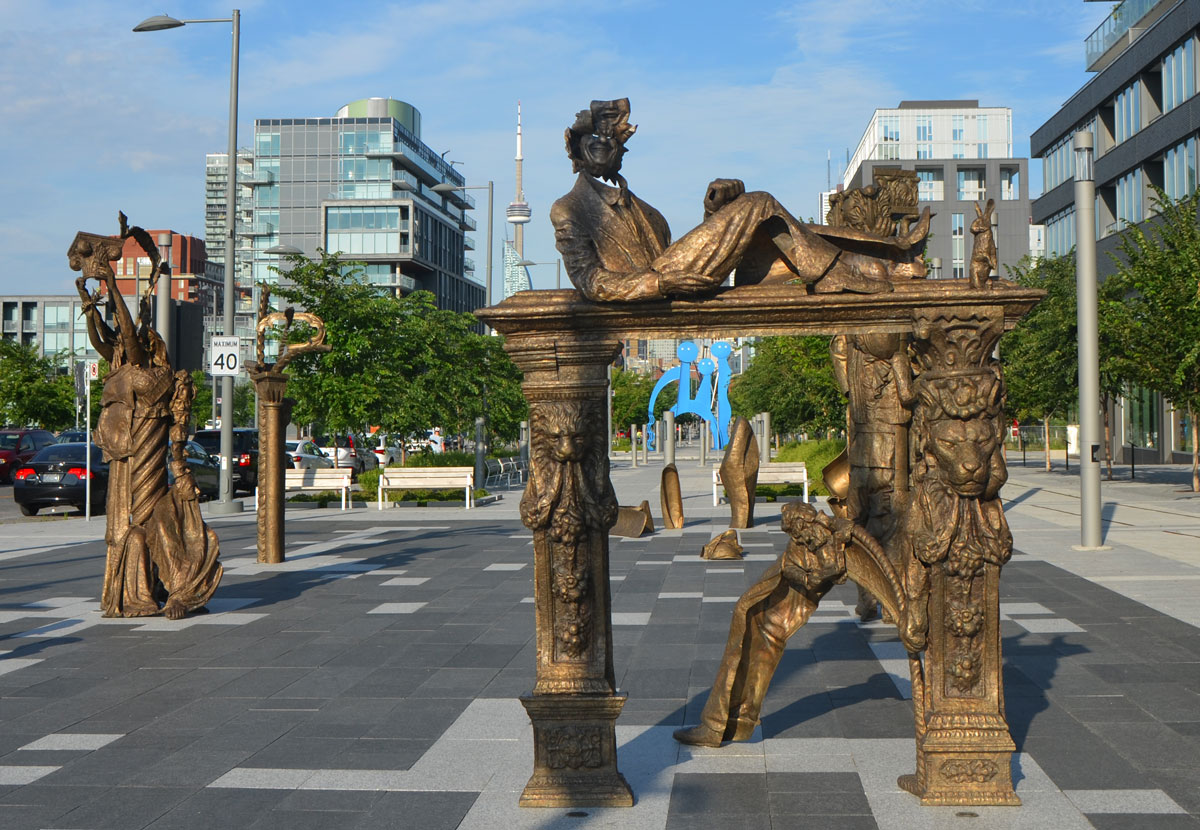
The first time I saw the latest art installation in the Canary District I was in a car and only got a quick look at it.  I couldn’t figure out what the mess was all about.  It wasn’t until I went back on foot to take a closer look that I could appreciate what the artists were trying to do.

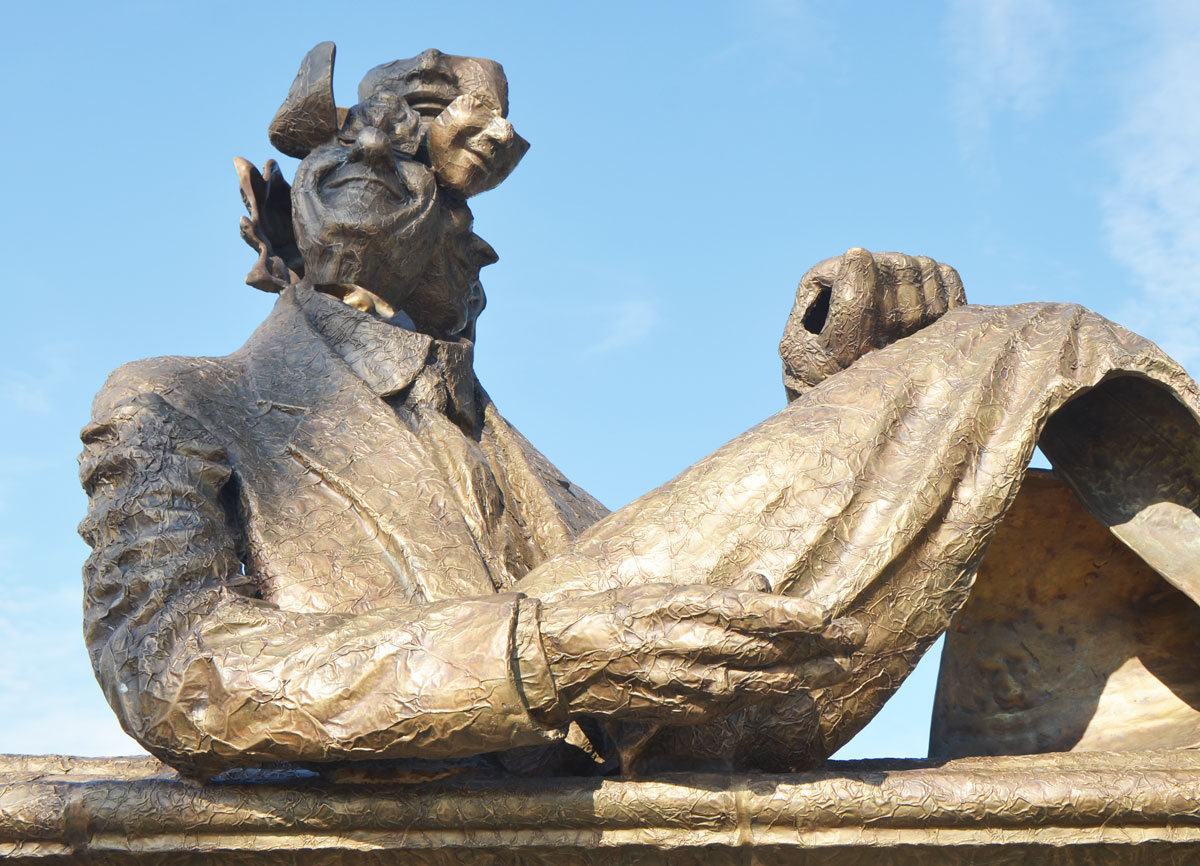
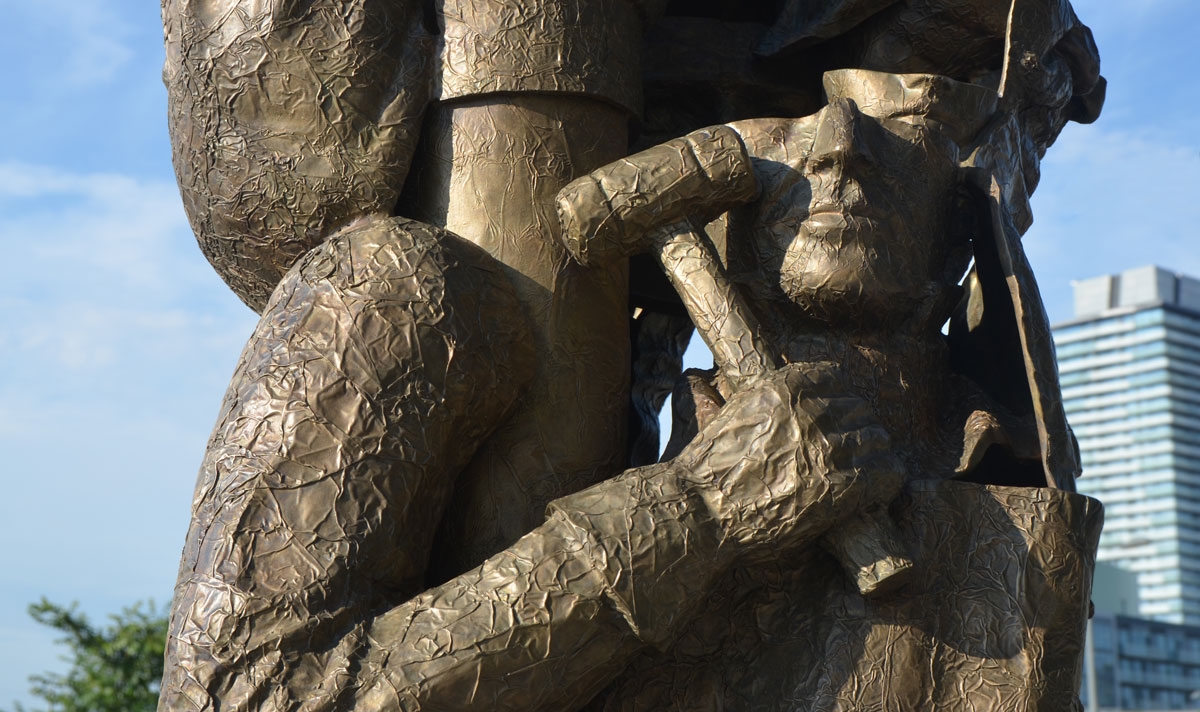
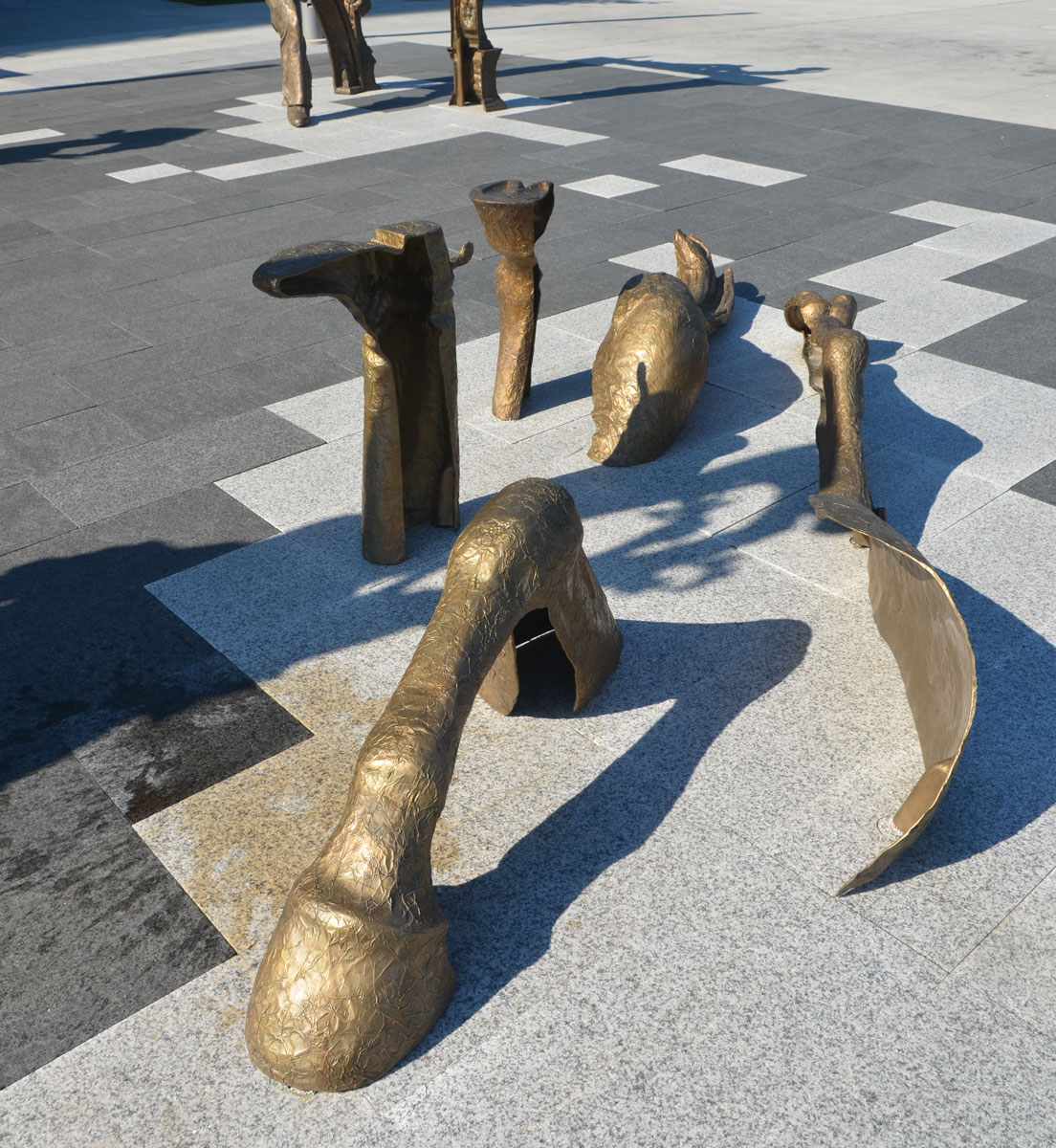
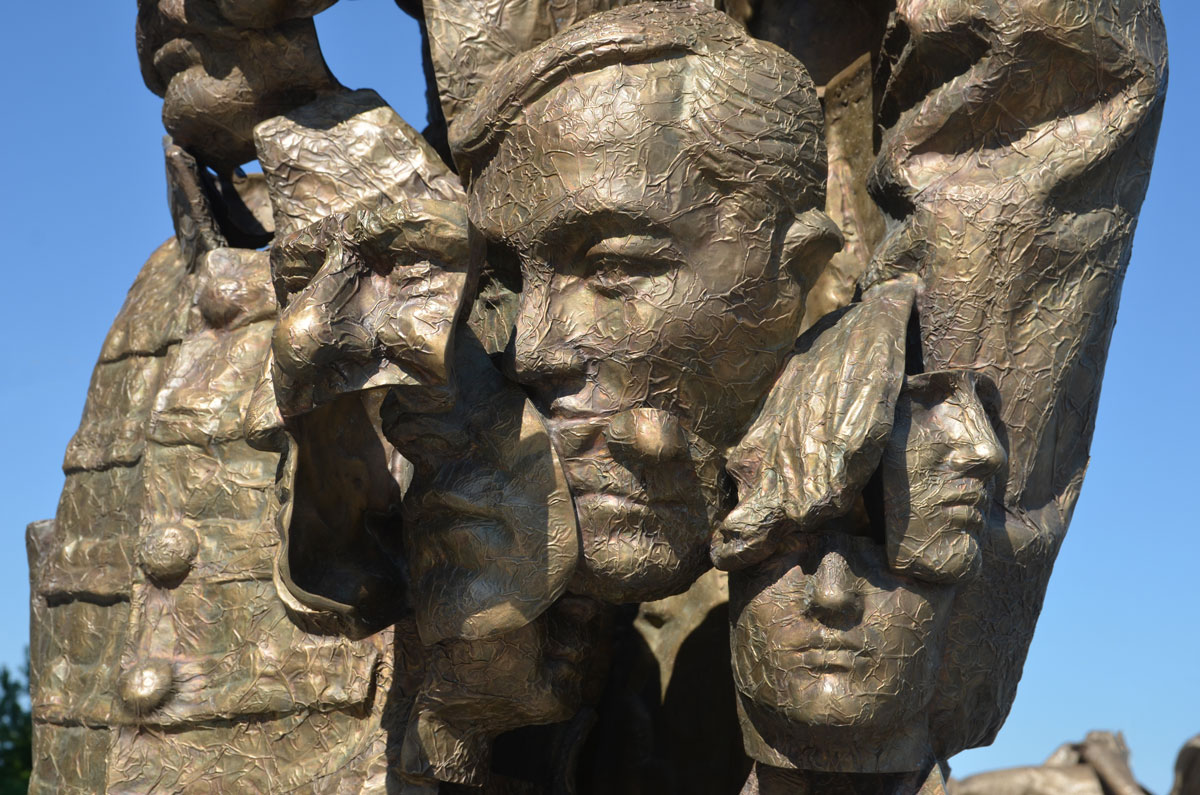
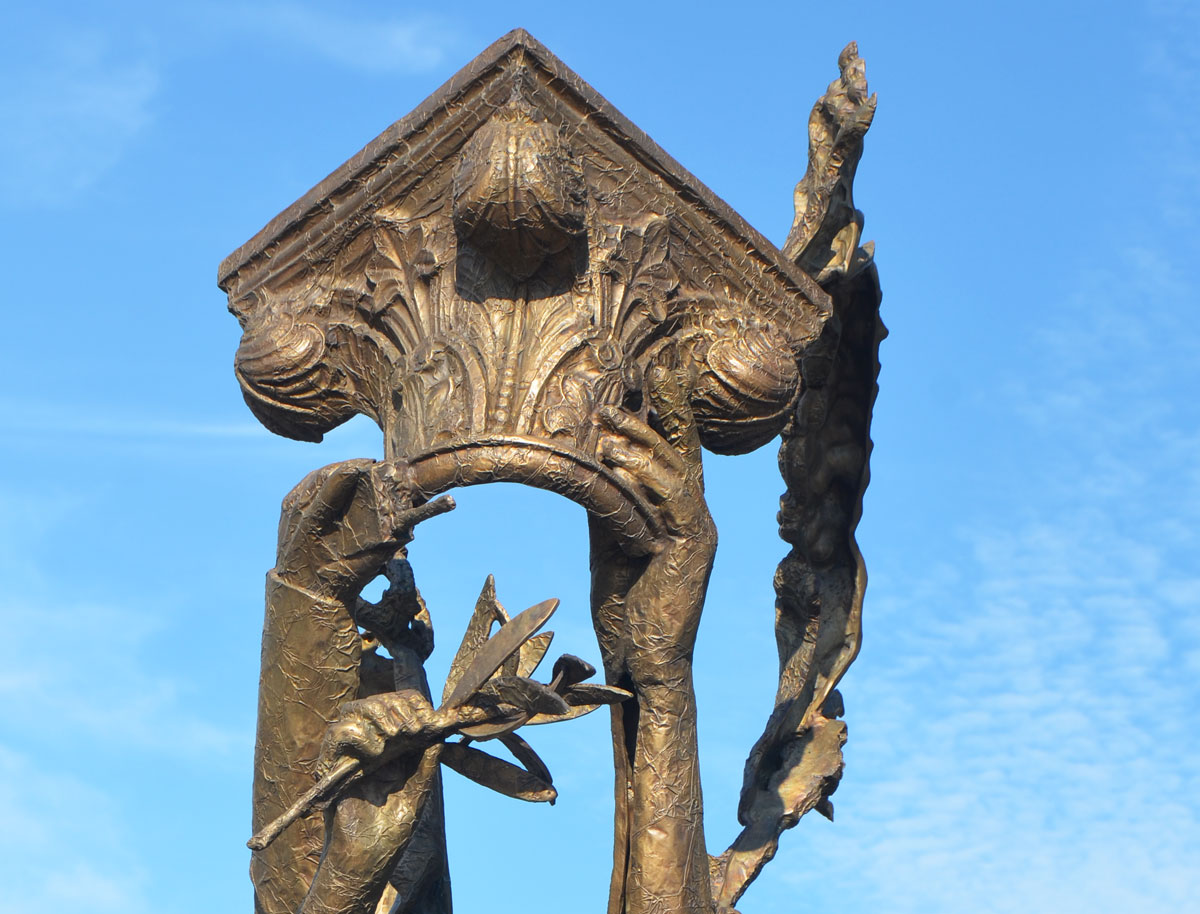
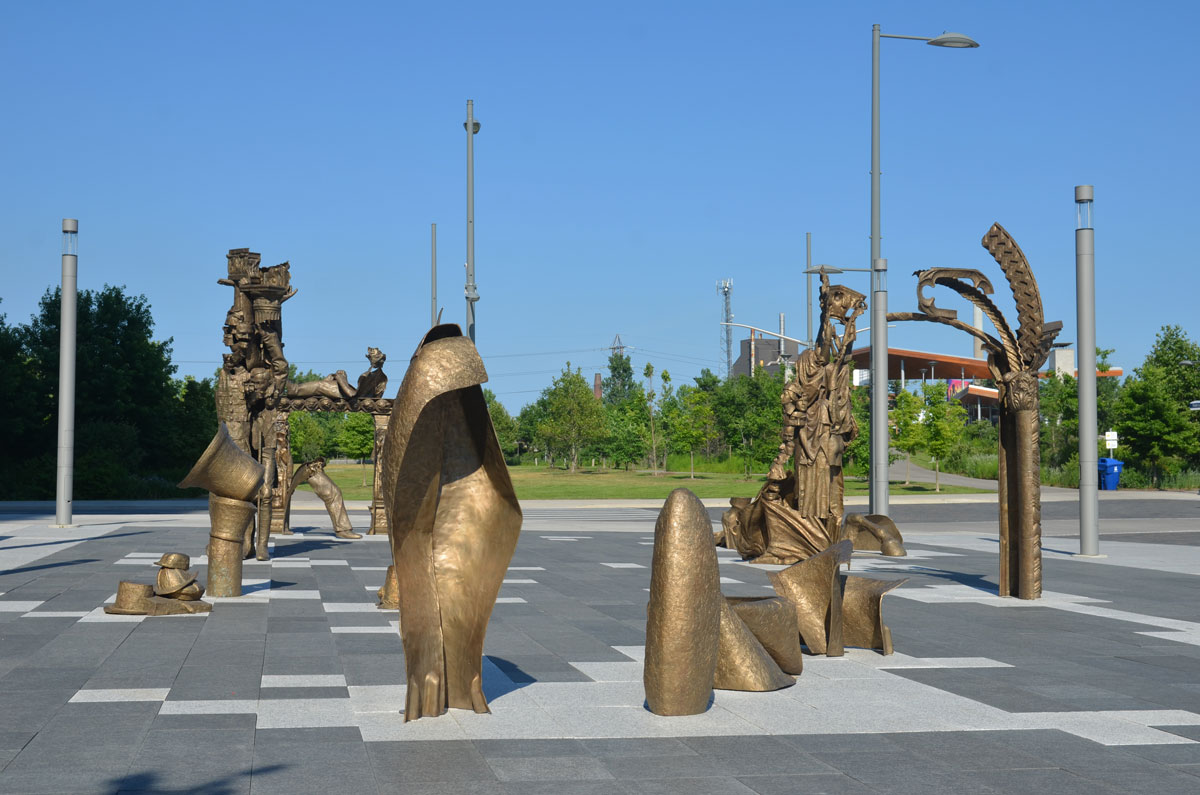
Located at Front and Bayview is the ‘Garden of Future Follies’ by Hadley Howes and Maxwell Stephens (Hadley & Maxwell and the Studio of Received Ideas).  It is a sculpture garden and there are 7 sculptures in this garden.  Each sculpture is a mashup of pieces from different sculptures around Toronto.  Aluminum foil ‘molds’ were used to replicate portions of over 80  different monuments and architectural features.  These portions were then put together in a whole new way.

public art installation on Front St East, various pieces of sculptures put together wrong, people with more than one face, legs in pieces, bronze pieces in 5 groupings on the sidewalk

From an interview with the artists:

“Sir John A. Macdonald’s nose is assembled along with the eyes of artists Frances Loring and Florence Wyle, the chin of Dr. Sun Yat-Sen, and Northrop Frye’s hair; Jack Layton’s smile is one of seven that grace a figure lounging atop a reconstituted mantel from the library at Osgoode Hall; a bell from St. James Cathedral’s famous collection is perched on a cannon from Fort York; while nearby a suitcase from the Memorial to Italian Immigrants acts as a plinth for a collection of hats from various bronze heads.”

Now you can play spot the pieces!  But you won’t find any hockey sticks.

blog_man_three_heads_statue

So far I haven’t seen anyone taking selfies here but I think it would be a great spot for them!

part of a public art installation outdoors created by piecing together fragments of other statues cast in bronze , man and hammer

fragments of horse and feet statues embedded in the sidewalk

part of a public art installation outdoors created by piecing together fragments of other statues cast in bronze

part of a public art installation outdoors created by piecing together fragments of other statues cast in bronze, hands, top of a column and a laurel leaf

part of a bronze sculptture, a naked bum with a hand beside it.

part of a public art installation outdoors created by piecing together fragments of other statues cast in bronze

below: No one will ever call it beautiful, playful yes, but not pretty.

arrangement of statue pieces to form a sculpture garden, Garden of Future Follies by Hadley and Maxwell.

a face is upside down on a statue made from bits and pieces of other statues


The dapper, larger than life Alexander Wood has stood on his corner at Church and Alexander streets for 11years now.  The bronze statue by Del Newbigging was unveiled in May 2005.

Wood came to Upper Canada from Scotland and settled in Toronto (known as York at the time) in 1797.  He was a successful merchant, magistrate, and lieutenant in the York militia.  The plaque on the granite pedestal tells his story.


statue of Alexander Wood, a young man with long coat, and a hat in his hand. The statue is on a large square pedestal so his feet are close to eye level.  Below the statue is a plaque detailing his life as early settler of York, of being a gay, and of being involved in a scandal in 1810.

“Militia Officer, Businessman, Public Servant, Justice of the Peace, Gay Pioneer

Alexander Wood came to Canada in 1793, settled in York in 1797 and started a mercantile business, one of only three stores in York at that time. Within a year he was a lieutenant in the York Militia; he was appointed magistrate in 1800 and by 1805 was a Commissioner for the Court of Requests (a senior planning officer). He was involved in a homophobic scandal in 1810 and fled to Scotland, but in two years he was back in Canada and resumed his duties. In spite of ridicule and discrimination he had a successful career in public service: he was on the executive of nearly every society in York, often as treasurer; he was manager of several businesses and acted for clients in land transactions. Wood died in 1844 at the age of seventy-two while in Scotland. The British Colonist paper called him one of Toronto’s ‘most respected inhabitants’.”

***

There is another bronze plaque on the back of the pedestal, complete with shiny bits.  This plaque adds more details to the story of the 1810 scandal that Wood got himself into.

plaques on a statue. The top is of a man with his pants lowered, the bottom is the story of the scandal that led to Alexander Wood having to leave Canada.  The bare bum on the plaque is shiny from repeated rubbing by passers by.

“1810 The Scandal
In 1810 a woman reporting a rape to Magistrate Wood said she had scratched her rapist. Wood inspected several suspects privately, requiring them to undress. To avoid the scandal caused by his unconventional behaviour, Wood fled to Scotland. After two years he returned to Canada but suffered ridicule and discrimination for the rest of his life.

Alexander Wood 1772-1844
Militia Officer, Businessman, Public Servant, Justice of the Peace, Gay Pioneer”

***

In 1810, word had spread quickly around the town (of 700) and Wood had become known as the “Inspector General of Private Accounts”.    The worst of the scandal blew over while Wood was in Scotland; he was back in York in 1812 and resumed all his previous occupations, including magistrate. At that time, “molly’ was a derogatory word for a gay man and he was nicknamed Molly Wood.

In 1826 he purchased 50 acres of land east of Yonge St. and north of Carlton St. in the neighbourhood where his statue now stands.  It is also the “Village”.  In Wood’s time it was referred to as ‘Molly Wood’s Bush’.  Wood remained in Toronto until 1842 at which time he returned again to Scotland where he died two years later.

Some of the art installations from Nuit Blanche remain available for viewing this week.
Two of them are near Jarvis and Gerrard.

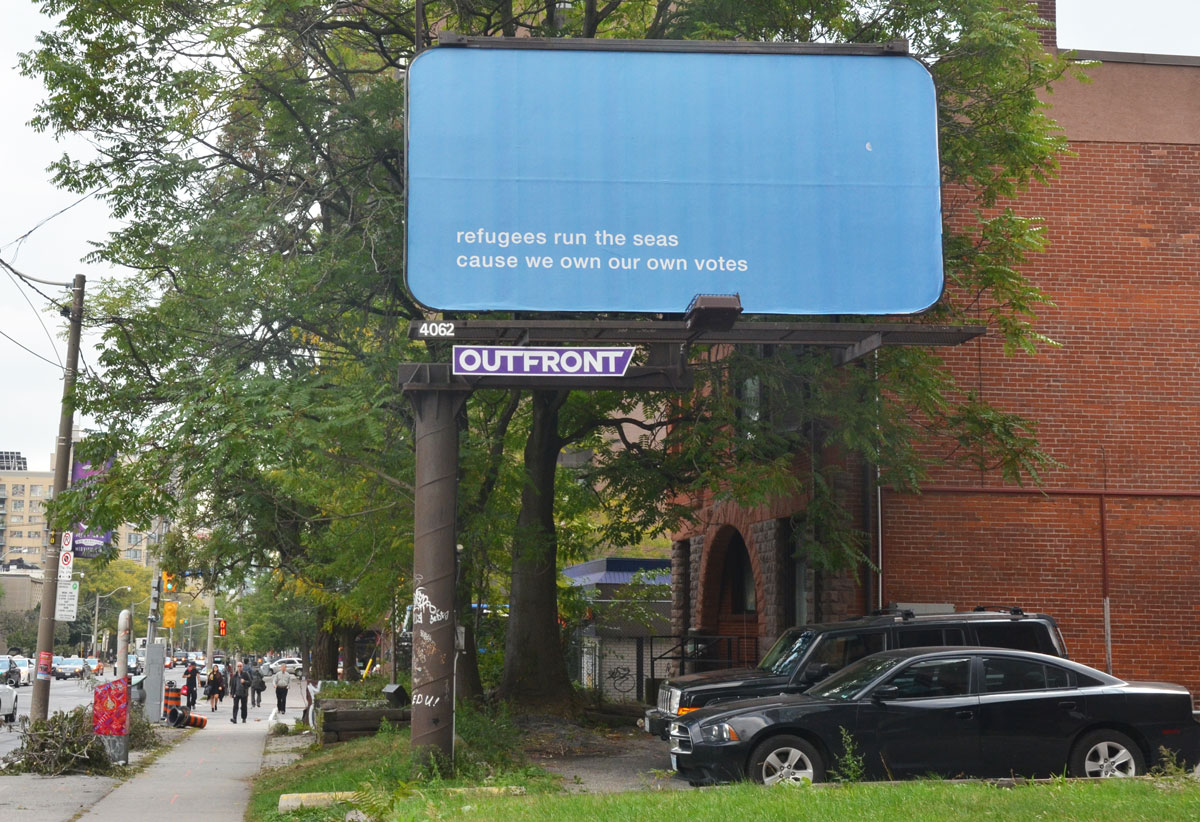
below: As you travel south on Jarvis Street, just before Gerrard, you can see a billboard art installation, ‘Refugees run the seas’ by Francisco Fernandos Granados.  The accompanying sign says:  “‘Refugees run the seas’ draws and diverts from pop culture as a way to invite the viewer to imagine a future where justice for migrants exists.  The work evokes past and present scenes of harrowing escape while allowing the possibility of a time to come when those seeking refuge will be agents of movement, rather than victims.”

“Refugees run the seas ’cause we own our own boats” is a line from Wyclef Jean’s rap in Shakira’s song ‘Hips Don’t Lie’ in case you were wondering how this billboard “draws and diverts from” pop culture.

a billboard on a city street. it is blue with just the words on it that say Refugees run the seas cause we own our own votes

below: In the Children’s Conservatory at Allan Gardens is another installation.  This one is titled “Sphinx” and it is by Luis Jacob of Toronto.   According to the Nuit Blanche sign: “Toronto is changing before our eyes.  Neighbourhoods and skylines are transformed seemingly overnight while the social fabric of the city is altered in ways that are difficult to discern.  Come in and see the ‘Sphinx’, who poses questions that we want ardently to ask.”

The hands and fingers of this tall and imposing headless man are forming a frame that is apparently supposed to capture our attention.  When you walk into the conservatory it’s definitely not the hands that you notice. The hands are way above the line of sight.   Of course, one could ask why he has no clothes and does having no head enhance the artwork.  Can you ask questions if you have no mouth, no voice?  And are the questions ardently wanted or ardently asked?  hmmm….

There are books and pamphlets in display cases around the room.  These publications are all about Toronto and they date back as far as 50 years ago.  No, you can’t access the books, you can’t open or read them.  I’m not sure what information they are supposed to add to the exhibit.

In a glass walled and glass roofed conservatory, a white statue of a headless naked man stands on a pedestal in the middle of the room. Two men are looking at a display on a table in the left of the picture.


#snbTO

100 Workers,
aka WSIB (Workplace Safety and Insurance Board) Simcoe Park Workers Monument,
a monument commemorating the workers of Ontario who died in the workplace,
by John Scott and Stewart H. Pollock.

Located downtown on Front Street between Simcoe and John.

low brown granite wall with large brass lettering on the front that says "100 workers".  Along the top of the wall are plaques with names of people who died in the workplace between 1901 and 1999.  The name, year and cause of death is given on each plaque.

 Along the top of the wall are plaques with names of people who died in the workplace between 1901 and 1999.  The name, year and cause of death is given on each plaque.   View looking down the top of the wall.

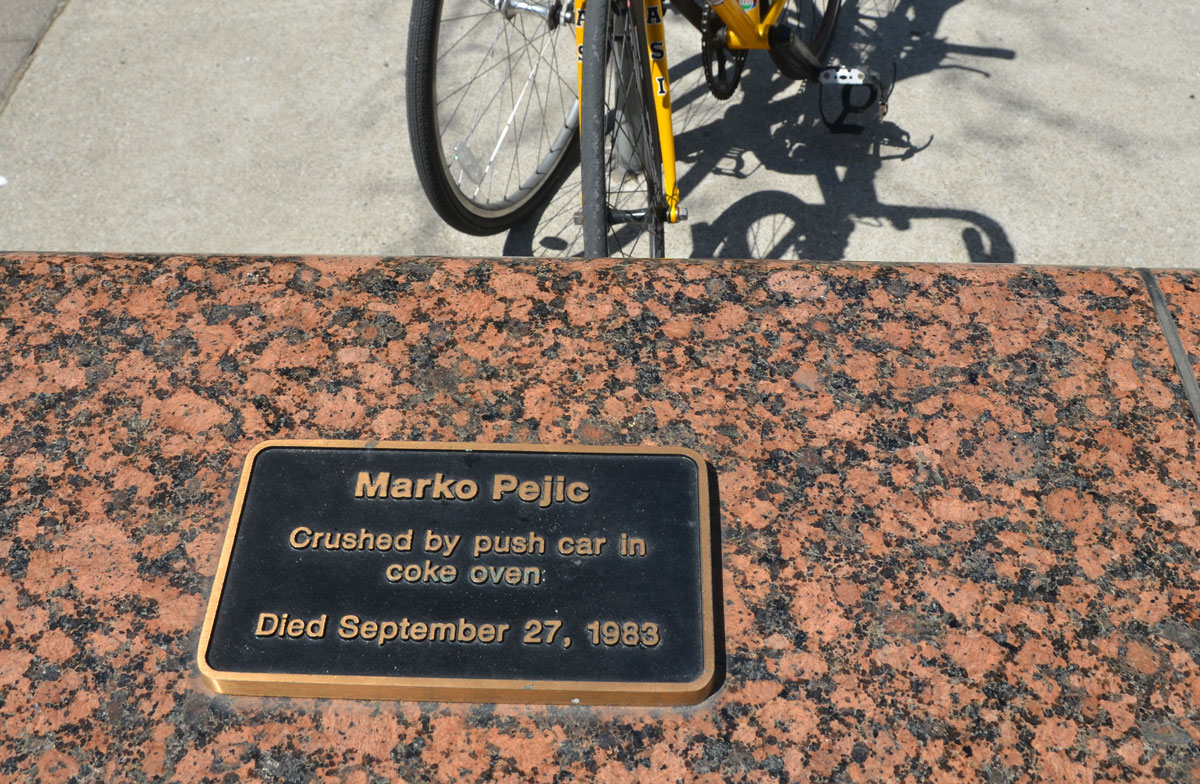
Each plaque on along the top of the wall commemorates one person, one from each year between 1901 and 1999.   Deaths are from mining accidents, industrial accidents, train crashes, silicosis, asbestosis, and the like.   At the end, there is one blank plaque to represent future accidents.

A black and brass plaque commemoration Marko Pejic who died in 1983

A statue of a workman chiseling out the words on a granite wall.

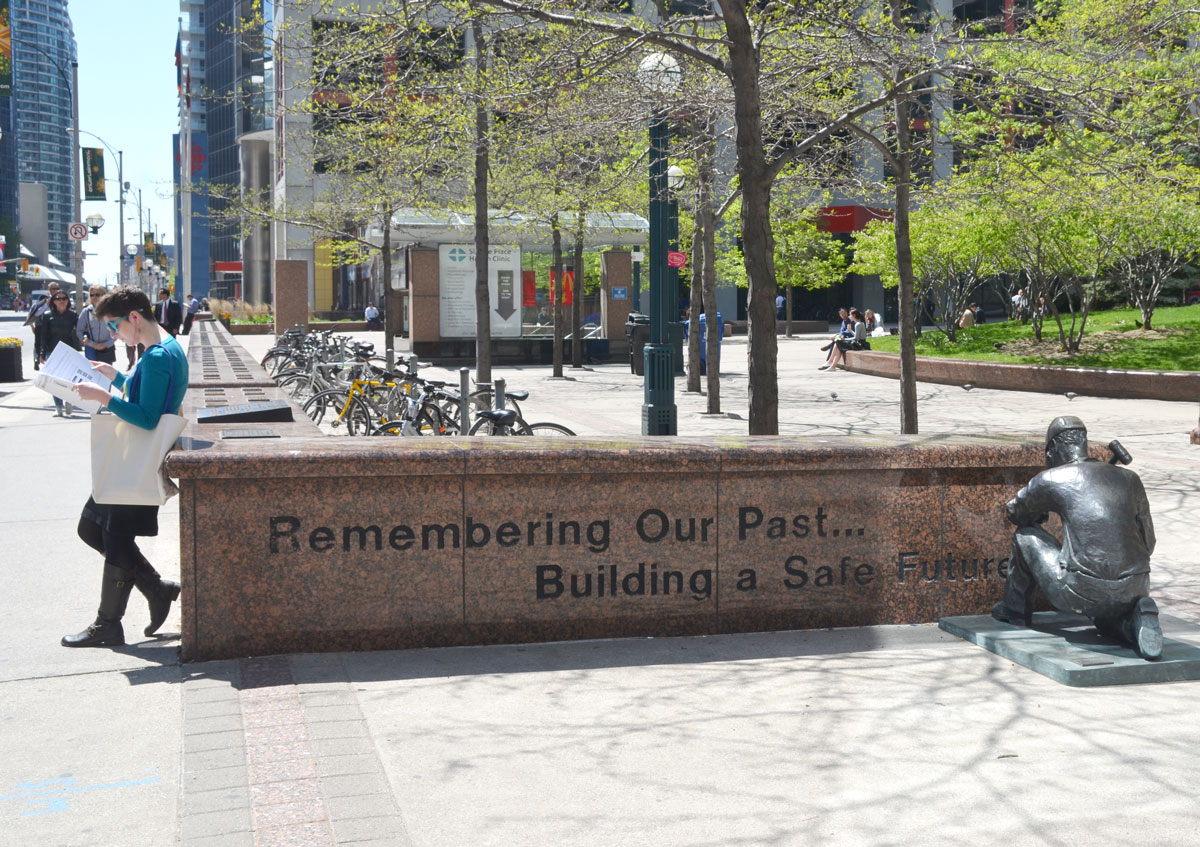
view from the east of the 100 Workers memorial showing one of the half walls with the words" Remembering our past.  Building a safe future."  A lifesize statue of a workman chiseling words into the wall is on the right side of the photo.

The Ontario Fire Fighters Memorial is near the corner of Queens Park Crescent and Grosvenor Street. 

A short wall of black rock has the names of fallen firefighters carved in it.  In the background is the statue of the firefighter and young boy.

The names of fallen fire fighters are engraved on black stone.

.
Statue of a firefighter wearing a gas mask and carrying a young boy is in front of a block of shiny black rock.  In the rock there is a reflection of the statue along with the Ontario flag that is flying nearby.

close up of statue of a firefighter carrying a young boy

Near the corner of Queens Park Crescent and Grosvenor Street is the Ontario Police Memorial.
It was dedicated in May of 2000.

Light grey stone horizontal with 5 panels.  The outer two panels on each side contain the names of the policemen who have died while on duty in Ontatio.  The center section of the stone is the base for two statues - an older and a younger policeman.

The names of fallen Ontario police are carved in the stone at the base of the memorial.

.
The two statues on the police memorial as seen from the side.
.
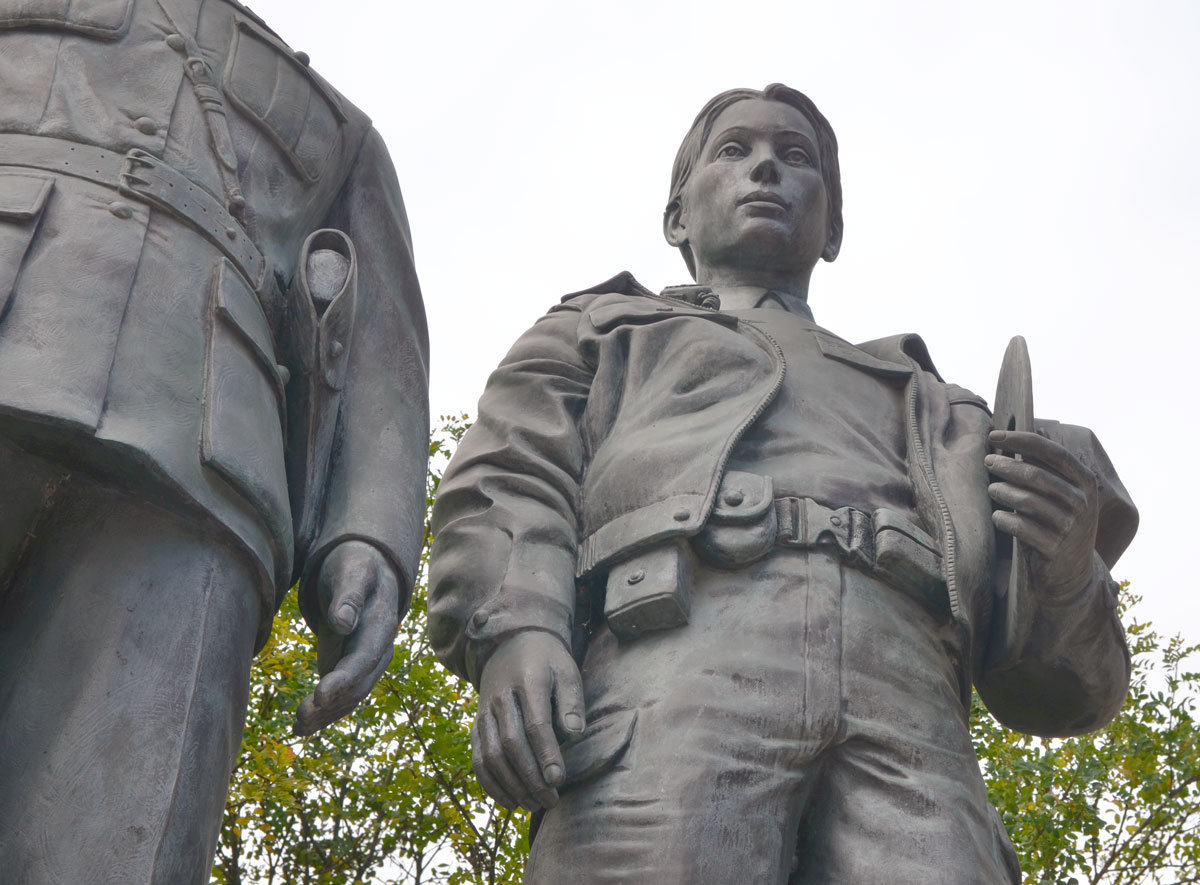
close up of young police officer (upper body) at the Ontario Police Memorial
.