Updated 2 September
The latest StreetARToronto (StART) summer project has just wrapped up. Seven new murals around Broadview and Gerrard East, each one depicting a famous landmark, make up this project which is now called ‘Around the World in East Chinatown’. Although it was largely funded and organized by StART, other partners include the Toronto Parking Authority, 55 Division police, and the Chinese Chamber of Commerce (East Toronto).
A crew of more than 20 artists headed by Mike Kennedy worked for about 2 weeks to complete the murals. Each mural includes the ‘signature’ of the artists. I am not very good are deciphering (or remembering) the graffiti writing but I’ve had some help identifying the artists.
below: Christ the Redeemer now watches over Gerrard East. Painted by bacon. This is the statue built high on a hill overlooking Rio de Janeiro. If you watched any coverage of this summer’s Olympics you probably saw this statue from every possible angle. The statue was designed by a Frenchman, Paul Landowski and built by a Brazilian engineer, Heitor da Silva Costa, between 1922 and 1931. Made of soapstone and reinforced concrete the statue stands 30m tall and has an arm span of 28m. He stands on an 8m high pedestal.

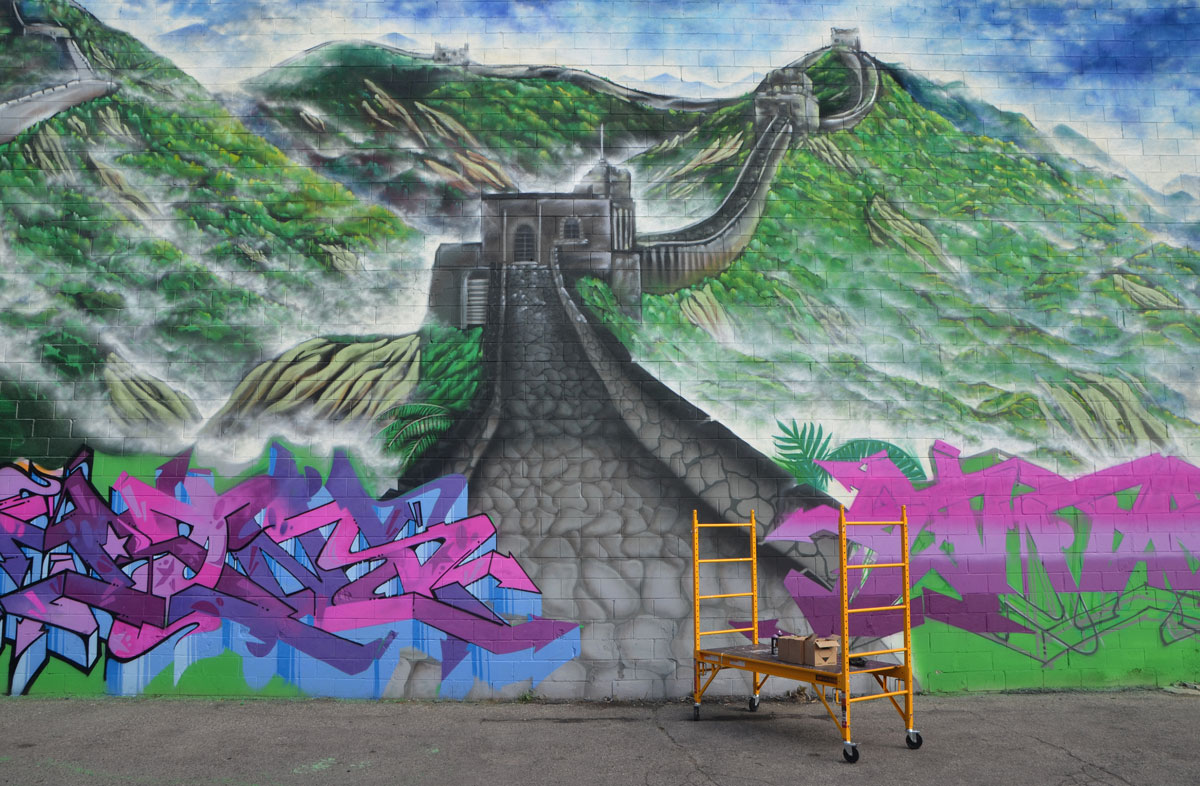
below: Putting the finishing touches on The Great Wall of China, a collaborative effort by Nick Sweetman, Wuns, Rons, Tens, Braes and Wales. The actual wall was built in sections over many centuries and includes walls, trenches and natural elements such as hills and rivers. Parts of the wall are in better repair than others – around Beijing where more tourists visit, the wall has been fixed up and is well maintained. Measurement of the wall varies but if all the branches of the wall are taken into consideration, the total length is about 21,000 km.

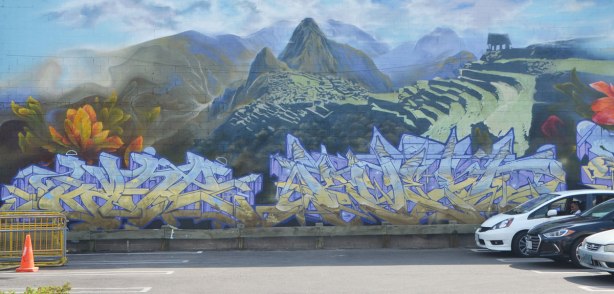
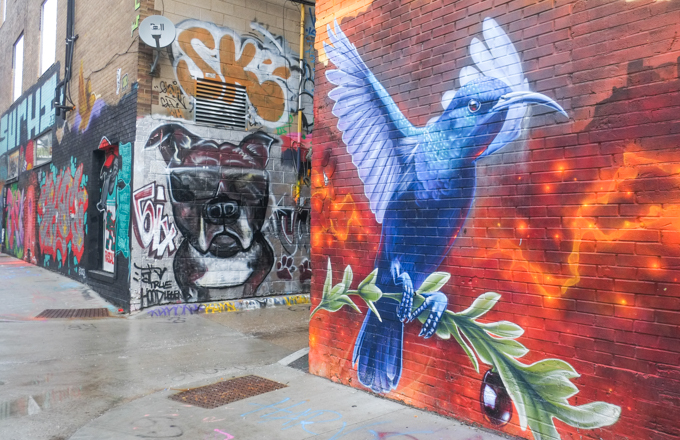
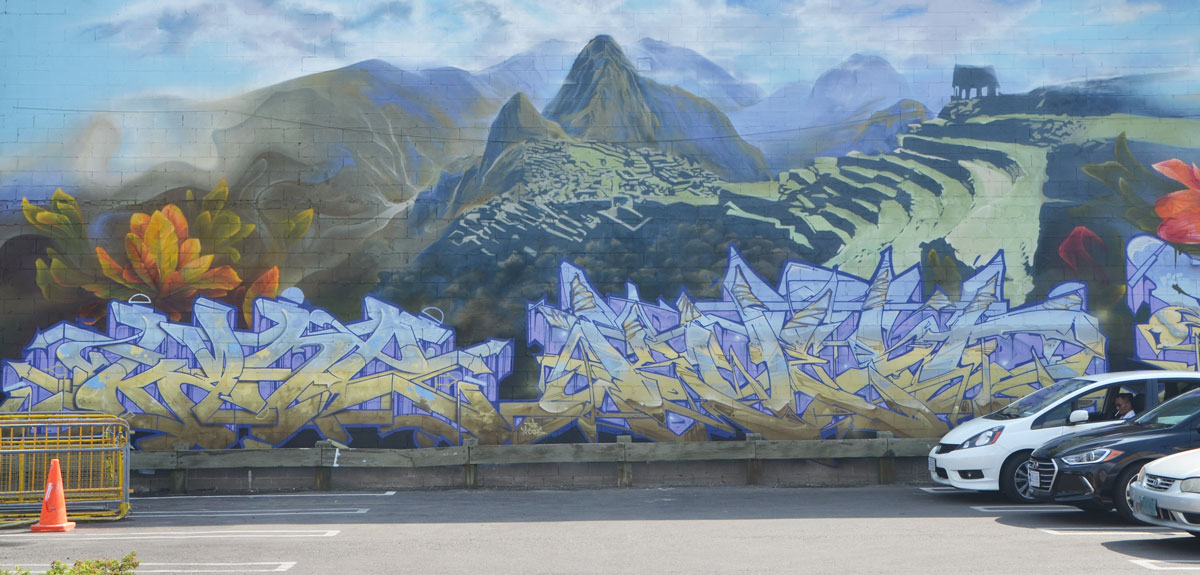
below: A hummingbird flies over Machu Picchu in the next mural. Machu Picchu was built by the Incas in the 15th century in what is now Peru. It is on a mountain ridge, 2430m above sea level.

below: Machu Picchu. Painted by Bacon, Kwest, Kane and Rath.
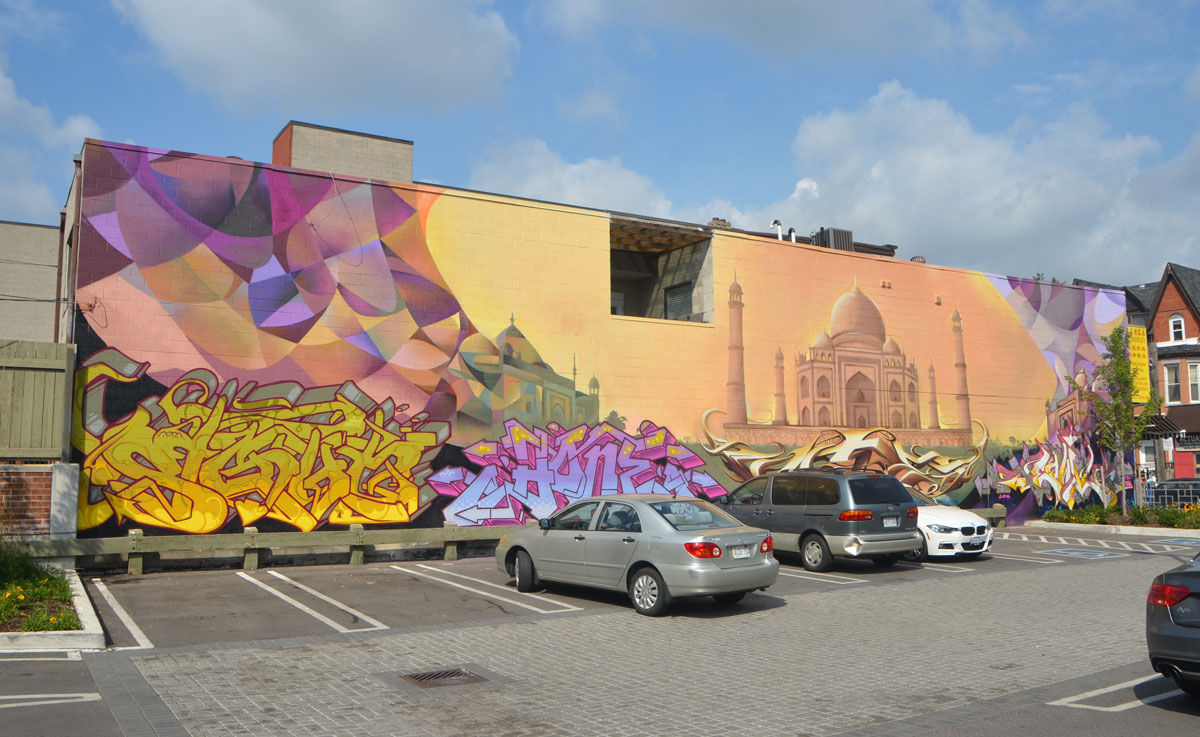
below: In the same parking lot as Machu Picchu but on the other side, is a very large mural centered around an image of the Taj Mahal. Painted by Sight, Hone, Water, Equal and Tenser.

below: Commissioned in 1632 by the Mogul Emperor, Shah Jahan, the Taj Mahal was built as a mausoleum for his favorite wife Mumtaz Mahal. She was born Arjumand Banu Begum, a daughter of Persian nobility in Agra India. In 1613, when she was 19, she married Prince Khurram (later he became Shah Jahan) as his 3rd or 4th wife. She died in June of 1631 while giving birth to their 14th child. If my math is correct, that’s 14 children in 18 years. After the Shah died in 1666, he was buried here too. Anyhow, many centuries later, the Taj Mahal is still standing in Agra India and it is visited by millions every year.

below: Teeny tiny people dwarfed by the doors of Petra, Jordan. Petra is an ancient city with immense buildings cut out of the sandstone cliffs and hills. It was once a thriving trading center and the capital of the Nabataean empire between 400 B.C. and A.D. 106 when it was called Raqmu. The Nabateans were a nomadic Arab tribe. Their empire came to an end when they were conquered by the Romans and their land annexed into the Roman Empire.

below: The whole Petra mural on the walls of an alley tucked in between the Ka Ka Lucky Seafood BBQ Restaurant and Paradise Spa on Broadview Avenue. This mural was painted by Hemps.

below: The Roman Coliseum (Rome) is now on the corner of Broadview and Gerrard. This is half of the mural and when the photo was taken it was incomplete. It is now finished – a second visit for a photo is in my future! The Coliseum (or Colosseum) is in Rome and it was built by 80 A.D, just before the Roman Empire swallowed up the Nabateans. It was built as an amphitheatre and could hold at least 50,000 spectators – people who came to watch gladiator fights, enactments of classical dramas, or other forms of entertainment.

below: The right hand side of the mural with the graffiti writing signature of the artist. If I could only easily photoshop out that garbage bin. Mural painted by Sewp, Poser and Frens.

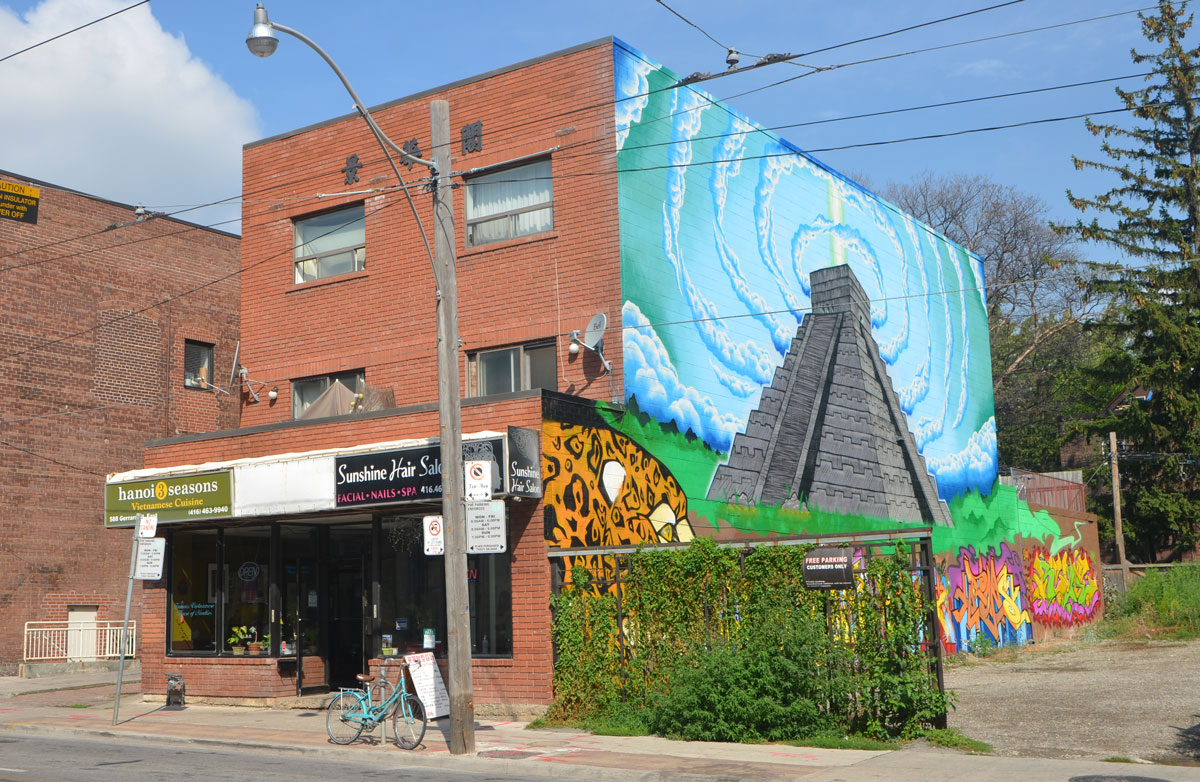
below: Chichen Itza ruins in Yucatan Mexico and a jaguar on the side of the Sunshine Hair Studio, partially obscured by greenery. Painted by Cruz, Rons, Sadar and Rcade. Chichen Itza was the largest Mayan city covering about 5 square km. It flourished between 900 and 1050. The mural depicts El Castillo, or the Temple of Kukulcan, the building at the center of Chichen Itza that dominates the site.
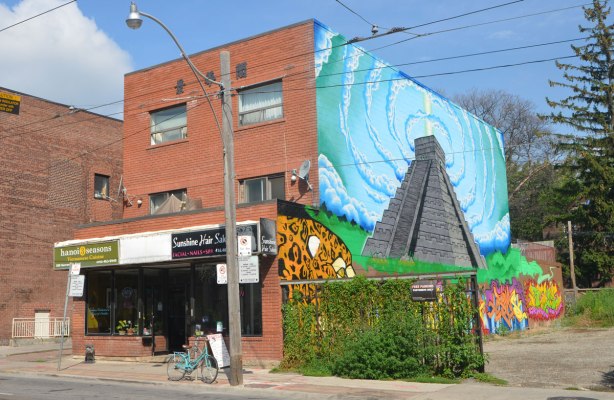
And that concludes the seven new murals – Christ the Redeemer statue, The Great Wall of China, Machu Picchu, Taj Mahal, Petra, the Roman Coliseum, and Chichen Itza.
This mural project follows the success of last year’s Project Picasso in the same area. Graffiti from some of the lanes was cleaned up and a Chinese themed mural was painted on the brick wall at the back of the parking lot on Gerrard Street East, just west of Broadview Avenue. Riverdale Collegiate students helped with the graffiti clean up and contributed ideas for the mural.
below: Chinatown East mural by ACK crew, bacon, wunder, tensoe 2, and cruz1
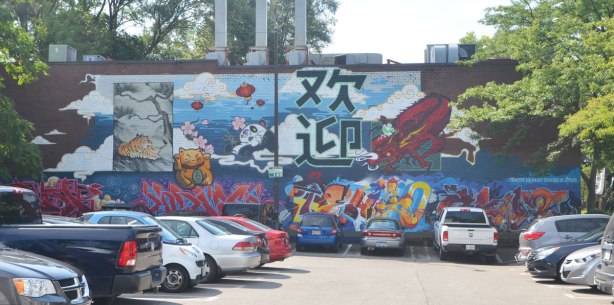
below: Chinese icons painted in the mural – a resting tiger, cherry blossoms, red Chinese lanterns floating by, a lucky cat with its paws up, and a panda munching on a piece of bamboo.

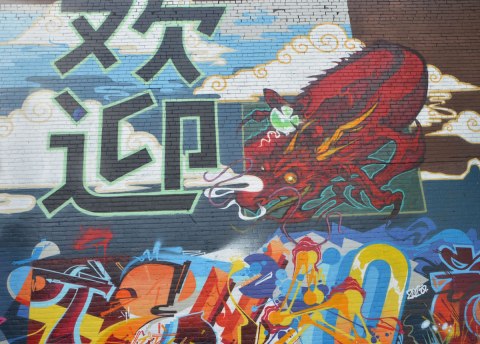
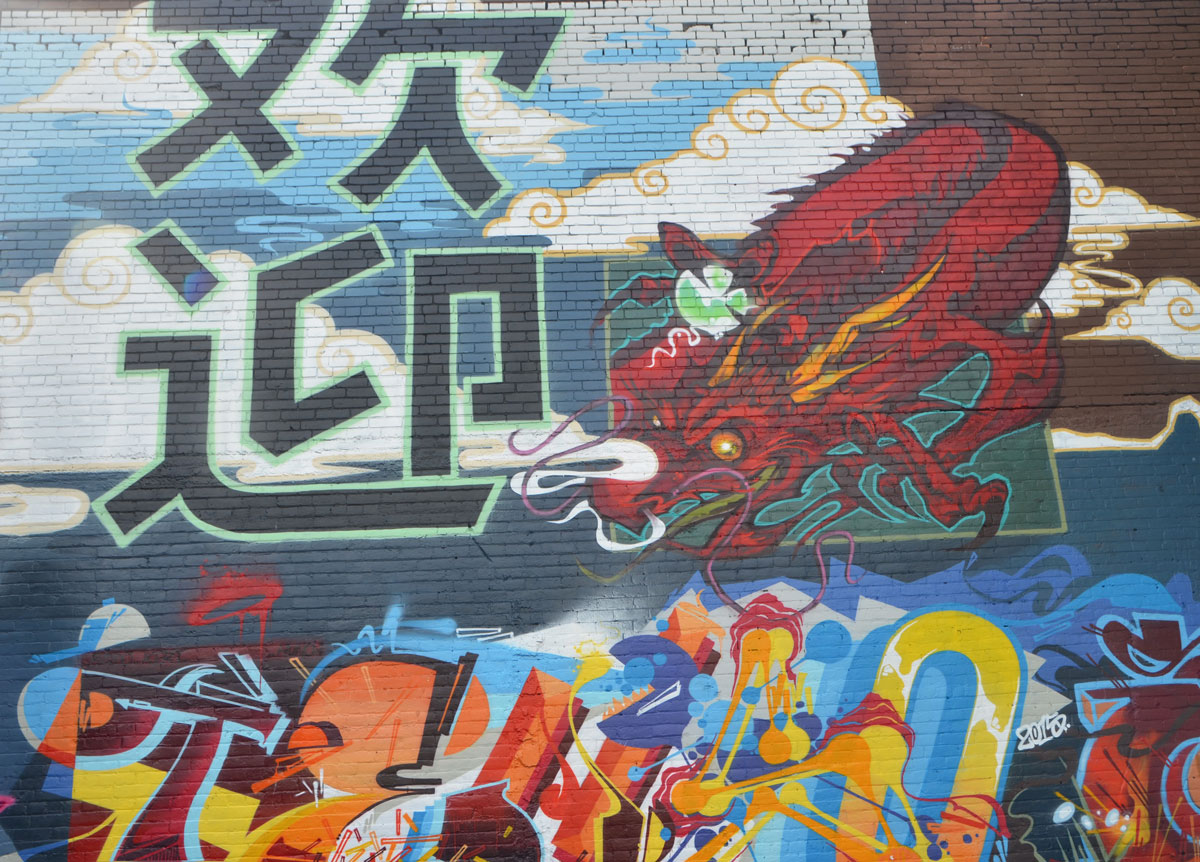
below: A red dragon beside some Chinese characters. Does anyone know what it says?



































































 as I walk Toronto