Posts Tagged ‘ink’

One of the pieces on display at TMU’s The Image Centre is this is pen and ink drawing signed by “Fun & Borckmann” from about 1895.  It is part of the exhibit, “Hypervisibility: Early Photography and Privacy in North America, 1839-1900.”  The drawing is on loan from the collection of Stephen Bulgar and Catherine Lash.   As you can see, across the top is the title, “A Common Enemy of Mankind”.  If you start at the first panel on the top left, you might think it is etiquette suggestions for photographers, but on closer inspection, is it?

an ink drawing from the late 1800s as seen in a gallery, framed and behind glass

Let’s take a look!

Panel 1 (below): ” The amateur
Photographer
A cheerful sort of nuisance is.
Does it occur To him – or her –
He shouldn’t take what isn’t his
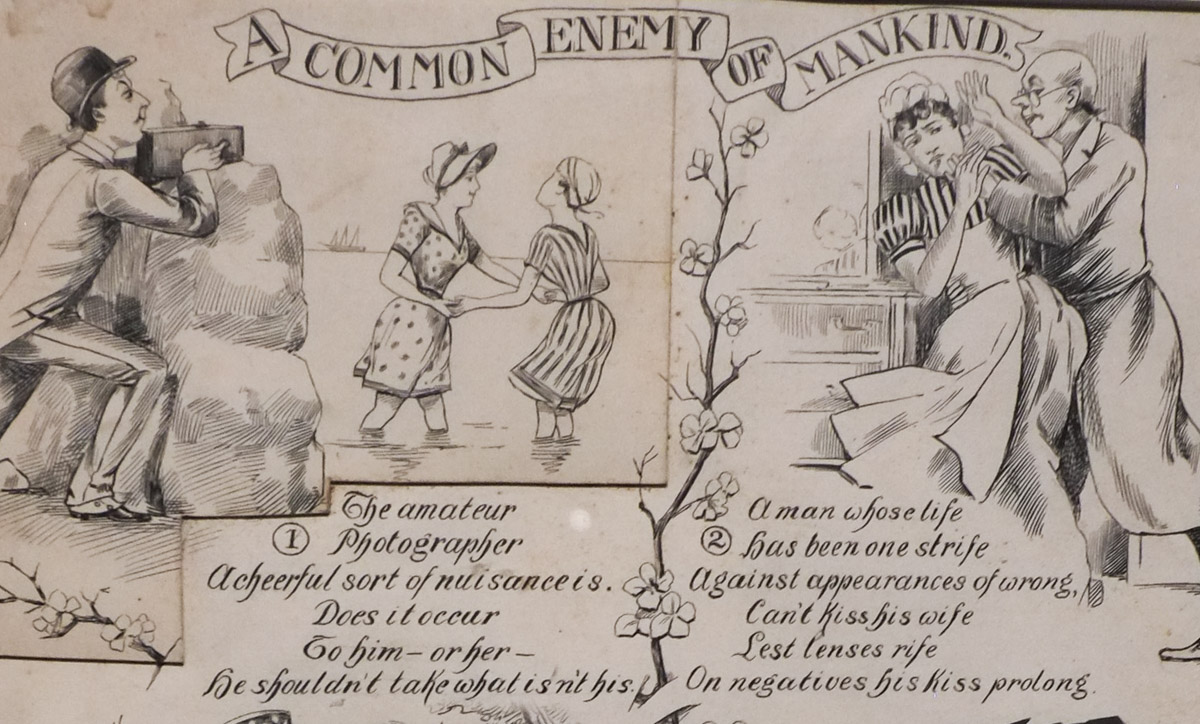
part of an ink drawing by Fun and Borckman from about 1895 on the etiquette of photography, a common enemy of mankind

Panel 2 (above): A man whose life
Has been one strife
Against appearances of wrong,
Can’t kiss his wife
Lest lenses rife
On negatives his kiss prolong

Panel 3 (below) – along with “The other fellow’s girl!”
“Where’er one goes
To seek repose
Far from the city’s heat and din
Be cannot doze
In wooded close
But that a snap-shot takes him in.”

Can I call him a jaunty looking fellow with his striped blazer and the polka dot band on his hat?
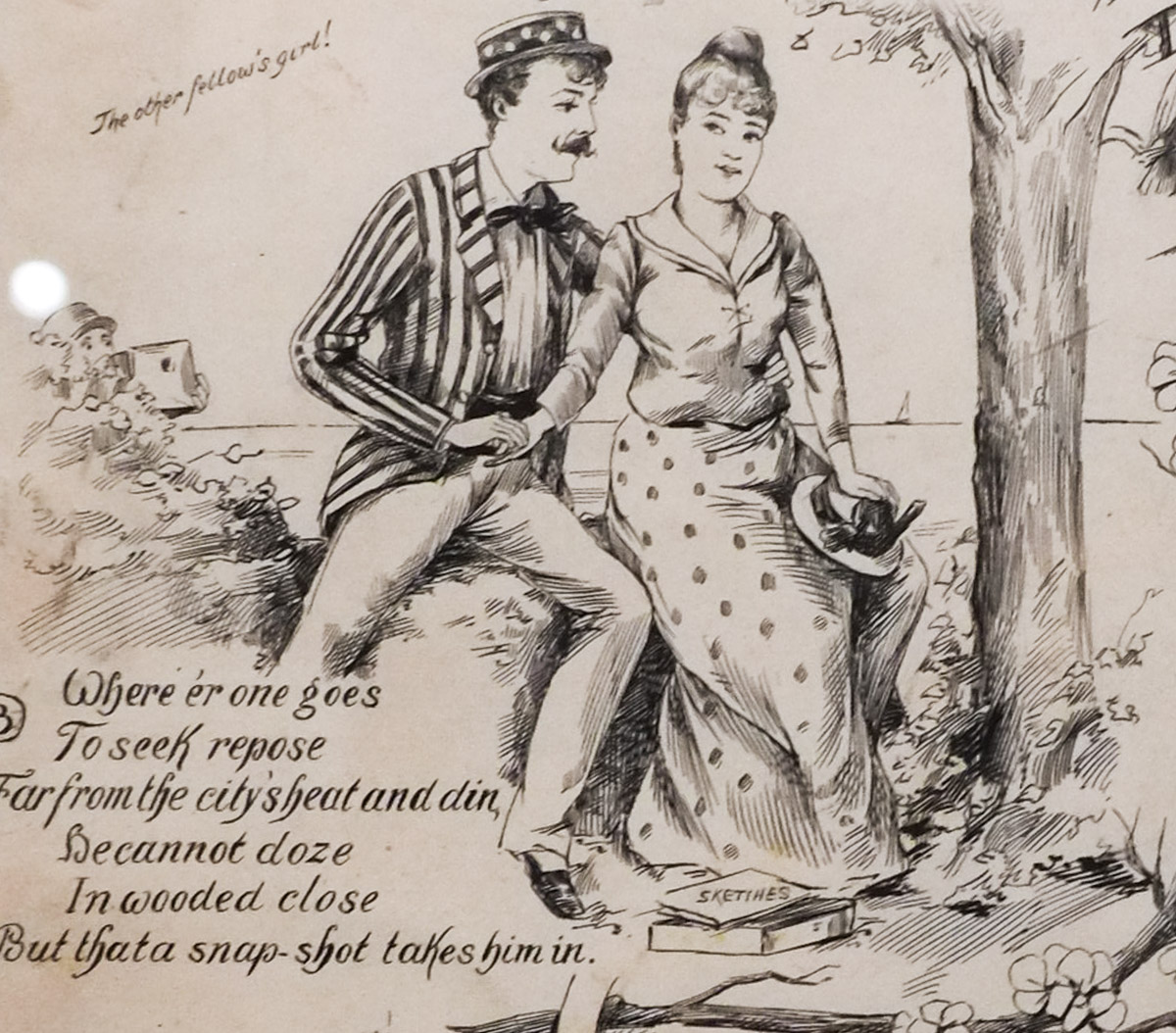
ink drawing from circa 1895, a young man and a woman are sitting together outside, another man with a camera is hiding in the bushes behind them

Panel 4 (below): “Sometime mayhap,
A city chap
May linger in the moonlight fair;
He hears the tap
Of shutter-snap
And knows too well he’s pictured there.”
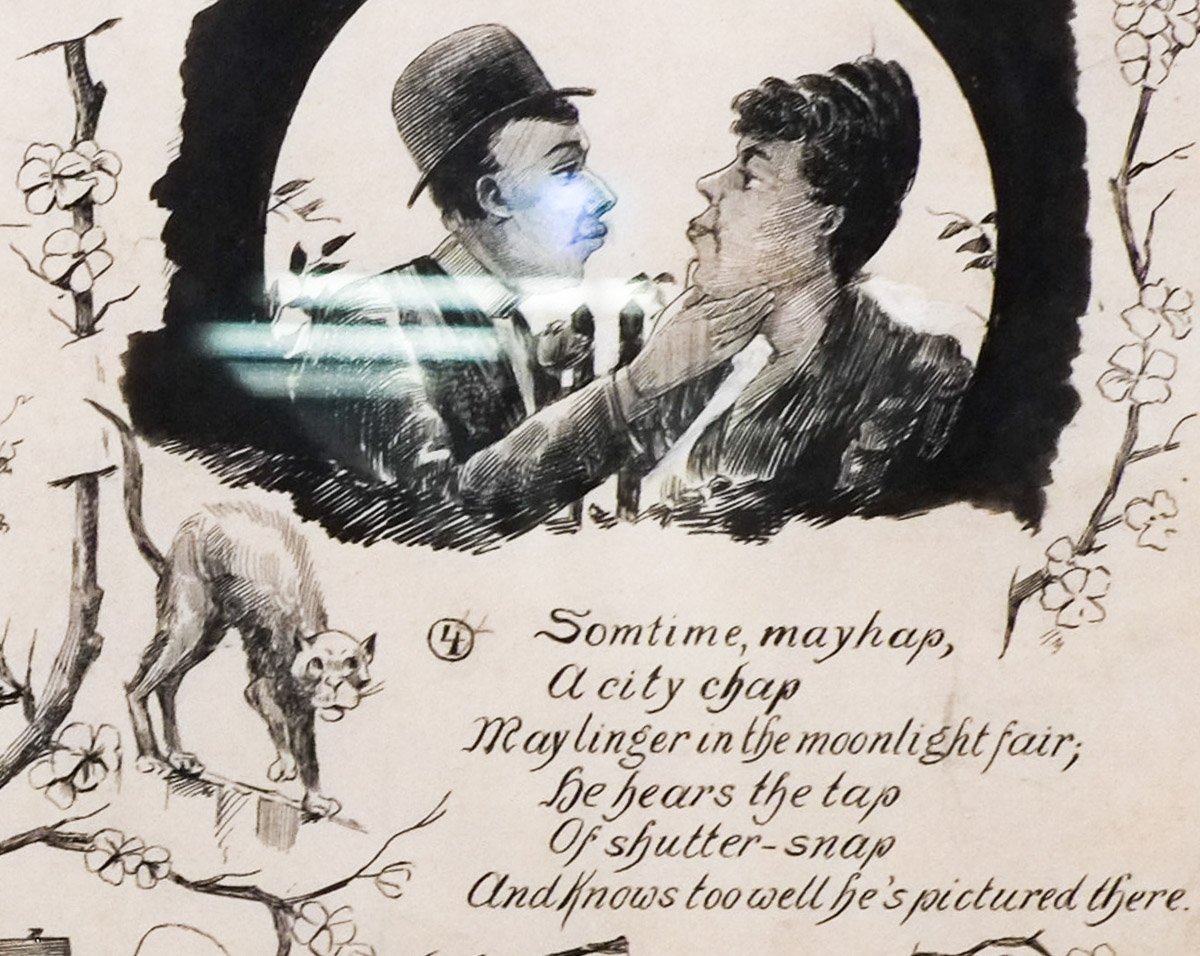
ink drawing with etiquette rules for photographers, or is it a guide to the follies of mankind? picture of two men about to kiss

Panel 5 (below): “Or in the street,
If he should meet
A former friend of single days,
It’s not meet
His smile so sweet
Be captured in actinic rays.”
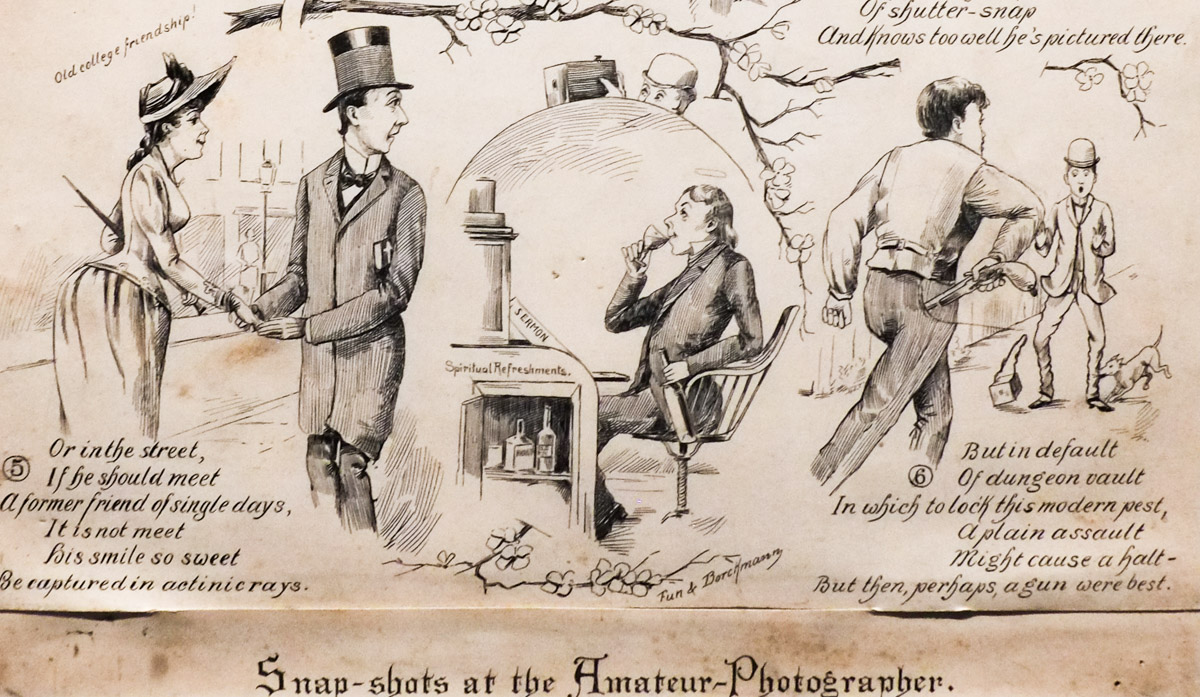
bottom panel of drawings, a common enemy of mankind, with bottom title of Snap-Shots at the Amateur Photographer, about 1895 by Fun and Borckmann

Panel 6 (above): “But in default
Of dungeon vault
In which to lock this modern pest,
A plain assault
Might cause a halt –
But then, perhaps, a gun were best.”

Life’s little indiscretions now preserved in little snap-shots!   Please don’t shoot the photographer!

Extra litte note or two: Peter Borckmann was an artist whose pen and ink drawings appeared in the “New York Fun Magazine”. In the 1880s and 1890s, this art form became very popular as demand for humorous illustrations grew along with the increasing popularity of magazines and journals at that time. The “Fun Magazine” was published in the 1880s and early 1890s.

Oh, in case you were wondering about that word ‘actinic’.  I looked it up….According to Merriam Webster:  “of, relating to, resulting from, or exhibiting chemical changes produced by radiant energy especially in the visible and ultraviolet parts of the spectrum.”   Sounds a lot like old-fashioned, pre-digital, light hitting chemically treated film, photography to me!

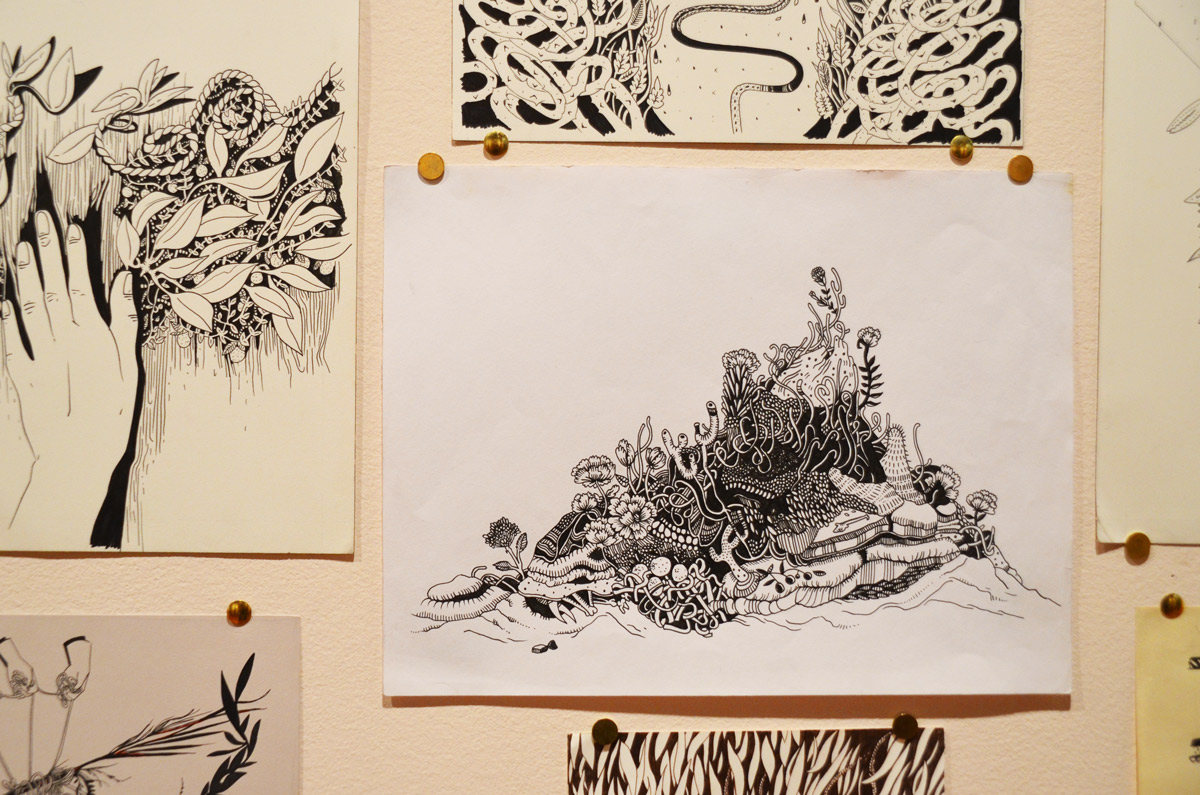
 

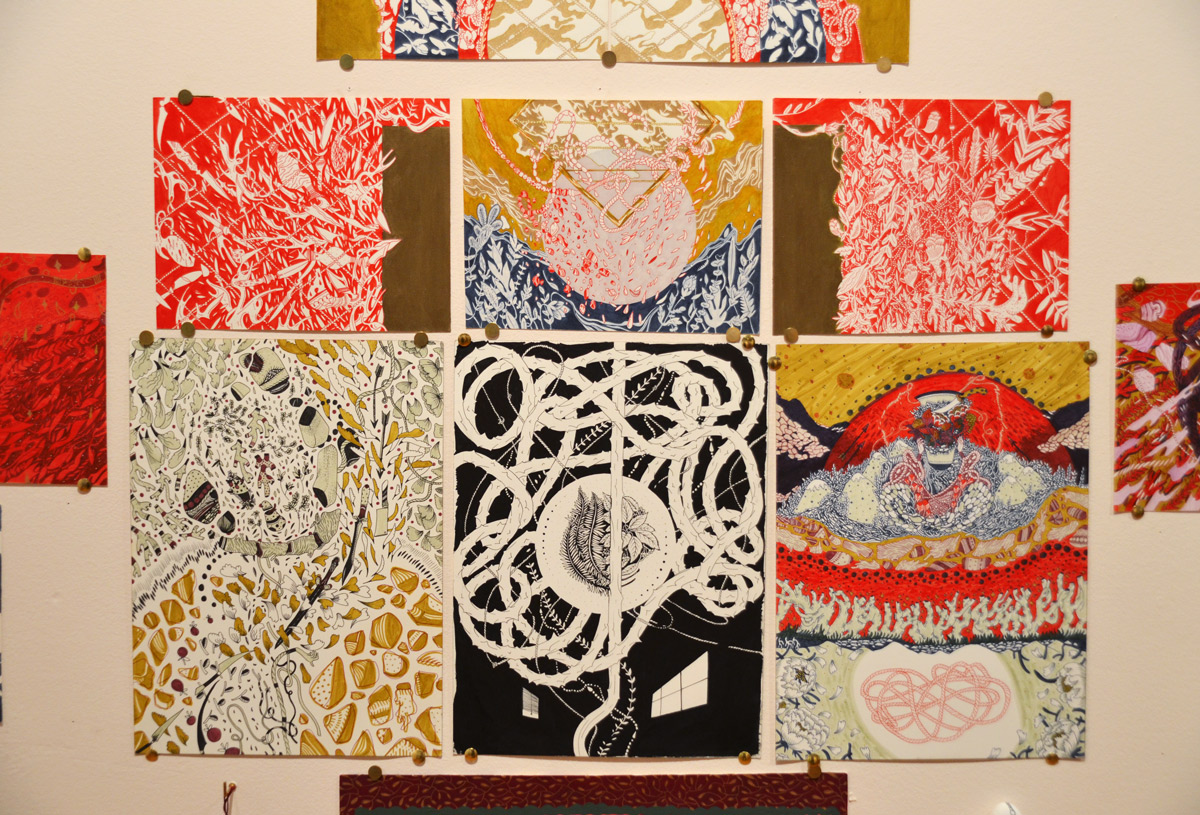
Progress is a spiral upward is the title of an exhibit at the Tangled Arts Gallery at 410 Richmond.  It is a series of collages of ink and/or paint drawings by Toronto artist sab maynert.

three people in an art gallery looking at drawings by sab meynert.

“for sight beyond seeing
for seeing in order to know”

pen and ink, and paint, drawings by sab meynert on a gallery wall, thumb tacked to the wall, black and white, intricate

“let the flow carry you, rest in the soil, let the seed push you to the sun,
palms out to the sky,
let go, make room”

pen and ink, and paint, drawings by sab meynert on a gallery wall, thumb tacked to the wall,

below: The piece in the middle is “By Proximity”, 24″ x 24″, gouache and ink on paper.

pen and ink, and paint, drawings by sab meynert on a gallery wall, thumb tacked to the wall,

below: bottom left (yellow and black): “You Give Everything”, ink on paper, 9″ x 12″ while bottom right (with the red ‘knot’) is “Decisions we Made”, ink on paper, 9″ x 12″.

pen and ink, and paint, drawings by sab meynert on a gallery wall, thumb tacked to the wall,

“pull yourself out of the thornbush
you smell like flowers”

pen and ink, and paint, drawings by sab meynert on a gallery wall, thumb tacked to the wall,

The quotes that I’ve used in this blog post are lines that I have pulled from the writing that accompanies the exhibit, a poem with the same title, “Progess is a Spiral Upward”.

The exhibit continues until the 14th of October.
Link to sab meynert’s website


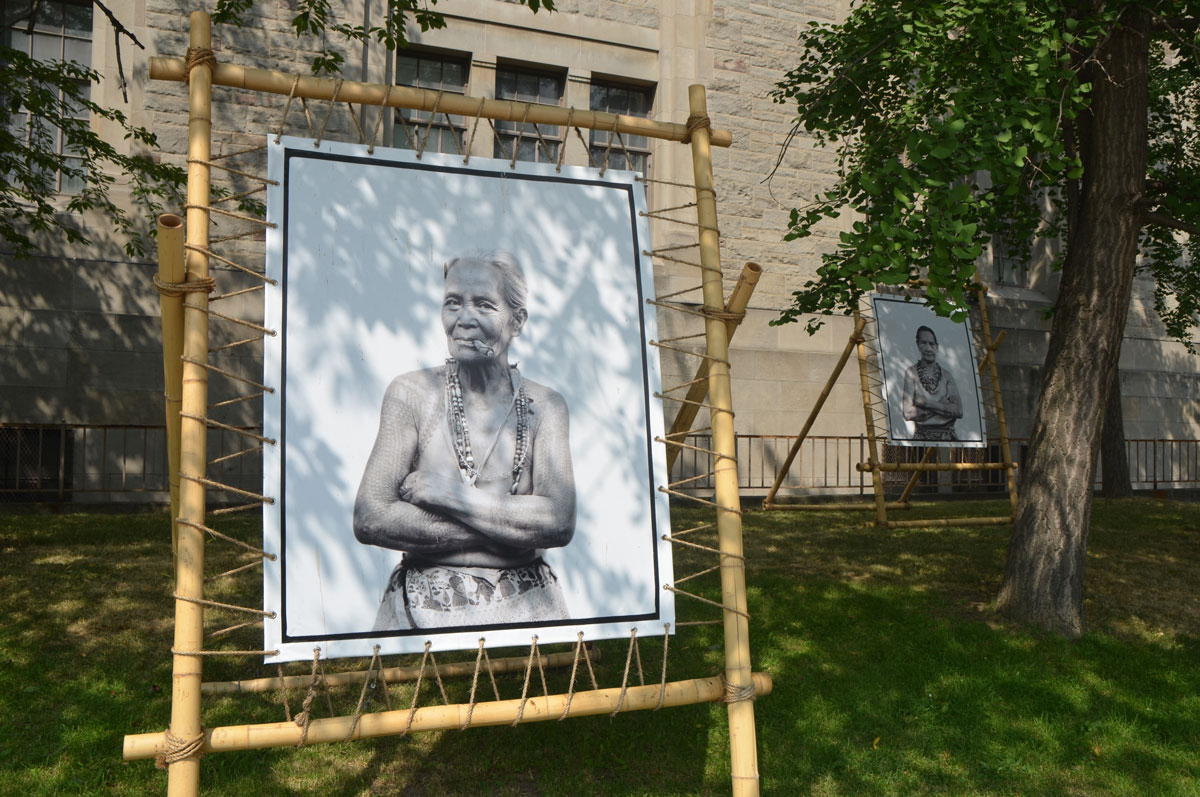
There are seven or eight large photographs, portraits of older women, on University Avenue.   They were actually part of the CONTACT Photography Festival and they have been on display outside the Royal Ontario Museum since early May.  The photos are the ‘The Last Tattooed Women of Kalinga”, portraits by Jake Verzosa.

large black and white photo of an older woman with many tattoos, black and white, displayed outside, another portrait in the background

In the villages of the Cordillera mountains of northern Philippines the women have been tattooed with lace-like patterns for centuries.  The tattoos are symbols of stature, beauty, wealth and fortitude and are traditionally applied during rituals.  The tradition is dying out as standards of beauty change and as the old ways are replaced with more modern methods.

Each village once had their own tattooist, or mambabatok, but today only one remains.  Born in 1918, Whang-od (or Fhang-od), is the last person to practice the centuries old technique called batok.  The ink is made of charcoal and water and it is applied by tapping the skin with a thorn.

two older women with their shoulders tattooed, wearing necklaces and a patterned skirt, seated. Black and white

Once the men were also tattooed.  The Kalinga tattoo has evolved from their ancient tradition as warriors and headhunters.  Heads were taken from fights and battles as a trophy; each time a man brought home a head he would receive another tattoo as a reward.  Tattoos were a mark of social status.

Indigenous groups throughout the Philippines practiced tattooing for centuries.   When the Spanish arrived in the 1500’s they called the people ‘pintados’ or ‘painted people’ as it was not uncommon for people to have tattoos covering their whole body.  While some tribes used tattoos to mark status, other tribes believed that tattoos possessed special spiritual or magical powers which gave the individuals strength and protection.  The use of tattoos as protective symbols is an idea that occurs in many cultures.

large black and white photo of an older woman with many tattoos, black and white, displayed outside, another portrait in the background

In conjunction with the Kalinga portraits, the ROM is featuring an exhibit that examines the beliefs surrounding tattoos, and the role that they and other forms of body art play in different cultures over the years.  “Tattoos: Ritual, Identity, Obsession, Art” is on view until September 5th.  It is a global tour of tattoos past and present.

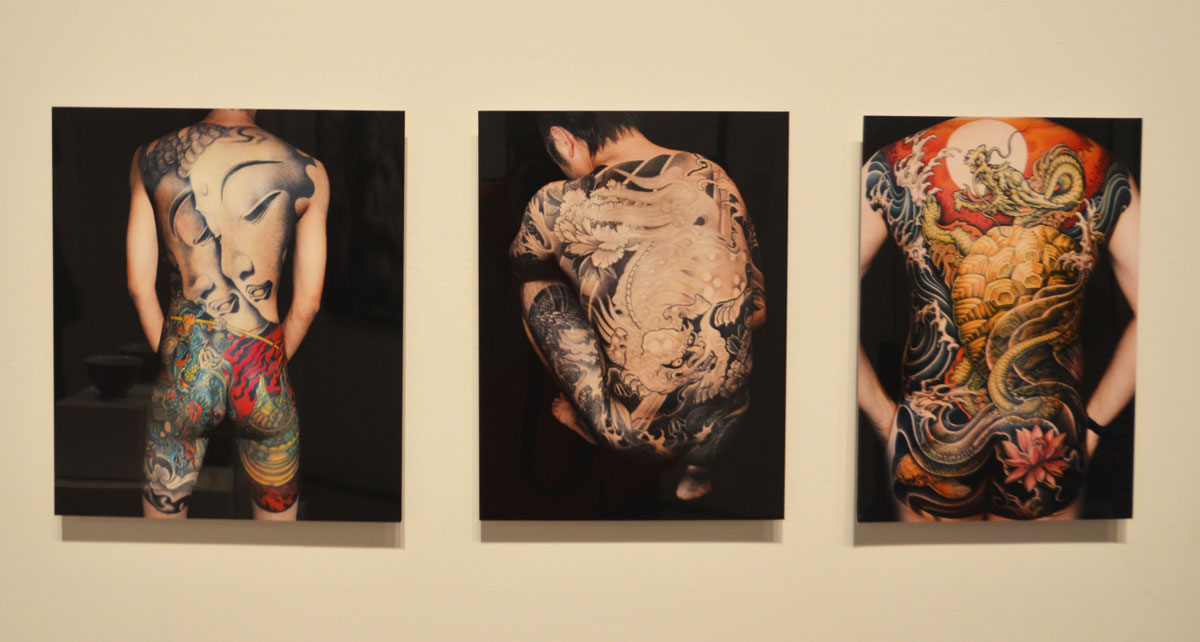
One of the cultures that is featured is the Chinese.  For centuries, tattoos were forbidden, or at least taboo, in China.  To be tattooed was to be discriminated against as they were associated with prisoners or vagrants.  Recently that has begun to change.

below: Three large modern picture tattoos by Taiwanese tattoo artist Gao Bin featuring traditional Chinese images, Buddha, lion and dragon.  Tattoos as a cultural expression.  In some countries such as Sri Lanka and Thailand images of Buddha are considered sacred objects of worship.  While it’s not illegal to have such a tattoo, wearing one could get you into trouble.

Three pictures of the backsides of men, each with a large picture tattoo from neck to thigh. Chinese art pictures as tattoos

below:  Here is another example of why people get the tattoos that they do.  This is a picture of one photograph in a series by Isabel Munoz.  Munoz spent three weeks inside several prisons in El Salvador and photographed mara gangs.  Gang members wear offensive tattoos to assert their antisocial behaviour and express their loyalty to the gangs.  Tattoos as statement; tattoos as a mark of membership and belonging.  Tribal.

photo of a picture in a museum of a man's face that has been tattooed with gang symbols and words,

below: A silicone arm with a tattoo by Montreal artist Yann Black on display.  This is one of 13 commissioned tattoos on silicone body parts – arms, legs and torsos both male and female that are part of the exhibit.   Tattoos as artwork.  Individuality.

a silicone arm has been tattooed with a design that looks something like a cross between Frank Lloyd Wright and Mondrian. It is in a glass showcase in a museum.

The oldest known tattoos were found on Otzi the Iceman, a natural mummy who was found in the Otzal alps near the Austria – Italy border in 1991.  His tattoos were 61 lines ranging in length between 7 and 40 mm.  The lines were arranged in groups.  Most of his tattoos were on his legs where there were 12 groups of lines.  Otzi is estimated to have died between 3239 BC and 3105 BC.

Tattooed mummies have also been found in other places – Greenland, Alaska, Siberia, Mongolia, western China, Egypt, Sudan, the Philippines, and the Andes in South America.  We will probably never know what significance the tattoos had.  Theories abound of course and they often involve reasons like protection, spiritual, status, tribal, or just for decoration.  Reasons that probably ring true today too.  The methods have changed and some of the images have changed, but human nature remains just that, human nature.