Posts Tagged ‘AGO’

Marys in Toronto 
It has become one of the things I do – I look for ‘Marys’ when I travel.  For one reason or another, I started seeing Marys in Toronto too.  Perhaps it was because I spent more time in galleries and museums on those really cold days that we had last winter.    There aren’t nearly as many Marys here as there are in Lima Peru or in Malta.  Hence, finding them was a bit more difficult but that just made the hunt more interesting.

below: In the window of Sonic Boom on Spadina

A picture of Mary and Jesus in a store window. Jesus is depicted as a middle age man.

below:  a sculpture of Mary and Jesus,  from the Gardiner Museum

ceramic (or glazed terracotta?) sculpture of mother and child, Mary and Jesus.

below: ‘The Dormition of the Virgin’ by Esteban Marquez De Velasco (c.1655 – 1720, Spain).
This painting is in the Art Gallery of Ontario.  It depicts the moment before Mary falls asleep and her soul leaves her body to join Him in heaven.  The apostles surround Mary and kneel in prayer.

A close up of a painting. A young woman, the virgin Mary, is sitting up in bed, her right hand over her heart and her eyes raised to heaven. A man is standing to the right, his eyes also looking up to heaven. Men reading books are to her left.

below: ‘Madonna and Child’ by Andrea Della Robbia (1435-1525, Florence Italy).
Glazed terracotta. On loan to the AGO from the family of Murray Frum.

A white porcelain relief sculpture on a reddish wall. Mother and child, Mary and Jesus.

below:  In front of St. Clare Roman Catholic church on St. Clair Ave. West

White statue of Mary and Jesus outside a church, a vase of red and white flowers is beside her feet. The words Sancta Maria Mater Dei are on a bronze plaque under the statue.

below: In the window of Crows Nest barber shop, Kensington Market

 A figurine of the Virgin Mary with her light blue shawl stands piously in the window of a barber shop. The building is painted a light blue colour.

below: Figurines for sale at Honest Ed’s

seven figurines of Mary painted with long white, light blue and gold robes. They are about 20 cm high, all with downcast eyes except the one on the left looks like she's looking at the camera.

below: Holographic cards with images of Mary Jesus in a red plastic tub.
You can buy a card at Honest Ed’s for 69 cents.

postcards with holographic images of Mary and Jesus.

below: Sagrada Familia, by the front door of a house in Little Portugal

A ceramic plaque of Mary, Joseph and Jesus on the exterior wall of a house beside the front door and above the mailbox

below:  Hiding amongst the drapery sits Mary and her child.

from the outside, the lower part of a window with white shutters and a stone window sill. Lace curtains are in the window and a statue of Mary and Jesus is inside.

below: Another from the AGO,  Virgin and Child from circa 1750, once in a chapel of a Montreal church.
Wood with traces of pigment.

 In the Art Gallery of Ontario, a wooden statue of Mary holding baby Jesus. Behind the statue is a large painting of the fire in Quebec City in the 1700's.

Wooden statue of Mary standing while holding a baby Jesus.

below: Mount Pleasant cemetery

close up of part of a tombstone in a cemetery showing a small relief sculpture of Mary, Joseph and Jesus

below:  On an ofrenda at a Dia de Muertos celebration

a statue of mary with pink candles on either side of her. A yellow day of the dead paper cut out is behind her. Strings of yellow, orange and pink flowers are also on either side of her.

below: Radio Maria, una voce cristiana nella tua casa, part of the Holy Mother World Networks.

entrace to a small red brick building with a two signs, one over the door and one beside the door, for Radio Maria.

below: With other members of the Nativity scene, for sale in a vintage store on Queen West.
I think that $20 buys you the contents of the box.

ceramic figures of the Nativity scene, Mary, Joseph, baby Jesus, etc. They are lying in a box that is for sale in a store.

below: In a front yard in the Junction
I’ve put her at the end because I am not 100% sure that she is a Mary. The Virgin Mary is usually depicted with a light blue shawl draped over her shoulder or else holding a baby Jesus.

A small white statue of Mary on a makeshift pedestal in a front yard. Early spring, bare rose bush branches, a couple of small white planters with flowers in them. A white metal railing on the front porch.

And here ends that game.  This post represents almost a year’s worth of looking and while the hunt was interesting in the beginning it’s charm is starting to wear thin.   I could probably find more Marys in churches and cemeteries but I think I will listen to words of wisdom and let it be.

The title of the exhibit is ‘Surrender’ and the words on the wall say this:

“Liz Magor’s art invites us to reconsider our relationships with the things we encounter every day.  Through subtle shifts in materiality and context, her works reveal the important role that objects play in our lives: they can allow us to conceal ourselves or to express our identities.  In her sculptures and photographs, Magor explores how we depend on domestic materials to develop a sense of self.”

Nothing is mentioned about surrendering, or why the exhibit has the title that it does.

In the first room there are boxes on the wall.  Each box looks like a carefully wrapped sweater or jacket that has just been purchased.  I can envision a middle aged saleslady taking her time to package your purchase, like in an Eatons store thirty or forty years ago.

art installation at the Art Gallery of Ontario by Liz Magor - two walls with many open boxes on them. The boxes are made to look like they've just been opened to reveal a sweater or top folded neatly inside, including the tissue paper that often accompanies a new purchase. The clothes have all been decorated with different objects.

On closer look, most boxes also have a hand print, or shape of a hand with index finger pointing at something and little details are amiss…  a ketchup package for example.

blog_liz_magor_cornhuskers

The second room has a number of smaller installations.

A garment bag left over a chair.
Neatly folded blankets hanging on a wall.
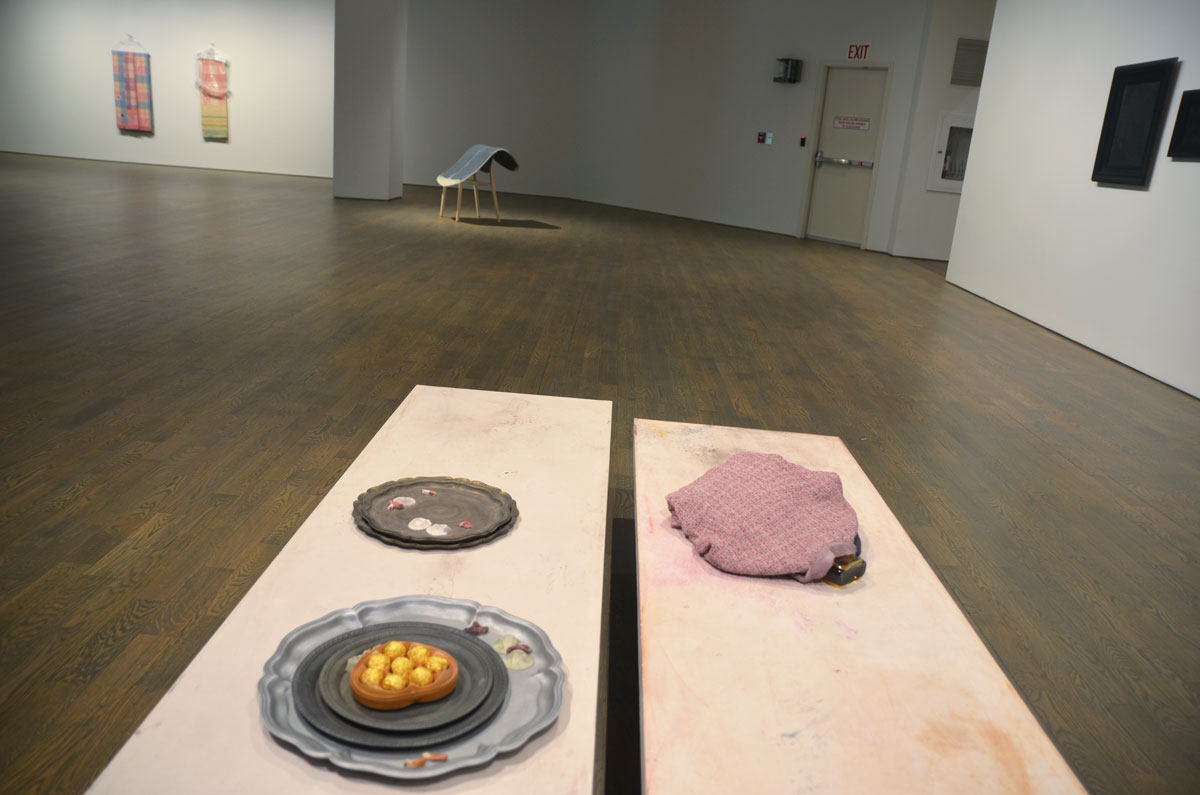
A platter of chocolates and left overs.
A tweed jacket on top of a liquor bottle.

art installation at the Art Gallery of Ontario by Liz Magor - in the foreground are two long narrow tables. On one of them is a platter with chocolates and a platter with the remains of cheese and crackers.

A husky under a blanket (of snow?  on a bed?)
A coat and purse hanging on a hook.
The contents of a room boxed and ready to move.

art installation at the Art Gallery of Ontario by Liz Magor - 3 pieces. First, a pile of moving boxes and other items that look like they are in the midst of getting ready for the movers. Second, a large white blanket bed sized that has a hole in the middle of where the pillows should be but instead there is a wolf curled up inside the whole. Third, what looks like a jacket hanging from a hook on the wall

art installation at the Art Gallery of Ontario by Liz Magor - two hangers with plaid blankets folded over them hanging from hooks on a wall. One of the blankets has a clear plastic Creeds bag over the top part of it

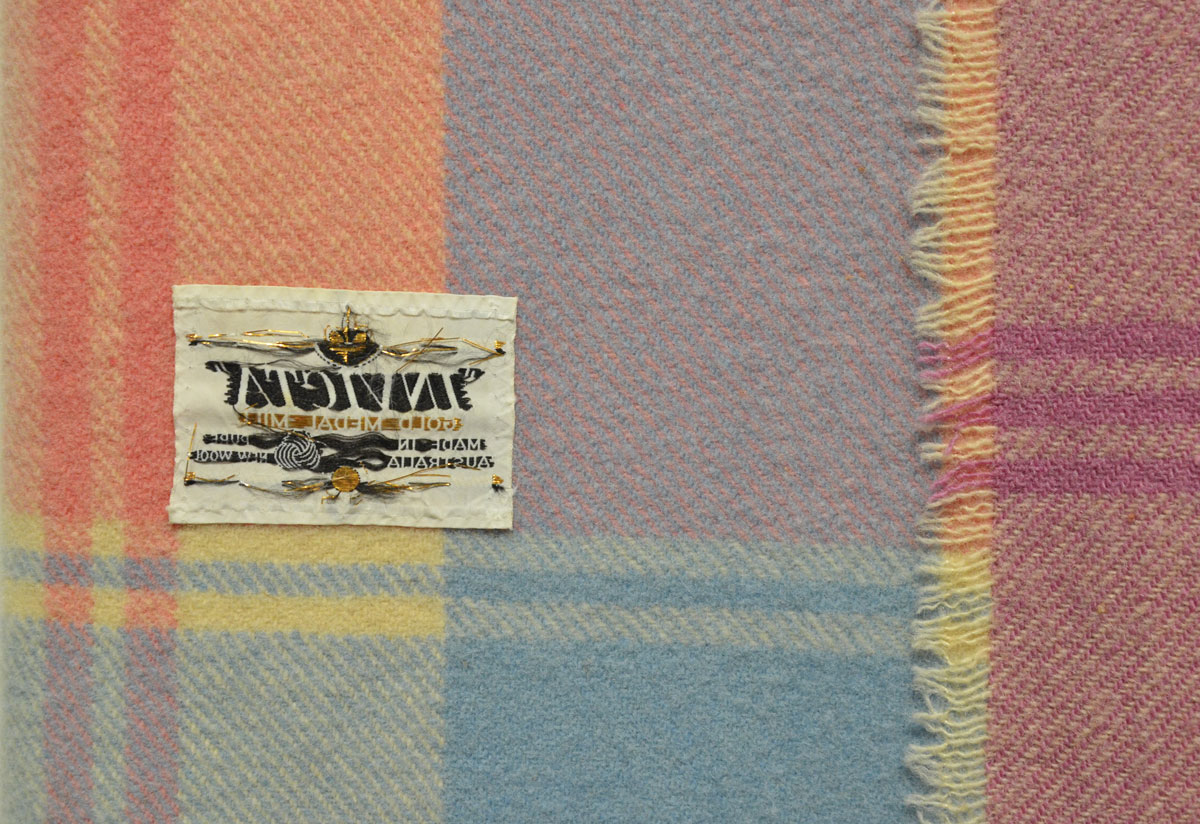
On closer look, some of the details on the blankets are wrong
including the labels that are sewn on back to front.

The label on a plaid blanket is sewn on backwards so that the writing on the label faces the blanket.

I was interested in what people’s reactions were to this exhibit so I had a chat with a couple of the employees about it.  According to them,  there was no reaction.  Most people showed interest in the boxes but when they walked into the second room they rarely stopped to take a closer look.

blog_liz_magor_rose

As for surrender, I did find reference to it in the description of the exhibit on the AGO website, ” In this exhibition, everyday objects and forms, as well as the natural world, function allegorically by evoking the human need to surrender to desires, compulsions, fantasies.”  Once again, I will leave it to you to decide if this description fits.

Exhibit continues until 29th November.

Camera Atomica
a photography exhibit at the Art Gallery of Ontario

below: The first photograph of the bones of the hand, by Wilhelm Rontgen in 1895.    Rontgen was a German physicist who discovered x-rays (or Rontgen rays) in 1895 and he produced this image of his wife’s hand shortly after.  The green in the picture below is a reflection of the chandelier that the AGO has hanging in the room where this exhibit is being shown.

An xray picture of a hand.

The exhibit consists of more than 200 works that all fall under the category of nuclear – topics such as atomic weapons, Cold War politics, nuclear energy, and the mining of uranium.  The photographs cover the history of these topics from 1945 to the present, from the development of the atomic bomb to the meltdown at Fukushima Daiichi in Japan in 2011.

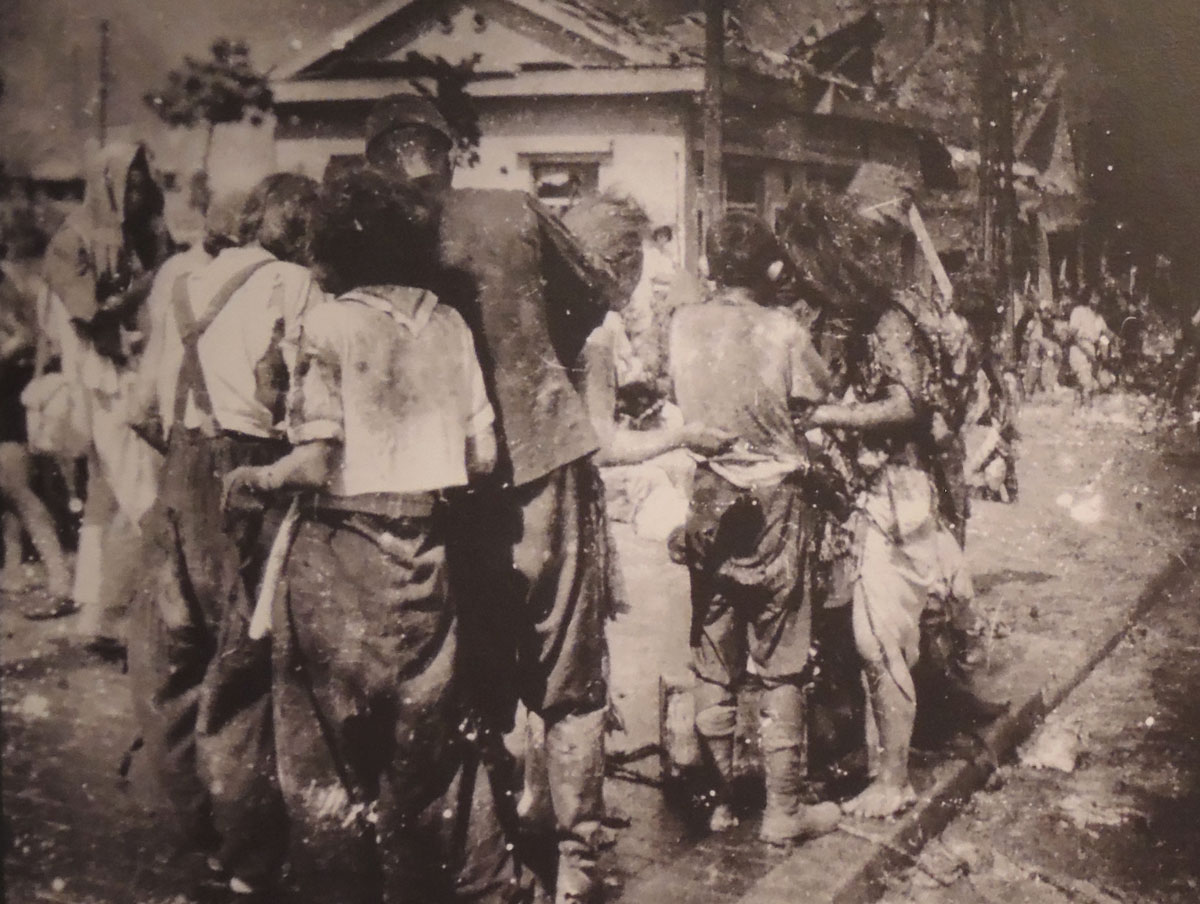
below: Hiroshima Japan, photo by Yoshito Matsushige, taken 6 August 1945.
The first atomic bomb was detonated at the Trinity test site in New Mexico USA on 14 July 1945.  Shortly after, American bombers dropped two atomic bombs on Japan.  The first bomb was dropped 6th August 1945 on the city of  Hiroshima and second one three days later on Nagasaki.

An old black and white photo taken in Hiroshima after the dropping of the atomic bomb during WW2

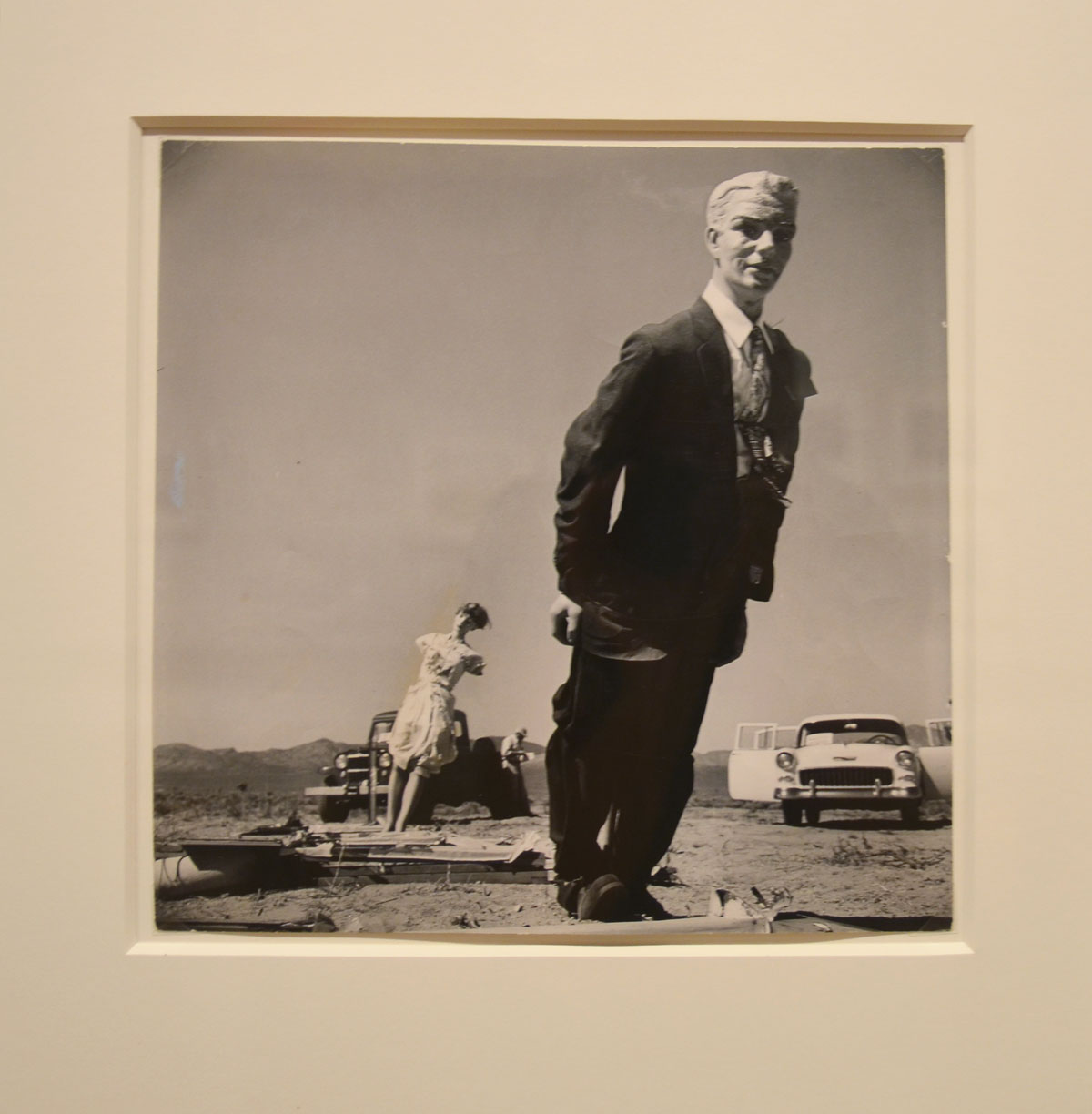
below: Photo by Dean Loomis, 7 May 1955 of scorched male mannequin standing in the desert 7,000 feet from the 44th nuclear test explosion at Yucca Flat Nevada.  Photo taken the day after the blast.  Apparently mannequins were used to test the effects of the nuclear blasts on people and this photo shows that people at 7000 feet from a blast could be burnt but alive.

Picture of a black and white silver gelatin print from 1955 by Dean Loomis showing a male mannequin in a black suit who has been partially knocked over by a nuclear test blast in the Nevada desert.

below: Mushroom clouds on a wall

A collage of photos of nuclear blast mushroom clouds. There are about 25 colour and black and white photos hanging on a wall of the Art Gallery of Ontario

below:  Part of  ‘Uranium Tailings #2, Elliot Lake Ontario’ a photograph by Edward Burtynsky.

Eliot Lake was established in 1955 as a mining town after uranium was discovered in the area.  In the early 1990’s the mines closed because of depleted reserves and low prices for uranium.

Tailings are the materials left over after the valuable part of an ore has been removed.  The uranium ore found at Eliot Lake had very little uranium in it, only about 0.1% of the ore was uranium.

Close up of part of a photograph by Edward Burtynsky titled Uranium Tailings #2, Elliot Lake Ontario. It is a picture of a desolate swampy looking terrain where all the vegetation is dead. The trees have been reduced to dead poles.

below:  Inkjet prints by David McMillan, part of four on display from his series of photographs of places abandoned because of the Chernobyl disaster in 1986.   The photograph on the right is of the nursery at Pripyat Hospital taken in 1997.   Beside it is a picture of a classroom in a Pripyat nursery school.

Pripyat is an abandoned city in northern Ukraine.  It was built in 1970 to service the Chernobyl Nuclear power plant.  Following the explosion and fire at Chernobyl on 26 April 1986, the city’s 49,000 people were evacuated

Two photographs on a wall. The one in the foreground shows an abandoned hospital nursery in Pripyat Ukraine, abandoned after the Chernobyl nuclear disaster.

A young man is half squatting as he leans back to get a better look at the words on the wall of an art gallery that accompany three black and white photographs.

The exhibit continues until 15th November.

#atomicAGO

The fifth floor of the Art Gallery of Ontario is devoted to contemporary art.

Three of the present exhibits are best described as conceptual art.  Conceptual art is art where the idea is more important that the look.  The story behind the work trumps aesthetics.

This blog post has taken me many days to write as I struggle with the love hate relationship that I have with conceptual art.   My biggest complaint about conceptual art is that skill too often gets thrown out the window;  God forbid that something like artistic merit should impede the artist.  I can empathize with causes and I can support ideas without liking the end product.  In other words, just because I don’t the ‘art’ doesn’t mean I don’t “get it”.

Anyhow, on to the exhibits.

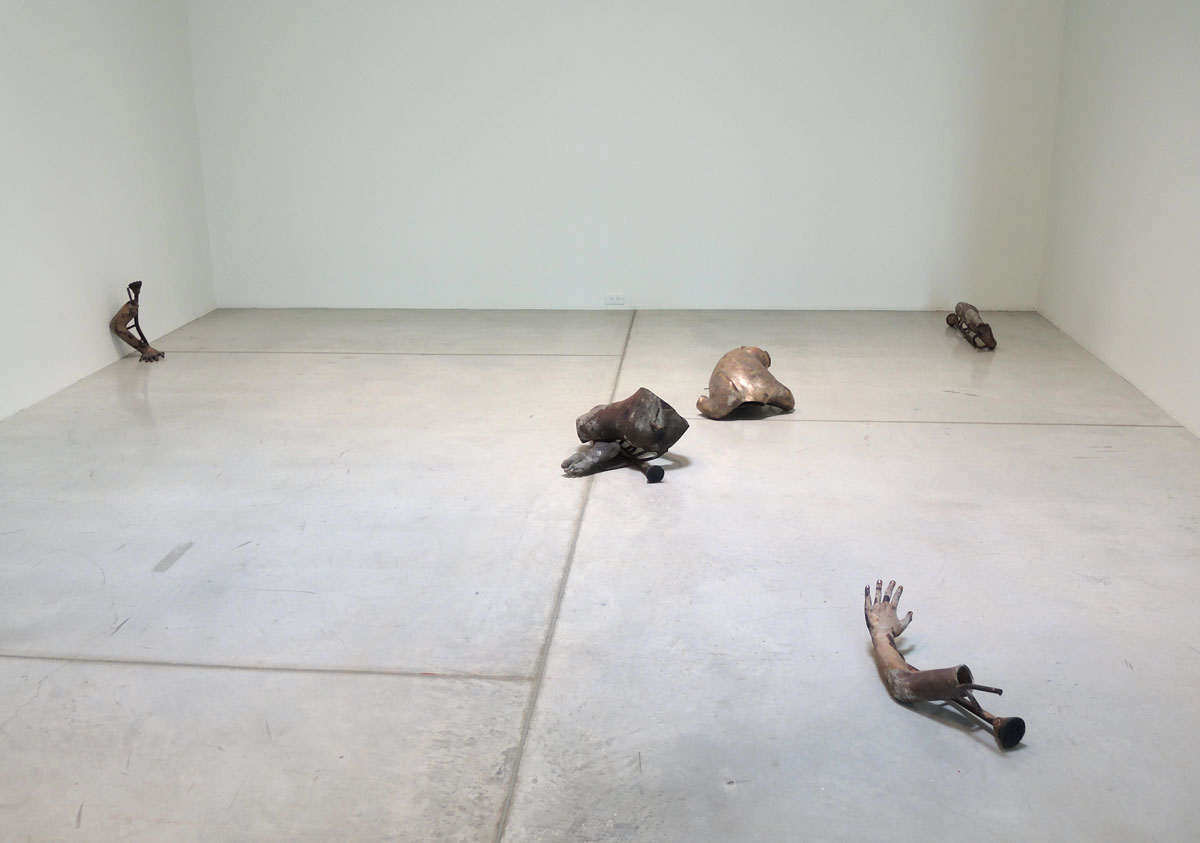
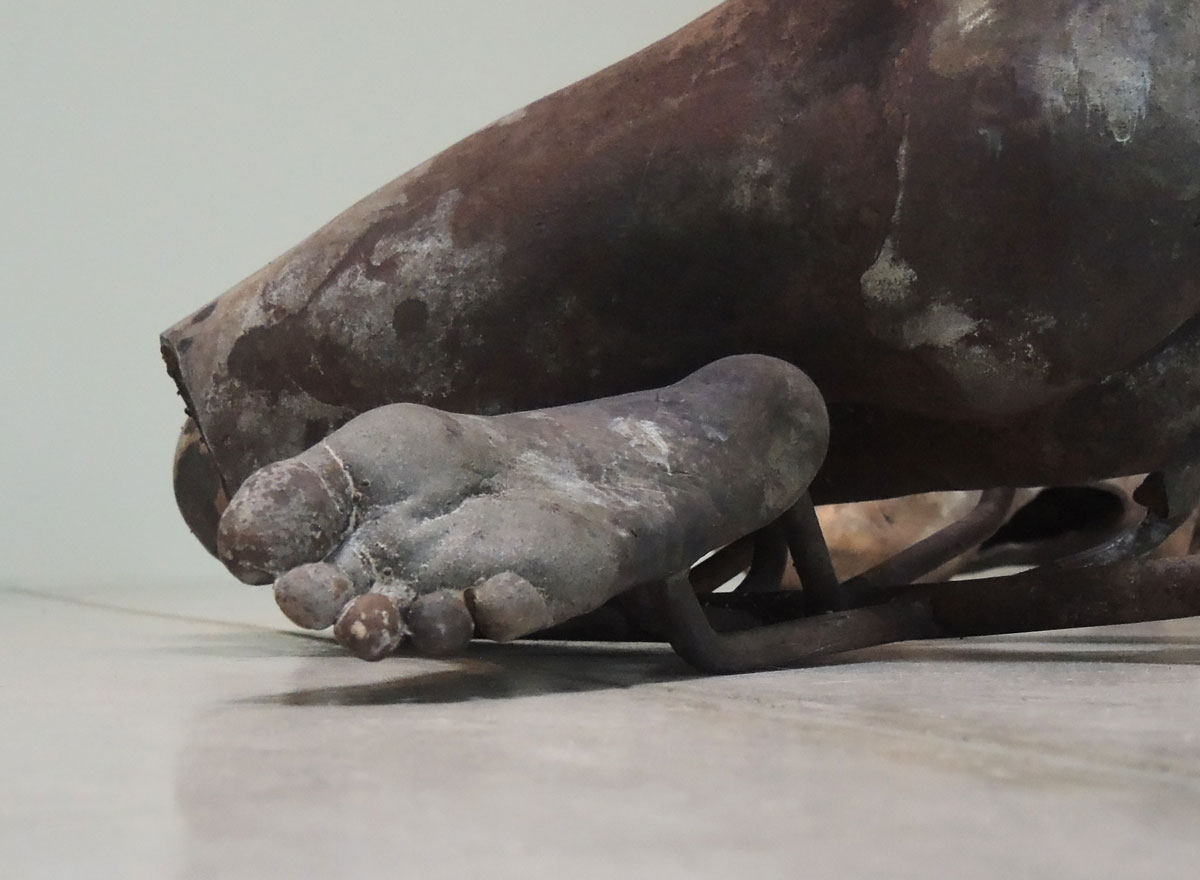
First, ‘Gustav’s Wing’ is an exhibit by Danh Vo, a man born in Vietnam but raised in Denmark.  Using his nephew as a model, Vo had a bronze of cast of the boy’s body made in six pieces.  The pieces are then arranged within a room.  “The resulting installation gives a fragmented and evocative portrait of a boy whose Danish and Vietnamese heritage echoes that of the artist, but who represents the next stage in the family’s story – that of the first-generation Danish citizen”, according to the description of the exhibit.

Looking into a white room, photo taken from the doorway, pieces of metal cast from a boy's body lie on the floor, scattered, part of an art installation at the Art Gallery of Ontario

Close up of a metal cast of a boy's foot. Part of an art installation by Danh Vo at the Art Gallery of Ontario

Three of the metal pieces from Gustave's WIng, an art installation by Danh Vo, pieces of body cast in metal

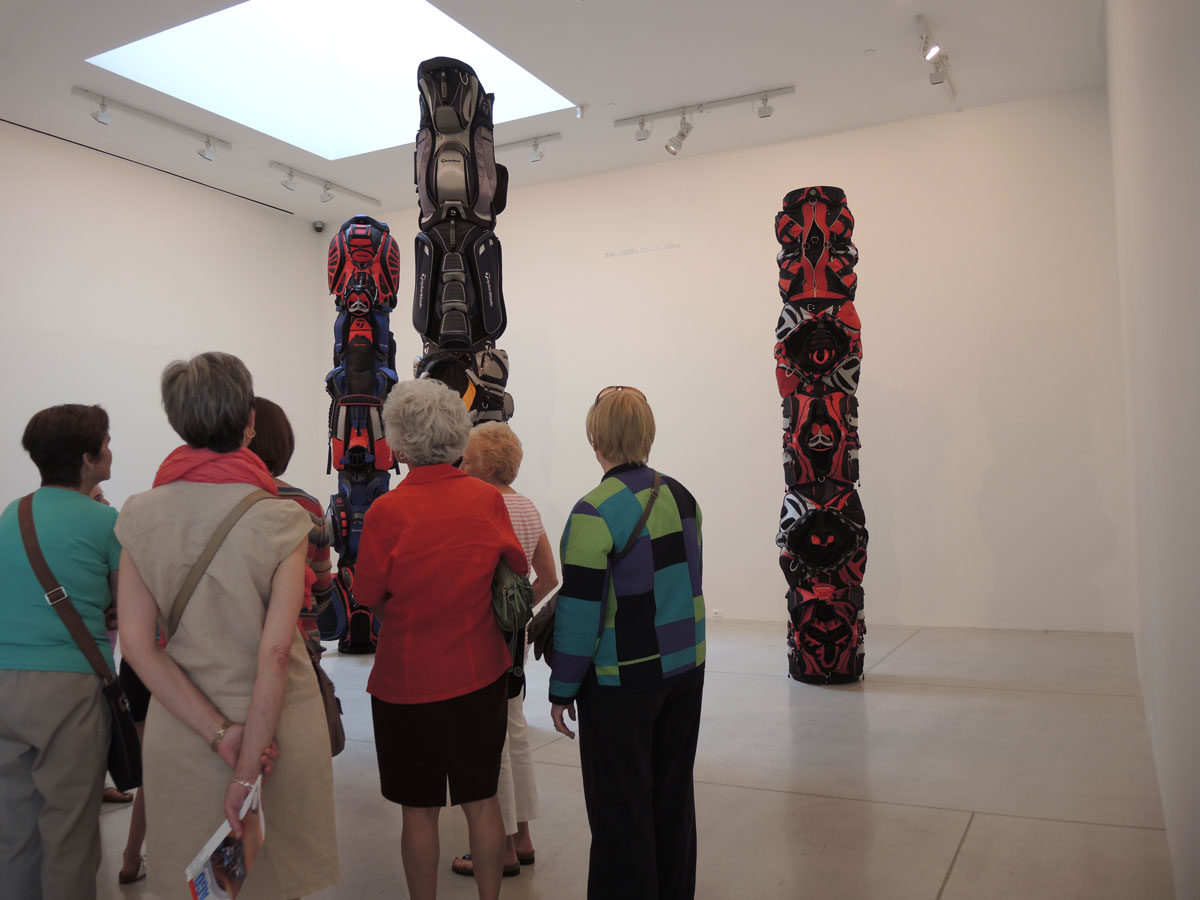
Second, there are three totem poles by Brian Jungen entitled ‘1960’, ‘1970’, and ‘1980’.  All three were made in 2007.  The words in the artist’s statement about this piece say “The towering works recall the complex social and political tensions that can result from First Nations land claims.”  Part of the artist’s reasoning is that golf courses are manicured and their use is quite different from the way land is used by First Nations.


A group of women looks at an art installation of three large totem poles made of golf bags on display in an art gallery (Art Gallery of Ontario)

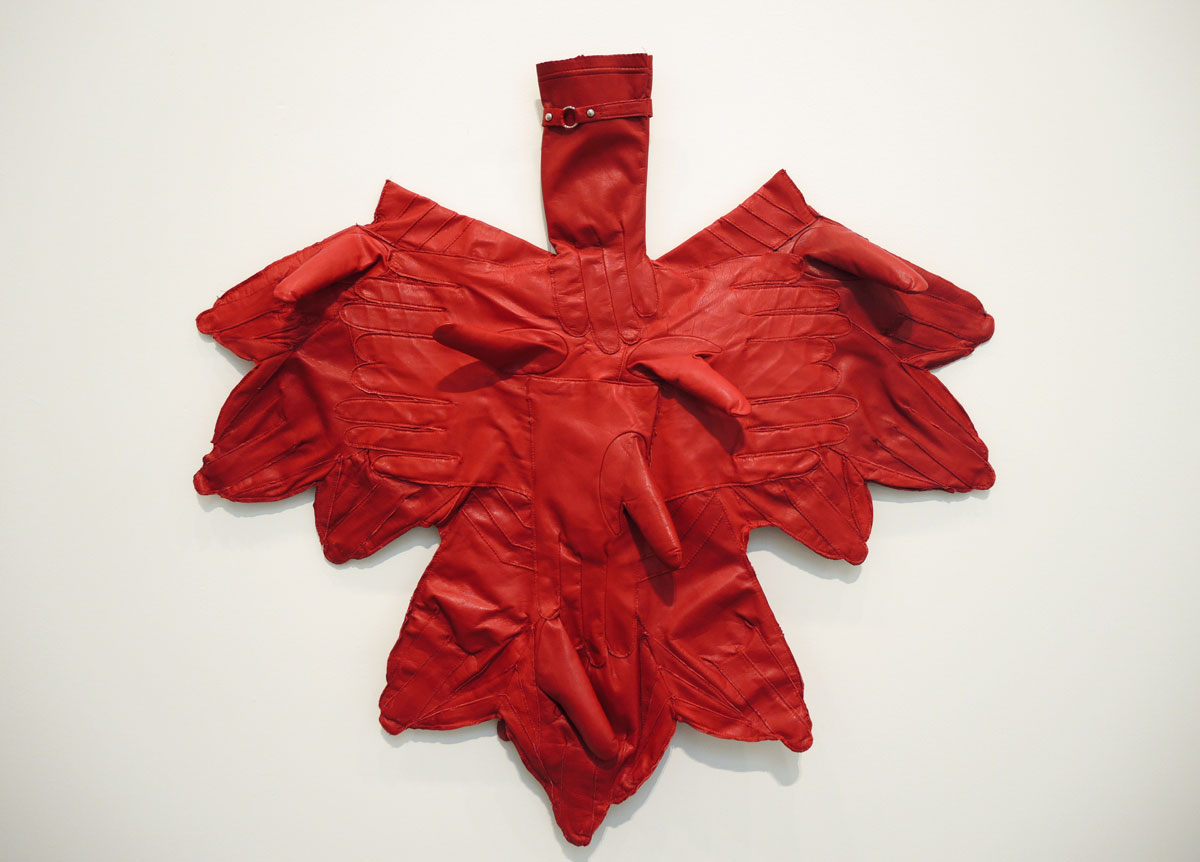
below: Anther piece by Brian Jungen, this one is called ‘Wieland’ and it is made of red women’s leather gloves.  It is supposed to be an upside down maple leaf, i.e. a Canadian symbol turned on its head.  When I first saw it, I saw an eagle with its wings spread but maybe that’s just me.

The words on the wall for this piece: “Its title celebrates Canadian artist Joyce Wieland (1931-1998) whose work in the 1960s and 1970s proposed a gendered patriotism in which indigenous art and culture were given only tokenistic inclusion. With Wieland, Jungen positions himself as part of and against an established narrative of Canadian art history.”

In Wieland’s opinion Canada was female I guess that that is what “gendered patriotism” means.  Otherwise, you will have to figure this one out for yourself.

Upside down rd maple leaf made of women's gloves. It also looks a bit like a large bird with outstretched wings. Part of an art installation at the art gallery of Ontario

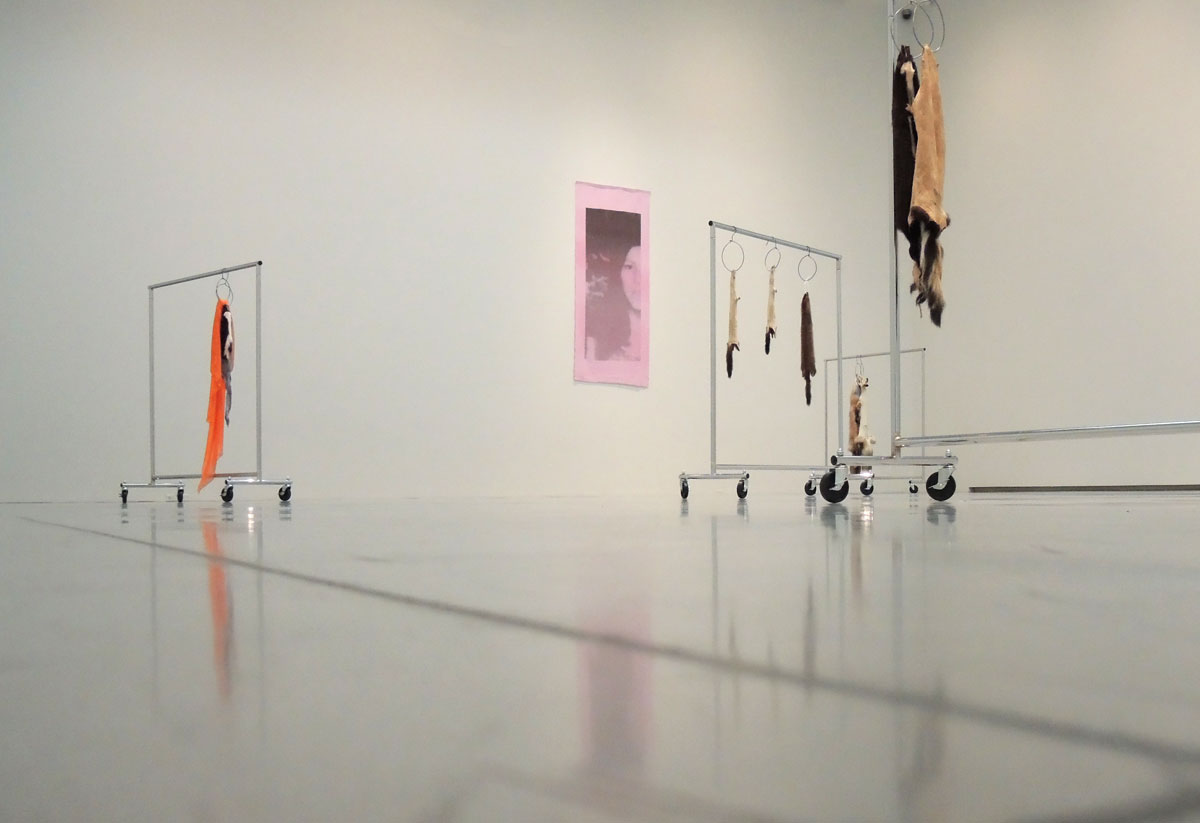
Lastly, there is an installation by Duane Linklater.  Each garment rack is piece and they have names like “My brother-in-law, my sister” and  “The marks left behind”.  Furs of different animals such as fox and skunk hang from the garment racks.  One has an old T-shirt and one has a piece of orange fabric.   “The evocative titles of the pieces speak to family ties, articulating a sense of personal loss” according to the description of the work found on the gallery wall.


A woman is in a large room at the Art Gallery of Ontario, she is looking at an art installation that involves skins of dead animals hanging from garment racks. A pink picture of a woman hangs on the wall.

in an art gallery, an art installation that involves skins of dead animals hanging from garment racks. A pink picture of a woman hangs on the wall.

The two pink pictures on the wall are each a half of a portrait of a woman called Anna Mae Aquash who died in 1976. Together they form ‘Family Photograph’.  Aquash was a Miqmaq woman who was involved as a “radical activist” in the American Indian Movement of the early 1970s.  She was murdered.    If you read the description of the work on the gallery wall, you will read these words: “By including her image, Linklater expresses a sense of familial connection with Aquash and establishes a symbolic relationship with the previous generation while asserting himself in the present. ”   Pardon?

The words on the wall don’t tell you that she was murdered by her own people because they thought she was an FBI informant.  So what relationship is the artist trying to establish?  How does this even remotely lead to “asserting himself in the present”?  Sorry, but empty jargonish words leave me cold. This isn’t art.  Linklater may have a valid idea but that doesn’t make it art.

A group of people in an art gallery, they are looking at an art installation that involves skins of dead animals hanging from garment racks. Two pink picture of women hangs on the wall.


Stephen Andrews POV
an exhibit at the Art Gallery of Ontario

Stephen Andrews is a Toronto artist whose career began in photography and the exhibit now on at the AGO does include a few excellent 8×10 photographs.  The main part of the exhibit though are approximately 20 (mostly large) paintings of his.

A room in an art gallery with white walls and three large paintings on it. A woman is taking a picture of one of them with a camera. The paintings consist of large rectangles
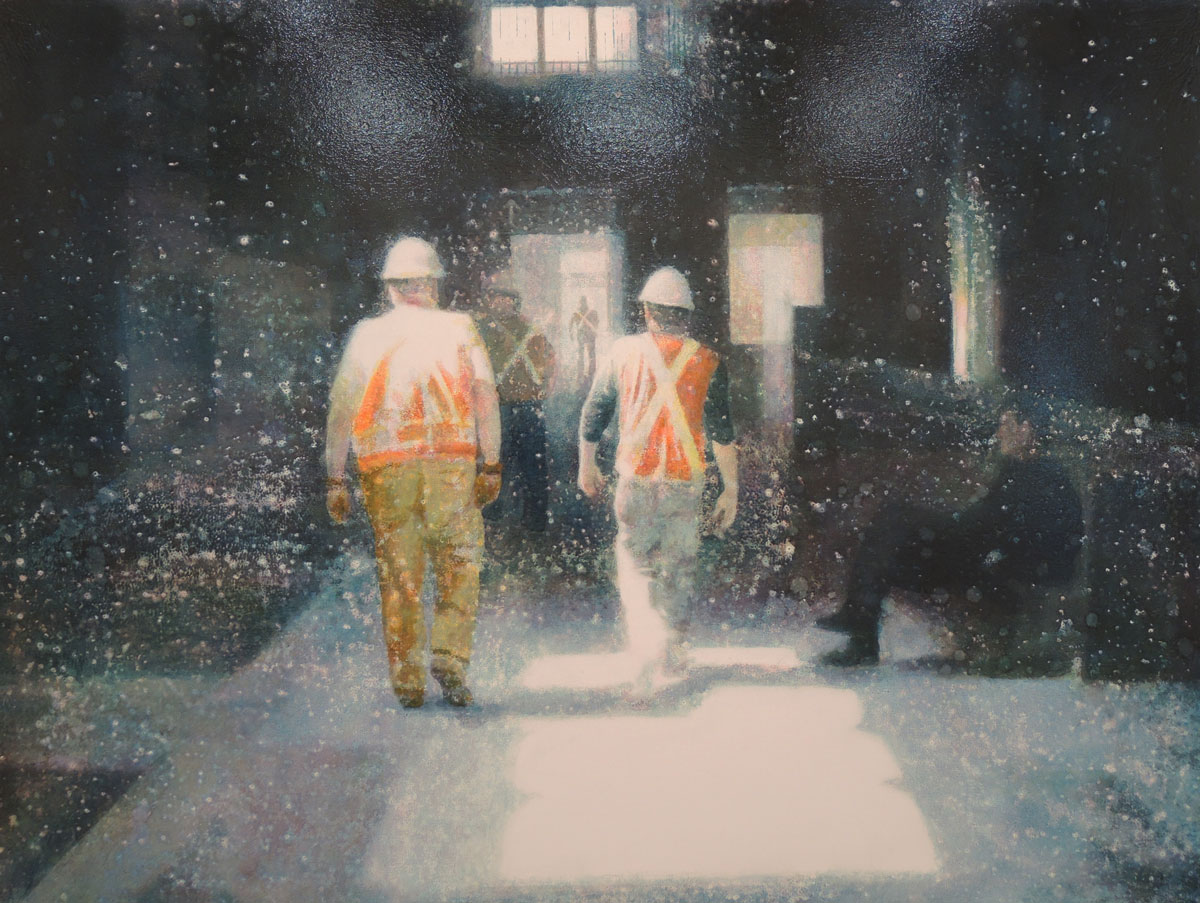
  below: ‘X-men at Union’, 2013, oil on canvas
Construction workers at Union Station, Toronto

rtwork picture of two construction workers wearing orange and yellow safety vests as they walk into a building that is being renovated

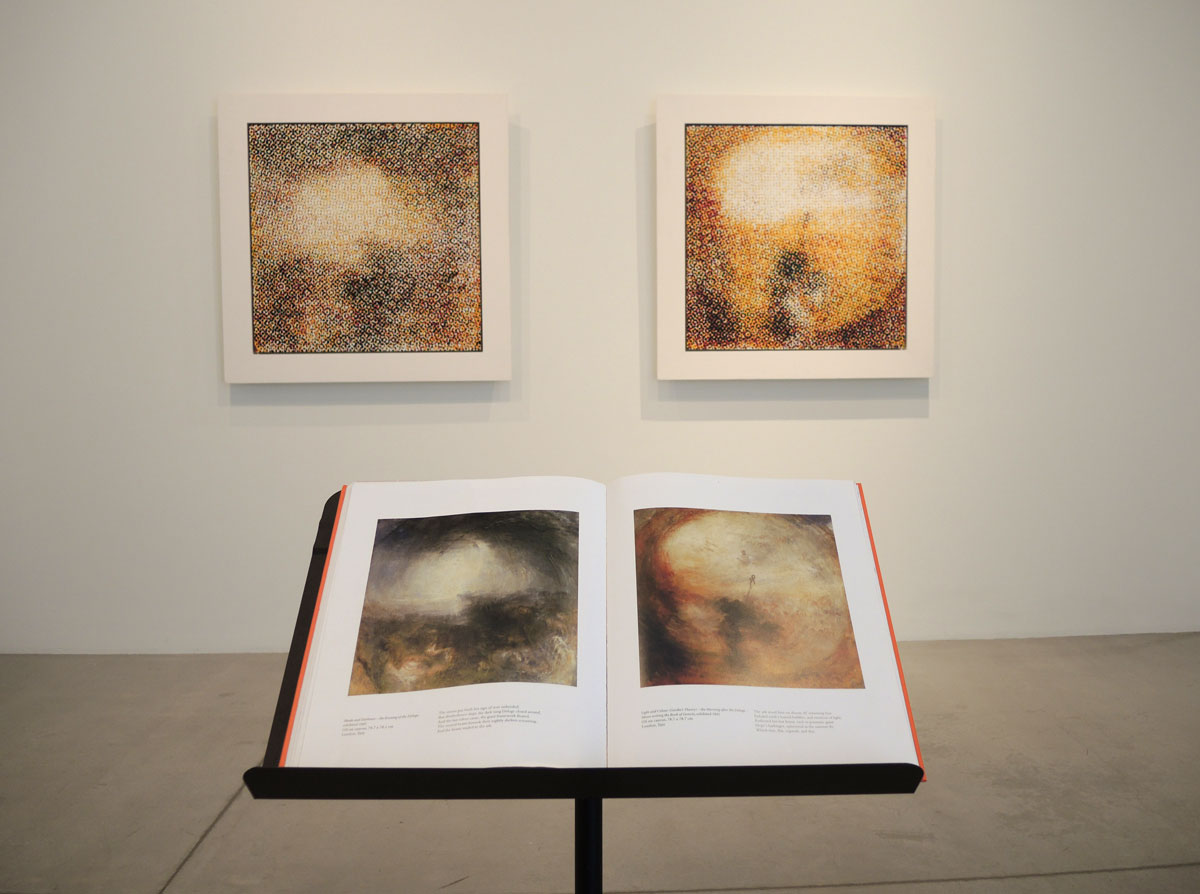
below: ‘After Before/After After’ oil on wood panels
The two paintings on the wall were based on landscapes by J.M.W. Turner that depicted scenes before and after the flood described in the bible (or before and after chaos).  Andrews has painted his with dots in only four colours, yellow, magenta, cyan and black

An open book on a pedestal, a large picture of a painting on each page. Two paintings on a wall directly behind the book. The paintings on the wall are replicas of the ones in the book .

below: detail from ‘Crossing’, 2011, oil on canvas

close up of a painting of a large number of railway crossing signs.

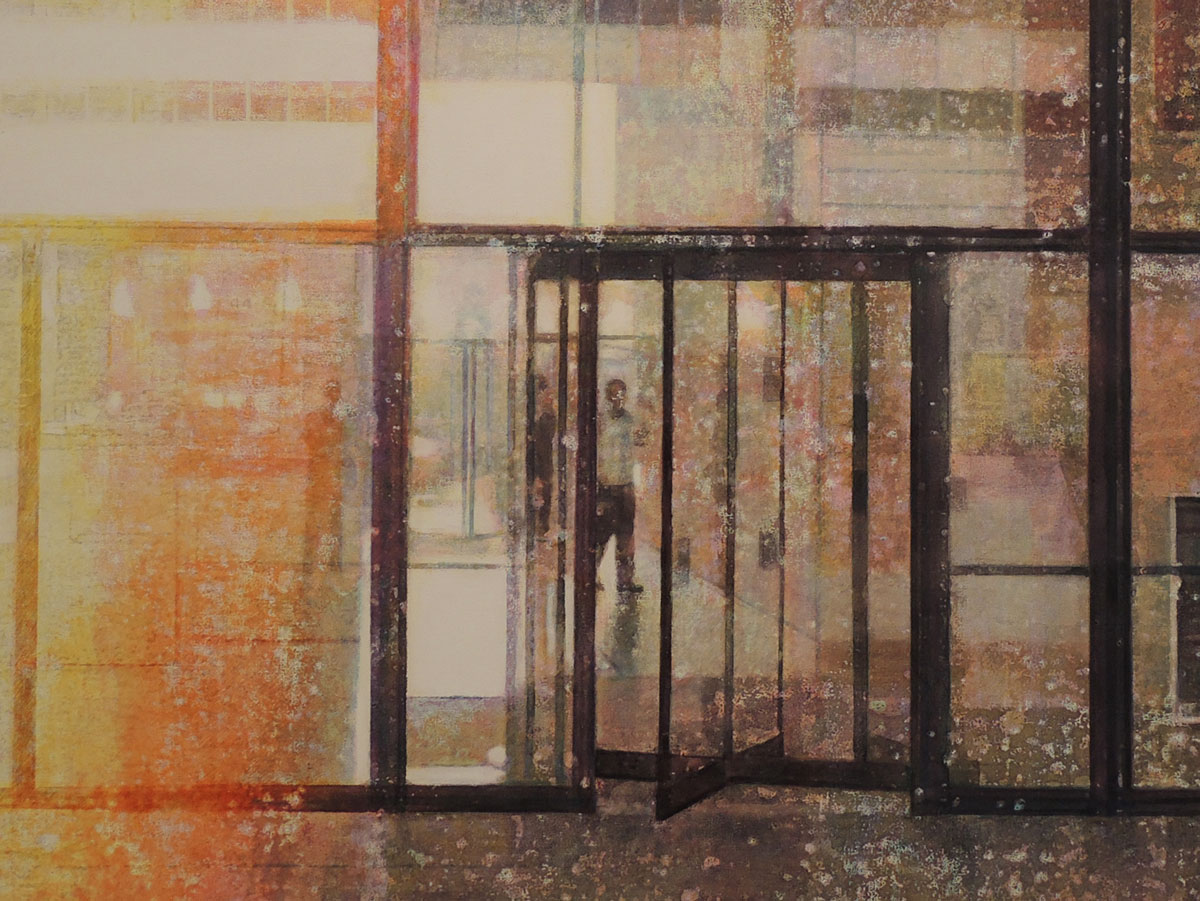
below: close up of part of ‘Entrance/Exit’, 2014, oil on canvas

close up of a slightly abstract painting of a person about to go through a revolving door in a glass wall

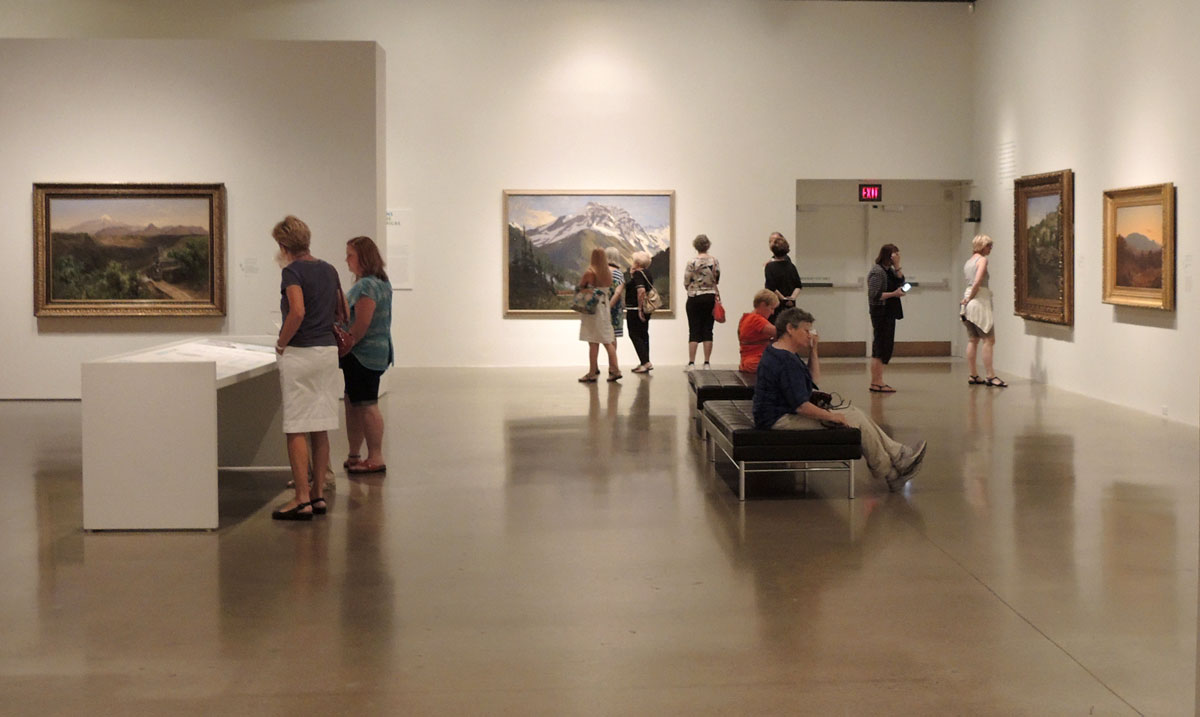
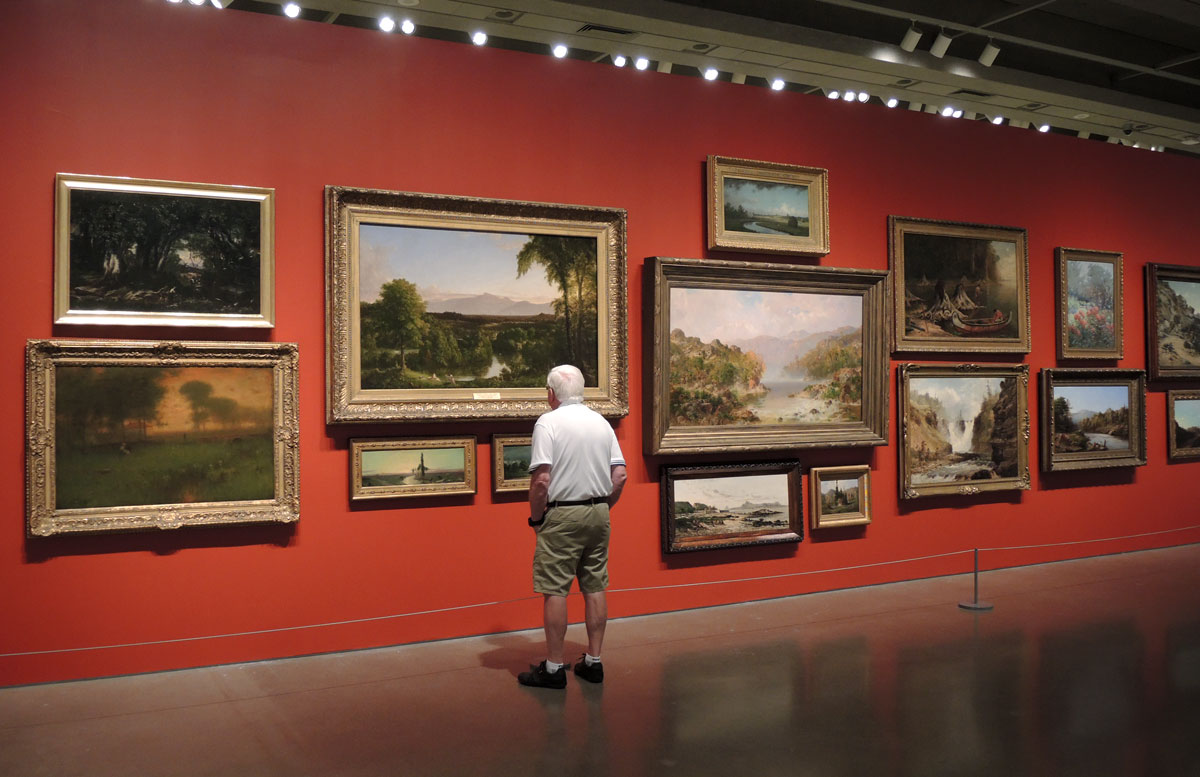
Landscape paintings depicting scenes from the top of North America to the tip of South America
are on display at the Art Gallery of Ontario until Sept 2015.   The collection centers on just over 100 works that were painted between the early 1800s and the eary 1900s.

7 or 8 people in an art gallery looking at paintings that are hanging on the walls

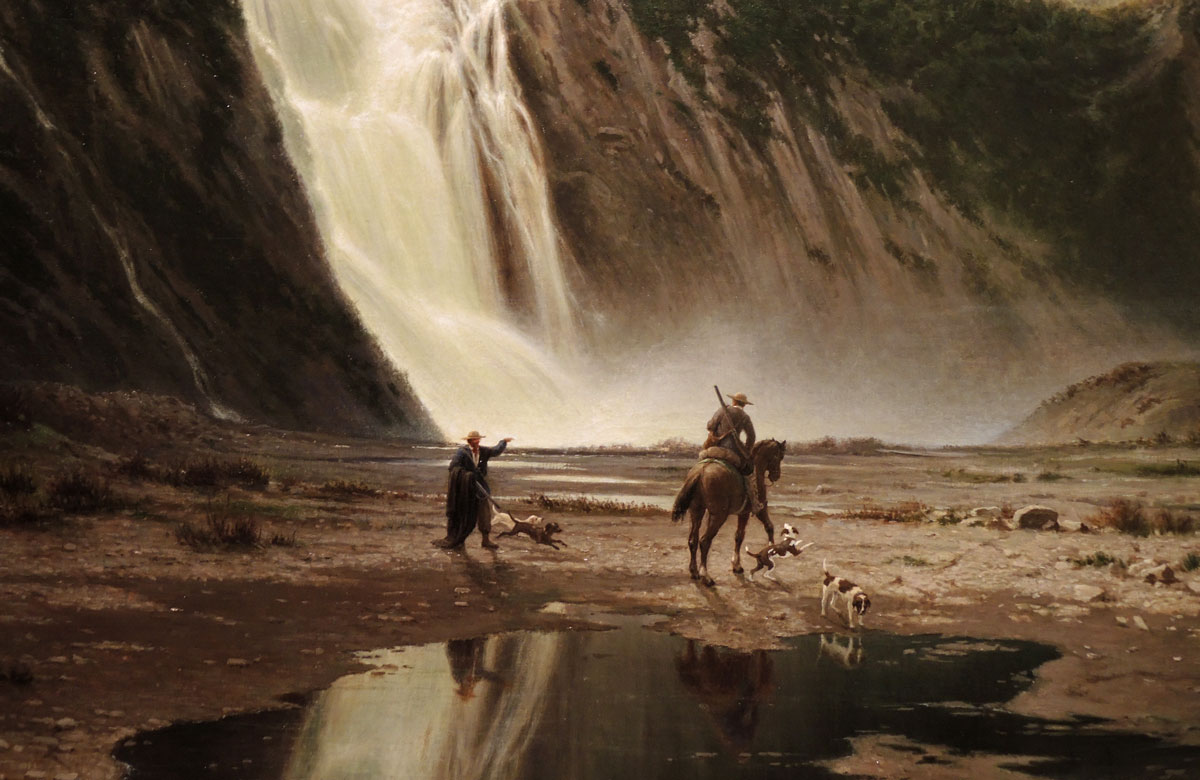
below:  part of a painting, ‘Montmorency Falls’ by Guido Carmignani (Parma Italy 1838-1909)
oil on canvas,  1869

close up of part of a painting - Montmorency Falls by Guido Carmignani 1869, Italian hunters at the base of the falls (even though they are in Quebec) in summer time.

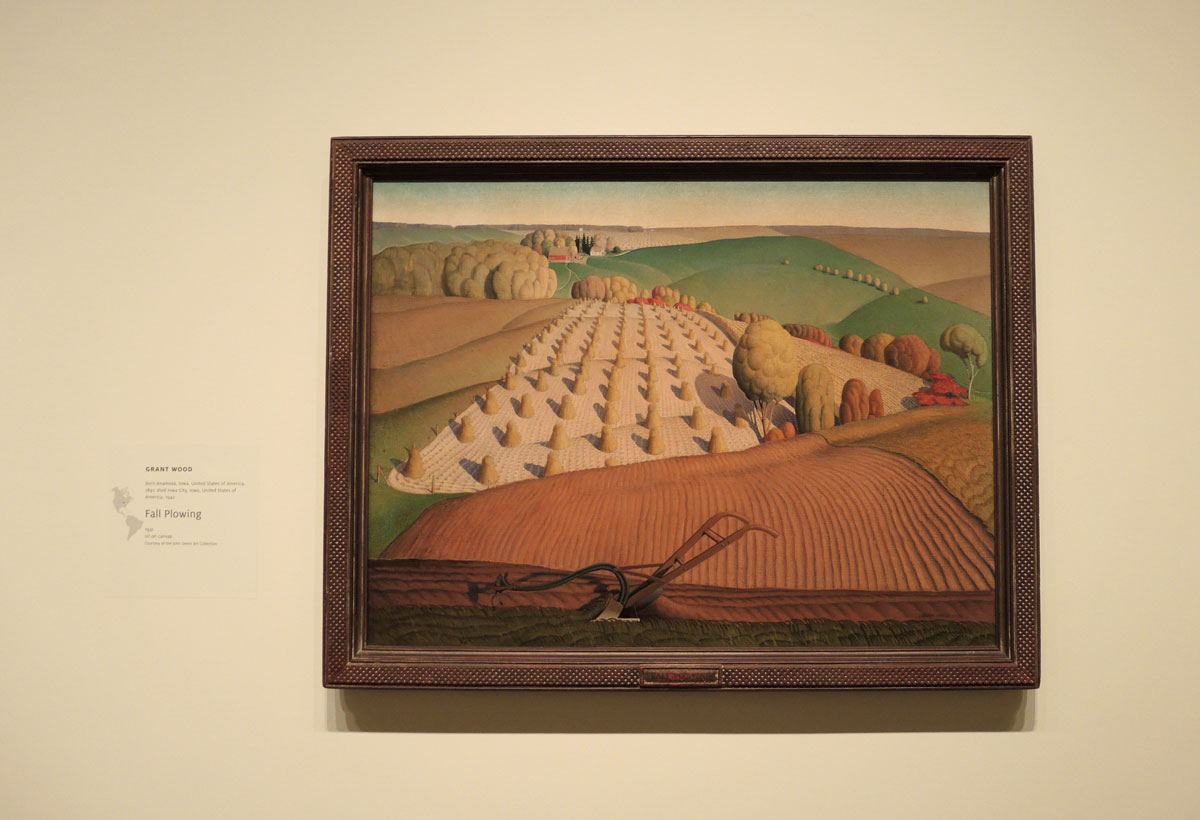
below: Fall Plowing, by Grant Wood (b. and d. Iowa USA),  1931, oil on canvas

painting on a wall in an art gallery of fields being harvested by Grant Wood


A man is looking at a wall of paintings. The wall is painted red. It is in an art gallery

close up of part of a painting including part of the intricately carved frame.  THree men getting into a boat at the edge of a river

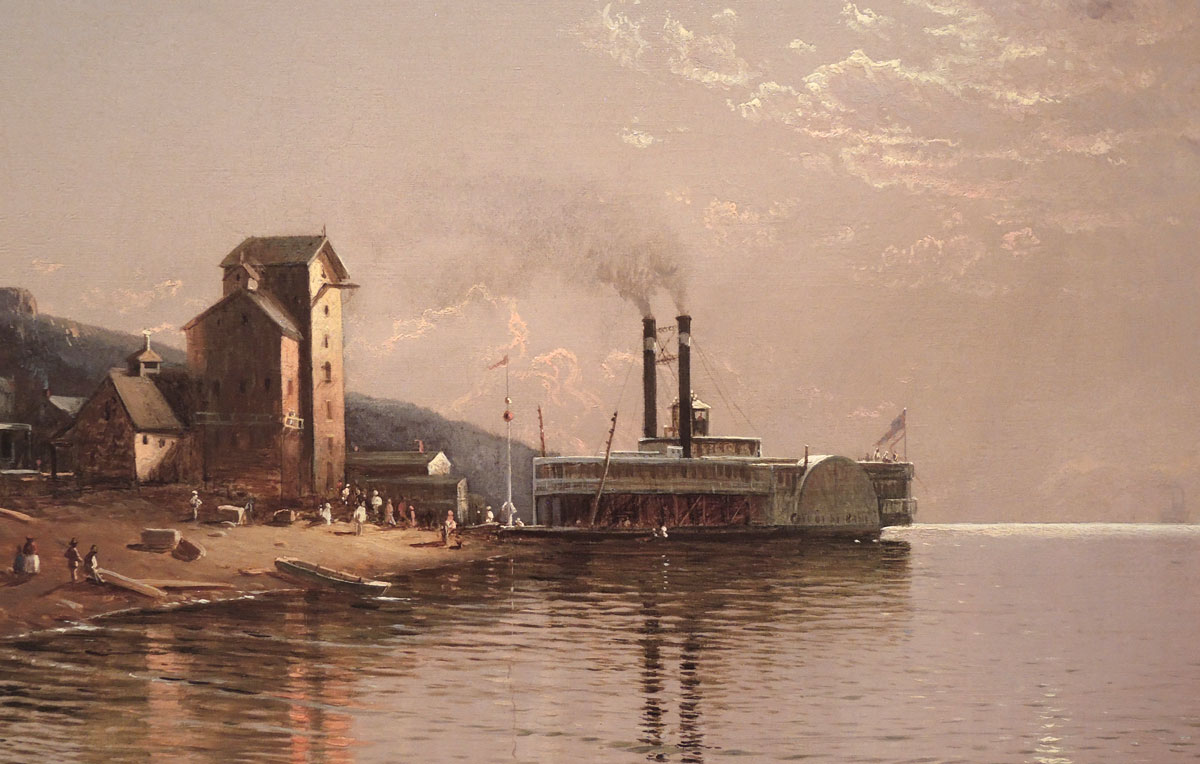
 below: part of “The Sidewheeler, the ‘City of St. Paul’ on the Mississippi River, Dubuque Iowa”
by Alfred Thompson Bricher (American), oil on canvas,  1872

close up of part of an oil painting showing an old paddle wheel steam boat on a river

Animals, people, and figures from his Inuit culture and tradition
carved and sculpted from bones, ivory and stones,

the work of Manasie Akapaliapik, Art Gallery of Ontario, until June 2015

part of a sculpture by Manasie Akpaliapik made of bone, ivory and stone, a man's face

part of a sculpture by Manasie Akpaliapik made of bone, ivory and stone, a person's face

part of a sculpture by Manasie Akpaliapik made of bone, ivory and stone, the head of a walrus
part of a sculpture by Manasie Akpaliapik made of bone, ivory and stone, a man like creature with a man's face but with walrus tusks

Last Folio, A Living Monument to the Holocaust
An exhibit of photographs by Yuri Dojc,

at the Art Gallery of Ontario

Yuri Dojc was born in Slovakia but is now based in Toronto.
Starting in the 1990’s he has returned to Slovakia a number of times in search of traces of Jewish life from prior to WW2.

a close up of a photograph of an old book, open, with the pages on one side all curled up.   The photo is taken from the top of the book.

Details of one of the photographs in the exhibit.

There are only eight photographs in this exhibit but each one tells a story.   Narratives of loss and of life interrupted.
But also stories of memory and remembrance.

 More information about the Last Folio project.