Happy Hallowe’en!
One of three murals newly painted on the Danforth is one by Elicser Elliott on the southeast corner of Danforth & Donlands (once a 7-Eleven store). Four other artists were involved in this mural which is part of ‘Destination Danforth’, a pilot project that involved a number of infrastructure improvements such as bike lanes and patios as well as creative elements such as these murals.
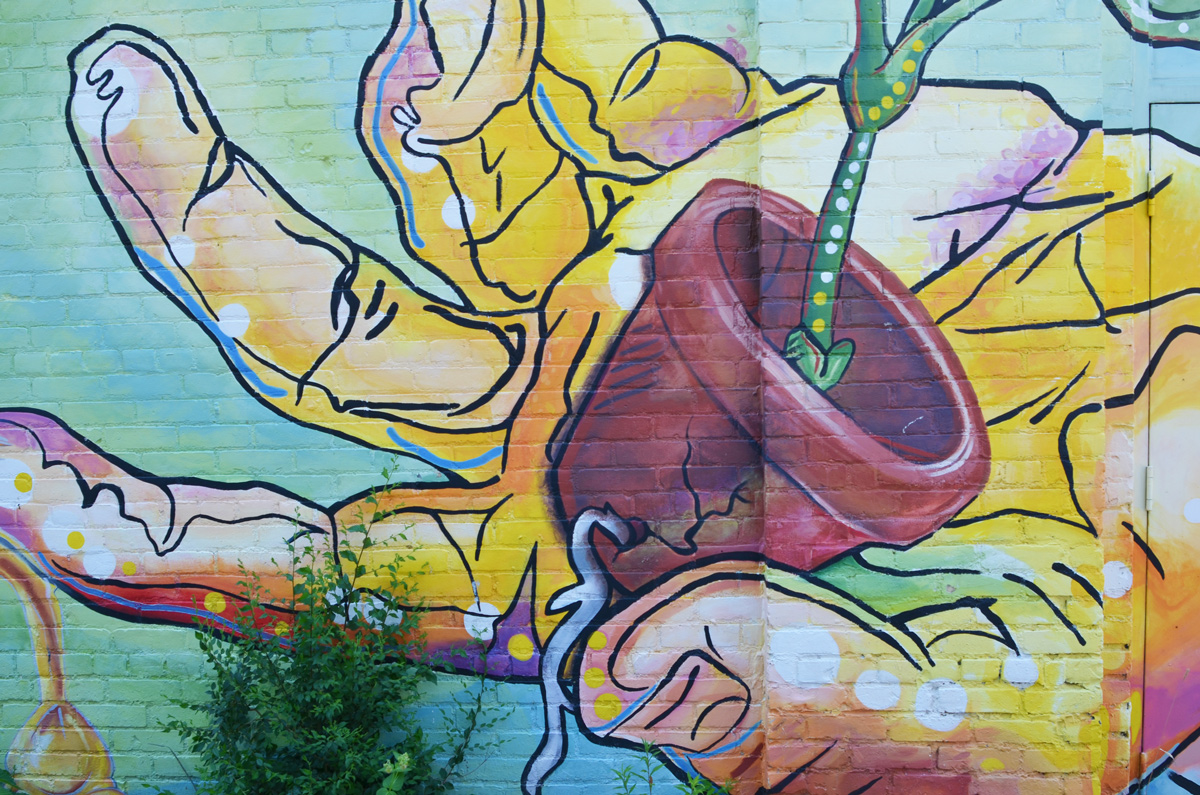
On the front and sides of the old 7-Eleven is this mural:
below: The swirls were painted by Flips (Swirlgod and BSC – Blurred Sight Clreared)
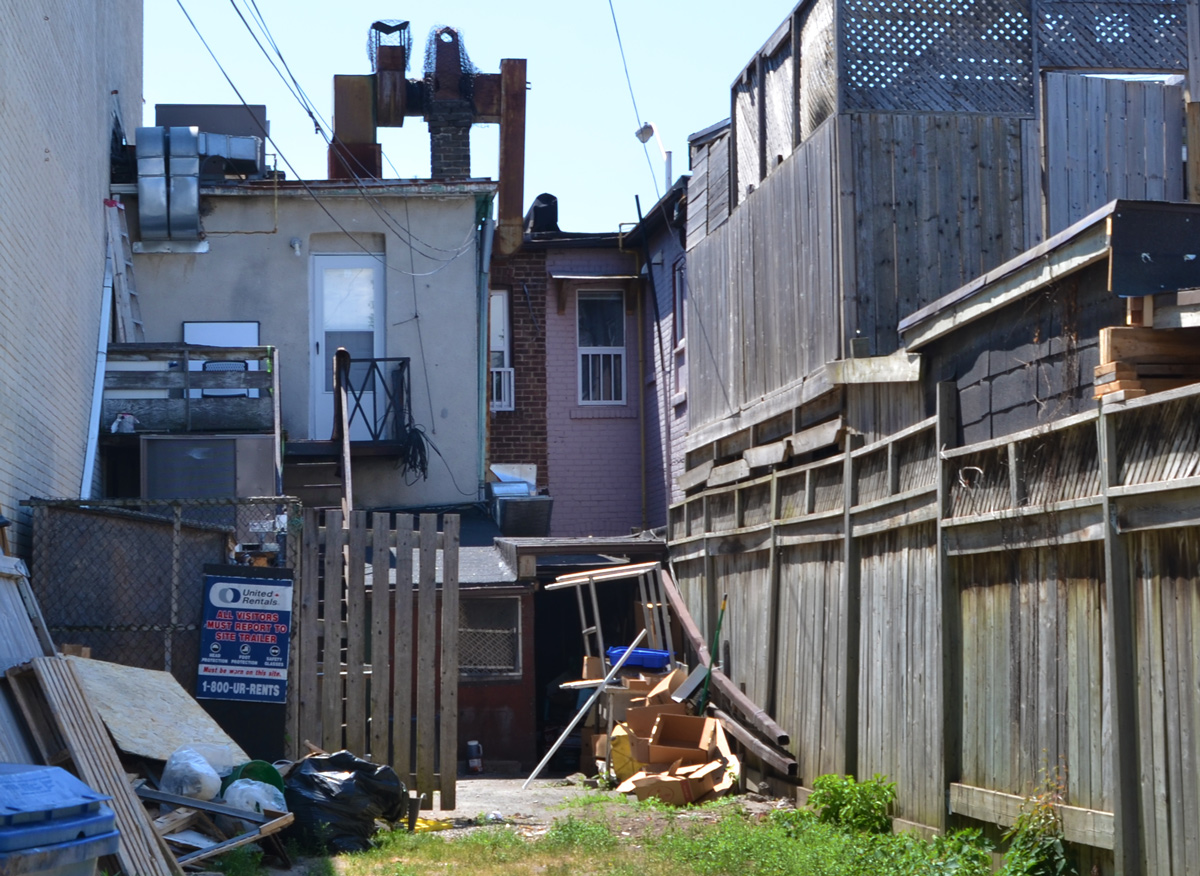
On the back of the building along the alley, is a mural in black, white, and shades of grey. “Enemy of Justice is Ignorance Allied with Power”
below: “No justice for Breonna Taylor” plays on the TV while a policeman in 2020 vintage riot gear stands by the door.
below: The year 1955 references the day that Rosa Parks refused to give up her seat on the bus to a white man in Montgomery Alabama, 1 December 1955. It was the year that saw the birth of the African-American Civil Rights Movement in the USA. Police uniforms sure have changed!
This project was also a collaboration with the local BIA’s, StreetARToronto, and East End Arts.
Three other artists contributed to these murals: Spyone, Nick Sweetman, Smokestack Lightning, and Maysr
Back in the early spring of 2019, I wrote about accessing the East Don path from Moccasin Trail.
below: Last week, the view from the east side of the tunnel under the DVP leading to Moccasin Trail Park.
Now, in a different year and a different season, I have explored more of that trail starting at the north end, near Lawrence Avenue and the Don Valley Parkway (DVP). Originally, Lawrence Avenue curved south down the east side of the ravine before it crossed the Don River. The remains of part of that road provide access to the East Don path at Charles Sauriol Conservation Area. Sauriol (1904-1995) was a Canadian naturalist who played a leading role in conserving many natural areas in the province including the Don Valley.
Here, the Alexander Milne family first settled in 1832. Over time, a woolen mill and a sawmill were built, other families moved in, and the village of Milneford Mills was born; it thrived until the early 1900’s. The old woolen mill remained derelict until it was demolished in 1946. Between Hurricane Hazel floods in 1954, and the expropriation of land to make way for the DVP construction, most traces of the village have disappeared.
below: All that remains is one house. It’s been behind chainlink and “under renovation” for MANY years. When I went searching for any kind of story about this house, I discovered a blog post from 2011 about Charles Sauriol Park and the house was fenced in then. Apparently it was covered in graffiti back in 2008/9. I’m not sure that Mr. Sauriol would be impressed.
below: The Rainbow Bridge from the north side.
below: The trail passes underneath the Canadian Pacific (CP) tracks.
below: Footings for the CP bridge
below: As the trail crosses land owned by CP Rail, it is covered by a metal frame canopy. It’s difficult to see in this photo but there is a series of small laser-cut metal artworks between the grey railings. The whole structure is “A Walk in the Woods” and it is the creation of both Robert Sprachman and Arnaud Boutle.
below: Farther down the trail is another railway bridge. This is the same line that goes north to Oriole GO station and beyond. The scaffolding under the bridge is for the construction of another canopy similar to one under the CP bridge (above) as well as an art installation.
below: Part of art installation “High Water Mark” by Robert Sprachman that is almost complete. There are 15 rocks each with a year on them. The height of the rock on a metal pole represents the height of the flood water on the Don River that year (but is not an exact height). There are four rocks in this picture and from left to right are 1926, 1934, 1942, and obscured (the last is behind the wood. Ooops).
below: Oak leaves
below: Backs of houses overlooking the park
below: A chickadee holding onto a dead flower as it eats the seeds.
below: Fish. Yes there are fish in the Don River, about 21 species apparently. This one, salmon?, although large is unfortunately also dead. Over the past 30 years the Don River has received a lot of TLC which has helped to reduce the level of industrial pollution as well as the amount of litter and trash found along the banks.
below: We were told “It’s not the best time” when we asked if we could continue on the trail. South of here the trail is a construction zone. Eventually (soon? I may have visited a little too soon?) the path will join with those farther south so that there will be a continuous trail from Lawrence to the lake. In the meantime, this is Wynford. You can exit here, or retrace your steps back to Lawrence. Next time!
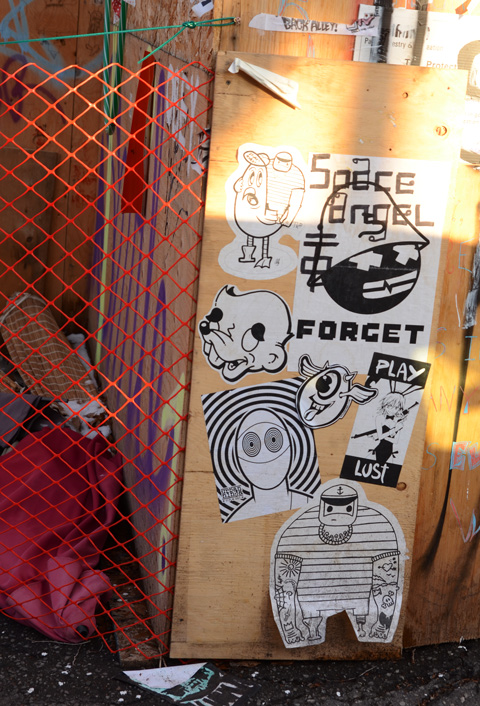
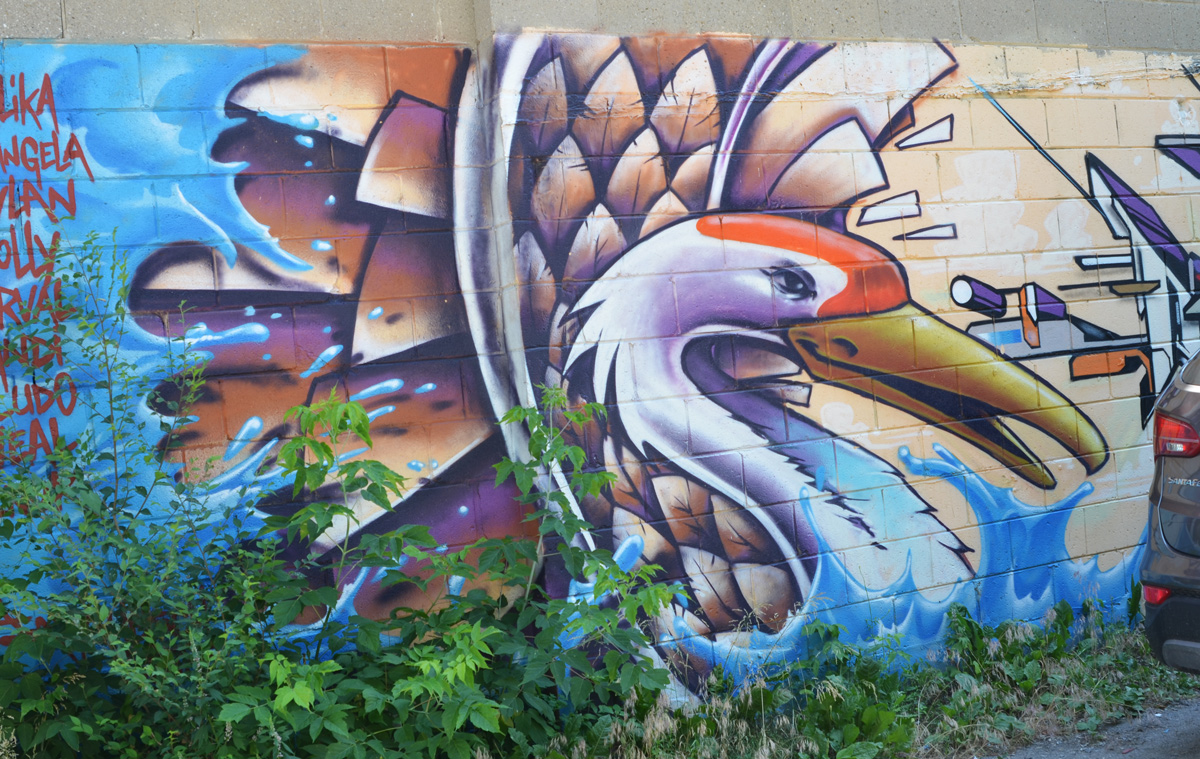
Just a small collection of some of the graffiti, and related, that I have seen lately.
below: A on top and B below. A = Alvin the Chipmunk as Aladdin. B = Bugs Bunny as Bullwinkle eating a banana.
below: Street art by Mike Salisbury, “Out of Time” red emergency phone.
below: Between the Madness Festival and the Hitler poster, a four line poem from “The Hawaiian healing program Ho’oponopono”. It’s a real thing apparently and perhaps I’m forgiven, thanked and loved.
below: Some friendly ghostly figures in time for Christmas.
below: Some black on white faces and a streetadventures sticker
below: Danger due to resisting.
below: Life jackets required because of a water hazard danger.
Parler23 is actually Parler Sneaker Company so this is probably part of an ad campaign.
“Social norms has been reset to factory settings”
I’m not sure what the above words mean or imply but I do know that we’ve all been impacted by Covid in one way or another. The city seems to be moving along albeit more slowly than usual. Sections of the city have fared better than others. In fact, it would be very easy to portray segments of Toronto as being in trouble.
Here the road is closed to vehicles for Open Streets (the last Sunday of September).
We are missing events. All those things that I like to take pictures at and blog about – the parades, the street festivals, and even the protests. With more people staying at home, no tourists on the streets, and events going virtual, it’s a much quieter city.
below: This was the last weekend of TIFF and you wouldn’t know anything was happening.
below: In past years, King Street closes for TIFF activities. This year there was none of that – no crowds jostling for a look at a celebrity or two, no booths selling things.
below: These little “patios” have been carved out of some downtown streets to help restaurants stay open during these COVID days. It’s a great idea for the warmer months. Although the city now allows propane heaters on the street, I am not sure how many people are going to want to have dinner outside in December.
below: The Royal Alex Theatre is still set up for “Come From Away”
below: A nearby restaurant still has its St. Patricks Day green on display.
below: Roy Thomson Hall in the foreground with downtown buildings in the background, as seen from Metro Hall.
below: New public art on Adelaide… this is “Dreaming” by Jaume Plensa. She’s three storeys high and I wouldn’t be surprised if she is dreaming of the days when we didn’t need masks. How long until someone gives her a mask?
below: Reflections with security guard
below: The steeple of St. Andrews Presbyterian church
below: Mother and daughter cycling together
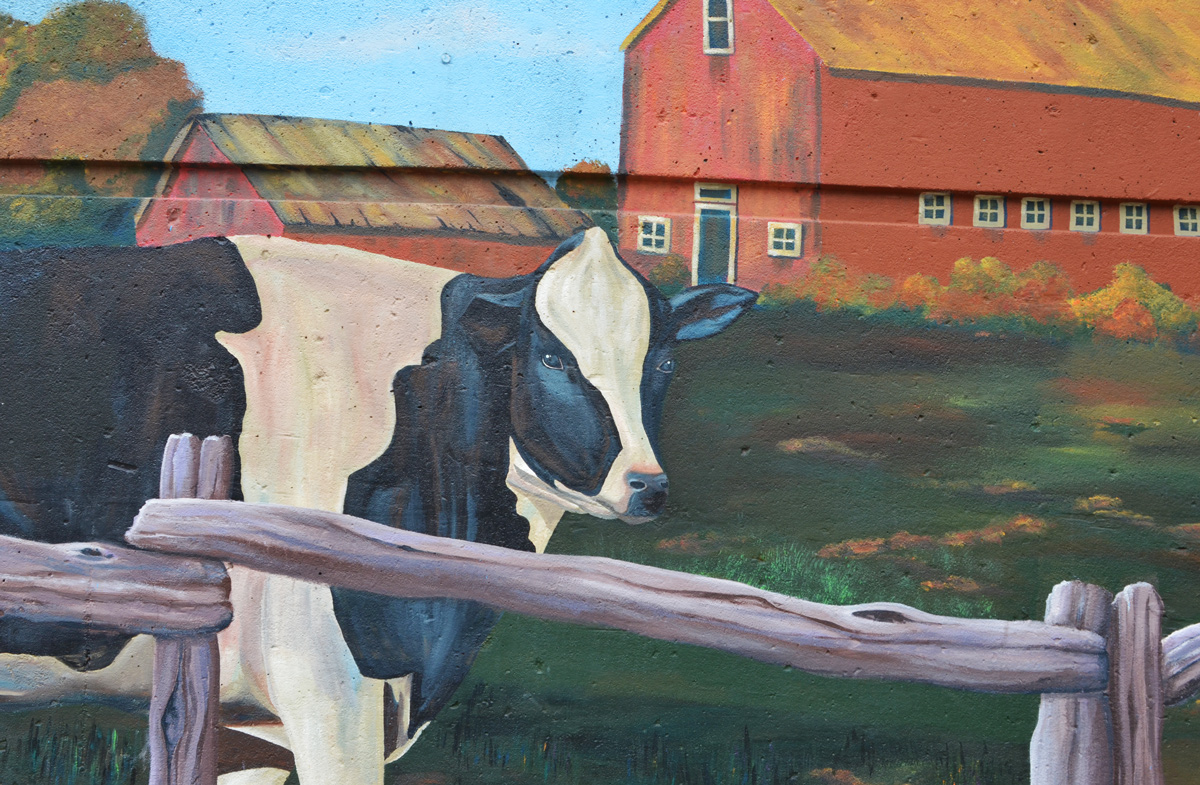
below: The cows are still in their pasture, unfazed by the changes around them.
below: The next two photos were taken while I was standing in among the tall black towers of the Toronto Dominion Centre. The first view is to the southwest towards the CN Tower.
below: The second view is to the northeast.
below: The Canada Permanent building on Bay street is getting a cleaning.
below: This is one of the Bank of Montreal buildings, also on Bay Street.
below: Window washers
below: Pearl Street, looking east. Old brick buildings in the foreground with their modern counterparts shining in the background.
below: The west end of Pearl Street.
below: I found a person!
below: Looking north up University Avenue
below: The Shangri-La hotel and Momofuko restaurant with it’s weird sculpture “Rising” by Zhang Huan at street level (also University Ave). Masses of “peace pigeons” cover the surface.
below: Looking the other way on University Ave, south past Richmond to Adelaide and beyond.
below: Preservation of a large brick facade on Adelaide.
below: Waiting for the lights to change
below: Under the heading of “somethings never change”, there are always photoshoots in front of Osgoode Hall. Presumably this photo or one similar can be found somewhere on instagram?
below: Arranging the veil.
below: With a the pigeon by the Eaton Centre.
below: Mr. Ryerson keeps changing colour. Apparently he was more red not that long ago. Rather than remove the red paint, he was “cleaned up” by painting him this shade of green. He probably doesn’t realize it but he’s become a controversial figure. He may have been one of the first to establish public schools but he also played a role in the creation of residential schools for the indigenous population. Because of the latter, there has been some people advocating for the removal of this statue.

This statue was unveiled in 1889. It stands in front of an ivy covered building that started its life as Toronto’s first teacher’s college (1847).
below: Queen Street West
below: This yellow birdie, at least in sticker form, may be on the verge of extinction. An Uber5000 creation that can also be found on several of his murals around the city.

As I write this, the number of Covid cases in Toronto (and all of Ontario) have gone back up. Although we were hopeful that we were wrong, was there ever any question that things would get worse before they got better? Are we more complacent? Maybe. But let’s hope that we are also wiser this time around.
I have been looking for places to find autumn colours and one idea I had last week was to visit Pinehills cemetery in Scarborough. I didn’t find many colourful leaves but I did find a few things. The most noticeable was the mix of names on the stones – Chinese, Italian, Spanish, Greek, and more, all mixed in together. In Toronto we often live side by side and it seems that we are also buried side by side – as in the three people below: Baffa, Rajamohan, and Gutierrez.
below: Black stones with crosses on the top seem to be the prefered headstone for those in the Greek community who are buried here. Sometimes the name is in English, and sometimes in Greek.

below: Cemeteries are fascinating in that they give us a glimpses into cultures and traditions. The decorating of grave sites with flowers and figurines adds a bit of joy to an otherwise somber setting. You know that these people are remembered and their lives celebrated.
below: A large shamrock. Beneath it, a Miss Kitty doll in purple and a pair of boxing gloves with the Irish flag. Doesn’t it make you wonder why? Was Frank Murphy a boxer? What will my descendants leave by my grave?
below: I assume that the red tape covers an inscription that is already on the headstone for the spouse of the departed? Perhaps a name and birthdate? Written vertically in Mandarin…. and I wish that I could read some of them. Is there something written about the deceased? Is there an epitaph? I’ll have to be content to look at the lotus flower, bamboo, and dragons that decorate the stones.
below: As I was leaving, this coyote came sauntering across the grass. It wasn’t the least bit afraid of me (in my car).
Another path through the woods. This time there was a hint of yellow in the leaves because it was late September and even in 2020, some things are the same as ever.
The path led me uphill to the newly renovated Guild Inn. It’s been five years since I have wandered around their gardens and surrounding park. In that time, the building has been renovated and expanded. I didn’t take very many pictures the other day because I knew that I had a lot from my previous visit. I was going to link to the blog post from that time but I discovered that I never actually got around to posting anything! So, I have found the old photos and have included some of them here.
below: For instance, this is the front of the inn in July 2015 with its windows covered.
below: And the back, five years ago.
below: Five years later – the back of the Guild Inn with the path leading to the gardens.
below: A statue of Saint Francis Assisi with a wolf, carved by Thomas Bowie (b.1905)
below: A stone wall with statues and carvings provides a backdrop for a garden full of black-eyed susans. Because of the efforts of a few people to salvage some of Toronto’s architectural and creative history, the gardens of the Guild Inn have become the final resting place of a number of pieces of older buildings that have been demolished to make way for modern skyscrapers.
below: Stone wall with features from the Bank of Nova Scotia building (1903)
below: The bird nest is long gone. … but it would have been a nice quiet spot to raise a family.
below: From the Royal Conservatory of Music. There are two bas-relief bronzes of men associated with the Royal Conservatory. On the right is Sir Ernest MacMillan (1893-1973), an organist, composer, and conductor who was knighted in 1935 by King George V. On the left is Dr. Healey Willan (1880-1968) another organist and composer who was associated with the Toronto Conservatory for 30 years (1920-1950).
below: Looking through one stone arch to another, the square arch from the Imperial Bank of Canada Building (1928) and underneath sits Musidora. Many artists have lent their interpretations of this woman (in sculpture and paint), the subject of a poem titled “Summer” by Scottish poet James Thomson written in 1727. The beautiful Musidora strips naked to cool down by bathing in the stream, not knowing that she is being watched by Damon. Damon is torn between watching and turning away but chooses the latter.
In 1887, a Bank of Montreal building was built at the northwest corner of King and Bay; a site now occupied by First Canadian Place. The building featured a series of sculptures representing the Canadian provinces that were created by a number of artists. When the building was demolished in 1968, these panels were brought to the Guild Inn. Not all of them are on view today possibly because some were not in good shape (held together with metal straps). Maybe they are being fixed up?
below: This is the Alberta panel in 2015; the artist was Jacobine Jones (1897-1976)
below: It has since been cleaned up.
below: One of two stone angel panels from the North American Life Assurance Company Building (1932).
below: The brick and stone entranceway from the Granite Club (1926)
below: This cabin was named for William Osterhout, a United Empire Loyalist who in 1805 was given the first Crown land grant from King George III as reward for his service with the Butler’s Rangers. Although Osterhoust briefly owned the property, he never settled in Scarborough Township. The structure was more likely built around 1850 to 1860…. that may be a contentious “fact” as some believe that it is at least 50 years older than that.
The gardens have several different types of trees all in their autumn plummage.
below: Orange berries on a mountain ash tree…
below: … and many little crabapples on a crabapple tree.
below: At the south, the property ends at the Scarborough bluffs and there are many warning signs along the paths that run near the edge.
below: Looking out over Lake Ontario
And then, when driving north on Morningside on my home, I encountered this…. The peacocks have arrived.
For more of the history of the Guild Inn, see their website.
Today’s post features two new murals near Yonge and Sheppard
below: Looking towards the tall buildings southwest corner of Yonge & Sheppard including the green Emerald condos with their curled tops.
below: Backside of the Sheppard bus station which is where I found….
“Flock Together” by KJ BIT Collective
These colourful birds were painted by Jieun June Kim and Erica James with the support of StreetARToronto and the city.
below: The older two storey storefronts on the west side of Yonge street reflected in the new windows of the updated Yonge Sheppard Centre on the east side.
below: Continuing northwards, there is this large hole in the ground on Yonge at Spring Garden.
below: And here we find another new mural (painted earlier in September I think) also painted by two artists.
below: On the righthand side, the artist was @rowellsoller
below: “Make me smile” with a ‘free flowing water queen’ with pink curls by @rowdyradrat aka Ian Gabriel is the other half of the mural.