Archive for the ‘memorials’ Category

Happy Mothers Day!

I didn’t write this blog post specifically for Mothers Day even though it’s about four women, Mary Pickford, Edith Cavell, Florence Wyle, and Frances Loring.  Just because they are women doesn’t mean that they are mothers, in fact only one is.  Mary Pickford adopted two children.  I also didn’t intend to write a blog post on the merits of motherhood vs childlessness so I am going to say nothing further on the subject!

The first woman can be found at the corner of University and Elm.  Here, there is a a bronze portrait bust of Mary Pickford that was sculpted by Eino Gira in 1983.

bust of Mary Pickford with her hand on her cheek, in front of Sick Kids Hospital in Toronto, red brick hospital behind her in the photo

The plaque beside her says:

Born in 1893 in a house which stood near this site, Gladys Marie Smith appeared on stage in Toronto at the age of five.   Her theatrical career took her to Broadway in 1907 where she adopted the name Mary Pickford.  The actress’s earliest film “Her First Biscuits”, was released by the Biograph Company in 1909 and she soon established herself as the international cinema’s first great star.   Her golden curls and children’s roles endeared her to millions as “America’s Sweatheart”.  She was instrumental in founding and directing a major film production company and starred in over fifty feature-length films including “Hearts Adrift”, “Pollyanna” and “Coquette”.  For the last named film she received the 1929 Academy Award as the year’s best actress.

below: Just up the street, next to one of the entrances of Toronto General Hospital, is a memorial to British nurse Edith Cavell (1865-1915) and to all the Canadian women who served as nurses in WW1.  The memorial  was installed at University Ave and College St. in 1921 but later moved to its present location.
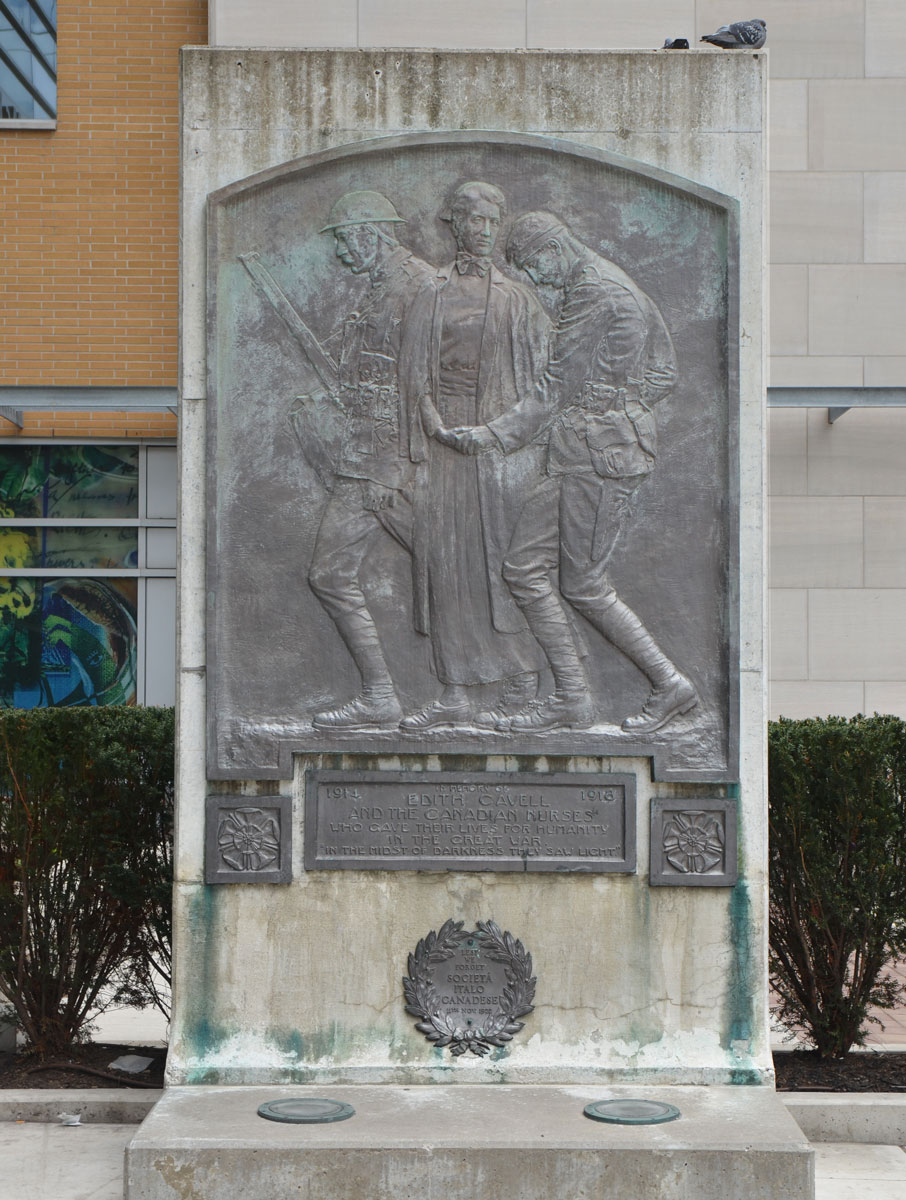
A memorial to British nurse Edith Clavell and the Canadian nurses of WW1, a bronze plaque mounted on a stone tablet. Picture of Clavell between two upright but wounded soldiers.

In memory of Edith Cavell and the Canadian nurses who gave their lives for humanity in the Great War.  “In the midst of darkness they saw light”

Cavell had been working in Brussels when WW1 broke out.  After the Germans invaded Belgium, Cavell helped wounded Allied soldiers escape to the Netherlands.  She was caught by the Germans, charged with treason, and executed on 12 October 1915.  She became the most well known woman casualty of WW1.

The above memorial was designed by Florence Wyle.  There is a memorial to Wyle and her partner, Frances Loring (also a sculptor), in a small park at the corner of Mt Pleasant and St. Clair.

below: bronze bust of Florence Wyle, by Frances Loring

bust of Florence Wyle, a Canadian sculptor, in a park

below: bronze bust of Frances Loring, by Florence Wyle
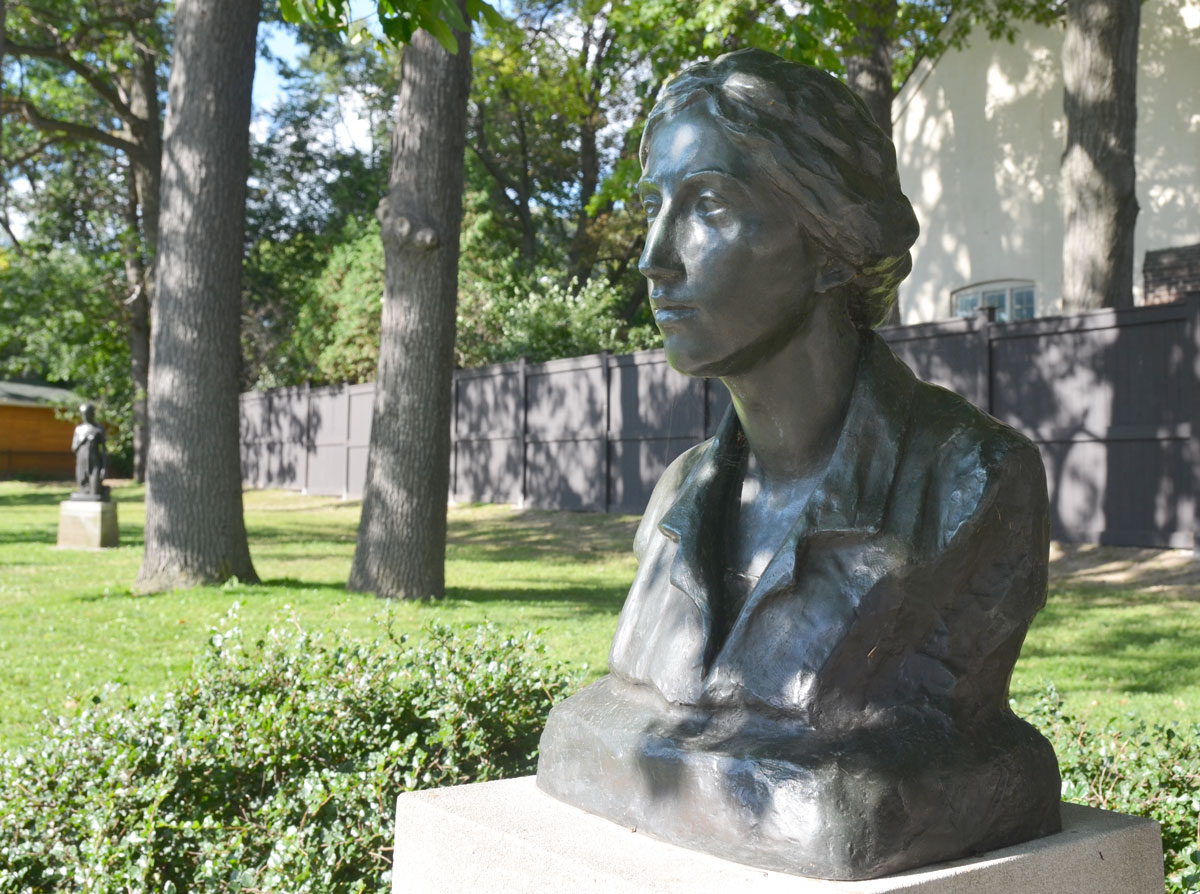
bust of Frances Loring, a Canadian sculptor, in a park, in the shade of a large tree

below: There are a couple of small statues by Wyle in the same park, including this one.
“Young Girl”, about 1938.

bronze statue titled "Young girl", showing a girl from the thighs up, holding up a cloth that is wrapped around her body but her breasts are bare

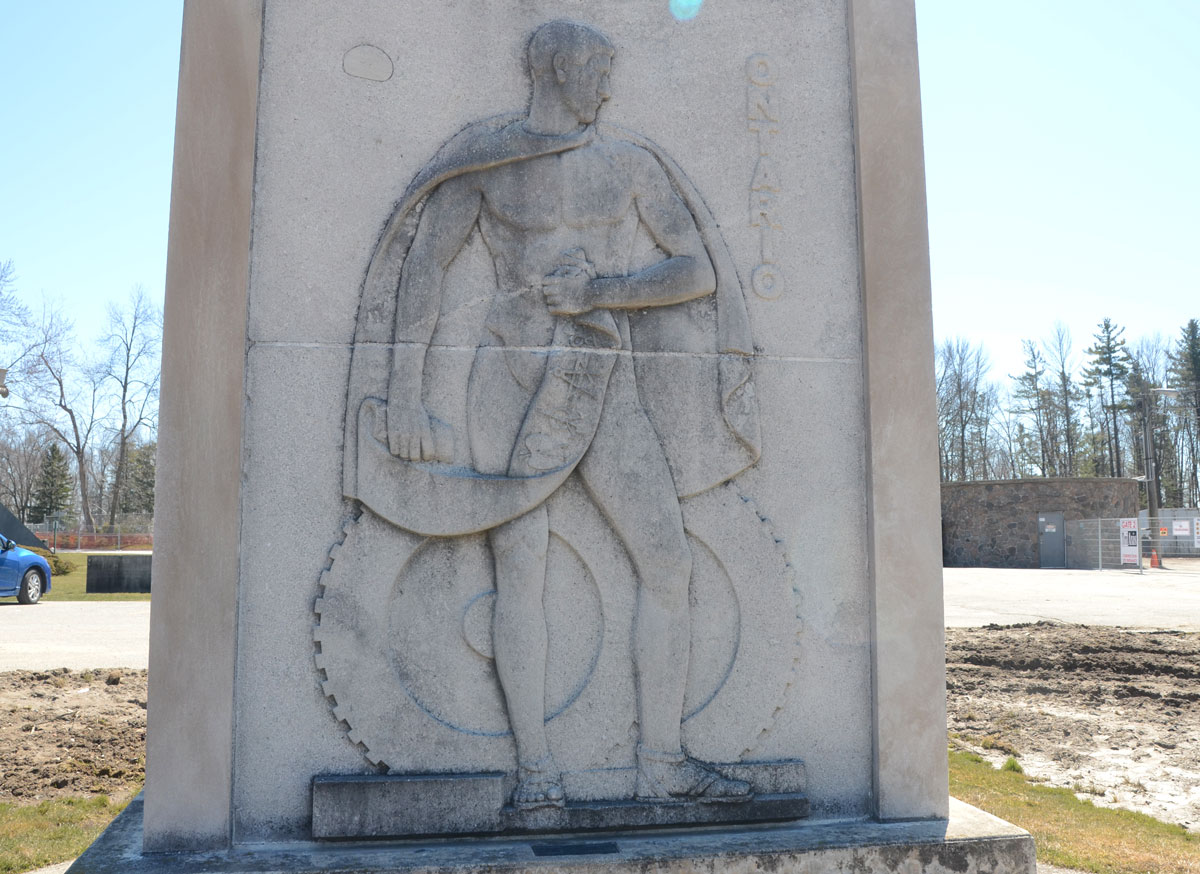
Loring and Wyle are responsible for a number of sculptures around the city.  Two of these used to be on the Bank of Montreal building at the northwest corner of King and Bay. It was built in 1887 by architects Marani and Morris and demolished in 1968.  The building featured a series of sculptures representing the Canadian provinces that were done by a number of artists.  Frances Loring sculpted the panels for Ontario and Quebec.  When the Bank of Montreal building was demolished, all of the panels were moved to the grounds of the Guild Inn in Scarborough where they remain today.
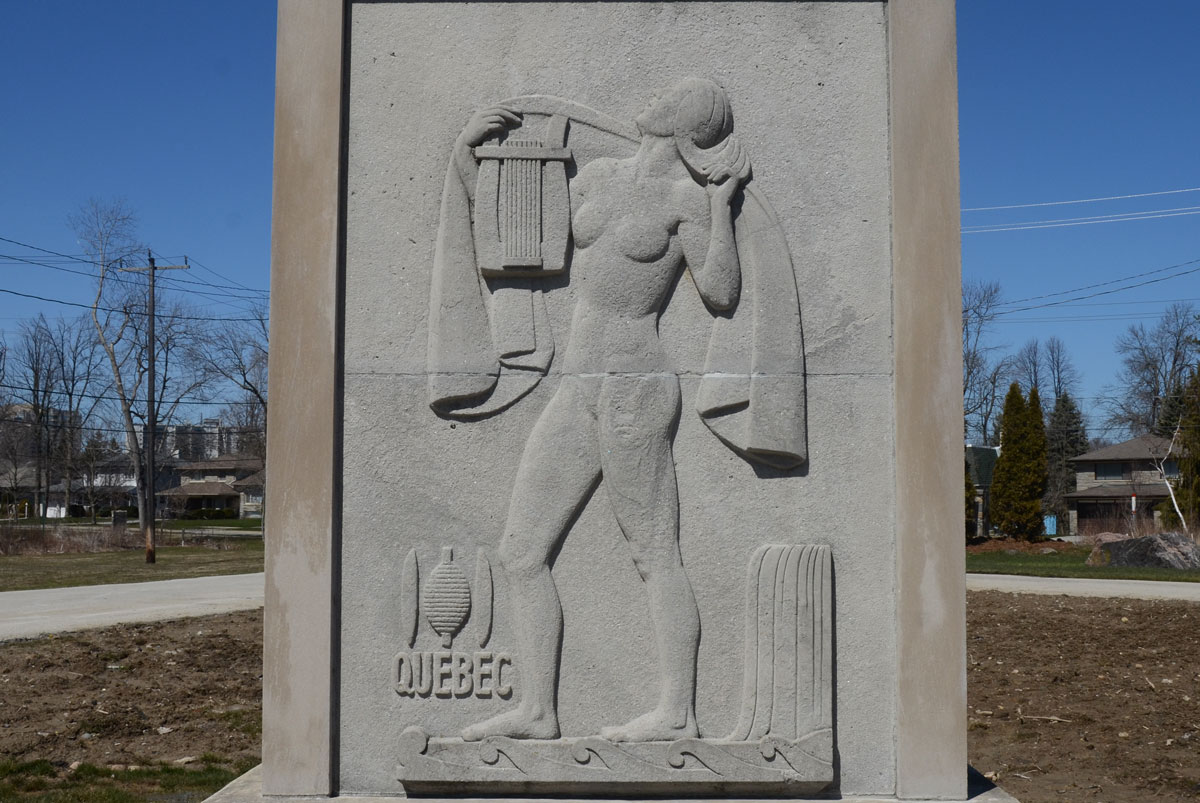
Quebec sculpture - A stone relief sculpture from a series on provinces of Canada, originally on a Bank of Montreal building in Toronto. They were rescued when the bank was demolished and moved to the grounds of the Guild Inn in Scarborough. By Canadian artist Frances Loring. A naked woman upright, with a cloth over her shoulders and looking upwards

A stone relief sculpture from a series on provinces of Canada, originally on a Bank of Montreal building in Toronto. They were rescued when the bank was demolished and moved to the grounds of the Guild Inn in Scarborough. By Canadian artist Frances Loring. Ontario is in the picture, as a man surrounded by symbols of industry such as large gears and architectural plans

Remembrance Day
the eleventh day of the eleventh month

November 11th at 11am in 1918 (the eleventh hour of the eleventh day of the eleventh month)  was when an armistice was signed by representatives of Germany and the Entente.  Nov 11th became known Armistice Day, or in some countries such as Canada, Remembrance Day.  An armistice is an agreement to stop fighting, a truce in other words.  After this signing, it took several months of negotiations before the First World War officially ended with the signing of the Treaty of Versailles on 28 June 1919.  That treaty ended the war between Germany and the Allies.  (The Allies of WW1 were also known as the Entente Powers while Germany and her allies were known as the Central Powers)

The poppy became a symbol of Remembrance day, and a symbol in remembrance of soldiers who died fighting in all wars, after the publication of the poem ‘In Flanders Fields’ in 1915.  This popular and often quoted poem was written by Canadian Lieutenant Colonel John McCrae.  In it he talks about the poppies that grew in the battlefields at Flanders Belgium during WW1.

“In Flanders fields the poppies blow
Between the crosses, row on row,”

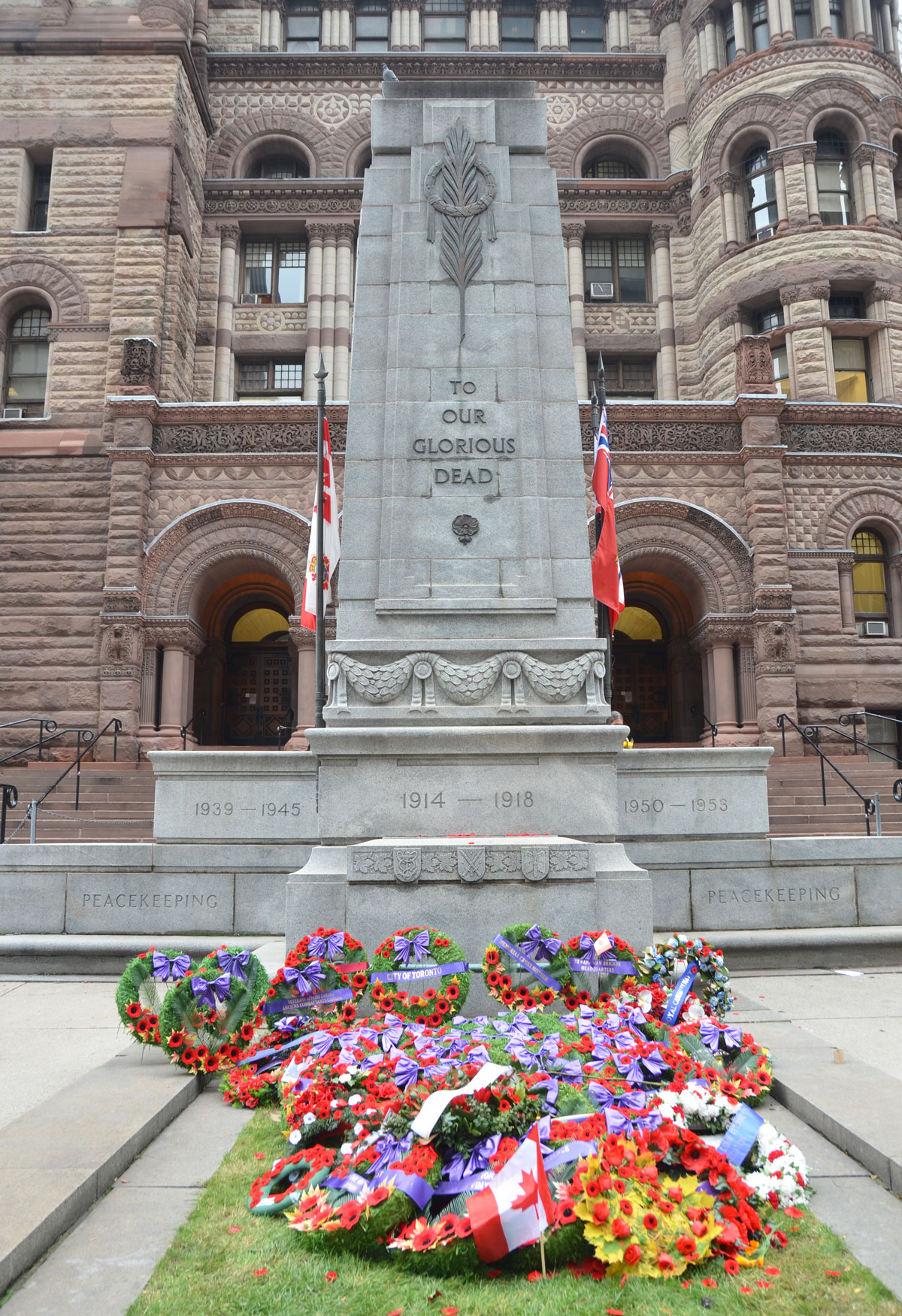
Many Remembrance day poppies lie on the grass in front of the cenotaph in front of old City Hall. In the background is a small Canadian flag as well as a few wreaths that have been laid in front of the cenotaph.

below: The cenotaph (war memorial) in front of Old City Hall was unveiled on 11 Nov 1925 to commemorate those Torontonians who died in WW1.  Since then, it has been expanded to include those who lost their lives in WW2 and in the Korean War.  The word cenotaph comes from the Greek and translates as ’empty tomb’. This style of memorial has been used widely for commemorating someone, or some group, whose remains are interred elsewhere.

More than 6000 Torontonians lost their lives in these three conflicts.  Close to three thousand men died in World War 1, a number that represents about 2% of the male population of the time. (1)

The cenotaph in front of Old City Hall in Toronto, with a collection of wreaths that have been laid at the bottom of it.

In the middle of University Avenue is a statue erected by the Toronto District of the Sons of England Benefit Society in memory of their members who died in World War 1.  Founded in 1876, this society provided insurance to its members who were in need because of illness or accident.

In 1914 Canada was still part of the British Empire.  As a result, when Britain found itself at war in August of that year, Canada too was involved.

statue and memorial at University and Elm streets.

below: At the base of the center lion is a small plaque that reads: “Chas Adamson, sculptor, 1923”.

A carving of a lion in granite. It is at the base of a sculpture. A small brass plate is attached in front of the lion and it says Chas Adamson, sculptor 1923

below: The Sons of England building on the NW corner of Richmond St. East and Berti St., 1922

historical picture of Richmond Street near Berti, taken in 1922, old buildings, a, horse drawn cart and an old car. Streets but no traffic. black and white photo.

photo credit: Toronto public library website


Another memorial in this city is the Ontario Veterans Memorial.  This is a 30m long granite wall in front of Queens Park dedicated to all the men and women from Ontario who served in the military.  Etched into the granite are scenes depicting Canadians in military roles between the time of the Fenian Raids in 1867 to the present day.

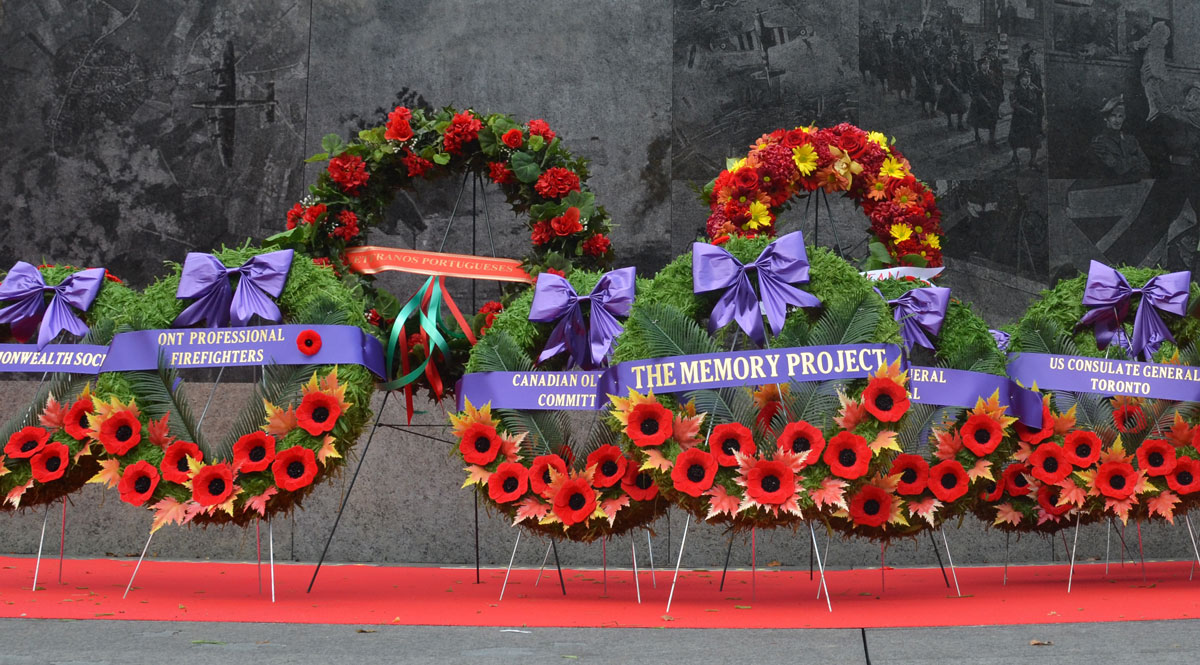
below: Part of the granite wall.  The red in the picture is a reflection of the red carpet that was laid in front of the memorial for the Remembrance Day service.
An etching of men running across a battlefield with rifles at the ready.

below: part of the granite wall

part of a war memorial showing the wars written on it

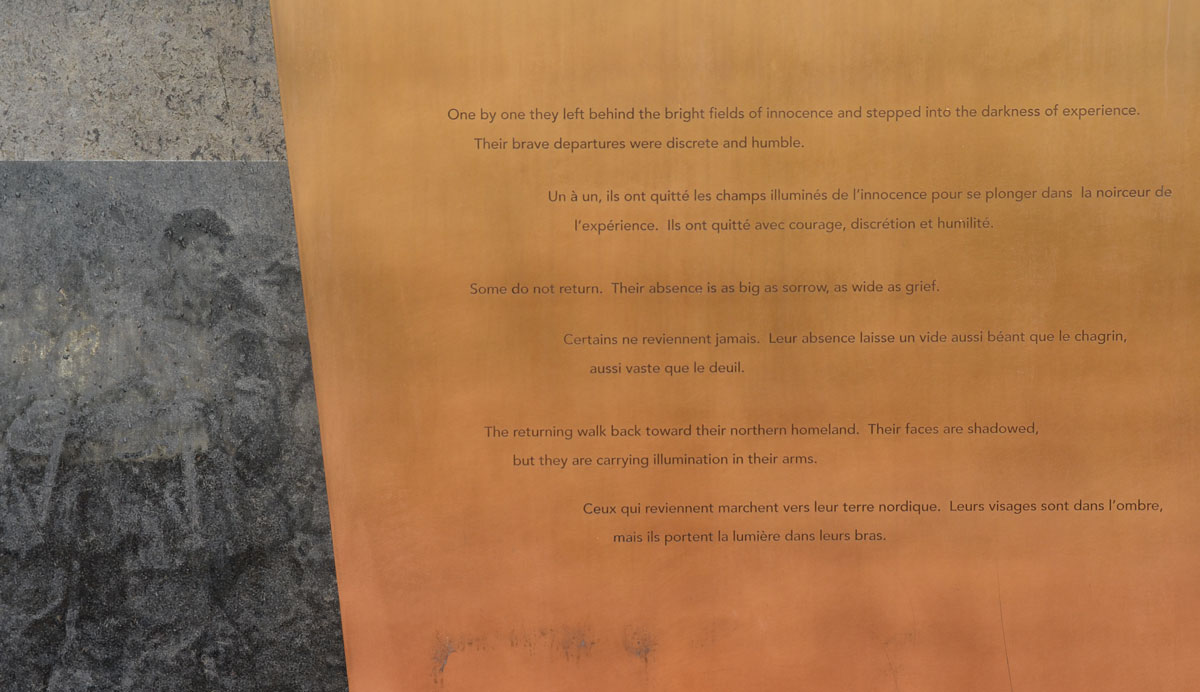
Transcription of the passage by Canadian author Jane Urquhart:
One by one they left behind the bright fields of innocence and stepped into the darkness of experience
Their brave departure was discrete* and humble.
Un à un, ils ont quitté les champs illuminés de l’innocence pour se plonger dans la noirceur de
i’expérience. Ils ont quitté avec courage, discrétion et humilité
Some do not return. Their absence is as big as sorrow, as wide as grief.
Certains ne reviennent jamais. Leur absence laisse un vide aussi béant que le chagrin,
aussi vaste que le deuil.
The returning walk back toward their northern homeland. Their faces are shadowed,
but they are carrying illumination in their arms.
Ceux qui reviennent marchent vers leur terre nordique. Leurs visages sont dans l’ombre
mais ils portent la lumière dans leurs bras.  

(* discrete vs discreet ?)

below: Some of the wreaths laid at the Ontario Veterans Memorial on Remembrance Day.

wreaths in front of the granite wall of the Ontario Veterans Memorial

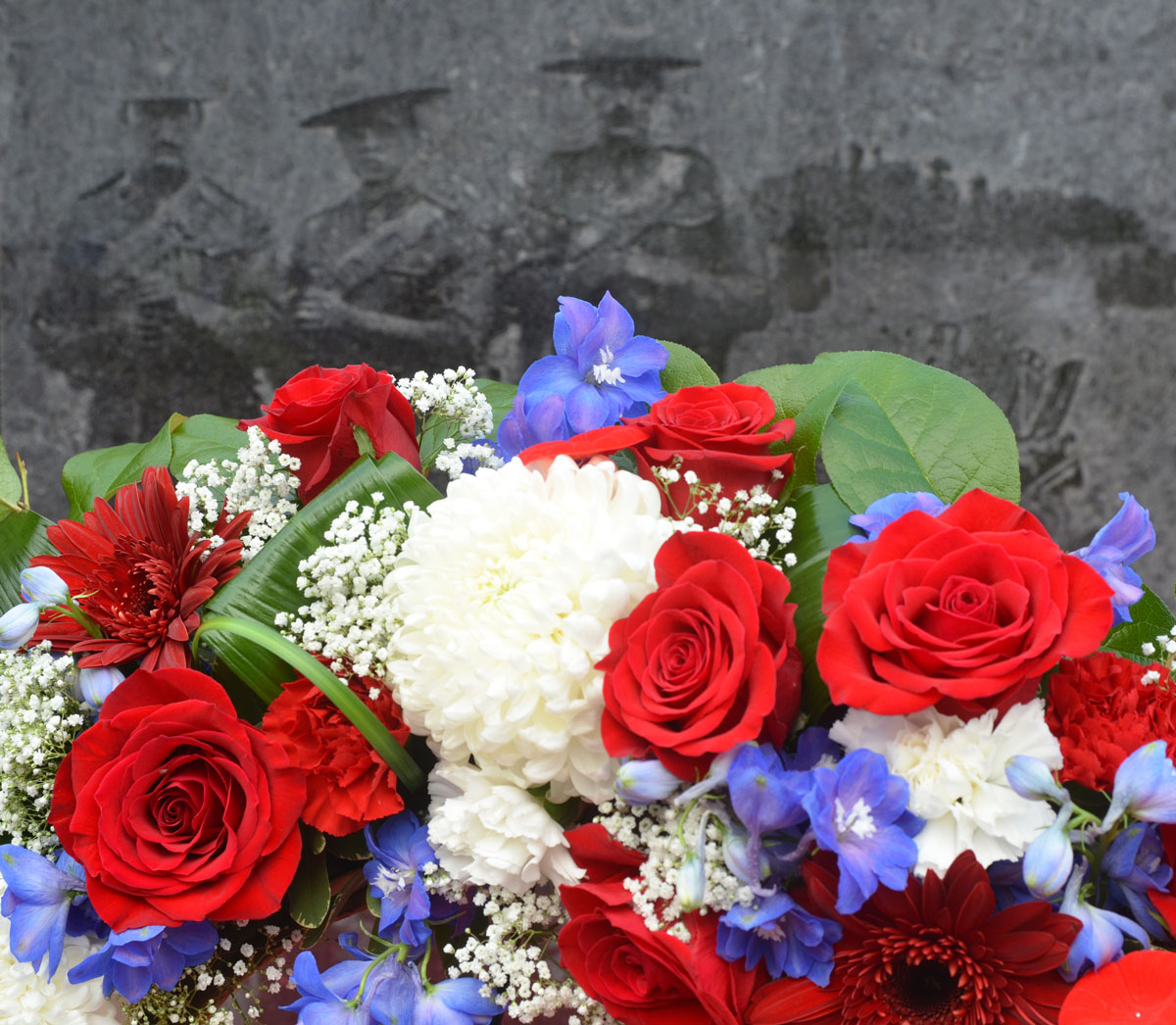
A bouquet of flowers, red roses, plus some white and blue flowers in front of a war memorial. An etching of three men in uniform, part of the memorial, is in the background.


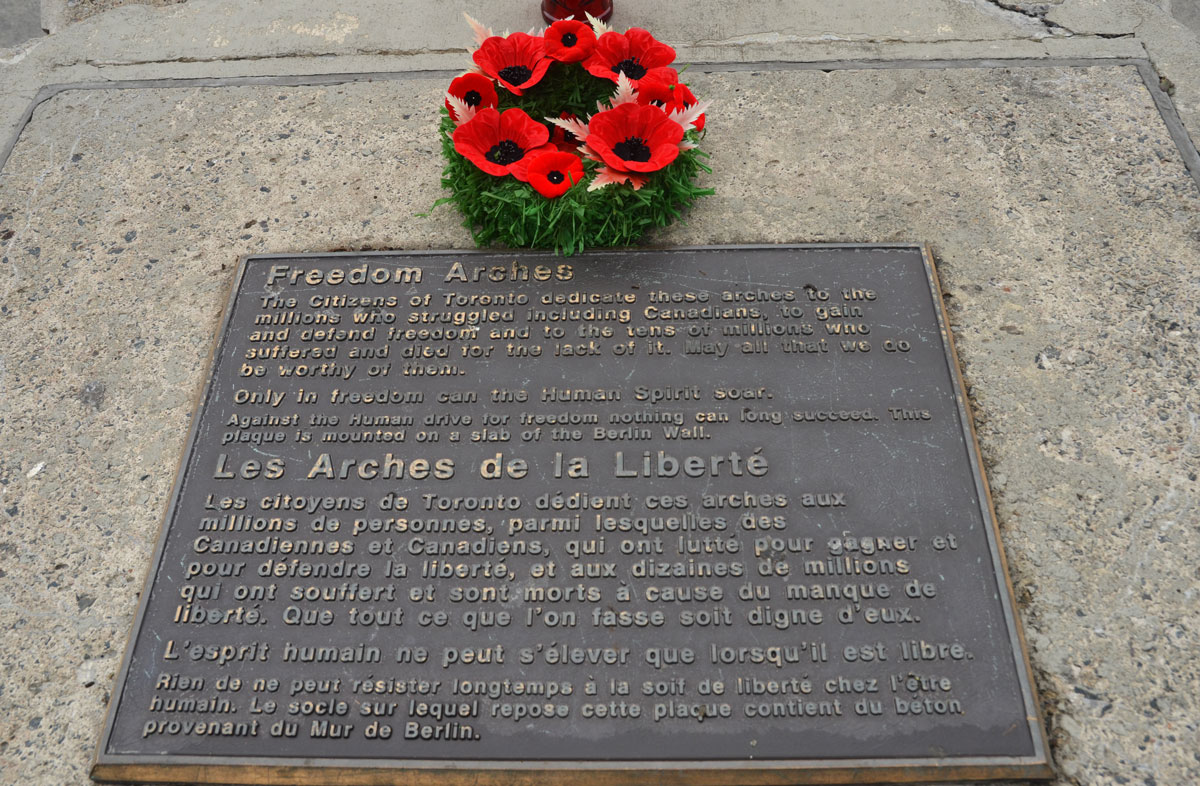
below: Although it is not a war memorial per se, someone left a small poppy wreath by this plaque at Nathan Phillips Square.  The plaque is by the arches over the pool, the freedom arches.

blog_poppies_freedom_arches

Transcription of the plaque: Freedom Arches. The citizens of Toronto dedicate these arches to the millions who struggled, including Canadians, to gain and defend freedom and to the tens of millions who suffered and died for the lack of it. May all that we do be worthy of them. Only in freedom can the Human Spirit soar. Against the Human drive for freedom nothing can long succeed. This plaque is mounted on a slab of the Berlin Wall.

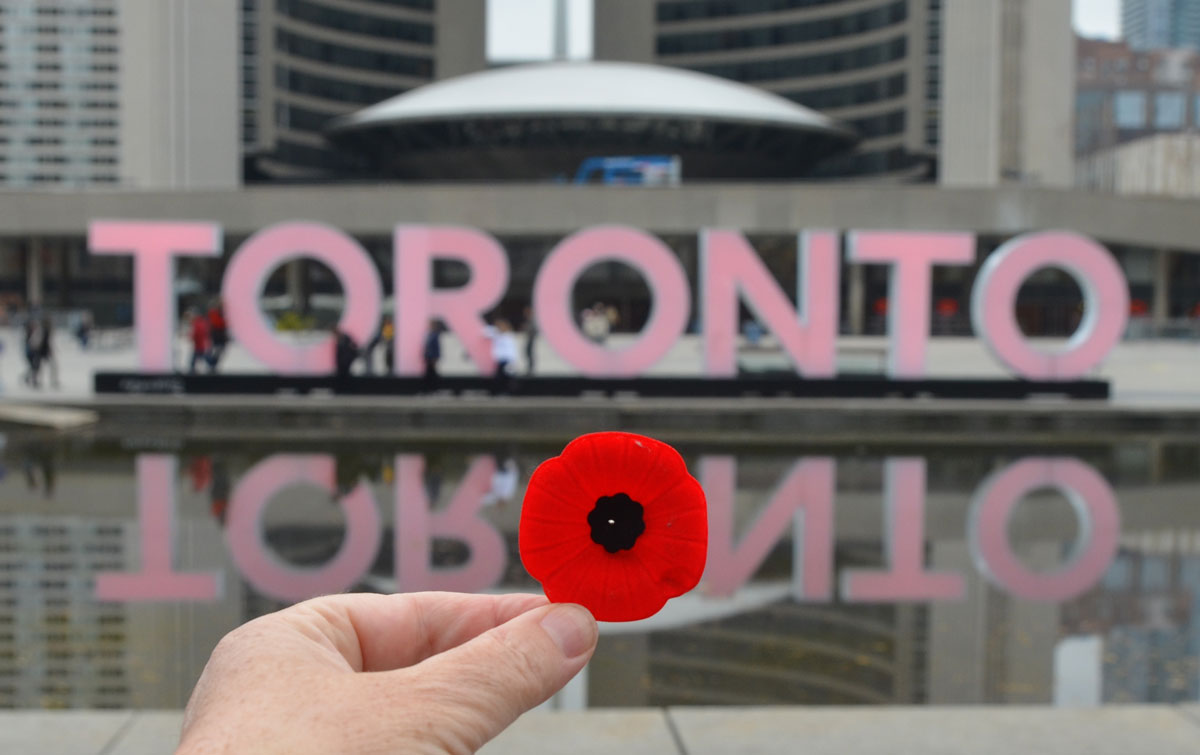
below: The 3D Toronto sign was red on Remembrance Day.

A remembrance day poppy is in the foreground. It is being held up in front of the 3D toronto sign which has been lit in red for Remembrance Day

We remember collectively as a nation, as a community. We also remember privately, as individuals, as families.  Countless small memorials can be found around Toronto including in schools, in churches and other religious institutions, and in cemeteries.

below: A memorial to the 48th Highlanders, Mount Pleasant cemetery.  In memory of the officers, non-commissioned officers, and men who have served with the 48th Highlanders.

Tall pinkish granite memorial to the 48th Highlanders in Mt Pleasant cemetery.

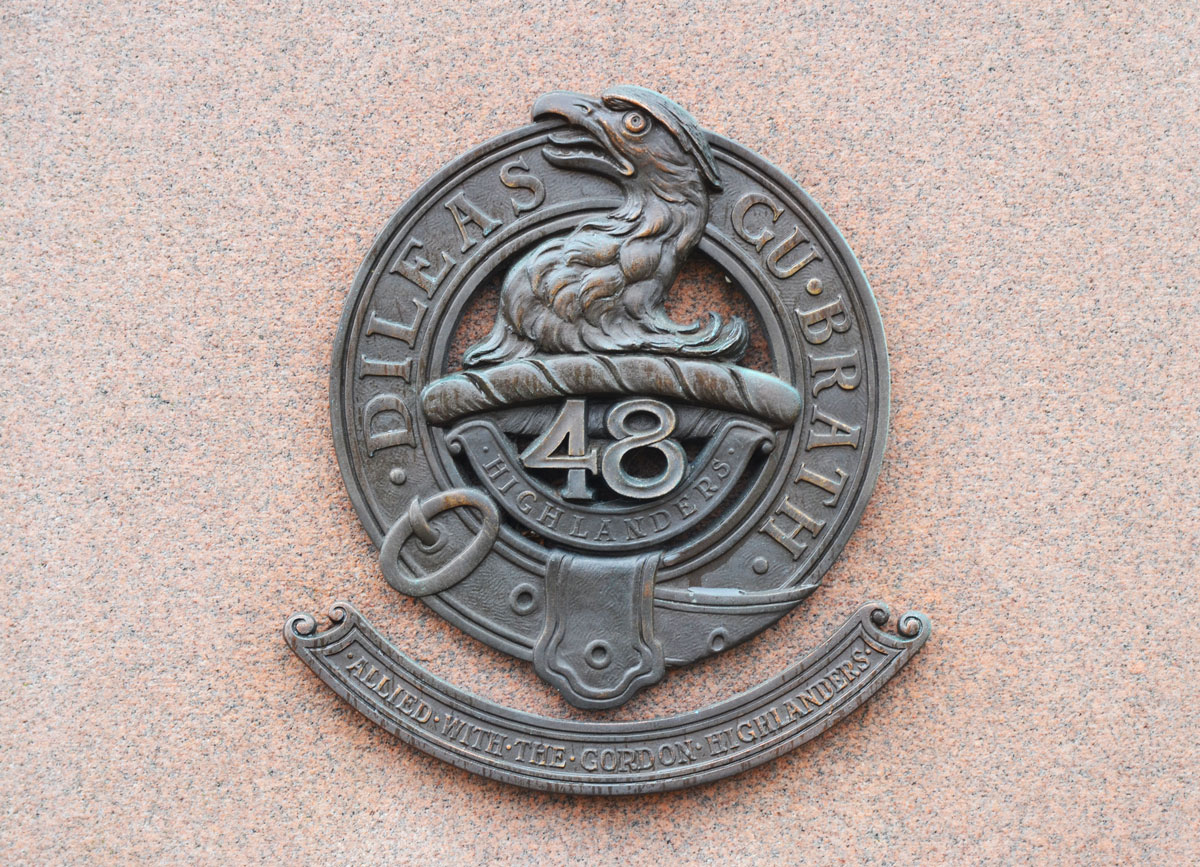
symbol, in metal, found on the memorial to the 48th Highlanders.

Dileas Gu Brath, their motto, is gaelic for ‘faithful forever’

below:  Quiet memorials

poppy wreath beside a tombstone in a cemetery

A small Canadian flag with two poppies pinned to it. The flag is inserted into the ground in front of a tombstone in a cemetery. The stone is a veterans stone, with air force insignia at the top and a cross at the bottom. In the middle is the information for the pilot who died during the war.


(1) source: Patrick Cain, Global News

100 Workers,
aka WSIB (Workplace Safety and Insurance Board) Simcoe Park Workers Monument,
a monument commemorating the workers of Ontario who died in the workplace,
by John Scott and Stewart H. Pollock.

Located downtown on Front Street between Simcoe and John.

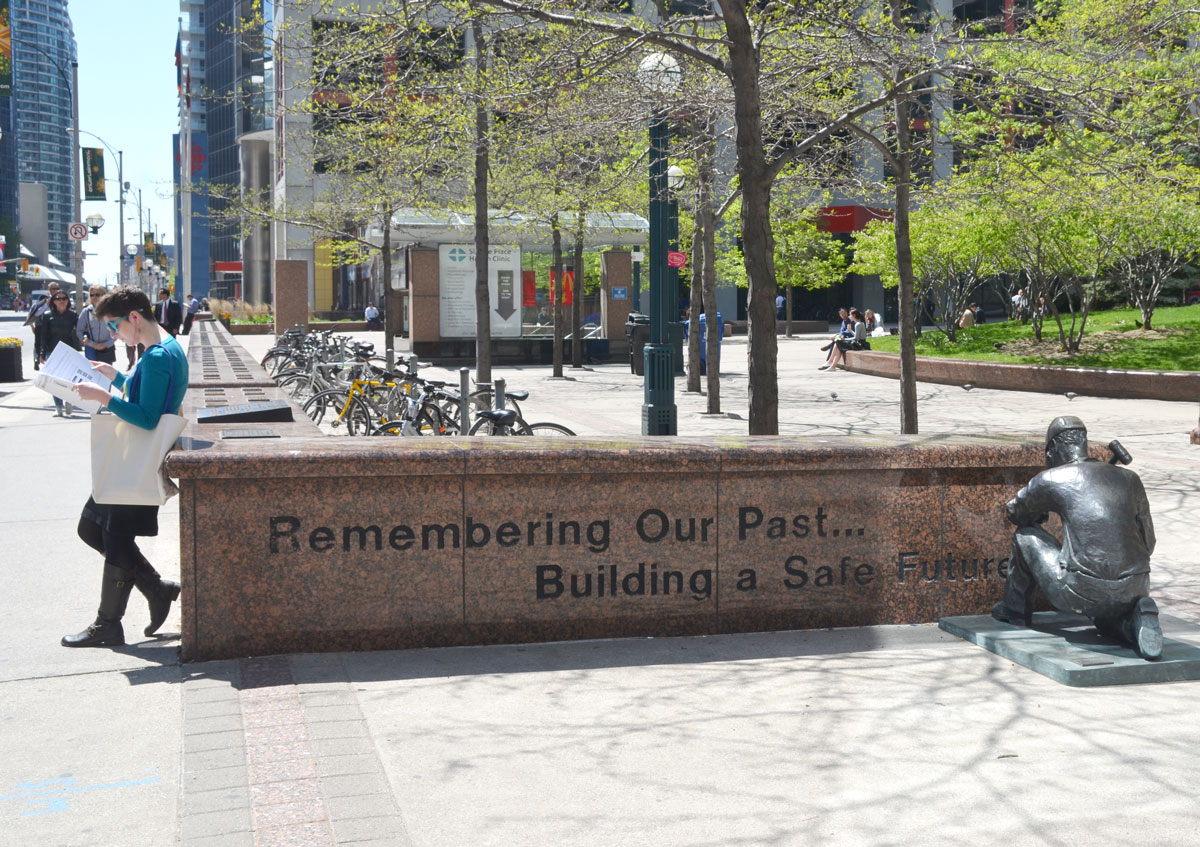
low brown granite wall with large brass lettering on the front that says "100 workers".  Along the top of the wall are plaques with names of people who died in the workplace between 1901 and 1999.  The name, year and cause of death is given on each plaque.

 Along the top of the wall are plaques with names of people who died in the workplace between 1901 and 1999.  The name, year and cause of death is given on each plaque.   View looking down the top of the wall.

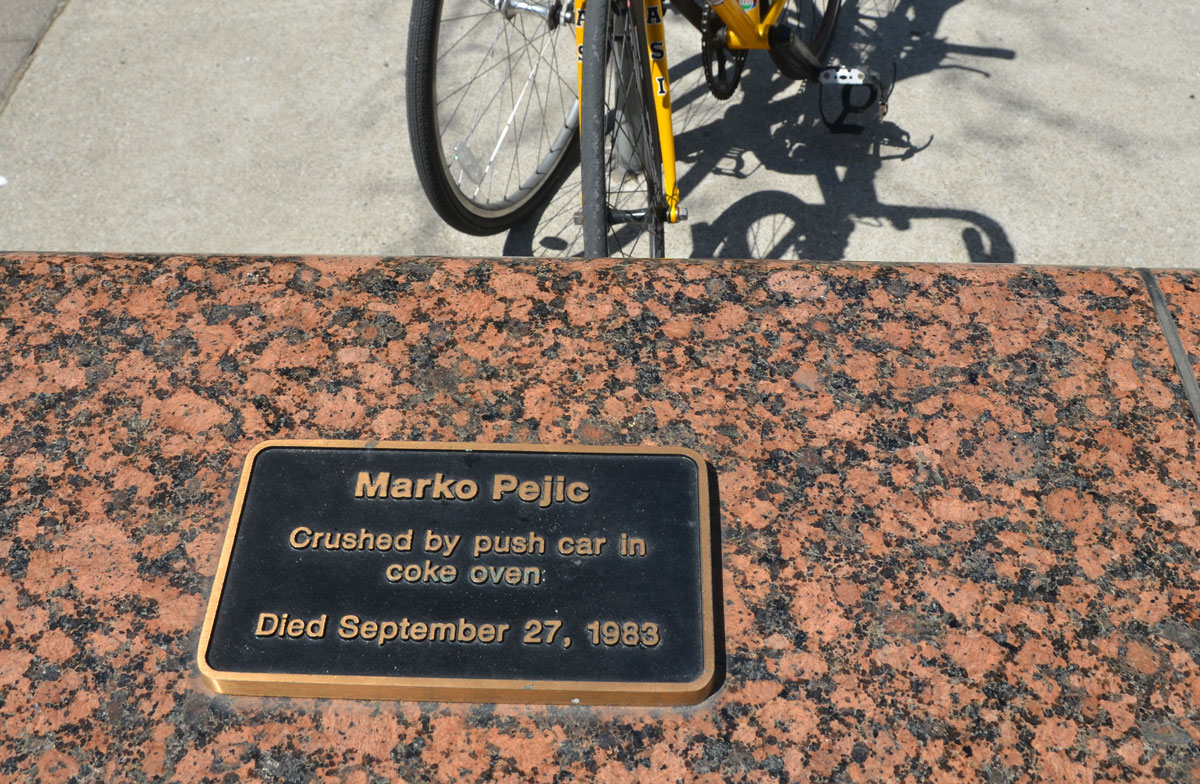
Each plaque on along the top of the wall commemorates one person, one from each year between 1901 and 1999.   Deaths are from mining accidents, industrial accidents, train crashes, silicosis, asbestosis, and the like.   At the end, there is one blank plaque to represent future accidents.

A black and brass plaque commemoration Marko Pejic who died in 1983

A statue of a workman chiseling out the words on a granite wall.

view from the east of the 100 Workers memorial showing one of the half walls with the words" Remembering our past.  Building a safe future."  A lifesize statue of a workman chiseling words into the wall is on the right side of the photo.

The Ontario Fire Fighters Memorial is near the corner of Queens Park Crescent and Grosvenor Street. 

A short wall of black rock has the names of fallen firefighters carved in it.  In the background is the statue of the firefighter and young boy.

The names of fallen fire fighters are engraved on black stone.

.
Statue of a firefighter wearing a gas mask and carrying a young boy is in front of a block of shiny black rock.  In the rock there is a reflection of the statue along with the Ontario flag that is flying nearby.

close up of statue of a firefighter carrying a young boy

Near the corner of Queens Park Crescent and Grosvenor Street is the Ontario Police Memorial.
It was dedicated in May of 2000.

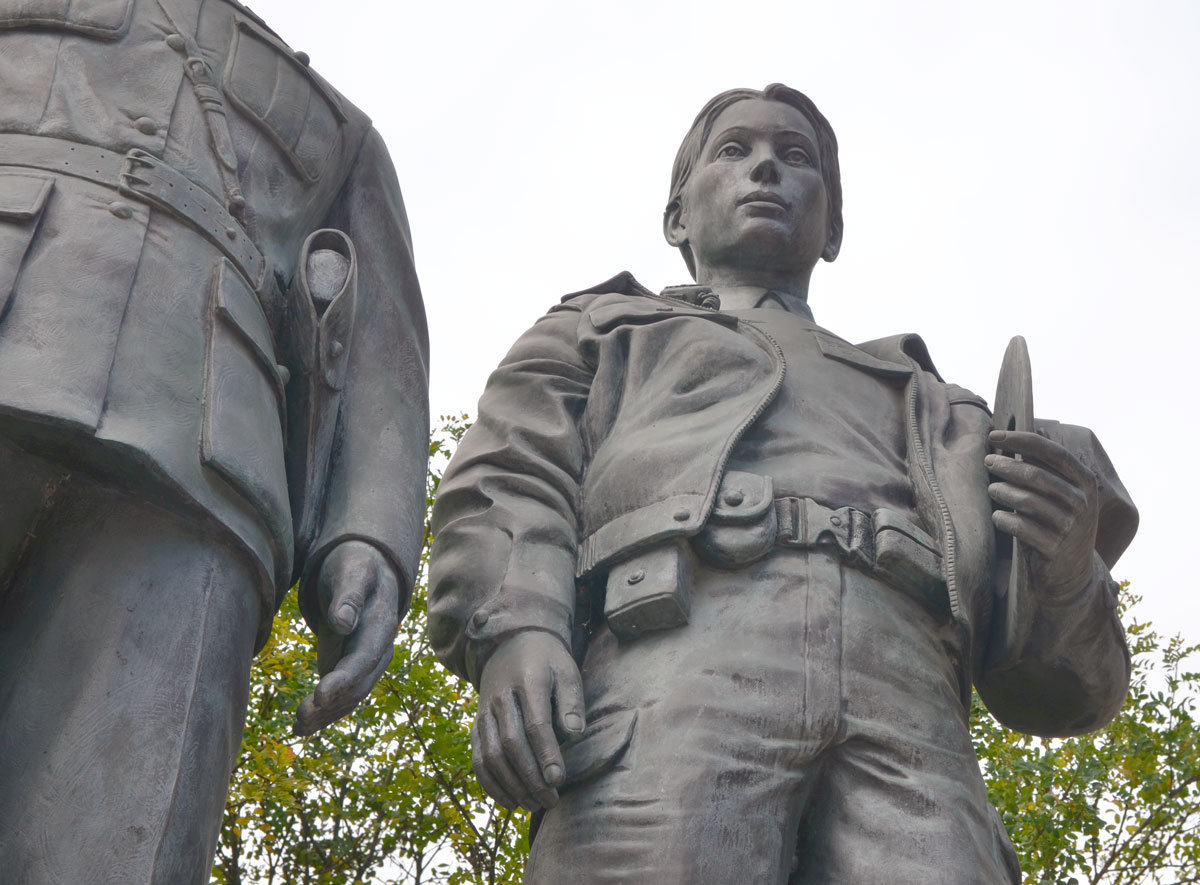
Light grey stone horizontal with 5 panels.  The outer two panels on each side contain the names of the policemen who have died while on duty in Ontatio.  The center section of the stone is the base for two statues - an older and a younger policeman.

The names of fallen Ontario police are carved in the stone at the base of the memorial.

.
The two statues on the police memorial as seen from the side.
.
close up of young police officer (upper body) at the Ontario Police Memorial
.

By the time of Confederation in 1867, one quarter of the population of Canada were of Irish ancestry.  Although the Irish had been immigrating to what is now Canada for a long time, the Irish famine years of 1845 to 1849 saw an increase in the number of immigrants.  Immigration peaked in the summer of 1847;  boatloads of Irish settlers arrived.  Most were very poor and sick.  They landed in a number of places along the St. Lawrence River and Lake Ontario, including Toronto.   Thousands of those Irish immigrants died in Ontario that summer, mostly from typhus (or typhoid fever).

Ireland Park is home to a memorial in honour of those immigrants. It is on the waterfront between Lake Ontario and the old Canada Malting Co. silos.

view of Ireland Park from the waterfront, and looking slightly north east.  A large shape made of limestone is on the left of the photo and a green space is beside it.  The silos of the Canada Malting Company are visible as is part of the Toronto skyline in the distance.

Sections of limestone fit together in a shape that resembles a boat.

Names are engraved on the sides of the limestone sections.  They are placed such that they are in the gaps between the sections.  At first they are not visible.  It is only when you are close to the stone that you can see the names.

Names in black lettering carved into the side of limestone.

675 names are carved in the stone. These are the known names of the 1000 to 1100 people who died shortly after they arrived in Toronto in the summer of 1847.


The park also has seven sculptures by Rowan Gillespie of Dublin Ireland.
The installation is called ‘Arrival’. 

Sculpture of a man with his arms upraised.  He is looking over part of the harbour towards downtown Toronto.

‘The Jubliant Man’ from behind.

close up of one of the sculptures in Ireland Park.  It is a man with his hands clenched in front of him and a worried look on his face.

‘The Apprehensive Man’

 for more information: the Ireland Park Foundation website