Posts Tagged ‘hotel’

The north end of Senlac Road is at Finch Avenue. It runs south through the middle of York Cemetery and the Lansing neighbourhood towards Sheppard Ave.   .

an old wood bench on a patch of grass in front of shrubs and trees

below:  Addington Greenspace (or Addington Greenbelt) is a small park on the west side of Senlac, or rather it is an access point to the city’s ravine system.  In this photo, the trail back up the hill to the street ends by a bus stop.
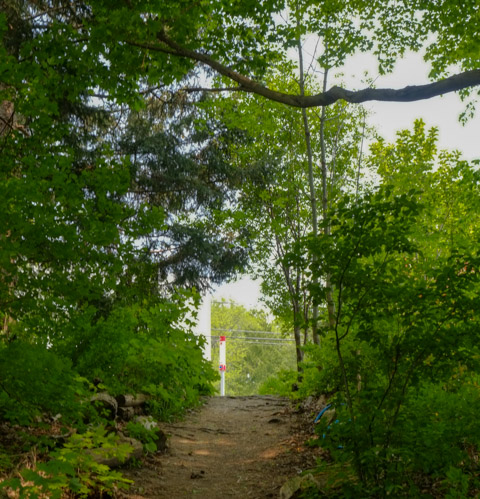
looking uphill along a path through the woods and ravine, Addington, to a TTC bus stop pole at the top of the trail

below: The greenspace follows a creek and passes under Addington Street before it meanders southwestward towards the Don River close  to Sheppard and Bathurst.
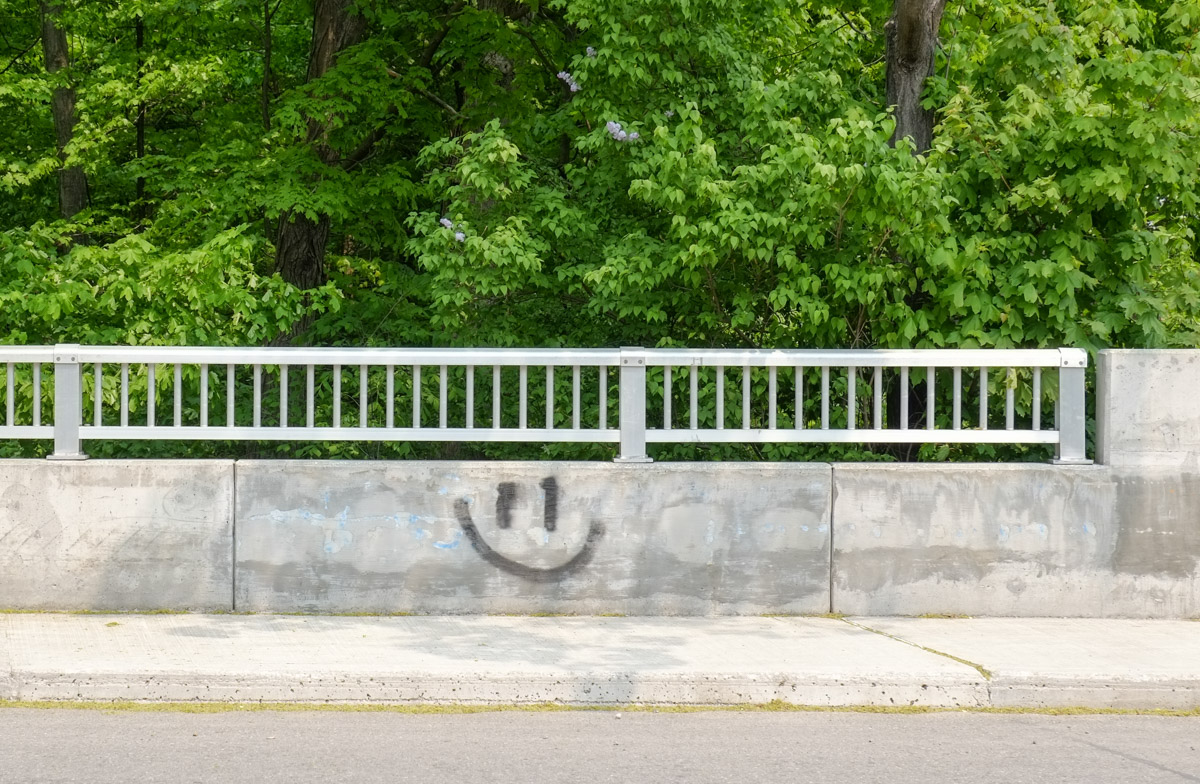
concrete wall on bridge, has a black happy face spray painted on it

below: Protest signs on lawns.  Back in May City Council tried passing a new bylaw that would limit what signs you put on your lawn and how many.  There were more than 30 amendments to the Toronto Municipal Code Chapter 693 (Signs).  Most of them were adopted on the 14th of June except (if I am reading it correctly) for all amendments concerning “advocacy signs”.   The council agenda item history is online.  If you check it out and find that I am wrong, please let me know!

sign beside sidewalk that says stop privitization of public hospitals

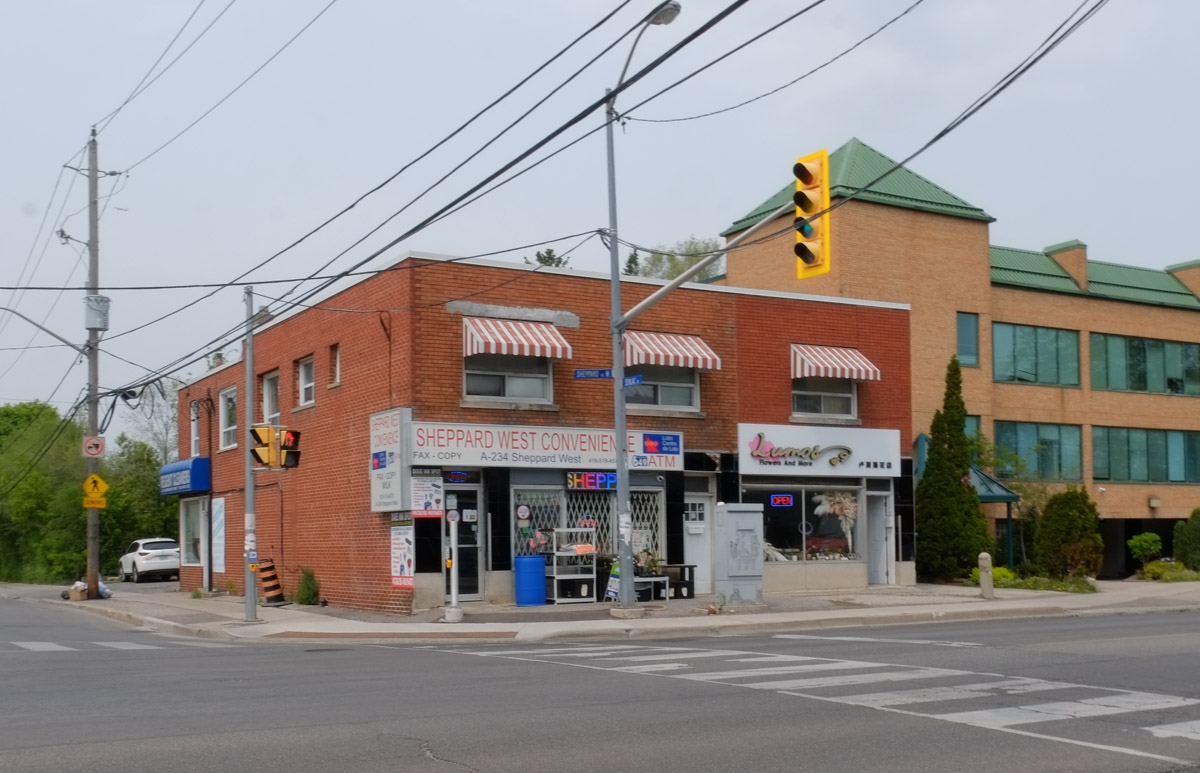
below: Although the main part of Senlac ends at Sheppard, there is a small two block section south of Sheppard slightly to the west.
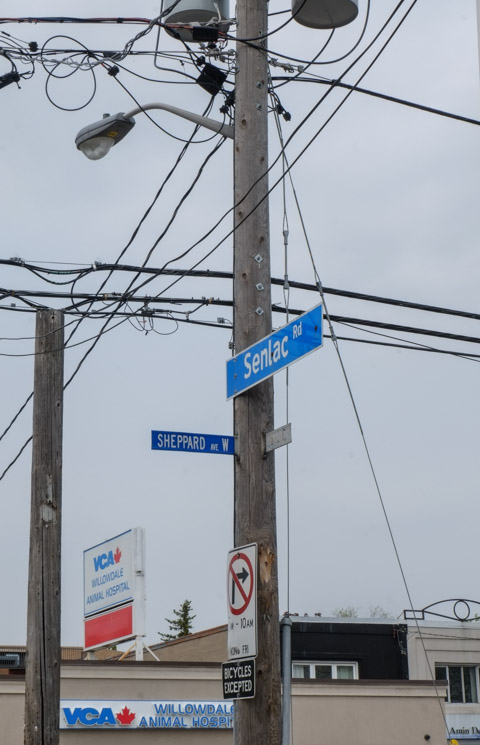
utility poles and hydro wires, street signs for senlac and sheppard avenue

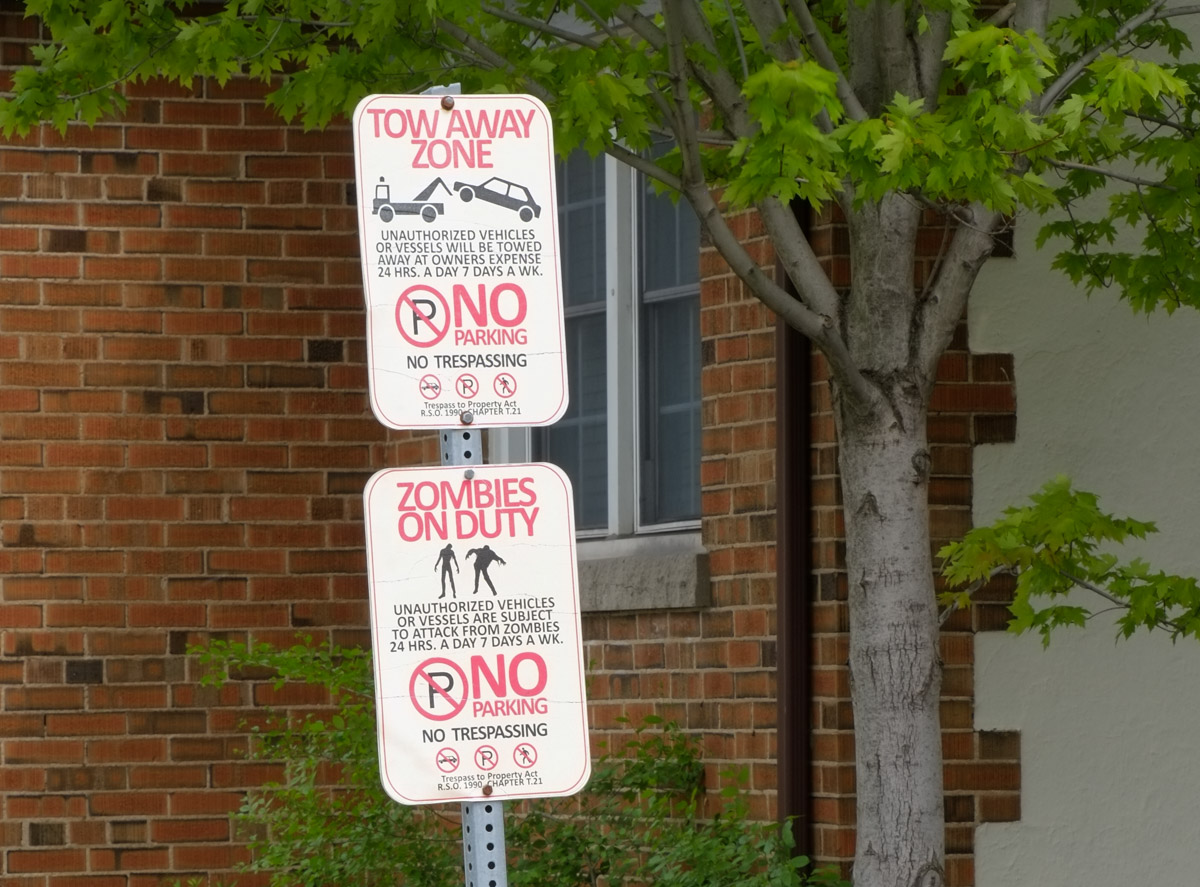
below: Beware of the zombies!!

no parking signs, one says zombies on duty


low rise brick building

below: Most of the area is residential – 1950s and 60s suburbia.
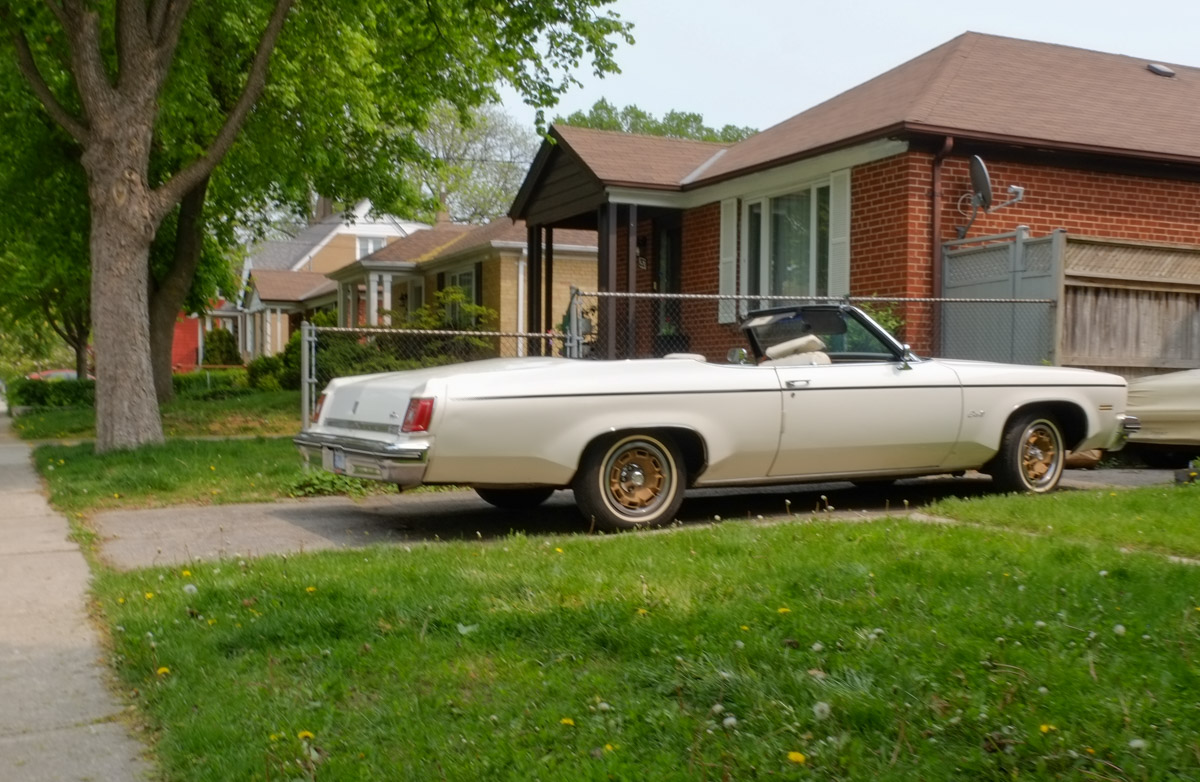
old white convertible with top down parked in driveway in front of a house

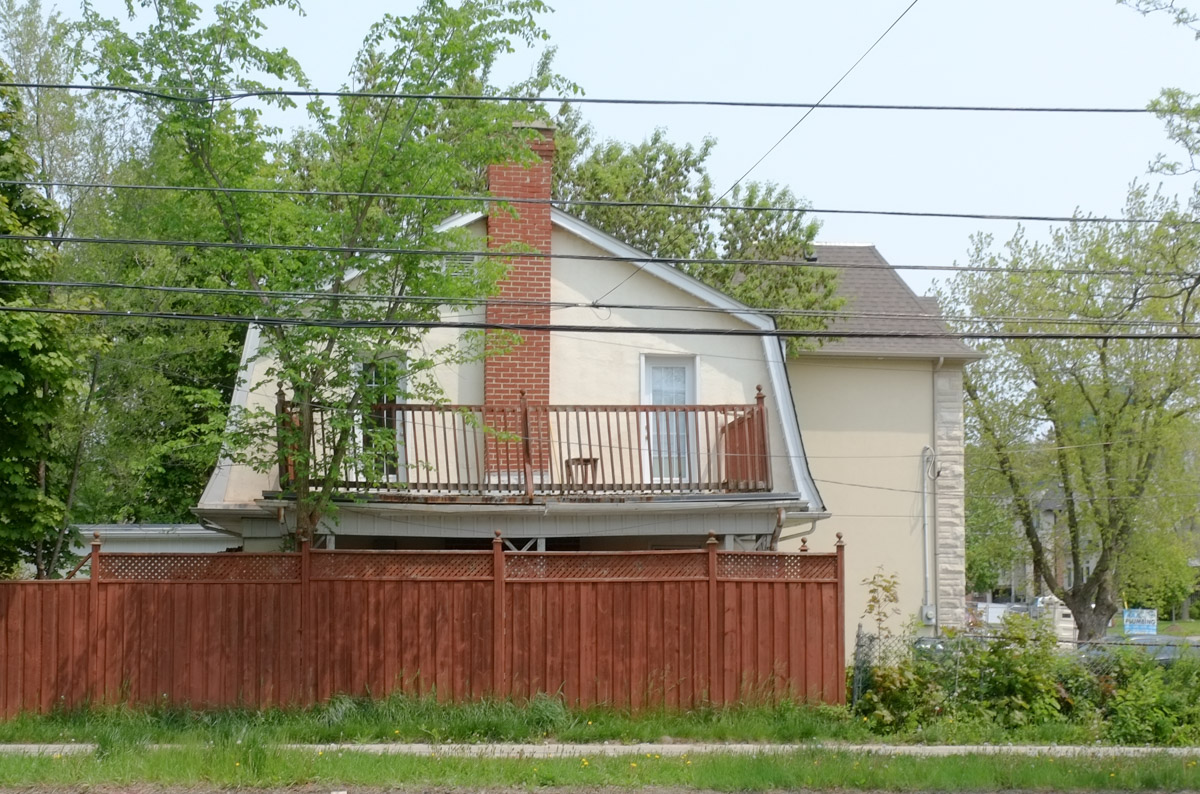
side view of a house, wood fence in front of it, roofline is barn shaped

lots of plants growing in blue and grey pots in front of the porch and beside stairs of a house

pink lilac bush in full bloom, by a wood fence

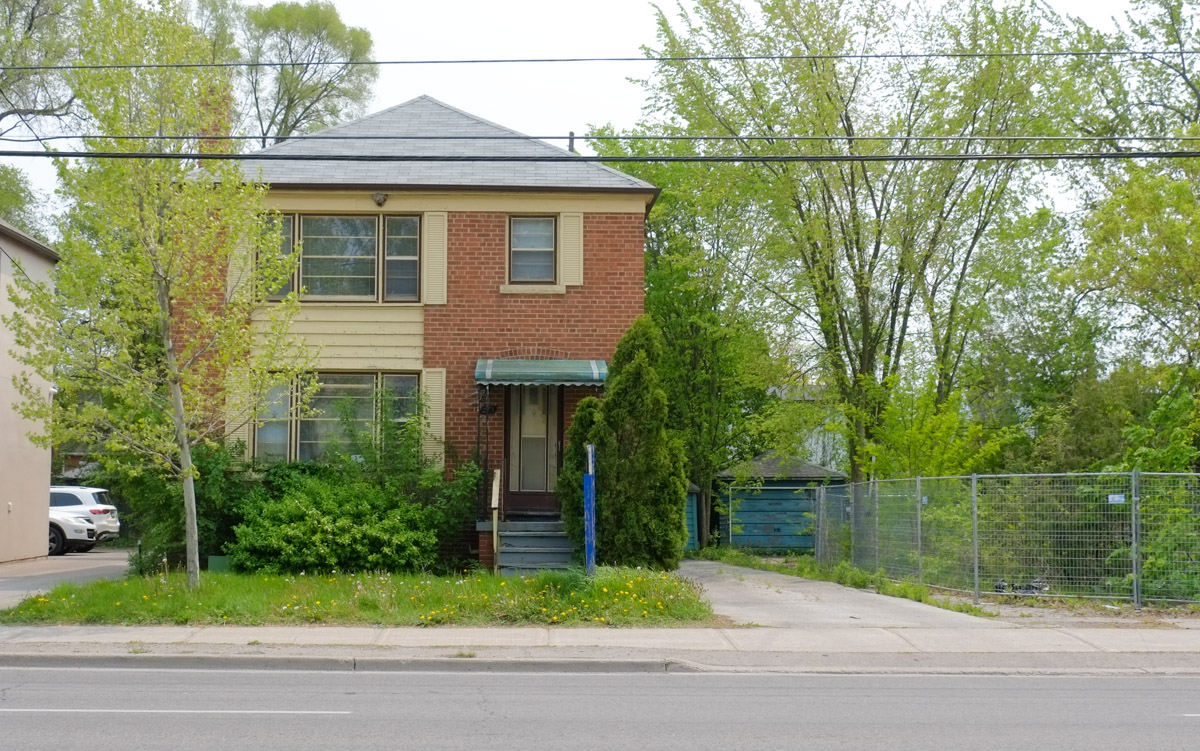
2 storey brick house on sheppard aveune, beside a vacant lot

old red car in driveway of a house

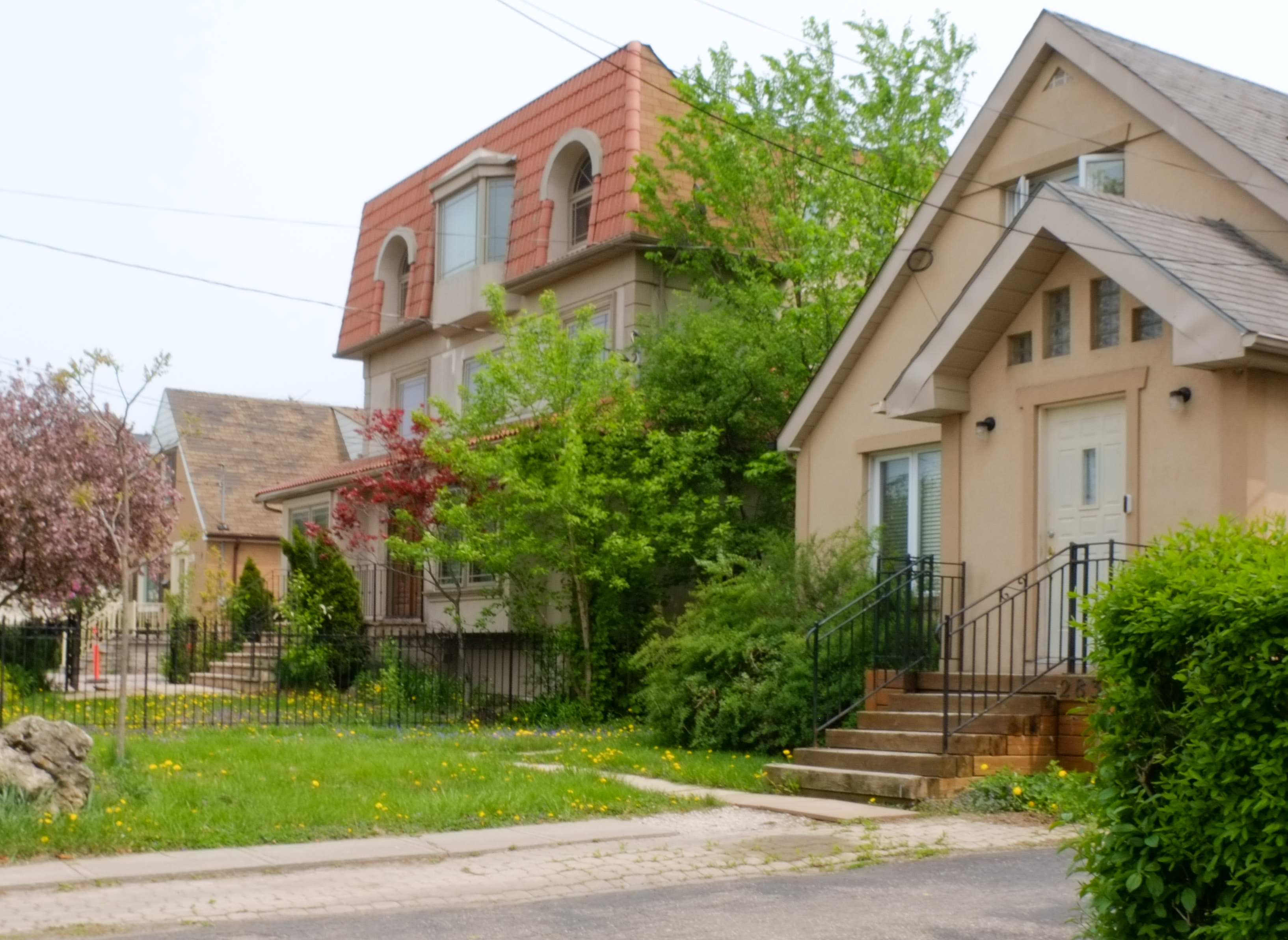
below: Like all older neighbourhoods in Toronto, many smaller houses are being upsized.
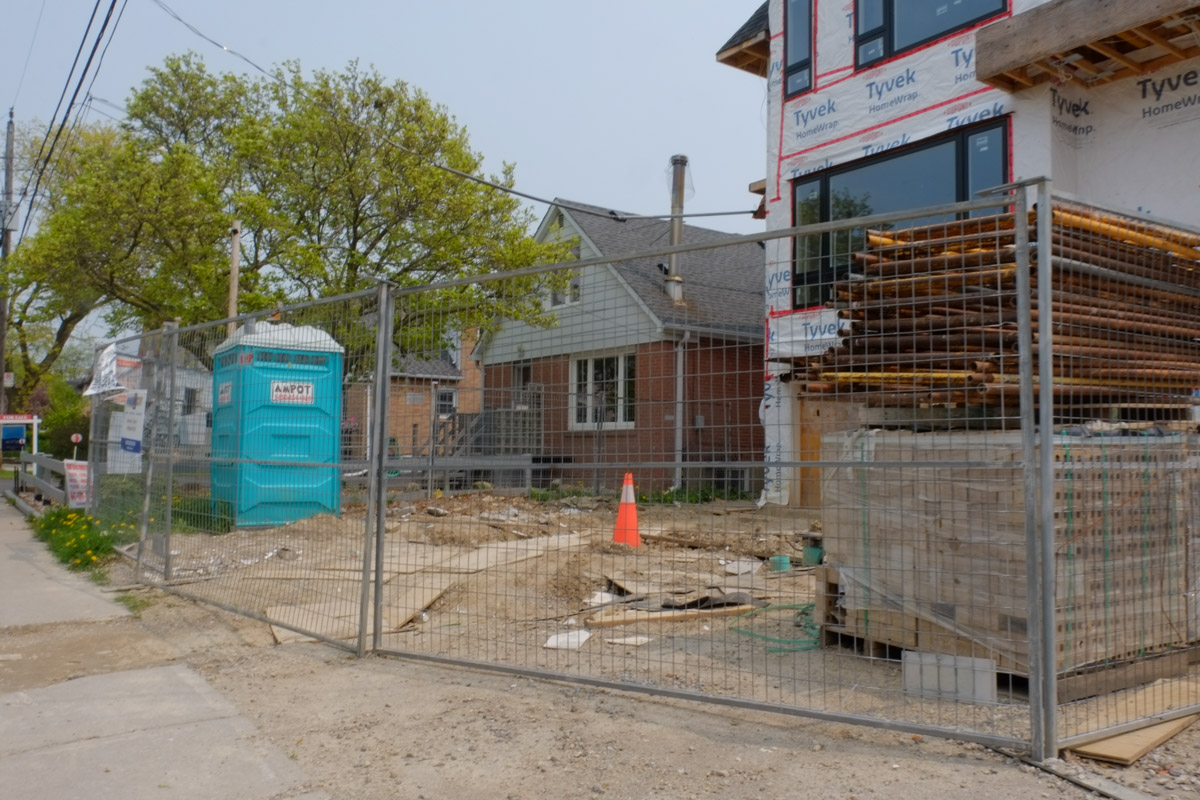
renovation and enlargement of a house, smaller older house beside

2 houses on a residential street

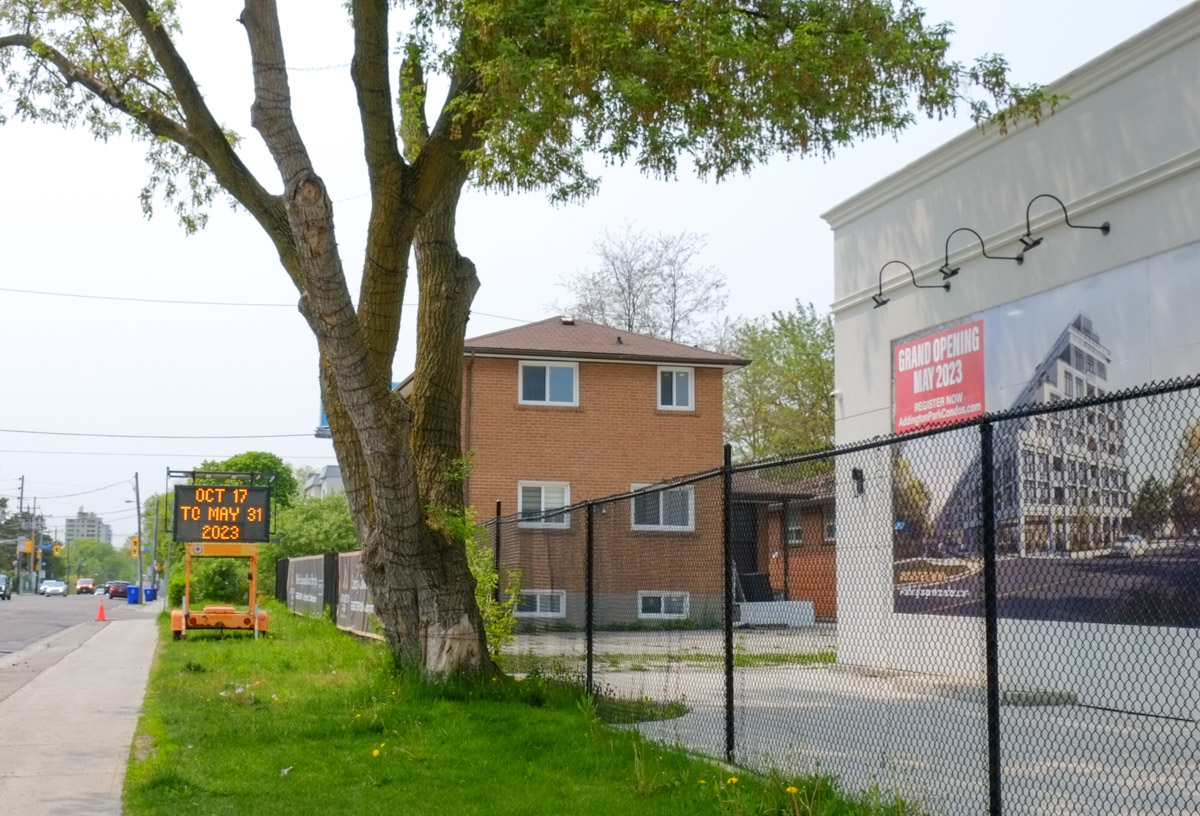
…. or torn down and redeveloped totally.
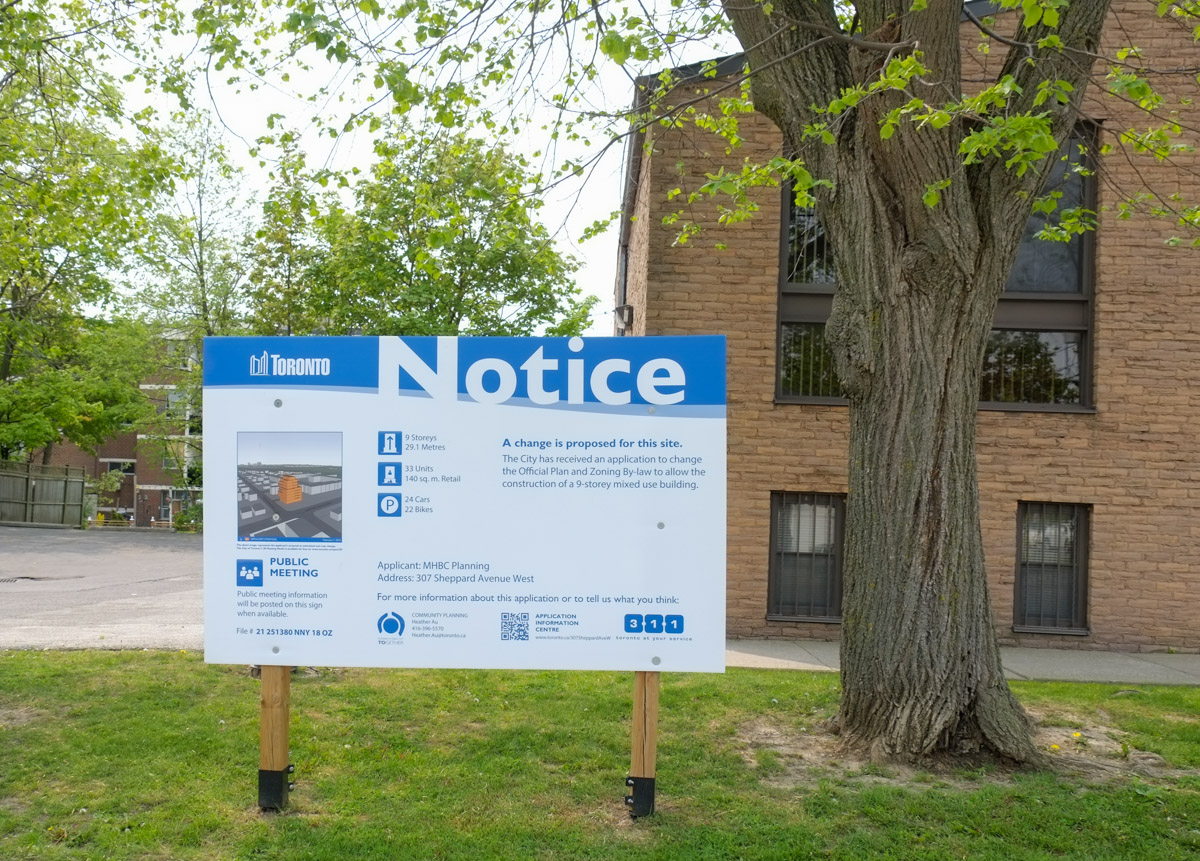
blue and white city of toronto development notice

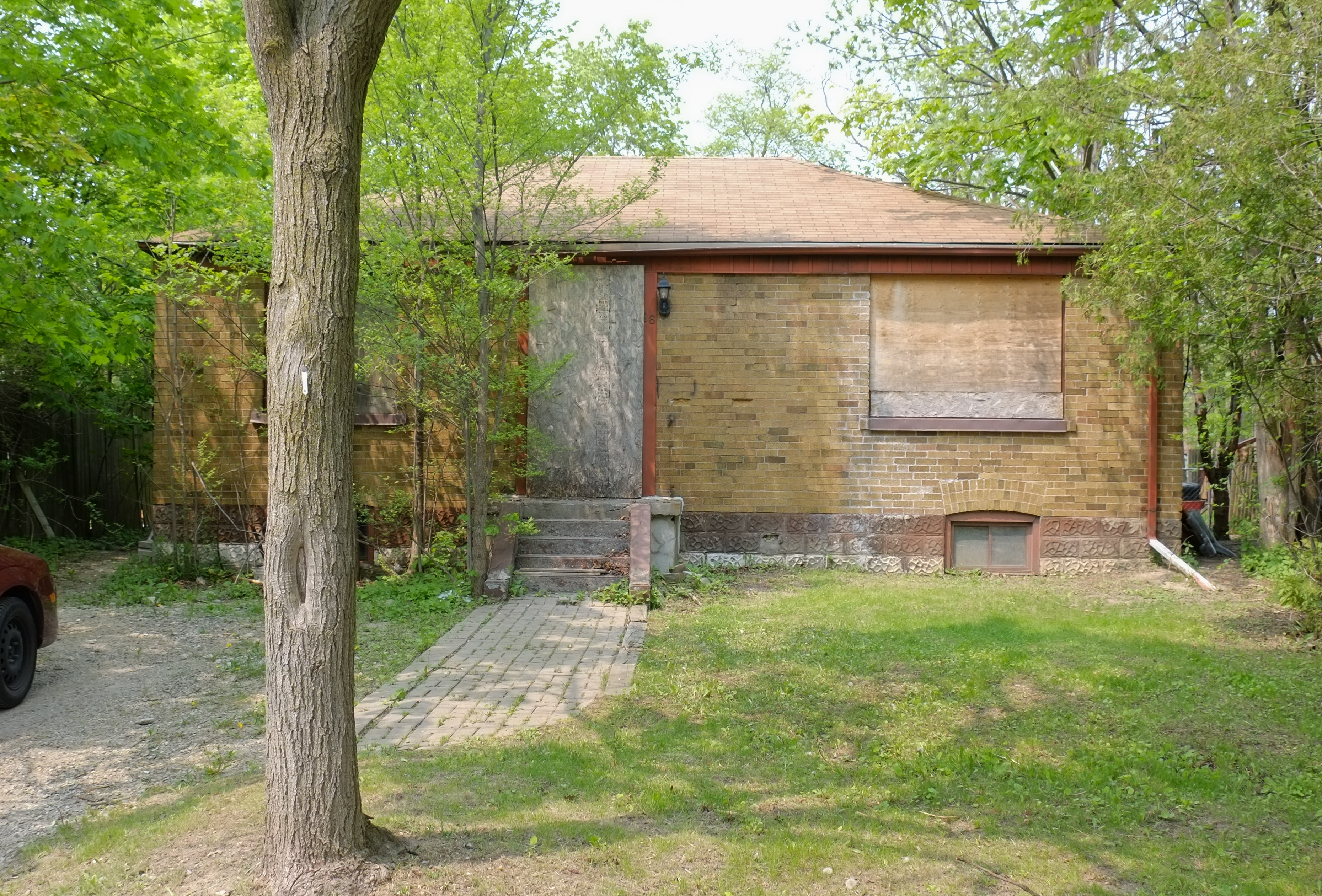
below: An empty house.  As I was taking these pictures, a woman passing by remarked that they had been empty for seven years.  I hadn’t meant for this walk to turn into yet another redevelopment story but even here there are blue white signs along with boarded up buildings.

front porch and front door of old brick house now empty

below: This development dates from 2016.  It proposes townhouses along Sheppard but 5 multistorey (11-25 storeys) buildings behind.  Part of the reason for the delay is that the project also involves tearing down existing rental accommodation.  In June 2022 the City Planning Division recommended that City Council approve the Rental Housing Demolition application that accompanies this development.  It is 14 pages long but if you are interested in what happens when developers want to tear down rental units, click on this City of Toronto link
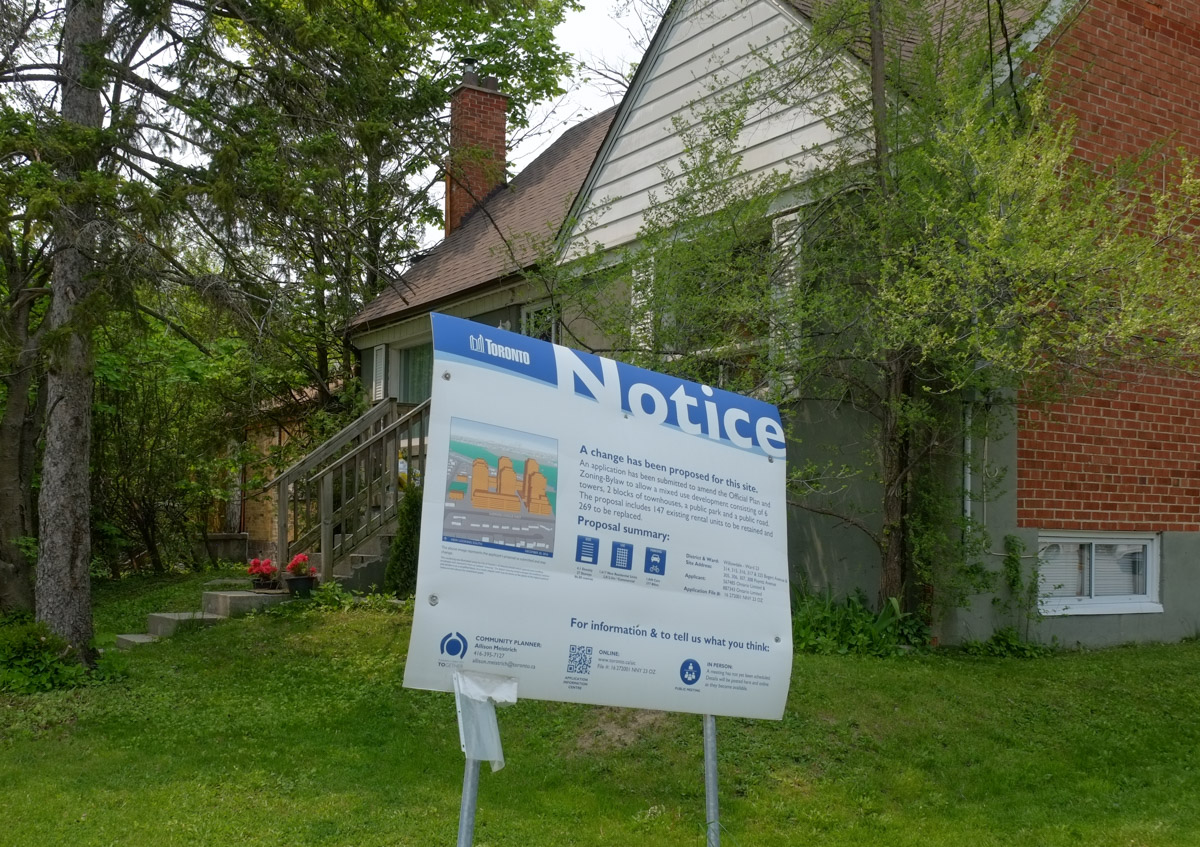
blue and white development notice in front yard of a house

below: Hiding behind a massive shrub, both a house and a development notice
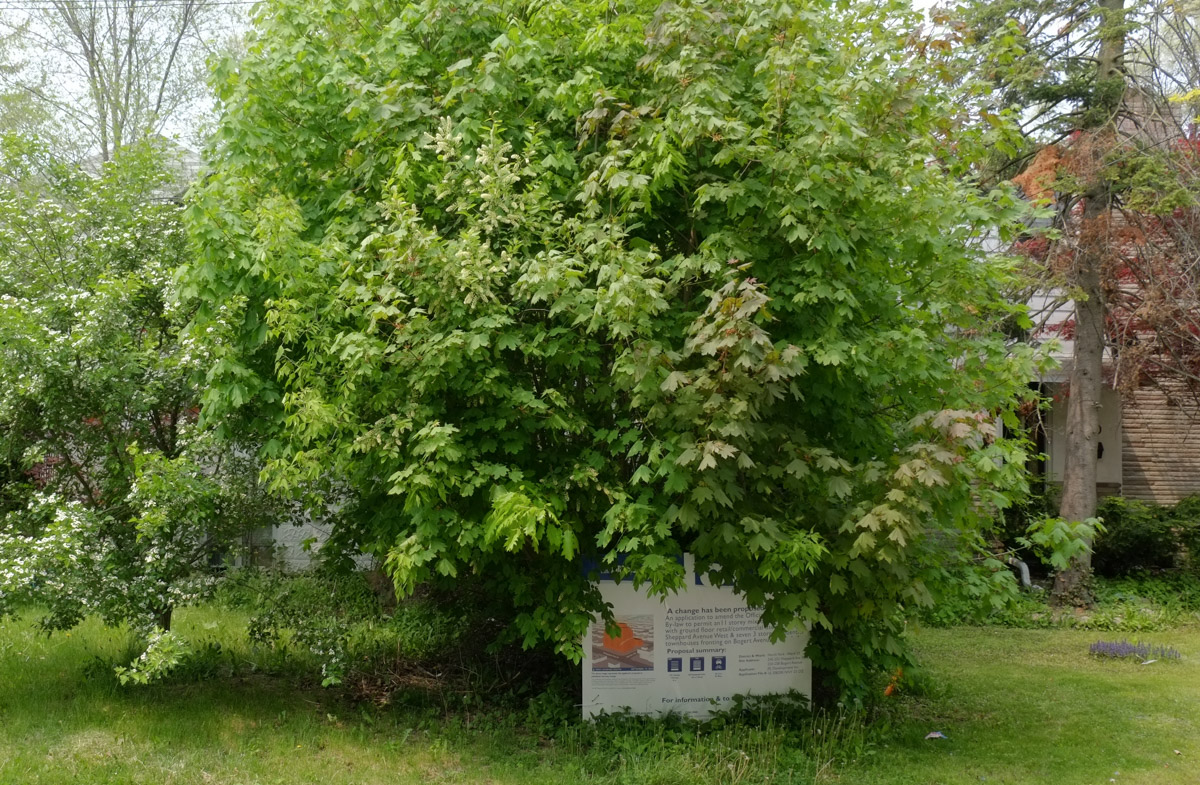
a large green shrub obscures a house that is awaiting demolition

boarded up doors and window of an empty brick house, wood porch has rotted away

old brick bungalow with boarded up windows and door

small brick house with boarded up windows

below: This bungalow is actually on Sheppard West.  The proposal here is not for a condo, but for a 38 room hotel (in 6 storeys).

small brick bungalow with development notice in the front yard

below: Also Sheppard West.

black metal construction fence around a building site

mm

Along Dundas St. West between Islington and Kipling there are a series of more than twenty murals that depict scenes from the history of the area. 

In 1793, Simcoe’s Queen’s Rangers cut a route through the forest for Dundas Street.  It was meant to serve both as a military route in case of war with the U.S. and as a route to increase settlement in the area.   Settlement of what became the village of Islington began a few years later with the arrival of the Johnston family in 1808.

The first mural was a picture of the Methodist church painted on plywood.  It no longer exists.

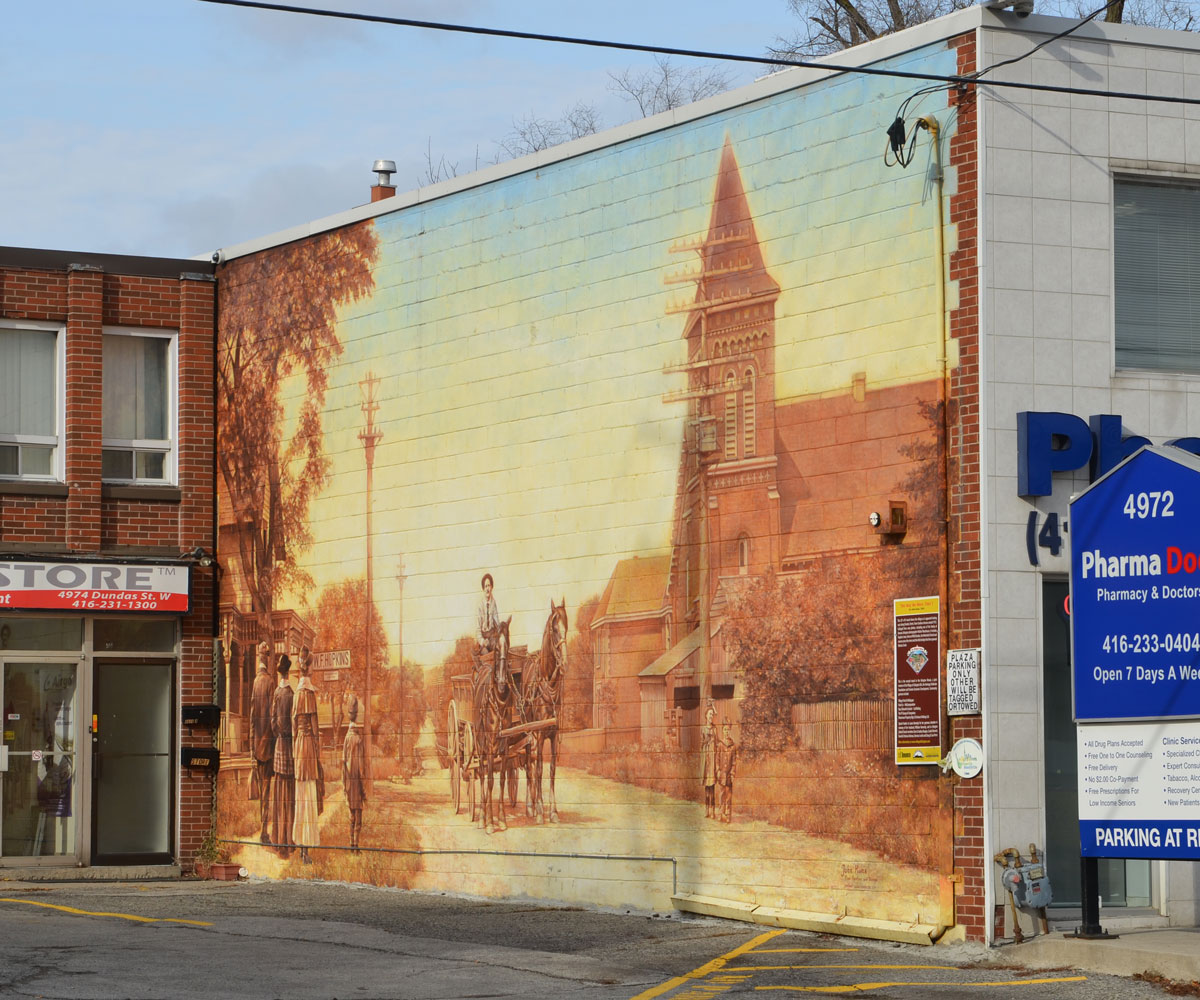
mural 2 – The Way We Were, part 1 by John Kuna, 2005.
Looking east along Dundas St. towards Cordova Ave in 1912.  It includes Hopkins store and the Methodist church.

large mural on the side of a building that shows people in old fashioned clothes walking down a street.  A man in a horse drawn wagon is coming down the street.

part of a large mural on the side of a building that shows people in old fashioned clothes walking down a street.  A man in a horse drawn wagon is coming down the street.

mural 3 – They Way We Were part 2, 1912, by John Kuna, 2006.
Because of the car that was parked next to it, I don’t have a good photo of the whole mural.

a mural showing a group of men in clothing from the 1930s shoveling in the dirt.

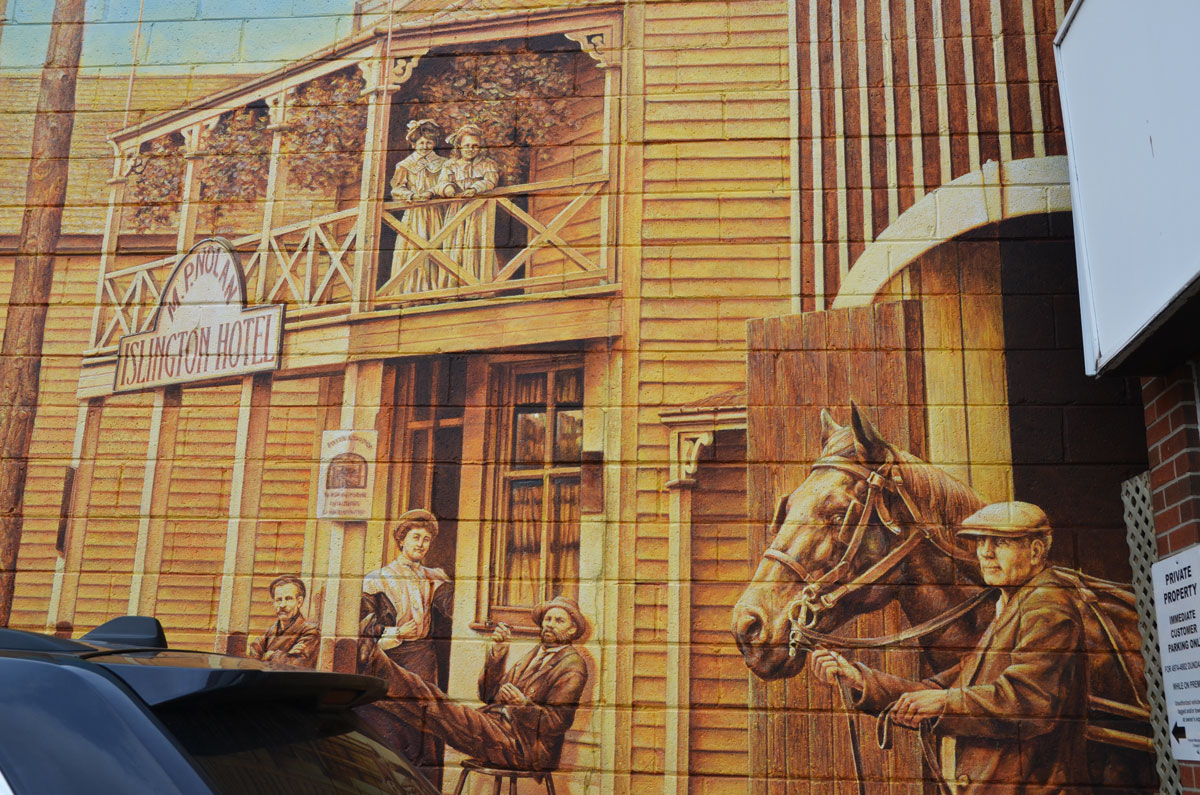
part of a mural, a man leading a horse out of the stables, the Islington Hotel behind.  Two ladies are standing on the balcony of the second floor of the hotel.  A man is reclining on a chair on the front porch of the hotel.

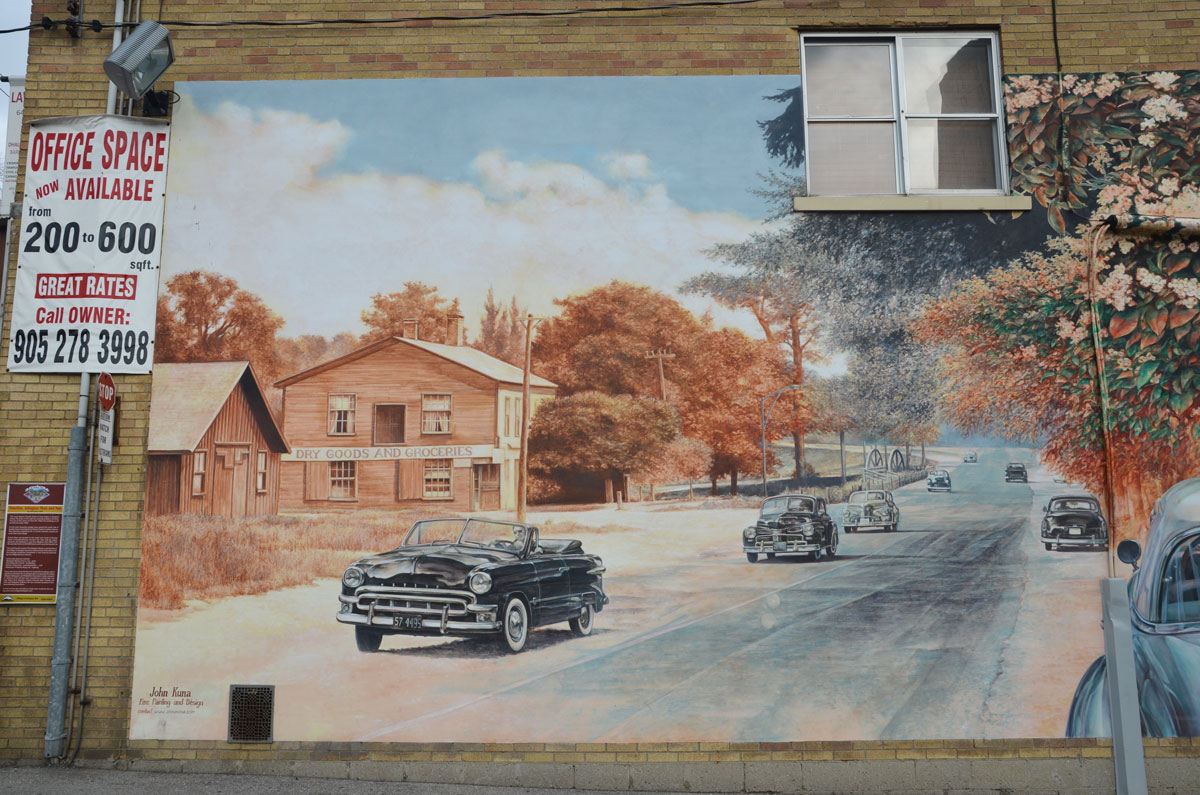
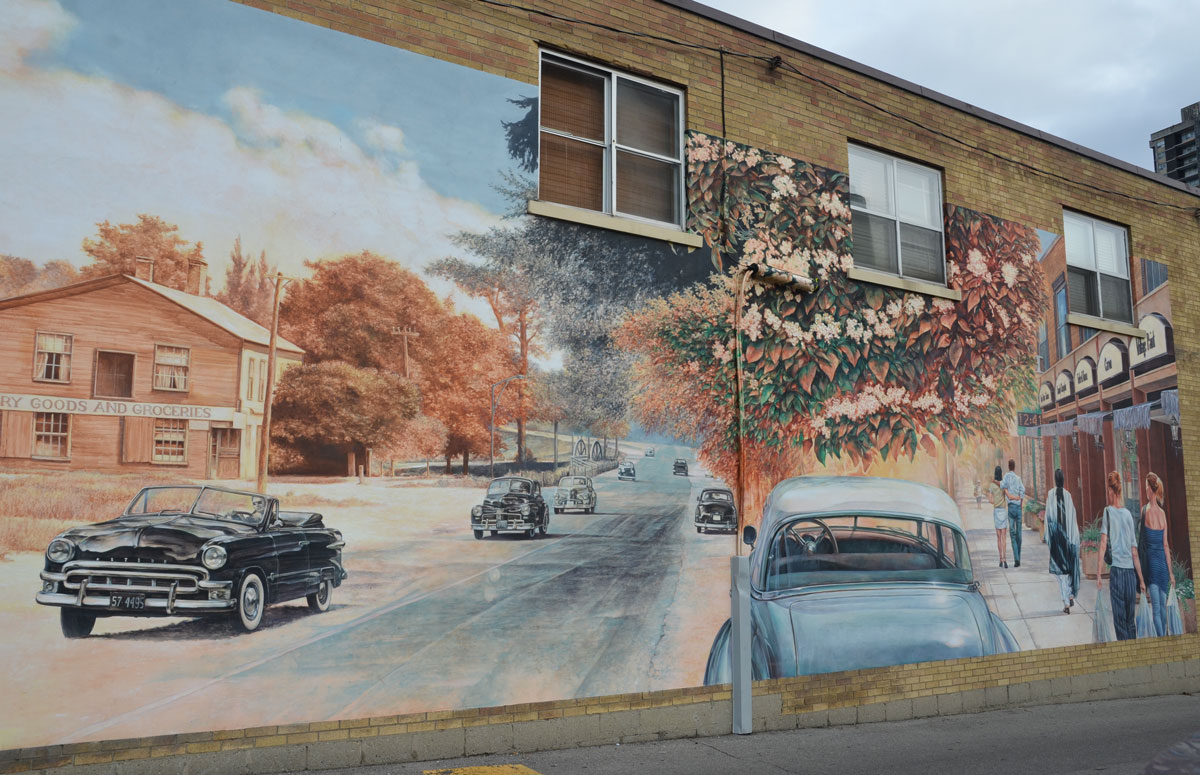
mural 4 – Timeline: Islington Then and Now, by John Kuna, 2006.
Showing Dunn’s store (NE corner of Dundas & Burnhamthorpe Cres) as well as the flowering catalpa trees that used to line the street (on the right in the picture)

part of a mural depicting the main street of town as it was in the 40s and as it was in 2006.  cars, street, people shopping,

blog_islington_here_right

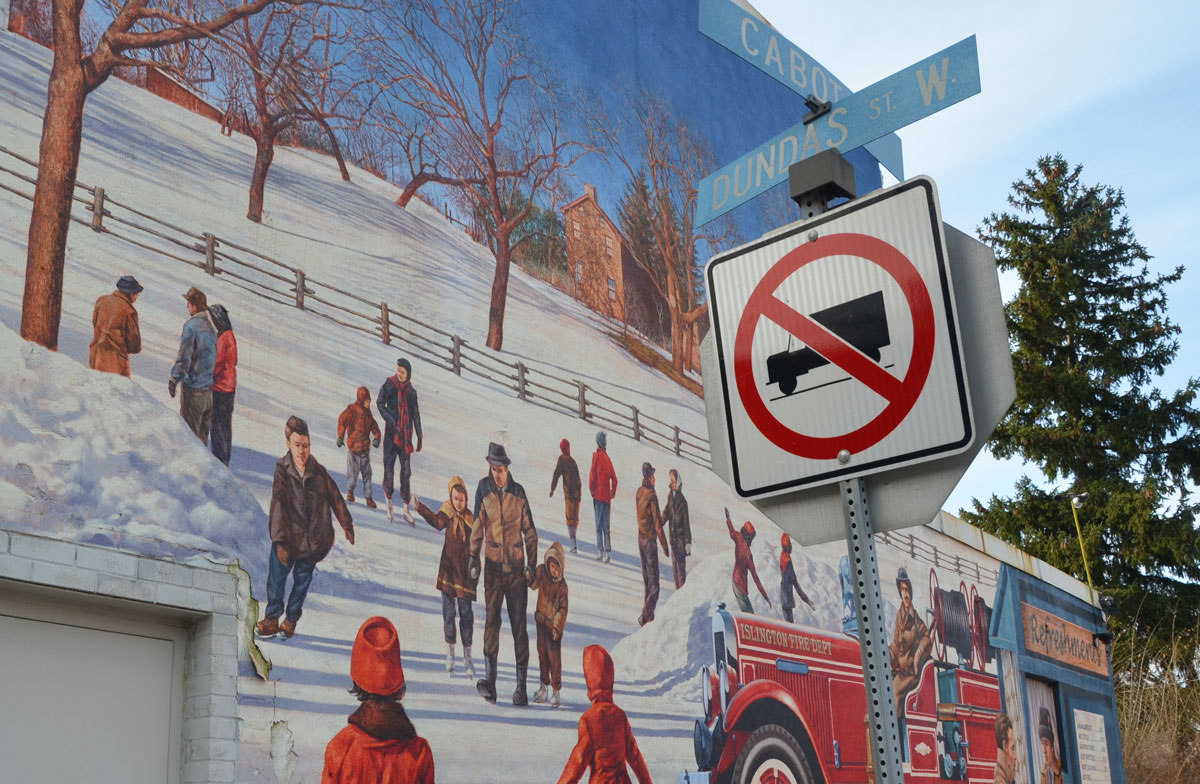
mural 5 — Honouring Islington’s Volunteer Fire Brigade, by John Kuna, 2007. 
Islington had its first motorized fire truck in 1931.  In the 1940s and 1950s the volunteer firefighters would use water from the Mimico creek to flood part of Central Park, on the west side of the creek, to create a skating rink.

looking across the street at a mural on the side of white brick building, a winter scene, some people are skating, lots of bright red jackets, there is also an old fashioned fire engine with firefighters sitting in it.  At the right edge of the picture is a small wood hut with a sign that says Refreshments on it.

close up of a mural showing people skating on a frozen pond in the winter.  In the foreground is a traffic sign that says no trucks, also blue street signs for Cabot St. and Dundas Street West

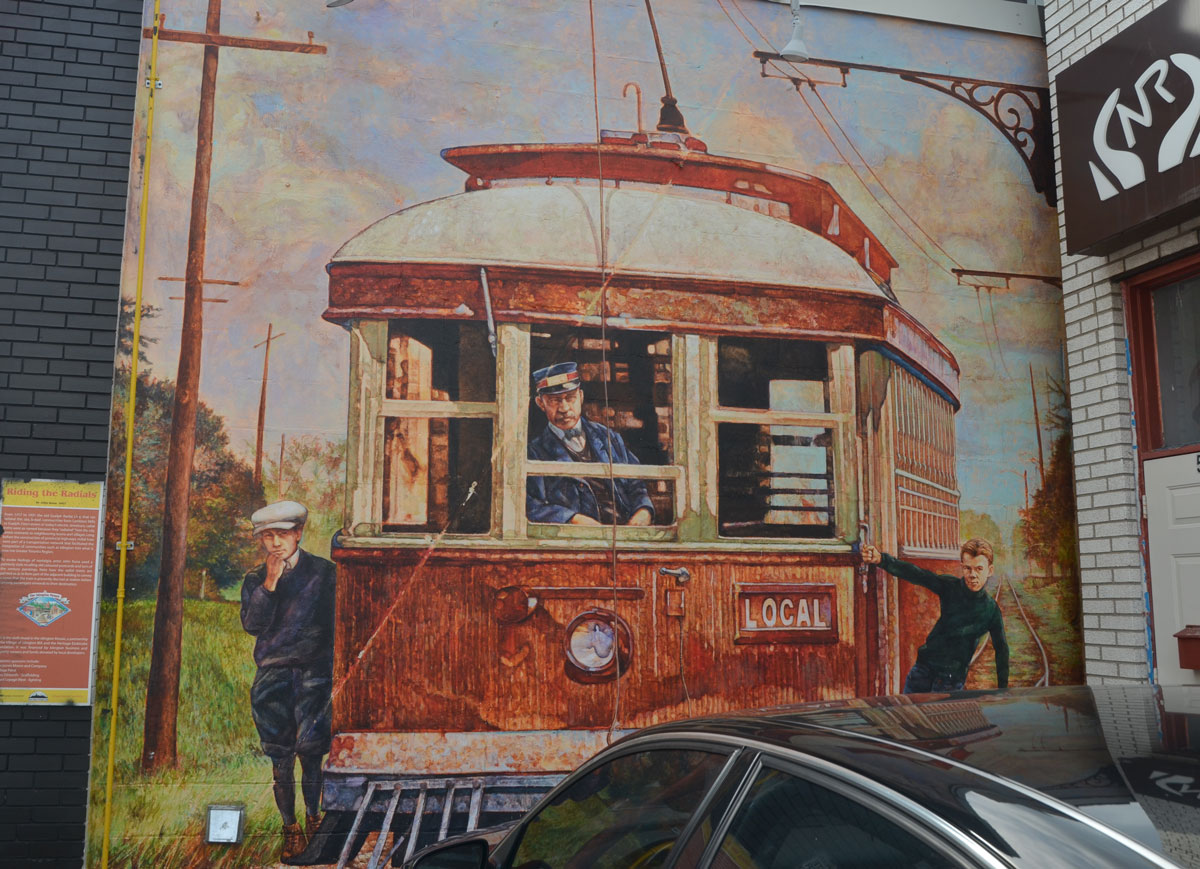
mural 6 – Riding the Radials, by John Kuna, 2007.
From 1917 to 1931 the old Guelph Radial Line (or Toronto Suburban Railway) ran close by this site.  It was an electric rail line between Toronto and Guelph.

A mural showing the front of an old electric train car with the conductor sitting in front.  Two boys are hanging out the doors, one on each side of the train car.

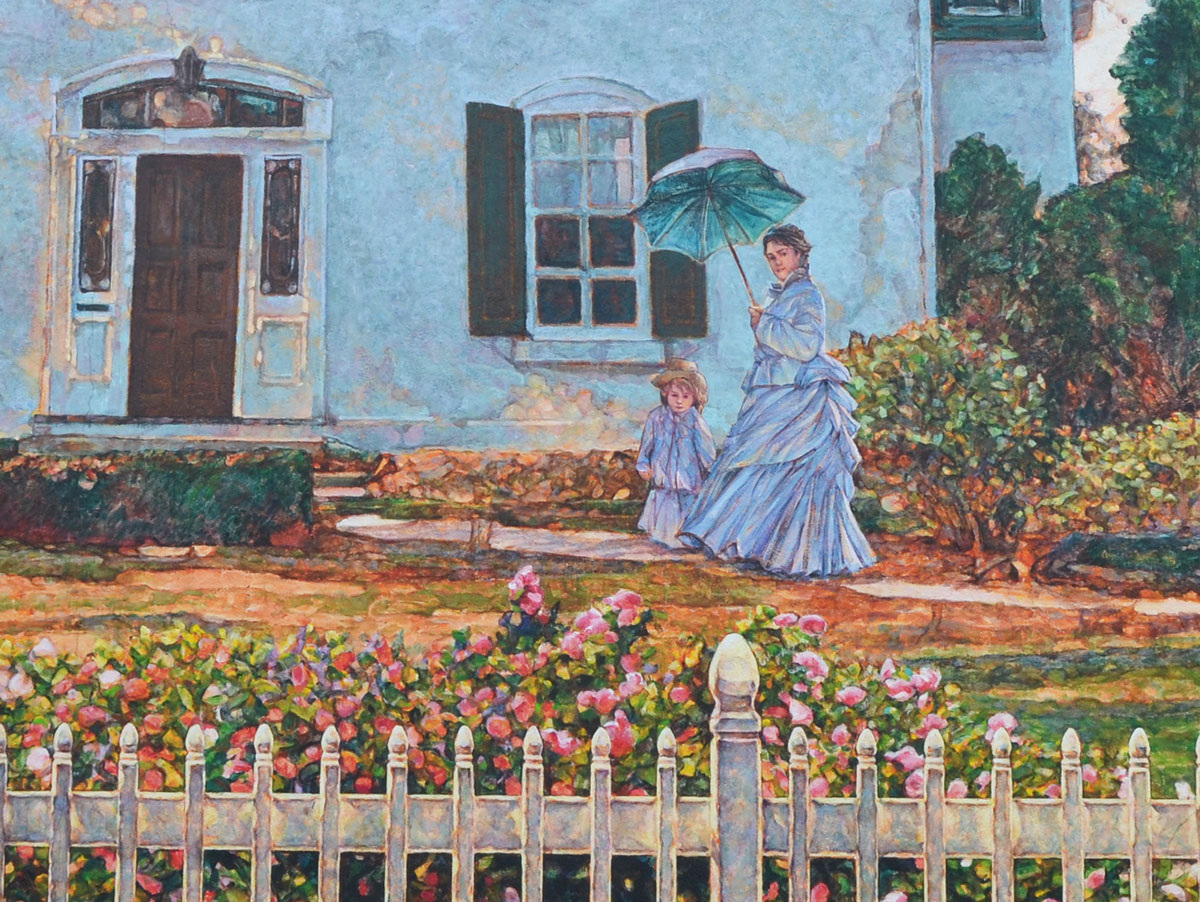
mural 7 – Briarly, Gone but not Forgotten, by John Kune, 2007.
Briarly, also known as Gunn House was built in 1840s. From 1870 to 1985 it was owned by the Montgomery family and their descendents.

mural 7 - Briarly, Gone but not Forgotten, by John Kune, 2007.  Briarly, also known as Gunn House was built in 1840s.  From 1870 to 1985 it was owned by the Montgomery family and their descendents.

A woman and a girl in long light blue dresses are walking in front of a house.  The woman is carrying a blue parasol.  There is a white picket fence and flowering shrubs in the foreground of the picture.

mural 9 – Harold G. Shipp’s Firt High Flier, by John Kuna, 2008.
The story behind this mural: “In 1944 Harold Shipp convinced a Lancaster bomber pilot who ferried supplies from Toronto to England during the war, to fly over the school’s football field and drop hundreds of leaflets, a few of which could be traded for tickets to the school dance. Unfortunately, a rogue wind scattered the leaflets across the Chinese market gardens near Montgomery’s Inn. In the ensuing mayhem, excited football fans frantic to secure a winning ticket, stormed the field and trampled the carefully tended cabbages”

mural showing men playing football in the 1920s, with a low flying airplane overhead.

mural showing men playing football in the 1920s, with a low flying airplane overhead, as seen from an angle - form this perspective you can see that the mural is actually two pictures.

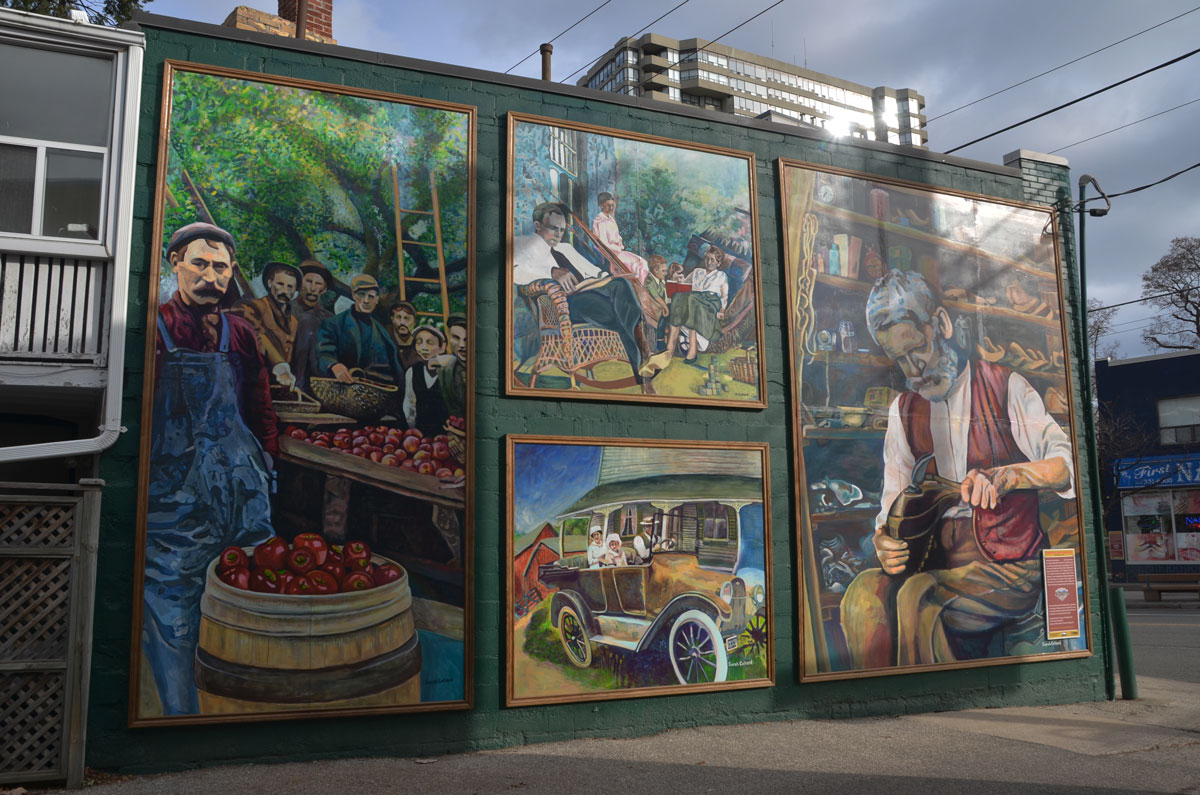
mural 10 – Portraits from our Past by Sarah Collard, 2008.
Inspired by pictures taken in the early 1900’s. “These include: Apple Packers at Bigham family orchards, Rathburn and Martingrove ~1917; Sunday Afternoon, a scene showing the family of famous Islington photographer Walter Moorhouse on their veranda at 34 MacPherson Ave. (now Aberfoyle); Islington’s First Car, a 1917 Chevrolet owned by the Appleby family; and the Village Shoemaker, Mr. Nelson in the 20th century.”

mural in 4 parts, 1 on the left, 1 on the right and 2 in the center.  The left depicts a man selling apples, the right depicts a cobbler fixing shoes.  In the center: bottom, a family in old fashioned car.  Center top - a family sitting in a livingroom including a man in a rocking chair

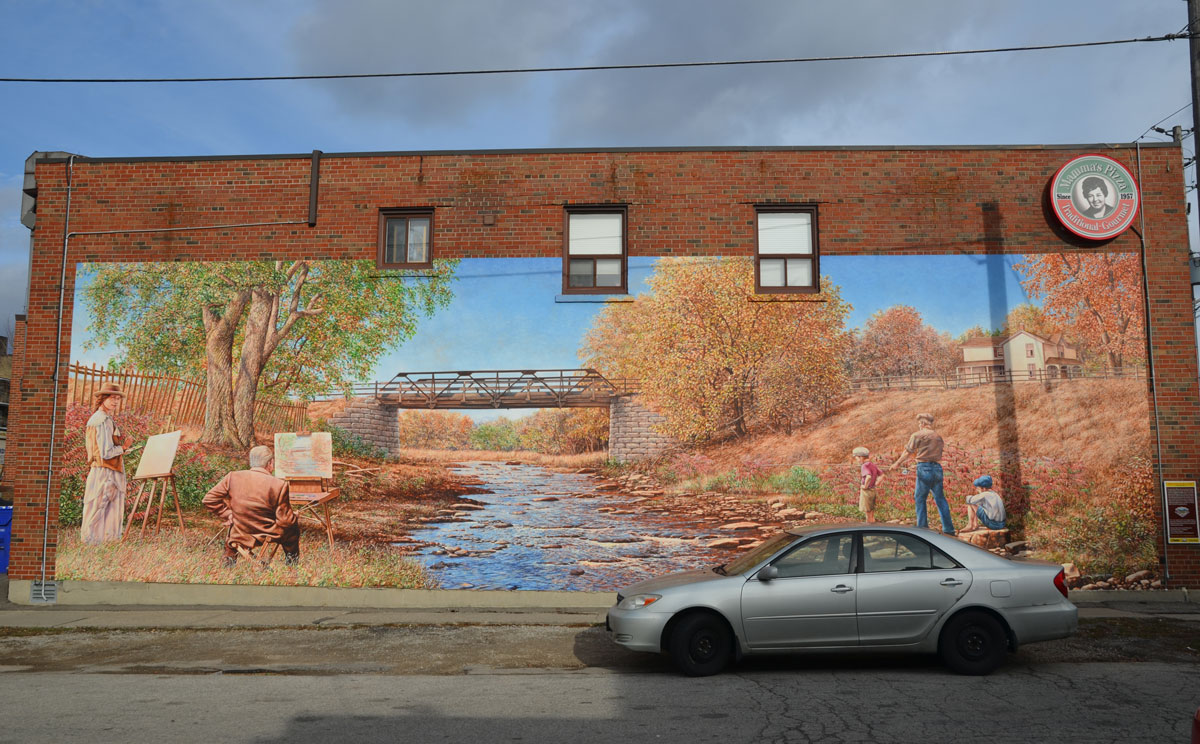
mural 11 – Mimico Creek in Fall, ca 1920, by John Kuna, 2008.
Looking north towards the Dundas Street bridge.

A large mural of a creek.  On the left back are two painters with their easels set up beside the river.  On the right bank are two boys and a man

Gordon’s Dairy, by John Kuna, 2008.

A mural on the front of the Islington Senior's Centre showing dairy carts.

mural 13 – The Old Swimming Hole by June Kuna, 2009.
Swimmers at the mill pond.

large mural of people swimming in a creek in bathing costumes from the 1920s

closer view of part of the mural of people swimming in a creek.  In this part of the picture, kids are climbing on a water wheel.  The mural is reflected in the window of the store next to it.

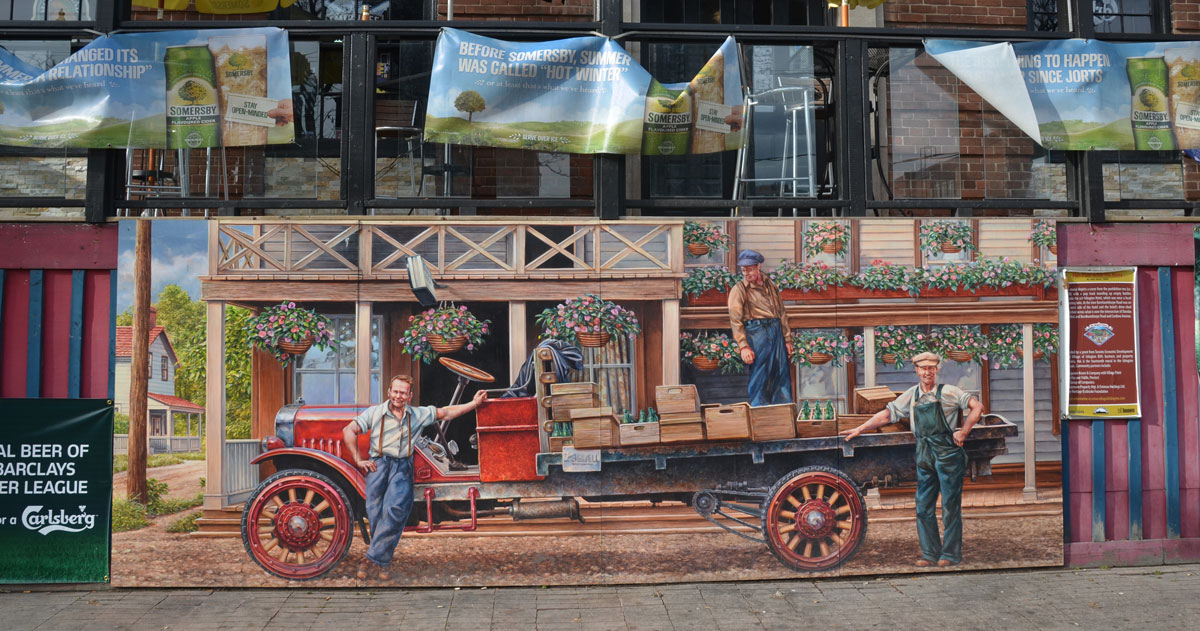
mural 14 – The Pub with no Beer, by June Kuna, 2009. 
A scene from the Prohibition Era in the late 1920’s.   Men collecting empty pop bottles from outside the Islington Hotel.

mural showing men loading an old flat bed truck with crates of empty pop bottles, 1920s

Fox and Fiddle bar, a two storey brick building,

mural 15, Faith of Our Fathers, part 2, by John Kuna

mural showing the building of a chirch

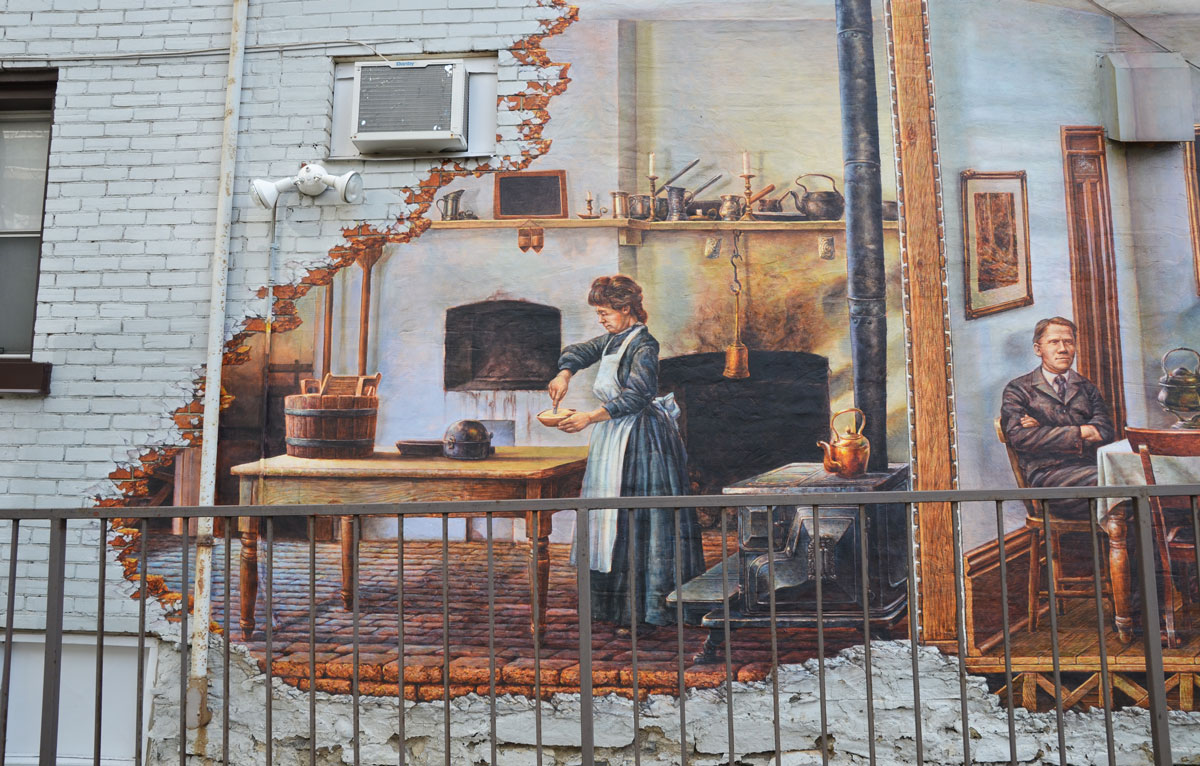
mural 16 – The Manse Committee by John Kuna 2010

mural on the side of a two storey white brick building.  The picture looks like the outer wall has been removed to reveal a family house from the early 1900s.  A cook is working in the kitchen,

blog_islington_16kitchen

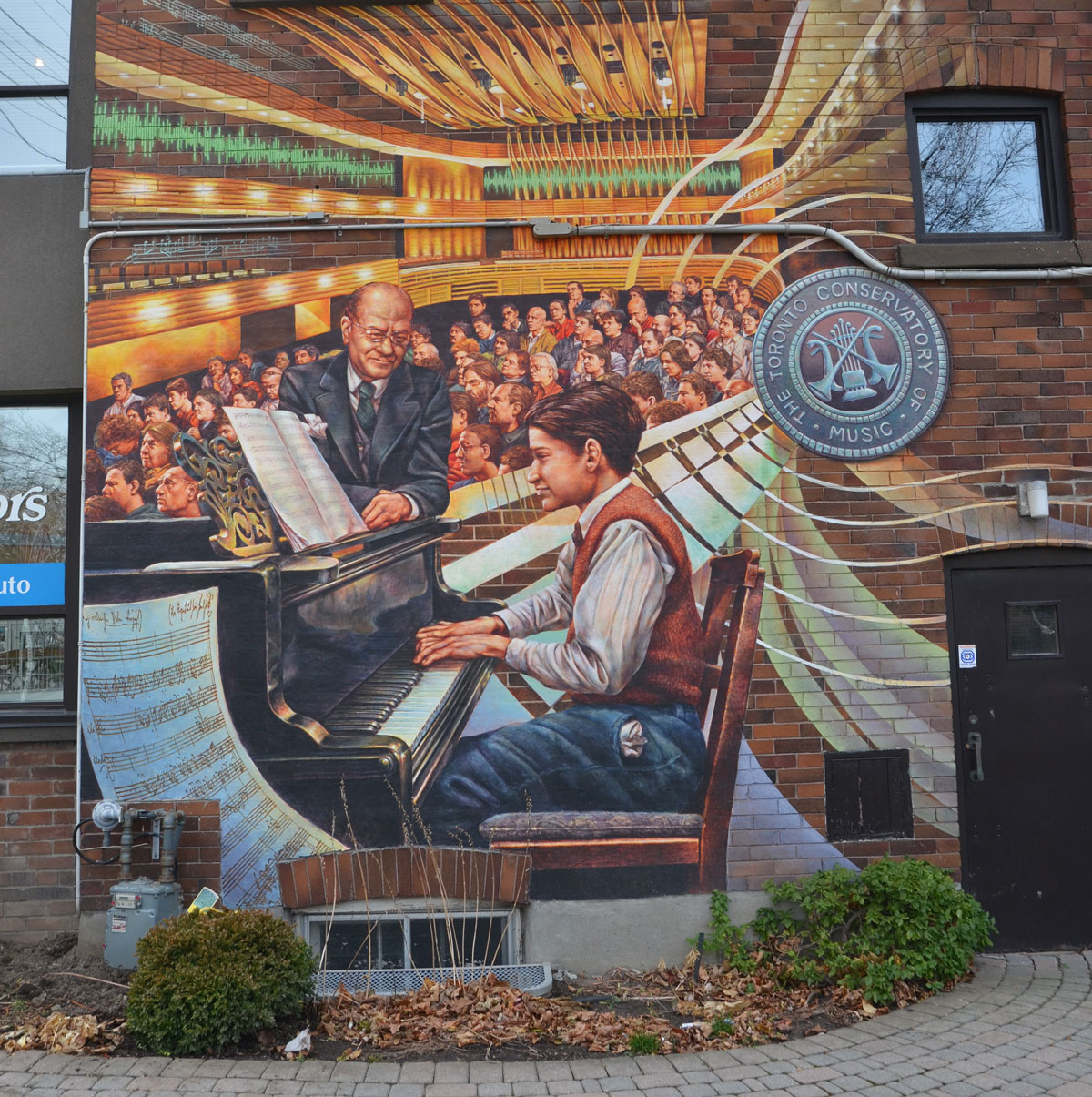
The Prodigy, by John Kuna, 2011
A satellite branch of the Royal Conservatory of Music was located in this building from the 1950s through the 1980s.

mural depicting a boy playing a piano in front of an audience.  A man is helping to turn the pages of the music.

mural 19 –  Aftermath by John Kuna, 2011.
After Hurricane Hazel on 15 Oct 1854, most of Islington Golf Course and the low lying areas around Mimico Creek were flooded.

large painting of men in boats, helicopter overhead

mural 20 – Ontario Gothic, by John Kuna, 2011

A mural of a man and a woman standing outside a two stroey farm house.  A white car is parked in front of the mural and it blocks the bottom right of the picture.

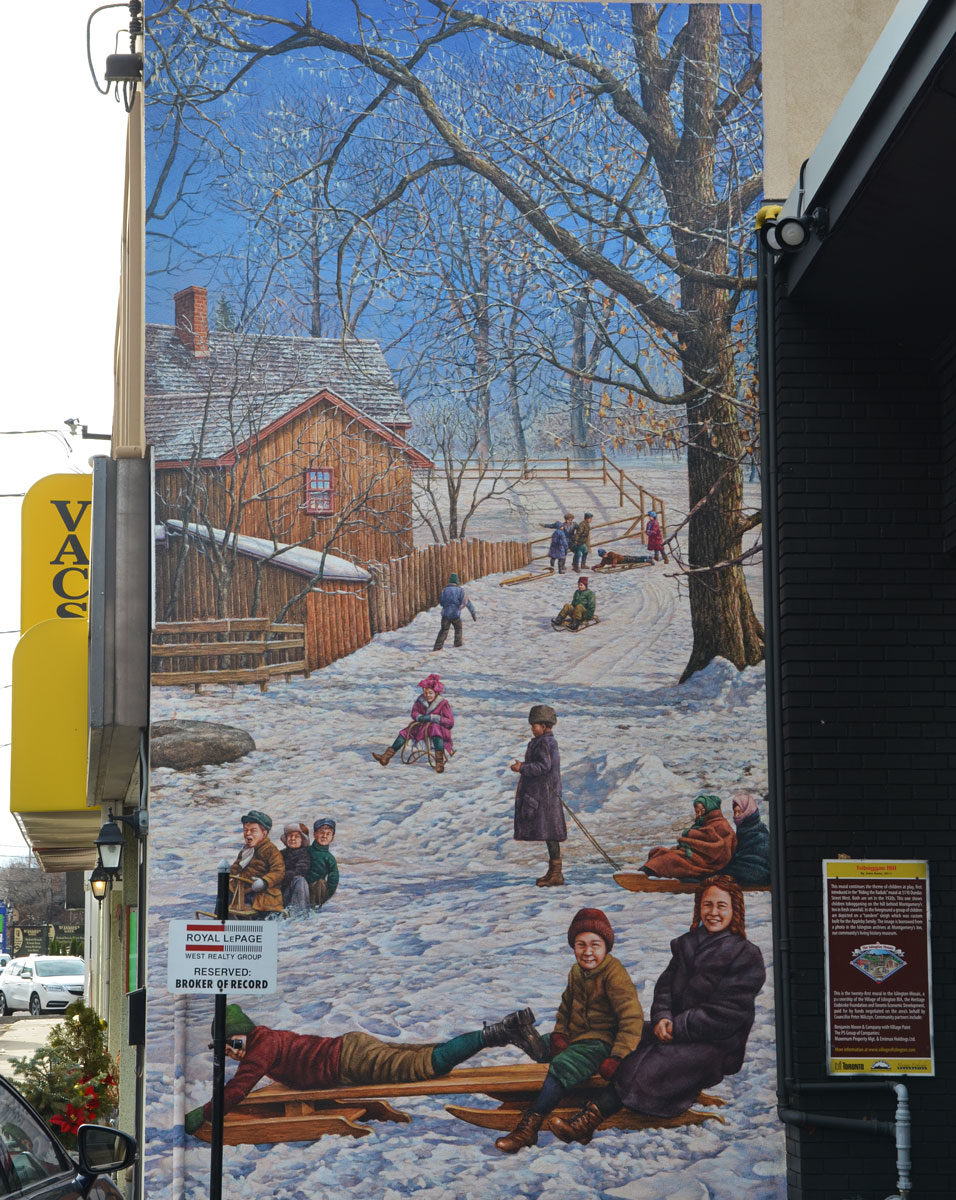
mural 21 – Toboggan Hill, by John Kuna, 2011

large vertical mural depicting a hill in winter.   Bare trees, kids on tobaggons.

Close up of the bottom part of a mural whowing kids on old fashioned wooden sleds, or toboggans.

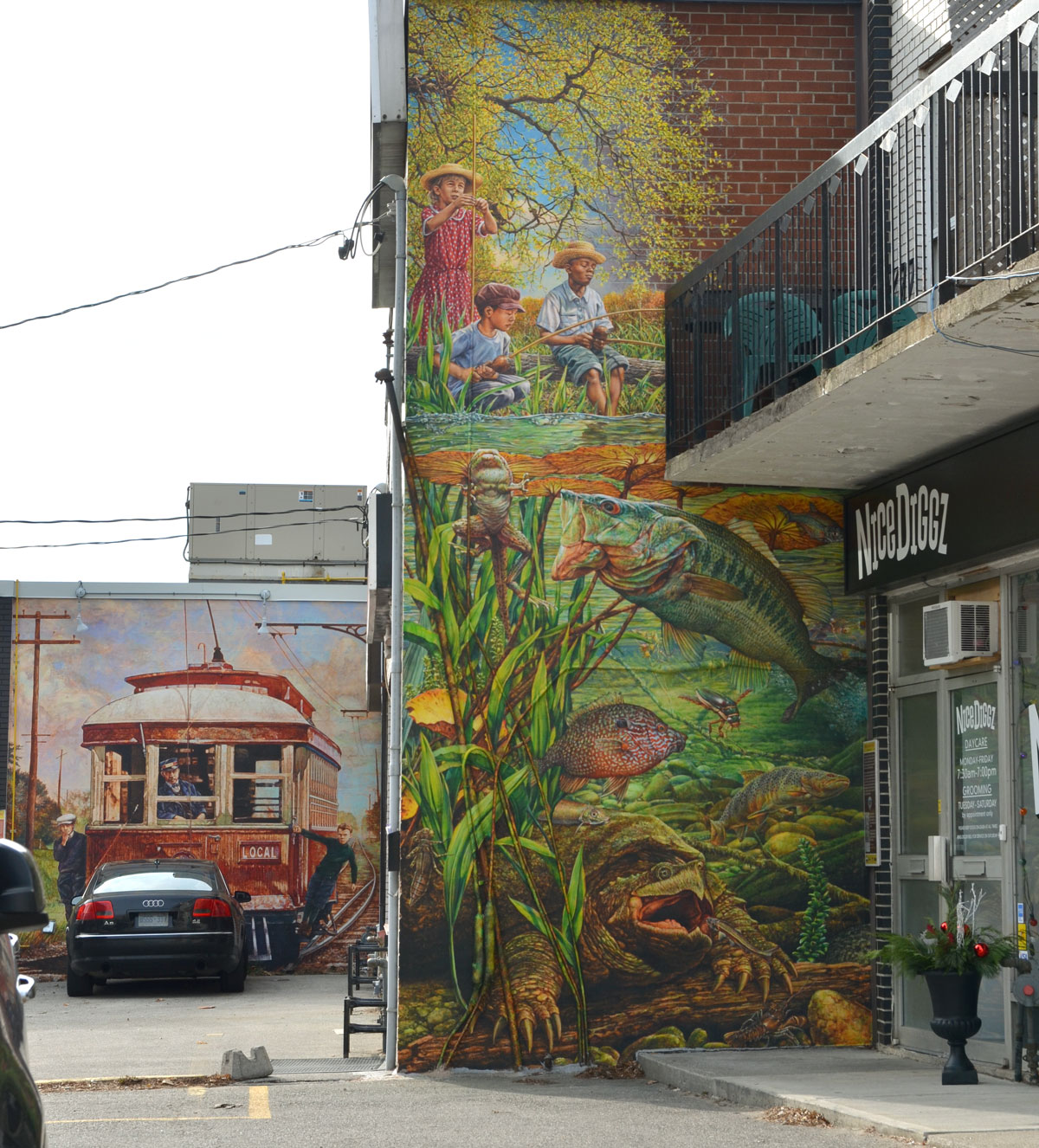
Fishing in Mimico Creek, by John Kuna, 2012,
with Riding the Radials seen in the background.

 includes largemouth bass, rainbow trout, pumpkinseed sunfish

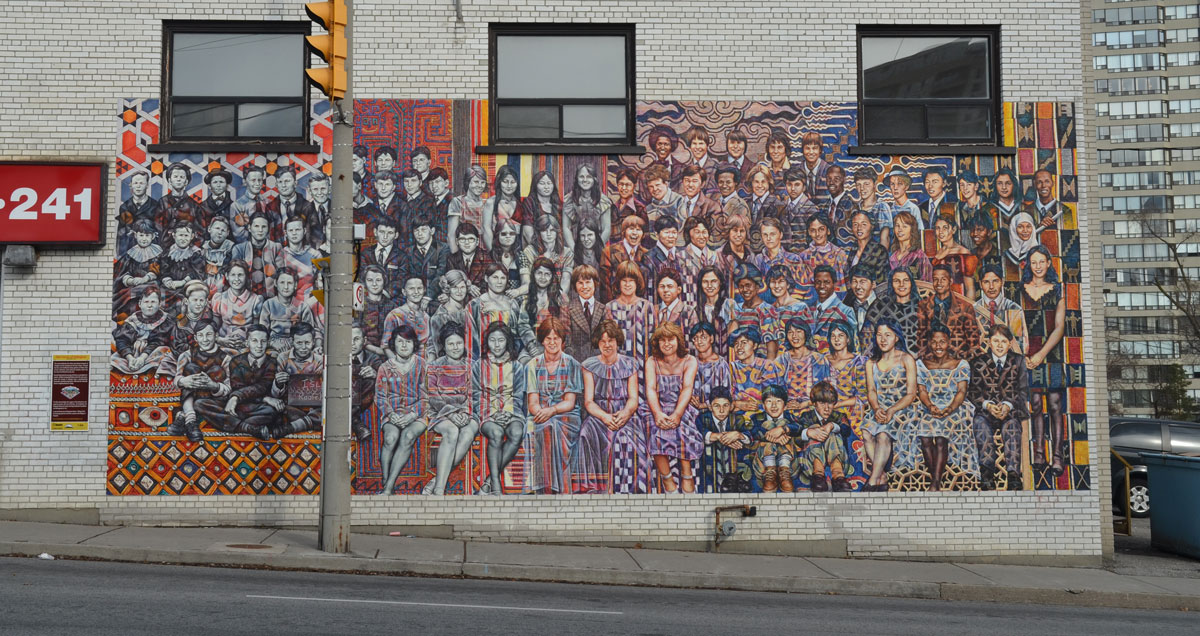
The Faces of Islington, by John Kuna, 2013

The Faces of Islington, by John Kuna, 2013

blog_islington_21part

the mural with no sign

mural of a group golfing in clothes typical of the 1940s

 more information – village of Islington murals website