Posts Tagged ‘lead’

Stained glass windows and churches go hand in hand. The church of St. Simon and St. Peter on Bloor Street East is no exception.  The church was built as St. Simon the Apostle, on the northern fringe of the city in 1887-1888.  The congregation grew rapidly and the church was expanded in 1892.   Its earliest stained glass window dates from 1899 and the most modern window was installed in 1997 – 100 years of history.   Some of the windows in this church, and the stories they tell, are shown below.

below: Saint Simon and Saint Matthew, 1927, Robert McCausland Ltd., Dedicated to the memory of Augustus Perrine Burritt (1868-1925).     Traditionally, saints are portrayed with their ‘attributes’.  Here,  Simon holds a saw and Matthew holds  a purse, or bag of money.   Matthew was a tax collector before he became an apostle.  No one really knows much about Simon and there are many conflicting stories about how, when, and where he died.  One story is that he died by being sawn in two in Persia.  Whatever the history,  now if you see a painting or a statue of saint and he’s holding a long saw, then you’ll know that it’s Simon.

Augustus P. Burritt’s wife, Jean Bell Smith, outlived him by many years.  She lived until 1969.  They are buried together in Mt. Pleasant cemetery.   She is Jean B. Smith Durland on the tombstone so she must have married a second time.   I may be flying away on a tangent, but there is CWSGA (Canadian Women’s Senior Golf Association) trophy called the Jean Burritt Durland trophy.
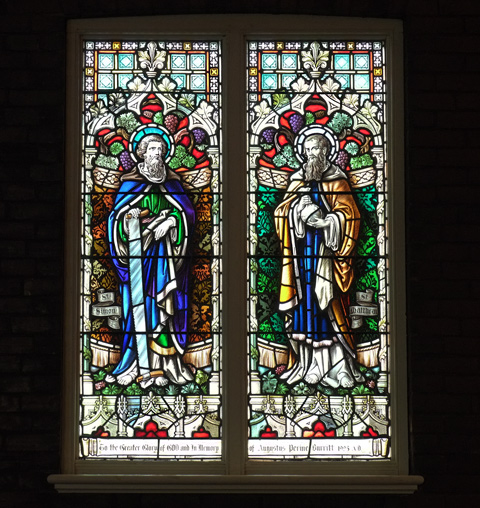
stained glass window, two panels, one with St. Simon and the other with St. Matthew,

McCausland of Toronto is the oldest surviving stained glass studio in North America. In fact, five generations of McCauslands have overseen the work of the firm from 1856 to the present.

“Joseph McCausland, glass stainer, house, sign, and ornamental painter, established his business in 1852, and added the stained-glass works in 1857, being the first of its kind in the city.   He is now employing over fifty hands.  Mr. McCausland was born in County Armagh, Ireland, in 1829 and came to Toronto in 1836.” from
History of Toronto and County of York, Ontario vol 1, 1885. (source)  The stained-glass works mentioned here was the Canada Stained Glass Works in Toronto.  Although the bulk of McCausland’s work was for churches in the Toronto area, they made windows for churches elsewhere, for a lot of government buildings (University College, City Hall, B.C. parliament in Victoria), and for commercial buildings such as the Bank of Montreal at Yonge & Front.   In 1881, Joseph’s son Robert took over the business and it has remained in the family ever since.

below: The Dorcas window – Dorcas distributes bread to the poor, by Robert McCausland Ltd. in 1921, dedicated to the memory of Martha Bolton Wilkes (d. 1919). Dorcas (or Tabitha in Hebrew or Aramaic) was a seamstress who clothed the poor as well as fed them. After she died, a miraculous prayer by Peter the Apostle brought her back from the dead. She has become a symbol of charity.

three panel stained glass window at St. Simons church

Martha Wilkes was the wife of Robert Wilkes (1832-1880), a politician and businessman. Robert drowned at Sturgeon Point with two of his children in August 1880, Florence Alexandria (age 15) and Bertie Cooke Wilkes (age 12). The family is buried together in Mt Pleasant cemetery.

An account of the death of Robert was given in the Canadian Methodist Magazine vol 15, January to June, 1882. “The sad disaster lacked no element of the tragical and pathetic. In the month of August, 1880, Mr. Wilkes and his family were spending a few summer holidays at Sturgeon Point, a beautiful health-resort on Sturgeon Lake. On the 16th of the month, his only son and second daughter, aged, respectively thirteen and fifteen, were bathing in the lake, while their father rowed a small boat near at hand. The lad, attempting to reach his father’s boat, sank beneath the water. Mr. Wilkes plunged in to rescue him, and found himself beyond his depth. His daughter Florence, rushing to their assistance, got also beyond her depth, and thus all three perished in full view of the shore. Mrs. Wilkes who was an eye-witness of the dreadful tragedy, rushed into the water and was with difficulty prevented from losing her life in a futile attempt to save those so dear to her. Prompt efforts were made to rescue the bodies, but, alas! the spark of life had fled. Although that of Florence was still warm, yet every attempt at its resuscitation was in vain.”


below: There are a few other McCausland windows in St. Simons church.  This is a detail from one of them, the Te Deum window, named for the prayer that contains the words “To thee all angels cry aloud”.

close up of stained glass window, angel, cherub heads, and words that say To thee all angels

below: Saint Cecilia, by Sarah Hall, 1997.   Saint Cecilia is the patroness of musicians and she is in the center, flanked by two trumpet bearing angels.  It’s difficult to see in this photo, but under the music notes, at the very bottom of the window, are the words “From har-mo-ny from heav-nly har-mo-ny This u-ni-ver-sal frame be-gan”.  Each syllable matches a note.   They are also the first two lines in a poem written by John Dryden in 1687 called  “A Song for St. Cecilia’s Day”.

stained glass window by Sarah Hall in St. Simons church, 3 panels each with an angel

below: These windows by Gerald E. Tooke (b. 1930), four panels, each an illustration of a miracle performed by Jesus.  On the very left is the marriage at Cana where water was turned into wine.  Next is the feeding of the multitudes with bread and fish.  Second to the right is the healing of the blind man and last is the Resurrection.  These date from 1965 and are dedicated to the memory of Anna Alfreda Waller (d. 1964) and her husband (d. 1949).   [There’s a turn – usually it’s the wife whose name gets lost!].

set of four stained glass windows in deep hues of red and blue with some yellow and green, by Gerald Tooke, at St Simons church

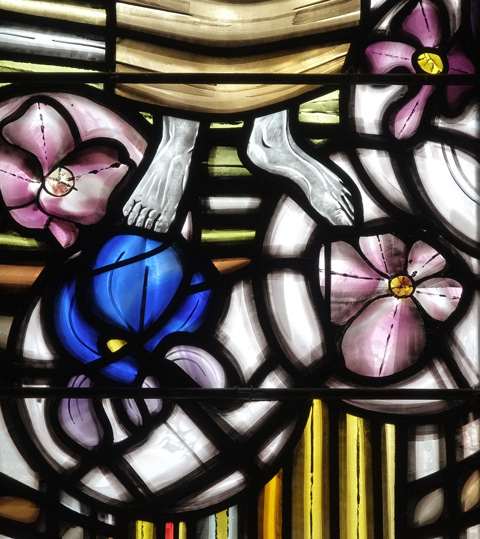
below: Memorial to the Women of St. Simons 1883-1983, by Stephen Taylor.   Maybe you see her as a  Mother Earth figure as the root of all that grows or maybe you see her as a woman in bondage.   She almost looks like she’s bound to a cross.  The carnations above her are symbolic – according to a Christian legend, carnations grew from Mary’s tears as she watched Jesus carry the cross and, hence, they became associated with motherly love.
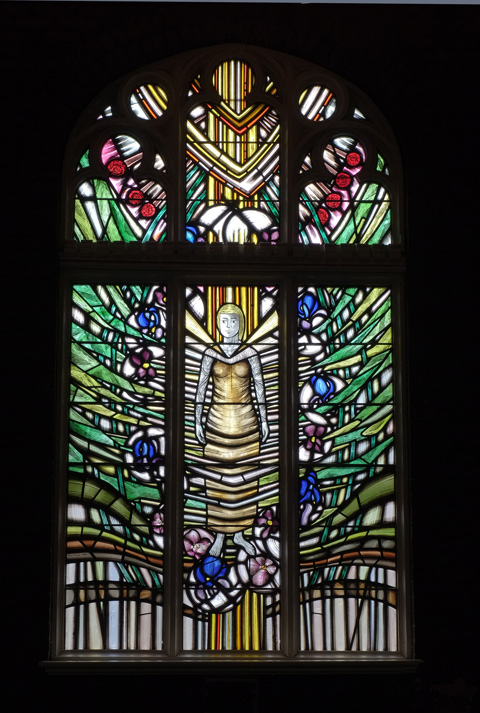
stained glass window by Stephen Taylor, memorial to the women of St. Simons, with a woman in the center, roots wrapped around her and greenery growing out from her,

detail of stained glass window, feet and large pink and blue flowers.

For a more complete story about stained glass and the windows of St. Simons, there is a pdf here

This post is subtitled ‘Staying Cool on a Hot Hot Day’.  When the temperatures are into the 90’s (old style) and the humidity makes the air thick, walking streets and alleys is not very comfortable.  Instead I took refuge in air conditioned arty places.  With the help of the (mostly) air conditioned TTC I only needed to take a few steps outside.

below: At one point I walked through an air conditioned building rather than going outside.  This is what I found there. ‘August 6, 1945’ by Matthew Day Jackson.  Moments after I pulled my camera out of my backpack, a security guard appeared.  I was sure that once again I was going to get the “this is private property” talk but instead we ended up discussing the work and how it is displayed.

It is constructed of four panels and it’s very heavy.  The base is made of lead; you can see the lead where Lake Ontario is.  It is attached to the wall with 18 very long bolts and each bolt is wired to an alarm.

map of toronto made of charred wood and lead, meant to resemble the city after an atomic bomb, large, made by Matthew Day Jackson, hanging on a wall behind a metal railing.

below:  Looking a bit more closely at it you can see that it is a map of Toronto.  As you might have surmised,  the title is a reference to the dropping of the atomic bomb on Hiroshima by the USA during WW2.    This isn’t just any map of Toronto, it’s an aerial view of a burnt out city after a nuclear explosion.  It is one in a series of cities given similar treatment, all with the same title.

detail of the islands and downtown area of map of toronto made of charred wood and lead, meant to resemble the city after an atomic bomb, large, made by Matthew Day Jackson

From the effects of man made death to the life enhancing effects of nature….

below: A few steps outside took me past the Gardiner Museum where I noticed that the front garden was redone about a year ago.  ‘Vertical Crevice Garden’ was designed and donated by landscape artist Neil Turnbull.  From the Gardiner museum website, a quote by the artist: “When the massive forces of continental drift push against layers of sedimentary rock, they cause it to crack, break, and rise. Over centuries, through exposure to wind, sun, and the freeze-thaw cycle, the layers split open. These fissures and crevices collect rain, dust, and an array of windblown bits like seeds and spores; plants take root, and life takes hold.”

limestone rocks arranged on a slant in a garden, stripes of red rock and grey rock, all just a few inches off the ground

below: When walking past the Gardiner Museum, one can’t help but notice the striped head.  It’s actually called ‘Untitled’ (why do artists do that?) and it’s by Jun Kaneko, 2002.  It’s made of glazed ceramic and galvanized steel.   Before heading underground at Museum subway station I took a few minutes to try to take a ‘pretty’ picture of the head.  The plants in the garden next door haven’t quite grown up enough to hide that ghastly table that the head sits on.  I have always wondered why the museum chose such a mundane bland platform for the sculpture but now that I look at it again I wonder if it’s possible that the table is actually part of the artwork.  Could it be?

large striped head sculpture on a table, outside, by Jun Kaneko, old building behind it, lavender and other plants growing in front of it.

below:  A photograph in the doorway of a gallery caught my eye.  The picture below is not the one in the doorway, but one that was hanging on a wall inside that I liked even more.  ‘Paris Rooftops 4’ by Michael Wolf.  It is 48″ x 68″ and is a chromogenic print (full-colour silver-based photograph), edition of 9.   To buy it will set you back $22,000 but looking is free – check out more of Michael Wolf’s work on the Bau-Xi gallery website.

picture of a photograph by Michael Wolf of Paris rooftops. Concrete grey with lots of lines of little terra cotta chimneys

below: A man with a camera stares at a painting on a gallery wall.  ‘Watching’ 2010, (26 inches high) by Tom Campbell on the left and ‘Brown Trail #7’ 2016 by Shi Le, a Toronto based landscape artist.  These are at the other Bau-Xi gallery (the non-photography one)

a small sculpture of a man holding a camera is placed in an art gallery such that he seems to be looking at a painting on the wall.

below: Three paintings by NUBARR Gallery, a collection of the works of Armenian-Canadian painter Noubar Sabag (Noubar Sabbaghian) 1920-2006.   These, and others by the same artist, are on show at the Art Square Cafe & Gallery but unfortunately I just learned that today is the last day.

a woman in a floppy black hat is taking pictures of three paintings hanging on a gallery wall.

below:  How many people try to paint pictures like this?  How many people sell such paintings, not to mention have them hang in the Art Galley of Ontario?  But they aren’t Robert Motherwell.      So I ponder on the age old question of what makes a piece of art valuable or collectable?  Is the AGO (and other galleries) collecting paintings or names?  Motherwell painted this in numerous variations – a few changes in colour, a slight change in the lines.  Cheating?  Or brilliant marketing?  One for every gallery of note? This is Motherwell’s ‘Untitled (In Orange with Charcoal Lines)’ c1970.  There’s that “untitled” again, the most popular name for an artwork.

all orange with 3 black lines that form three sides of a square, top line of the square is missing. It's a picture of a painting by Robert Motherwell in an art gallery

My last stop of the afternoon was at the photography exhibit by Thomas Ruff at the AGO.  Part of the exhibit was a few large photographs of stars,  ‘Sterne’.  Large pictures of stars in the night sky were made from negatives that Ruff bought from the European Southern Observatory in Chile in 1989.

below:  They are difficult to look at, or rather it is difficult to what is the picture because the blackness of the photograph creates a mirror when placed behind glass.   This is me taking a picture of the picture – me plus the picture on the opposite wall plus the lights and light fixtures in the ceiling plus a table plus another person in the room plus a few white spots that are stars.

large photograph of the night sky, lots of stars and blackness. The black acts like a mirror and parts of the gallery are reflected in the picture.

below: ‘Walking Away, Walking Through the Universe’ a manipulation of a manipulation.

a reflection of two people walking hand in hand as seen reflected in a photograph of stars in the black night sky

below:  One last photo.  Let’s end this on a positive note and give Thomas Ruff credit for some interesting work.   These two pictures are part of his press++ series where he has taken old photos used in print medium and merged the front (picture) and back (words and markings) of the print into one.

a woman is standing in an art gallery and she is looking at two large pictures on the wall.

Thomas Ruff, Object Relations, at the AGO until 1 August 2016