Posts Tagged ‘contemporary art’

The title of the exhibit is ‘Surrender’ and the words on the wall say this:

“Liz Magor’s art invites us to reconsider our relationships with the things we encounter every day.  Through subtle shifts in materiality and context, her works reveal the important role that objects play in our lives: they can allow us to conceal ourselves or to express our identities.  In her sculptures and photographs, Magor explores how we depend on domestic materials to develop a sense of self.”

Nothing is mentioned about surrendering, or why the exhibit has the title that it does.

In the first room there are boxes on the wall.  Each box looks like a carefully wrapped sweater or jacket that has just been purchased.  I can envision a middle aged saleslady taking her time to package your purchase, like in an Eatons store thirty or forty years ago.

art installation at the Art Gallery of Ontario by Liz Magor - two walls with many open boxes on them. The boxes are made to look like they've just been opened to reveal a sweater or top folded neatly inside, including the tissue paper that often accompanies a new purchase. The clothes have all been decorated with different objects.

On closer look, most boxes also have a hand print, or shape of a hand with index finger pointing at something and little details are amiss…  a ketchup package for example.

blog_liz_magor_cornhuskers

The second room has a number of smaller installations.

A garment bag left over a chair.
Neatly folded blankets hanging on a wall.
A platter of chocolates and left overs.
A tweed jacket on top of a liquor bottle.
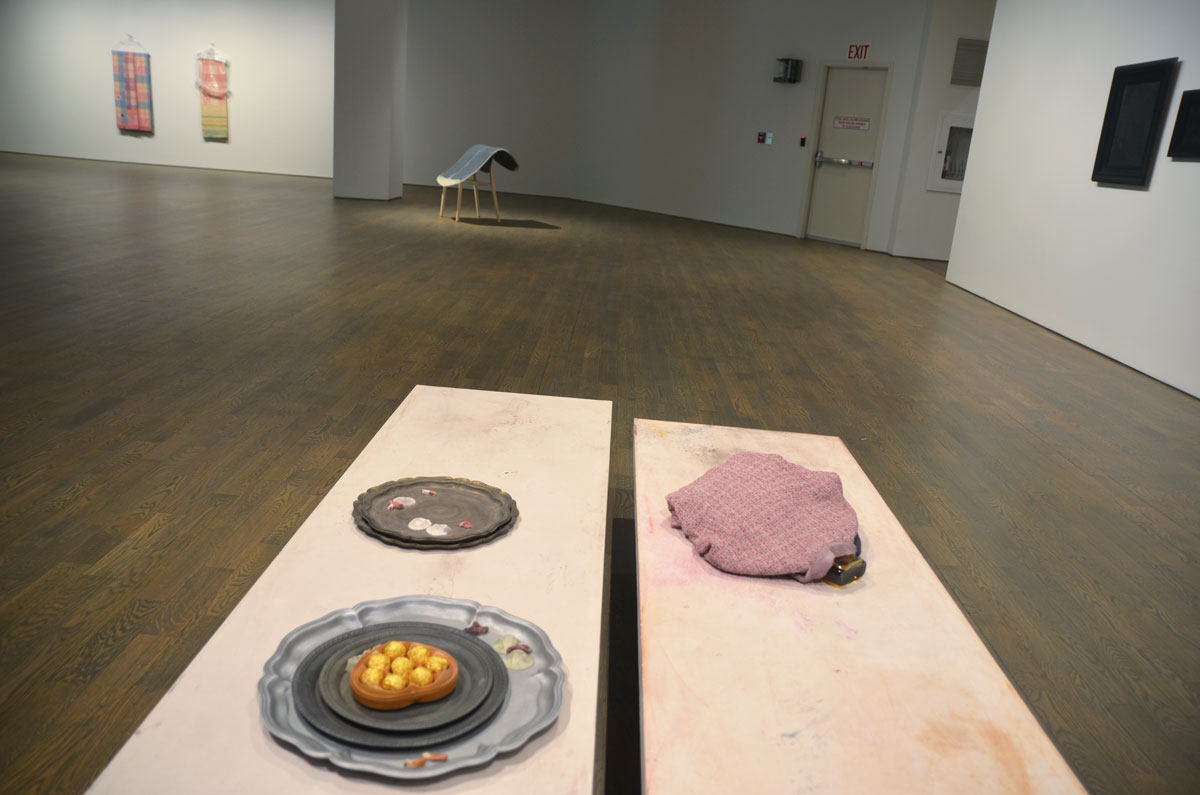
art installation at the Art Gallery of Ontario by Liz Magor - in the foreground are two long narrow tables. On one of them is a platter with chocolates and a platter with the remains of cheese and crackers.

A husky under a blanket (of snow?  on a bed?)
A coat and purse hanging on a hook.
The contents of a room boxed and ready to move.

art installation at the Art Gallery of Ontario by Liz Magor - 3 pieces. First, a pile of moving boxes and other items that look like they are in the midst of getting ready for the movers. Second, a large white blanket bed sized that has a hole in the middle of where the pillows should be but instead there is a wolf curled up inside the whole. Third, what looks like a jacket hanging from a hook on the wall

art installation at the Art Gallery of Ontario by Liz Magor - two hangers with plaid blankets folded over them hanging from hooks on a wall. One of the blankets has a clear plastic Creeds bag over the top part of it

On closer look, some of the details on the blankets are wrong
including the labels that are sewn on back to front.
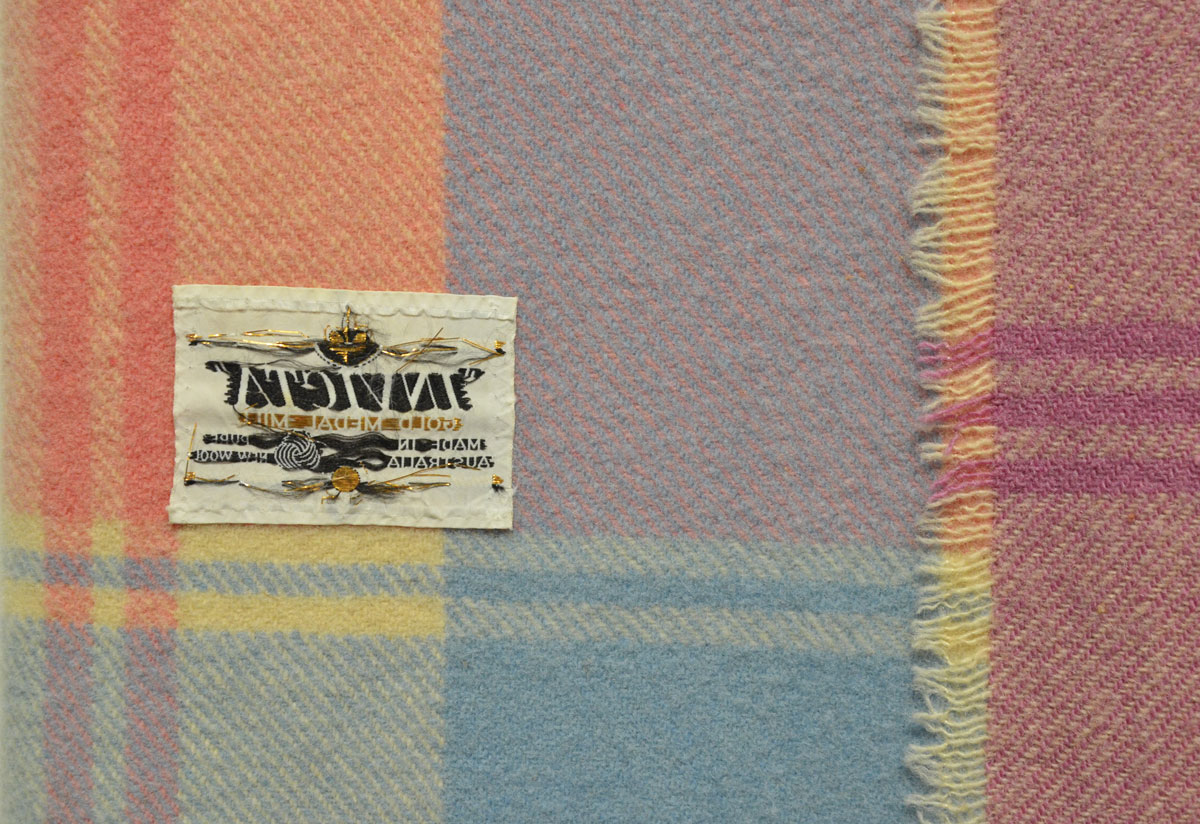
The label on a plaid blanket is sewn on backwards so that the writing on the label faces the blanket.

I was interested in what people’s reactions were to this exhibit so I had a chat with a couple of the employees about it.  According to them,  there was no reaction.  Most people showed interest in the boxes but when they walked into the second room they rarely stopped to take a closer look.
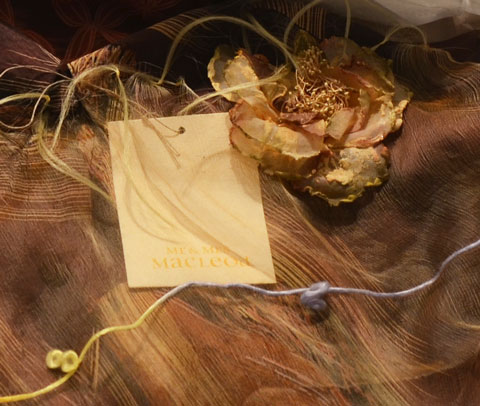
blog_liz_magor_rose

As for surrender, I did find reference to it in the description of the exhibit on the AGO website, ” In this exhibition, everyday objects and forms, as well as the natural world, function allegorically by evoking the human need to surrender to desires, compulsions, fantasies.”  Once again, I will leave it to you to decide if this description fits.

Exhibit continues until 29th November.
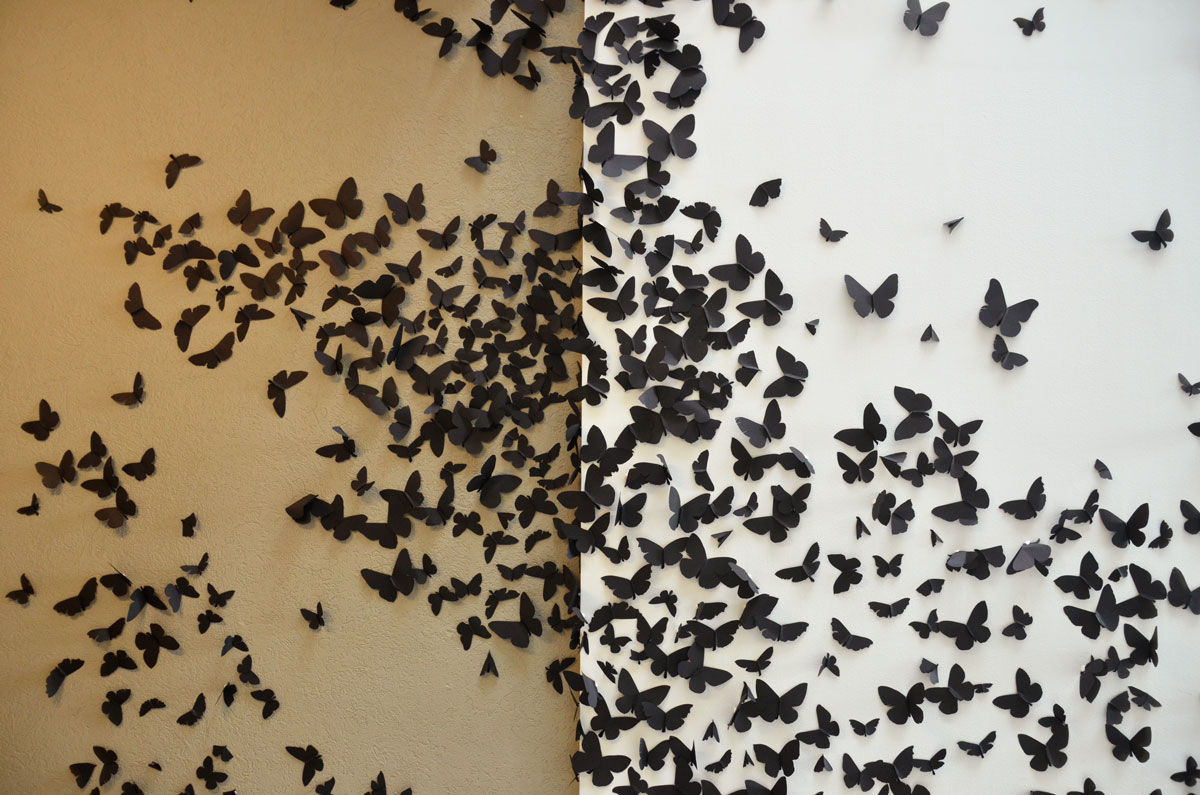
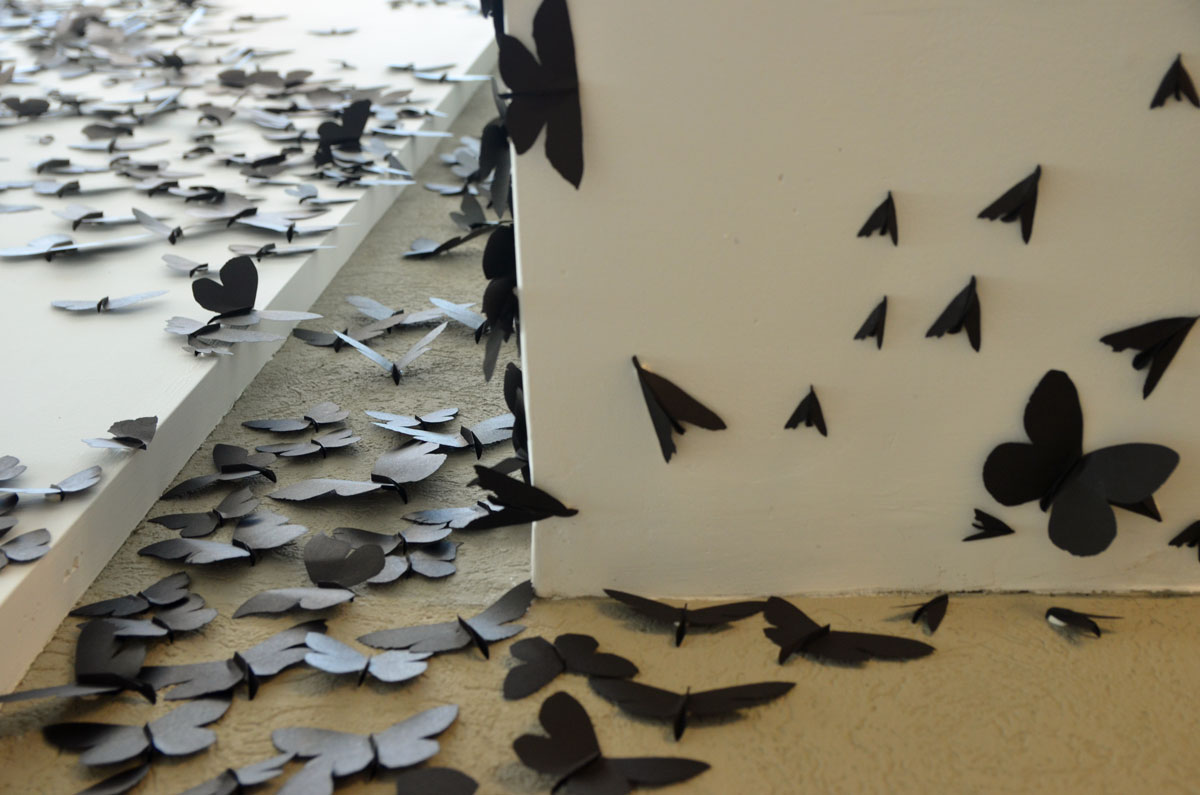
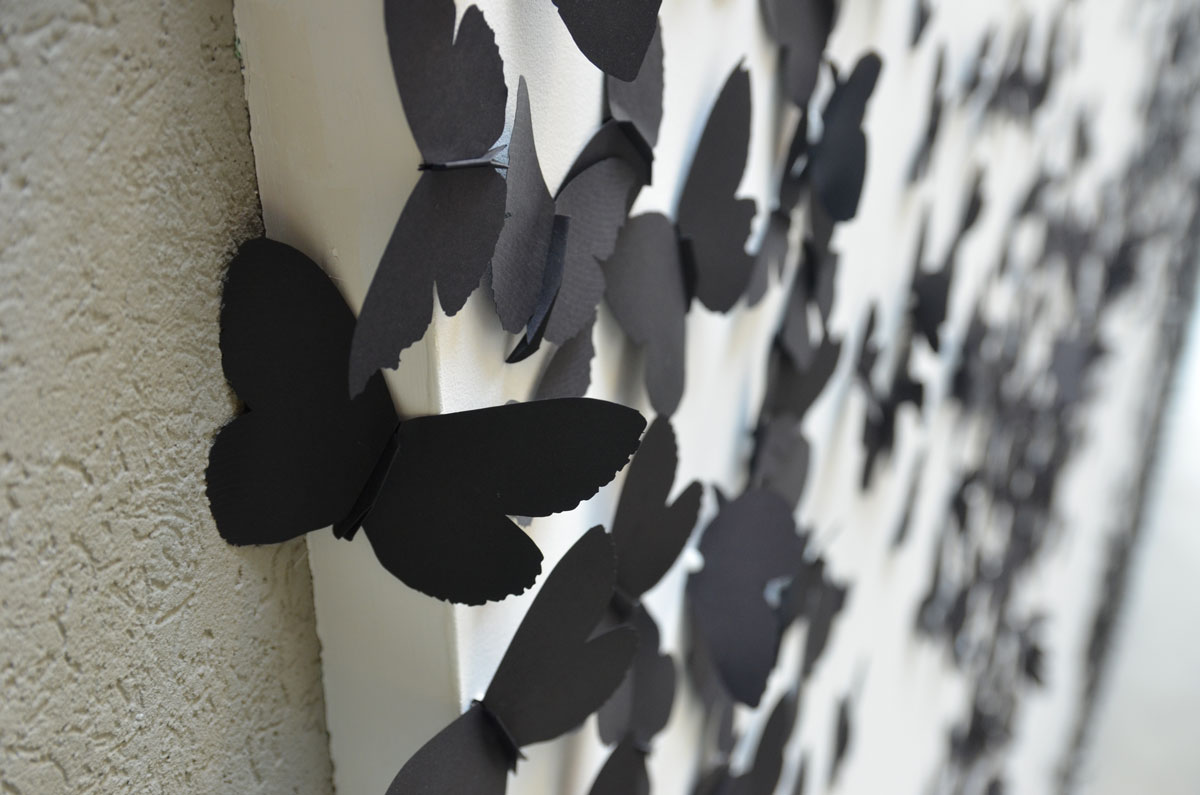
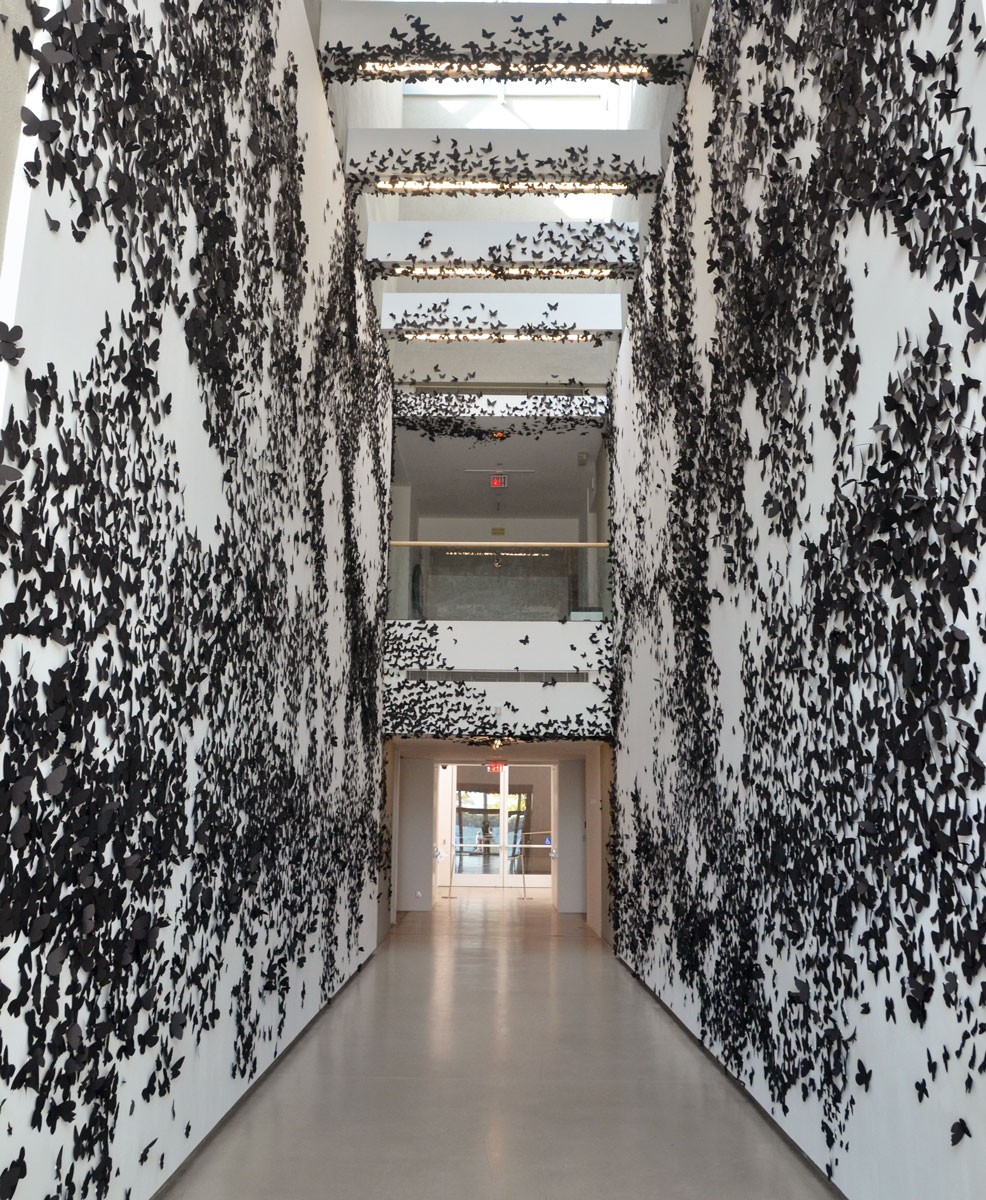
The exhibit is called ‘Black Cloud’ and it consists of thirty thousand black moths, each one individually attached to the walls and ceiling of the clerestory of the The Power Plant Gallery.   Artist Carlos Amorales has reproduced the shapes and sizes of thirty six different species of moth with black paper.  They swarm towards the lights and they congregate in the corners.  It’s a fascinating display both in the overall composition and in the attention to small details.   This installation first appeared at an art gallery in Paris in 2007.

A wall covered with black paper moths, part of an art installation called Black Cloud by Carlos Amorales

A wall covered with black paper moths, part of an art installation called Black Cloud by Carlos Amorales where 30,000 black paper moths are stuck to the walls and ceilings of a hallway - looking up at all the moths on the ceiling

A wall covered with black paper moths, part of an art installation called Black Cloud by Carlos Amorales where 30,000 black paper moths are stuck to the walls and ceilings of a hallway - looking at the corner of the hall, where the wall meets the ceiling

A wall covered with black paper moths, part of an art installation called Black Cloud by Carlos Amorales where 30,000 black paper moths are stuck to the walls and ceilings of a hallway - this picture is a close up of some of the moths

As much as I liked the display, I was glad they weren’t real moths!

A hallway covered with black paper moths, part of an art installation called Black Cloud by Carlos Amorales where 30,000 black paper moths are stuck to the walls and ceilings of a hallway

#PPBlackCloud

King East Design District Life.Style.Fair is a festival celebrating contemporary design.
This year’s event was last Saturday and these are some of the things I saw as I walked King Street East that day:

A section of sidewalk. On it is painted the logo for King East Design District. There are also three lovebot stencil shapes spray painted in white on the sidewalk.

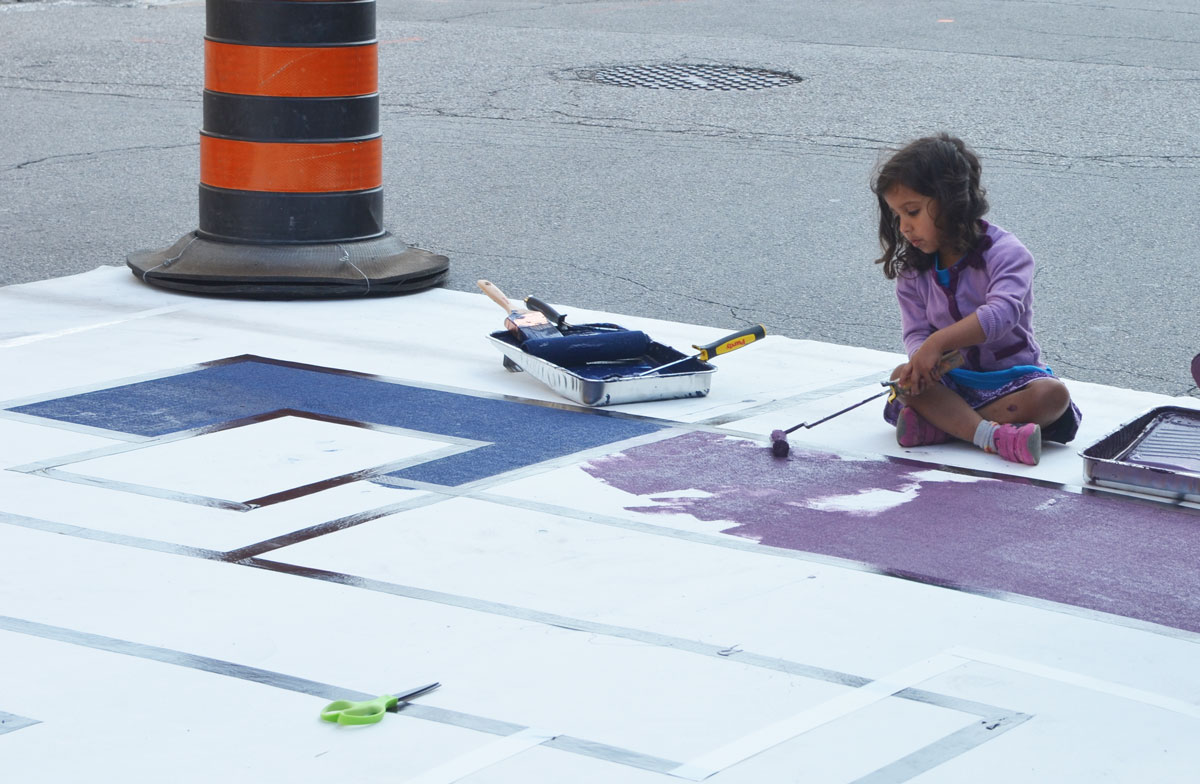
below: Frederick Street painting collaboration, organized by George Brown College School of Design students.

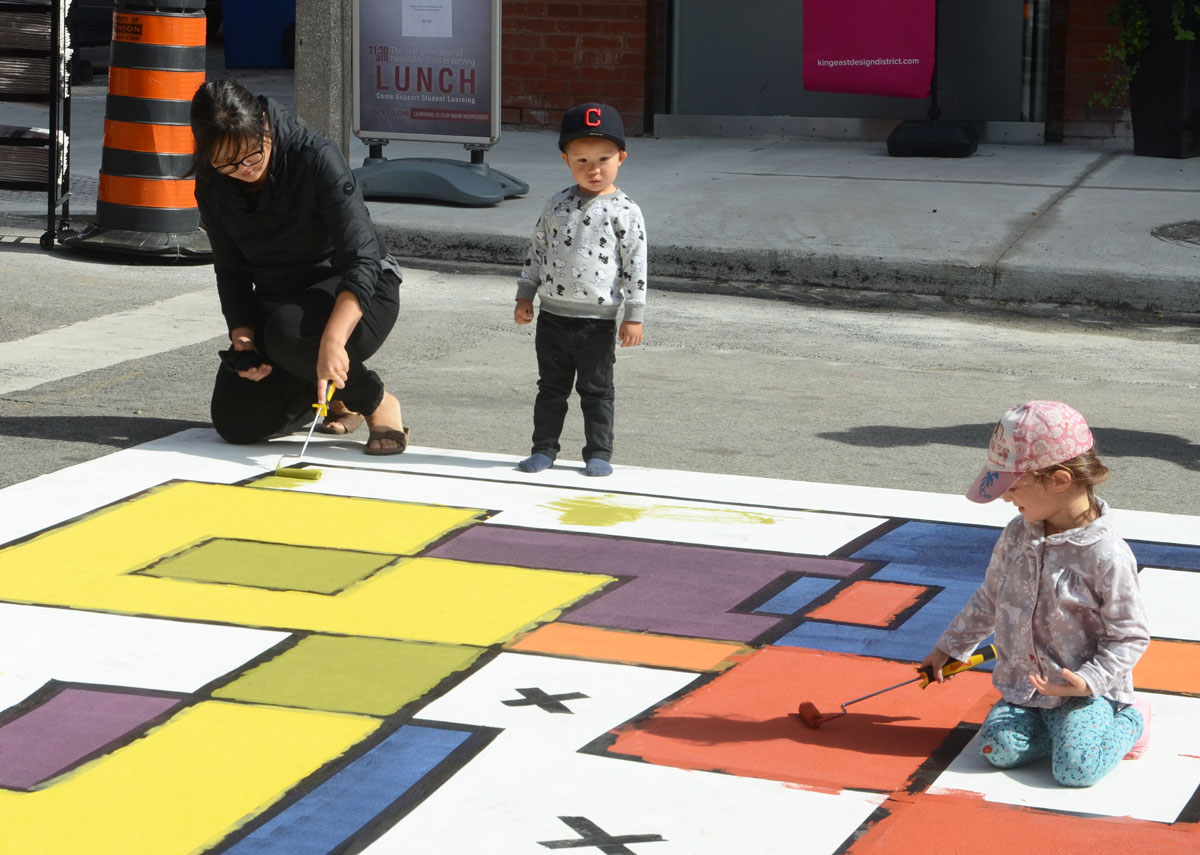
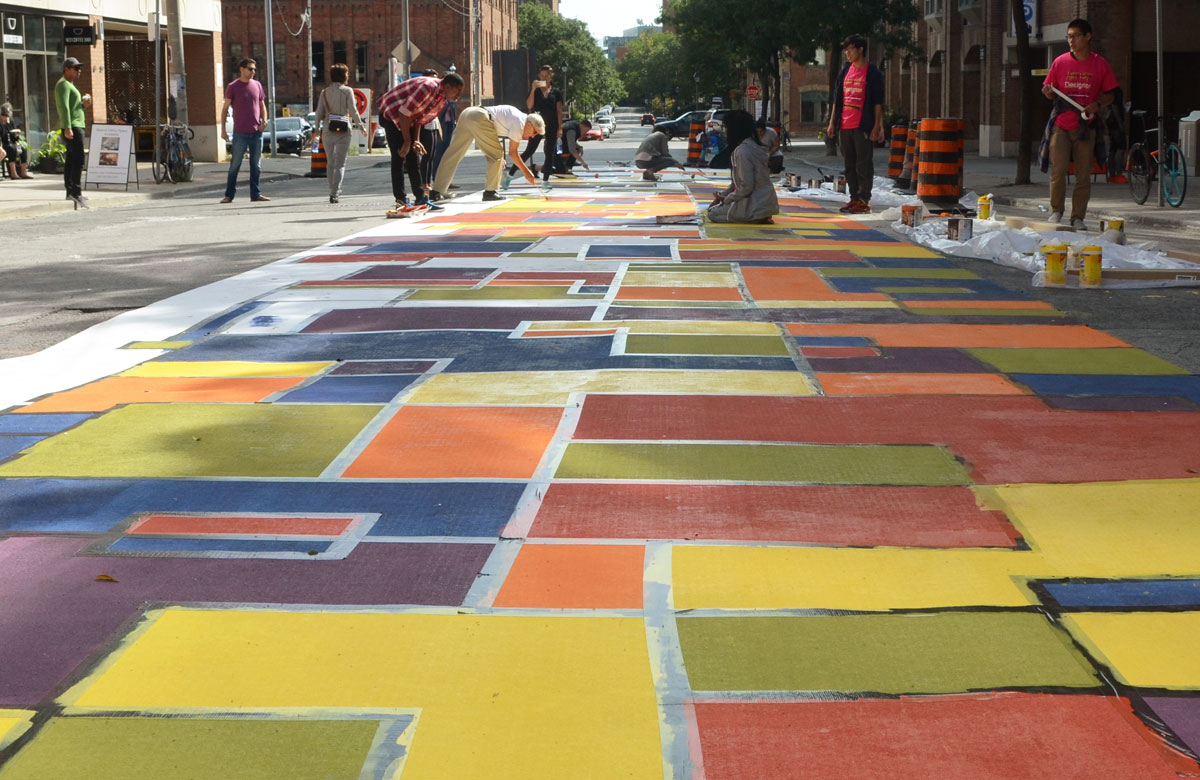
painting a large Mondrian-like painting on the street. A large mat is laid out along Frederick Street and students have marked off squares and rectangles with tape. People are painting the shapes in red, orange, yellow, green and purple.

painting a large Mondrian-like painting on the street. A large mat is laid out along Frederick Street and students have marked off squares and rectangles with tape. People are painting the shapes in red, orange, yellow, green and purple. A young girls is using a small roller to paint purple in this picture

painting a large Mondrian-like painting on the street. A large mat is laid out along Frederick Street and students have marked off squares and rectangles with tape. People are painting the shapes in red, orange, yellow, green and purple. A small boy watches while his mother and a girl paint

painting a large Mondrian-like painting on the street. A large mat is laid out along Frederick Street and students have marked off squares and rectangles with tape. People are painting the shapes in red, orange, yellow, green and purple. Looking down the length of the canvas as it nears completion

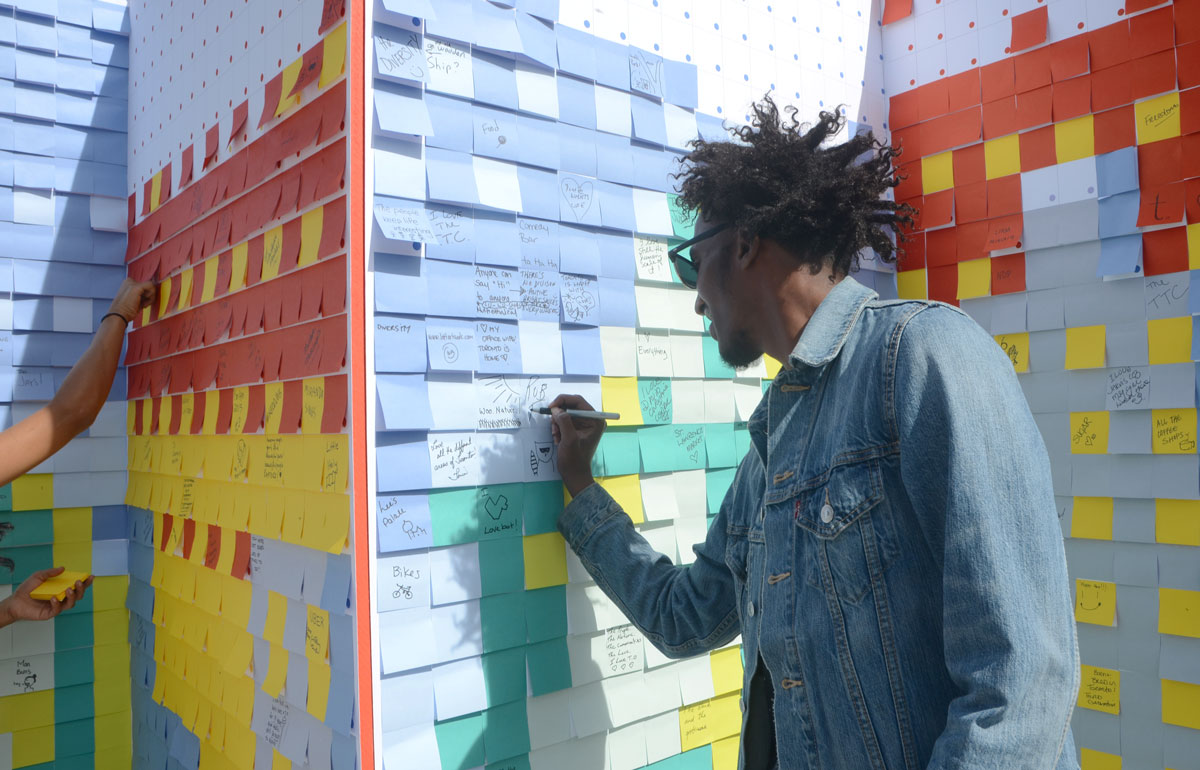
below: What do you like about Toronto? This man was writing “Rob Ford” as I took the picture.
In hindsight, maybe I should have written something like “is not the mayor” beside it?
Some of the other things people wrote include, coffee shops, bikes, freedom, trees, TTC and lovebot.

A man with spiky black hair is writing on a board covered with different coloured post it notes.

below: The Beauchamp Art Gallery had strips of dried acrylic paint hanging from the ceiling that you could walk through.

Curtains of long strips of dried acrylic paint in many bright colours hang from the ceiling of an art gallery.

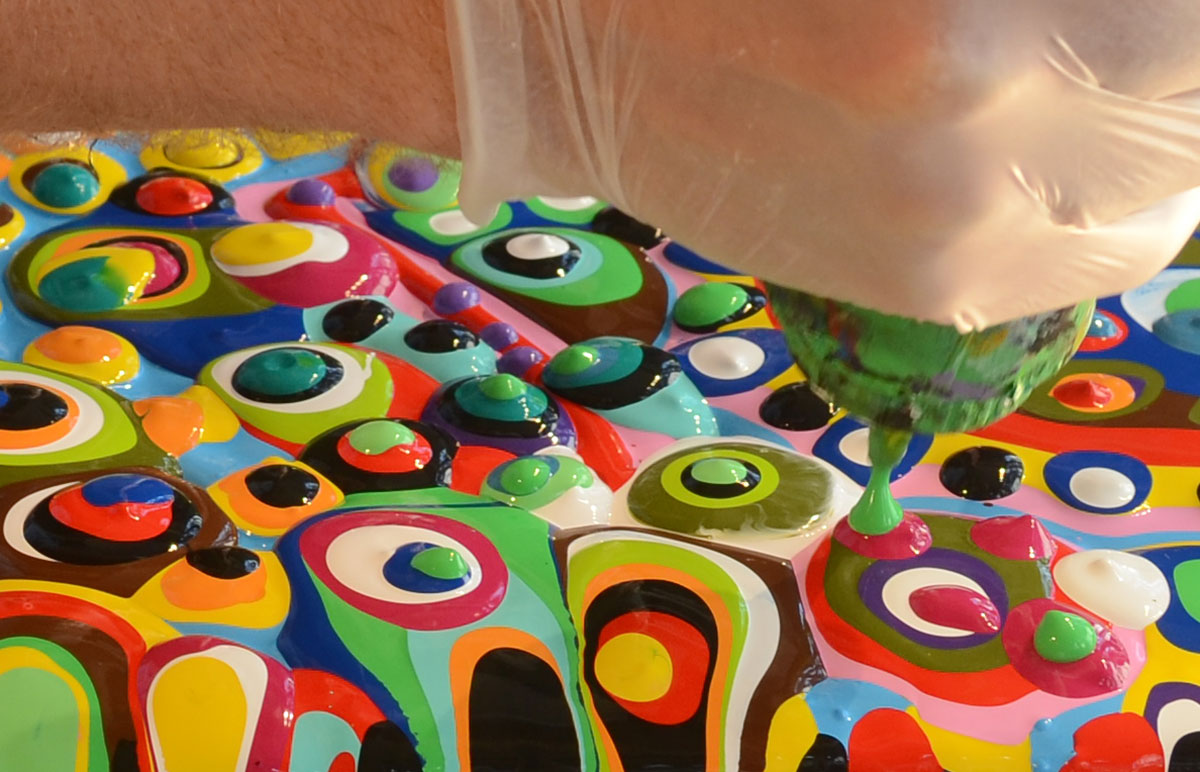
below: Also at the Beauchamp Gallery, artist Mike Hammer was creating a colourful painting consisting of blobs of acrylic paint.  The blobs flattened as additional drops of paint were added on top.  The paint flowed over the edge and created stripes.

an artwork in progress, made of many blobs of acrylic paint. The blobs flatten as other blobs are placed on top of them. The artist Mike Hammer is making this piece (although only his hand is in the picture)

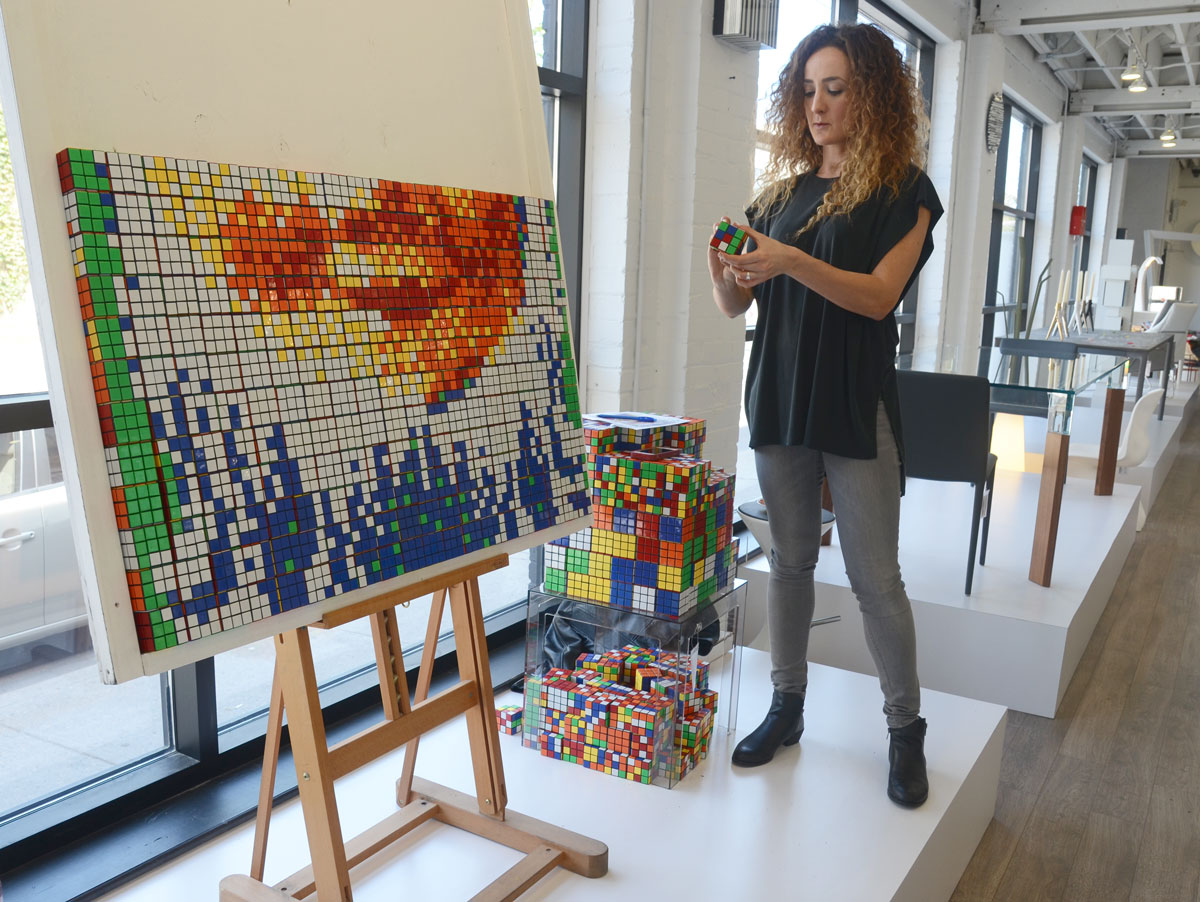
below: Cubeworks studio demo.  Yes, she really does hand twist each Rubiks Cube into the colour pattern needed for the artwork.  This particular picture, of a gnome face, requires 500 cubes.  The algorithms for solving the cube are online so you can teach yourself and become a Rubiks Cube artist!

A woman is getting a rubiks cube ready to add to a picture that she is making using 500 rubiks cubes. The picture, about half done, is on an easel in the window of a store.

below: Painting by Jessica Gorlicky.  The easel spins to make the painting easier.


In the immediate foreground, but a little out of focus, is the shoulder and arm of a man taking a picture. The subject of his picture, a woman with long blond hair, is painting a picture of a TTC street car and a Toronto street scene. She is in this picture too.

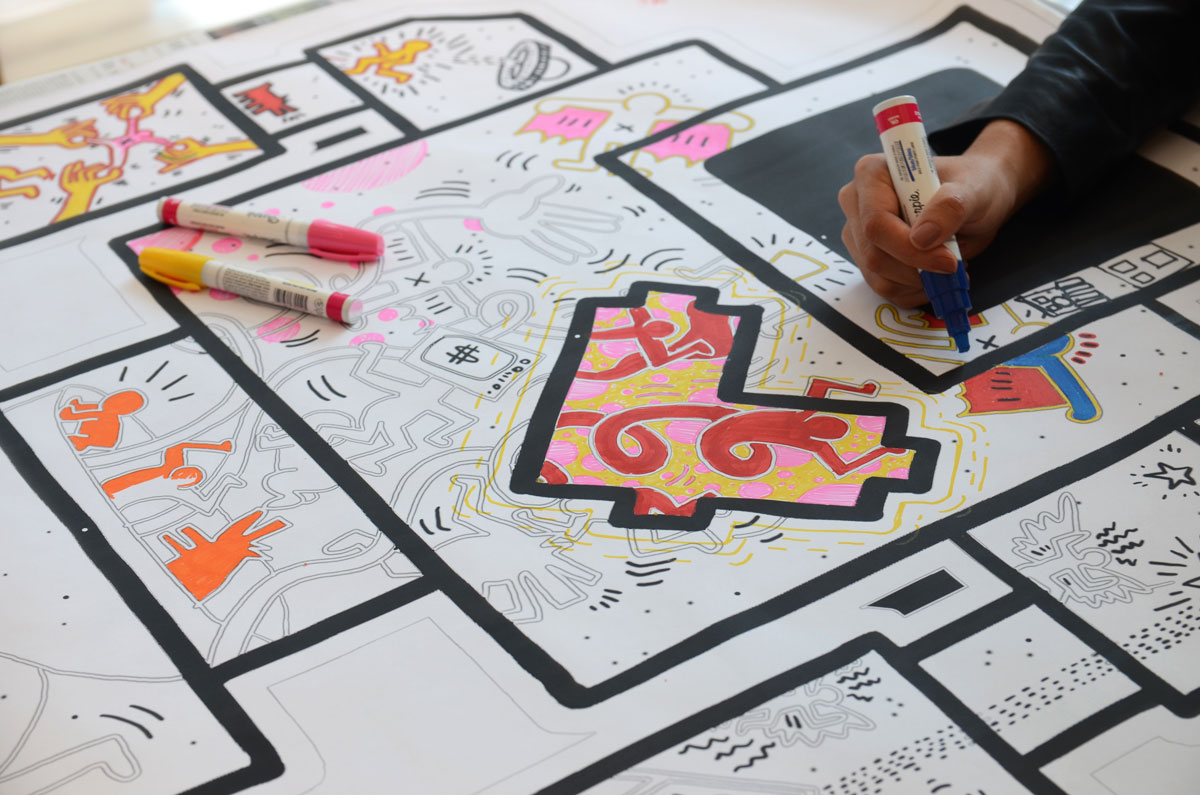
below: Lovebots to colour

A large lovebot on paper is on a table. Black lines on white paper. It is more than a meter high. There are shapes in the middle and it is designed to be coloured. A hand holding a black sharpie is also in the picture, colouring part of the lovebot

below: Pizza carpets outside and pizza making inside, at the corner of King and Parliament.

A man and a woman are crossing the street. They are close to the sidewalk on the other side of the street. On that sidewalk are a number of carpets that look like wedge shaped pepperoni pizza slices. Each carpet is just over a meter long. They are in front of a shop that sells appliances.

below: The store Relative Space displayed three pieces by Stan Olthuis made from flooring materials that they sell.  This one is called ‘Dance Like No One’s Watching’

Part of the store window for the store Relative Space. The word space is seen in this picture. In the window is a design of a woman's silhouette in light yellowish woods inlaid into grey flooring.

below:  Will Graham and the beginnings of his sidewalk dragon.

A man is creating a dragon drawing in chalk on a sidewalk.

below: And last but not least, we can’t forget   – neon signs by Gary Taxali.  This is one of two that were on display at DOM Interiors.

In sursive writing the words Unforget Me in neon tubing to make a sign that is hanging in a store window.

#kedd2015

The fifth floor of the Art Gallery of Ontario is devoted to contemporary art.

Three of the present exhibits are best described as conceptual art.  Conceptual art is art where the idea is more important that the look.  The story behind the work trumps aesthetics.

This blog post has taken me many days to write as I struggle with the love hate relationship that I have with conceptual art.   My biggest complaint about conceptual art is that skill too often gets thrown out the window;  God forbid that something like artistic merit should impede the artist.  I can empathize with causes and I can support ideas without liking the end product.  In other words, just because I don’t the ‘art’ doesn’t mean I don’t “get it”.

Anyhow, on to the exhibits.

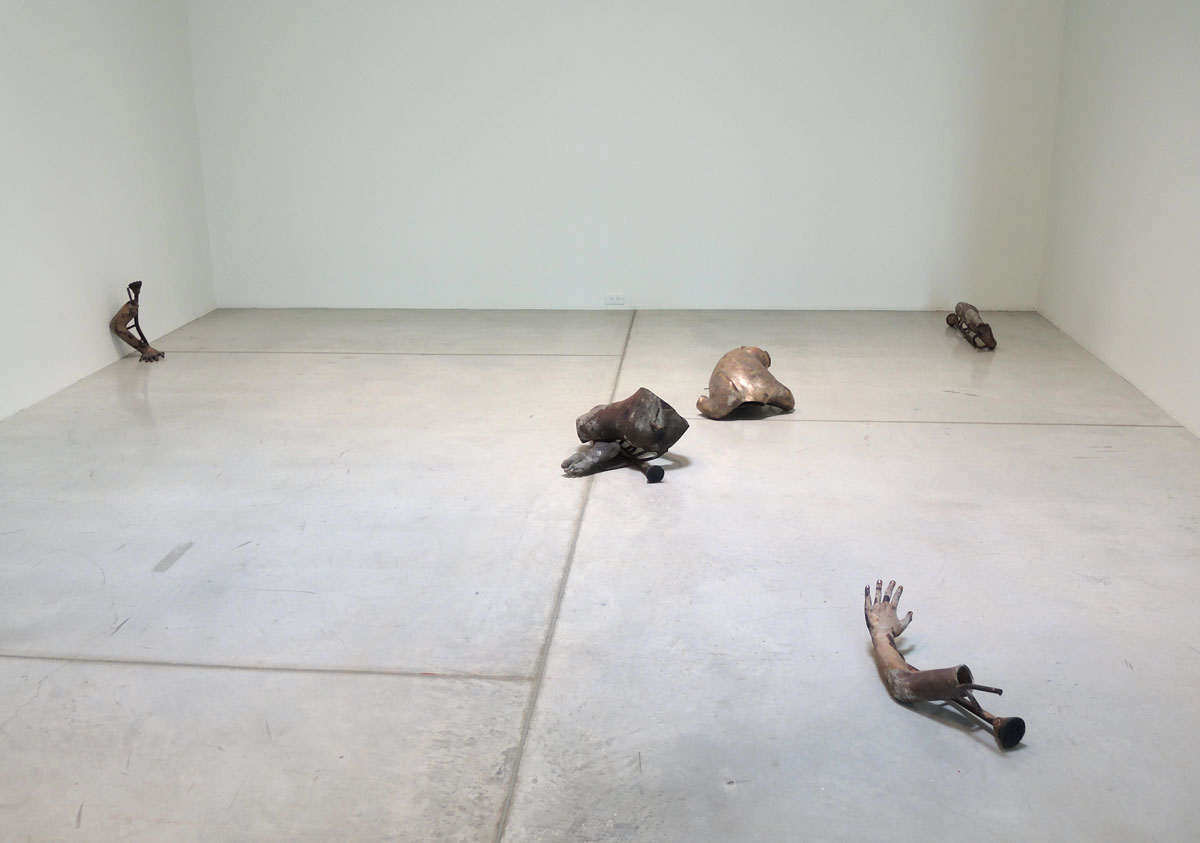
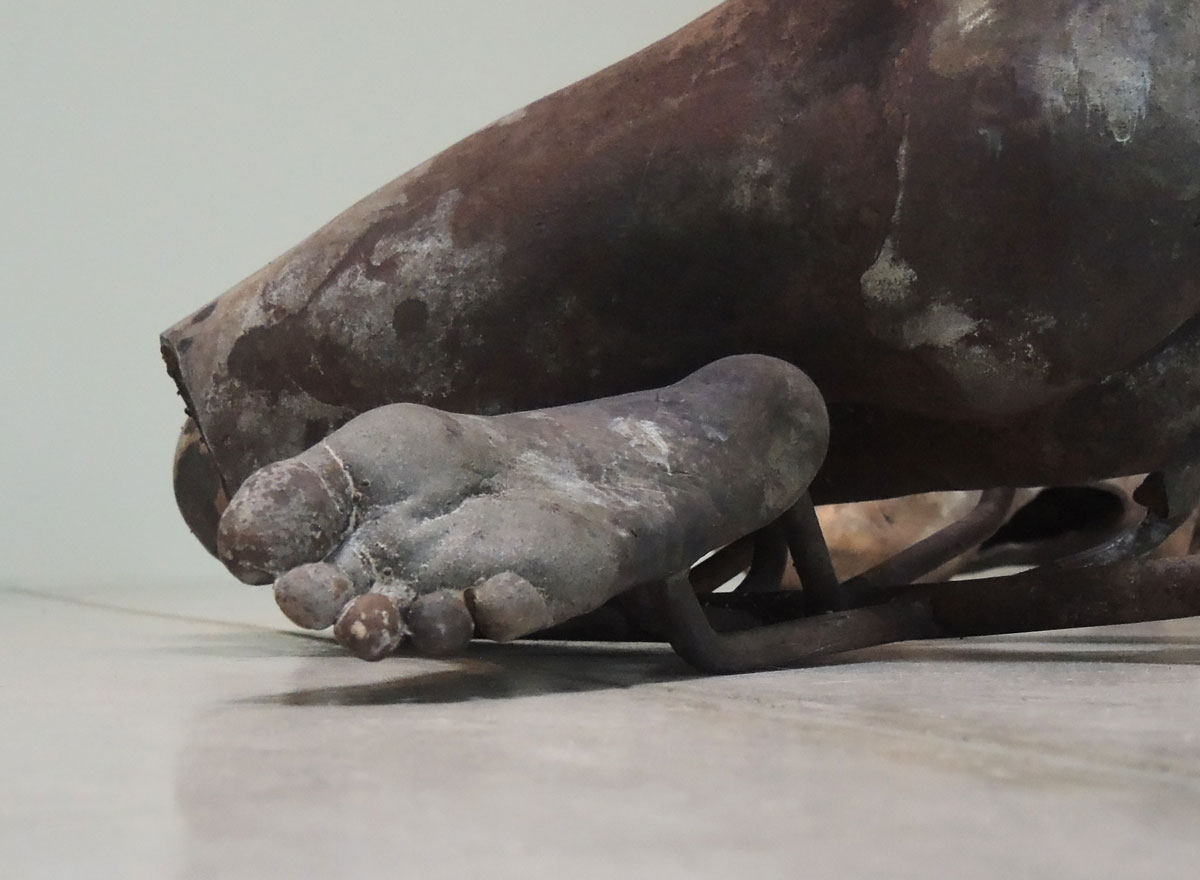
First, ‘Gustav’s Wing’ is an exhibit by Danh Vo, a man born in Vietnam but raised in Denmark.  Using his nephew as a model, Vo had a bronze of cast of the boy’s body made in six pieces.  The pieces are then arranged within a room.  “The resulting installation gives a fragmented and evocative portrait of a boy whose Danish and Vietnamese heritage echoes that of the artist, but who represents the next stage in the family’s story – that of the first-generation Danish citizen”, according to the description of the exhibit.

Looking into a white room, photo taken from the doorway, pieces of metal cast from a boy's body lie on the floor, scattered, part of an art installation at the Art Gallery of Ontario

Close up of a metal cast of a boy's foot. Part of an art installation by Danh Vo at the Art Gallery of Ontario

Three of the metal pieces from Gustave's WIng, an art installation by Danh Vo, pieces of body cast in metal

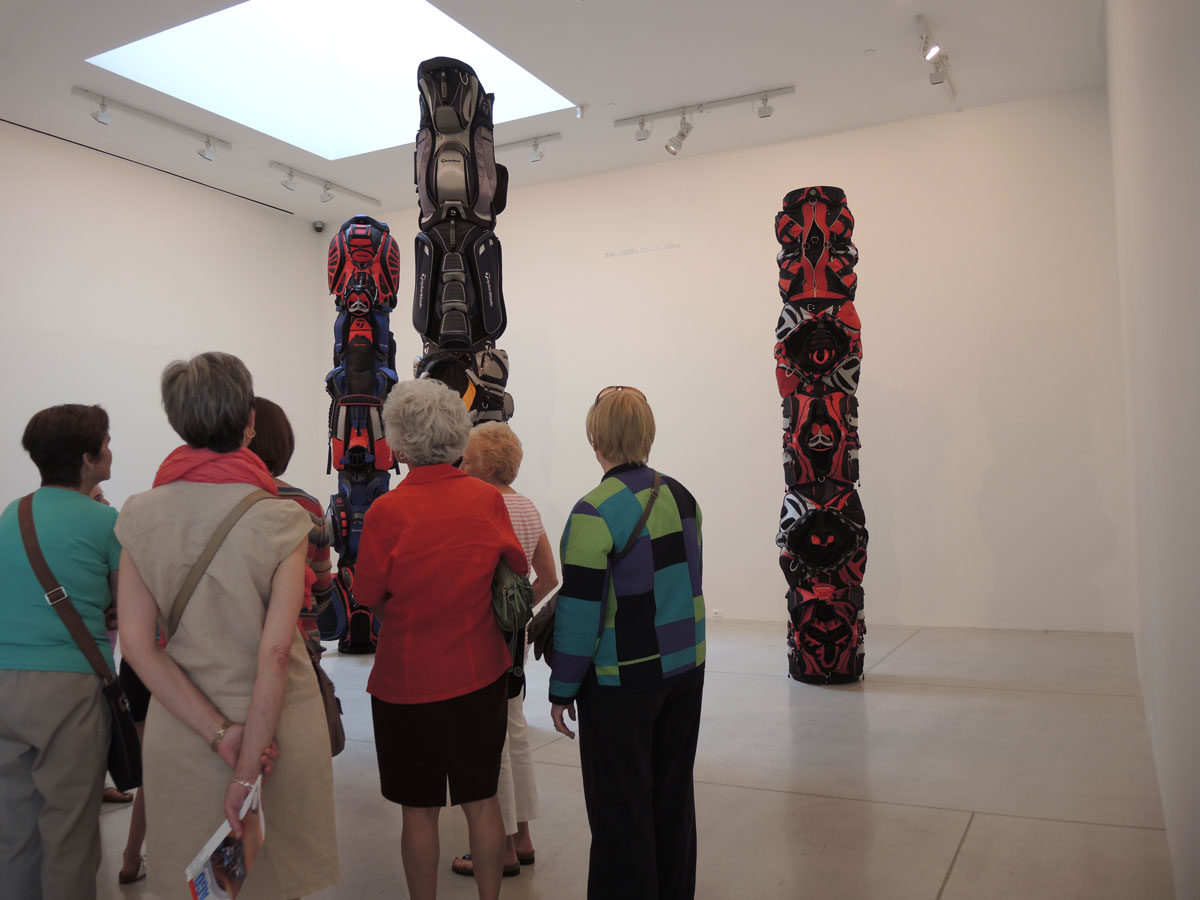
Second, there are three totem poles by Brian Jungen entitled ‘1960’, ‘1970’, and ‘1980’.  All three were made in 2007.  The words in the artist’s statement about this piece say “The towering works recall the complex social and political tensions that can result from First Nations land claims.”  Part of the artist’s reasoning is that golf courses are manicured and their use is quite different from the way land is used by First Nations.


A group of women looks at an art installation of three large totem poles made of golf bags on display in an art gallery (Art Gallery of Ontario)

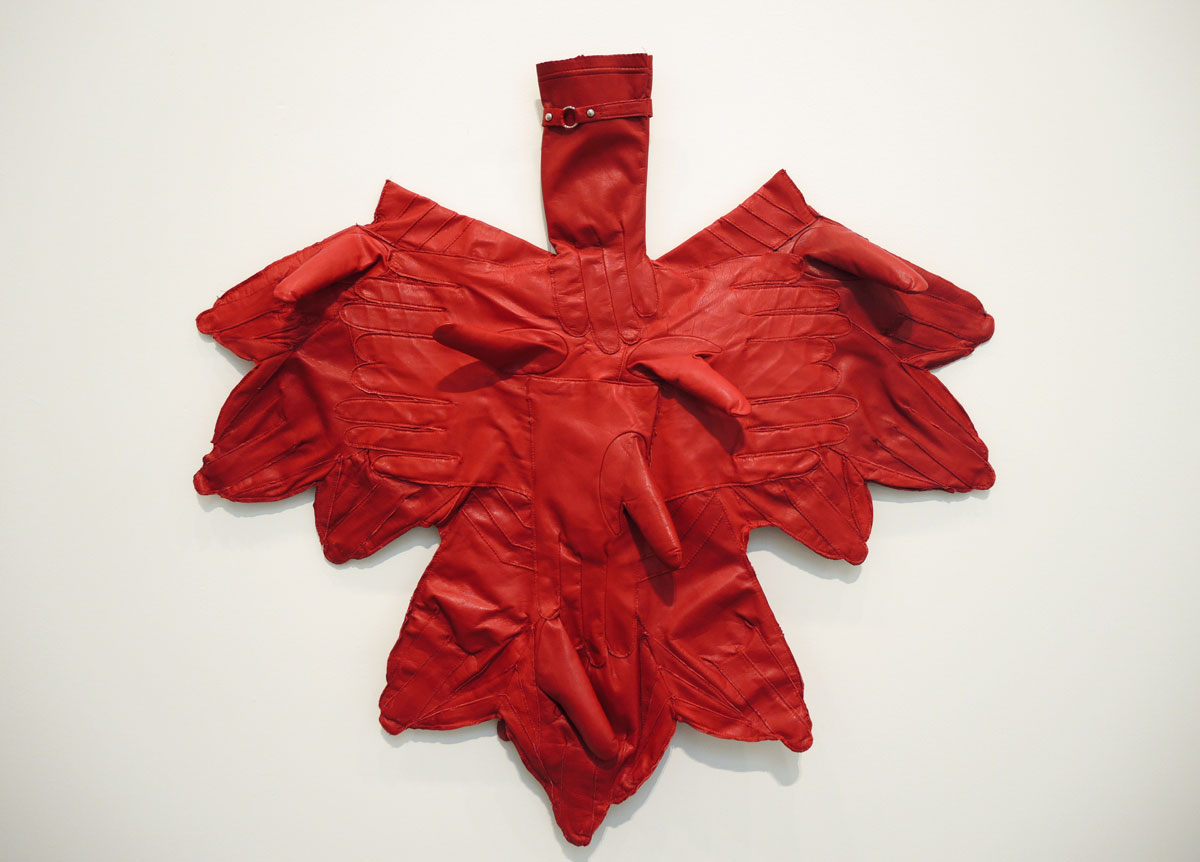
below: Anther piece by Brian Jungen, this one is called ‘Wieland’ and it is made of red women’s leather gloves.  It is supposed to be an upside down maple leaf, i.e. a Canadian symbol turned on its head.  When I first saw it, I saw an eagle with its wings spread but maybe that’s just me.

The words on the wall for this piece: “Its title celebrates Canadian artist Joyce Wieland (1931-1998) whose work in the 1960s and 1970s proposed a gendered patriotism in which indigenous art and culture were given only tokenistic inclusion. With Wieland, Jungen positions himself as part of and against an established narrative of Canadian art history.”

In Wieland’s opinion Canada was female I guess that that is what “gendered patriotism” means.  Otherwise, you will have to figure this one out for yourself.

Upside down rd maple leaf made of women's gloves. It also looks a bit like a large bird with outstretched wings. Part of an art installation at the art gallery of Ontario

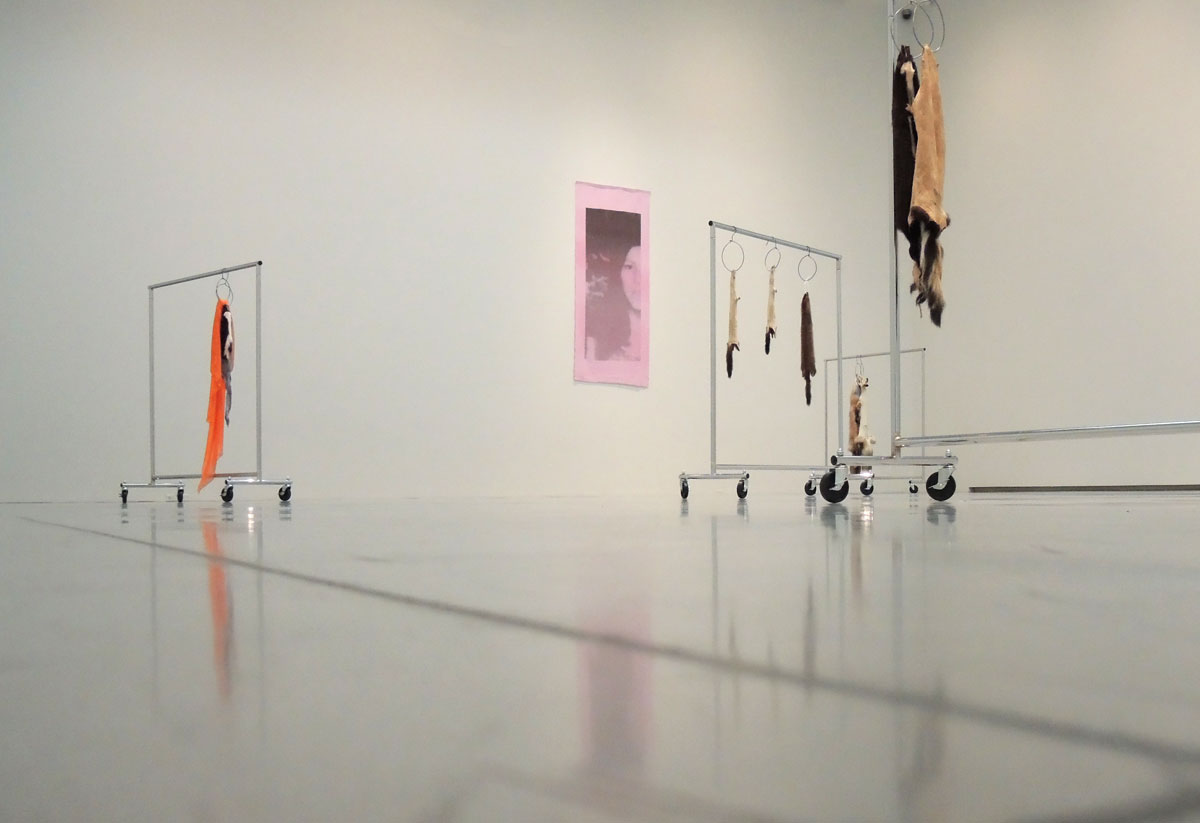
Lastly, there is an installation by Duane Linklater.  Each garment rack is piece and they have names like “My brother-in-law, my sister” and  “The marks left behind”.  Furs of different animals such as fox and skunk hang from the garment racks.  One has an old T-shirt and one has a piece of orange fabric.   “The evocative titles of the pieces speak to family ties, articulating a sense of personal loss” according to the description of the work found on the gallery wall.


A woman is in a large room at the Art Gallery of Ontario, she is looking at an art installation that involves skins of dead animals hanging from garment racks. A pink picture of a woman hangs on the wall.

in an art gallery, an art installation that involves skins of dead animals hanging from garment racks. A pink picture of a woman hangs on the wall.

The two pink pictures on the wall are each a half of a portrait of a woman called Anna Mae Aquash who died in 1976. Together they form ‘Family Photograph’.  Aquash was a Miqmaq woman who was involved as a “radical activist” in the American Indian Movement of the early 1970s.  She was murdered.    If you read the description of the work on the gallery wall, you will read these words: “By including her image, Linklater expresses a sense of familial connection with Aquash and establishes a symbolic relationship with the previous generation while asserting himself in the present. ”   Pardon?

The words on the wall don’t tell you that she was murdered by her own people because they thought she was an FBI informant.  So what relationship is the artist trying to establish?  How does this even remotely lead to “asserting himself in the present”?  Sorry, but empty jargonish words leave me cold. This isn’t art.  Linklater may have a valid idea but that doesn’t make it art.

A group of people in an art gallery, they are looking at an art installation that involves skins of dead animals hanging from garment racks. Two pink picture of women hangs on the wall.


Stephen Andrews POV
an exhibit at the Art Gallery of Ontario

Stephen Andrews is a Toronto artist whose career began in photography and the exhibit now on at the AGO does include a few excellent 8×10 photographs.  The main part of the exhibit though are approximately 20 (mostly large) paintings of his.

A room in an art gallery with white walls and three large paintings on it. A woman is taking a picture of one of them with a camera. The paintings consist of large rectangles
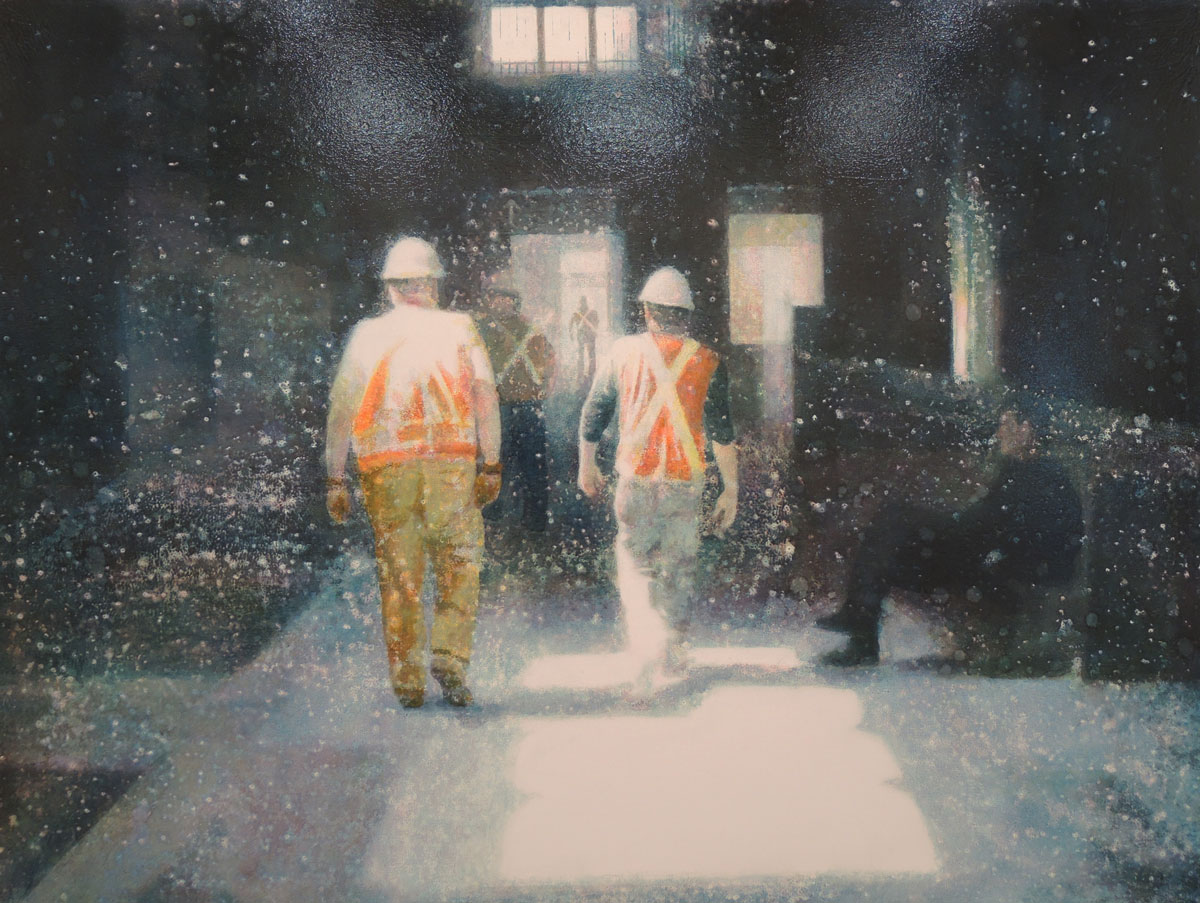
  below: ‘X-men at Union’, 2013, oil on canvas
Construction workers at Union Station, Toronto

rtwork picture of two construction workers wearing orange and yellow safety vests as they walk into a building that is being renovated

below: ‘After Before/After After’ oil on wood panels
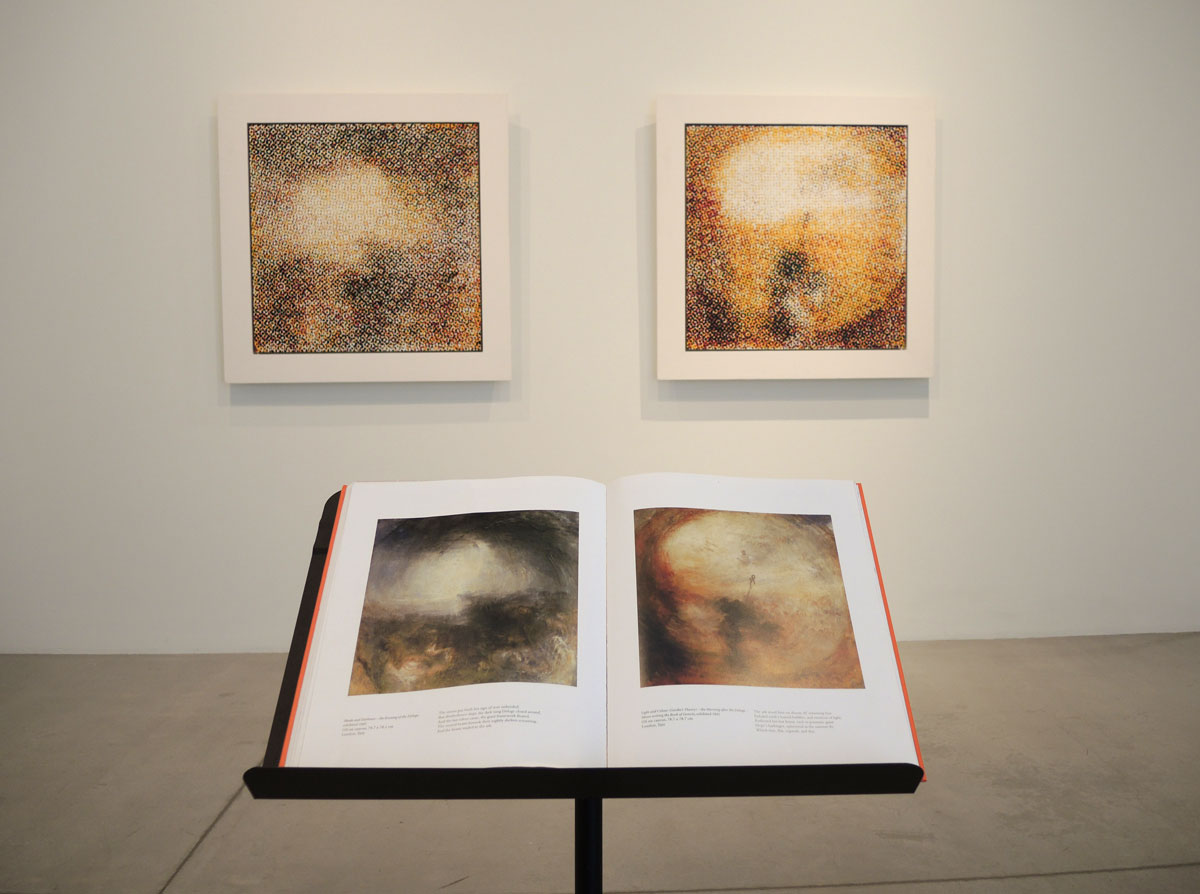
The two paintings on the wall were based on landscapes by J.M.W. Turner that depicted scenes before and after the flood described in the bible (or before and after chaos).  Andrews has painted his with dots in only four colours, yellow, magenta, cyan and black

An open book on a pedestal, a large picture of a painting on each page. Two paintings on a wall directly behind the book. The paintings on the wall are replicas of the ones in the book .

below: detail from ‘Crossing’, 2011, oil on canvas

close up of a painting of a large number of railway crossing signs.

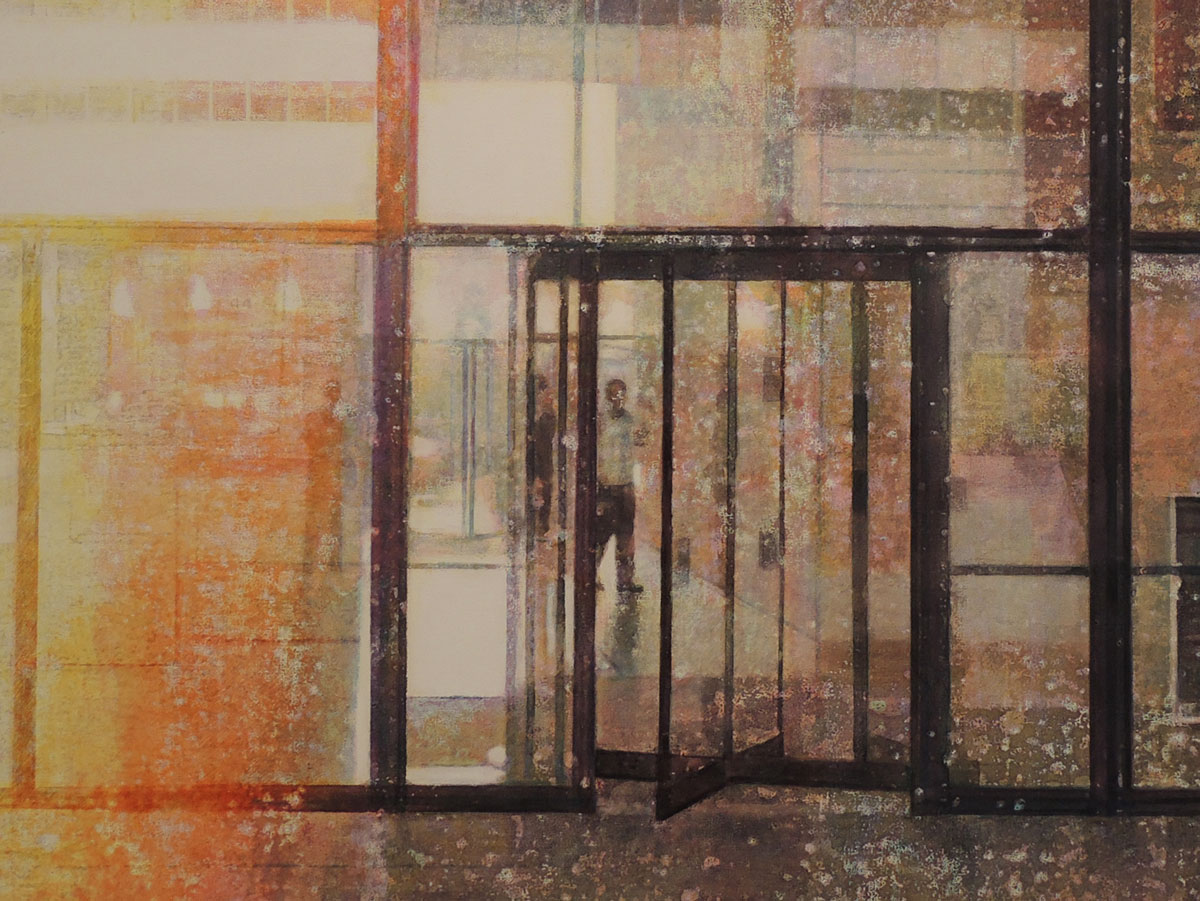
below: close up of part of ‘Entrance/Exit’, 2014, oil on canvas

close up of a slightly abstract painting of a person about to go through a revolving door in a glass wall