


Earlier in May there was a collection of works by Vancouver based Jin-Me Yoon at the Image Centre (Toronto Metropolitan University). She was a 2022 Scotiabank CONTACT Photography award winner.
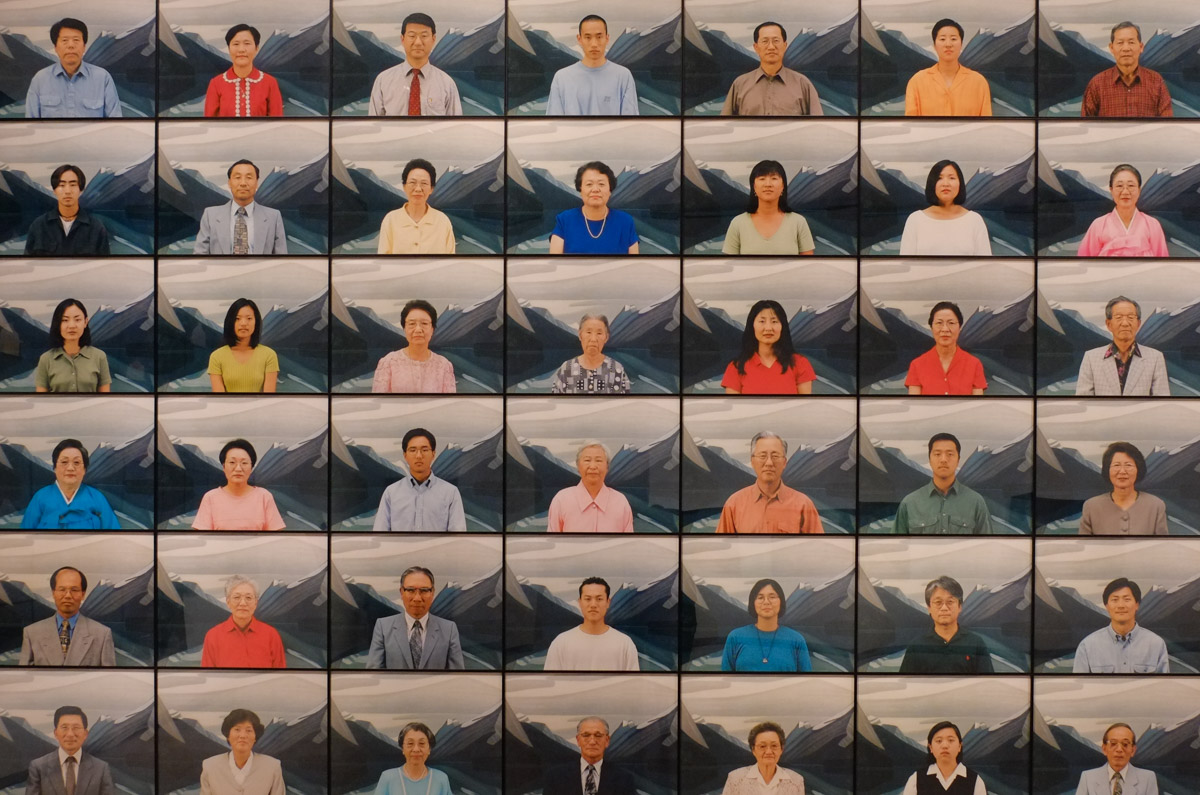
below: Part of the large work, “A Group of Sixty-Seven”, 1996. These are members of the Korean-Canadian community in Vancouver and they are all standing in front of the same painting, “Maligne Lake Jasper Park”, 1924 by Lawren Harris. There is a companion piece that shows the back of each person’s head instead of the face.
Many of the images on display featured people in masks.
below: “Untitled 6 (Long Time So Long)”, 2022, inkjet print.

The words on the all for this exhibit describe the ‘Long Time So Long’ series as “absurd satirical elegy to a broken world”. In each photo, one person is seen in a mask, posing at different sites creating little stories, little dramas just like Korean talchum mask dances and theatre. Masks to facilitate stories; masks as entertainment.

below: Is it the inside or outside of the mask?

At the Art Gallery of Ontario (AGO) at the moment is another set of photos with masks. This time the series is “Acts of Appearance” and the photographer is Gauri Gill (b. 1970, India). Gill had traditional mask makers create a series of masks for her. Instead of the usual religious masks that they make, she asked them to make masks of themselves or of ordinary things in their lives.

Gill’s subjects, as well as the mask makers, were from an indigenous community (Adivasi) in Maharashtra India. They are known for their papier-mâché objects especially the traditional sacred masks that depict deities and are worn during festivals. The main festival is the three day Bohada Festival (usually in May) where people wear masks of 52 different gods and goddesses.


Masks appear in many cultures and feature in many religious activities. The practice goes back many millennia and probably finds its roots in shamanistic activities. Shamanism played an important part in primitive societies as the channeler of spirits for healing, purification, and protection of those under his supervision. Masks helped the shaman embody one of the spirits (or gods/goddesses) and use it to heal the sick, drive away evil influences, and help people through events that might be affected by the spirit world. When hung in a house, the mask served a protective function.
below: One-eyed shaman mask made of wood, on display at the Art Gallery of Ontario.

below: “Raven Steals the Moon”, 2021, by David Ruben Piqtoukun. Art Gallery of Ontario. From the words on the wall beside the artwork: ” In this sculpture the Shaman appears as both human and bird, with pieces of the moon stuck in his beak. Piqtoukun tells the story of a Shaman who was not respected by the people in his community because they did not believe in his powers. In order to prove himself, he tells them that he will steal the moon an bring it back. He asks everyone to cover him with rocks and snow, and uses his powers to steal the moon from the sky.”
He accomplishes this by turning into a raven and flying to the moon. Once there he grows very big and eats the moon, piece by piece, until it is gone. The world goes dark and people can not hunt or fish. [My note: why can’t they hunt and fish during the day?] Shortened version of the ending: people repent and change their ways so raven spits up the moon piece by piece and makes it whole again.

Masks bridge the spiritual and earthly worlds. They also connect religion to art as well as to other aspects of culture. They become part of theatre and drama and allow us to become different people or different creatures. They help us tell stories and both Gill, with her use of masks to alter the ordinary, and Yoon, with her masks that highlight the absurd, are part of that age-old tradition that transcends cultures.

Under the masks are faces. And faces play a large role in how we see ourselves, how we look to others, and often more importantly, how we want to be seen by others. Jin-Me Yoon’s portraits of Korean-Canadians puts very Asian looking people in a static pose in front of a scene created by a very iconic Canadian painter. How do we portray ourselves and our communities especially when we want to move beyond the physical? These are just some of the things that I thought about as I walked through the AGO (having just seen the Yoon exhibit that morning).
below: “Her Blood Spoke in Creole, in Gaelic, in Twi, and in Yoruba”, 2021, Alberta Whittle (b. Bridgetown Barbadoes, 1980).

But art looks more than one way. Like the purple Whittle piece above, we use it to look inward and to express ourselves and our situations. But we also look outward as we explore and document the world around us.
below: Photo by Louie Palu (b. Toronto 1968), “Afghan civilians by a graffiti-ed wall with machine guns and anti-coalition slogans in Pashto (‘Death for America’, ‘Death for London’). Helmand Afghanistan 2008.

What makes us want to look at the images produced by other people?

What makes us want to stop and take a closer look? The average person looks at a painting in a gallery for about 15 to 25 seconds (depending on which study you read). Admit it, you scan through these photos fairly quickly! Maybe you catch a few words; maybe you don’t.


The self portrait – artists have been creating them forever.
below: “Self Portrait with Blue Handkerchief”, 1941, by Alma Duncan (b. Paris Ontario 1917, d. Ottawa 2004).

Of course technology has made it possible for everyone to “take selfies” whenever they want. Whether it’s art or not is an entirely different question! If you could paint (or other medium) a self portrait of yourself how would it differ from a photo? How could you convey something more about yourself? What stories would you want the world to know?

This blog post has veered in a different direction from most and has been a bit weird to write. It’s not often that I get distracted by thoughts and questions. But I hope that you’ve had a chance to think along with me at least for a short time.

And maybe the next time you’re out walking you’ll start thinking about some of the stories that are swirling around us.

I’d like to end this with a quote that is displayed on a wall at the AGO: “All that we are is story. From the moment we are born to the time we continue our spirit journey, we are involved in the creation of the story of our time here. It is what we arrive with. It is all we leave behind. We are not the things we accumulate. We are not the things we deem important. We are story. All of us. What comes to matter then is the creation of the best possible story we can while we are here; you, me, us, together. When we can do that and we take the time to share those stories with each other, we get bigger inside, we see each other, we recognize our kinship – we change the world, one story at a time.” Richard Wagamese (1955-2017) Ojibwe author and journalist.
 as I walk Toronto