Archive for the ‘history’ Category

On the 19th of April, 1904, a large section of downtown Toronto burned for nine hours.

street map of downtown Toronto showing the buildings that were affected by the fire of 1904.

Map showing the area of Toronto affected by the fire of 1904. Bay Street from the Esplanade to Miranda Street (just south of King Street) was the hardest hit.  At the time, this was called the Wholesale District of the city.

.
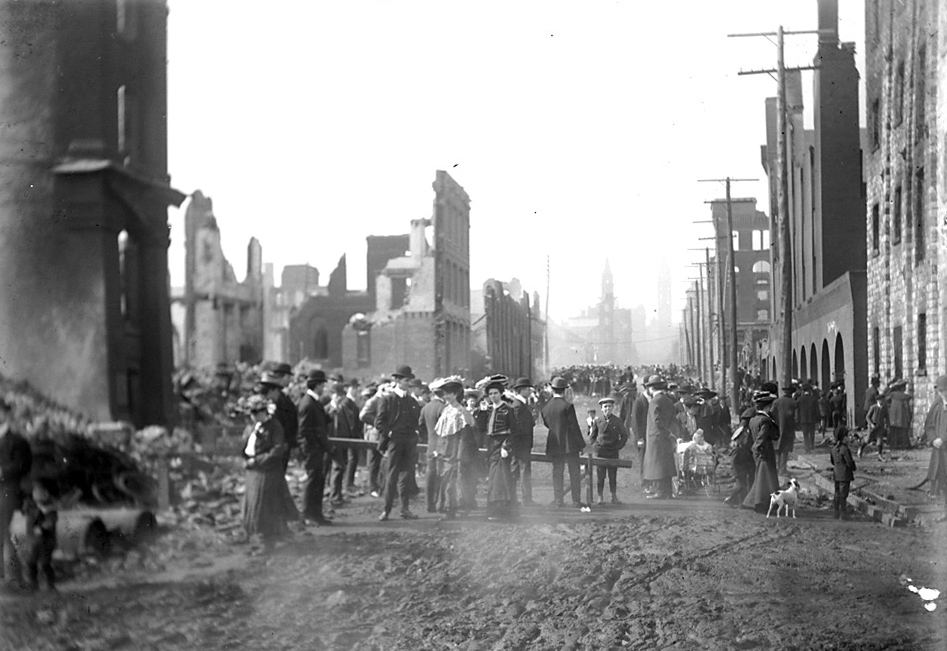
Historical photo of Bay street after the 1904 fire in Toronto.  There are people on the street.  The street is all mud.  There are many burned out buildings on both sides of the streets.  Brick facing of two to four storey buildings is all that remains.

Aftermath, Bay street, April 1904.

In part, because the fire started in the evening, there were no fatalities. As a result of the fire, 5000 people were left without a job.   In 1904, the population of Toronto was about 200,000 so the loss of employment on this scale had an impact on the city.
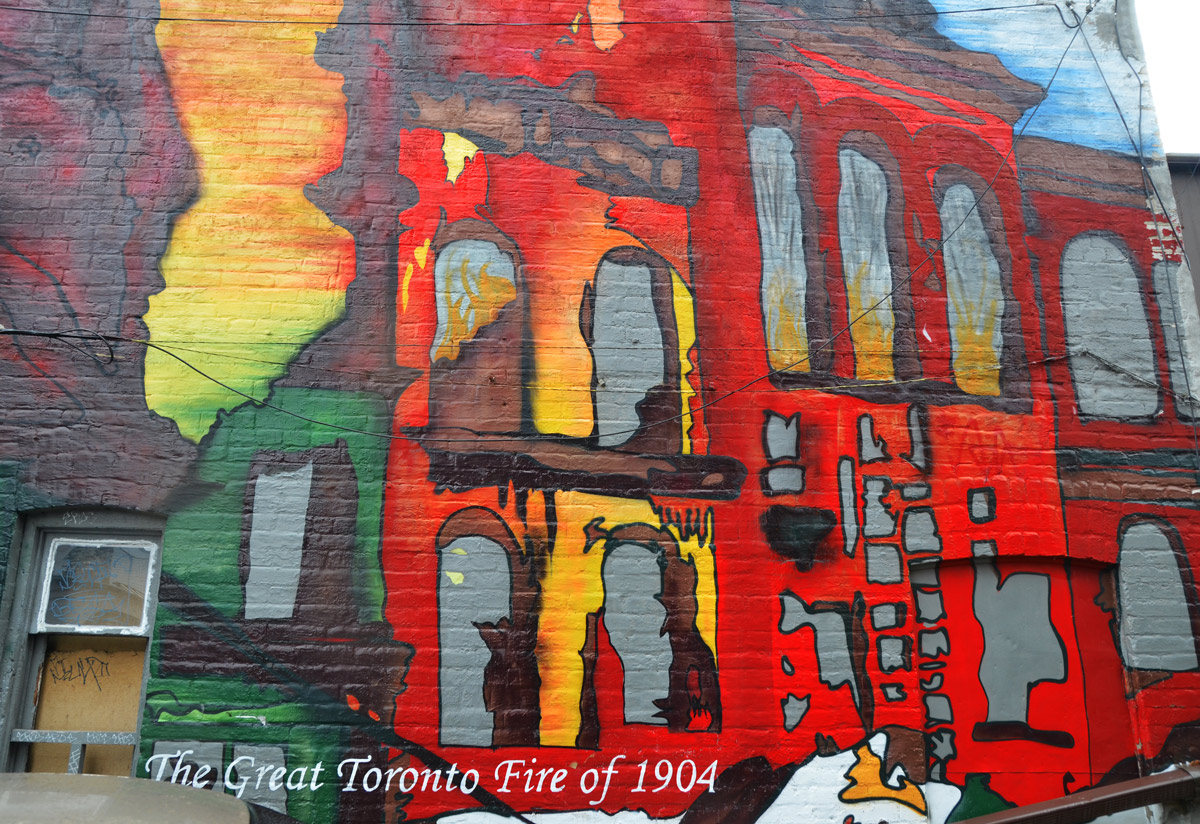
a very bright and colourful mural on the back of a brick building,  It shows, in reds, yellows ans oranges the burning of a couple of brick buildings, with flames coming out of the windows.

Mural painted on the back of the building on the northwest corner of College St. and Croft St.  (398 College St.), commemorating the fire of 1904.

Demolition of the ruins left by the fire took many weeks.  On the 4th of May, John Croft died while using dynomite to bring down the remains of the W.J. Gage building on Front Street.  His was the only known death associated with the fire.  What is now Croft Street was renamed in his honour.

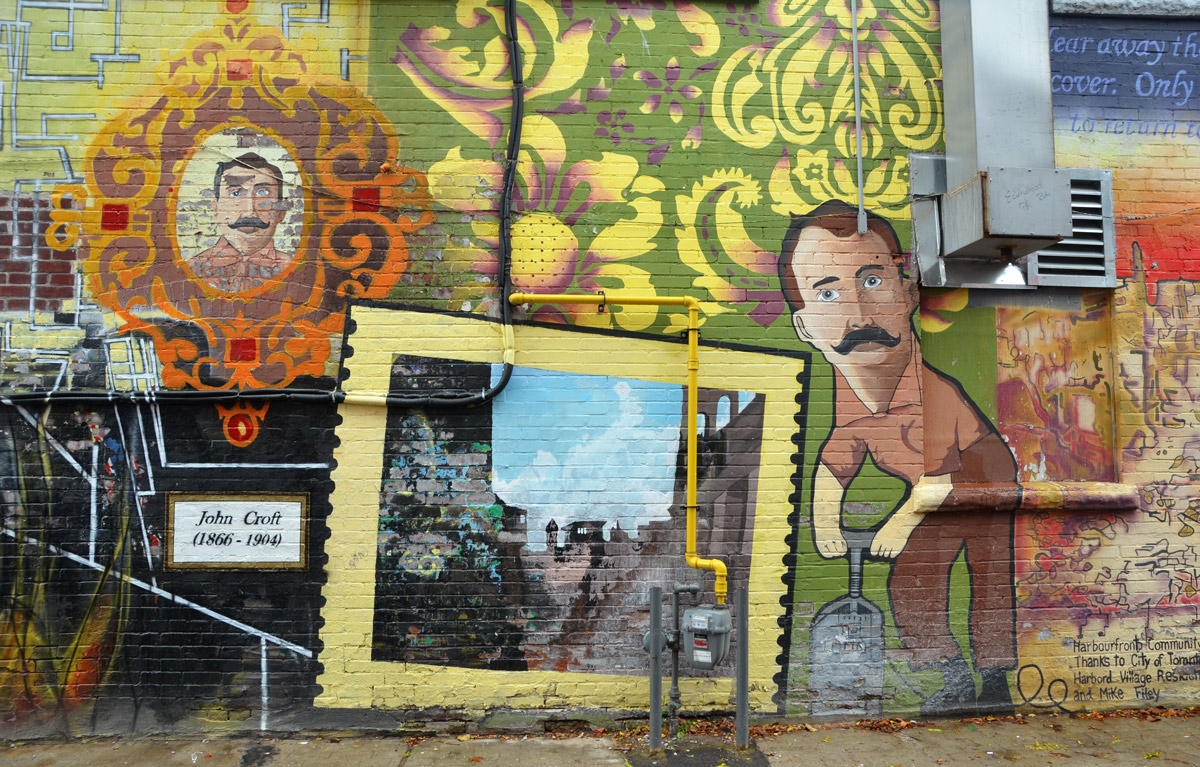
The east side of 398 College St., at the south end of Croft St., is painted with a mural as a memorial to John Croft.
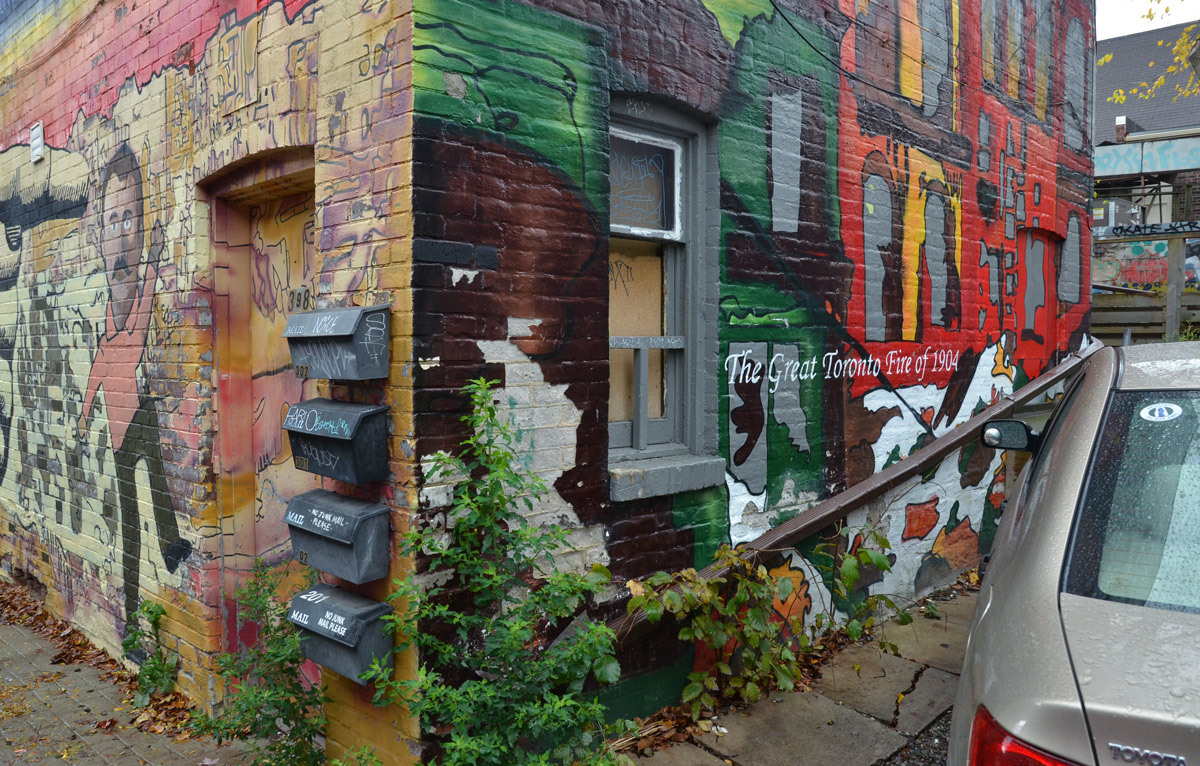
corner of a building showing parts of two murals.  On the back wall is the mural depicting the fire itself.  On the side wall is a memorial to John Croft.

northeast corner of the building

.
1904

blog_croft1

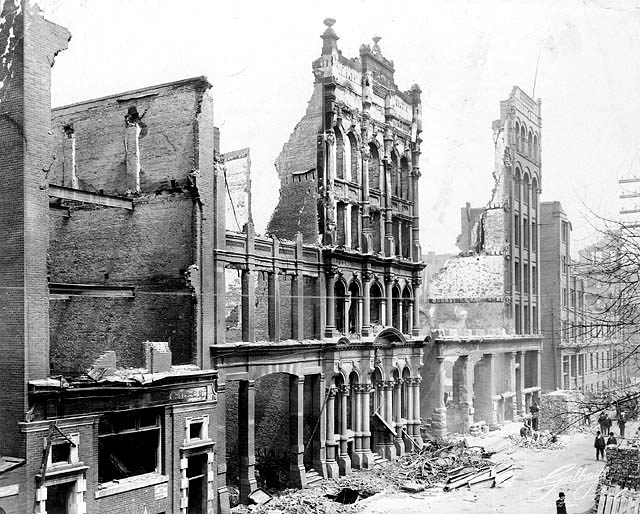
Burned out brick buildings.  All that remains is part of the front facade of these two to six storey buildings.

Burned out buildings, April 1904

The images of the fire’s aftermath are available online.   The originals are kept at the City of Toronto Archives, located on Spadina Road., just north of Dupont Street.

.
St. Andrews  Bendale, Presbyterian church and cemetery, are located in a quiet corner of Scarborough, east of McCowan Avenue and north of Lawrence Avenue.  The property backs onto Thomson Memorial Park which in turn follows the West Highland Creek.

The acre of land for the church was donated by David Thomson and the original wood church was built here in 1818.  It was the first Presbyterian church built in what is now Toronto.   David Thomson had arrived in the area from Scotland in 1796 at which time he was granted 400 acres of land.  David was soon followed by his brothers Andrew Thomson and Archibald Thomson who settled nearby.  The area became known as the Thomson Settlement.

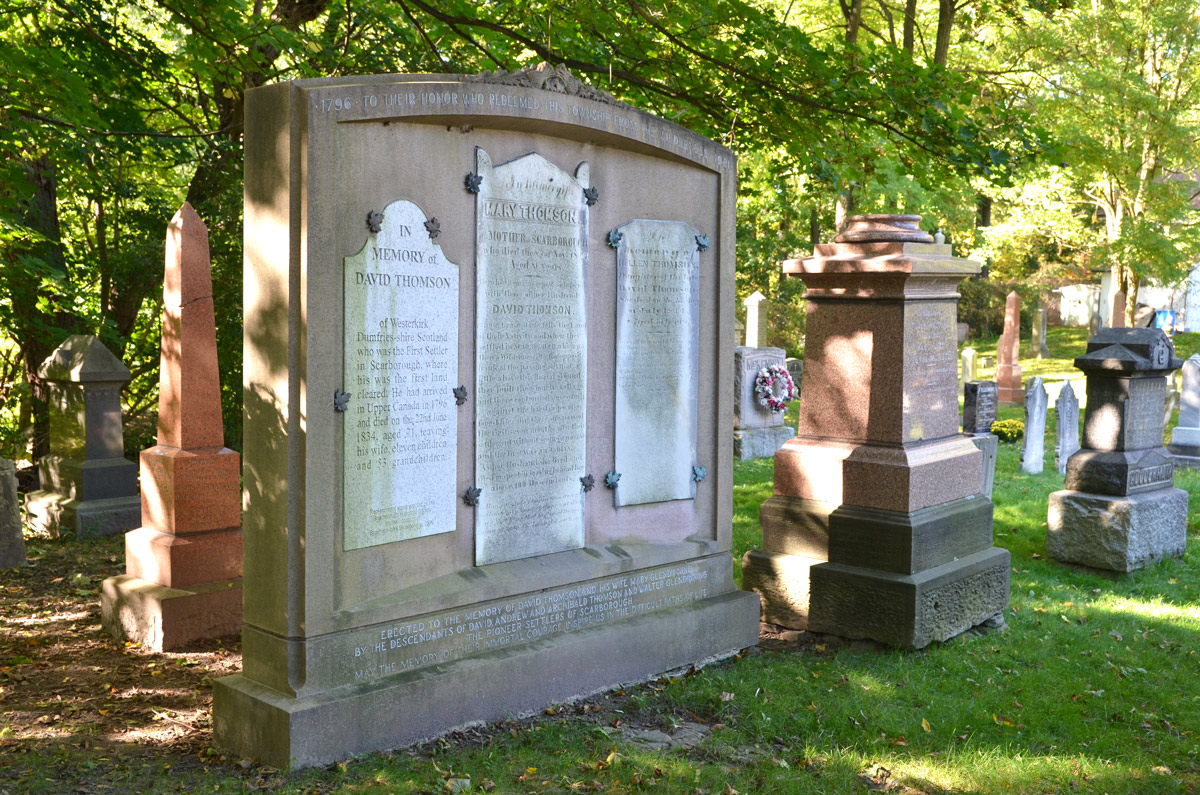
A large memorial in a cemetery.  The memorial consists of three tombstones that have been attached to a large concrete structure that looks like a tombstone

Thomson burial plot.   The inscription across the top reads “1796 – To their honor who redeemed this township from the wilderness – 1921”    
The three plaques (stones) are for David Thomson, Mary Thomson and Hellen Thomson.On the left: “In Memory of David Thomas of Westerkirk Dumfries-shire Scotland who was the First Settler in Scarborough where his was the first land cleared.  He had arrived in Upper Canada in 1796 and died on the 22nd  June 1834, aged ?, leaving his wife, eleven children and 53 grandchildren.”
Center: “In Memory of Mary Thomson, Mother of Scarborough, who died the 8th of Nov 18–? aged 80 years….”
On the right is the stone for Hellen Thomson. It is very worn and is difficult to read.

.

Robert Rae and Agnes Hamilton "natives of Lesmahago Scotland who came to Scarboro in 1832.  Three weeks after their arrival, in his 29th year, he was killed by a falling tree :: his wife survived him 46 years, dying in 1878 - in her (86?)th year."

Robert Rae and his wife Agnes Hamilton
“natives of Lesmahago Scotland who came to Scarboro in 1832. Three weeks after their arrival, in his 29th year, he was killed by a falling tree :: his wife survived him 46 years, dying in 1878 – in her (86?)th year.”To the left of the Rae/Hamilton memorial is a smaller tombstone for Margaret Rae (d. 1860), wife of Amos Thomson.

To the right of the Rae/Hamilton memorial is a tombstone for James McCowan and Margaret Porteous. This couple also came from Lesmahago Lanarkshire Scotland and they too were one of the pioneering families of Scarborough.

There are a large number of other old Scarborough families represented in this cemetery – Gibson, Muir, Young and Stobo to name a few.

A view of St. Andrews Bendale showing a number of tombstones both old and new

four old tombstones in a cemetery

.